Restaurant review: Caper and Cure, Bristol

I don’t know how many restaurant reviewers you read – apart from yours truly, naturally – but the shocking truth is that I don’t really bother with any of them. I’ve no interest, for instance, in reading Giles Coren wanking on in his Corenesque way about another country pub near his house in the Cotswolds, peppering it with his usual contrarian casual racism. If I want to be bored shitless by an edgelord, I’ll just fire up Twitter.

That’s rich coming from me, I know. The irony isn’t lost on me, and if everybody thought the way I do I’d probably have the grand total of about three readers. But there you go: with some of the big names I have a peek to see where they’ve reviewed, and I might scan through to see if they liked it – if it’s somewhere I might one day go – but beyond that I don’t really pay much attention. 

So for instance I know that Grace Dent from the Guardian had a meal in Maidenhead not too long ago that she really enjoyed. As a result I’ve added the venue to my to do list, but I won’t be poring over her deathless prose line by line before I go. Similarly the subject of this week’s review, Caper and Cure, received rave reviews in the Sunday Times and the Financial Times recently. I didn’t read them (because paywall, Rupert Murdoch etc.), but when I happened to be in Bristol for the weekend I made a beeline there to see what the fuss was about.

And yes, that means another Bristol review, which in turn means that some of you will look away now – or, more likely, didn’t click on the link in the first place. But I make no apologies, because for many years now Bristol has had, for my money, the most interesting food scene in the U.K. Cities and towns like Brighton (back in the day) and Margate always strike me as trying to be London-on-Sea, but what I love about Bristol is that it ploughs its own furrow, with no interest in being anything other than itself. 

Places that want to develop a food culture, like Reading, could learn a lot from that: if we got even a fraction of the kind of restaurants in our town centre that Bristol seems to say hello to every month, we’d be a much richer place for it. Besides, it’s just over an hour away by train. 

So Zoë and I turned up on a Saturday lunchtime to check it out. Caper and Cure is in Stokes Croft, a short stroll from Cabot Circus, the city’s main mall, at the point where Bristol starts to get properly lively and interesting. Beyond Caper and Cure, Stokes Croft becomes the Cheltenham Road and then the Gloucester Road, a fascinating indie-land of bars and restaurants, shops selling every kind of beer or wine and charcuterie (and a special prize surely has to go to the splendidly named Bristanbul, a Turkish bakery).

On the walk to the restaurant I saw the parts of this area that have defeated gentrification: the patch of land called Turbo Island still sports a couple of shabby sofas whose best days were decades ago, and the people sitting on them were already a few cans of lager to the good by early afternoon. The last time I was here I had a fantastic brunch at nearby Jamaica Street Stores: it closed last month after five years, partly because of growing issues with Turbo Island.

But Caper and Cure, a handsome blue and gold fronted restaurant on the corner, still felt relatively genteel; Stokes Croft institution Café Kino is next door, and the gorgeous Elemental Collective sells coffee and pastries the other side of the road. The building Caper and Cure is in used to be a chemist, back in the Twenties, and the room retains exceptional bones – generously proportioned floor to ceiling windows letting in tons of light, and a compact, almost-triangular dining room with about twenty covers. 

A fetching button-backed banquette ran along one side – we were seated at the slightly less attractive tables on the other side of the room, but it didn’t feel like there were any truly duff seating choices. There was a small counter at the back, the open kitchen beyond, and along one wall was a map of Europe showing the provenance of some of the ingredients used in the kitchen: a nice touch. Why was Bristol so good at making excellent dining rooms and kitchens out of such modest spaces, and why had none of that genius ever made it down the M4 to us?

For that matter, why were Bristol restaurants so good at putting a menu together which was simultaneously compact but where you wanted to order everything? Four starters, five mains, three desserts, a cheeseboard and a couple of specials. Starters around a tenner, mains fifteen to twenty quid, desserts maxing out at eight pounds. Absurdly streamlined, really, compared to the overkill of so many restaurants, and yet I could have ordered any combination of dishes (I should mention, too, that this being Stokes Croft vegetarians and vegans also had decent, imaginative choices). There’s a real talent to assembling a menu like this, to hitting all the bases and keeping it lean and appealing, and I for one wish more restaurants had it.

But before we made those agonising yet enjoyable decisions, we tried a couple of things from the snacks section of the menu. Cauliflower cheese croquetas were a real piece of wizardry, with spot on crunch and the smoothest, glossiest core, tangy with cheese and the sweetness of cauli. Each of them sat under a little Johnsonian toupée of Parmesan, each was stupendous. A ridiculous five pounds for these, and it took all my strength not to order more. 

But even better was the sourdough with jamon butter. The words “jamon butter” rather sell short what you got, a quenelle of salty, savoury spreadable jamon with a texture somewhere between whipped butter and rillette. It was one of the most moreish things I’ve eaten in years, and if they’d sold it over the counter I’d have walked out of the restaurant at the end of my meal with a tub of the stuff the size of my head, knowing full well that it wouldn’t survive the rest of the weekend. 

The bread that came with it was decent enough, but its one role was to provide a vehicle for eating the jamon butter that was more civilised than just devouring the stuff with your bare hands. If I’m being ultra-critical, one of the slices of bread was as much air as bread and if I’d been in the kitchen I wouldn’t have served it. But it upped the jamon butter to bread ratio, so it wasn’t all bad.  

A high standard had been set, and the starters just vaulted over that as if it was nothing. I’d chosen the sweetbreads, because I love them and they don’t turn up on menus in this country anywhere near often enough. Caper and Cure’s might well be the best I’ve ever had: pert and tender, in a dish where they played the starring role but with excellent support. That meant fresh, nutty peas, translucent slices of radish and some braised baby gem, but more importantly it meant a chicken butter sauce bringing the whole thing together triumphantly. It supplied another intense umami hit, fortified with little nuggets of pancetta just in case you weren’t having enough fun already. 

As we discovered over this and our other dishes, Caper and Cure specialises in those high-gloss, super-reduced sauces that speak of patience and expertise. Having finished my starter I was frustrated to see far too much sauce still in the high-sided bowl, but without prompting one of the wait staff asked if I needed some more bread. I didn’t think twice, and Caper and Cure’s bread with the remnants of my chicken butter sauce was, on its own, tastier than ninety per cent of the starters I’ve eaten in nine years of writing this blog.

Zoë was equally happy with her decision to order the burrata. It’s an ever-present on menus now, but I doubt many restaurants pair it with tomatoes quite as good as these (from the Isle Of Wight, of course). And more importantly I doubt many restaurants plonk the whole thing on their own exemplary tapenade, with the perfume of deep purple olives. I had a forkful of this, and although I couldn’t have not ordered the sweetbreads it also had much to admire.  

By this point I knew beyond doubt that we were in very good hands, and the only remaining question was just how special the rest of the meal might be. Our main courses answered that question emphatically. Hake, one of the two market fish on the blackboard, was cooked just right and perched on top of an absolutely glorious layer of pickled fennel, just sweet enough and just sharp enough: I’ve never had pickled fennel before, and now I’m just counting the days until the next time. 

A tangle of samphire heaped on top added a little saltiness and if the skin wasn’t as crispy as I’d have chosen, that was probably because the whole thing was swimming in a superbly glacé lobster sauce. It wasn’t all perfect, mind you; I’d personally have liked the orzo, the base of the dish, a little closer to al dente and the lobster sauce was more muted than it could have been. But those would have been minor niggles at the best of times: on such a successful plate of food, coming in at a ludicrous twenty-one pounds, they were just the only things I could find that fell short of flawless. It was still one of the most marvellous dishes I’ve eaten all year.

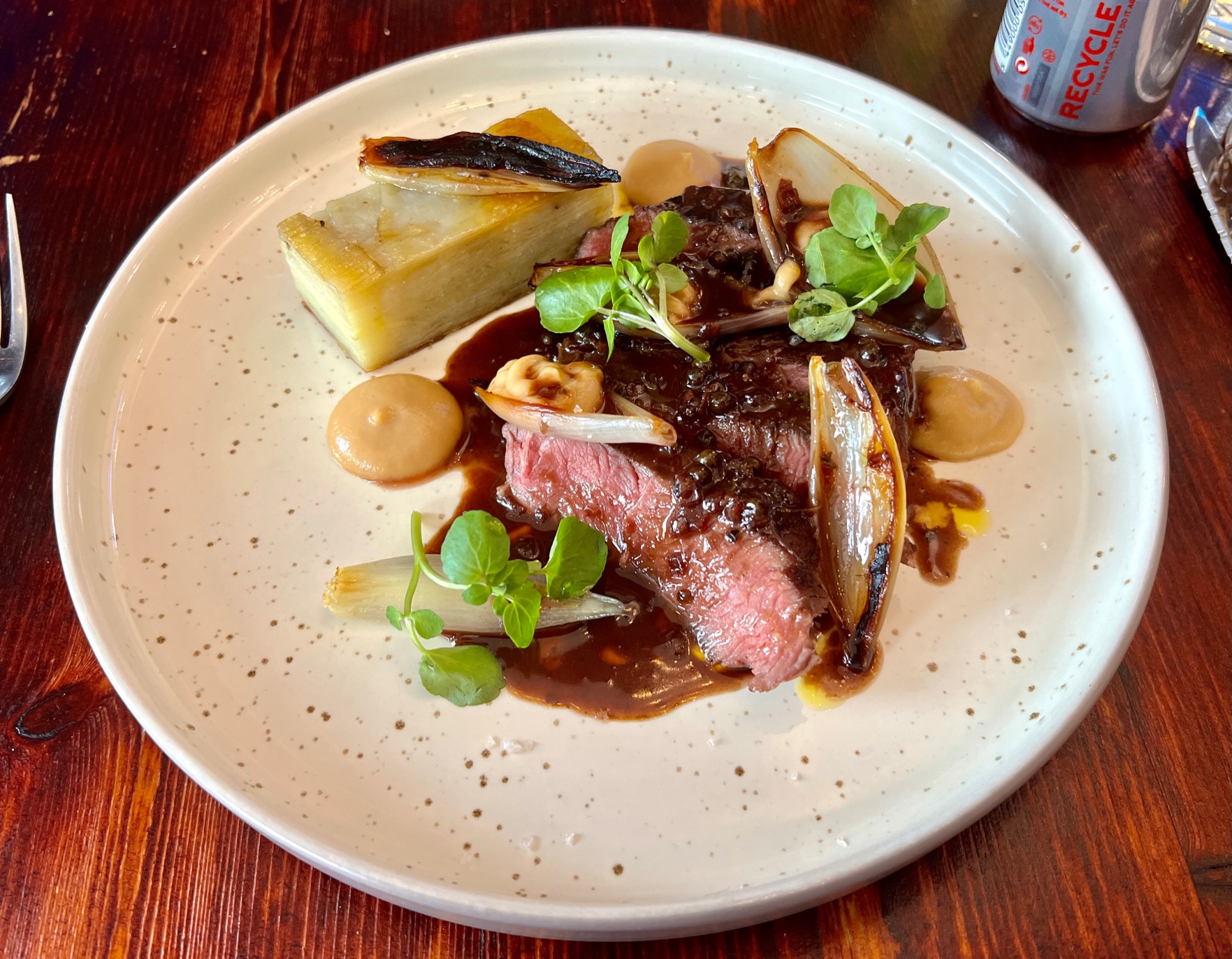
Zoë had absolutely no reservations about her rump of beef, and the couple of forkfuls I had were easily enough evidence to understand why. It was a beautiful piece of meat, cooked medium-pink but with a nice crust, but again it was all about how that ingredient played nicely with the delightful company it was keeping. In this case that meant another sticky, glossy sauce – peppercorn this time – little puddles of onion purée and banana shallots, also with a little char. And to add a little ballast, a perfect slab of Pommes Anna, as enticing and multi-layered as a great novel. This might have been one of the most marvellous dishes I didn’t eat all year, but at least it went to a truly deserving home
We had some Parmesan and truffle fries with our mains – completely unnecessary but also impossible to resist – and they were themselves a fascinating experience. It’s a dish that crops up on menus a lot lately, from Buon Appetito to the Last Crumb and beyond, but in most places it’s a way to tart up bought-in French fries and flog them for a fiver. Here they were the real deal, and when we’d finished our mains and used the fries to clean up the last of our respective sauces we picked at the rest with slightly oily fingers and glad hearts.  

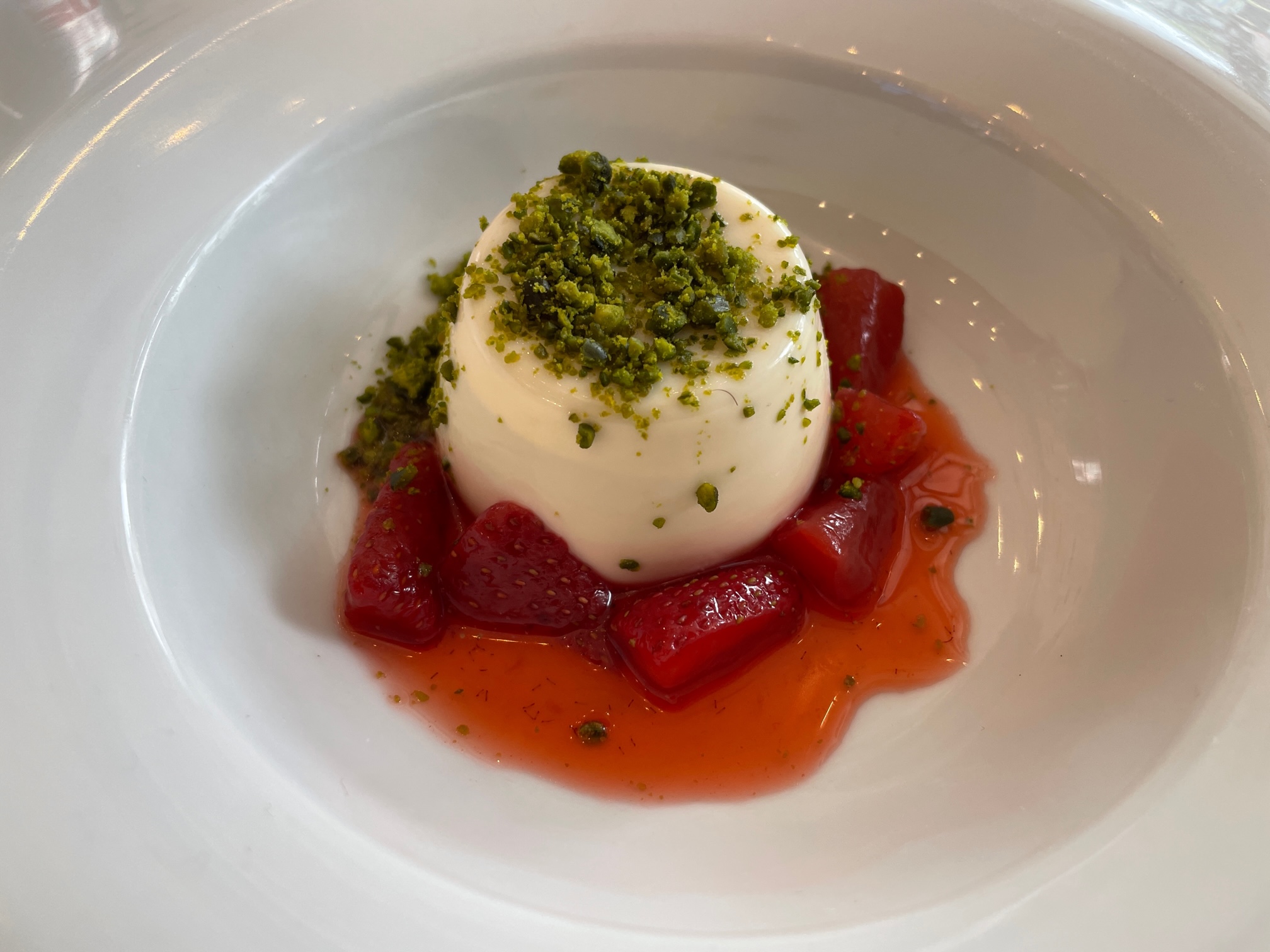
Dessert was the point at which things stopped being spectacular and settled for merely being rather good: technically there are only really two desserts on the menu along with a couple of cheeses and chocolate sorbet with coffee liqueur which felt like a distant cousin of the affogato. I rather liked my panna cotta, which had a pleasing wobble, tons of crumbled pistachio on top and a moat of strawberries and sweet syrup. But the advertised wild honey was the quietest of whispers, and without it the whole thing felt a little run of the mill.
I thought Zoë chose better than me, but she wasn’t wild about her choice either. A rum brûlée was served denuded of a ramekin – how often does that happen? – with plenty of pineapple and coconut sorbet. I liked it, although again the rum was a little muted, and I thought it all worked well together. Zoë was less convinced, and I think on another day would have had the chocolate sorbet. But we were both being restrained, with a boozy evening ahead and (in my case) a gin sodden one behind me, so we steered clear of booze.
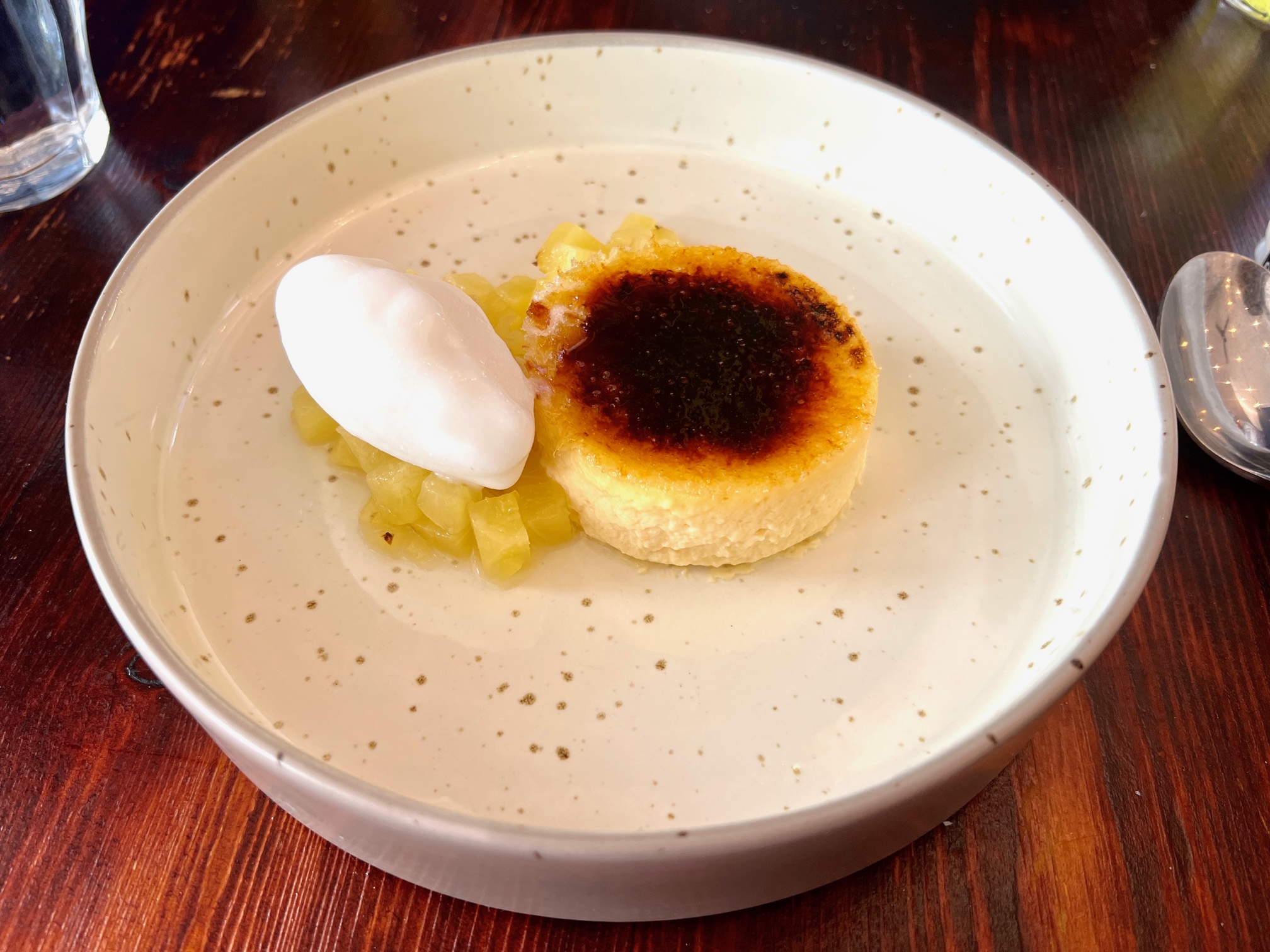
That means I can’t tell you anything about the wine list, which is a matter of some regret for me as it had plenty to appeal – and three special wines available by the glass, including a Georgian orange wine by Tbilvino which sounded well worth trying. But instead I’m afraid we were well behaved – I had a very good alcohol free pale ale by local Bristol Beer Factory and Zoë had soft drinks. Next time I go, which I anticipate will be the next time I visit Bristol, I’ll try it properly.

I haven’t really talked about service, but it was very much of a piece with everything else: smooth, efficient, friendly and good at making everything look easy. Offering me some bread with my starter was a great example, but really the whole thing seemed effortless. Caper and Cure wasn’t as busy as I expected but it had a real mixture of tables and types of diners, with more people coming in for lunch as we were leaving, and the whole thing had a nice flow and rhythm to it. I imagine it would be a truly enchanting place to have a boozy evening meal with friends, and next time I go there that’s exactly what I plan to do.

Our bill came to a hundred and twelve pounds, including a twelve and a half per cent service charge, and when the owner came to take our payment I pointed out that they’d slightly undercharged us. Before we left he asked where we came from, and if he was fazed that people had come all the way from Reading he concealed it well; I looked him up afterwards, and it turns out he’s also a professional actor (“you can just tell” said Zoë as we ambled up the Cheltenham Road in search of caffeination).

This is the second critically acclaimed Bristol restaurant I’ve visited this year, and the contrast with Sonny Stores couldn’t have been more marked. Restaurant critics like to talk about Bristol growing these restaurants – small, unpretentious places with short, magnificent menus and interesting wine lists – as if in a laboratory. And it’s true that the place is a Petri dish for culinary creativity, more than anywhere I know.

But I think it doesn’t do Caper and Cure justice to make it sound like just the latest place to fall off some gastronomic assembly line. There’s something uniquely special about it, and re-reading this review I’m not sure I’ve truly captured it in what I’ve written. It’s worth going to these places, even if they’re an hour and a quarter away by train, to remember what we have to aim for in Reading and that for all the Kungfu Kitchens, the Bakery Houses, the Lyndhursts and the Clay’s we still have some distance to travel.

If a restaurant like Caper & Cure opened in Reading it would be packed to the rafters every night and lauded as far as the eye can see. And yet in all the time I’ve been writing this blog, the best part of a decade, nowhere even slightly like Caper and Cure has opened here. At some point, we might all have to stop and think about why that is. Reading has the money, it has the prosperity and it has a discerning demographic. Why don’t we have the restaurants?

Caper and Cure – 9.2
The Old Chemist, 108a Stokes Croft, Bristol, BS1 3RU
0117 9232858
https://www.caperandcure.co.uk

Restaurant review: Miyazaki, Maidenhead

We were on the train to Maidenhead, Zoë and I, and both of us realised that neither of us had been to the town in the best part of twenty years. Travelled through it on countless occasions, of course, as everyone has. Changed trains there a couple of times to go to Marlow, too – usually for indifferent meals out, come to think of it. But had either of us ever got off a train there, exited through the barriers and explored the place? I didn’t think so, and nor did Zoë.

We were there to visit Maidenhead’s shiniest, newest hospitality venue – not a restaurant, but the second branch of Windsor’s craft beer bar A Hoppy Place. Zoë wanted to write it up for the magazine she edits and having had her plans to attend the grand opening thwarted by the train strike, she was keen to pay it a visit as soon as humanly possible. 

But where to eat beforehand? Maidenhead looked to be the town that restaurants forgot. A rummage through Tripadvisor – don’t judge, there was virtually nowhere else to look – suggested that most of Maidenhead’s restaurants were actually in the town’s affluent satellite villages. But then I guess if you lived near Bray or Cookham Dean, would you really go into Maidenhead of a night out? The town centre boasted a Kokoro and a Coppa Club, but I couldn’t say I fancied either of those known quantities.

And then I remembered my physio, who lives in Maidenhead, recommending Miyazaki to me. It’s a little restaurant at the unfashionable end of town which has been serving up Japanese food to the people of Maidenhead for something like seven years. No fuss, no drama, just uniformly good reviews on Tripadvisor and Google, all of which gave the vague impression that Miyazaki’s fans were quite comfortable with it remaining a well-kept secret. I phoned up on a Friday evening and was pleasantly surprised to find that they could fit in a booking for the following night.

It wasn’t the loveliest of walks from the station, and I sense that there’s an awful lot of development under way in Maidenhead. Miyazaki was on a little run of shops and restaurants, rubbing shoulders with pizza and kebab takeaways, just past the purgatorial horrors of “The Honey Pot” (remember when Reading had one of those?) and the thumping music of an O’Neill’s already in full swing. “There’s a reason why they always have an O’Neill’s near the train station”, said Zoë sagely. 

Once we reached Miyazaki, though, it stood out like the opposite of a sore thumb. Nestled between joints called Sizzlers and Tennessee Fried Chicken, a building site on the other side of the road, it looked completely out of place. No garish shop front, no big red letters and brightly-lit laminated pictures of the food on display like its neighbours, just a simple space. 

Inside, the neutral, unfussy tables couldn’t have seated more than twenty people at a push, and the long thin room was beautifully lit, the light from the summer evening pouring in through the curved, graceful floor to ceiling window. Tasteful prints and drawings were dotted on the plain white walls. Just two other tables were occupied when we got there at quarter to eight – which saddened me a little. But it was a very hot evening, and the restaurant was doing a roaring trade in takeaways, neatly packaged and on the table by the bar, waiting for delivery drivers to pull up outside and take care of them.

Miyazaki’s menu was the kind that reassured you instantly. Some people, spoiled by the compendious likes of Sushimania or Yo! Sushi, would have found it restrictive but I liked the fact that it did what it did, and didn’t try to offer everything. Just three types of sashimi, a few more nigiri and just over a dozen sushi rolls in two different sizes. There was also a selection of side dishes, along with a very small selection of what you might call mains – three curries, two different noodle dishes and a range of udon soup noodles. 

And even with such a restrained selection I saw dishes I’d never heard of or tried. Yasai kakiage, a sort of vegetable tempura fritter. Sunomono, a crunchy, vinegary cucumber salad. Chicken nanban, a deranged-but-inspired-sounding dish of fried chicken in a tangy coating, served with, of all things, tartar sauce. If I have one regret about this meal, it’s that I can’t tell you what those three taste like: I’ll know after next time.

Instead we stayed on safer ground, but we were richly rewarded all the same. Salmon sashimi was as perfect an example as I can remember – rich, smooth, glossy diamonds of perfect pink, just needing a dab of soy to perfect them. We liked it so much we ordered another portion. Mackerel sashimi was a little less successful: the skin looked like it had been torched, and the slight tinge of vinegar suggested it was cured rather than raw. I liked it more than Zoë did, which might have been a factor in us ordering more salmon.

Sushi rolls kept up a high standard. With a relatively compact menu a lot of these were variations on a theme, but even so I enjoyed everything I had. The small avocado maki were the kind of dish I could gladly eat every day for the rest of my life, and the avocado was splendidly buttery – ripe but not overripe, no hint of those telltale brown edges that always fill me with sadness. 

Larger spicy tuna rolls with a little dab of fiery red sauce inside had a surprising kick, as did the pale ribbons of ginger on the plate – it’s always encouraging to see this more natural colour, rather than the standard-issue hyper-real pink ginger you so often get. And assembly was pretty good: there were a few ragged bits of nori here and there but generally they were put together deftly, and just the right size that you could eat them in one glorious go.

All the larger sushi rolls hovered around the eight pound mark, which struck me as very good value. Another set with both avocado and salmon were probably my favourite, and so much more than the sum of their parts, speckled on the outside with black and white sesame. I’m always reminded, when I eat food like this, how nice it can be to eat something almost-virtuous, so pure-looking. That feeling always dissipates by the time the next portion of fried chicken comes along but it’s nice to experience it all the same, however fleeting. 

It helped, I’m sure, that the setting was so pared-back and ascetic, but also it’s so rare – for me at least – to find really healthy food that I actually like. By this point it was nearly quarter past eight and we were the only customers left in the restaurant, and I would have felt guilty about keeping the staff if it wasn’t for the still-steady stream of takeaway dishes coming out of the kitchen. Their work was far from over, so Zoë drank a second bottle of Sapporo, I had some sweet, fresh plum wine in a glass tinkling with ice and we ordered one last wave of dishes.

Doing so proved, if nothing else, that the period between fried chicken dishes – in my life, at least – is never that long. Karaage chicken is a staple order of mine, in Japanese restaurants and anywhere else I can find it on a menu, but Miyazaki’s was one of the best I’ve had anywhere. Normally it comes plain with some mayo on the side (and I’m absolutely fine with that) but this had been tossed in a tangy red sauce which took it somewhere even better. All soft thigh meat, crunchy coating and gnarled edges with a little spike of heat, it was up there with the nicest things I’ve eaten this year. Chicken gyoza felt a little more boilerplate, but even boilerplate chicken gyoza are still better than the majority of things you can pop into your mouth. 

It’s a shame that I saved the worst til last, but our final two noodle dishes suggested that the kitchen’s strengths lay elsewhere. You can have soba or udon noodles with chicken katsu, fried prawns or vegetable korroke, but either way the underlying dish didn’t quite come together. My soba noodles – a neatly petite portion – were nice enough I suppose, but the sauce they had been lightly stir fried in had a slightly off-putting sweetness when I was hoping for more savoury depth. And my three breaded prawns, tasty though they were, didn’t feel like they really went; I resorted to eating those with my fingers and then ploughing through the noodles, but it didn’t feel like a cohesive dish, or a hugely enjoyable one. 

I think Zoë picked better with the katsu chicken, which was nicely done, but other than the gauge of her noodles her dish was subject to much the same problems. These two dishes are only available at dinner time, but to be honest when I go back I’ll probably just order more sushi, because that felt like where Miyazaki truly excelled. Or I might just leap into the unknown reaches of the menu, and see whether Japanese fried chicken with tartar sauce is as chaotic and magnificent on the plate as it is in my imagination. Either way, I also plan to sample their extensive and impressive selection of sake.

I know it’s a little perverse of me to review a restaurant in Maidenhead this week, because Reading has had two Japanese restaurants open in quick succession: Intoku, where the Tasting House used to be, at the end of May and Iro Sushi, replacing Raayo on Friar Street, at the beginning of July (a third, You Me Sushi, opened a few doors down from Iro yesterday). But I thought Miyazaki was worth exploring, because restaurants that have been doing their stuff for years with no fuss are often overlooked in favour of shiny new places. Or, possibly, bandwagon-jumpers. 

And it was right that I did, because Miyazaki is quietly splendid and well worth celebrating. I’m not inclined to let those final two dishes detract from what was a truly wonderful meal a twelve minute train ride from Reading in surroundings that really couldn’t be more incongruous. Service was flawless, the room has a sort of touching humility which I liked very much and if our meal wasn’t cheap – it came to just over ninety pounds for all that food and a couple of drinks each, not including tip – it was worth every penny. 

And if you need somewhere to go in Maidenhead for a post-dinner drink, I can thoroughly recommend A Hoppy Place which has excellent outside seating and had two phenomenal imperial stouts on keg when I visited, both of which I enjoyed a great deal. You could go to O’Neill’s instead of course, but you don’t need to leave Reading for that, although you would need to take leave of your senses. I will get to the likes of Intoku and Iro in due course, but the standard they have to reach has already been laid down, in a little sanctuary a matter of minutes away on the Elizabeth Line. And if they turn out to be disappointing, I know exactly where I’ll go to get over it.

Miyazaki – 8.1
63 Queen Street, Maidenhead, SL6 1LT
01628 785377

http://www.miyazaki.co.uk

Restaurant review: Bánh Mì QB

I was having a chat with my friend Reggie the other day, and I told him that my upcoming review was of Bánh Mì QB, the new Vietnamese restaurant on the ground floor of what used to be called Kings Walk. I’d been there earlier in the week, I told him, and I just needed to write it up.

“You know what the problem with that place is, don’t you?” he said.

“The landlord, I know.” The whole of that space, Atlantis Village or whatever it’s called this week, is owned by Sykes Capital, the company founded by noted philanthropist John Sykes. I should apologise at this point: if you had an Edible Reading bingo card, or were playing an Edible Reading drinking game – even at half eleven on a Friday morning – you’d fully expect me to name drop Sykes, Reading’s answer to It’s A Wonderful Life’s Henry F Potter, nice and early in the proceedings. I know I’ve probably lived down to your expectations: I’ll try not to mention him again.

Subscribe to continue reading

Become a paid subscriber to get access to the rest of this post and other exclusive content.

Restaurant review: Shree Krishna Vada Pav

When it comes to food and drink, Reading is an especially interesting place. You may find this hard to believe at times, but it’s true.

I don’t mean all the stuff that’s obvious to you, especially if you’re a regular reader of this blog. I don’t mean our coffee culture, or our street food scene that’s the envy of towns for miles around. I don’t mean our two local breweries with taprooms, or excellent pubs like the Nag’s and the Castle Tap selling fantastic craft beer and cider. I don’t mean the jewels in our restaurant crown – places like Clay’s, the Lyndhurst, Kungfu Kitchen or Vegivores. I’m not even talking about our network of local producers and the independent shops, like Geo Café and the Grumpy Goat, which sell their stuff. You know all that already, although I suspect a lot of people who live here still don’t. 

No, I mean interesting in terms of the world outside our food-loving, indie-supporting echo chamber. Because a lot of businesses have clocked that Reading – with its university, its prosperous populace and its tech employers, just the right distance from London – is the perfect place for them to open another branch of their restaurant chain and make pots of cash. They have us down, mistakenly I like to think, as something of an Everytown, the perfect testbed for their particular flavour of the hospitality experience.

In fact, two very different types of businesses have Reading in their sights. The first, tapping into that affluent, well-educated demographic, are smaller, more targeted chains. They’ve often seen Reading as their first attempts to expand west (Honest, Pho) or east (The Coconut Tree), or just picked it as one of the first stops on a journey to nationwide ubiquity (Itsu). And this still continues, albeit to a lesser extent: we’re getting a Leon and a Wasabi this year, don’t forget.

But the second type is more interested in Reading as Everytown, and often we are the lucky Petri dish they squirt their pipette into before deciding whether to open branches elsewhere. And this is, I’m afraid, often an American thing. It’s no coincidence that Reading got one of the first Five Guys, got a Chick-Fil-A, albeit briefly, got a Taco Bell and a Wingstop and a Wendy’s and has a Popeyes on the way. Such is life: newly added to the Tube map, but somehow equidistant between London and the good ol’ United States. 

These big American chains with plenty of money are aided and abetted in their mission to slightly worsen Reading by our local media – which posted dozens of stories about Wendy’s, mainly because they were too dumb to think critically for even a split second about whether Reading getting the first Wendy’s in the U.K. was actually a Good Thing. But it also points to just how much is going on in Reading, and how interesting the battle will be between all these factions fighting it out for your money. No wonder Jonathan Nunn, the editor of Vittles, called our town a “fascinating anomaly”.

“Why is this the subject of your interminable preamble this week?”, I hear you say. I thought you’d never ask. The reason I talk about all of this is that the subject of this week’s review is that rare thing, a chain choosing to plonk a branch near the centre of town that people can get genuinely excited about. Because Shree Krishna Vada Pav, a small chain selling vegetarian Maharashtrian street food which started out in Hounslow and only has three branches outside the M25, comes here with an excellent reputation.

Subscribe to continue reading

Become a paid subscriber to get access to the rest of this post and other exclusive content.

Restaurant review: Marmo, Bristol

What’s your favourite restaurant? Your absolute favourite, I mean. I ask because a couple of weeks ago I was sitting in my friends James and Liz’s back garden in Bristol, drinking white wine on a sunny afternoon and having exactly that conversation. The wedding we’d been to the day before – on a Wednesday, no less – was that miraculous thing, a wedding where you’re not hung over the morning after, and so the day stretched out in front of us, feeling partly like a Sunday, partly like something else.

James refused to take part: he didn’t believe in picking a single favourite. So we talked instead about possibly allowing everyone to choose three. But if anything, that made it more difficult, because then you had to pick at least one from your home town and then you were forced to choose just the two restaurants from everywhere else you have ever been. 

Liz said that you couldn’t pick somewhere you’d only been the once, but that didn’t help either. Zoë started waxing lyrical about Eetkaffee De Lieve, a little gem in the sidestreets of Ghent, and I daydreamed about sitting outside at Uvedoble in Malaga, demolishing a little brioche stuffed with suckling pig. But which restaurant in Bologna to pick? And how could you leave out Paris? It was just too much of a puzzler.

“I think my favourite restaurant right now is Marmo” said Liz – with a hint of trepidation, because we had a table booked there that evening. And I understood that nervousness better than most, because there’s little as nerve-wracking as telling people that somewhere is good, knowing they’ve gone there because of you and then sitting there waiting to find out whether they’ve lost all faith in your good opinion. I get that all the time.

We went to Marmo with Liz and James’ friends Ed and Ben, a very entertaining couple they’d been telling me about for some time. It was clear straight away, as we took our seats at a Belgian beer bar in the old city, that they liked the finer things in life, which always makes me feel like I’ve found my tribe but also brings out the imposter syndrome.

On our walk to the restaurant Ed and Ben asked me which restaurants I liked in Bristol, and I couldn’t help but feel that this was a test. I didn’t go to Bristol often enough to be on top of the latest developments, but then I mentioned my love of the sadly departed Wallfish, a little neighbourhood restaurant a stone’s throw from Clifton Suspension Bridge, and there was a tacit nod that indicated that I might have just about scraped a pass.

Marmo is a single, buzzy room – all handsome white wood panelling and framed prints on the walls that you daydream about nicking (I also would have loved one of the branded wineglasses, come to think of it). There’s a tiny kitchen at the back, clearly in view, where all the magic happens. Our table was in the heart of things, close to the bar, and I tried to remember what this place had looked like in its previous incarnation as Bar Buvette, a wine bar I’d loved that made you feel like you were somewhere in the eleventh arrondisement.

The menu made you want to order everything, and was compact enough that we nearly did. There were a few snacks and then a 3-4-2 formation of starters, mains and desserts respectively, with one fish dish and one vegetarian dish on offer for each course. The menu looked carb light, but the waiting staff explained that you could have an intermediate pasta course to fix that, as the Italians do, or just have some bread. Starters were around nine pounds, the most expensive main was eighteen pounds fifty. The wine list – of which Marmo seems particularly proud – had a superb selection of red, white and orange wines, with a few producers I’d heard of and many I fancied trying.

In short, it was a menu to get lost in, and we did that while drinking glasses of Muz vermouth, served properly with ice and a wedge of orange. I loved it, and said that the tangy, fruity note in it was strangely reminiscent of brown sauce. There was an awful moment while I waited for someone to tell me I was talking bollocks, and then to my huge relief there was agreement around the table (Zoë didn’t enjoy the rest of the vermouth from that point onwards: “I tried”, she told me later, “but all I could taste was the vinegars”).

Aperitivi deserve accompaniment, so we kicked off with Marmo’s textbook sourdough. It came with butter, which no doubt would have been fantastic, but we were all more keen to dip it in smoked cod roe, perfectly salty and pastel pink, with a pool of olive oil at its centre. Also pastel pink was the mortadella, draped over gnocco fritto, little fried parcels of joy. I’ve never liked mortadella, not even in Bologna, but I loved it here; Marmo, like the best restaurants, can make you enjoy ingredients you wouldn’t normally look at twice.

We’d been torn between a couple of white wines – one from Jura which would have had more funk, and a more conventional Riesling from Staffelter Hof, a producer I recognised because one of their wines crops up on Clay’s fancy new wine list. I tried to palm the casting vote off to Ed, who clearly knew his wine, and he eventually plumped for the Riesling (I’m sure the fact that it was called “Little Bastard” was an unintended bonus). 

But then the staff came over and said that they only had one bottle of Riesling left, so we went for one of each. Those of us who tried the Riesling were delighted by its cleanness, the slight effervescence on the tongue. Those who decided to drink the Jura were pleased to have picked something so unusual, with agricultural notes of scrumpy and sherry knocking about harmoniously in the same glass. We all changed ends at half time, tried the other white wine and in the end decided that they were both terrific.

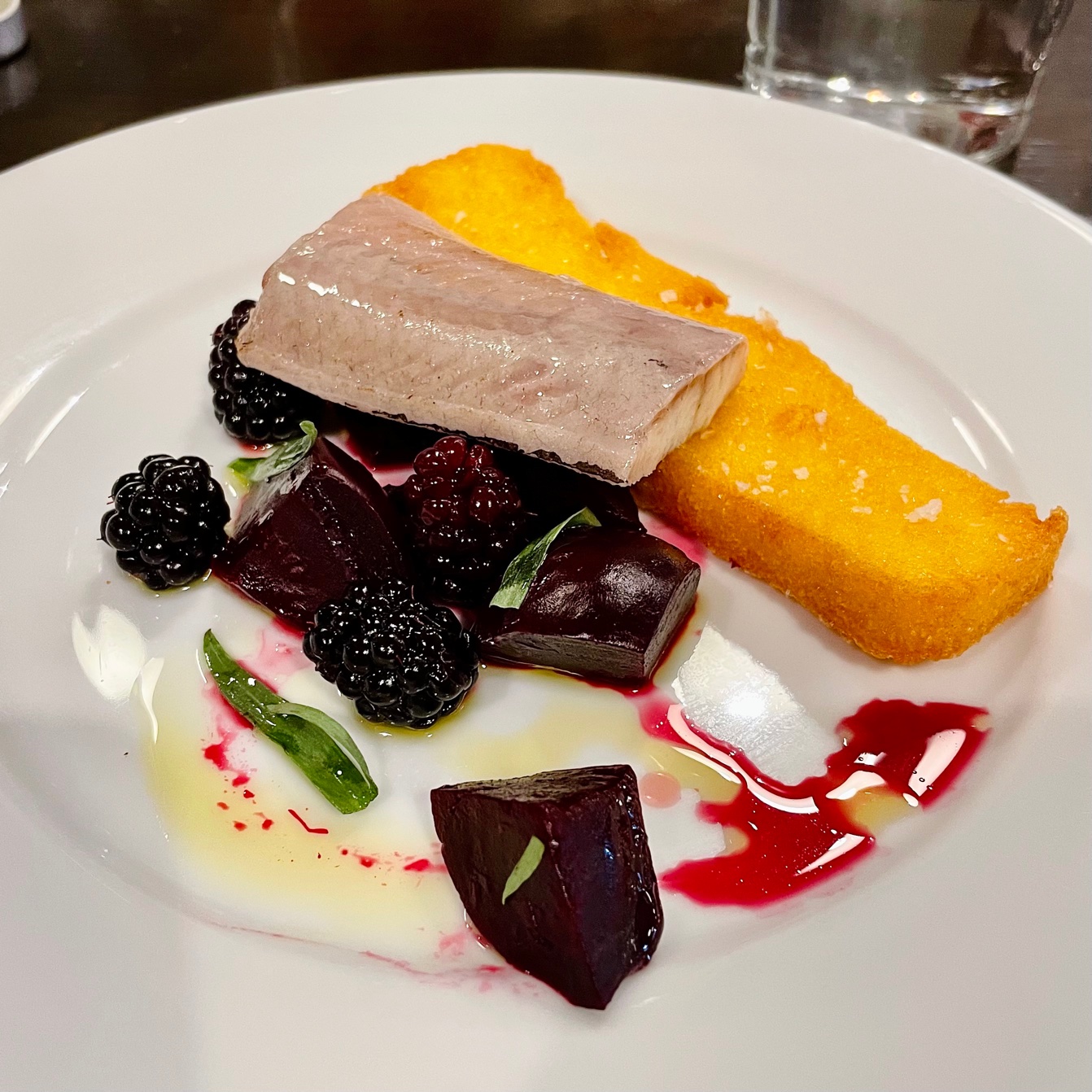
By this time the starters had turned up, and I got my first sign that I was in for an evening of sustained brilliance. I had gone for smoked eel, beautifully muscular and only lightly smoked, on an oblong of crunchy fried polenta. So far so delicious, but teaming it up with bright cubes of beetroot and blackberries with a balsamic sweetness was a killer blow. I could have eaten this all the live long day, and it left me wanting more – or, to be more specific, another portion. That’s what great starters do.

Although it was the most popular starter, a couple of us tried something else. Liz spoke highly of her marinated peppers, buried under an avalanche of Ticklemore, and I could see that I would have been equally happy with that. Ed had chosen the beef tartare, topped with chives and a slow-cooked egg yolk, flavour soaking into the bread below. How could you have food envy when you’d enjoyed your own starter so much? 

I was sitting between Ed and Ben – the kind of civilised couple who don’t have to sit next to one another all evening – and, being a civilised couple, they passed plates back and forth across me, or behind me, or through me so that neither of them felt left out. But I was having such a good evening that I was more than happy to be the proverbial dumb waiter. 

They were in the holiday mood – Ed’s mother was visiting their cottage in the Chew Valley over the weekend and then they were off to Cornwall for a well-earned break eating and drinking their way around that part of the world. They would spend much of the following week in their own favourite restaurants. I recognised kindred spirits, the kind of people – like me – who plan a holiday entirely around lunches and dinners, who enjoy going to places they know and love, experiencing the comfort, familiarity and total relaxation that comes with a pilgrimage like that. At the tail end of my own holiday, I couldn’t help but feel envious.

Given that Marmo was at least nominally Italian, I felt like we should have at least one Italian wine with our meal, so I chose a Tuscan red called Infraded, a deep, velvety Syrah. Ordering wine had been delegated to me by this point, but I was almost merry enough to be happy with that. Again, I felt like I’d committed a faux pas when the waiter told us this one was best served chilled, but Ed reacted with delight and I decided that on balance, I’d got away with it. It was, as you can probably guess by this point, predictably wonderful, and I made a mental note to see if there was anywhere you could buy some when I got home and Bristol was just a distant, happy memory.

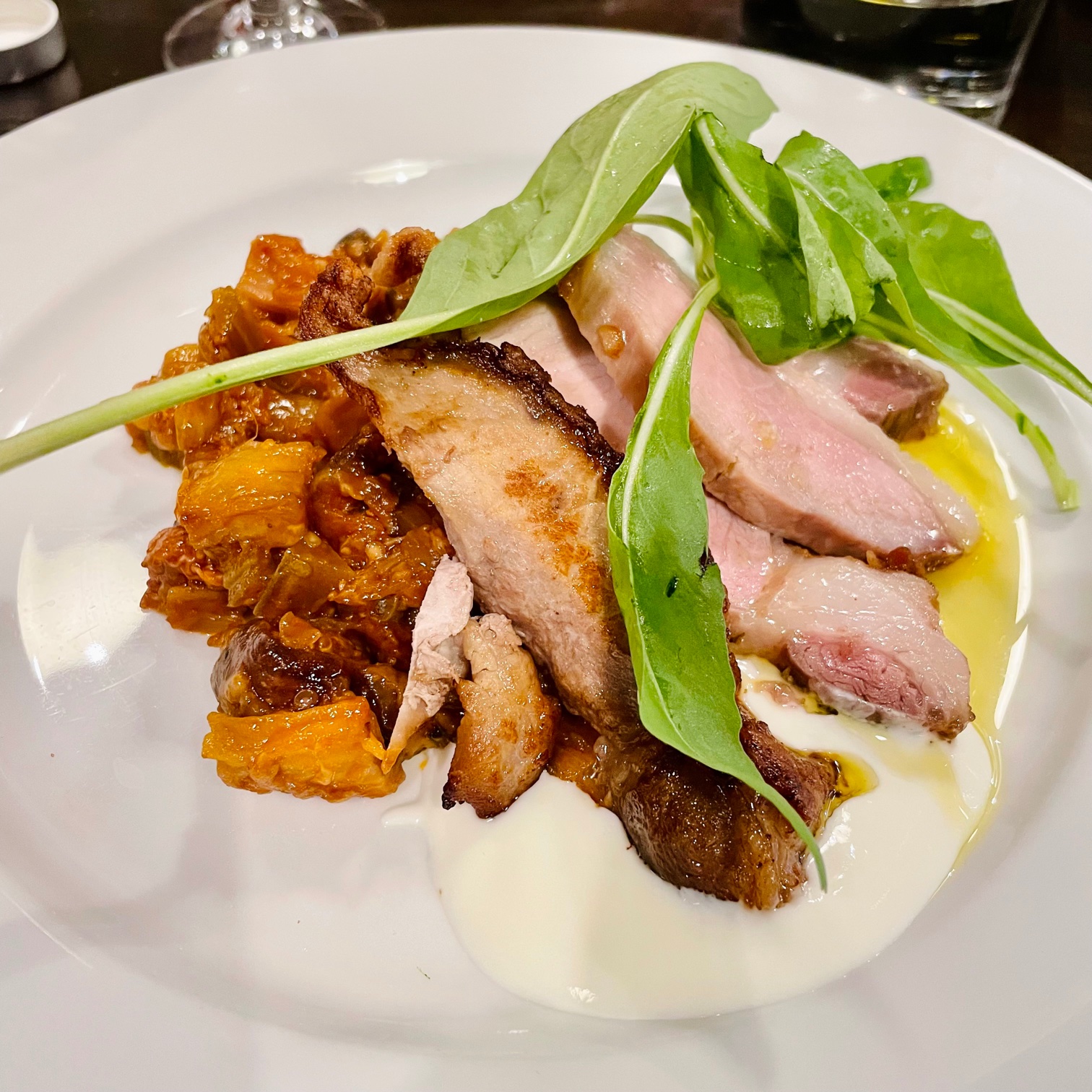
The main courses brought more fireworks. I’ve always heard Mangalitza pork spoken of in hushed tones as the Kobe beef of the pork world, but I’d never tried it before so I was keen to pick it off the menu. It came in glorious marbled slabs, just-pink and tender with the most beautiful melting fat: eating it I could understand why the Italians got so excited about lardo, and the idea of eating fat on its own. It was served simply with a handful of other elements, a wonderful caponata given a fresh edge with the judicious addition of fig, some good oil and a little slick of yoghurt. It was as good a single dish as I’ve eaten this year: I looked over at James, who had ordered the same thing, and saw him lost in a reverent silence.

That silence was eventually broken by Ed telling a story from the time when he used to manage a bookshop in Oxford.

“We had lots of celebrities in while I was there, but the best rider we ever had was from Roger Moore. And Roger Moore only asked for two things.”

“Really?” I tried to imagine exactly what vintage of Château Mouton Rothschild would feature in Sir Roger’s demands. “What were they?”

“A bottle of Jacob’s Creek and a Pret crayfish sandwich. That was all, every time. And by the end of a signing he was always absolutely fucked.”

This couldn’t help but make me warm to the great man. And of course, Ed had a picture on his phone of him with Jacob’s Bond, although it wasn’t clear how much wine had been taken by that point. Ed’s main course was a very attractive-looking pollock dish with mussels, and although he was taken with it, it it didn’t give me any buyer’s remorse about the Mangalitsa pork. Liz had chosen the vegetarian option, a very accomplished spinach and ricotta ravioli dish. Again, although it looked the part, missing out on it didn’t fill me with regret.

There were only two desserts on the menu and we all fancied the same one, the chocolate and hazelnut fritter, so five of us went for that while Ed nursed a grappa. It was an exemplary way to end the meal, a deep, smooth chocolate mousse, sharpened with cream and sandwiched between layers of the lightest of batters. Looking at the picture, it resembles nothing more than a witty dessert take on the ubiquitous burger: would that it was anywhere near as easy to get hold of, but it seems you have to travel to Bristol. We accompanied this with a sweet, fresh and generous glass of Coteaux de Layon (always a better bet than Sauternes, if you ever see it on a menu) – although Zoë had a negroni, because she’s developing a taste for them.

If I haven’t talked much about service it’s because they were so good. Completely unobtrusive but always there when you needed them, really friendly and enthusiastic and very good at what they did. We needed to pay at the same time as ordering our dessert so Ed and Ben could make their taxi on time, and all of that was no trouble and very efficiently sorted. 

Our meal for six, including a discretionary ten per cent service charge, came to just over four hundred and ninety pounds, or something like eighty-two pounds a head. That might sound like a lot, but we really went for it – aperitifs, snacks, a three course meal, plenty of wine and dessert wine. You could spend less and I have no doubt you’d still have a superb meal, and if you find yourself in Bristol at lunchtime they have a set menu which is even more impressive value. But either way I had no regrets – a couple of nights before I’d eaten at Paco Tapas, Bristol’s Michelin starred tapas restaurant, where I spent significantly more, eaten and drunk considerably less and not had quite as much fun. You pay for a meal, but you pay for memories too.

Even as I was eating at Marmo, I knew that the marker had been set down for the rest of this year and probably most of the next: as complete, satisfying and perfect three course meal as I could imagine. I would go to Bristol to eat here again, and I would plan trips to Bristol just so I could. It’s not my favourite restaurant – if only because you can’t give that accolade to somewhere you’ve only eaten at once – but it was my favourite meal for a long time. And if you ever wonder why I don’t give out higher ratings more often, this is why. I save the big guns for the great meals, and this is the kind of standard Reading restaurants need to aspire to, slowly but surely. I still hope we’ll get there. But in the meantime, we’ll just have to hop on a train.

Marmo – 9.4
31 Baldwin Street, Bristol, BS1 1RG
0117 3164987

https://www.marmo.restaurant