Restaurant review: The French House, Soho

It would be easy to envy London-based restaurant reviewers, I think. Just imagine having such a broad canvas, such an embarrassment of riches, every kind of restaurant at every level, from the plush, spenny Mayfair spots A.A. Gill used to frequent to the unsung cash-only middle-of-nowhere places Vittles has made its speciality – and, I suppose, everywhere in between. Like Samuel Johnson almost said, imagine getting tired of the London restaurant scene! How jaded you would have to be.

And yet… I don’t know. I think there are huge consolations to being a gastronomic tourist in the capital. For a start, everyone writes about London restaurants. All the critics, all the Substackers, all the people jabbering to camera in their weird self-parodying voices on TikTok. It would be exhausting to be in that pack of misfits, let alone trying to keep pace with them.

It’s all about the urge to be first – to get to the new place before everybody else, or to get there at the same time but say it better. We have reached the point where various critics have visited, say, Josephine in Marylebone in recent weeks and come down solemnly on either side of the fence, saying it’s great or bobbins, as if they’re handing down Supreme Court judgments. And really, who cares?

Well, if you’re invested in it I’m sure you do but from a distance it feels like the kind of Inside Baseball stuff that only interests a small number of people. There are at least a couple of Substacks specially for those people, too: I imagine if you fancy a very niche printed word take on Gogglebox they’d be catnip to you.

No, I quite like being free of all that. I get it in Reading, that if a new place opens people want to know what it’s like and that makes me want to get there fairly soon after it opens; if you’re hankering for a review of Nua, or Pho 86 or even Take Your Time, the new spot that’s opened where Dolce Vita used to be, don’t worry. I will get to them, I promise.

But to have that feeling amplified to the max, to see all these hot new places and know you only have so many evenings, so much time, so many spare calories, so much money? I don’t envy any of them that, not even the ones whose decisions are made infinitely simpler by choosing the restaurants that bung them cash, free food or both.

Of course, there’s also the FOMO I always associate with big cities. It’s bad enough when I go on holiday to, say, Lisbon, and the infuriating brain that has unhelpfully held me hostage all my adult life – the one I struggle to quieten – looks at all the places on my narrowed-down shortlist before piping up about every single restaurant that didn’t make the cut. What about all of these?

Don’t get me wrong, I loved Lisbon, I ate well there and people tell me my city guide is very useful. But for each list of places I visit there is always an equal and opposite running order of the ones I didn’t choose, all taunting me with the possibility that they might have been even better. I copy-paste them into a new note entitled Next time when I get home, but mainly to try and fool myself.

So I am very comfortable with my relationship with reviewing London restaurants. I get to places I have always wanted to visit – a real mix of the old and new, no real guiding principle behind them except that I fancy them. Often it means things go brilliantly and I make a favourite new discovery, sometimes I’m underwhelmed by somewhere that has been hyped to high heaven (Chick ‘N’ Sours has since closed). But even that is as it should be: if I loved literally everywhere I went in London I’d be no better than Eating With Tod and the world of food doesn’t need another Toby Inskip. It already has one Toby Inskip too many.

All that explains why Monday morning found me outside Flat White on Berwick Street ahead of a lunch reservation in Soho, at the French House. David Schwimmer – all in black, bags under his eyes, baseball-capped, quiet and polite – had just been in there grabbing a coffee and the staff, who were probably discovering him on Netflix for the very first time, were decent enough not to act starstruck. And then someone even more celebrated crossed my path – my friend Graeme, my lunch companion that day, merrily wandering aimlessly through Soho after a morning spent shopping.

So off we walked to the French House together. Our lunch had been a spur of the moment thing: it was the last Bank Holiday before Christmas, and we were both at a loose end. His wife was away camping, mine was at work so we decided to indulge in one of life’s great joys, a leisurely lunch on a day when you’d ordinarily be at work, a Monday stolen back from the cosmos.

The French House is one of London’s great pubs, which means that it’s one of the world’s great pubs, and it’s been a favourite of mine for many years. I’ve lost count of the number of times I’ve sat downstairs in among the regular churn of Soho types, tourists and people passing through, drinking Breton cider and chatting away to those I already knew and, often, others I didn’t know from Adam.

I’ve introduced a fair few people to it over the years, too – including Graeme, who had never been – and I never tire of seeing them fall for it the way I have. The acclaimed Devonshire is an attempt to manufacture a classic in the laboratory – and don’t get me wrong, the people in that lab are experts and I’m sure they’ve done an outstanding job. But the French House is the real deal.

I won’t bore you with the trivia – all that stuff about de Gaulle getting drunk there in exile, or Dylan Thomas drinking there, or Lucian Freud. You can read about that anywhere, and my interest on that sunny day was mostly about the dining room upstairs. That too has a storied history, by the way.

Fergus Henderson cooked there over thirty years ago with his wife, before leaving to set up some unsung joint called St John. I ate there nearly fifteen years ago back when it was Polpetto, an offshoot of Russell Norman’s Polpo, just after it opened; celebrated chef Florence Knight was in the kitchen, near the start of her career. Then Polpetto moved elsewhere, and went the way of the rest of the Polpo empire, and that room above the pub lay dormant.

But seven years ago chef Neil Borthwick took it over, offering a pared-back menu of French classics, and I’ve pretty much wanted to eat there ever since. I’ve even booked it a couple of times, and then ended up having to cancel, or choosing to go elsewhere. The thing is, the French House is that unusual thing in this day and age: an almost homework-proof restaurant.

You won’t find a current menu online anywhere, and the restaurant’s website directs you to an Instagram feed with pictures of the latest menu. It last posted in May last year, so all you can get is a vague idea of the sort of things you might eat. So Graeme, a man with a sense of adventure, was the perfect wingman for this one. He also quite fancied lunching at venerable Mayfair pub The Guinea Grill (“it serves meat pies with sides of offal” was his rationale), but agreed that the French House would suit him just fine.

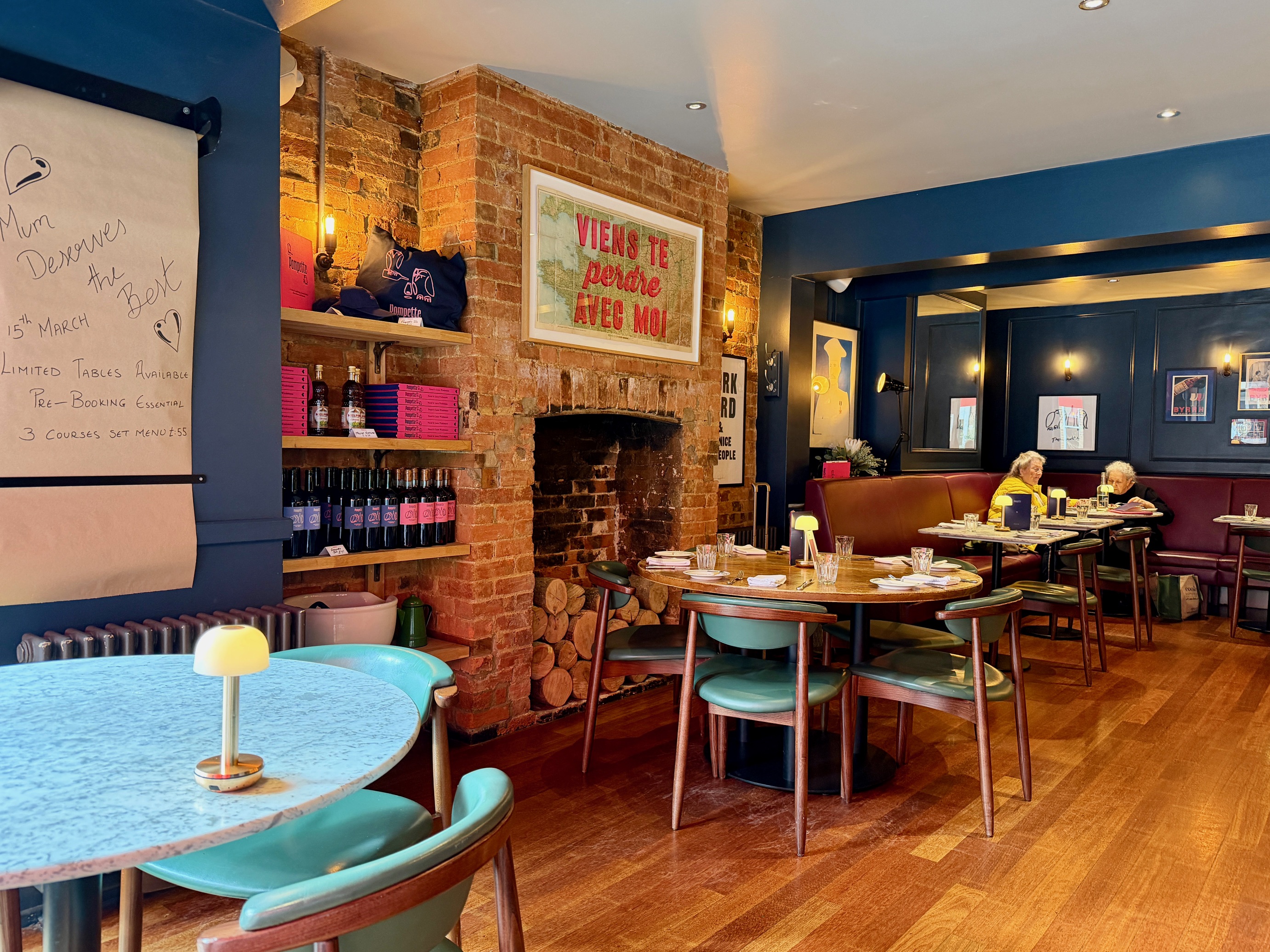
It’s the loveliest dining room, a small and peaceful space above the small and boisterous bar underneath. It has a strange kind of placid calm, all oxblood walls and wood panelling, tasteful black and white prints everywhere paying tribute to the pub’s past. I don’t think it seated more than 16 people and was almost full when we were there, with a second sitting coming along towards the end of our lunch. You could almost be anywhere, but you wouldn’t necessarily think the clamour of Balans, of Bar Italia, of Ronnie Scott’s, Bar Termini and all those branches of Soho House were the other side of those big, handsome windows.

The menu was handwritten and changed daily, another thing the Devonshire probably likes to pretend it invented. Here was a novel experience, my first chance to see an actual French House menu with today’s date on it, let alone one written in 2025. It was a thing of beauty, restrained and limited. Four starters and two mains, bolstered by a blackboard listing specials: two more starters, two more mains and a couple of bigger sharing dishes, a huge pork chop or a cote de bœuf.

When you handwrite a menu every day, I don’t really understand the logic of also having a blackboard, but perhaps the specials were in shorter supply and doing it that way saved them drawing a line through all sixteen menus.

The French House is also, by the way, far from being a prohibitively expensive place to eat. Most of the starters were £12 and the mains, excluding those sharers, were between £28 and £35. But before we were ready to make our choices we had an apéritif, a drink marked on the menu as Today’s Tipple.

I’d never heard of a Pousse Rapière before, but it turned out to be an orange cognac liqueur from Charente mixed with English sparkling wine and it was properly divine, like a Kir royal for ponces. I was very taken with it, and one of the two servers brought the bottle over to show us what was in it. “You can probably buy it in Gerry’s” she said, but sadly the Old Compton Street booze emporium was closed that day.

Although the menu changes every day, I’m not sure I’ve ever seen any version of it that didn’t include Graeme’s starter. Sourdough toast came slathered in goat’s curd but then the pièce de résistance, the thing that propelled this dish into the stratosphere, was the entire bulb of confit garlic crowning the whole affair. You just had to ease out a clove – a process which took minimal effort, as far as I could see – smoosh it on your toast and curd and heaven was a forkful away. I always let my dining companion choose first, and Graeme nabbed this. But if he hadn’t, I would have ordered it and this paragraph would have been even more of a paean of praise.

I on the other hand chose from the specials menu and was rewarded with an equally worthy example of the genre known as great things with toast. The French House’s steak tartare was not only one of the best I’ve had but arguably the most classic. This is a dish I’ve enjoyed all over the place – at Marmo in Bristol, in Paris, Bruges and Montpellier, and usually everyone tries to put their spin on it, whether that’s relying on a fudgy, slow-cooked egg, smoking the beef or spiking the whole thing with gochujang.

But I think it’s at the French House that I had this dish at its most textbook. No whistles and bells, no twists or gimmicks. Just gorgeous beef with plenty of capers and, at a guess, finely chopped cornichons, that stupendous alchemy of salt and sharpness that makes this dish, at its best, an unalloyed pleasure. They did a larger version of this dish with frites, too, but I was happy to have the smaller option, streaked with rays of golden sunshine from that broken yolk, a perfect precursor to what lay ahead.

The French House’s wine list is a curious one in that there’s nothing that cheap on it but, simultaneously, a lot that isn’t ridiculously expensive (it also, refreshingly, contains a reasonable number of half bottles). I wish I’d taken a photo but it did seem like a lot of the bottles were £50, and the one we chose, an Alsatian pinot gris, definitely was.

It was by Famille Hugel, as were many of the other options, and for what it’s worth I found it delightful. It felt like a dangerously easy to drink white that could quite happily smudge the sharp edges of an afternoon, and both Graeme and I were more than in the mood for that.

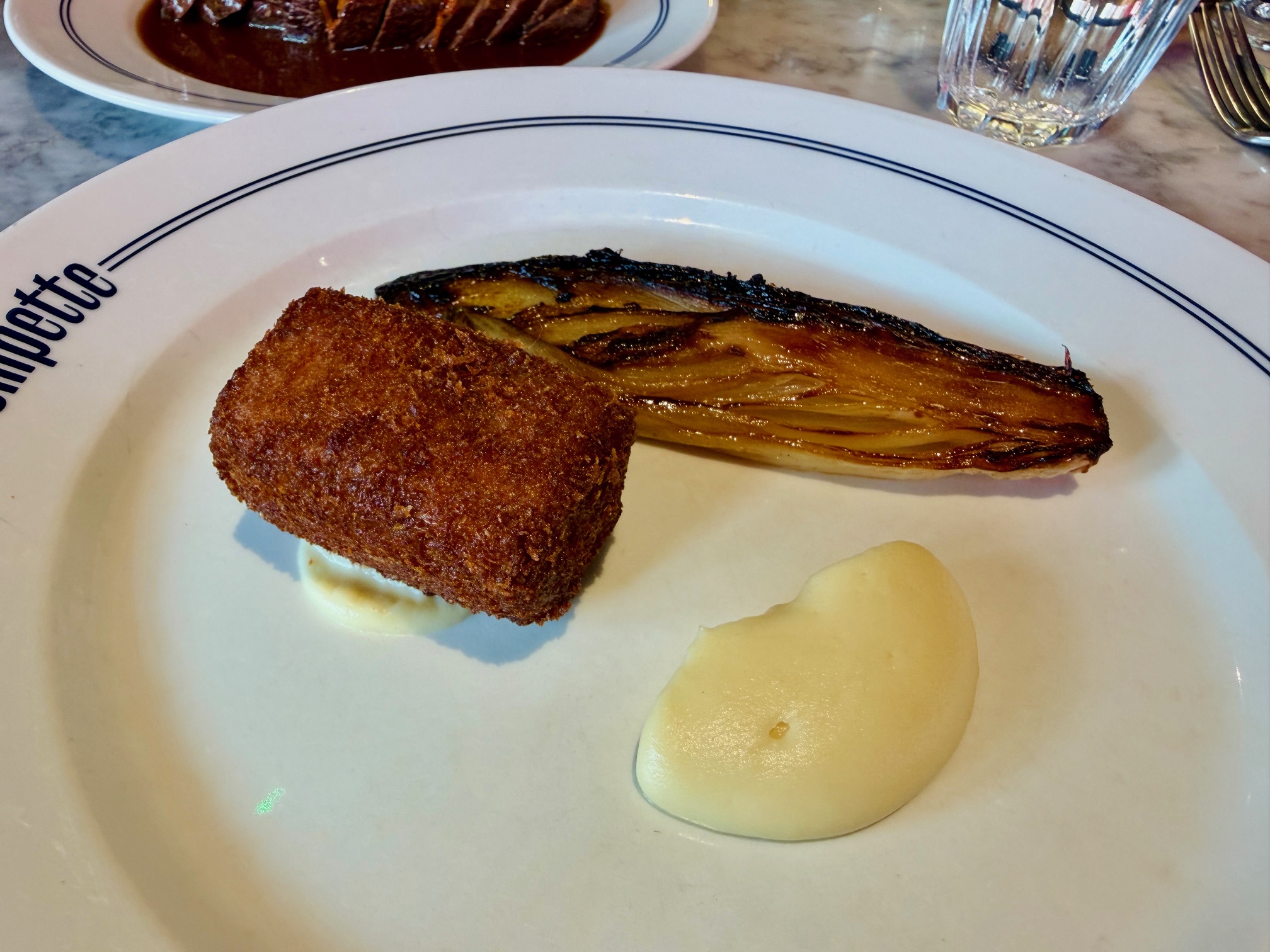
It went superbly, I suspect, with Graeme’s main course which was another masterpiece of simplicity. Three muscular, golden lengths of monkfish tail, mostly off the bone, came resting on a little mat of steamed spinach, served with ribbons of fennel and a glossy purée: the menu suggested it was fennel, too, but Graeme wasn’t so sure about that.

Graeme loved this dish, and rhapsodised about it from start to finish. A bit of a flex, as people younger than me like to say, from someone who had been agitating in favour of a sturdy pie with an offal chaser, but that’s one thing I really like about Graeme: he, more than most people I know, properly contains multitudes.

The words describing my main leapt off the blackboard and onto my lips when the server asked us what we wanted to order. Well, two words did anyway, confit duck. I find it so hard not to order it in restaurants but my lack of imagination is rarely rewarded quite as profoundly as it was at the French House. A huge duck leg came with a bronzed carapace, some of the fat remaining underneath but much of it sacrificed to achieve the happy medium of yielding meat and skin like crackling.

So often confit duck doesn’t quite achieve that balance, or it does but it’s too small, or it doesn’t and it’s too small. Rarely is it as beautiful, and substantial, a wonder as this. I could eat this all the live long day, or perhaps more realistically once a week, but maybe it’s for the best that it’s a far more irregular treat in real life. It came on a rib-sticking pile of lentils shot through with carrot, celery, ambrosial lardons: there might even have been some braised lettuce in there, but that may have been my imagination playing tricks.

This was a complete plate of food in a way many dishes never are, to the point where I didn’t envy the neighbouring table the very attractive portion of frites they took delivery of partway through my eating this. Well, almost: I think I 90% didn’t envy them. 75%, perhaps.

Time spent with a good friend is a bit like a really happy dream, in some respects. When you look back you know you had a wonderful time but you can’t remember the specifics of what you said. So Graeme and I caught up on his house move, our families, the impressive women we’d fluked our way into marrying, his belief that he was still the best Doctor Who we’d never had.

We also shared a firm conviction that summer wasn’t over until it was over, frustrated by the widespread defeatist doom-mongering on social media that it was as good as autumn already. A lunch at the French House felt like a brilliant way to rage against the dying of the light brought about by the impending end of British Summer Time. See? I slipped in a Dylan Thomas reference after all.

I had read everywhere that you had to order the French House’s madeleines, but also that they were baked to order and took fifteen minutes, so I persuaded Graeme that we should order them and another dessert to tide us over while they were prepared. Oh, and a dessert wine to enjoy into the bargain. Again, our server gave us loads of brilliant advice about that section of the drinks menu and we ended up sipping a Petit Prince de Guillevic, which was a bit like a pommeau, made with eau de vie and cider.

It was heavenly, and transported me to the first time I tried pommeau, on a holiday to Normandy with my dad the best part of twenty-five years ago. It also reminded me that I have a bottle of a British equivalent, brought out this year by Herefordshire’s Little Pomona, in my garage and that I really should enjoy it before the clocks go back.

I gave Graeme first choice of desserts, not wanting a repeat of the chocolate mousse incident from three years ago, and he eschewed the chocolate mousse so I felt it was my duty to, well, chew it. It was truly glorious, a dense boozy sphere of the stuff redolent with rum and served with just the right amount of excellent crème fraîche to stop it being too much. By which I mean too much for most people: it was absolutely fine for me, but I loved the crème fraiche all the same.

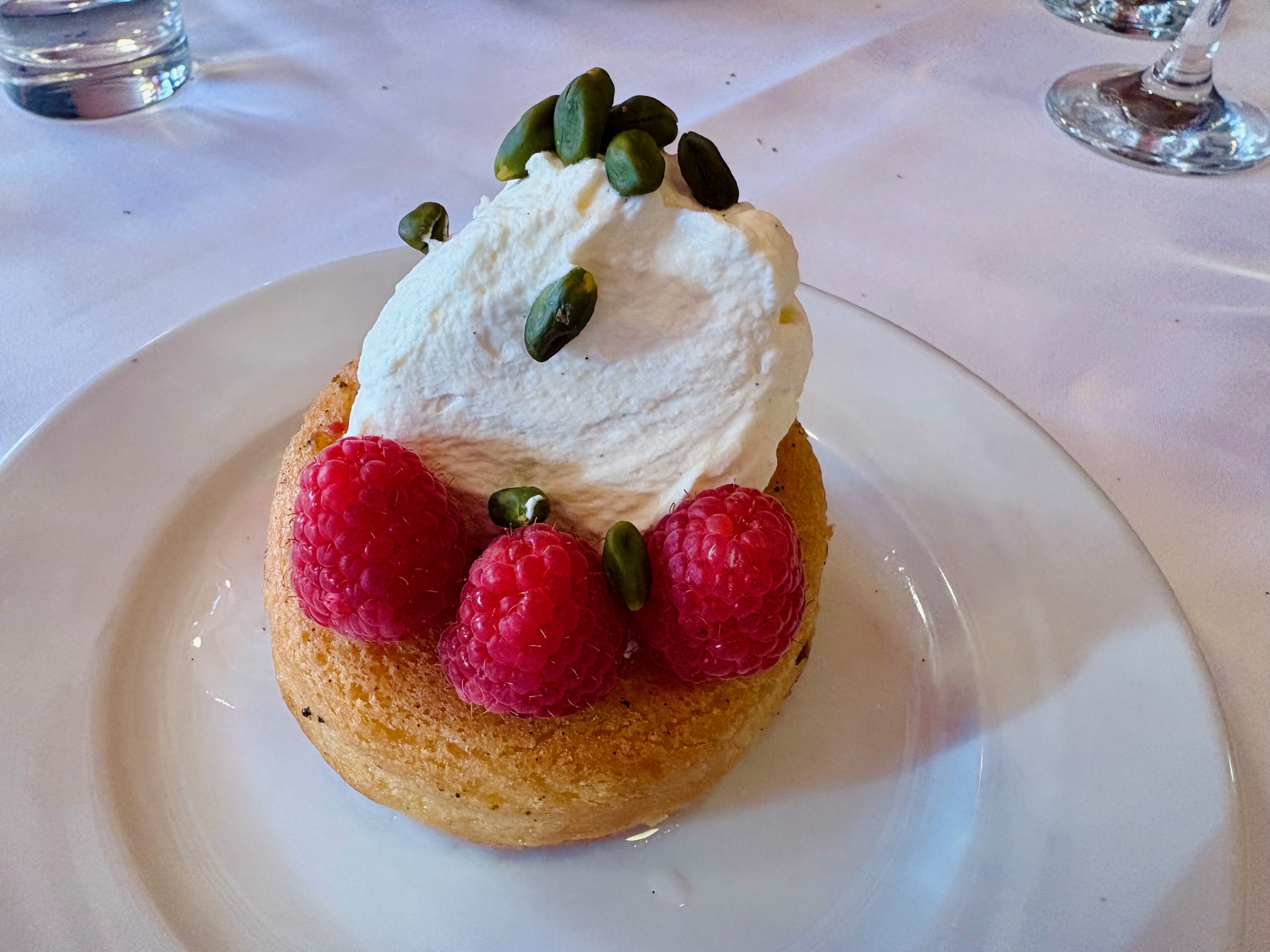
What had prompted Graeme to risk dessert dissatisfaction and swerve that mousse? He was persuaded by our excellent server to try the dessert on the specials, a raspberry savarin. It was sold to him as a bit like a baba au rhum, only with raspberry liqueur instead of rum. I don’t think that necessarily did the dessert justice.

The thing is, a sponge soaked through with booze feels instinctively like it should be sodden, be heavy. That is, you might think, what you’re pricing in when you order this dish. But this was airier than any rum baba I’ve tried, the sponge almost float-away light, but still with raspberry coulis lurking at its epicentre. But before that you had that indulgent sponge, and raspberries ringing a heap of the lightest Chantilly cream.

This dish is absolutely not the kind of thing I would ever order, but after trying a spoonful of Graeme’s I can tell you that if I ever got the chance to eat a whole one of these I’d grab it swiftly with both hands. Maybe this time Graeme had performed a Jedi mind trick on me? You couldn’t say it was undeserved.

By this point most of the people who had started their lunches at the same time as us had settled up and moved on, which I always consider a little moment of triumph. The dating couple at the next table had ordered exactly the same combination of dishes as we had, him my choices and her Graeme’s. “See, you’re the women in this arrangement” I said to Graeme, enjoying the novelty value because, at least half of the time, I’m not even the man in my own marriage.

Most of the other tables left before us because they’d made the mistake of passing on the madeleines. In a meal full of showstoppers we’d left the very best till last, a board with six warm madeleines, all scalloped edges, dusted with icing sugar and served with a little ramekin of lemon curd that was somehow sunnier than the yolk on my steak tartare, sunnier even than the rays pouring in through the windows into that ravishing dining room.

Dipping those madeleines into the curd, biting, tasting, raving and repeating did something wonderful: it perfected a meal that had been pretty close to perfect anyway. These are worth visiting the French House for in their own right, but I’m not sure that’s saying much, because so was everything else.

After we had finished them Borthwick left the kitchen – so he’d been at the stoves that day – and walked past our table and both Graeme and I thanked him and went bananas about the madeleines in a way that was probably more enthusiastic than it was coherent.

Borthwick very graciously, with an air of someone who’d had this conversation many times, told us that they’d originally been the creation of a Kiwi he worked with in the kitchen who had a real genius for baking. Although he had since quit cooking to bring up his kids the madeleines stayed on the menu, kind of his legacy.

I have no idea what the chap’s name was, but I suspect many London diners owe him a debt of thanks. Eating these madeleines I could sort of understand how Proust got all those novels out of them. Graeme said they had ruined Waitrose madeleines for him, which is in its way equally high praise.

I was sad to ask for our bill and to leave, but I knew that you couldn’t stay in that gorgeous room and eat nothing when other people could make excellent use of those tables, and I was also aware that it was London and that other lovely tables lay downstairs and beyond, and that I could drink Breton cider at the ones downstairs and carry on probing Graeme’s credentials to be the next Doctor Who and the first from Middlesbrough (“lots of planets have a North-East”, he proudly told me later).

Our bill, including a 12.5% service charge, came to just over £226. I’m going to stick my neck out and say that this was as good value as any meal I’ve had on duty this year.

The rest of the day was every bit as agreeable: drinks in the French House, an amble through Trafalgar Square and down to the Embankment for a couple of companionable glasses of wine sat outside Gordon’s, while Graeme gazed lovingly at every single dog at every single neighbouring table. And then we headed back to Paddington for – shamefully – a little booze fuelled sustenance at Market Halls before our journeys home.

But the way to best put that lunch in perspective is to think about the messages I got from Graeme the following day. “There isn’t a single course of that meal I’m not still thinking about” he said. “It was so good.” I’ve thought about it, and he’s right: I reckon I’ve thought of every single course at least once a day since Monday and, in the case of those madeleines, several times a day. And I’ve also thought about Graeme’s order, and how I would have been just as happy if it had been mine. And the things neither of us ordered – the rillette, or the tomato and lovage salad, or those frites: I’m pretty sure I’d adore those too.

Best of all, now that I’ve been to the French House and loved it, the fact that I can’t see a menu online goes from a homework-proofing source of anxiety to a matter of constant wonder and delight. I don’t know what I would get there, but I know that I would like it. Put that way, the prospect of going there again, which I’m sure I will, feels like a piece of magic you rarely get in restaurants these days.

So I am very glad I picked the French House this week and that, free from the need to keep up with the Joneses of the London food media, I was completely at liberty to do so. Because the French House has that indefinable feeling of authenticity that was somehow lacking when I visited the likes of Lapin earlier in the year. It feels like the team behind Lapin have been to, and loved, places like the French House. But it feels like the team behind the French House have been to, and loved, France. That’s it. That’s the difference between good and great in a nutshell.

The French House – 9.4
49 Dean Street, London, W1 5BG
020 74372477

https://www.frenchhousesoho.com

Since January 2025, Edible Reading is partly supported by subscribers – click here if you want to read more about that, or click below to subscribe. By doing so you enable me to carry on doing what I do, and you also get access to subscriber only content. Whether you’re a subscriber or not, thanks for reading.

Restaurant review: RAGÙ, Bristol

I was on a run of bad luck when we turned up for dinner at RAGÙ, situated in a shipping container in Wapping Wharf, on the last night of our trip to Bristol. It’s not that I hadn’t eaten well, because I had in places, but I hadn’t eaten consistently well. My lamb kofte wrap from Matina, always a staple, felt a little under-sauced and under-seasoned, my vegetarian pizza sandwich at the Left Handed Giant brewpub was bland and stodgy.

There was a meal at a gastropub in Clifton so middling I didn’t end up writing it up, because even I can’t spend 3,500 words just saying meh, and of course there was my very brief, rather expensive dinner at Snobby’s. In that sense, it wasn’t a vintage trip.

That’s not to say that there hadn’t been some good things to eat. That rolled lamb dish at Snobby’s was magnificent, even if it stuck out like a sore thumb in the wider context of a hapless meal. The fried potatoes with truffle mayo at Left Handed Giant almost made up for that sandwich by Pizza Is Lovely, which wasn’t.

I sat outside Panunzio’s on Cotham Hill on a blazing afternoon and enjoyed a tub of the most incredible chocolate gelato (they make everything onsite), and possibly preferred it even to Swoon, the bigger name at the foot of Park Street. There were bright spots, but most of them were isolated dishes, or the highlight of a disappointing meal.

The one exception was brunch at OddShop on Whiteladies Road, eating outrageously good crumpets topped with fried chicken, chilli jam, bacon and coffee maple syrup, accompanied by the hash browns of the gods; I liked this so much I was prepared to overlook the fact that I discovered the place by virtue of Bristol’s most prominent influencer. Still, at least I paid for my meal: maybe if it had been free I also would have described it as “proper unhinged naughty scran”, but somehow I doubt it.

So the stakes were relatively high for our final dinner in the city, but I suspected RAGÙ could handle it. Back at the start of 2023, before everybody and anybody discovered it, I reviewed a little spot in Bedminster called COR, and adored it. I said at the time that I was ahead of the zeitgeist, for once, and it turned out that I was; Michelin gave it a Bib Gourmand, bloggers hopped on the bandwagon, and in the meantime COR carried on thriving, doing what they did well. I watched their progress with happiness and pride, just glad I knew them before they were famous.

Anyway, two years later they opened their second restaurant, RAGÙ, on Wapping Wharf. Where COR’s menu ranged across much of southern Europe, RAGÙ’s was very deliberately Italian, and prior to it opening COR’s head chef Vyck Colsell and some of her team went on a fact finding trip to Emilia Romagna: I remember seeing the photos on Instagram and feeling profound envy of her time in Bologna.

As it happens, Colsell has a Reading connection, having started out in Caversham’s very own, much-missed Mya Lacarte. When RAGÙ opened in March Colsell got a promotion, being confirmed as executive chef of both restaurants: to think that it all began on Prospect Street.

I was not ahead of the curve with RAGÙ, sadly. Despite booking my table back in May, by the time I got there earlier this month – as with Town – a national critic had beaten me to it. Grace Dent this time, making the most of a trip to Bristol to visit both RAGÙ and Lapin. She loved them both, although RAGÙ was the one she dubbed her new favourite restaurant of 2025. Still, only one review of consequence to measure mine against counted as pretty good going.

Whether it was the Dent factor or just a Thursday night in Bristol, the restaurant was buzzing when we turned up. RAGÙ felt much smaller than Lapin – it’s just the one shipping container, I think – and had something like half a dozen tables, the rest of the covers being up at the bar with a great view of a very open kitchen. It shares the terrace outside with its neighbour, and it was a warm enough day, but I loved being inside with all that life.

I recognised Colsell in the kitchen and one of the servers as the one who had looked after me so brilliantly on my first ever trip to COR, and taking it all in I started to get whatever the opposite of a sinking feeling is. Could one meal redeem an entire mini break? You wouldn’t have bet against it.

RAGÙ’s menu, like COR’s, is broadly structured in sections, from nibbles to smaller plates, to bigger plates you might share to the largest that you perhaps wouldn’t. This is something both restaurants are really good at, and it’s all about flow. It’s one thing to just stick dishes of varying size and cost on a menu and leave you to fend for yourself, and even some very good places are prone to doing that. But with RAGÙ’s menu you get a clear picture of how it all hangs together and how you might – wanky word alert – curate a meal.

And actually all the tables around me were doing that different ways, shuffling plates in different orders, sharing things I might not have, all finding different ways to configure a list of dishes where you would struggle to find good reasons not to order all of it. That said, I doubt there were many duos in the restaurant that night who tried quite as many of the dishes as we did. What can I say? We were greedy, hungry, delighted to be there and we had an underwhelming trend to buck. Time to roll our sleeves up and get into it.

Our first wave of dishes came, nicely spaced and paced, as it should be, to accompany aperitivi. Zoë’s negroni, which was leftfield but not heretical, was made with local Psychopomp gin and coffee-infused Campari, and received rave reviews. I had something called a Scialla which was made with Moscato d’Asti – which I’ll always unapologetically love, however unfashionable it might be – with mint and lime. A little like a rebujto, and a lot like something I could easily rustle up at home. A light whisper of a drink, gone too soon, but also, because Moscato d’Asti is something like 5%, gone without doing significant damage to the liver.

That feeling of being in safe hands began with the first thing we ate. An opening gambit of beautifully done focaccia, studded with salt and rosemary, would have been fine on its own or even better with bright extra virgin olive oil to dip. But whipped butter topped with bottarga? Utterly exquisite. My friend Al brought me some bottarga back from a recent trip to Italy: now I know exactly what to do with it.

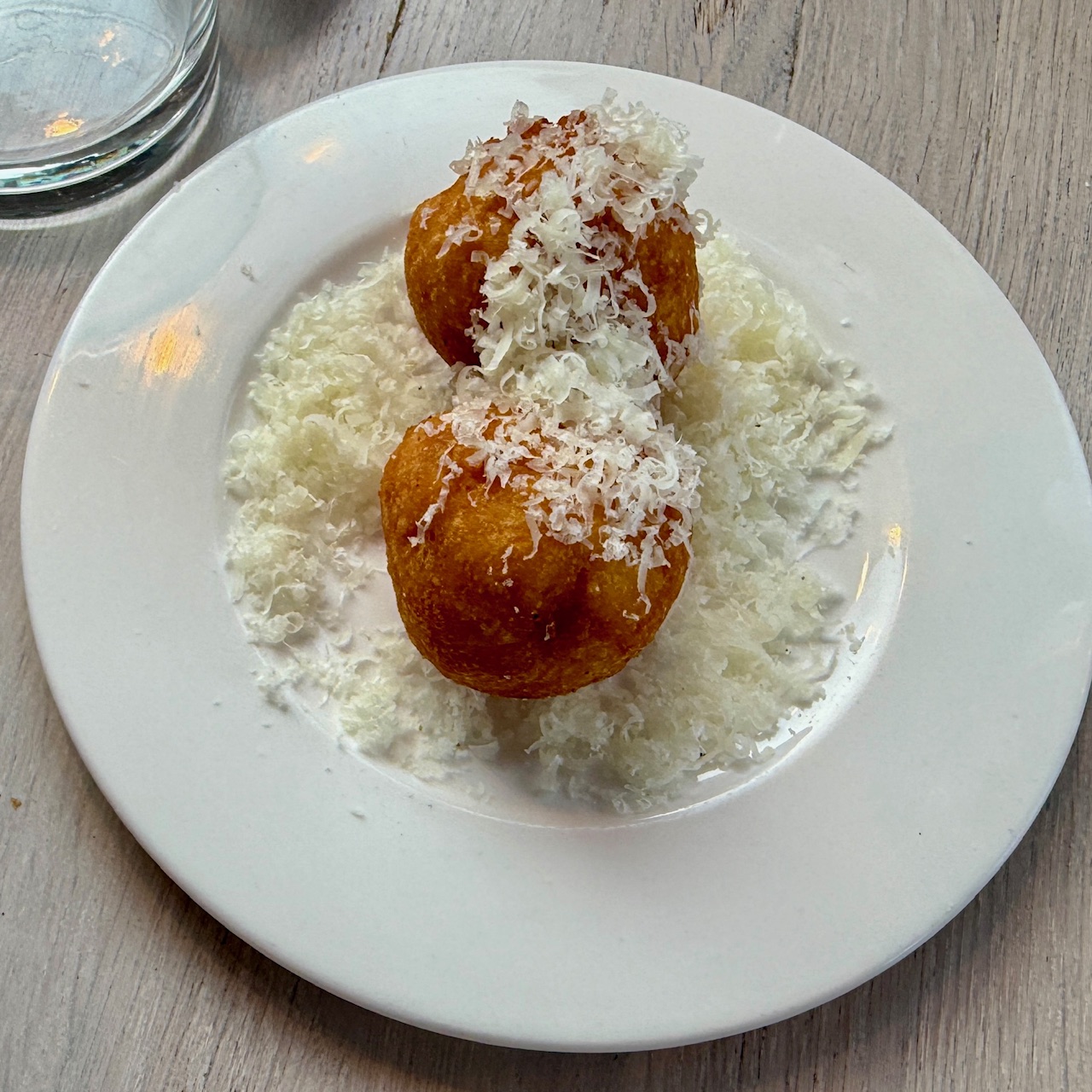
Slightly less successful, for me, was the one thing we had from the specials board. Crocche were little balls of fried, mashed potato, served carpeted with cheese. And as an exercise in texture they were a masterclass – such a light crunch, so ethereal inside. But texture isn’t everything, and for me these lacked the oomph I would have liked, especially at seven pounds fifty for a pair.

As it was when I ate at RAGÙ’s neighbours Lapin, I mentally compared this dish to the worldbeating cheese fritters at Upstairs At Landrace, and wasn’t convinced RAGÙ’s came out on top. I keep getting told off for comparing restaurants – some random said I spent too much of the last review talking about Clay’s – but how do you work out whether something is great or merely good without comparing it to other stuff you’ve had? Honestly, some people.

My absolute favourite of the small plates we shared was what came next. Prosciutto and melon could easily be seen as a throwback, the kind of thing we all thought we should be eating forty years ago. And I’m not sure when I saw it last on a menu, mainly because I suspect it’s the province of very trad Italian restaurants and, Reading not having any of those, I never visit that kind of place. But this dish, one of the best things I ate in the meal, was 100% comeback and 0% throwback.

First of all, the prosciutto was undeniably first rate – coarse and thick, the good stuff, free from the sheen that is the clearest tell that it had spent the last few weeks incarcerated in plastic. This stuff sang, and it wasn’t alone in doing so: the hunks of Charentais melon it was draped over were deeply sweet and fragrant, soft and unmissable. That alone might have made for a knockout dish, but RAGÙ knew when to add and, crucially, when to stop. So the Sorrento tomatoes in the mix added a different kind of sweetness, another dimension, and torn basil (and, I think, some more finely chopped mint) perfected matters.

It felt like a supercharged summer from the first mouthful to the last, the kind of thing you’d love to eat at home but, because you don’t have RAGÙ’s access to ingredients, you know you never will. That said, RAGÙ’s Instagram suggests they get produce from extra-fine greengrocer Hugo’s, a few doors down from COR in Bedminster. So if you live in Bristol, you at least have a fighting chance of recreating it.

The final dish in this phase of our assault on the menu was probably my least favourite, although I should say in fairness that Zoë loved it. I now realise I’ve not had friggitelli peppers before and I didn’t realise that they were dark, green, slightly bitter things, not a million miles away from padron peppers, which I’ve always been able to take or leave. They were served with confit tomato, which was actually a thin pool of liquid, and topped with grated, salted, aged ricotta.

So the fact that I didn’t like this might have been on me. Every component of it was well done – the peppers in particular were cooked nicely and slightly blackened – but I do think that its three elements didn’t cohere into a single dish. Something you sort of have to eat with a fork, sort of have to eat with a spoon, is sort of hot and sort of cold left me sort of both. But as the one outlier, it probably says more about my tastes than anything else.

That was all the sharing either Zoë or I felt like doing, so from that point onwards there was her dish and my dish all the way through to paying the bill. I don’t know whether everyone does that or not, but I remain unconvinced that some dishes – especially things like pasta – are really sharable anyway, unless you change ends at half-time, so to speak.

One thing we did share, though, was a beautiful bottle of Gavi which cost just shy of fifty pounds and felt worth it. It didn’t necessarily go with everything we ate, but having a lovely time did and it contributed its fair share to that.

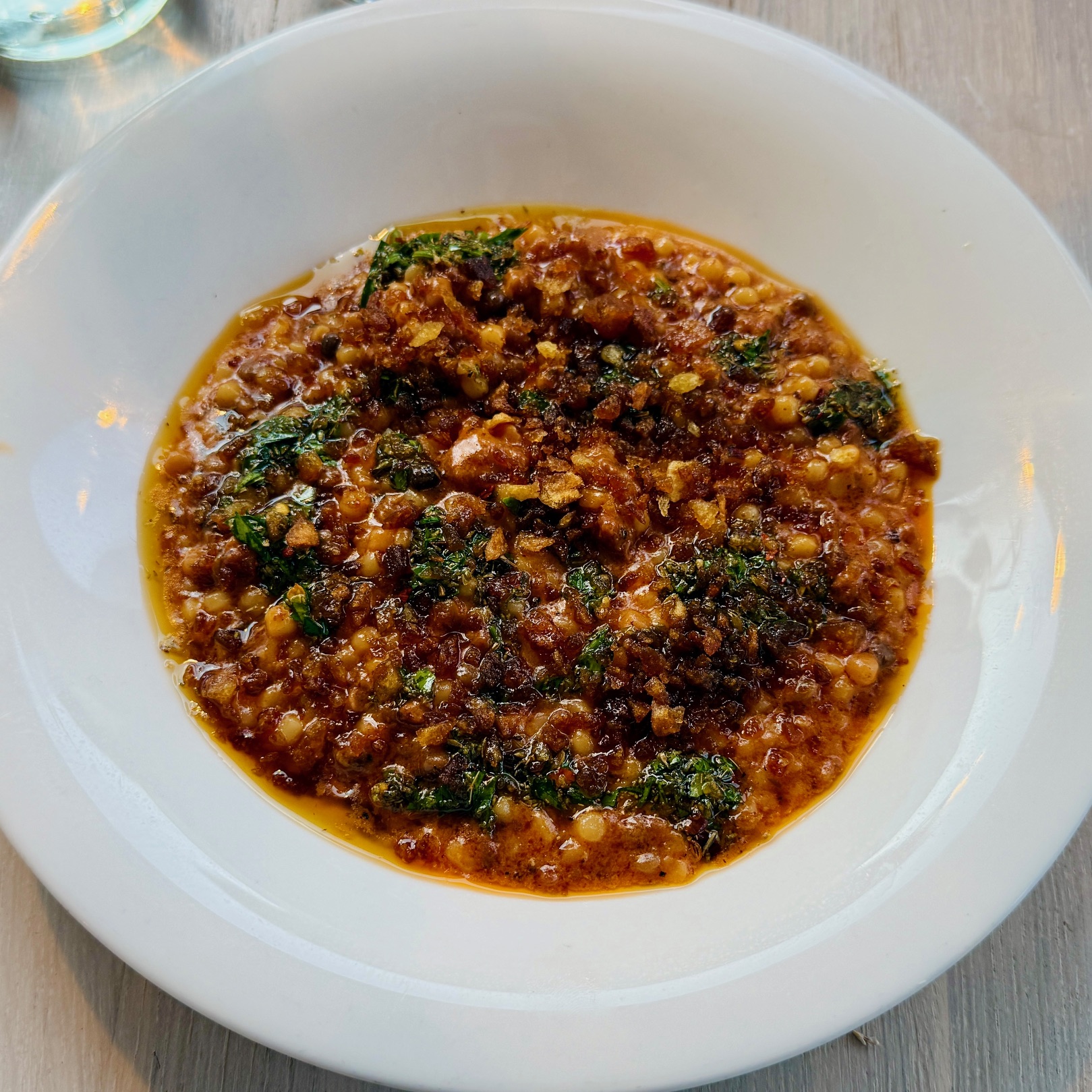
Zoë, for me, ordered the other dish of the meal. Billed as fennel sausage with fregola it was really so much more than that, a bowl of the most tremendous, intense, savoury joy. I’m not used to associating fregola with comfort rather than virtue, but here it was deployed as a supporting player with crumbled sausage, a painterly swathe of gremolata and a potato crumb.

And you could look at the picture down there and not really get all that, but this was entirely about surpassing the sum of the dish’s parts. Our friends James and Liz went to RAGÙ a couple of weeks ago, partly after hearing how much we’d enjoyed our meal, and I told James that this was the one dish he should make sure he ordered. He ordered it. He loved it.

Liz’s highlight, on their visit, was the dish I had next and which, to be fair, I knew she would also love. An exceedingly generous portion of tagliolini was possibly the platonic ideal of a comforting bowl of pasta, with not a strand out of place. The pasta was thin and fine, golden with egg and carrying just the right amount of bite, the crab delicious and cossetting.

But the whole thing was offset with lemon and a little spike of chilli, because RAGÙ understood that even cosiness is improved with a touch of something waspish. And the crowning glory was a beneficent scattering of pangritata, to add that textural cherry on top. As elsewhere in the meal, RAGÙ’s genius was an understanding of just how many components to load on a dish before saying “when”, and to make that hard work and judgment look free, easy and natural.

After this we had a lovely, leisurely pause before attacking our final two savoury picks of the evening. And this one was a score draw, with both of us admiring one another’s candidates but secretly thinking we had chosen better. Mine involved what I honestly think is one of the finest things you can eat, slow-cooked shoulder of lamb, pressed into a dense, cylindrical puck, where you know that every indulgent forkful will contain nothing but the epitome of this meat at its finest.

So far so Snobby’s, you could say, but RAGÙ, as at every point in proceedings, went one step further, finishing the lamb over fire to caramelise the outside. This dish gave me almost unseemly amounts of joy, and pulling apart those shreds, loading a fork with them, along with a ragu of peas and carrots and a delirium-inducing salsa verde was a voyage of blissful discovery that could never have lasted long enough.

A meal that contained this dish, or that crab tagliolini, or the sausage and fregola combo, would have been a meal to be reckoned with. To go to a restaurant with all three on the menu, where if you arrived hungry enough and paced things just right you could eat more than one of them, was close to nirvana. And all three of the dishes I’ve mentioned clocked in at less than twenty pounds: I’ve not found many dishes offering such impressive value this year.

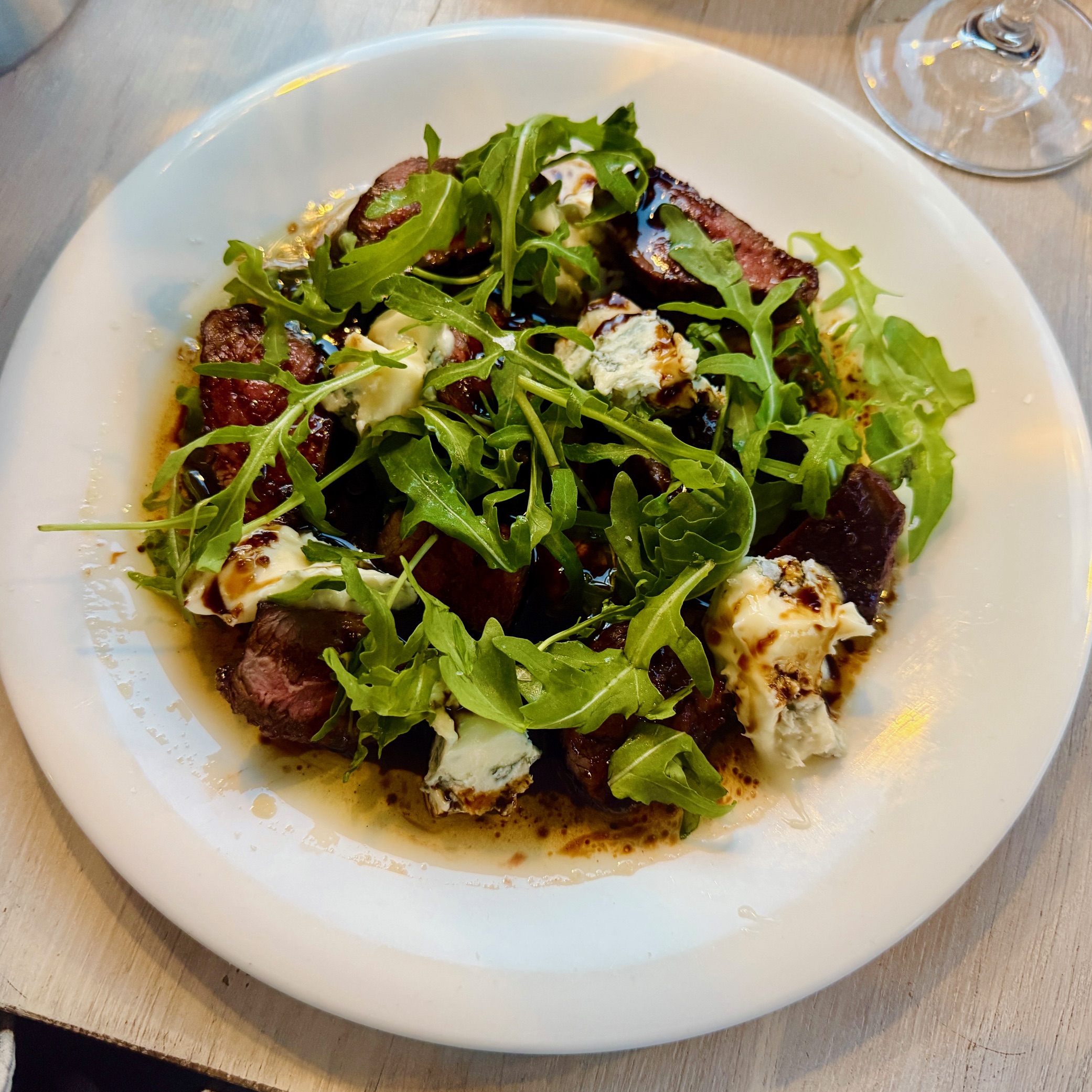
Zoë would argue that her main – just shy of thirty pounds, this one – was even better. Enormous, butter-soft pieces of venison came strewn with splodges of sweet Gorgonzola, the whole thing bathed in bone marrow butter and aged balsamic vinegar. Almost like a tagliata, if every single ingredient in it had been amped up to be its absolute best. Venison, so often at risk of being dry, is very rarely like this. The cheese was perfectly judged – so yes, there was salt and funk in there but not just that.

And again, the artistry of how to finish the dish was right on the money – adding the depth of the bone narrow and all the complexity that aged balsamic can bring to a dish. A bit of a theme here: RAGÙ always knows when to stop, but they don’t stop until a dish is just right, unequivocally on the money.

Now, you might look at that dish – brilliant though it is – and think this is another example of the phenomenon I observed earlier in the year at Gee’s, of being given salad in disguise. Because I’m a heathen, I might even agree with you on that, but we had a solution: more carbs (because heaven knows, the meal so far had been so lacking in them) in the form of patate schiaccate, boiled, crushed and fried potatoes which are a speciality of Calabria, or Trieste, depending on which Google result you believe.

I quite liked these, and that combination of boiling, bashing and frying made for sheer crunchy, crispy textural delight. I didn’t get masses of the rosemary or garlic, but when the potatoes have that many sharp, golden corners you overlook that completely, in my experience.

By this point, enjoying the last of our wine at our leisure, the restaurant was a calmer but equally lovely place to be. The best part of a couple of hours had passed since we took our seats, and the tables indoors had thinned out, although the terrace still hummed with a slightly more subdued energy. The sky was growing inky beyond the windows, and the staff were winding down slightly.

If anything I enjoyed watching the kitchen even more then than I had when they were busy and cooking: many writers better than me have tried to capture the camaraderie of a kitchen at many different periods in a restaurant’s day, using a variety of tools, but all I can say is that it seemed to me that I was looking at a brigade who genuinely liked one another, and that warmth and joie de vivre had permeated the whole evening. 

Service throughout my meal was brilliant, from all the people who looked after us, and it managed to nail the sweet spot where it was eager to please rather than oversolicitous, enthusiastic and informal rather than slapdash or chummy. After a series of meals that had disappointed me – both in Bristol and beyond, on duty and off – it was nice to be reminded: this is what it’s supposed to be like. A night like that can make you fall back in love with restaurants.

But there was time for one last thing to eat, accompanied by nectar of a glass of dark, sticky Recioto della Valpolicella in a very generous 100ml pour. Zoë, adhering to our unwritten law that if tiramisu is on a menu at least one of us needs to order it, lucked out with a delectable wodge of the stuff, carpet bombed with cocoa. It’s had a fair amount of attention online – the influencer I referred to earlier said it was “proper unruly” and “has got edges”, the latter of which is true of pretty much anything you eat, anywhere, ever. I’m sure he knew what he meant.

But yes, it was one of the best I’ve tried, and I’ve tried quite a lot. Influencer-speak described this tiramisu as “hit” with orange and nutmeg, which to the rest of us means it had orange and nutmeg in it. It didn’t bang, it didn’t slap – why are these half-wits always so drearily percussive about things? – but it was outstanding.

I, on the other hand, couldn’t resist the gelati. The two options were fior di latte gelato with aged balsamic or peach and basil sorbet, and I let you down by having two scoops of the former and none of the latter. But I couldn’t resist: I don’t think I’ve ever seen fior di latte gelato on a menu outside Italy, ice cream with the confidence to just taste of itself, no adjuncts or gimmicks, so I wanted to sample it.

I say that, but of course the adjunct was the balsamic vinegar, and it was transformational. Forget the humdrum pairing of having it with strawberries, forget tipping some Pedro Ximenez on your vanilla ice cream, this was the combination I’d been missing out on my whole life. You could try to recreate this at home, too, but everything you used would have to be unmistakably top notch, and I know that if I did it would fall short. Better to remember it here, this way, transcending sweet, salt, sour and savoury to create something that would persist in the memory.

I wish they’d brought it in a single bowl, mind you, rather than these two slightly bizarre individual portions. There, right at the end: something that looks like a criticism.

Our bill for two people – for all that food, a couple of aperitivi, an excellent bottle of wine and two glasses of dessert wine – came to just shy of two hundred and seventy pounds, including a 12.5% tip which was earned many times over. You may say that’s expensive. I say it’s exceptional value for what we had, and for an evening that I’ll remember as one of the best meals of this or any year. Only one dish – that venison – came in north of twenty pounds.

It’s funny seeing RAGÙ getting the attention that COR did not. For me, it feels like reading rave reviews of the sophomore album when you bought the debut (an experience, to be fair, I’ve also had more than once). But I’m delighted that Colsell and owners Karen and Mark Chapman are getting their moment in the sun, better late than never, because RAGÙ is as good a restaurant as you could hope to find. Despite being only a few months old, it already feels like a destination restaurant in the making.

Some people will prefer COR’s more spacious homeliness, many will make a beeline to RAGÙ for its more compact, more clamorous buzz. I can honestly say, though, that you wouldn’t go wrong with either, and you could read either’s menu and struggle mightily deciding what you could come to terms with leaving without eating. Such restaurants are rare, and any town is lucky to have one. A city with two, run by the same team, is fortunate indeed.

So it turns out a meal can redeem a holiday, after all.

RAGÙ – 9.5
Unit 25, Cargo 2, Museum Street, Bristol, BS1 6ZA
0117 9110218

https://www.ragurestaurant.com

Since January 2025, Edible Reading is partly supported by subscribers – click here if you want to read more about that, or click below to subscribe. By doing so you enable me to carry on doing what I do, and you also get access to subscriber only content. Whether you’re a subscriber or not, thanks for reading.

Restaurant review: Orwells, Shiplake

The exterior of Orwells

Writing about food – or, more specifically, writing about restaurants – is an enormous privilege. It costs money, and you need money to do it. It is absolutely no coincidence that most of the national broadsheet restaurant critics, nearly all men of course, are either descended from the aristocracy or other journalists. To the point where there isn’t much difference, to be honest: I heard Giles Coren described once as a “hereditary columnist” and, like my vague feelings of revulsion towards Coren, it has always stayed with me.

So how do people afford it? The most frequent route, for Instagrammers at least, is to accept free food in return for content. I’ve talked about that recently, so I won’t do it to death, but what surprises me is how little people on Instagram follow the ASA guidelines and declare things as #ADs or #gifted. Sometimes it’s down to ignorance, others down to wilful ignorance. Often it’s hard to tell. “I thought that was just a courtesy thing” said a content creator I swapped messages with recently. Err, well, how about giving your audience the courtesy of knowing that you didn’t pay for the food you just raved about?

“What if I went intending to pay and they wouldn’t let me?” he followed up, an oblique take on the eternal if a tree falls in the forest and there’s nobody around to hear it question. It doesn’t matter what you intended, it matters whether you put your hand in your pocket. I’m afraid it really is that simple.

But restaurant bloggers do this too, usually while criticising influencers and content creators, seemingly for the crime of being less subtle. They take free stuff all the time, and often don’t declare it either. They certainly wouldn’t break out the hashtags of shame, because that would let the cat out of the bag, so instead they resort to weasel words like “I didn’t see a bill”. Some restaurant bloggers are positively myopic where bills are concerned, but they still have good enough eyesight to say the food looks phenomenal. What are the chances?

But this is the problem: writing about food is an expensive business, so unless you are fantastically independently wealthy you need to find a way to keep doing it – whether that’s wealthy friends, or a patron, or in-laws you can stiff, or some other route. It’s why many restaurant bloggers drift into doing PR for restaurants they like on the side, so the line between the writer and the subject gets hopelessly blurred.

Again, I do kind of understand: I have made a few friends in the business since I started writing this blog (although, and this probably says something about my winning personality, not many) but I don’t review their restaurants. Stay in this game long enough though, and of course you risk compromising yourself. But what I don’t understand, given all the privilege entailed in being able to do this, is how little restaurant bloggers seem prepared to check or acknowledge their privilege.

Instead, you just get tin-eared humblebragging from people who aren’t even pretending to be relatable. “I eat out more often than you, so I know what I’m talking about” says one restaurant blogger who routinely promotes businesses he has worked for. “My lunch is better than yours” repeatedly boasts a second, who rarely sees a bill and appears to be about six months from a cirrhosis diagnosis. Classic car crash.

“I’m especially interested in submissions from writers who identify as working class” says a third, a double barrelled type who is currently in the twelfth week of a jaunt round Asia. Nice work, gang: keep on keeping it real!

So at this point, I should acknowledge my own privilege: I am extremely lucky that I can afford to do this, and very glad that I’ve never gone down the route of accepting free food from restaurants and reviewing it. At the start of this year, I asked if readers wanted to support the costs of what I do, and I was very fortunate that the response was positive. I said at the time that it would hopefully enable me to cover some of the costs of running this blog, and that it might allow me to write more, or different content. It has definitely done the former, and enabled me to get rid of ads on the blog, but what about the latter?

The reason I’m talking about this, today of all days, is because this week’s review is of Orwells, the widely acclaimed Shiplake restaurant that features in the Michelin guide, has received multiple accolades from the Good Food Guide and has been pursuing excellence for something like fifteen years. Its chef owners, married couple Ryan and Liam Simpson-Trotman, are regulars on James Martin’s ITV show Saturday Morning. It is probably the best, nearest restaurant I have never reviewed in nearly twelve years of doing this, and in honesty I would probably not have reviewed it if it wasn’t for the support this blog receives from subscribers.

That’s not to say that I couldn’t have afforded to, but I publish a review every week and in the old days, I could have reviewed two or three places, easily, with the money it would cost me to eat at Orwells. I try to cover a variety of places, at a variety of price points, and eating at Orwells would have scuppered that. So it has never made it to the top of my list – because I’m not one of those reviewers who “didn’t see a bill” – and it’s only now that I felt, on a Thursday night during a well-earned week off, that Zoë and I could hop in a taxi and head out to Binfield Heath to see what the fuss was about.

Incidentally, that’s also why this review is behind a paywall. It was made possible by people who subscribe to the blog, so being able to read it is the least they should get in return for their generous support. But also, be honest: if you’re thinking of going to Orwells and you want an opinion you can trust on whether it’s any good, you can afford to subscribe to this blog, for a month at least. If you can afford to eat at Orwells, you can afford that.

Subscribe to continue reading

Become a paid subscriber to get access to the rest of this post and other exclusive content.

Restaurant review: Paulette, Little Venice

Formosa Street, an enclave in Little Venice less than twenty minutes’ walk from Paddington Station, could be the platonic ideal of a London street. It has a little cafe, a chocolate shop, a ludicrously handsome Victorian pub with wood-panelled walls and glass compartments, with tiny doors linking them together. It has a little Italian restaurant that has been there thirty years, and a craft beer place two doors down, the past and the present coexisting cheerfully.

It doesn’t have a butcher, although there’s one just round the corner on Clifton Road. But tucked away seconds from the Tube station, one stop away from Paddington, a stone’s throw from the strikingly modernist St Saviour’s Church, it is a deeply pretty pocket of London that few people know about. If this was your neighbourhood, you would be very happy indeed. Of course, if this was your neighbourhood you would also be filthy rich.

I’ve frequented this part of the world, on and off, for many years. I think I ate in that Italian restaurant not long after it opened, and I’ve drunk in the handsome Victorian pub a fair few times. Just before lockdown, I tried out the craft beer place a couple of times, and I’ve admired the steeple of that modernist church on more occasions than I can recall. I am no closer to living there, or even pretending that I could do, but it’s nice to try to pretend.

Just before lockdown, five years ago, Zoë and I went for dinner at a small French restaurant on Formosa Street called Les Petits Gourmets. At the time, I had the idea of publishing some London reviews, of places close to Paddington, thinking they might be useful to people wanting somewhere good to eat before grabbing an off peak train home. And it might have been a good plan, if I hadn’t hatched it about a fortnight before people stopped taking trains in general, going to the office or indeed leaving their houses.

So I never wrote a review of Les Petits Gourmets, although that might have been for the best because it was small, eccentric and nuts. On arriving we were told that their oven had packed up, so we could have whatever we liked from the menu as long as it was something they could cook on the hob. The place was dark and atmospheric, our table tiny and cramped. Another table, weirdly shaped and right next to the bar, with a couple of high stools, was so bad that a couple came in, were offered the table, had a shouting match with the staff and stormed out.

I can’t remember anything about what I ate, but I do remember that. And I was tempted to publish a review, if only because it was so surreal, but what would have been the point? It was just a place you would never have heard of, and a review that wouldn’t have sent you rushing there, at a time when you couldn’t have rushed there anyway – even if, for whatever reason, a dingy spot with no working oven and some shocking tables was right up your alley.

I thought no more about Les Petits Gourmets, really, until last summer when I read a rave review in the Standard of a French restaurant in Little Venice called Paulette. I know that area, I thought. I wonder where it is? And then I checked the address, and thought Isn’t that where that weird French place used to be? And then I Googled some more and discovered that it was exactly where that used to be, and opened later in 2020. Les Petits Gourmets was an early casualty of the pandemic: perhaps the cost of fixing that oven was the final straw.

The review I read of Paulette made it sound like everything I had wanted its predecessor to be, so I made a booking there and on a drizzly Saturday morning I caught the train up into London, ready for a long overdue lunch with my cousin Luke, last seen as baffled as I was by supercool Haggerston spot Planque. Fun fact: both Planque and Paulette featured in Conde Nast Traveller‘s listicle last summer of London’s best on-trend French restaurants although, as we will see, they couldn’t be more different.

The walk from Paddington is a lovely one. You start out exiting the station right by the Paddington Basin and cross over it, right by the floating barge restaurants, walking past craft beer and pizza spots and impossibly spenny-looking modern apartment complexes. The route ducks under the grime and bustle of the Westway and then, suddenly, everything is beautiful: the streets widen and are flanked with gorgeous redbrick mansions, huge buildings made up of pinch-me-if-I-live-here flats. And then you’re at the canal, and you wonder how such a fetching residential area can be hiding in plain sight here, in Zone 1.

I stopped for a latte at the brilliant D1 Coffee, a stone’s throw from the waterway, and thought to myself that as usual I was trying to pass myself off as congruous in a neighbourhood far, far above my station. I chatted to the couple next to me about giving up smoking – something I did twenty years ago and still think of as one of my greatest achievements – and as we did, countless cosmopolitan types ambled past, walking dogs or just chatting happily. One was carrying a MUBI tote, and I wondered how it had happened that I’d wound up living in a postcode so far from my tribe. It’s almost as if I just hadn’t tried hard enough to make something of myself.

I got to Paulette before Luke did, and it was unrecognisable from the room I’d eaten unsuccessfully in five years before. Still eccentric, yes: all mismatched patterns on the walls and ceilings, mismatched cloths on the tables, mismatched light fittings, all maximalist and unashamed. But it was bright, cheery and welcoming. Even with the canary yellow awning out, light flooded in from the full length windows and all the tables were full of people who seemed profoundly happy with their life choices. I ordered a kir while I waited for my cousin, and it was sweet sunshine, a liquid escape from rainy London. Even noticing that the gorgeous Victorian boozer opposite was closed for renovations couldn’t dent my joie de vivre.

Nor could the discovery, when Luke turned up and ordered a Meteor Zero, that he was off the sauce. He explained that he’d bust his hip and that alcohol interfered with his rehabilitation regime: news to me, as I’ve always found Dr. Booze an invaluable consultant I’ve involved in my recovery from pretty much anything affecting me.

I thought it would bother Luke, a man who runs more marathons in a year than I’ve eaten Marathon bars in my lifetime, but he was surprisingly sanguine about it. “I figure everything goes through a fallow period” he told me later in the pub, showing a kind of Zen perspective I’d have loved to have twenty years ago when I was his age: come to think of it, I haven’t attained that mindset even now.

That meant that I had to forego the delights and dilemmas of choosing a bottle from the enormous wine list, seemingly covering all of France in compendious detail. But it wasn’t all bad – just under twenty wines were available by the glass, a great spread including half a dozen dispensed using a Coravin. I picked a Sancerre, which was terrific, and we started doing a bad job of making our choices from the menu and a much better job of catching up.

The menu was a tad lopsided, with about a dozen starters and half that of mains, but everything on there was tempting. Many of the things I’d read about in advance and hoped to encounter, like a Roscoff onion tarte tatin with mascarpone, were missing in action, but even so the challenge was very much what you missed out on, as much as what you picked. On another day you would have wound up hearing about the classic onion soup, the scallops or the halibut with sauce Meunière, but I will have to try them next time, assuming they haven’t been whipped off the menu by then.

As it was Luke and I agreed to share a few things to try and cover as much as we could, helped by pricing which encouraged you to try a bit of everything. Starters tended to be at or around the fifteen pound mark, with mains mostly between thirty and forty quid. But everything was so fabulous, and generous, that I didn’t object to that in the slightest.

We kicked off proceedings with a small selection of charcuterie, which was easily enough for both of us. All of it was marvellous, from the bresaola to the pork loin but especially the coppa, dried and intense, and a doozy of a jambon de Bayonne: again, dry and coarse, which very much said tiens ma bière to both Serrano and Parma ham. This came with bread (which should be a given but isn’t always), butter (which was a very welcome surprise) and, best of all, a ramekin containing a deeply acceptable quantity of sharp, tart cornichons.

Fourteen pounds for all that, and for a pound more our second starter was every bit as stellar. I love pâté en croute, and Paulette’s version was the best I’ve tried – a glorious slab of heaven, golden burnished pastry housing coarse pâté, shot through with dark prunes. On occasion I’ve had this kind of dish in Paris and it’s been painfully close to Pedigree Chum, but no such worries here: no dodgy jelly, just densely packed meat – pork and duck in this case – topped with yet more pickles and a quenelle of exceptional whole grain mustard. A very well-dressed salad completed an impeccable plate of food.

I wish I’d had one of these to myself, but to do that I’d have had to go without the charcuterie. This is the problem with sharing food, isn’t it: you always end up wanting twice as much of everything, everywhere, all at once. I was about to start a sentence with Next time, but I’ll try to stop myself or I’ll be doing it for the rest of the review. Truth be told, even by this point the only question in my mind was when exactly that next time would be. It was already a given that it would happen.

I gave Luke first pick of the main courses and, torn between the fillet of beef and the bourguignon, he eventually chose the latter. He chose extremely well. The pan brought to his table was a one-stop shop of pure happiness – a deep, reduced sauce full of wine and care, with a few waxy potatoes, plenty of mushrooms and a transverse beast of a carrot, heftily substantial and yet superbly cooked.

But of course, none of that gets top billing in the name of the dish, and this all comes down to the beef itself. I’m used to having this dish with shin or chuck, but Paulette opted for beef cheeks and, with hindsight, it was an inspired choice. The food writer Harry Eastwood once said that cheek was perfect for this dish as, in her words, “the meat surrenders completely”. I can’t improve on that description, so I’ve nicked it instead.

And it’s true, but only if the kitchen is absolutely on top of its game and the beef is braised to the point where any gelatinous quality is gone, replaced with that terrific stickiness where the beef and the sauce become a symbiotic dream team. That’s what had happened here, and it was a wondrous thing. Trying a forkful I thought back to my friend Graeme’s bourguignon at Côte the previous month, and the difference between good and great. The difference, it turns out, is nine quid and forty miles.

“This is the best French food I can remember eating” said Luke. I’m a relatively frequent visitor to France, but I could see what he meant.

If I had been Luke, I would have wished that I’d saved some bread to mop up that final layer of sauce coating the bottom of the pan. But if I’d been Luke he’d probably have a forty inch waist and far less success online dating and would get over the disappointment of busting his hip (which would be more likely to happen by, say, getting out of bed awkwardly) by medicating with the finest mid-price reds the restaurant had to offer. Instead I offered him some of my frites, and after refusing twice – he is Canadian after all, so awfully polite – he took me up on my offer.

I’ve seen quite a few reviews online talk about how Paulette does the capital’s best frites. They might or they might not: I’ve had nowhere near enough frites in London to be qualified to judge, but they were up there with the best frites I’ve had in this country or any other, irregular, golden, salted and decidedly moreish. They were so good I wasn’t sad that I didn’t get to try the gratin Dauphinois, and frites have to be pretty damned good for that to happen.

My frites accompanied my order from the specials board, duck breast cooked pink, sliced and served simply with a boat of what was described as a duck velouté, in practice one of those ultra-reduced, fantastically concentrated sauces that French cuisine seems to do better than almost anybody else.

I’ve had duck breast many, many times in my life and a lot of the time, afterwards, I wonder if I’m doing it because I think I should like it rather than because I do. It’s often a tad tough, a smidge fatty, somewhat poorly rested: much like me, most weekday mornings. This was more like me after a full day in Nirvana Spa, utterly relaxed, thoroughly cosseted, treated like a king.

The analogy breaks down at that point, because this duck was also enormously tasty and I imagine most people wouldn’t be able to get enough of it. But it was good while it lasted.

By this point I had moved on to a Saumur, which was perfect with the duck: Paulette has the sort of outstanding staff who will compliment you on each of your wine choices even though you’re the poor schmuck muddling your way through the list of wines by the glass.

Luke and I decided to eat as Frenchly as possible, which meant a cheese course and then some dessert: the wine list distinguishes, winningly, between “cheese wines” and “dessert wines” so I nabbed something from the former section, a 1986 Muscadet. I have no doubt the Coravin was involved here, and the result was stunning, an amber marvel with a hint of sherry sweetness, outstanding complexity and length. A 50ml pour, in this case, was plenty.

Paulette does a small or large assiette de fromages with three or five cheeses respectively, and they are in principle a deli too, so I did wonder whether you could pick which cheeses you had. When our server authoritatively told us you got a Comte, a truffled brie and a Saint Nectaire I realised this was a choice best left to the experts, so that’s what we had.

The picture here probably doesn’t fully convey this, but it was a generous wodge of each, easily enough to share without needing a scalpel and a protractor. They were all outstanding: the Comte with all the crystalline grit you would want, the Saint Nectaire, not a cheese I’d ever seek out, bringing a savoury depth to justify its seat at the table.

But the truffled brie – oh my goodness. Luke and I agreed that we shared a suspicion about truffle being brought out to zhuzh up the ordinary, but in this case it turned a gooey, creamy delight into a total showstopper. As with the charcuterie, this came with a generous helping of bread but once we had finished all of the bread and nearly all of the cheese the twinkliest of our servers returned with a couple more slices, urging us to use them to clean up the very last of the brie. We did as we were told.

Normally I would have a different dessert to my dining companion, but I figured we’d got through a decent range of dishes already and I’d seen the chocolate mousse being carried past to other tables and decided there was no way I was leaving without trying it. I mean, just look at it in the picture below: a stegosaurus of a thing, plump and shiny, with a spine of caramelised hazelnuts sitting in a pastel-green lake of pistachio crème Anglaise. How could I not order that? How could anybody?

And it tasted every bit as beautiful as it looked. By now I’m used to chocolate mousses in fancy Spanish places where they drizzle it with extra virgin olive oil and pop some salt crystals on top, the modish way to revamp a staple. But this had no interest in playing those tricks, so like everything else at Paulette it was a classic rendition of a classic dish, prepared by a kitchen that revered the classics.

Don’t get me wrong – there is a place for deconstructing, reconstructing and reinventing, and I’m a fan of those things as much as anyone. But whatever that place is it isn’t Paulette, I’m very glad to say. This was a dark, glossy miracle – so smooth, almost not aerated at all, and I wished every spoonful could have lasted hours. The final spoonful, as it always does with such dishes, came too soon, and I found myself wishing there was some sweet equivalent of bread I could use to mop up those last bits of crème Anglaise. Maybe that, rather than ruining burgers, is the point of brioche.

When you book lunch at Paulette you get that standard issue we want your table back in X hours gubbins that London restaurants so often do. But none of that happened here, and over three hours after I ordered that kir pretty much every table was occupied by somebody new despite it still being mid-afternoon, the evening service around the corner.

I’ve never understood restaurant reviewers who insist on eating at a place twice before writing a review – mainly because they need to get over themselves – but if I could have eaten at Paulette again that evening I would have seriously considered it. But the craft beer place a couple of doors down was calling to us, and the pub after that, so it was time to reluctantly pay for the wonderful time we had had. Our bill for two, all that food, a couple of beers for Luke and five different glasses of wine for me, came to just over two hundred and ten pounds, including a 13.5% service charge. It felt as much like a bargain as I suspect any meal will this year.

Later on, Luke and I were in the Bear, just around the corner from Paddington, having one last drink and comparing notes before going our separate ways.

“The only thing that stops it getting the highest mark, for me” said Luke, “was that it just lacked that thing that would make it a truly transcendental experience. That and the bread, I guess, the bread could have been better.”

I knew what Luke meant, but I also suspected that looking at Paulette that way missed an important point, which was that Paulette had no interest in being that kind of restaurant or delivering that kind of experience. It was more interested in transporting you completely by delivering something unfussy and unfancy but, in its way, truly outstanding. Paulette was about as good an example of this kind of restaurant as it’s possible to find, and I loved it. Absolutely loved it, unreservedly, from start to finish.

It’s twenty minutes from Paddington, and Paddington is thirty minutes from Reading. Just think about that: you could be at Reading station, and within an hour you could be eating in this place. If I don’t do so a couple more times this year, I will be extremely surprised, not to mention deeply disappointed. I know most of my London reviews, lately, have been of spots in the centre where you hop on the Elizabeth Line to get there, very much a tribute to the march of progress in the capital. But this? Simply timeless.

Paulette – 9.3
18 Formosa Street, London, W9 1EE
020 72862715

https://www.paulettelondon.com

As of January 2025, Edible Reading is partly supported by subscribers – click here if you want to read more about that, or click below to subscribe. Whether you’re a subscriber or not, thanks for reading.

Restaurant review: Lucky Lychee, Winchester

Even though Reading is my patch and always has been, I get asked for recommendations elsewhere fairly often. And my blog is more useful in that respect, I hope, than it used to be, with a number of reviews from beyond Berkshire and a series of European city guides you can consult to help with lunch, dinner or even coffee choices. I’m always encouraged when people tell me the city guides have come in handy: a friend told me a few weeks ago that she and her boyfriend were trying to pick somewhere for a holiday later in the year and she actually said “can’t we just go somewhere Edible Reading has been?” Few higher compliments exist.

Somewhat closer to home, I do like to have a few choice spots in my back pocket for the occasions when people ask for my help. If you want somewhere in London or Bristol, I can sort you out. Ditto Bath, Oxford, Exeter, even Swindon. But beyond that it gets sketchy. My last trips to Cardiff, Edinburgh and Glasgow were so long ago that I’d struggle to know what’s hot and what’s not these days; I could suggest somewhere, but it would be based on research rather than personal experience. And as for the likes of Manchester, Newcastle, Birmingham or Liverpool, forget it.

I’ve felt for a while, though, that Winchester was a gap in my repertoire that I ought to fix.

After all, it’s a lovely city, it’s a half hour train hop from Reading and it has plenty to do – excellent shopping, great coffee, good mooching opportunities, historic streets, pretty pubs and a gorgeous cathedral. For a long time my dining option of choice there was Michelin-starred pub the Black Rat, but the last time I went it really wasn’t great and when it subsequently lost its star I wasn’t hugely surprised. A couple of years ago it closed down, the owner citing spiralling energy bills.

And the last time I ate in Winchester it was at Rick Stein’s restaurant there, where I had a pleasant, well-mannered, expensive meal that felt a little like Hotel du Vin but ever so slightly better; Winchester has a Hotel du Vin of its own, which gives you some idea of the kind of place it is. But that was in January 2020, just before everything changed, and catching a whiffy, clapped-out Voyager train to Winchester last weekend I was struck that it had gone from being a city I knew moderately well to a passing acquaintance with whom I’d lost touch but was keen to reconnect.

I had a solo lunch reservation at Lucky Lychee, a restaurant which operated out of a Greene King pub called the Green Man, a fifteen minute walk from the train station and not far from the aforementioned Hotel du Vin. The brainchild of couple James Harris and Nicole Yeoh, it started out in street food and home delivery before getting a residency at another Winchester pub and then moving to the Green Man two years ago. Harris and Yeoh met in Malaysia, and their menu spans Malaysian, Thai and Chinese dishes.

I had discovered it through an Instagram post I stumbled on which was singing the praises of Lucky Lychee’s brunch roti wraps, a fusion of Malaysian and British food, and although the post was written by a person who used the word “sossidge”, there was something about the food that looked unmissable. Sometimes you can just look at a menu and suspect two things: first, that you’ll eat well, and secondly that you’ll find it impossible to decide exactly how you will eat well. Lucky Lychee’s menu was one of those, and I reached the front door of the pub with a heady blend of excitement and anticipation.

It helps that it’s such a handsome pub, all dark muted tones and wood panelling. The front room looked like a proper boozer, if a classy one, with high tables and sturdy leather-topped benches. Further through, near the fireplace, there were comfy booths and tastefully-upholstered sofas. But I was sat in what I imagine was the dining room, on a banquette, looking out on the whole thing, sunlight sneaking in through the windows. The table opposite me was occupied, with a couple making inroads into a tempting-looking lunch order, but otherwise it was pretty quiet. It was one o’clock on a Saturday not that far from payday. Had I made a mistake?

Not based on the looks of the menu, anyway. I actually think a weekend lunchtime might be the trickiest time to visit Lucky Lychee, because you have a selection of what are dubbed snacks but looked like starters and small plates, their lunch menu – a slimmed down version of their evening offering – and the brunch menu.

And that’s where it got really difficult. Because the lunch dishes – 8 hour rendang, tom yum king prawn fried rice and the like – looked extremely tempting. But it was the brunches that first drew me in and that selection was calling to me every bit as much. The idea of curry sausages and fennel cured smoked collar bacon, bound up in a flaky roti wrap with lime mayo and sweet chilli sauce sounded too good to miss. A great hangover cure too, and after a couple of bottles of red with my friend Jerry the night before it sounded just the ticket. What to do?

In the end I decided to postpone the decision by ordering snacks and seeing how I felt after that. But first I ordered a drink. Lucky Lychee boasts a fascinating range of low intervention wines, but postponing the hair of the dog for the time being I decided to try an iced Milo, allegedly a popular chocolate malt drink in Malaysia. It was nice enough, though the ice took some time to get the overall experience below lukewarm. Perhaps the glass was straight out of the dishwasher: either way, it may well have been thoroughly authentic but I couldn’t shake the feeling that I’d just spent four pounds fifty on a Nesquik.

That was the last – the only – misfire of the entire meal, and everything after that was so terrific as to render it insignificant. Chicken karaage was a decent portion for eight pounds fifty, and if it ever so slightly lacked crunch, the flavour that had permeated the chicken thighs, from soy, oyster sauce and rice wine, more than made up for it.

Mayo is a frequent accompaniment for karaage but rarely is it anywhere near as good as Lucky Lychee’s, which was positively awash with citrus. I kept going back and forward between this and my second small plate, trying to figure out which I liked the best.

I think though, on balance, the second small plate was ever better. Billed as Penang pork spring rolls it was really nothing of the kind. I mean, technically it was, but the ratio of dense, delicious meat to wafer-thin, greaseless pastry made it something closer to a sausage roll (or, if you’re three, “sossidge roll”) that was all sausage and no roll.

But that’s not all, because the meat was beautiful – shot through with tiny dice of carrot and, I think, spring onion. The menu said that it was marinated in a 10 spice powder and I could well believe it, because I’m not sure I’ve ever had anything like it.

I’m conscious that this is my third solo review in a row – and yes, I might be auditioning for some additional dining companions. It meant I ordered slightly more food than I strictly needed, to try and give the menu a fair run out. But I was as pleased as Punch not to have to share these spring rolls with any other fucker. They were mine and mine alone, and it was a beautiful moment.

My server, who was downright lovely throughout, gave me a little time after my starters were cleared to make my decision. As I mulled it over, I ordered a glass of white wine, a German riesling which turned out to have plenty of zip and pith, and a little honey. And the more I thought about it, the more I couldn’t decide: brunch or lunch? Buttery roti or something with rice?

It wasn’t easy but in the end, believe it or not, I was thinking of you lot. I decided you’d find an idea of Lucky Lychee’s dinner and lunch options more useful than a brunch, however good. So I forwent that roti stuffed with good things, and decided that if I walked away disappointed it was all your fault.

Gladly, nothing was your fault and my main course was one of the most enjoyable things I’ve eaten all year. Billed as honey Marmite chicken, it wasn’t a combination I’d ever considered or even heard of, although a Google suggests that it is indeed a dish eaten in China and Malaysia. But honestly, it was such a phenomenal combination. The chicken, thigh again, was in a crispy, craggy coating, studded with sesame seeds, and it had all the textural interest that the karaage had only just failed to bring to the table. But what made this dish, and made it one I’ve thought about many times since, was the sauce.

What a sauce! You might not like Marmite, you might not like honey – for what it’s worth I love both of them – but this sauce from Lucky Lychee managed to completely transcend either Marmite or honey, being infinitely more than the sum of those things. So you had the huge, salty savoury depth that came from the Marmite (and, apparently, a bit of oyster sauce) and the almost smoky sweetness from the honey, dovetailing and transforming in a way that was nothing less than magical.

Add in some just-cooked peppers and a sprinkling of peanuts and you had one of the most intensely moreish dishes I’ve eaten in well over a year. Put it this way – last month I ate at Kolae, one of the most hyped restaurants in London right now, and I had some of the most fascinating dishes I’ve sampled in a long old time. But nothing there matched the joyousness of this honey Marmite chicken.

I spooned, and then scraped, every last bit of sauce onto my fluffy jasmine rice, I cleaned my plate as best I could without abandoning decorum, and I wondered when I could eat this dish again. I love fried chicken, which ultimately this dish was, but I couldn’t remember trying anything quite like it.

By this point I was gratified to see that a few more people had taken tables in the pub. A young couple came in, him with a London Review Of Books canvas tote, her with one bearing the logo of Shakespeare & Co, the legendary bohemian Paris bookshop, and took the table near the window that had been occupied by others when I came in. I smiled at them – I’m not sure when I reached the age where I’m twinkly and avuncular, but sadly that point has come – and then I peeked nosily as they ordered from the brunch menu.

One of them had ordered a roti that was served absolutely stuffed with beef rendang, and as I saw it come to the table I realised there was nothing for it: I was just going to have to return, sooner rather than later. I realised my mistake hadn’t been to order lunch instead of brunch, it had been not to order brunch, find some excuse to loiter around Winchester for five hours and then go back for dinner. Never mind – I was already planning multiple return visits, with a pretty good idea of at least one person, miffed to have missed out on this trip, who would insist on trying it out.

Lucky Lychee does have a dessert menu, but on this occasion it didn’t have enough to tempt me. It’s mostly ice cream and affogato, with just two more interesting options – a banana spring roll and a piña colada crème brûlée. I had it mind to possibly grab an ice cream from Chococo, across town, so I decided to settle up and amble to Coffee Lab for a latte. My bill came to just under forty-eight pounds, not including tip. The most expensive thing I had was the honey Marmite chicken, which was under fifteen pounds. It would be hard, I think, to spend fifty pounds on lunch better than this.

As you’ve probably gathered, I truly adored Lucky Lychee. And weirdly, just as with Bombay Brothers last week, I came away feeling that I hadn’t seen the restaurant at its absolute best. With Bombay Brothers that was driven by a faint hope that surely it could be better than that, but with Lucky Lychee it was more an awareness that, phenomenal though my meal was, I suspected they were capable of even more.

I need to go back – to try the brunch menu, to work my way through the other snacks, the curry puffs and sesame prawn toasts, and to try the full gamut of their main courses at dinner time. Char siu with honey rhubarb glaze has my name on it, as does the Guinness chicken with lychees. And that rendang.

Who am I kidding? I want to try all of it – and rarely have I come away from a restaurant so simultaneously delighted with everything I had and frustrated that I wasn’t able to polish off more. The other thing I kept thinking was that this is a restaurant operating out of a Greene King pub. So I cast my mind over all of Reading’s Greene King pubs – the Roebuck, the Palmer Tavern, the Outlook and so on – and thought how sad it was that none of them had done anything this bold. Another one to chalk up under I wish Reading had something like this.

Don’t get me wrong, its closest equivalent is the Moderation, a fine pub. But Lucky Lychee was properly next level stuff. As so often, going away from Reading reminds you of the things Reading is still missing. Maybe we’ll get a top notch Malaysian restaurant at some point, but I’m not holding my breath. On the plus side, I now have somewhere to recommend whenever anybody asks me where’s good in Winchester. But this is the drawback: how am I ever going to review anywhere else in the city, if it means missing out on eating at Lucky Lychee?

Lucky Lychee – 9.0
The Green Man, 53 Southgate St, Winchester, SO23 9EH

https://www.luckylychee.uk