Writing about food – or, more specifically, writing about restaurants – is an enormous privilege. It costs money, and you need money to do it. It is absolutely no coincidence that most of the national broadsheet restaurant critics, nearly all men of course, are either descended from the aristocracy or other journalists. To the point where there isn’t much difference, to be honest: I heard Giles Coren described once as a “hereditary columnist” and, like my vague feelings of revulsion towards Coren, it has always stayed with me.
So how do people afford it? The most frequent route, for Instagrammers at least, is to accept free food in return for content. I’ve talked about that recently, so I won’t do it to death, but what surprises me is how little people on Instagram follow the ASA guidelines and declare things as #ADs or #gifted. Sometimes it’s down to ignorance, others down to wilful ignorance. Often it’s hard to tell. “I thought that was just a courtesy thing” said a content creator I swapped messages with recently. Err, well, how about giving your audience the courtesy of knowing that you didn’t pay for the food you just raved about?
“What if I went intending to pay and they wouldn’t let me?” he followed up, an oblique take on the eternal if a tree falls in the forest and there’s nobody around to hear it question. It doesn’t matter what you intended, it matters whether you put your hand in your pocket. I’m afraid it really is that simple.
But restaurant bloggers do this too, usually while criticising influencers and content creators, seemingly for the crime of being less subtle. They take free stuff all the time, and often don’t declare it either. They certainly wouldn’t break out the hashtags of shame, because that would let the cat out of the bag, so instead they resort to weasel words like “I didn’t see a bill”. Some restaurant bloggers are positively myopic where bills are concerned, but they still have good enough eyesight to say the food looks phenomenal. What are the chances?
But this is the problem: writing about food is an expensive business, so unless you are fantastically independently wealthy you need to find a way to keep doing it – whether that’s wealthy friends, or a patron, or in-laws you can stiff, or some other route. It’s why many restaurant bloggers drift into doing PR for restaurants they like on the side, so the line between the writer and the subject gets hopelessly blurred.
Again, I do kind of understand: I have made a few friends in the business since I started writing this blog (although, and this probably says something about my winning personality, not many) but I don’t review their restaurants. Stay in this game long enough though, and of course you risk compromising yourself. But what I don’t understand, given all the privilege entailed in being able to do this, is how little restaurant bloggers seem prepared to check or acknowledge their privilege.
Instead, you just get tin-eared humblebragging from people who aren’t even pretending to be relatable. “I eat out more often than you, so I know what I’m talking about” says one restaurant blogger who routinely promotes businesses he has worked for. “My lunch is better than yours” repeatedly boasts a second, who rarely sees a bill and appears to be about six months from a cirrhosis diagnosis. Classic car crash.
“I’m especially interested in submissions from writers who identify as working class” says a third, a double barrelled type who is currently in the twelfth week of a jaunt round Asia. Nice work, gang: keep on keeping it real!
So at this point, I should acknowledge my own privilege: I am extremely lucky that I can afford to do this, and very glad that I’ve never gone down the route of accepting free food from restaurants and reviewing it. At the start of this year, I asked if readers wanted to support the costs of what I do, and I was very fortunate that the response was positive. I said at the time that it would hopefully enable me to cover some of the costs of running this blog, and that it might allow me to write more, or different content. It has definitely done the former, and enabled me to get rid of ads on the blog, but what about the latter?
The reason I’m talking about this, today of all days, is because this week’s review is of Orwells, the widely acclaimed Shiplake restaurant that features in the Michelin guide, has received multiple accolades from the Good Food Guide and has been pursuing excellence for something like fifteen years. Its chef owners, married couple Ryan and Liam Simpson-Trotman, are regulars on James Martin’s ITV show Saturday Morning. It is probably the best, nearest restaurant I have never reviewed in nearly twelve years of doing this, and in honesty I would probably not have reviewed it if it wasn’t for the support this blog receives from subscribers.
That’s not to say that I couldn’t have afforded to, but I publish a review every week and in the old days, I could have reviewed two or three places, easily, with the money it would cost me to eat at Orwells. I try to cover a variety of places, at a variety of price points, and eating at Orwells would have scuppered that. So it has never made it to the top of my list – because I’m not one of those reviewers who “didn’t see a bill” – and it’s only now that I felt, on a Thursday night during a well-earned week off, that Zoë and I could hop in a taxi and head out to Binfield Heath to see what the fuss was about.
Incidentally, that’s also why this review is behind a paywall. It was made possible by people who subscribe to the blog, so being able to read it is the least they should get in return for their generous support. But also, be honest: if you’re thinking of going to Orwells and you want an opinion you can trust on whether it’s any good, you can afford to subscribe to this blog, for a month at least. If you can afford to eat at Orwells, you can afford that.
Subscribe to continue reading
Become a paid subscriber to get access to the rest of this post and other exclusive content.
Formosa Street, an enclave in Little Venice less than twenty minutes’ walk from Paddington Station, could be the platonic ideal of a London street. It has a little cafe, a chocolate shop, a ludicrously handsome Victorian pub with wood-panelled walls and glass compartments, with tiny doors linking them together. It has a little Italian restaurant that has been there thirty years, and a craft beer place two doors down, the past and the present coexisting cheerfully.
It doesn’t have a butcher, although there’s one just round the corner on Clifton Road. But tucked away seconds from the Tube station, one stop away from Paddington, a stone’s throw from the strikingly modernist St Saviour’s Church, it is a deeply pretty pocket of London that few people know about. If this was your neighbourhood, you would be very happy indeed. Of course, if this was your neighbourhood you would also be filthy rich.
I’ve frequented this part of the world, on and off, for many years. I think I ate in that Italian restaurant not long after it opened, and I’ve drunk in the handsome Victorian pub a fair few times. Just before lockdown, I tried out the craft beer place a couple of times, and I’ve admired the steeple of that modernist church on more occasions than I can recall. I am no closer to living there, or even pretending that I could do, but it’s nice to try to pretend.
Just before lockdown, five years ago, Zoë and I went for dinner at a small French restaurant on Formosa Street called Les Petits Gourmets. At the time, I had the idea of publishing some London reviews, of places close to Paddington, thinking they might be useful to people wanting somewhere good to eat before grabbing an off peak train home. And it might have been a good plan, if I hadn’t hatched it about a fortnight before people stopped taking trains in general, going to the office or indeed leaving their houses.
So I never wrote a review of Les Petits Gourmets, although that might have been for the best because it was small, eccentric and nuts. On arriving we were told that their oven had packed up, so we could have whatever we liked from the menu as long as it was something they could cook on the hob. The place was dark and atmospheric, our table tiny and cramped. Another table, weirdly shaped and right next to the bar, with a couple of high stools, was so bad that a couple came in, were offered the table, had a shouting match with the staff and stormed out.
I can’t remember anything about what I ate, but I do remember that. And I was tempted to publish a review, if only because it was so surreal, but what would have been the point? It was just a place you would never have heard of, and a review that wouldn’t have sent you rushing there, at a time when you couldn’t have rushed there anyway – even if, for whatever reason, a dingy spot with no working oven and some shocking tables was right up your alley.
I thought no more about Les Petits Gourmets, really, until last summer when I read a rave review in the Standard of a French restaurant in Little Venice called Paulette. I know that area, I thought. I wonder where it is? And then I checked the address, and thought Isn’t that where that weird French place used to be? And then I Googled some more and discovered that it was exactly where that used to be, and opened later in 2020. Les Petits Gourmets was an early casualty of the pandemic: perhaps the cost of fixing that oven was the final straw.
The review I read of Paulette made it sound like everything I had wanted its predecessor to be, so I made a booking there and on a drizzly Saturday morning I caught the train up into London, ready for a long overdue lunch with my cousin Luke, last seen as baffled as I was by supercool Haggerston spot Planque. Fun fact: both Planque and Paulette featured in Conde Nast Traveller‘s listicle last summer of London’s best on-trend French restaurants although, as we will see, they couldn’t be more different.
The walk from Paddington is a lovely one. You start out exiting the station right by the Paddington Basin and cross over it, right by the floating barge restaurants, walking past craft beer and pizza spots and impossibly spenny-looking modern apartment complexes. The route ducks under the grime and bustle of the Westway and then, suddenly, everything is beautiful: the streets widen and are flanked with gorgeous redbrick mansions, huge buildings made up of pinch-me-if-I-live-here flats. And then you’re at the canal, and you wonder how such a fetching residential area can be hiding in plain sight here, in Zone 1.
I stopped for a latte at the brilliant D1 Coffee, a stone’s throw from the waterway, and thought to myself that as usual I was trying to pass myself off as congruous in a neighbourhood far, far above my station. I chatted to the couple next to me about giving up smoking – something I did twenty years ago and still think of as one of my greatest achievements – and as we did, countless cosmopolitan types ambled past, walking dogs or just chatting happily. One was carrying a MUBI tote, and I wondered how it had happened that I’d wound up living in a postcode so far from my tribe. It’s almost as if I just hadn’t tried hard enough to make something of myself.
I got to Paulette before Luke did, and it was unrecognisable from the room I’d eaten unsuccessfully in five years before. Still eccentric, yes: all mismatched patterns on the walls and ceilings, mismatched cloths on the tables, mismatched light fittings, all maximalist and unashamed. But it was bright, cheery and welcoming. Even with the canary yellow awning out, light flooded in from the full length windows and all the tables were full of people who seemed profoundly happy with their life choices. I ordered a kir while I waited for my cousin, and it was sweet sunshine, a liquid escape from rainy London. Even noticing that the gorgeous Victorian boozer opposite was closed for renovations couldn’t dent my joie de vivre.
Nor could the discovery, when Luke turned up and ordered a Meteor Zero, that he was off the sauce. He explained that he’d bust his hip and that alcohol interfered with his rehabilitation regime: news to me, as I’ve always found Dr. Booze an invaluable consultant I’ve involved in my recovery from pretty much anything affecting me.
I thought it would bother Luke, a man who runs more marathons in a year than I’ve eaten Marathon bars in my lifetime, but he was surprisingly sanguine about it. “I figure everything goes through a fallow period” he told me later in the pub, showing a kind of Zen perspective I’d have loved to have twenty years ago when I was his age: come to think of it, I haven’t attained that mindset even now.
That meant that I had to forego the delights and dilemmas of choosing a bottle from the enormous wine list, seemingly covering all of France in compendious detail. But it wasn’t all bad – just under twenty wines were available by the glass, a great spread including half a dozen dispensed using a Coravin. I picked a Sancerre, which was terrific, and we started doing a bad job of making our choices from the menu and a much better job of catching up.
The menu was a tad lopsided, with about a dozen starters and half that of mains, but everything on there was tempting. Many of the things I’d read about in advance and hoped to encounter, like a Roscoff onion tarte tatin with mascarpone, were missing in action, but even so the challenge was very much what you missed out on, as much as what you picked. On another day you would have wound up hearing about the classic onion soup, the scallops or the halibut with sauce Meunière, but I will have to try them next time, assuming they haven’t been whipped off the menu by then.
As it was Luke and I agreed to share a few things to try and cover as much as we could, helped by pricing which encouraged you to try a bit of everything. Starters tended to be at or around the fifteen pound mark, with mains mostly between thirty and forty quid. But everything was so fabulous, and generous, that I didn’t object to that in the slightest.
We kicked off proceedings with a small selection of charcuterie, which was easily enough for both of us. All of it was marvellous, from the bresaola to the pork loin but especially the coppa, dried and intense, and a doozy of a jambon de Bayonne: again, dry and coarse, which very much said tiens ma bière to both Serrano and Parma ham. This came with bread (which should be a given but isn’t always), butter (which was a very welcome surprise) and, best of all, a ramekin containing a deeply acceptable quantity of sharp, tart cornichons.
Fourteen pounds for all that, and for a pound more our second starter was every bit as stellar. I love pâté en croute, and Paulette’s version was the best I’ve tried – a glorious slab of heaven, golden burnished pastry housing coarse pâté, shot through with dark prunes. On occasion I’ve had this kind of dish in Paris and it’s been painfully close to Pedigree Chum, but no such worries here: no dodgy jelly, just densely packed meat – pork and duck in this case – topped with yet more pickles and a quenelle of exceptional whole grain mustard. A very well-dressed salad completed an impeccable plate of food.
I wish I’d had one of these to myself, but to do that I’d have had to go without the charcuterie. This is the problem with sharing food, isn’t it: you always end up wanting twice as much of everything, everywhere, all at once. I was about to start a sentence with Next time, but I’ll try to stop myself or I’ll be doing it for the rest of the review. Truth be told, even by this point the only question in my mind was when exactly that next time would be. It was already a given that it would happen.
I gave Luke first pick of the main courses and, torn between the fillet of beef and the bourguignon, he eventually chose the latter. He chose extremely well. The pan brought to his table was a one-stop shop of pure happiness – a deep, reduced sauce full of wine and care, with a few waxy potatoes, plenty of mushrooms and a transverse beast of a carrot, heftily substantial and yet superbly cooked.
But of course, none of that gets top billing in the name of the dish, and this all comes down to the beef itself. I’m used to having this dish with shin or chuck, but Paulette opted for beef cheeks and, with hindsight, it was an inspired choice. The food writer Harry Eastwood once said that cheek was perfect for this dish as, in her words, “the meat surrenders completely”. I can’t improve on that description, so I’ve nicked it instead.
And it’s true, but only if the kitchen is absolutely on top of its game and the beef is braised to the point where any gelatinous quality is gone, replaced with that terrific stickiness where the beef and the sauce become a symbiotic dream team. That’s what had happened here, and it was a wondrous thing. Trying a forkful I thought back to my friend Graeme’s bourguignon at Côte the previous month, and the difference between good and great. The difference, it turns out, is nine quid and forty miles.
“This is the best French food I can remember eating” said Luke. I’m a relatively frequent visitor to France, but I could see what he meant.
If I had been Luke, I would have wished that I’d saved some bread to mop up that final layer of sauce coating the bottom of the pan. But if I’d been Luke he’d probably have a forty inch waist and far less success online dating and would get over the disappointment of busting his hip (which would be more likely to happen by, say, getting out of bed awkwardly) by medicating with the finest mid-price reds the restaurant had to offer. Instead I offered him some of my frites, and after refusing twice – he is Canadian after all, so awfully polite – he took me up on my offer.
I’ve seen quite a few reviews online talk about how Paulette does the capital’s best frites. They might or they might not: I’ve had nowhere near enough frites in London to be qualified to judge, but they were up there with the best frites I’ve had in this country or any other, irregular, golden, salted and decidedly moreish. They were so good I wasn’t sad that I didn’t get to try the gratin Dauphinois, and frites have to be pretty damned good for that to happen.
My frites accompanied my order from the specials board, duck breast cooked pink, sliced and served simply with a boat of what was described as a duck velouté, in practice one of those ultra-reduced, fantastically concentrated sauces that French cuisine seems to do better than almost anybody else.
I’ve had duck breast many, many times in my life and a lot of the time, afterwards, I wonder if I’m doing it because I think I should like it rather than because I do. It’s often a tad tough, a smidge fatty, somewhat poorly rested: much like me, most weekday mornings. This was more like me after a full day in Nirvana Spa, utterly relaxed, thoroughly cosseted, treated like a king.
The analogy breaks down at that point, because this duck was also enormously tasty and I imagine most people wouldn’t be able to get enough of it. But it was good while it lasted.
By this point I had moved on to a Saumur, which was perfect with the duck: Paulette has the sort of outstanding staff who will compliment you on each of your wine choices even though you’re the poor schmuck muddling your way through the list of wines by the glass.
Luke and I decided to eat as Frenchly as possible, which meant a cheese course and then some dessert: the wine list distinguishes, winningly, between “cheese wines” and “dessert wines” so I nabbed something from the former section, a 1986 Muscadet. I have no doubt the Coravin was involved here, and the result was stunning, an amber marvel with a hint of sherry sweetness, outstanding complexity and length. A 50ml pour, in this case, was plenty.
Paulette does a small or large assiette de fromages with three or five cheeses respectively, and they are in principle a deli too, so I did wonder whether you could pick which cheeses you had. When our server authoritatively told us you got a Comte, a truffled brie and a Saint Nectaire I realised this was a choice best left to the experts, so that’s what we had.
The picture here probably doesn’t fully convey this, but it was a generous wodge of each, easily enough to share without needing a scalpel and a protractor. They were all outstanding: the Comte with all the crystalline grit you would want, the Saint Nectaire, not a cheese I’d ever seek out, bringing a savoury depth to justify its seat at the table.
But the truffled brie – oh my goodness. Luke and I agreed that we shared a suspicion about truffle being brought out to zhuzh up the ordinary, but in this case it turned a gooey, creamy delight into a total showstopper. As with the charcuterie, this came with a generous helping of bread but once we had finished all of the bread and nearly all of the cheese the twinkliest of our servers returned with a couple more slices, urging us to use them to clean up the very last of the brie. We did as we were told.
Normally I would have a different dessert to my dining companion, but I figured we’d got through a decent range of dishes already and I’d seen the chocolate mousse being carried past to other tables and decided there was no way I was leaving without trying it. I mean, just look at it in the picture below: a stegosaurus of a thing, plump and shiny, with a spine of caramelised hazelnuts sitting in a pastel-green lake of pistachio crème Anglaise. How could I not order that? How could anybody?
And it tasted every bit as beautiful as it looked. By now I’m used to chocolate mousses in fancy Spanish places where they drizzle it with extra virgin olive oil and pop some salt crystals on top, the modish way to revamp a staple. But this had no interest in playing those tricks, so like everything else at Paulette it was a classic rendition of a classic dish, prepared by a kitchen that revered the classics.
Don’t get me wrong – there is a place for deconstructing, reconstructing and reinventing, and I’m a fan of those things as much as anyone. But whatever that place is it isn’t Paulette, I’m very glad to say. This was a dark, glossy miracle – so smooth, almost not aerated at all, and I wished every spoonful could have lasted hours. The final spoonful, as it always does with such dishes, came too soon, and I found myself wishing there was some sweet equivalent of bread I could use to mop up those last bits of crème Anglaise. Maybe that, rather than ruining burgers, is the point of brioche.
When you book lunch at Paulette you get that standard issue we want your table back in X hours gubbins that London restaurants so often do. But none of that happened here, and over three hours after I ordered that kir pretty much every table was occupied by somebody new despite it still being mid-afternoon, the evening service around the corner.
I’ve never understood restaurant reviewers who insist on eating at a place twice before writing a review – mainly because they need to get over themselves – but if I could have eaten at Paulette again that evening I would have seriously considered it. But the craft beer place a couple of doors down was calling to us, and the pub after that, so it was time to reluctantly pay for the wonderful time we had had. Our bill for two, all that food, a couple of beers for Luke and five different glasses of wine for me, came to just over two hundred and ten pounds, including a 13.5% service charge. It felt as much like a bargain as I suspect any meal will this year.
Later on, Luke and I were in the Bear, just around the corner from Paddington, having one last drink and comparing notes before going our separate ways.
“The only thing that stops it getting the highest mark, for me” said Luke, “was that it just lacked that thing that would make it a truly transcendental experience. That and the bread, I guess, the bread could have been better.”
I knew what Luke meant, but I also suspected that looking at Paulette that way missed an important point, which was that Paulette had no interest in being that kind of restaurant or delivering that kind of experience. It was more interested in transporting you completely by delivering something unfussy and unfancy but, in its way, truly outstanding. Paulette was about as good an example of this kind of restaurant as it’s possible to find, and I loved it. Absolutely loved it, unreservedly, from start to finish.
It’s twenty minutes from Paddington, and Paddington is thirty minutes from Reading. Just think about that: you could be at Reading station, and within an hour you could be eating in this place. If I don’t do so a couple more times this year, I will be extremely surprised, not to mention deeply disappointed. I know most of my London reviews, lately, have been of spots in the centre where you hop on the Elizabeth Line to get there, very much a tribute to the march of progress in the capital. But this? Simply timeless.
As of January 2025, Edible Reading is partly supported by subscribers – click here if you want to read more about that, or click below to subscribe. Whether you’re a subscriber or not, thanks for reading.
Even though Reading is my patch and always has been, I get asked for recommendations elsewhere fairly often. And my blog is more useful in that respect, I hope, than it used to be, with a number of reviews from beyond Berkshire and a series of European city guides you can consult to help with lunch, dinner or even coffee choices. I’m always encouraged when people tell me the city guides have come in handy: a friend told me a few weeks ago that she and her boyfriend were trying to pick somewhere for a holiday later in the year and she actually said “can’t we just go somewhere Edible Reading has been?” Few higher compliments exist.
Somewhat closer to home, I do like to have a few choice spots in my back pocket for the occasions when people ask for my help. If you want somewhere in London or Bristol, I can sort you out. Ditto Bath, Oxford, Exeter, even Swindon. But beyond that it gets sketchy. My last trips to Cardiff, Edinburgh and Glasgow were so long ago that I’d struggle to know what’s hot and what’s not these days; I could suggest somewhere, but it would be based on research rather than personal experience. And as for the likes of Manchester, Newcastle, Birmingham or Liverpool, forget it.
I’ve felt for a while, though, that Winchester was a gap in my repertoire that I ought to fix.
After all, it’s a lovely city, it’s a half hour train hop from Reading and it has plenty to do – excellent shopping, great coffee, good mooching opportunities, historic streets, pretty pubs and a gorgeous cathedral. For a long time my dining option of choice there was Michelin-starred pub the Black Rat, but the last time I went it really wasn’t great and when it subsequently lost its star I wasn’t hugely surprised. A couple of years ago it closed down, the owner citing spiralling energy bills.
And the last time I ate in Winchester it was at Rick Stein’s restaurant there, where I had a pleasant, well-mannered, expensive meal that felt a little like Hotel du Vin but ever so slightly better; Winchester has a Hotel du Vin of its own, which gives you some idea of the kind of place it is. But that was in January 2020, just before everything changed, and catching a whiffy, clapped-out Voyager train to Winchester last weekend I was struck that it had gone from being a city I knew moderately well to a passing acquaintance with whom I’d lost touch but was keen to reconnect.
I had a solo lunch reservation at Lucky Lychee, a restaurant which operated out of a Greene King pub called the Green Man, a fifteen minute walk from the train station and not far from the aforementioned Hotel du Vin. The brainchild of couple James Harris and Nicole Yeoh, it started out in street food and home delivery before getting a residency at another Winchester pub and then moving to the Green Man two years ago. Harris and Yeoh met in Malaysia, and their menu spans Malaysian, Thai and Chinese dishes.
I had discovered it through an Instagram post I stumbled on which was singing the praises of Lucky Lychee’s brunch roti wraps, a fusion of Malaysian and British food, and although the post was written by a person who used the word “sossidge”, there was something about the food that looked unmissable. Sometimes you can just look at a menu and suspect two things: first, that you’ll eat well, and secondly that you’ll find it impossible to decide exactly how you will eat well. Lucky Lychee’s menu was one of those, and I reached the front door of the pub with a heady blend of excitement and anticipation.
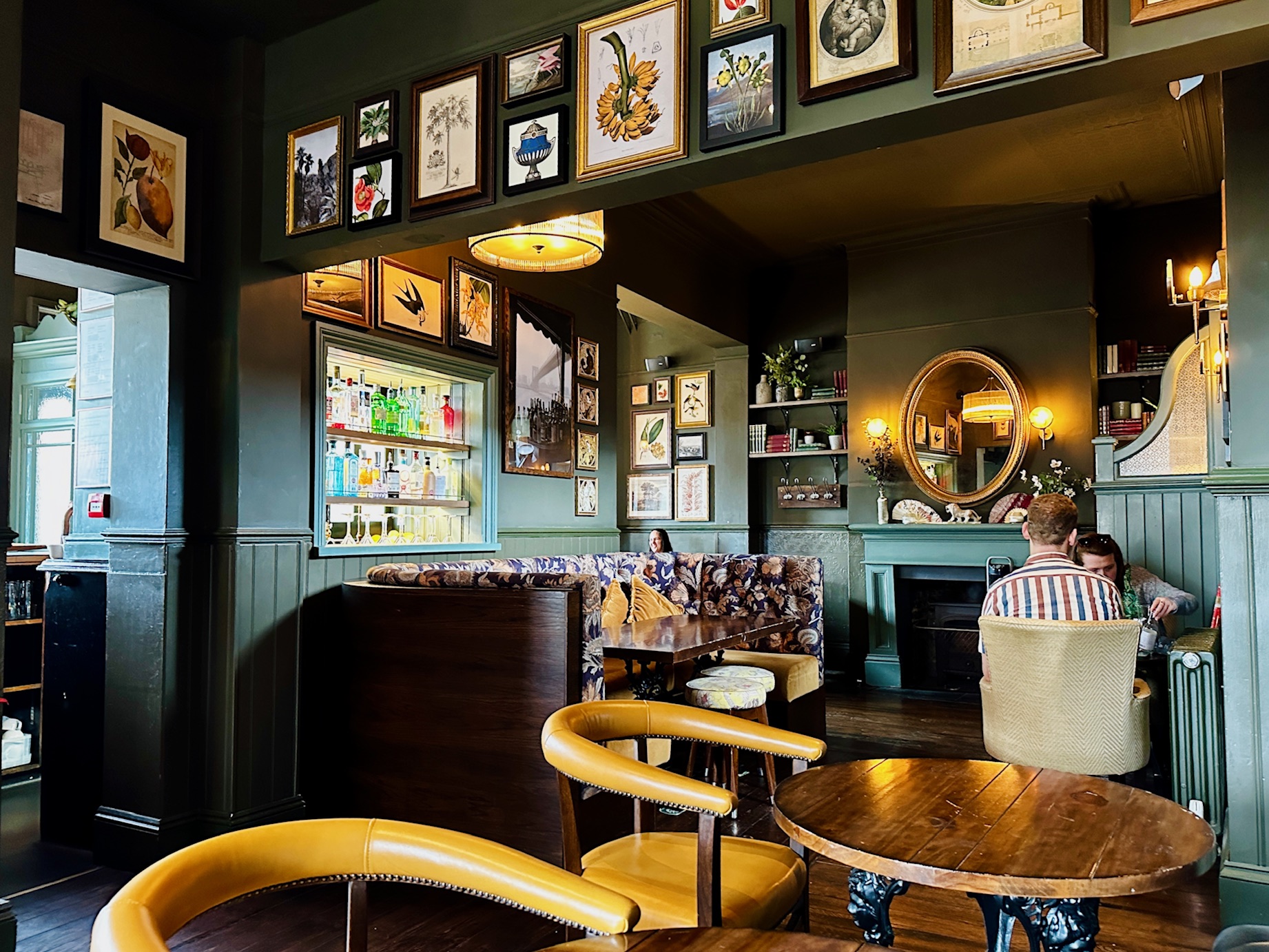
It helps that it’s such a handsome pub, all dark muted tones and wood panelling. The front room looked like a proper boozer, if a classy one, with high tables and sturdy leather-topped benches. Further through, near the fireplace, there were comfy booths and tastefully-upholstered sofas. But I was sat in what I imagine was the dining room, on a banquette, looking out on the whole thing, sunlight sneaking in through the windows. The table opposite me was occupied, with a couple making inroads into a tempting-looking lunch order, but otherwise it was pretty quiet. It was one o’clock on a Saturday not that far from payday. Had I made a mistake?
Not based on the looks of the menu, anyway. I actually think a weekend lunchtime might be the trickiest time to visit Lucky Lychee, because you have a selection of what are dubbed snacks but looked like starters and small plates, their lunch menu – a slimmed down version of their evening offering – and the brunch menu.
And that’s where it got really difficult. Because the lunch dishes – 8 hour rendang, tom yum king prawn fried rice and the like – looked extremely tempting. But it was the brunches that first drew me in and that selection was calling to me every bit as much. The idea of curry sausages and fennel cured smoked collar bacon, bound up in a flaky roti wrap with lime mayo and sweet chilli sauce sounded too good to miss. A great hangover cure too, and after a couple of bottles of red with my friend Jerry the night before it sounded just the ticket. What to do?
In the end I decided to postpone the decision by ordering snacks and seeing how I felt after that. But first I ordered a drink. Lucky Lychee boasts a fascinating range of low intervention wines, but postponing the hair of the dog for the time being I decided to try an iced Milo, allegedly a popular chocolate malt drink in Malaysia. It was nice enough, though the ice took some time to get the overall experience below lukewarm. Perhaps the glass was straight out of the dishwasher: either way, it may well have been thoroughly authentic but I couldn’t shake the feeling that I’d just spent four pounds fifty on a Nesquik.
That was the last – the only – misfire of the entire meal, and everything after that was so terrific as to render it insignificant. Chicken karaage was a decent portion for eight pounds fifty, and if it ever so slightly lacked crunch, the flavour that had permeated the chicken thighs, from soy, oyster sauce and rice wine, more than made up for it.
Mayo is a frequent accompaniment for karaage but rarely is it anywhere near as good as Lucky Lychee’s, which was positively awash with citrus. I kept going back and forward between this and my second small plate, trying to figure out which I liked the best.
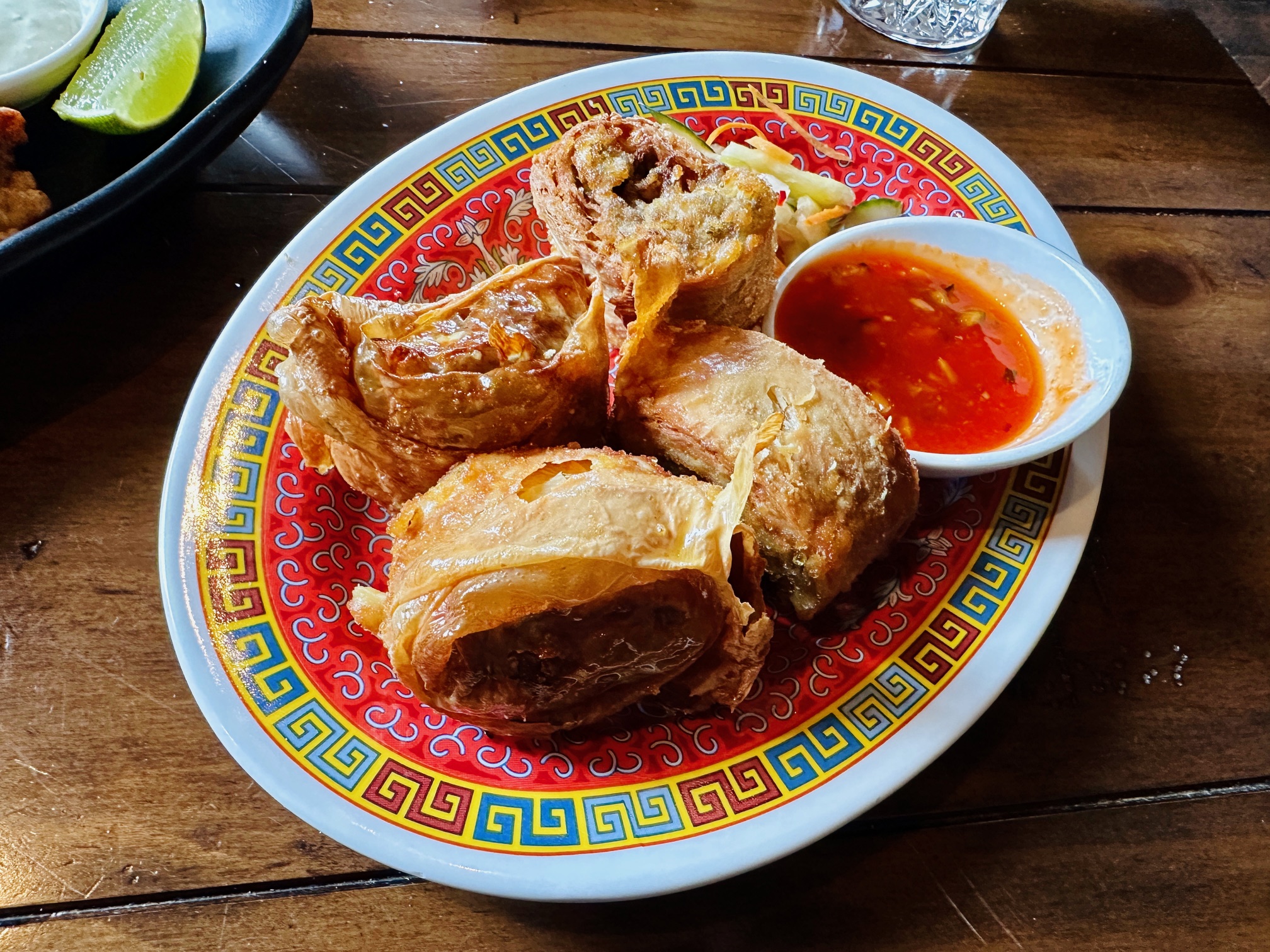
I think though, on balance, the second small plate was ever better. Billed as Penang pork spring rolls it was really nothing of the kind. I mean, technically it was, but the ratio of dense, delicious meat to wafer-thin, greaseless pastry made it something closer to a sausage roll (or, if you’re three, “sossidge roll”) that was all sausage and no roll.
But that’s not all, because the meat was beautiful – shot through with tiny dice of carrot and, I think, spring onion. The menu said that it was marinated in a 10 spice powder and I could well believe it, because I’m not sure I’ve ever had anything like it.
I’m conscious that this is my third solo review in a row – and yes, I might be auditioning for some additional dining companions. It meant I ordered slightly more food than I strictly needed, to try and give the menu a fair run out. But I was as pleased as Punch not to have to share these spring rolls with any other fucker. They were mine and mine alone, and it was a beautiful moment.
My server, who was downright lovely throughout, gave me a little time after my starters were cleared to make my decision. As I mulled it over, I ordered a glass of white wine, a German riesling which turned out to have plenty of zip and pith, and a little honey. And the more I thought about it, the more I couldn’t decide: brunch or lunch? Buttery roti or something with rice?
It wasn’t easy but in the end, believe it or not, I was thinking of you lot. I decided you’d find an idea of Lucky Lychee’s dinner and lunch options more useful than a brunch, however good. So I forwent that roti stuffed with good things, and decided that if I walked away disappointed it was all your fault.
Gladly, nothing was your fault and my main course was one of the most enjoyable things I’ve eaten all year. Billed as honey Marmite chicken, it wasn’t a combination I’d ever considered or even heard of, although a Google suggests that it is indeed a dish eaten in China and Malaysia. But honestly, it was such a phenomenal combination. The chicken, thigh again, was in a crispy, craggy coating, studded with sesame seeds, and it had all the textural interest that the karaage had only just failed to bring to the table. But what made this dish, and made it one I’ve thought about many times since, was the sauce.
What a sauce! You might not like Marmite, you might not like honey – for what it’s worth I love both of them – but this sauce from Lucky Lychee managed to completely transcend either Marmite or honey, being infinitely more than the sum of those things. So you had the huge, salty savoury depth that came from the Marmite (and, apparently, a bit of oyster sauce) and the almost smoky sweetness from the honey, dovetailing and transforming in a way that was nothing less than magical.
Add in some just-cooked peppers and a sprinkling of peanuts and you had one of the most intensely moreish dishes I’ve eaten in well over a year. Put it this way – last month I ate at Kolae, one of the most hyped restaurants in London right now, and I had some of the most fascinating dishes I’ve sampled in a long old time. But nothing there matched the joyousness of this honey Marmite chicken.
I spooned, and then scraped, every last bit of sauce onto my fluffy jasmine rice, I cleaned my plate as best I could without abandoning decorum, and I wondered when I could eat this dish again. I love fried chicken, which ultimately this dish was, but I couldn’t remember trying anything quite like it.
By this point I was gratified to see that a few more people had taken tables in the pub. A young couple came in, him with a London Review Of Books canvas tote, her with one bearing the logo of Shakespeare & Co, the legendary bohemian Paris bookshop, and took the table near the window that had been occupied by others when I came in. I smiled at them – I’m not sure when I reached the age where I’m twinkly and avuncular, but sadly that point has come – and then I peeked nosily as they ordered from the brunch menu.
One of them had ordered a roti that was served absolutely stuffed with beef rendang, and as I saw it come to the table I realised there was nothing for it: I was just going to have to return, sooner rather than later. I realised my mistake hadn’t been to order lunch instead of brunch, it had been not to order brunch, find some excuse to loiter around Winchester for five hours and then go back for dinner. Never mind – I was already planning multiple return visits, with a pretty good idea of at least one person, miffed to have missed out on this trip, who would insist on trying it out.
Lucky Lychee does have a dessert menu, but on this occasion it didn’t have enough to tempt me. It’s mostly ice cream and affogato, with just two more interesting options – a banana spring roll and a piña colada crème brûlée. I had it mind to possibly grab an ice cream from Chococo, across town, so I decided to settle up and amble to Coffee Lab for a latte. My bill came to just under forty-eight pounds, not including tip. The most expensive thing I had was the honey Marmite chicken, which was under fifteen pounds. It would be hard, I think, to spend fifty pounds on lunch better than this.
As you’ve probably gathered, I truly adored Lucky Lychee. And weirdly, just as with Bombay Brothers last week, I came away feeling that I hadn’t seen the restaurant at its absolute best. With Bombay Brothers that was driven by a faint hope that surely it could be better than that, but with Lucky Lychee it was more an awareness that, phenomenal though my meal was, I suspected they were capable of even more.
I need to go back – to try the brunch menu, to work my way through the other snacks, the curry puffs and sesame prawn toasts, and to try the full gamut of their main courses at dinner time. Char siu with honey rhubarb glaze has my name on it, as does the Guinness chicken with lychees. And that rendang.
Who am I kidding? I want to try all of it – and rarely have I come away from a restaurant so simultaneously delighted with everything I had and frustrated that I wasn’t able to polish off more. The other thing I kept thinking was that this is a restaurant operating out of a Greene King pub. So I cast my mind over all of Reading’s Greene King pubs – the Roebuck, the Palmer Tavern, the Outlook and so on – and thought how sad it was that none of them had done anything this bold. Another one to chalk up under I wish Reading had something like this.
Don’t get me wrong, its closest equivalent is the Moderation, a fine pub. But Lucky Lychee was properly next level stuff. As so often, going away from Reading reminds you of the things Reading is still missing. Maybe we’ll get a top notch Malaysian restaurant at some point, but I’m not holding my breath. On the plus side, I now have somewhere to recommend whenever anybody asks me where’s good in Winchester. But this is the drawback: how am I ever going to review anywhere else in the city, if it means missing out on eating at Lucky Lychee?
Lucky Lychee – 9.0 The Green Man, 53 Southgate St, Winchester, SO23 9EH
A.B.O.E. closed in August 2024. I’ve left the review up for posterity.
Last Friday I found myself in Bristol enjoying a badly-needed long weekend away. Our train pulled into Temple Meads, half an hour late, and Zoë and I wheeled our suitcases into the centre, three days of eating, drinking and excellent company ahead of us. But before we checked into our hotel, before we did almost anything, I had lunch on my mind and only one candidate to provide it. We made a pilgrimage to the Apple Cider Barge and there, next door, in its distinctive black and red was Gurtrina, the van belonging to fried chicken supremos and Reading legends Gurt Wings. How could I kick off my minibreak anywhere else?
By my reckoning it’s over six months since Gurt Wings stopped coming to Blue Collar – something to do with the council being difficult, if I remember rightly – and the reunion with their magnificent food was all the sweeter for all that deprivation and delayed gratification. In my time away the buffalo sauce had become just a little more piquant, the blue cheese saltier and tangier. The sun came out, the bench we were perched on positively glowed and we polished off our food in wordless joy. Truly, it would have been worth a trip to Bristol just for that.
Afterwards James Mitchell – the man behind Gurt, also known to his many fans as Uncle Gurty – came over and the three of us caught up and shot the breeze. I told him where we were planning to eat in the city, he mentioned a few places he’d heard were good and then he did something I wasn’t expecting. He went out of his way to tell me somewhere especially good I should check out.
“You need to get yourself to Oboe” he said.
“What, like the musical instrument?”
“No, A.B.O.E. It stands for ‘A Bit Of Everything’. The chef is a guy called Seb Merry who was on Masterchef, and he’s so passionate about his food. The whole team are brilliant. They do the best Bloody Mary I’ve had – it’s not on the menu, but if you ask they’ll make it for you. And they have this fried chicken dish – well, it’s not like our fried chicken but it’s amazing, it’s more like a croquette but you’d have to try it. And they do this incredible dessert, have a look at this.”
He fired up his phone and showed me a picture of a dessert which was all chocolate and caramel, thick slabs of each. I’ve rarely seen a photograph I wanted to eat more.
After our chat we went on our way and stopped in the Small Bar for the first beer of the holiday but that glowing endorsement weighed on my mind. If the man who does the best fried chicken you’ve ever tasted tells you that a restaurant does amazing fried chicken, and more besides… could I really let a trip to Bristol pass without investigating? But anyway, there’s no way they would have a table free the following night, I thought. But then I checked, and they had. So I texted my friends James and Liz, sent them the website.
I know the four of us are booked somewhere else tomorrow night, but Mr Gurt Wings says this place is incredible. What do you reckon, stick or twist?
James, a keen fan of Bristol’s restaurant scene, responded almost immediately. Let’s take a risk and twist, he said, and that was that. Bookings were made and cancelled, and the next night Zoë and I clambered off the bus halfway up the Whiteladies Road, ready to take our chances.
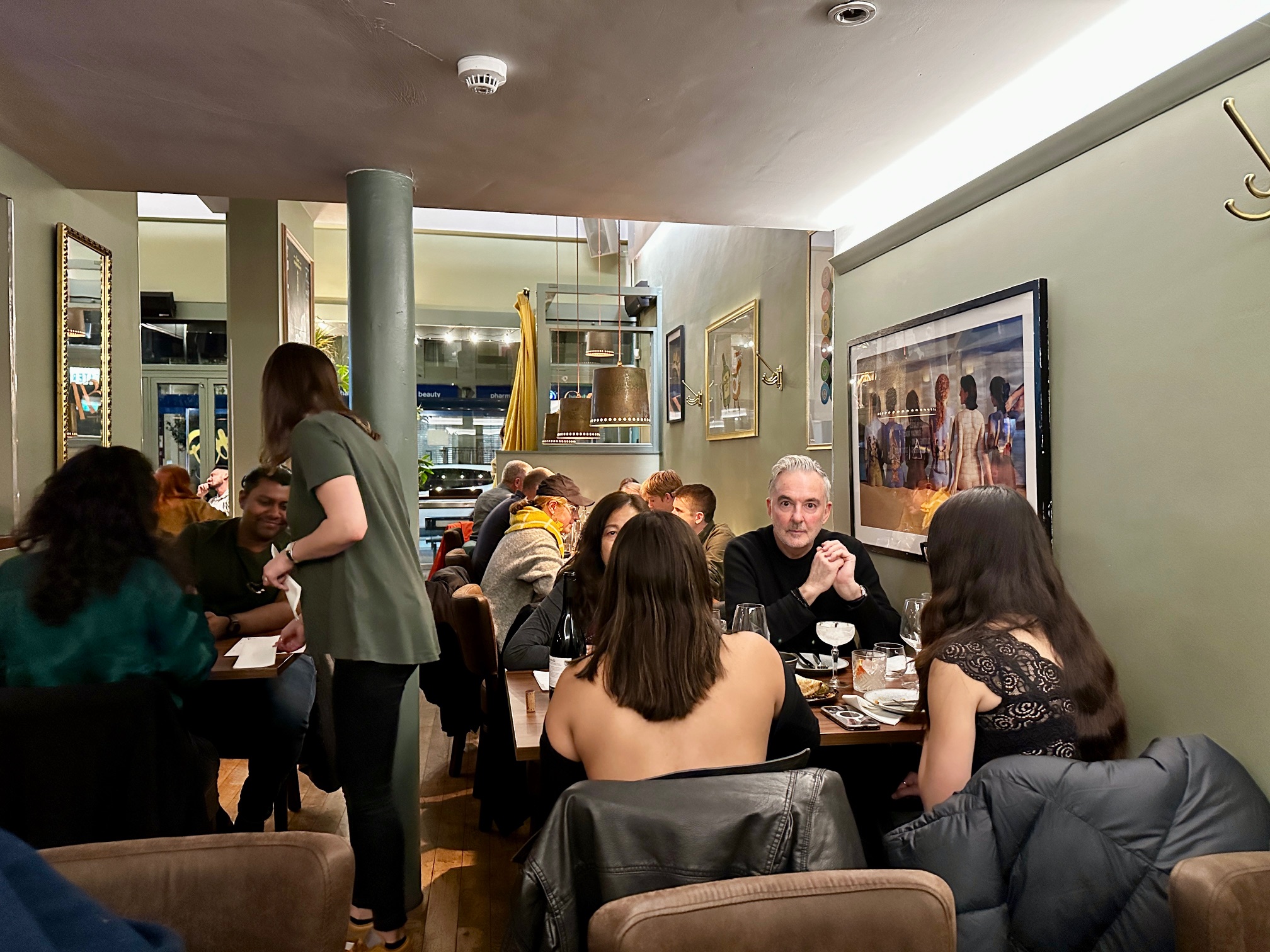
The interior was tasteful, all muted green paint, wall art and pillars. There was a mezzanine floor, although there didn’t seem to be anyone seated there on a Saturday night, and the whole place had a pleasing buzz. It sort of looked as if it could have been part of the Loungers Group in a previous life (I checked: it wasn’t) but none the less it was a pleasant dining room with tables companionably close without being crammed in.
It was also almost completely full and our server whisked us to a table right at the back, far too big for our party of four. He explained that a table for four near the front had slightly outstayed their welcome, and although they’d paid the bill they hadn’t yet left the premises. He told us, quite charmingly I thought, that he didn’t feel like acting the heavy with them given how much they had spent.
Then he asked if Zoë and I wanted a cocktail on the house while we waited. So Zoë had a negroni, made with rosemary vermouth, which she raved about and I asked for that off-menu Bloody Mary. I knew it would be good when the server didn’t ask me how spicy I wanted it: they just did their job and made it, and it was magnificent.
All in all, we were waiting ten minutes with our cocktails, hardly anything to complain about. By then James and Liz had arrived, more drinks had been ordered and we had taken our table nearer to the front of the restaurant, with a good view of other tables, dishes wafting past and the staff – just the two of them, that I could see – working non-stop.
The menu is the kind that makes jaded restaurant bloggers roll their eyes – no starters, no main courses, just snacks and small plates. The menu suggests two snacks and four small plates between two, which I suppose gives you an idea of whether they’re starters or mains. Now, I can be as critical of small plates venues as the next person and I’ve always found it counterintuitive that restaurants tell you to share small plates. I also thought that A.B.O.E.’s pricing was a little out of keeping with the small plates concept – snacks mostly cost just over five pounds, but the small plates ranged from fourteen to twenty-two pounds and that for me, at the risk of doing an accidental Partridge, is the kind of price I expect to pay for a big plate.
But anyway – perhaps it was the charm of the welcome, or the edge-softening effect of that Bloody Mary, but I found I was prepared to suspend my disbelief. So we bartered about the snacks we wanted to ourselves and the small plates we were reluctantly prepared to share, I popped it all down on a note on my phone and when our server came back we ordered with military precision.
“I just need to tell you,” he said, “that the steak tartare is a small portion, so it isn’t really suitable for sharing”.
“That’s okay, that’s for me” said James, in a manner that suggested he had never really considered sharing it with anyone.
That does James a huge disservice because when it arrived, although it was indeed too petite to share, he insisted that I try a forkful of the tartare. It was made with dry-aged bavette, and I have to say it was pretty impressive with plenty of savoury depth. Not the very best tartare I’ve ever had – that honour still goes to Paris’ superlative Double Dragon – but pretty close. Certainly it compared well with a similar dish across town at Marmo, although I wasn’t a hundred per cent sure about the stuff, allegedly taleggio, on top.
Zoë and Liz both went for the pumpkin croquette: A Bit Of Everything definitely applies geographically if in no other way, with this dish having hints of Japanese korroke. But unlike the croquettes at, say, Caper And Cure where you get four little spheres, A.B.O.E. goes for broke with a single enormo-croquette loaded with cheese and horseradish. Again, I was allowed a forkful and again it induced a reasonable amount of envy. Zoë in particular raved about this dish. I probably would have liked more, smaller croquettes to capitalise on the surface area but I couldn’t deny that the flavour of the thing was outstanding.
To continue the globetrotting, my snack was A.B.O.E.’s take on poutine. Rather than fries, it was cuboids of confit potato, à la Quality Chop House, buried in Parmesan with a jug of thick, intense, almost-sweet jus to trickle over the whole affair. Enormously enjoyable stuff: I imagine dreary types might complain that this wasn’t poutine, but it was a darned sight nicer than most poutine I’ve had. Besides, I knew exactly what it would be like because I’d checked out the restaurant’s Instagram in advance (it’s called research, you know).
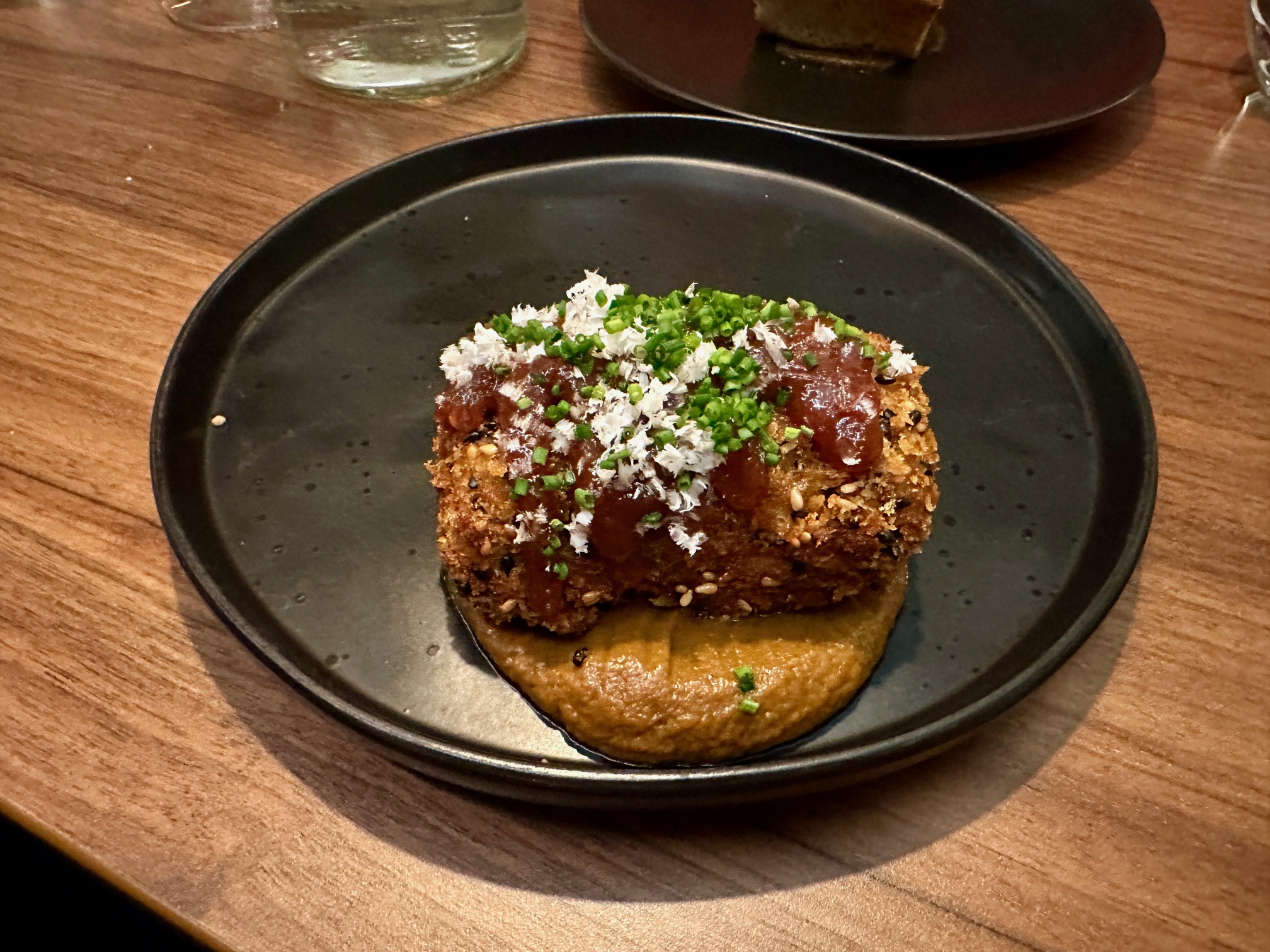
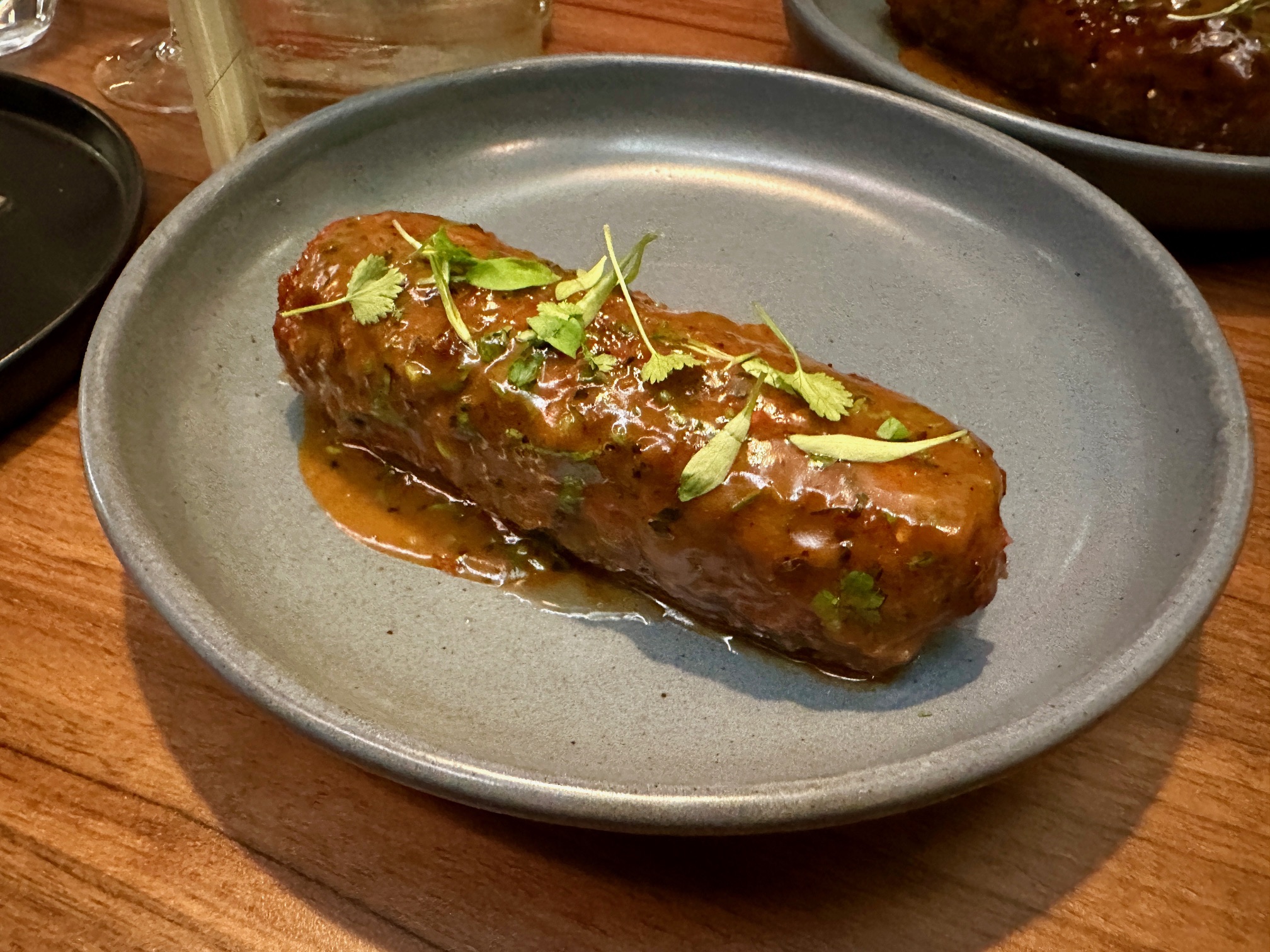
The first of the small plates to come out was that fried chicken dish so beloved by the man behind Gurt Wings – high praise indeed, from an expert in the field. Well, he was right to say that A.B.O.E.’s rendition was nothing like his. It was surprisingly hard to describe, but it’s important to try because otherwise all you have to go on is the photo below, which looks on the scatological side. It was somewhere between a boudin and a ballotine, a cylinder of tightly compressed chicken thigh bound in a crispy coating, the whole thing smothered in a sticky curried sauce.
Did it work? Well, yes, we all thought it did. As with the pumpkin croquette, I personally would rather have had more, smaller pieces to maximise the surface area. The coating didn’t have as much crunch as I’d have liked, and came away under a knife rather than adhering to the chicken beneath. But you couldn’t argue with the flavours, or the note of citrus that danced through it. Uncle Gurty had not steered me wrong – and no, it didn’t look like fried chicken, much in the way that the poutine didn’t look like poutine. That was sort of the whole point.
I’d had my eye on the barbecued squid with galangal, but it became a must-order when our server, the charming Italian chap who had sorted out our welcome cocktails, told me they’d run out of the clams it was meant to come with. Their solution, he told me, was just to give you more squid. That was good enough for me, and the dish was tender and fragrant with a nicely building heat. Another of those dishes you slightly resented sharing, which in hindsight is a decent description of literally everything we ate.
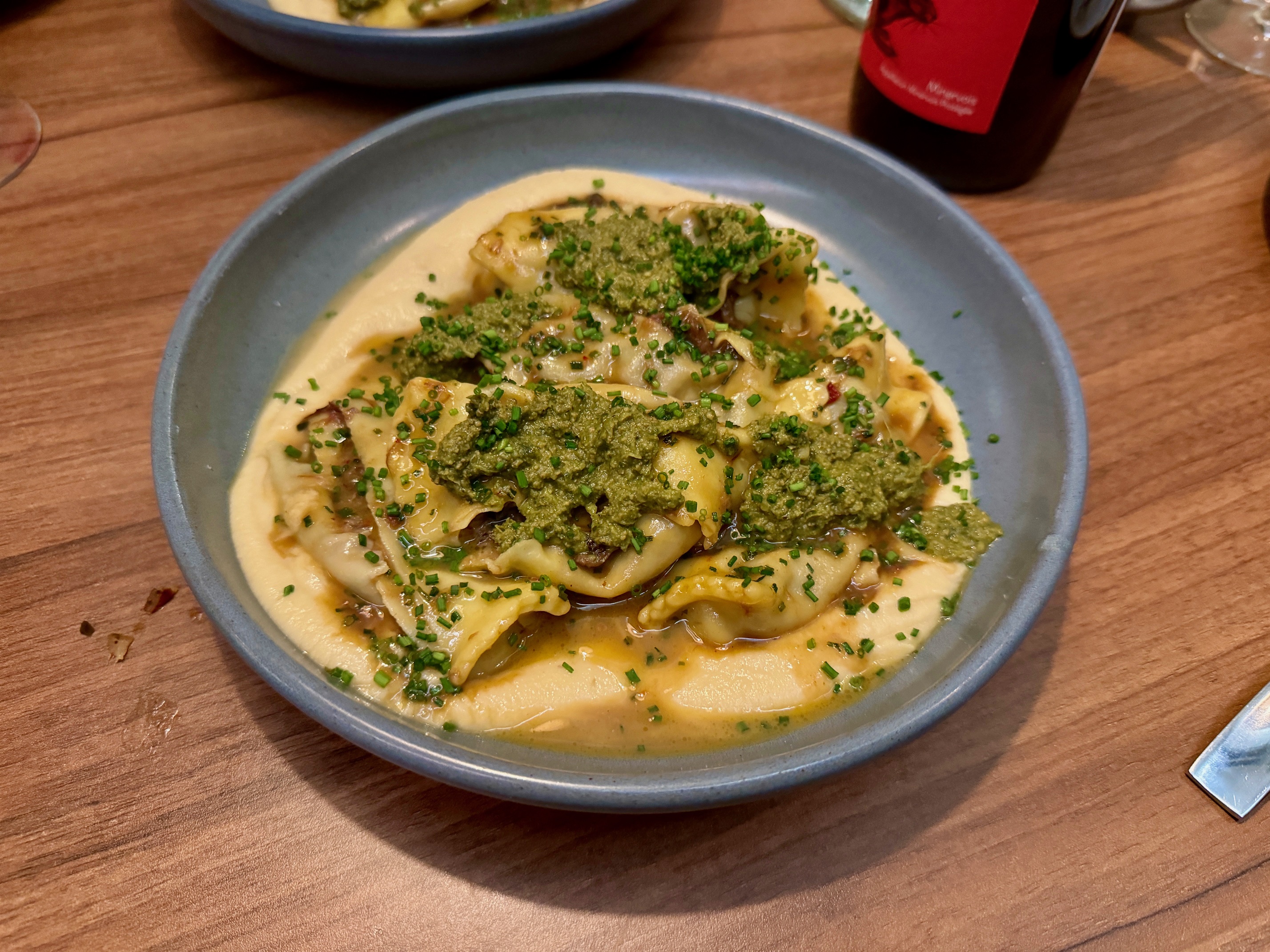
The most expensive dish on the menu – so naturally we ordered two of these – was the short rib beef agnolotti. Nearly twenty-two pounds a portion, and for me a fascinating misfire. My companions all loved it so I was the lone dissenter, but for me the agnolotti themselves were overcooked, which made the whole dish a bit limp and mulchy.
Everything on the plate was good: the celeriac, apparently with aged beef fat, the glorious beef in the filling and a powerful mole verde, although we didn’t get the advertised goats cheese. As with everything else we tried, the flavour was unimpeachable but for me, the texture let this one down. But I may well have been wrong: certainly everybody else thought so.
Red mullet is James’ favourite fish on earth so he had to order a portion of that, and I got enough of a taste to appreciate that it was, like everything else, very skilfully done. I’m a sucker for braised lettuce, a relatively conventional pairing, but putting mustard – a delicious mustard, at that – in the mix was the sort of clever and unexpected touch Merry seems to specialise in.
The last of our small plates was an outrageously delicious one: barbecued cod with leeks wrapped in nori and two sauces – one of which, studded with ultra-salty nuggets of chicken skin, was one of the most compelling things I’ve eaten in some time. Again, this was at the north end of the price list and I can see you could argue it wasn’t an enormous amount of food for twenty pounds. But it was exceptional, one of the best-cooked pieces of fish I can remember served alongside a sauce with a proper, clobbering heft. James and Liz left a bit of theirs, and I waited as long as I could bear it before saying “would you mind if I finish that?”
Although service was brilliant, there were only two people working front of house (and, just as gobsmacking, I understand there were only two people in the kitchen). If there had been more, or they’d been less busy, we might have got to a second bottle of wine but instead we took our time with the one we had, a beautiful Minervois which sort of went with some of the dishes. It’s a small wine list, six white and six red, about half of them available by the glass.
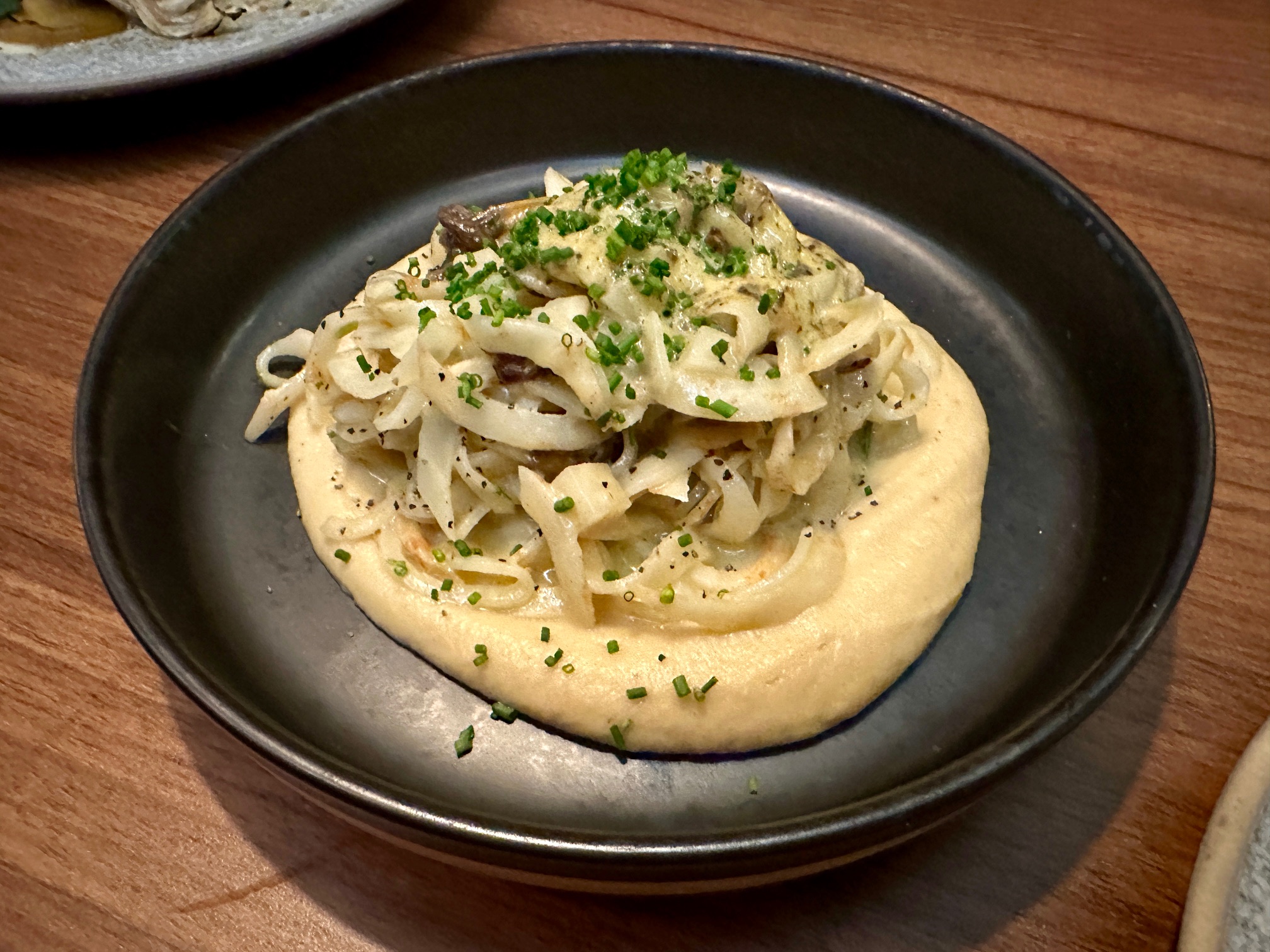
Our server asked what we made of the food and checked what we’d ordered. He said it was a shame we hadn’t gone for the celeriac cacio e pepe and we said that it hadn’t quite made the cut. So he decided to send a plate of it out to us anyway, which was very kind and completely unexpected. It really was a beautiful dish – ribbons of just-cooked celeriac taking the place of pasta, more sweet and comforting cubes of celeriac and little mushrooms dotted throughout. Clever and imaginative, like everything else, and in its way every bit as enjoyable as the cacio e pepe I’d raved about earlier in the year at Manteca.
“Isn’t it great?” said our server as he took the empty plate away. “I shouldn’t like it, because I’m Italian and making this without pasta is, well…” He shrugged at that point to indicate that he knew full well the dish was culinary heresy. “And I’m not just Italian, I’m from Rome. But the chef is right, and it’s just so good.”
The menu also recommends that you share one dessert between two people. I don’t know if it was our greed, or the small plates not being quite big enough, but we disregarded that and ordered one apiece. Mine and Zoë’s was the dish I’d seen in the photo on Uncle Gurty’s phone the previous day. Dubbed the Rolo Finesse, it was about the most high-end Rolo you can imagine – a thick wobbly layer of something partway between caramel and toffee, gloriously indulgent with just the slightest hint of miso. Beneath that, a thick stripe of a chocolate cremeux that was almost more like ganache, and beneath that a crunchy base.
That would have been enough, but malted milk ice cream on the side and more little nubbins of that crunchy chocolate holding it in place elevated this to god tier. If I’ve had a better dessert this year I can’t remember it, and if I have a better one next year I’ll be very surprised indeed. I can’t tell you how delighted I was that this one of the only plates I didn’t have to share.
James and Liz both opted for the tiramisu and again, were generous enough to let me try it. It was – no surprises by now – excellent: light yet moreish, a far more elegant way to finish a meal than the whopping slab I’d just eaten. I’ve tried a few Bristol tiramisu over the last couple of years – Sonny Stores and Little Hollows spring to mind – and for my money this was better than either.
As we sat there in the afterglow of a brilliant meal, ready to pay and slope off to the Good Measure for a post-prandial beer, we discussed A.B.O.E. in the wider context of a city full of phenomenal restaurants. We knew it was good, but just how good was it? James thought it was better than Wilsons, but he’s been burned by going there after my rave review, eating a meal which was almost completely devoid of carbs and leaving hungry: it’s made him an avid detractor. Zoë liked it even more than COR, which is pretty much the most exalted praise you can award in Bristol.
I loved it, but I wasn’t sure how to place it. The flavours had been exceptional, the service some of the best I’ve had this year. But those small plates were priced on the keen side. It required further reflection, I decided. Our bill, not including the two comped cocktails and that extra celeriac dish, came to just over three hundred pounds, including a 12.5% service charge which the staff more than earned. As we paid up, James told our server how much he’d enjoyed it.
“Way better than Wilsons” he said. He always takes pleasure in saying that.
“Thank you!” she replied. And then, before we put on our coats and made our exit, she came back.
“I know this is cheeky, but I passed your compliments on to the chef, and he asked if there was any way you could write a review saying you thought the food was better than Wilson’s? It’s really high praise.”
“Don’t worry” I said, “I’m sure one of us will.”
The funny thing is that since my meal, which I’ve thought about many times, I’ve discovered, while writing this review, that A.B.O.E. has a bit of a controversial reputation. I’ve read a review online, best characterised as a tad sneering, that criticised A.B.O.E., partly for some of the dishes but mainly, it seems, because they linked up heavily with influencers just after they opened around the start of the year. One influencer in particular, a chap the Rolo Finesse is named after as it happens, came in for particular criticism.
Well, I can sort of see both sides of that. I’ve always felt a bit icky about influencers myself, especially ones who don’t declare ads or invites, although that criticism in my experience comes better from people who don’t take free or heavily discounted food themselves.
And looking at the influencer in question’s output, I did feel about three thousand years old. Saying that it’s, and I quote, “non stop grub-a-dubdub” at A.B.O.E. is the kind of expression that makes me want to sigh all the remaining air out of my lungs, as is the observation that “every component on your plate will SLAP so hard you won’t even know what month you were born in”. Let’s not even get into the bit where he described A.B.O.E.’s roast beef as “more tender than your nan’s left arm” or their cauliflower cheese as “so peng I could have cried”.
But the point is, much as it might pain me to admit it, the guy is not wrong (well, except maybe about my nan’s left arm). I, rather, would say that the staff work their socks off and are brilliant at what they do, I would say that every element of every dish has been given serious thought and cooked with enormous skill and that, irrespective of how or whether it slaps, let alone how hard, A.B.O.E. has a very talented kitchen doing fascinating things. I guess if you put what I said into an English-to-influencer Google Translate it might end up as roughly what he said.
I can always tell when I’ve really, really enjoyed my meal because I actively look forward to writing it up, to trying to put into words what I’ve experienced. In that sense A.B.O.E. is a restaurant blogger’s dream, and I feel lucky to be a Bristol outsider because it means that, free of all that infighting and beef I can just judge the food and the experience, and say that both were terrific. The list of places I need to go back to in Bristol gets longer and longer, which makes reviewing restaurants there difficult. But as long as they keep that dessert on the menu – which I suspect they will, if only because it pisses off all the right people – I can very much see myself returning.
I have a note on my phone which is just a list of London restaurants. I mean, doesn’t everyone?
Strictly speaking, it would be more accurate to say that I have a note on my phone which is two lists of London restaurants. The first is a set of restaurants near Paddington, and dates from the time early in 2020 when I thought it might be a good idea to branch out. I figured that many of us end up having to drag our feet in London to take an off peak train home and that some reliable restaurants people could visit in the meantime might prove a godsend.
It was a good idea in theory, but I only managed one before suddenly all of us were taking far fewer trains, and heading to London became a pipe dream. But the list’s still there, and one day I may get back on it, exploring the Malaysian restaurants around Paddington, the Lebanese joints on the Edgware Road, or just revisiting my favourite little side street Greek place in Maida Vale.
The second list is of all the London restaurants I’ve always wanted to review but never got round to. Some, like Rules and Noble Rot, I’ve been to before. But others are ones I’ve read about in newspapers or in blogs and told myself I’ll visit one day. Like the Wes Anderson-esque French stylings of Otto’s in Clerkenwell, or the little dining room above Soho’s French House where Neil Borthwick, Angela Hartnett’s husband, cooks a small menu of Gallic classics. They’re not all French, I should add: Smoking Goat, Kiln, Quality Chop House all get a look in. Even with all the casualties in hospitality, I know this list will only ever increase in size. One day, it will see me out.
Manteca has been on that second list for quite a while. It started with a brief spell on Heddon Street (not far from where Casa do Frango is now) before spending some time in Soho and then relocating to Shoreditch’s Curtain Road in late 2021. At every step critics and bloggers have had nothing but praise for it, and looking at the menu in the run-up to my visit it was easy to see why. They make their own pasta on site – so far, so Padella and Bancone – but also specialise in nose to tail eating and make their own salumi, so nothing gets wasted.
The acclaim was so universal that this felt as close to a sure thing as you could get, so I made a lunch reservation for the Saturday of May’s last long weekend, so Zoë and I could try it out after a shopping expedition. Arriving a little late – finding your way there from Liverpool Street can be a bit of a horror show if you get lost in the Broadgate Centre – the welcome was warm and forgiving.
It’s a sizeable site, although you’d never know it was a Pizza Express in a previous life, and they pack them in, with the overall effect that you can barely hear yourself think (would-be restaurant inspector and all-round gastro-spod Andy Hayler complained that it was “like eating in a nightclub” – as if he’d know), and once you’re wedged into your table you’re going nowhere in a hurry. Our server initially tried to seat us at a dingy, unloved table right at the back, far from daylight, and when I asked if we could instead have a nicer table near the window she seemed taken aback, as if the idea had never occurred to her.
The menu’s brilliant at creating agonising dilemmas, more than nearly any restaurant I can remember. There are snacks and nibbles, small plates and a handful of pasta dishes – fewer than you might expect. Small plates are around a tenner, pasta closer to fifteen. Finally, there were some bigger dishes which came in at thirty pounds plus.
Our server explained that pretty much everything was designed for sharing. She also talked us out of ordering two of the large plates once she’d taken the rest of the order, a fact for which I was very grateful further down the line. I sipped a gorgeous cocktail made with Amaro and lemonade – how did I not know that was a thing? – while Zoë, as is her habit these days, tried (and loved) her negroni.
We started with a few snacks while we made up our mind and they contained the only dud of the meal. Focaccia was, to my mind, nothing of the kind, being dry and stodgy and only having a whisper of oil in it. The top crust was great, but that was the tip of the iceberg. And the iceberg was dense and heavy going. I should add that Zoë loved it, but she’d spent the week on a carb-free diet so she might just have been euphoric to be eating bread again.
Much better were the fried olives, little breaded spheres of sausage meat and olives that I could have eaten all the live long day. At three pounds each, though, you might be broke before you were full. Nonetheless, this was the first hint that something special was in store, a hint which quickly gathered momentum, becoming a firmly held conviction.
I’d seen the first of our starters on Manteca’s very distracting Instagram page, along with a caption that said it was only on the menu when they had the right cuts to make it. Ciccioli was lean pork, braised in rendered fat and then pressed into a cake and fried to a burnished crisp. It fell apart under the fork, eager to be dabbed with the sweet-sharp apple mostarda on the side. More than just the acceptable face of mystery meat, this was a symphony of flavour and texture and I wish I’d had one all to myself: if you go, and it’s on the menu, order it.
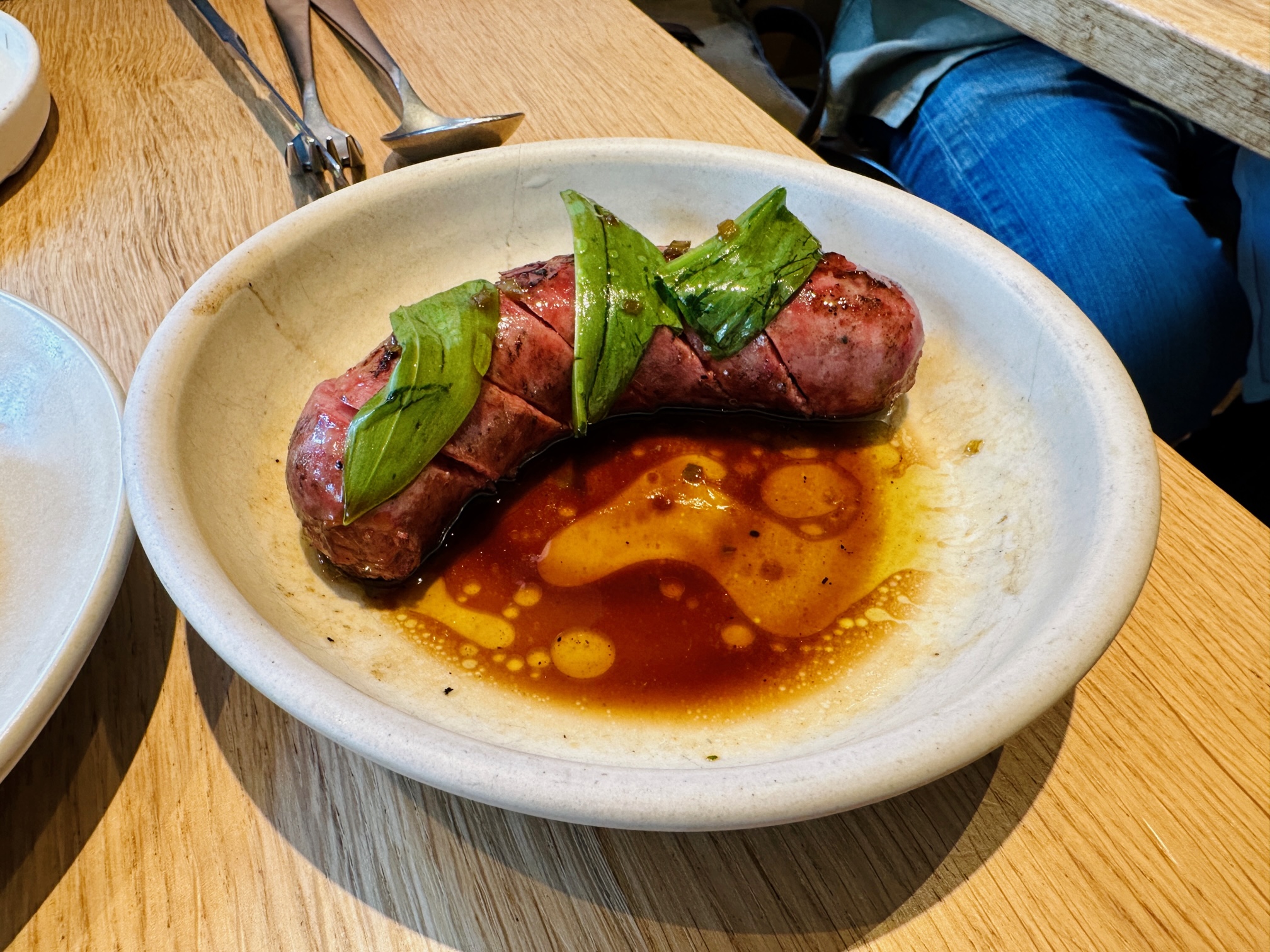
Less successful, possibly because it’s a dish that happens to share my porn star name, was hogget sausage. I liked but didn’t love it: knowing that Manteca does all its butchery on site reassured me that this was packed with the good stuff, but the texture was still smoother and closer to saveloy than I’d personally choose. The flavour more than made up for it, the whole thing draped in wild garlic leaves, because ’tis the damn season. Probably should have kept some of that slab of bread to mop up the juices – maybe that’s what the restaurant had in mind for it.
I think I read somewhere that Manteca used to do their pasta courses in a small and large, but they’ve done away with that now and a portion is very respectable size – enough for you to eat as a main, if you’re no fun, or a beautiful stepping stone between the smaller and larger plates. Manteca’s brown crab cacio e pepe is so fêted that it might be the closest thing the restaurant has to a signature dish, so naturally I ordered it.
It was a gorgeous, simple plate of soothing sustenance which didn’t outstay its welcome. The pasta – strozzapreti in this instance – was terrific, al dente almost to the point of squeakiness. And the crab didn’t dominate, playing nicely with the cheese and pepper to create something beautifully emulsified and far greater than the sum of its parts: if anything, the foremost note was a brilliant tingle of lemon that prevented it from cloying. Like most of my experience, it thoroughly justified the hype.
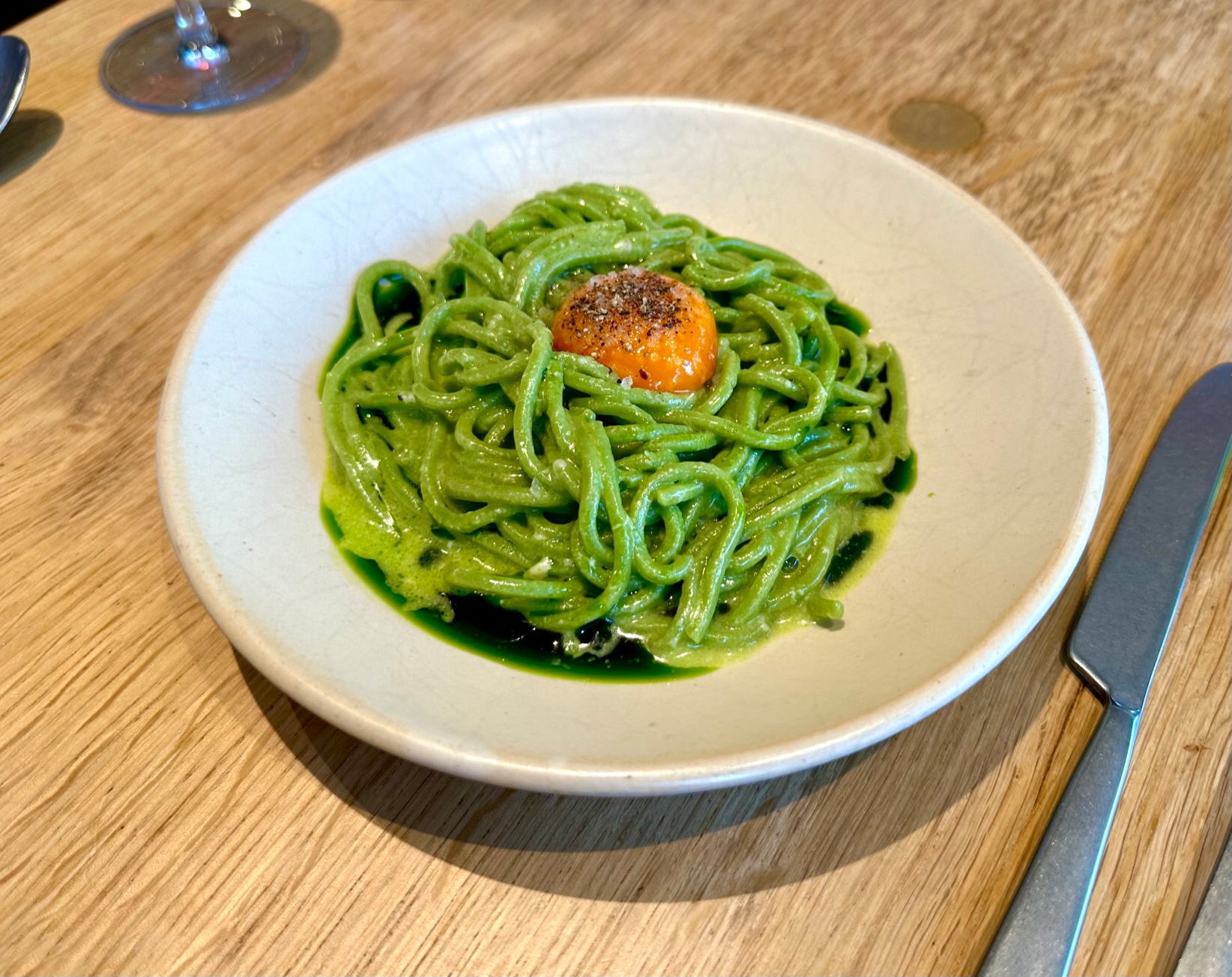
Wild garlic made another appearance in Zoë’s pasta. Chitarra, a sort of square spaghetti, if you can imagine that, was positively luminous with wild garlic, its edges fringed with racing green wild garlic olive oil. An egg yolk nested in the centre and although it looked slow-cooked and fudgy, once nudged with a knife sunrise spread across the plate. I didn’t try any, because it struck me as a messy thing to reach across the table and eat, but Zoë loved it. She tasted citrus in this too – lime, she thought, although that might have been synaesthesia because it was just so very green.
The one thing that doesn’t tell you about those two pasta dishes – one of the few frustrations of eating at Manteca – is that they came to the table ten minutes apart. When Manteca said their dishes were intended to be shared I assumed they couldn’t mean the pasta because nobody shares pasta, except in Lady And The Tramp. Perhaps they honestly thought we’d share the first pasta dish and then share the second, but they’d also said, in a Wagamama-esque spiel, that dishes from the same section of the menu would come out together.
Does it matter? On many levels, not really. We were having a lovely time, by this point we’d ordered a beautiful bottle of an Australian pinot noir/syrah blend and all was well with the world. But it’s always weird to sit there while your dining companion watches you eat and then have your roles reversed: it’s why I so rarely send steak back in a restaurant. More to the point, we only had the table for two hours – less, because we’d showed up a little late, so you’d think they’d be tighter on time. As it was, because they didn’t rush us through the pasta, which they should have done, things got more frantic at the end.
But this was the only misstep in a meal where even if we were slightly processed, it never felt like it. Manteca’s front of house team were quite fantastic from start to finish, working in one of the busiest, buzziest restaurants I’ve eaten in for a very long time. Also, given the acoustics, their hearing must be exceptional – for the first half of the meal Zoë and I probably had to repeat almost fifty per cent of everything we said.
Arguably, the best way to deal with the challenging noise levels is to dish up food so good it renders customers speechless. I think that might have been Manteca’s plan, and they achieved it admirably with the next set of dishes. Grilled duck breast, pink and tender underneath caramelised skin, was superb, and pairing it with sausage – I think also made from duck, but I might be wrong – was a masterstroke. But the thing that made the dish, for me, was the preserved quince that came with it: fruity, ever so slightly chewy, a fantastic foil for all that meat. It reminded me, ever so slightly, of Georgian fruit leather (don’t knock it til you’ve tried it) and I’d choose it over red cabbage any day. We were approaching full by the end of this dish, but we heroically soldiered on.
The accompaniments were a mixed bag. Grilled greens were a wan medley of cauliflower and chard, and although they tasted decent the texture was too limp for my liking. A thousand times better – and again, almost reason to visit on its own – were the pink fir potatoes, cooked until golden and crispy and smothered in something the restaurant calls “salumi brown butter” – little crunchy nuggets of meat, herbs and fat. I could have eaten these on their own and left the restaurant a happy man, but being able to pair them with duck, or sausage, or use them to soak up the pool of juices at the bottom of the plate, was nothing short of heavenly.
By this point we were decidedly full but still up for attacking the dessert menu, possibly with something from the restaurant’s extensive list of amaros, once we’d finished our bottle of red. Our minds were concentrated wonderfully by our server telling us we had less than twenty-five minutes before they needed the table, so we were forced to accelerate matters.
The dessert menu is skeletal, with just three options. Zoë’s choice, a chocolate choux bun filled with chocolate cremoso, tasted very nice indeed but I was delighted I hadn’t ordered it because I’m not sure I could have pretended to you that I could taste the “whey caramel” it apparently contained, or even for that matter tell you what whey caramel tastes like.
I’m also delighted I didn’t order it because the dish I did order, pistachio cake, was one of the finest desserts I’ve ever had. There was an awful lot going on here, all of it good on its own yet better together. The cake, which could so easily have been stodgy or unremarkable, had a beautifully dense texture with flashes of salt and pistachio in every spoonful. The ribbons of candied, pickled fennel on top added a fragrant sweetness that never overpowered: I’d have liked more of them, but fennel always has that effect on me. And the preturnaturally smooth pistachio ice cream was as good as anything I’ve had in Italy – or for that matter at Clay’s, who do a mean pistachio ice cream these days. Resting the sphere on a handful of salted, roasted pistachios, though, was an inspired touch.
Zoë had a spoonful, and her reaction was immediate: “you win”. If we’d had our table for longer, I think she’d have ordered one as a second dessert. It’s rare for me to rave about dessert, rarer still to do it about a dessert with no chocolate in it, but I’ve thought about this every day since my lunch at Manteca, wondering quite how they elevated something seemingly so everyday to a dessert so extraordinary.
As we were tight for time, there was no digestif. But there was still room for one last delight, so along with the bill we asked for a couple of pieces of beef fat fudge to send us on our way. I’m not always sure about beef fat in desserts – I still remember a beef fat caramel I had at an otherwise excellent restaurant in Cardiff for which no word other than “minging” will do – but this lent a certain glossiness while omitting the overtly bovine notes. It was one pound fifty for a generous cube, deftly sprinkled with salt, and it took all my strength not to ask them to make me up a box. I wasn’t hungry any more, but I knew I would be later. Or rather, I wouldn’t be hungry but I’d have made enough room for more of that fudge. Another time, perhaps.
Our bill for all that food, a couple of aperitifs and that gorgeous bottle of red – which I liked so much that before the end of the meal I’d tracked it down and ordered a few bottles online – came to just over two hundred and fifteen pounds, including service charge. You could eat there for less, and have less fun, but honestly, when you have a meal this good it costs what it costs, and you don’t give a shit. We emerged blinking into the Shoreditch sunshine, and made a beeline for the Mikkeller bar for a beer and a post match debrief. Our ratings are usually a gnat’s crotchet apart, but for this one they were identical.
You can see that rating just a few paragraphs below, but what’s more important is to talk about just how good Manteca was. Because the truth is, back when I used to eat in London more often – but wasn’t reviewing those restaurants – they never quite lived up to my expectations. To the point where I worried that I was becoming semi-professionally underwhelmed. So I did the likes of St John or Quo Vadis, the places everybody likes, and I wondered what I was missing.
I sometimes think that London has to survive on a bubble of hype because if it wasn’t for that, people would wonder why they’re paying such unsustainable amounts of money to live and work there. And indeed my two recent visits to highly rated London restaurants, Casa do Frango and Chick ‘N’ Sours, left me equally ambivalent. So I can’t tell you how happy I was to eat somewhere that not only justified the hype but made me want to add to it, to lend my voice to the chorus of voices shouting about how special Manteca is. Though hopefully you’ve been reading my blog long enough to know that I don’t really do hype. I’m just as likely to walk away from somewhere critically acclaimed feeling nonplussed as I am delirious with joy, if not more so.
So there you have it: Manteca served up one of my favourite lunches of the last ten years and is well and truly one restaurant ticked off my “places I must get to in London” list. Although it doesn’t make matters easier because now, when I try and work through the other restaurants on it, I’ll always be thinking, in the back of my mind, or I could just go back to Manteca. Anyway, hopefully you’ve read this and might add it to your own version of that list. I’m still kidding myself that everyone has one, because in my echo chamber they probably do.