Restaurant review: San Sicario

San Sicario closed in August 2023. i’ve left the review up for posterity.

“What was this place before it was Cozze?” said Zoe as we flipped through the menus at San Sicario, the newish Italian restaurant at the bottom of the Caversham Road which has replaced Cozze’s central Reading branch.

“How long have you got? Before Cozze it was a Mexican restaurant called Maracas. And before that it was another Italian place called Casa Roma. Casa Roma and Maracas were owned by the same people…”

“…and they changed it to Maracas because they could use all the letters from their old sign? You’ve told me that story before.”

I smiled, although I did wonder if it was a good thing to have reached the you’ve told me that story before stage in our relationship.

“Yes, and before that it was a Lebanese restaurant called El Tarboush. That wasn’t bad actually – this would have been around 2009. Before that it was a place called La Fontana, but they moved out to Twyford.”

“Another Italian?”

“More generic Mediterranean, really. And before that it was a restaurant called Chi’s Oriental Brasserie. Now that was a restaurant! It was run by a chap called Wayne Wong from Cardiff, of all places. I still remember their XO chilli prawns. They ended up moving to the spot where Buon Appetito is now. I did karaoke there once, would you believe.”

Suddenly I had memories of nights in that restaurant over twenty years ago. At the time, I was going out with a woman who took great pride in stealing a six inch, brushed steel soap dispenser from Chi’s Oriental Brasserie’s ladies’ toilets: it was, with hindsight, one of many indicators that we wanted different things out of life.

“It keeps defaulting to Italian, I suppose.”

“Sort of. I guess Italian is a go-to option in this country – it tends to be mid-priced, it’s easy to do multiple pizzas and pasta dishes. Even now we still tend as a nation to have Italian out and Chinese or Indian food for a takeaway.” 

That doesn’t tell the whole story, though, because before this place was San Sicario it was San Carlo – same location, same owners, but a name they had to cease and desist from using barely a month after they opened last November because of a large national chain of Italian restaurants called San Carlo. 

I felt for San Sicario when I heard that – a far from auspicious start in a site where, if history was anything to go by, the owners would need every lucky break they could get. That’s when I made a mental note to pay San Sicario a visit sooner, rather than later.

“It’s got to be better than Cozze, anyway.”

Zoe was right about that – Cozze, San Sicario’s predecessor, had been terrible. I still remembered my meal there, eating carbonara paler than Cate Blanchett. It was a mystery how they’d ever expanded to three branches.

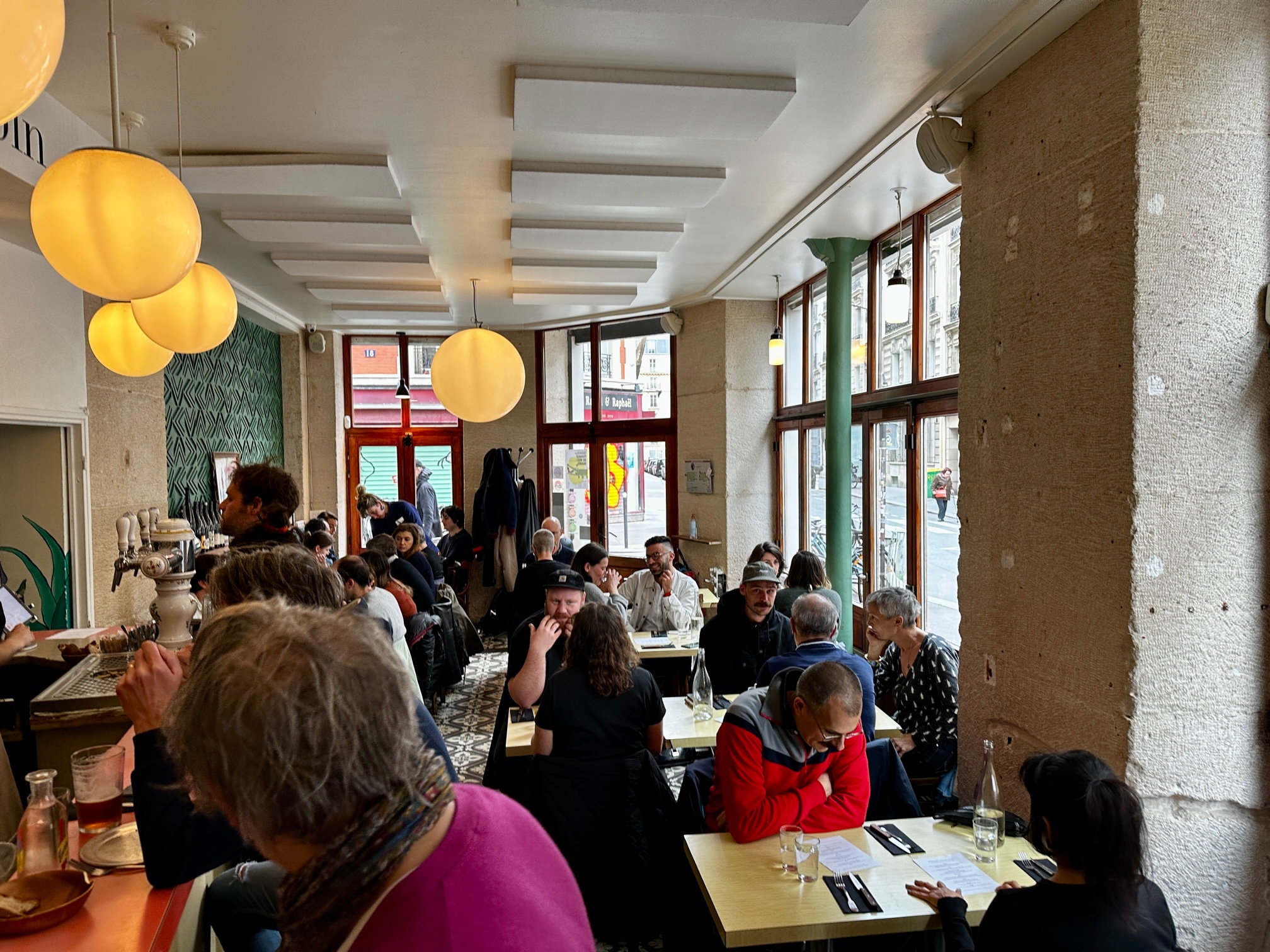
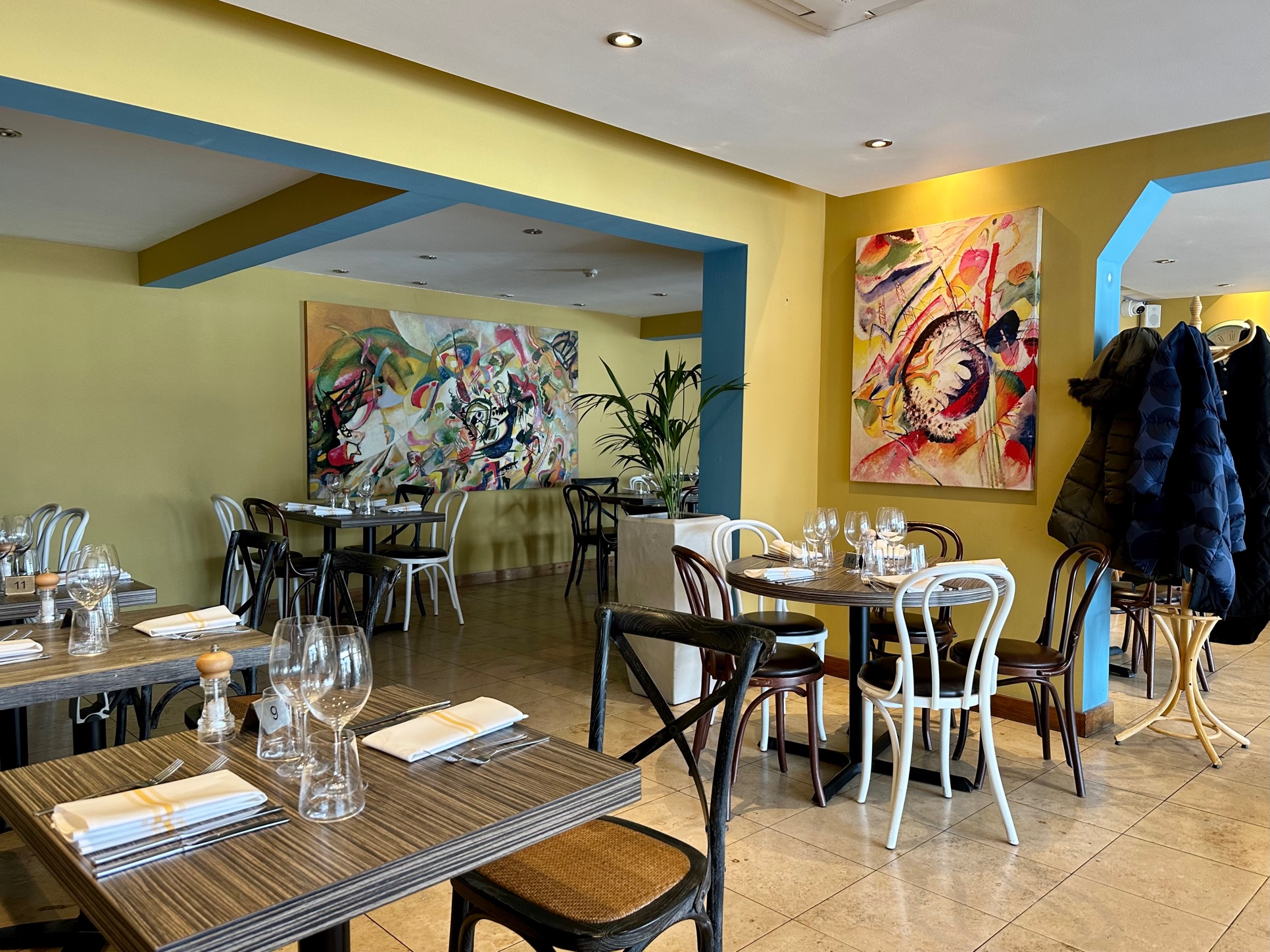
The interior of San Sicario was especially jarring: the glassware might have been different – and rather fancy – but the furniture, the banquettes, the exposed brick-effect wallpaper and the faux Kandinsky wall art had all been inherited from Cozze. Literally inherited: they’d lightened up some of the colour scheme, but it was fundamentally exactly the same. 

It was a big room, and the owners hadn’t really done anything to break it up into zones or to soften the noise – a room which really had to be full not to look a bit strange, although full it would have been deafening. On a Saturday lunchtime it was far from packed, with about three other tables occupied. Another three or so groups came for lunch after we sat down.

The first sign that this was a very different beast from Cozze came when I paid attention to the menu. I was never sure just how Italian a restaurant could be when it did chicken wings and burgers, but San Sicario’s menu left you in no doubt that it was a Proper Italian Restaurant. The menu was big – possibly too big – but it didn’t feel like it was chasing customers from Prezzo or Zizzi; the chef has cooked at Pepe Sale, and that felt far more the ballpark here. 

That doesn’t mean that San Sicario didn’t sell pasta and pizza – far from it, they did – but the pasta was an interesting range of sauces and shapes rather than a boilerplate way of flogging the two in an almost infinite number of combinations (just typing this reminds me, by the way, how little I miss Wolf Italian Street Food). But there was also a reasonably priced set lunch menu, which they even offered on Saturdays, a specials menu with five additional dishes on it and a Valentine’s Day menu, which I assume they hadn’t got round to removing yet.

The main thing I thought, looking at the menu, was that these were classic dishes and combinations, and that if the restaurant could pull them off it would be the kind of restaurant Reading hasn’t had for some time. I know many people miss Dolce Vita, and others miss what Pepe Sale used to be before the original owners sold up. Some, for that matter, still talk about Nino’s. But really, I’m not sure Reading has had a truly classic Italian restaurant since Topo Gigio closed.

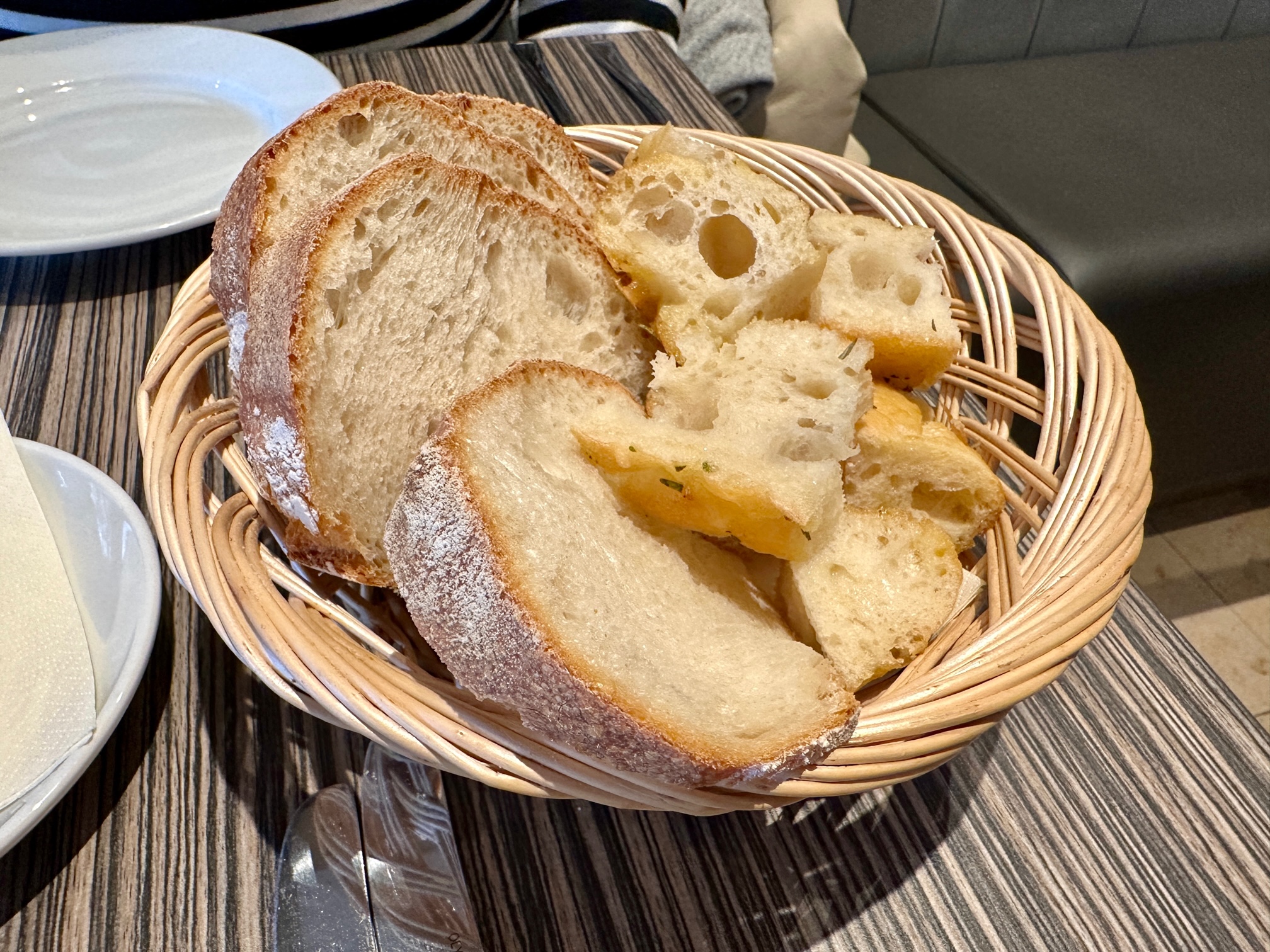
Our first dishes came as we were making inroads into a couple of very servicable drinks – a powerful negroni for her, a G&T made with fragrant Italian gin for me – and they made for an excellent start. According to the restaurant’s social media they make their own bread and focaccia every day, and they were both pretty decent, especially the focaccia which came sliced into little cubes, perfect for dipping in oil and balsamic vinegar, just enough salt scattered on the crust. We saved the bread for mopping, showing uncharacteristic foresight.

I picked the best of the starters, which is something I don’t get to say often enough. White crab meat came heaped onto what could have been crème fraîche or mascarpone, the whole thing sitting on a potato rosti. Simple, elegant, pristine flavours, and if the advertised watercress was nowhere to be seen I was hardly complaining, as it would have thrown the whole thing out of kilter. 

It wasn’t perfect – the rosti could have done with more lightness and crispness, and felt more like a latke, and I had a few bits of shell in the crab – but none of that detracted from just how delightful it was. And could I think of anywhere else in Reading where this dish would end up on the menu? Not really.

That was one of the specials, as was Zoë’s starter. Calamarata, a shape of pasta I’ve never had before, are short thick rings of pasta thought to resemble calamari (they were obviously named by somebody who’d never eaten a packet of Hula Hoops, that’s all I’m saying). They were paired up with a tantalising-sounding ragu made with beef, lamb, pork and veal. Four different animals on one plate: just imagine!

For what it’s worth, I enjoyed this dish more than Zoë did – just as well because, as a generous-sized starter, I got to finish it. The sauce hugged the pasta better than I was expecting and I quite liked the ragu which was studded with tender meat. But I agreed with Zoë that the ragu was a little unbalanced – it was underseasoned, which meant the sharpness of the tomato was more prominent than it should have been. A carpet of parmesan couldn’t save it, although maybe it would have done if it had been a lot thicker.

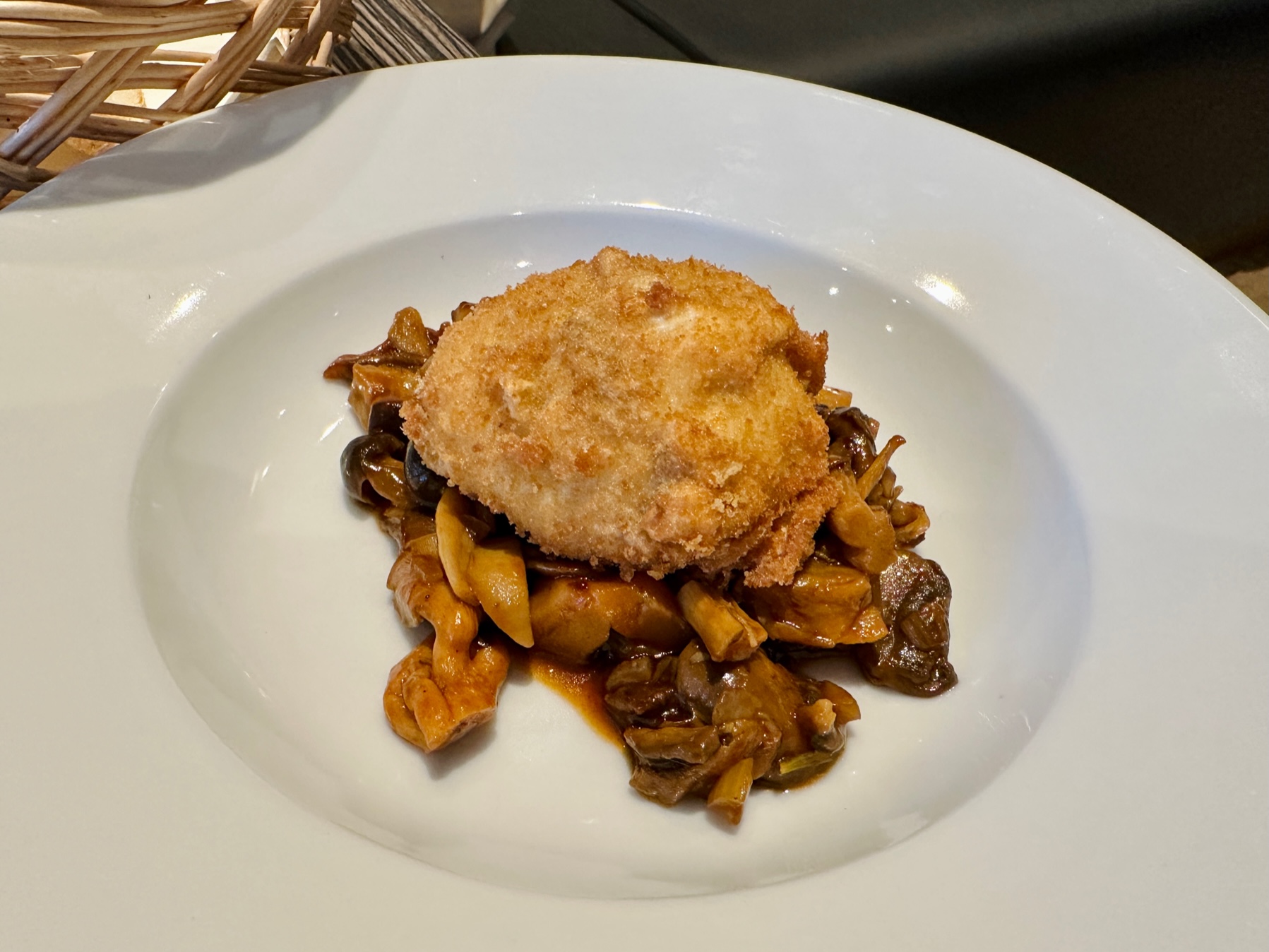
A final starter sounded so good, and looked so good online, that we were greedy and ordered it to share. A pile of wild mushrooms – accurately described for once – was sticky and reduced, topped with a crispy breadcrumbed egg. The egg was cooked just right, with only a little over-wobbly egg white, and when cut open the yolk worked its magic spreading across the mushrooms, an edible sunrise. 

Again, it was a dish so close to superb but not quite there – I wanted more savoury depth in the mushrooms, and that was missing. I didn’t mind that it was on the small side, and I didn’t mind that it was a tiny bit pricey (it was just under a tenner), but I did mind that. If the flavour had been spot on, none of that would have mattered in the slightest.

All that said, main courses were pretty good. Zoë’s lamb rump was expertly cooked, far better than at, say, London Street Brasserie, and four really generous slices of it were fanned out on top of a very creditable caponata with plenty of black olives, the whole thing bathed in jus. The salsa verde was denser than Owen Jones, but considerably more appetising (and like Owen Jones, a little went a very long way). This dish wasn’t cheap at just over twenty-five quid, but I thought it was probably about its money. Again, Zoë found it a smidge underseasoned. She might have been right.

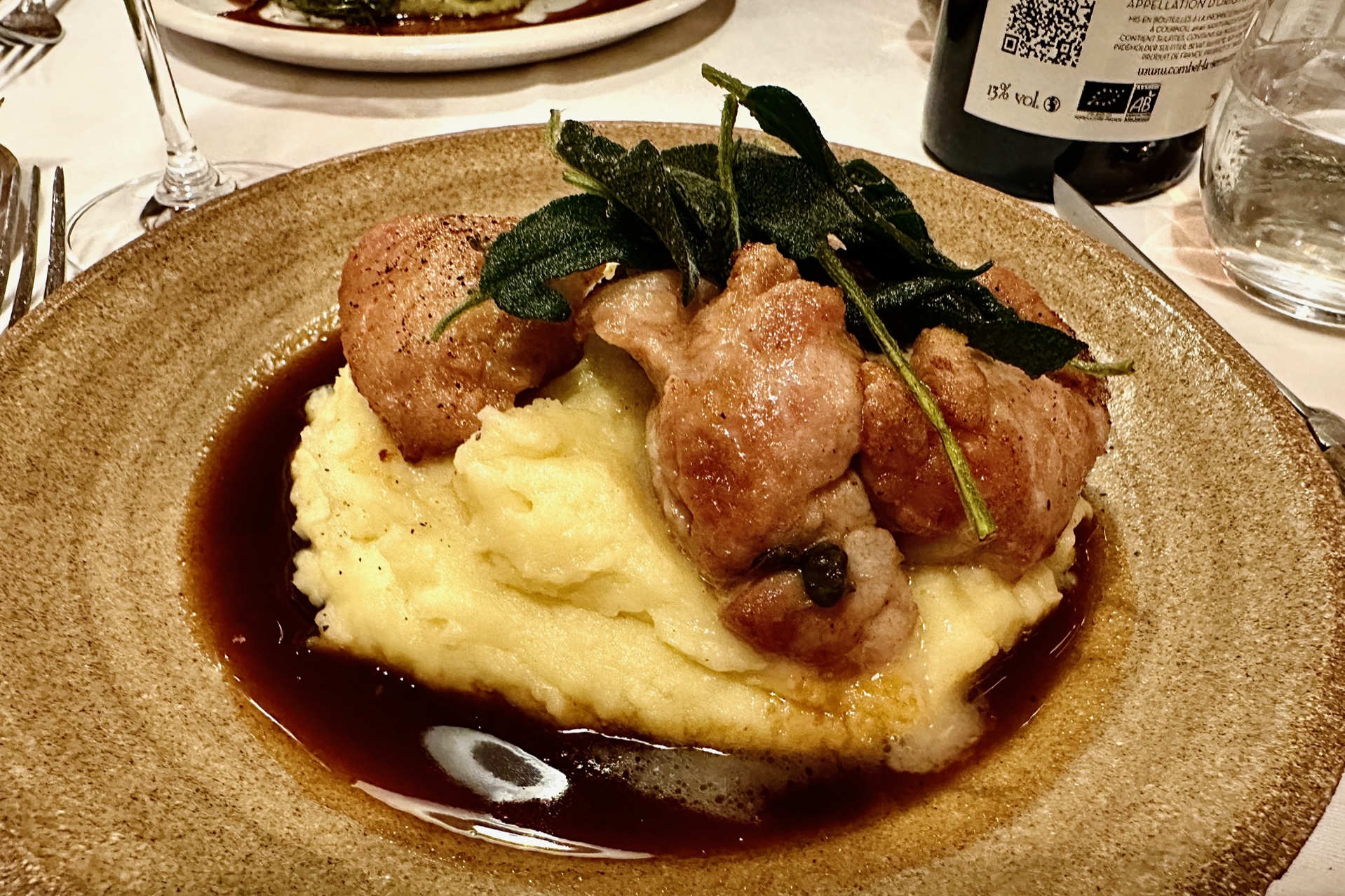
Saltimbocca has always been one of my favourite dishes, and since Dolce Vita closed nearly five years ago I’ve never found one that came close. San Sicario’s, I’m pleased to say, did – three pieces of veal, topped with prosciutto and luxuriating in butter and sage is one of the loveliest, simplest plates of food you can eat. Again, I feel a bit like I’m kicking a puppy saying this but it needed more – more butter, more sage, more seasoning, more oomph. The courgettes it was served with were pleasant enough, and certainly not cooked to mulch, but they felt like a bit of a plod without plenty of that butter to trawl them through. In my mind I was hoping for courgette fritti, but it wasn’t to be.

We did, however, make an excellent choice of side. Potatoes were wonderfully bronzed cylinders, all crinkled edges that spoke of a far healthier relationship with fat than I’ve ever managed. They were more fondant potato than roast potato, and all the better for it. Three pounds fifty, too, which is ludicrous value. “This is a lot better than that medley of veg you get at Pepe Sale” said Zoë. I couldn’t agree more.

By this point the restaurant was as full as it was going to get at lunchtime, and it was interesting how that exposed some problems with the service and the space. We eventually ordered some wine – a glass of barbera for Zoë and a sauvignon blanc for me – after we finished our starters. Both were lovely, but by the time they’d arrived our mains were in front of us. We hadn’t specified what size we wanted, he hadn’t asked and he brought us large glasses, which isn’t really what we wanted.

We didn’t make anything of it, it wasn’t a biggie, but there were a few niggles like that. The waiter was absolutely lovely, and quite up front about his limited English – still, of course, infinitely better than my Italian – but there was just the one of him and he did seem to struggle a little with half a dozen tables demanding his attention. And the room was so big, and the tables were so spaced out, that it could be difficult to grab him when you needed him.

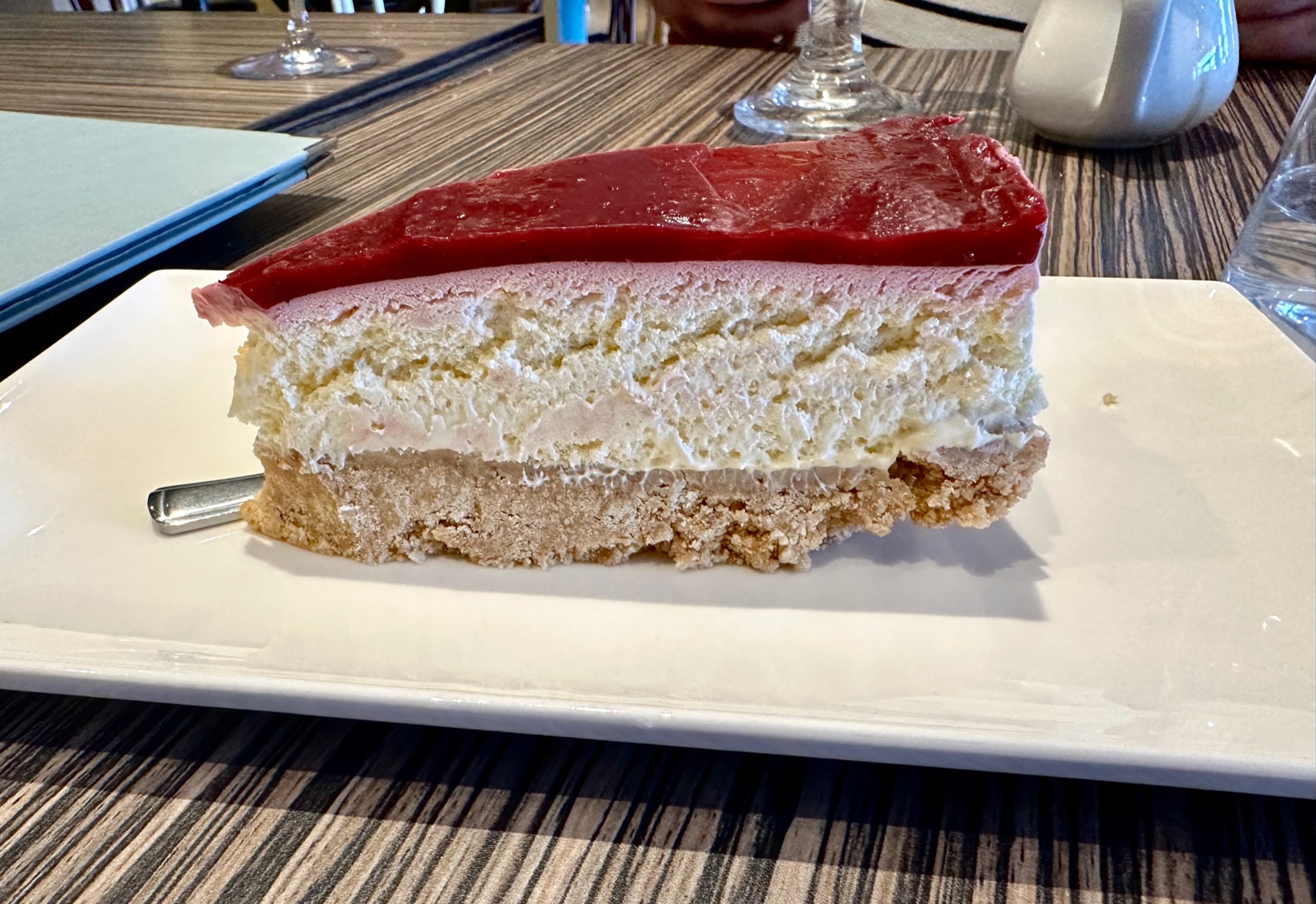
I would say desserts are San Sicario’s weak point. The menu sensibly only has half a dozen, but they don’t bowl you over. Having ordered tiramisu at practically every Italian restaurant I’ve reviewed since 2019 we gave it a miss this time, although it turned up at a neighbouring table and looked good. Zoë chose a cheesecake, and enjoyed it without ever going into raptures. It was billed as a vanilla lemon cheesecake with berry compote – talk about covering your bases – but actually it was a slab without compote and with a layer of fruit jelly on top. I didn’t try it, but tellingly I didn’t especially want to.

I’d picked an affogato, prompted by fond memories of the one Tamp Culture used to do back in the day. It was entry level – two scoops of vanilla ice cream that could have been Walls, a jug of burnt-tasting espresso and, allegedly, some amaretto. It looked like the ice cream might have had a few molecules of the stuff splashed over it, but not enough to taste of it. When a dessert is this simple, every aspect of it should be good. With this one, none of it really was.

Our bill for all that food, a couple of drinks each and a post-prandial espresso came to one hundred and thirty pounds, not including tip, and took a fair old while to conjure up. I actually think quite a lot of what we had was pretty decent value, and it’s also worth pointing out that for the time being the restaurant is offering 20% off food Tuesday to Thursday via their Facebook page. After we settled up we went to Phantom for a drink, and it was hosting some kind of punk pop festival which made me feel ancient – I’m old enough to remember Basket Case the first time round – so we hopped into a taxi, went to Double Barrelled and had a very pleasant couple of hours working our way through the pales on offer. A perfect Reading Saturday.

If it’s brave to open a restaurant in the winter of 2022, knowing everything we know, it’s especially brave to open the kind of restaurant San Sicario is. I think the lower end of the market, your Franco Mancas and Zizzis, are possibly better protected from the economic shocks of the moment than somewhere unapologetically upmarket like San Sicario. And that’s before you factor in that their site is enormous. That their site is in a location that’s not in town or in Caversham, with limited parking. That it’s a site that has proved to be a poisoned chalice for so many restaurants. Then consider all the faff and palaver of revealing your name in November and having to change it literally on the 3rd of January – talk about New Year, new you – and San Sicario starts to look positively heroic.

And yet I really hope they make a go of it. It’s truly encouraging to see somewhere trying to offer what Reading doesn’t have – a genuine, interesting, high-end Italian that doesn’t just pile up the pizza and pasta, lazy variations on a theme, and try to take easy money. Some of the dishes I had I simply wouldn’t have been able to get elsewhere in Reading, and the fundamentals of the restaurant are solid. They need to tighten up the service a little, and I’d like them to be a little more liberal with the seasoning, but in honesty there’s nothing wrong with San Sicario that a few more customers wouldn’t solve.

Restaurants run better busier, and if I’d been there on a Saturday night, all buzz and bustle, I suspect it could have been fun enough to quite make me forget the glory days of Chi’s Oriental Brasserie. I will be back, and I sincerely hope San Sicario breaks the duck of one of Reading’s unluckiest sites. After all across town, in an equally ill-starred space, their compatriots Madoo have proved that it can be done.

San Sicario – 7.6
93-97 Caversham Road, RG1 8AN
0118 9560200

https://www.sansicario.co.uk

Restaurant review: Wilsons, Bristol

Wilsons was awarded a Michelin star in February 2025.

I’m sorry to start proceedings with what looks suspiciously like a humblebrag, but last month I was on holiday in Belfast and as a treat, we booked a table at Ox, one of the city’s Michelin starred restaurants. But it was a hugely disappointing evening, which will please those of you who don’t like humblebrags. Everything was not quite right; nothing was actively terrible, but the whole thing felt far from optimal. We left underwhelmed, slightly peckish and feeling as if our wallets had been mugged in a dark alley, and wandered away from the scene of the crime in search of a pint.

I’ve never understood people who collect Michelin starred restaurants – too humblebraggy even for me – or restaurant bloggers who loftily describe meals they’ve had as “easily one star food”, as if somebody died and promoted them to inspector. Get over yourselves: it’s just one set of opinions, from an organisation so shrouded in secrecy and obscurity that they make the Freemasons look like the Good Law Project. For what it’s worth, I’ve always thought the Bib Gourmand is a better indicator that you’ll have a good and interesting meal.

The subject of this week’s review is Wilsons, a little restaurant in Bristol which doesn’t have a Michelin star per se (it has a green star, which is something different) but which served me one of the very best meals I’ve had in the last five years. Not only did it get everything right that Ox got wrong, but it made me think about what excellence in restaurants really means – and how little of it has anything to do with being fancy.

Take the room, for example. At Ox, we walked past the lovely, twinkly, atmospheric downstairs room – which had free tables in it – only to be walked up the stairs to an unlovely mezzanine floor, all hard surfaces and dead air, the overflow car park of hospitality. It was boiling hot, the aircon stayed resolutely switched off and even blowing out the candles didn’t seem to alert the staff to what a stuffy, unpleasant place it was in which to have a meal. Wilsons has just the one dining room. It’s plain, simple, dignified and stylish with nothing on the walls except chalkboards and a lovely stained glass sign hanging in the full-length window. Good restaurants, ideally, have no shit tables. Wilsons has no shit tables.

This extended through to the menus. Ox doesn’t have a menu, so you are surprised on the night. Instead, they hand you a rather pretentious-looking sheet of paper which lists all the elements and ingredients that will feature in your meal, without telling you how or where. The menu is on their website, so even as gimmicks go, it’s pointless. Wilsons also offers a single menu but it’s written on the chalkboard each day for everybody to see. You can have the whole lot for sixty pounds – twenty pounds less than Ox – or a stripped-down version at lunch for twenty five quid (I read a review where someone said “that’s less than you’d spend on a pair of socks”: I’m as fond of conspicuous consumption as the next person, but what a knobber).

A mystery menu wouldn’t be a problem if the service brought the meal to life. Again, Ox was disappointing: everything was mechanical and muted, and much of it was hard to hear in that unforgiving and joyless space. Detail was scant, and there was more warmth in the room than in the welcome. And again, Wilson’s was outstanding. All the staff abandoned zonal marking for the hospitality equivalent of total football, which meant that our dishes were brought by a huge variety of friendly faces.

All of them could talk with huge knowledge and enormous enthusiasm about every single detail of every single dish: a better reviewer than me would have taken notes. On another night in Belfast we went to Edo, an incredible tapas restaurant and our waiter, almost immediately after we took our seats, said “well obviously I know the menu inside out so I can answer any questions you have”: that’s how you do it.

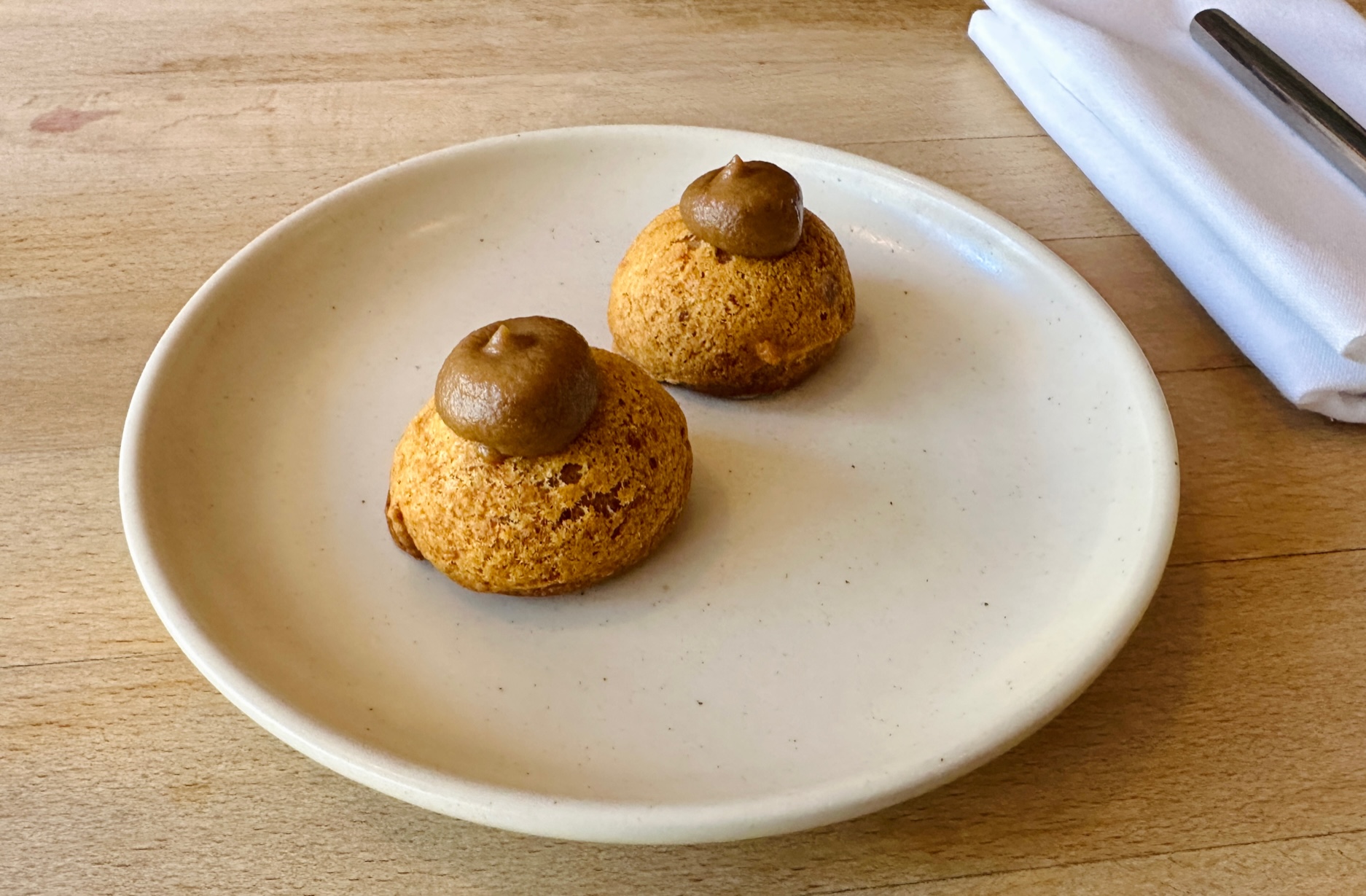
The food at Ox was also muted and bland, but that’s quite enough talking about restaurants other than Wilsons. Let’s talk about their food instead, because everything was stunning, more or less. We went for the full monty, and it started with a beautiful, clever piece of work – a gorgeous feather-light gougère packed with cheddar and leek and topped with a little beret of pickled onion purée. The whole thing imploded in the mouth leaving nothing but joy, an accomplished disappearing act.

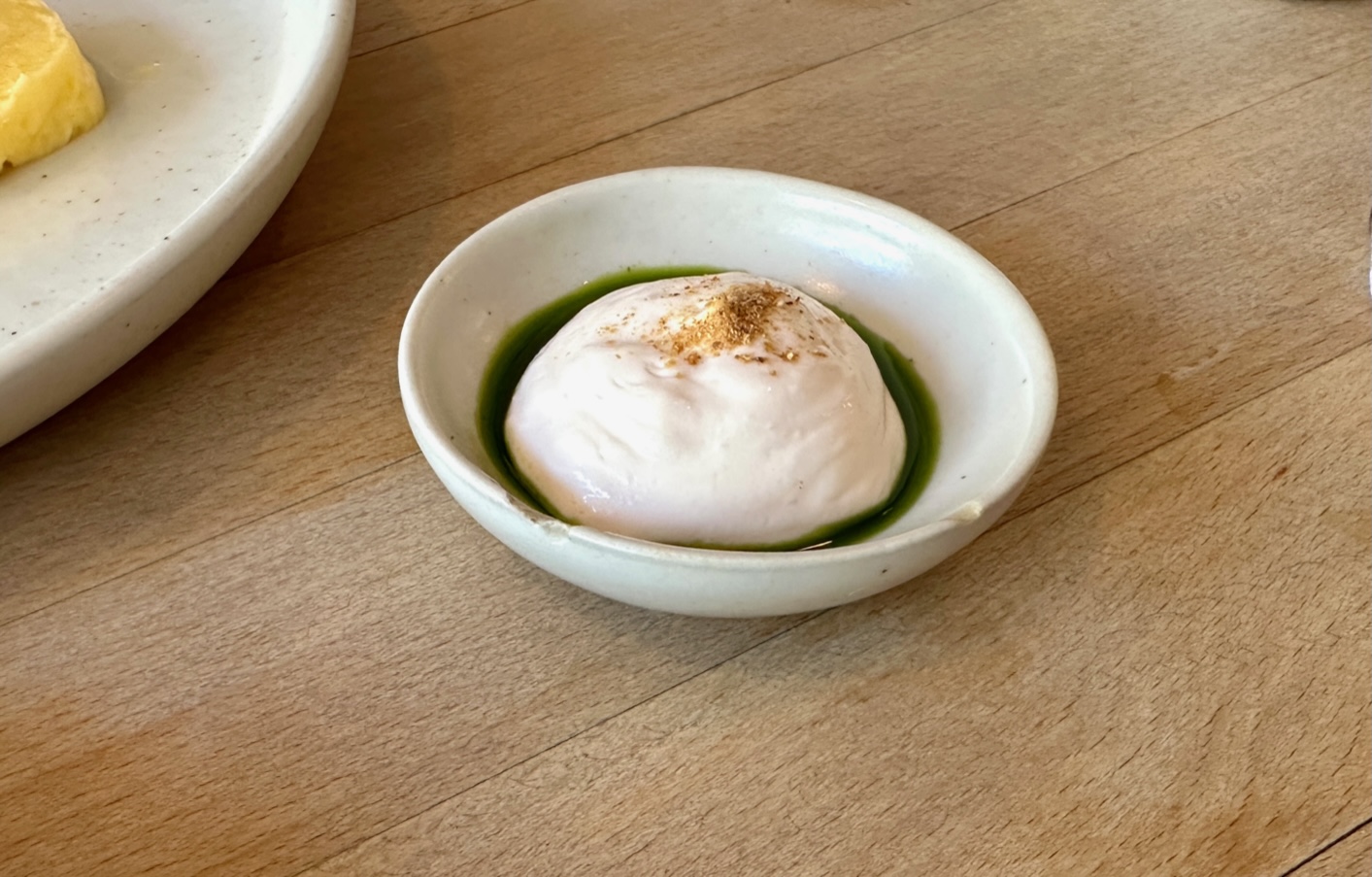
Bread was made by the restaurant and came to the table still warm with a puck of butter which the restaurant cultures itself. This was accompanied with a vivid little dish of cod roe, pastel pink with a little iris of bright herb oil. There was powdered something-or-other on top, and if I’d made notes I’d be able to tell you what it was. All of this was lovely, incidentally, although the bread was sliced a tad too thick which made it difficult to use all the butter and cod roe. Zoë ran her finger along the bowl, and I pretended to be shocked.

At the same time, we had one final snack which the wait staff playfully described as a taco – a chicory leaf with chicken liver parfait, preturnaturally smooth, topped with powdered beetroot and the pop of toasted pearl barley. So much effort gone into making something so small, gone in an instant but remembered for days: truly magical stuff.

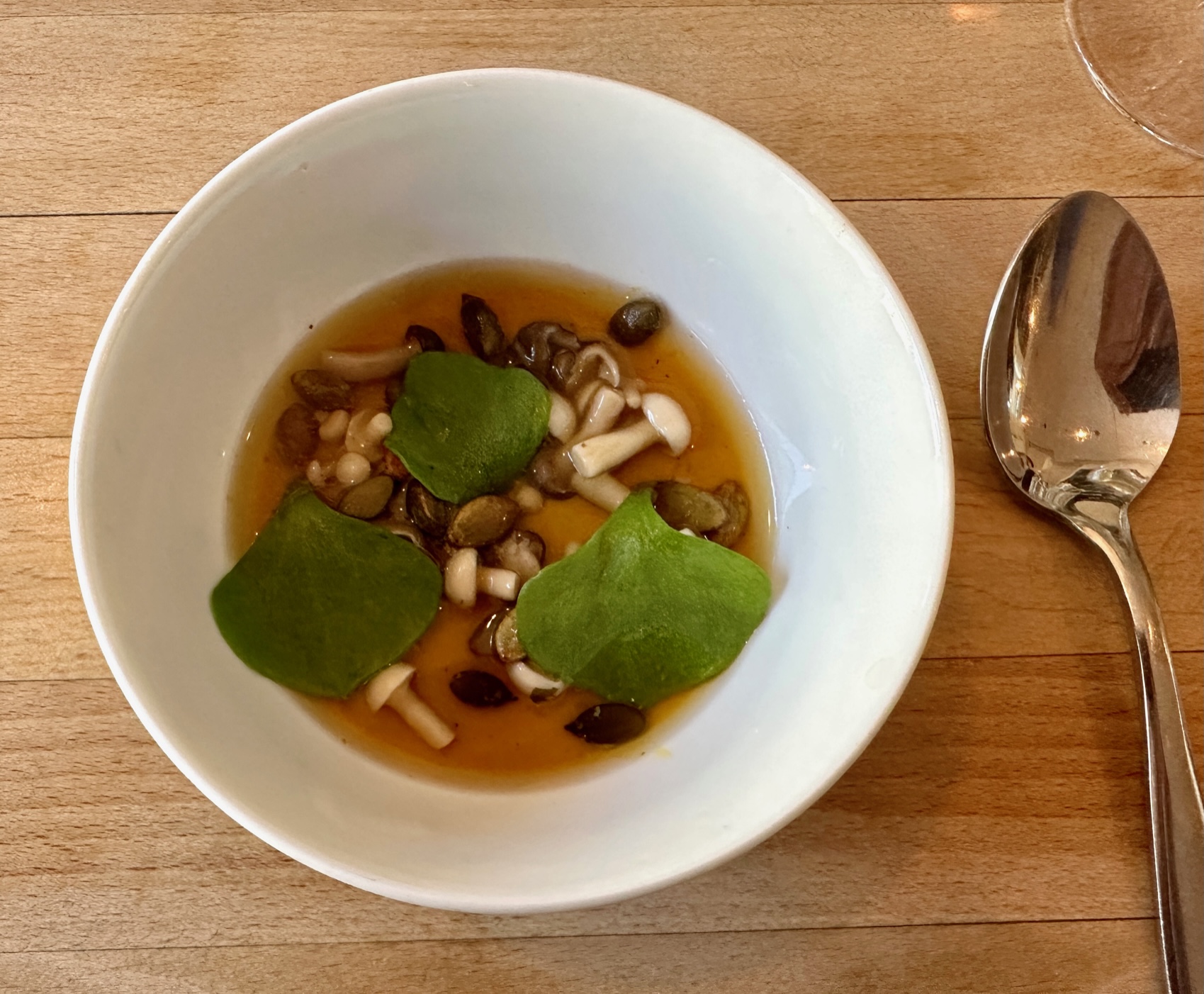
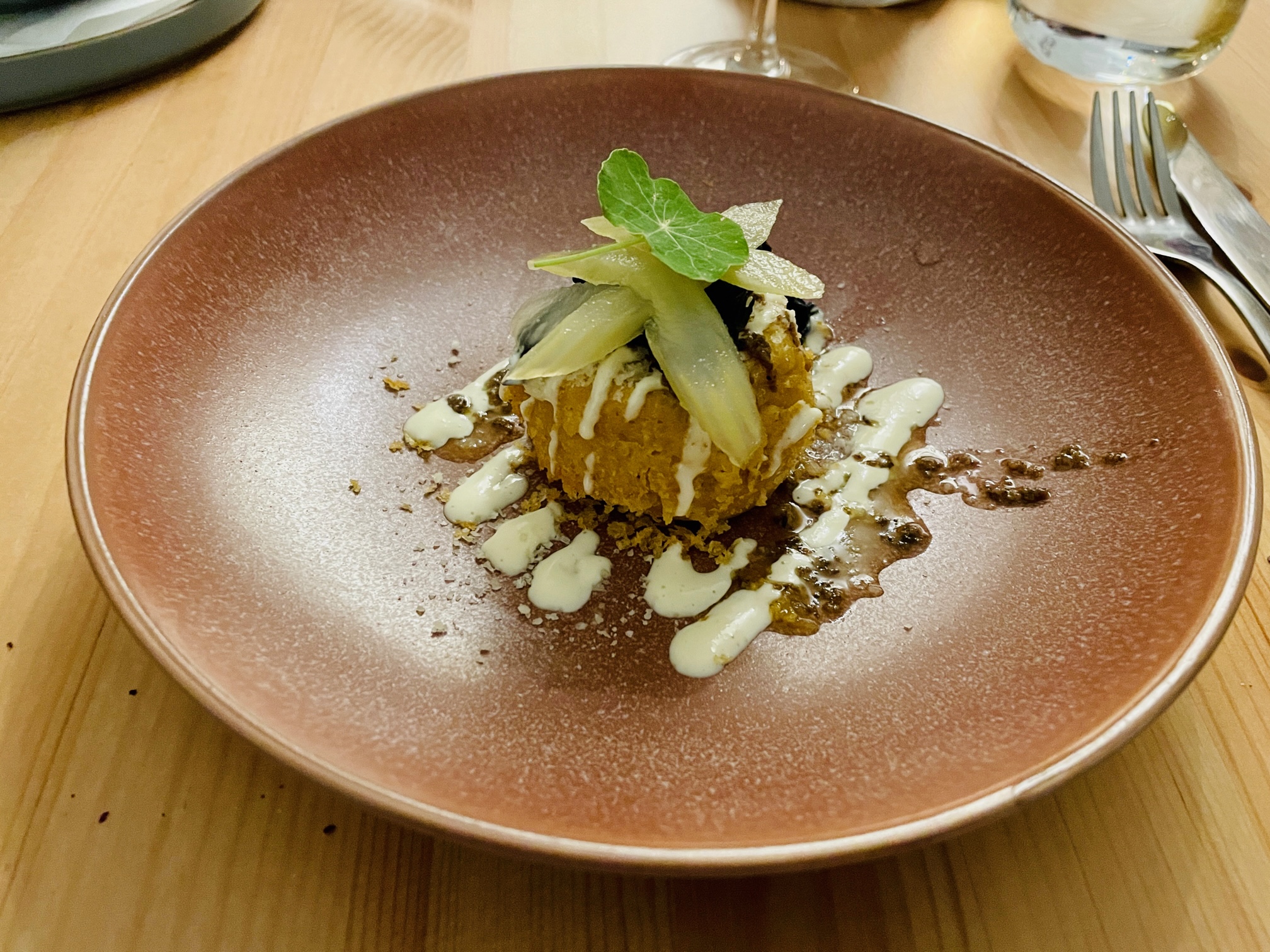
The next dish was one of the best things I ate that day, which makes it one of the best things I’ve eaten full stop. A savoury custard made with squash was sweet, glossy and perfectly spiced. Again, texture and pop was beautifully added with seeds, toasted in some of the same spice mix. But then the other elements added layer on layer of complexity and cleverness – tiny shimeji mushrooms, pickled in sherry vinegar, and a mushroom consommé poured over at the table, submerging the custard under something phenomenally savoury. Again, if I’d made better notes I could tell you what the leaves were: sorry about that.

By this point we were a couple of glasses into a fantastic bottle of natural Gruner Veltliner (the same one, actually, that I’d had at Goat On The Roof: it’s far more attractively priced at Wilsons) and I was already beginning to realise that this food was like very little I’ve eaten in other restaurants. I couldn’t recall anywhere I’ve eaten where the flavours were so pinpoint, where things had been so refined and perfected to make everything taste of its truest, best self. And as it turned out, I hadn’t seen anything yet.

Next to come was possibly the most disappointing course. Jigged squid – I have no idea what jigging is, and this time it’s not because I didn’t take notes – came in a rich and salty broth with rainbow chard. The squid, cut into ribbons to resemble udon, was among the freshest I’ve had and this dish made me love rainbow chard, something beyond the talents of most kitchens. The broth bringing it together had absolutely everything, and again it was that precise, super-concentrated hit that makes you sit up and pay attention, eat more slowly, take it all in. But this was the first time a portion felt stingy and doubt crept in: four ribbons of squid, and it’s not a good sign that I counted them.

Was it enough to dumbfound your tastebuds if you left a restaurant hungry? And yet my tastebuds were so dumbfounded – not least by a little tuile made from squid ink, as black as night and dotted with herb emulsion (I probably should have mentioned that much of the produce Wilsons use comes from their garden). It was a perfect mouthful, in a meal full of perfect mouthfuls and in a world where the word perfect is much devalued, not least by me. “It’s like the best crisp ever” said Zoë, who usually sums these things up better than I do.

More was to come, and the fish course proper was a proper marvel. A little cylinder of pollock, a notoriously recalcitrant fish, was cooked bang on and topped with another symphony of herbs, alongside a silky parsnip puree, the whole thing bound together with a superb vin jaune sauce which delivered more salt and less funk than I was expecting. I’ve talked about the half-life of dishes before and this had a long one – each forkful carefully calibrated to prolong the enjoyment. But again, the lack of carbs troubled me. What was the point of these beautiful sauces, dips and oils when there wasn’t always the substance to transport them into your gob?

I should have trusted in the process, because the next course made everything right. Crown of pheasant, cooked and then, I think, finished on the barbecue, glazed with some kind of emulsion and dotted with the smallest, punchiest capers I’ve ever eaten was a thing of rapture, as was the pheasant sauce and the wedge of just-cooked cabbage (there was also something called Tokyo turnip, but I thought that was a Steven Seagal film so what do I know?)

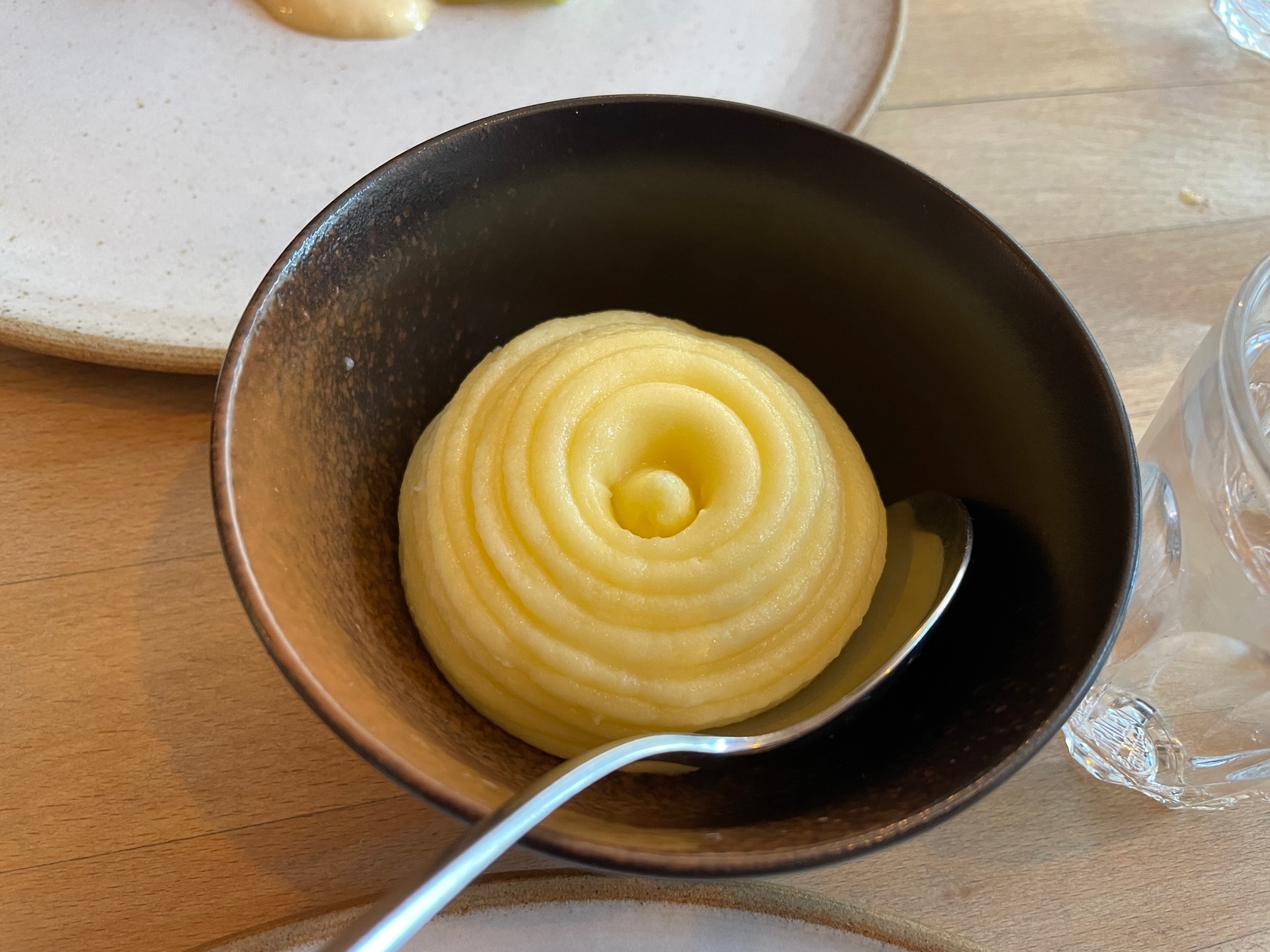
But where are the carbs? you might ask. But this is where Wilsons completely won me over by bringing a bowl of the best mash I’ve ever eaten. It was, the waiter told us, fifty per cent potato and fifty per cent butter. He also told us this is the only way to have mash, and I fear he might be right. It’s profoundly ruined me for other mash: I’ve already used the words ‘silky’ and ‘glossy’ in this review, so to save me reaching for the thesaurus let’s just settle for ‘exceptional’ here.

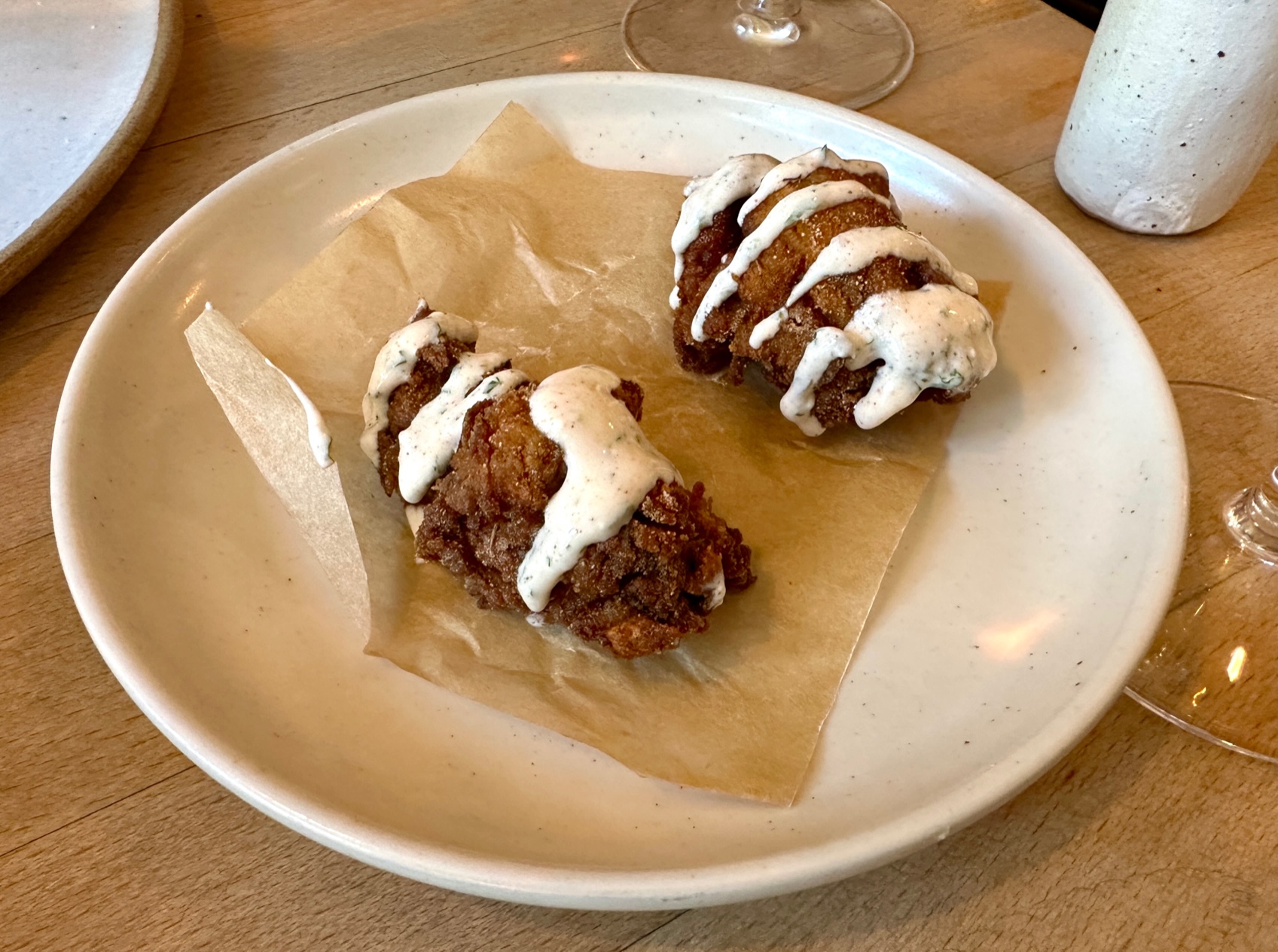
And there was still time for one more extra, one more whistle and bell to show that the kitchen left no stone unturned. We were also brought two pieces of what the waiter called “Kentucky Fried Pheasant”, little nubbins of pheasant thigh coated in the restaurant’s secret blend, deep fried and then drizzled with a ranch dressing including some of the same spices. You might wonder who goes to all that trouble, and I wouldn’t blame you. Wilsons do, that’s who. I may never get to try Eton Fried Swan (once we have a republic I really think this is a franchise that could take off) but until then this will tide me over nicely.

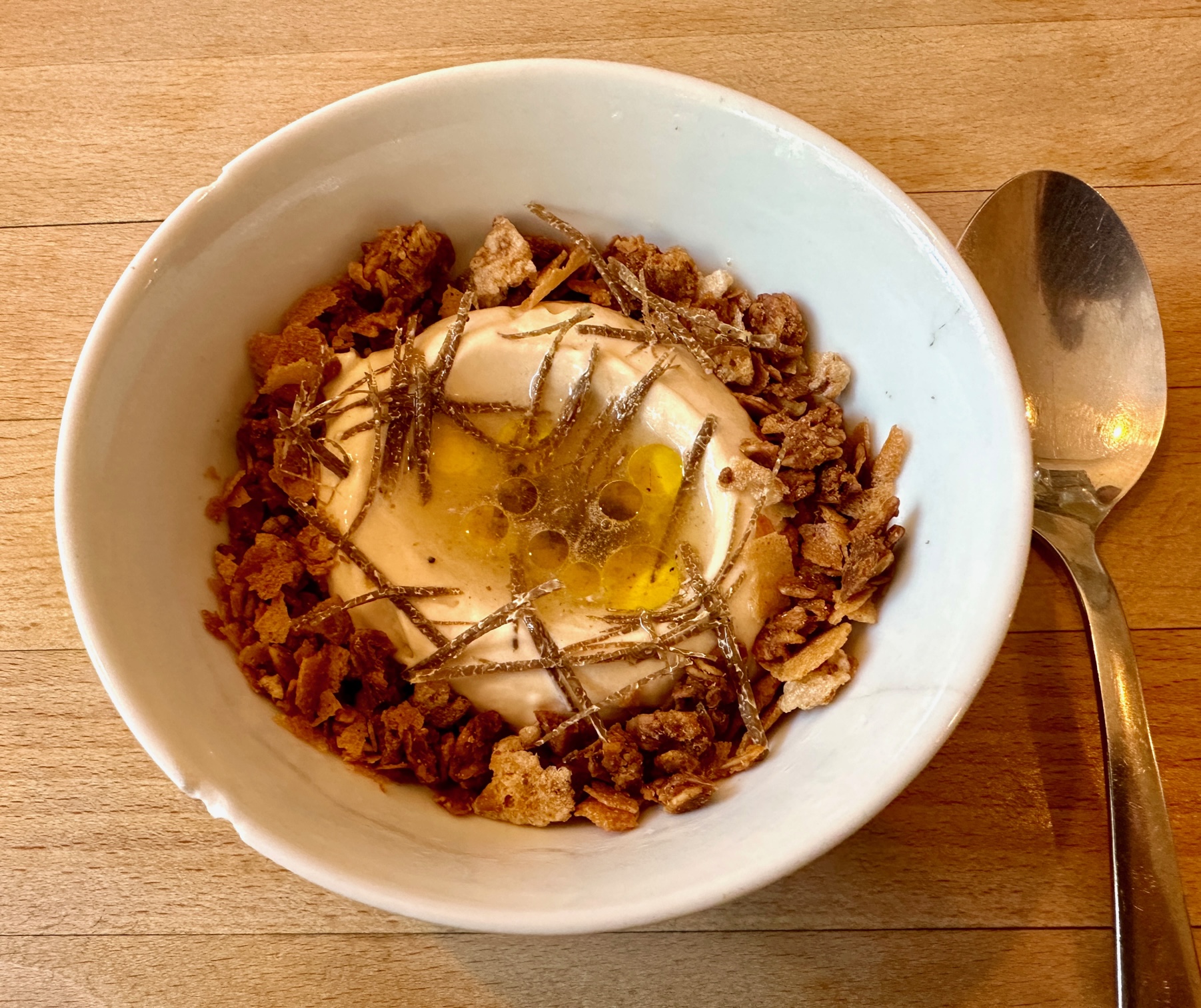
Having had some of the best, most interesting courses of my restaurant-going life, presumably things would dip for dessert, right? They so often do, after all. Well, think again: Wilsons’ dessert was also a desert (or even dessert) island dish. On paper it just sounded weird – celeriac, fermented honey and truffle. And it might not have been to everyone’s taste, but it absolutely knocked my socks off. The celeriac was an ice cream, more a semifreddo really, with a pool of fermented honey lurking in its hollow. All around it were toasted grains adding crunch and sweetness, and then on top were little truffle shavings.

I don’t know who thinks to put all those flavours together, and it’s a highwire act where any of them could have backfired. But none of them did, and this is the dish, more than any other, that I’ve thought about since that meal. I’ve had parsnip ice cream before but never celeriac, and it worked better than I thought it would. But what I loved was the harmony. Truffle isn’t a team player, nor is anything fermented. But the kitchen deftly drew all of that together into something delicious, remarkable and perhaps slightly mad. And yet not a note was out of place.

Now in Michelin-land, if they haven’t given you a minuscule pre-dessert they tend to send you on your way with some petits fours. They’re not big but they are clever, and they’re another way of making you feel like you’ve had something for free even though all of that luxe is very much priced in. So I adored Wilsons for instead bringing over a hulking great canélé de Bordeaux for each of us.

Now, I’ve had these many times because Reading is lucky enough to have Davy of Wolseley Street Bakery fame, and this is one of his specialities which he supplies to various places, most notably Geo Café. I like a canélé. But this was a completely different beast, and I wasn’t in Kansas – or Caversham – any more. This had been elevated with whisky and tonka, and the sweetness and richness was like little I’ve experienced. This level of sensory opulence is something I associate more with fragrance than with food, and I can’t put it more strongly than this: if somebody sold an eau de parfum that smelled how that canélé tasted, I’d buy a bottle. They were so good I can even forgive Wilsons for putting the napkin underneath them, although I still think that’s baffling.

My meal – two aperitifs, a bottle of wine and all those terrific experiences and memories – came to two hundred pounds including service, and I’d do it all over again in a heartbeat. If Wilsons did vouchers I’d just ask for some for Christmas, and as it is I’m struggling to imagine going to Bristol without eating there again. More to the point, I’m wondering how quickly I can justify going back. As it was, we left knowing it would take a while to process just how good our meal was, and fell into a beautiful nearby pub called the Good Measure which, as luck would have it, was doing a tap takeover by our very own Siren Craft. It was Friday afternoon, I was full and happy and I’d had a miraculous lunch. Life rarely gets much better.

I’m sorry-not-sorry for putting you through this catwalk show of beautiful dishes and purple prose. Sorry because it’s a lot to rattle through, and also arguably sorry if I’ve made you hungry (although, also, not sorry: this is what restaurant reviews should do). Sorry that I’ve rhapsodised about a restaurant that’s a train and bus trip from Reading. But also not sorry, because this is one of the best restaurants I’ve been to in years of trying, and that deserves to be mentioned. I’m sorry because Reading doesn’t have somewhere to match Wilsons and, in fact, I don’t think it ever has. But I’m also not sorry because when people ask me what Reading needs I might stop talking about tapas restaurants, ice cream cafés and good wine bars and just say: it needs somewhere like Wilsons.

Wilsons – 9.6
24 Chandos Road, Redland, Bristol, BS6 6PF
0117 9734157

https://www.wilsonsbristol.co.uk

Restaurant review: Seasonality, Maidenhead

I get a fair few requests to recommend somewhere to eat in Reading. And when I do, I can usually come up with something: if you tell me how central it needs to be, your budget, what kind of food you like and how many of your party are vegans, or vegetarians, or coeliacs, I can find you somewhere suitable. It’s very rare that I’m completely stumped. 
But there is an exception to that, which I suppose you could best describe as the Special Occasion Restaurant. It used to be called fine dining, before that phrase became a term of abuse. But special occasion restaurant probably sums it up better – somewhere you want to go to spoil yourself, or treat someone, or celebrate anniversaries, birthdays, engagements or exam results. Yet even describing it that way makes me realise what a niche and endangered species it might be.

The thing is, a lot of restaurants can make an occasion feel special. It’s what they’re meant to do – the good ones, anyway. And isn’t special occasion dining a concept that has outlived its usefulness, as eating out becomes a special occasion, full stop? After all, we’ve staggered through two and a bit years of Bad Times, and summer has come to an end just in time for Even Worse Times to hove into view. I mark a special occasion these days by bunging the central heating on.

That said, it’s too early to say whether the latest coming storm will hit all of hospitality, or whether parts of the sector will fare better than others. Casual dining might be protected, in terms of demand, although it will have less of a buffer against rising costs. Chains may have enough of a war chest to see them through, as they did in the pandemic. But what about the top end? Is this a luxury people will forego, or will people ring-fence those kinds of meals? I imagine many restaurants, both new and well-established, are asking themselves those questions with some anxiety, especially with their peak trading period a month away.

I have to say, though, that even before the pandemic Reading never really boasted that sort of restaurant. In the town centre, the closest we had were places like Forbury’s (which, back when it was good, was very good), Cerise and London Street Brasserie. Only the latter is still going, although it’s not always felt quite special enough, I think. Further out of town we had Mya Lacarte which, in its early years, was terrific but faded away and closed. And I suppose we have Thames Lido. The location is special, if nothing else.

So for that kind of meal, people have always gone further afield – to London, which isn’t far in the scheme of things, or to one of the pretty pubs between here and London that trouble the Michelin and the Good Food Guides. Or out Henley way, for dinner at somewhere like Orwell’s: not Henley itself, mind you, as its upmarket restaurant Crockers closed its doors for the last time last month. “People won’t pay for fine dining but restaurants like Côte Brasserie do really well here” said the owner. “I have never been so badly disrespected as I was in Henley”: someone’s not going to get tapped up by the tourist board any time soon.

So where do I recommend, these days? Well, my go to used to be the Miller Of Mansfield in Goring – very pretty, terrific food and accessible by train if you all want to drink – but then it closed at the start of January: the cause of death was a greedy landlord, as usual (N.B. it’s since reopened under very different management). Since then I’ve struggled a bit, telling people there are better options further afield; the last time someone asked me, I suggested Goat On The Roof.

So that’s the thinking behind this week’s review – could Maidenhead’s Seasonality be a suitable option? The compact family-owned restaurant, run by husband and wife team Wesley and Francesca Smalley, got a rave review in the Guardian back in July and that, combined with the short sample menu on their website, made it look like an intriguing prospect. I never need much persuasion to hop on the Elizabeth Line, stopping only for a pre-prandial pale at A Hoppy Place, so I booked a table for Friday night with some anticipation. Could I finally find somewhere of a standard similar to places like Marmo and Caper & Cure without having to trek over to Bristol?

Seasonality was a short walk from the train station and, at first glance at least, was pretty unassuming. The dining room’s best feature were the big windows that I imagine let plenty of light in, but by nightfall, without that glow, the place was neutral and a little spartan. The only exception to the muted furniture was a weird-looking marble bar area, a little like a kitchen island, where you could perch side by side on bar stools and stare at the wall together: they tried to seat us there but I politely asked if perhaps we could have a conventional table instead.

The evening improved from there, and Seasonality do one thing of which I approve heartily, seating couples at adjacent corners rather than opposite one another so you both get a good view of the space. The place was quiet when we arrived, but by the end of our meal every table was occupied (except that weird kitchen island – another couple was seated there but made a break for a real table the moment one became vacant).

“It’s a bit dark” said Zoë, who is always better at critiquing the decor than I am. “I don’t understand why none of the lights are on over the window seats.”

The menu was a mixed bag – attractive but small. Based on the name (not a huge fan of the name, incidentally) I imagine the menu changes at least four times a year but I hope they tinker with it more frequently than that because otherwise it has decidedly limited replay value. Three starters, three mains, three desserts. A few snacks to start you off and a couple of sides. Starters just under a tenner, most mains twenty-five quid, desserts the same price as the starters. That’s your lot. 

On the plus side, that means that in this review you’ll read about the majority of what was on offer, but the minus is that if you enjoy the delicious agony of narrowing it down, or if you’re a vegetarian or a vegan, or find that the menu happens to contain one of your flat-out no-nos this might not be for you. I gave Zoë the first pick of each course, because manners, and I was delighted that in at least one case she went for the option I fancied least, giving me at least the illusion of choice.

The wine list was small and perfectly formed too – something like four reds and four whites, maxing out at forty quid. Ironically this is an area where I often think less is more, so I was happy with that and our bottle of Morgon, which was about thirty two pounds, had plenty of fruit and just enough about it to bridge the gap between the mains we went for. But before all that we started with a couple of things from the “snacks” section of the menu. The bread was lovely: two quadrants of a little loaf, still warm from a little gentle toasting and spot on with a pat of cultured butter (from Ampersand, who used to supply butter to Geo Café).

Better still was the other snack – sheets of lardo dotted with figs, grapes, sunflower seeds and micro herbs. This was the moment when I realised the evening would be nothing if not interesting. The salty whack of that lardo tempered and toyed with by a whole palette of other flavours and influences – the bright sweetness of fruit, the freshness of little leaves of mint – was a true delight, and unlike anything else I’ve tried this year. Besides, look at it: it’s like an edible Kandinsky. 

More fascination was to follow, not least because Zoë’s starter, which I’d dismissed as very much not my bag, knocked it out of the park. “Tunworth Cheese Soup” hadn’t appealed to me – a soup, made of cheese? – but more fool me: what turned up was a soothing bowl of lactic lusciousness, comforting but not too heavy, scattered with the crunchiest croutons and finished with verdant spots of olive oil. I used to have a friend who said she never ordered soup in a restaurant because every mouthful was exactly the same. Ordinarily I would have agreed with her, but with this masterpiece that was rather the point.

By comparison my starter felt like a good idea not executed right. On paper a potato and Jerusalem artichoke fondant with mushroom ketchup sounded right up my alley, but the flavours and textures of this dish were out of whack. Maybe it was the balance of the potato and the artichoke, but the whole thing had an oddly spongey feel to it without any crunch or crispness. The outside had no upside.

That made it feel a bit like a vegetarian fishcake, and there was nowhere near enough umami punch from the underpowered mushroom ketchup to lift it. Only the fennel, which I thought might be pickled, broke up the beige and reminded me of Bristol’s lovely Caper & Cure where I last had it. The starter we didn’t try was bergamot cured trout with oyster custard: only three options on the menu and I’d picked the wrong one.

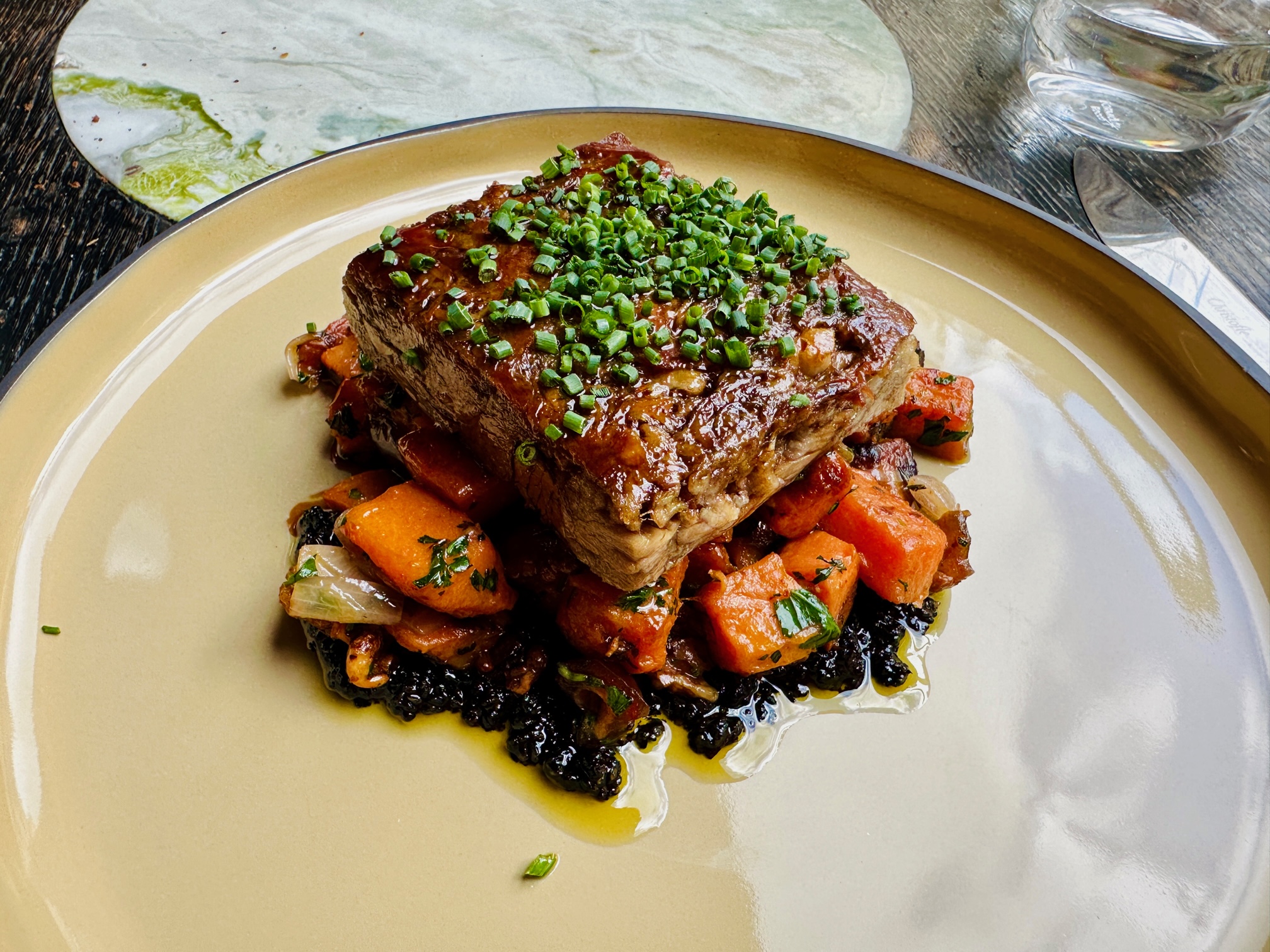
Mains reassured me that my starter was a blip. Mine was a beautifully cooked piece of hake topped with tightly curled, muscular brown shrimp and served on top of a ribbolita of coco beans, croutons and cavolo nero – more broth than sauce but still absolutely bewitching stuff. I thought I detected more of that fennel chucked into the mix, which I found a little strange – the dish didn’t need it and with a menu so small it seemed odd to have duplication.

Similarly the “Cookham greens” we ordered as a side – a tranche of cabbage a bit like a hot wedge salad – was drizzled with a dressing or sauce that looked very similar to the one that had adorned my starter. But even with those minor quibbles, the hake was a great dish. Could I think of anywhere in Reading that served food like this? Not really.

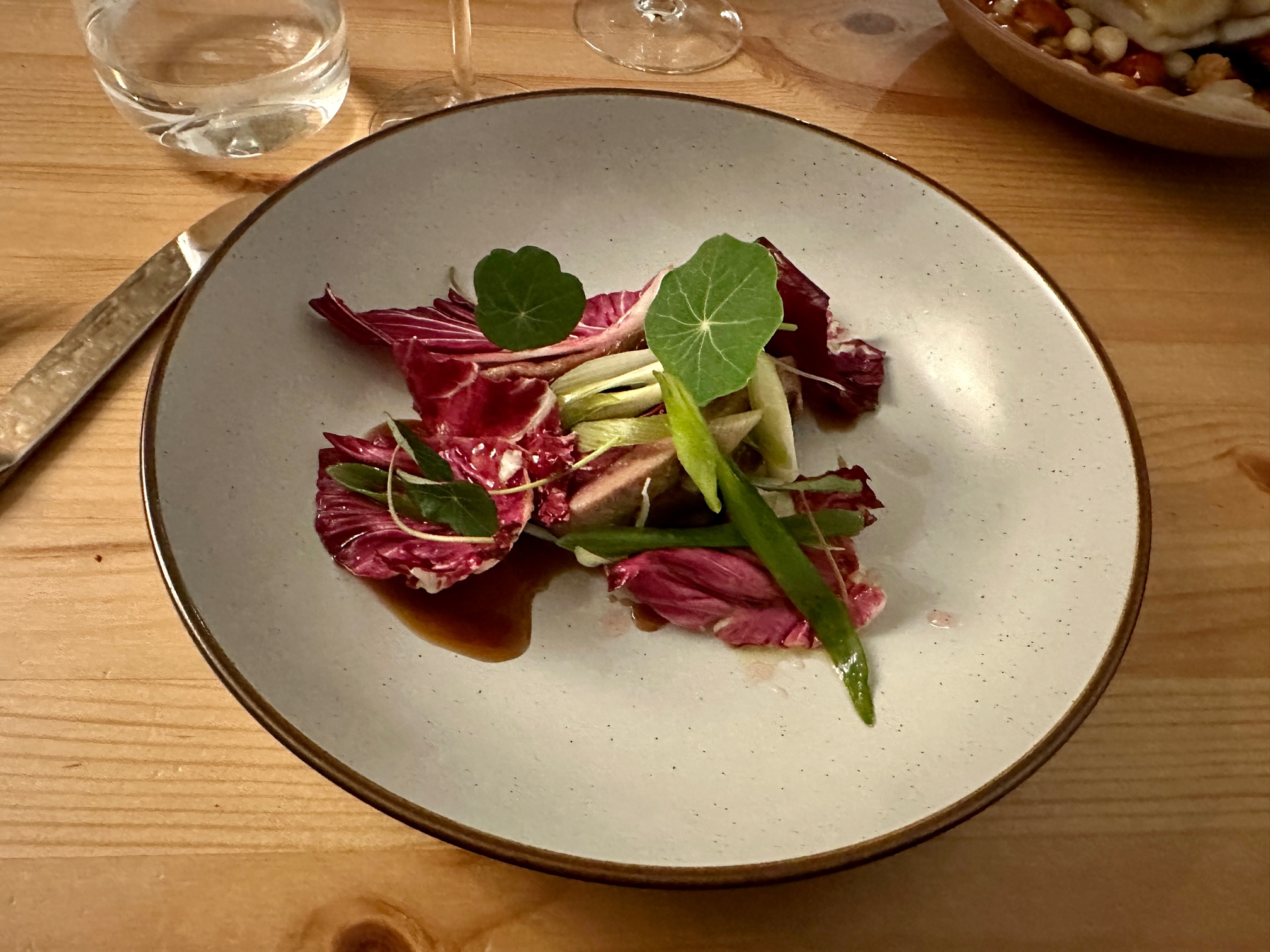
Zoë’s main showed more of that imagination and skill and again, had one truly impressive component. Venison was really nicely done, although pairing it with radicchio made it feel, and look, surprisingly insubstantial. But what saved the day was the other element of the dish, a bowl of salty, savoury, spiced venison keema topped with – another genius touch – something called “crispy potato” which, to me, had the feel of puffed rice (unless of course it was meant to be puffed rice, in which case the potato had gone AWOL).

The forkfuls of this I was allowed might have been my absolute high point of the meal, yet even so those two separate parts, the fillet and the keema, didn’t cohere into a single dish so in that sense, enthralling though it was in places, it didn’t entirely work. Seasonality does a set lunch Wednesday to Friday for a ridiculously reasonable £18 and when I last checked it included a roe deer keema pie and hispi cabbage: now that I could eat every week for the rest of my life.

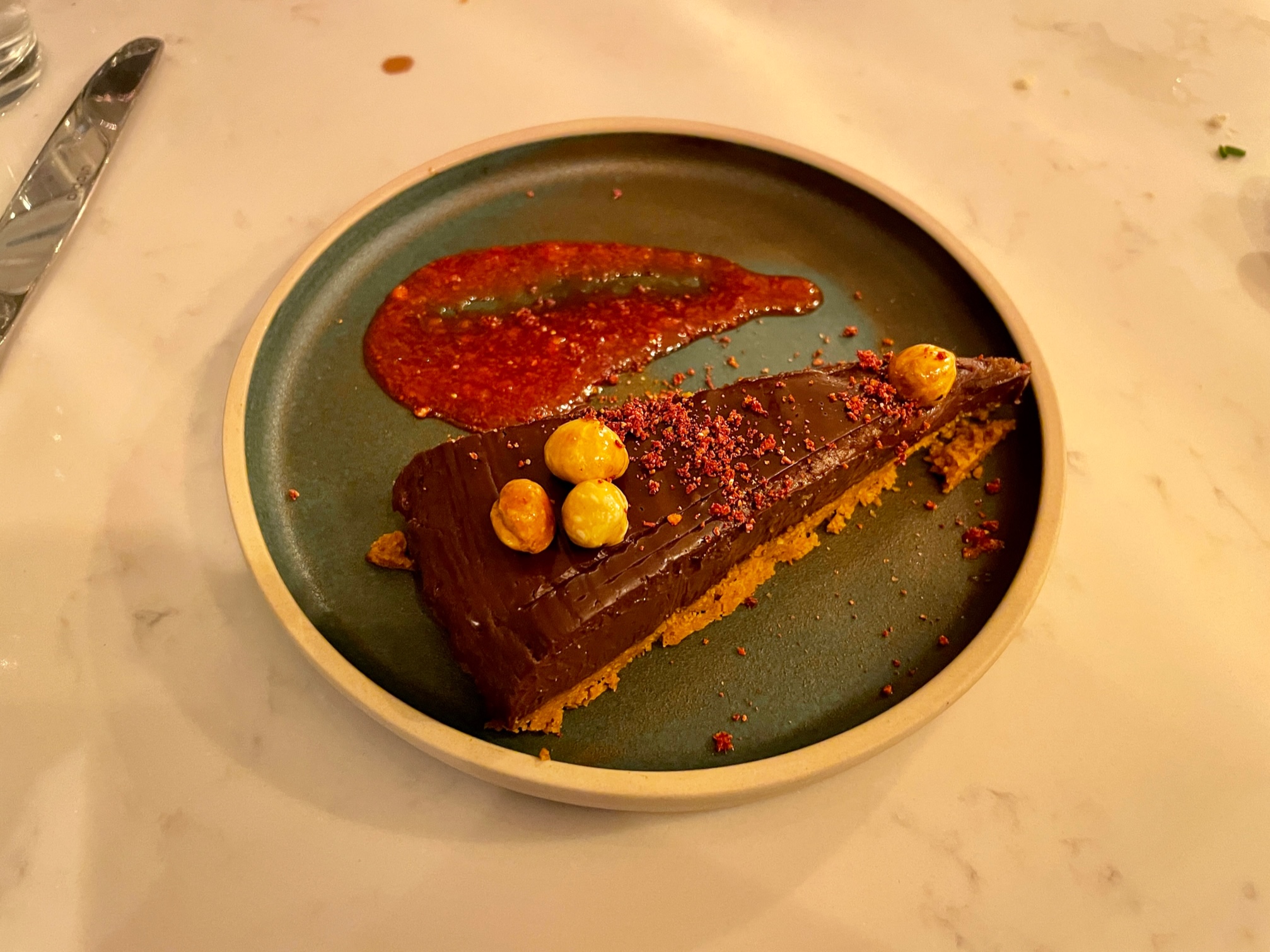
The wine list included a few dessert wines so once we’d finished our mains and our bottle of red we grabbed a Sauternes and a Pedro Ximenez (both impeccable) and ordered dessert. Again, Zoë had first choice and again she chose better – a slab of cake studded with hazelnuts, surrounded by a moat of deep chocolate sauce and crowned with a sphere of smooth, indulgent nut butter ice cream was just a superb plate of food. I wouldn’t necessarily thank you for a sticky toffee pudding but I might well beg you for one of these.

Despite seeing them mangled on Bake Off the other week (they’re a favourite of Brexiteer ghoul Prue Leith) I didn’t really fancy îles flottantes so I opted for the other option – the vicissitudes of a tiny menu again – the crème brûlée. Now, I must say that this is something I almost never order because I can nearly always find something I’d rather eat. 

It’s a blessing that I did, though, because it was the nicest I’ve had in ages. It had perfect texture, a wonderful note of tonka and a little freshness from the fig leaf – so much more to it than plain old vanilla – and a caramelised lid with a perfect snap and a wonderful burnt sweetness. I’d forgotten how enjoyable that first tap of the spoon can be, and everything that comes after. I also liked the palmier unceremoniously dumped on top of it but, again, it didn’t really go and felt like two desserts uneasily merged into one.

I haven’t talked much about service, but it was good and friendly if perhaps slightly lacking in polish. Little things like not taking cutlery away, or not bringing it out, along with just a general feeling that they were very agreeable but slightly on the green side. At one point the chef came out and talked to a few tables, which was wonderful to see, and I got the impression that a fair few of Seasonality’s customers are regulars. I can see why, too. 

Our bill – for four courses, a bottle of wine and a couple of dessert wines – came to a hundred and seventy pounds, which included a twelve and a half per cent service change. Grace Dent’s review in the Guardian said that a meal including drinks and service at Seasonality costs around forty pounds a head: either prices have rocketed in just over three months, or Grace Dent is on mushrooms. I know which my money’s on.

So does Seasonality do enough to become a serious prospect for Reading residents wanting to treat themselves? Yes and no. There are a fair few things in the latter column. The service needs more polish, the room is a little unspecial. The narrowness of the menu is going to be a big problem for some people, and I saw lots of little quirks that need ironing out – dishes that didn’t completely work, or didn’t come together, a certain amount of duplication which felt jarring across such a small menu.

Yet despite that Seasonality has a real charm and real skill that thoroughly won me over and made me want to come back sooner rather than later. There is imagination and talent on display in spades across that menu – in that phenomenal lardo dish, in the depths of that Tunworth soup, in my majestic hake or Zoë’s wonderful hazelnut cake. Those real highs, those fireworks, make me think that it would definitely do you a turn if you wanted to go somewhere different to celebrate – especially if you were getting there by train.

So although it’s not yet the finished article, I think Seasonality has more than enough showstoppers and jawdroppers to merit a visit. I keep thinking about the very best of what we had and trying to imagine anywhere in Reading that can quite match it, and the answer is that I can’t. The high points reminded me far more of places in Bristol than in Reading, and anybody that reads the blog will know how much of a compliment that is. So I will be recommending this a lot in future, because it proves something I’ve long suspected. You don’t need a special occasion to eat at some restaurants. Some restaurants are the special occasion in their own right, all by themselves.

Seasonality – 8.7
26 Queen Street, Maidenhead, SL6 1HZ
07507 714087

https://www.seasonality.co.uk

Restaurant review: Five Little Pigs, Wallingford

No blethering preamble for you this week, talking about the history of Reading’s food scene and putting things In Context (because there always has to be a Context). Things are much simpler this time around, because by the time you read this I’ll be off on my holidays and I just wanted to eat somewhere really nice the weekend before I went.

There’s something magical about the weekend before you go away, right from the moment you close the work laptop on a Friday afternoon: the knowledge that the weekend you’re about to have won’t be bookended by opening the sodding thing again on Monday morning, knowing that instead you’ll be at the airport, putting your phone and house keys in the plastic tray at security, browsing the duty free fragrance, daydreaming about that first holiday beer or glass of wine.

That’s why I found myself in Wallingford on Saturday afternoon with a reservation for Five Little Pigs that evening. Five Little Pigs received national attention earlier in the year when it got a rave writeup in the Observer. And whatever you think of Jay Rayner, his review of the place talked about deep-fried olives, a burnished toastie with cheese from nearby Nettlebed Creamery and a deep, savoury venison ragu. Reading that was enough of an incentive.

And besides, it’s not as if I had to go there with Rayner. Like most people, I have an infinitely better option: in fact, Five Little Pigs was on the list of restaurants I wasn’t allowed to review with anybody but Zoë (or, as she puts it, “not without me you fucking aren’t”).

Wallingford is a sleepy place, although remarkably easy to reach on the evocatively named River Rapids bus. It’s a very agreeable forty-five minute amble through Oxfordshire, out past Cane End, Gallowstree Common, Stoke Row. I expected Wallingford to be a little like Henley, or Witney, but it’s smaller than either with a couple of main streets, a pretty pub by the green and a really lovely wine shop, the neatly named Grape Minds. There’s also one of those antiques centres which is a succession of rooms full of tat and treasure in indeterminate proportions, and a Scandi interiors shop which mostly sells Farrow & Ball. The craft beer scene there is one bar with a fridge full of Phantom and Arbor Ales. That’s not to say I didn’t like Wallingford, but by the time our table was ready I was very much ready for it.

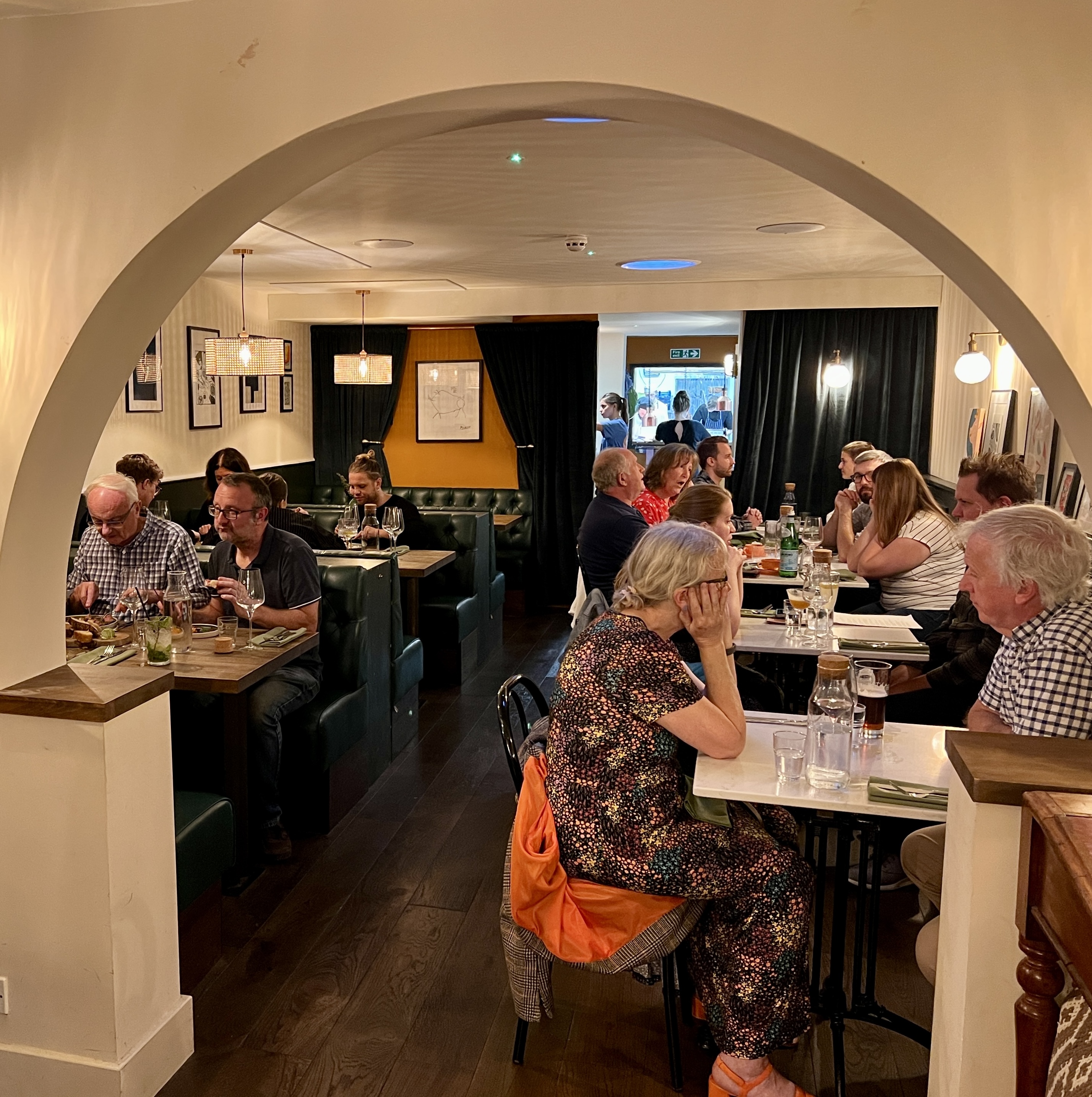
From the review I’d read I thought Five Little Pigs would be small but actually it was much larger than I expected. The front room, with the full length windows out onto St Mary’s Street, was a chic (if slightly chilly) space which was very tastefully done, an interesting mix of deep blues and golds and pastel shades from the art on the wall. It reminded me of places like Coppa Club, which isn’t necessarily a compliment. Further back was a longer, plainer room with banquetted booths. It’s a surprisingly hard space to photograph (as you can probably tell) but it was packed at seven o’clock on a Saturday night: a good review in the Observer will do that for you.

The menu read well and had plenty on it to appeal. Starters clustered around eight or nine pounds, and only a couple of mains were north of twenty. Plenty of it was local, too, with nearby cheesemakers, growers and butchers all namechecked. “We don’t have the pigs cheeks at the moment” said one of the wait staff, “but they may come in later.” I found that a bit confusing – were they being delivered by drone? – but decided it was best not to ask.

By that point a bottle of red had been opened, a really enjoyable organic Rioja, and I was about to reach that happy place where the food has been ordered and you know you’re safely in somebody else’s hands for the next few hours. Every table was full – with date nights, family gatherings and, in one case, an elderly couple who seemed to spend most of the evening glowering at each other. We were all going to have an enchanting evening. The Observer said so.

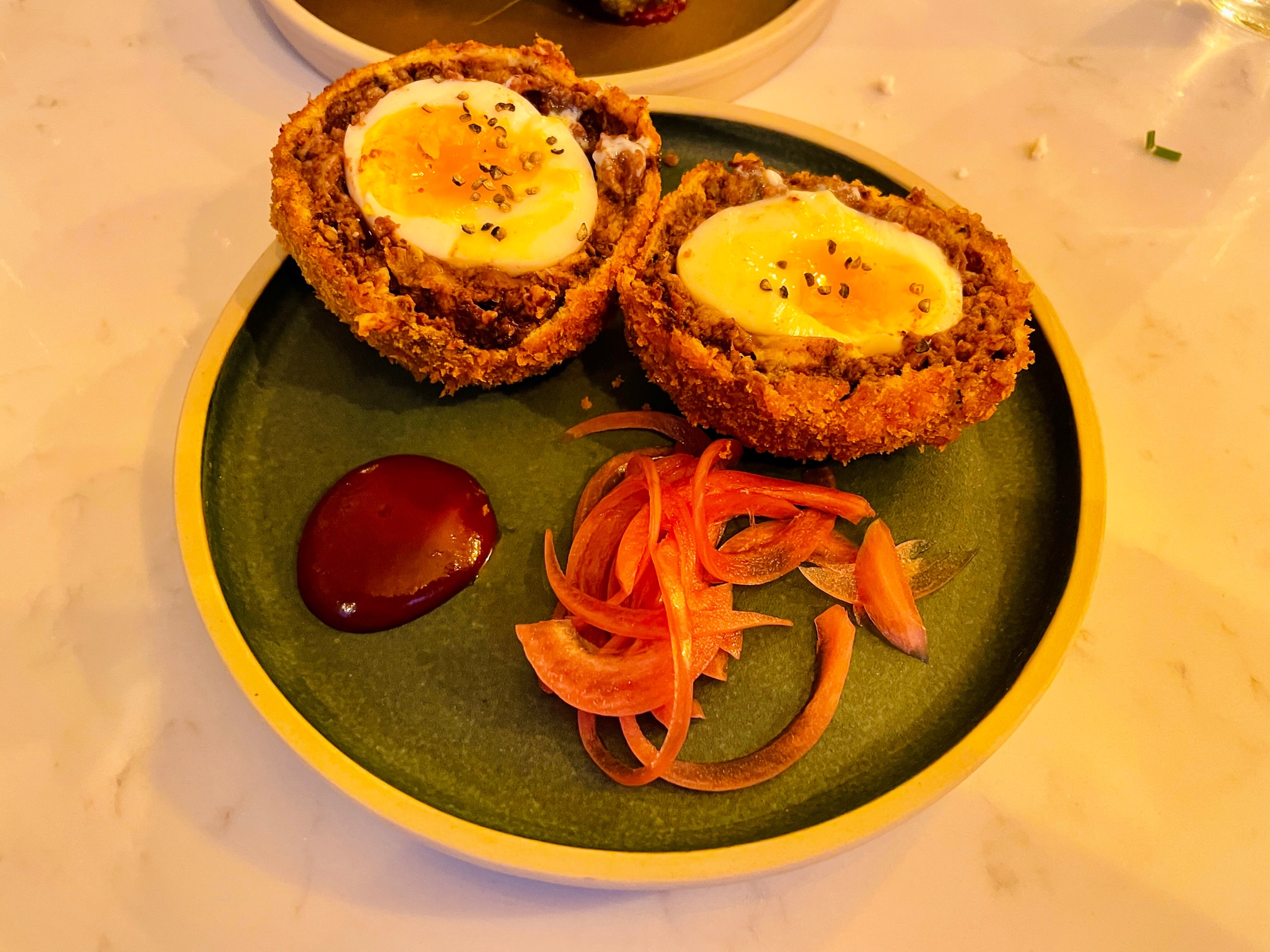
I felt a bit basic ordering the Scotch egg, but I can’t remember the last time I had one so it was calling to me from the menu right from the outset. It was one of the nicest things we ate all evening, so proved to be a happy choice : the sausagement was nicely coarse, with black pudding adding a little earthiness. And if I’d have liked the outside a little crisper, or the whole thing slightly less crumbly, the presence of a small pool of superbly tangy rhubarb ketchup mostly made up for that, as did the pickled pink onions.

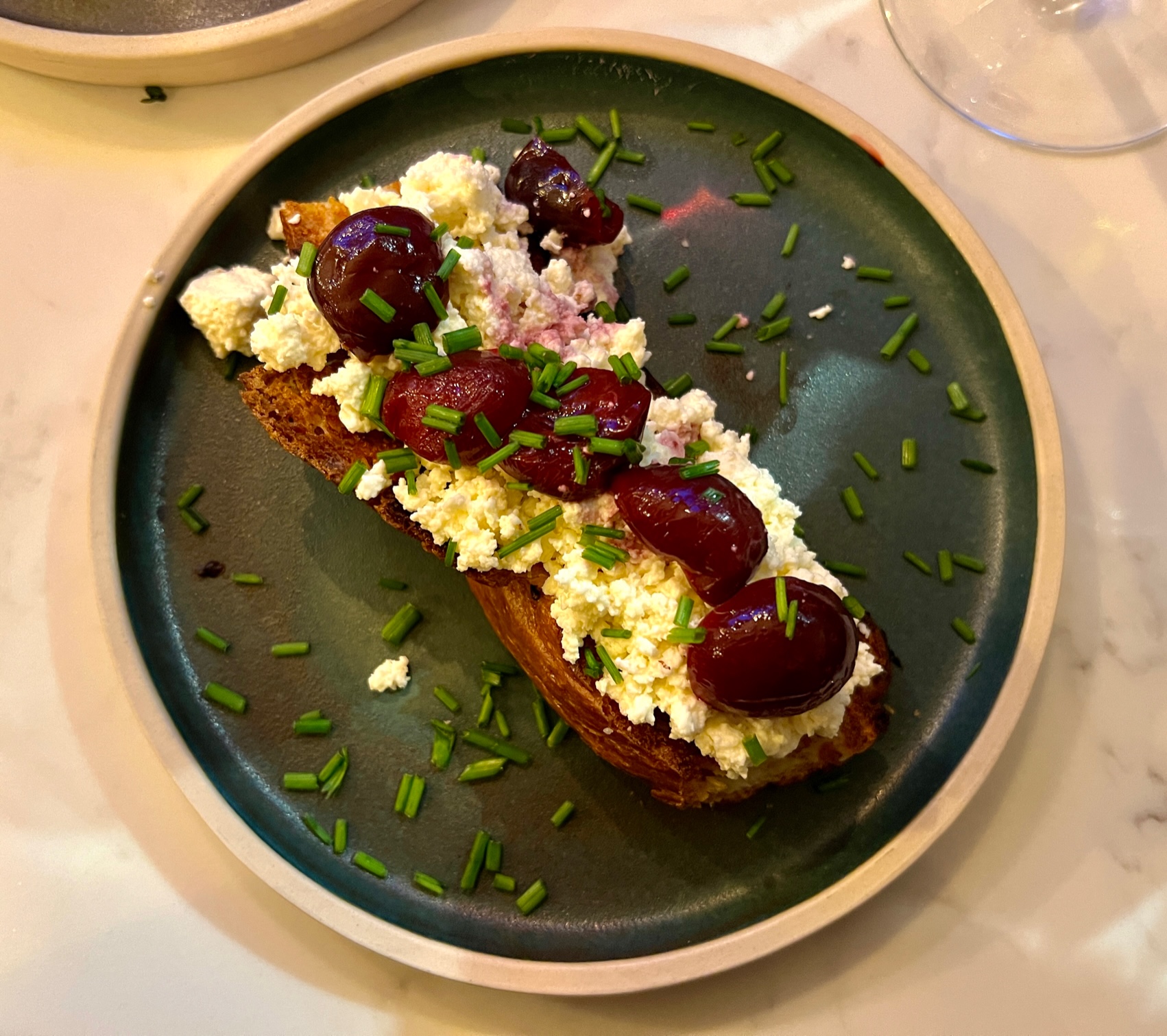
“You win” said Zoë, tackling her ricotta on toast, which sounded great on paper but in reality was disappointing. “It’s all a bit dry” she said, and this is a woman who’s listened to me talking about my favourite Bob Dylan records, so she knows what she’s talking about. For what it’s worth I agreed – the ricotta was dry and anaemic, the cottage cheese of the Chilterns, and although the roasted cherries were an interesting idea they didn’t add enough of the moisture this dish needed. Literal cherries on top, yes, but sadly not figurative ones. “This could have been really nice with honey” was Zoë’s take.

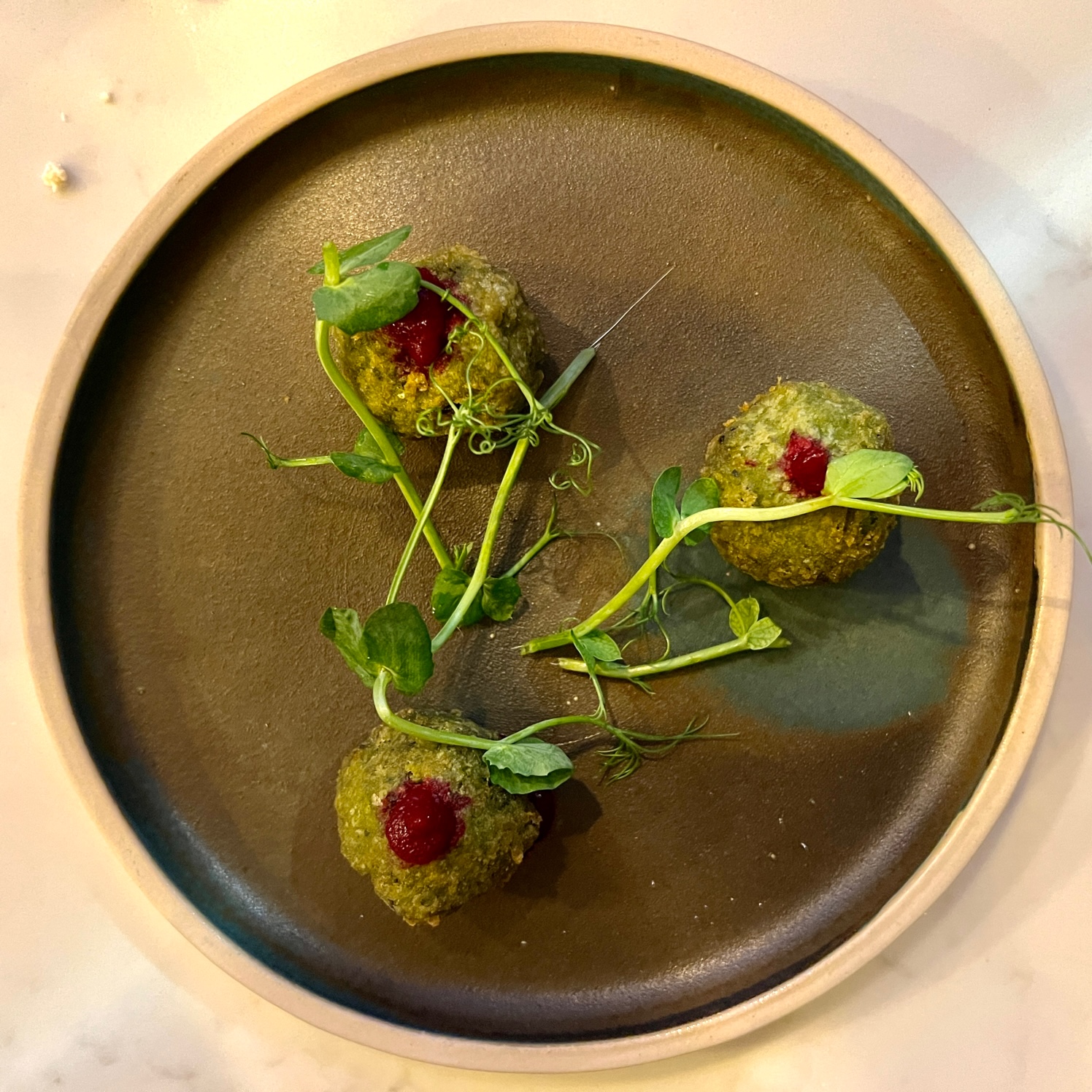
We’d also ordered a third starter, broad bean fritters, because they sounded so magnificent. And they tasted gorgeous, with huge amounts of freshness from the mint and a dab of deep whipped beetroot on top. But plating it up with pea shoots and plenty of negative space couldn’t really conceal the most obvious thing about this dish, which is that it was minuscule; it was one of those times when I wish I’d popped a twenty pence piece on the plate before I took the photo so you could see just how small they were. We had this as an extra dish, but if this had been my starter I’d have been looking at everybody else’s, feeling profoundly robbed.

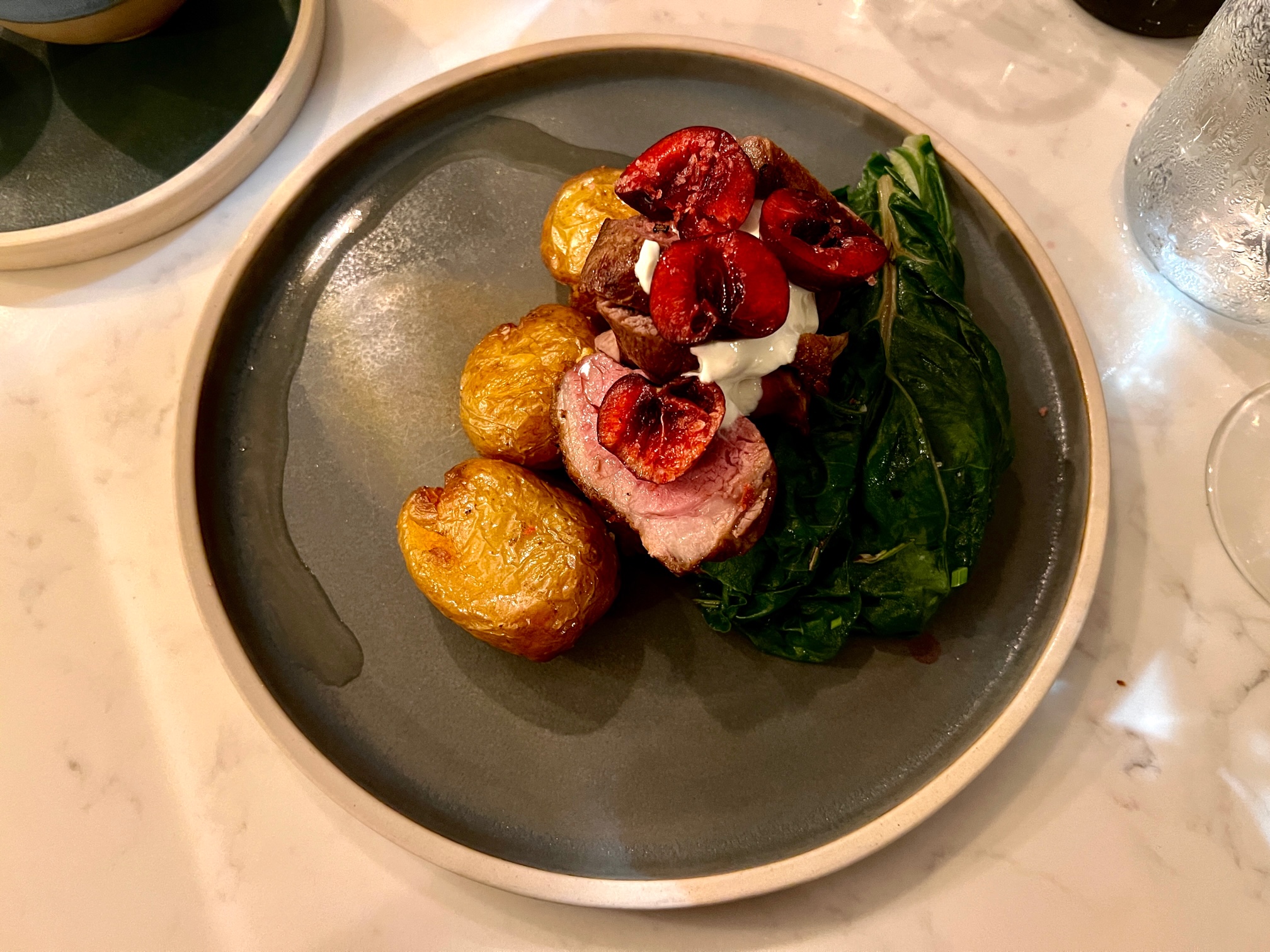
Things were well paced at Five Little Pigs, possibly because it was so busy, because our starter and our mains were about half an hour apart, for me close to the optimum interval between the two. I think Zoë chose better with the mains and her lamb rump with yoghurt, more of those roast cherries and what the menu calls “crispy potatoes” was the pick of the two. But even here, it wasn’t perfect. “Again, it’s dry” said Zoë. “The yoghurt is really good, but if anything it needs more of the cherries. They work better here than they did with the starters.” I agreed with that, although I thought the crispy potatoes were a standout, with a lot more texture than met the eye. But for me, the lamb rump was a little overdone. I found it odd, too, that they brought me a steak knife but not Zoë, when her dish needed it every bit as much as mine.

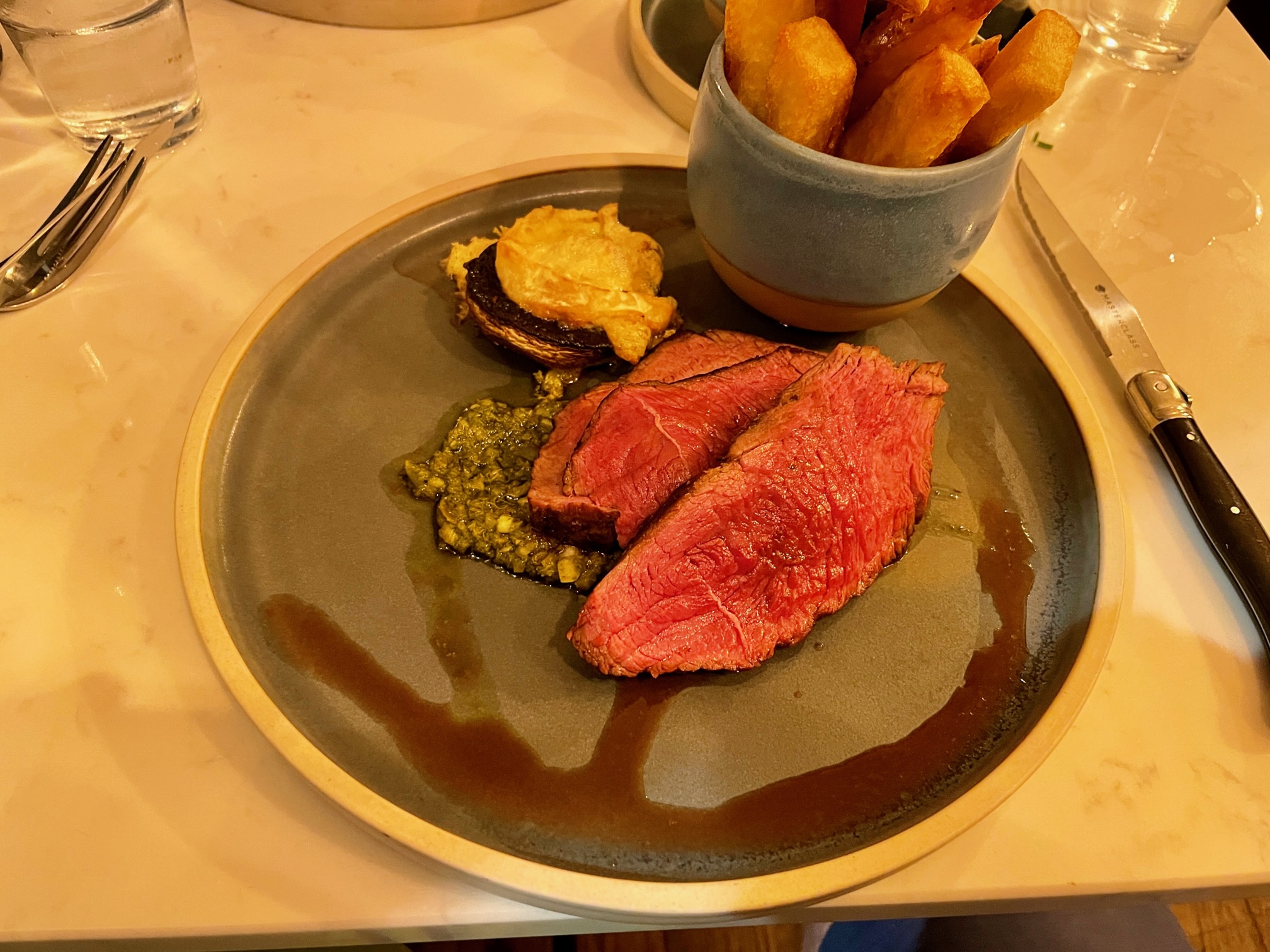
My rump steak was the most expensive dish on the menu, which always adds the potential for it to be the most underwhelming. It was a beautiful piece of beef and the cooking couldn’t be faulted – pretty much medium-rare throughout with beautiful caramelisation outside. But it was underseasoned, and surprisingly bland. The chimichurri underneath it had a pleasing zing, but ran out very quickly indeed. And after that the whole thing became a bit of a slog. There was some kind of puddle of juices at the edge of the plate, but it would be pushing it to call it a jus or a sauce. The best thing on the plate was a solitary mushroom cooked with cheese (again from Nettlebed) until it was salty and crispy, but when the star of the show plays such a brief cameo role, you’ve got problems.

Just to add to the onslaught of dryness, my triple cooked chips had decent texture – and were huge – but, again, they came without anything to add moisture. We’d ordered another portion separately, not knowing that we wouldn’t really need them, and I think in a restaurant with sharper service they might have talked us out of doing that. They came with a very good aioli but, as with the chimichurri or the beetroot ketchup, there was nowhere near enough of it. We asked for some more from a passing member of the wait staff. Five minutes passed and it didn’t materialise. We asked again and some time later, when the chips were nearly at an end, it finally arrived. 

We looked at the dessert menu because our bus wasn’t for another forty-five minutes, or at least that’s what I told myself. By this point the couple at the next table had both ordered the hake – which looked nicer than either of our mains – and there was a certain mesmeric quality to watching them push it round the plate in that way that people who don’t really enjoy food seem to do. 

Anyway, desserts represented a slight recovery. My chocolate delice was a brilliant wodge of deep, gooey chocolate with a sweet, almost-sharp smear of bright strawberry purée to cut through. The biscuit base underneath was so crumbly that it barely stayed in one piece, but I didn’t mind that at all. Zoë’s key lime pie had a similarly short base and I thought it was pleasant, but I’d probably describe it as “subtle”, which really isn’t what you’re looking for in a dessert. 

Zoë had her dessert with a Cotswold cream liqueur (although it turned up on the bill as Bailey’s, so Christ knows which it really was) and I had a dessert wine – from Graves of all places – which went beautifully. And well done if you’ve made it this far, because the truth about Five Little Pigs is that, sadly, by this point I’m even slightly boring myself. Our bill came to a hundred and forty-six pounds, including service, and then we went outside, got the penultimate bus out of Dodge, got home, had a cup of tea and went to bed. The end.

Last week somebody commented on my Facebook page about the review I did of Sauce And Flour. “I wish you’d stop doing reviews of places outside Reading” he said. “I prefer the Reading reviews. And after all, this blog is called Edible Reading”. I always find it interesting when people pipe up to tell me that this entirely free blog is somehow not delivering value for money, and after I politely told him that I’d review wherever I bloody well liked he deleted his comment. But there’s an important point here, believe it or not. I think it’s good to review places outside Reading because it gives you that all-important context (like I said at the start, there’s usually a Context). Otherwise how do you know if a place is good, or just good for Reading? 

And it goes beyond Reading. If I hadn’t been to the likes of Marmo and Caper & Cure maybe I’d have thought about Five Little Pigs very differently. But at the same price point, making similar noises, and even with some similar dishes, the difference is stark. There are better ways to spend a hundred and fifty pounds eating out than to go to Five Little Pigs. One is to go to Marmo, or Caper & Cure. Another, to be honest, is to eat at Tasty Greek Souvlaki four times. Five Little Pigs is probably an absolute boon to Wallingford, and on another night I might well have had a meal there I’d have enjoyed better. But in truth, I can’t see myself going back. 
So there you go: it turns out that restaurant reviewers aren’t always right. But as a regular reader of this blog you knew that already, didn’t you?

Five Little Pigs – 7.1
26 St Mary’s Street, Wallingford, Oxfordshire, OX10 0ET
01491 833999

https://www.fivelittlepigs.co.uk

Restaurant review: Sauce And Flour, Maidenhead

One of my oldest friends lives in Swindon. Someone has to. Whenever he comes to Reading he enjoys our street food, our craft beer and our shopportunities and he complains to me – at length – that it didn’t have to turn out like this. He reckons that there was a time, back in the Nineties when all that money hadn’t decided where to coalesce, when it Could Have Been Swindon. They had a House Of Fraser, well before the Oracle opened, and that designer outlet everyone used to get so excited about. And Reading – Heelas aside, of course – was a bit of a wasteland in the mid-Nineties. Things could have been very different. 

But the retail and hospitality gods smiled on Reading and, like many of us, they sneered at Swindon. We got the big names and the investment and Swindon, over the few decades, withered and died. It’s not all terrible: Darkroom Espresso is a great place to grab a coffee, Los Gatos in the old town is a tapas restaurant Reading would be lucky to have and a few doors down Rays does thoroughly likeable ice cream. But there’s a reason people who live in Swindon go to Bath, Oxford or Cirencester at the weekend, just as people from those places don’t pop over to Swindon of a Saturday.

The reason I’m starting a review of a place in Maidenhead talking about Swindon is that lately I’ve been looking at what’s going on in Maidenhead and starting to wonder if we might find ourselves in the Swindon role at some point in the coming years. Because although it’s early days, the businesses beginning to come to prominence in Maidenhead are the kind that you’d want to see in Reading instead of – hooray – a branch of Popeyes or our twentieth Costa Coffee. 

Take A Hoppy Place, a credible, nicely fitted out craft beer bar a five minute walk from the train station with close to twenty beers and ciders on cask and keg. Last time I went it was doing a roaring trade and making the most of its outside space, and it was a wonderful place to while away a few hours. And although Reading has a brilliant craft beer scene – bolstered by the new addition of the Grumpy Goat’s upstairs bar – there’s nothing on that scale in the town centre. 

And then there’s Seasonality, which recently got a rave review in The Guardian. It started in lockdown as a deli also selling heat at home meals, and has since morphed into a restaurant offering an interesting and inventive menu. It’s tasteful, gorgeous looking and independent: you could count the number of restaurants like that which have opened in Reading in the last couple of years on the fingers of one stump. With the winter we have looming, and the town’s famously charmless landlords, can you imagine one trying their luck here in the next twelve months?

Finally, the subject of this week’s review which might be the most interesting of the lot. Flour and Sauce opened in March as part of Maidenhead’s Waterside Quarter and seems, on paper at least, to be an example of a London trend that hasn’t so far made it this far west, the pasta restaurant. And by that I mean that, from a look at the menu, it seems to be modelled on Borough Market’s famous Padella and the hugely influential Bancone along with more recent imitators.

Those places – offering starters, a selection of pasta and not much else – have been one of my favourite trends of the last few years. They’ve given dishes like silk handkerchiefs with confit egg yolk or bucatini cacio e pepe iconic status and at their best they make for fantastic mid-priced casual restaurants. Throw in a negroni to start and a decent dessert at the end and you have the blueprint for a marvellous lunch or dinner: I’ve eaten at the original Bancone in Covent Garden a few times and never had a meal there that was less than splendid. So was Maidenhead boasting an example of this very London trend by virtue of its place on the Elizabeth Line? I wanted to find out.

It looked gorgeous from the outside, all white columns and full length windows. And it had the feeling of a fully realised concept, with clear branding, although something was niggling and bringing out my inner Mary Portas. Was it the name? Somehow it felt like it should be Flour And Sauce, both in chronological and alphabetical order. And the slogan – Wine Meats Dine – might have worked as a pun, but it didn’t seem to descibe what they actually did.

Going inside and taking my table brought out my inner Michelle Ogundehin. It was a big deep room but everything was somehow disconnected. The furniture didn’t match, but not in a charming way or even a calculated one, more as if they’d run out of stuff. I saw three different types of chair, one of which was the ubiquitous Tollix I associate with far cheaper food and greater discomfort.

Likewise the lampshades didn’t match, but not in a way that made sense – including the ones over the window seats which looked like grass skirts humping a lightbulb. There were some cheap shelving units from Ikea along one wall and a completely incongruous pine Welsh dresser at the back. It all felt thrown together, as if they’d opened in a hurry – and of course it might well have been. The faux marble wallpaper along one wall, already slightly peeling at the joins, might have gone on in a hurry too.

“It’s funny” said Zoë. “You walk in and think ‘this is nice’ but then the longer you look at it the more jarring it gets.”

I don’t think it helps that we got arguably the worst table in the place. The restaurant wasn’t really broken into zones, and we had the last free table – right at the front, near the open door. It was a bit chilly, and with people traipsing past in either direction it felt like eating in a corridor – especially when at one point a large group decided to stand right next to our table and chat to a couple eating up at the window for the best part of ten minutes. The window seats, by the way, are probably the best place to sit if you’re in a pair: the counter is lovely and deep, and you get a great view (and, therefore, superb people watching opportunities).

The menu was a little like the room – superficially attractive, but the closer you looked the more you wondered. At places like Bancone, the array of pasta dishes all involve different types of pasta which gives you a much wider range of choices. By contrast nearly all the pasta dishes at Sauce And Flour revolved around relatively similar shapes, and not too many of them, so you had multiple permutations of pappardelle, tagliatelle, linguine and bucatini which made up all but one of the pasta dishes on offer (the exception was a penne dish: what kind of a monster orders penne from choice?). I was hoping to see some ravioli, something like trofie or orechiette, a little more variety.

And while I’m whinging, the drinks list was irksome too. A reasonable selection of wine, but only one of each colour available by the glass. Come in a group or don’t bother, that seemed to say. And the pricing of the solitary red, white and rosé were absolutely nuts: the menu sold wine in 125ml and 250ml glasses with no option in between. And if you did decide you wanted a small glass of wine they stung you, with most of them costing only two pounds less than the large glass (I mean, you could say the large glasses were a relative bargain, but I suppose I’m a bit more large-glass-half-empty).

The irony wasn’t lost on me: I’ve moaned for years that not enough restaurants sell wine in 125ml glasses, and here I was in a place where it was one of the only options. But it felt badly thought out. There were two beers on offer, those ubiquitous macro lagers Peroni and Moretti. I took another look, thought fuck this and ordered a large bottle of San Pellegrino.

Would the food redeem matters? Some of it came close. We started with some thoroughly decent dishes from the starters menu and for a while I thought my tetchiness would be held in check. The pick of the bunch – of the whole meal, in fact – were the short rib beef croquettes: three beautiful specimens crisp of shell and packed with soft, yielding, slow-cooked beef. They were perched in a little moat of spiced mayonnaise which might have had a kiss of ‘nduja, and each had a slice of pickle draped on top which was more sweet than tart and tied things together nicely.

There were three of these and I let Zoë have the spare because she was so underwhelmed by the next starter, although I didn’t like it much better. Squid – “body and tentacles” according to the menu, which I think is TMI – was meant to come fried with ‘nduja but was actually in a thin, vinegary sauce with capers and no heat or seasoning. All the squid was bouncier than you’d like, and just made me think wistfully of better squid I’ve had in the not too distant past. It came with a long transverse slice of focaccia toast which was so rock hard that trying to cut it with a knife and fork left me worrying that half of it would ping off and hit the next table. A pointless blob of squid ink mayo perched on it, looking like a dirty protest.
Finally, I wasn’t sure what “warm buttermilk garlic bun & parmesan” would turn out to be, and the answer is essentially this: four giant dough balls. They were about as nice as giant dough balls can be, strewn with Parmesan and rosemary, and I squidged a piece into the sauce that came with the squid to verify that yes, it really was that dull.

Mains were better but, and this is rather a theme, not exactly as billed. My linguine puttanesca was solid, I think. The ribbons had just enough pleasing bite and the sauce, a combination of all my favourite things, worked well. It had the note of acidity from the capers, a pleasant hum of chilli in the background and beautiful, plump olives. I felt like it needed more anchovy, but then I feel that way about the world in general so this dish was hardly an isolated incident. I’d paid extra to have some yellowfin tuna in the mix and I think I spotted a couple of forkfuls, but that was it. Not bad at all, and not bad value at fourteen pounds, but in the wider context of the whole meal it was doing a lot of heavy lifting.
Zoë’s dish, slow-cooked duck ragu with tagliatelle, had sounded good on paper and she enjoyed it, but from what I tasted it didn’t quite work. Again, the menu was misleading: this didn’t feel like a ragu at all, and the pieces of duck leg I ate didn’t have that tenderness I associate with slow cooked sauces. This hadn’t been reduced for a long time in red wine and tomatoes, it was a white ragu if anything, but it felt like the duck had been added to the white wine and mascarpone right at the end.

And it tasted pleasant enough, but if I’d ordered it I’d have been disappointed: perhaps the kitchen’s other ragus – one made with beef shin, the other with pork and ‘nduja – showed off their skills better. Zoë couldn’t finish it – you can’t fault the portion size – but by the end the sauce had pretty much solidified which made it a challenge. I will say this for Sauce And Flour, though: both pasta dishes had the welcome crunch of judiciously added pangrattato, and it’s hard to completely take against a restaurant that does that.

We decided to try dessert, to give the place a fair crack of the whip. They too were pretty representative of the whole Sauce And Flour experience. Zoë’s tiramisu was decent, and she loved the mascarpone and the leftfield inclusion of Kahlua, but it was a lot more cream than sponge. It didn’t dampen her ardour for Buon Appetito’s magical pistachio tiramisu, put it that way.

I went for the cheese selection and for one person, for seven pounds, I thought it was generous. They have a big deli counter just along from the open kitchen so you can see the staff cutting and preparing the cheese plate, and maybe if I’d had better eyesight I could have worked out what they were. But with the exception of a gorgeous, crumbly Parmesan with decent age which I left until last, I have no idea what they were because the wait staff just plonked them down and sodded off (the menu doesn’t say, either).

The others were a mix of a soft cheese that might have been Brie but possibly wasn’t, a hard cheese that could have been pecorino but probably wasn’t and a couple of other cheeses which honestly could have been anything. Maybe it was the adrenalin, or maybe I was just high on life and drunk on San Pellegrino but I have absolutely no idea. I do know that they came with crackers which tasted a lot like water biscuits and a little dish of something the menu just calls “jam” which tasted of surprisingly little.
Not telling us what the cheeses were was pretty consistent with service in general: it wasn’t unpleasant or rude, just distinctly brisk and disinterested. Maybe it’s because they were busy, but it lacked warmth – and I’m not just saying that because I was sitting by the open door. For me, that was arguably the biggest drawback about Sauce And Flour because it’s the thing – over and above the quirks of the menu or that sore thumb Welsh dresser – that badly needs to be fixed. Our meal came to just over sixty-seven pounds, and included a ten per cent service charge I’m not entirely sure was warranted.

On the train home, Zoë and I mused about exactly what had been missing from our evening.

“The room wasn’t that bad, and some of the food was very good, but great service would absolutely transform that place” she said. And she’s right. Sauce And Flour is a curious beast. It looks, on paper, like an attempt to recreate those specialist pasta restaurants in the capital, but scratch the surface and I have a horrible feeling that it’s actually just a reasonable Italian restaurant with a more limited menu. Like the faux marble wallpaper, it might look the part from a distance but underneath, it’s already peeling. So we can relax: Reading isn’t missing out, not this time anyway. If you want to leave town to eat superb Italian food, take a train to Mio Fiore.

What it really made me think about was the glory days of Dolce Vita, at the height of its powers. I loved Dolce Vita, but let’s be honest: the room wasn’t the best in Reading, and a fair amount of the food didn’t quite live up to its reputation (mainly, ironically, the pasta and pizza dishes). But because of the service, you never cared about that. You’d go back time and again, and it always felt like having friends cooking for you. And if I’d gone to Dolce Vita and there had only been one wine by the glass, I wouldn’t have given a shit; I don’t think I ever went there without ordering a bottle anyway. Trends or no trends, Reading doesn’t need a Sauce And Flour. But there will always be room for another Dolce Vita.

Sauce And Flour – 7.0
4A High Street, Maidenhead, SL6 1QJ
07516 948421

https://www.sauceandflour.com