At the start of every year, the broadsheets wheel out an article about the food trends of the coming twelve months. And every year, nobody checks the article from the previous January to verify that almost none of the trends became a thing. Peruvian food never took off, beyond a couple of places in London. Neither did corn ribs, hard seltzers, carob, eringi mushrooms.
But it fills a gap for column inches in January, among all the clean eating/“new year new you” articles they dust off and spruce up at the start of every year. And besides, it’s not like anybody’s keeping score: from this year’s predictions, keep an eye out for potato milk, whatever that is. It has another four months to become famous (they sell it at Waitrose, where reviews run the full gamut from “another unsatisfactory milk alternative” to “very neutral tasting”).
Anyway, Reading food trends aren’t like London food trends, because every year since I started this blog the trend has been pretty much the same: you’ll get more cafés, and some dickheads will complain that we have too many cafés. You’ll get more burger places, and some dickheads will moan that there are too many burger places. And, in recent years, you’ll get more American chains and some dickhead will whinge about the Americanisation of Reading. And yes, that last dickhead is me.
The real trends are the ones that blindside you. Late last year and early this year it was biryani places, with a mini explosion of options – Biryani Mama in town, Biryani Boyzz on the Oxford Road and, just opposite it, the interestingly named Biryanish (“it’s sort of like a biryani…”). And then in the last few months, the trend literally nobody saw coming: three Japanese restaurants opening in the space of two months. Did anybody predict that on New Year’s Day?
I’ve always loved Japanese food, but Reading’s never been incredibly well served for it. In the centre, you had Yo! Sushi and Sushimania, and both have their place: Yo! Sushi in particular democratised sushi and acted as an introduction for many people, me included. And I’ve always enjoyed heading to Sushimania after a day at work with Zoe, grabbing seats on the banquette and looking out on the dining room with a cold bottle of Asahi.
More recently Oishi opened down the Oxford Road: I loved it when I went, but for a while it had an alarming hygiene rating which put me off a return visit. And of course there’s Osaka which I liked but didn’t love, although I visited it during one of the weirdest months the world has ever seen. But for a more special meal I’ve always headed to Windsor, to eat at Misugo (recent discovery Miyazaki is an excellent alternative). Did any of Reading’s newcomers have what it takes to displace Misugo in my affections?
Subscribe to continue reading
Become a paid subscriber to get access to the rest of this post and other exclusive content.
I don’t know how many restaurant reviewers you read – apart from yours truly, naturally – but the shocking truth is that I don’t really bother with any of them. I’ve no interest, for instance, in reading Giles Coren wanking on in his Corenesque way about another country pub near his house in the Cotswolds, peppering it with his usual contrarian casual racism. If I want to be bored shitless by an edgelord, I’ll just fire up Twitter.
That’s rich coming from me, I know. The irony isn’t lost on me, and if everybody thought the way I do I’d probably have the grand total of about three readers. But there you go: with some of the big names I have a peek to see where they’ve reviewed, and I might scan through to see if they liked it – if it’s somewhere I might one day go – but beyond that I don’t really pay much attention.
So for instance I know that Grace Dent from the Guardian had a meal in Maidenhead not too long ago that she really enjoyed. As a result I’ve added the venue to my to do list, but I won’t be poring over her deathless prose line by line before I go. Similarly the subject of this week’s review, Caper and Cure, received rave reviews in the Sunday Times and the Financial Times recently. I didn’t read them (because paywall, Rupert Murdoch etc.), but when I happened to be in Bristol for the weekend I made a beeline there to see what the fuss was about.
And yes, that means another Bristol review, which in turn means that some of you will look away now – or, more likely, didn’t click on the link in the first place. But I make no apologies, because for many years now Bristol has had, for my money, the most interesting food scene in the U.K. Cities and towns like Brighton (back in the day) and Margate always strike me as trying to be London-on-Sea, but what I love about Bristol is that it ploughs its own furrow, with no interest in being anything other than itself.
Places that want to develop a food culture, like Reading, could learn a lot from that: if we got even a fraction of the kind of restaurants in our town centre that Bristol seems to say hello to every month, we’d be a much richer place for it. Besides, it’s just over an hour away by train.
So Zoë and I turned up on a Saturday lunchtime to check it out. Caper and Cure is in Stokes Croft, a short stroll from Cabot Circus, the city’s main mall, at the point where Bristol starts to get properly lively and interesting. Beyond Caper and Cure, Stokes Croft becomes the Cheltenham Road and then the Gloucester Road, a fascinating indie-land of bars and restaurants, shops selling every kind of beer or wine and charcuterie (and a special prize surely has to go to the splendidly named Bristanbul, a Turkish bakery).
On the walk to the restaurant I saw the parts of this area that have defeated gentrification: the patch of land called Turbo Island still sports a couple of shabby sofas whose best days were decades ago, and the people sitting on them were already a few cans of lager to the good by early afternoon. The last time I was here I had a fantastic brunch at nearby Jamaica Street Stores: it closed last month after five years, partly because of growing issues with Turbo Island.
But Caper and Cure, a handsome blue and gold fronted restaurant on the corner, still felt relatively genteel; Stokes Croft institution Café Kino is next door, and the gorgeous Elemental Collective sells coffee and pastries the other side of the road. The building Caper and Cure is in used to be a chemist, back in the Twenties, and the room retains exceptional bones – generously proportioned floor to ceiling windows letting in tons of light, and a compact, almost-triangular dining room with about twenty covers.
A fetching button-backed banquette ran along one side – we were seated at the slightly less attractive tables on the other side of the room, but it didn’t feel like there were any truly duff seating choices. There was a small counter at the back, the open kitchen beyond, and along one wall was a map of Europe showing the provenance of some of the ingredients used in the kitchen: a nice touch. Why was Bristol so good at making excellent dining rooms and kitchens out of such modest spaces, and why had none of that genius ever made it down the M4 to us?
For that matter, why were Bristol restaurants so good at putting a menu together which was simultaneously compact but where you wanted to order everything? Four starters, five mains, three desserts, a cheeseboard and a couple of specials. Starters around a tenner, mains fifteen to twenty quid, desserts maxing out at eight pounds. Absurdly streamlined, really, compared to the overkill of so many restaurants, and yet I could have ordered any combination of dishes (I should mention, too, that this being Stokes Croft vegetarians and vegans also had decent, imaginative choices). There’s a real talent to assembling a menu like this, to hitting all the bases and keeping it lean and appealing, and I for one wish more restaurants had it.
But before we made those agonising yet enjoyable decisions, we tried a couple of things from the snacks section of the menu. Cauliflower cheese croquetas were a real piece of wizardry, with spot on crunch and the smoothest, glossiest core, tangy with cheese and the sweetness of cauli. Each of them sat under a little Johnsonian toupée of Parmesan, each was stupendous. A ridiculous five pounds for these, and it took all my strength not to order more.
But even better was the sourdough with jamon butter. The words “jamon butter” rather sell short what you got, a quenelle of salty, savoury spreadable jamon with a texture somewhere between whipped butter and rillette. It was one of the most moreish things I’ve eaten in years, and if they’d sold it over the counter I’d have walked out of the restaurant at the end of my meal with a tub of the stuff the size of my head, knowing full well that it wouldn’t survive the rest of the weekend.
The bread that came with it was decent enough, but its one role was to provide a vehicle for eating the jamon butter that was more civilised than just devouring the stuff with your bare hands. If I’m being ultra-critical, one of the slices of bread was as much air as bread and if I’d been in the kitchen I wouldn’t have served it. But it upped the jamon butter to bread ratio, so it wasn’t all bad.
A high standard had been set, and the starters just vaulted over that as if it was nothing. I’d chosen the sweetbreads, because I love them and they don’t turn up on menus in this country anywhere near often enough. Caper and Cure’s might well be the best I’ve ever had: pert and tender, in a dish where they played the starring role but with excellent support. That meant fresh, nutty peas, translucent slices of radish and some braised baby gem, but more importantly it meant a chicken butter sauce bringing the whole thing together triumphantly. It supplied another intense umami hit, fortified with little nuggets of pancetta just in case you weren’t having enough fun already.
As we discovered over this and our other dishes, Caper and Cure specialises in those high-gloss, super-reduced sauces that speak of patience and expertise. Having finished my starter I was frustrated to see far too much sauce still in the high-sided bowl, but without prompting one of the wait staff asked if I needed some more bread. I didn’t think twice, and Caper and Cure’s bread with the remnants of my chicken butter sauce was, on its own, tastier than ninety per cent of the starters I’ve eaten in nine years of writing this blog.
Zoë was equally happy with her decision to order the burrata. It’s an ever-present on menus now, but I doubt many restaurants pair it with tomatoes quite as good as these (from the Isle Of Wight, of course). And more importantly I doubt many restaurants plonk the whole thing on their own exemplary tapenade, with the perfume of deep purple olives. I had a forkful of this, and although I couldn’t have not ordered the sweetbreads it also had much to admire.
By this point I knew beyond doubt that we were in very good hands, and the only remaining question was just how special the rest of the meal might be. Our main courses answered that question emphatically. Hake, one of the two market fish on the blackboard, was cooked just right and perched on top of an absolutely glorious layer of pickled fennel, just sweet enough and just sharp enough: I’ve never had pickled fennel before, and now I’m just counting the days until the next time.
A tangle of samphire heaped on top added a little saltiness and if the skin wasn’t as crispy as I’d have chosen, that was probably because the whole thing was swimming in a superbly glacé lobster sauce. It wasn’t all perfect, mind you; I’d personally have liked the orzo, the base of the dish, a little closer to al dente and the lobster sauce was more muted than it could have been. But those would have been minor niggles at the best of times: on such a successful plate of food, coming in at a ludicrous twenty-one pounds, they were just the only things I could find that fell short of flawless. It was still one of the most marvellous dishes I’ve eaten all year.
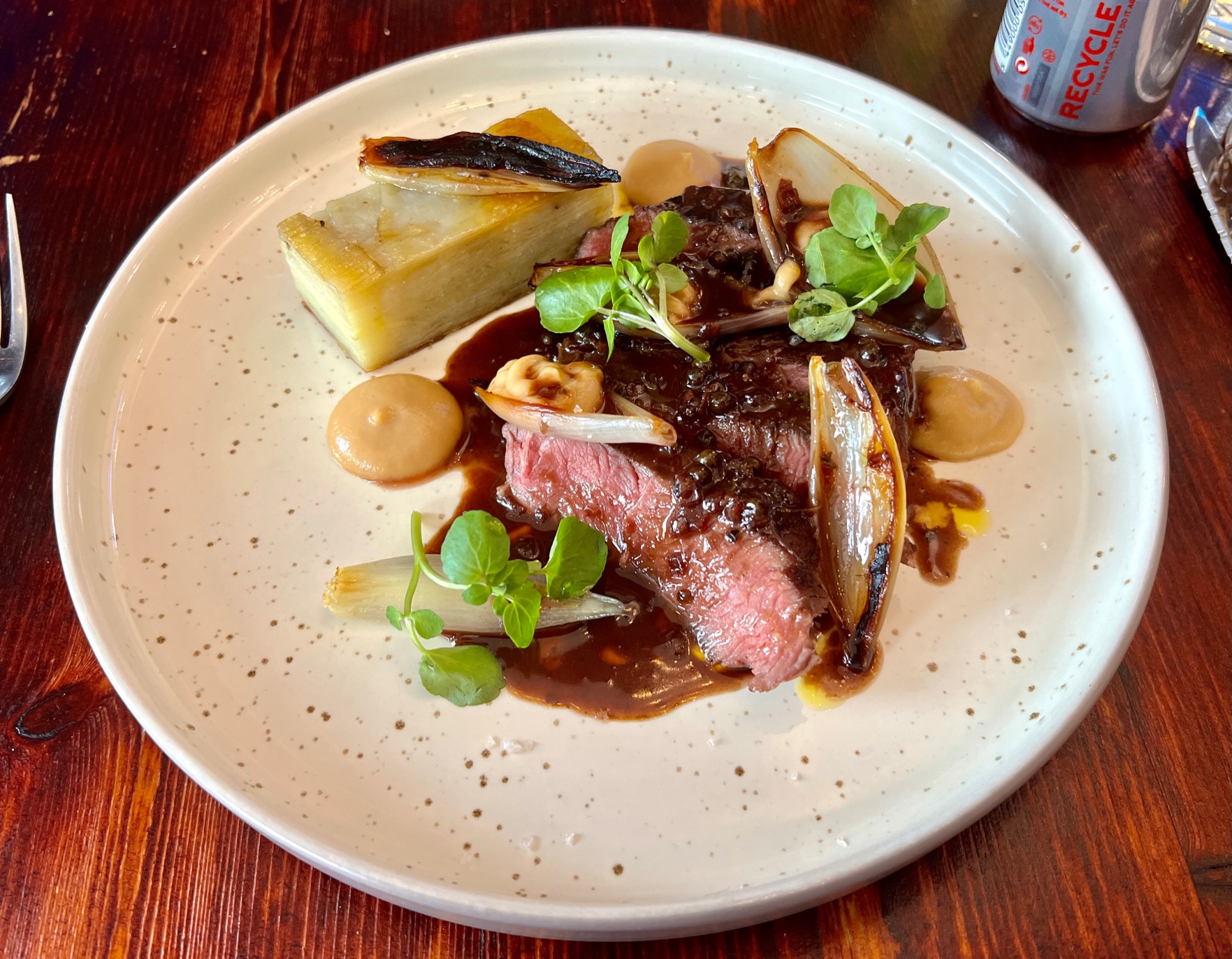
Zoë had absolutely no reservations about her rump of beef, and the couple of forkfuls I had were easily enough evidence to understand why. It was a beautiful piece of meat, cooked medium-pink but with a nice crust, but again it was all about how that ingredient played nicely with the delightful company it was keeping. In this case that meant another sticky, glossy sauce – peppercorn this time – little puddles of onion purée and banana shallots, also with a little char. And to add a little ballast, a perfect slab of Pommes Anna, as enticing and multi-layered as a great novel. This might have been one of the most marvellous dishes I didn’t eat all year, but at least it went to a truly deserving home
We had some Parmesan and truffle fries with our mains – completely unnecessary but also impossible to resist – and they were themselves a fascinating experience. It’s a dish that crops up on menus a lot lately, from Buon Appetito to the Last Crumb and beyond, but in most places it’s a way to tart up bought-in French fries and flog them for a fiver. Here they were the real deal, and when we’d finished our mains and used the fries to clean up the last of our respective sauces we picked at the rest with slightly oily fingers and glad hearts.
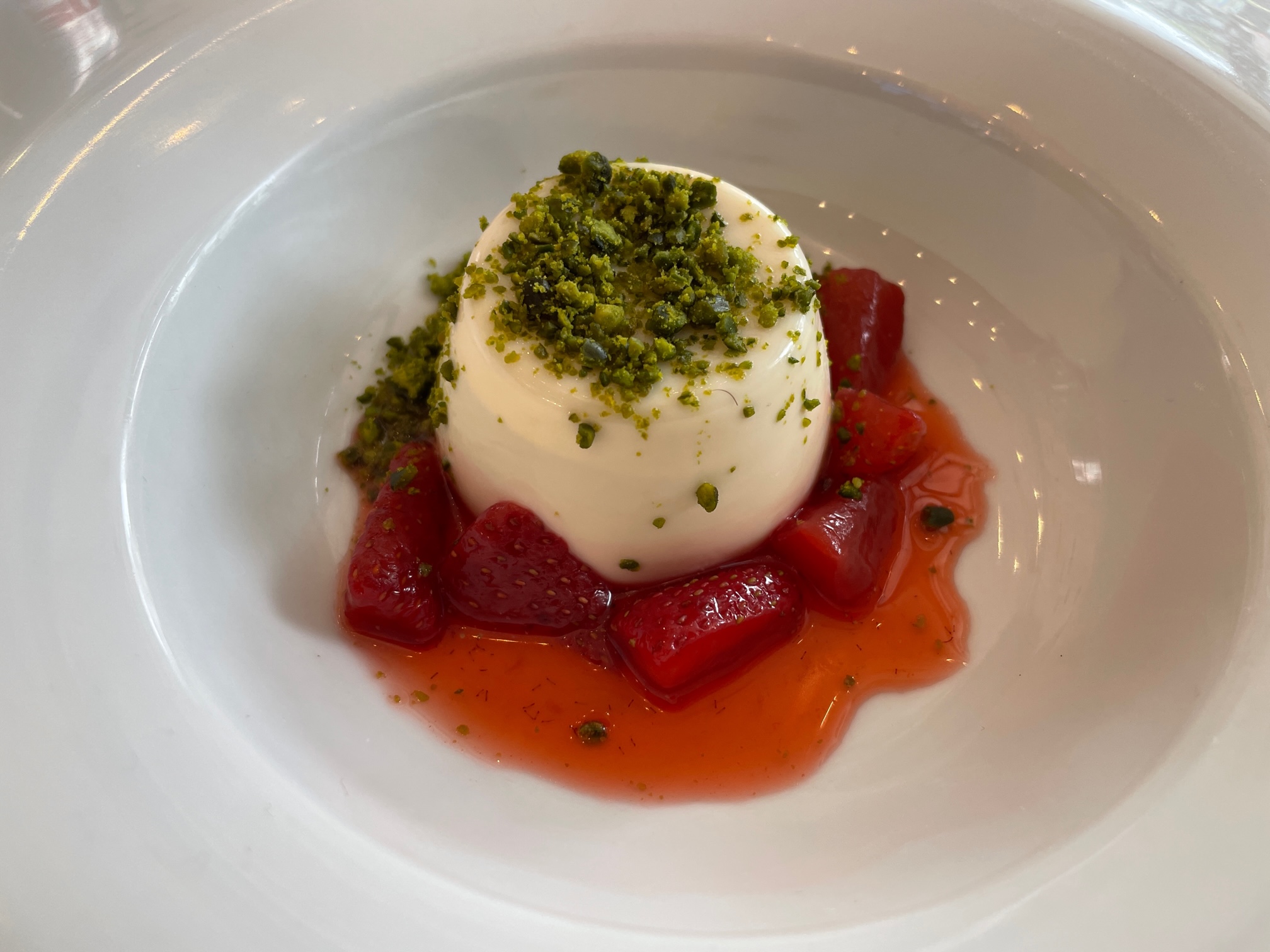
Dessert was the point at which things stopped being spectacular and settled for merely being rather good: technically there are only really two desserts on the menu along with a couple of cheeses and chocolate sorbet with coffee liqueur which felt like a distant cousin of the affogato. I rather liked my panna cotta, which had a pleasing wobble, tons of crumbled pistachio on top and a moat of strawberries and sweet syrup. But the advertised wild honey was the quietest of whispers, and without it the whole thing felt a little run of the mill.
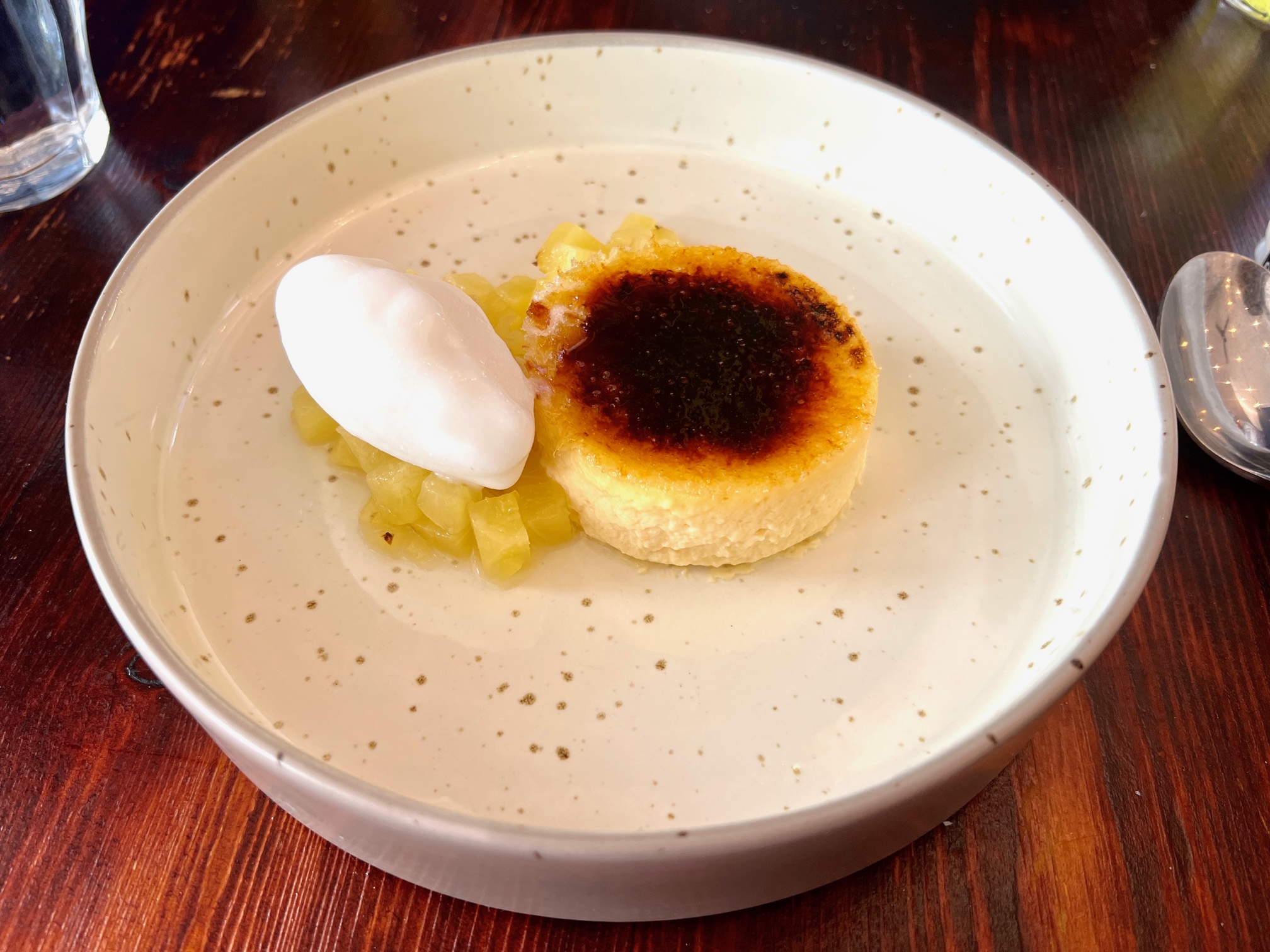
I thought Zoë chose better than me, but she wasn’t wild about her choice either. A rum brûlée was served denuded of a ramekin – how often does that happen? – with plenty of pineapple and coconut sorbet. I liked it, although again the rum was a little muted, and I thought it all worked well together. Zoë was less convinced, and I think on another day would have had the chocolate sorbet. But we were both being restrained, with a boozy evening ahead and (in my case) a gin sodden one behind me, so we steered clear of booze.
That means I can’t tell you anything about the wine list, which is a matter of some regret for me as it had plenty to appeal – and three special wines available by the glass, including a Georgian orange wine by Tbilvino which sounded well worth trying. But instead I’m afraid we were well behaved – I had a very good alcohol free pale ale by local Bristol Beer Factory and Zoë had soft drinks. Next time I go, which I anticipate will be the next time I visit Bristol, I’ll try it properly.
I haven’t really talked about service, but it was very much of a piece with everything else: smooth, efficient, friendly and good at making everything look easy. Offering me some bread with my starter was a great example, but really the whole thing seemed effortless. Caper and Cure wasn’t as busy as I expected but it had a real mixture of tables and types of diners, with more people coming in for lunch as we were leaving, and the whole thing had a nice flow and rhythm to it. I imagine it would be a truly enchanting place to have a boozy evening meal with friends, and next time I go there that’s exactly what I plan to do.
Our bill came to a hundred and twelve pounds, including a twelve and a half per cent service charge, and when the owner came to take our payment I pointed out that they’d slightly undercharged us. Before we left he asked where we came from, and if he was fazed that people had come all the way from Reading he concealed it well; I looked him up afterwards, and it turns out he’s also a professional actor (“you can just tell” said Zoë as we ambled up the Cheltenham Road in search of caffeination).
This is the second critically acclaimed Bristol restaurant I’ve visited this year, and the contrast with Sonny Stores couldn’t have been more marked. Restaurant critics like to talk about Bristol growing these restaurants – small, unpretentious places with short, magnificent menus and interesting wine lists – as if in a laboratory. And it’s true that the place is a Petri dish for culinary creativity, more than anywhere I know.
But I think it doesn’t do Caper and Cure justice to make it sound like just the latest place to fall off some gastronomic assembly line. There’s something uniquely special about it, and re-reading this review I’m not sure I’ve truly captured it in what I’ve written. It’s worth going to these places, even if they’re an hour and a quarter away by train, to remember what we have to aim for in Reading and that for all the Kungfu Kitchens, the Bakery Houses, the Lyndhursts and the Clay’s we still have some distance to travel.
If a restaurant like Caper & Cure opened in Reading it would be packed to the rafters every night and lauded as far as the eye can see. And yet in all the time I’ve been writing this blog, the best part of a decade, nowhere even slightly like Caper and Cure has opened here. At some point, we might all have to stop and think about why that is. Reading has the money, it has the prosperity and it has a discerning demographic. Why don’t we have the restaurants?
Caper and Cure – 9.2 The Old Chemist, 108a Stokes Croft, Bristol, BS1 3RU 0117 9232858
Three months ago I wrote about the quiet revolution taking place at Reading University’s bars. Park House, always one of Reading’s best kept secrets for an al fresco drink, underwent a surprising but convincing transformation this year: out went the cheesy chips and in came a menu that made all the right noises – listing suppliers, talking about provenance and using both local producers and the university’s own beef.
I went, I tried it and I was pleasantly surprised – so much so, in fact, that when I put together my updated list of Reading’s best spots to eat outdoors Park House bagged a place. Some people missed the cheesy chips, apparently. But there’s no accounting for taste: some people are going to miss Boris Johnson.
But could lightning strike twice? That was the question Zoë and I asked ourselves after I met her from work and we ambled to the Dairy on a golden midsummer evening. We strolled past the Turks Head (you can tell it’s glorious weather when even sitting outside the Turks looks tempting), past the sedate, leafy thoroughfare of Kendrick Road, and I thought to myself that it was moments like these I should be storing up in my head, so I could turn them over in my mind when the clocks went back and the feeling of sun on my skin was a distant memory.
The Dairy also revamped its menu in 2022 and makes the same claims as Park House when it comes to where they get their ingredients from. Bread from Waring’s, eggs from Beechwood Farm, all the right noises, all that jazz. But I was particularly keen to see if the Dairy had raised its game because, to be honest, it could easily have done so just by buying in some ready meals from M&S.
Or, for that matter, Asda. My previous visit to the Dairy on duty, back at the start of 2019, had been a grim experience with lukewarm, chewy curry and a chicken burger which, underneath its modish charcoal bun, was as wan and tasteless as Jacob Rees Mogg. So, did lightning strike twice or was it more a case of fool me twice, shame on me? I can honestly say I approached the Dairy with no real hunch as to how this one would play out.
Subscribe to continue reading
Become a paid subscriber to get access to the rest of this post and other exclusive content.
We were on the train to Maidenhead, Zoë and I, and both of us realised that neither of us had been to the town in the best part of twenty years. Travelled through it on countless occasions, of course, as everyone has. Changed trains there a couple of times to go to Marlow, too – usually for indifferent meals out, come to think of it. But had either of us ever got off a train there, exited through the barriers and explored the place? I didn’t think so, and nor did Zoë.
We were there to visit Maidenhead’s shiniest, newest hospitality venue – not a restaurant, but the second branch of Windsor’s craft beer bar A Hoppy Place. Zoë wanted to write it up for the magazine she edits and having had her plans to attend the grand opening thwarted by the train strike, she was keen to pay it a visit as soon as humanly possible.
But where to eat beforehand? Maidenhead looked to be the town that restaurants forgot. A rummage through Tripadvisor – don’t judge, there was virtually nowhere else to look – suggested that most of Maidenhead’s restaurants were actually in the town’s affluent satellite villages. But then I guess if you lived near Bray or Cookham Dean, would you really go into Maidenhead of a night out? The town centre boasted a Kokoro and a Coppa Club, but I couldn’t say I fancied either of those known quantities.
And then I remembered my physio, who lives in Maidenhead, recommending Miyazaki to me. It’s a little restaurant at the unfashionable end of town which has been serving up Japanese food to the people of Maidenhead for something like seven years. No fuss, no drama, just uniformly good reviews on Tripadvisor and Google, all of which gave the vague impression that Miyazaki’s fans were quite comfortable with it remaining a well-kept secret. I phoned up on a Friday evening and was pleasantly surprised to find that they could fit in a booking for the following night.
It wasn’t the loveliest of walks from the station, and I sense that there’s an awful lot of development under way in Maidenhead. Miyazaki was on a little run of shops and restaurants, rubbing shoulders with pizza and kebab takeaways, just past the purgatorial horrors of “The Honey Pot” (remember when Reading had one of those?) and the thumping music of an O’Neill’s already in full swing. “There’s a reason why they always have an O’Neill’s near the train station”, said Zoë sagely.
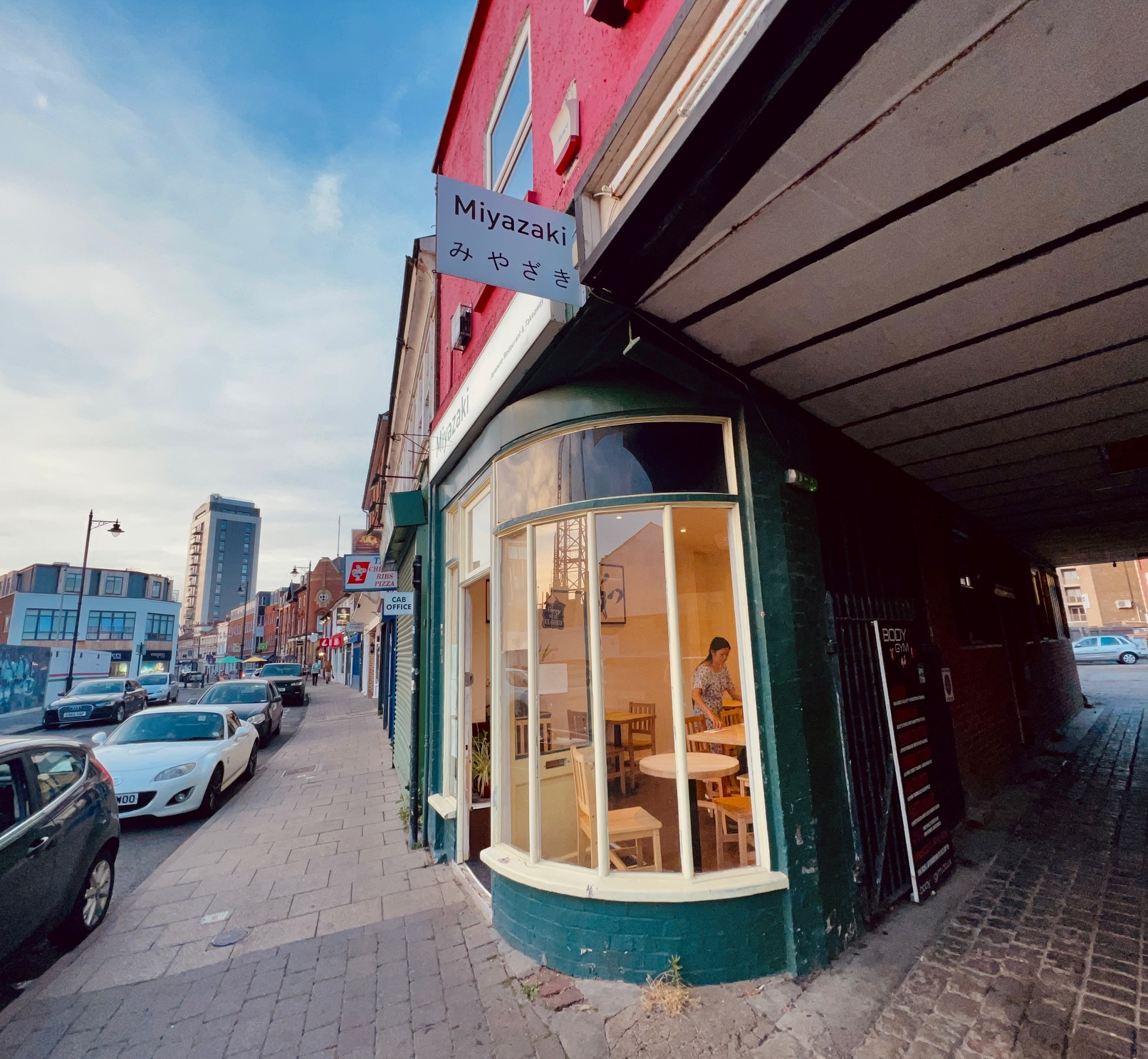
Once we reached Miyazaki, though, it stood out like the opposite of a sore thumb. Nestled between joints called Sizzlers and Tennessee Fried Chicken, a building site on the other side of the road, it looked completely out of place. No garish shop front, no big red letters and brightly-lit laminated pictures of the food on display like its neighbours, just a simple space.
Inside, the neutral, unfussy tables couldn’t have seated more than twenty people at a push, and the long thin room was beautifully lit, the light from the summer evening pouring in through the curved, graceful floor to ceiling window. Tasteful prints and drawings were dotted on the plain white walls. Just two other tables were occupied when we got there at quarter to eight – which saddened me a little. But it was a very hot evening, and the restaurant was doing a roaring trade in takeaways, neatly packaged and on the table by the bar, waiting for delivery drivers to pull up outside and take care of them.
Miyazaki’s menu was the kind that reassured you instantly. Some people, spoiled by the compendious likes of Sushimania or Yo! Sushi, would have found it restrictive but I liked the fact that it did what it did, and didn’t try to offer everything. Just three types of sashimi, a few more nigiri and just over a dozen sushi rolls in two different sizes. There was also a selection of side dishes, along with a very small selection of what you might call mains – three curries, two different noodle dishes and a range of udon soup noodles.
And even with such a restrained selection I saw dishes I’d never heard of or tried. Yasai kakiage, a sort of vegetable tempura fritter. Sunomono, a crunchy, vinegary cucumber salad. Chicken nanban, a deranged-but-inspired-sounding dish of fried chicken in a tangy coating, served with, of all things, tartar sauce. If I have one regret about this meal, it’s that I can’t tell you what those three taste like: I’ll know after next time.
Instead we stayed on safer ground, but we were richly rewarded all the same. Salmon sashimi was as perfect an example as I can remember – rich, smooth, glossy diamonds of perfect pink, just needing a dab of soy to perfect them. We liked it so much we ordered another portion. Mackerel sashimi was a little less successful: the skin looked like it had been torched, and the slight tinge of vinegar suggested it was cured rather than raw. I liked it more than Zoë did, which might have been a factor in us ordering more salmon.
Sushi rolls kept up a high standard. With a relatively compact menu a lot of these were variations on a theme, but even so I enjoyed everything I had. The small avocado maki were the kind of dish I could gladly eat every day for the rest of my life, and the avocado was splendidly buttery – ripe but not overripe, no hint of those telltale brown edges that always fill me with sadness.
Larger spicy tuna rolls with a little dab of fiery red sauce inside had a surprising kick, as did the pale ribbons of ginger on the plate – it’s always encouraging to see this more natural colour, rather than the standard-issue hyper-real pink ginger you so often get. And assembly was pretty good: there were a few ragged bits of nori here and there but generally they were put together deftly, and just the right size that you could eat them in one glorious go.
All the larger sushi rolls hovered around the eight pound mark, which struck me as very good value. Another set with both avocado and salmon were probably my favourite, and so much more than the sum of their parts, speckled on the outside with black and white sesame. I’m always reminded, when I eat food like this, how nice it can be to eat something almost-virtuous, so pure-looking. That feeling always dissipates by the time the next portion of fried chicken comes along but it’s nice to experience it all the same, however fleeting.
It helped, I’m sure, that the setting was so pared-back and ascetic, but also it’s so rare – for me at least – to find really healthy food that I actually like. By this point it was nearly quarter past eight and we were the only customers left in the restaurant, and I would have felt guilty about keeping the staff if it wasn’t for the still-steady stream of takeaway dishes coming out of the kitchen. Their work was far from over, so Zoë drank a second bottle of Sapporo, I had some sweet, fresh plum wine in a glass tinkling with ice and we ordered one last wave of dishes.
Doing so proved, if nothing else, that the period between fried chicken dishes – in my life, at least – is never that long. Karaage chicken is a staple order of mine, in Japanese restaurants and anywhere else I can find it on a menu, but Miyazaki’s was one of the best I’ve had anywhere. Normally it comes plain with some mayo on the side (and I’m absolutely fine with that) but this had been tossed in a tangy red sauce which took it somewhere even better. All soft thigh meat, crunchy coating and gnarled edges with a little spike of heat, it was up there with the nicest things I’ve eaten this year. Chicken gyoza felt a little more boilerplate, but even boilerplate chicken gyoza are still better than the majority of things you can pop into your mouth.
It’s a shame that I saved the worst til last, but our final two noodle dishes suggested that the kitchen’s strengths lay elsewhere. You can have soba or udon noodles with chicken katsu, fried prawns or vegetable korroke, but either way the underlying dish didn’t quite come together. My soba noodles – a neatly petite portion – were nice enough I suppose, but the sauce they had been lightly stir fried in had a slightly off-putting sweetness when I was hoping for more savoury depth. And my three breaded prawns, tasty though they were, didn’t feel like they really went; I resorted to eating those with my fingers and then ploughing through the noodles, but it didn’t feel like a cohesive dish, or a hugely enjoyable one.
I think Zoë picked better with the katsu chicken, which was nicely done, but other than the gauge of her noodles her dish was subject to much the same problems. These two dishes are only available at dinner time, but to be honest when I go back I’ll probably just order more sushi, because that felt like where Miyazaki truly excelled. Or I might just leap into the unknown reaches of the menu, and see whether Japanese fried chicken with tartar sauce is as chaotic and magnificent on the plate as it is in my imagination. Either way, I also plan to sample their extensive and impressive selection of sake.
I know it’s a little perverse of me to review a restaurant in Maidenhead this week, because Reading has had two Japanese restaurants open in quick succession: Intoku, where the Tasting House used to be, at the end of May and Iro Sushi, replacing Raayo on Friar Street, at the beginning of July (a third, You Me Sushi, opened a few doors down from Iro yesterday). But I thought Miyazaki was worth exploring, because restaurants that have been doing their stuff for years with no fuss are often overlooked in favour of shiny new places. Or, possibly, bandwagon-jumpers.
And it was right that I did, because Miyazaki is quietly splendid and well worth celebrating. I’m not inclined to let those final two dishes detract from what was a truly wonderful meal a twelve minute train ride from Reading in surroundings that really couldn’t be more incongruous. Service was flawless, the room has a sort of touching humility which I liked very much and if our meal wasn’t cheap – it came to just over ninety pounds for all that food and a couple of drinks each, not including tip – it was worth every penny.
And if you need somewhere to go in Maidenhead for a post-dinner drink, I can thoroughly recommend A Hoppy Place which has excellent outside seating and had two phenomenal imperial stouts on keg when I visited, both of which I enjoyed a great deal. You could go to O’Neill’s instead of course, but you don’t need to leave Reading for that, although you would need to take leave of your senses. I will get to the likes of Intoku and Iro in due course, but the standard they have to reach has already been laid down, in a little sanctuary a matter of minutes away on the Elizabeth Line. And if they turn out to be disappointing, I know exactly where I’ll go to get over it.
It’s weird, you know. I’ve been writing this blog for the best part of nine years, during which time I’ve reviewed restaurants, cafés and pubs in all manner of places. I’ve gone as far west as Bristol, as far east as London. I’ve covered Windsor and Henley, Bracknell and Wokingham, I’ve even written dispatches from further afield – from France, Spain and Belgium. So why is it, in nearly nine years, that I’ve never reviewed a single venue in Tilehurst?
Your guess is as good as mine, but I think lack of opportunity plays a big part. West Reading is a true crucible of culinary creativity, as evidenced by the likes of Chef Stevie’s Caribbean Kitchen, Momo2Go, Buon Appetito, Oishi, Kobeda Palace. And every time I trundle down the Oxford Road on the number 17 – usually for a few pints at Double-Barrelled – I see a new restaurant I’ve never heard of: I’m forever making notes of places that might feature on my to-do list.
But somewhere west of Kensington Park, or Grovelands Road, something odd happens and you enter some kind of black spot: not of mobile reception, but of restaurants. Where are they all? Because I think in all my time writing reviews only a handful of Tilehurst establishments have even appeared on my radar. Two are Indian restaurants: one is Zyka, which won an award, but I had takeaway from there and wasn’t enormously impressed. The second is Himalayan Hotspot, which I should check out at some point (I think it’s been there forever, which is possibly the reason why I haven’t).
Then you have Tilehurst’s two cafés of note. One, The Switch, is a place which opened last September on Tilehurst Triangle. It’s co-owned by the owner of Zyka, and it looks, on paper at least, like an attempt to recreate the success of Café Yolk across town with a relatively similar menu. It’s all herbed potatoes and smashed avo and no doubt I will make my way there at some point, hopefully in less than another nine years. Maybe smashed avo will be out of fashion by then, you never know.
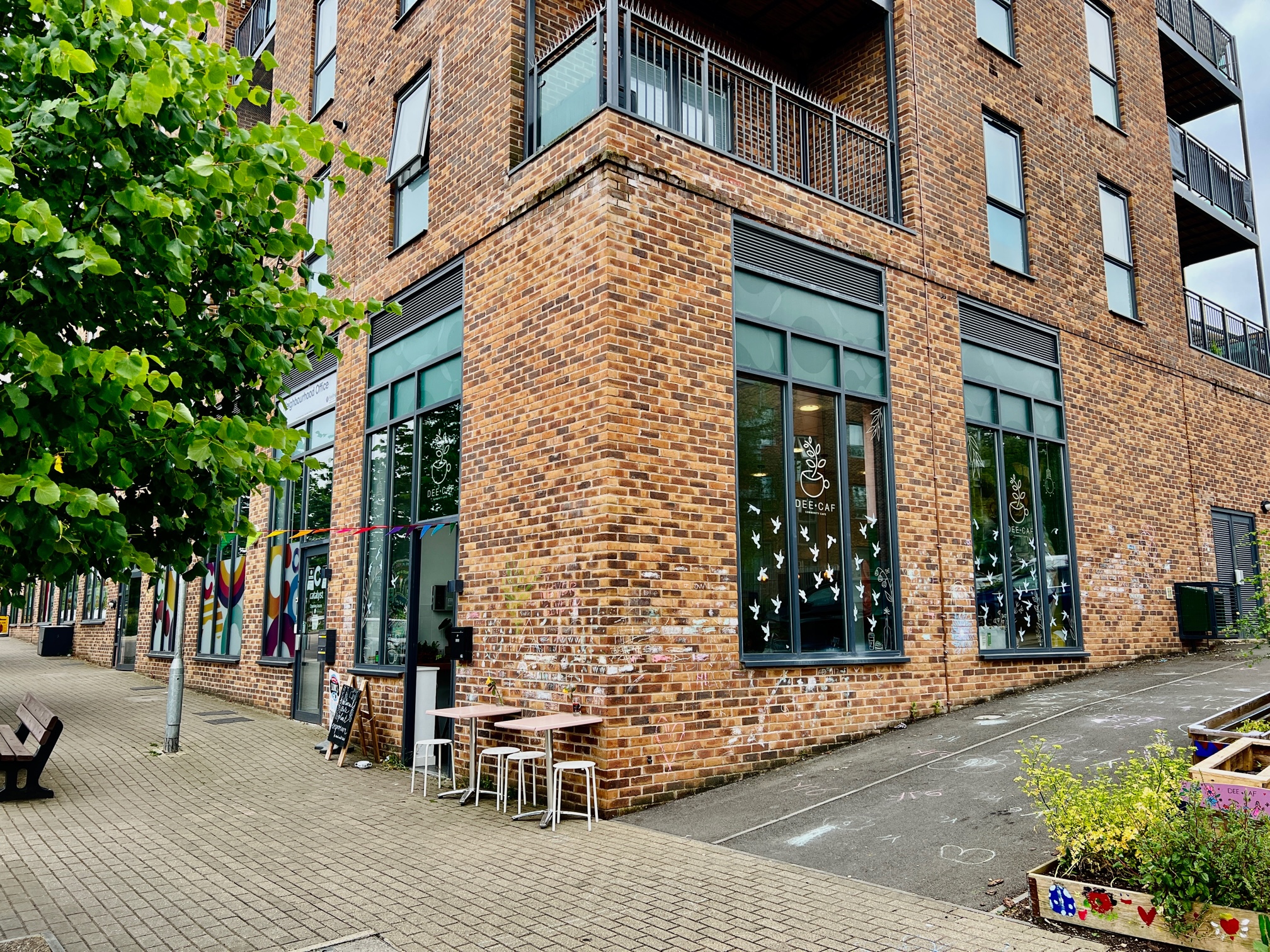
But my choice of venue this week is the superbly named Dee Caf, an altogether more curious beast with a very different story. It’s on Spey Road, in the heart of the Dee Park Estate, in a site which used to play host to Workhouse Coffee’s short-lived Tilehurst outpost. In September 2020, at about the worst possible time to open a hospitality business, Dee Caf opened in that space under the aegis of Tina Farrow. Farrow’s background is in education, both in the prison and food sectors, but she said she’s always loved food and wanted to create business of her own.
Dee Caf is run as a CIC, with clear links to the community it serves, and that’s obvious both from a visit to their website and to the café, in a myriad of ways. The café has a community fridge every week for people in need, runs a food bank and has equipment for litter picking (pickers are rewarded with a hot drink for their efforts). It also provides free sanitary products, runs community events for locals and has a refill station in the corner. There’s even an event for dads on Saturday mornings where they can turn up, meet other dads and enjoy a bacon sandwich and a coffee for a fiver.
On paper, at least, it looked more Fidget & Bob than Café Yolk. But all those laudable intentions didn’t necessarily mean the food was great, so on a Saturday lunchtime I headed over with Zoë – pre-Double Barrelled – to give the place a try. It was a short, slightly meandering walk from the 17 bus stop opposite the Pond House pub, and when you reach Dee Caf it does have the feel of an oasis about it, all tasteful big windows and cheery bunting. You could think you were in Copenhagen, or Rotterdam, on a sidestreet far from home; having never been to Tilehurst, I suppose technically I was.
Subscribe to continue reading
Become a paid subscriber to get access to the rest of this post and other exclusive content.






 Edible Reading