Restaurant review: Kolae, Borough

How many of the U.K.’s 100 best restaurants have you been to? I ask because it’s a thing – the National Restaurant Awards – and it came out last week.

Looking through the list, I couldn’t help but feel I was letting the side down as a restaurant reviewer: my score was a measly 7.  Some of them, like Manteca, ranked among the best meals I’ve eaten in the course of writing this blog. But there were at least a couple in that list where I thought “really?” I was pleased to see Wilsons make the list but COR, which didn’t feature, is definitely better than at least a couple of the top 100 that I’ve been to. Still, as I’ve said in the past, the delight of reading a list like this largely lies in disagreeing with it. 

Anyway, as it happens my total only ticked up to 7 because I happened to visit Kolae, a regional Thai restaurant in Borough, the week before the awards were announced. It was ranked 27th, significantly higher than any of the other places I’ve been to, which is an impressive achievement given that it opened late last year. It’s the second restaurant from the team behind Shoreditch’s Som Saa and has very quickly surpassed it in terms of profile (it probably helps that, unlike Som Saa, it doesn’t have any problematic racist incidents in its history).

What this means is that a significant number of restaurant critics have reviewed the place already: Giles Coren for the Times, Tom Parker Bowles for the Mail On Sunday, Tim Hayward for the FT, Jimi Famurewa for the Evening Standard, and Lilly Subbotin for the Independent. Even a couple of restaurant bloggers have already got in on the act, so I can honestly say I’ve rarely, if ever, read as much about a restaurant before stepping through its front door as I had with Kolae.

And the acclaim was consistent, full-throated, verging on the hyperbolic. I mean, get a load of this: Famurewa said it was a “scintillating shot in the arm”, Parker Bowles that it made “the tastebuds tumescent and the gut giddy”. Hayward, the thinking person’s least favourite broadsheet reviewer, settled for the overblown “This has just reminded me why I eat”.

It wasn’t all like that – Giles Coren spent a large part of his review name-dropping Important People He Knew, as did one distinctly regional restaurant blogger – but the important thing was that there wasn’t a single word of dissent: Kolae, according to the consensus, was magnificent.

So it had been on my radar for a while, and an afternoon off in London ahead of a gig that evening – the exceptional Jessica Pratt at Islington’s Union Chapel – gave me a chance to check it out with Zoë. It’s literally just round the corner from Borough Market, a few doors down from Monmouth Coffee, and a pre-lunchtime stroll round the market made it clear just how much competition there was for Kolae to stand out amongst: not just from traders, but nearby restaurants like Barrafina, Berenjak and Bao.

It’s a handsome site, across three storeys, which apparently used to be a coach house in a previous life. I didn’t see the first or second floors, but the ground floor was lovely, all muted concrete and exposed brick. Everything was nicely proportioned: the tables were generously sized and well spaced, and even the bar stools followed suit, being even better padded than I am. So different from, for example, sitting cheek by jowl at Manteca. The Independent summed it up thus: “there’s no other way to say it, Kolae is cool”.

We arrived for a late lunch but even then the room was full of happy-looking diners. No outside space that I saw, really, but the exterior was quite fetching, to the extent where when we left a couple of people were taking pictures sitting in front of the restaurant and uploading them to the ‘gram. “But they haven’t even eaten here!” was Zoë’s baffled assessment.

The menu, on paper at least, looks like it can’t decide whether it’s a starters and mains or small plates restaurant. All the reviews I’ve read say it’s the latter, but the menu lists three things as “smaller” and the rest as “larger” and our server said we should probably plan on three of the larger plates between two. But it’s sort of structured as starters, mains and sides and so we approached it that way. I would say everything seemed reasonably priced, too, with the smaller plates costing about six pounds and the larger ones going from ten to eighteen.

But really, a lot was fluid: at least some of the larger plates felt more like starters or sides, and at least one of the sides, which we ended up ordering, was far more like a main in its own right. Perhaps all the dishes simply identified as food – if so, all power to them. We took it as an excuse to order pretty much everything we wanted and to risk being full. From what I’ve seen, many people who have reviewed Kolae have taken exactly that approach.

Now, before I tell you about everything we ate, I do have to mention heat. Because another thing my research indicated, time and again, was that the food at Kolae might be hotter than you’re used to. A few reviews don’t really talk about it – presumably because those people are hard as nails. But most go to town on it – in no particular order, the food apparently “jolts the senses like being woken at 4am by a sadistic drill instructor”, “blew my bloody head off”, is “blisteringly hot” or leaves you “teetering between burning pain and pure, unfiltered pleasure”.

Does that sound like fun to you? I have to say it didn’t really to me, so I did ask the server which dishes to absolutely steer clear of. There were about three of them. Everything we had was fine, so you won’t get any sub-Fifty Shades Of Grey hogwash in this review.

The first thing we ate was that first step outside the comfort zone. Fried prawn heads with turmeric and garlic were one of those things where you just have to suspend disbelief and give them a go, so we did. Zoë was reluctant approaching the first one but they were crunchy and distinctly moreish and that meant I didn’t have to polish off the rest on my own. I’m not sure how something from the sea could taste quite so earthy, but these did: I can honestly say that I’ve never enjoyed eating brains so much before, and almost certainly never will again. And yes, prawns do have brains. I know, because I Googled it.

Even better were biryani rice crackers, huge slabs of tactile delight with more than a trickle of nam jim, one of those dipping sauces which just has, and effortlessly combines, everything: sweetness, citrus and funky, salty fish sauce, infinitely more than the sum of its parts. This, for me, was the first of many moments at Kolae where I just thought: this isn’t quite like anything I’ve eaten before. Some of that is my own fault for my sheltered gastronomic life, but if anything that made me appreciate how high definition this food was.

The next few dishes, a mixture of small plates, large plates and specials, were variations on a theme and all linked with the name of the restaurant. Kolae is apparently a southern Thai technique which, as far as I can gather, involves marinating in coconut milk and spice, grilling over fire, re-marinating and re-grilling until what you get is glorious, deep and sticky.

The small plate displaying this technique was a couple of skewers with plump – or, if you get your kicks this way, “tumescent” – mussels threaded on them. I liked them, but perhaps having read so much hype about them I expected these eight mussels to be even more magnificent than they were. Worth it, perhaps, just for the novelty of seeing mussels served in such a different, faff-free way.

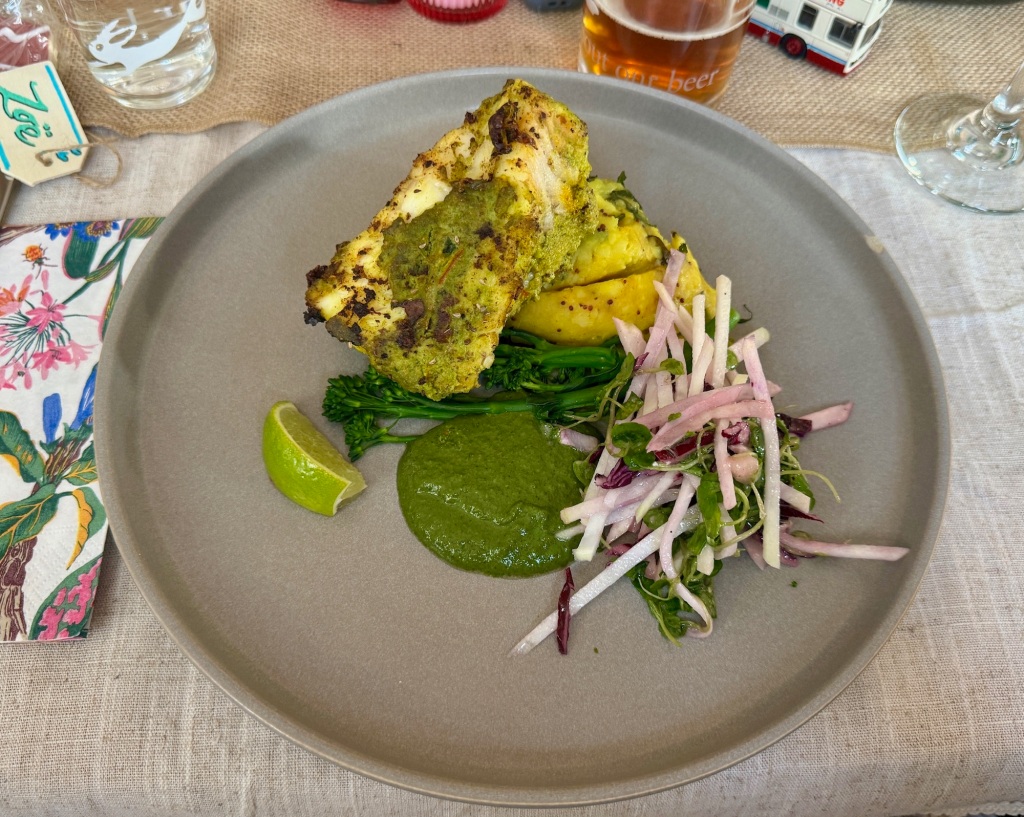
It was much, much more successfully deployed with chicken – in this case a huge, deboned chicken thigh which came on a skewer which surely could barely have carried its weight. This is where the technique was really at its best, the meat permeated with complexity and delight.

This kind of food makes fools of us reviewers because it exposes our narrow horizons and our limited vocabulary – I’ve seen it compared to yakitori, to laksa, to satay and to massaman. Better to be honest and say you can’t really sum up the smoke, sweetness, spice and comfort and just say that you should maybe order it so one day, you can compare other great dishes to it instead.

The third of our trilogy of skewers was bavette, topped with crispy onions. You get the idea by now, and although I enjoyed it, three different permutations of that concept was probably one too many. It was better value than the mussels, but not quite as good as the chicken.

At this point, the only question in my mind was where in the pantheon of greats Kolae would wind up nestling. The space was fantastic, the food had been eye-opening – just enough challenge, just enough fascination – and it was simply a wonderful place to be on a weekday afternoon. Every now and again flames leapt from a wok in the open kitchen, there was still hubbub even after the lunch rush had passed, and more was to come.

But that’s where things wobbled, if only slightly. Service had been wonderful, and when you got the attention of a server they couldn’t have been more helpful, but it proved increasingly difficult to flag them down. We’d finished a really gorgeous hazy IPA, Juicy Chug, by small London brewery Jiddler’s Tipple, which had gone beautifully with the small plates, but were keen to get some wine.

And we got there eventually, but if the staff had been more on it I daresay we would have drunk more. It’s a decent and interesting wine list, although the vast majority of the options by the glass were north of a tenner. I really loved my choice, a Greek malagousia and assyrtiko blend, but I think Zoë might have shaded it with her New Zealand riesling.

The first of the large plates that came out again demonstrated that this was a fluid menu where things overlapped and echoed other dishes. I’m not saying that the kale fritters were a replica of the biryani rice crackers from earlier in the meal, but they were definitely close siblings, both in terms of the crunch and complexity. This sauce was very different from the nam jim, but I got sweetness and chilli but maybe not the fermentation the menu suggested would be there. It was however another tactile triumph, although I’m not sure it really felt like a side. Perhaps I should have tried the sour mango salad with dried fish, but everything I’d read suggested that eating it would be a fast train to meltdown..

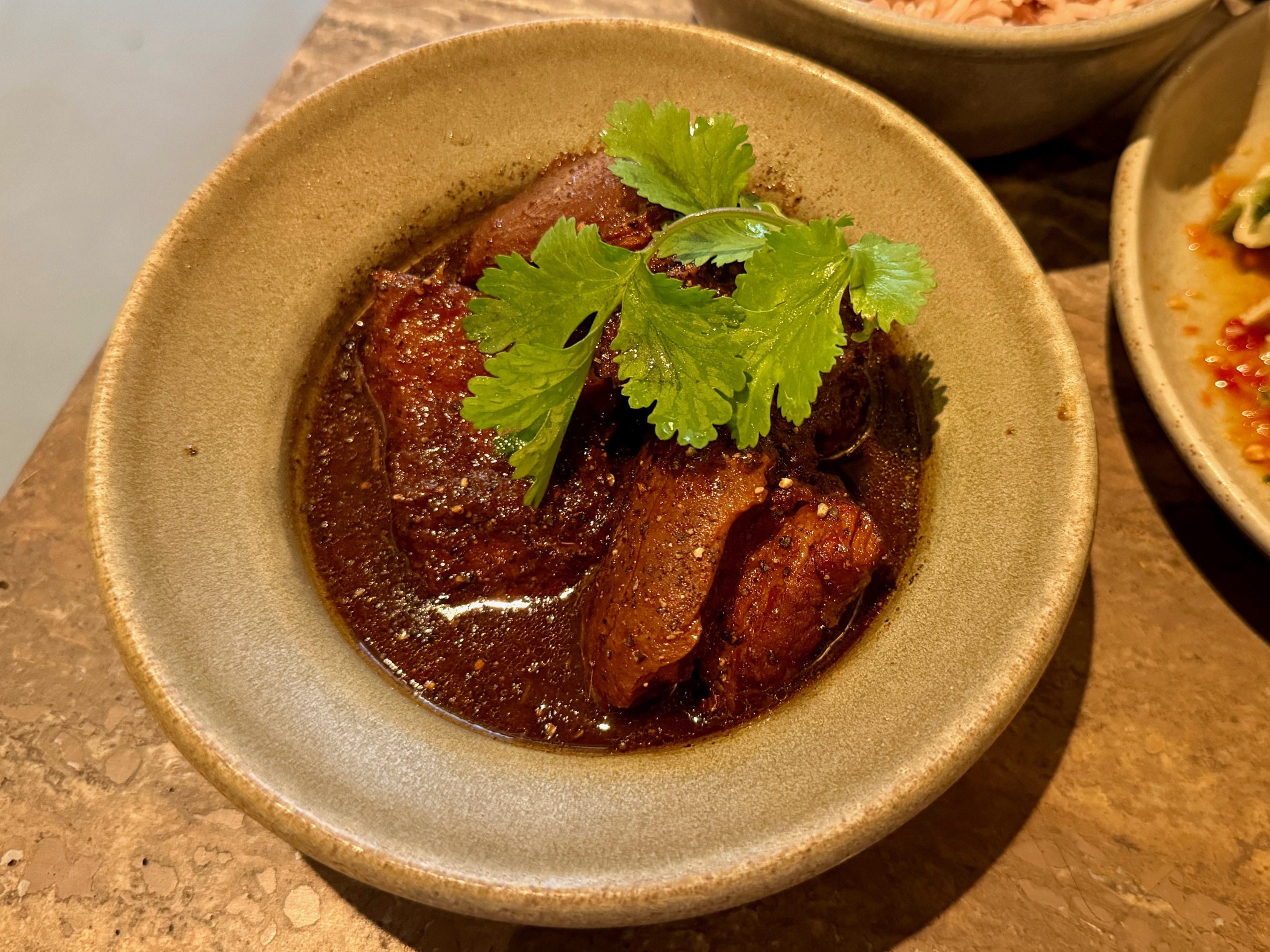
One of the absolute standout dishes of the meal was – surprise surprise – Zoë’s choice. Soy braised pork belly and ribs was outstanding, in a sauce that was far more about the tightrope between sweetness and saltiness, with heat, just this once, taken out of the equation. The sauce was just gorgeous, the meat was that perfect combination of caramelised and yielding, and it was if anything another dish I hadn’t expected – more poise than bombast, in a meal that had mostly been about very forceful flavours.
And this was where the wobble came in again. We’d ordered this and a second main, a prawn and stone bass curry, and we’d asked for a couple of bowls of rice to accompany them. Our server told us that one bowl of rice would easily be enough for both dishes, and that we could always order more if we wanted to. And maybe that might have been true, but it was very hard to judge when we were waiting something like ten minutes for that second dish to come out.

And this is the drawback of small plates and large plates, starters and mains: because, rightly or wrongly, we had ordered a main each and what this meant in practice was that I sat there like a lemon wondering if they’d forgotten my order. By the time it came out, most of the rice was gone. We ordered another one to go with the fish curry, but didn’t end up using most of it.

I waited so long for my main that I didn’t even get a photo of it, which would frustrate me more if it had been more exciting. It was okay but not extraordinary, and I wonder if the staff have had to manage expectations about the heat levels in the menu following some of those hype-laden reviews, because they told me that this dish was on the hot side and reality it was more restrained than I’d expected.

It was possibly the only thing I ate, up to that point, that tasted unspecial: was that because I’d had to wait so long for it, or just because it didn’t quite match the standard elsewhere? Who knows. All the other reviewers seem to have thought it was out of this world.

Kolae’s menu only had two desserts on it, so naturally we ordered both: how could you resist the possibility that you might just eat the twenty-seventh best dessert in the country? Especially as there was a Coteaux du Layon on the menu, a dessert wine I can never see without ordering which always punches above the likes of a Sauternes (or even a Tokaji, for my money).

Zoë had the worst of it, with a dessert which left her baffled and ambivalent. Mango custard with sweet sticky rice and fresh coconut sounds great, doesn’t it? But the reality was a little odd and neither one thing nor the other. The custard was pleasant enough, if not exactly singing with mango, but the layer of lukewarm rice – more claggy than sticky – left her a little cold. Looking at the reviews I’ve seen, Kolae only did one dessert for some time, and all their desserts have been kind-of permutations of what Zoë had (well, left some of) and what I ordered.

That suggests they might still be searching for the right dishes to end meals at the restaurant. On this evidence, perhaps they should keep looking.

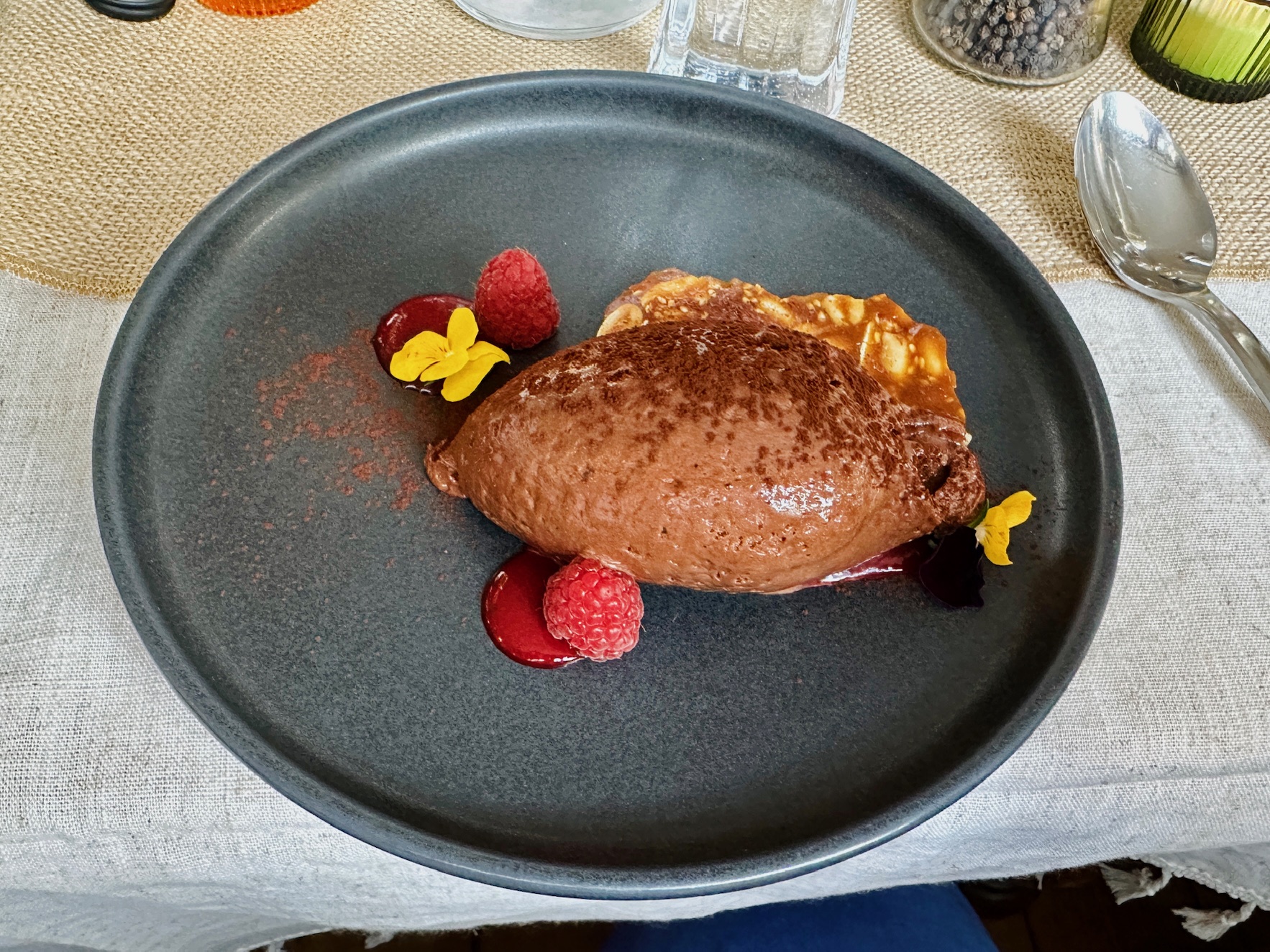
I had the smaller, cheaper and better dessert, and arguably the more conventional one. A single sphere of coconut sorbet, gorgeously smooth, came crowned with a salted tea caramel, peanuts on the side. And again, it felt like a few good ideas in search of better execution: I liked the sorbet, I absolutely loved the caramel, I wanted the ratio of the two to be different. And just dumping peanuts next to it felt like an afterthought, when I’d have liked the whole thing to feel integrated.

As I said, previous reviews I’ve seen suggested that Kolae previously only offered one dessert which combined elements of these two. That process of evolution doesn’t feel like it’s concluded yet.

Still, we were full and happy with much to digest. At this point getting attention was a breeze, and our meal – a lot of food, three drinks apiece and a 12.5% service charge lobbed on – came to a hundred and sixty four pounds. I’ve seen a few reviews say that you could spend less, which you could, but I for one didn’t want to come away from the meal thinking anything along the lines of ‘I wonder what those chicken skewers would have tasted like?’

Hours later, after a hectic traipse round Selfridges and Liberty unsuccessfully trying to identify birthday presents, we sat in the very nice beer garden of a pub in Islington, drank two deeply expensive pints of Steady Rolling Man and talked about our meal. It’s always one of my favourite things about going on duty with Zoë, the post mortem, and few things accompany one as well as sunshine and an al fresco pint of Steady Rolling Man.

Our conclusions were fairly similar – that Kolae was extraordinary, and that we were glad we’d taken a punt on it. That the room was incredible, the location was brilliant and that there were many dishes on there the likes of which neither of us had ever had. If the overwhelming critical reaction did have a feel of mass hysteria about it, it didn’t detract from the fact that it was an excellent restaurant.

And yet, there were a few things that just stopped it from being truly great. The slightly disconnected service, for one, and the homogeneity of some of the menu. And the timing issues with the mains did really bug me: I get that when you bill things as large plates and say people might want to share them you may not guarantee they will all come out seconds apart, but a ten minute lag felt like a gaffe and really did take the sheen off what had otherwise been an excellent meal.

And then there were the desserts, the most underwhelming element of the whole thing. I don’t hold with all the tourists wafting round Borough Market with their naff standard issue strawberries swamped in chocolate, but I seem to remember a stall in the market offering raw milk ice cream. If I’d known what Kolae’s desserts would be like, I’d have gone there instead.

But these are, in the scheme of things, relatively minor quibbles. If you have a list of London restaurants you plan to get round to, and Kolae isn’t on it, I’d definitely recommend adding it. If you have any curiosity about this kind of food and this region, even if like me you might lack the experience or the vocabulary to express it, it’s well worth expanding your consciousness with a visit.

And if you’re slightly worried either by suggestions of apocalyptic chilli heat or the visceral horrors of munching on a plate of prawn heads, don’t worry: the former probably won’t materialise, and the latter isn’t mandatory. That’s just the hype talking – the hype that sells papers, results in reservations and gets a very good restaurant an elevated status as the twenty-seventh best restaurant in the country, less than a year after it opened.

Is it the twenty-seventh best restaurant in the country? I’m not sure about that. I’ve wondered, since eating there, whether it would make my top thirty meals of all time: it’s one of the highest ratings I’ve given out on this blog, but top thirty full stop? Maybe not. But the best is the enemy of the good – and whether or not Kolae is the best, the fact remains that it really is very good indeed. Just leave as many preconceptions as you can at home, and enjoy the ride.

Kolae – 8.7
6 Park Street, London, SE1 9AB

https://kolae.com

Restaurant review: Chilis

The week after you get back from holiday is the absolute worst, isn’t it? One minute you’re loafing in the sun, you can have a lie in if you want to, your hardest morning decision is where to grab coffee and then where to have lunch, your post-lunch coffee, maybe a snack, your pre-prandial drink, your dinner, your post-dinner bar of choice. On and on it goes until you’re a modern-day lotus eater, free of cares, a flâneur and a gourmand, carefree and arguably in need of detox. Little, if anything, is finer than reaching that stage.

And then it’s over. The plane touches down at miserable old Shatwick, and you’re reintroduced to the M25. When you get home your clothes all need to be washed, the fridge is bare and there’s this thing called work you have to get up for at something ridiculous like half-seven in the morning. Just like that you’re back in a life of dreary cold packaged sandwiches and cobbling together a meal plan, of not drinking during the week, watching your calorie intake and hanging in there until payday.

And even though it’s May, it seems to be raining most of the time. I don’t care how much you might love your job: objectively speaking, if you compare it to a holiday there’s only ever going to be one winner. Why does anybody do it?

This year, for me at least, that comedown has been even more of a cliff edge than usual. Because not only was I back from holiday, but I was back from honeymoon – I got married, although I haven’t talked about it much – and my next trip away won’t involve planes, trains or automobiles but instead a white van and the removal men as I burn a week’s leave next month moving house.

So although Zoë and I did the supermarket shop as usual, with a sense of resignation, sticking to the plan wasn’t easy last week. Instead there were accidental takeaways, or wanders over to Bakery House or Honest, anything to make real life just a little more unreal, even if only for a short while. You could call it a transition phase, you could call it a soft landing. You could even call it a cry for help: probably it’s a little of all three.

On the plus side, it meant there was a slight role reversal. In the run up to my nuptials it was more difficult to persuade Zoë to come with me on duty, a combination of trying to shed that last couple of pre-marital pounds and save those last few pre-marital other pounds. Now that I’ve been elevated to the dizzy heights of husband? It turns out that Zoë can be persuaded to eat out during the week, especially if it happens to be her turn to cook.

I may have used this to my benefit, in truth. Bet you can’t be fucked to cook the salmons tonight I messaged her, as she was on the train back from London. How did you guess? came the reply. Failing at this, aren’t I. After a bit of plea bargaining – it was raining, so nowhere too far out of town (my wife does not like the rain), and nowhere that involved walking away from home only to head back (my wife also doesn’t like going back on herself) we settled for Chilis: central, a short walk from the station, potentially interesting.

Subscribe to continue reading

Become a paid subscriber to get access to the rest of this post and other exclusive content.

The Lyndhurst

I don’t normally write reviews that are of places that have closed. It has that same whiff of smugness as reviewing drinks nobody can buy or plays that have finished their run: I’m going to make you feel bad about what you missed, they seem to say. My life is better than yours. It’s all very “if you know, you know” – another phrase I hate – only more “if you didn’t know, now you never will”.

But I’m making an exception to write about the Lyndhurst, which closed under the management of Dishon Vas and Sheldon Fernandes a couple of weeks ago, one final time. Because I don’t think anywhere that’s closed in Reading in all the time I’ve lived here – not the 3Bs, not Dolce Vita, not Mya Lacarte or the Grumpy Goat – has had this kind of effect on me, and I feel like trying to explain why. So I suppose this is for anyone who has been to the Lyndhurst in the last five years, which I expect might include a decent proportion of the people who read my blog.

Part of this is because I am feeling sentimental: as anyone who follows me on social media will know, because I haven’t stopped banging on about it, I got married a couple of Fridays ago. It was simply a perfect day. The sun shone for the first time in ages, the ceremony room in the Town Hall was serene and calm, my dear friend Jerry gave the most beautiful reading, and when I kissed my brand new bride the crowd packed into that room made a disproportionate amount of gleeful noise.

We turned round and there were our favourite people, the biggest small congregation you’ve ever seen in your life. My parents, my step-parents, my brother, his wife and his children. My boisterous, fantastic in-laws. Friends I had known for thirty or forty years, and people that had known my wife since she was at school. Newer friends, and friends who had been there since the very start of my relationship with Zoë. The friend that saved my life, time and again, in the darkest moments of my divorce. There was nothing but love and joy in that beautiful room.

A lot of the rest was a daze. An eruption of confetti on Blagrave Street, standing in a pack under the Maiwand Lion as our photographer corraled and marshalled us into groups, snapping and cajoling. Sipping a crisp glass of bubbly from nearby Veeno, being congratulated by passers-by. Everyone congratulates newlyweds, I’ve found: it’s a moving, life-affirming thing. A Reading Buses driver stopping us in the park to tell us it brought back memories of his own wedding – also in the Town Hall, also photographs in Forbury Gardens.

My wife, grinning and clutching her beautiful bouquet, as happy as I was. Wandering round the Forbury desperately seeking shade, finding spots for photos. “Look into Zoë’s eyes” said the photographer, such easy and enjoyable instructions to follow. And then, at the end of all that, all of us marching to Friar Street to hop on a vintage Reading bus, driven by Tim Wale, the legend behind Tutts Clump cider. Reading institution Paul King turned up out of nowhere and took pictures before all of us, laughing and merry, were driven away to the venue for our celebration.

When I told people I was getting married a lot of people – especially on social media – said “no pressure for your venue, right?” or “I bet the food will have to be really good”. But I never worried about it, because my celebration was being hosted by the Lyndhurst. Of all the Is to dot and Ts to cross in the run up to the big day, of all the things that blindsided us on the home stretch, I never worried once about the food. The Lyndhurst was doing it: that was all I needed to know.

I was at the Lyndhurst for their first night under new ownership, back in the summer of 2019. I’d really liked the previous management and their clever, precise food, and when they left – because the pubco hiked the rent, I imagine – I wasn’t entirely sure the new landlords would be able to match that standard. I remember there being a crowd on the first night, all the regulars happy that their community pub was open again, and the place was packed and chaotic.

There was a rabbit in the headlights feel about it, and I had my gin and tonic with slight misgivings and no idea that I was spending my first evening in what would prove to be one of my favourite places on earth. I remember they put a sign up that suggested they were only serving dinner on Friday and Saturday nights, and I called it out on Twitter. Some random local online prat had a go at me for pointing it out, but the pub just said Thanks for letting us know, we’ll change it.

I didn’t know then that that was their style all over – humble, apologetic, unfailingly polite and always, always getting shit done. The sign got changed. And then I went back to try the food, and had quite the wake-up call. A beautiful Scotch egg, a very accomplished plate of pork belly, pig’s cheek and black pudding bonbons and perhaps most significantly, a bowl of chilli nachos, everything made from scratch, from the tortillas to the guacamole. These people really knew what they were doing, I realised.

The menu changed many, many times over the next five years. They even refreshed it in April, with barely a month remaining, because they never stopped tweaking and improving. But those nachos, which over time became emblematic of the Lyndhurst, never came off the menu, not once.

I read an article in the Guardian in the run-up to my wedding about how much weddings cost these days: one couple, American needless to say, spent five thousand dollars alone on their rehearsal dinner. I liked to joke as my wedding approached that Zoë and I had taken a less conventional approach to rehearsal dinners by instead going to the Lyndhurst pretty much every week for years. And for that matter, I also had a few rehearsals of the Lyndhurst’s mass catering skills: three readers’ lunches, each one more assured, if anything, than the last.

And all that was lovely in principle, but in practice it made decisions about the menu almost impossible. Looking back through the photos on my and Zoë’s phone, of every dish captured at the bottom of Watlington Street over the course of nearly five years, made it even more difficult. So many beautiful plates of food, from which to select just nine. How could you possibly choose?

But of course it also brought back so many happy memories. Braised oxtail, wrapped up in cabbage, enjoyed when they’d barely been open a month. Saddle of rabbit, stuffed with liver and rolled in Parma ham, the equal of anything you could get in Bologna. Their crispy-skinned supreme of chicken with soft leeks and the shiniest, most comforting morel sauce. The legendary – and enormous – porchetta sandwich which graced their menu in the spring of 2021. Their confit duck poutine, which occupied an exalted place on the menu, and in my affections, around the same time.

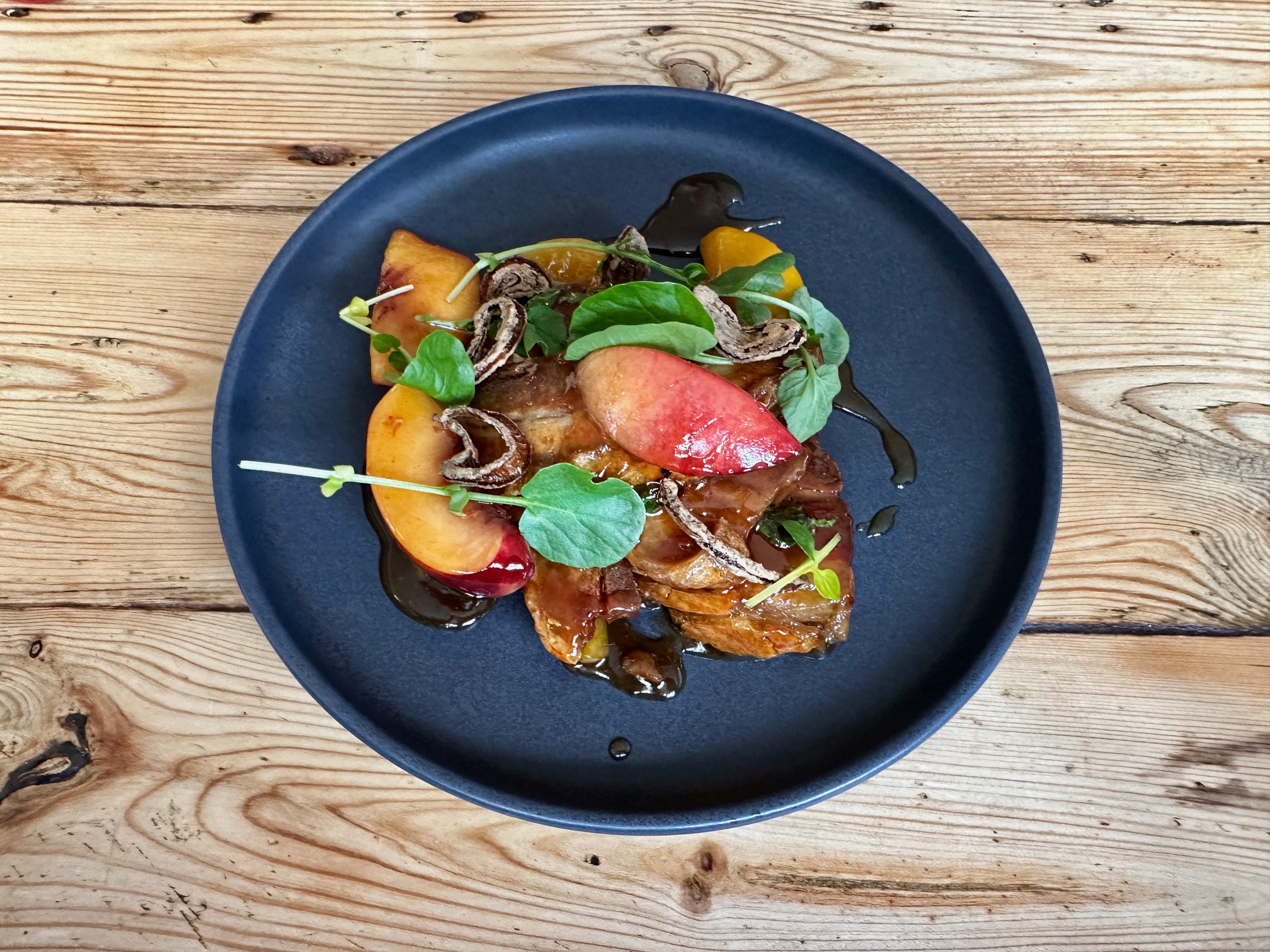
Even towards the end new classics took their place, making life even more difficult. The monkfish tacos, which became one of the Lyndhurst’s signature dishes – so delicious, so generous, so very difficult to roll up and eat, so crammed were they with perfectly executed monkfish. The Korean chicken thigh burger, seemingly invented to make it impossible for me to cook my own dinner ever again on a Monday. Or perhaps best of all, the pork belly with plums and fried onions, in a deep, glossy sauce redolent of hoi sin. It only arrived on the menu around the start of this year, but even so I lost track of the number of times I ordered it. Even now, writing this and thinking about it I get a pang of sadness that I won’t get to eat that dish again.

I’ve made a point of trying to take almost everyone I know to the Lyndhurst at some time or another over the last five years. My family, local friends, friends from out of town, colleagues on one occasion, even my brother on his last trip to the U.K. from the other side of the world (he insisted on trying the monkfish with Bombay potatoes, and left in raptures). So I had done my level best to make sure as many people as possible at the wedding already knew how good the Lyndhurst’s food was.

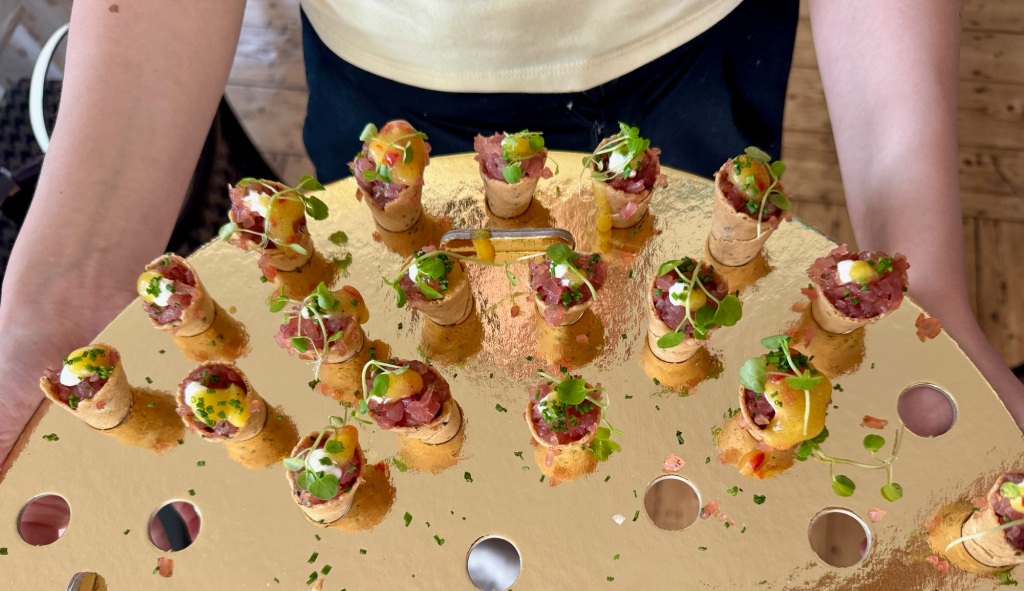
But my new in-laws had never been there, and nor had some of the other wedding guests, and I couldn’t help but feel happy and proud of the pub as the canapés came round. Little cones packed with tuna, crowned with a dab of mango. Black pudding croquettes which seemed super-dense, as if they were made of more black pudding than their shell could contain: my father-in-law, not always an easy man to please with food, devoured quite a lot. Little choux buns filled with mushroom, for the vegetarians, and polenta squares topped with butternut squash, for the vegans.

And a treat I first sampled at a reader’s lunch the previous year, beetroot macarons, sweet yet salty, with a judiciously chosen core of goats cheese. “Holy shit”, my Canadian cousin Luke said to me later. “I think those might be the best things I’ve ever tasted.” And Luke eats out a lot.

I think some of our guests kept expecting the canapés to run out, because they didn’t know the Lyndhurst, but wave after wave passed through the room: no need to stand near the kitchen and grab them before they were demolished by others. No need to worry about that, or anything else. The Lyndhurst, their brilliant, well-oiled team, were completely in control. Why on earth would I worry?

The Lyndhurst opened in 2019, but within nine months or so they were plunged into the awful event we all now remember as 2020. Everywhere closed, from March to July, and when places reopened they faced a nervy, uncertain future. Many people, me included, were reluctant to go out. And then of course there was the superspreading folly of Eat Out To Help Out, followed by the many-tiered madness of various restrictions, all of which fell far short of what was really required.

I sometimes wonder how Sheldon and Dishon must have felt, celebrating the end of their first year in charge not knowing whether there would be a second. But if they ever lost hope it never showed, and although I liked the Lyndhurst a lot in 2019, it was in lockdown that I came to love them; I am lucky enough to live round the corner from the pub, and they carried on delivering to me, to my doorstep, throughout the winter of 2020.

It became a wonderful, comforting Saturday night ritual – place the order, transfer the money and then just as Strictly was about to begin there would be a knock at the door and there was Piotr holding a bag for us. If there were specials on we would invariably order them, but there was always a treat of some kind. I remember the asparagus in batter with romesco sauce, one of the best snacks of all time. I remember first the pork and then the lamb tacos, although any time the Lyndhurst did tacos was a time to cherish. I remember the beer can chicken, and the phenomenal ancho chile relish: I think I ended up with a jar of it in the fridge at one point, and used it on everything.

And I remember – how could I not? – the occasions when they had skate wing on. Classically cooked, golden and bathed in beurre noisette, scattered with capers and croutons, just waiting to be clumsily decanted on a plate and scoffed, with the simple joy of flipping the wing over at the halfway point. It might have been movie week on Strictly, or perhaps Halloween week or Blackpool week. But it was always, always Lyndhurst week.

One story I never told at the time, although I suppose I can now that Sheldon and Dishon have moved on, is that in the spring of 2021 I published a review of the Lyndhurst’s takeaway menu. I loved nearly everything I tried, but I did express a few reservations about a dish they’d just added to the menu, a chicken tikka naanza. Later that afternoon I got a message from them on Twitter: they’d been thinking about the feedback and they’d made a few tweaks as a result. Would I mind if they dropped one over so I could let them know what I thought?

Naturally I said yes, and just after five there was that knock at the door again. I split it in half and took half of it up to Zoë, who was in the spare room finishing her last conference call of the day. They’d pretty much made every change I’d suggested in the review and I know it’s me saying this, but it was damn near perfect.

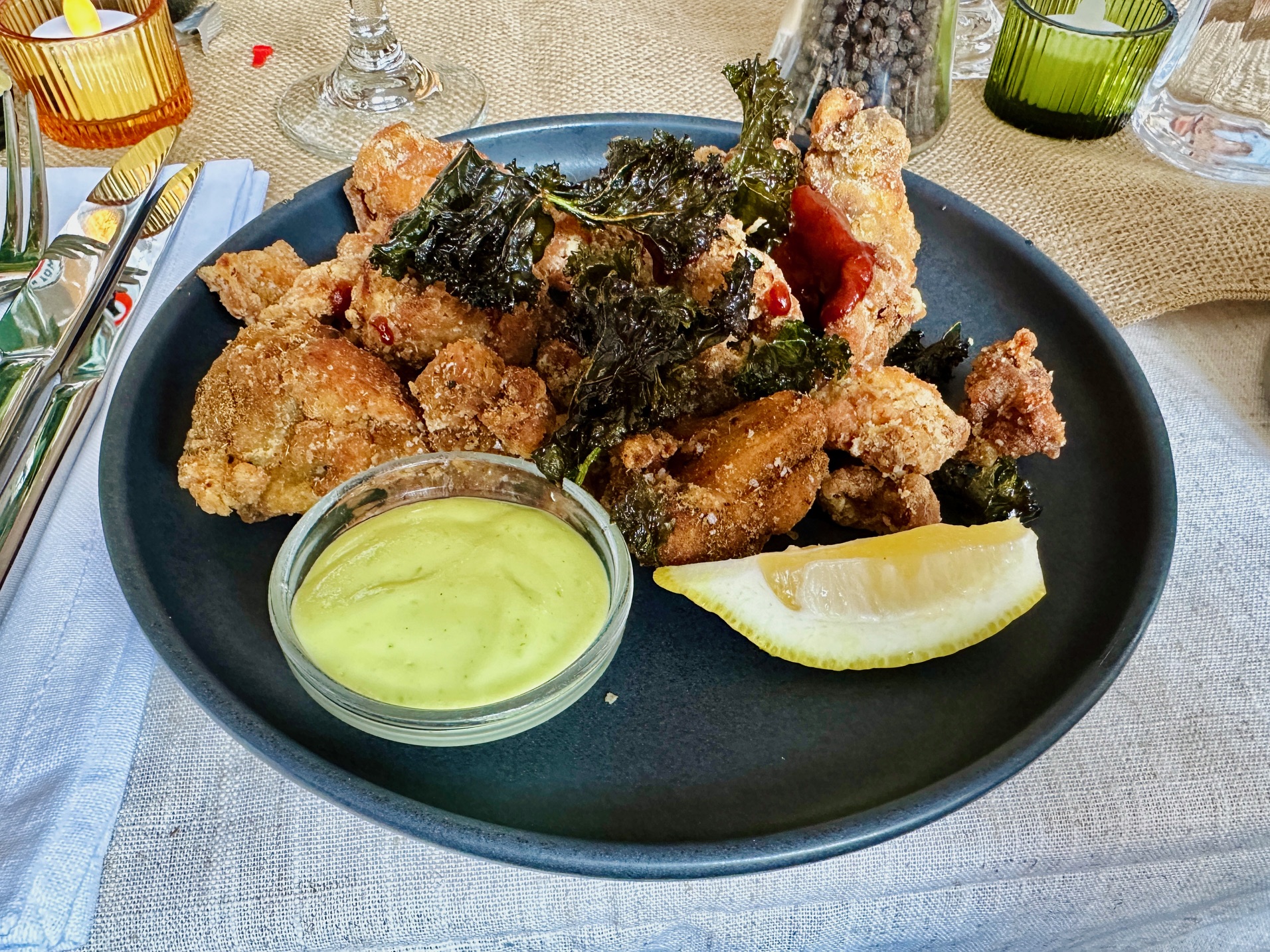
One dish that the Lyndhurst never needed to change, not from day one, was their karaage chicken. I first had it in the spring of 2021 and to this day, however hard I’ve looked – and trust me, I’ve looked hard – I’ve never found a karaage anywhere else that matched it. It was my starter of choice, my first starter as a married man, and although it wasn’t the single best choice I had made that day it could well have been the second.

Although I was a takeaway customer of the Lyndhurst for quite some time, even after lockdowns eased and a lot of people went back into the pubs and restaurants, I wasn’t their last takeaway customer. That honour belonged to a chap at my office, who loves their curry night. He lives round the corner from the pub too, but with small kids he couldn’t eat in, much as he might have wanted to. So without fail every Thursday he would check Instagram, find out what the three curries on offer were, place his order and then go and collect it that evening.

Often I would be eating in and I would see him, we’d acknowledge each other, compare notes on which curry we were going for. I think he had the pint of beer that came with the curry – an outrageous bargain for twelve pounds, all in – but I can’t remember. But every week he was there, getting his curries, taking them. home. And every week the Lyndhurst was there, letting him: most other places would have said that the pandemic was over and they didn’t do that kind of thing any more, but not the Lyndhurst. Forget Eat Out To Help Out, they were helping him to stay home.

The last night that the Lyndhurst traded was a Thursday night, curry night. I wasn’t there because it was the night before my wedding: my fiancée (for one last night) and I went to London Street Brasserie, on the early bird set menu special, and had our first carbs and calories for quite some time. I drank English fizz and ate LSB’s excellent fish and chips, although I couldn’t finish the chips. So I didn’t make it to the Lyndhurst, but I’m pretty sure I know one person who did, one final time, for his family’s habitual takeaway.

And yes, what that also means is that my wedding day was the last day that the Lyndhurst was sort-of, kind-of open. I’d known that they were still trying to agree the rent with the pubco, and I knew that those negotiations didn’t look like they would end happily, but the Lyndhurst told me that one way or the other they would cater our wedding. The fact that they did means more to me than you can imagine, and it really felt like they were celebrating with us too. The pub, and the team, were such a big part of the wedding day that it was impossible to imagine it without them.

I found it equally impossible to pick main courses for our wedding meal. In the end we went for three options, any of which would have suited me down to the ground. Mine on the day was confit duck, the skin burnished, the meat underneath slumping helpfully from the bone, with Sarladaise potatoes, a smooth parsnip purée and the jus of the gods (the Lyndhurst had told me they could easily do a more cheffy duck dish, but this was the one I wanted).

But the main I almost wish I’d had, one final time, was that monkfish – a huge tranche of it, served on a heap of those addictive Bombay potatoes, a bright herb chutney and salad on the side. My wife had that, and I just looked on in awe and envy. My brother had it too, a wonderful gastronomic connection between his first and last meals at the Lyndhurst. So did my father-in-law: he cleaned his plate.

A couple of days after the wedding, I got a message on Facebook from a reader of my blog. He wanted to tell me something about the Lyndhurst.

He said that he’d recently gone to the Royal Berks and been told that he needed to be admitted for an emergency operation. But they said that he had just enough time to grab a meal before they would take him in. And so he went to the Lyndhurst, not far from RBH, and it just so happened that he was there in the week before they closed, eating there – just like I did – one final time. “It was a really meaningful experience” he said, “and I wouldn’t have done it without your review.”

It made me think of all the evenings that pub had made, and the fact that they probably didn’t know the half of it. Just for me alone, they had filled a very special place in my life for five years, in a way I’m not sure I’ve managed to explain. Don’t fancy cooking? Go to the Lyndhurst. Celebrating the start of a holiday? Dinner at the Lyndhurst. Back from holidays and feeling blue? The Lyndhurst it is. Finishing work at the same time as your other half, meeting in town and thinking “isn’t it burger night on Mondays?” Off to the Lyndhurst. Your brother’s last night in the country? Go on then.

But my reader’s story made me think of something else too. December 2021, when after over eighteen months on the run, playing it safe, not going into shops, not eating in restaurants, working from home, only socialising outdoors, waiting for the vaccine and the second vaccine and with the booster in touching distance, Zoë tested positive for Covid. And then she too spent time in the Berks, four fraught nights, and when she came out, after I met her outside the ward and slowly took her home, the Lyndhurst delivered me a simple order that night – just two beefburgers and chips. That was the beginning of the road to recovery, and one of my most meaningful experiences.

There was no way, though, that the beefburger was going to feature on the wedding menu. The Lyndhurst’s chocolate mousse, though, was another story. The first time it was on their menu, the first time we ordered and ate it, Zoë had that look in her eye. “We’re having that at our fucking wedding” she said. And so we did.

The rest of the evening was a riot – of my friend James’ home-brewed beer, of gin and tonic, of conversations with old friends out on the Lyndhurst’s patio. The heat and sun of the day had faded, the crowd had slightly thinned and everyone was sitting outside, chatting and mingling. My stepmother caught up with my schoolfriends, who she hadn’t seen in over thirty years. We took a last family photo before my brother and my sister-in-law headed off, their next flight a day away.

And there was more food – a buffet, of more food than I could conceive of eating. Thinking about it now, I wish I’d had more room for the charcuterie, for the chicken pakora, for every manner of bite-sized savoury delight. And because I’d asked them to, the Lyndhurst did a slider of their legendary Korean chicken burger, the dish they’d introduced in February which had made losing weight in the run-up to the wedding so challenging. I made sure I had one of those. A few people did: my mother-in-law took one home and had it the following morning for breakfast.

The next morning, town seemed to be an even more beautiful place than usual. I went and got a couple of coffees from C.U.P. to take them to our hotel, and the man behind the counter shook my hand and congratulated me. I told the hotel receptionist that my wife would be checking us out shortly – the first time I said “my wife”, the first of many. And we got to the Lyndhurst to take down the decorations, to find that the process of getting the pub ready to hand back was already taking place. A man was painting woodwork, the party was over.

Well, almost over. On the Saturday night there was a little farewell party for the pub and Zoë and I went in to say one last goodbye. Many of the regulars were there, faces I recognised from curry nights, or burger nights, or Friday nights. So many different stories intersecting with the pub the way mine had, so many different people who would miss Sheldon, Dishon and the team every bit as much as I would. When people talk about how pubs can be community hubs, they never mention how difficult it actually is to do, to manage that and still be inclusive, not some gammon pubman’s boys’ club. But the Lyndhurst did it.

And all the staff were there relaxing and chatting. Sheldon and Dishon, too, and I realised that I’d rarely seen them in the same place at once. Usually Dishon was running the front of house, Sheldon tucked away in the kitchen. But here they both were, casually dressed, laughing and, I hope, feeling the love. Dishon is moving back to Northamptonshire to be with his family, with a baby on the way. Sheldon told me he was looking forward to a break, to visiting his family in Mumbai, and after that who knows? Both of them looked like they were ready for a long rest, but proud of what they’d achieved. They should be.

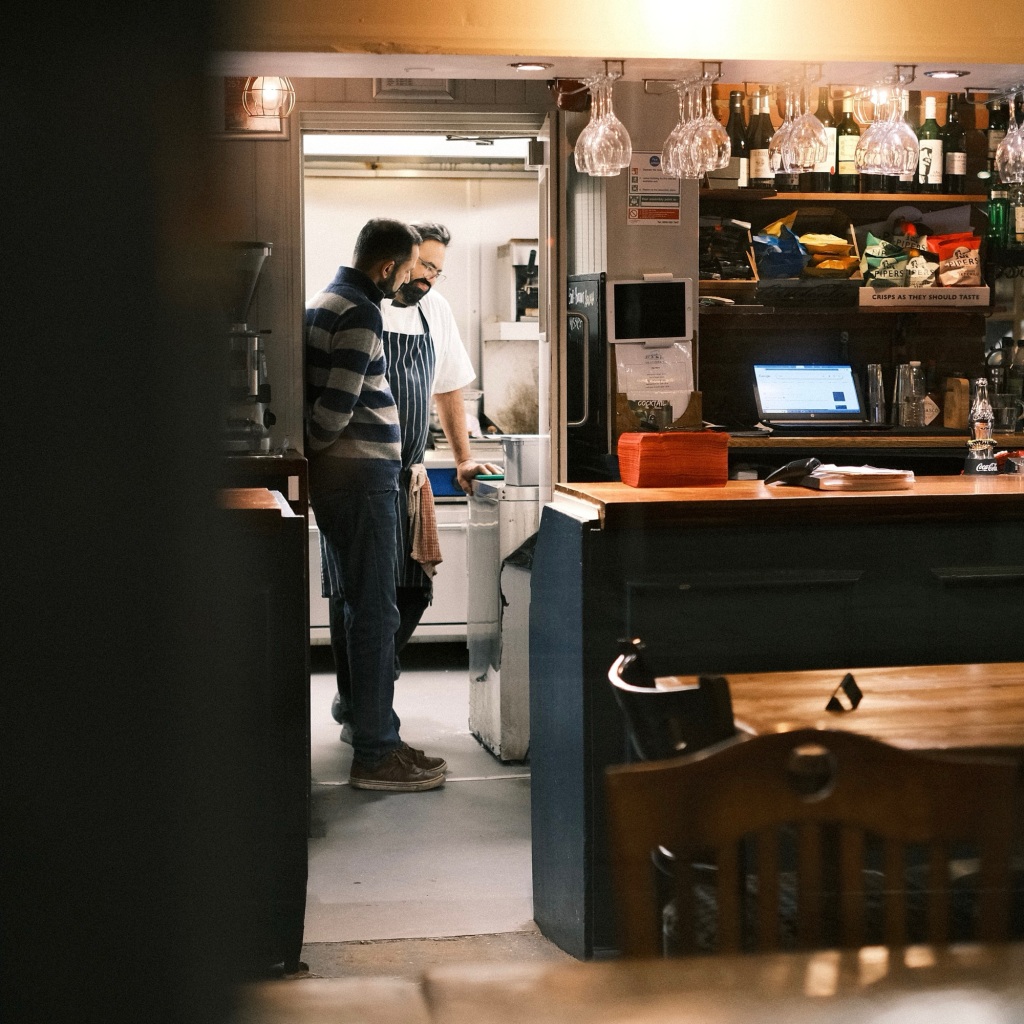
I may have rarely seen Sheldon and Dishon together, but one of my favourite pictures is of the two of them, taken by a chap called Antonio, a local Instagrammer and neighbour who also loves the pub. It captures a moment, during service, of the two of them putting their heads together, of the front of house and kitchen meeting right at the point where the former ends and the latter begins. It captures something of the wonderful partnership that Reading was lucky to enjoy and, for me, something of what made the pub so magical. Neither of them had run a pub before that fateful day in the summer of 2019. Well, what a debut.

(Photo by @simple_living_in_berkshire)

2024 is shaping up to be a year of changes. I got married, the Lyndhurst did a beautiful job of hosting our celebration and now they have moved on. Things happen quickly, and last Friday the Lyndhurst reopened under new management, a lady who previously ran a pub in Theale. There’s talk of it being more of a sports bar than it was in previous incarnations; locals have wished her well, and I’m sure they will all be in to check it out. I will too, and I’m conscious that when Sheldon and Dishon took the pub over I would have been the first to say they had big shoes to fill.

But fill them they did, and life moves on. And now it’s time for me and Zoë to move on, too: next month we’ll be leaving the Village, where I’ve lived so happily for seven years. So it wasn’t just greeting married life, or bidding farewell to the Lyndhurst, but the start of a period of loving living here, with all its quirks, but knowing that it will come to an end.

Everything does eventually, I suppose, but it’s important to recognise how good things are while you’re living them, rather than only later when you look back. But I will always remember the Village, and those five halcyon years when it had the best village pub anybody could hope for. I’ll remember the two men that made it happen, and that brilliant sunny day in May when the whole world was at its absolute best.

Pub review: The Plough, Shiplake

I still remember the first time I gave out a really good rating on this blog. It was towards the end of 2013, when we were all a lot younger and more carefree, and my blog had been running for just over three months. I wasn’t drunk on the power (next to nobody read the blog in those days) but even so giving out a rating in the high 8s felt like a proper stake in the ground. This is my kind of thing, that rating was saying. Go here on my recommendation and I promise you won’t regret it.

Ten years on, unlike a lot of restaurant reviewers who think their pronouncements should be on tablets of stone – why do so many of them write like they’re on coke? – it still feels like a big thing to say. And a presumptuous one, too: for me, that trepidation about writing a rave review has never quite gone away. Nor has the euphoric relief when anybody visits a restaurant on the back of one of my reviews and tells me they didn’t hate it, let alone loved it. I know the blog’s free, so nobody can ask for a refund, but I can’t give anybody back the money they’ve wasted on a bad meal.

The recipient of that first rave rating, a rating that wasn’t beaten for two whole years, was a gorgeous pub called the Plowden Arms in Shiplake. Run by married couple Matt and Ruth Woodley, it was the most beautiful spot – snug in the winter, with a fantastic garden in a little corner of South Oxfordshire for the summer. The crockery was vintage before everyone jumped on the chintz and retro bandwagon, the menu revived classics from the pages of Mrs Beeton and there was 20s jazz playing all the time. I adored it, and I went there often – with friends, with my partner, with my family, with anybody I could persuade to head to Shiplake.

Just over three years later, the Woodleys left the pub. It reopened under new management, but it wasn’t the same. You looked at the menu and thought that food was just something the management thought it should offer, all function and no passion. It was the first in a long string of disappointments, of places that had the temerity to close despite my loving them. Since then there’s been Dolce Vita and Buon Appetito, and soon there will be the Lyndhurst, but that first one stung. I wish I’d gone more often. As Andy Bernard says in The Office – the funnier version – I wish there was a way to know you’re in the good old days before you’ve actually left them.

When it closed two years later, I wasn’t surprised. It sat vacant by the side of the road, and for a while it looked like it would just be the latest pub to turn into accommodation, the latest community to lose a hub and gain a handful of extra residents with nowhere to drink. It was empty throughout Covid, but then in summer 2021 there was an interesting development: the owners of nearby Orwells announced that they had saved it from near-certain demolition and were going to open it as The Plough in early 2022.

That news was welcomed beyond the narrow confines of Shiplake: Orwells has a lot of fans, and I’m sure they liked the idea of a more affordable, more casual venture from the same people. But then something strange happened in 2022. The Plough didn’t open early that year and at some point – I suspect we’ll never know exactly why – Orwells dropped out of the picture. But the Plough did open, just before Christmas 2022, owned instead by Canadian-born Jill Sikkert, her first hospitality business after a career in interior design. Last month she appointed a new chef, Charlotte Vincent, who has been on Great British Menu and got one of her previous venues into the prestigious Top 50 Gastropubs list four years ago.

All very impressive: who needs Orwells anyway? But I would be the first to admit that the revitalised Plough isn’t the kind of venue I would normally review. A lot of that’s down to accessibility: I know that the countryside around Reading has plenty of food pubs which ordinarily would interest people, like the Dew Drop Inn at Hurley, the Crown at Burchett’s Green or even the Wellington Arms at Baughurst. But as a non-driver who relies on public transport they don’t generally fit my catchment area, so you’re more likely to hear about restaurants near a train station, like Seasonality.

Besides, you don’t need me for those kind of places because they’re the province of the website Muddy Stilettos, which you may know. They love rural gastropubs, and they gush about them in their weirdly infantilised language where things are “yummy” or “scrumptious” and go in their “tummies”, where food and drink are summed up as “scoff and quaff”. Apparently if you like this kind of restaurant you also like twee: I even read one review which referred to something called a “Michelin twinkler”, presumably this is awarded when your scoff and quaff are particularly yummy and scrumptious. Goody gumdrops!

If I say more about Muddy Stilettos – especially that their annual awards are an exercise in epic grift where they get small businesses slogging away to promote their website while giving back nothing in return – I’ll probably get in trouble, so let’s move on. I found myself reviewing the Plough because a very good friend got me one of their vouchers for my birthday last year, so Zoë and I finally found an opportunity to get there on Good Friday, at the end of our holiday, literally days before it expired. So I suppose, technically, I only paid for part of my bill: I wonder if that gives me something in common with Muddy Stilettos?

The makeover the Plough has received is quite something. In its previous incarnation it looked like a pub, like a beloved local that also happened to serve food. Now it is a really gorgeous series of rooms – you can tell Sikkert has a background in interiors – that take advantage of the pub’s good bones, its bricks and beams and parquet floors, but create something much more luxe. That said, the chairs looked better suited to lounging than dining, but that’s probably just me being a bit old-fashioned.

We were seated in a room I remembered well, having eaten in it many times when it was the Plowden Arms, and yet it felt completely familiar and totally different all at once. Even though it was the end of March there was still a nip in the air and the fire was burning, and it felt properly comforting: I can’t wait for summer to come, but I’ll miss the smell of woodsmoke.

The menu is written in that way that was modish a few years back, listing ingredients but nothing else: sea trout pastrami, mussel, apple gremolata, that kind of thing. I know this annoys some people but it didn’t bother me – it was more detailed than other examples I’ve seen and, besides, a little element of surprise when you order dishes can add to the experience. Perhaps I’m just getting soft.

As is the fashion there were snacks, starters, mains and desserts – most of the snacks just over a fiver, the starters just over a tenner, the mains between twenty and twenty six pounds, desserts a tenner. You’ll have your own views about whether that’s steep, but I compared it to what things cost at London Street Brasserie these days and decided to judge it at the end, not the outset.

There’s also a no-choice set lunch menu, twenty-seven fifty for three courses, which didn’t overlap with the main menu. But in honesty I think if you’re going to only offer one option on a menu it has to be more interesting than the likes of swede and carrot soup, so I gave it a miss. The Plough could learn from the likes of Quality Chop House, whose set lunch costs about the same and seriously makes you consider swerving the à la carte. Besides, that voucher was burning a hole in my satchel – in for a penny, in for a pounding, as my fiancée likes to delicately put it.

We got some snacks while we made up our mind about everything else, and they were the first indicator that it wouldn’t all be plain sailing. Homemade focaccia/blue cheese butter was the first thing we tried. Now, I don’t object to minimalist wording provided there isn’t anything significant in the dish it neglects to mention, and so long as what you’re told will be there is actually present and correct.

So the menu really should have said homemade bread/garlic butter, because that, weirdly, is what I got. The picture below is one of the dullest ever to grace my blog, but I put it there for a reason, to demonstrate that this bread wasn’t springy or spongy or aerated. It wasn’t open-crumbed at all. It wasn’t permeated with olive oil, it didn’t have salt or rosemary or anything else to zhuzh it up. The reason it was none of those things is that it wasn’t focaccia.

It was, instead, perfectly serviceable bread. And as for the butter – well, we went from the blue cheese in this must be very subtle to there’s no blue cheese at all in this, is there? before ending up at isn’t this garlic butter? The menu wasn’t just economical with words, it was a little economical with the truth too.

The second snack was a lot more enjoyable. I’ll do away with the stripped down wording from here on in, but this was a clump of battered, fried enoki mushrooms, strewn with shoots, more mushrooms (pickled, I think, but my mind might be playing tricks) and a little Walnut Whip of mushroom ketchup. This was far more like it – wild mushrooms cropped up in a few places on the Plough’s menu, and the mushroom ketchup, lending gorgeous depth, was the star of the show.

But at the risk of nit picking again, the ratio of the enoki to batter was so out of kilter that I felt like I was eating a savoury churro that just happened to have a tiny bit of mushroom in the middle. That said, if it had been described as that on the menu I might still have ordered it. Anyway, it was only a fiver.

The starters proper were more successful, and started to give me an idea of what the kitchen could do. My pork terrine wasn’t bad – a slab of pork, bound up with jamon iberico and strewn with gubbins – cups of onion with thyme crumb nestling in them, and more of those little shoots. I would have preferred some acidity in the mix – a piccalilli, or some caperberries – and without them it was nice but a little well behaved for my liking. A tad too fridge-cold, clean and pristine where it needed to be gutsy.

This came with what was billed as sourdough bread – I wasn’t sure it was sourdough but if anything, it was more open-textured than the focaccia had been. This dish felt sanitised, but it would probably have been a hit with the Muddy Stilettos crowd – every time I read a review by them, the reviewer practically apologises for having three courses and makes a tired joke about undoing the top button of her trousers. I never feel like I have to apologise to you lot for ordering too much food: it’s one of the reasons I’m so fond of you all.

Zoë had chosen scallops, a couple of plump specimens in a puddle of dashi beurre blanc, topped with some kind of sea vegetable whose name I’m sure I used to know but have since forgotten. I wouldn’t have ordered this – I’m not sure beurre blanc is improved by cross-pollinating it with dashi – but Zoë really enjoyed it. Unfortunately I wasn’t allowed to try any, and when I asked her for a more detailed critique she said “I fucking loved it, I’d order it again, what more do you want from me?”.

This will please fans of her expletives, and I know there are a few of you out there, but probably isn’t of practical help. She did eventually tell me under cross-examination that the scallops were beautifully cooked, the contrasting textures managed just right, but that’s all I have for you.

At this point I was feeling slightly underwhelmed, but the Plough rescued things with two exemplary and very different main courses. Fish and chips – just described as “day boat fish”, so I have no idea what it was – was outstanding. A thick cylinder of pearlescent, just-cooked fish was hugged by brilliant, almost ethereal batter. I was allowed to try a bit and it was miles better than I’d been expecting, and weirdly it made me think of my dad. He has a bit of a habit of ordering fish and chips in fancy restaurants, so I’ve seen him try it at Rick Stein’s place in Padstow, at the Beehive in White Waltham and in my opinion, the Plough’s rendition was better than either of those.

The accompaniments were bang on too – excellent peas which were crushed rather than mushy, and a tartare sauce Zoë could tolerate, which meant that it wasn’t quite vinegary enough for me. Having it with fries, although that was clearly communicated on the menu, felt a little strange to me. They were very good fries but, in an inversion of how I feel every time I look in the mirror these days, I’d sooner they had been chunky rather than skinny.

If that covers the pub classics end of the menu, my choice was cheffier and one of the best plates of food I’ve eaten this year. Lamb rump was just stellar – thick and tender, accurately seasoned, the perfect shade of pink with just the most beautiful stripe of fat, the kind of thing I could eat all day. It came with a little of everything wonderful – more onion, this time smoked, chewy and delectable nubbins of Jerusalem artichoke, a sweet and glossy puree, a little jus and, by the looks of this picture, some extra virgin olive oil thrown in for good measure.

Oh, and I neglected to mention my other favourite part of this dish – described as hash browns, they were a couple of golden pyramids of pressed and fried potato that were worth the price of admission by themselves. I truly loved this dish, and it single-handedly justified the trip to Shiplake. A few forkfuls in and that dense non-focaccia and the slightly timid terrine were completely forgotten. All was forgiven: this dish was twenty-six pounds and, I reckon, worth every penny. Even looking down at the picture I can remember how happy it made me.

As it was a little light on the veg I’d ordered some green beans on the side with pickled chilli and soy sauce. They were well enough executed, the beans with a little bite, but I didn’t think they quite worked: the sauce didn’t adhere, so you ended up with a pool of the stuff at the bottom. I’ll go for the ubiquitous hispi cabbage next time.

We both wanted dessert, which is a good sign, and we both wanted the same dessert. So we had it, unrepentantly and without loosening any garments. Again, it was good but not perfect and again, it wasn’t quite as billed. It was allegedly a dark chocolate cheesecake but, for my money, it wasn’t in any way dark. And texturally I didn’t think it entirely worked – that huge layer of chocolate was a tad gelatinous, the base so heavy and thick that you couldn’t get a spoon through it without risking injury to passers-by.

And again, it was a pity because the minor details were all excellent, from the chocolate soil on top to the blobs of yuzu gel and – especially – the warming, boozy cherries. I finished it, because it’s rude not to, but I would have liked something slimmer and more refined. That is something I often say when I look in the mirror, come to think of it.

Replete and satisfied, we asked for our bill and prepared for the trip home. And it would be remiss of me not to mention at this point that – more than once on my visit to the Plough – Zoë had raved about the bathrooms. “Seriously, you have to go to the loo before we leave” she said. “I think they’re some of the best restaurant toilets I’ve ever seen.” So I did, and they were indeed very chic and the handwash smelled magnificent. But, just as with Zoë and those effing scallops, that’s all I can remember. I wish I’d taken a picture.

Our bill for all that food, a non-alcoholic cocktail called a tropical something or other which Zoë found too sweet (and at nine pounds, a little too rich) and a couple of bottles of sparkling mineral water – because I was on antibiotics – came to a hundred and thirty-eight pounds, including a 12.5% service charge. And it feels like an insult to shoehorn the service in here, between the loos and the conclusion, because it was faultless from start to finish. We had just the right level of attention, enthusiasm and smiles from the moment we were greeted to the point where we said goodbye and went out the front door. It made me think what a boon this place must be to genuine locals, although if you live in Shiplake I imagine you had enough to be smug about even before the Plough came along.

I’ve ummed and aahed since about what I made of the Plough, on balance. In the debit column, some of the dishes were underpowered or didn’t work, and the feng shui menu didn’t always reflect what turned up on the plate. I suppose I compare it in some ways to the robust, magical cooking of somewhere like the Bell at Waltham St Lawrence, and it doesn’t quite match that standard. But on the other hand, some of the dishes were exceptional, especially the mains, and the little touches with much of the food show an imagination which quite won me over. And then there’s the room, the welcome, that open fire and – yes, let’s mention them again – those bathrooms.

But the main thing I took from my trip to the Plough was a feeling of being in really capable hands, of a menu that could please almost anybody and managed to walk that very fine line where it was accessible and clever. That’s not an easy balance to strike, and many chefs or restaurants, despite their best intentions, end up falling clumsily on one side or the other. That the Plough has avoided that pitfall, and that the team have created somewhere so universal but sophisticated is a more skilful trick than you might think.

“This is the kind of place we could take your dad and stepmum” said Zoë in the car on the way back to Reading, and that’s as good a summary of its appeal as I can think of: it might mean more if you’d met them, but hopefully you get the drift. I think you could take anybody here for a meal – either for a special occasion or for no reason – and have a properly charming time.

This might not read like an out and out rave, I may not have talked about tummies or the fact that they might be awarded a Michelin twinkler at some point, but regular readers will know that this is me saying I was quietly impressed. This is my kind of thing. Hopefully, if you go here on my recommendation, you won’t regret it.

Nope, still feels presumptuous.

The Plough – 8.0
Plough Lane, Shiplake, RG9 4BX
0118 9403999

https://www.theploughshiplake.co.uk

Restaurant review: Masakali

I’ve been asked about Masakali, the Indian restaurant that replaced San Sicario at the bottom of the Caversham Road, ever since it opened last November. I had a fair few messages on social media saying that it looked interesting, and when I’ve put Twitter polls up asking which of Reading’s newest openings I should visit first it’s always picked up a lot of votes. Being an awkward sod I still reviewed Minas Café, Filter Coffee House and Hala Lebanese before getting round to Masakali, but better late than never: here, at last, is the review literally some of you wanted.

I can see why people noticed Masakali. Something about the polish of its website made people dispense with their usual cynicism about yet another restaurant opening at a site which sees a new occupant every few years. The branding felt completely realised, in a way we don’t often see with new independent restaurants here. Masakali means pigeon in Hindi, and the restaurant is apparently partly inspired by A.R. Rahman’s Bollywood song of the same name: some of that might just be marketing guff, but at least they were trying.

The other thing that stood out about Masakali was the menu. Generic Anglo-Indian curries were kept to a minimum, and instead everything looked – on paper at least – properly interesting. No mix and match proliferation of protein and sauce, instead a range of more singular dishes. A few interesting cultural cross-pollinations here and there, like kulcha stuffed with truffle ghee or a chaat apparently topped with Walker’s crisps, but otherwise a good range of regional Indian dishes.

Someone had done their homework. And you know the C word was going to come up eventually, so here it is: the whole thing felt like a land grab for customers of Clay’s Kitchen rather than, say, people who went to the Bina (assuming, of course, that people still go to the Bina).

Subscribe to continue reading

Become a paid subscriber to get access to the rest of this post and other exclusive content.