I’ve written before about the factors that make a restaurant perfect for solo dining: a good table that doesn’t face a wall or, worse still, the bogs; a great view to enable people watching; a menu that doesn’t make you feel like you’re missing out – no small plates or other “everything has to be shared” formats – and staff that respect rather than judge the choice made by solo diners.
Get all that right and, whether you’re up at the window at Mama’s Way or tucked away in a corner of London Street Brasserie, you’ll have a brilliant time. Take a book, if you want to pretend you’re not going to scroll your phone, order a glass of wine, sit back and enjoy. I really like solo dining these days: so much so, in fact, that I was even quoted to that effect in the Independent. Fancy, right?
The criteria for picking a restaurant to review on your own, though? That’s another kettle of fish.
The thing is, reviewing restaurants is about giving readers a representative picture of what a place is like to eat at. Some of that – the room, the service, the view, the background music – is largely the same whether you have a table for 1 or 11, this is true. But it falls down when you come to the food, because in many restaurants you want to see a decent range of what the kitchen can do. With two of you, that can be six dishes – more, if you’re greedy. On your tod it risks giving a lopsided perspective.
What that means is that when I review solo, I think some kinds of restaurants lend themselves especially well to that. Places where most of the dishes – be they pizza, tacos, momo or biryani – are variations on a single theme are ideal: I may like or love my pizza, for instance, but the one someone else might have eaten with me will share a lot of its DNA. It’s a safer bet that my view of that restaurant will be a typical one.
Casual places tend to be better too, because people are more likely to eat at those alone, possibly in a rush – although it’s a hill I will die on that an unhurried solo meal is one of life’s great joys. And some restaurants are particularly unsuited to reviewing solo, and here’s where the overlap with the opening paragraph comes in: anywhere with small plates or dishes designed for sharing, for instance, is a bust.
I always think of my poor friend Jerry, who went on a solo holiday to Valencia determined to try paella, only to find that the restaurants there would only serve it for two people; he came home with a paella pan but no first hand experience of the city’s most famous dish. Personally I’d have ordered for two, got them to box up the leftovers and eaten them in my hotel room the next day, but Jerry is far less gluttonous than I am (and awfully nice and polite, for that matter).
The reason I tell you all this is that this week’s review was meant to be of a fancy food pub out in the sticks, the kind of place that as a non-driver I don’t review anywhere near as often as you might like. But my dining companion, who has a lovely car and enjoys giving it a run-out, cancelled on me at fairly short notice, leaving me looking at my to do list and scratching my head, trying to work out the best option.
So this week you nearly got a review of Paesinos, the new pizza place that has opened opposite Jackson’s Corner, a perfect candidate because one pizza will tell you if the dough, the base and the tomato sauce are good. And I nearly dropped in next door instead to Just Momo: even the name suggests they only do one thing, although they offer chow mein too. I also considered Biryani Mama, although their name is misleading as biryani is a fraction of the dozens of dishes on their menu: they do more different kinds of chicken starter than biryanis, for crying out loud.
I swerved all those places because I had a better option in mind. Creperie Doux Sourire (it translates as “sweet smile”, and if you thought it meant “two mice” you and that Duolingo owl need to have a word) has been open since late last year in the glass-fronted site on the Oracle Riverside next to Vue Cinema. It’s their second branch: the first opened last May in the salubrious surroundings of Windsor station, although it looks like it was either a replacement or a rebrand for a wine bar called Gregory & Tapping that used to occupy that pitch.
Subscribe to continue reading
Become a paid subscriber to get access to the rest of this post and other exclusive content.
Formosa Street, an enclave in Little Venice less than twenty minutes’ walk from Paddington Station, could be the platonic ideal of a London street. It has a little cafe, a chocolate shop, a ludicrously handsome Victorian pub with wood-panelled walls and glass compartments, with tiny doors linking them together. It has a little Italian restaurant that has been there thirty years, and a craft beer place two doors down, the past and the present coexisting cheerfully.
It doesn’t have a butcher, although there’s one just round the corner on Clifton Road. But tucked away seconds from the Tube station, one stop away from Paddington, a stone’s throw from the strikingly modernist St Saviour’s Church, it is a deeply pretty pocket of London that few people know about. If this was your neighbourhood, you would be very happy indeed. Of course, if this was your neighbourhood you would also be filthy rich.
I’ve frequented this part of the world, on and off, for many years. I think I ate in that Italian restaurant not long after it opened, and I’ve drunk in the handsome Victorian pub a fair few times. Just before lockdown, I tried out the craft beer place a couple of times, and I’ve admired the steeple of that modernist church on more occasions than I can recall. I am no closer to living there, or even pretending that I could do, but it’s nice to try to pretend.
Just before lockdown, five years ago, Zoë and I went for dinner at a small French restaurant on Formosa Street called Les Petits Gourmets. At the time, I had the idea of publishing some London reviews, of places close to Paddington, thinking they might be useful to people wanting somewhere good to eat before grabbing an off peak train home. And it might have been a good plan, if I hadn’t hatched it about a fortnight before people stopped taking trains in general, going to the office or indeed leaving their houses.
So I never wrote a review of Les Petits Gourmets, although that might have been for the best because it was small, eccentric and nuts. On arriving we were told that their oven had packed up, so we could have whatever we liked from the menu as long as it was something they could cook on the hob. The place was dark and atmospheric, our table tiny and cramped. Another table, weirdly shaped and right next to the bar, with a couple of high stools, was so bad that a couple came in, were offered the table, had a shouting match with the staff and stormed out.
I can’t remember anything about what I ate, but I do remember that. And I was tempted to publish a review, if only because it was so surreal, but what would have been the point? It was just a place you would never have heard of, and a review that wouldn’t have sent you rushing there, at a time when you couldn’t have rushed there anyway – even if, for whatever reason, a dingy spot with no working oven and some shocking tables was right up your alley.
I thought no more about Les Petits Gourmets, really, until last summer when I read a rave review in the Standard of a French restaurant in Little Venice called Paulette. I know that area, I thought. I wonder where it is? And then I checked the address, and thought Isn’t that where that weird French place used to be? And then I Googled some more and discovered that it was exactly where that used to be, and opened later in 2020. Les Petits Gourmets was an early casualty of the pandemic: perhaps the cost of fixing that oven was the final straw.
The review I read of Paulette made it sound like everything I had wanted its predecessor to be, so I made a booking there and on a drizzly Saturday morning I caught the train up into London, ready for a long overdue lunch with my cousin Luke, last seen as baffled as I was by supercool Haggerston spot Planque. Fun fact: both Planque and Paulette featured in Conde Nast Traveller‘s listicle last summer of London’s best on-trend French restaurants although, as we will see, they couldn’t be more different.
The walk from Paddington is a lovely one. You start out exiting the station right by the Paddington Basin and cross over it, right by the floating barge restaurants, walking past craft beer and pizza spots and impossibly spenny-looking modern apartment complexes. The route ducks under the grime and bustle of the Westway and then, suddenly, everything is beautiful: the streets widen and are flanked with gorgeous redbrick mansions, huge buildings made up of pinch-me-if-I-live-here flats. And then you’re at the canal, and you wonder how such a fetching residential area can be hiding in plain sight here, in Zone 1.
I stopped for a latte at the brilliant D1 Coffee, a stone’s throw from the waterway, and thought to myself that as usual I was trying to pass myself off as congruous in a neighbourhood far, far above my station. I chatted to the couple next to me about giving up smoking – something I did twenty years ago and still think of as one of my greatest achievements – and as we did, countless cosmopolitan types ambled past, walking dogs or just chatting happily. One was carrying a MUBI tote, and I wondered how it had happened that I’d wound up living in a postcode so far from my tribe. It’s almost as if I just hadn’t tried hard enough to make something of myself.
I got to Paulette before Luke did, and it was unrecognisable from the room I’d eaten unsuccessfully in five years before. Still eccentric, yes: all mismatched patterns on the walls and ceilings, mismatched cloths on the tables, mismatched light fittings, all maximalist and unashamed. But it was bright, cheery and welcoming. Even with the canary yellow awning out, light flooded in from the full length windows and all the tables were full of people who seemed profoundly happy with their life choices. I ordered a kir while I waited for my cousin, and it was sweet sunshine, a liquid escape from rainy London. Even noticing that the gorgeous Victorian boozer opposite was closed for renovations couldn’t dent my joie de vivre.
Nor could the discovery, when Luke turned up and ordered a Meteor Zero, that he was off the sauce. He explained that he’d bust his hip and that alcohol interfered with his rehabilitation regime: news to me, as I’ve always found Dr. Booze an invaluable consultant I’ve involved in my recovery from pretty much anything affecting me.
I thought it would bother Luke, a man who runs more marathons in a year than I’ve eaten Marathon bars in my lifetime, but he was surprisingly sanguine about it. “I figure everything goes through a fallow period” he told me later in the pub, showing a kind of Zen perspective I’d have loved to have twenty years ago when I was his age: come to think of it, I haven’t attained that mindset even now.
That meant that I had to forego the delights and dilemmas of choosing a bottle from the enormous wine list, seemingly covering all of France in compendious detail. But it wasn’t all bad – just under twenty wines were available by the glass, a great spread including half a dozen dispensed using a Coravin. I picked a Sancerre, which was terrific, and we started doing a bad job of making our choices from the menu and a much better job of catching up.
The menu was a tad lopsided, with about a dozen starters and half that of mains, but everything on there was tempting. Many of the things I’d read about in advance and hoped to encounter, like a Roscoff onion tarte tatin with mascarpone, were missing in action, but even so the challenge was very much what you missed out on, as much as what you picked. On another day you would have wound up hearing about the classic onion soup, the scallops or the halibut with sauce Meunière, but I will have to try them next time, assuming they haven’t been whipped off the menu by then.
As it was Luke and I agreed to share a few things to try and cover as much as we could, helped by pricing which encouraged you to try a bit of everything. Starters tended to be at or around the fifteen pound mark, with mains mostly between thirty and forty quid. But everything was so fabulous, and generous, that I didn’t object to that in the slightest.
We kicked off proceedings with a small selection of charcuterie, which was easily enough for both of us. All of it was marvellous, from the bresaola to the pork loin but especially the coppa, dried and intense, and a doozy of a jambon de Bayonne: again, dry and coarse, which very much said tiens ma bière to both Serrano and Parma ham. This came with bread (which should be a given but isn’t always), butter (which was a very welcome surprise) and, best of all, a ramekin containing a deeply acceptable quantity of sharp, tart cornichons.
Fourteen pounds for all that, and for a pound more our second starter was every bit as stellar. I love pâté en croute, and Paulette’s version was the best I’ve tried – a glorious slab of heaven, golden burnished pastry housing coarse pâté, shot through with dark prunes. On occasion I’ve had this kind of dish in Paris and it’s been painfully close to Pedigree Chum, but no such worries here: no dodgy jelly, just densely packed meat – pork and duck in this case – topped with yet more pickles and a quenelle of exceptional whole grain mustard. A very well-dressed salad completed an impeccable plate of food.
I wish I’d had one of these to myself, but to do that I’d have had to go without the charcuterie. This is the problem with sharing food, isn’t it: you always end up wanting twice as much of everything, everywhere, all at once. I was about to start a sentence with Next time, but I’ll try to stop myself or I’ll be doing it for the rest of the review. Truth be told, even by this point the only question in my mind was when exactly that next time would be. It was already a given that it would happen.
I gave Luke first pick of the main courses and, torn between the fillet of beef and the bourguignon, he eventually chose the latter. He chose extremely well. The pan brought to his table was a one-stop shop of pure happiness – a deep, reduced sauce full of wine and care, with a few waxy potatoes, plenty of mushrooms and a transverse beast of a carrot, heftily substantial and yet superbly cooked.
But of course, none of that gets top billing in the name of the dish, and this all comes down to the beef itself. I’m used to having this dish with shin or chuck, but Paulette opted for beef cheeks and, with hindsight, it was an inspired choice. The food writer Harry Eastwood once said that cheek was perfect for this dish as, in her words, “the meat surrenders completely”. I can’t improve on that description, so I’ve nicked it instead.
And it’s true, but only if the kitchen is absolutely on top of its game and the beef is braised to the point where any gelatinous quality is gone, replaced with that terrific stickiness where the beef and the sauce become a symbiotic dream team. That’s what had happened here, and it was a wondrous thing. Trying a forkful I thought back to my friend Graeme’s bourguignon at Côte the previous month, and the difference between good and great. The difference, it turns out, is nine quid and forty miles.
“This is the best French food I can remember eating” said Luke. I’m a relatively frequent visitor to France, but I could see what he meant.
If I had been Luke, I would have wished that I’d saved some bread to mop up that final layer of sauce coating the bottom of the pan. But if I’d been Luke he’d probably have a forty inch waist and far less success online dating and would get over the disappointment of busting his hip (which would be more likely to happen by, say, getting out of bed awkwardly) by medicating with the finest mid-price reds the restaurant had to offer. Instead I offered him some of my frites, and after refusing twice – he is Canadian after all, so awfully polite – he took me up on my offer.
I’ve seen quite a few reviews online talk about how Paulette does the capital’s best frites. They might or they might not: I’ve had nowhere near enough frites in London to be qualified to judge, but they were up there with the best frites I’ve had in this country or any other, irregular, golden, salted and decidedly moreish. They were so good I wasn’t sad that I didn’t get to try the gratin Dauphinois, and frites have to be pretty damned good for that to happen.
My frites accompanied my order from the specials board, duck breast cooked pink, sliced and served simply with a boat of what was described as a duck velouté, in practice one of those ultra-reduced, fantastically concentrated sauces that French cuisine seems to do better than almost anybody else.
I’ve had duck breast many, many times in my life and a lot of the time, afterwards, I wonder if I’m doing it because I think I should like it rather than because I do. It’s often a tad tough, a smidge fatty, somewhat poorly rested: much like me, most weekday mornings. This was more like me after a full day in Nirvana Spa, utterly relaxed, thoroughly cosseted, treated like a king.
The analogy breaks down at that point, because this duck was also enormously tasty and I imagine most people wouldn’t be able to get enough of it. But it was good while it lasted.
By this point I had moved on to a Saumur, which was perfect with the duck: Paulette has the sort of outstanding staff who will compliment you on each of your wine choices even though you’re the poor schmuck muddling your way through the list of wines by the glass.
Luke and I decided to eat as Frenchly as possible, which meant a cheese course and then some dessert: the wine list distinguishes, winningly, between “cheese wines” and “dessert wines” so I nabbed something from the former section, a 1986 Muscadet. I have no doubt the Coravin was involved here, and the result was stunning, an amber marvel with a hint of sherry sweetness, outstanding complexity and length. A 50ml pour, in this case, was plenty.
Paulette does a small or large assiette de fromages with three or five cheeses respectively, and they are in principle a deli too, so I did wonder whether you could pick which cheeses you had. When our server authoritatively told us you got a Comte, a truffled brie and a Saint Nectaire I realised this was a choice best left to the experts, so that’s what we had.
The picture here probably doesn’t fully convey this, but it was a generous wodge of each, easily enough to share without needing a scalpel and a protractor. They were all outstanding: the Comte with all the crystalline grit you would want, the Saint Nectaire, not a cheese I’d ever seek out, bringing a savoury depth to justify its seat at the table.
But the truffled brie – oh my goodness. Luke and I agreed that we shared a suspicion about truffle being brought out to zhuzh up the ordinary, but in this case it turned a gooey, creamy delight into a total showstopper. As with the charcuterie, this came with a generous helping of bread but once we had finished all of the bread and nearly all of the cheese the twinkliest of our servers returned with a couple more slices, urging us to use them to clean up the very last of the brie. We did as we were told.
Normally I would have a different dessert to my dining companion, but I figured we’d got through a decent range of dishes already and I’d seen the chocolate mousse being carried past to other tables and decided there was no way I was leaving without trying it. I mean, just look at it in the picture below: a stegosaurus of a thing, plump and shiny, with a spine of caramelised hazelnuts sitting in a pastel-green lake of pistachio crème Anglaise. How could I not order that? How could anybody?
And it tasted every bit as beautiful as it looked. By now I’m used to chocolate mousses in fancy Spanish places where they drizzle it with extra virgin olive oil and pop some salt crystals on top, the modish way to revamp a staple. But this had no interest in playing those tricks, so like everything else at Paulette it was a classic rendition of a classic dish, prepared by a kitchen that revered the classics.
Don’t get me wrong – there is a place for deconstructing, reconstructing and reinventing, and I’m a fan of those things as much as anyone. But whatever that place is it isn’t Paulette, I’m very glad to say. This was a dark, glossy miracle – so smooth, almost not aerated at all, and I wished every spoonful could have lasted hours. The final spoonful, as it always does with such dishes, came too soon, and I found myself wishing there was some sweet equivalent of bread I could use to mop up those last bits of crème Anglaise. Maybe that, rather than ruining burgers, is the point of brioche.
When you book lunch at Paulette you get that standard issue we want your table back in X hours gubbins that London restaurants so often do. But none of that happened here, and over three hours after I ordered that kir pretty much every table was occupied by somebody new despite it still being mid-afternoon, the evening service around the corner.
I’ve never understood restaurant reviewers who insist on eating at a place twice before writing a review – mainly because they need to get over themselves – but if I could have eaten at Paulette again that evening I would have seriously considered it. But the craft beer place a couple of doors down was calling to us, and the pub after that, so it was time to reluctantly pay for the wonderful time we had had. Our bill for two, all that food, a couple of beers for Luke and five different glasses of wine for me, came to just over two hundred and ten pounds, including a 13.5% service charge. It felt as much like a bargain as I suspect any meal will this year.
Later on, Luke and I were in the Bear, just around the corner from Paddington, having one last drink and comparing notes before going our separate ways.
“The only thing that stops it getting the highest mark, for me” said Luke, “was that it just lacked that thing that would make it a truly transcendental experience. That and the bread, I guess, the bread could have been better.”
I knew what Luke meant, but I also suspected that looking at Paulette that way missed an important point, which was that Paulette had no interest in being that kind of restaurant or delivering that kind of experience. It was more interested in transporting you completely by delivering something unfussy and unfancy but, in its way, truly outstanding. Paulette was about as good an example of this kind of restaurant as it’s possible to find, and I loved it. Absolutely loved it, unreservedly, from start to finish.
It’s twenty minutes from Paddington, and Paddington is thirty minutes from Reading. Just think about that: you could be at Reading station, and within an hour you could be eating in this place. If I don’t do so a couple more times this year, I will be extremely surprised, not to mention deeply disappointed. I know most of my London reviews, lately, have been of spots in the centre where you hop on the Elizabeth Line to get there, very much a tribute to the march of progress in the capital. But this? Simply timeless.
As of January 2025, Edible Reading is partly supported by subscribers – click here if you want to read more about that, or click below to subscribe. Whether you’re a subscriber or not, thanks for reading.
This probably isn’t something I should admit but even now, after nearly twelve years doing this, I’m not always the best judge of which reviews will and won’t prove popular.
I mean, some obviously do well: you all tend to want to know about the new openings and the big names as soon as possible, something I’ve been trying to get to quicker over the last year. And I know from my trips to the likes of TGI Friday and Taco Bell that if it looks like I’m going to have a bad time, you tune in. I don’t take that personally – everyone likes a hatchet job and we can all derive vicarious pleasure from the suffering of others at times.
Beyond that? I have a vague idea at best. Sometimes I can write up a lovely independent place in the middle of town and – well, there aren’t crickets, but it doesn’t go gangbusters in the way that a Siren RG1 or a Rising Sun might. And other times the success of a review takes me completely by surprise.
Take Gordon Ramsay Street Burger, for instance: I didn’t think that many of you would especially care what it was like. On the run up to my visit, I wasn’t even sure I especially cared what it was like. And when I went I found that it was perfectly serviceable, the kind of place you might quite enjoy if you lived in a town without Honest Burgers. Little to write home about all round, you might think, and yet it was my most popular restaurant review of the year: me having a fair to middling time at a big chain in the Oracle. Go figure.
I actually think this might be for the best, that there’s no crystal ball. Because it would get tempting just to write the crowdpleasers, and that would skew the kind of places I go to and the kind of meals I seek out. And part of my – let’s call it a job, just for the sake of argument – job here is to highlight all kinds of establishments.
The ones you know about, but also the ones you don’t. The ones you would never consider going to in a million years, or walk past thinking “I wonder what that’s like?” And the ones you may well have already been to, probably in the first month after opening, before I get round to them. If you always have a pretty good idea what, or where, is coming next then something’s probably gone wrong.
One of the impressions I do get, though, is that collectively speaking you’d like to see more Oxford reviews. I can see why: it’s only half an hour away by train and is almost the anti-Reading. It has everything Reading lacks, yet lacks all the stuff Reading has got. No widespread craft beer, but lots of handsome old boozers, the kind Reading has gradually lost. No street food, but a covered market and cheesemongers and delicatessens galore.
A big shopping mall, yes, but a completely different kind that attracts the chains that Reading still just doesn’t get. More independent retail and two independent cinemas, but crap buses. Better bookshops, but nothing like the Nag’s Head. Did I mention that it also has the Oxford Playhouse, which for all its charm South Street can’t quite match? Anyway, add the two together and you would have the perfect large town slash small city; Oxford even has a couple of universities, would you believe.
All that makes Oxford the perfect place for a weekend lunch or dinner, especially coupled with mooching, shopping, drinking coffee and people watching. So every time I put an Oxford review up it does pretty well, and I get the impression – perhaps wrongly – that you might like to see more of them. My first visit to Oxford on duty was to one of my favourite Oxford spots, The Magdalen Arms on the Iffley Road. I had a lovely time, as I expected to, and resolved to cover the city more often. Two and a half years later, I’ve written the grand total of five reviews of Oxford restaurants: time to pull my socks up.
So last weekend Zoë and I were in Oxford, on her Saturday off, and I had booked a table for two at the Oxford restaurant I’ve possibly eaten at more than any other, Branca. It’s a sort of Italian brasserie – or would be if such a thing isn’t two different kinds of cultural appropriation – and had been trading on Walton Street in Jericho for over twenty years.
And that means that, like Pierre Victoire just round the corner on Little Clarendon Street, it’s part of an elite club of restaurants that have been an ever-present in my dining life. The only thing even comparable in Reading, now that Pepe Sale is gone, is London Street Brasserie, and that tells its own story, that Oxford can hang on to these places when Reading can’t.
It helps that Jericho is such a lovely part of Oxford, less than twenty minutes’ walk from the train station but a world away from both the town and gown of the city centre. It’s all nice cafés and bars, pubs tucked away on sidestreets, the Phoenix cinema where people, me included, queued round the block to see Four Weddings thirty years ago, watering holes like Raoul’s and Jude The Obscure that feel like they’ve been there forever.
I lived in Jericho, for a strange and surreal year halfway through the Nineties, and I didn’t appreciate how gorgeous it was at the time. And now it’s so gentrified that I could never afford to do so again in this life I am struck with brutal clarity by what a terrific part of the world it is. Isn’t it always the way? Never mind. Sitting in Branca, menu in front of me, soaking it all up I could kid myself, for a couple of hours at least, that this was my place and these were my people. Good restaurants, apart from providing you with great food and wonderful drink, have a knack of giving you that, too.
In the years since it opened Branca has expanded into next door, turning it into a cafe and deli more than capable of improving your cupboards and denting your wallet. But the dining room is as it always was, a tasteful if cavernous space.
The tables nearer the front, close to the bar, are nice enough but if you can get one at the back you’re treated to a beautiful room with marble-topped tables, exposed brickwork, what looks like a Bridget Riley on the wall. There’s a view out into their courtyard through full length-windows, and the light in general is quite magical, helped by a skylight and clever use of mirrors. Even on a dreich February day it felt like spring was in touching distance.
This isn’t the criticism it might sound, but Branca’s is simultaneously the biggest and smallest menu I’ve ever seen. Big as in physically big, a one-sided sheet of something like A3 that lists everything they serve. But when you delve into the detail, it’s compact: four starters, a couple of salads, three pasta dishes, four pizzas. Four mains, a burger and a steak and a couple of specials. I felt like I had just enough choice, although if I’d fancied either of the specials I wouldn’t have felt constrained at all.
As it was, this was just on the right side of the border between streamlined and narrow. Starters clustered around the ten pound mark – don’t they always, everywhere, these days – while mains were more scattergun. A pizza was about sixteen quid, with the exception of the sirloin steak the mains stopped at twenty-five. If I hadn’t eaten at Branca before I think the menu would still have inspired confidence, that it was aiming to do fewer things better, but they’d already proved that to me time and time again.
Before any of that, a negroni apiece and some of Branca’s focaccia, which they’ve been dishing out free of charge to diners for as long as I can recall. The focaccia was great stuff, airy and speckled with salt, oily enough to make your fingers shine even before you dipped hunks of it into oil and balsamic vinegar. It made me happy to start a meal in the same way as I always had, knowing that it pretty much always presaged good things. Branca played it straight down the middle with its negroni: no fancy curveballs, just Gordon’s, Campari and Martini Rosso. It was a good reminder that stripped of any whistles and bells, the cocktail just has good bones.
Another reason I’ve always liked Branca enormously is the wine list, and more specifically that they do something so few restaurants in the U.K. do: the majority of the wines on it, around three quarters in fact, can be ordered in a 500ml carafe. So we did that and had a New Zealand sauvignon blanc for thirty quid, which was downright lovely. I got kiwi fruit and gooseberry, Zoë got a hint of melon and, for an hour or so, we managed to kid ourselves that we got wine. We became a little bit more North Oxford with every passing minute.
Most of Branca’s starters are probably a nod to the excellent deli next door: with the exception of the soup they largely involve buying well rather than cooking well. Zoë is an expert at the third part of that triumvirate, ordering well, and she had the edge with her burrata on sourdough, served with olives and cherry tomatoes. Up to a point this is something you could rustle up in your own kitchen, and we often do come summertime, but the transformative element here was a cracking red pesto. Try doing that at home seemed to be the implication and no, I wouldn’t even attempt to.
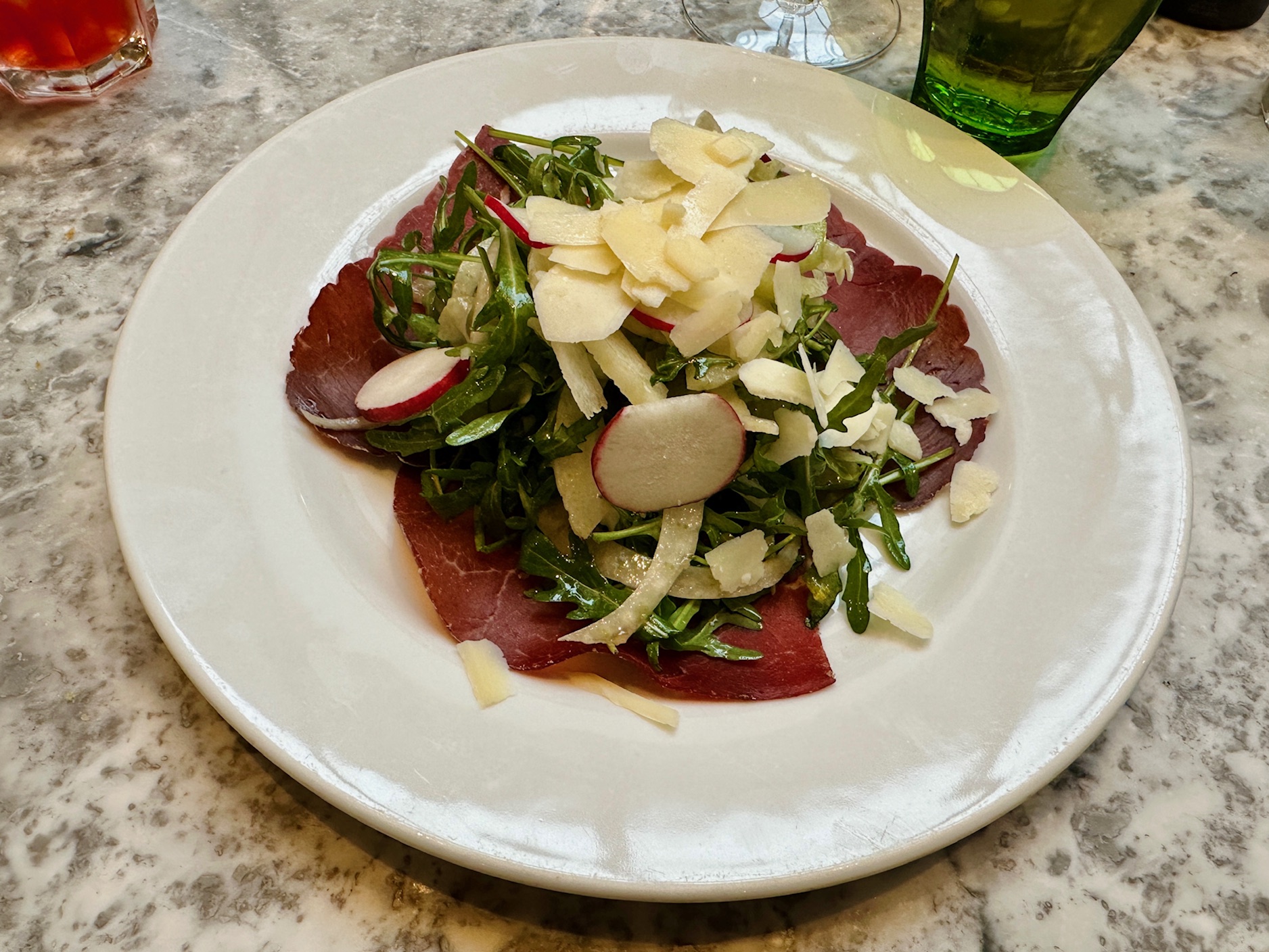
My starter left me feeling a little deceived. It was described as bresaola with a fennel, rocket and radish salad, and that description made me think it would be a cornucopia of cured beef with a little bit of greenery on top. Just how hoodwinked I had been became apparent when our server – who, I should add, was superb from start to finish – came to our table.
“Who ordered the salad?”
Neither of us, I hope I wanted to say to him, but I realised as he set the plates down that this was exactly what I had unwittingly done. And, truth be told, I felt a little conned. Three pieces of bresaola – I would say “count them”, but that didn’t take long – buried under an ambuscade of foliage is, to be honest, a salad. You can’t roll that in glitter: it is what it is. And eleven pounds for a salad and three pieces of beef felt like it could slightly mar my long and happy relationship with Branca.
And maybe it would have done but damn them, it was lovely. I always regret using the adjective “clean” to describe dishes or flavours because, like “dirty”, it’s a dimension that really shouldn’t feature in stuff you stick in your gob. So instead I would say that this was subtle, unfussy and refined, that every flavour in it was distinct, well-realised and harmonious.
Rocket seems to get a lot of stick these days but I still like it, especially compared to the twin horrors of pea shoots and watercress, two of the most pointless green things in creation. The quantity of excellent Parmesan chucked on top felt like it was by way of apology for the whole salad thing. Everything was so well-dressed and well balanced that I decided I could forgive Branca, just about. The eleven quid still felt a bit cheeky, although mainly I just wished they’d chucked some of that red pesto into the mix.
Conscious of a few recent experiences where we’d been rushed, Zoë decided to have The Conversation with our server as he came to take our empty plates. We were having a lovely time, she told him, and were really in no hurry so could they wait a while before bringing our mains? And he was brilliant with that, feeding that back to the kitchen and then coming to check with us, something like twenty-five minutes later, if we were ready for what came next.
I can’t tell you how welcome that was, that a restaurant understood how to put the brakes on. And it really helped to make me appreciate Branca all over again – the room, that light, the chatter from neighbouring tables, that feeling that there was no rush to go anywhere or do anything that comes from a proper, leisurely lunch. Saturdays with Zoë have been at a premium recently, so I felt glad this one was far from squandered.
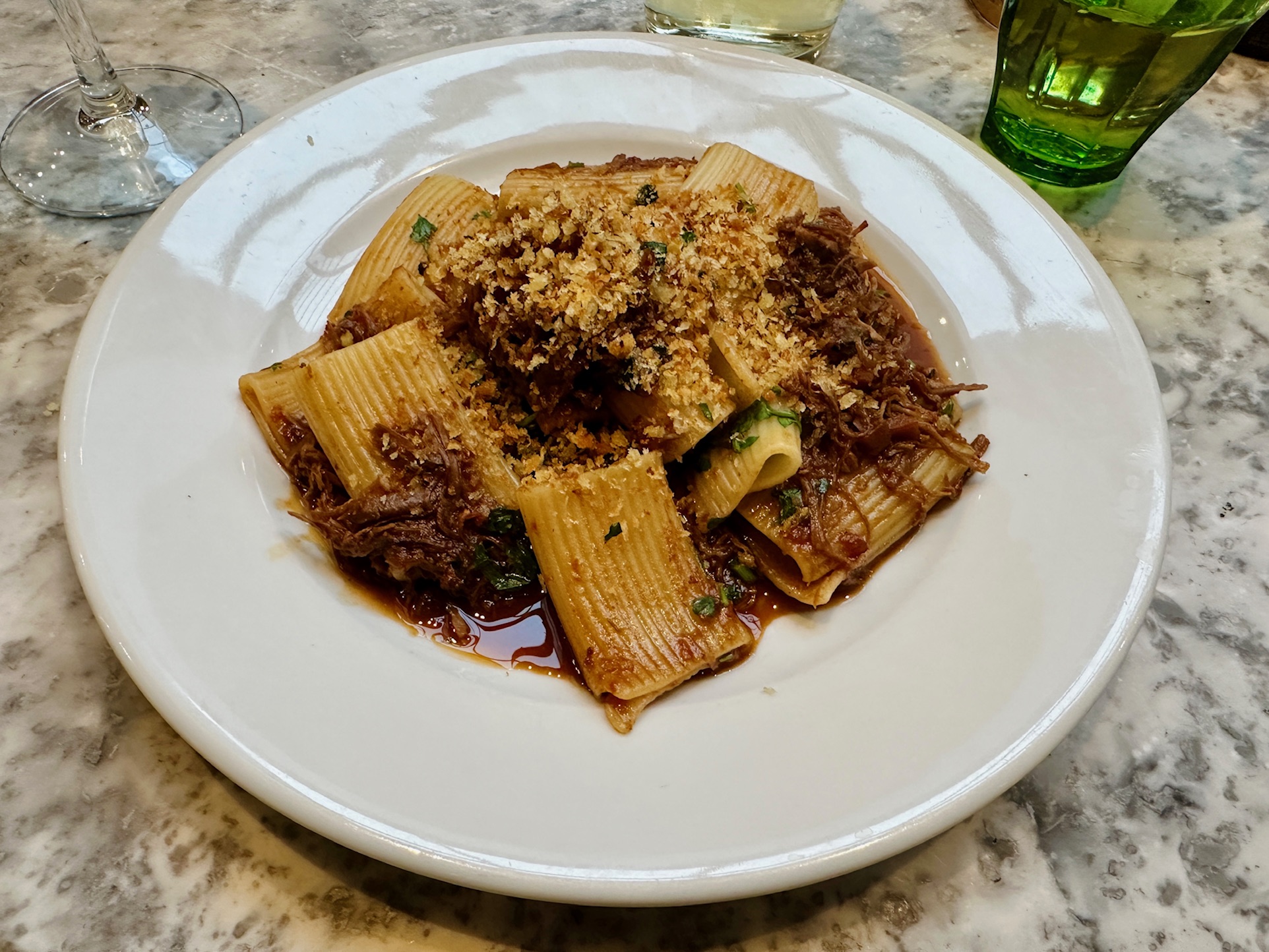
By the time my main came, I was ready for it, and it helped that it was a treat from start to finish. Rigatoni, giant corrugated tubes of comfort sagging under the weight of their own carbiness, came interlaced with sticky strand after strand of a long-cooked duck ragu. It may not have clung to the pasta, but it was hidden away under every single layer, a glorious, indulgent beast of a sauce.
That along would have made me almost delirious with joy on a winter’s day, but carpeting the whole lot with the crunch of herb and pecorino pangrattato and then leaving a bowl of grated parmesan at the table for you to use as unsparingly as your heart desired? I’d won at lunch. There was simply no question.
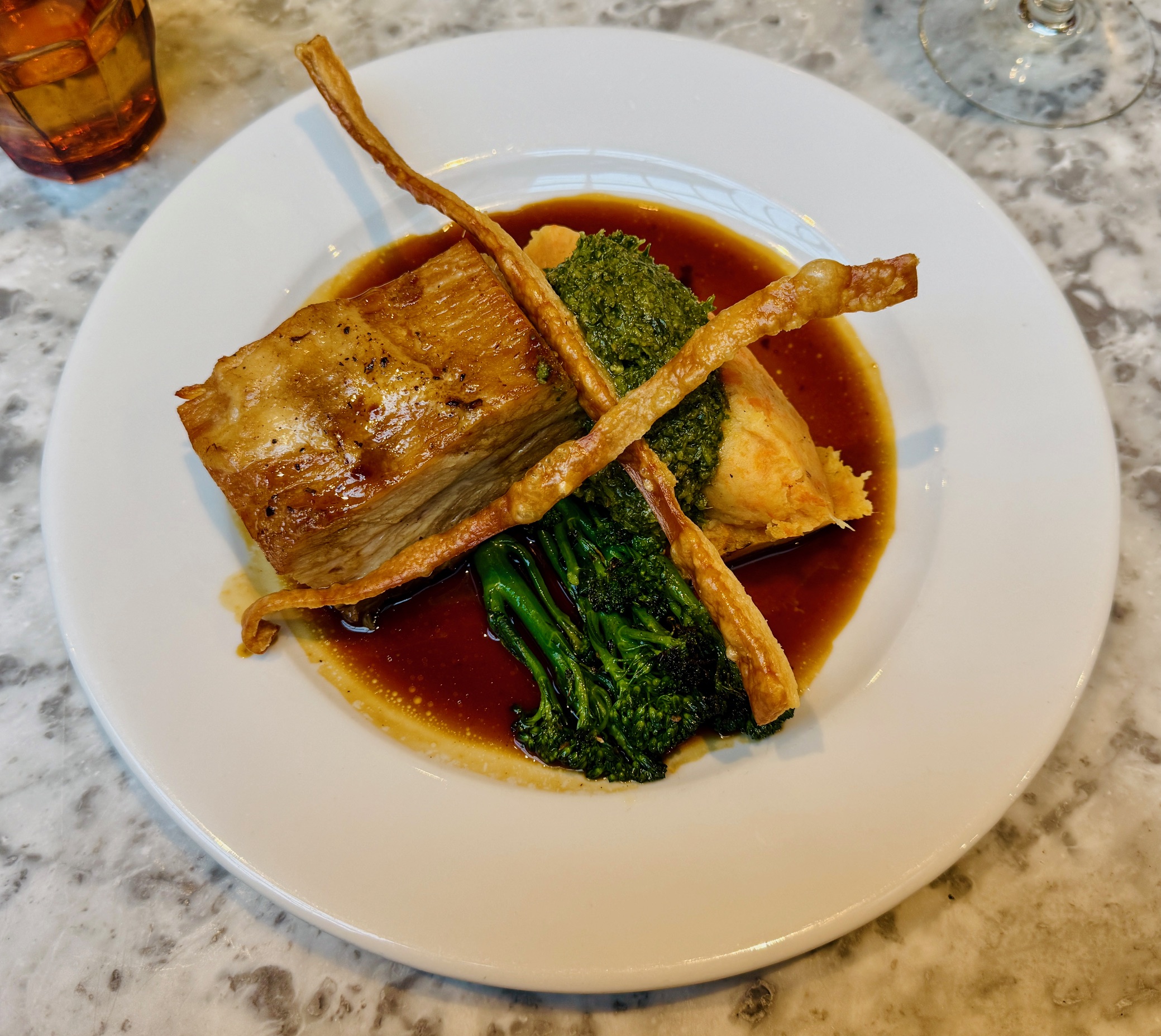
Of course, as anybody who’s married knows, you only really win at lunch if your dining companion wins too. So I was glad that Zoë, picking the other dish that jumped out from the menu, was as happy as I was. A colossal slab of pork belly, all fat rendered beautifully, would have been worth the price of admission alone. Add in a deeply savoury jus, an enormous quenelle of root vegetable mash, some firm but delicious tenderstem broccoli and a couple of crispy straws of crackling and you had a dish that could redeem the month of February single-handedly.
And the final element, the icing on the proverbial, was a salsa verde that supplied the zip and verve that stopped this all being a bit too much. Like the red pesto, a little went a long way. It also highlighted, again, that the kitchen had decided to do a few things to the very best of its ability rather than produce a bloated menu that lost its way.
“This is the first Lyndhurst-style dish I’ve had since the Lyndhurst closed” said Zoë, and I knew exactly what she meant. Very few people cooked pork belly as well as Sheldon and Dishon at the Lyndhurst, and this was the first time I’d eaten somewhere that reminded me of that. The room couldn’t have been more different, and the menu couldn’t have been much more different either, but there was that thread of brilliant hospitality that connected a restaurant I’ve loved for years and a restaurant I’ve mourned for nearly twelve months. It was nice to be reminded of it like this.
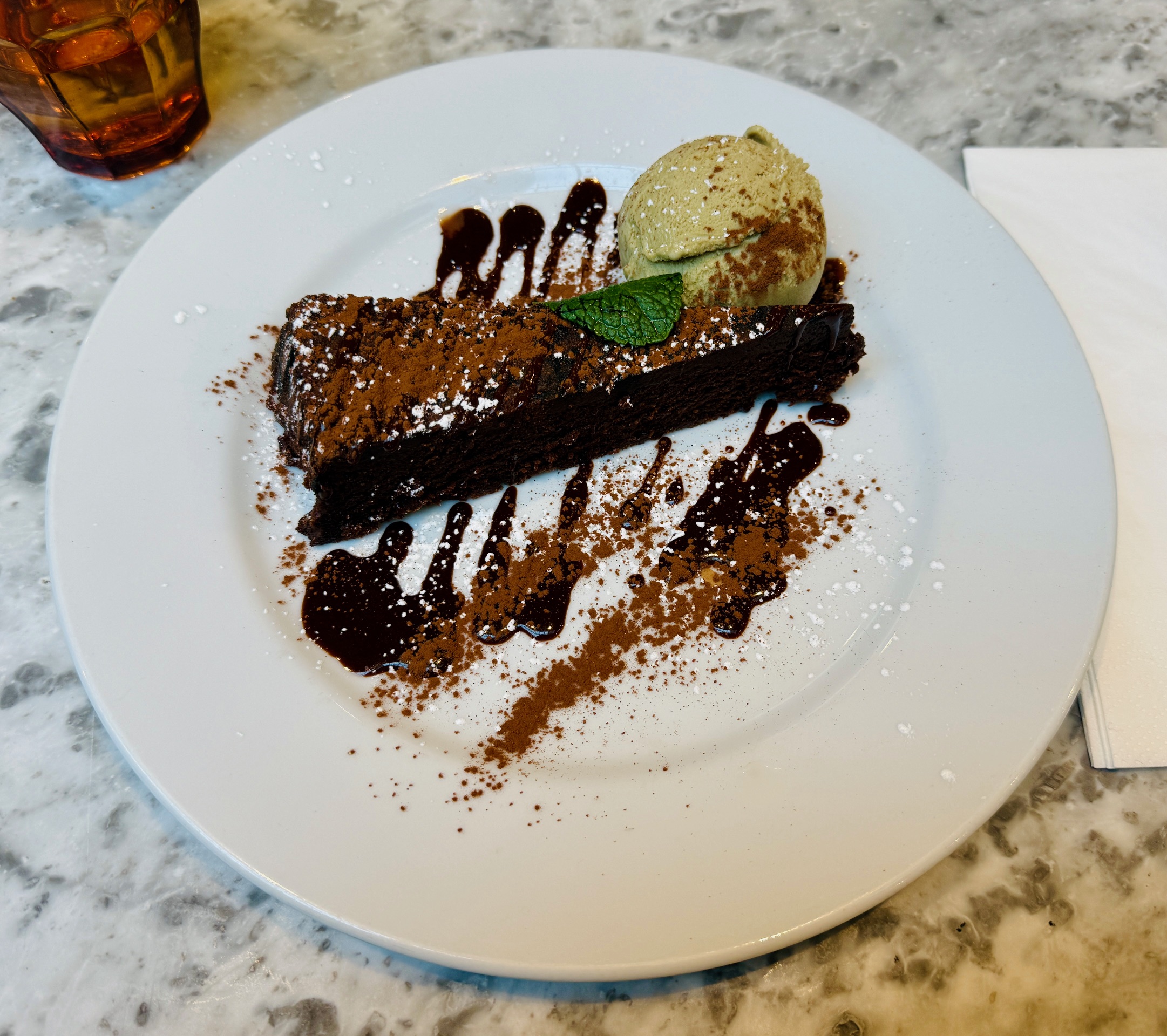
Branca’s dessert menu was also compact and really, when you stripped away the padding, it was four desserts and a range of ice cream; I’m happy to accept that a chocolate brownie classes as a dessert but things like affogato, chocolate truffles or – as was the case here – Pedro Ximenez poured over vanilla ice cream don’t really count. I found the dessert menu the least exciting bit, with most of it reminiscent of London Street Brasserie, so of course I gave Zoë carte blanche and she picked the dish I’d most likely have chosen, the chocolate nemesis.
She was very happy with it, and I daresay I would have been too. It was a tranche of deep, fudgy decadence, festooned with cocoa and squiggled with sauce, pistachio ice cream on the side. It was exactly the kind of dessert Zoë has been ordering since she first started ordering desserts many years ago, and it did not disappoint. It happens to be exactly the kind of dessert I too have been ordering, for ten years longer than her.
“It looks great” I said, which is usually my attempt to get a spoonful. “Is the texture more like a fondant, or a ganache?”
“It’s more like a brownie” said Zoë. There was to be no spoonful.
I’d asked where Branca got its ice cream from, half hoping they bought local from legendary ice cream parlour George & Davis, round the corner. They didn’t, and instead it was from Purbeck, a maker I don’t think I’ve tried.
My benchmark for these things is Jude’s – I’m still up in arms about Nirvana Spa swapping them out for the kind of stuff you get in the interval at the theatre – but I would say the ice cream at Branca came close. The chocolate was deep and smooth and studded with chocolate chips and the salted caramel was actually salted caramel with more than a hint of salt, rather than an attempt to rebadge something that’s either butterscotch or has tooth-shattering chunks of solid sugar in it. It was a fitting ending to my latest, but by no means my last, meal at Branca.
The best part of a couple of hours after we took our seats, it was time to settle up and sally forth into the streets of Jericho. Our bill for two came to just under one hundred and fifty-five pounds, including the 12.5% service charge, and paying it I thought that Branca was one of the safest bets I know of in the world of restaurants. I suppose after more than two decades it should be, but then I also remember the dwindling handful of Reading restaurants that have been here that long – places like Quattro and Sweeney and Todd – and realise that I’ve never had even a fraction of the affection for them that I do for Branca.
The rest of our afternoon, fortified by that lunch, was idyllic. We stopped at the Old Bookbinders, a ludicrously pretty backstreet boozer, for a quick half and thought that we needed to come back to try the small, perfectly formed French menu they happen to offer. We snuck into St Barnabas’ Church and gawped at the wonder of this little basilica, plonked in the middle of Jericho. We browsed paperbacks at the Last Bookshop, bought phenomenal cheeses in the Covered Market and stopped for a pre-train beer at Tap Social, wanting for nothing except a mobile signal strong enough to allow access to Untappd.
Oxford was at its finest that day, and I had that thought again: I need to come here more often. Yet the thing that really made all of that, you see, was Branca, and a reunion with an old friend of a restaurant. Lots to catch up on, but the news – getting married, moving house – was all mine. Because Branca was as it always is: classy, fetching, welcoming and utterly, utterly reliable. I’m glad I finally got round to reviewing it, and even gladder that I caught it on a day when it was very close to its best.
But if it hadn’t been, with nearly twenty years of history, I probably would have let it off. Because after all, how many restaurants can you say you’ve been going to for twenty years? I used to have more, but the ones in Reading have a habit of closing. Oxford can hold on to its institutions better, I think. But given the institutions that have been defining Oxford for nearly a thousand years, is that really a surprise?
Like I said at the beginning, I can never tell which of my reviews will do well. But I liked Branca so much that all of that feels immaterial: and that, to me, is the best reason there is to write a review.
As of January 2025, Edible Reading is partly supported by subscribers – click here if you want to read more about that, or click below to subscribe. Whether you’re a subscriber or not, thanks for reading.
This week’s review came about because of a comment on the Edible Reading Facebook page. I’d posted a link to my do list, as I regularly do, asking if there was anywhere on it that I should prioritise. Somebody chipped in and told me I should check out Shawarma Reading on West Street. “Their mixed shawarma with rice is great on a cold day”, their comment said.
That was all well and good, but the comment wasn’t from just anybody. It was from Mansoor.
Mansoor has been a reader of my blog for as long as I can remember, an early and vocal supporter of what I do. He came to the very first readers’ lunch at Namaste Kitchen, over seven years ago, bringing a blue Toblerone because I’d enthused about them on the blog. He told me that when he was first courting his wife, he used my blog for tips; despite that, it seems to have worked out nicely for him.
He was also one of my very first subscribers, when I launched that last month. “Lifetime subscription please” he said, which moved me more than I can say. And that’s despite the fact that Mansoor, his wife and his beautiful daughter have moved to Bristol now, which makes him one of my few readers who avidly looks forward to reviews from that part of the world rather than ones from the ‘Ding (don’t worry Mansoor, you’ll get some later in the year).
But that’s not why I give Mansoor’s words such weight. Back when he lived in Reading, Mansoor tipped me off about all kinds of places which went on to be favourites. He was the one who told me to check out La’De Kitchen, out in Woodley, and Rizouq on the Wokingham Road. And perhaps most life-changing of all, Mansoor told me once about a little spot doing samosas, also on the Wokingham Road, that I ought to investigate. Years later I still stop by Cake & Cream regularly for their epic samosas and pakoras, and have recommended them to countless others.
So when Mansoor says somewhere is good, I pay attention. And he first mentioned Shawarma to me at a readers’ lunch about eighteen months ago. “Give it six months, and I think it will be worth you reviewing it”, he said. Well, that six months had more than elapsed, and Mansoor’s initial “you might want to try it out” had morphed into a “go here”.
Subscribe to continue reading
Become a paid subscriber to get access to the rest of this post and other exclusive content.



 Edible Reading