Lemoni

It became apparent in early 2021 that Lemoni was not going to reopen after the third national lockdown. I’ve left the review up for posterity.

It is, I think, a universal reaction when we taste something funny, or not quite right, or even plain bad, to seek a second opinion. Whether that’s saying “do you think this milk is still good?” when it’s a day past the use by date or asking “does this taste weird to you?” in a restaurant, we all do it. We like to share delicious food, providing we have enough of it to spare, but it’s when something’s awful that we really feel the need to share the pain.

I say this because I’ve had several people in the last three months ask me if I’ve been to Lemoni, the new Greek restaurant in the Oracle, or when I’m going – and not because they say the food is stellar. One message on Twitter said “OMFG, it was awful. Service took ages every time, when they arrived the flicking of long hair over food was… ugh”. Another, on Instagram, said it was so bad that they refused a discount because they wanted to leave as quickly as possible. “I never thought I’d say this” she added, “but I really miss Jamie’s Italian”. Someone else on Twitter said “I went there last weekend and I’m interested to hear your opinion”: sometimes what isn’t said shouts as loudly as what is.

As a result, despite my best efforts to stay positive, I approached my visit to Lemoni with a gradual mounting dread. On the one hand, people definitely wanted an impartial review. But on the other, looking at their website I had a real feeling of “must I?”. Part of that came from looking at the menu online, because the dishes at Lemoni were undeniably pricey. Sixteen pounds fifty for a moussaka, or for a chicken shish kebab? They’d have to be absolutely faultless to charge that much.

Matters weren’t helped by my other half sending me a picture which had been doing the rounds at her work, taken from Tripadvisor, of the lamb kebabs. They look as if they had been formed not by hand but by the combination of a colon and a sphincter, nature’s piping bag. As if to reinforce the point, one of her colleagues had effortlessly Photoshopped a single kebab into an image of a toilet bowl: it wasn’t even slightly incongruous, bobbing there.

Tripadvisor didn’t help in general, as it seemed polarised between glowing reviews (often from Greek users with very few other TA reviews) and mutinous rumblings from everybody else about poor value, indifferent food, terrible service. Who to believe?

And then there was the wider mystery – who were Lemoni anyway? Hard to tell from social media, that’s for sure: there was a glut of very polished Instagram activity when the restaurant was about to open, but since then the silence has been deafening. Trying to get any background was challenging – the suggestion had been that this was their second restaurant but from what I could glean from Companies House the first restaurant, in Southampton, had gone into liquidation before the Reading branch opened.

How did an independent business with no real footprint come out of nowhere to take on the Oracle’s biggest restaurant site, quite possibly paying an annual rent in the high six figures? How was it going to survive in such a competitive site, even (or especially) charging those prices? There was only one way to get to the bottom of it: I was going to have to go there myself.

I felt bad about asking anybody to accompany me, but in the end my mother and my stepfather gamely agreed to come along: sometimes you really do need the unconditional commitment only family can truly provide. So, despite my stepfather’s wistful looks askance at the entrance to Royal Tandoori, we walked up to Lemoni on a warm summer’s evening to take our chances.

The welcome at the door was bright and friendly, and we walked up through the stairs and through the restaurant to take a table out on the upstairs balcony, one of Reading’s better al fresco spaces. The transformation from when the restaurant was Jamie’s Italian was marked, and very nicely done: the upstairs and downstairs are both very tasteful, airy spaces with plenty of natural light, grown-up looking marble-topped tables and grey tweedy banquettes. I didn’t eat inside, but I liked the look of it – I did wonder though just how much sound would be absorbed on a busy Friday or Saturday night and whether the restaurant would feel quite as welcoming on a darker winter’s evening.

The first big surprise came when the menus arrived, because the prices have been reduced significantly since April (although Lemoni has neglected to change its website to reflect this). Mains in particular had come down by between three and five pounds per dish – badly needed, because many of the dishes skirted around the twenty pound mark which felt very expensive for this kind of food. This means that Lemoni must be the first restaurant I’ve encountered to do a soft opening in reverse: still, at least it showed they were learning from their mistakes.

We ordered a few drinks, namely a Mythos for my stepfather, a Menebrea – the Italian beer which is becoming Peroni for people who think they’re too good for Peroni – for my mother and some sparkling mineral water (don’t judge) for me. Nearly all the waiting staff, all dressed all in black, seemed to be Greek and they certainly looked efficient, darting from table to table; maybe they’d also learned from some of that early criticism.

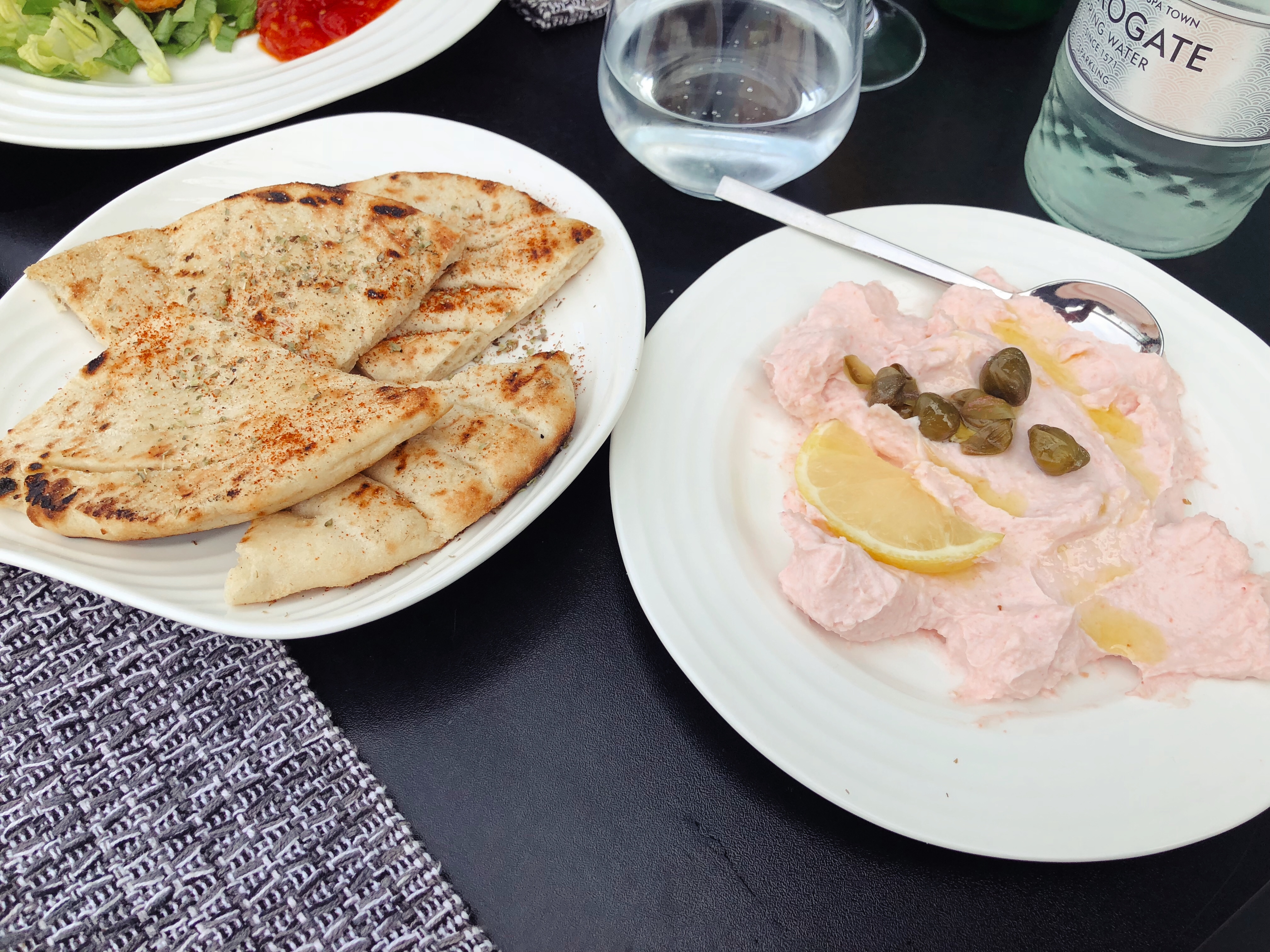
We decided to share some of the starters to begin with – these all vary between about five and eight pounds, although they charge extra for pitta which felt cheeky to me. How else did they expect you to eat houmous or taramasalata, exactly? The taramasalata, incidentally, was one of the best starters we had – brighter pink than I’m led to believe it should be but punchy all the same. I especially liked the addition of some salted capers on top, but I suspect they were more popular with me than with my mother. “It doesn’t taste that fishy” was her feedback – my stepfather and I disagreed, but she had taken against the dish and that was that.
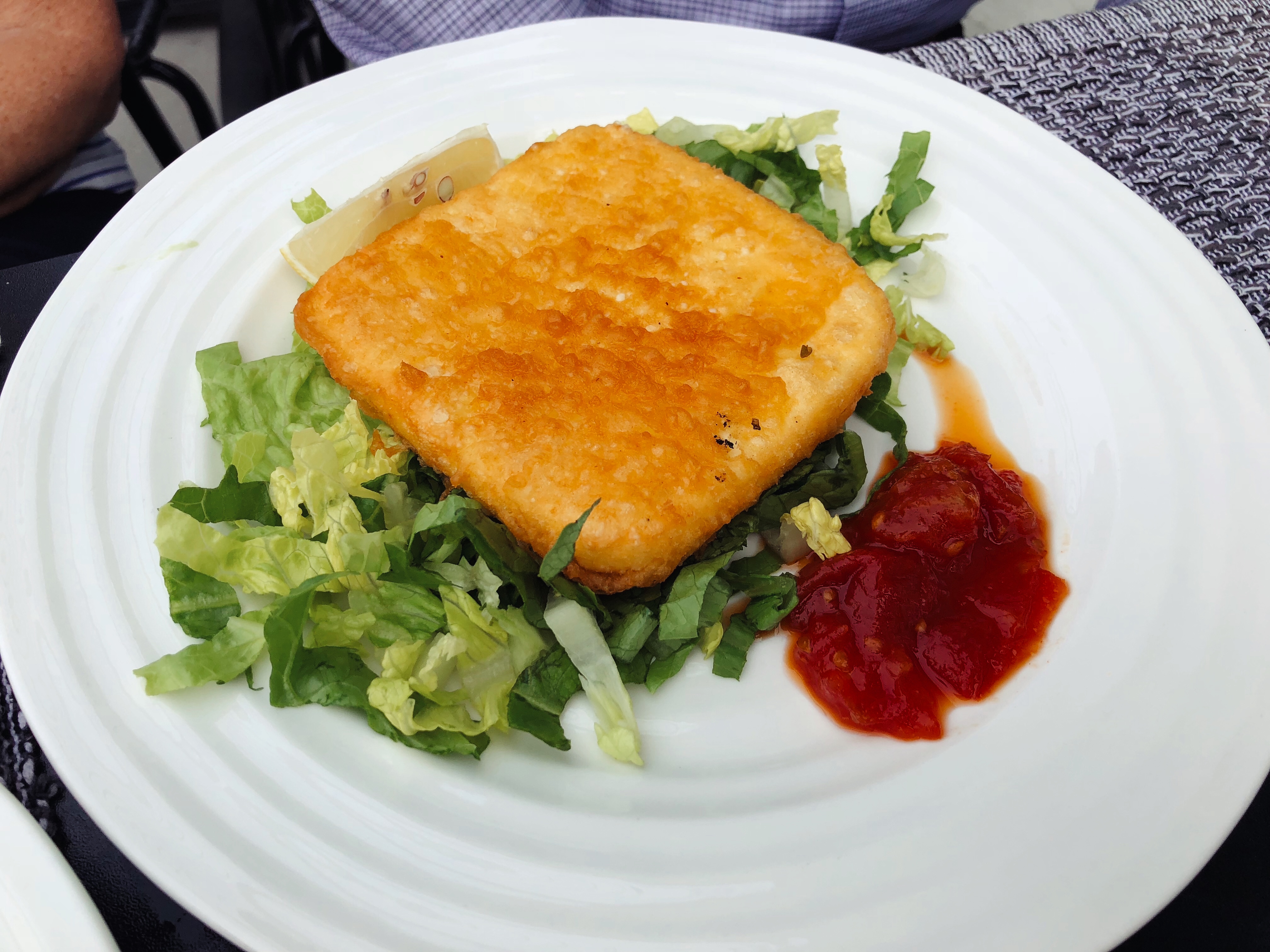
The spanakopita was a hit with all of us – light filo pastry with just enough crunch housing a beautifully molten mixture of feta, spinach and mint. The other two starters, though, were the relative duds. Saganaki is one of my favourite Greek starters and done well it’s a glorious, indulgent thing. The menu chose not to specify which cheese it was (which perhaps should have been a warning bell) but it’s usually feta and this didn’t feel like feta at all. Whatever it was, it was a lukewarm block of cheese with a leathery texture which had no give whatsoever. The “homemade tomato jam” might just have been able to paper over the cracks of this dish, but there was nowhere near enough of it.
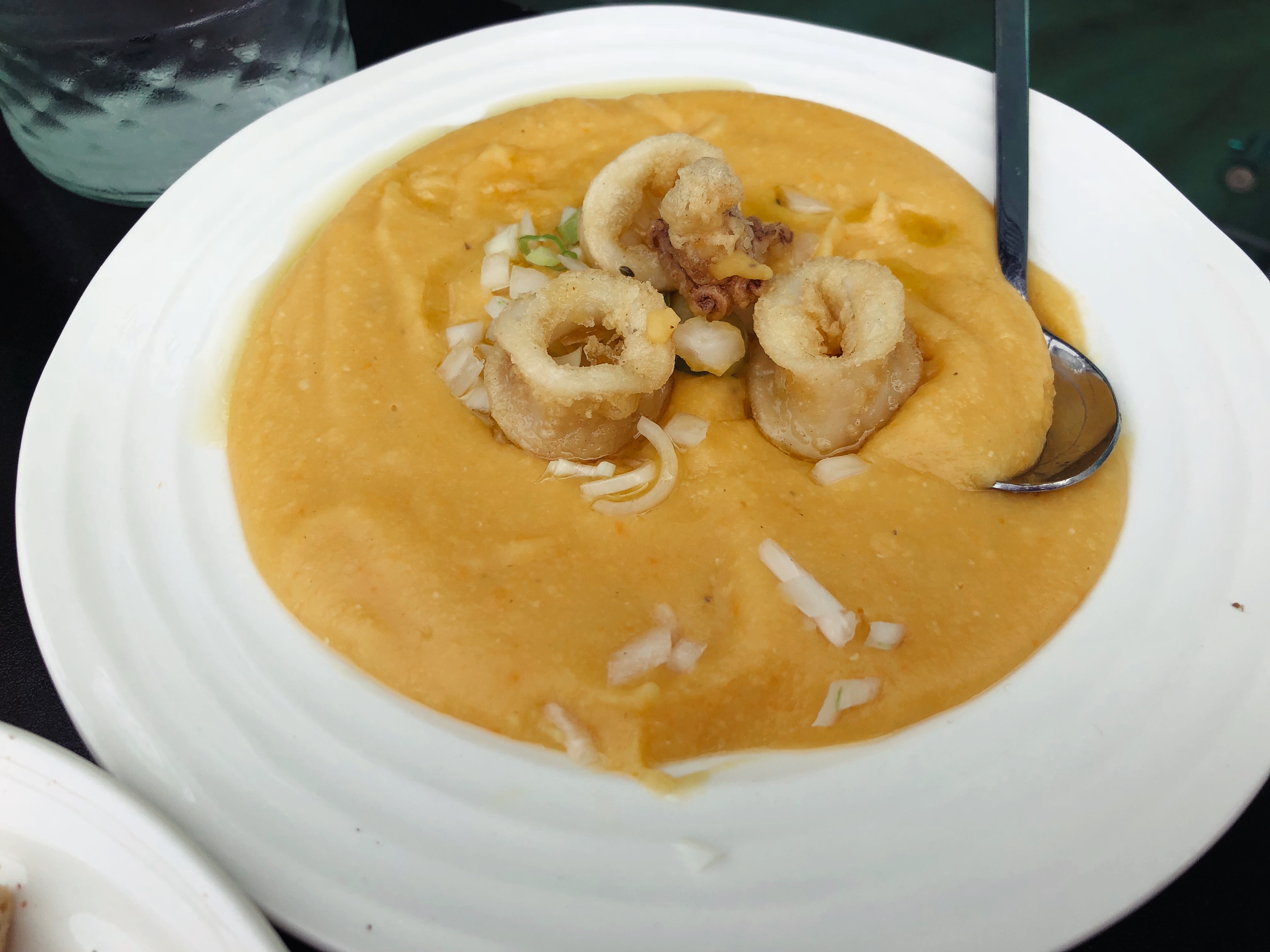
The last starter arrived after the other three, and before the side plates we’d had to ask for twice. Mashed fava beans topped with calamari were a pleasing shade of yellow and had a earthy, if subtle, taste. But I couldn’t help wishing it was hot rather than lukewarm and it also needed some pita to do it justice. Our first helping of pita – tasty, topped with something like cayenne pepper or paprika along with dried oregano but far too little of it – had already vanished by then and it took multiple attempts to flag someone down to ask for more. By the time it arrived we still just about needed it, but the moment had passed.

“That dish is bland” said my mother, pointing accusingly at the fava beans.

“It’s okay – it could do with a bit more seasoning” I said.

“Well, it’s not unpleasant” she added, the implication clearly being that not unpleasant was not good enough. I could see what she meant, but I was more disappointed that paying two pounds extra got your fava bean purée topped with precisely four tiny bits of squid. Maybe I’ve inherited her critical faculties.
Having struggled to get our side plates and struggled to get extra pita bread, we then found we were left alone with our leftovers in front of us for some time. This gave my mother enough time to do some detective work.

“Our placemats are by John Lewis” she said. “They have the tag on them.”

I inspected them. This was indeed the case.

“And the labels are still on the underside of our side plates.”

I wasn’t sure how my mother had clocked this – nothing gets past her – but lifting up my snazzy rippled white plate it was true. Sophie Conran for Portmeiron, no less, and that stuff isn’t cheap; these aren’t plates you’d want to smash at a wedding.

“It’s weird, isn’t it? It’s like they’ve picked this stuff up at a department store because money’s no object.” And again, I found myself wondering where the money came from to open this massive restaurant out of nowhere and kit it out with a lovely new refit, John Lewis placemats and Sophie Conran crockery. At this point my stepfather outlined his theory on the matter: sadly, I’ve had to omit it from the review but I’m sure you could come up with your own ideas.

I was jogged out of this reverie by the fact that as our plates were taken away the main courses were plonked in front of us, supervised by an older man who looked as if he might be the owner. The overall effect was a little menacing, especially as my stepfather had ordered the “chicken skewer” which comes to the table on a long and potentially dangerous skewer fresh from the grill. The skewer was served on a bed of undressed, pointless rocket with some soft-looking roasted potatoes, a cold couscous salad and some kind of dip. I tried some of the chicken and it wasn’t unpleasant but there was no real sign that it had been marinated. At fourteen pounds it was still more expensive than the same dish at Bakery House, with nowhere near the same whistles and bells.

“That dip is salad cream” said my mother, looking none too impressed.

“I think it’s more like burger sauce” I said. “The menu says it’s ‘Lemoni mayonnaise sauce’, apparently.”

“Well it tastes like salad cream to me.”

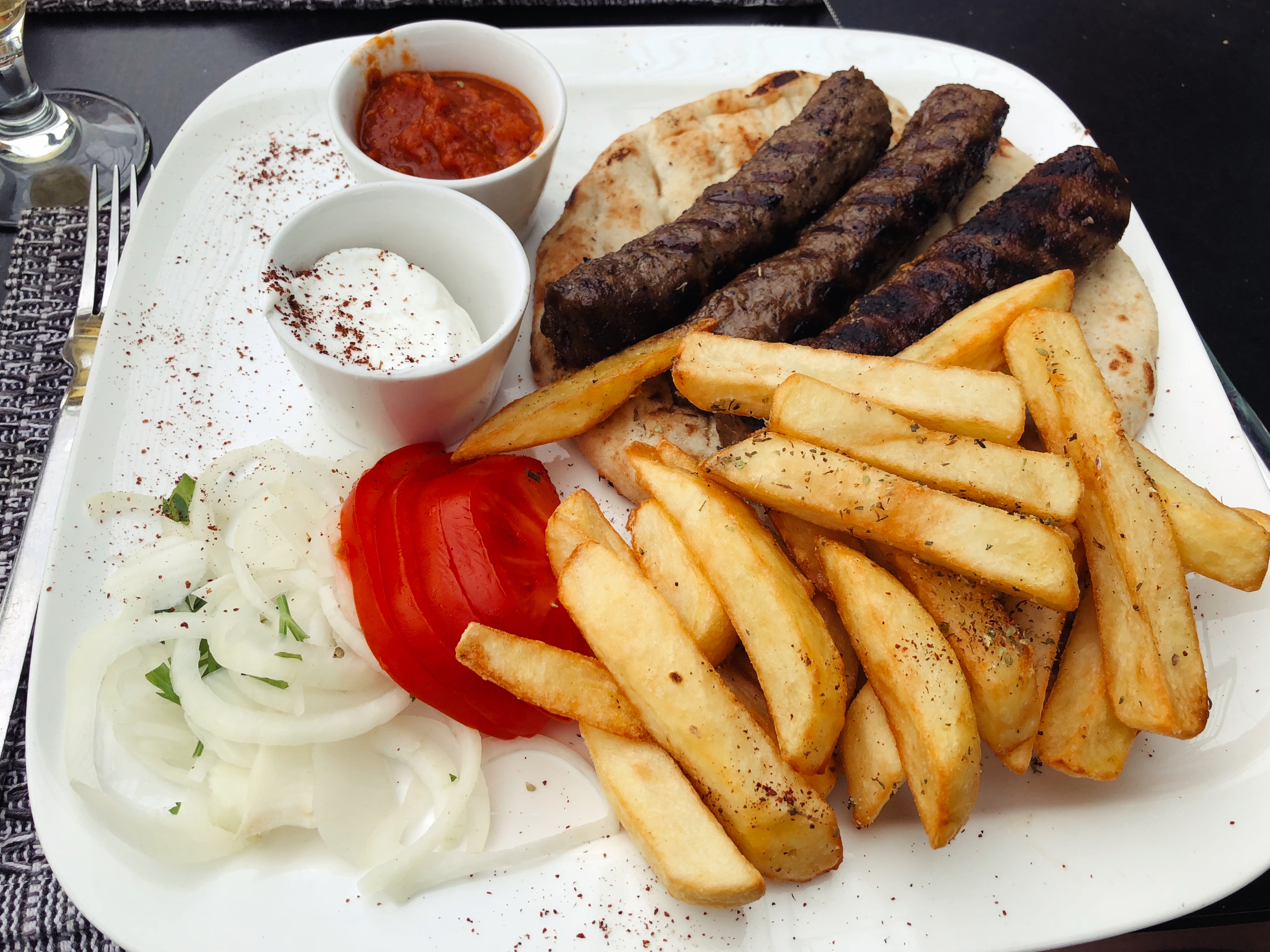
“It’s not going to be a glass half full evening, is it?” said my stepfather philosophically as he attacked the rest of his main, undeterred by any resemblance to Heinz’s finest. I had ordered the classic kebab, and I was delighted to discover that they no longer looked like the Photoshopped horror I’d been sent via Whatsapp. If anything, these were uncannily regular cylinders of meat – a mixture of beef and lamb, apparently – and I wasn’t sure whether I enjoyed them or if I was just relieved that they weren’t worse. They were nicely seasoned and although they were a little on the smooth and homogeneous side for my liking they weren’t unpleasant. They came with a yoghurt thicker and more pointless than Dominic Raab, and a tomato sauce which lacked any spice or heat at all. Nice chips, to be fair, but apart from that this was another dish that Bakery House does miles better for less.
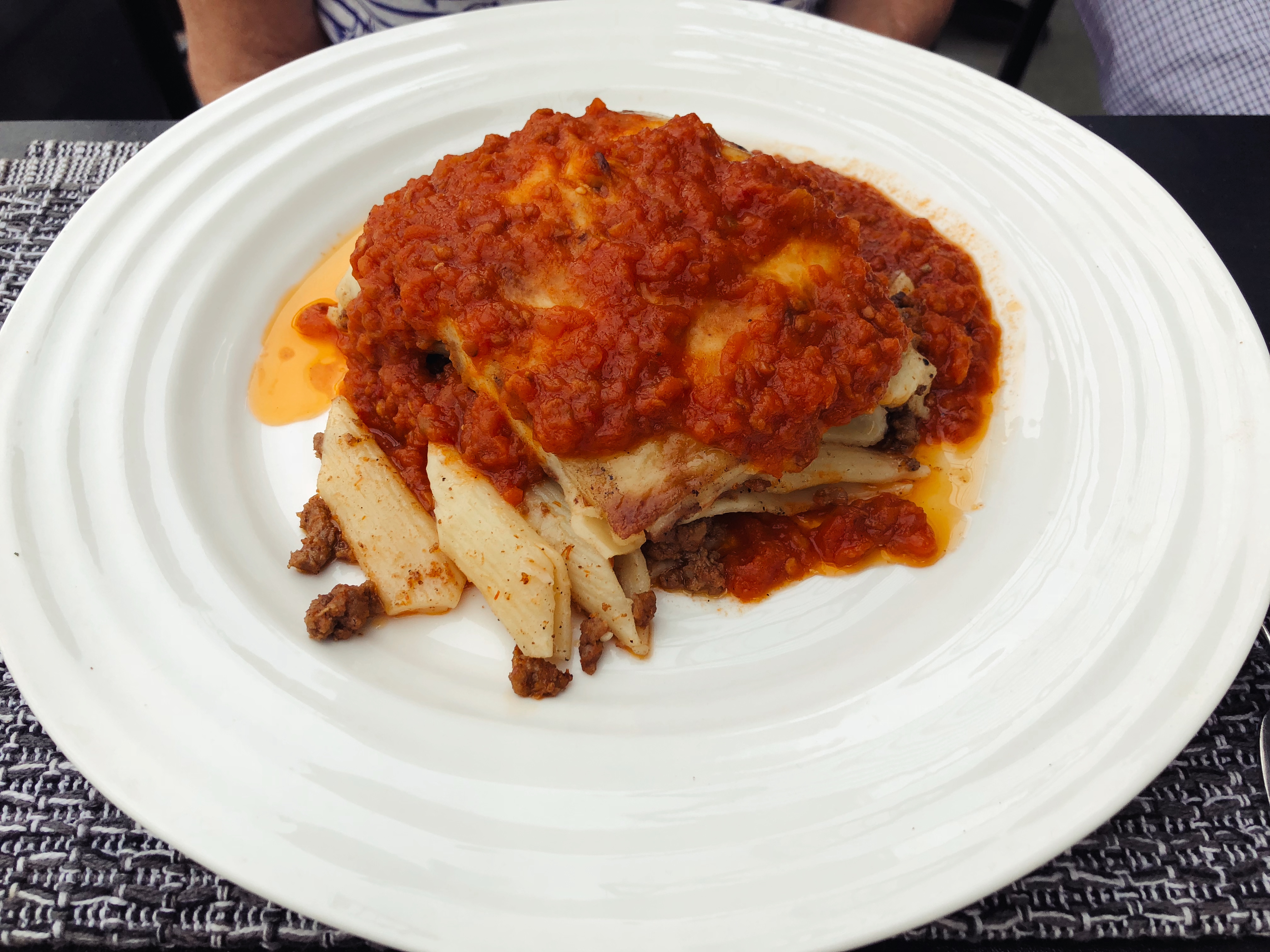
Even if the glass had been half full up to that point, it pretty much emptied when my mum started eating her pastichio, a sort of Greek lasagne which serves as an alternative to moussaka.

“This is sweet. It’s as sweet as a dessert. And there’s nowhere near enough mince. It’s just a sweet tomato sauce and some pasta. And the cheese! Well, it doesn’t taste cheesy.”

I tried some. You couldn’t knock her brevity: it would take me a whole paragraph to say a lot less.

“I think it tastes sweet because there’s definitely cinnamon in that tomato sauce.” I said, trying to put a brave face on it. Who was I trying to kid? The dish was a duffer.
It didn’t help that the accompanying Greek salad also didn’t pass muster. “It’s a nice olive” my mother said, “but it needs company.” A pity, because the feta was lovely and, again, I thought adding capers was a nice touch. But it’s difficult to argue with somebody saying that a Greek salad needs to contain more than one solitary olive.

We stayed for dessert, because I desperately wanted to give Lemoni one more chance. The big thing here is loukoumades, Greek doughnuts, so I ordered them with Greek honey and crushed walnuts. They were nicely irregularly-shaped, so obviously made by hand, but that’s as far as the plusses went. They were heavy, stodgy things, the shell not crisp and the inside a million miles from a fluffy cloud of joy. The honey was in a lake at the bottom rather than drizzled over the doughnuts, and the whole thing was heavy going. We didn’t finish them.

“Doughnuts ought to be a delight” said my mother, who by this point was turning into a one-woman Greek chorus of disapproval. “You should want to race through them.”

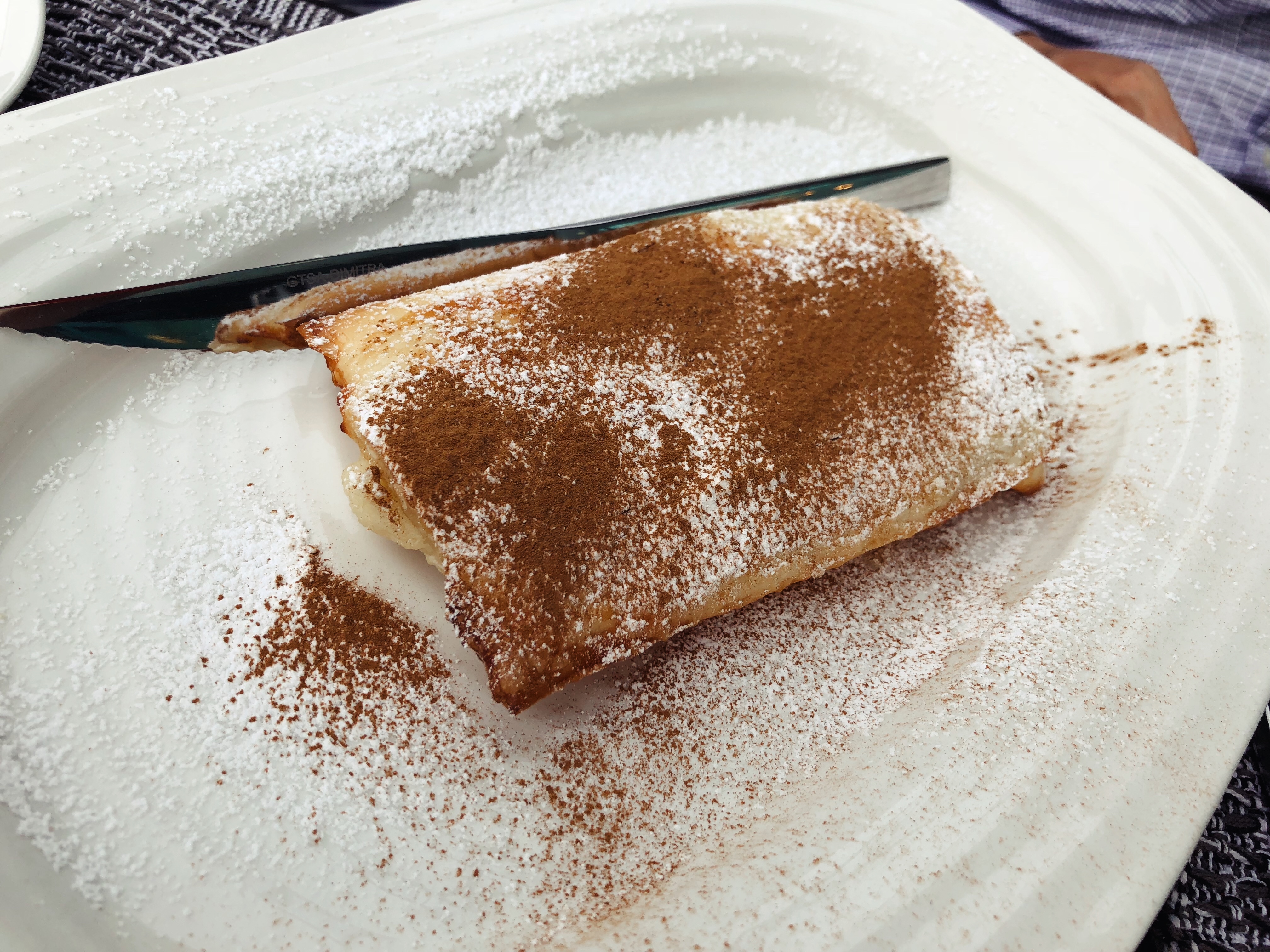
My stepfather’s bougatsa, custard in filo pastry, was better but still not right. I liked the custard very much, but this pastry didn’t have the same lightness of touch as our starters had had. Sawing through it with a knife felt like a slog. “It’s a bit tough” said – well, I’m sure you can guess who said that.
It won’t surprise you to hear that we also had to ask for the bill twice. Lemoni was busier than I expected on a Wednesday evening – the sun was still shining, the big screen on the Riverside was showing Wimbledon, people were sitting in the deckchairs on the opposite bank watching it and the beach bar was full of the kind of people who like the beach bar. It was a glorious evening, and if our meal had been better maybe we’d have been happy to sit there and digest and chat away with all the time in the world. All the best Greek food I’ve had – usually on holiday, but also in restaurants like Maida Vale’s scruffy Tsiakkos & Charcoal, or Notting Hill’s upmarket Mazi – is best eaten in a leisurely fashion, while you daydream of being somewhere in the Cyclades. But in this case, we just wanted to settle up and sod off.

Eventually, we flagged someone down and our bill – four starters, three mains, two desserts, two beers and some mineral water – came to ninety pounds, not including tip. Not hugely expensive, in the scheme of things, but when you consider that we barely drank it’s still a fair amount to spend on something so middling.

“You could come here and have quite a good meal” said my stepfather, “if you happen to order just the right things. Or if you ordered badly it would be terrible.” I nodded in agreement: I’d seen huge plates of what looked like home-made crisps turn up at other tables and I was thinking that if I’d just ordered those and some houmous I probably would have had a better, cheaper time.

So, there you have it: Lemoni isn’t the horror show I half expected, which just goes to show that anybody who reviews a new restaurant in the first month is making an error of judgment. But, even after three months of working on the pricing, the menu and the service it’s still deeply unspecial. Not better than Bakery House, not better than The Real Greek, not better than Kyrenia in its heyday. I don’t say that with any joy or any axe to grind – it would be a wonderful thing for the prime pitch in the heart of the Oracle to be occupied by a brilliant, distinctive, smartly-priced and well-run independent restaurant. But Lemoni is not that restaurant.

My closing thought about Lemoni was the saddest of all, because what my visit really did was make me think about Dolce Vita. Dolce Vita paid less rent than Lemoni, it charged more than Lemoni, it was busier than Lemoni, it did better food, it had better service and it closed for good last year. If Dolce Vita couldn’t make a go of it with so much in its favour, who would bet on Lemoni seeing out the year? More to the point: just imagine how wonderful Reading would be if a restaurant like Dolce Vita had occupied a spot like the one Lemoni has. How I wish we lived in a town like that.

Lemoni – 6.2
Unit 1, The Riverside, The Oracle, RG1 2AG
0118 9585247

https://reading.lemoniuk.com/

Kungfu Kitchen

As of June 2024, Kungfu Kitchen has moved to a new site on 62 Christchurch Green, a minute’s walk away from its old site.

I love lists, to an extent which probably verges on unhealthy. At any given time I have several on my phone: things to do; shopping to get; household chores to finish; people to see. I enjoy the feeling you get – and if you’re wired like me, you’ll understand what I’m talking about – when you add something to a list for the sole reason of immediately ticking it off. Really, I ought to have a list of all my lists where I rank them in order of preference, but even I know that might be taking things too far.

Anybody with a to do list will also know that there’s always at least one thing on any to do list that you keep shunting to the bottom. You look at it, you’d like to be the kind of person who tackles it right away, but in the end you know you’re really the sort to leave it to another day. Some days, every item on your to do list looks like that: those are the days when personally, I’d rather just stay in bed.

Kungfu Kitchen, the Chinese restaurant on Christchurch Green, has been on my reviewing to do list all year without ever getting to the top. There’s a website, which is stunningly uninformative, and a Facebook page which has a couple of decent-looking photos but nothing more. They’re on Twitter, but they haven’t Tweeted this year. (N.B. Following this review Kungfu Kitchen has updated its website with a full menu – the link is at the end of this review – and has become much more active on Twitter.) The menu looked on the authentic side, as far as I could tell, but the Tripadvisor reviews were mixed to put it lightly. So my regular accomplice Zoë and I walked up the hill towards the university area with a certain degree of trepidation, not at all sure what to expect.

Subscribe to continue reading

Become a paid subscriber to get access to the rest of this post and other exclusive content.

Revolución de Cuba

Revolución de Cuba closed in January 2026. I’ve left the review up for posterity.

Let’s get this out of the way straight away: it’s not a typo, you don’t need to adjust your set and you definitely don’t have to pay Specsavers a visit. This really is a review of Revolución de Cuba, Reading’s Latin American bar slash (chain) restaurant.

You might wonder what possessed me. Here’s what – I’ve been complaining for some time about Reading lacking a good tapas restaurant, a feeling which was compounded by a holiday in Granada at the start of the month. I returned even more bereft that I couldn’t find somewhere good to eat jamon, manchego, croquetas or chorizo in cider (let’s not dwell on the fact that in Granada you get something free with every beer: one step at a time).

On my first day back in Reading I sat in the courtyard outside Workhouse Coffee and ate paneer from Bhel Puri House while enjoying a crisp Estrella from the hotel bar next door, and it made a decent substitute but I still found myself wishing Reading had somewhere more suitable. That’s when the idea of trying the tapas menu at Revolución de Cuba entered my head.

After all, it might have been a chain but it was hardly a big one: less than twenty branches across the UK. And although it was part of the same group as Revolution, I’d been pleasantly surprised when I went to Revolution on duty back in 2015 (that said, I’d never been back, probably assuming that lightning never strikes twice in the same place). So on a Monday night I mooched over to Friar Street with my regular dining companion Zoë, wondering if my expectations would be surpassed.

My first impression was that it’s a striking – and gigantic – space. It used to be the old HMV building (I have plenty of happy memories of those days) and Revolución de Cuba waited a long time to open here, initially applying to take over the site in late 2014 and wrangling with the council before eventually opening two years later. The fit out had been nicely done – the long bar down the left looked especially inviting – and the room went back a very long way indeed, gradually getting darker and more conspiratorial.

Actually, that was probably my second impression. My first impression was that I wasn’t sure if I was in a bar or a restaurant, whether I could just plonk myself at a table or wait to be seated and whether it was bar or table service. We stood waiting near the front like lemons for some time before a solitary waitress told us to sit anywhere, before going on to explain that the two areas nearest to the front were probably more suitable for dining.

That might have been a more useful distinction at weekends when the place was busier, but when I went the place was pretty dead; there was a couple sitting at the tables nearest to the window, but the only thing they seemed to be eating was each other (in broad daylight on a Monday evening: I didn’t know whether to be appalled or impressed). Gladly they put their coats on and left seconds later – headed for the nearest Travelodge, I imagine – so we took the table next to where they’d been sitting. Was it my imagination, or did the banquette reek of sex?

The menu looked nice enough, although I don’t think it was the thing that had got them so frisky. It was divided into tapas and main plates, and was a mixture of Spanish, Tex-Mex and general 2019 box-ticking (halloumi, pulled jackfruit and so on). The tapas tended to come in around the six pound mark with three for fourteen pounds, so we decided to go for that, along with a couple of sides. While we waited for our food to turn up I had a pint of Angry Orchard which was just what I needed and not too dry (albeit oddly named: why so cross? Had it been reading the BBC website?) and Zoë had a bottle of Pacifico Clara, a serviceable crisp lager not that distinguishable from Modelo.

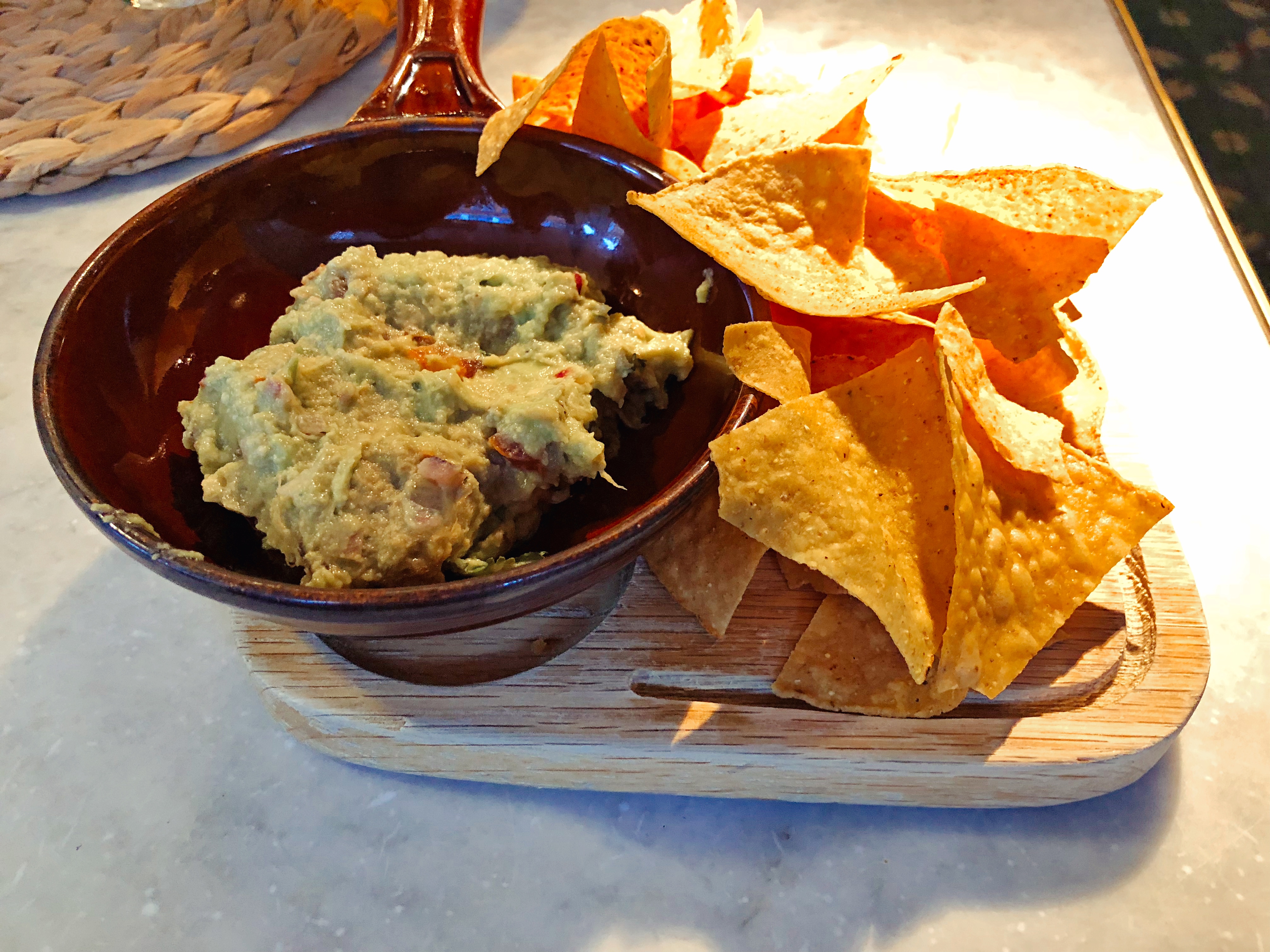
We’d asked for some guacamole and tortilla chips while we made up our mind, so this was the first thing to come out. A sign on the wall said it was freshly made, and although I wasn’t entirely sure it had been made to order it was decent, with just a little heat lurking in there. The previous week I’d been to Wahaca on the South Bank and their guacamole was better (as I had expected it to be) but not by a country mile. The tortilla chips were a little wan and not quite up to the job of dipping but again, for three pounds I was hardly devastated.

The tricky bit is what happened next: all the rest of our food was brought out at once. This wasn’t a problem in itself: god knows I’ve been known to bitch about the likes of Wagamama bringing out dishes as and when they’re ready, but for tapas this style of serving seems much more appropriate. But the real problem was that although the dishes were all brought out at the same time, some of them had clearly been sitting around a while. So much of what should have been piping hot was verging on tepid, and in many cases that made a world of difference.

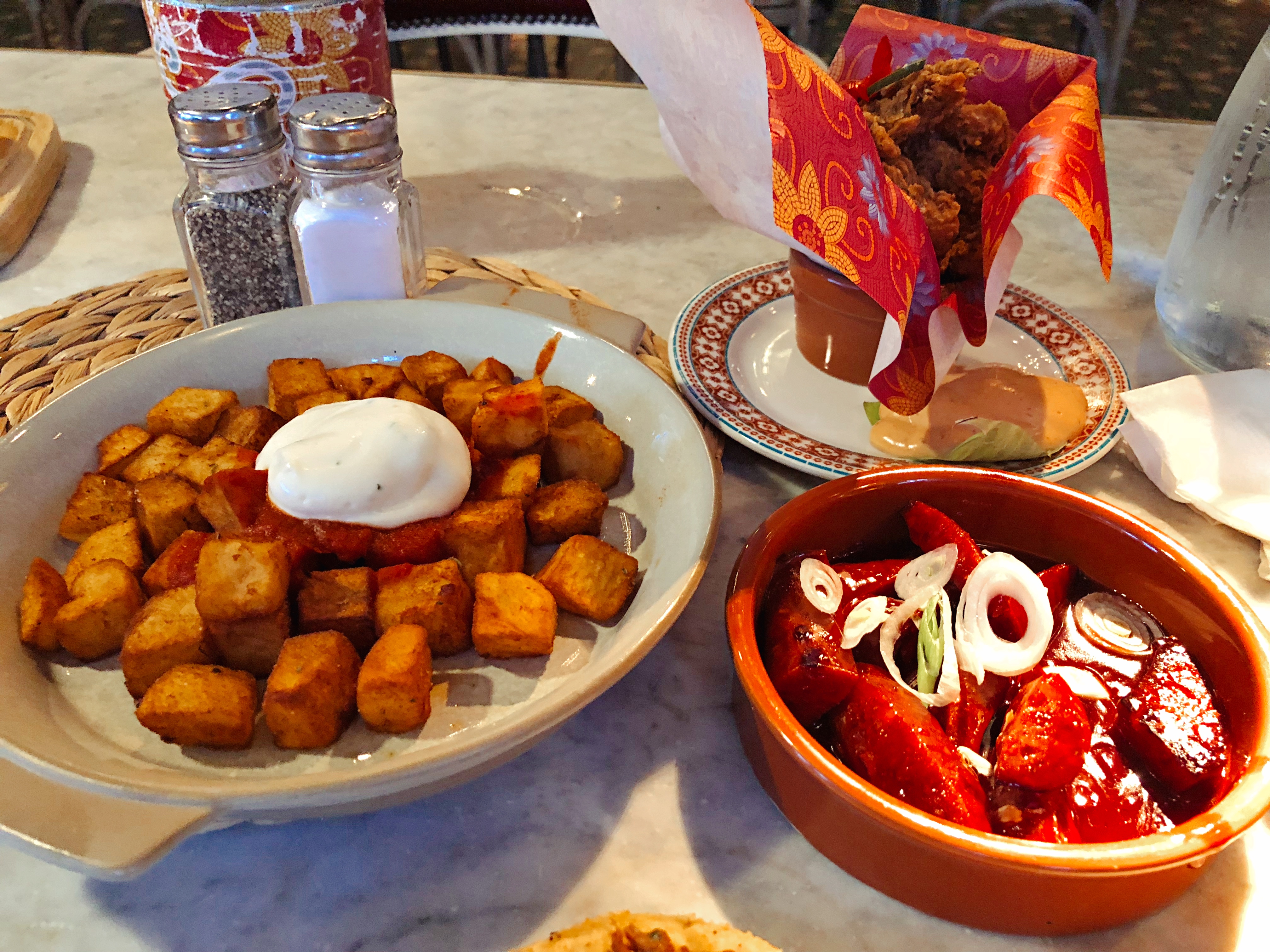
Take the chorizo in red wine and honey, for instance. Done well, this is a superb dish – I had something very similar in Granada – but Revolución de Cuba’s version was cold. Not fridge-cold, but cooked-some-time-ago-cold. It came in a terra cotta pot without any steam or sizzle, and the pot was cold to the touch. So, pretty much, was the chorizo which made me wonder if it had spent any time in the sauce or just been introduced to it right at the end like some kind of super-awkward culinary blind date. It had been cut into weirdly-shaped segments by somebody who appeared never to have seen or eaten chorizo before.

The patatas bravas – a staple of any tapas menu – were also distinctly underwhelming. They had been placed on the mat in the middle of the table as if they’d be scorching hot, but again they weren’t. There just wasn’t the crispiness I was hoping for, and the helping of spicy sauce and aioli was both disappointing and miserly: there should have been more of it, but I wasn’t especially sad that there wasn’t.

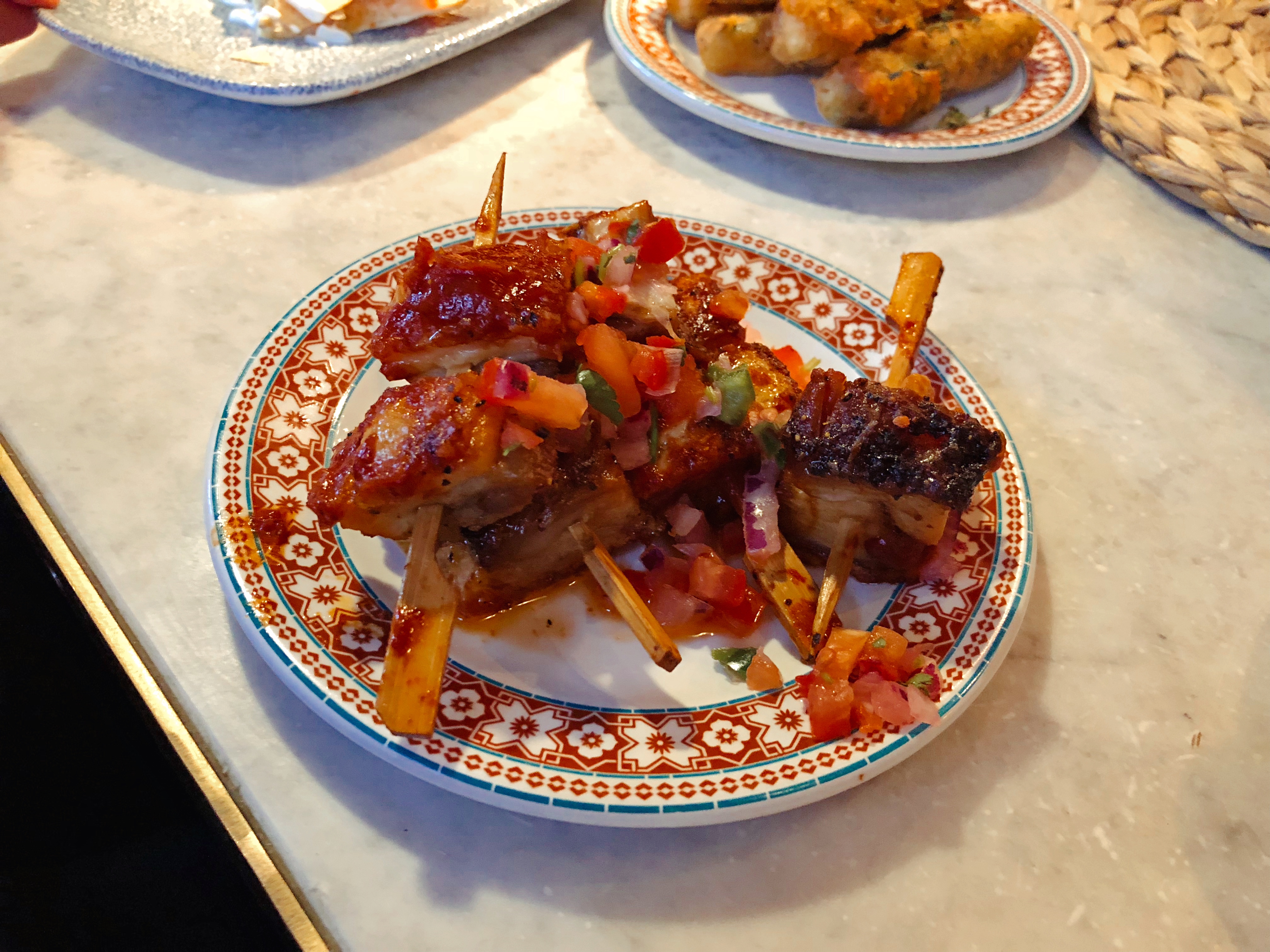
Better were the pork belly skewers, which were well cooked, all fat melted away and a crispy-crackling layer on top. I’m not sure I got the “signature spicy rum sauce” which had apparently been used, but I wasn’t complaining. These reminded me of the pork belly at The Real Greek, which is higher praise than it might sound.

I also enjoyed the jerk fried chicken, although that says more about my love of fried chicken than of Revolución de Cuba’s version. It was nicely seasoned, if a little too crunchy, and it didn’t need the rum mayo I didn’t dip it in. But even here it could have stood with being hotter, and although the texture was a long way from mechanically recovered meat, they didn’t feel like single pieces of coated chicken. Make of that what you will.

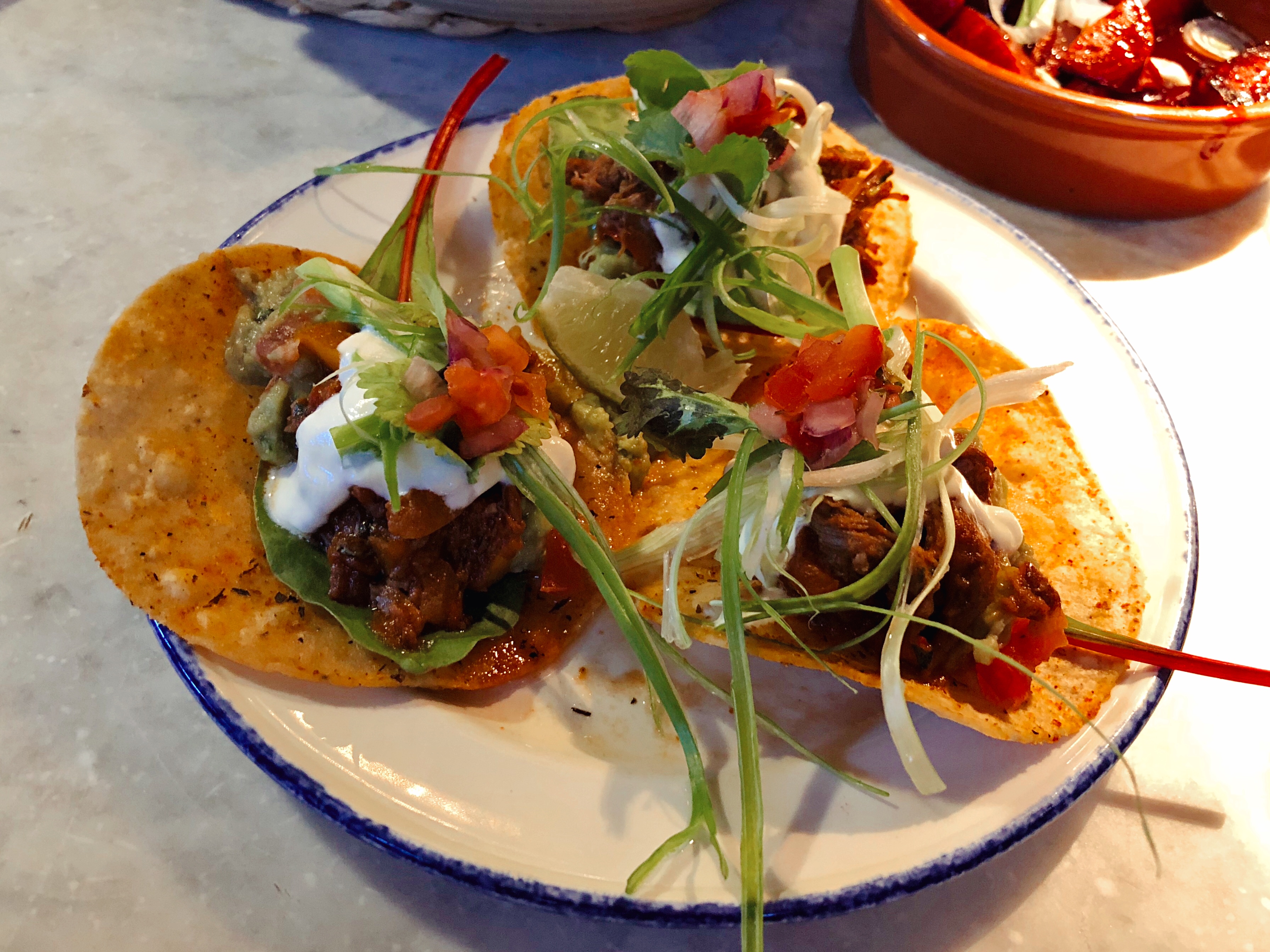
The more Latin American dishes we’d ordered were the ones that really fell flat. Chicken quesadillas might have been average if they’d been served hot but they arrived much closer to room temperature, wan anaemic things it was difficult to get excited about. We’d also ordered pulled beef tostadas, but the beef itself was claggy, bland and lukewarm. You didn’t get much of it before the dish gave way to the (cheaper) guacamole underneath and the tortilla shell, which pretty much made it the dish we’d started the meal with. The Cuban term for this beef is ropa vieja, which it turns out doesn’t translate as old rope: a shame, as it would have been apt.

Finally, we also had some crispy fried courgette. Well, two out of three anyway: it was indeed courgette but cut thick enough that getting it crispy was always going to be a challenge. I didn’t mind this, but even as I ate it I was aware of how many places do it better (especially Papa Gee). It was apparently served with Cuban gremolata, although barely enough to be noticeable, and if it had been fried in “Mojito batter” you really wouldn’t have known that either.

“This is a menu that reads much better than the food looks or tastes, isn’t it?” I said to Zoë as we surveyed the plates (mostly empty, although neither of us had shown much interest in the insipid chorizo).

“I’m afraid so. I’d come back for the guacamole, the chicken and the pork belly but that’s it.” I thought about it and tended to agree: three out of eight wasn’t exactly a stellar hit rate. I reflected on the other reviews I’d seen of Revolución de Cuba, so breathless, so enthusiastic, so positive. So comped, come to think of it. We decided to skip the churros (no doubt described somewhere on the internet as “yummy”) and asked for the bill. The whole lot – six tapas dishes, two sides, a pint and two beers – came to just under fifty pounds, not including tip. That’s not an expensive meal by most standards, but even at that price point your money would go much further in a many other places.

So far so meh, but I do have to say a word about the service. Georgina, who looked after us (and, seemingly, everyone else in Revolución de Cuba that night) was lovely – personable, polite and likeable. She came over halfway through – mid-mouthful, as wait staff always do – to check if our food was okay and we both muttered the usual pleasantries. But when she came with the bill she asked more than once, as if she actually wanted to know. So we told her. The food all came out at the same time because that’s how the kitchen did it, she said. We explained that it might be better not to and that some of the food had been cold as a result. She promised to feed that back, and I believe she did (every bit as much as I expect that feedback fell on deaf ears).

In conversation with Zoë, who tends to ask lots of questions, Georgina told us that she was studying for a Masters in criminology (a part-time job which involves looking out on Friar Street on a Friday and Saturday night probably forms part of her dissertation, come to think of it). It can be rare in chain restaurants to feel looked after rather than processed, and Revolución de Cuba would have got a lower mark if it wasn’t for the service. I wanted to tip her extra, just for enduring the canoodling couple from earlier on (“it was definitely heavy petting”, said Zoë later, “you’d get kicked out of a swimming pool for that”).

I never saw Revolución de Cuba as the kind of place I might eat on a Friday or Saturday night – I’m far too old and unfashionable for that – but I did hope it might be a serviceable small plates restaurant for a school night, or a spot of lunch on the weekend. Sadly, I think it doesn’t quite hit that level either. Some of the dishes are decent enough, but you can get them better elsewhere – Mission is better for tacos or burritos, The Real Greek better for small plates and Bhel Puri House better still. Whenever I ask what chain restaurant people would most like to see in Reading the response is overwhelming: people would love a Wahaca to open here. Based on my visit to Revolución de Cuba that gap in the market is still there. My own personal gap in the market also remains empty: if I want to feel like I’m in Andalusia, I’m going to have to get on a plane.

Revolución de Cuba – 6.6
138-141 Friar Street, RG1 1EX
0118 2077016
https://www.revoluciondecuba.com/bar/reading/

Da Village

I remember being irked when Comptoir Libanais opened in its fancy new space on the Oracle Riverside. It felt like such a lazy attempt to steal custom from my beloved Bakery House: didn’t the people going there know that just across the IDR you could get much better, far cheaper Lebanese food from a proudly independent restaurant which had been there for years? Was being able to drink really enough consolation for such underwhelming food?

Subscribe to continue reading

Become a paid subscriber to get access to the rest of this post and other exclusive content.

Persia House

By July 2020, Persia House had closed and been replaced by another Persian restaurant called Persian Palace. That too has now closed, and an Afghan restaurant called Pathaan’s now operates from this site. I’ve kept the review up for posterity.

This is my second attempt to review Persia House, the new Iranian restaurant tucked away on the other side of Caversham Bridge, and it differs from my first attempt in one important respect: I turned up when the restaurant was actually open (nearly six years writing this blog, and still so amateurish at times). I’d wanted to go for some time – Iranian food sounded fascinating and exotic, and from my research I hoped to have my head turned by a new favourite cuisine, the way it had been by Georgian or Hyderabadi food. Read an article like this and you’ll see what I mean: tell me it doesn’t make you hungry.

My dining companion for the first, unsuccessful, visit was Martin, author of pub blog Quaffable Reading, and he graciously agreed to overlook my ineptitude and accompany me again second time round (although he did still say “are you sure it’s open today?” as we were nursing a pre-dinner pint in the Crown: bloody cheek).

Going through the front door we were greeted by a very large and almost completely empty restaurant. I’m so used to saying “it’s a long thin room” about restaurants that it’s quite a relief to be able to say something different for a change: Persia House is huge. By the windows looking out on to the road there were some low tables where you sit cross-legged (possibly authentic, definitely for people who’ve done a lot more yoga than me) but the rest of the restaurant was more conventional and there really were an awful lot of tables. The bare wood floor was broken up with the occasional rug, there was art on the bare brick walls and some of the tables at the far end looked out over the river. I quite liked it, but it did feel cavernous.

We took a table by the window – close to the only other pair eating in the restaurant – and flipped through the menu. I’d researched it online, but the Persia House website is so user-unfriendly that trying to work out what I might order filled me with a sudden desire to throw my laptop at a wall with great force. We had no trouble picking a mixture of starters but we were undecided about our main courses: our waiter said that was absolutely fine and took that order, along with a bottle of red.

We’d also enquired about the rather bling oven you see as you enter the restaurant, so our waiter invited us over to see our naan breads being made. It was an incredible contraption, hotter than the sun (and not even running at full whack, as he proudly demonstrated by turning it up: it’s a miracle that Martin and I still have eyebrows). We watched as he stretched, rolled, and shaped the dough for the naan before effortlessly flipping it on to the roof of the oven for mere seconds before taking it out, cutting it up and putting it in a basket ready for our starters. All very impressive.

He said that he was from Afghanistan, although the owner was Iranian. The restaurant had been running for nearly six months and all was going well, he said, although he added that it was normally busier than tonight (only one other pair of diners arrived while we were there, not long after the other two customers had left).

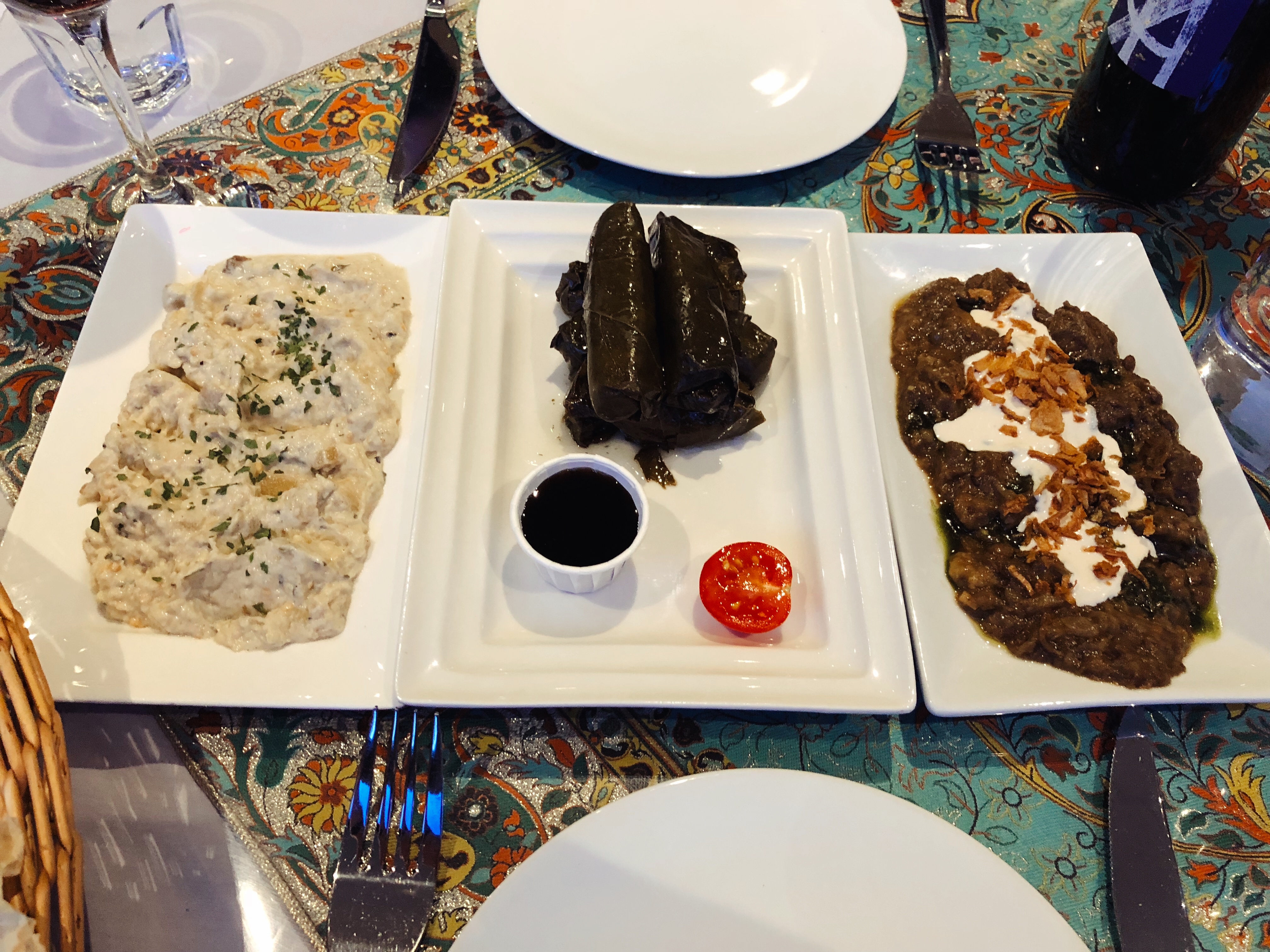
By the time we returned to our table from that little culinary detour, our starters had arrived. The menu divides the starters into cold and warm appetisers and we’d picked from both sections, although I didn’t discern any noticeable difference in temperature. The best of them was the baba ghanoush, which really did have a smoky taste (you could picture the charred skin being taken off the aubergine before the flesh was combined with everything else). But the dolmades were deeply unspecial – the rice in them was claggy and dense, and they didn’t taste of much. The decision to serve them with a little pot of what looked like balsamic glaze but which I assume was pomegranate molasses might have been to conceal the lack of flavour, but it seemed an odd choice. I would have thought these were shop bought but one of them was so saggy and lacking in filling that I think they probably were made by hand.

“You can have the last one” I said to Martin, which obviously translates as I don’t like these much.

“No, I insist” he replied, or in other words I don’t like them either.

The last of the dishes was called halim badenjan, a stew of aubergine, tomato and braised lamb. We both quite liked this – although again, not enough to fight over the last few mouthfuls – but it didn’t knock my socks off. The lamb was in soft strands, the aubergine was tasty enough but it didn’t really feel like anything I hadn’t had before (the yoghurt on top, though, added a nice contrast).

By now, you’re hopefully wondering if that naan I saw being baked in front of my very eyes was any good. Well, I’m afraid no, not really. It might just be me, but I found it a bit thin and nothingy – despite being bubbled it had no fluffiness and no real texture. It might as well have been crackers, and by the end the last few pieces were hard enough that they pretty much were.

A mixed bag, then, and as our waiters took the plates away Martin and I sipped our wine and decided on our next move. We’d ordered a Malbec for twenty-two pounds and although it got better as the evening went along (what booze doesn’t?) it felt a bit thin and weedy to me, with nowhere near the depth or complexity I’d expect from Malbec: with hindsight, it might have been emblematic of the whole meal.

The main courses were split into three sections – kebabs, stews and other Persian specialities. Martin had decided to test out the grill, and I was torn between a traditional stew or the Persian biryani, a dish called lubia polo. I asked another waiter, and he said the stew was a “good choice” but that he’d had the lubia polo earlier in the evening and that it was very good. He also said that you couldn’t get these dishes anywhere else in Reading (which, come to think of it, may or may not have been a good thing). Like all the people who looked after us that evening he was friendly, smiley and engaging, and so I was won over and took his advice.

The problem with taking advice from people you don’t know, like reading reviews from people you don’t know I suppose, is that you take them on trust. So it’s possible that the Persian biryani is the best meal that waiter has had in a while, but if it is I think he rather needs to eat out more often. It was one of the most disappointing dishes I’ve had in a restaurant for a while – not specifically bad, but so failing to live up to its potential that it might as well have been.

It was rice, tomatoes, lamb and green beans and it tasted of rice, tomatoes, lamb and green beans. No real discernible depths of flavour, no nuance, no wow factor, no heat and no spice (Martin thought he detected cinnamon in it: I think he’s being charitable). I expected so much more – I wanted it to open my eyes to something new but instead it made me want to roll them or, worse still, close them for some time. Even the texture didn’t work; the lamb was nicely soft but so were the green beans. The latter had the feel of beans which had either come from a tin or been cooked so long that they might as well have done.

Martin had opted for the mixed grill for one, pretty much, the kebab bakhteari (“it sounds like bacteria” he said to the waiter, a tad ominously). It was a skewer of kofta, a skewer of chicken shish and a skewer of lamb shish, served with some rice with a little yellow hat from the saffron, an underwhelming-looking salad and – completely randomly – an individual portion of butter from a catering pack (what for? we both wondered).

“What do you think?”

“With lamb, you want the lovely caramelised exterior and for it to be pink in the middle” said Martin. “This is just grey”.

He generously let me try some of each of the kebabs, although once I ate them I realised he wasn’t really being generous, it’s just that he wasn’t fussed. The chicken was the best of them I thought, but all of them were middling at best. This dish cost eighteen pounds, a full five pounds more than the equivalent dish at Bakery House. There you get beautiful yellow rice, a perfectly dressed salad and all the garlic and chilli sauce you want. Here you get cross.

“It’s not as good as Bakery House, is it?” I asked.

“It’s nowhere near as good as Bakery House.”

You probably have the general idea by now. I really didn’t rate Persia House, I think there are dozens of better ways to spend your money in Reading and several better ways to have similar food – at Bakery House, at Kobeeda Palace, even at Clay’s if you want a biryani. And if your response to that is to say “but they’re not Iranian food” then fine, I agree – but based on what I experienced at Persia House I wonder if that’s Iranian food either. It didn’t feel distinctive or authentic to me: apart from the lamb stew with aubergines, we didn’t have anything you couldn’t get elsewhere, and that dish didn’t make me desperate to try the rest of the menu. I hoped for fireworks, I got a sputtering tealight.

What’s a little sad about it, though, is a couple of things. One was the service, which was unfailingly nice and polite – although, to be fair, we made up fifty per cent of the clientele for the duration of the visit. The other was that when we asked for the bill they brought some little sweet pastries and a beautiful black tea, poured into tiny glasses which tasted quite lovely sweetened with a little sugar. Such a nice touch, but too little too late. Dinner for two – three starters, two mains and a bottle of red – came to seventy pounds on the nail, not including service.

I wondered about how to end this review. Originally I was going to say “I hope Persia House does well”, but that too feels inauthentic. No, I hope Persia House does better. God knows, they easily could, but I suspect this is the kind of food they want to serve and the restaurant will either succeed or it won’t. Caversham is not blessed with loads of good restaurants, so perhaps novelty value will keep them afloat for some time yet. But at those prices, for that quality, it’s not a place I could recommend. In any case, what do I know? A few doors down Picasso – one of the most uninspiring meals I’ve ever had writing this blog – continues to ply its inexorable trade, years after many places I’ve adored have closed their doors for the final time.

Persia House – 6.4

2 Bridge Street, RG4 8AA

0118 9470222