

After the news that cuddly Mark Zuckerberg was doing away with fact checkers, when the penny dropped that distinguishing between our tech overlords was a similar exercise to using the Bristol stool scale, I read a lot of stuff online about how blogs were making a comeback. Enough of pithily sharing whatever’s on your mind and giving your data away on a billionaire’s platform, they said: time to get back to the good old days when people put their thoughts, longform, on their own blogs. Taking back control – a concept we’ve learned by now can only lead to happier times ahead.
It would be lovely if that were true, but I have my doubts. I’ve been blogging, in one form or another, for over fifteen years and I was late to the party when I started, so you can imagine how behind the curve I am now, waiting for the whole thing to finally be back in fashion. What this world needs is more 3000 word reviews of restaurants is a sentence I’ve only ever heard in dreams. I’m under no illusions – I’m happy in my niche, but I know that’s exactly what it is: a niche.
The tectonic plates of food writing changed last weekend when gastro-blowhard (and life president of the Jay Rayner Appreciation Society) Jason Rayner signed off from the Observer after 26 years, with a review which was ostensibly of an Indian restaurant in Leicester but was really about how great he was and how much we’ll all miss him. Bless.
He replaces tedious Tim Hayward at the FT, who took his leave with a review showing his unerring talent to slip a repulsive sentence into every piece. “I’d compare it to some kind of ecclesiastical erection were it not so determinedly sensuous” he said. Of a restaurant. What’s the opposite of starting as you mean to go on?
But these moves, really, are just shunting deckchairs around on the Titanic of print journalism. So too is the announcement of a new website, Scribehound, amalgamating the output of 30 food writers so that for a monthly fee you get a bit of everything. “Why pay for all those Substacks?” said one of the contributors, making it clear who they’re gunning for.
No, the real opinion formers in food these days are working in short form video, on TikTok and Instagram. I’ve written about Toffjaw before with their nearly 800,000 Instagram followers, but even they pale into insignificance compared to the influencer Eating With Tod, who is followed by more than twice that number.
His real name is Toby Inskip, but “Eating With Toby” would give the game away too early that this is yet another posho telling people what to eat. For the uninitiated, Inskip is a ginger chap with a very excitable plummy voice who always sounds like he’s just about to run out of breath: his many detractors are probably disappointed that he never does. He goes to a range of places and invariably describes them all as the best of their kind in London/the United Kingdom/this galaxy, and he’s on record as saying that he won’t ever criticise anywhere. He’s not a reviewer, he says, his is a “recommendation page”, and by recommendation he means hyperbole.
Whether he pays for his meals or not is unclear, but you get a pretty good idea from a cursory scan through his Instagram what he’s about. With more raves than Ibiza and a seemingly endless supply of gurning at food, Inskip’s techniques are now ubiquitous across a whole genre of ladz reviewing food on TikTok and Instagram.
From the overload of superlatives to the ridiculously exaggerated come face that follows every single mouthful, as if each one is utterly consciousness-redefining, from finger-banging thin air, as if to say that’s what I’m talking about, to the orgasmic waggle of the fork, to the naff chef’s kiss at the end of the video, these techniques have been snapped up by dreary bloke after dreary bloke.
Inskip also misses his mouth. A lot. For someone who has made a putative career out of eating out, he doesn’t appear to be very good at it, so every bite of a burger or a pizza leaves a huge smear miles from the corner of his mouth in a way that makes me feel icky. It’s like watching a toddler. How far we have come, that back in 2014 not being able to eat a bacon sandwich properly disqualified a man from the highest office in the land and in 2025 lacking basic hand-eye coordination is a fast track to thousands of followers? It makes you think.
Anyway, this week’s review found me in Guildford eating at The Boring Burger, and it was largely because of Eating With Tod. He went there last April, as part of his ongoing quest to find Britain’s best burger, and was every bit as aerated as ever. He raved about chef-owner Jamie Kuhls’ “Michelin skill set” because he worked at Claridge’s, although no restaurant at Claridge’s has held a star for something like 7 years. “His attention to detail blows my mind” said Inskip, a man whose mind seems to be blown on a daily basis.
“I could literally just put on a pair of sunglasses and stare at these burgers all day” he said, accompanied by footage of him, sunglass free, holding a burger up and gazing with wonder before taking a bite, smearing sauce on his face and waving his hand in the air with orgiastic abandon. “The best part”, he concluded, “is when you’re ordering through UberEats you can get their brisket mac and cheese bites, and they’re rather bloody tasty”.
That’s the best part? Really? These influencers love to team up with delivery apps for even more free food, another smoking gun that they don’t really like restaurants all that much.
Now, I know I’ve been scathing about poor Eating With Tod – it’s like shooting fish in a barrel – and I could go on. But it cannot be denied that even though he’s a challenging watch, he gets a lot of information across in a short space of time. And looking at that burger, which was infinitely preferable to looking at his boat race, it did look very good. So the seed was planted… should I maybe give it a try?
Anyway, influencers are like buses: you wait ages and then two come along at once. Because last October Bos Finesse, Bristol’s answer to Eating With Tod, also ate at The Boring Burger. And that’s what swung it.
Bos Finesse – real name Oscar Bostock – is an ebullient Bristolian chap who wears a lot of streetwear and has a unique line in hyperbole. For what it’s worth I rather enjoy his contributions to the English language, although I worry terribly about his complexion and his colon, and not necessarily in that order. Bostock has amassed 85,000 Instagram followers and you can’t fault his commitment, eating at highly rated Bristol restaurants, random takeaways in the arse end of nowhere, street food joints, burger vans and even fans’ houses (he also likes Gurt Wings, so he can’t be all bad).
When Bostock went to The Boring Burger he cranked Eating With Tod’s hype-o-meter up to 11. “These might just be the sexiest burgers I’ve ever seen in my entire life” he enthused, before adding that “they aren’t messing about in here, mate”. Bostock also met the owner and said “when you hear about his portfolio of Michelin restaurants you don’t ask no further questions”, despite the obvious question being which ones are they then? Quite the evolution from just having a “Michelin skill set”.
But critical evaluation is not what influencers are about: Bostock grinned like a pig in shit as he was presented with a tray groaning with three different burgers and as many different side dishes and portions of fries. It made me wonder – is it like Masterchef and, after a couple of bites, is the rest eaten by the film crew? Anyway, Bostock loved it and awarded what, for him, might be the highest accolade possible. “Boring Burger: what a gaff” he said. That was it: I had to try it now, so off I went to Guildford on a sunny Saturday morning.
You might well know this already, but isn’t Guildford nice by the way? I don’t think I’d visited it since before the pandemic, and I’d forgotten what an agreeable place it is once you’ve crossed an IDR-style thoroughfare and cut through the decidedly retro Friary shopping centre. The other side of that is a rather fetching, gently sloping cobbled high street that reminded me of a cross between Winchester’s High Street and Windsor’s Peascod Street – or would do if the shops in the latter hadn’t all apparently closed and been replaced by phone repair and vape outlets.
No, Guildford is far more well-to-do than that and on its high street and the little lanes that slope off it you can find a who’s who of businesses Reading doesn’t have: Anthropologie; Coppa Club; Joe & The Juice; Le Creuset. At the bottom of the street a busker was doing a perfectly serviceable job of belting out Set Fire To The Rain by Adele, a song which never even tries to explain the impossibility of its title.
The lanes that head up to the castle have interesting stuff in them, too: I stopped at a very nice wine shop called Corkage and picked something up for later. Continuing my stroll I saw the Ivy and the Ivy Asia, and thought that Guildford definitely had some things Reading needn’t envy.
Boring Burger is up one of those lanes, just across from a Giggling Squid and two doors down from Meat The Greek, a souvlaki place I’ve always rather liked. The sun was shining and at about half-twelve all of its orange tables outside were already occupied, although it shares the terrace with its neighbours and so has fewer tables than you might think. Inside was a very no-frills long, thin room with about ten stools crammed together in a line, all facing the wall.

There was a self-service touchscreen at the front, which seemed a bit jarring, and quite a few orders were takeaways, either from the blokes waiting in the queue or the steady stream of delivery drivers. People must have heard about the best thing about the restaurant, those brisket mac and cheese bites.
The clientele was nearly all men, some of them dragging their partners along, and they all looked like they could easily be acolytes of Eating With Tod. If you can’t take a date, take a mate he always vacuously declaims at the end of his reviews: I, like the loser I am, had done neither.
The menu sensibly keeps it narrow. Four different permutations of beefburger, one chicken burger. Nothing vegetarian that I could see, although I’m pretty sure they used to do a portobello mushroom number. Most of the burgers are twelve pounds, though one with fifteen hour braised brisket costs more, as does having an extra smashed patty. Fries are an extra fiver, unless you jazz them up with bacon and cheese sauce or katsu sauce.
There are a couple of sides, mac and cheese bites – with gochujang, not brisket – or buttermilk chicken tenders, which I was always going to struggle to resist: once I saw them on the menu, in the immortal words of Bos Finesse, you don’t ask no further questions. I placed my order, gave them my name and then managed to find an actual low table with a banquette tucked away right at the back of the restaurant. I couldn’t quite believe my luck. A doubled up smashed burger, tenders and fries cost me twenty-eight pounds, and they told me it would be about fifteen minutes.
In reality it was half an hour, but I didn’t mind. It was fun to see the bustle behind the counter, the burgers turning up for the family of four who had camped out in a row at the end of the ledge. One thing all the influencers went on about was Boring Burger’s attention to detail: designing and making their own buns, making all their own sauces, hand-cutting fries every day the way Honest do. In fairness those influencers also talk with wonderment about restaurants “making everything from scratch”, I guess because some of the places they review don’t.
This is an exceptionally silly thing to say about a restaurant whose fame has entirely spread through a visual medium, but Boring Burger’s food really does look terrific when it lands at your table. The bun is burnished and glows, the fries are the perfect shade of golden, the tenders look gnarled and toothsome. I don’t know if I could have popped on my shades and stared at it all day, but fair play to Boring Burger: you eat with your eyes and in that respect you eat very well there. I could see why this stuff appeared in grid after grid.
But could it live up to that when you actually tasted the stuff? In the case of the burger, yes – a hundred times yes. I’d gone for the eponymous Boring Burger, their signature, and it was the best smash burger I’ve had in this country and one of the best I’ve had full stop. The patties were beautiful, especially at the edges where they were crinkled and crispy, the fabulous bits of burger overhanging the perimeter of the bun. Doubling up was probably overkill, but I felt like I ought to do it properly.
The dill pickle, sliced mandolin thin, added crunch and tartness, and the bun – toasted, another nice touch – was the perfect antidote for anybody tired of brioche. Eating With Tod said the buns “hold their shape like a bodybuilder”. Err, I guess. They definitely had the structural integrity to carry the show. No soggy mulch at the bottom as even happens sometimes with Honest’s more overloaded burgers.
Even the bacon – they dry age it themselves, apparently – was bang on. I don’t think I shared everyone else’s wide-eyed enthusiasm about the burger sauce, which was fine but no more, but honestly: this was one of the best burgers I’ve tried. I’ve had ones at this standard in France, but nothing to live up to it in the U.K. – neither Honest nor Reading’s much missed Smash N Grab came close.
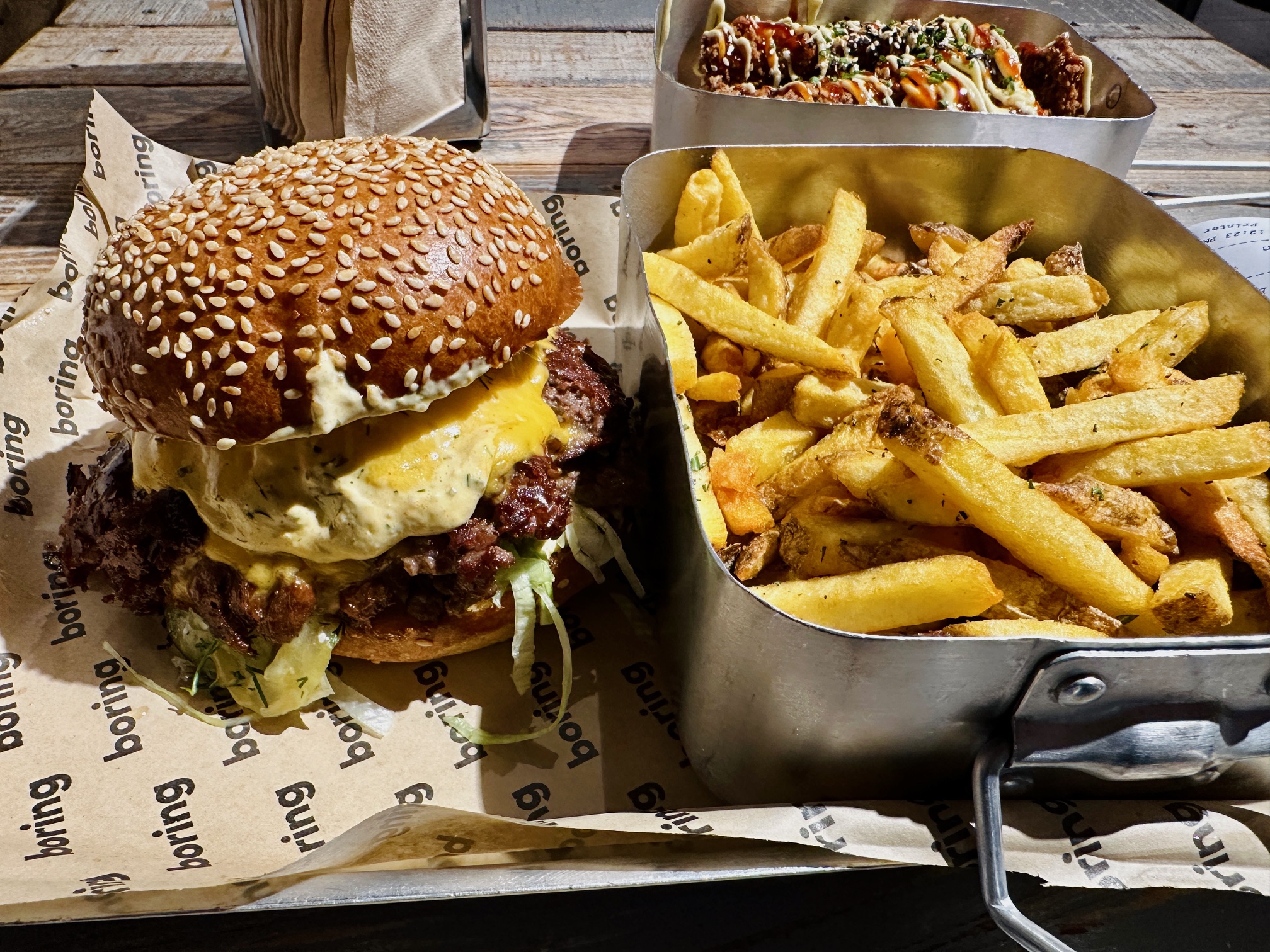
That’s why it so disappoints me to say that Boring Burger’s golden touch deserted it with the rest of my order. Fries were meant to come with rosemary and tossed in confit garlic oil, and if they had done I imagine I’d have been as evangelical about them as I was the burger. But they just came, skin on, fried in oil with very little rosemary, which meant that they were about up there with Honest’s chips when Honest has a good day, which it doesn’t always.
For five pounds, on top of the price of the burger, I was hoping to see them glistening with garlic oil and honking of the stuff, so I was disappointed. This is the problem with hyping stuff, you see, it means that something that’s only thoroughly decent can still feel poor. It’s also, by the way, the problem with someone who only creates content to say that everything is absolutely bloody amazing all the time.
Even more disappointing were the tenders. Properly disappointing, and the gulf between style and substance is rarely so marked as this. On paper, and in the photo down there, they look like a profoundly good way to spend eight pounds fifty – huge, drizzled with sauce, bearing the promise of crunch and euphoria.

But they looked good in the way that some people’s lives look good on Instagram, purely cosmetically. Because the coating – wanky food bloggers call it the “dredge” – didn’t have herbs or spices in it. I’m not sure what it did have in it, because all it really tasted of was undercooked flour. Which was strange, because the texture was there, in the coating at least. Yet the chicken breast underneath was a little too firm, a little too easily parted from the shell housing it. It didn’t feel like it had been brined, or if it had something had gone amiss.
The sauces were a gochujang that felt red and anonymous with no funk or complexity and a miso mayo that just tasted of mayo. I was hoping to find something that challenged the primacy of Gurt Wings as the best chicken tenders I’ve ever tasted. Instead, I ate something that made me appreciate Honest Burgers. That wasn’t how that was meant to play out: looking good on camera is all very well, but it’s not everything.
It’s also worth noting that a combination of giant quantities and underwhelming quality meant that I did something I rarely do: I left food. I ate nearly all of the burger, maybe half of the fries and two of my tenders. That partly says that if you go to Boring Burger you should share those things, but it also says that I felt no wrench at all leaving three huge chicken tenders. That’s something that happens about as often as Michael McIntyre saying something funny.
As I left, noting ruefully that a table in the glorious sunshine outside had just come free, I was determined to find some other nice spots in Guildford just to flesh out this review and give you another reason to go there.
So I’m delighted to report that Guildford has a lovely little craft beer spot called Kerrera, down another little alley, where I sat with my people and enjoyed the fruits of them having a tap takeover by Bristol’s Left Handed Giant. They had a menu with very tempting-looking toasted sandwiches on it, and next time I might try them out: their social media is properly winning, and made me want to go back. I was delighted to see they were solidly booked that evening.
After that I walked across town to Canopy Coffee, an Australian owned café with a view overlooking the Waitrose car park. And I had a beautiful latte, in a very tasteful cup, watched people coming and going and thought that Guildford has easily enough going on to justify the forty-five minute, fifteen pound journey on the train. I’m glad I went, and really delighted that the day I visited the sun finally played ball. I didn’t take a date or a mate, but it was quality time nonetheless.
But is Boring Burger worth going to in its own right? Actually, if you like burgers, yes. Its burgers alone, for me, justified that trip and set a bar that I will mentally return to every time I have another burger for at least the next year. So if that’s your kind of thing I can unreservedly recommend the place. Just pair it with the wine bar, or the café, or the craft beer spot, rather than with fries or chicken tenders, and you’ll have a wonderful time.
I doubt any of the influencers who have covered Boring Burger will read this review, and if they did they probably wouldn’t understand a conclusion like this. That’s okay though, because I know by now that you will. It’s called nuance. They should look it up sometime.
The Boring Burger – 7.2
15 Chapel Street, Guildford, GU1 3UL
01483 374090
https://www.instagram.com/theboringburger
As of January 2025, Edible Reading is partly supported by subscribers – click here if you want to read more about that, or click below to subscribe. Whether you’re a subscriber or not, thanks for reading.



 Edible Reading