Some of the most prevalent of Reading’s many cynics are people I like to call the Not Another Brigade. They crop up all the time: Not another burger place, they say. Not another coffee shop. If I had a fiver for every time I’ve heard someone say that, I could open a coffee shop of my own. Shortly after doing so, I’d hear enough not anothers to be able to open another, and another, and another.
Although when it comes to burgers, they might have a point. Aside from Gordon Ramsay’s new outpost where Giraffe used to be, there’s one opening on St Mary’s Butts in the old Pizza Express site, one on the Oxford Road opposite the Broad Street Mall, one more taking up the Sprinkles Gelato building next to Smash N’ Grab, itself another – that word again – burger restaurant. Oh, and Slam Burger on Christchurch Green, which will offer burgers called the Big Slam and – ridiculous name alert – the “Beef Wooper”. There was once a Black Country establishment called Kent’s Tuck Inn Fried Chicken. Slam Burger could learn a lot from them: if you’re going to be shameless, at least be funny with it.
Coffee shops are a different matter. People have been saying not another coffee shop ever since C.U.P. opened next to Reading Minster, but now C.U.P. has another branch on Blagrave Street and a third, a recent addition, in the Broad Street Mall. We get new coffee places all the time. Compound Coffee is now operating out of the ground floor of the Biscuit Factory, and something called “Artizan” (showing that swapping an S for a Z always makes a brand look classier) has opened in the building once occupied by Nineties throwback Smokin’ Billy’s.
It’s not a story of unchecked growth, though: the year hasn’t been without its closures in caféland. Earlier this year Anonymous Coffee pulled out of the Tasting House, shortly before the Tasting House pulled out of Chain Street. And only a few weeks ago punters heading for Tamp Culture outside the Oracle were surprised to find an empty space where the kiosk used to be. Tamp had upped sticks and left after over seven years trading at that pitch with no farewell: they’ve since put something on their website. Do these closures prove that Reading can’t sustain (not) another café, or is it just the circle of life?
One part of Reading that has traditionally felt poorly served for cafés is Caversham. There was a time when you had Costa and Alto Lounge, and that was pretty much it. Then in 2016 Tipsy Bean opened, serving something you could loosely describe as coffee, and so did Nomad Bakery. And for a while we also had Siblings Home, a little place on the Hemdean Road: I liked it a great deal, but its owners had a haphazard approach to some of the basics, such as being open when you’d expect them to be. Anyway, that flurry of activity didn’t last long – Nomad, Tipsy Bean and Siblings Home have all ceased trading.
But in more recent times, there’s been a new wave of cafés in Caversham trying to challenge the dominance of Costa. So now Geo Café, which is part cafe, part delicatessen slash general store, is where Nomad used to be, but you also have Gardens Of Caversham, a third branch of the Workhouse empire, in the old Lloyds Bank building. At the more traditional end of the spectrum, there’s the superbly named Nathan’s Nibbles. And up past the Griffin you’ll find The Collective, the subject of this week’s review.
Subscribe to continue reading
Become a paid subscriber to get access to the rest of this post and other exclusive content.
Of all of Reading’s new restaurants, The Coconut Tree might be the one most people have asked me to review as soon as possible. Which is in itself interesting, because The Coconut Tree has already had more write-ups online than most of Reading’s new places – but the thing is, they’re all on Instagram. Remember all that talk last year about how hospitality was on its knees and taking free shit was plain immoral? Nature is definitely healing, because The Coconut Tree’s plan for its launch was very much as they used to be in the before times – find some local Instagrammers with over five thousand followers, bung them some PR copy to include in the social media coverage, sit back and watch.
And I don’t know about you, but I learned a lot. Admittedly, nearly all of it I could have learned just from reading their menu, but it’s dead useful to discover that the food is “fresh, tasty and full of flavour” (it would be a brave restaurant that said “you know what? Lots of our stuff is stale and bland”). And to discover, from multiple Instagram posts, that one of the cocktails is set on fire in front of you: the drinks in general, allegedly, are “banging”. Did I mention the “proper good vibes”, or the fact that it’s “cool” and “trendy”? Perhaps the best summary was that “the cuisine is insane”. Sri Lankan food: utter madness!
Of course, what none of those posts covered in much detail was that their food was all free. Their booze, too. “There wasn’t a cocktail I didn’t like” said another influencer. I bet. “Nothing too specific, we’re quite happy for you to construct the post!” said one writeup, showing that the influencer had copied and pasted all the text from the PR company without reading it first. That one was a “paid partnership”: not only did they get free food but, presumably, they were also paid to do the copying and pasting. I can’t compete with those levels of polish, sadly, so instead you get my impressions of the place after I turned up on a weekday with my friend Jerry, two Sancho Panzas in search of a Don Quixote.
Subscribe to continue reading
Become a paid subscriber to get access to the rest of this post and other exclusive content.
Buon Appetito closed in April 2023. I’ve left the review up for posterity.
A couple of Mondays ago I was walking through town around lunchtime, and I noticed that every table outside Bill’s was occupied. The sun was shining, and Bill’s has one of the best al fresco spots in Reading, but even so: every single table? Then I walked past Jollibee on Broad Street, with a queue outside, just like every day since it opened. As I looped back down Friar Street I noticed, through the windows, that Wendy’s was packed. We can congratulate ourselves on promoting an independent, thriving Reading, through the money we spend and the businesses we amplify on social media, but the fact remains that chain restaurants have a huge hold on our town and its customers.
The struggle is real, and relentless. Recently a branch of Sri Lankan themed chain The Coconut Tree opened, and influencers surfaced on Instagram raving about how good their (free) food was. It is next door to South Indian restaurant Pappadam’s, which has been there for years. Last week Gordon Ramsay opened a restaurant in the Oracle – one of five new burger restaurants coming to Reading – and gave out a thousand free burgers. Berkshire Live ran a breathless story enthusing about the opening. Of course they did, because it’s easier to Ctrl-C, Ctrl-V some guff from a PR company than it is to write a real story (although in Berkshire Live’s defence they subsequently reviewed the burger, and didn’t rate it).
The uncomfortable reality, even if we wish it wasn’t so, is that chain restaurants in general, and American ones in particular, do well in this town. Last month Deliveroo revealed Reading’s five most frequently-ordered dishes. Who made the list? Taco Bell, Wingstop, Shake Shack and Five Guys. The only thing preventing a clean sweep by American chains was the holder of the top spot, from German Doner Kebab. They wouldn’t make my top hundred dishes in Reading, let alone take the crown. Maybe Reading’s favourite illness is dyspepsia. Or dysentery, you never know.
If you’re reading this you probably have at least a passing interest in Reading’s independent restaurants, so perhaps you’re mystified (or depressed) by the continuing popularity of places like Taco Bell. It’s easy to forget, in an echo chamber that buys local, supports indie businesses and slopes off to the farmer’s market a couple of times a month, that most people in Reading would still rather queue for Wendy’s.
Even if you support independent businesses, there are other ways to be out of step. I’ve never quite “got” some of Reading’s fêted indies. I freely admit that Sweeney and Todd is one of them, Quattro is another. A third, the subject of this week’s review, is Buon Appetito. It’s always been highly rated on TripAdvisor, yet when I went there over five years ago I was bemused by the rave reviews. Years later the wonderful Tuscany opened down the Oxford Road and I had another, better pizza option; I never returned to Buon Appetito.
Yet here we are in 2021, Tuscany closed over two ago, and Buon Appetito is still going strong. It’s still highly rated on Trip Advisor. More to the point, the pictures on its Instagram account look a world away from the greasy, cheese-sodden edible cardboard I waded through back in 2016. Flicking through them made me feel decidedly peckish. So I decided to take another look, accompanied by my friend Nick, fresh from his previous appearance in this blog and not put off by the whole experience of being immortalised in print.
Buon Appetito has made the best of an unlovely spot. Like many canny businesses they’ve done great things with their outside space, with plenty of tables and some little booths with circular pub tables and heaters on the wall. Everything was covered by a corrugated plastic roof, and more corrugated plastic formed a partition closing off much of the view of Chatham Street. It will set them up perfectly for winter, and the overall effect made me feel like I was on holiday. That sensation was only accentuated by the soundtrack, which sounded like hotel lobby jazz covers of popular songs. I started out thinking the music was deeply naff, but by the end it had won me over and I’d used Shazam to work out who the band was (The Cooltrane Quartet, since you asked).
Service was bright, friendly and immediate. Rather than relegate it to the end of the review it deserves to be mentioned early and often, because the woman who looked after us all evening was brilliant. Every restaurant should have a front of house like this: warm, enthusiastic, likeable and with opinions about the dishes you ought to try. She brought us a couple of pints of Peroni (the drinks selection isn’t the widest at Buon Appetito) and we began the process of picking through the menu.
“I’m not a fussy eater, but there are four things I won’t eat” said Nick.
“What are they?” I mentally ran through my own list of no-nos, but apart from the obvious ones, like tripe, I could only come up with sweetcorn and dried fruit.
I couldn’t help but feel Nick was missing out, but I didn’t interject.
“And raw coriander. It’s awful, it just tastes soapy. It’s genetic, you know.” Having been closely associated with a coriander hater in the past, I’d been told this fact more times than I cared to recall. Can’t you just tell restaurants you’re allergic? I used to ask: apparently not.
“What are the other two?”
“Olives! They just always taste so bitter to me, it doesn’t matter what colour they are. And the last one’s marzipan.”
I could eat marzipan by the block, cutting it like cheese – I have, in my day – but I let that pass. I looked at the menu and mentally struck a virtual red pen through all the items with olives or blue cheese in them: it was more than a few (I was surprised, given our last meal out, that snails hadn’t made the list).
The menu was mainstream but better and more well put together than the one I remembered from my previous visit. It was compact in the right places – only four pasta mains, for instance – and more expansive where that made sense. It’s okay to have many different pizzas because ultimately many of the core ingredients are frequently the same. Pricing was consistent and reasonable – nearly all the pizzas and pasta dishes ranged between ten and fourteen pounds and starters were around the seven pound mark, or more expensive and big enough to share.
Pizzas were a mixture of recognisably Italian combinations – plenty of ‘nduja on there, and the classic Neopolitan pizza with anchovies, capers and olives – and options from further afield. The Honolulu and the Hawaiian, both of which featured pineapple, constituted the lunatic fringe. “I quite like pineapple on pizza” said Nick, “but I won’t order it: you’ll get hate mail from Italians.” I wondered what Italians would make of a vegetarian pizza called “Garden Of Eatin”, but perhaps they’d made their peace with that.
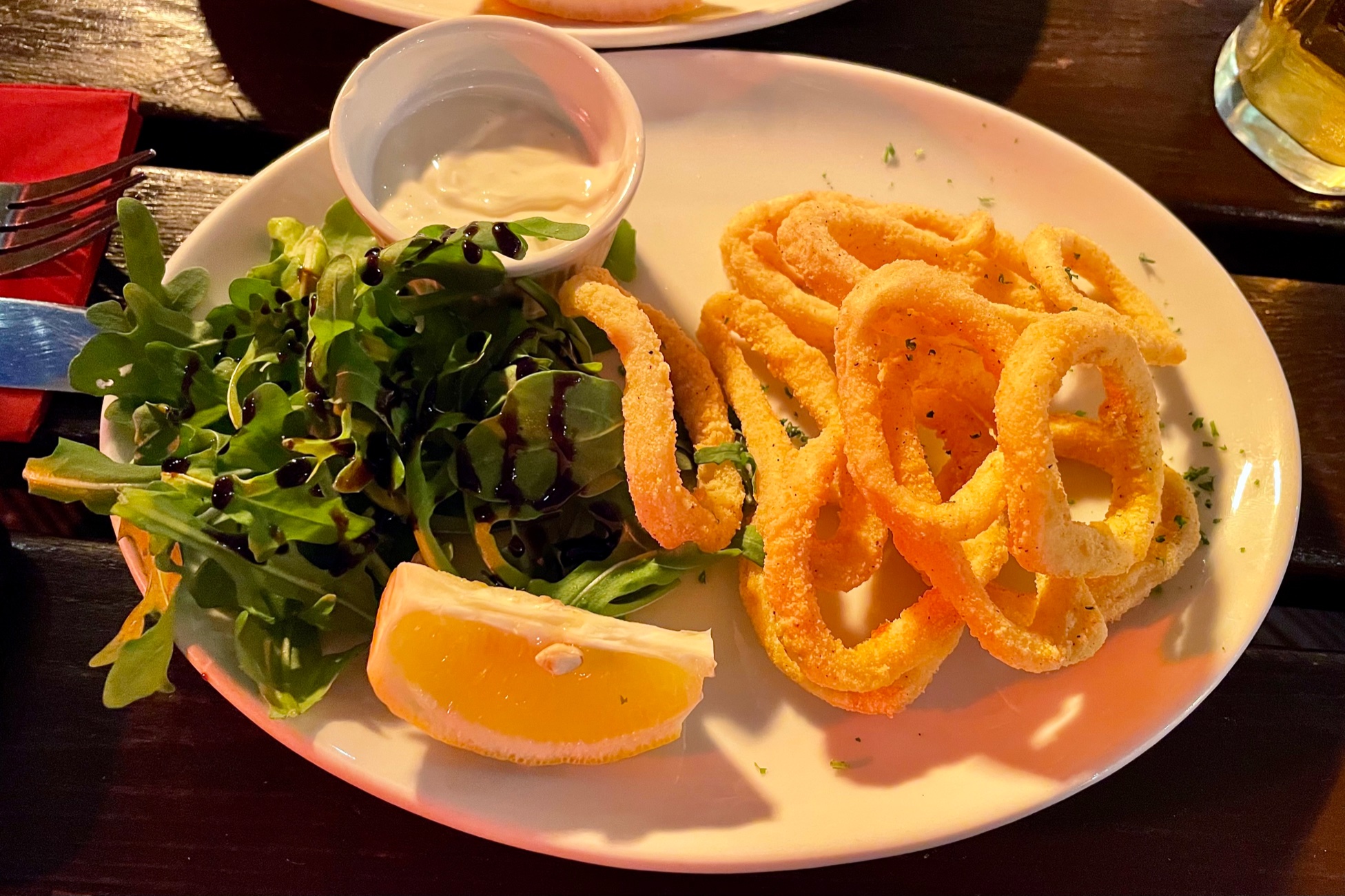
If all of our meal had been like our starters, the rating you’ve already scrolled down to check would have been lower. Calamari was decent, though: it mightn’t have had the tenderness of ultra-fresh squid, but it wasn’t rubbery either. It came with a gentle aioli: a bigger honk of garlic wouldn’t have gone amiss. Even so, it was better than the same dish at the Fisherman’s Cottage a few months back, by which token it was better than most calamari I’ve had in Reading over the years.
The other dish, king prawns with chorizo, was merely pleasant. They were nice plump prawns, three of them, with plenty of sweet flesh once you’d yanked off the head and opened up the shell. The problem was everything else. I know chorizo isn’t Italian, which made the dish potentially slightly incongruous. But worse, this chorizo was nothing special – thick, coarse and bouncy without heat or the terrific crimson oil that colours everything it touches. The menu said that this was cooked with garlic and extra virgin olive oil, but I got little or no garlic, just an anonymous orange puddle under the prawns that didn’t taste of enough.
I began to worry that history would repeat itself: I haven’t doled out a poor rating this year, and I’m somewhat dreading the first time I have an iffy meal on duty. But then our pizzas arrived and those worries, and indeed any other cares I might have had, dissipated in a cloud of carbs. Based on what I’d seen on social media I fully expected Buon Appetito’s 2021 pizzas to be an improvement on the one I had in 2016, but what I wasn’t prepared for is just how improved they would be. They weren’t just better than the previous one I’d eaten at Buon Appetito, they were better than any I’ve had in Reading and many I’ve had further afield.
Now, I can understand you being sceptical: it was only a few weeks ago that I said I might have discovered Reading’s best sandwich, and here I am saying that Buon Appetito does Reading’s best pizza. I couldn’t blame you for thinking I’m busting out hype for the sake of it. But I try hard to be sparing with the superlatives – not everywhere can be the best ever – and by any standards Buon Appetito’s pizza was extraordinary. The base was night and day compared to what I’d eaten before, with a beautifully bubbled, puffy crust with a little leopard-spotting and a deeply satisfying chewiness.
The toppings – I’d gone for the Napoli, which has always been my ideal pizza – were superb. A great tomato base, just enough cheese, lots of salty anchovies, a judicious helping of sharp, tangy capers and those black olives Nick was so averse to. I think this particular pizza is the choice of salt and vinegar fans everywhere and when it’s perfectly in balance, as it was here, it’s a full-on, sing-at-the-top-of-your-voice truly joyous thing to eat. Better than Papa Gee’s, better than The Last Crumb’s, better even than Tuscany used to be. I loved it, and knowing I could rock up to Buon Appetito any time and order this pizza again for a mere eleven pounds was both a wonderful and a dangerous discovery.
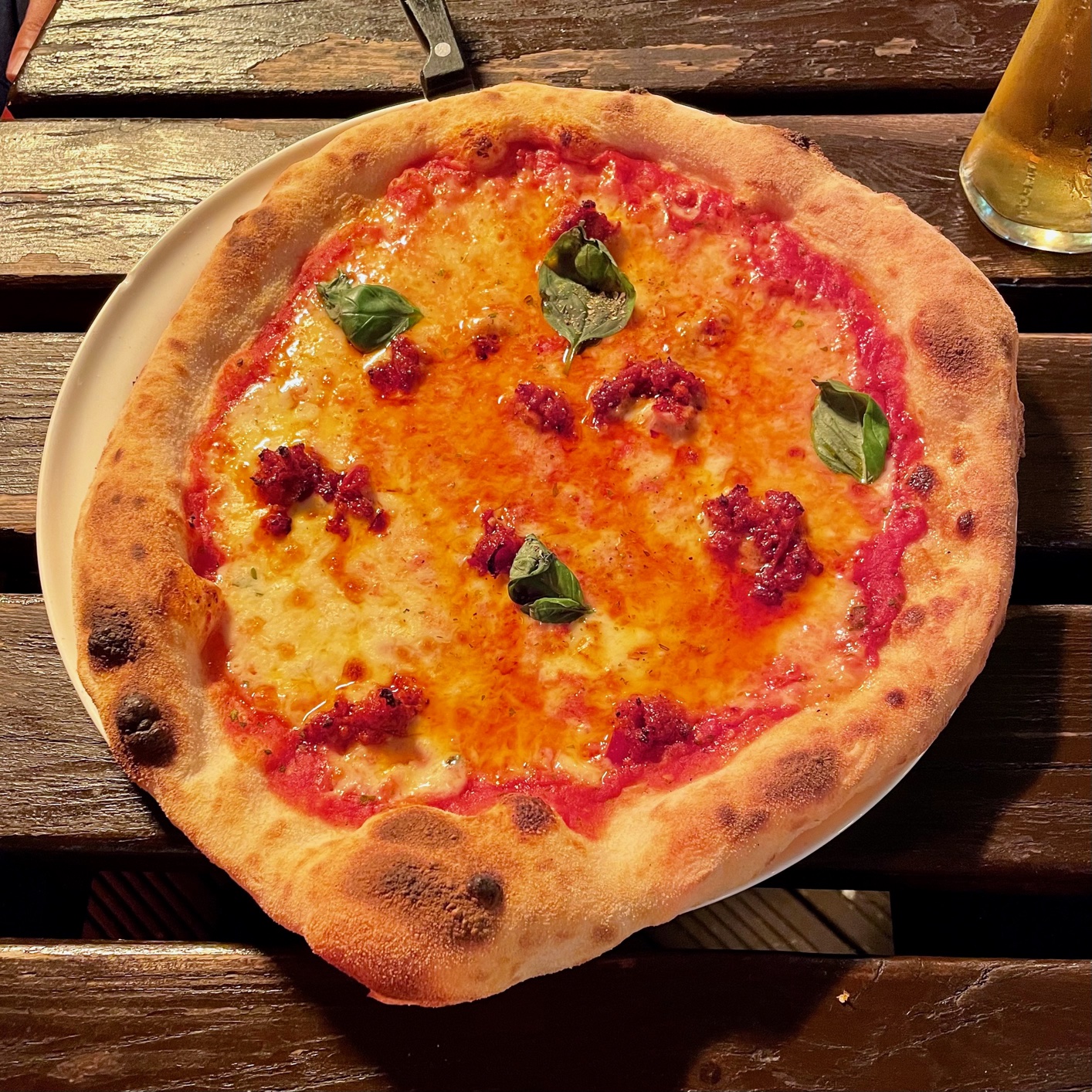
Nick’s pizza showcased that great base in a completely different direction. The “Calabrian” manages to appear on the menu twice, once halfway through and once at the end of the list of pizzas. But it was a masterpiece of pared-down simplicity – tomato sauce, mozzarella, clusters of ‘nduja, basil leaves: nothing else. Nick had never had ‘nduja before – in 2021, can you believe it? – and though he ordered it with abandon, he approached it with trepidation. “Yes, it’s hot, but it’s good” he said, just before our waitress came up and asked, part sympathetically, part playfully, whether he needed a glass of milk. “We have chilli oil, if you want to make it hotter” she added. But Nick was happy with his choice: from where I was sitting it looked a smart one.
“That was good, wasn’t it?” Nick said.
“It really was. Hold on, is that a Latin jazz cover version of Never Gonna Give You Up?”
“Certainly sounds like it.”
We asked for the dessert menu, because I’ve always felt it’s rude not to at least look. It was on the right side of too big, with four desserts and some variations on the theme of gelato and sorbetto, along with an espresso martini which had wandered over from the cocktail menu. “The panna cotta and tiramisu are the best ones” our waitress told us. “Although our banoffee pie is very good too. We import it from Italy, along with our Torta Rocher”. I suspect they come in frozen from a company called DiSotto, which also provides Buon Appetito’s ice cream and sorbet.
We took our waitress’ advice. Nick’s tiramisu was a hefty helping, on the rustic side with huge, boozy savoiardi biscuits (or lady fingers, as you probably should no longer call them) and loads of mascarpone under a blanket of cocoa powder. He liked it, but was too full to make significant inroads into it. I gallantly stepped up purely so I could tell you what it was like, namely serviceable. Only now, looking at the DiSotto website, do I clock that they sell a defrost-it-yourself tiramisu which looks strikingly like this one. I’d love to think Buon Appetito makes its own, but I wouldn’t bet on it.
The panna cotta was a strange one: I’m used to it turned out and quivering on the plate whereas this one had been imprisoned in a little sundae dish. There was an enjoyable pistachio mousse underneath, the beautiful crunch of a candied pistachio crumb on top. All tasty enough, but it felt more like an upside-down, out-of-kilter cheesecake than a panna cotta. I’m not sure the panna cotta element – hemmed in, unable to wobble freely – worked.
“Pretty good” said Nick, “but not as good as Laura’s panna cotta.” I tried his other half’s panna cotta not long ago: he’s right.
The restaurant had a steady flow of customers throughout our meal without ever seeming busy. But it was a Wednesday evening close to payday: perhaps that was a factor. “Inside is very nice too, you should eat there next time” said our waitress as she brought the bill, along with a couple of shot glasses of a Kermit-green pistachio liqueur like next level Bailey’s. Three courses and two and a half pints each came to seventy-eight pounds, not including tip.
As I said, night and day; I still think that the place I went to five years ago left a lot to be desired, but aside from being in the same building and doing Italian cuisine I don’t see many remnants of the Buon Appetito that left me nonplussed. They’ve created a properly lovely space, the service is spot on and if part of the menu were merely not bad or even so-so, the plusses outweighed that in spades. The biggest of those plusses is the pizza, which for my money is one of the best I can remember.
I wish there were more sunny days ahead, because few pleasures can match pizza and beer on a sunny day, but those little booths will be very inviting when the nights draw in, especially for those of us who aren’t sure how much indoor dining we plan to do in what remains of 2021. With Buon Appetito, Chef Stevie’s Caribbean Kitchen and the Nag’s Head, that little piece of West Reading is looking like the best gastronomic micro-climate the town has to offer. Chatham Street, a food hub: who’d have thought it?
All restaurants have distinct personalities, just like people. And, just like people, we encounter them in different ways: you might meet them by chance, or be introduced to them by friends. You decide you’d like to see them again, and over time the relationships you have with some restaurants become friendships themselves. You introduce your other friends to these places and you’re delighted when they hit it off, sad when they don’t quite gel.
Restaurants can be many different kinds of friends. There are the ones you see all the time, because they’re your neighbours, or the ones that live further away that you have to make an effort to visit. Ones you go to when you want to be cheered up by a night of dumb fun, and the ones you’re drawn to for a deep and meaningful evening. Ones where you can be yourself and come as you are, and ones where you must dress up and be on your best behaviour, become a marginally improved version of yourself.
Sometimes you don’t go to a restaurant for a long time, and when you return you’re reminded of exactly why you liked them. I saw one of my oldest friends a few weeks ago, the first time since last March, and although we had much to discuss, in all important respects we picked up where we’d left off. Some restaurants are like that. Restaurants see us at our best and our worst and they welcome us all the same, and conversely we forgive their off days, as we overlook them with people we care about.
And, of course, those friendships sometimes end. We drift apart, our tastes change, we move towns, we lose them in divorces. Sometimes the restaurant simply ceases to be, and we mourn it. But there are always new restaurants to go to, new friends to make. Of course restaurants are like friends: we celebrate with them, we commiserate with them. We spend time with some of them to forget momentarily about our own lives, with others because they have become part of our lives.
That’s the genius of restaurants and the friendships they create. The best restaurants connect us to something bigger than us, they build a community. If you didn’t know that before, surely the last year and a half has written it in big. Look at the outpouring on social media when Clay’s Hyderabadi Kitchen reopened after sixteen months. It was like a friend coming home after far too long away. Some people felt surprisingly emotional when they went through those doors again, me included.
One of my oldest friendships, as restaurants go, is with Medlar in Chelsea. It’s been open for ten years, in which time it’s been written up by most restaurant critics, gained a Michelin star, lost it for reasons nobody could really fathom and dealt with it by shrugging and carrying on regardless. I must have been going to Medlar for eight years or so, with friends and family, pre and post divorce. I’ve introduced all manner of people to the joy of Medlar. The prices on the prix fixe have gained a few pounds over the years, but so have I. On my last visit, pre-pandemic, I took Zoë there to pop her Medlar cherry. We’d not been together long at that point, and I wondered what she’d make of it, but I needn’t have worried. She was an instant convert. She ordered better than me: I didn’t realise, at the time, that this was the shape of things to come.
When a restaurant has traded for ten years it becomes largely immune to trends, but, far from the hype machine, it risks getting forgotten. I went through a phase of eating at much-hyped London restaurants, the latest big thing each time, and I usually came away thinking “that was okay I guess, but I wouldn’t go back”. But Medlar wasn’t like that: I never had a bad meal, and even the least magnificent was on the money. So when I decided to go to London a few weeks back I asked on Twitter if anybody had any recommendations for al fresco dining. I’m sure the places mentioned in my replies would all have been worthy choices, but in the back of my mind I was always thinking or I could go back to Medlar: I was delighted when none of the suggestions caused me to hesitate, even for a second.
Medlar is in Chelsea, but not the nice part. If you go down the Kings Road it’s all very chi-chi until the Bluebird building (which Zoë tells me features frequently in Made In Chelsea:fucked if I know, I’ve never watched it) and then it starts to get scruffy. The Brutalist World’s End Estate – could a name conjure less hope? – is across the way and although Medlar itself looks genteel from the outside, it looks out on a branch of Mail Boxes Etc, over the road.
Inside though, all is peaceful and calm. It’s a long thin room broken up into sections – a beautiful one at the back with sunshine flooding through a skylight, a middle one full of booths, all smart mint-green button-backed banquettes, and a plainer room at the front. We initially had booked one of the tables outside but the sun was scorching, so we moved to a table next to the open French doors, mini John Lewis fans on the table, whirring away. There were perspex screens between the tables, and everything felt safe and well spaced.
Medlar runs a prix fixe menu for lunch and dinner, and lunch has always been a steal: I remember when it was thirty pounds for a three course lunch, outrageous value, but even now at forty pounds it still feels reasonable. There are seven options for each course, and some – crab raviolo with bisque sauce, duck egg tart with duck hearts and lardons – have been on the menu so long I imagine they have protected status. Perhaps that’s why they lost their Michelin star, for not being seasonal enough, but I’ve had both those classics more than once and I’d rather they kept the dishes than kept the star.
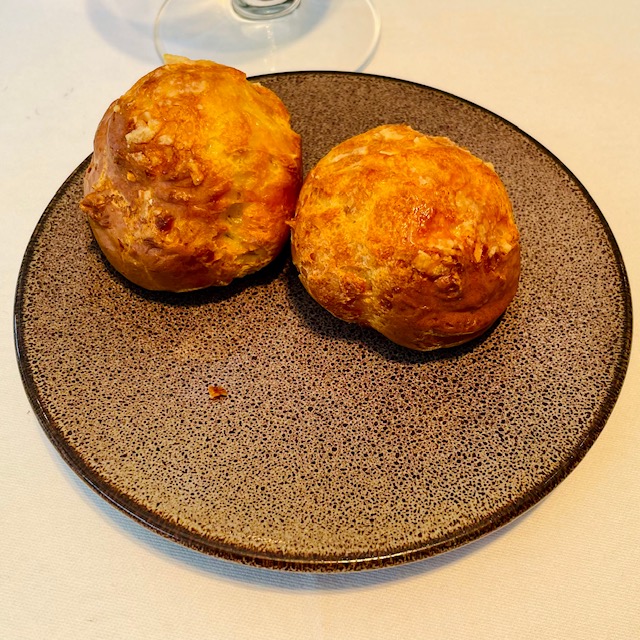
We started with a pair of stunning aged Comte gougeres. It was odd to taste Comte without that familiar crystalline grit, but odd in a good way, and the pastry was dense yet airy. By this point we’d been served a choice of bread from a wooden tray (Medlar’s focaccia is another thing of wonder) and we’d been brought water and a glass full of ice cubes, which was regularly taken away and replenished throughout our meal. We’d chosen our wine, and everything was right in my little world. A proper lunch, a leisurely one where you get through a bottle of wine and have nowhere you need to be afterwards, is a holiday in its own right, if you choose the right place.
Speaking of wine, that was the first misstep. We’d ordered a bottle of Riesling by Pegasus Bay, a stellar producer from New Zealand. They brought it, opened it and then explained that it wasn’t cold enough. So they poured a little into our glasses and took it away to try and get it colder quickly. But they didn’t succeed, because it was only reached the right temperature at the end of the meal, by which time we’d drunk most of it. It was still a fantastic wine, but we had it far from its best: given that it cost around sixty pounds I’d have expected them to give us the option to choose another, rather than opening it when it was barely chilled.
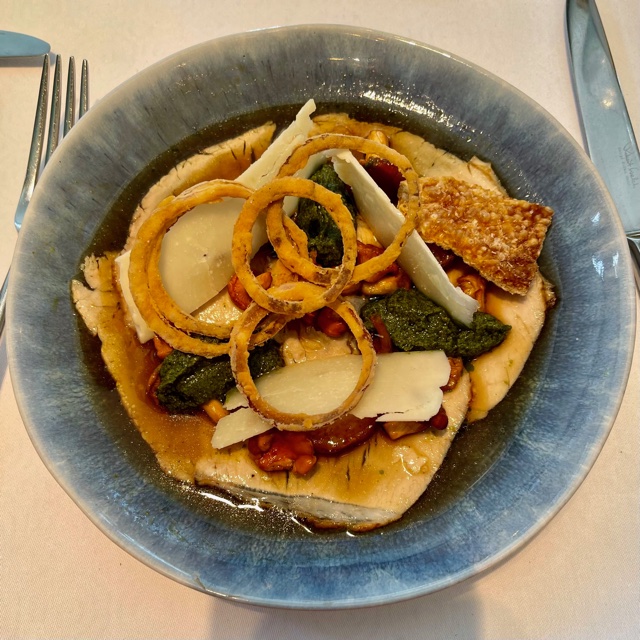
But the food was as good as I remembered. As on our previous visit, Zoë picked the best of the starters – thin slices of pork loin served in a sauce almost like a consommé, topped with thin, crisp onion rings, salty splinters of pecorino, girolles, cubes of fondant potato and a grassy, intense salsa verde. It was a dish where you could construct an almost infinite number of different forkfuls, each of them magical, and I looked at it with a level of envy that only intensified when I tried it.
“Pork, onion, potato and cheese – no wonder I love this dish” said Zoë. “It’s the Irish in me” (I look forward to the day when she has the passport to prove it).
I could have, should have gone for one of my favourite starters from the menu, for old time’s sake. But it was a hot day and I wanted to avoid the tried and tested, so I chose the gazpacho. If I wasn’t absolutely bowled over by it, that’s probably because it’s a soft-spoken dish even when done as skilfully and fastidiously as this. The cubes of scallop were super-fresh, pristine and elegant, but if I’d known it was padded out with cucumber – I’ve never been a fan – I would have chosen something else. Superb olive oil had been used but didn’t break through, hesitantly clearing its throat when it should have sung. Cobnuts added texture and a second dimension, but overall it was too mild-mannered for me. I consoled myself with another piece of focaccia.
By this time the restaurant was filling up. They charge reasonable corkage at lunchtime, which explained one chap lugging what appeared to be a jeroboam of claret. Medlar clearly has a reputation and a regular clientele, because many of the diners were well-upholstered: a florid, blazered buffer at the next table was humblebragging away to his friends (“I’m still seven hundred pounds in credit with the Royal Opera House” being one gem). I’ve missed people watching, and watching these people was another level completely from sitting in the Workhouse courtyard, seeing who wanders past.
Zoë’s main is a mainstay of the Medlar menu and if she hadn’t ordered it I would have – glorious, soft rump of beef, served pink and fanned out with blobs of shallot purée, along with a portobello mushroom stuffed with snails in Café De Paris butter. You also got a side salad and a hefty helping of a beautifully made Béarnaise, with an almost medicinal hum of tarragon. Zoë was sceptical about the snails in particular but I talked her into ordering it, reasoning that if she didn’t like them I could swap with her – so of course, when it came to it, she loved the whole lot. Again, no two forkfuls need be the same, but every forkful was marvellous.
My dish – bit of a theme here – was good but not at the same level. Barbary duck came pink, also fanned out (they love a bit of fanning around at Medlar) on mange tout, with a jug of a fantastically sticky jus. But the second half of the dish, the confit duck tart, was problematic. It felt like it had wandered in from a completely different meal, one where you wouldn’t have a sticky jus. But also, it wasn’t a tart: plonking ingredients on a thin disc of pastry as a means of displaying them doesn’t constitute a tart, however much you might want it to. So the stuff on the edible coaster – the confit duck, roasted courgette and tomato, the ribbons of fennel, even the almost-rubbery ricotta gnocchi – were very nice, but they had nothing to do with the rest. I know the weather lately has made us all uncertain whether it’s summer or winter: this dish had a similar identity crisis.
We ordered chips to go with both distinctly carb-free dishes. They come with more of that marvellous Béarnaise, but usually they’re better than they were that day: they didn’t have that brittle crunch they needed, although as a vehicle for tarragon-infused indulgence they did just fine.
The dessert course comes with suggested pairings, and this was the first time the restaurant felt truly pricey: the cheapest dessert wine came in at a tenner but the rest were in the region of fifteen pounds for a glass. I liked my Beerenauslese, which had a note of sharpness alongside the sweetness, and Zoë loved her Australian Riesling. But neither was worth quite that much money.
Never mind: gladly the dessert we’d both chosen properly saved the day. It was a festival of chocolate and cherry, a deep dark delice surrounded by dots of cherry and griottine cherries, crowned with an orb of almond ice cream and a brittle tuille made from cocoa nibs. The almond ice cream – extraordinarily smooth, with hints of marzipan – and the cherry lent the dish a touch of Bakewell, and the whole thing amounted to a proper desert island dessert. We ate it in silence, interrupted only by the duffer at the next table holding forth to his unfortunate friends.
As we waited for our bill, the staff brought over one last treat, velvety chocolate truffles and pieces of marshmallow which tasted of sweet, concentrated passion fruit, a little miracle. Aside from our slightly lukewarm wine, service was perfect – attentive but nicely distant, very efficient indeed, far better than service I’ve had at places which have retained their Michelin star (l’Ortolan springs to mind). Our three course meal, with a bottle of wine and a couple of glasses of dessert wine – and those gougeres right at the start – came to two hundred pounds, which included an optional 12.5% service charge.
We left nicely full, edges a tad blurred, and strolled down the Kings Road, pausing now and again to stumble into a(nother) ridiculously expensive boutique. Exactly how many branches of Joe & The Juice does one road need? I thought to myself (the answer, as far as the Kings Road is concerned, is two). I tried on crazy glasses in Moscot – it turns out that Woody Allen-style glasses are best left to Allen – we ambled round Peter Jones, we walked to Belgravia and made a pilgrimage to Les Senteurs, one of my favourite shops on the planet. In the sunshine, you could nearly convince yourself that the city was almost normal.
So yes, it wasn’t a perfect meal. And Medlar might not have been completely at the top of its game when I visited them, but even on a relative off day they could teach pretty much any restaurant in Reading a thing or two – about food, about service, and about doing the same thing day in, day out for years, without getting bored, rebranding or chasing fads. It’s an underestimated quality in restaurateurs: the patience to build something up, to stay focused, to not lose interest. And if I picked Medlar up and dropped it, say, in the space Bill’s is currently wasting they would easily be one of the best restaurants the town has ever had. For my part, it was an absolute pleasure to go to London and catch up with an old friend. All things considered, I’d say they’re doing pretty well. I won’t leave it so long next time.
I’m not sure there’s any such thing as the perfect pub, but I’m lucky to live near three that each embody different aspects of the platonic ideal of a public house.
The Retreat is arguably Reading’s best “classic” pub, even if its refurb last year made the toilets disconcertingly classy. The story goes that when the landlord of the Alehouse visited and saw the work the Retreat had carried out in lockdown he turned to Brian, the landlord, and said “thanks a bunch – now I really do have the shittest pub toilets in Reading” (apparently the Alehouse has done some work on them since). The Retreat lacks outside space, and the small beer selection is a little too cask-led for my personal taste, but it remains a wonderful place with a welcome like no other.
Then there’s the Lyndhurst, which does Reading’s best pub food, without question. It hosts burger nights on Mondays and curry nights on Thursdays, and boasts a menu full of staples like chilli beef nachos and katsu chicken burgers. And then there’s the icing on the cake: dazzling specials that tend to go on the menu Fridays and Saturdays and match any restaurant food anywhere in Reading. One week it’s skate wing topped with capers and crunchy croutons soaked in a sauce Grenobloise, another it’s lamb rump with an enormous slab of shredded lamb shoulder, breadcrumbed and fried, on the side.
To round off the holy trinity, the Weather Station boasts a superb selection of beers, the vast majority of which are on keg, has a nice little courtyard out back where you can drink them and has really gone from strength to strength in 2021. It always has at least one sticky, strong, indulgent imperial stout on the list and some of the DIPAs and pales on tap are truly terrific (a special mention to Wild Weather’s Orange Lazarus, which is as refreshing a summer drink as you could hope to find).
Having said all that, over the last twelve months I’ve spent a fair amount of pub time on the edge of West Reading, where the Castle Tap and the Nag’s Head have done an exemplary job of adjusting to Covid and providing great converted spaces for al fresco drinking. When I finally emerged from the cocoon of that first ever lockdown for an al fresco alcoholic drink, it was the Nag’s Head I made a beeline for. But the Nag’s Head always had two drawbacks.
One is that you couldn’t book a table, whereas at the Castle Tap they’ll gladly reserve you one outside. The other was that they never really had much of a food offering. That needn’t be be a problem. The Castle Tap is more than happy for you to order from Deliveroo and eat it at your table – they’ll even give you the postcode for the beer garden out back to use as a delivery address – but the Nag’s has always taken a dim view of that.
On one hand, it meant that the Nag’s Head didn’t bother trying to adapt to the constantly changing landscape of substantial meals, this tier and that tier. Life was simpler, if less lucrative – although the Nag’s also reopened later than its peers last year, sensibly spending extra time sprucing up their beer garden, so perhaps they could absorb those losses. But it also meant that they were closed for longer than some of Reading’s other pubs with outside space when they could have put together a menu, or invited a street food trader over, and continued to trade.
Anyway, when they reopened in April this year they were sporting a brand new food menu and a new smoker for pork and brisket. The menu was compact – not big enough to necessarily make the Nag’s a food destination in its own right, but aiming to offer enough choice that you wouldn’t have to face the invidious choice between leaving the pub to grab a meal or staying, getting shitfaced on an empty stomach and accidentally falling into Harput Kebab on the way home (and I’m not judging, because I speak from experience). And that kind of menu works: Zoë and I were having an early evening beer in the sunshine during her week off, and neither of us could face going home and cooking, which is why you get this review this week.
Subscribe to continue reading
Become a paid subscriber to get access to the rest of this post and other exclusive content.








 Edible Reading