Tampopo

N.B. Tampopo closed in June 2015. I’ve left the review up for posterity.

If I’m honest, I wasn’t predisposed to like Tampopo. It always felt like another link in the vast chain of chains on the Oracle Riverside, a bookend at the opposite end of the shelf to Wagamama. I found the concept a bit strange: food from throughout East Asia, a range of dishes from – among others – Singapore, Thailand, Indonesia, Vietnam and Malaysia. Can you imagine a pan-European restaurant, serving boeuf bourguignon alongside pizza, paella, fish and chips, moussaka, schnitzel and herring? If you can imagine it, and I can’t, would you really recommend that anybody go to it?

So I turned up ready to be underwhelmed, and was pleasantly surprised from the moment I walked in. Like Wagamama, Tampopo offers the threat of communal eating – long tables which imply that, if the restaurant is busy, you won’t be eating on your own. Unlike Wagamama, they’ve made some effort to make that seem less stark and unpleasant – tables feel more compact, the seating is made up of (surprisingly comfy) stools rather than large benches and the lighting is warmer and more attractive, giving the room a glow. On a Monday night there was no danger of sharing a table with anyone, but even if I’d had to it wouldn’t have felt like the end of the world.

The culinary first impressions were also good. Edamame were considerably more interesting than their counterparts at the other end of the Riverside, dressed in chilli and sesame oil and coarse flakes of salt. The wine that accompanied them was also very good – a viognier was light and peachy and the Gewürztraminer was delicious, fresh with (at the risk of sounding like something out of the Carry On films) a strong hint of banana. They do glasses in 125ml, too – something I wish more restaurants would sign up to.

Regular readers will be unsurprised to hear that I ordered the “Tampopo sharing platter” to start. I’m beginning to feel less ashamed about this habit, rationalising it as an opportunity to try as many different things from the kitchen as possible (that’s my story, anyway, and I’m sticking to it). And I’m unrepentant, because it was an excellent choice – a big black slate arrived at the table with six different items from the starter menu, neatly laid out in a grid, each with an accompanying dip or garnish.

StarterThe least remarkable were the coconut prawns – butterflied, breadcrumbed and served with sweet chilli sauce, they were the stuff of sharing platters everywhere. Everything else, though, was either a pleasant surprise or a very pleasant surprise. The chicken satay, for instance: so often a pedestrian space filler served up with some warm Sun-Pat, but Tampopo’s was a world away from that. The chicken was soft and tender (I wondered whether it might be minced rather than the fibrous fillet you usually get) and the sauce was deep, rich, chunky and much more savoury than satays in so many other places in Reading. The corn fritters made a pleasant change from the usual fishcake – lighter, taster and without the slightly disturbing sponginess fishcakes can have. The gyoza were plump and soft, full of minced pork, subtle and lighter to eat than they looked on the plate.

The last two were things I’ve not tried before. Goi cuon were cold, soft rice paper rolls packed with vegetables, noodles and coriander – fresh and clean, if almost impossible to eat tidily (whatever you think of a traditional spring roll, it’s at least easy to dunk in a dipping sauce). Bulgogi, Korean grilled beef, was also good, with a smoky char to it. It came served on a lettuce leaf which is meant to serve as an impromptu wrap – a great idea, although it did mean that the beef didn’t stay hot for long. That was fine though, because it didn’t stay uneaten for long. The only letdown was the kimchi that came with the beef – an oddly bland pile of cabbage without the eye-watering, intense taste I’m used to. It was the only place where the menu felt like it lacked the courage of its convictions.

I’m not one for listing the price of dishes in brackets in a restaurant review – there are other places you can go for that – but this one is worth emphasising: that selection of starters, for two, was £13.95. Pretty impressive stuff, and it built up a feeling of goodwill that the rest of the meal would have to go some to ruin. Good starters are like that.

Another nice touch came when the waitress – who was excellent all evening, friendly and helpful without being matey or patronising – took our empty slate (and extra napkins, because it’s messy stuff) away.

“Was that okay for you?”

“Yes, it was gorgeous.”

“I’m glad you liked it, it’s one of my favourites. I had it for lunch, actually.”

She was also full of good advice on which mains to order and came across as genuinely passionate about Tampopo’s food. Another waitress, later in the evening, asked what we made of the menu and showed real interest in feedback. She also told me that Tampopo was only a small chain (five branches, three of them in Manchester), and that Reading was the baby of the family, having only been open for three years. So much for my preconceptions about eating in a faceless chain – and in fact, a subsequent look at the website suggests that the owners either have a genuine passion for this kind of food or are phenomenally good at faking it. Either way I was struck that all of the serving staff felt like ambassadors for the restaurant, also a million miles from the experience in most chains.

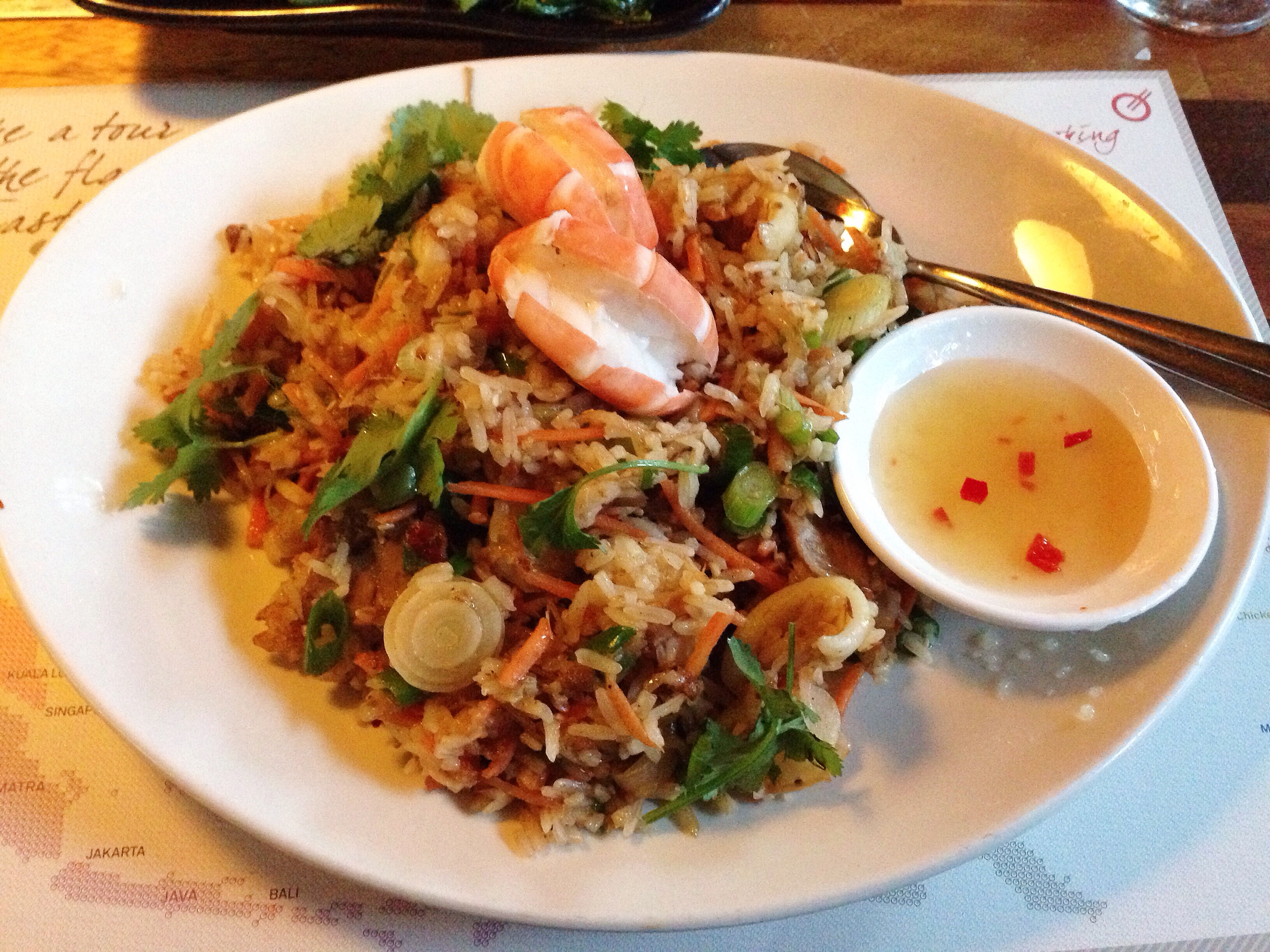
Could the mains live up to the start? Well, not quite. Com Hué, a Vietnamese rice dish, was the biggest disappointment of the evening. It was almost like a Vietnamese paella – rice with chicken, squid and king prawns, along with coriander, red onion, spring onion and carrot. Bits of it were beautifully cooked – the squid in particular was more tender than I’d expected – but the overall effect was a bit restrained for my liking. I often worry with subtle food that it’s my fault for not having a refined enough palate, but the good Vietnamese food I’ve had has positively sung with flavour, whether it be mint or lemongrass or coriander. This had none of that, and I don’t think it was my fault. All the other dishes tasted of something, but this was food with the mute button on. I didn’t finish it.
Main2Happily, the other main course was streets ahead. Khao Soi, a Thai dish of chicken and yellow noodles in red curry sauce, was delicious. The sauce was creamy and coconutty with decent sized but perfectly soft pieces of chicken, the noodles were small enough to twirl and there were tasty crispy onion pieces on top. I was apprehensive because of the two chillies next to it on the menu but actually the flavour was well balanced with loads going on – a good whack of garlic and ginger with the creamy sauce taking the edge off the heat. This is the sort of curry I want to eat on a cold, wet night (and I probably will soon, Reading summers being what they are). What it reminded me of, and I mean this in the nicest possible way, was curry sauce from my local chip shop when I was a kid, when the chippie was a treat, all this eating out was a lifetime away and Thai food was still a few years from hitting our shores. I’m not even sure I’m saying it tasted like that, but it took me back to that magical time when foreign foods were new and exciting without being intimidating.

Main1The side dish was nothing to write home about. I went for wok fried greens – you have a choice of broccoli or pak choi in oyster or tamarind sauce. My broccoli was some kind of mutant strain that looked so much like pak choi that it’s almost impossible to tell apart from it, except for the presence of a few tiny florets. Even wilted it was almost impossible to eat with chopsticks and not quite worth the bother of doing so. A pity, really, because the tamarind sauce – like so much of the food at Tampopo – was really tasty, sweet and sharp at once.

I’ve always found desserts a bit of an Achilles’ heel in this kind of restaurant so I was amazed not only to find a few things I fancied ordering but to really enjoy them into the bargain. There isn’t much on the menu from the Philippines (just the one main) but they contribute one dessert – churros and chocolate (popular since Spanish colonial times, if you believe the blurb on the menu). These were some of the better churros I’ve had in this country; thin piped doughnuts with a good balance of crispy and chewy. Better still, the chocolate sauce was thick, intense and tasted of real chocolate, as opposed to the watery, synthetic chocolate flavoured sauce so often dished up with churros on the continent. They were perhaps a little over-zealously dusted with icing sugar but that was soon tapped off (nothing stands between me and fried dough, I can tell you).

ChurrosThe other dessert was another weakness of mine which I always order on the very rare occasions when I see it on a menu. Black sesame ice cream was gorgeous – there’s something about the hit of those sesame seeds in such a surprising context that really works. This wasn’t the best example I’ve had (a chunk of ice in the middle of it was disconcerting) but it was close enough for me. The other flavour I tried, cinnamon, was creamier and blander and mainly left me wishing I’d had two scoops of sesame instead.

Dinner for two – edamame, three courses, a side and a couple of glasses of wine – came to fifty-nine pounds, not including tip. Again, it’s worth mentioning what good value Tampopo is. Aside from those starters, which I’ve already enthused about, the most expensive main was £12. Neither of the desserts cost more than £3. The Oracle can be a punishing place for restaurants to make a living, and I was impressed by the balance between cost and quality here – and the service, which was miles better than at most Oracle restaurants I’ve been to (Browns and Pizza Express, I’m looking at you).

If I was summing up Tampopo in three words I think they’d have to be these: better than Wagamama. They occupy very similar spaces but Tampopo avoids everything that gets on my nerves about the latter: unforgiving lighting, unwelcoming furniture, the rote instruction that your dishes will arrive in a random order whether you like it or not (I can’t tell you how much this irks me) and the feeling that you are meant to eat your food quickly, leave and go to the cinema. Tampopo isn’t necessarily a place to settle in for an evening, and still feels like somewhere you’d eat before going on somewhere else, but it manages to make that feel like an experience in itself rather than a transaction. I will definitely be back, and in future when I go to a restaurant I might try leaving my preconceptions at home.

Tampopo – 7.6
The Riverside, Oracle Shopping Centre, RG1 2AG
0118 9575199

http://www.tampopo.co.uk/

Ruchetta, Wokingham

As of September 2025, Ruchetta is in the process of closing and reopening under the name Angelo’s, to tie in with a second branch of Angelo’s opening in Reading on Station Hill. As a result I’ve marked this as closed, though I’ve kept the review up for posterity.

There are two kinds of expensive meal. There are the ones where you know in advance that they’re going to be expensive, where you look at the menu beforehand, brace yourself, tell yourself it’s a special occasion. Then there are ones where you’re taken by surprise; maybe you order the really pricey main course you weren’t expecting to, or pick a really fancy bottle of wine, or throw caution to the wind and get a second bottle of the less fancy wine. However it happens, there are some meals where you get carried away, it all adds up and you get a little shock when you take that first look at the bill.

Why am I saying this? Because, to begin at the end for once, Ruchetta is the most expensive meal I’ve reviewed so far – and I knew it was going to be costly before I even stepped through the door. And why’s that important? Because when you know a meal’s going to be expensive, lots of things happen. The anticipation is completely different – I get excited about reading the menu, start looking forward to it (something that doesn’t always happen, believe me). But also, price inevitably becomes another dimension, and each dish is assessed not only on whether it’s good, but also on whether it’s worth the money. It’s only natural that the bar is set higher: after all, you can be pleasantly surprised by a ten pound lunch in the middle of nowhere, but it’s harder to be pleasantly surprised by an expensive meal in a beautiful little house in the prosperous market town of Wokingham.

It really is a beautiful house, too. I don’t know Wokingham well but Ruchetta looks very much like the kind of restaurant it ought to have, really standing out (if you think Reading has a lot of chains, you ought to walk round Wokingham some time). It’s slightly off the main drag in a tiny, nicely jumbled building with a mosaic of little rooms. I sat in the conservatory – partly to get better light for photos – and regretted that more and more as the evening went on, feeling rueful that I hadn’t chosen one of the more snug, atmospheric sections at the front of the house. That said it was a pleasant room with crisp white linen and smart white plates, although the tables do feel a little close together; I was glad the one next to us was empty, or else I would have felt very overlooked.

The menu’s one of the most difficult I’ve had to choose from. There is something magical about good Italian food at the best of times, but the menu at Ruchetta really is the kind where you’re aggrieved that you can’t have everything. We tucked into the bread basket (white and a brown which resembled sourdough, with good salted butter) and sipped our Prosecco in the early evening sunlight, haggling and agonising until the decision could be postponed no longer. If the waiter had arrived two minutes earlier, or two minutes later, you’d probably be reading a review of four completely different dishes.

I adore truffles, and I nearly always order them when I get the chance. The distinctive aroma was noticeable the moment I entered the restaurant and I reckon it subliminally influenced both choices of starter. The first was one of the simplest things you could have, truffle ravioli in butter and sage, and it was a delight. The pasta was al dente and richly flavoured with the earthy, dirty truffles. The dish was topped with thin slivers of parmesan and a handful of young sage leaves. But most importantly a whole pencil sharpener tub of those heavenly truffle shavings had been sprinkled on the top of the dish making the flavour even more intense. Eating it was close to an ecstatic experience, the forkfuls close to the end simultaneously magnificent and agonising.

Truffle pastaThe other starter called to me because it was just so unusual that I had to try it: baked white onion in sea salt, filled with truffle fondue with pan-fried foie gras and caramel. The foie gras was just delicious – a generous piece, soft and yielding, perfect with or without the smidge of sweet caramel. The truffle fondue was less successful – it was salty and tasty and rich with truffle, but very liquid and I really had no idea how I was meant to eat it. They didn’t bring a spoon, but I ended up finding one from a neighbouring place setting and improvising. I thought the point of fondue was to dip something in it, and without that something it was more like a very cheesy soup (I briefly pondered whether I was meant to use the foie but surely not: far too expensive to use as a glorified soldier). The quail egg didn’t really add anything and the white onion had been baked just enough that it made an excellent bowl but not enough that it made a sweet and tasty way to mop up the rest of your fondue. I’m glad I can say I’d ordered it, but it felt like was two starters, neither of which quite worked, joined at the hip.

Fondue

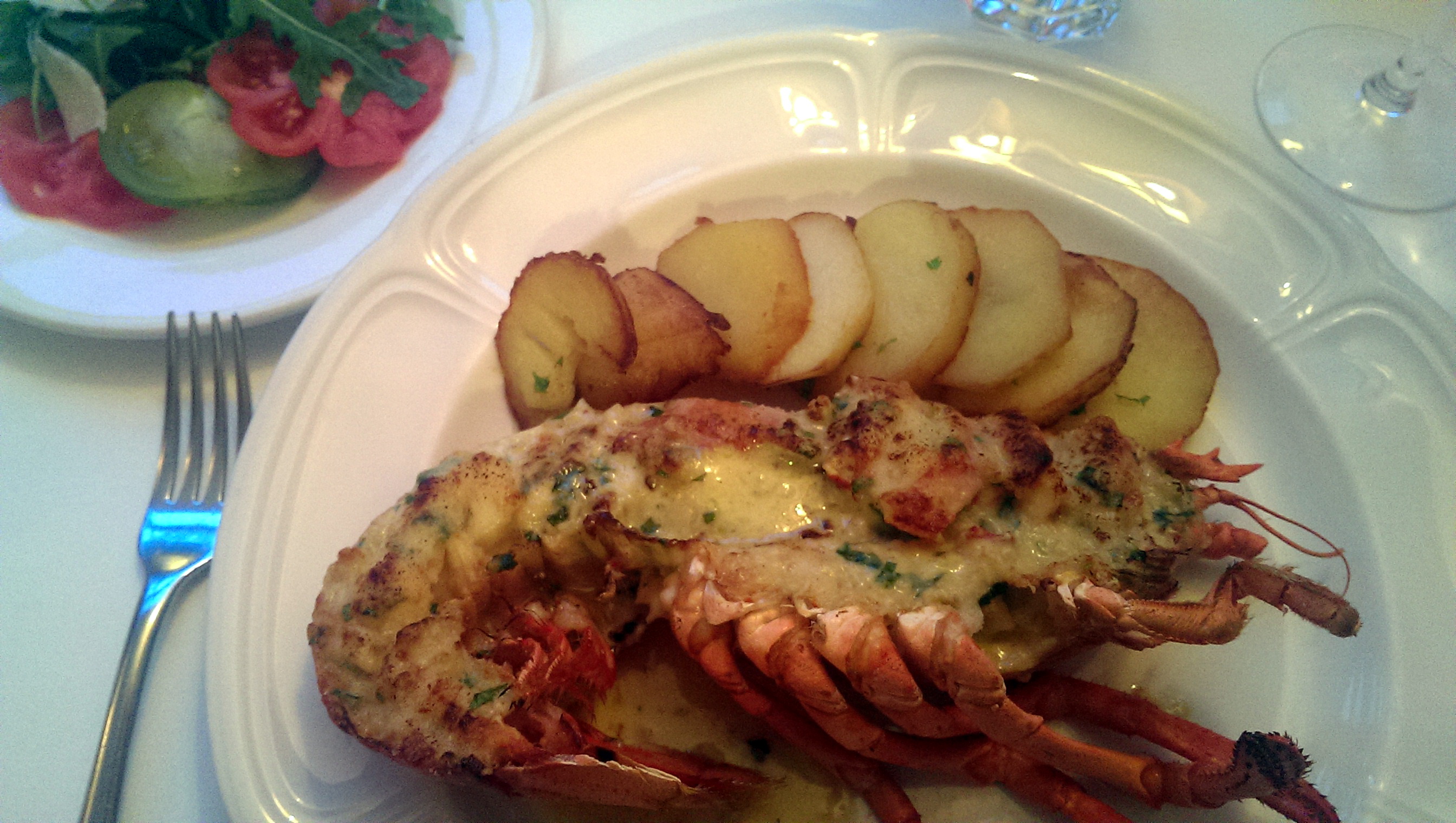
Nearly all the mains at Ruchetta are around the twenty-five pound mark, so it didn’t seem too much of a stretch to order the half lobster thermidor (twenty-eight pounds, and not even the most expensive dish on the menu). It was just lovely. The meat had been removed, cooked in the sauce, returned to the shell and topped with cheese. I loved the note of tarragon in it, which surprised me as I’m usually not a fan and didn’t realise it would be in there (like most people outside the Royal Family, I don’t eat lobster thermidor very often). It came with sauté potatoes, in thick slices rather than cubes, which were cooked well and left plain to keep the lobster as the main event. The side salad seemed lost in all of this: the tomatoes were a mixture of green and red but were pithy and lacking in flavour and was either undressed or underdressed, I’m not quite sure which.

Lobster

The other main, roasted saddle of lamb stuffed with spinach and garlic with lamb sauce and vignole (peas, artichokes, broad beans in mint and pancetta – no, I didn’t know either) was the most disappointing dish of the night. This is going to sound like a stupid thing to say, but the lamb was, well, too lamby. The taste of it was almost overripe, verging on agricultural, and drowned out the lighter flavours of the rest of the dish. It appeared to be stuffed just with spinach, which made for a soggy slog, and if there was any garlic in there I didn’t get it. The peas, artichokes and broad beans, potentially a symphony of spring flavours, were pleasant but bland because there wasn’t enough mint to lift them. Most damningly, it wasn’t particularly hot: the lamb, in particular, felt a bit lukewarm. Also, I know this was a light dish but it felt like it needed carbs of some kind. Not everybody who orders it is going to be lucky enough to be able to pinch some sauté potatoes from another plate, as I was.

Ruchetta is one of very few restaurants that offers wine in carafes; a terrific idea for when it’s hard to decide what wine to pick or if you don’t fancy a whole bottle of something. There are a few affordable wines on the list but nothing under the twenty pound mark, so the carafes aren’t as tempting as they normally would be (they’re also 425ml rather than the regulation 500ml, which somehow seems a little stingy). Because of this we ordered a bottle of Italian viognier (much crisper with more citrus than the French ones I have experienced) and a carafe of Barbera d’Alba which was red, robust and unremarkable. I knew we’d struggle to drink both but a carafe of the Gavi I had my eye on was the same price as the bottle of viognier which made me object to buying it (just because you know the restaurant is going to be expensive doesn’t mean you lose all concept of value, after all).

In the end we finished the red and with only half the white drunk the staff offered to cork it so we could take it home – a nice gesture, I thought. That was fairly typical, as service was excellent throughout. All the waiting staff had that charm which just stays on the right side of over-familiarity, something I associate with good Italian restaurants (and I think all of them were actually Italian, though I may be wrong) and they made sure we never felt hurried. In that respect, it definitely felt like a special occasion – nobody wants to be turned when they’re spending this kind of money.

Desserts, like the mains, were at opposite ends of the spectrum. Lemon posset was a glorious thing, wobbly and zingy, topped with cooked rhubarb and dangerously easy to devour. Everything in it should have been tart and sharp and yet it wasn’t (the grilled figs and little pearls of what looked like fruit caviar on the top did their bit to balance it out). The moist orange cake with citrus mascarpone was more prosaic. It was tasty enough and I was happy to eat it all but compared to the complexity of the lemon posset it seemed a bit basic. All the desserts cost seven pounds – an amount I was happy to pay for the posset but much more grudging to part with for the cake. Funny the calculations you make in your head when you know a restaurant is expensive. We also had a couple of dessert wines with these – a Labrandi and a moscato – and both were beautiful choices.

PossetI said at the start that there were two types of expensive meal. Well, as it turns out Ruchetta is both: the total bill for two people – three courses each, two glasses of prosecco, one bottle of white, a carafe of red, two glasses of dessert wine – was £160. This is the bit where I usually say “but it’s possible to eat far more cheaply”, but I’m not sure it’s entirely true of Ruchetta. Their set lunch during the week is a cheaper, but it’s still £19 for two courses. Sunday lunch is £32.50 for two courses. You could spend less, but I still think it’s the kind of restaurant where the size of your bill is always going to take you somewhat by surprise.

I also said at the start that when a restaurant is expensive the bar is set higher, and that’s why I can’t wholeheartedly recommend Ruchetta. There’s a lot to like: the service is terrific, produce and seasonality is clearly important to them (when I went there were lot of asparagus specials on offer. A lot) and the menu is a tempting, readable mix of classic Italian cooking and more creative, inventive dishes. But I’m not sure which restaurant Ruchetta is meant to be: the unpretentious neighbourhood Italian or the high-end destination restaurant. The pricing suggests the latter, but the execution of some of the dishes (the fondue dish, the lamb) and the way the tables are squeezed together feel more like the former. I was left wondering if someone had got carried away with the calculator when pricing the menu. I went expecting something really special and whilst I really enjoyed it wasn’t quite special enough. If these dishes were priced at the twenty pound mark and there was good wine for, say, eighteen pounds a bottle, I would be making my way to Wokingham again and again. As it is, it will have to wait for the next special occasion and hope that, in the meantime, I don’t find somewhere a little more consistent.

Ruchetta – 7.5
6 Rose Street, Wokingham, RG40 1XU
0118 9788025

http://www.ruchetta.com/

Cappuccina Café

N.B. Cappuccina Café closed in June 2014. I’ve left the review up for posterity.

Cappuccina Café wins one accolade right from the off; I think it might have the ugliest view of any café or restaurant in Reading. From my seat, through the glass front window, I could make out “Sam 99p” on West Street, with its rather hyperbolic slogan Yes! Everything’s 99p or less (it’s hard to imagine anybody walking past and actually saying that). Still, Cappuccina Café isn’t unique in having a bad view. From Picnic you can see the tables outside Munchee’s which house some of Reading’s most glamorous smoking al fresco diners. From the terrace at London Street Brasserie I once made out somebody on the grassy bank opposite urinating against the bridge (stay classy, Reading). None the less, I wanted to make the visit because Cappuccina Café is a fusion of Vietnamese and Portuguese and you don’t see that every day – not in Reading, not anywhere.

First impressions were mixed. It’s a very long room with the counter at the front, the kitchen at the back and the two overstretched waiters constantly doing a long walk from one to the other and back again. Only one person was serving when I got there, and he didn’t seem to be able to make up his mind whether to take my order or attend to the large pile of dishes in plain view in the sink, a pile which made me a tad nervous about ordering anything at all. As it was, he ineffectually pottered around in the general vicinity of the sink before coming back to check what I wanted (I had half a mind to tell him to do the washing up first). Was their dishwasher broken?

It’s a pity because the interior is quite handsome – smartish tables and chairs, a nice banquette along both sides of the room and tasteful tiled walls. There were plenty of cakes visible up at the counter and all of them looked distinctly tempting. I went on a Sunday lunchtime and it was full of families, most of them Asian – presumably Vietnamese, though I couldn’t tell for sure – all tucking into bowls of what I imagine were pho. Normally I’d take this as a good sign, but after recent experiences I approached things with a note of caution. The whole place did have the air of a crèche about it with plenty of kids roaming around – which ironically means this may be the most family-friendly place I’ve reviewed so far.

The general chaos continued well after I placed my order. One of the dishes I picked was bánh mì, the famous Vietnamese baguette which has been so popular in London over the last few years. It looked to me like the staff got a baguette out of the oven behind the counter, part assembled it behind the counter (next to the sink) and then took it all the way to the back of the restaurant, past my table, to add the rest of the ingredients. As a study in time and motion it was weird to put it lightly. To make matters worse, despite being (you’d hope) the easier to prepare of the two things I’d ordered it arrived a good couple of minutes after the other dish. By this stage we’d gone well past chaotic and were cantering into haphazard with reckless abandon.

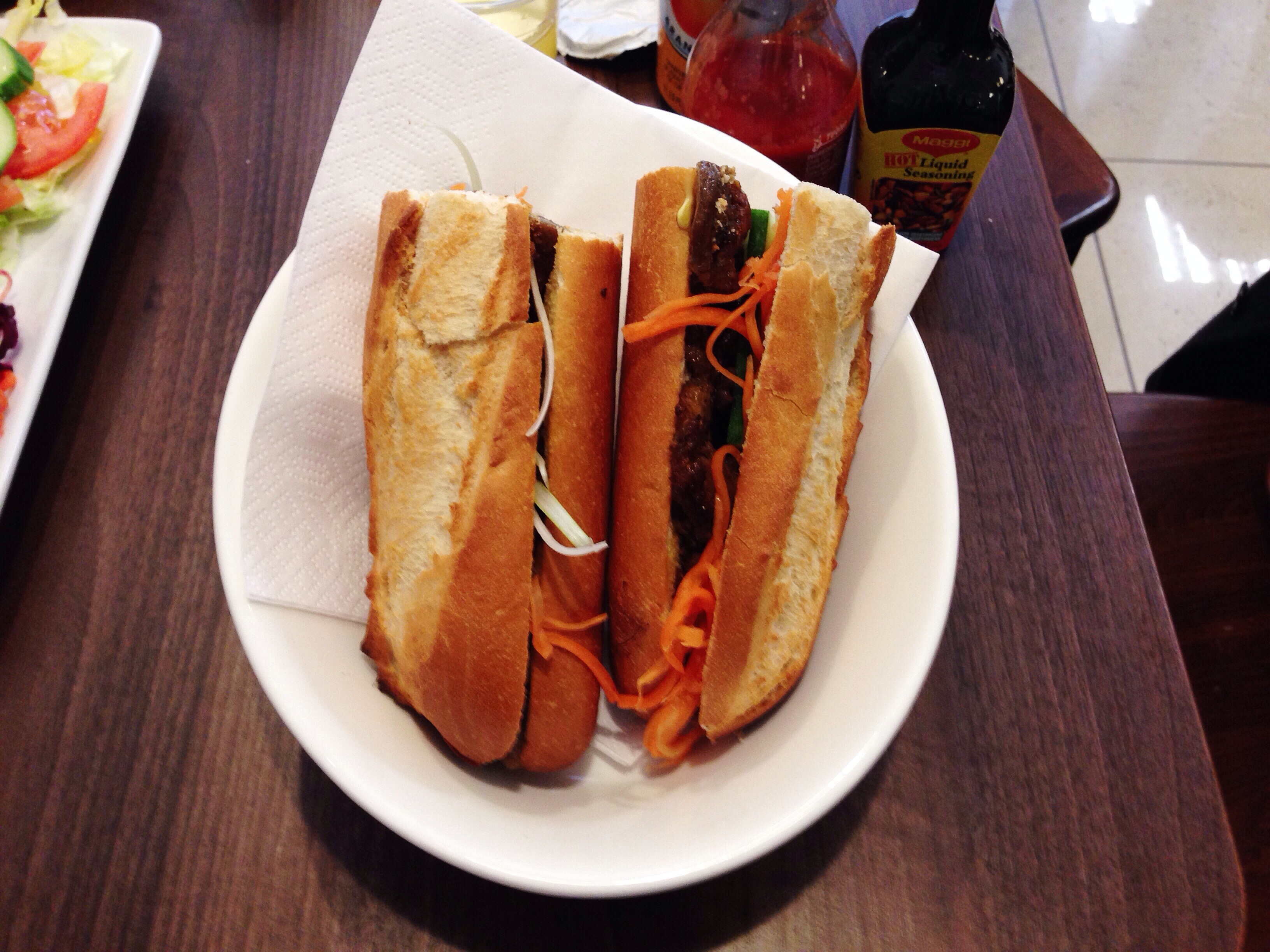
When the bánh mì arrived I had waited so long, with such mounting despair, that I was expecting it to be indifferent. It should have been, because up to that point everything else was. To my surprise and relief, it was anything but. The barbecued pork was moist but not fatty, crispy, warm and utterly delicious. The menu said it was marinated in honey, five spice and lemongrass and I got all of that but especially the lemongrass. The shredded carrot (which I think was pickled), the little strips of cucumber and the daikon added crunch and yet more freshness, although the coriander seemed to be missing in action – a shame, because it would have fitted in perfectly. It was the kind of dish where you have a big grin after the first mouthful which lasts until well after the last, the sort of food that makes you shake your head in slow joy. It made me realise how underwhelming most sandwiches in Reading are – miserable clammy things, heavy and cold and soggy with mayo.

Banh mi

The grilled chicken with rice (com ga nuong) was so much more than the brief description would have you expect. The main attraction was a large leg of chicken which tasted like it, too, had been marinated in spices (including Chinese five spice and lemongrass) with a delicious crispy skin. For the size of the chicken leg there wasn’t a great deal of meat but what was there was moist and tasty, if a bit hard to get off the bone. On the side was a neat hillock of plain rice topped with a little pile of fried onions and a heap of pickled red cabbage and carrot which was just lovely with a forkful of chicken. The only out of place thing on the plate was the afterthought of salad, so forlorn and unloved that it just shouldn’t have been there.

Chicken

I felt it would be wrong to leave without also sampling the Portuguese section of the menu, so I went up and ordered a couple of pasteis de nata for dessert. These came warmed – again, in an oven rather than a microwave – ready to be dusted with cinnamon and wolfed down. For me, a Portuguese egg custard tart is one of the seven culinary wonders of the world, ideally fresh out of the oven, dusted with icing sugar and cinnamon and dispatched in two, maybe three mouthfuls at most. The pastry is light and flaky, the top golden brown and not quite burnt and the filling ever so slightly wobbly and flecked with vanilla. These weren’t like that – too firm, not warmed through enough, no icing sugar – but they were still pretty good, and a darned sight closer than I ever hoped to get in Reading, in a little spot on West Street with a prime view of the 99p shop. Pleasingly they were also ninety-five pence each, which makes them far better value than anything you could pick up in “Sam’s”.

Pasteis

The whole thing – bánh mì, chicken with rice, two tarts, a cup of tea and a soft drink – came to fourteen pounds. A comparable lunch would have cost just as much in Pret, Costa or Nero and wouldn’t have been anywhere near as good. To me, Cappuccina Café is part of something interesting happening to Reading’s lunch scene. All over the place independent cafes are springing up – from Lincoln down the King’s Road (coffee and bagels) to Arepas Caffe at the other end of West Street (Venezuelan food and churros), to Shed in Merchant’s Place (toasties and “Saucy Friday”) – not to forget the granddaddy, Picnic (salad and cakes). There’s no excuse any more for the laziness of going to the usual players on Coffee Corner. So yes, the service is iffy, the layout is a nightmare and they really need to fix their dishwasher, but with all that said I’ll still be going back to Cappuccina, and sooner rather than later. They have three other types of bánh mì and I fancy trying them all, collecting the Vietnamese equivalent of stickers in a Panini album.

Cappuccina Café – 7.0
16 West Street, RG1 1TT
0118 9572085

https://www.facebook.com/cappuccinacafe

China Palace

N.B. China Palace closed in December 2019. I’ve left the review up for posterity.

One of the joys of writing this blog is when people ask me for recommendations. It means an awful lot that you (well, maybe not you specifically, but you catch my drift) trust me enough to approach me for advice. Usually I’m able to help, but I do feel like I let people down when it comes to Chinese restaurants: I’ve been asked several times to suggest a good Chinese restaurant in central Reading and I couldn’t, because I just don’t know of any. And when I’ve been asked about China Palace, which is probably the best-known Chinese restaurant in town, all I’ve really been able to say is that I wasn’t a fan, although that’s based on a visit from some time ago. So this week’s review ends the (I’m really sorry about this pun) China crisis and kills two birds with one stone: filling a gap in my repertoire and meaning I can give you better advice on restaurants in Reading.

China Palace is one big room next to the Argos, on the outskirts of the Broad Street Mall (“Reading’s favourite mall” according to, well, the Broad Street Mall). It’s undeniably handsome with beautiful black lacquered walls and lots of tables, mainly large circular numbers with proper white tablecloths. I went on a Monday lunchtime and it was more than half full, a sign of a restaurant doing something right. Another promising sign was that the other diners appeared to be pretty much all Chinese: everything was shaping up nicely for a delicious, authentic meal.

When I arrived I was disappointed to see the tables laid out with dim sum menus; I’ve nothing against dim sum per se but it wasn’t what I’d gone there to review. Fortunately China Palace also offers their a la carte menu, though I did have to ask for it and look suitably helpless. The full menu is exactly that; huge and more than a bit terrifying, offering over 200 different dishes running the gamut from fully Westernised (sweet and sour chicken, crispy chilli beef) to those with more exotic-sounding ingredients (duck web or intestines, anyone?). In the end we were helped by the manager who recommended ordering from the dim sum menu to start with so we could then decide whether or not to order anything else. This struck me as genuinely kind, not only because he could see we were floundering but also because the dim sum dishes are three to four pounds compared to six pounds for an a la carte starter.

The manager picked some relatively user-friendly dim sum for us, steering us away from the tripe and chicken claws and the cheung fun being so expertly manipulated with chopsticks at the neighbouring tables. Prawn dumplings with salad cream (yes really, salad cream) were very tasty – a mixture of chopped and minced prawns, with finely chopped carrot and spring onion in among the relentless pinkness, shaped into dollops a little like misshapen potato croquettes and fried. I liked the taste – especially dipped in the salad cream, something I haven’t had in ages and am now experiencing nostalgic cravings for – enough to overlook the slight wobbliness under the crispy surface.

Vietnamese style spring rolls were even better and a world apart from what I was used to. The rice paper was finer and less stodgy than Chinese spring rolls and the contents far more delicate – so there were mushrooms and beansprouts and prawns but also beautiful fragrant lemongrass. The sweet chilli sauce they were served with was clear, fresh and subtle rather than the gloopy sugary hit you normally get. They were so tasty that we fought over the third spring roll with the prawn dumpling as a runner up. I lost. I’m not bitter (I may be a little bitter).

Dim sum 1

Possibly even better than the spring rolls were the steamed pork buns. I’m sure I’ve had these elsewhere and really not enjoyed them but my guest really fancied them so I was prepared (or forced) to give it a go. These were three fluffy dumplings, sweet and thick – rather like bread made with candyfloss, if that makes sense – filled with chopped char siu style pork in a rich red sauce. We picked them out of the steamer by hand and burned our fingers on the hot dough and our tongues on the filling because we didn’t want to wait. All of the dim sum came served in threes – the curse of the odd numbers, again – but after failing to win the prized third spring roll I made sure we split the last bun fifty-fifty. I wasn’t going to make that mistake again (see? not bitter).

Dim sum 2

All told those dishes cost us about ten pounds. I wish I’d stopped there, or flagged down the manager again before ordering the mains. I’m sure I’d have had a better meal if he’d picked our dishes. To be honest, I’d probably have had a better meal if he’d cooked them, too. I can’t even rule out the possibility that I’d have had a better meal if I’d gone into the kitchen and done it myself.

The sizzling lamb with ginger and spring onion wasn’t sizzling, literally or metaphorically. I was expecting it to arrive with a bit more theatre and be drier, rather than the rather slimy looking dish which turned up (my friends tell me they’ve had very similar experiences on match.com). The sauce itself was shiny and bland. All the ginger came from huge slabs of the stuff scattered throughout the dish which made the taste a rather binary affair: either it tasted of ginger and nothing else, or it tasted of nothing at all. The lamb was floppy slices of oddly textureless meat which didn’t taste of lamb and easily could have been lamb, beef or something created in a particularly unpleasant laboratory. I didn’t finish it and I didn’t regret it, and minutes later I couldn’t really remember anything about it except how unmemorable it was.

Lamb

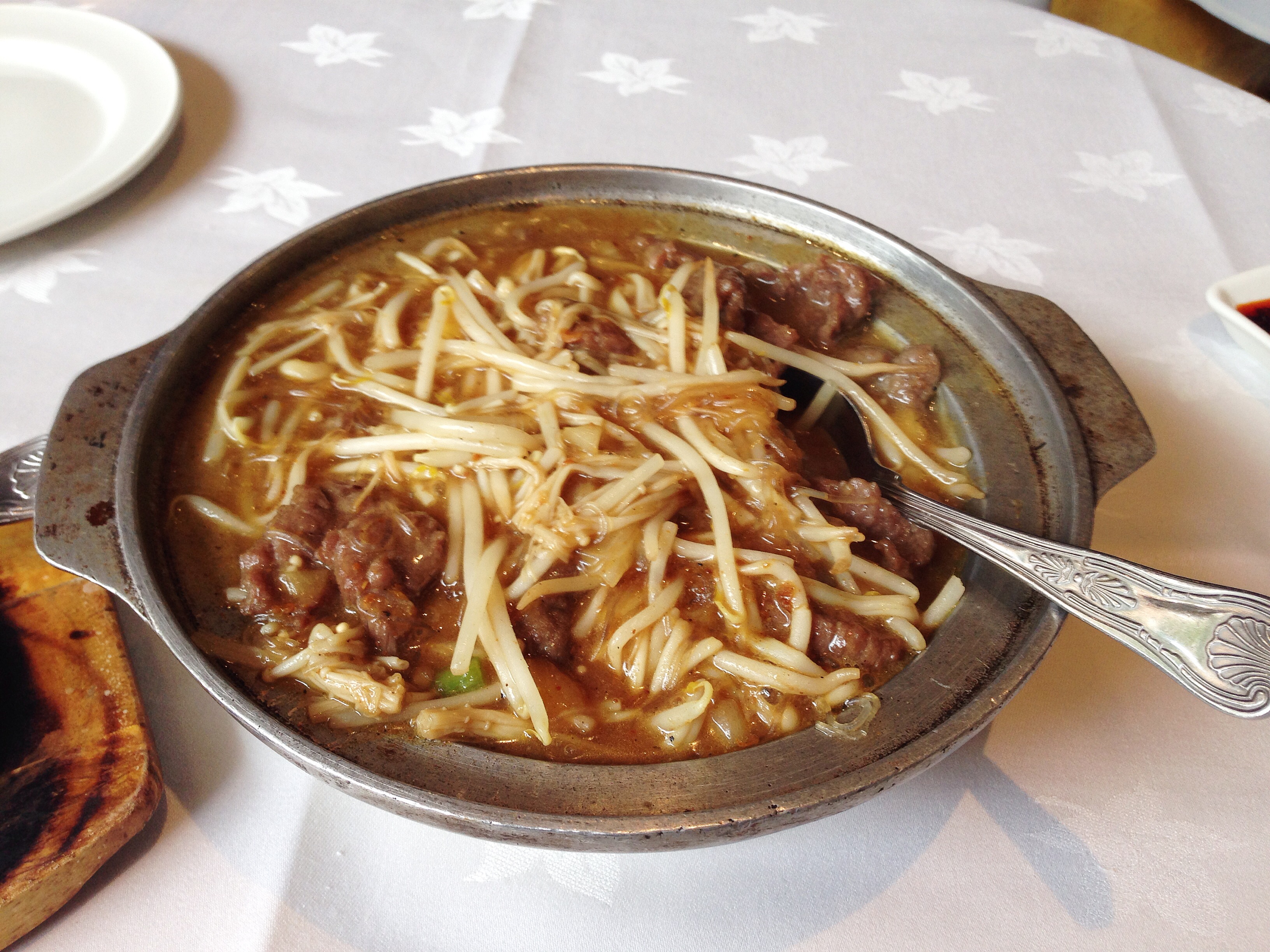
The beef with golden mushrooms in satay sauce (from the “chef’s favourites” section of the menu, “favourites” appearing to translate to “a couple of pounds more expensive”) was better without being good. The beef was as grey as the lamb (if you had told me they were the same meat I would have believed you) but the dish was almost redeemed by everything else. The golden mushrooms turned out to be enoki, the skinny little pinhead mushrooms which grow in clumps. There were also, rather randomly, little pieces of pineapple which turned out to be a pleasant surprise. This was all generously distributed in a sauce which I suppose you could just about have described as satay if you were otherwise lost for words. It was inoffensive verging on pleasant but had no salt, no kick and no real oomph. For thirteen pounds fifty, I was expecting something considerably better. The dish was padded out with what I think were glass noodles, rendering the steamed rice a bit redundant. Except by then it was all redundant because the dim sum was quite nice, this was desperately average and I was already wondering how much I could leave without causing offence when I asked for the bill.

Beef

Getting the bill proved difficult (I had to ask twice). Getting served, except by the manager, proved difficult. Getting any kind of suggestions proved difficult. Getting a smile proved difficult. Getting a second glass of cabernet sauvignon (which was quite nice but felt, from the moment I ordered the first one, like a rookie mistake) proved difficult. Perhaps this is a sign of a very busy restaurant which was used to serving fast turnaround dim sum to the legion of diners there at that time of day. Or maybe this is a restaurant that is so successful that it doesn’t need to look after its diners. Either way I felt a little neglected. The bill for two, for three dim sum, two main courses and four glasses of house wine, came to £60. This included a compulsory ten per cent service charge. Seeing this as value for money proved difficult.

I’ve been thinking a lot about authenticity since I ate at China Palace. You can’t deny that it’s a very successful restaurant: the room seats 120 according to their website and was very busy when I was there. You also can’t deny that it would appear authentic: it was very popular with Chinese diners and I’m told that’s par for the course. But authenticity doesn’t automatically mean good – taste is all that really matters and for me, that’s where China Palace was a let down. Maybe my palate is too Westernised, maybe not, but I like to think I can tell the different between subtle and bland and for me there was way too much of the latter and nowhere near enough of the former. So next time someone asks me if I can recommend a Chinese restaurant in the centre of town I’ll say: No, not really. I suppose there’s China Palace at lunchtime if you pick dim sum carefully but otherwise, probably not. On the other hand, if authenticity is all that matters to you, by all means go there – and all power to you if you can convince yourself that you’re enjoying it.

China Palace – 6.3

43-45 Oxford Road, RG1 7QG
0118 9572323

http://www.chinapalacereading.com/

Bhoj

Bhoj relocated in July 2016 to Queens Walk at the back of the Broad Street Mall, and in February 2018 they closed. I’ve left the review up for posterity.

If you had to name the best restaurant in Reading, which would you nominate? Mya Lacarte? Forbury’s, perhaps? Or would you go further afield and opt for l’Ortolan, still our only Michelin-starred restaurant? Well, TripAdvisor would say that you’re wrong. According to them Bhoj, a relatively little-known restaurant down the Oxford Road, is currently Reading’s best restaurant (Forbury’s and l’Ortolan don’t even scrape into the Top 20). Is that proof that TripAdvisor can’t be trusted when it comes to restaurants, or a heartwarming tribute to democracy in action? I felt I owed it to myself to find out.

The parade of shops on the Oxford Road where Bhoj sits, after Reading West station but before the mosque, isn’t the most inviting location for a restaurant. With a sex shop and the euphemistically named “Skunkworks” (apparently a “one stop shop for lifestyle choices” – which I’m sure it is, provided you’re Afroman) within 100 yards it’s a very different experience to the little enclave next to Forbury Gardens or the more polished surroundings of the Oracle Riverside. Bhoj is only about ten minutes away from town on the number 17 bus and the mix of shops en route makes for an interesting journey (how do all those barbers survive?) even if I was cursing my bad luck that somebody was already at the front of the top deck, stopping me from driving the bus.

The restaurant itself is fairly small – less than 30 covers – and whilst basic in terms of decor it’s spotlessly clean and neatly laid out (the fairy lights were a particularly nice touch). On the night I went, there were only a couple of other tables occupied although it’s clear that a lot of customers use Bhoj for takeaway as I saw one of the waiters leaving with bags full of goodies several times throughout the evening. Service, though, was excellent from the moment I arrived to the moment I left: our waiter – friendly and cheery in an orange polo shirt – wasn’t just knowledgeable about the dishes but (and you forget how rare this is in Reading until you experience it) enthusiastic too, happy to explain everything in a way that meant I didn’t feel stupid asking.

If anything, the menu is a tad spartan – smaller than many Indian restaurants I’ve been to and particularly strong for vegetarians (I showed it to a vegetarian friend after and she said “you should have taken me along to do this menu justice”, with a tone of genuine envy). As so often in restaurants I go to nowadays, I found this reassuring; it made me feel like each of the dishes might be distinctive rather than another permutation of the same orange liquid with different chunks of protein bobbing around in it.

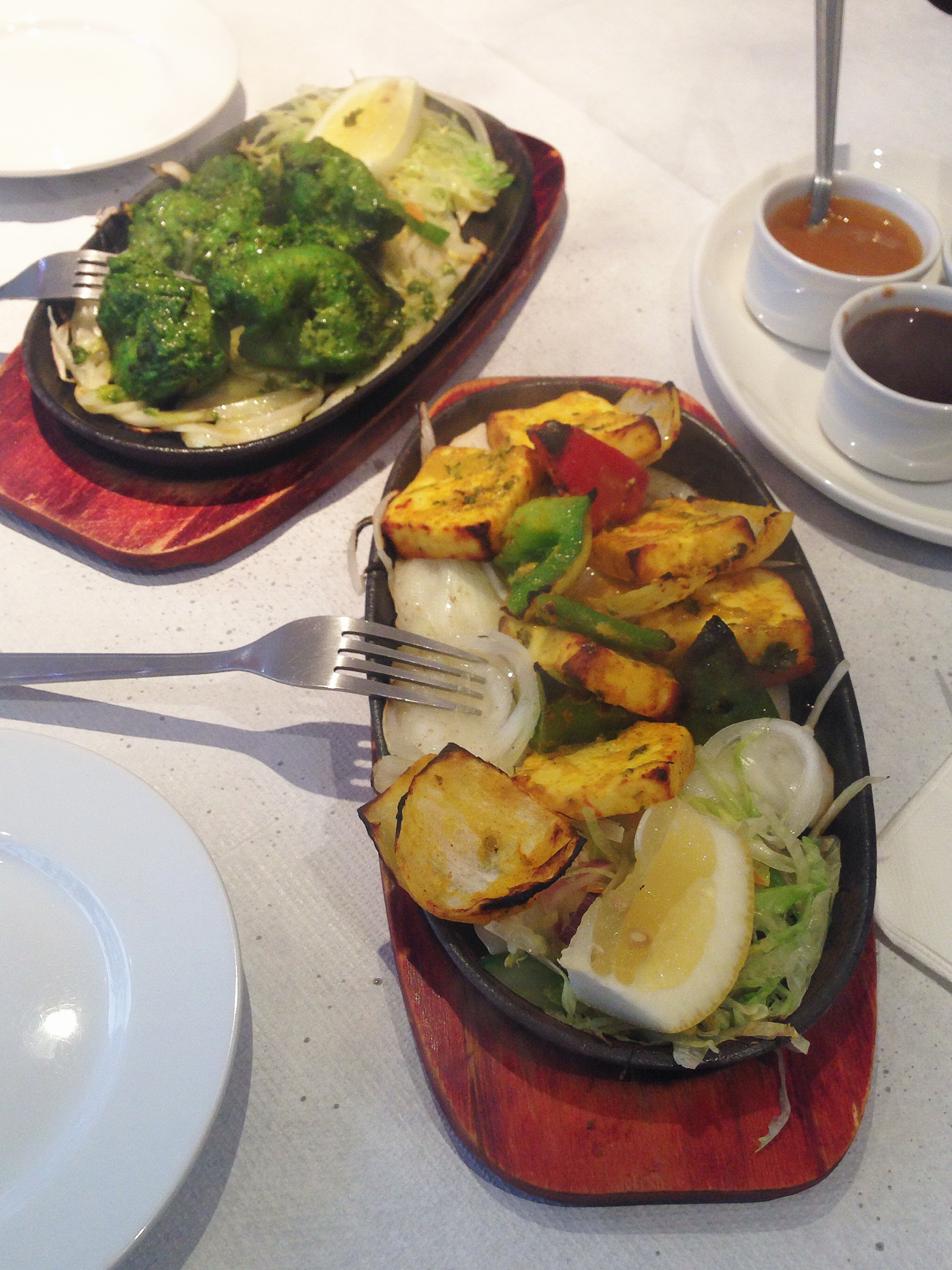
Both starters arrived on those sizzling platters which inevitably induce envy in neighbouring tables: who doesn’t like a dish that audibly announces its arrival? This was great in theory, although by the end the paper tablecloth was so spattered that it looked like we’d been out for dinner with Roy Hattersley. Saffron paneer tikka was served in large flattish squares, gently spiced with chunks of peppers mixed in. I liked it, although it didn’t blow me away and the spices didn’t come through strongly enough. Ironically, I think I was hoping for a little more sizzle and a bit more caramelisation.

Bhoj startersMurgh hariyali tikka – recommended by my waiter as a good contrast – was, well, green. Not pastel green. Not pale pistachio green. I am talking Kermit The Frog green; worryingly green, if I’m honest. It was a huge relief when my knife sliced through to reveal the familiar white flesh beneath. The flavour and colour come from the fresh herb paste that the chicken is marinaded in; I was expecting the mint and coriander (and I think I got a bit of ginger), but there was definitely more than a little garlic in there too. The taste was lovely, but stopping by the newsagent the next day and buying a packet of Extra Strong Mints before heading to work is probably advisable. I did find the chicken a little on the firm side, not as soft and tender as I was expecting from something marinaded before cooking, but even so there was a pitched battle for the fifth piece (do restaurants dish up an odd number just to watch people bicker? I’ve always wondered that.)

There was more of a pitched battle, mind you, for the onions underneath the chicken. Isn’t that silly? Onions are as cheap as can be, so how could they possibly be one of the tastiest things I ate all evening? But it’s true, I promise: sizzling, continuing to cook at the table, soft and sweet, spicy and caramelised, coated in all those juices. They were incredible, and we pounced on them like yummy mummies hitting the Boden website come sale time. It wasn’t dignified, but it was delicious.

You may be wondering why I didn’t mention the poppadoms. There’s a reason for that: I totally forgot to order any. Perhaps that’s the trick to leaving an Indian restaurant without being stuffed to bursting: traditionally I always have poppadoms and by the time the mains arrive dinner is as much a food marathon as it is a treat (I guess your fellow diners are the equivalent of running mates on the other side of the finishing line, cheering you on). I’m glad I forgot on this occasion because the mains were dishes to be enjoyed, not endured.

Dhaba chicken – again, recommended by the waiter – was so gorgeous that I could overlook it being fundamentally meat in an orange sauce. I was expecting it to be hotter than it was, and maybe a little less sweet, but the heat was that clever kind which builds up gradually. Bhoj’s menu, rather unhelpfully, just describes it as a “tangy sauce” so I can’t even bluff and pretend I picked out all the things in there. As always, Indian food shows up how much I struggle with describing such a complex combination of flavours – I got cumin, I got coriander, but beyond that we reach the limits of my powers of description. I can tell you, though, that the chicken wasn’t the star of the show: it was that glorious sauce, mixed in with the jeera rice (speckled with cumin seeds) or heaped onto a scoop of torn, buttery paratha.

Even better was the karahi lamb. This was a drier, hotter curry than the dhaba chicken and easily one of the best things I’ve eaten so far this year. The lamb, in what looked like firm chunks, gave in to the slightest pressure from a fork. The sauce was sticky, rich, intensely savoury: heavenly. I would say that my idea of restaurant hell might well be eating a chicken korma while sitting opposite somebody having Bhoj’s karahi lamb and not being able to try any. Even the bit where I accidentally crunched on a cardamom pod couldn’t dampen my ardour for this dish: I want to have it again, and soon (did I mention that they do takeaway?)

Bhoj mains

When Bhoj first opened it didn’t have a license so was a BYOB establishment. This has now changed, but the drinks list still feels very much like an afterthought. Generally we stuck to mango lassis and these too were streets ahead of other ones I’ve tried in Reading – fresh and recognisably packed with mango rather than the more generic sweet versions I’ve had elsewhere in Reading. Wine drinkers, though, are faced with a real Hobson’s choice: Blossom Hill by the glass or Jacob’s Creek by the bottle.

I was torn – the snob in me would rather not have gone there, but I really fancied wine with my main. What to do? I might get excommunicated from the Guild Of Food Snobs for saying this, but who cares: reader, I had the Blossom Hill and it wasn’t bad. Easy to drink, uncomplicated, went okay with the curries, nothing to dislike (and who’d have a Burgundy with a biryani anyway?) Perhaps, like restaurants people rate on TripAdvisor, it’s popular for a reason; judge away by all means, but I might well have it again next time.

The bill, for two starters, two mains with rice and paratha, three lassis and that rogue glass of Blossom Hill came to £45. I’m not sure how much £45 buys you at l’Ortolan but it’s not a lot. And I would say that it’s worth coming here even though they do takeaway, because the service is brilliant and without it I probably would have ordered what I always have and not discovered some of the great dishes on Bhoj’s reassuringly compact menu.

So, is Bhoj Reading’s best restaurant? Objectively probably not: the room is basic, the drinks offering is limited, my starters weren’t perfect. But personally, I think the best answer to “what is Reading’s best restaurant?” is probably “who cares?” Bhoj’s chef is never going to appear on Great British Menu or be gushed over by critics. They’re never going to do a tasting menu. But that’s the elitist tip of the iceberg, and the rest of the iceberg is what food should really be about – eating something tasty. Sounds oversimplistic, but it’s true. There are times you want three fiddly, fancy courses, and times when you just want to sit down and eat something you know you’ll adore. There are nights when you want to see a wine list the size of a novella and watch a flunky decant your vintage claret into a carafe shaped like a lab flask. But there are also times when you want to sit in a restaurant two doors down from “Skunkworks”, lit by fairy lights, over a fat spattered paper tablecloth and eat delicious, dark, sticky, flavourful lamb, hoping nobody will come in and spot the miniature bottle of Blossom Hill in front of you. God bless Bhoj.

Bhoj – 8.2
314 Oxford Road, RG30 1AD
0118 9581717

http://www.bhoj.co.uk/