Restaurant review: Ciao Bella, Bloomsbury

Family-run trattoria Ciao Bella is at the top of Lamb’s Conduit Street, not far from the British Museum. These days that street is about as affluent as they come, home to the original branch of restaurant Noble Rot and its offshoot wine shop Shrine To The Vine and to the likes of Honey & Co, La Fromagerie, Aesop, Sunspel and fancy umbrella sellers London Undercover.

It’s brimming with possibility. You can have a latte outside Knockbox Coffee in the sunshine, or sip a pint at the Perseverance, where acclaimed Nunhead pizza traders Dinner For One Hundred operate out of the kitchen. It truly is as likeable as street as you’ll find in the capital.

I’m guessing it wasn’t, though, back in 1983 when Ciao Bella first opened. Yet over forty years later it sits at the head of, but somehow separate from, all that gentrification. Because Ciao Bella is that rare thing, a restaurant beloved by those in the know but rarely talked about by everyone else. Ten years ago, back when Marina O’Loughlin was restaurant critic for the Guardian, she listed it as one of her 50 favourite U.K. restaurants.

“This 30 year old trouper packs ’em in night after night” she said and although – as so often with O’Loughlin – this approval had a touch of the performative about it, you couldn’t say she wasn’t consistent. Last year, writing in the FT about life post-retirement as a restaurant critic, under the headline At last, I can eat in places I actually like she said that she was still dining at Ciao Bella, and had recently lunched there three Fridays running. “Every visit is an event, a celebration” she is on record as saying.

It wasn’t just O’Loughlin, though. When Oisin Rogers, celebrity publican and Topjaw fanboy, published his list of his 55 favourite restaurants last year, surfing the wave of his post-Devonshire popularity, he also found room for Ciao Bella. He described it as the “quintessential family-run trattoria… full of jollity and chaos”.

The impression I got of Ciao Bella, doing my research, is that it will never trouble Michelin or the Good Food Guide but remains on many hospitality insiders’ shortlists. “If you don’t like it, you’re a snob” said one regular, interviewed by the now defunct London edition of Eater a few years ago. There was a similar comment in Harden’s: “anyone who doesn’t love Ciao Bella is mad”. Talk about a sure thing.

That’s not to say that all those rave reviews say that the food is brilliant – or, indeed, that any of them do. But they all suggest that it’s good enough, and that the overall experience of eating there is hugely more than the sum of its parts. They talk about the buzzy dining room, the legendary terrace with its blue canopies and its people-watching possibilities, the live pianist every night, the huge unpretentious portions, the seafood pasta decanted from a bag into your bowl tableside.

I’ve always understood that great restaurants are about so much more than the food – something Reading-based readers might recognise as the Dolce Vita effect – and, with that in mind, I would challenge you to read almost anything in the public domain about Ciao Bella and not at least slightly want to eat there. It all definitely had that effect on me. It had been on my to do list for a really long time, and on the last Saturday in September I zig-zagged up Lamb’s Conduit Street, window-shopping in the sunshine, on my way to a lunch reservation with my old friend Aileen.

The terrace always comes up in reviews of Ciao Bella and on a slightly warmer day I might have fancied eating outside, but I really liked the look of the dining room on the ground floor. It’s an unfussy space, its walls groaning with framed black and white pictures with a heavy reliance on the films of Fellini. There’s Marcello Mastroianni and Anita Ekberg, almost connecting in the Trevi Fountain in La Dolce Vita. Just along from that is a picture of the director’s wife, Giulietta Massina, in La Strada. It felt like the room in which all those stories I’d read – of long boozy lunches or chaotic evenings with accompaniment on the piano – took place.

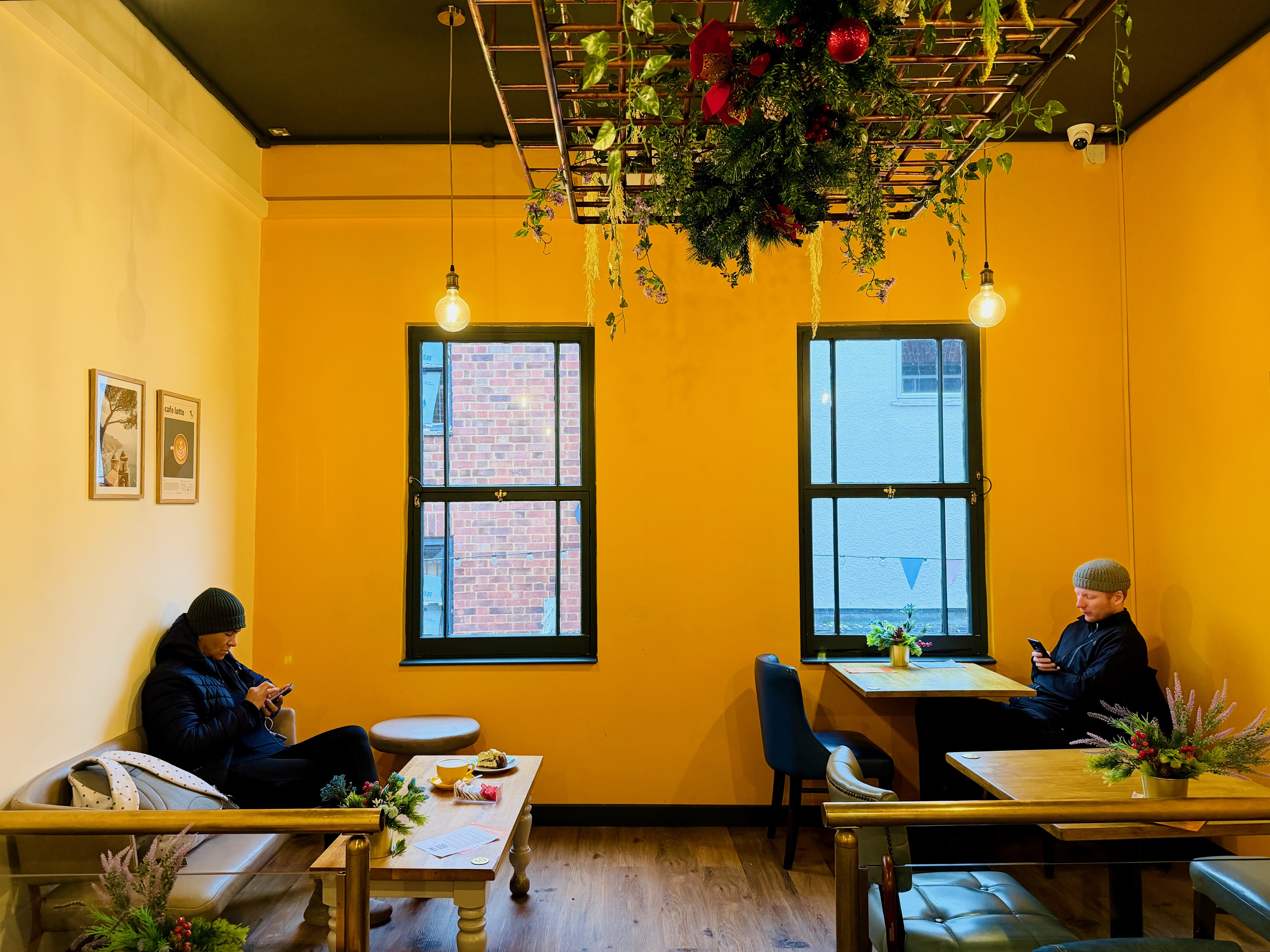
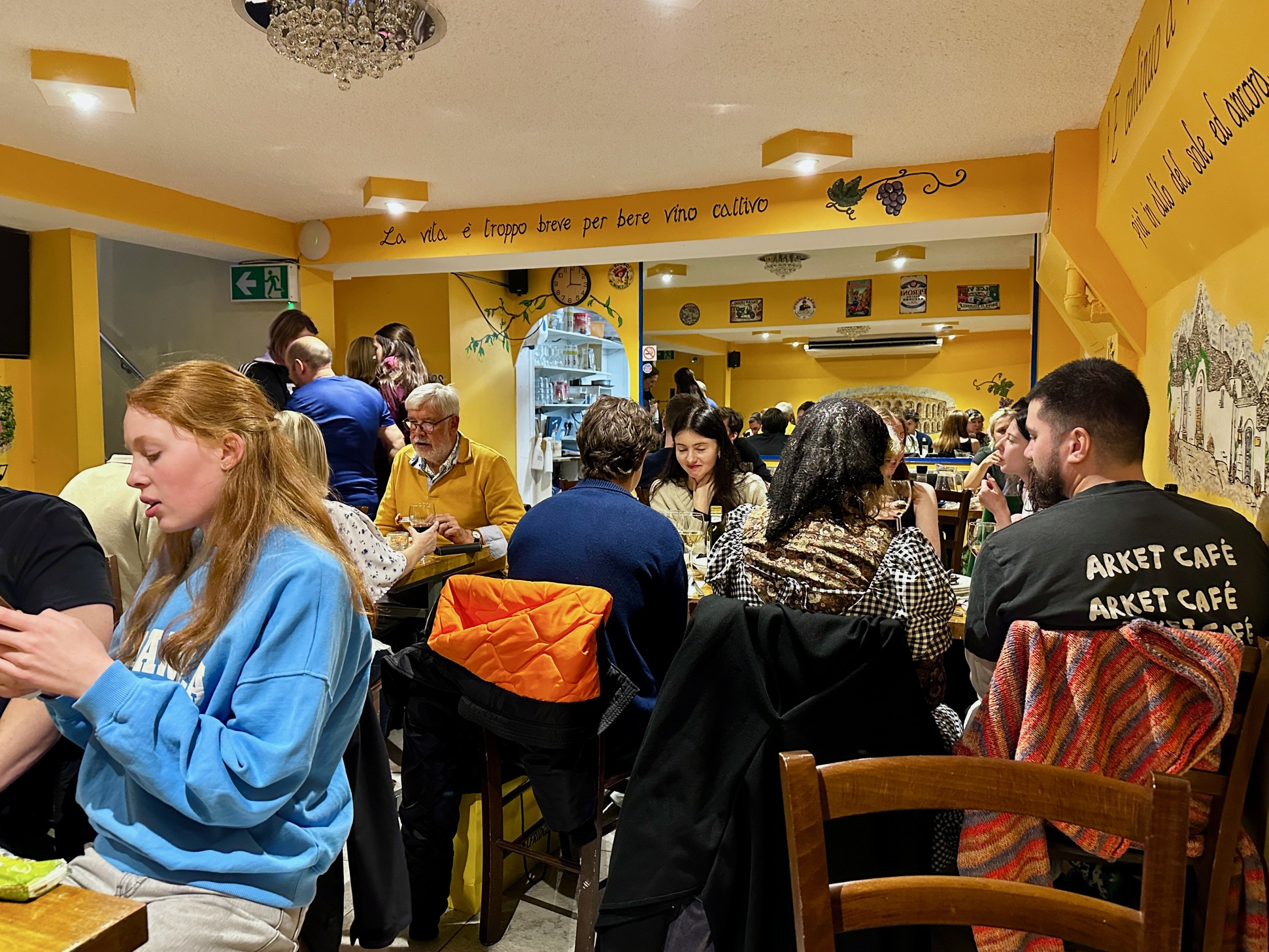
So I was disappointed to be led to the sunshine-yellow basement, which was empty when I arrived, and plonked in the corner, at a table where my right elbow felt like it would be knocking against the wall for the entire meal. On my left I had a great view of the men’s toilets. The waiter conspiratorially told me it was a good seat because I could “see all the pretty girls coming in”, which I’m sure he meant in a vaguely twinkly way but which came across as on the borderline between cheesy and due for cancellation. Maybe I looked like an ornithologist, but I don’t think so.

Rooms benefit from people, it has to be said, and it was a better space by the end of our meal when every table was occupied. But it was still a slightly unlovely one, and I felt like I was in some kind of gastronomic overflow car park, in the room put aside for tourists. I’m used to having that experience in, say, Paris, but it was strange to have it happen in London.

In Ciao Bella’s defence, I think I’ve read somewhere that the basement is usually used for private parties but it seemed on that Saturday that the converse might have applied: when we left there was a wedding Routemaster parked outside on the pavement and I suspect a wedding was being celebrated on the ground floor. I can’t blame them for that: if they had the numbers to escape from the canary-coloured cellar they should have seized that opportunity with both hands. But away from daylight and ambience, I couldn’t help wondering what might have been.

By this point Aileen had arrived and we attacked a very serviceable, almost medicinal, negroni apiece. It was, after all, negroni week – or, to give it its full name, ‘Instagram bores going on about negroni week’. Ciao Bella’s was bang on, no whistles or bells, no flourishes, just a route one approach to dropping that soft, orange filter over the rest of the day. I liked it a great deal.

As we tried without success to get round to the menu, Aileen filled me in on what she’d been up to, which included commencing a grand project with a friend to do twenty-six city breaks over the next ten years or so, proceeding in reverse alphabetical order. Never let it be said that Aileen hadn’t found ways to fill her retirement, not that she sounded very retired from all the side hustles she had taken on since leaving her main job. I learned that Zagreb – where else would it have started? – was very nice, although the cathedral isn’t quite finished yet following the earthquake.

I also discovered that Aileen planned to go back there when it was completed, so I tried pointing out that repeat visits would just make her project almost impossible to finish. Apparently it’s Ypres next, but do pop any suggestions for other destinations in the comments. I’m sure Aileen will read them. X will be particularly challenging, I’m guessing: my suggestion was that she could just about stretch it to Aix en Provence on a technicality. Do you think that’s cheating?

Ciao Bella’s menu, on a single outsized sheet of card, was as pleasingly retro as its website. Its contents were, too: this felt like the menu at every neighbourhood Italian since time immemorial, a proper, old-school selection of dishes. It took me back to places from my past – Pepe Sale circa 2009, or my dad’s erstwhile favourite Sasso in Kingsclere. It reminded me, too, that this kind of spot isn’t seen as frequently as it once was: a quote in that Eater article, tellingly, said “what’s nice about Ciao Bella is that it’s still there. One by one, other restaurants like it have been shut down”.

What that meant in practice was that starters were between £6 and £16, pizzas about £15 if you wanted one and pasta priced all over the place, although you could have a smaller portion of pasta for about £12. It meant that mains were between £20 and £30, a price point that used to mean fancy and now just means ‘get used to it’. It meant mozzarella in breadcrumbs, and Parma ham with melon, aubergine parmigiana, veal with lemon sauce or fried scampi. It meant that the modern affectations of Italian food were largely unnoticed by Ciao Bella: burrata appeared on one pizza, ‘nduja on one starter, neither anywhere else.

There was also a small specials menu, and even that made me feel nostalgic for those evenings at Pepe Sale, a lifetime ago, when Marco would materialise at your table and talk you through the options that evening. By this point, however underwhelming that yellow room was, I was disposed to like Ciao Bella a lot. It seemed to be transmitting from a time when life was very much more straightforward, and disappointment less abundant. I guess this must be the dragon Reform voters spend their whole lives unsuccessfully chasing.

But we were in 2025, where disappointment is rarely far away, and it came quickly in the shape of Aileen’s starter. Breadcrumbed mushrooms stuffed with spinach and ricotta weren’t the kind of thing I’d order, mainly because they always felt like a dish you could pick up in the chiller cabinet at M&S, or Iceland for that matter. They came sauceless and strangely burnt in places, plonked on a plate with a lemon wedge in the middle and pointless distraction from the dregs of a bag of Florette, in a presentation that screamed from the rooftops will this do?

“Taste this” said Aileen, in a manner that was a long way from oh my goodness, you have to try this. “It’s sort of wet: it makes me think it’s been frozen.”

I wasn’t sure about that, but it was middling in the extreme, if such a thing is possible. The filling was watery and bland, the layer of mushroom itself very thin.

“And it’s dry, it needs something else – a sauce, or a dip, or something. How does it manage to be wet and dry at the same time?” Aileen wondered out loud. “And what’s the point of those bits of undressed salad?”

So many questions, and so few answers. The late Shirley Conran famously once said that life was too short to stuff a mushroom: I suspect she might have thought it was too short to eat these, too. This cost £11. I was about to say something pithy about that, but putting the price there on the page, unembellished, makes the point.

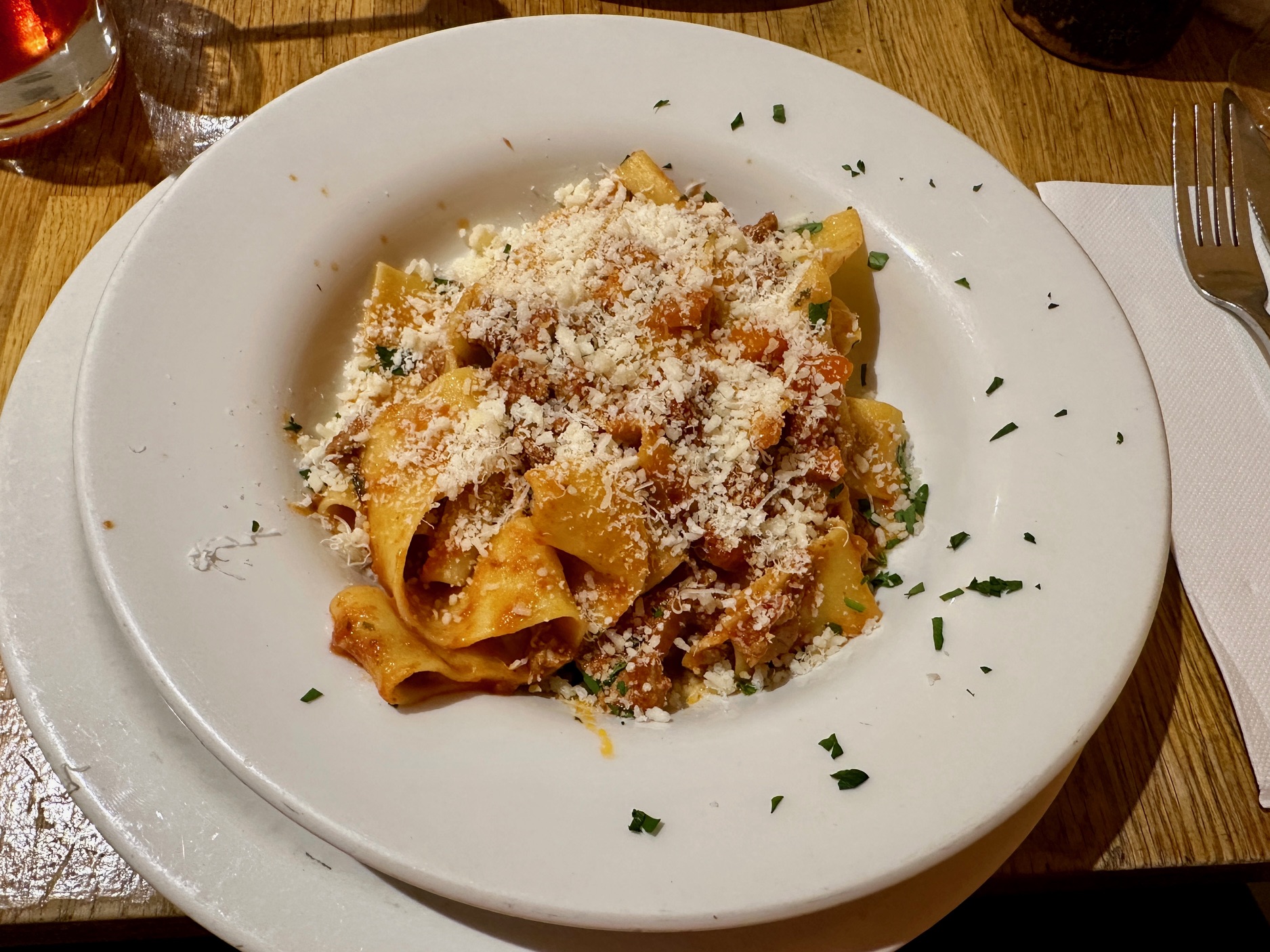
I fared better, but better’s a relative term. Pappardelle with lamb ragu was on the specials menu and it was good but far from special. The thick ribbons of pasta were decent enough, but cooked past al dente until they were more slump than spring, and the lamb in the ragu battled against an overly sharp note of tomato, as if everything hadn’t had enough time to form a lasting relationship. The diced carrots were too substantial, too, standing out where they should have blended in, a long way from sofrito.

Better really is a relative term, and I couldn’t help looking at this dish in other relative terms, too. If I’d been served this at, say, Tilehurst’s Vesuvio I might have been pleasantly surprised. Something this good at Cozze would have been a miracle. But on Lamb’s Conduit Street, in a restaurant older than my wife that’s lauded by food insiders far and wide? It just felt ordinary.

Everything was a little rushed, too – I know I complain about this fairly often, sometimes at length, but the pacing here felt like the restaurant was trying to get ahead of a rush they knew was coming; perhaps it was another impact of having a wedding celebration upstairs. But it meant that our starters must have come out ten minutes or so after we picked them, when we were barely into our negronis, and that meant that a leisurely lunch, the kind so mythologised at Ciao Bella, was out of the window.

So we downgraded our expectations and picked a half bottle of Aglianico from the wine list. To be fair to Ciao Bella it was perfectly pleasant and far from poor value at £15, and I was delighted to see a few half bottles on the menu. Maybe they are to cater for the kind of lunch we turned out to be having. Our mains turned up about fifteen minutes after the starter plates were taken away, if that. Aileen expressed audible surprise that they were so quick, too taken aback to be completely English about it.

I had chosen an old favourite, and something I rarely see on menus, veal saltimbocca. In keeping with the whole nostalgic theme, I suppose, because back when Dolce Vita was at the height of its powers, something like ten years ago, I could have eaten this dish every Friday night for the rest of my life. Some months, to be honest, it felt like I did.

This did just enough to transport me, if only momentarily. That veal, slight and tender, wrapped in Parma ham and served with that sauce singing with white wine triggered plenty of happy memories. And if there wasn’t quite enough sage perhaps it didn’t matter, just like perhaps it didn’t matter that the accompaniment was five little cubes of potato, some veg which probably didn’t come out of a tin but somehow felt like it had and yet more of that bloody bag of Florette. For a moment, I felt like maybe Ciao Bella had worked its magic at last, and none of that mattered.

But sadly, there was one thing that did matter, and Aileen summed it up when describing her main.

“It’s such a shame this isn’t hot.”

She was absolutely right. It felt like the worst of both worlds, really: if your dish is going to emerge from the kitchen in record time you might complain about being turned but at least your meal should be piping hot. But for it to turn up so quickly and be lukewarm? It just felt like adding insult to injury, as if they’d cooked it at the same time as the starters and then just left it lying around on the pass until the earliest possible moment when it could be carted to the table.

Otherwise Aileen would have been absolutely delighted with her gamberoni, I imagine: plump prawns swimming in a sauce which looked almost identical to the one that came with my saltimbocca but which was clearly chock-a-block with garlic. But what was identical were those five cubes of spud, that mixed veg by numbers, that pointless, perfunctory scattering of salad from a bag. What was identical was that feeling of expecting more.

My dish cost £19.50, Aileen’s was £22.50. Neither was so expensive as to leave you feeling like you’d been mugged, but even so that word, ordinary, hovered in the air again.

Also distinctly ordinary were the courgette fritti, which were very thick batons which left your fingers shining with oil. I’ve had some gorgeous versions of this dish over the years – at Town, or at Battersea’s downright terrific Antica Osteria Bologna. The more I think about it, the more I think that everything I’ve heard about Ciao Bella and how magnificent it is emphatically applies to Antica Osteria Bologna. That is the restaurant people say Ciao Bella is. Ciao Bella, I’m afraid, is not.

We’d partly ordered a half bottle of red because we didn’t see ourselves staying the course at Ciao Bella but the dessert menu came along, and our wine was nearly finished, so we thought that we may as well give the restaurant one last chance to turn things around. It was, ironically, the area where I found Ciao Bella strongest, although the dessert menu does essentially say that only three of the desserts are homemade: possibly their most famous dessert, lemon sorbet served inside an actual lemon, is apparently not.

We ordered two of the three homemade desserts and I would say they were the – best? least disappointing? most acceptable? – things that we ate. My tiramisu wasn’t going to win any awards but it was a classic example of this dish – a thick wodge buried in cocoa, deeply boozy savoiardi biscuits and mascarpone in distinctly agreeable harmony. If everything else had been at the standard of this, I’d have liked the place far more. Still, better to finish on a high I suppose than begin brightly and plummet from there.

Similarly Aileen’s panna cotta, served in the shape of an old-school jelly mould, had a satisfying wobble and was crowned with a nicely done fruit couli. The dessert menu blurb is far too literal where the panna cotta is concerned – not sure “popular creamy white dessert made with sugar, gelatine and vanilla” is really selling it to anybody – but thankfully Ciao Bella is better at making panna cotta than it is at describing it.

The whole dessert experience rather summed Ciao Bella up. At £8.50 and £7.50 apiece these dishes weren’t expensive. But they arrived about five minutes after we ordered them, which is plain silly. I was catching up with a very good friend I hadn’t seen in a year, we’d been chatting so much that it took ages for us to place our order. Absolutely nothing about us, as a table, said “we’re in a hurry”.

It was nice of our waiter – who I do have to say was charming, in that very well-practiced way you might expect of an old stager – to ask if we wanted coffee, but by then we were ready to cough up and seek out somewhere else for the rest of our afternoon. Our bill came to just under £140, including an 11% optional service charge (this very specific uplift, deliberately picked to fall between the traditional 10% and the more common 12.5%, seemed strange). It was hard to feel happy with it or angry with it. It was what it was, as the meal was what it was.

Sitting outside Noble Rot, across the way, afterwards with a very nice bottle of red, making the most of the fact that it was still warm enough to do so, we agreed that the meal at Ciao Bella had been a tricky one. Even though both of us felt our meal could have been far better we didn’t feel aggrieved in the way that we might have done.

I’ve thought and thought about it since, and I’m still not sure entirely why. Of course, I had a lovely lunch with a very precious friend, and we both agreed that it could have happened anywhere and we would have had an excellent time. So there is that, but I can’t give a good rating every time I have lunch with Aileen just because I’m having lunch with Aileen: my credibility can do without that kind of dent.

So what was it? Did some of Ciao Bella’s magic transfer to us, by osmosis from the better, buzzier room upstairs, or slip through the cracks in the ceiling? I really don’t know. Objectively Ciao Bella was deeply average. If you had an Italian restaurant like it in your neighbourhood you might go, and you might go often enough to become a regular. You might form the kind of relationship with it where you overlook off days and look forward to seeing your favourite waiters or ordering your favourite dish.

But it is, as others have said, the kind of restaurant that is slowly dying out in the U.K., replaced by pizza places that only do pizza, pasta places that only do pasta and the abomination that is mid-price casual dining trying to devalue Italian food with all its horrendous Zizzis, Prezzos and Bella Italias. Maybe I just felt a little warm echo of some of the restaurants I’ve loved over the years that are no longer with us, and maybe some of that goodwill reflected on Ciao Bella, although it might not have deserved it.

Yet although it wasn’t my cup of tea, I can imagine it might hold that place in the affections of others, and I do envy them, both what they have and what I’ve lost. It’s funny, sometimes I can read reviews of restaurants in places I will never go, enjoy the writing, know I’ll never go there and feel that reading the review was enough, that it was as close to dining in that restaurant as I need to get. I sort of hope, on some level, that this review serves that purpose for you, even if the meal wasn’t entirely for me.

So if you’re the sentimental sort, you’re in London a lot, and you want to do your bit to prop up an institution, one of the last of its kind, if you’re prepared to overlook some bad tables, some middling dishes and some lukewarm food you might find, after you’ve invested enough time and money, that Ciao Bella is a restaurant you can truly fall in love with. For the rest of us, it might be better just to know that this place exists for its people, that there are places like that out there for everybody, and that in time we will all find ours.

Ciao Bella – 6.4
86-90 Lamb’s Conduit St, London, WC1N 3LZ
020 72422119

https://ciaobellarestaurant.co.uk

Since January 2025, Edible Reading is partly supported by subscribers – click here if you want to read more about that, or click below to subscribe. By doing so you enable me to carry on doing what I do, and you also get access to subscriber only content. Whether you’re a subscriber or not, thanks for reading.

Restaurant review: Vino Vita

Last year, in one of the more baffling developments in Reading’s food and drink scene, wine bar Veeno changed its name to Vino Vita. It wasn’t initially clear whether this was because the people running it had bought the business from Veeno or if something else was going on. If you read the details on Vino Vita’s website you’d be none the wiser. “We’ve rebranded, but our commitment to excellence remains unchanged” it said. “Join us as we start an exciting new chapter that expands our offerings and vision.”

More details emerged when the owners spoke to the Chronicle last month. “A big reason why we became independent was so we could have more say over the produce” said the restaurant’s Head Of Sales. “We developed our whole menu, and everything is done on site.” I remember reading the article and thinking that this potentially merited a revisit, but the main thing I took away was They have a head of sales? It felt like a role Veeno, a chain with 5 restaurants across England and Scotland, might need but that Vino Vita, a single spot opposite Forbury Gardens, probably didn’t.

So what were the differences, and had Vino Vita improved on the Veeno formula since taking their destiny into their own hands? The only way to be sure was to eat there – which clearly I did, because you’re reading this – but before that I carried out some research. Because I visited Veeno on duty nearly 8 years ago, not long after they opened, and at the time I would have said that there was plenty of room for improvement.

Vino Vita’s menu does indeed offer a slightly wider selection of dishes than Veeno’s, with more nibbles, bruschette, small plates and so on. It has about as many pasta dishes, although I’d say Vino Vita’s sound less interesting. The big difference, and again this is baffling, is the sheer volume of pizza: between conventional pizzas and Pinsa Romana, Vino Vita offers almost twice as many options as its estranged siblings.

Did Vino Vita move in this direction to compete directly with the likes of Mama’s Way, who clearly have superb access to produce? And if so, wouldn’t you maybe change course given that Reading has seen pizza place after pizza place open this year, at least two of them – Paesinos and Amò – being truly first class? I did wonder.

A couple of other strange things that came out of my homework. One was wine. Veeno’s selling point was that the wine was from their own vineyard: their selection was excellent, the vast majority of it was available by the glass and much of it was affordable. To give you an example, 7 of their 21 reds will set you back £30 or less. By contrast, Vino Vita’s 21 reds were more expensive – the cheapest was £29.95, the remainder all cost more than that.

It wasn’t clear where any of them came from either, because unlike Veeno, Vino Vita didn’t quote producers or vintages. It felt odd to split away from the parent company to offer greater choice, only for that choice to be more expensive and less informative. Like the name change, it had a hint of shadiness about it.

The other odd thing was something I discovered when making a reservation, because booking online with Vino Vita also raised some questions. The thing is, you don’t just book a table. You also have to tell them, and I’ve never seen this before, when you plan to give it back. Not only that, but you also have to say what you’re booking it for – is it for a meal or an Experience?

Yes, an Experience with a capital E, and the booking system asks you which one you want: Quattro Rossi, for example, Trip To Italy or Italian Afternoon Tea, without telling you what they are (they’re on a separate menu, but it’s odd that they don’t tell you as part of the booking Experience – sorry, I mean experience). And all those Experiences? Copied straight from Veeno. The grape didn’t fall very far from the vine, it seemed.

After all that research, I was in two minds about going to Vino Vita. Was it different enough? Was it promising enough? But one thing clinched it. Sometimes people specifically ask if they can join me for particular reviews: so for instance, when I get round to visiting Lebanese Flavours to discover whether the artist formally known as Bakery House has simply changed its name or changed for the worse, my friend Liz has called shotgun on that one.

Similarly, I can’t review Wendy’s unless it’s in the company of Kevin, a long-standing reader, because I promised him, and as he’s moved to the Cotswolds it won’t happen any time soon. In this case it was Zoë, my wife and number one dining companion, who put in a request specifically to go to Vino Vita, so I met her outside at the start of the weekend, to discover whether their commitment to excellence really did remain unchanged.

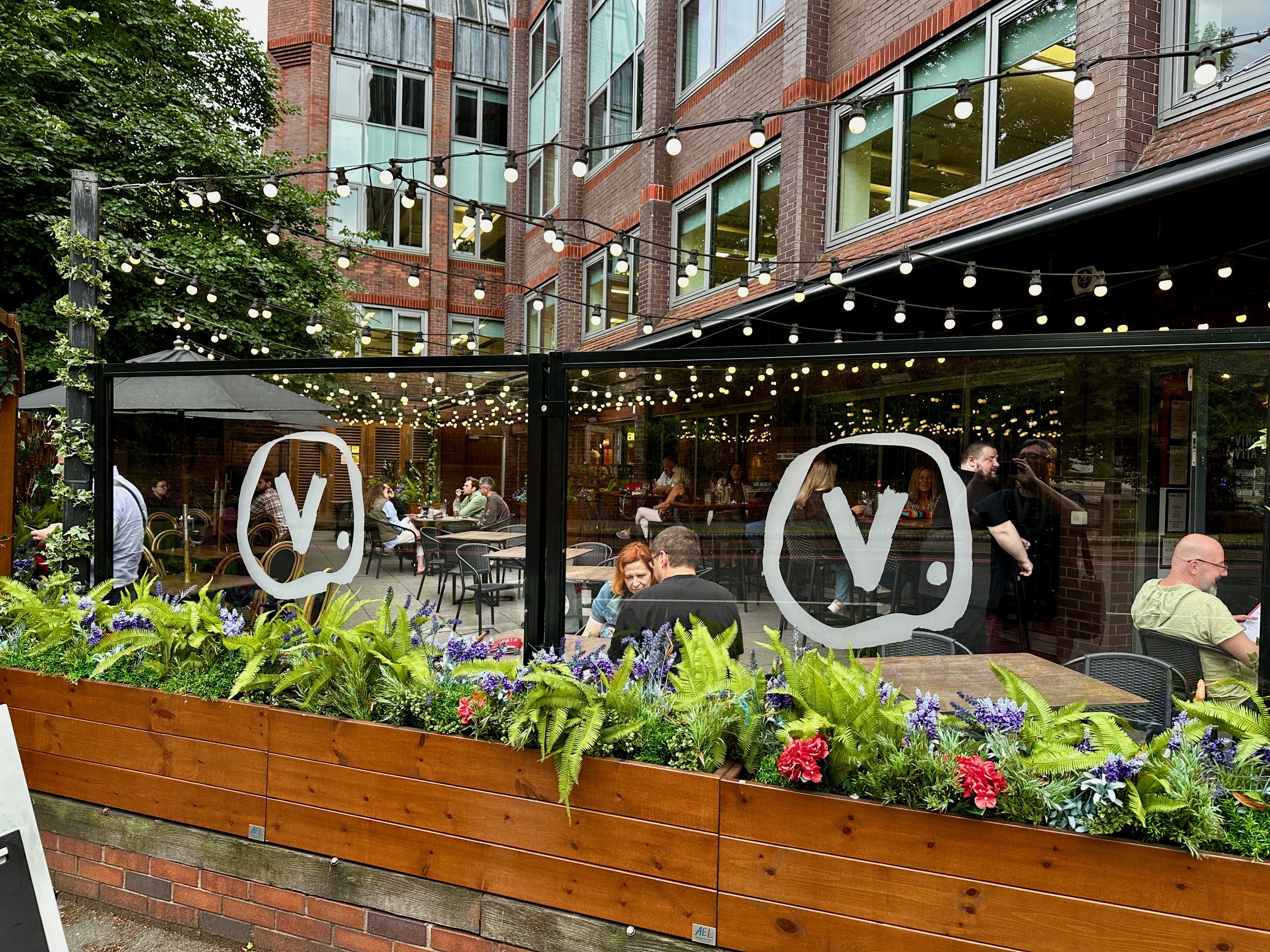
Our table wasn’t ready when we arrived, so we went out to the terrace to have a drink before our meal. It really is one of Reading’s most appealing al fresco spaces, a very pleasant spot opposite the park, strung with lights and convivial on a warm day. It was nice to spend time there before dinner, quitting as the evening became a little nippy, but it does help if you don’t mind passive smoking because there was a fair bit of that. Very Italian, I suppose.

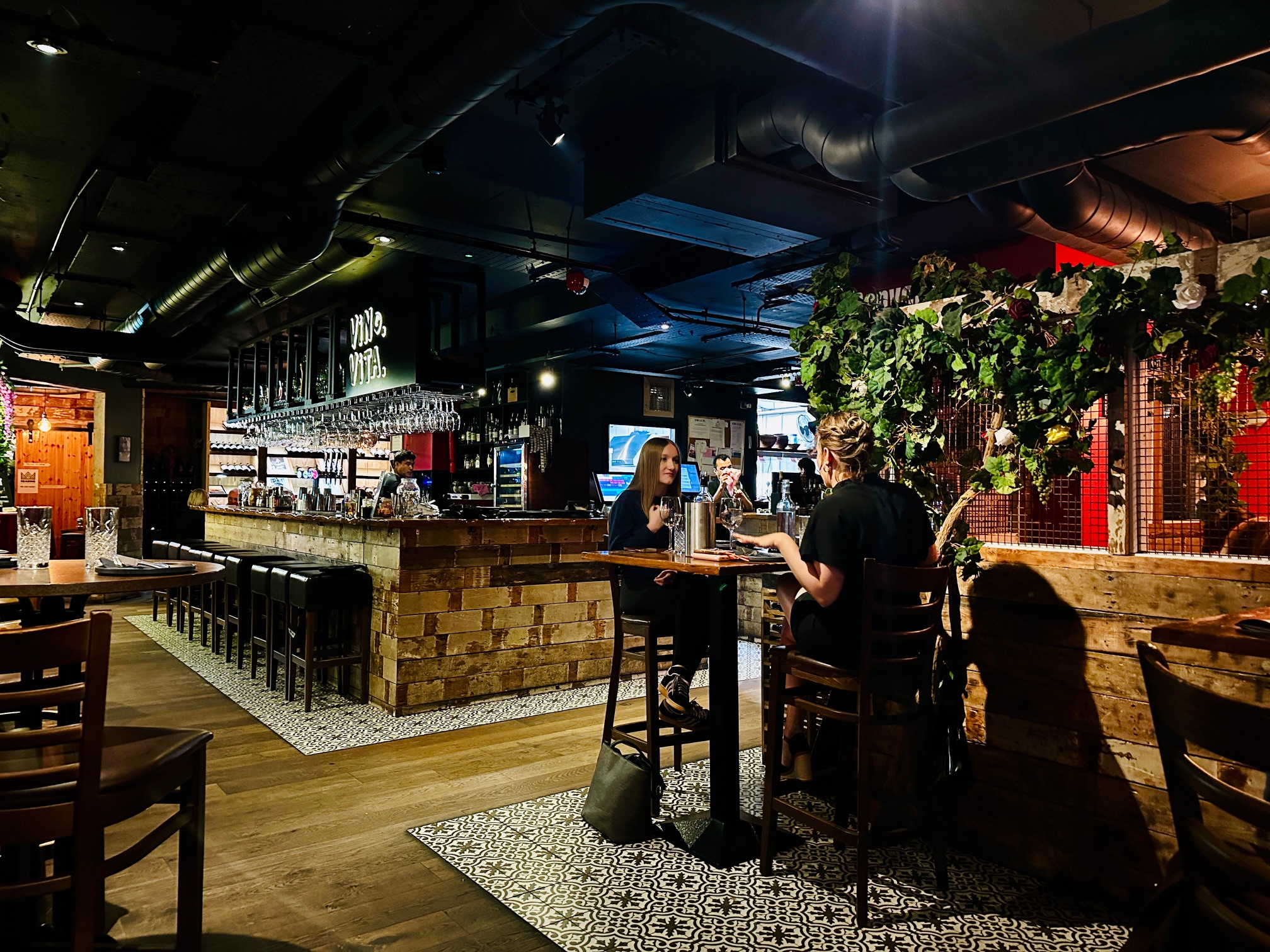
It was, however, difficult to get attention. So by the time we did, and managed to place an order, and the nibbles came out, it was chilly enough that it felt like time to move inside. Vino Vita’s interior didn’t feel any different to when it was Veeno, and I’ve always found it a slightly disjointed set of spaces – some high tables, some low tables, a series of disconnected rooms that don’t entirely feel like they’re all part of the same establishment.

We were taken to a more conventional table to the right of the bar, in the room I’m pretty sure I ate in back in 2017. On a Friday night the place wasn’t rammed, although I suppose many of the customers were outside. Perhaps they seated all the people that had booked a table for an actual meal in the same room, and everyone else was off having their Experiences.

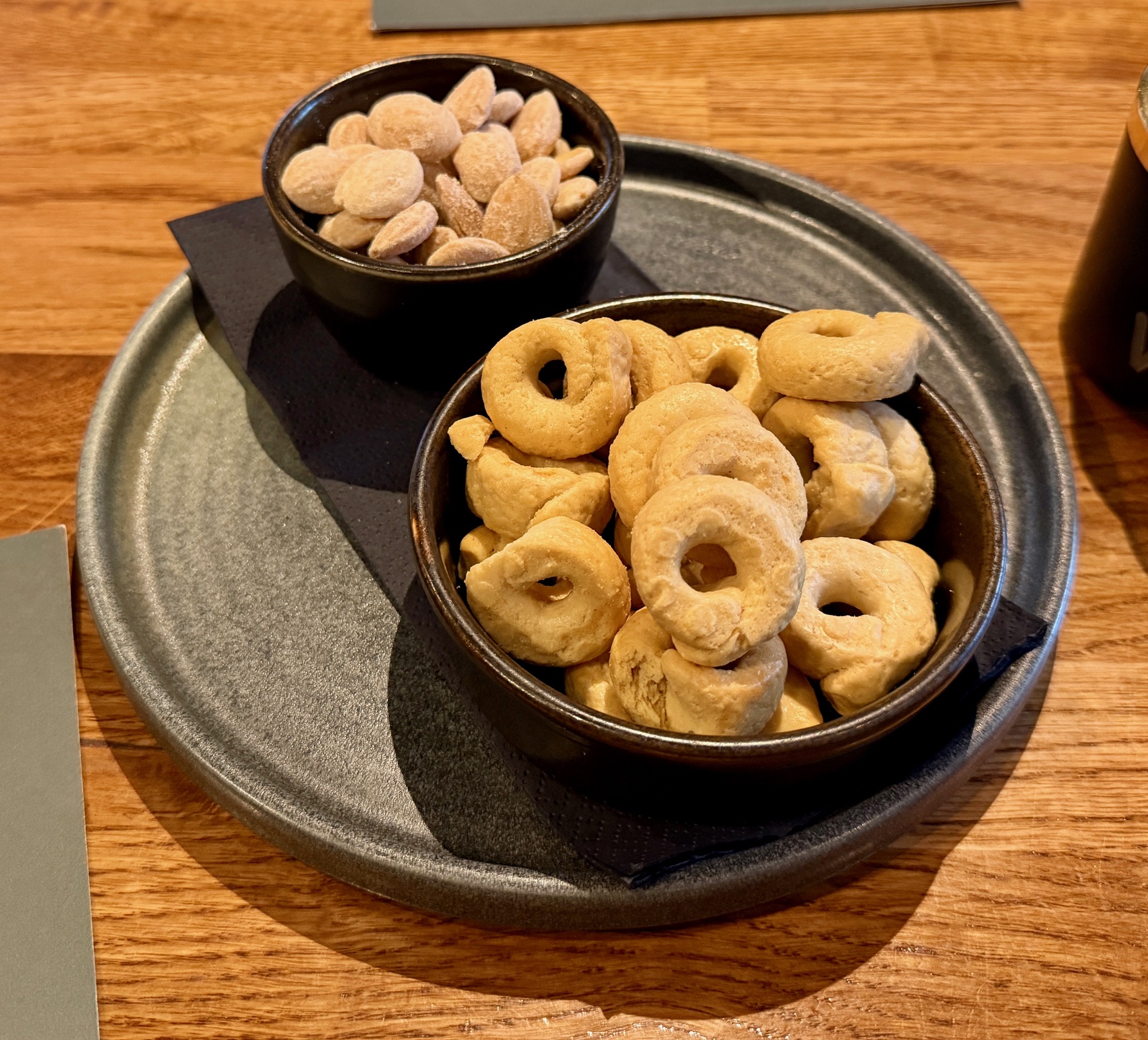
Our nibbles were disappointing, sub-pub stuff. I was hoping that salted almonds would be the kind of treats you get in Andalusia, burnished with oil and speckled with salt. These were out of a packet or a tub, dusty with salt and completely unremarkable. Even more nothingy were the taralli, dense little knots with the texture of sawdust. Really good taralli come spiked with fennel seeds and, with a crisp white wine, can be a delight. These weren’t really good taralli. Eight pounds for two ramekins of blandness.

We had a wine flight with these, the “VINO.VITA.BIO” which was three 70ml glasses of Vino Vita’s organic wines. The first, a verdicchio, was genuinely very enjoyable – and it was just as well that it was, because getting someone to bring some water to accompany those very dry snacks proved difficult. When we finally did manage it one of the staff brought a small bottle of water, a single glass and another glass full to the brim with ice. We had two perfectly good water glasses sitting on the table, which made it all a bit weird. “It’s funny” said Zoe. “They do have enough staff, it just feels like they don’t.”

The other two wines in that flight, by the way, were also quite nice. One, a Nero d’Avola, was decent, perfumed and very enjoyable: it didn’t go with anything we ordered, but that might be because it was tasty and none of the food turned out to be. The third wine was a Frappato, which is a new one on me, and was also perfectly drinkable.

This is sure to be a firm favourite amongst those who enjoy wines on the medium end of the spectrum said the blurb on the piece of paper which accompanied the wine flight: that quote is sure to be a firm favourite amongst those who like their sentences to be completely devoid of meaning. As with the wine list, the piece of paper didn’t give useful details like producers or vintages, and you didn’t get to see the bottles or labels. Did that make for a premium experience, or Experience, when you were paying £17 for 210ml of wine?

We’d also ordered some garlic ciabatta, but our server accidentally brought over the bread selection instead. He was very apologetic, and ran off and made amends, but it was a useful exercise because the bread was a dreary-looking generic selection, none of which looked like it had been baked onsite or indeed anywhere exciting; I made a mental note not to order any of the numerous bruschetta options.

Instead we got what we’d originally ordered, four slightly sad triangles of ciabatta which had been sort of toasted, a little, inconsistently brushed with olive oil and scattered with parsley. There was some garlic there, but nowhere near the industrial quantities Italian food called for. Zoë thought this was okay, but she was being charitable. I thought that for six pounds I was having the kind of thing you could easily pick up at a supermarket.

The real crimes against Italian food, though, were to follow, in a meal where the longer it went on the worse it seemed to get. I can’t think of a better way to demonstrate that than the first of the small plates we’d ordered. The menu promised stuffed courgette flowers, and I thought this would be a real test of whether they truly held all those lofty aspirations. Because a courgette flower, its head stuffed with ricotta and lemon zest, the whole thing fried in an almost translucent, lacy batter is one of the very best things you can eat.

It is serious cooking, and a menu offering it is making a claim to be serious about cooking. I still remember it being served by the Lyndhurst, when I held a readers’ lunch many years ago: Amy, the vegetarian on our table, had it all to herself and every omnivore envied her. It’s taking all my strength not to include a picture of it in this review, so you can see what it’s meant to look like. Instead, just look at that: three beige cylinders bearing no resemblance to courgette flowers at all. No light coating, instead a thick layer of stodge.

Inside, something that definitely wasn’t a courgette flower: I’m prepared to take their word for it that it was courgette, but only just. And inside that, some blend of cheeses that tasted of nothing. This was like some kind of continental reinterpretation of stuffed jalapeños you might pick up at Iceland, an affront to the promise of this dish. Providing some honey, the only thing that actually tasted of anything, didn’t rescue it. The price – £8.50 – rubbed salt in the wound.

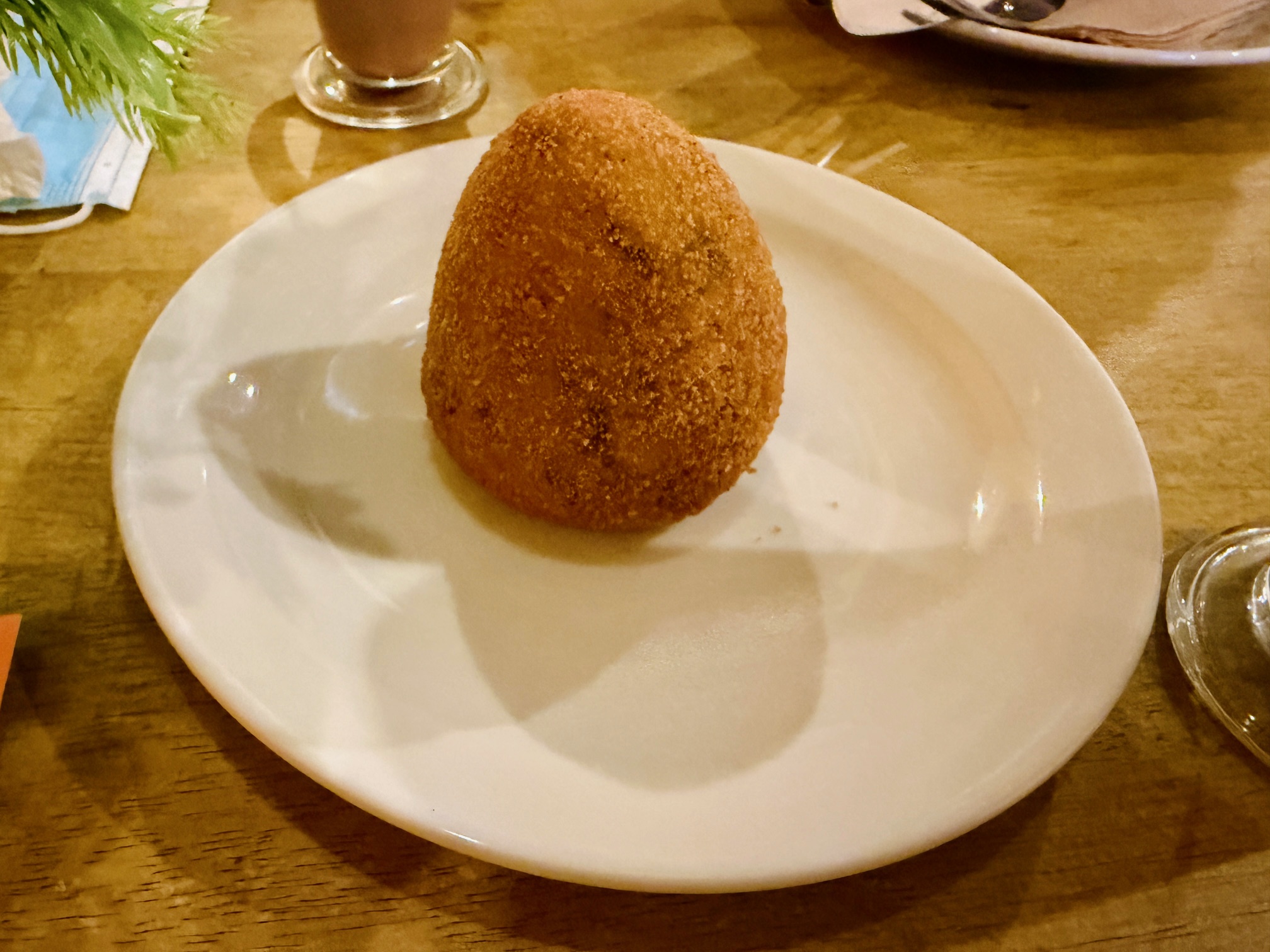
The arancini were in the same vein. Veeno only did one kind, filled with ragu, whereas at Vino Vita you can choose between ragu, mushroom and truffle or ham and cheese. The mushroom and truffle ones didn’t taste of truffle in any way, being just claggy stodge with no crunch or crispness to the exterior. Plonking them on a shallow pool of tomato sauce, grating some cheese and unceremoniously dumping some basil in the middle neither elevated them nor disguised their inadequacy.

I’ve used that word, stodge, twice now, because nothing else encapsulates those dishes. Italian food at its best can embrace the wonder and comfort of carbs, but this seemed to prioritise filling the stomach and emptying the wallet with brutal efficiency. In fairness, these were billed as bite-sized and only cost £6, but they still weren’t worth it. When I went to Veeno, 8 years ago, I said that it felt like the kitchen was more interested in margins than food. Hold my beer, said Vino Vita.

Neither Zoë nor I managed to take a picture of one of our small plates, so you’ll have to both imagine it and take my word for it. If you read the title carpaccio of salmon and the description smoked salmon drizzled with a lemon and caper dressing and fresh rocket and think that, based on what you’ve heard so far, this is likely to be a small piece of smoked salmon draped over a hill of the kind of salad you get in a bag at the supermarket, domed to make it look like you’re getting more salmon than you are, meanly scattered with capers, you would be absolutely spot on. Give yourself a pat on the back.

This is me trying to find positives, believe it or not. But I don’t think even Pollyanna could find a positive in the final small plate, the caponata. Caponata is a wonderful thing, a cold, sweet and sour aubergine stew with olives, capers and pine nuts. It has a distinctive taste which I adore. It is not, as it was at Vino Vita, a bland mulch of aubergine and far too many tinned black olives, with no sweetness, sharpness or sourness. It didn’t even look like caponata, didn’t have that depth of colour, although you’d have to whip off all the pointless foliage that had been dumped on it to be absolutely sure.

You know who used to do a very enjoyable caponata, back in the day? Carluccio’s, of all places. You know who does the worst caponata I’ve ever tasted? That would be Vino Vita.

Now, you might just think I’m being curmudgeonly, so I have to say this in my defence: Zoë thought all of this was awful. Zoë, the woman who is able to tolerate me. Even she – especially she – found all these dishes unforgivably bad.

“There’s somebody in that kitchen who really hates Italy” was her conclusion.

“It definitely doesn’t feel like anybody in the kitchen’s ever been there.”

“What we’ve just had,” she added, “was a crap-paccio. A crap-paccio and a craponata.”

Irony of ironies, the bottle of white wine we were on by now was really very nice, with fruit and structure and, to my mind, even a little hint of licorice. And by this point we had a server who was really good and very personable, checking in on us and taking away our empties. At just over fifty pounds you’d want that bottle to be good – Vivino suggested its mark up was something like three times retail price – but however pleasant it was, I wasn’t sure how much of it you’d need to drink to make the food seem like a good idea. I was sure, though, that I wasn’t capable of putting that much wine away.

The food up to that point had been so poor that it became partly about cutting our losses. The couple at the next table had paid up and gone leaving behind the best part of a bowl of anaemic-looking pasta – the mushroom tagliatelle, at a guess – and a blond, bland pizza. So we decided to try a Pinsa Romana, the airier Roman variant as popularised in Reading by Mama’s Way. In a way, I was trying to give Vino Vita one last chance, aware that if I had a conventional pizza and was comparing it to Amò or Paesinos it would be the final nail in the coffin.

But the final nail in the coffin was the Pinsa Romana. The Piccante promised, if the menu were to be believed, ‘nduja and oil, roasted peppers, burrata, rocket and basil. Like all the other promises, it was an empty one. The base was crunchy, dry as a bone with no airiness or give: Mama’s Way may buy their pinsa bases in, but they were miles better than this.

The pinsa had been pre-cut into eight miserly squares, and good luck finding ‘nduja on every one, because you wouldn’t. “Nigel Farage turns up to vote more often than ‘nduja turns up to this pizza” was Zoë’s verdict. Bland unlovely bits of burrata had been placed here and there – no oil, no discernible basil and no rocket.

In the rocket’s place, obscuring just how atrocious this pinsa was – which surely must have been the prime objective – somebody had thrown random salad on top of the whole affair. This was the last straw for Zoë. “It’s meant to have rocket on it, not the contents of a fucking bag of Florette”. The whole thing was so subpar that we followed our neighbours’ example.

It’s not even that this pinsa didn’t compare well to what you could get a short walk away at Paesinos or Amò, although it didn’t. It’s that it didn’t compare well to what you could get at Zia Lucia, or Zizzi, or Pizza Express. Or Marks, or Tesco, or Aldi, or the Co-Op. And if you bought one from a supermarket and took it home, you could dot it with ‘nduja yourself and even if it was from the chiller cabinet, heated up in your oven, it would be dozens of times better than this effort. It wouldn’t cost you £15.50, either, and for that money you can enjoy the best pizza Reading currently has to offer, minutes away on Kings Road.

Our server came over to check how our food was. We said “it was fine” almost in unison, the universal English euphemism for It was bad, but I can’t face a conversation about that. Our bill came to £166, including a 12.5% service charge. A bit of me wants to say that in Vino Vita’s defence, nearly ninety of that was on wine. But even if I do say that in their defence, the rest was indefensible.

Can you tell I wasn’t a fan? I don’t think I’ve written a review like this in ages, and certainly not of somewhere independent, and I don’t take pleasure in doing it. I’m reassured that Zoë, who is positivity personified, disliked it even more than I did – because yes, it turns out that’s possible. And I don’t know what offends me most about the place. The mediocrity is bad enough, the mediocrity coupled with the laziness is worse. To combine both those things with really iffy value, at a time when Reading’s Italian scene is having something of a renaissance, is woeful.

Worse still, it made me feel like that rebrand from Veeno to Vino Vita had something else behind it. A desire to make more from less, to cut corners and conceal charging a premium. Even some of the dishes that have been tweaked from Veeno’s menu to Vino Vita’s display this – Veeno does a bruschetta with capers and Sicilian dark tuna, Vino Vita’s boasts a tuna paté. What’s the Italian for Shippams?

But just as sad is this: with the Cellar gone and Vino Vita, well, like this, Reading still doesn’t have the wine bar with excellent food that has been missing ever since the Tasting House closed after lockdown. That gap in the market remains, and on this evidence Vino Vita isn’t even trying to fill it. Maybe Notes, just opened on Station Hill, will do better: it’s not as if it could do much worse. It is bad luck for Vino Vita that I review them the week after I had one of my meals of the year – also Italian, but miles better – at RAGÙ, but Vino Vita would be bad whoever you were comparing them to.

It might have been a little different if the service had been better – Apo, formerly of Dolce Vita and Pho, and one of Reading’s great front of house operators – works at Vino Vita, although he wasn’t on duty the night I went there. But the problems are squarely on the menu and in the kitchen, not elsewhere: you could forgive the slightly disjointed interior or the relatively expensive wine if everything else was firing on all cylinders, but it didn’t even get started.

If Paesinos or Amò had more space and an alcohol license, I’m not sure what the point of Vino Vita would be. In fact, if either of them did I think it would spell curtains for Vino Vita. I might be wrong, of course, because it seemed to be doing reasonably well the night I was there and that puff piece in the Chronicle made it sound like they were going from strength to strength. Be that as it may Vino Vita achieved something I would never have thought possible, despite nearly twelve years in the reviewing game. It made me miss Veeno, and that’s not a good thing.

Vino Vita – 4.6
Minerva House, 20 Valpy Street, Reading, RG1 1AR
0118 9505493

https://vinovita.bar

Since January 2025, Edible Reading is partly supported by subscribers – click here if you want to read more about that, or click below to subscribe. By doing so you enable me to carry on doing what I do, and you also get access to subscriber only content. Whether you’re a subscriber or not, thanks for reading.

Restaurant review: Paesinos

Here’s a tip for you: if you want to discover how many Italians live in Reading just drop innocuously into conversation online, on a local Facebook page or the Reading subreddit, the question of Reading’s best pizza. Because if you do, Reading’s Italian contingent will come out of the woodwork. This calls for opinions, and they have plenty. They don’t fuck about, either.

“Being Italian and of partly Neapolitan descent, I am picky when it comes to pizza. Or better, I eat anything, but I know a good pizza from a bad one, and from a non-pizza” began Luca, on the Edible Reading Facebook page. He went on.

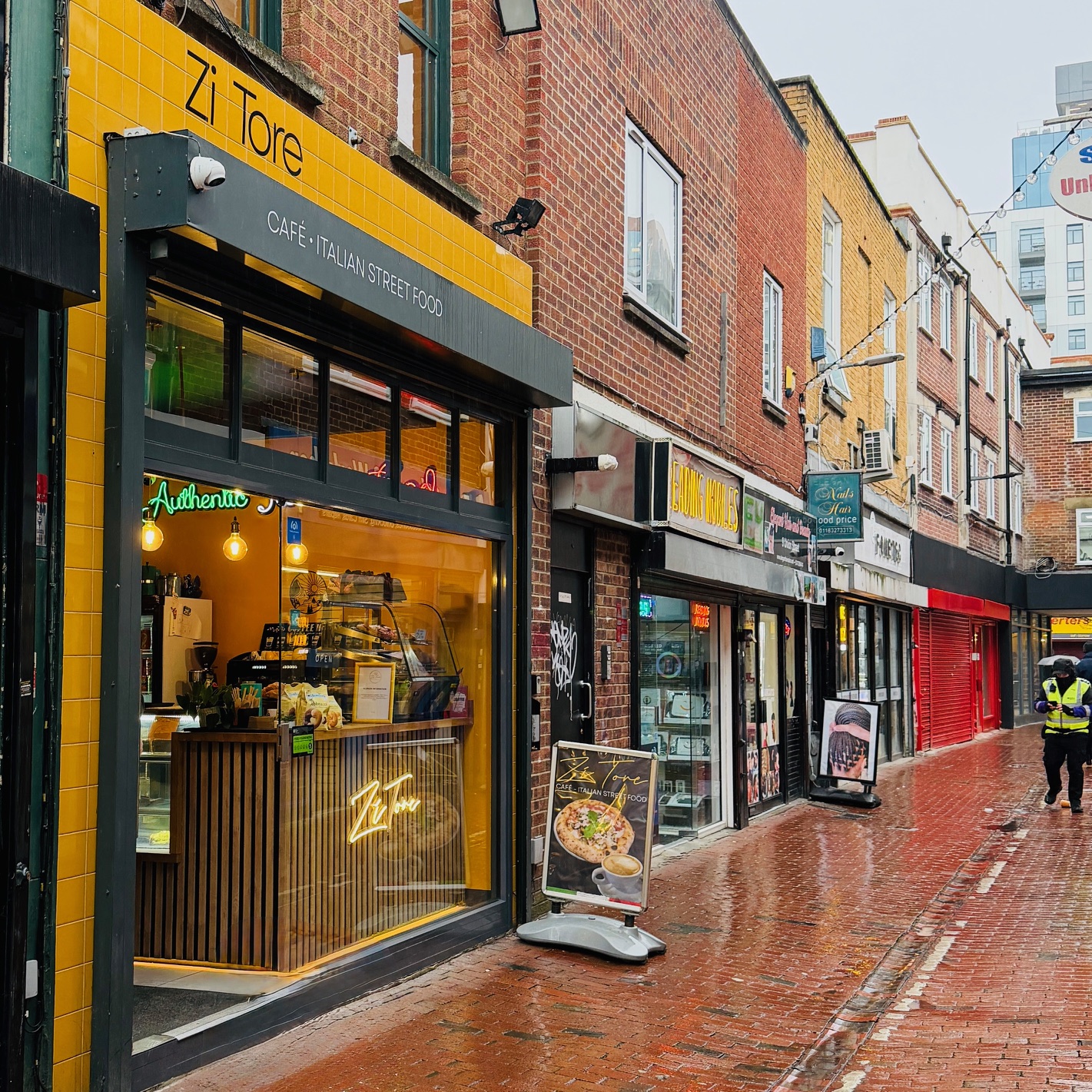
“The only real pizzas in Reading have been Papa Gee’s, for years. Then Sarv came, and Zia Lucia (both ok). I have recently tried Zi’Tore and above all Paesinos, the latter is possibly the best in Reading. The chef and manager is Sicilian and has previously worked at the Thirsty Bear. However, Thirsty Bear make American style pizza, while Paesinos make real pizza.”

Another of my Italian readers, Franz, was more generous about the Thirsty Bear. “It’s just a different style” he said. “Italian pizza purists perhaps will take a bit to adapt (I’m Italian, but open minded). A slice of their TriBeCa, curly fries and a pint is hard to beat. It just makes me happy and satisfied.” Franz also had opinions about Zia Lucia, and its “horrible, plasticky” mozzarella.

After that Luca and Franz ended up having a fascinating conversation about whether you could find good pizza outside Italy. Franz thought it was easy to do, these days. Luca disagreed, but said you could even end up getting what he called “non-pizza” in Italy, unless you were in Campania or Sicily. Just to chuck in a curveball, the best pizza Franz ever had was in the Swedish city of Norrköping. “It was Neapolitan style and was excellent, but then they had a corner in the pizzeria that was all dedicated to Totti so that confused me from an allegiance perspective.”

I could have listened to Luca and Franz discuss these niceties all day: it seemed that if you asked two Italians you were likely to come out of the conversation with at least three opinions. Over on Reddit, other Italians were weighing in. “Zi’Tore in Smelly Alley has taken the crown as the best pizza in town (in my humble, Italian, opinion)” said one. “And the pizza al taglio from Amò is even better.”

This is particularly topical because last week Sarv’s Slice announced that they were leaving the Biscuit Factory, after falling out with the owners both there and in Ealing. The reaction across the internet was one of huge sadness, coupled with genuine fear for the future of the venue. But this happens against a backdrop of Reading’s pizza scene exploding, so Sarv’s Slice might have quit while they were ahead: the market has become saturated since they opened in 2023, and even more so in the last six months or so.

Let’s run through the timeline. Last year Dough Bros opened out on Northumberland Avenue, and in the summer Zia Lucia opened in town. From then, things have only accelerated: at the start of the year Paesinos opened opposite Jackson’s Corner. Then Zi’Tore opened in February, in the old Grumpy Goat site. At the end of April, two doors down from Paesinos, Reading got Amò, a joint venture between the owners of Madoo and Pulcinella Focaccia, a pizza trader who operated from their home address out in Earley.

And believe it or not, last Wednesday another pizza restaurant, Peppito, opened on the first floor of Kings Walk, John Sykes’ restaurant sweatshop. The time between pizza restaurants opening in Reading appears to have some sort of half-life, so by the time this goes to press I wouldn’t be surprised if two more places had started trading, making all this out of date.

So the vexed subject of Reading’s best pizza isn’t something anybody, Italian or not, is going to settle in a hurry. But that’s no reason not to begin this important project, so last week I strolled down the hill from Katesgrove into town to check out Paesinos, the first of this year’s intake to start trading, on the Kings Road. I had a secret weapon, my very own Italian: my friend Enza was joining me to check this one out and see how it compared against Zi’Tore and Amò, both of which she’d researched extensively.

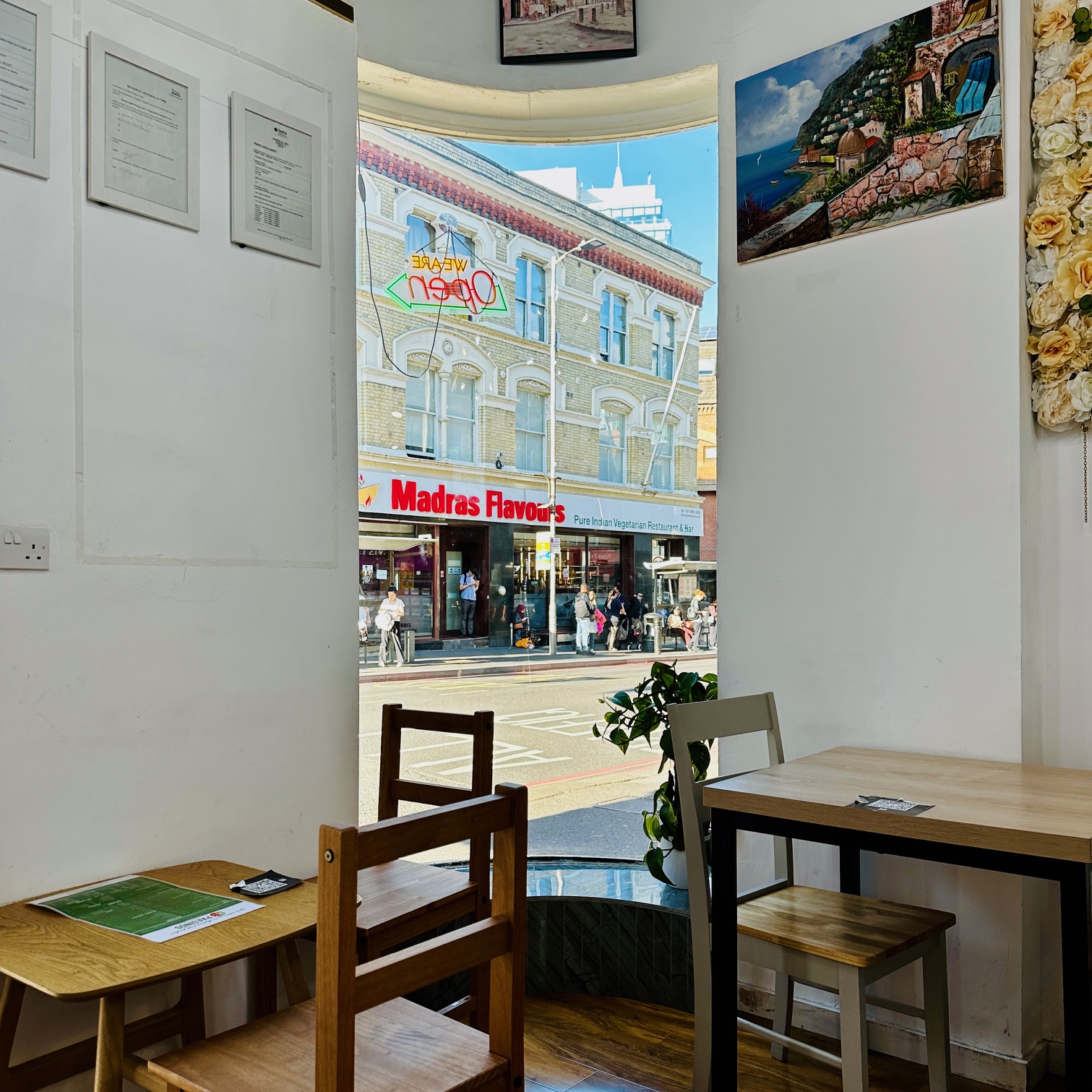
I was early, so I got to take in what must be one of Reading’s smallest dining rooms. Just three tables, each seating two people, although the table closest to the front door was so Lilliputian that it was hard to imagine adults sitting there, except to wait for a takeaway. A fridge hummed next to the counter, holding an interesting selection of soft drinks.

I spotted chinotto, one of my favourite things, and got one, with a plastic cup, while I waited. I’m used to the San Pellegrino version of this drink, that you can pick up in cans in Madoo. It’s dandelion and burdock’s older, more sophisticated cousin, wearing a rollneck and smoking a cigarette. But this bottled version, by Sicilian company Polara, was more nuanced, the rough edges smoothed off. I felt that all-too-familiar sensation, the gradual raising of expectations.

I looked through Paesinos’ menu. It was a single long laminated sheet with pizzas split into categories – classic, premium, signature, fusion – although the taxonomy they’d used was unclear to me. It certainly wasn’t pricing: most of the 13 inch, standard pizzas, were between thirteen and sixteen pounds whatever you ordered, many of them costing random amounts like £12.97, £13.96, £14.86. I liked the capriciousness of that.

They weren’t split into categories using any mindset I could understand. I could see something with “kebab chicken, jalapeños and buffalo sauce” being a fusion – or even a confusion – pizza, but a standard pizza bianca? Paesinos had attracted some commentary around its pizza Americana, topped with french fries and frankfurter: it might well be authentic, or authentically Sicilian, although I’d personally rather drink the bin juice from my food recycling after it’s been strained through Jay Rayner’s y-fronts. But whatever it was, surely it wasn’t “premium”?

All that said, there was something about the lack of polish in this menu that I liked. I could say it was trying to do too much, with its paneer and tandoori chicken, but nobody was making me order that stuff. In the core of it, ignoring the wackiness, there was a solid collection of options, many of them intriguing.

Then Enza arrived, and ordered a chinotto, and we got to catching up. Despite regularly exchanging messages, we realised we hadn’t seen one another in a very long time and there was plenty to discuss – her empty nest, my new house, all the life events and randomness that make you realise that you think you know what’s going on with someone via social media but that, really, you don’t.

The other thing I gathered, gradually, as we got to talking about Reading’s explosion of Italian restaurants, was that I was finally eating with someone even more determined to maintain their anonymity than me. Enza, it transpired, had been to Paesinos once before with her husband and very much enjoyed what they ate – the pizza “al portofoglio” or folded pizza for her (it translates as ‘wallet’), the tuna and red onion for him – but she was a far more frequent visitor to Amò a couple of doors down. So much so that she seemed to be furtively looking around, worried about being discovered, and lowered her voice when she mentioned Paesinos’ neighbours.

“I can’t help it!” she laughed. “I love it there. So much that I want to get involved. I keep telling them they should make the kind of pizzas you can only get in my part of Italy” – Enza’s from Potenza, in the ankle of Italy, halfway between Naples and Bari – “and if they do, I think I should get commission.” I offered to change her name for the purpose of this review, but she decided to let the chips fall where they may. At least they didn’t fall onto a pizza Americana, I suppose.

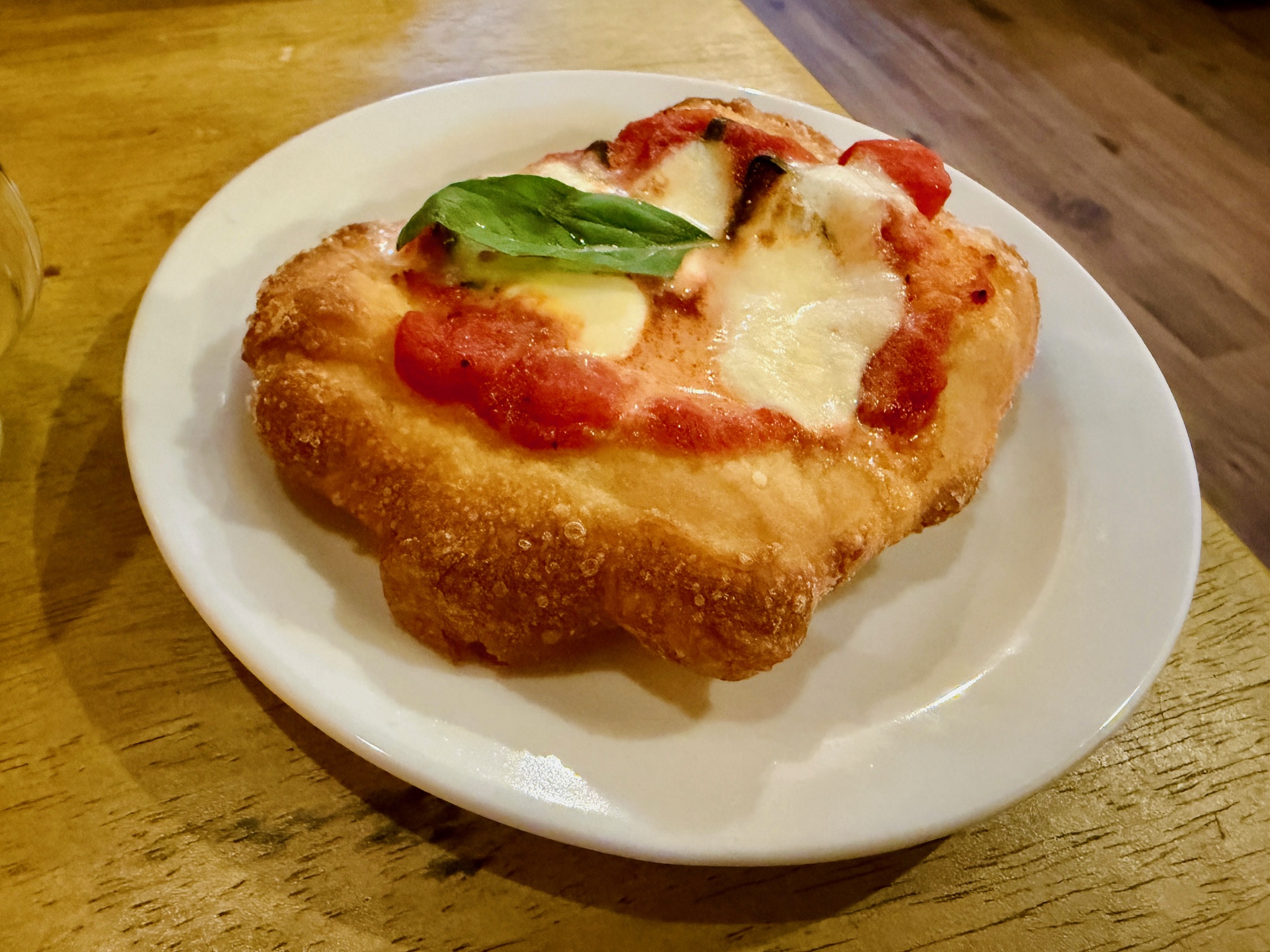
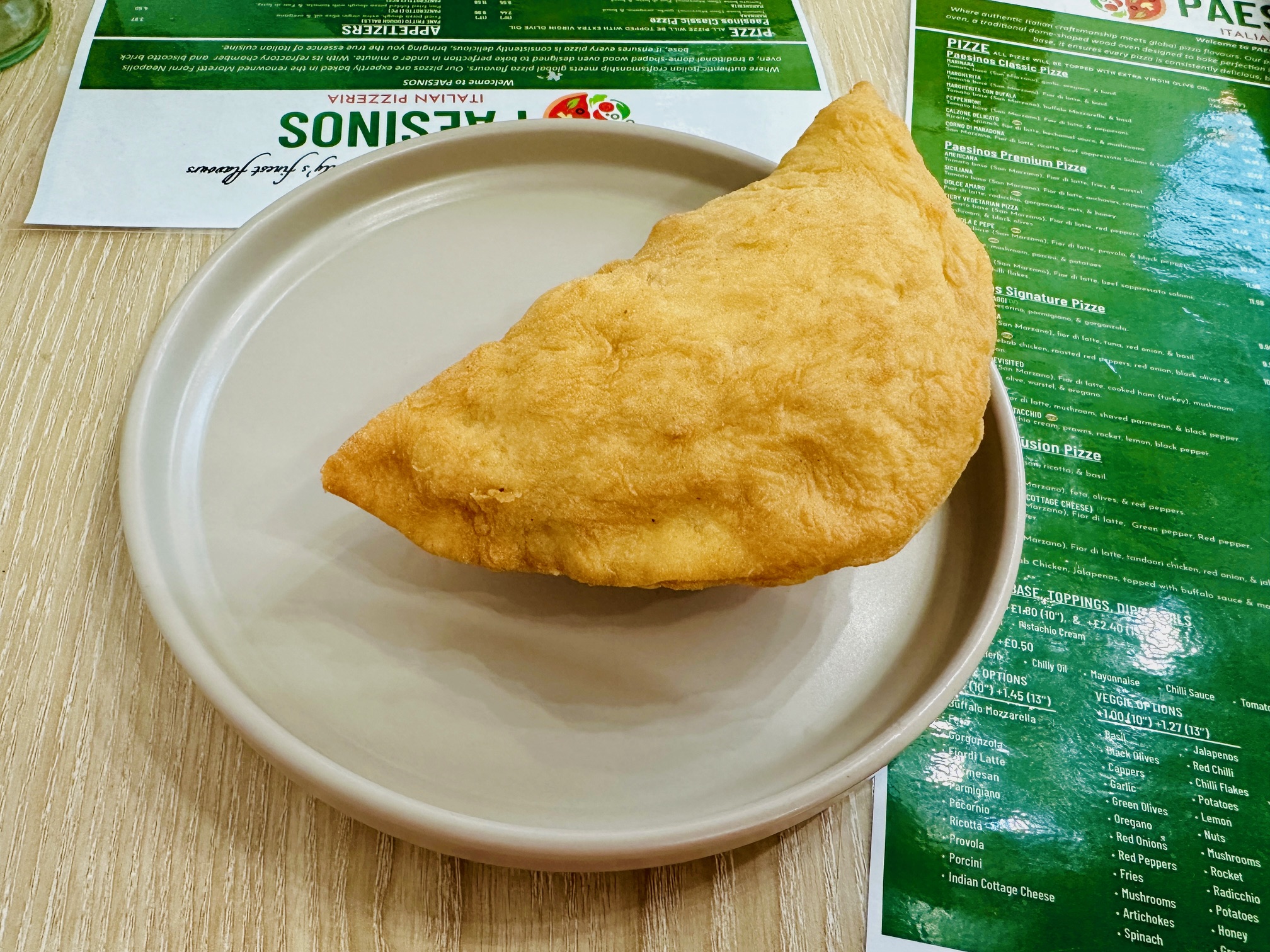
We started with appetisers, which meant a panzerotto each. Franz, on my Facebook page, had particularly recommended these, saying they were a speciality from Bari, where he came from. It was my first experience of Paesinos, and about as good a calling card as you could hope to encounter, a gorgeous crescent of fried dough filled with just enough mozzarella and tomato, too big to eat with your hands but not like a full-sized calzone. You got two for something silly like seven quid, and outstanding just about does them justice. As an introduction to the dough, too, it put down quite a marker. This huge, irregular pocket of joy made me very happy indeed.

“I tell you what, this is a lot bigger than the panzerotto I had in Montpellier” I said to Enza, between mouthfuls. She smiled.

“I wouldn’t say this is big by Italian standards. It is really good, though.”

In my mind I was thinking that I would come here and eat this again, but I was also remembering that the menu boasted pizza fritti, stuffed with ricotta and sopressata, and that I needed to try that. Enza also had a yen to sample the mozzarella in carrozza and maybe we should have tried that too, but I was put off by experiences of having it at Prezzo, many years ago, no doubt straight out of the freezer. I already had a reasonable idea that the only thing coming out of a freezer at Paesinos was the gelato.

“Would you say there’s never been a better time to be an Italian in Reading?”

“Absolutely!” said Enza, and then she told me a lovely story. I knew that she was a big fan of Zi’Tore, on Smelly Alley, and especially their cakes, many of which were ones you just didn’t find in this country. But then Enza told me all about the graffe, a sort of fried doughnut made in a distinctive loop shape, sugared but made out of a mixture of flour and potatoes. They’re specific to Campania, where she was born, and growing up in Salerno they were a regular childhood treat.

And then, some years later, Enza wanders into a cafe hundreds of miles away that’s just opened in her adopted home town, the unlikeliest of places, and finds them there. Graffe. And when she told me about this: maybe it was her excitement, or how well she conveyed it, or perhaps I was just having a lovely time, but even I felt it. I was vicariously moved, and I remembered the power food has to transport and transform.

It’s one reason to envy Italians, because what would I feel nostalgic about? Ice Magic, the chocolate sauce that was no doubt filled with chemicals so it hardened into a shell when you poured it on ice cream? The way Nice N’ Spicy Nik Naks used to taste before they were fucked with? Different permutations of processed food, and the excitement of a Findus Crispy Pancake? No, Britain had nothing to compete with graffe. Little wonder that Enza sounded so full of joy, although it did make me ponder how many privations she’d suffered through years of living here.

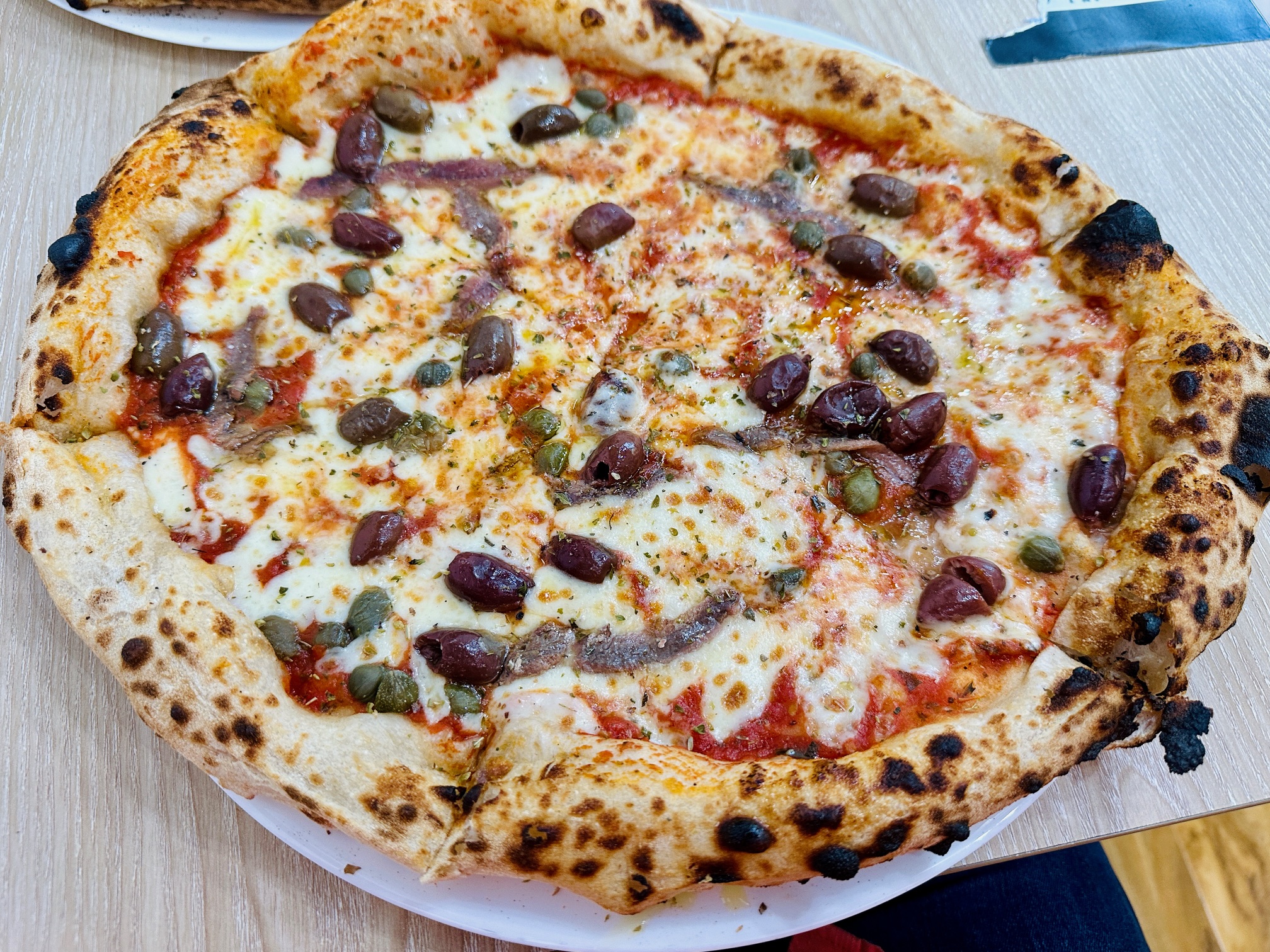
If the panzerotto set up expectations, the pizza fulfilled them. I’d chosen the Siciliana, my reference pizza of olives, anchovies and capers. It’s sometimes called a Neopolitan, presumably because every part of Italy wants to claim the best ever pizza as theirs. Based on what I ate at Paesinos, I can hardly blame them. Everything was exactly as it should be – the right amounts, the right proportions, the right balance. The saltiest of anchovies, generously deployed without being overkill. Purple, perfumed olives. Little clusters of plump, sharp capers (Enza preferred them salted, but give me the vinegary hit any day).

The base was heavenly. Puffed at the rim, beautifully irregular, a proper Neapolitan style pizza that drooped in the middle, although it firmed up as it cooled down. “The dough is completely different towards the end of eating the pizza” said Enza, and she was spot on. I loved the way that she tore a little bit of her crust off and tried it, on its own, before making inroads, a little ritual, almost like a benediction. I followed suit, and again that allowed me to admire Paesinos’ dough before all that other stuff happened to it. It was better after, but pretty much perfect before.

Later on I asked the pizzaiolo, who was indeed Sicilian, whether most of their trade was takeaway and delivery, given Paesinos’ size. He said it was, but that those people, however good his pizza was, missed out ever so slightly. “It’s 100% when it leaves the oven” he said, “but when it gets delivered it can only ever be 90%.” I think he’s right, and explains better than I can why, when you read the rating at the bottom, you need to come here rather than fire up Deliveroo.

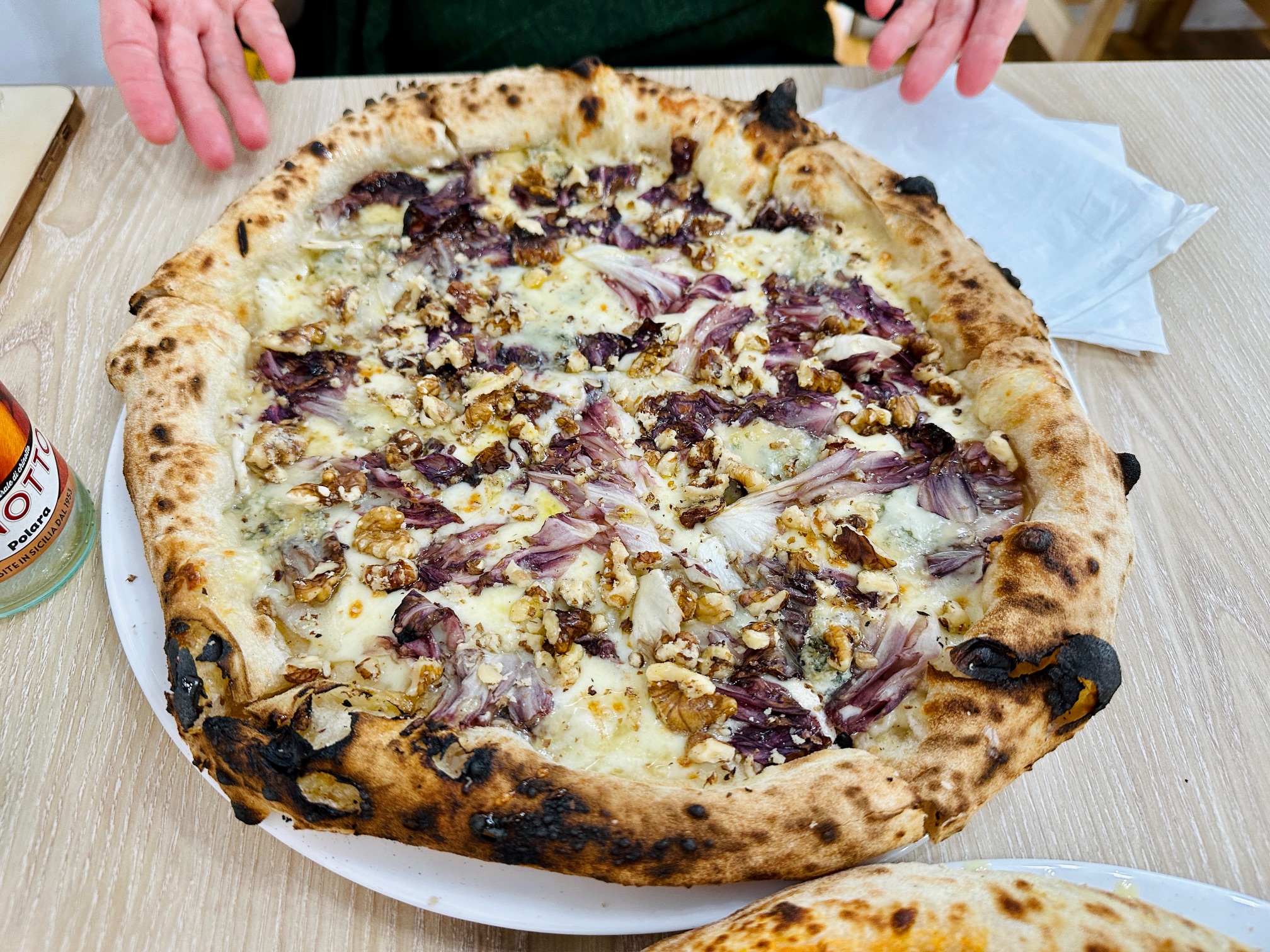
Enza also loved my pizza, and preferred it on balance to hers, which isn’t to say that she didn’t enjoy hers. She went for the “dolce amaro”, a white pizza (premium, not fusion) topped with walnuts, gorgonzola, honey and radicchio. “I know people back in Italy who would disown me for ordering this” she said. Maybe she was right but they ought to try it before they knock it.

This had everything: salty, sweet and bitter in gorgeous harmony. The gorgonzola was so punchy that you smelled it, got that agricultural tang as you lifted a slice up, before you ever took a bite. But the honey – how nice to have honey rather than hot honey on a pizza, for a change – softened its roar. The walnuts lent texture and the final piece of the jigsaw, radicchio with bite and bitterness, was the clinching evidence of intelligent design. All that and, as a white pizza, it was easier and less messy to eat than the Siciliana. I really enjoyed it: Enza thought it a little unbalanced and needing something else, possibly black pepper.

Later on, when we debriefed over a beer in Siren RG1, I asked Enza how authentic that pizza was and she very kindly said something I’d never thought of before that made me feel stupid, in a good way. “Of course it’s authentic” she said. “It’s authentic because somebody has made it.” All these combinations start out as curveballs at some point, but if nobody ever innovated you’d have a cuisine that’s set in aspic. It’s 2025: nobody willingly eats aspic any more.

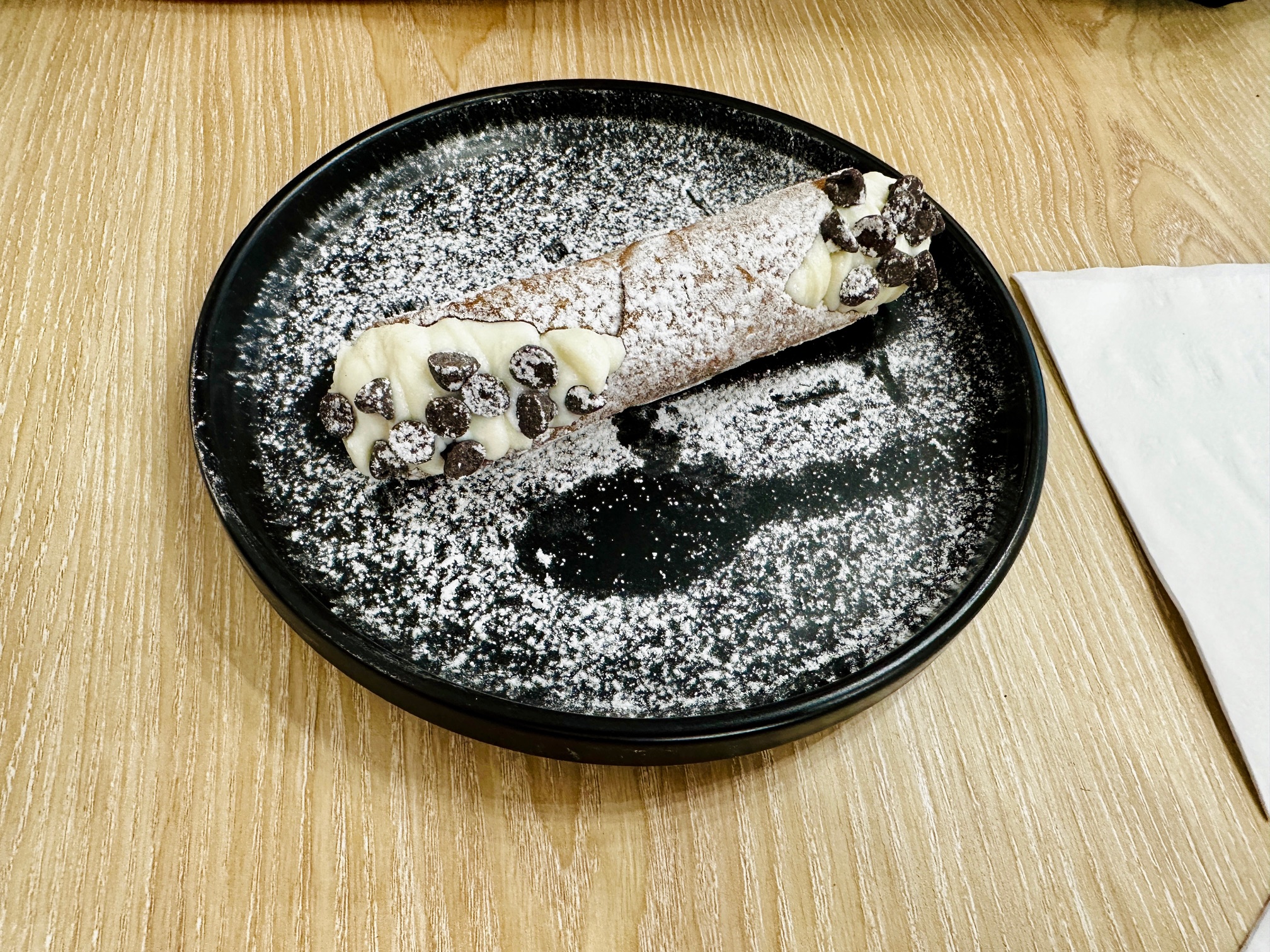
Paesinos has a small section of desserts, plenty of them tempting, and we decided that in the interests of research we ought to try some. Enza’s no slouch, so she asked the pizzaiolo which ones were made by Paesinos. In a flash, without hesitating or deflecting, he told us: just the two, the tiramisu and the cannoli. In the case of the cannoli he bought the shells in, but the ricotta filling was all his own work. That was good enough for us, so Enza decided to road test the cannolo and I – such hardship – ordered the tiramisu.

We also ordered a couple more drinks. The chap who’d prepared our pizzas suggested we try a bottle of something called Spuma, so I did, and it was night and day with the chinotto but equally lovely in its way – sweet and fresh, sunshine in a bottle. I thought it had a taste of grape juice, but online research later suggested it was more complex than that, with rhubarb and elderflower, cloves and caramel. It beat a Fanta Limon, and I say that as a fan of Fanta Limon.

By this point we’d got chatting with our chef, and he told us a little more about the desserts. Normally he imported the cannoli shells from Palermo, he said, but on this occasion he’d had to get them from Catania instead. That meant they’d be more brittle, smoother, less bubbled. He apologised, as if this wasn’t optimal, when discussing the difference between going to the trouble to buy these things from two different Sicilian cities. I admired that focus, that he felt there was an important distinction to be drawn between the best and the merely excellent.

And goodness, but it was exquisite. If this was the second-tier shell, I’d like to try the very best out of sheer curiosity. Beautifully presented – I loved the outline in icing sugar of the wooden spoon, as if at a crime scene – it was an utter joy. Initially Enza tried to press me to have half, using the ultra sharp knife our chef had brought to our table, but I convinced her to just let me try a section from one end. It was so delectable that I almost wished I’d taken up Enza’s offer. The ricotta was so light, so smooth, the chocolate chips it was studded with were so very generous. It made the ones at Madoo, for instance, feel pedestrian.

Everything was imported, we were told, either from Italy or specifically from Sicily. Enza loved it: I’m not making this up, but she honestly did exclaim Mamma mia (I nearly did too, and I was born in Bristol).

There was a story behind the tiramisu, and he told us that too. It was his fiancée’s recipe – she works at the Thirsty Bear – but she only finally let him have it once he opened Paesinos, despite them having been together for twelve years, despite the fact that they were getting married towards the end of the year. Many tiramisu recipes just used egg yolk, he said, but this one included egg white too, to give a lighter texture. The only other tweak was a little vanilla, to offset the flavour of the egg yolk.

It was another tour de force, and he also went to great trouble to tell me it was a bigger portion than you got elsewhere around town. He’d weighed the rival tiramisu you could get in other places, and weighed his, and his was more substantial. It was the best tiramisu I’ve had in Reading, and honestly I can’t remember eating a better one anywhere else. No wonder he was marrying his fiancée: if I had ready access to somebody who could knock one of these out, I’d be the size of a house.

The strangest thing happened after that: we had eaten, we’d drunk (no alcohol, Paesinos is unlicensed) and we ought to have headed straight off to compare notes over a beer. But I was in the company of two Italians, and they talked food, compared notes, discussed recipes, the best places to buy mascarpone, where he sourced his ingredients from. And like that conversation on my Facebook page at the start of this review, I could have listened all night. Being in the company of people whose passion for food verges on obsession – the real meaning of obsession, not that social media meaning that just means “I like this” – was infectious.

In the process I learned a few other things. Paesinos had been open nearly six months, and things were going well. Our chap knew the people at Mama’s Way, loved it there, didn’t see any of this explosion of Italian spots as competition. A rising tide truly did lift all boats, and the slow spread of Reading’s Little Italy round the corner to become a Not So Little Italy felt like a beautiful thing. Eventually we settled up. Our bill for everything came to just under sixty pounds; there was no option to tip – it’s almost as if they just didn’t expect anybody to – so I made a second card payment for that.

If I was giving advice to Paesinos – not that I’m qualified to – it would probably be to lose the things at the periphery of their menu, the pizzas with chicken kebab or paneer, the chicken nuggets, the peri peri fries. I think I saw somewhere online that they had burgers “coming soon”, and a look at their website suggests that they now indeed do a range of burgers. I don’t think they need any of that, but what do I know? Maybe their delivery customers will lap that up.

But actually, if I was giving advice to Paesinos it would be to carry on doing exactly what they’re doing. I cannot think of a pizza I’ve enjoyed so much in a long time, and I can’t think of a Neopolitan-style pizza I’ve liked as much in longer still. What a small, unassuming delight Paesinos is, and what a mind-boggling prospect it is that there’s a healthy debate, under way right now, about whether our town has places to eat pizza that are even better than it is.

I’m not qualified to weigh in on that: I’ve not visited its rivals yet, I’m not a fully paid up pizza obsessive and I’m about as far from Italian as it’s possible to be. So take this as my ill-informed, incomplete, English opinion: this might not be the best pizza in Reading, but if it isn’t, the place that can beat this is going to be one hell of a restaurant. Either way it’s the best pizza I’ve had in Reading, I think. I can’t wait to test out its competition. Even more so, I can’t wait to go back.

Paesinos – 8.6
Unit 4, 2 Kings Road, Reading, RG1 3AA
0118 2068806

https://paesinos.com

Since January 2025, Edible Reading is partly supported by subscribers – click here if you want to read more about that, or click below to subscribe. By doing so you enable me to carry on doing what I do, and you also get access to subscriber only content. Whether you’re a subscriber or not, thanks for reading.
Restaurant review: Branca, Oxford

This probably isn’t something I should admit but even now, after nearly twelve years doing this, I’m not always the best judge of which reviews will and won’t prove popular.

I mean, some obviously do well: you all tend to want to know about the new openings and the big names as soon as possible, something I’ve been trying to get to quicker over the last year. And I know from my trips to the likes of TGI Friday and Taco Bell that if it looks like I’m going to have a bad time, you tune in. I don’t take that personally – everyone likes a hatchet job and we can all derive vicarious pleasure from the suffering of others at times.

Beyond that? I have a vague idea at best. Sometimes I can write up a lovely independent place in the middle of town and – well, there aren’t crickets, but it doesn’t go gangbusters in the way that a Siren RG1 or a Rising Sun might. And other times the success of a review takes me completely by surprise.

Take Gordon Ramsay Street Burger, for instance: I didn’t think that many of you would especially care what it was like. On the run up to my visit, I wasn’t even sure I especially cared what it was like. And when I went I found that it was perfectly serviceable, the kind of place you might quite enjoy if you lived in a town without Honest Burgers. Little to write home about all round, you might think, and yet it was my most popular restaurant review of the year: me having a fair to middling time at a big chain in the Oracle. Go figure.

I actually think this might be for the best, that there’s no crystal ball. Because it would get tempting just to write the crowdpleasers, and that would skew the kind of places I go to and the kind of meals I seek out. And part of my – let’s call it a job, just for the sake of argument – job here is to highlight all kinds of establishments.

The ones you know about, but also the ones you don’t. The ones you would never consider going to in a million years, or walk past thinking “I wonder what that’s like?” And the ones you may well have already been to, probably in the first month after opening, before I get round to them. If you always have a pretty good idea what, or where, is coming next then something’s probably gone wrong.

One of the impressions I do get, though, is that collectively speaking you’d like to see more Oxford reviews. I can see why: it’s only half an hour away by train and is almost the anti-Reading. It has everything Reading lacks, yet lacks all the stuff Reading has got. No widespread craft beer, but lots of handsome old boozers, the kind Reading has gradually lost. No street food, but a covered market and cheesemongers and delicatessens galore.

A big shopping mall, yes, but a completely different kind that attracts the chains that Reading still just doesn’t get. More independent retail and two independent cinemas, but crap buses. Better bookshops, but nothing like the Nag’s Head. Did I mention that it also has the Oxford Playhouse, which for all its charm South Street can’t quite match? Anyway, add the two together and you would have the perfect large town slash small city; Oxford even has a couple of universities, would you believe.

All that makes Oxford the perfect place for a weekend lunch or dinner, especially coupled with mooching, shopping, drinking coffee and people watching. So every time I put an Oxford review up it does pretty well, and I get the impression – perhaps wrongly – that you might like to see more of them. My first visit to Oxford on duty was to one of my favourite Oxford spots, The Magdalen Arms on the Iffley Road. I had a lovely time, as I expected to, and resolved to cover the city more often. Two and a half years later, I’ve written the grand total of five reviews of Oxford restaurants: time to pull my socks up.

So last weekend Zoë and I were in Oxford, on her Saturday off, and I had booked a table for two at the Oxford restaurant I’ve possibly eaten at more than any other, Branca. It’s a sort of Italian brasserie – or would be if such a thing isn’t two different kinds of cultural appropriation – and had been trading on Walton Street in Jericho for over twenty years.

And that means that, like Pierre Victoire just round the corner on Little Clarendon Street, it’s part of an elite club of restaurants that have been an ever-present in my dining life. The only thing even comparable in Reading, now that Pepe Sale is gone, is London Street Brasserie, and that tells its own story, that Oxford can hang on to these places when Reading can’t.

It helps that Jericho is such a lovely part of Oxford, less than twenty minutes’ walk from the train station but a world away from both the town and gown of the city centre. It’s all nice cafés and bars, pubs tucked away on sidestreets, the Phoenix cinema where people, me included, queued round the block to see Four Weddings thirty years ago, watering holes like Raoul’s and Jude The Obscure that feel like they’ve been there forever.

I lived in Jericho, for a strange and surreal year halfway through the Nineties, and I didn’t appreciate how gorgeous it was at the time. And now it’s so gentrified that I could never afford to do so again in this life I am struck with brutal clarity by what a terrific part of the world it is. Isn’t it always the way? Never mind. Sitting in Branca, menu in front of me, soaking it all up I could kid myself, for a couple of hours at least, that this was my place and these were my people. Good restaurants, apart from providing you with great food and wonderful drink, have a knack of giving you that, too.

In the years since it opened Branca has expanded into next door, turning it into a cafe and deli more than capable of improving your cupboards and denting your wallet. But the dining room is as it always was, a tasteful if cavernous space.

The tables nearer the front, close to the bar, are nice enough but if you can get one at the back you’re treated to a beautiful room with marble-topped tables, exposed brickwork, what looks like a Bridget Riley on the wall. There’s a view out into their courtyard through full length-windows, and the light in general is quite magical, helped by a skylight and clever use of mirrors. Even on a dreich February day it felt like spring was in touching distance.

This isn’t the criticism it might sound, but Branca’s is simultaneously the biggest and smallest menu I’ve ever seen. Big as in physically big, a one-sided sheet of something like A3 that lists everything they serve. But when you delve into the detail, it’s compact: four starters, a couple of salads, three pasta dishes, four pizzas. Four mains, a burger and a steak and a couple of specials. I felt like I had just enough choice, although if I’d fancied either of the specials I wouldn’t have felt constrained at all.

As it was, this was just on the right side of the border between streamlined and narrow. Starters clustered around the ten pound mark – don’t they always, everywhere, these days – while mains were more scattergun. A pizza was about sixteen quid, with the exception of the sirloin steak the mains stopped at twenty-five. If I hadn’t eaten at Branca before I think the menu would still have inspired confidence, that it was aiming to do fewer things better, but they’d already proved that to me time and time again.

Before any of that, a negroni apiece and some of Branca’s focaccia, which they’ve been dishing out free of charge to diners for as long as I can recall. The focaccia was great stuff, airy and speckled with salt, oily enough to make your fingers shine even before you dipped hunks of it into oil and balsamic vinegar. It made me happy to start a meal in the same way as I always had, knowing that it pretty much always presaged good things. Branca played it straight down the middle with its negroni: no fancy curveballs, just Gordon’s, Campari and Martini Rosso. It was a good reminder that stripped of any whistles and bells, the cocktail just has good bones.

Another reason I’ve always liked Branca enormously is the wine list, and more specifically that they do something so few restaurants in the U.K. do: the majority of the wines on it, around three quarters in fact, can be ordered in a 500ml carafe. So we did that and had a New Zealand sauvignon blanc for thirty quid, which was downright lovely. I got kiwi fruit and gooseberry, Zoë got a hint of melon and, for an hour or so, we managed to kid ourselves that we got wine. We became a little bit more North Oxford with every passing minute.

Most of Branca’s starters are probably a nod to the excellent deli next door: with the exception of the soup they largely involve buying well rather than cooking well. Zoë is an expert at the third part of that triumvirate, ordering well, and she had the edge with her burrata on sourdough, served with olives and cherry tomatoes. Up to a point this is something you could rustle up in your own kitchen, and we often do come summertime, but the transformative element here was a cracking red pesto. Try doing that at home seemed to be the implication and no, I wouldn’t even attempt to.

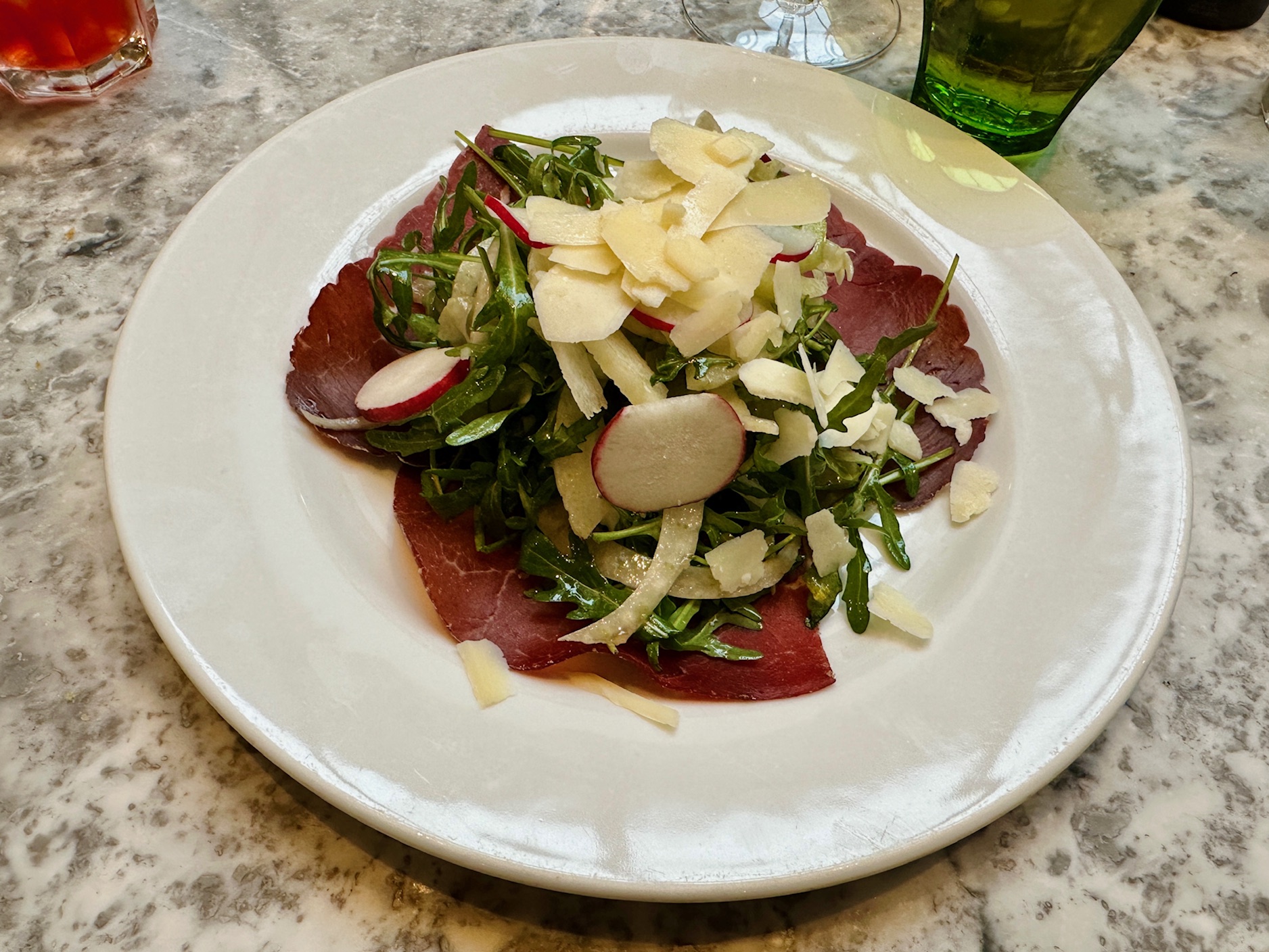
My starter left me feeling a little deceived. It was described as bresaola with a fennel, rocket and radish salad, and that description made me think it would be a cornucopia of cured beef with a little bit of greenery on top. Just how hoodwinked I had been became apparent when our server – who, I should add, was superb from start to finish – came to our table.

“Who ordered the salad?”

Neither of us, I hope I wanted to say to him, but I realised as he set the plates down that this was exactly what I had unwittingly done. And, truth be told, I felt a little conned. Three pieces of bresaola – I would say “count them”, but that didn’t take long – buried under an ambuscade of foliage is, to be honest, a salad. You can’t roll that in glitter: it is what it is. And eleven pounds for a salad and three pieces of beef felt like it could slightly mar my long and happy relationship with Branca.

And maybe it would have done but damn them, it was lovely. I always regret using the adjective “clean” to describe dishes or flavours because, like “dirty”, it’s a dimension that really shouldn’t feature in stuff you stick in your gob. So instead I would say that this was subtle, unfussy and refined, that every flavour in it was distinct, well-realised and harmonious.

Rocket seems to get a lot of stick these days but I still like it, especially compared to the twin horrors of pea shoots and watercress, two of the most pointless green things in creation. The quantity of excellent Parmesan chucked on top felt like it was by way of apology for the whole salad thing. Everything was so well-dressed and well balanced that I decided I could forgive Branca, just about. The eleven quid still felt a bit cheeky, although mainly I just wished they’d chucked some of that red pesto into the mix.

Conscious of a few recent experiences where we’d been rushed, Zoë decided to have The Conversation with our server as he came to take our empty plates. We were having a lovely time, she told him, and were really in no hurry so could they wait a while before bringing our mains? And he was brilliant with that, feeding that back to the kitchen and then coming to check with us, something like twenty-five minutes later, if we were ready for what came next.

I can’t tell you how welcome that was, that a restaurant understood how to put the brakes on. And it really helped to make me appreciate Branca all over again – the room, that light, the chatter from neighbouring tables, that feeling that there was no rush to go anywhere or do anything that comes from a proper, leisurely lunch. Saturdays with Zoë have been at a premium recently, so I felt glad this one was far from squandered.

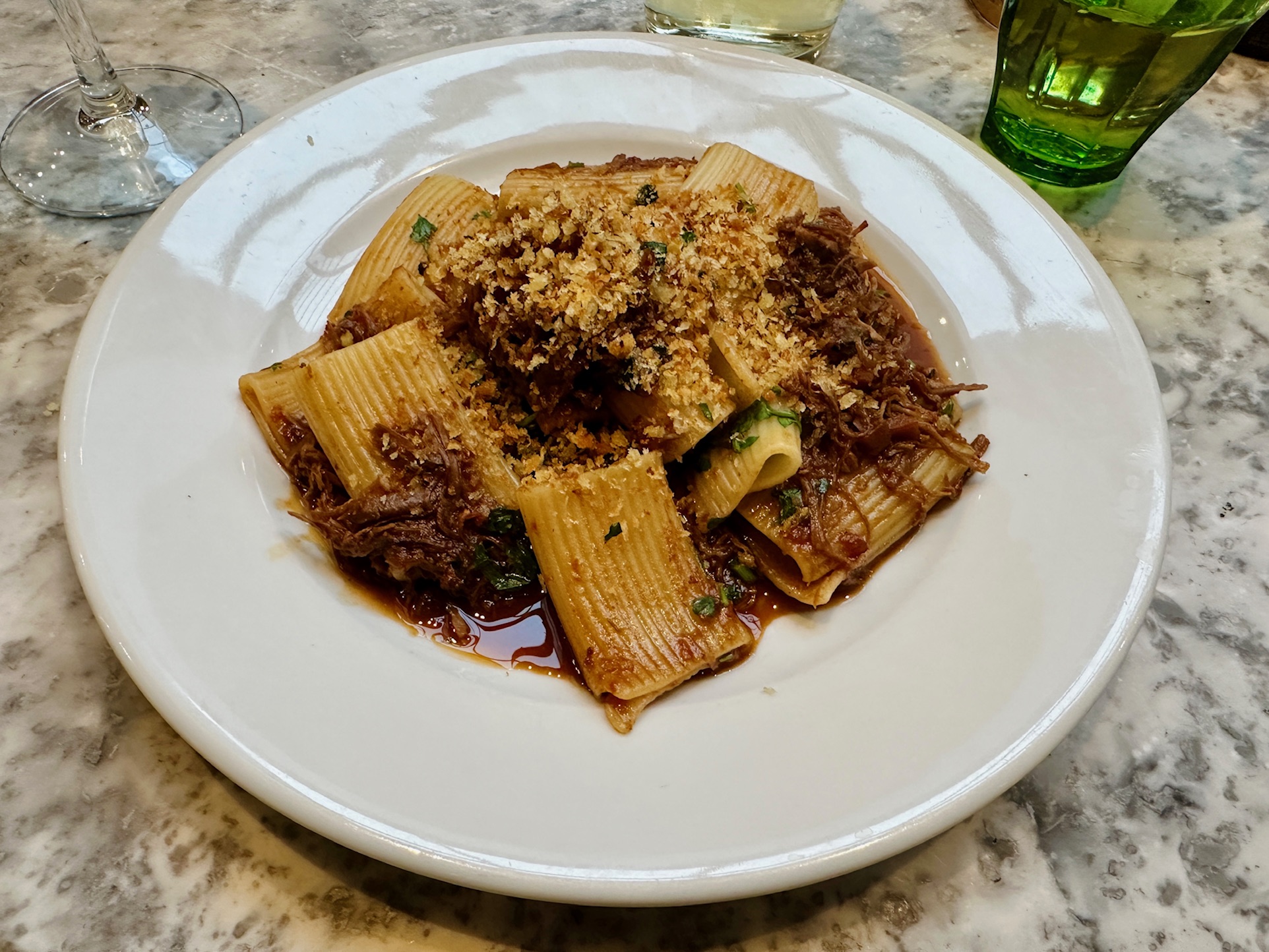
By the time my main came, I was ready for it, and it helped that it was a treat from start to finish. Rigatoni, giant corrugated tubes of comfort sagging under the weight of their own carbiness, came interlaced with sticky strand after strand of a long-cooked duck ragu. It may not have clung to the pasta, but it was hidden away under every single layer, a glorious, indulgent beast of a sauce.

That along would have made me almost delirious with joy on a winter’s day, but carpeting the whole lot with the crunch of herb and pecorino pangrattato and then leaving a bowl of grated parmesan at the table for you to use as unsparingly as your heart desired? I’d won at lunch. There was simply no question.

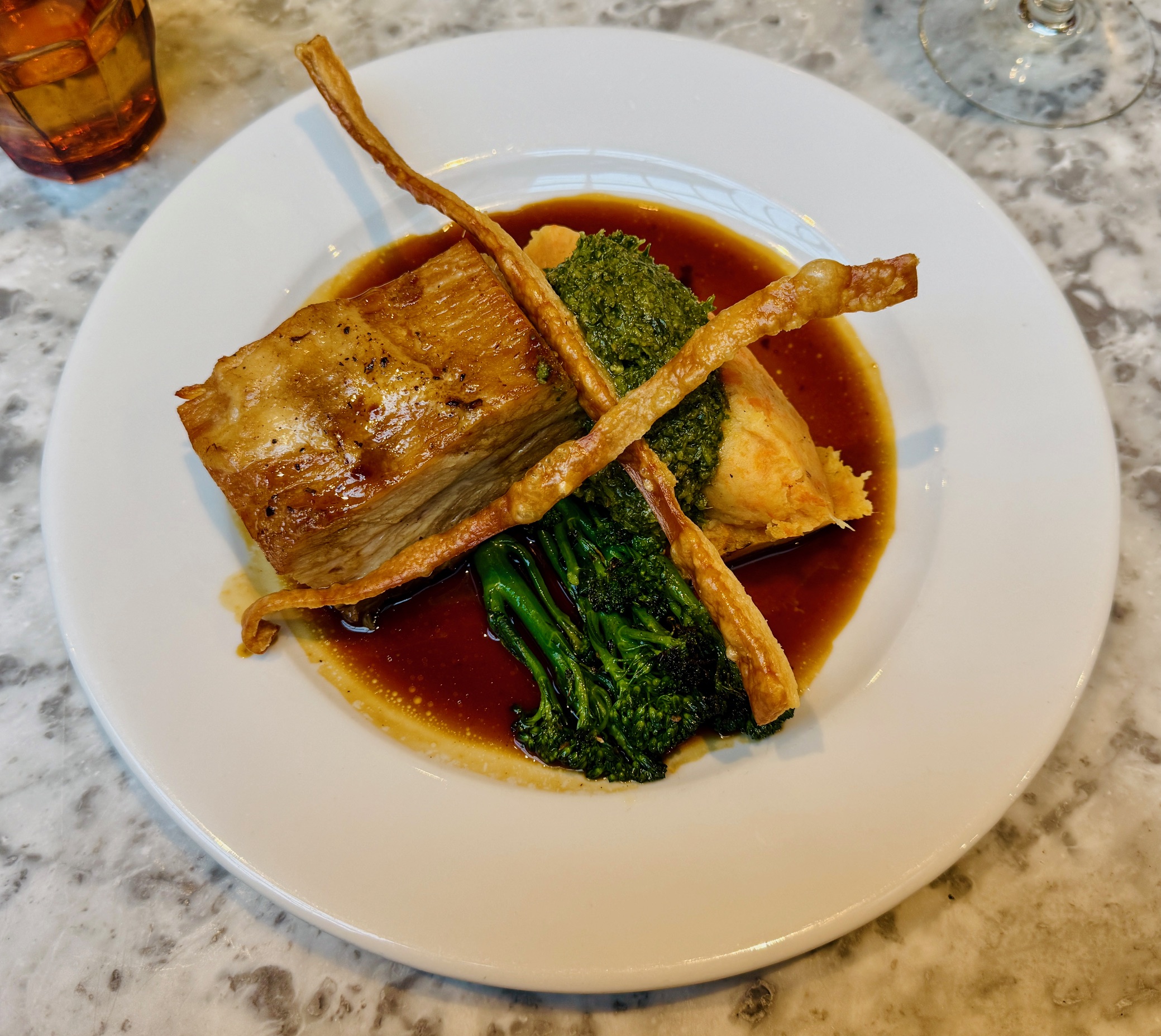
Of course, as anybody who’s married knows, you only really win at lunch if your dining companion wins too. So I was glad that Zoë, picking the other dish that jumped out from the menu, was as happy as I was. A colossal slab of pork belly, all fat rendered beautifully, would have been worth the price of admission alone. Add in a deeply savoury jus, an enormous quenelle of root vegetable mash, some firm but delicious tenderstem broccoli and a couple of crispy straws of crackling and you had a dish that could redeem the month of February single-handedly.

And the final element, the icing on the proverbial, was a salsa verde that supplied the zip and verve that stopped this all being a bit too much. Like the red pesto, a little went a long way. It also highlighted, again, that the kitchen had decided to do a few things to the very best of its ability rather than produce a bloated menu that lost its way.

“This is the first Lyndhurst-style dish I’ve had since the Lyndhurst closed” said Zoë, and I knew exactly what she meant. Very few people cooked pork belly as well as Sheldon and Dishon at the Lyndhurst, and this was the first time I’d eaten somewhere that reminded me of that. The room couldn’t have been more different, and the menu couldn’t have been much more different either, but there was that thread of brilliant hospitality that connected a restaurant I’ve loved for years and a restaurant I’ve mourned for nearly twelve months. It was nice to be reminded of it like this.

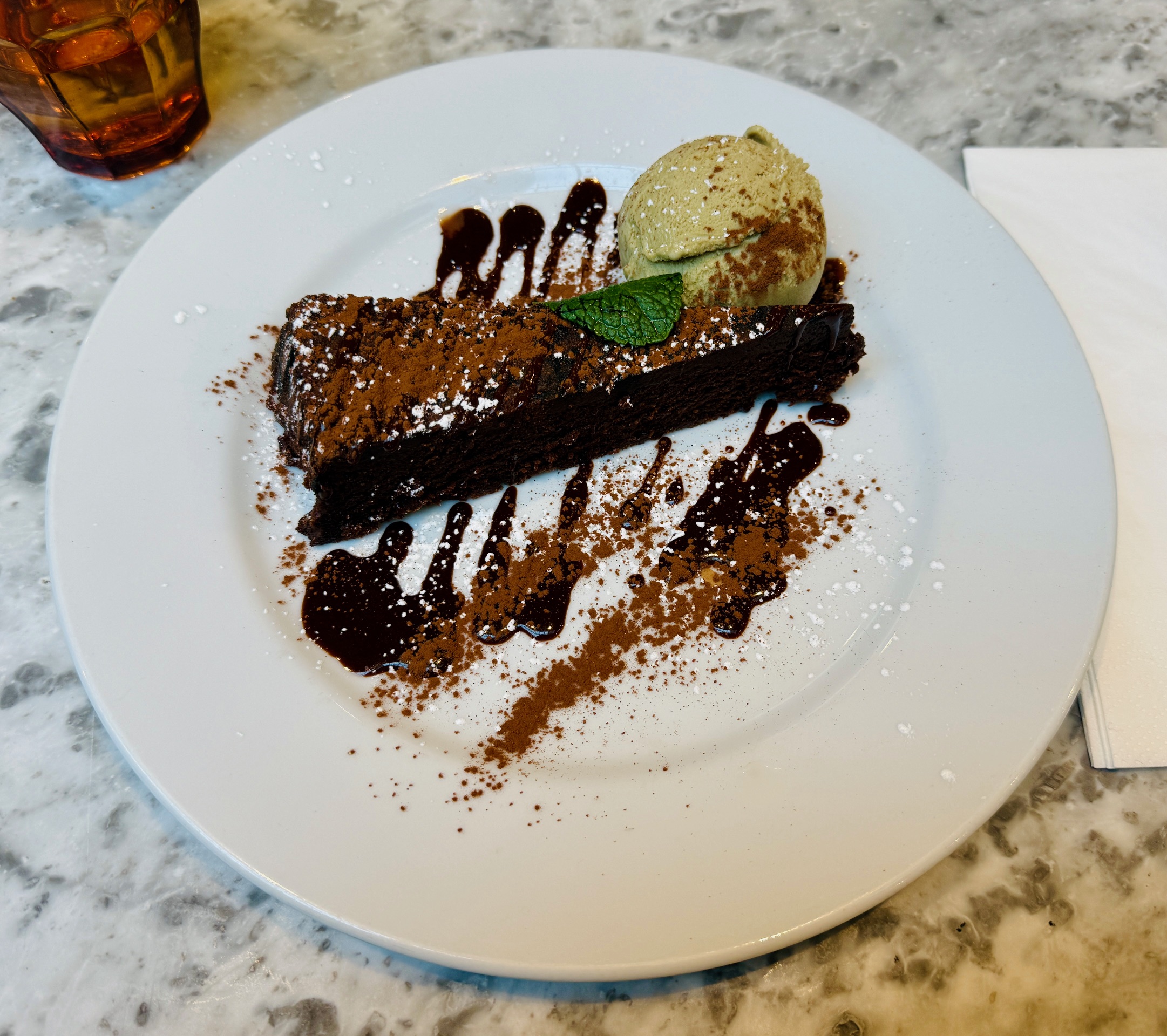
Branca’s dessert menu was also compact and really, when you stripped away the padding, it was four desserts and a range of ice cream; I’m happy to accept that a chocolate brownie classes as a dessert but things like affogato, chocolate truffles or – as was the case here – Pedro Ximenez poured over vanilla ice cream don’t really count. I found the dessert menu the least exciting bit, with most of it reminiscent of London Street Brasserie, so of course I gave Zoë carte blanche and she picked the dish I’d most likely have chosen, the chocolate nemesis.

She was very happy with it, and I daresay I would have been too. It was a tranche of deep, fudgy decadence, festooned with cocoa and squiggled with sauce, pistachio ice cream on the side. It was exactly the kind of dessert Zoë has been ordering since she first started ordering desserts many years ago, and it did not disappoint. It happens to be exactly the kind of dessert I too have been ordering, for ten years longer than her.

“It looks great” I said, which is usually my attempt to get a spoonful. “Is the texture more like a fondant, or a ganache?”

“It’s more like a brownie” said Zoë. There was to be no spoonful.

I’d asked where Branca got its ice cream from, half hoping they bought local from legendary ice cream parlour George & Davis, round the corner. They didn’t, and instead it was from Purbeck, a maker I don’t think I’ve tried.

My benchmark for these things is Jude’s – I’m still up in arms about Nirvana Spa swapping them out for the kind of stuff you get in the interval at the theatre – but I would say the ice cream at Branca came close. The chocolate was deep and smooth and studded with chocolate chips and the salted caramel was actually salted caramel with more than a hint of salt, rather than an attempt to rebadge something that’s either butterscotch or has tooth-shattering chunks of solid sugar in it. It was a fitting ending to my latest, but by no means my last, meal at Branca.

The best part of a couple of hours after we took our seats, it was time to settle up and sally forth into the streets of Jericho. Our bill for two came to just under one hundred and fifty-five pounds, including the 12.5% service charge, and paying it I thought that Branca was one of the safest bets I know of in the world of restaurants. I suppose after more than two decades it should be, but then I also remember the dwindling handful of Reading restaurants that have been here that long – places like Quattro and Sweeney and Todd – and realise that I’ve never had even a fraction of the affection for them that I do for Branca.

The rest of our afternoon, fortified by that lunch, was idyllic. We stopped at the Old Bookbinders, a ludicrously pretty backstreet boozer, for a quick half and thought that we needed to come back to try the small, perfectly formed French menu they happen to offer. We snuck into St Barnabas’ Church and gawped at the wonder of this little basilica, plonked in the middle of Jericho. We browsed paperbacks at the Last Bookshop, bought phenomenal cheeses in the Covered Market and stopped for a pre-train beer at Tap Social, wanting for nothing except a mobile signal strong enough to allow access to Untappd.

Oxford was at its finest that day, and I had that thought again: I need to come here more often. Yet the thing that really made all of that, you see, was Branca, and a reunion with an old friend of a restaurant. Lots to catch up on, but the news – getting married, moving house – was all mine. Because Branca was as it always is: classy, fetching, welcoming and utterly, utterly reliable. I’m glad I finally got round to reviewing it, and even gladder that I caught it on a day when it was very close to its best.

But if it hadn’t been, with nearly twenty years of history, I probably would have let it off. Because after all, how many restaurants can you say you’ve been going to for twenty years? I used to have more, but the ones in Reading have a habit of closing. Oxford can hold on to its institutions better, I think. But given the institutions that have been defining Oxford for nearly a thousand years, is that really a surprise?

Like I said at the beginning, I can never tell which of my reviews will do well. But I liked Branca so much that all of that feels immaterial: and that, to me, is the best reason there is to write a review.

Branca – 8.6
111 Walton Street, Oxford, OX2 6AJ
01865 807745

https://www.branca.co.uk

As of January 2025, Edible Reading is partly supported by subscribers – click here if you want to read more about that, or click below to subscribe. Whether you’re a subscriber or not, thanks for reading.
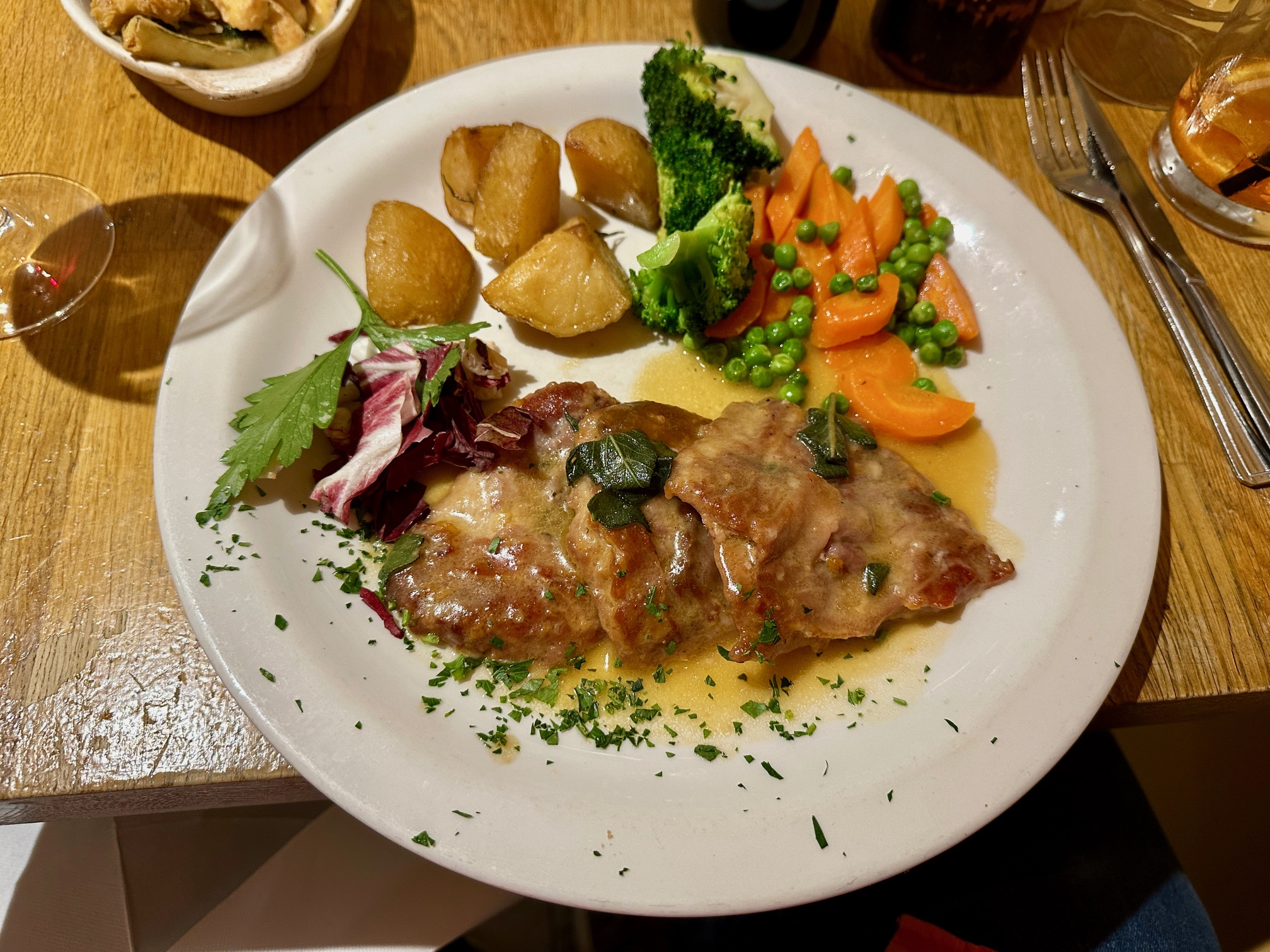
Café review: Zotta Deli

About five years ago, a very nice lady called Elizabeth came to the last ER readers’ lunch of the year, at Clay’s Hyderabadi Kitchen, back when it used to be on London Street. I assumed she must have had a terrible time for some reason, as she never came to another. But then this year she returned, attending one at Clay’s new home in Caversham, and the most recent lunch at Kungfu Kitchen’s new home. She’s brought both her husband and her son to lunches this year, so I guess perhaps she likes them after all.

Elizabeth is American, and her accent has that drawl of somewhere in the southern states, although I’ve never asked exactly where. And at my lunch in the summer I discovered that Elizabeth and I were as good as neighbours. Because, just like Kungfu Kitchen, I moved house this year and it turns out that Elizabeth lives just around the corner from me – in, I might add, a really handsome-looking house. She lives so nearby, in fact, that she told me that if she’d known when I was going on holiday she’d have taken my bins out for me: I was reminded of something the great Barry Crocker sang, nearly forty years ago.

Anyway a couple of weeks back I got an email from Elizabeth, telling me I should review Zotta Deli. It was on my radar already, an institution run by father and son Rocco and Paolo Zottarelli. It made the local news this year when it announced that it was closing its Winnersh premises in July after 10 years trading there, relocating to a new site on the Basingstoke Road, just opposite the holy trinity of Aldi, the Victoria Cross pub and that massive Morrisons. Now Reading residents, they opened their doors in their new spot at the end of September: all the best people seem to be moving house this year.

I knew people who raved about Zotta as a deli, and I have a feeling it used to supply arancini to the likes of Shed, but the move from Winnersh to Whitley was more than an alphabetical one: Zotta was also changing angle somewhat, going from being a pure deli to a spot where you could eat and drink, as well as picking up produce to take home. So a combination of Mama’s Way and Madoo, you could say, just around the corner from Minas Café and Whitley’s legendary New City Fish Bar.

The comparison with Minas Café was an apt one, and part of the reason why I was so keen to get to Zotta before the year was out. Because despite all the money owners have chucked at Siren RG1 and The Rising Sun in the town centre, the gems of the last couple of years in Reading have been far more likely to be found in the less fashionable parts of town, on the Oxford Road or Northumberland Avenue.

And in particular, they were more likely to be discovered in a new breed of cafés like Minas and DeNata Coffee & Co offering proudly regional food, with a crowd-pleasing full English on the side, just to keep the locals happy. After all, that was a model that had worked well in Reading ever since Kungfu Kitchen took over the old Metro Café on Christchurch Green in 2018, keeping the breakfast menu going while cooking up authentic Szechuan dishes into the bargain. And look what happened to them.

So Elizabeth already had my interest, but she also told me that she was a big fan of Zotta’s lasagne. “They’ve just moved, and a good review from you might help”, she added. “I’ll even drop you off there sometime if you want.” I could hear Barry Crocker clearing his throat again. Now, I may not be as motivated by altruism as I should be, but I’m definitely motivated by lasagne. So on a drab and overcast Saturday afternoon I hopped on a number 6 bus and made my way down the Basingstoke Road with carbs and comfort uppermost in my mind.

Apparently Zotta’ new premises used to be something called “Motorists’ Discount Centres”, a place I was about as likely to have visited as Buzz Gym. In its new incarnation the interior was no frills, but by no means unwelcoming. It was split into two rooms, both of which had tables, but the front room also housed the counter, with the deli out back. The latter felt a little bit of a work in progress, but the front room definitely had loads going on with a display cabinet showing cakes and cannoli, another filled with arancini and focaccia. The focaccia in particular are made by Earley-based Pulcinella Focaccia, another local Italian business with a good reputation on delivery apps.

But the thing I really noticed, right from the off, was the welcome. I’m guessing the chap behind the counter was Paolo, and he was immediately warm and friendly. Not only that, but I noticed over the course of my lunch that he seemed to already know everyone coming in, so either these were customers who had followed him from Winnersh or he’d made a good impression on his new neighbours very quickly. Whichever of the two it was, it said good things about the place.

I asked him how long they’d been there and he said it was just over a month. I was surprised to hear that he’d moved because of high rents in Winnersh: who knew that Winnersh was such a desirable part of town?

“It was crazy, I’d have paid less rent in the centre of Reading” he said. “But I needed more space anyway to open the café as well as the deli. I was waiting for the site next to us to come free in Winnersh, but it never quite happened.”

“Do you get lots of people coming here from Winnersh?”

He smiled.

“Yeah, we do actually. We’re very lucky with our customers.”

I grabbed a table at the front, in what little daylight there was, and had a look at the menu. It’s a shame I was there solo because Zotta offers several different things, and in an ideal world I’d be able to tell you about more than one of them. There was a compact range of pizzas pretty much with the toppings you’d expect – a quattro formaggi, a quattro stagioni, a pepperoni and ‘nduja pizza and another with sausage and friarelli. Most were a fraction over ten pounds, so pretty keenly priced; I don’t know whether Zotta make their own bases or buy them in, but their Instagram has shown pictures of bags of Caputo flour in the past, so I very much hope it’s the former.

Then there were sandwiches – again, a reassuringly small range which would seem to take advantage of the produce they have in store. These mostly came in at less than a fiver and despite being compact, the selection was interesting – one with Parma ham, mozzarella and pesto, another with mortadella, provolone and three other types of cured meat. The gentleman at the table next to me ordered the “Don Rocco”, a simpler affair with breaded chicken, lettuce and mayo and I have to say it looked decent, although he missed a trick not having it in one of those focaccia.

But I was on a quest for lasagne, so I had to forego all of those options. Again, the pasta choices were compact – half a dozen options, all distinct pasta shapes with distinct pasta sauces rather than the sort of mix and match horror I associate with the now departed Wolf Italian Street Food. But I did suspect that these all relied on dried pasta, and there were no filled pasta dishes on the menu. And finally there were two al forno options, the lasagne and a ricotta and spinach cannelloni number.

There’s also a section with breakfast items on it, so I ought to mention that for completeness’ sake. But I’m guessing that if you read this blog you’re probably not deeply interested in all that. For that matter, you’d probably think a little less of me if I went to a place called Zotta Italian Deli to review it and then ordered a fry-up. I should hope so, anyway: I’d think less of me too. I went up to the counter with my can of chinotto in hand, like a right wanker, ready to order.

“I hear that your lasagne is really good. Is there anything else I should consider?”

“Thank you! Lots of people say good things about our spaghetti with meatballs too” he said. (JUST LIKE MAMA’S! said the menu in brackets after that particular dish).

“Your lasagne is made with sausage, is that right? What kind of sausage?” I said, expecting it to be some kind of crumbled sausage meat.

“It’s made with a kind of dried sausage” he said. That was a new one on me, but I was sold. I placed my order for all that and a latte, then realised it was daft to have a latte at the same time a hot dish and a can, so I asked him to hold that until I’d finished eating. I sat back down with my chinotto and made myself comfortable.

And, as an aside, I was so delighted to find chinotto in the fridge. It’s the soft drink that always, to me, feels a little louche and disreputable, partly I suspect because it’s more bitter than sweet. It’s the Brian Ferry of soft drinks – or, more accurately, the Marcello Mastroianni of pop. It’s also just the tonic if you’re nursing a mild hangover, which on this occasion I was.

My lasagne came along fifteen minutes later, by which point I was rather enjoying sitting, straw-slurping and people watching, really hoping that it would be magnificent and I could end my year with a discovery to match Minas Cafe, just around the corner. And the signs were good – it came in an enamel dish that had clearly gone nowhere near a microwave. I wasn’t sure whether it had been layered and cooked as an individual dish, or heated up from a bigger portion, but ultimately it didn’t matter. And to me, at first sight, it looked the part.

And it sort of almost was, but I need to pick through the things here that are a matter of personal taste and things I just think could have been better full stop, to help you make your own decisions. So personally, I wasn’t entirely sure about Zotta’s ragu, but that could have been me. It was heavy on the tomato, with no béchamel offering light and shade, and the tomato was a little sharp and acidic, unleavened with sweetness. And I didn’t mind the slices of dried sausage in it – they might have been unexpected, but they worked. But I found the bits of ham in the mix strange and jarring – not prosciutto crudo, not pancetta, not pork mince, but pink prosciutto cotto.

But just to stress, all those things are matters of personal taste, and your taste may be different. I’m not saying that it wasn’t authentic, it might well have been, but it wasn’t quite my bag. But the other things about the lasagne, I think, were a little more universally in need of tweaking. First, although it was hot at the edges and corners it was lukewarm in the middle, and that felt like it wasn’t quite right. I wonder if this is also about Zotta’s transition from deli to café, because ordinarily in the Winnersh days they’d have portioned it up and left finishing it off in the oven to you, and you wouldn’t make that mistake. But it did feel like a mistake.

And that led to the second problem, which is that for me the very best bit of a lasagne, apart from a blinding ragu, is the crispy, almost-chewy caramelised edges where a long sojourn in the oven has worked its magic. And again, that was where this lasagne was a little wide of the mark. And I feel bad saying this, just as I felt bad at the time thinking that, although the room was great, the service was brilliant and the endeavour was to be applauded, the main thing I noticed was what could have been better. My glass of chinotto, by this point, was half empty.

The second act of my meal, though, was lovely. My latte was beautiful – an old-school coffee, not a third wave statement, but tasty and lacking in bitterness. And my cannolo, because I ordered one of those to go with it, was a joy. I should have had a couple, really, but the lasagne was nothing if not substantial so I limited myself to just the one, in this case salted caramel. The shell was dense, and slightly lacking in lightness, but I didn’t mind that, because it made it a perfect vehicle for a gorgeous, glossy filling. Sometimes salted caramel is just code for “this tastes a little like butterscotch”, but no such problem here – this was a proper treat.

All in all my lunch cost less than fourteen pounds and left me with plenty to digest, in more ways than one. I wandered back out to the deli and had another look, but couldn’t quite find anything I fancied taking home with me. As I said, that felt not quite the finished article yet, with some way to go before it felt an embarrassment of riches in the way that Mama’s Way does.

But I wouldn’t bet against them getting there. Because one thing I’ve noticed about Zotta from their Facebook page is the rhythms of when their stock comes in, announcing the arrival of fresh focaccia, fresh arancini, brand new mozzarella or cornetti like they’re returning friends. And this, to me, is the kind of thing Zotta do really well, that makes you root for them. In my case, it made my experience there more as a whole than it might have seemed on paper. It helped me understand why Elizabeth had been moved to send me that email, to try and make sure more people knew about them.

And I do feel much more generously inclined towards Zotta because even if they’ve been trading for ten years, going from being a deli to being a café is not easy. Doing that while also trying to keep your old customers, attract new ones, promote what you do, extend your hours, take on staff and keep your previous business as a deli going, all at once? I can’t even imagine how difficult that is.

Perhaps I feel particular empathy for Zotta because we both moved house this year. And that’s not easy. I still don’t know where some of my stuff is, I still have boxes I haven’t unpacked and whole rooms that don’t feel like rooms yet. I still don’t completely know my neighbourhood, which is so different from my old one. It’s scary and exciting and sometimes it pisses me off and makes me feel defeated. And I don’t have people coming round to my house, paying for goods and services and expecting everything to be perfect. If Zotta has had a year anything like mine, all I can do is take my hat off to them.

So no, I didn’t absolutely adore my lasagne the way Elizabeth loved hers, but I saw enough to make me think that Zotta will iron out whatever wrinkles they have and go on to be a real force for good on the Basingstoke Road. And I will be back to have another latte, try their focaccia, catch up on their deli, buy some coppa and support them in their efforts to bring a little of la dolce vita to Whitley. And I’ll have another chinotto too, because once a pretentious wanker, always a pretentious wanker. It’s what Marcello Mastroianni would have wanted.

Zotta Deli – 7.0
279 Basingstoke Road, Reading, RG2 0JA
0118 9776222

https://www.facebook.com/zottadeli