Restaurant review: Town, Covent Garden

Town – or, as it’s sometimes written, TOWN – is the hot new restaurant on Drury Lane, with celebrated chef Stevie Parle in the kitchen. It’s been open a couple of months, and has already had rave reviews from every quarter. Admittedly, some of those came with caveats. Giles Coren declared at the outset that he was friends with Jonathan Downey, one of the backers – a rare piece of transparency about vested interests in this sphere – and in the process revealed that Tom Parker Bowles is too (which means it’s quite possible that Parker Bowles is also friends with Coren: and to think we’re meant to trust these people’s tastes).

So yes, in the space of just over 6 weeks, almost every national restaurant critic we have – not William Sitwell, he was probably too busy campaigning for Nigel Farage – went to Town, literally and figuratively, to almost universal acclaim. Even that chap with the bouffant who writes for the Standard whose name escapes me went there (only kidding, he’s called David Ellis and I read somewhere that his earliest restaurant memories involve Quattro: he still goes with his family and gets limoncello on the house).

I’ve written about this phenomenon before, talking about Kolae or, more recently, Brutto: that even though London has many thousands of restaurants, and the rest of the U.K. many thousands more, you will find a handful of London restaurants every year that get written up by every single reviewer. Either because they offer something interesting and different or because the chef has a backstory or, more likely, is well-connected in the world of food.

All those channels and nothing new on: it’s all repeats. But it’s more important that they have their say on a significant new opening than it is to give readers a range of options, so they all race to file their copy and put their stamp on it first. Plus it’s much easier for them to get to than some godforsaken place out in the regions or, heaven forbid, the North. I suppose it’s handy if you really do want to go to that restaurant, because, like Metacritic, you can cobble together a composite view from those half a dozen pronouncements.

All this makes it look like I’m late hopping on a speeding bandwagon – which is both annoying and untrue, because I booked my table at Town a week before the first review of Town came out. And that’s not because I’m some kind of incredible trendwatcher with my ear to the ground: it’s because Zoë’s birthday was coming up and I asked her to choose a venue for the big day.

Initially she wanted a table at Lasdun, the Brutalist-inspired restaurant based in the National Theatre and run by the people behind superb Hackney pub the Marksman. But then, for reasons that were never explained, they contacted us to say that they weren’t offering lunch that Friday and would we like to move it to an evening booking? We didn’t, so we didn’t, and then a few weeks later Zoë said “I’ve decided: there’s this place opening called Town”.

And this is the difference, I suppose, between a punter and a would-be pundit. In the run up to our visit, every new review was great news for Zoë – someone else liked it! our meal is going to be excellent! – whereas I quietly facepalmed and channelled Brenda from Bristol. But never mind: everyone said it was excellent, so we spent the morning bimbling round Covent Garden before heading to Drury Lane, stopping for a couple of Belgian beers at Lowlander Grand Café, a place that feels like it’s been there for my entire restaurant-going life, before making our lunch reservation.

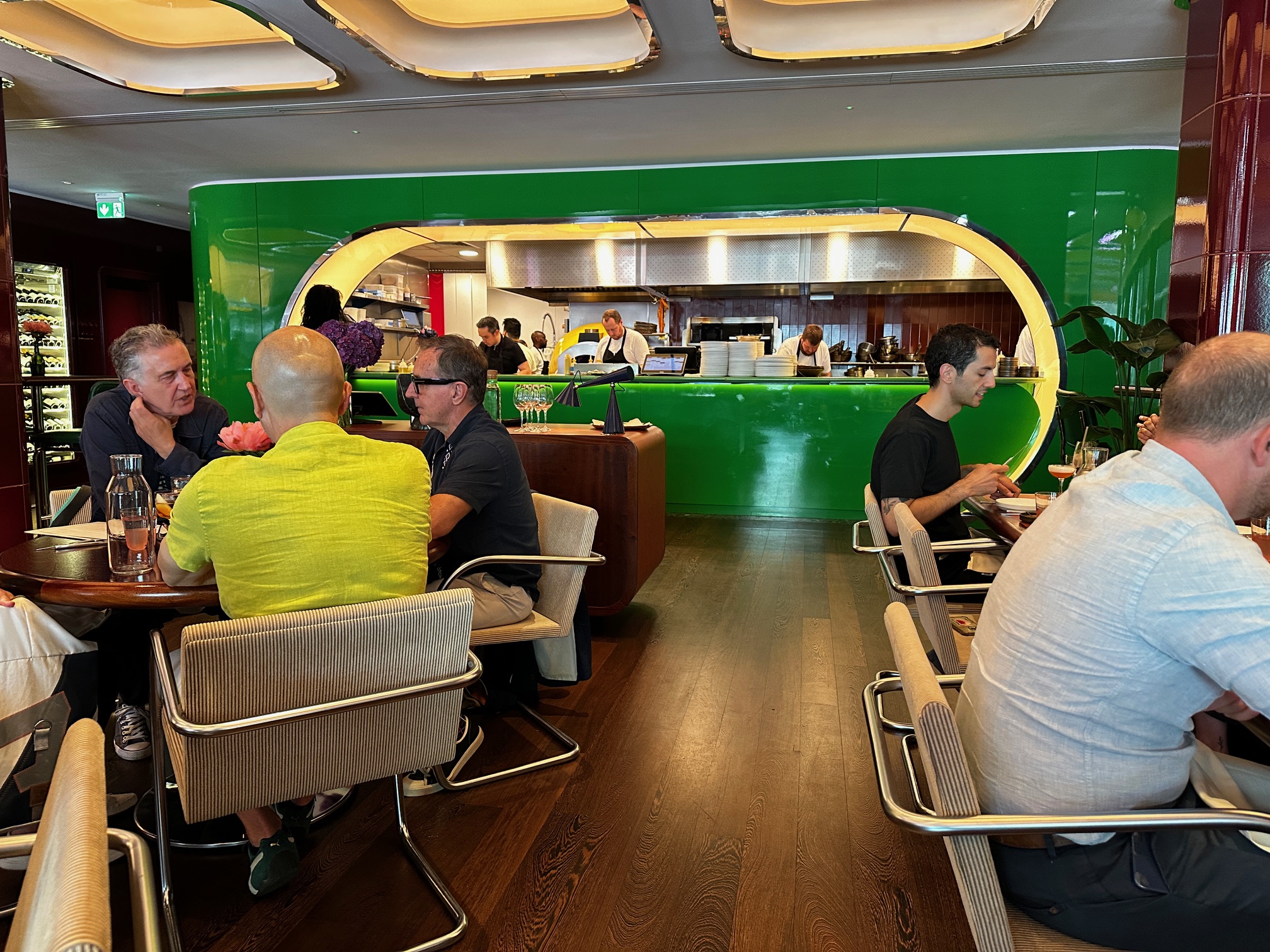
The interior of Town is gorgeous, and all the reviews have made much of that. Everything is very luxe, very glamorous, very Sixties – Tom Parker Bowles referenced Ken Adam, David Ellis suggested Mad Men – and the attention to detail is impressive. There are curved edges everywhere, from the rounded, tiled burgundy pillars to the beautiful chrome-edged ceiling lights. The photos I’d seen in advance also focussed on the feature in the centre of the dining room, a striking kelly green window into the open kitchen.

It really is stunning, but the single press photo – used in no less than three of the reviews – made it look like this is a huge centrepiece of the entire restaurant. And that’s not entirely true. We were sat in the middle section, and I had no complaints, but if your table was nearer the outside of the restaurant I think the place would have felt far less special. And I did wonder if, like the episode of Curb Your Enthusiasm where Larry David keeps being seated in the “ugly section”, there was a kind of centrifugal force going on here: the outer section had more boomers in it than a British Airways flight to Malaga.

The broadsheet reviewers won’t tell you that, of course, because they never get shit tables.
Town’s menu was a funny one: despite having plenty of dishes on it, little of it jumped out at me. Starters ranged from fifteen to twenty-five pounds, mains all the way from just over twenty all the way up to ninety, although the priciest ones were to share. But I was surprised by how untempted I was by it all on paper: some of that will be my preferences, not being wild about clams – which pop up twice – and feeling generally like having steak in a restaurant like this is a bit of a waste, even if it is Wildfarmed beef (Town goes to, well, town on its provenance, with butter and cheese coming from Parle’s brother’s dairy).

Vegetarians might have found things tricky too, with just one starter and two mains to choose from, one of them being the ubiquitous hispi cabbage. The reviews I’ve read waxed lyrical about the menu, but it was rare for me to find the choice difficult for all the wrong reasons, in some cases ordering the only thing that appealed rather than the thing that appealed most. The irony isn’t lost on me that vegetarians and vegans probably feel that way a lot of the time.

But before all that we had a negroni and a couple of things from the snack section of the menu. Town’s negroni goes firmly off piste with Somerset brandy and eau de vie instead of gin in the mix: I quite liked it but, as I had at Oxford’s Gees, found myself wondering why people tampered with the classics.

The introductory dishes on a menu are like the opening tracks on an album: every review mentions them, although it might not cover everything else. So I’d heard all about Town’s fried sage leaves with honey and chilli, and enjoyed them every bit as much as I expected to.

The trick here was to manage to make them truly snackable, moreish and sticky without making you reach for the hand sanitiser afterwards, and in that respect they worked very well. Sorry to mention Gees again but ironically their version, with anchovy in the middle, was even better (mind you, it was also the only good thing I ate at Gees).

But the dish everybody lost their shit about was the bread: potato sourdough which came not with butter but with a little bowl of dipping gravy. I’d read so much hyperbole about this dish that I almost had an invented memory of having eaten it myself: reading a plethora of reviews will do that to you.

It brought out the purple streak in reviewers: “we all need dipping gravy in our lives” was Jay Rayner’s take on it, while Giles Coren called it “show stopping”. Tom Parker Bowles said that it “coats the lips with a lustre of sweet fat” – just no, thanks – and Grace Dent didn’t try it. But that’s Dent all over: read her reviews carefully and she talks about far more dishes than she actually eats. I know people like that.
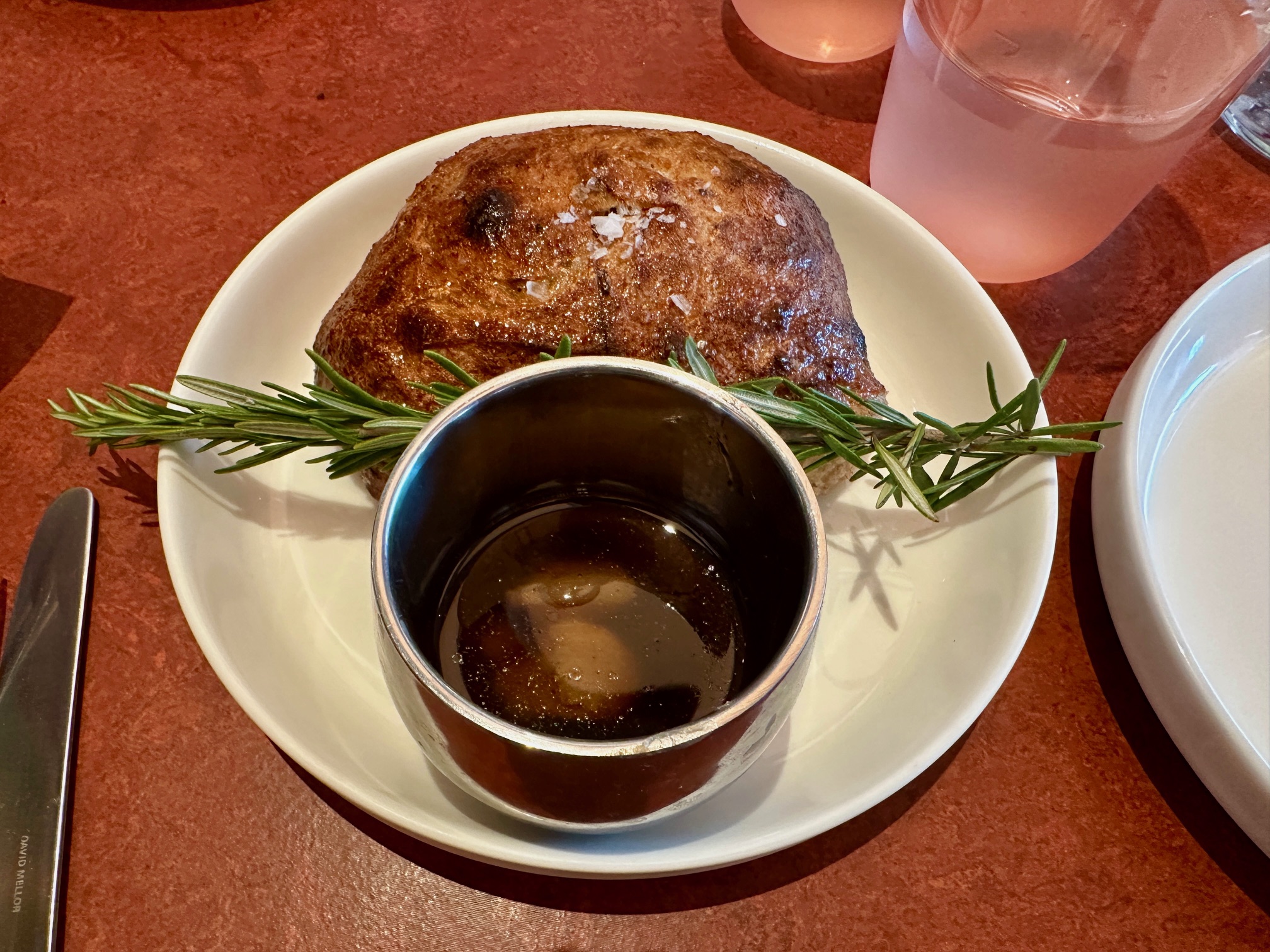
So did it live up to all that hype? Well, no. The gravy is indeed terrific: thin, glossy, beaded with beef fat with some soft, steeped garlic in it. But I tend to think if you’re going to dip some kind of food in a liquid, that something shouldn’t be wet too. And the sourdough was a soft, slightly underbaked ball of stodge that wasn’t really up to the job of acting as a vehicle. Sometimes the line between USP and gimmick is a thin one: you didn’t need VAR to work this one out.

I had a slight sense by this point that, as with the beautiful dining room, things had been designed more for form than for function and my starter backed this up. Again, many of the reviews have lavished praise on Town’s saffron risotto with roasted bone marrow and I was very excited to try it. And it’s clearly visually imposing, to have this kind of roundel of a dish with a bridge of bone crossing a pool of risotto.

Very Instagrammable, I’m sure, and a huge hit with the critics. Grace Dent said it was “sublime”, Jay Rayner “stupidly rich” and Giles Coren went on about a “huge canoe of fat, salty marrow” (fun fact: Coren is also a canoe, although a different kind). But this dish felt like it was for looking at, not eating. My bone was decidedly short on marrow, and once you’d worked it free and into the risotto, there was nowhere to put the bone, which rather got in the way of eating the bloody thing. You ended up playing some kind of weird gastronomic Poohsticks, pushing your risotto under the bone so you could get to it.

With all those reservations, was it worth it? Well, yes and no. I liked the risotto, which was saved from anonymity by a judicious hit of citrus, and what little marrow there was was indeed outrageously good. But as a dish, it felt performative rather than knockout. Seventeen quid for that: Giles Coren said that it would have done him for lunch or dinner on its own, but maybe he’s on some kind of appetite suppressant.

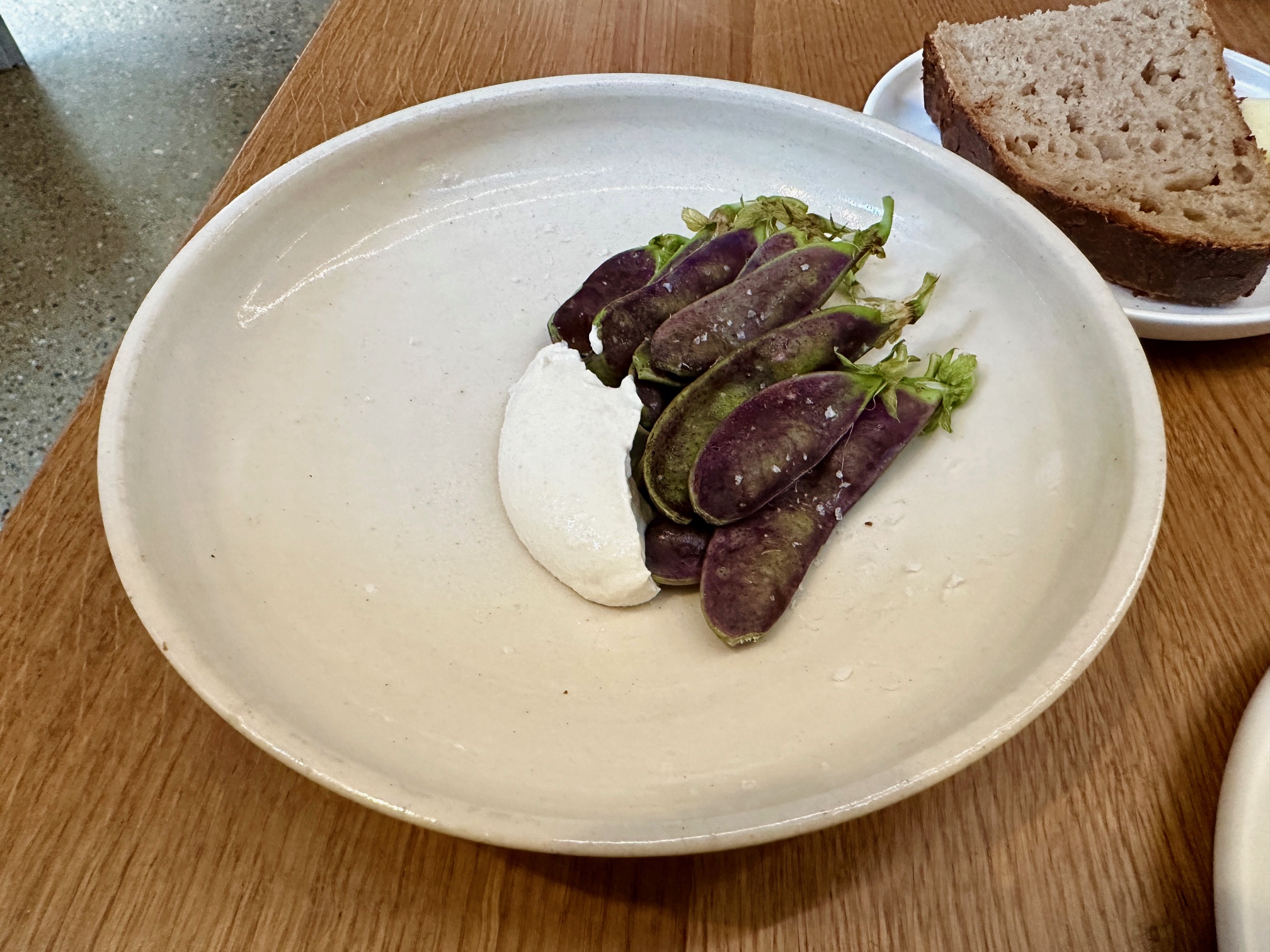
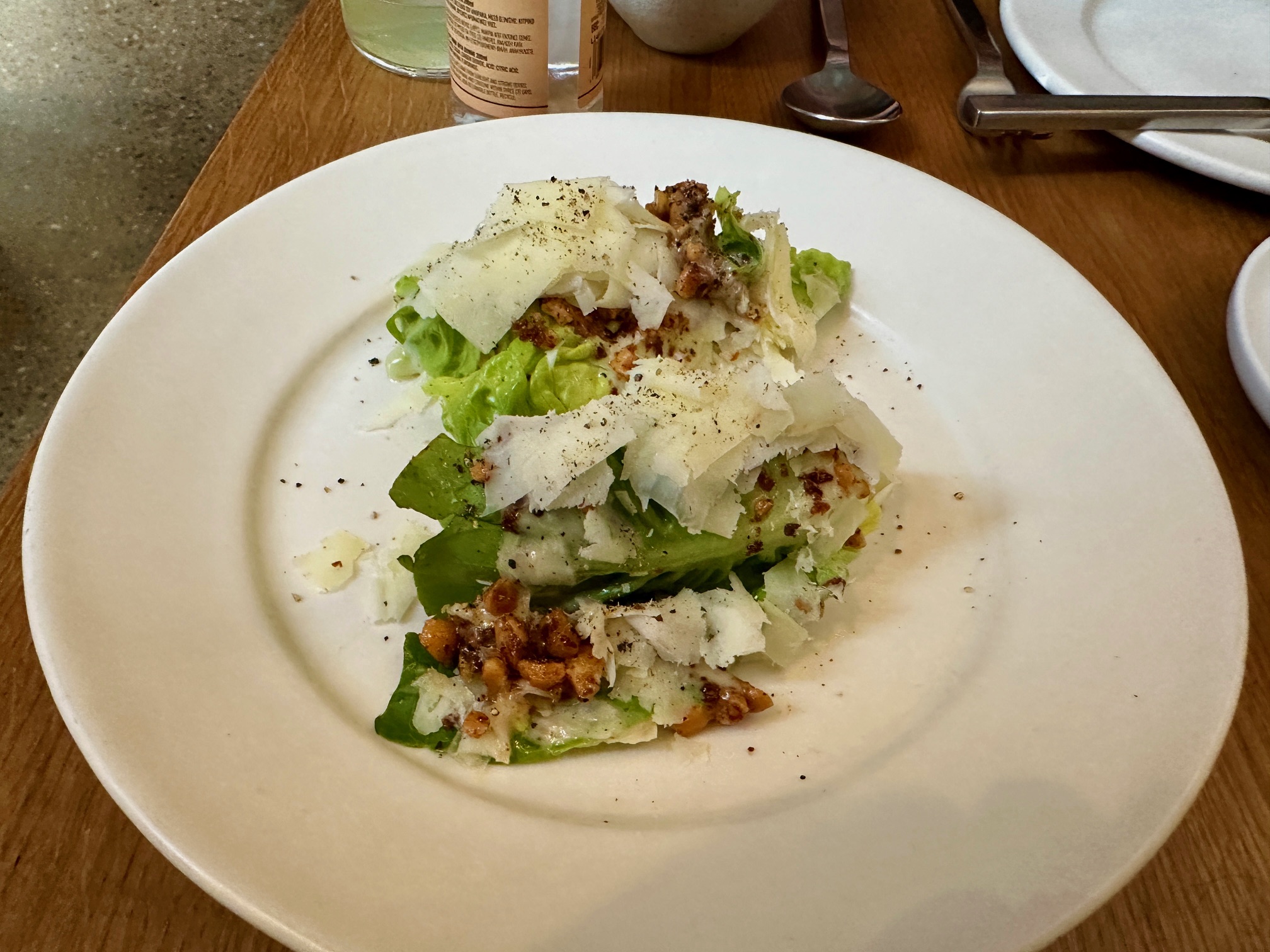
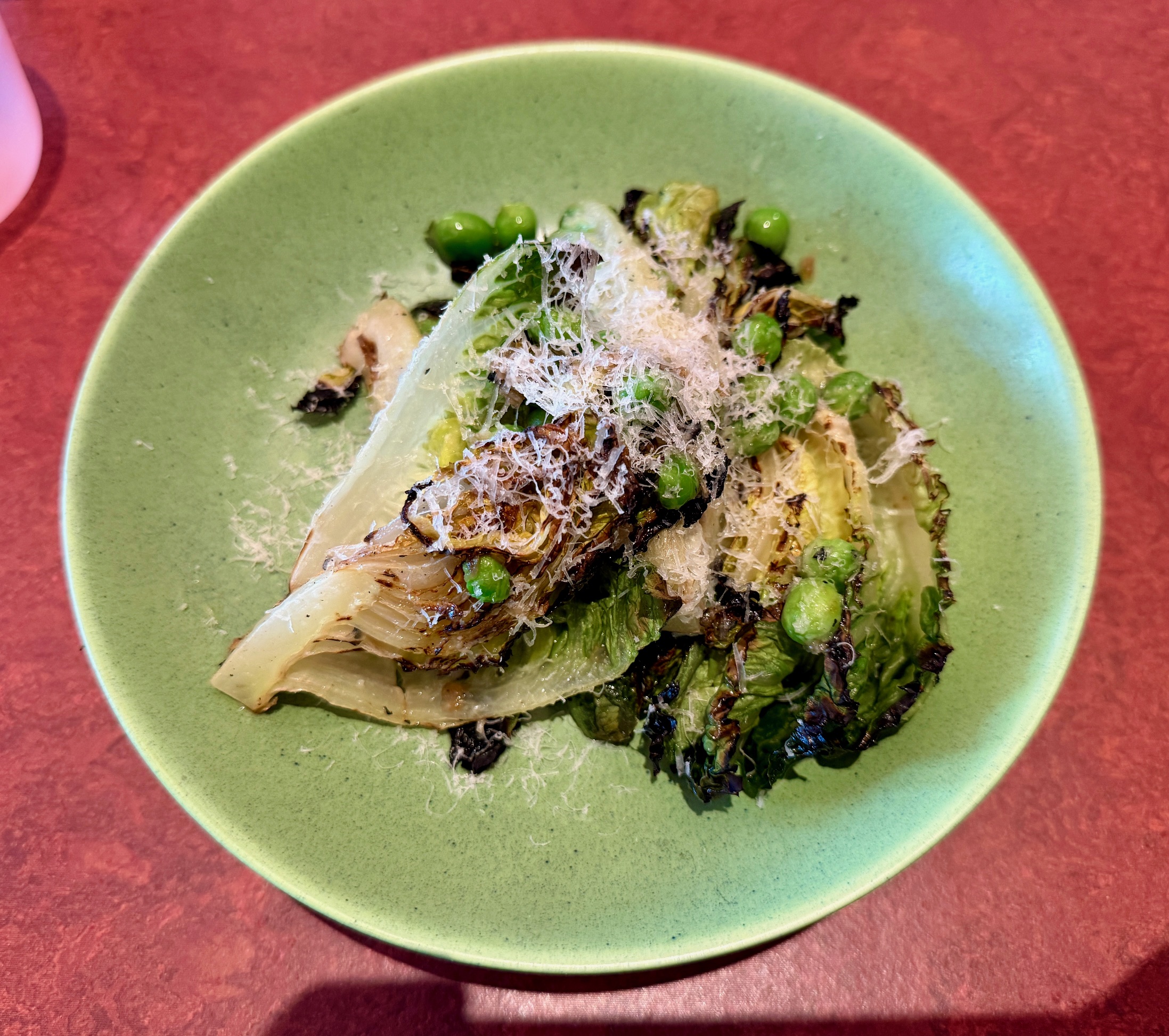
Far more successful was Zoë’s choice, charred baby gem lettuce with peas and Spenwood. Town appears to have dedicated itself to the worthy pursuit of making salad both warm and interesting, and this was a great leap forward in that field. I had a forkful, loved it, and didn’t resent the fact that Zoë had ordered it and I hadn’t. Mostly, in truth, because it was her birthday. Perhaps Town’s gift was that dishes which looked unassuming on paper turned out to be worldbeating in the flesh. Which was great and all that, but how would most people ever find that out?
The reviews I’ve read of Town talk about the service in glowing terms, and again that wasn’t entirely my experience. Perhaps I was there on a bad day for them, but it felt solicitous to a fault, as if they had over-resourced and wanted to look useful. So while we were still finishing our starters, they came over and plonked down the cutlery for our main courses, which just seemed odd. I didn’t think much of it at the time, but then they made a similar, more annoying mistake later on: we’ll get to that.

But anyway, we were having a lovely time, in a lovely room, we were off work for the next week and a bit and there’s something about lunch in London on Friday, when most people are at work, that always feels like a little victory. And our table was decent, the company was superb – well, for me anyway – and the bottle of Albariño we were on was going down nicely. I knew at some point, when I wrote the place up, I would need to distil how much of the excellence was down to Town and how much was down to everything else, but that was a quandary for later.

The birthday girl also chose the best main. It wasn’t even close. Pork came beautifully done, a charred crust masking perfect pinkness, a really deft piece of cooking. The menu said it came with “early season onions and burnt apple sauce”: in honesty I think the onions were close to burnt, but that’s never really a bad thing. The apple sauce, its Stygian tones matching the best bits of the pork and the onions, was quite glorious: I didn’t mind the mustard, but like most condiments it wasn’t Zoë’s bag. At thirty-two pounds, this was a relative bargain on Town’s menu and – and this is high praise – it reminded me of the sort of thing you can get at Quality Chop House.

Town was no slouch with its sides, either. Pink fir potatoes came coated and roasted in beef fat – they do like making the most of their cows at Town – and was bang on for flavour, although I’d have liked these to have a little more texture. Not at all a bad side dish, though.

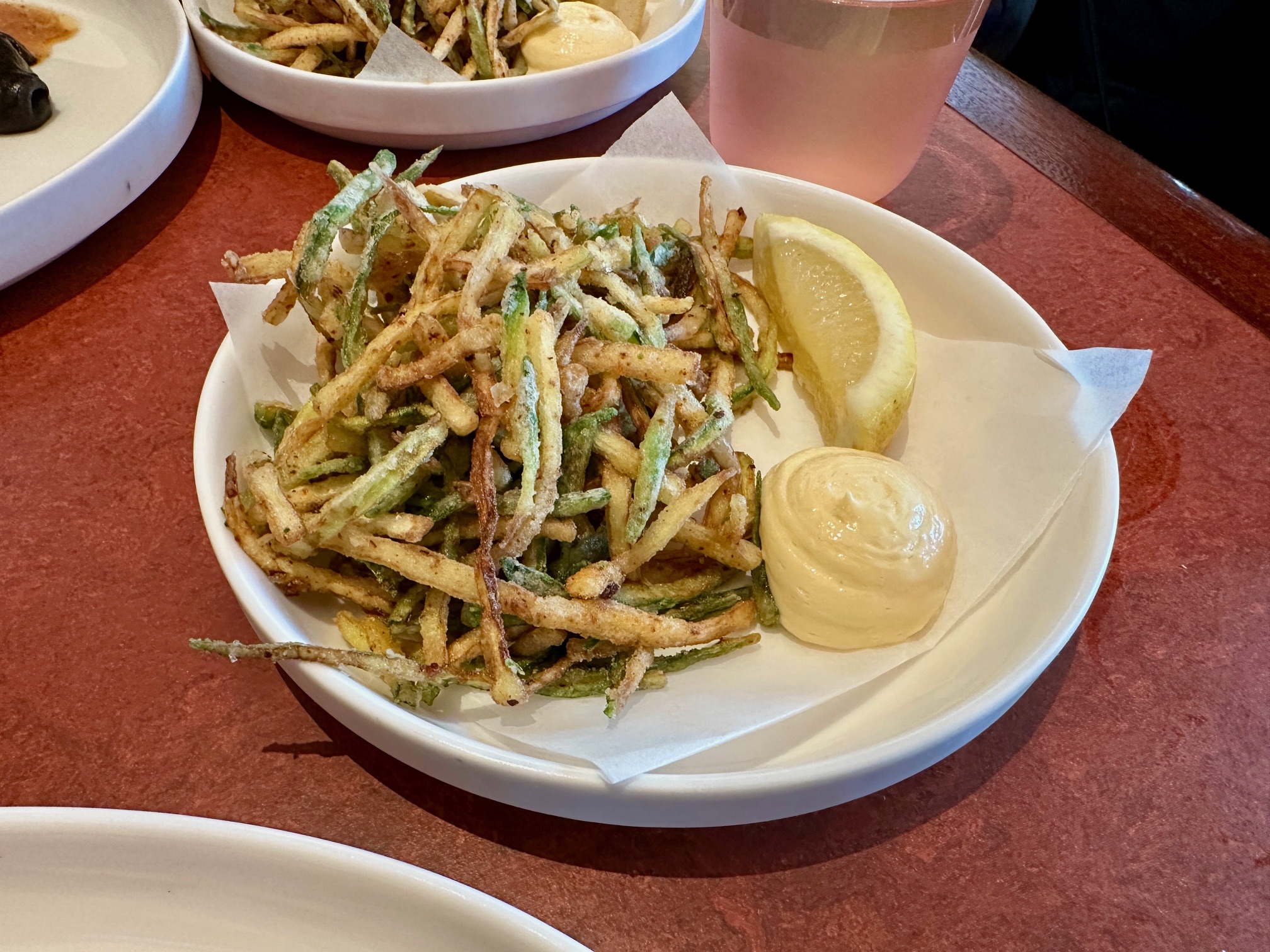
Even better – by my reckoning, anyway – were the courgette fritti, a glorious mess of these served simply with a squeeze of lemon and a little of what I seem to recall was aioli. I loved these, but I do have to say they wouldn’t be for everyone: their saltiness was right at the upper limit of what I enjoy, and it’s eminently possible that I like salt more than you do. I wasn’t sure they went with anything, but they were so much fun that I also wasn’t sure they needed to.
Here’s how ridiculous the contortions I had to go through were: Zoë had picked the pork, which otherwise would have been my choice, and my two remaining options – that hispi cabbage, inexplicably, didn’t appeal – were the duck pappardelle or the Cornish lobster. I would order the pasta dish probably 99 times out of 100, but I’m very aware that this makes me a rather samey reviewer (fried chicken, anybody? Gobi Manchurian?) so, just this once, I strode confidently into the unknown.

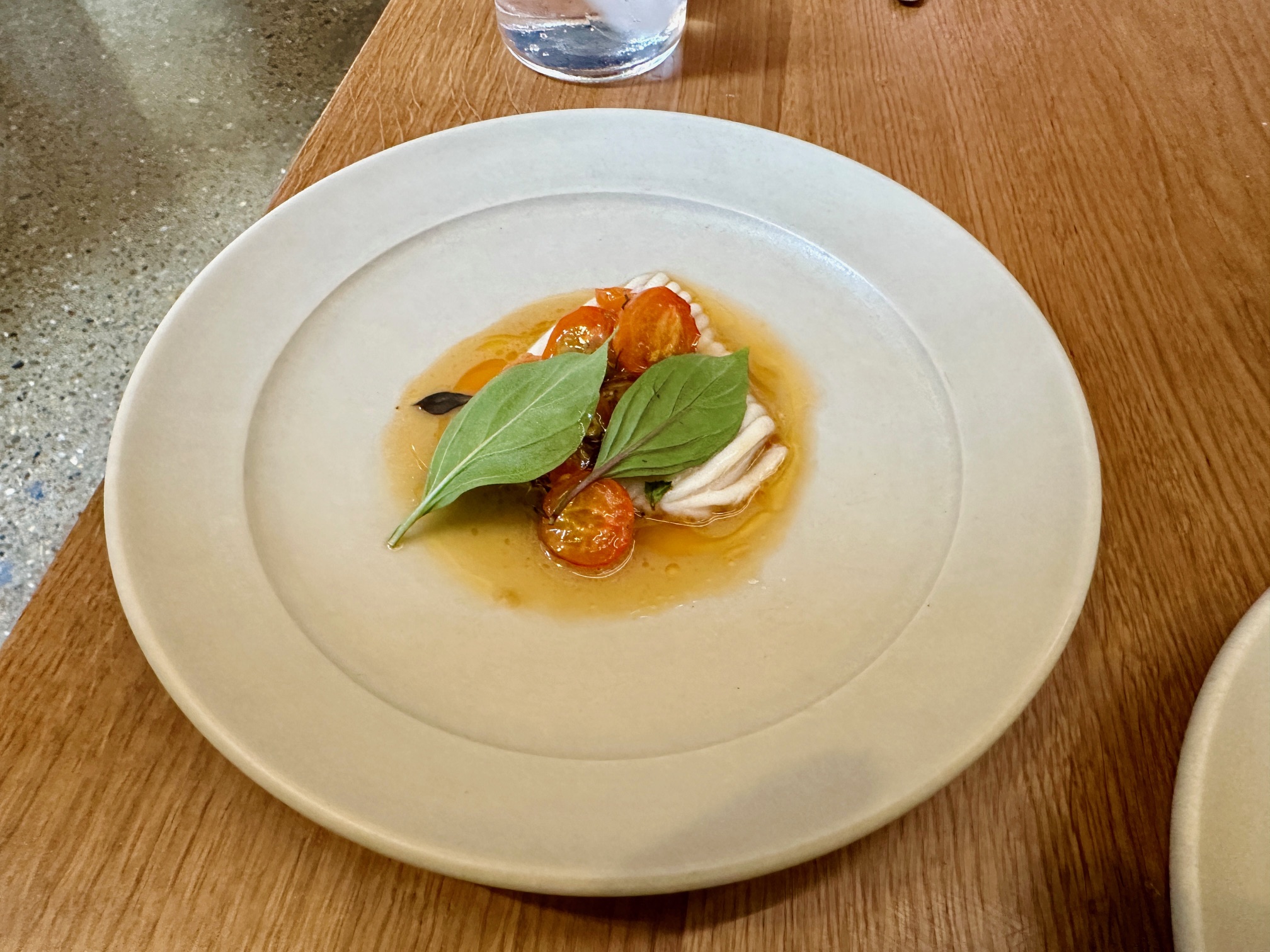
Now, you might absolutely love lobster and so that picture below might look like heaven on a plate to you. I’ve often thought, sacrilegiously I’m sure, that it’s just a big prawn – scarred by The Lobster Room, perhaps – but I’ve also always wanted someone or something to change my mind. Town’s lobster is not, sadly, going to be the dish to do it.

It wasn’t dreadful. Some of the meat was a tad tough, took a little prizing away from the shell, but the XO sauce Town makes to go with it is absolutely stellar: savoury, intense, take-my-money-for-a-jar-of-the-stuff stuff. But where was the lardo? It’s not those white sheets you can see in the picture above: those were thin ribbons of some vegetable, celeriac at a guess. And artfully draping some foliage over proceedings, to make it look more like a still life than a £45 plate of food, didn’t fool me.

I was gratified to find it wasn’t just me, though. David Ellis ordered this dish just after they opened. “The kitchen is settling in” was his verdict on it: on this evidence, they haven’t got there yet.

After this we still had a little wine to drink, so we had a look at the dessert menu and enjoyed the room a little more, now it was less packed. And again, it wasn’t Town’s fault necessarily but the dessert menu didn’t really scratch me where I itched. I’m sure it would be a great menu for loads of you, that you’d make a beeline for the buttermilk pudding or the pandan milk cake, go crazy for the “coconut tapioca” that put me off ordering the mango with yoghurt sorbet. But by this point I’d given up on ordering something else just for the sake of it, so chocolate tart it was.

But before that I have to explain the other service mishap, which I’m afraid involves a little too much detail. I’m going to do it, though, because it illustrates how exactly Town was trying just a little too hard, and because I know if there’s one thing my readers love it’s me either coming a cropper or talking about a perceived bad experience.

So, because it was Zoë’s birthday they brought her out a little treat-sized portion of the chocolate tart, which she ate and loved. That was really kind of them. And because we loved it, we ordered a portion each, and so the staff brought out our cutlery. And then, before our dessert turned up, even though we were sitting there having a perfectly nice time, one of the over-attentive staff swooped on our table, totally unsolicited, and tried to clear the cutlery, which we actually needed, away, knocking the rest of my glass of wine over in the process.

So that was annoying, and they were perfectly nice and apologetic – although I did end up mopping it up myself – and then to say sorry they brought me a glass of the dessert wine Zoë had ordered over for me. Which, again, was kind, but I didn’t actually want it. So I topped up Zoë’s glass, at which point it transpired, as far as I could tell, that actually they hadn’t brought me the Coteaux du Layon Zoë had ordered but something cheaper. So I ended up soaked and irked, with a drink I didn’t want, having accidentally adulterated Zoë’s very nice drink, and feeling ungrateful into the bargain. Hey ho.

But yes, the chocolate tart was lovely, an oblong lozenge of indulgent ganache that tested your resolve, made you wield a fork with almost surgical precision, trying to make the experience last as long as possible. The black barley ice cream was pleasant, if surprisingly generic given that description, and even the raisins, soaked in Pedro Ximenez, were a lot of fun.

Would I have come away thinking that the base was so molecule-thin that it was hard to describe it as a tart if I wasn’t still pondering my spilled wine? Would I have noted that the hazelnut mentioned on the menu, like the lardo from earlier on, were nowhere to be seen on the plate? We’ll never know.

All that said and done I settled up, although not before taking advantage of Town’s facilities, which are exceptionally plush and luxurious and boast a gorgeous hand soap (I wish I’d remembered to take a picture). Our meal, including an optional ten per cent service charge, came to just under two hundred and ninety pounds.

I think, for what we had, that’s slightly on the steep side – but bear in mind I’m saying that from a perspective unlike that of most broadsheet reviewers who get to expense everything. But it was Zone 1, it was Covent Garden, so maybe that’s only to be expected. “Nobody gets out for under £80/head in central London any more for food you’d tell your friends about. Unless your friends like talking about pizza” was Giles Coren’s contribution on this subject, and who’s more relatable than Coren? Exactly.

If you found it easy to guess the rating on this one, having read all this, then have a gold star, because I’ve found it very difficult to assess. The room is great, though not as great as everyone said it would be. The menu I personally found more limited than I expected. The food was quite nice, but not as amazing as the reams of breathless prose devoted to it in the papers.

It’s very strange, this. I’m not an expert, but I imagine there are countless restaurants in London better than Town. Some of them may even have opened the same month as Town did. And yet nearly everybody who reviews restaurants for a living dropped in on this place within six weeks to say how great it was.

Does it do good things for the food scene in this country that our vanishingly small number of restaurant critics all go to the same restaurants? No. Am I part of the problem by reviewing the place as well? Not sure we’re comparing apples with apples really, but possibly, yes.

Never mind. Town is quite nice, and I suppose I’m glad I went there and tried it. Nothing I ate will feature in any list I make at the end of the year, but not everybody gets on the podium. You can be a decent restaurant without managing that. Would I go again, though? Well, between the places in London that I’ve loved and would dearly like to revisit and the restaurants in the capital burning a hole in my to do list, I think the answer to that is no.

But that’s just me. Giles Coren said he’d happily go there “every day, if that’s all right with them”. But his mate owns the place, so I’m guessing he gets some kind of discount. Oh, and in the interests of full disclosure: I do not know Jonathan Downey. Not only that, but I honestly have no idea who he is.

Town – 7.8
26-29 Drury Lane, London, WC2B 5RL
020 35007515

https://www.town.restaurant

Since January 2025, Edible Reading is partly supported by subscribers – click here if you want to read more about that, or click below to subscribe. By doing so you enable me to carry on doing what I do, and you also get access to subscriber only content. Whether you’re a subscriber or not, thanks for reading.

Restaurant review: Paulette, Little Venice

Formosa Street, an enclave in Little Venice less than twenty minutes’ walk from Paddington Station, could be the platonic ideal of a London street. It has a little cafe, a chocolate shop, a ludicrously handsome Victorian pub with wood-panelled walls and glass compartments, with tiny doors linking them together. It has a little Italian restaurant that has been there thirty years, and a craft beer place two doors down, the past and the present coexisting cheerfully.

It doesn’t have a butcher, although there’s one just round the corner on Clifton Road. But tucked away seconds from the Tube station, one stop away from Paddington, a stone’s throw from the strikingly modernist St Saviour’s Church, it is a deeply pretty pocket of London that few people know about. If this was your neighbourhood, you would be very happy indeed. Of course, if this was your neighbourhood you would also be filthy rich.

I’ve frequented this part of the world, on and off, for many years. I think I ate in that Italian restaurant not long after it opened, and I’ve drunk in the handsome Victorian pub a fair few times. Just before lockdown, I tried out the craft beer place a couple of times, and I’ve admired the steeple of that modernist church on more occasions than I can recall. I am no closer to living there, or even pretending that I could do, but it’s nice to try to pretend.

Just before lockdown, five years ago, Zoë and I went for dinner at a small French restaurant on Formosa Street called Les Petits Gourmets. At the time, I had the idea of publishing some London reviews, of places close to Paddington, thinking they might be useful to people wanting somewhere good to eat before grabbing an off peak train home. And it might have been a good plan, if I hadn’t hatched it about a fortnight before people stopped taking trains in general, going to the office or indeed leaving their houses.

So I never wrote a review of Les Petits Gourmets, although that might have been for the best because it was small, eccentric and nuts. On arriving we were told that their oven had packed up, so we could have whatever we liked from the menu as long as it was something they could cook on the hob. The place was dark and atmospheric, our table tiny and cramped. Another table, weirdly shaped and right next to the bar, with a couple of high stools, was so bad that a couple came in, were offered the table, had a shouting match with the staff and stormed out.

I can’t remember anything about what I ate, but I do remember that. And I was tempted to publish a review, if only because it was so surreal, but what would have been the point? It was just a place you would never have heard of, and a review that wouldn’t have sent you rushing there, at a time when you couldn’t have rushed there anyway – even if, for whatever reason, a dingy spot with no working oven and some shocking tables was right up your alley.

I thought no more about Les Petits Gourmets, really, until last summer when I read a rave review in the Standard of a French restaurant in Little Venice called Paulette. I know that area, I thought. I wonder where it is? And then I checked the address, and thought Isn’t that where that weird French place used to be? And then I Googled some more and discovered that it was exactly where that used to be, and opened later in 2020. Les Petits Gourmets was an early casualty of the pandemic: perhaps the cost of fixing that oven was the final straw.

The review I read of Paulette made it sound like everything I had wanted its predecessor to be, so I made a booking there and on a drizzly Saturday morning I caught the train up into London, ready for a long overdue lunch with my cousin Luke, last seen as baffled as I was by supercool Haggerston spot Planque. Fun fact: both Planque and Paulette featured in Conde Nast Traveller‘s listicle last summer of London’s best on-trend French restaurants although, as we will see, they couldn’t be more different.

The walk from Paddington is a lovely one. You start out exiting the station right by the Paddington Basin and cross over it, right by the floating barge restaurants, walking past craft beer and pizza spots and impossibly spenny-looking modern apartment complexes. The route ducks under the grime and bustle of the Westway and then, suddenly, everything is beautiful: the streets widen and are flanked with gorgeous redbrick mansions, huge buildings made up of pinch-me-if-I-live-here flats. And then you’re at the canal, and you wonder how such a fetching residential area can be hiding in plain sight here, in Zone 1.

I stopped for a latte at the brilliant D1 Coffee, a stone’s throw from the waterway, and thought to myself that as usual I was trying to pass myself off as congruous in a neighbourhood far, far above my station. I chatted to the couple next to me about giving up smoking – something I did twenty years ago and still think of as one of my greatest achievements – and as we did, countless cosmopolitan types ambled past, walking dogs or just chatting happily. One was carrying a MUBI tote, and I wondered how it had happened that I’d wound up living in a postcode so far from my tribe. It’s almost as if I just hadn’t tried hard enough to make something of myself.

I got to Paulette before Luke did, and it was unrecognisable from the room I’d eaten unsuccessfully in five years before. Still eccentric, yes: all mismatched patterns on the walls and ceilings, mismatched cloths on the tables, mismatched light fittings, all maximalist and unashamed. But it was bright, cheery and welcoming. Even with the canary yellow awning out, light flooded in from the full length windows and all the tables were full of people who seemed profoundly happy with their life choices. I ordered a kir while I waited for my cousin, and it was sweet sunshine, a liquid escape from rainy London. Even noticing that the gorgeous Victorian boozer opposite was closed for renovations couldn’t dent my joie de vivre.

Nor could the discovery, when Luke turned up and ordered a Meteor Zero, that he was off the sauce. He explained that he’d bust his hip and that alcohol interfered with his rehabilitation regime: news to me, as I’ve always found Dr. Booze an invaluable consultant I’ve involved in my recovery from pretty much anything affecting me.

I thought it would bother Luke, a man who runs more marathons in a year than I’ve eaten Marathon bars in my lifetime, but he was surprisingly sanguine about it. “I figure everything goes through a fallow period” he told me later in the pub, showing a kind of Zen perspective I’d have loved to have twenty years ago when I was his age: come to think of it, I haven’t attained that mindset even now.

That meant that I had to forego the delights and dilemmas of choosing a bottle from the enormous wine list, seemingly covering all of France in compendious detail. But it wasn’t all bad – just under twenty wines were available by the glass, a great spread including half a dozen dispensed using a Coravin. I picked a Sancerre, which was terrific, and we started doing a bad job of making our choices from the menu and a much better job of catching up.

The menu was a tad lopsided, with about a dozen starters and half that of mains, but everything on there was tempting. Many of the things I’d read about in advance and hoped to encounter, like a Roscoff onion tarte tatin with mascarpone, were missing in action, but even so the challenge was very much what you missed out on, as much as what you picked. On another day you would have wound up hearing about the classic onion soup, the scallops or the halibut with sauce Meunière, but I will have to try them next time, assuming they haven’t been whipped off the menu by then.

As it was Luke and I agreed to share a few things to try and cover as much as we could, helped by pricing which encouraged you to try a bit of everything. Starters tended to be at or around the fifteen pound mark, with mains mostly between thirty and forty quid. But everything was so fabulous, and generous, that I didn’t object to that in the slightest.

We kicked off proceedings with a small selection of charcuterie, which was easily enough for both of us. All of it was marvellous, from the bresaola to the pork loin but especially the coppa, dried and intense, and a doozy of a jambon de Bayonne: again, dry and coarse, which very much said tiens ma bière to both Serrano and Parma ham. This came with bread (which should be a given but isn’t always), butter (which was a very welcome surprise) and, best of all, a ramekin containing a deeply acceptable quantity of sharp, tart cornichons.

Fourteen pounds for all that, and for a pound more our second starter was every bit as stellar. I love pâté en croute, and Paulette’s version was the best I’ve tried – a glorious slab of heaven, golden burnished pastry housing coarse pâté, shot through with dark prunes. On occasion I’ve had this kind of dish in Paris and it’s been painfully close to Pedigree Chum, but no such worries here: no dodgy jelly, just densely packed meat – pork and duck in this case – topped with yet more pickles and a quenelle of exceptional whole grain mustard. A very well-dressed salad completed an impeccable plate of food.

I wish I’d had one of these to myself, but to do that I’d have had to go without the charcuterie. This is the problem with sharing food, isn’t it: you always end up wanting twice as much of everything, everywhere, all at once. I was about to start a sentence with Next time, but I’ll try to stop myself or I’ll be doing it for the rest of the review. Truth be told, even by this point the only question in my mind was when exactly that next time would be. It was already a given that it would happen.

I gave Luke first pick of the main courses and, torn between the fillet of beef and the bourguignon, he eventually chose the latter. He chose extremely well. The pan brought to his table was a one-stop shop of pure happiness – a deep, reduced sauce full of wine and care, with a few waxy potatoes, plenty of mushrooms and a transverse beast of a carrot, heftily substantial and yet superbly cooked.

But of course, none of that gets top billing in the name of the dish, and this all comes down to the beef itself. I’m used to having this dish with shin or chuck, but Paulette opted for beef cheeks and, with hindsight, it was an inspired choice. The food writer Harry Eastwood once said that cheek was perfect for this dish as, in her words, “the meat surrenders completely”. I can’t improve on that description, so I’ve nicked it instead.

And it’s true, but only if the kitchen is absolutely on top of its game and the beef is braised to the point where any gelatinous quality is gone, replaced with that terrific stickiness where the beef and the sauce become a symbiotic dream team. That’s what had happened here, and it was a wondrous thing. Trying a forkful I thought back to my friend Graeme’s bourguignon at Côte the previous month, and the difference between good and great. The difference, it turns out, is nine quid and forty miles.

“This is the best French food I can remember eating” said Luke. I’m a relatively frequent visitor to France, but I could see what he meant.

If I had been Luke, I would have wished that I’d saved some bread to mop up that final layer of sauce coating the bottom of the pan. But if I’d been Luke he’d probably have a forty inch waist and far less success online dating and would get over the disappointment of busting his hip (which would be more likely to happen by, say, getting out of bed awkwardly) by medicating with the finest mid-price reds the restaurant had to offer. Instead I offered him some of my frites, and after refusing twice – he is Canadian after all, so awfully polite – he took me up on my offer.

I’ve seen quite a few reviews online talk about how Paulette does the capital’s best frites. They might or they might not: I’ve had nowhere near enough frites in London to be qualified to judge, but they were up there with the best frites I’ve had in this country or any other, irregular, golden, salted and decidedly moreish. They were so good I wasn’t sad that I didn’t get to try the gratin Dauphinois, and frites have to be pretty damned good for that to happen.

My frites accompanied my order from the specials board, duck breast cooked pink, sliced and served simply with a boat of what was described as a duck velouté, in practice one of those ultra-reduced, fantastically concentrated sauces that French cuisine seems to do better than almost anybody else.

I’ve had duck breast many, many times in my life and a lot of the time, afterwards, I wonder if I’m doing it because I think I should like it rather than because I do. It’s often a tad tough, a smidge fatty, somewhat poorly rested: much like me, most weekday mornings. This was more like me after a full day in Nirvana Spa, utterly relaxed, thoroughly cosseted, treated like a king.

The analogy breaks down at that point, because this duck was also enormously tasty and I imagine most people wouldn’t be able to get enough of it. But it was good while it lasted.

By this point I had moved on to a Saumur, which was perfect with the duck: Paulette has the sort of outstanding staff who will compliment you on each of your wine choices even though you’re the poor schmuck muddling your way through the list of wines by the glass.

Luke and I decided to eat as Frenchly as possible, which meant a cheese course and then some dessert: the wine list distinguishes, winningly, between “cheese wines” and “dessert wines” so I nabbed something from the former section, a 1986 Muscadet. I have no doubt the Coravin was involved here, and the result was stunning, an amber marvel with a hint of sherry sweetness, outstanding complexity and length. A 50ml pour, in this case, was plenty.

Paulette does a small or large assiette de fromages with three or five cheeses respectively, and they are in principle a deli too, so I did wonder whether you could pick which cheeses you had. When our server authoritatively told us you got a Comte, a truffled brie and a Saint Nectaire I realised this was a choice best left to the experts, so that’s what we had.

The picture here probably doesn’t fully convey this, but it was a generous wodge of each, easily enough to share without needing a scalpel and a protractor. They were all outstanding: the Comte with all the crystalline grit you would want, the Saint Nectaire, not a cheese I’d ever seek out, bringing a savoury depth to justify its seat at the table.

But the truffled brie – oh my goodness. Luke and I agreed that we shared a suspicion about truffle being brought out to zhuzh up the ordinary, but in this case it turned a gooey, creamy delight into a total showstopper. As with the charcuterie, this came with a generous helping of bread but once we had finished all of the bread and nearly all of the cheese the twinkliest of our servers returned with a couple more slices, urging us to use them to clean up the very last of the brie. We did as we were told.

Normally I would have a different dessert to my dining companion, but I figured we’d got through a decent range of dishes already and I’d seen the chocolate mousse being carried past to other tables and decided there was no way I was leaving without trying it. I mean, just look at it in the picture below: a stegosaurus of a thing, plump and shiny, with a spine of caramelised hazelnuts sitting in a pastel-green lake of pistachio crème Anglaise. How could I not order that? How could anybody?

And it tasted every bit as beautiful as it looked. By now I’m used to chocolate mousses in fancy Spanish places where they drizzle it with extra virgin olive oil and pop some salt crystals on top, the modish way to revamp a staple. But this had no interest in playing those tricks, so like everything else at Paulette it was a classic rendition of a classic dish, prepared by a kitchen that revered the classics.

Don’t get me wrong – there is a place for deconstructing, reconstructing and reinventing, and I’m a fan of those things as much as anyone. But whatever that place is it isn’t Paulette, I’m very glad to say. This was a dark, glossy miracle – so smooth, almost not aerated at all, and I wished every spoonful could have lasted hours. The final spoonful, as it always does with such dishes, came too soon, and I found myself wishing there was some sweet equivalent of bread I could use to mop up those last bits of crème Anglaise. Maybe that, rather than ruining burgers, is the point of brioche.

When you book lunch at Paulette you get that standard issue we want your table back in X hours gubbins that London restaurants so often do. But none of that happened here, and over three hours after I ordered that kir pretty much every table was occupied by somebody new despite it still being mid-afternoon, the evening service around the corner.

I’ve never understood restaurant reviewers who insist on eating at a place twice before writing a review – mainly because they need to get over themselves – but if I could have eaten at Paulette again that evening I would have seriously considered it. But the craft beer place a couple of doors down was calling to us, and the pub after that, so it was time to reluctantly pay for the wonderful time we had had. Our bill for two, all that food, a couple of beers for Luke and five different glasses of wine for me, came to just over two hundred and ten pounds, including a 13.5% service charge. It felt as much like a bargain as I suspect any meal will this year.

Later on, Luke and I were in the Bear, just around the corner from Paddington, having one last drink and comparing notes before going our separate ways.

“The only thing that stops it getting the highest mark, for me” said Luke, “was that it just lacked that thing that would make it a truly transcendental experience. That and the bread, I guess, the bread could have been better.”

I knew what Luke meant, but I also suspected that looking at Paulette that way missed an important point, which was that Paulette had no interest in being that kind of restaurant or delivering that kind of experience. It was more interested in transporting you completely by delivering something unfussy and unfancy but, in its way, truly outstanding. Paulette was about as good an example of this kind of restaurant as it’s possible to find, and I loved it. Absolutely loved it, unreservedly, from start to finish.

It’s twenty minutes from Paddington, and Paddington is thirty minutes from Reading. Just think about that: you could be at Reading station, and within an hour you could be eating in this place. If I don’t do so a couple more times this year, I will be extremely surprised, not to mention deeply disappointed. I know most of my London reviews, lately, have been of spots in the centre where you hop on the Elizabeth Line to get there, very much a tribute to the march of progress in the capital. But this? Simply timeless.

Paulette – 9.3
18 Formosa Street, London, W9 1EE
020 72862715

https://www.paulettelondon.com

As of January 2025, Edible Reading is partly supported by subscribers – click here if you want to read more about that, or click below to subscribe. Whether you’re a subscriber or not, thanks for reading.

Restaurant review: Brutto, Clerkenwell

Every year, without fail, a handful of new U.K. restaurants get hyped beyond measure. Every critic goes there, usually within the space of a fortnight, and every critic raves in their own hyperbolic way. Those places become impossible to book, if booking them were ever possible in the first place, and move into the heart of smugness: proper “if you know, you know” territory. These London restaurants – it’s always London, of course – are invariably hailed as evidence that it’s the most exciting food city in the entire world, mainly by restaurant reviewers living in London and writing for the national papers (or, perhaps more understandably, the Evening Standard).

So last year, it was all about Mountain in Soho and Tomos Parry’s cooking over fire (“can a dish be too good for itself?” wibbled Tim Hayward in the FT). Or Bouchon Racine, Henry Harris’ bistro. Jay Rayner described himself as a “huge dribbling admirer”, presumably to put people off booking a table, or for that matter ever eating again. And of course, there was Kolae, but you already know whether that’s good, don’t you?

And this year? Everyone has lost their collective marbles over Josephine Bouchon, Claude Bosi’s earthy Lyonnais restaurant on the Fulham Road, and Giles Coren, Tom Parker Bowles and Jay Rayner all went to the Hero in Maida Vale seemingly in the same fortnight. Giles Coren dined with Camilla Long, which means that for once he might have had an even worse time than his dining companion. I have a friend who everybody loves, who never has a bad word to say about anybody: you should hear his vitriol on the subject of Camilla Long.

Of course, the hype beast to end all hype beasts, this year, has been the Devonshire, the Soho pub run by the chap behind Flat Iron and Oisin Rogers, the closest thing the U.K. has to a celebrity pub landlord who isn’t Al Murray. Nearly all of the U.K.’s broadsheet restaurant reviewers descended on the Devonshire, mystifyingly all being able to land a table despite it being nigh-on impossible to do so, unless you’re famous. It’s almost as if there’s one rule for civilians and one rule for everyone else. Almost.

Coren even went all meta, writing in his review about being desperate to file his copy first despite seeing Tom Parker Bowles and Charlotte Ivers in there literally at the same time as him (Grace Dent, always at the cutting edge, finally got round to it last month). Still, nobody was going to match Coren for overstatement: “It’s just insane, what they’re doing” he gushed, about a pub taking the unprecedented steps of serving beer and cooking food.

It would be temping to review The Devonshire, if I could ever get a table. I used to know Rogers, a little, over a decade ago, and even got drunk with him a couple of times; he’s enormous fun, and a very canny operator. You have to take your hat off to someone who has always managed to keep in with whoever is making the weather in the notoriously bitchy world of London food, and Osh has managed simultaneously to be on good terms with everybody from Fay Maschler to the restaurant bloggers of the late Noughties and early Tens, all the way through to those tacky toffs from Topjaw. He’s always known exactly who to have onside, and is possibly even better at doing that than he is at running a pub.

But actually, I’d be more likely to go to his previous place, the Guinea Grill, which everybody thought did the best Guinness in London before Rogers jumped ship, and which also does the kind of steaks, puddings and pies people associate with the likes of Rules. All that without having to bump into the likes of Ed Sheeran? Count me in. And it’s interesting to me, that: you have places like Rules, or St John, that have been there for ever, and you have places like the Devonshire that are the new upstarts. Between those two types of restaurant? Sometimes it feels like there’s nothing at all.

But how can restaurants ever go from being the hot new thing to becoming institutions when everybody’s attention spans have been destroyed by social media, influencers and restaurant critics desperately craving the new? And what becomes of the flavour of the month when things settle down and the bandwagon rolls on to the next place, and the place after that? That’s why this week, after meeting Zoë from work up in the big smoke, catching the Elizabeth Line to Farringdon with what felt like a thousand West Ham fans and gulping down a handful of Belgian beers at the beautiful Dovetail pub, we mooched across to Brutto for our evening reservation there.

Brutto, you see, was one of The Restaurants Of 2021. Critics flocked to it that year, not necessarily because a trattoria modelled on the restaurants of Florence was what the capital was crying out for, but because this was the comeback restaurant of restaurateur Russell Norman. Norman’s Polpo group of restaurants, fifteen years ago – no reservations, small plates, typewritten menus on brown paper, Duralex glasses – probably did as much as any other to change the way people ate in London. It’s just insane what they did, as Giles Coren might have ineptly said.

I went to Polpo a little just after it opened, and offshoot Polpetto after that, and they were brilliant places to eat, although they never entirely overcame that feeling, when the bill arrived, that you’d spent too much on too little. But then came the unwise expansion, including branches in Bristol and Brighton, and then came the crash: Norman made his exit in 2020, and now only two branches remain.

And then, pretty much a year ago, Norman died suddenly and was mourned by seemingly everybody in the food world. Yet even if you never ate at one of his places, the likelihood is that in the last fifteen years you have eaten at least somewhere that has done something differently because of one of Norman’s restaurants from all that time ago, and that in itself is an interesting and far-reaching legacy.

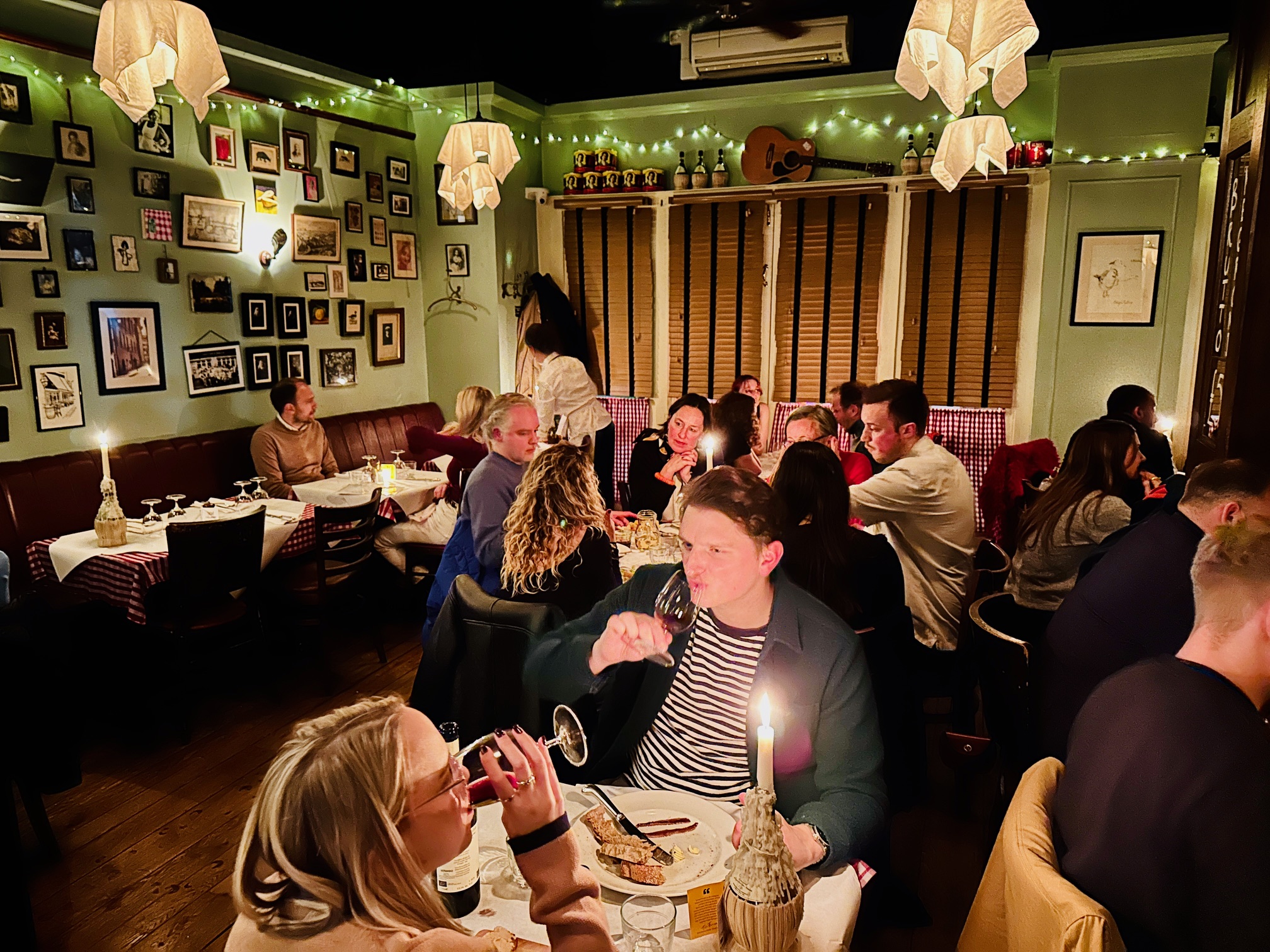
Reading all that back it sounds like a bit of a downer, but I find it hard to imagine anybody walking into Brutto would feel down for long. I can think of few dining rooms that make you feel happier to be in them – it was simultaneously snug and buzzy, with tables full of people thoroughly enjoying their Saturday nights and others sitting up at the bar, making the most of Brutto’s fabled £5 negronis.

The dining room is kind of split level, and I guess the room at the front would be the one you’d ideally want to be sitting in, with its banquette and framed pictures arranged haphazardly on the teal wall behind (“it’s like Alto Lounge, but not shit” was Zoë’s take). But we were closer to the bar at a surprisingly good table next to a pillar, and although there was a distinct hubbub, and an effortlessly cool soundtrack seemingly pitched at Gen X duffers like me, it was never uncomfortably loud.

It really was a marvellous place, from the gingham tablecloths to the napkin lightshades to the candles stuffed into wicker-chianti bottles, and I loved it. It had that feeling of otherness I adore, the restaurant as a cocoon, where for the next couple of hours you could kid yourself that you’d walk out of the door at the end of your meal and be somewhere completely different.

It was, however, and I might as well get this out of the way now, dark. It started out as atmospheric, but as the evening went on it started to reach Dans Le Noir levels of stygian gloom. A lovely spot to be in, to drink and talk, but the practicalities of doing some of the things you ideally want to do in a restaurant, like read your menu or see what you were eating, were severely curtailed.

A solitary votive candle in the middle of our table wasn’t really going to help with that, even if the staff – who were on it throughout – replaced it very efficiently when it sputtered and went out. I got told off for getting the torch out on my phone to try and read the menu. Zoë told me that I was ruining the atmosphere for everybody, and I’ve since discovered that this is allegedly a boomer thing to do, for which I can only apologise.

Once Zoë had taken some pictures with her phone, in night mode, naturally, and AirDropped them over to me, I managed to get a decent look at the menu, which was of course typewritten. It was everything you’d want it to be, mostly: compact, affordable and interesting. Starters were mostly under a tenner, pasta dishes were closer to twenty and so were the secondi, with the exception of Florentine steak which is sold by weight. I think in the past I’ve seen these listed up on a blackboard, so as to say that when they’re gone they’re gone. Maybe they’d already gone, because our server didn’t mention them to us.

The thing you don’t notice on the menu, at first, is that there’s no fish to be seen anywhere. I saw it written on a mirror in the dining room that Brutto doesn’t serve fish, and although it’s often not my first choice it was still odd to see it completely excluded. It gave the dishes on offer a certain brownish hue, or that could have been the dim lighting, but I suppose it worked on a nippy evening with London well on its way to winter. And it’s not as if I minded, much. The negroni was fierce and medicinal and, lest we forget, only a fiver and, on top of those Belgian beers from earlier on, positively knocked the edges off the day.

I don’t sense that Brutto’s menu has changed enormously since it was first reviewed three years ago, because many of the dishes on offer were talked about in those initial reviews. One definitely was – coccoli, which translates as “cuddles”, and is little fried bits of dough with prosciutto and a small pot of tangy stracchino cheese. Remember when I said that these restaurants attract bucketloads of hype? Jimi Famurewa, then of the Standard said that they were “one of the year’s best dishes”.

I don’t know about that, but they were rather enjoyable. More doughnut than doughball, and pleasant enough with little slivers of ham and a small dollop of the cheese; there wasn’t enough stracchino, but I imagine there never is. But the problem with hype, however old it is, is that it almost sets you up against something. I bet the people who raved about these would have sneered at good old Pizza Express. It reminded me of a restaurant in Shoreditch I used to love called Amici Miei which did a similar dish to this, but far better and completely unsung. But then it hadn’t been opened by Russell Norman, that was the problem.

The other starter was three things that in isolation are hard to beat. Very fine, extremely salty anchovies, with decent salted butter and sourdough from St John just down the road. It’s impossible to argue with this really, even if it involves no cooking, and all three things were good. Zoë adored it, I wasn’t convinced it was really any more than the sum of its parts. In fairness though, this dish was just over a tenner and even in Andalusia seven anchovies of this quality might well set you back more than that.

By this point we were on the red wine, The wine list is all Italian, with lots to enjoy, provided you can read the bastard thing. Bottles start at thirty-six pounds and ascend quickly into three figures from there, and we settled for a Montepulciano closer to the shallow end for sixty-two pounds. which retails for eighteen quid online. Was it worth sixty-two pounds? We’ve established over eleven years that I don’t know a lot about wine, but I’d say maybe not.

For me the pasta dishes were probably Brutto’s greatest strength, and easily the thing I most enjoyed. I’d been tempted by pappardelle with rabbit, but in the end the classic tagliatelle with ragu was too hard to resist. And it was as close to perfect as this dish gets in this country, fantastic al dente ribbons of pasta and a rich, sticky ragu that hugged its curves closely. I’ve always been somewhat sniffy about this widely-held belief that there should be more pasta than sauce, but eating this, for once, I got the point. Everything felt like it was completely in order, in absolutely the right proportions.

Because Brutto is a homage to the trattoria of Italy, they left a bowl of grated Parmesan at your table, with a spoon. But because we were still in London, there wasn’t a lot of Parmesan in it.

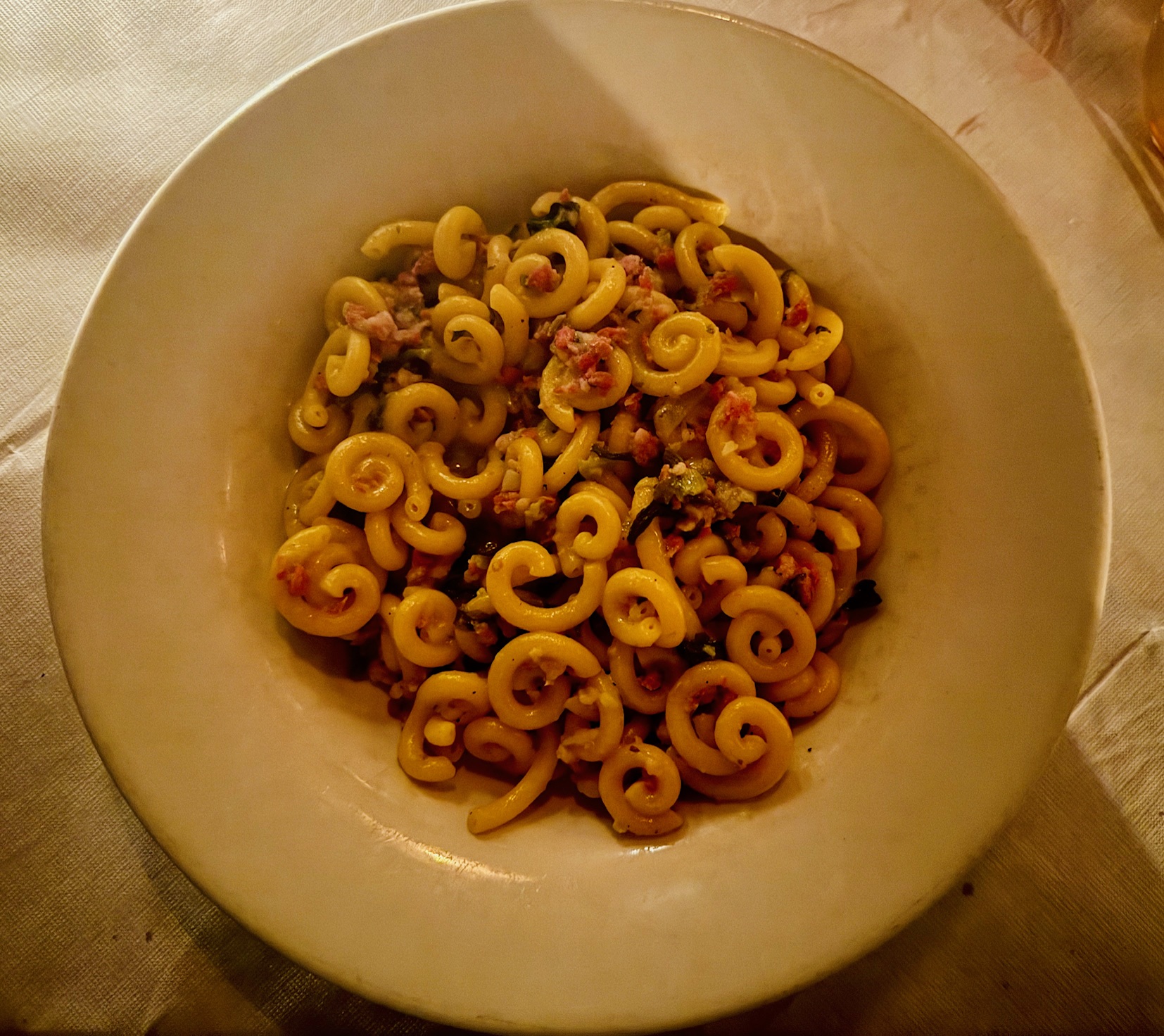
For me if anything, Zoë chose even better. Her gramigna, a little spiral shape from Emilia-Romagna, came – as it does in that region – tumbled with sausage and friarelli and was a real joy. But don’t be fooled by the brightness of these pictures from Zoë’s iPhone: by this point it was getting more and more difficult to see what was going on. Even so, these two dishes, to me, highlighted that when it came to pasta dishes restaurants like Brutto or Bancone are still light years ahead of well-intentioned pretenders like Little Hollows in Bristol or bandwagon jumpers like Maidenhead’s Sauce And Flour.

I complained recently that Reading was still lacking a really good Italian restaurant and someone popped up and said “what about Vesuvio?”. And I said that I was looking for somewhere more genuinely Italian and less like a better reimagining of Prezzo, with more interesting secondi. But actually, I got that wrong: what’s really missing is brilliant pasta like this. Pepe Sale had that, back in the day. So did San Sicario. But since then, this kind of carb-centric comfort has been missing from Reading, and it’s a poorer place for it.

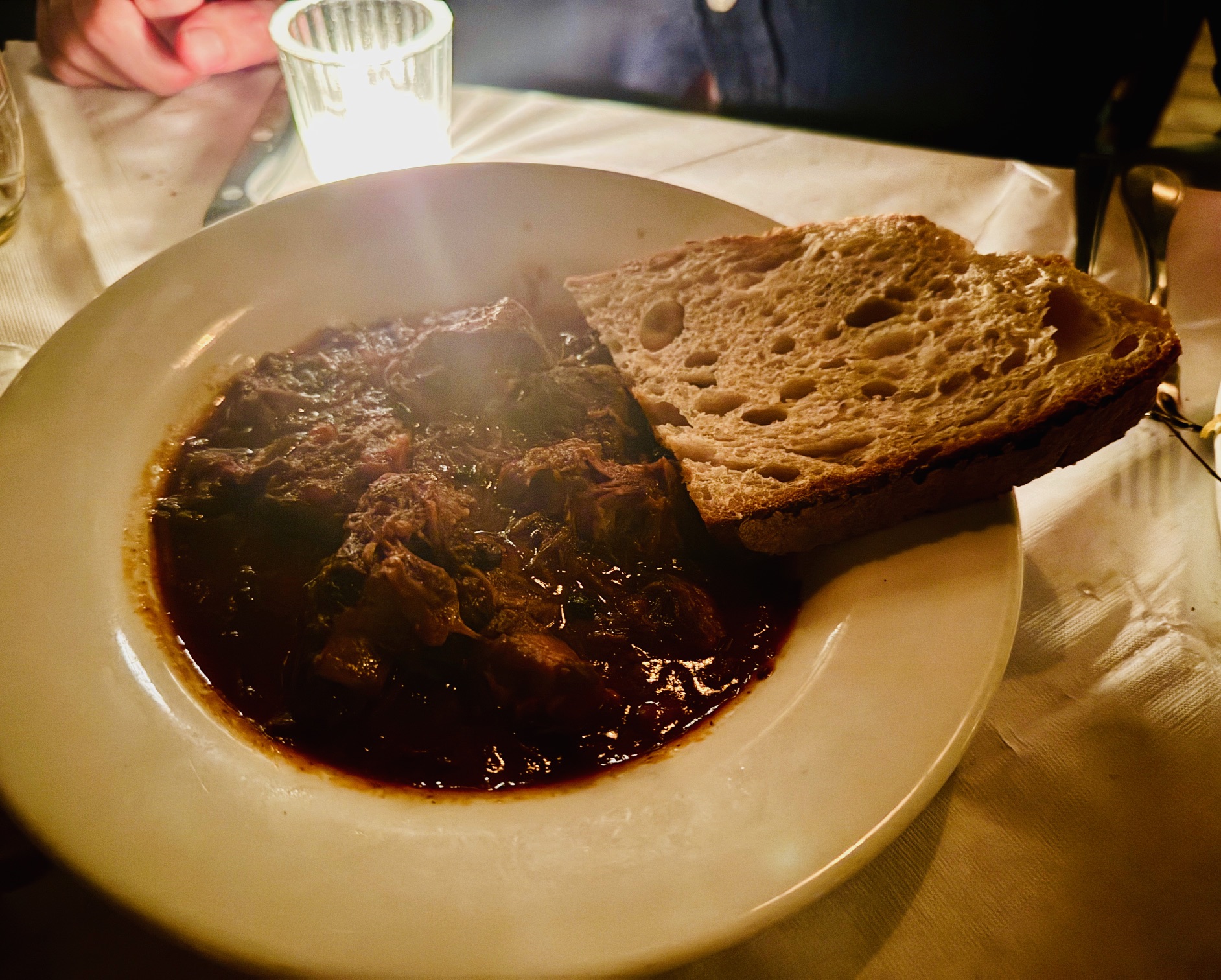
Speaking of secondi, to eat that course at Brutto it does help if you like beef. Three of the options are beef-driven (possibly four, depending on what’s in the bollito misto) and the roasted squash, virtuous though it doubtless was, just didn’t appeal. I had chosen the peposo, a slow-cooked stew of beef shin in a sticky, reduced sauce shot through with whole black peppercorns. And I liked it – it sort of reminded me of a stifado, although with no reliance on tomato or those maverick shallots that make the Greek dish such a delight.

But you know how you feel when you see a picture of a moment you don’t fully remember and you’re not sure if the photograph itself is inventing a memory you didn’t really have? Usually that experience dates back to childhood, but I have it when I look at the picture Zoë took of my main course. I know this is what I ate, the photo has my hand in it and the date stamp to prove it. But for me it was just a pool of blackness. You never quite knew what you were eating, or whether this would be your last big chunk of beef. I’ve always understood the saying that you eat with your eyes, but maybe not as well as I did after having this dish at Brutto. And however convivial the atmosphere was, this is where it took something away for me.

I didn’t need a great view of the roast potatoes I’d ordered on the side to know that they weren’t the best roast potatoes. Decent enough, but lacking that contrast of crunch and fluff that would have come if they’d been parboiled, and scuffed up, and cooked properly in really hot fat. Without that, they were just ballast.

Zoë infinitely preferred her main, which was a variation on the same theme. The same roast potatoes, which she viewed more kindly than I had. A slab of pink roast beef, the fat on the outside mellow and puckered, sitting in a little pool of jus. It needed the peas with pancetta that she ordered with it – I’d have liked these à la Française, with a little cream, although I know that’s missing the point in a Florentine trattoria. Anyway Zoë loved it, although she did admit that it was a tad dry. But if there’s anything our marriage proves – six months and counting – it’s that she has far lower standards than I do.

We had a fair bit of wine left, so we drank that and chatted about all sorts before making any decisions about desserts. Now Zoë works in London she is there every Saturday, and usually knocks off at eight o’clock, so by the time our evening begins, most weeks, it’s time for bed. A rare date night in the capital was a precious thing, and so neither of us was in a rush to bring it to an end. But desserts also meant digestivi, and that meant a Frangelico for her and an Amaro del Capo for me. It’s one of my favourite amaros, with something like 29 botanicals, though the one that leaps to the surface for me is mint.

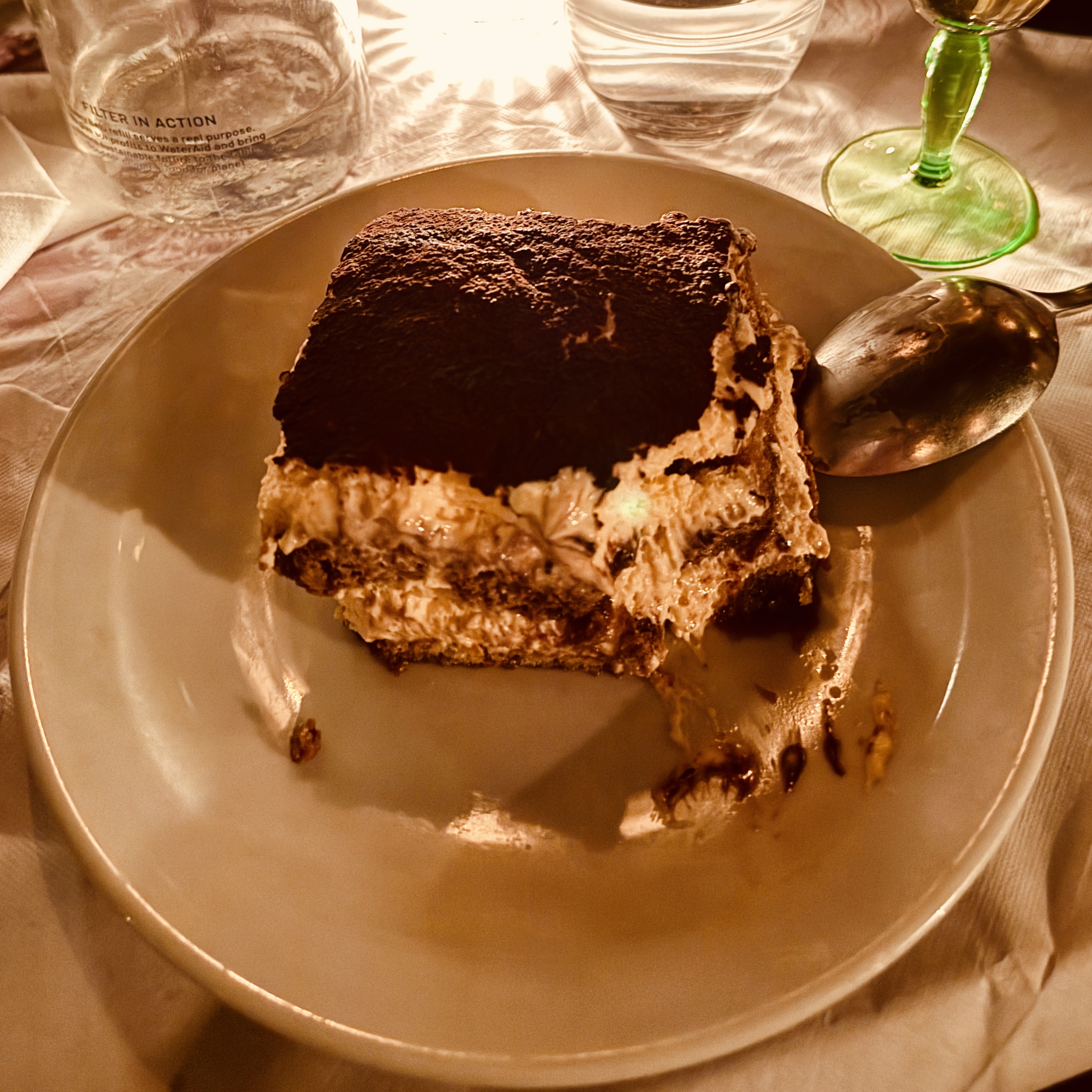
I could have nursed that for some time, and maybe even had another, but the dessert menu only had a few things on it (putting pear and almond cake on there twice, once with ice cream and once without isn’t fooling anybody). Anyway, one of the items on the dessert menu was tiramisu, which meant that we were both contractually obligated to have one. Is it the dessert I order most often when I’m on duty? It definitely feels that way, and Brutto’s is up there with the best I’ve had – miles better than Little Hollows’, better than Sonny Stores‘, better than anything I’ve had in Reading, even including the wonder of Sarv’s Slice or the sadly departed Buon Appetito.

It properly contained multitudes, managing to be substantial yet airy, innocent yet boozy, simultaneously just the right size and nowhere near big enough. I loved it, and it reminded me that on the many occasions that I skip dessert when eating on duty I’m leaving the play before the final act, taking the book back to the library with the last fifty pages untouched. Brutto understands that a good meal has a beginning, a middle and an end, and that tiramisu was a more than worthy way to bring the curtain down.

With all that done, it was time to settle up and pray that the Elizabeth Line could get us back to Paddington before we were forced to catch one of those final trains back to the ‘Ding, the ones everybody refers to as the Burger King Express.

Our meal – a couple of negronis each, that bottle of wine, four courses each and a pair of digestivi – came to just over two hundred and fifty pounds, including an optional 12.5% tip. I know that’s a fair amount of money, but we had plenty of food and didn’t stint on the wine. Personally, I think Brutto is keen value, although probably more so in its starters and pasta than in its mains or wine list. I could have spent less and enjoyed myself just as much, and if I went again I imagine I would.

But would I go again? That’s the question, isn’t it. And it prompts the time-honoured answer, which goes like this. London is so blessed with restaurants – there are easily a handful of other great places to eat less than a ten minute walk from Brutto – that places have to be truly amazing to keep you visiting time and again. That drives quality, I’m sure, and it makes restaurants work hard for custom.

And maybe that also goes to answer the other question, of why it’s hard for anything to become an institution when somewhere else is always, always coming down the tracks. Back when I was on Tinder (what a fun three months that was) I deplored the way it effectively made you channel hop human beings, with their own lives and aspirations and back stories. Whatever. Next! But the way the food media works does the same thing with a lot of restaurants: one minute you’re the hottest ticket in town, the next you’re old hat.

So I had a lovely meal at Brutto and it taught me a lot about what restaurants do at their best and their worst. I have rarely felt, in a restaurant in the U.K., more like I was part of something brilliant and bigger than me. But ultimately one of the many things that united us that night was being together in the darkness. If that’s not a metaphor for something I don’t know what is. Maybe I’m just too old for all that.

Brutto felt like a neighbourhood restaurant in search of a neighbourhood. And speaking of neighbourhoods, if somewhere like Brutto opened in Reading you can bet I would be there on its opening night, and often after that. The fact that Reading can’t attract and maintain restaurants like this really puts the lie to all the old tut spouted by the likes of Hicks Baker that the town centre isn’t dying on its arse.

But while Reading still doesn’t have places like this, it still has that one thing Reading-haters always extol the virtues of: a train station you can use to get anywhere else. You could do a lot worse than make a reservation, hop on a train and find yourself here, in a place that isn’t quite Italy, isn’t quite London, but most definitely isn’t Reading. I know that’s not exactly hype, but it’s the best I can do.

Brutto – 8.4
35-37 Greenhill Rents, London, EC1M 6BN
020 45370928

https://brutto.co.uk

Restaurant review: The Drapers Arms, Islington

I was meeting Aileen, a very dear old friend, in London for lunch and she gave me carte blanche to pick wherever I wanted. “You’re the food expert”, her message said. “You choose.” And I have to say, that was more difficult than usual; I have a list of London places I want to get round to, but lots of them didn’t seem right for this. I didn’t want us to sit at a cramped table somewhere in Soho, elbows battling, or up at a bar watching an open kitchen. I might go to the edgy places with my cousin Luke, but lunch with Aileen required somewhere in the image of our friendship: comfortable, classy, unrushed with a long history. Somewhere worth celebrating.

Aileen and I, you see, have been friends for well over a decade. Long before I started writing this blog I used to write another – not about restaurants, about something else – and somehow Aileen chanced upon it. And somehow, I’m not even sure how, we went from writer and reader to firm friends. I don’t think I could possibly have appreciated at the time how fortunate I was about that. Because a few years later my marriage and my life imploded and things got almost impossibly hard and Aileen, arguably more than anyone, was the person who kept me together.

In the dark moments when nobody else was there, or (more likely) they had all gone to sleep, Aileen showed up for me time and time again. She always had the same mantra, which I railed against but over time discovered was true: this is a phase. It’s a phase, and it will pass. And it was, and it did, and she never once said I told you so, even though she could have done.

I like to tell people that she saved my life, and she likes to reply that I’m talking nonsense. She might be right, because she nearly always is, but if we hadn’t become friends I don’t know who or where I would be now: I almost certainly wouldn’t be here.

It was a huge honour for me that she was at my wedding earlier in the year, a wedding that might not have happened had I not met her. Late in the evening, when the guests were thinning out, we sat together outside the Lyndhurst and had a good old gas, as if the intervening months had never happened. And the next morning I managed to catch her in the hotel bar before she headed home to Milton Keynes, and that easy, joyous conversation was one of my highlights of the whole weekend. I told her we should do lunch in London soon. So we agreed to, and all I had to do was find somewhere suitable for the occasion.

I ended up choosing the Drapers Arms in Islington, because it just felt right. It’s been going for well over twenty years, one of the generation of London gastropubs that includes the celebrated Anchor & Hope near Waterloo, and in that time it has become an institution. It held a Bib Gourmand from Michelin for much of the last decade, losing it in 2018, but it still featured in this year’s list of the U.K.’s top 100 gastropubs. But the thing that most cements its status as an institution is that nobody talks about it online, because nobody needs to. You won’t find a recent review of it online, and the London restaurant bloggers stopped name checking it a long time ago.

All that meant that although I’ve always wanted to go, I didn’t have a very clear idea what to expect. Aileen and I wandered there, strolling up Camden Passage and looking at all the stalls and boutiques, before heading across to Upper Street and then ambling off the main drag, onto side streets filled with houses you wished you lived in. On the way I went past various restaurants I’d heard of – the likes of Bancone clone Noci, Alsatian brasserie Bellanger and regional specialists Hainan House – all of which have been reviewed by somebody a darned sight more recently than the Drapers Arms has.

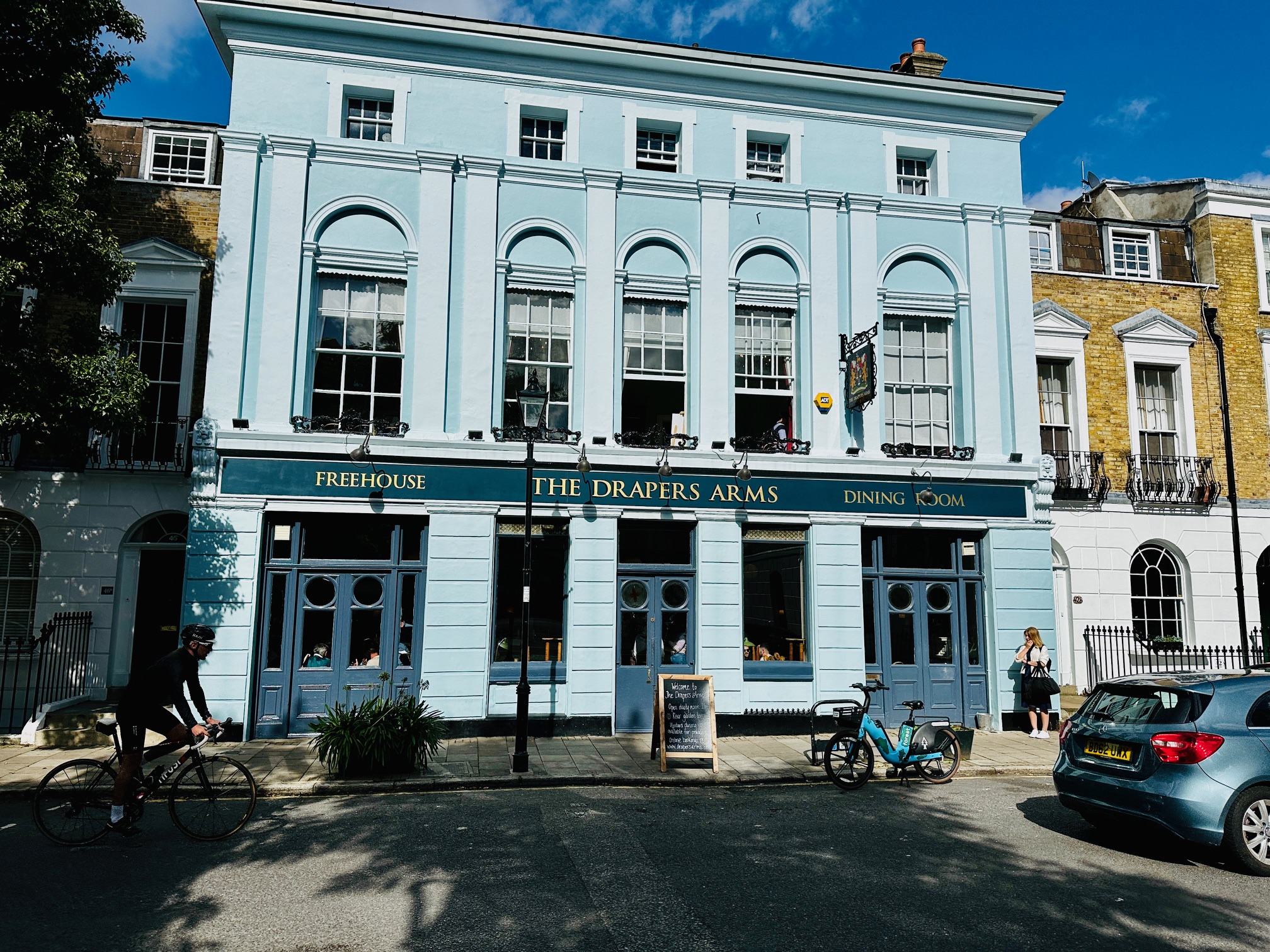
It’s a handsome, imposing building, a three-storey, powder blue beauty, and going in the front room was flooded with sunshine from the windows and glass-panelled doors. There were unoccupied tables at the front, and I was hoping our reservation was at one of them, but instead we were led to a room further back which was dingier and less agreeable. Almost every table was taken, and we were seated at possibly the worst one there – equidistant from the terrace at the back or those big windows out front, starved of sunshine.

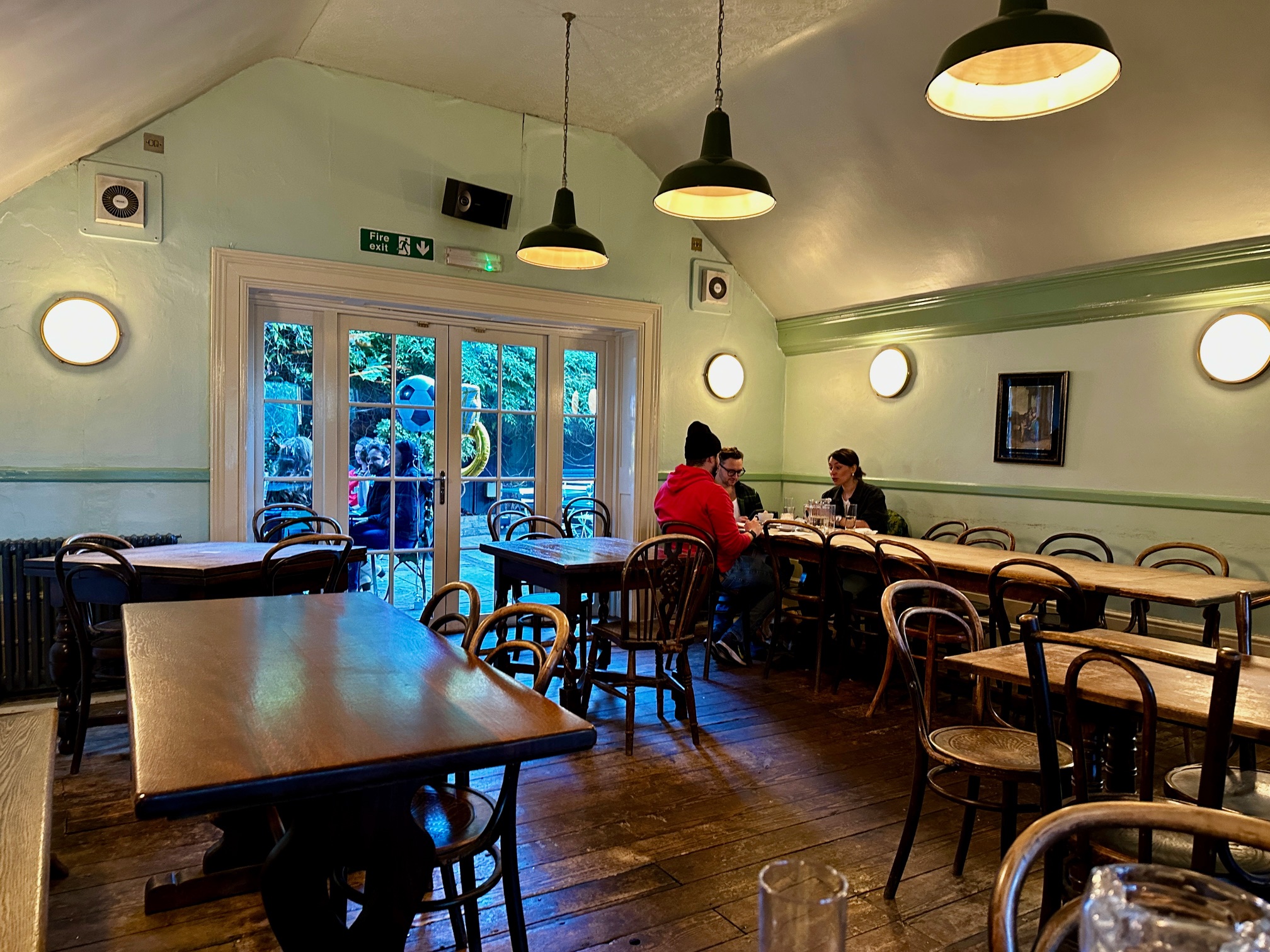
I plonked myself on a Thonet-style bentwood chair that didn’t entirely feel as if it could deal with my weight at the start of the meal, let alone the end. Around us all the tables were packed with loud, lively, chattering groups, and there was nothing to soak up the sound. I took a picture of the room much later on, which makes it look nicer than it was.

But maybe all that is a tad grumpy. After all it was busy, which you want somewhere to be, and the fact remained that it was an extremely attractive pub, even if we had the restaurant equivalent of the worst house on a good street. I especially loved the emerald-coloured bar, and a print on the wall advertising HP Sauce in the proper bottles.

“Mark brought some home from the supermarket recently in a squeezy plastic bottle and I made him take it back” said Aileen, talking about her husband. “It doesn’t taste the same when it’s not in a glass bottle. I reckon it’s thinner, too.” This, I realised, was one of many reasons why I loved the woman.

The menu changes every day and they publish it on the website, so it was much as I’d expected. It’s curious how some menus present you with very difficult choices while some, despite making all the right noises, are devoid of dilemmas. I would say that, however well it read, the Drapers Arms menu was the latter. Nine starters, all of which seemed to be either gutsy and rustic or, for my money, a little too virtuous. It was all a tad binary for me. You had the same number of mains, although four of them – the fun ones – were to be shared between two.

That made the whole thing a little more restrictive than I’d have liked and if you didn’t like offal or bone marrow, both of which made an appearance, I think you might have found things trickier still. Starters generally clustered between eight and fifteen pounds, mains started just shy of twenty but climbed, for the sharing dishes, up to ninety quid.

While we weighed things up Aileen ordered a negroni and I asked for a Bloody Mary, we clinked glasses and celebrated the prospect of a long lunch with a great friend. They didn’t ask me how spicy I wanted the Bloody Mary, which gave me confidence that it would be good. It was both spicy and very, very good.

It had been far too long since I’d had lunch with Aileen, and I didn’t realise that she was excited about featuring in the blog. “I’ve wanted to do this for ages!” she said. “And I don’t want you using a pseudonym for me, either.” Chatting away, I realised that we both had many of the same criteria when it came to restaurants getting a gold star or nul points. When our bread turned up, it turned out we both had a bugbear about fridge cold butter (Aileen checked it and thought it was okay, for my money it was still a little on the cold side).

My starter was a bisque, and Aileen rested her hand briefly against the outside of the bowl. “I don’t like it when hot food comes in a cold dish” she said. I hadn’t ever considered it, but she had a point.

The problem with the bisque, though, wasn’t one of temperature per se. It was a tasty dish where almost everything worked, but it wasn’t quite the sum of its parts. I loved the depth of the bisque and the crab meat tumbled through it. Spiking the whole thing with dots of deep green oil and red flecks of espelette pepper gave the whole thing contrast and depth.

The problem, and I never thought I’d hear myself saying this, was the octopus: there were a few pieces in the bisque and I just wasn’t sure, in terms of flavour or texture, whether they added enough to be worth it. This dish was fifteen pounds, and I couldn’t help thinking it might have been better, and been better value, without the octopus.

“Another thing that annoys me, while we’re at it” I said to Aileen, “is dishes like soup appearing in shallow bowls like this. It just means it’s really hard to get to all of it, and it goes cold quicker.”

“I agree with that” said Aileen. I cleaned up the rest of my bisque with some of the bread, which was fulfilling one of its most noble purposes: the edible jay cloth for sauce removal. The bread was okay, by the way: two big slices of sourdough and two pieces of baguette is hardly highway robbery for three pounds, but it wasn’t the most exciting.

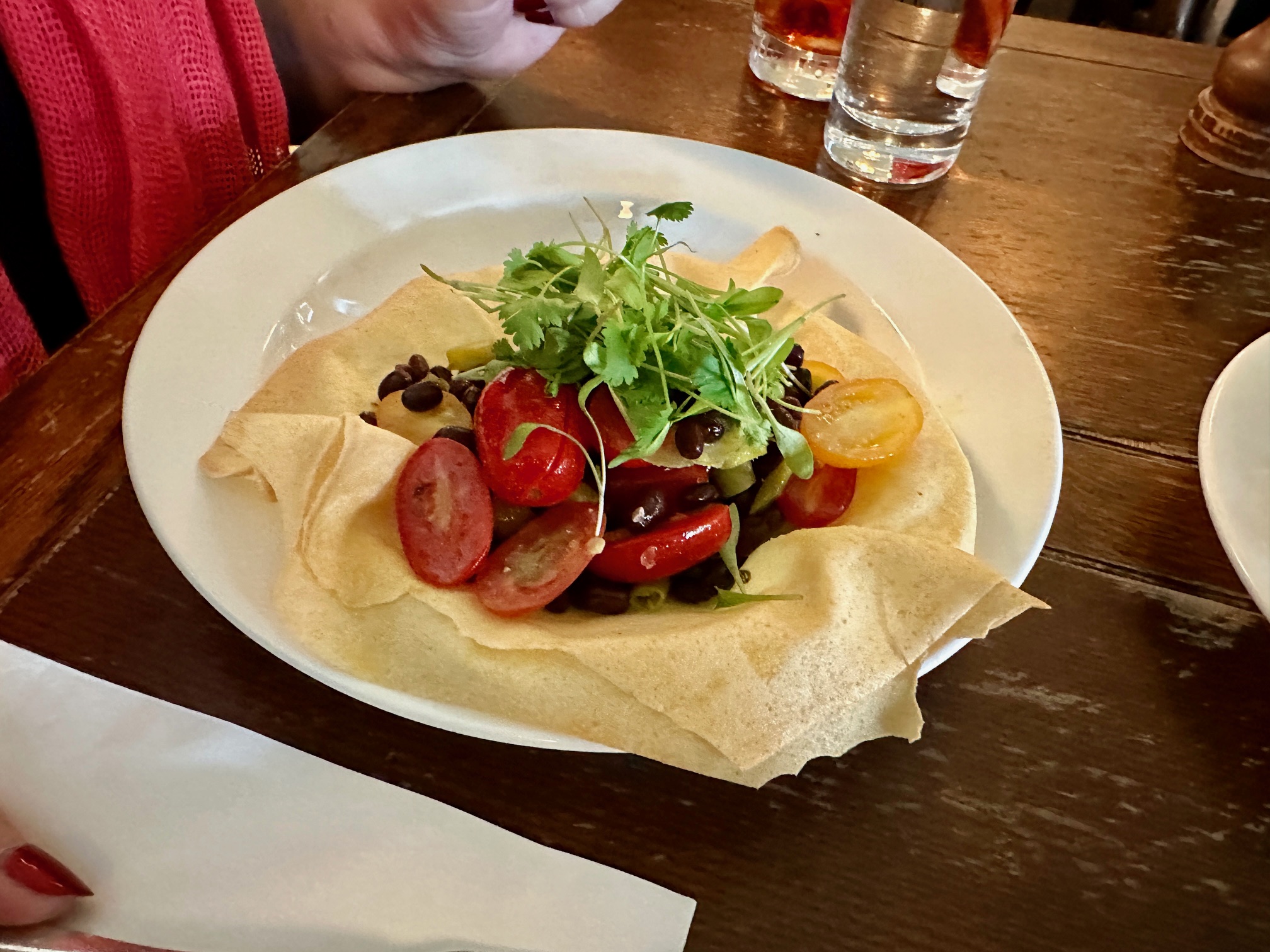
Aileen’s starter was the kind of dish I would never order in a million years, and a great advert for bringing people with you to review restaurants whose tastes are not the same as yours. It was a bean salad with coriander, chillies and datterini tomatoes, served in a sort of filo pastry basket. Aileen loved it – the flavours worked well and the beans had a nice amount of bite. I had a forkful, which confirmed that it was indeed the kind of dish I would never order in a million years. I didn’t feel like there was anything bringing a fun factor to the plate, but that probably tells you more about me. It also felt steep at eleven quid.

Aileen is planning to retire at the end of the year, and was telling me how she plans to take over more of the cooking from her husband. This dish struck me as having a hint of Ottolenghi about it, and Aileen said she’d tried making some of his recipes. I’ve never followed her example: in my experience, they always seem to involve lots of ingredients and hours of processes, so perhaps they’re best left to the retired.

“Have you ever been to an Ottolenghi?” she said.

“Yes, just the once. I was at this event to commemorate the eightieth anniversary of the Cable Street Riots, because my then girlfriend knew someone who was in a Yiddish marching band.” This sentence, by the way, sums up perfectly how very strange my life was in the latter half of 2016.

“There was a march, and a demonstration, and lots of placards and Jeremy Corbyn was one of the people making a speech. It was so boring that we sloped off to the Ottolenghi in Spitalfields and they managed to fit us in. It was all right, but it felt like a glorified salad bar.”

This starter, to me, felt like the kind of thing you’d have at a glorified salad bar.

But no matter. Both of us had chosen far more substantial mains and had ordered a bottle of Gamay to go with them: initially I thought Aileen might have insisted on just having wines by the glass, but that negroni had persuaded her to throw caution to the wind. It was thirty-one pounds, so very much at the shallow end of the wine list, but the list went deeper than at many restaurants.

“That one said 300, and for a moment I thought it was the price” said Aileen.

“No, that is the price.”

“But this is a pub!”

“Well, yes. And no.”

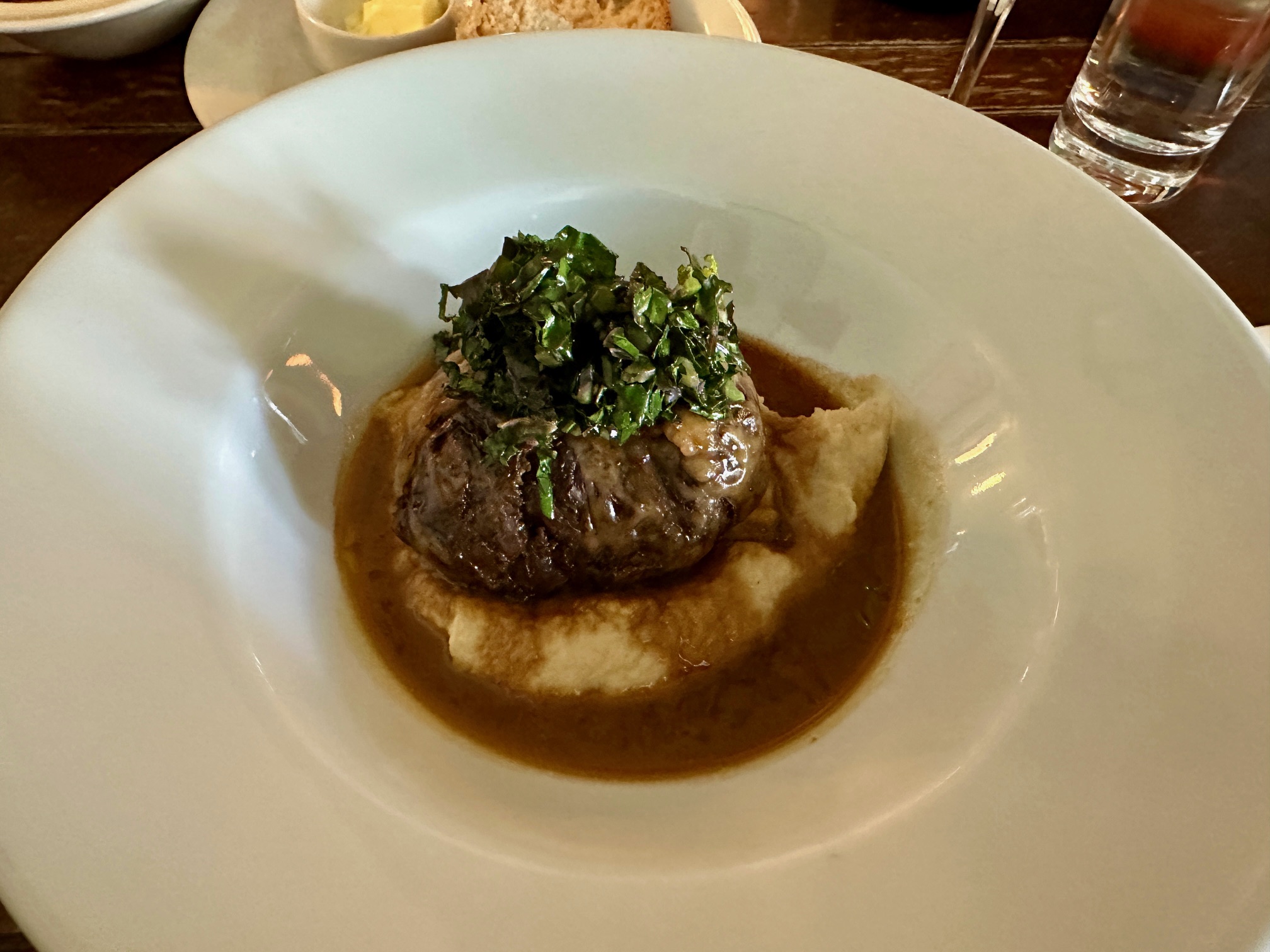
My main course was a sure sign that summer was long gone and that winter, as Leonard Cohen once put it, was tuning up. Lamb faggot and celeriac purée sounded like a glorious, fortifying treat and I was very glad Aileen hadn’t stuck a pin in it, because I always let my dining companions choose first. On paper it was beautiful, and at first sight it was every bit as appealing – a huge faggot, a splodge of mash, a moat of sticky gravy and one accent of not-beige, a crowning garnish of kalette tops. It was a dish to be enjoyed in a cosy pub, even one with three hundred pound bottles of wine on offer.

Things only went slightly awry when I ate the damned thing. The faggot had a terrific, coarse, crumbly texture and the celeriac purée was one of the nicest, silkiest ones I can remember. The kalette was a revelation – still firm, with a zip of mint that the dish badly needed. But the faggot was really heavy on the offal, to the point where it was a little too intense, a bit much even for me. I liked it at the time, and I finished it, but it sort of stayed with me for the rest of the day, in the way you don’t want.

Aileen had gone for my second choice from the menu, a beef and mushroom pie with a suet crust – or, for the purists among you, a stew with a lid. It came without accompaniments, so I was glad we’d also ordered chips and veg. It was placed on the table, and Aileen asked if it came with gravy (she is from Nottingham, after all). We were told, very nicely, that it did not.

At first, Aileen wasn’t sure about the whole affair but I think she warmed to it – the beef was all at the bottom but there was a fair amount of it, tender and breaking into strands. There was carrot and mushroom in there too, and she loved the green beans she’d ordered on the side, just-cooked and topped with crispy shallots. But even though this wasn’t a pie for sharing it was strange that it didn’t come with anything, including a plate to dish it up onto.

It reminded me very much of some of the great gastropub pies I’ve tried in the past, at Hackney’s The Marksman or The Magdalen Arms in Oxford, but it didn’t look quite as alluring as either of those. Still, it was eighteen pounds, one of which goes to Action Against Hunger, so you couldn’t really complain.

“That was lovely” said Aileen. “It needed gravy though.”

I’ve realised I didn’t get any pictures of the green beans or the chips. The chips were skin on (I thought that might be one Aileen’s list of restaurant no-nos, but apparently not) and clearly made in-house. And they were pleasant, but perhaps a little limp and unremarkable. I wanted that contrast of brittle crunch and fluff – and I didn’t care how many times they had to be cooked in order to achieve it – but these weren’t quite there. They were a decent vehicle for the last of my gravy, even so.

Our meal had been a little haphazardly timed – we didn’t get our bottle of wine almost until our mains turned up, so once they’d been eaten we had a lot of wine left. And service was brilliant at this point, leaving us in peace while we finished it and continued our epic conversation. I saw pictures of Aileen’s twins at their prom and wondered, as I’m sure she did, where the time had gone and how the little girls I’d first met all those years ago were suddenly sixteen.

Aileen in turn saw pictures of my wedding, and in between flicking through them and chatting about all sorts we caught up in the way that is such a tonic – a proper state of the nation natter encompassing work, family, friends, the past and the future. And I loved the Drapers Arms for this if for nothing else, for enabling this kind of afternoon.

Eventually, the wine was polished off and the dining room almost empty: I felt strangely proud of the fact that we’d outlasted all our fellow diners. So we got round to ordering dessert, along with a tea for Aileen and a bitter, middling latte for me. That section of the menu was very compact – a duo of cheeses and three desserts – and again, catered to people with different preferences to mine (I’ll eat most things, but I’ve never warmed to custard). So we both went for the lime posset and, like so much of what I’d eaten, it was nearly there.

As with my main course, almost everything was how you would want it to be. The strawberries on top were plump and sweet, the syrup they were in sticky and ambrosial. The shortbread was reassuringly irregular and crumbly: I saved mine to the very end. And the sharpness of lime in the posset worked so well, a welcome variation on a theme. But here’s the problem: the posset wasn’t properly set. Some of it was, but the rest was just liquid and hard to eat tidily, part dessert and part drink. So at the end of proceedings, you got a dish that was something like a synecdoche, a pretty good summary of the meal as a whole.

Our meal for two, including service charge, came to pretty much bang on one hundred and eighty pounds. And if that sounds like a lot, I’d say it could easily have been more. Our wine was distinctly entry level and we had, by accident rather than design, ordered the two cheapest mains on the menu. You could easily come away with a far more dented wallet than we did, although if you had an afternoon as terrific as the one I’d had you’d be fortunate indeed.

We wandered, full and happy, back to Angel tube station to go our separate ways. I could have talked for hours, but the idea of eating another mouthful or drinking another drop was more than either of us could contemplate (“I’m not sure I’ll even eat tomorrow” was Aileen’s verdict, although if she’s anything like me I’m sure she managed it). London looked beautiful in the autumn sun, and all around us Islington was gearing up for a busy Saturday night. We, on the other hand, were both dead set on being installed on our respective sofas by the time Strictly began.

When I think about the Drapers Arms, the thing I keep coming back to is that everything was good, and some of it was very good, but none of it was spot on. I imagine they have better days than they did the day I visited, I imagine there are nicer tables than the one we sat at, and iterations of that menu that would have suited me better. But I’ve had many far worse experiences, too, in countless places. So where does that leave you?

Yes, it was good but not perfect. And when it turns out like that you have to resort to your gut feel, try and weigh up all those almost intangible incidentals that define a meal. Because restaurant reviewers may not always tell you this – in fact many never talk about it at all – but there’s so much more to a meal than food, the room, or even service. I wish I’d liked everything a little more, and yet at the same time I know it will be hard to top as one of my favourite lunches of the year. So the Drapers Arms could have been better, but nonetheless I’m still really glad I went there. Happy that I ticked it off my list, and delighted that I chose it to host such a brilliant afternoon.

The Drapers Arms – 7.5
44 Barnsbury Street, London, N1 1ER
020 76190348

https://www.thedrapersarms.com

Restaurant review: Planque, Haggerston

Our story this week starts with your narrator sitting outside an achingly hip café called Batch Baby in De Beauvoir Town, a part of London I’d never heard of, gulping down a latte before heading to a lunch reservation at Planque, an achingly hip restaurant in Haggerston, another part of London to which I had never been. It was a Saturday lunchtime, the sun was out – so were my legs, for that matter – and I felt very old and very fat, but mostly very old.

I had taken the Elizabeth Line to Liverpool Street and then hopped on a bus from Moorgate, wending its way past the horrendous roundabout at Old Street and out towards the North Circular, into the bits of London that are Vittles territory, rather than the province of broadsheet critics or restaurant bloggers. I had no idea what to expect of De Beauvoir Town but you couldn’t say it wasn’t interesting – handsome mansions one side of the road, stark and forbidding tower blocks on the other, presumably the legacy of a little light wartime bombing.

Those contrasts went further than the architecture. Up one side street, past a big red sign advertising The Sun, an establishment called the Happy Café offered a full English, and a “Sunday Roast Diner” (sic) with three veg, potatoes and gravy. Round the corner, Batch Baby was tasteful in an artfully yet carelessly thrown together sort of way, on the ground floor of a handsome building which apparently serves as a “community space and creativity hub”. The coffee was immaculate, and some of it was roasted by Sweven, the equally hip café in Bristol’s Bedminster. Do these places have a twinning scheme?

I sat outside, and I felt every year of my fifty years, and every stone of my no-I’m-not-telling-you-how-many stones. Everybody was thin and young and stylish and wearing dungarees and the sort of clothes you used to be able to buy in Shakti. And I remembered when they were first cool, back when I was at university, and then I realised that they were probably first cool in the seventies, before I was born, and that my parents probably looked at people wearing them in the nineties and felt how I felt in that moment, and that only served to make me feel older and wearier still.

Never mind. I loved the coffee, I took a picture, I applied my best filter, put it on Instagram, pretended I wasn’t fifty. And then I checked the time and scurried to the restaurant, just in time for my lunch reservation. On my way I passed a handsome old boozer, a cute Japanese canal by the towpath, a plant-based wine bar and bottle shop, a small plates restaurant with a sideline in sake. There was no denying it: I might not be in Dalston, but I was definitely Dalston-adjacent.

Planque is an exceptionally voguish spot which was recently listed as the 97th best restaurant in the U.K. by the National Restaurant Awards. I felt like I had seen it in dispatches everywhere and when my cousin Luke, who moved to London from Toronto a couple of years ago, suggested we should have lunch in town some time it turned out it was on both our lists. The chef was previously at P Franco, another legendary small plates and natural wine spot in Lower Clapton – another cool part of London to which I had never been – but Planque was meant, by all accounts, to be a step up even from that.

I’d seen reviews that had raved about the food, and others that had waxed lyrical about the interior. And to add to the exclusivity, although they allowed people like me to book tables in the restaurant there was also some kind of private members’ club element where you could cellar wine there, get discounted corkage rates and so on.

My swiftly grabbed photos of the room don’t do it justice but it is indeed a coolly attractive space. It’s built into two railway arches, but this has been lavished with funds and the interior, designed by a Danish studio, does have that very Scandi feel to it. Actually, it reminded me of many places I’ve eaten in on the continent, in Ghent or Copenhagen, but few in Blighty. But that also made me realise that in Europe, nobody would bat an eyelid about a dining room like this but here in England you can rely on people to lose their shit about it.

All that said, it was more a place to admire than necessarily enjoy eating in. The long communal table – again, something I feel like I’ve seen more in Europe than here – was very striking, and the wooden booths for four were attractive (although when Giles Coren reviewed Planque for the Times he complained about his arse going to sleep: now he knows how his dining companions must feel). But if you’re at a table for two, I think you do get a little diddled: those three tables were right at the start of the dining room, near the front door, close together and slightly unloved.

By this point Luke had arrived and we’d ordered a few aperitifs – a negroni for me and a Chartreuse and tonic for him. Luke is in his early thirties and lives in Clapton in an apartment which he assures me is slightly bigger than a studio. He runs multiple marathons a year, and his Instagram is a positive advert for being young and happy and living in London: if he isn’t jetting off to Australia or back to Canada, attending this wedding or that, running a marathon in one European capital or another he is in a beer garden or at a house party somewhere in London, surrounded by equally young and attractive people, living their halcyon days.

As if I didn’t feel old and fat enough already! Just once I’d like to see a picture of him heating up a depressing ready meal or watching Love Island, but it’s impossible to hold it against him. Too likable, you see.

At weekends Planque serves a set lunch only, which is yours for thirty-nine pounds and includes four small plates, your choice of main course and a set dessert. There are a few additional dishes in the bottom section, and with a little light questioning our server gave us a view on where in the meal they might turn up – so some would precede your small plates, some accompany your mains and a couple of cheeses which would come before your dessert (if you’re doing things right) or after it (if you’re not).

All pretty straightforward, but Luke and I couldn’t decide between the two mains. Steamed skate wing managed to combine one of my favourite ingredients with possibly the drabbest cooking technique there is, veal sweetbreads had undergone a similar experience by being turned into some kind of sausage and served with coco beans. Was Planque’s superpower taking the fun out of things? In the end, Luke said we should order both and share, which in most restaurants would be a perfectly viable option.

Wine first, though, and another reason to feel the exclusivity of Planque – and by exclusive I mean expensive. The cheapest wines at Planque are around sixty pounds, and the majority of the list comes in at three figures. My original choice was a Maccabeu from the Languedoc, but our server quickly and firmly told me it was very wild, and that I might well regret ordering it (why is it on the menu then? might be your question: I might have had that question in my mind too).

So instead he steered us towards a Corsican white which was a blend of Muscat, Vermentino and Bianco Gentile, an indigenous Corsican grape I’d never heard of. And, in fairness, it was a beautiful white wine. At eighty-four quid, you’d really want it to be. You can’t easily buy it elsewhere, which I guess is kind of the point, but what research I did manage to do suggested the mark-up was steep.

From this point onwards, though, concepts of value and its relationship to quality, and quantity, became foggier and harder to grasp. A good illustration was our opening dish – scallop tartelettes were divine, dimples of clean, pure, subtle high-grade scallop sheltering the crunch and sharpness of sea lettuce, like the tiniest gherkins. An exquisite couple of mouthfuls, one of the nicest amuses-bouches you could possibly imagine. Nine pounds, for the pair of them.

Then came the four small plates, pretty much at the same time as the tartelettes. I didn’t take a picture of the bread because I don’t think I’d clocked that it was one of the small plates in question. That felt a little cheeky, especially as it was literally the only ballast in the entire meal. Decent bread, gorgeous butter that spread at room temperature. Is that a course in its own right? Not convinced.

Far, far better was a little bowl of consommé, made with lardo and more scallop. If Planque had a gift for removing the fun, this was the most playful reversal of that. Consommé never looks like it’s going to be the most exciting thing you eat during a meal, but it can pack a massive punch that belies its unprepossessing appearance. That was definitely the case here, with that wonderful concentration of salt, sea and smoke. If there had been more of this kind of thing, I’d have been a happy man. I used some of the unremarkable bread to dab up the rest of the remarkable consommé.

The other two small plates also had that Nordic, beige feel to them. I guess using turbot is one way to make a roe dish seem luxe, but I wasn’t sure it delivered disproportionately well. Fish roe seems to be everywhere this year, and I’ve had something like this at Quality Chop House and 1 York Place. The former served it with salt and vinegar doughnuts, which were marvellous, and the latter with fennel, which was interesting.

Here instead you had mange tout which I believe the restaurant grows itself, crudités without the crudeness. It was okay, but I felt like it was trying to improve me. Many people have tried to do that over the years, always without success.

To me the very best of the small plates, and the single best thing I ate in my meal, was just described as lettuce, hazelnuts and Cora Linn. It was a salad, and when I say salad I mean two lettuce leaves scattered with hazelnuts, dressed and festooned with Cora Linn, which is apparently a Scottish take on Manchego. Again, if it sounded like it could be fun, Planque could make it plod. And if it sounded workaday, Planque could elevate it. I suppose that’s a skill of sorts, although not one I’m sure a restaurant should cultivate.

As you can probably tell, the small plates were small. But I was unconcerned, because our mains were on the way and I was counting on them to redeem matters. I was mistaken about that.

So first up, that veal sweetbread sausage. A single disc of it, with coco beans and some wilted greens draped on top. The sausage was, I do have to say, truly delicious – glossy, almost silky, rich stuff, and as far from mystery meat as you could hope to be. The beans were like many people I’ve worked with over the years – firm, nutty and a little boring. There was a meagre puddle of insipid jus. I dutifully bisected the sausage and doled out half of the coco beans onto a separate plate for my cousin, a properly joyless experience. Who wants to eat at a restaurant that literally turns you into a bean counter?

This was a small plate, not a main course, and it followed what had been billed as small plates but were in fact even smaller plates. I was getting a bad feeling about this.

Was the skate wing better? No, not really. When you get so little skate that you can obscure it with two cherry tomatoes, for my money you have a problem. As we ate this dish, after Luke had put precisely half of it on a side plate for me, I explained to him how much fun skate wing can be. How enjoyable it was to have a big fat skate wing in front of you, littered with capers, and to slowly ease the flesh off the cartilage.

Here, the restaurant had done that for you, it just so happened that they’d done it on a fraction of a skate wing, after steaming it – the optimum way of ensuring that something is technically cooked but hasn’t been introduced to anything that could enhance its flavour. Here the flavour enhancement came from three or four perfectly pleasant little tomatoes, two leaves and a lobster sauce which was thin and not exactly honking of crustacean. Was this really the ninety-seventh best restaurant in the country?

Feeling a tad peckish, we decided to interpose a cheese course between our small savoury plates and our no doubt small sweet plate. 24 month aged Comté was truly brilliant, with plenty of umami and grit to it. I thoroughly enjoyed it, and perhaps my expectations had been brutally crushed by this point but I didn’t even think it represented relatively poor value at nine pounds.

“Would you like some bread with that?” asked our server and, desperate for carbs, we said yes. Two more slices, four more quid.

Last of all, our dessert. If dessert isn’t fun a restaurant might as well give up and go home, and gladly Planque did rise to the occasion right at the end. The menu just called it sheep’s curd, plum and raspberry which doesn’t do justice to one of the best dishes of the day – a fantastic, well orchestrated collection of flavours that came together beautifully. The raspberry, lurking within, was the sharp surprise that brought it all together. I was frustrated, because this showed that the restaurant could do crowd-pleasing: it felt like they chose not to.

We decided that having a coffee or a digestif would be throwing good money after bad so, about an hour and a half after we first sat down, we got our bill. It came to two hundred and seven pounds, not including tip, and it’s to Planque’s credit that they don’t sneak in a twelve and a half per cent service charge but let you decide all that for yourself. And service, I should add, was very good – hushed but quietly authoritative, and I was very glad that our server saved us from what sounded like an exceptionally challenging wine.

But here’s the thing – even though the service was good, I didn’t get any warmth. And ironically that was absolutely in keeping with everything else. Planque felt like a cerebral restaurant, rather than somewhere to love, and when London has so many restaurants out there I do wonder who would go to Planque, decide it was absolutely their cup of tea and become a regular. Very thin people, I suppose.

I enjoyed some of what I ate, very much, but I couldn’t help feeling, at multiple times during my meal, where’s the rest? And that reinforced in my mind the vague presentiment that Planque was a restaurant to see and be seen in, more than it was a place in which to drink and be fed. So on that cerebral level I know that the kitchen can cook, I know the wines are good and I know the space they’ve created is very well executed. But I feel like they have missed something about hospitality, because all of that – even all of that – is just not enough.

When you leave a good restaurant, you should feel lots of things. You should feel like you’ve been privileged to have someone cooking for you, you should feel looked after. You should feel a rosy glow, and know that you’ve banked a happy memory. You should feel like telling people about it, and ideally you should feel like going back. This next bit might mark me out as not just old, not just fat, but also a bit of a Philistine, but here goes. Leaving a good restaurant should make you feel so many things. But you shouldn’t leave it, I’m sorry to say, feeling like you could murder a KitKat Chunky.

Planque – 6.6
322-324 Acton Mews, London, E8 4EA
020 72543414

https://planque.co.uk