Ian Caren was born in Everton and despite being told at school that he wasn’t clever enough to go to university he trained as a teacher, is a qualified social worker and has three degrees. He’s been working in social services, charity and probation since he was 21 and was CEO of Launchpad, Reading’s leading homelessness prevention charity, for over 15 years, leaving in April 2021. He is a fanatical Everton supporter and season ticket holder and eats to live, so is held in great disregard by the gastronomic part of his family. He is married with three children (one of them, to his shame, a Manchester United fan) and lives in Fleet.
What are you missing most while we’re all in lockdown? I miss talking to people, visiting the Oxfam book shop, hugging my grandkids and going to watch Everton.
You’ve run the organisation you lead for nearly fifteen years. What, for you, defines leadership? I think having a passion to do the right thing for the vulnerable of Reading is important in my role, and good leadership is never asking your staff to do something that you won’t do. Having a good team around you is also key to good leadership; not thinking you can do everything yourself. I’m sometimes like Don Quixote – tilting at giants when they are in fact windmills – and, like everyone else, I get things wrong. But I have talented people around me to put me on the right track.
What’s your earliest memory of food? Growing up in a tenement in Liverpool in the late 50s and early 60s was bleak. My earliest and happiest memories of food were having chips in the rain at the park and a meat pie for tea. The worst was being offered bread and dripping if I was hungry.
What’s your favourite thing about Reading? The people. Reading is a fantastic community and full of life. It has a vibrancy unlike elsewhere in Berkshire. If it was to be a shop it would be the Oxfam book shop!
What is the worst job you’ve done? Working in an abattoir – the smell of the vats of blood was appalling.
You are an avid reader and recommend a book every month on your CEO blog. What writers, living or dead, do you most admire? I read for knowledge and enjoyment. Fiction would be John le Carré and his early novels; I loved Cold War spy stories. A sci-fi writer would be Iain M. Banks and his Culture series of novels. I read masses of history books and the most impressive writer is Jonathan Fennell who rewrote the history of the British Army in World War 2.
What’s the best meal you’ve ever eaten? My wife is Italian and it was at a family’s in Galatone, Apulia in Italy. There were thirteen courses which finished with banana liqueur cake – it tasted unbelievable. There’s also one meal that almost beats it: fresh grilled swordfish and chips on the harbour side of Calabernardo in Sicily.
Which words or phrases do you most overuse? “It’s what we do”!
Where will you go for your first meal out after lockdown? My eldest son Daniel is a food guru and he has plans for a party at one of the restaurants he loves, Yauatcha in Soho.
What’s the biggest change you’ve seen during your time at Launchpad? The biggest change in my period at Launchpad has been the increasing levels of poverty, which is heartbreaking. I also find the betrayal of people under 40 a disgrace, perpetually stuck in rented accommodation and regularly forced to move. I have staff members in their 40s who have never lived in their own flat, they’ve always had to live in shared accommodation. I find that unacceptable: the way a significant proportion of people are effectively forced to live the rest of their life like students is appalling.
What one film can you watch over and over again? Casablanca – the La Marseillaise scene is so emotional. The Godfather: “Tattaglia’s a pimp. He never could have outfought Santino. But I didn’t know until this day that it was Barzini all along.” Brilliant! And The Cruel Sea, to remember my Uncle Tommy who died out in the Atlantic in June 1942.
Who would you invite to your dream dinner party? Peter Kay, John Cleese, Tina Fey, and Phoebe Waller-Bridge. I would spend the evening in hysterics.
What was your most embarrassing moment? My children have a long list of my embarrassing moments. The most recent episode was recently falling off my bike in the pouring rain, rolling down the canal embankment and straight into the canal. I was standing in the canal thinking, how do I get out? I eventually pulled myself out and cycled six miles home covered in mud!
Where is your happy place? Northumberland and Cisternino in Italy – they’re both beautiful, haunting places full of history and silence.
What’s the finest crisp (make and flavour)? Walkers Prawn Cocktail.
How do you relax? This week I watched the satellites pass in the night sky and downloaded an app which told me the bright star was the planet Venus. I love to learn and find it relaxing: I’m contemplating a PhD in history.
What is the most important lesson life has taught you? That we cannot stand alone.
What’s your guiltiest pleasure when it comes to food? Dessert wines.
Tell us something people might not know about you. I wrote a couple of history sections on Wikipedia.
Describe yourself in three words. Compassionate, committed, (occasionally) unforgiving.
Glen Dinning has been the mastermind behind Blue Collar Street Food for nearly four years, going from running a street food stall cooking burgers to a weekly food market, adding Cheese Feast and Feastival in Forbury Gardens as major events in Reading’s food calendar. In 2018 he won the Pride Of Reading Award for Entrepreneur Of The Year, and last year he was awarded the contract to provide the match day food at the Madejski Stadium, making Reading’s fans some of the best-fed in the UK. He lives with his girlfriend in West Reading.
What are you missing most while we’re all in lockdown? Street food, pubs, restaurants, football, everything. I’m desperate to get back to work – I’ve volunteered but can see myself being more of a hindrance than help.
What’s your earliest memory of food? Trying apple crumble for the first time. I still can’t get enough of it – brown sugar instead of white is the key.
What’s the worst street food pitch you’ve ever heard? Someone once rang to pitch their entomophagy stall (the practice of eating insects). At the time I had no idea what it meant so just nodded along until I looked it up, horrified, later. I’m all for giving things a go but the conversation with Environmental Health would’ve been a difficult one.
You’ve been running Blue Collar for coming up to four years. What’s the most ridiculous situation you’ve found yourself in? Early on, a rival organiser tried to sabotage our events by getting their food traders to sign up, but pull out at the last minute leaving empty pitches. On a more positive note, the celebrations for Blue Collar’s first game at Reading FC ended at the bar with Sir John Madejski, Ady Williams and a drunken phone call to one of my heroes, former manager Brian McDermott.
What words or phrases do you most overuse? “Do you know what I mean?”
What’s your favourite thing about Reading? The independent scene in our town continues to build. You can have breakfast at Yolk, lunch at Vegivores or Shed and dinner at Bakery House, Clays or Geo Café and have an experience unique to Reading. The independent coffee places and pubs were thriving – before Coronavirus hit I genuinely thought in ten years’ time we would have an identity of our own as strong as Bristol or Oxford, but now I’m not so sure: everything is up in the air.
Who would you invite to your dream dinner party? Obama, Gervais, Robin Friday and Don King – he’s a controversial figure but the best salesman there’s ever been.
What one film can you watch over and over again? The Godfather.
What’s the best meal you’ve ever eaten? A meal at José, a tapas restaurant in London by the Spanish chef José Pizarro, had a big impact on me. It’s a tiny space, about four hundred square feet, walk ins only and the menus are chalked up daily depending on what’s available. The food is always brilliant and eaten stood up, with wooden barrels to rest small plates on. It’s a different kind of dining experience but there’s such a buzz to it, it’s so authentic and I’d love to try and open something like that one day. On the finer dining side of things, I really like Dinner by Heston and Manchester House by Aidan Byrne.
What’s your most unappealing habit? Snoring.
Where will you go for your first meal after lockdown? Bakery House for the chicken shawarma.
What’s the most important lesson life has taught you? If you find a job you love, you’ll never work again.
What’s the finest crisp (make and flavour)? The original Hula Hoop.
Where is your happy place? A long boozy lunch in the sunshine.
What would you be doing in life if you weren’t running Blue Collar? I had visions of being a comedy agent and promoter for a while and started a little business hiring out pub function rooms, booking comedians and selling tickets. It led to a job selling shows at the Edinburgh Festival and was fun, but I think I’d find it difficult to enjoy something that isn’t food and drink related now.
How do you relax? When I started Blue Collar I was still young enough to be able to drink heavily to get through stressful times and not wake up with a monster hangover the next day. More recently, I’ve jumped on every fad going – my girlfriend has tried to get me into yoga during isolation but I’m not sure my body is designed to bend that way.
Who would play you in the film of your life? If we’re being honest, it would be a low budget project that would go straight to DVD. A former Hollyoaks star would probably be the best I could hope for.
What’s your guiltiest pleasure when it comes to food? Cheese. The smellier the better.
Tell us something people might not know about you. My first little food business was selling chocolate bars in the school playground when I was eleven. I used to dabble in a few other things too, like watches and pens, but then Jamie Oliver came along and banned schools from selling sweets in vending machines. It meant my only competition was gone and my sales went through the roof. I owe that man a Wispa.
Describe yourself in three words. Ambitious, friendly, foodie.
Sen Sushi closed in October 2023 and the owners have moved to Wokingham and opened a new restaurant called Sen Ichie. A new restaurant, Blissful Umami, is in its place. I’ve left the review up for posterity.
I’ve always, I think, been a contrarian at heart. I really don’t like being told what to do. Few things irk me more than people using that Twitter trope “Retweet if you agree” (often I do agree, but I never Retweet). Or when someone tells you to “drop everything and read this”. I used to have a very opinionated friend who was always telling me what I should listen to or read: weekends away at his house in Kent were a bit like being in the musical equivalent of North Korea, being educated in whatever records 6 Music had told him to like that month.
The contrarian in me is why you get a review of Sen Sushi, the little Japanese restaurant at the Three Tuns end of the Wokingham Road, today. I know everybody wants to read a review of Osaka, the gleaming new Japanese restaurant in the Oracle. I completely understand why – the fit out looks superb, the menu has an impressive range and the buzz so far has been good. But something in me thought: what about Sen Sushi? It’s been there a few years, I had it recommended to me recently, and if not now, when would I go? So I hopped on a number 17 bus with my partner in crime Zoë to see if Reading had an undiscovered gem I hadn’t got round to visiting yet.
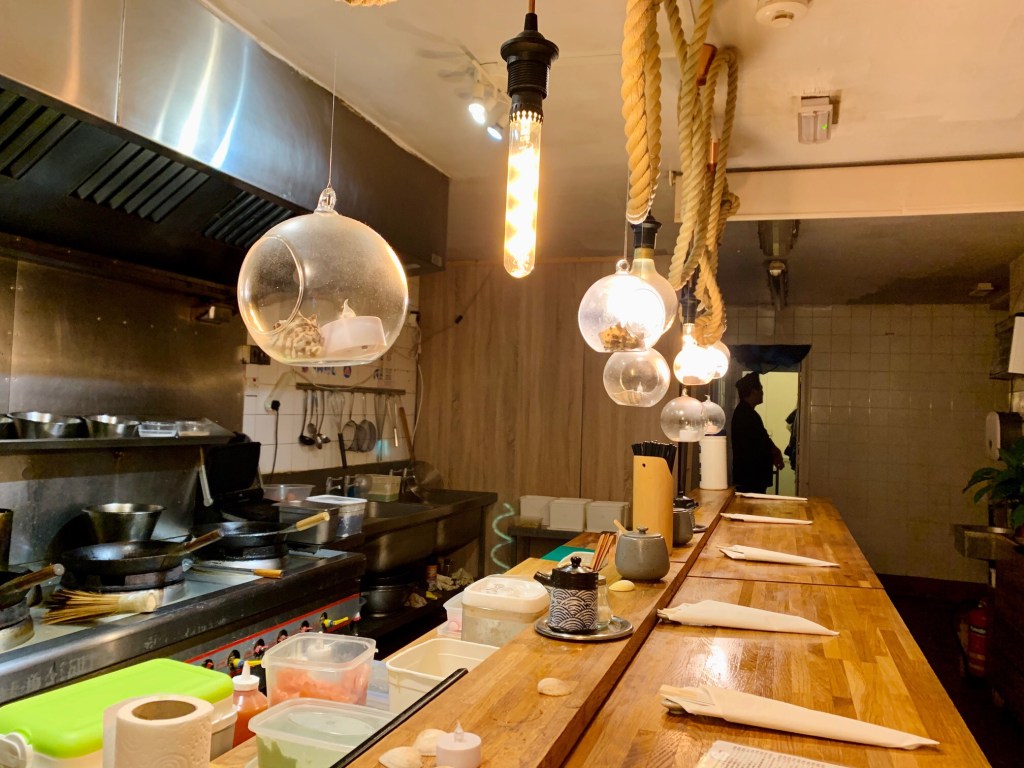
It’s a little restaurant that can probably seat less than twenty people. The front room has stools up at the window looking out, and a low table complete with tatami where you can sit cross-legged, provided you take your shoes off first. The back room has about half a dozen seats up at the counter where you can watch your sushi and sashimi being prepared. Behind the counter are a fryer and a gas range with four big weathered-looking woks, shiny with oil. That’s where we decided to sit, close to the action, and we had our pick of seats as we were the first customers that evening.
At this point, I pontificated to Zoë about how in many restaurants, being able to see the kitchen up close was considered a positive selling point. However (as we shall see) as the evening went on I started to wonder if it was such a good thing after all.
The menu was pretty big and covered all bases – hot starters, sushi and sashimi, rice and noodle dishes. We decided to try a bit of everything, but started with sushi and sashimi. Our waitress was lovely and polite but giving her our order was an interesting convoluted affair – she then went into the other room, printed off a ticket and came back to put it on the counter for the two chefs doing the cooking and prep. Admittedly, this made more sense when I realised that Sen Sushi also gets a fair amount of takeaway orders which also join the queue.
It really was fascinating watching as one of the chefs flattened the rice on the mat and cut strips of tuna, rolling the whole thing in front of us. Or seeing a beautiful piece of salmon come out of the fridge and be precisely cut into slices with an ultra-sharp Global knife. The wonderful thing about sitting at the counter is that there’s no hiding place in the kitchen: I found myself quite transported by the whole affair, and could have gawped at it for ages. I was possibly more transfixed than Zoë, who by this point was wondering why they hadn’t switched the heater on and was considering wandering over to the coat rack to retrieve her scarf.
The salmon sashimi was easily the nicest thing I ate at Sen Sushi – a really fine piece of salmon, beautifully marbled, soft and buttery. It was better than any sashimi I’ve had in Reading and probably up there with my favourite Japanese restaurants. The spicy tuna maki and avocado maki were fine but no more than that – initially they forgot that the tuna maki were meant to be spicy so they were whisked away and topped with a blob of sauce and a sprinkling of what I think was togarashi. Zoë thought they were a little ragged and lacking in uniformity, I was inclined to be a bit more charitable. Those reserves of goodwill got used up throughout the rest of the meal.
For our second round, we went for chicken gyoza, karaage (Japanese fried chicken) and, just to break up the chicken motif, some soft shell crab maki. The problem with sitting at the counter is that there’s no hiding place in the kitchen, so we saw a chef retrieve a tupperware container full of dumplings and another full of chicken nuggets – I thought it was from the fridge, Zoë reckoned the freezer – and put them in the fryer. Only the soft shell crab was done there and then, battered and then put in the fryer.
All three dishes were moved between the two fryers at what felt like random intervals, so I’m not sure how Sen Sushi would keep, say, vegetarian gyoza separate from the fried chicken. That’s especially ironic because I’m pretty sure they gave us vegetarian gyoza by mistake. They were oddly claggy, and the filling felt bulked out with something stodgy like potato. Zoë generously said I could have her last one and I said “no, I insist”, a sad inversion of how those discussions are meant to go with good gyoza.
Ignorance is bliss, and I wonder how I would have felt about the fried chicken if I hadn’t seen it being decanted from tupperware in front of my very eyes. I probably would have liked it more – the edges were nicely gnarly and crispy, and the meat was tender enough. But normally karaage comes with mayonnaise on the side, whereas Sen Sushi slathered the whole thing with wasabi mayo and a fruity sauce. Wasabi is strong enough, and enough of an acquired taste, that they should have left that choice to the diner: I found it off-putting. “You should have the extra piece, you’re hungrier than I am” I said to Zoë: a transparent attempt to dress up my lack of enthusiasm as gallantry.
Soft shell crab is one of my favourite things, so I was sorry that Sen Sushi’s maki also fell short. They looked the part, a fairly generous portion, the rice studded with tobiko, but putting both cucumber and avocado in with the crab and then drizzling the whole thing with mayonnaise and fruity sauce crowded out the flavours and felt like overkill. They were poorly rolled, too – half of the rolls weren’t closed off properly and fell apart when we tried to pick them up with chopsticks. I saw the chef struggling with rolling them: he had a couple of attempts and then clearly thought Fuck it and had one last half-hearted stab at massaging the sushi rice into the gap. Again, there’s no hiding place in an open kitchen.
What I was also quickly discovering about sitting next to an open kitchen was that it was impossible to have an honest conversation with your dining companion about whether the food was any good. “What do you think?” said Zoë. “Mmm” I replied, non-committally and in earshot.
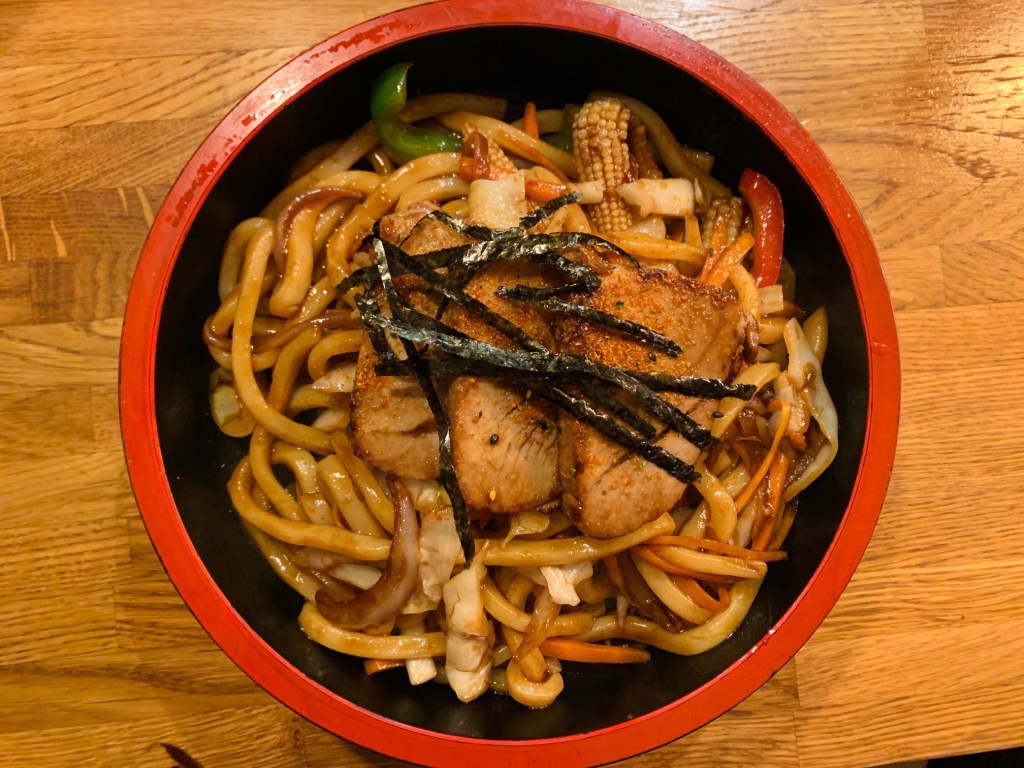
Being overheard was even more of a problem when the mains turned up, because they were the low point of the meal. Zoë’s teriyaki udon noodles with char sui came in a high-sided, thick rimmed ceramic bowl. She whispered something to me which I couldn’t make out but which I was later told was “dog bowl”. And it’s true, it did look like a dog’s bowl. “I expected to get through it and see a picture of a bone on the bottom” she told me.
But there was no danger of getting through it, because it wasn’t nice at all. The noodles were thick, slippery and strangely oleaginous, the sauce bland and thin. And the char siu was nothing of the kind. Fidget & Bob’s exemplary char siu is so beautifully cooked that it falls apart when prodded with a spoon, and comes to the table anointed with a stunning sticky-sweet sauce. Sen Sushi’s char siu, by contrast, is three thick slabs of pre-cooked pork taken out of yet another tupperware container and chucked in the wok at the end to warm through. It was hard even to tear apart with your teeth, and not worth the effort.
My dish wasn’t cooked until after Zoë’s had been served up – an odd course of action in a kitchen with multiple woks and indeed multiple chefs. I had a rice bowl with braised Taiwanese pork and again, it was an unsettling thing to eat. Disturbingly uniform little cubes of pork were served in a dark sauce which managed not to be sweet, or spicy, or even savoury, just a sort of dark brown white noise. There were a few bits of spring onion scattered on top, but they just left me wishing for more food without that mushy texture.
I didn’t want to draw the parallel, but although Zoë’s dish had come in what looked like a dog’s bowl mine – chunks of meat in a thick but strangely flavourless gravy – was the one that felt like it belonged there. I ate as much as I could face. We weren’t asked why we’d left so much of our main courses, which meant that I didn’t have to fib about how full we were. That said, something about those last two dishes did make you feel unpleasantly full: they didn’t sit easily, and it wasn’t until much later the following day that I felt like eating again.
It’s a shame the food was so iffy in so many places, because the service – from the waitress and the chefs – was pleasant, friendly and attentive for most of our meal. Nice enough that I feel like a bit of a shit for slating the food, but not so nice that they asked whether we were happy with everything, or so nice that I volunteered that information. Sen Sushi does a few desserts (mostly mochi and a matcha ice cream) but we felt like we’d given them enough money already, so we paid and made our escape.
Dinner for two – all that food, two bottles of Kirin and two cans of San Pellegrino – came to just shy of sixty pounds. Perhaps I’m a traitor to the cause for pointing out the inconvenient truth that chain doesn’t necessarily mean bad and independent doesn’t necessarily mean wonderful, but I’m afraid you would get a far better return on that sixty pounds eating at Wagamama or Yo! Sushi than you would at Sen Sushi. You’d also be better off eating at Sushimania, or Kokoro, or taking the train to Windsor and eating at Misugo. And I don’t know how good a cook you are, but you’d probably also have a better meal at home doing a stir fry.
One of my favourite Japanese restaurants is a little place called Chez Taeko in Paris. It’s part of the Marché des Enfants Rouges in the Marais, and it’s just a few little benches and tables and a small menu, on a chalkboard, of sushi, bento boxes and rice bowls. All the food there is beautiful, and when I went there last winter I sat uncomfortably close to my fellow diners, under a heater, with limited elbow room in a little temporary structure like a gazebo enjoying terrific crispy chicken and rice, maki and then concrete-grey sesame ice cream, like edible Brutalism. I honestly couldn’t have been happier.
At the end when I went round the corner to pay the bill I saw the tiniest kitchen, the staff in it working flat out, serving up terrific dish after terrific dish to the lunching Parisians. I so wanted Sen Sushi to be like Chez Taeko, to have the potential to become a happy place, but it didn’t even come close.
“It really did look like a dog bowl” said Zoë when we were safely ensconced back in our house, the meal an uncomfortably recent memory. “If my mum or dad had been there when they served that up they would have wet themselves.”
“You didn’t like it at all, did you?” I said. My initial thoughts had been that the sushi was pretty good and perhaps mitigated the disappointment of the other dishes, but the more time passed, the more I felt that I was being too kind.
“No, I really didn’t. I wouldn’t go back. And it was so cold in there – they had a heater on the wall, why the fuck didn’t they switch it on? And what about the gloves?”
“The gloves?”
“Sometimes the chef was wearing blue gloves and sometimes no gloves at all. What was that about?”
“Well, he wore gloves when he was handling raw fish though, didn’t he?”
There was a pause: Zoë was clearly deciding whether to break bad news to me.
“Not always. And I didn’t appreciate one of the chefs taking a fag break while we were eating our main meals with the back door open, so I had my dinner with a side of Benson & Hedges.”
Again, I hadn’t noticed that.
“It’s a real shame,” she went on “because I wanted to like them, but that char sui was just… it wasn’t good at all.”
“You’re right, I’m afraid.”
Zoë’s accompanied me on nearly twenty reviews by now: I’m starting to think she deserves some kind of promotion (or time off for good behaviour, at the very least). As for me, I’m sure I should learn something from this whole experience. But I fear I’m far too contrarian for that.
I know many people scroll to the bottom of my reviews to check the rating and the summary, the tl;dr equivalent of slogging all the way through my deathless prose. I know, too, that some people think my reviews are too long; God knows how many people make it to the end of the middle section where I (finally) get round to telling you what the food tastes like.
Well, this will confuse plenty of those people – let’s start at the end for once. Taco Bell is bloody awful. Truly. Don’t eat there. I can’t think of a single good reason for visiting Taco Bell unless you’ve never been to one before and are genuinely curious about what it’s like. That was me before I did this review, so I tell you what: I’ll satisfy your curiosity and then you can save your money, your calories and your dignity and have a better meal somewhere else. Sound all right to you?
Subscribe to continue reading
Become a paid subscriber to get access to the rest of this post and other exclusive content.
Click here to read a more recent review of Vegivores, from August 2024.
Vegivores was probably the most keenly-anticipated opening of last year, and certainly one of the restaurants I got asked to review most often. Not only that, but it also probably received more buzz online in the last couple of months of 2019 than anywhere else: everywhere I looked, on Twitter and Instagram, I saw people raving about the food, be it brunch or dinner. It’s no-reservations, and I heard frequent reports that it could be difficult to get a table there; the first few months are often incredibly difficult for a new restaurant, but Vegivores clearly got off to a flying start.
The buzz makes perfect sense to me. Vegivores is a proper success story – a journey (so sorry for using that word) from serving street food at Reading’s markets, every Wednesday and Friday in all weathers, to taking on permanent residence in Caversham’s precinct. That they’ve opened their plant-based restaurant next to gammon specialists the Caversham Butcher gives me enormous pleasure, even if I’m not sure whether it’s a happy coincidence or good old-fashioned epic trolling (I always get in trouble for talking about politics or Caversham, so let’s leave it at that).
And then, of course, there’s the meat-free factor: Vegivores is one of Reading’s only entirely meat free restaurants – along with Bhel Puri House and the Global Café – and that’s a sizeable market with very few players in it. It’s entirely a coincidence that I happened to review them in a month when many people are choosing to go vegetarian or vegan, but I’m sure many people doing that would have actively considered a visit to Vegivores.
I can imagine there would be many more natural people to review Vegivores than me. A proper vegetarian or vegan, for a start: I’ve never made a secret of being a meat-loving omnivore, and although I’ve been known to order meat-free starters it’s very rare for me to pick a vegetarian main course. I went through a phase a few years ago of deliberately ordering a vegetarian main course once a month when on duty, and although it definitely exposed the paucity of options for vegetarians and vegans it didn’t leave me itching to make changes to my diet. Nonetheless, I headed over to Caversham on a wet and miserable weekday evening with my other half Zoë to see whether Vegivores would change my mind about plant-based food.
The room was long, thin and nicely done – pretty intimate, with the counter and the open kitchen down one side and the tables along the other. There was plenty of tasteful almost-Scandi bare wood, although the chairs and the wooden banquette weren’t the comfiest. I liked it, even so – it probably had about 30 covers, so I can see it could easily fill up, and even on a truly dismal evening the place was about half-full. It was also nice to have a view of the kitchen, and the pass is under very fetching spotlights which means you can see other people’s food about to to be taken to their tables (and adjust your own order accordingly to have what they’re having).
The evening menu was nicely compact, with a small selection of starters and nibbles (most around the six or seven pound mark) and eight main courses, with an additional special on the night we visited. There was a bit of duplication – a couple of the starters appeared as larger versions in the main courses – but even so I felt like it was a decent range and I easily could have ordered numerous dishes in both sections. If you’re used to being confined to the one token plant-based dish on the menu in restaurants, seeing this might well make you drop to your knees and weep salty tears of gratitude.
The menu doesn’t specifically list items as vegetarian or vegan, and Vegivores’ website doesn’t use either V word, so it wasn’t entirely clear to me whether the yoghurt, mayonnnaise, ice cream and so on were vegan, although I assumed they were. It was a good drinks list, too – wines were all organic, there were some excellent bottled beers and ciders (most either organic or local or both) and a couple of local beers on draft. I had a Santo by Siren Craft – priced at three ninety-five for two thirds of a pint – and Zoë had a bottle of alcohol-free Riedenburger. It didn’t make her feel any happier about being on antibiotics.
Zoë and I both picked starters which could also be ordered as mains, to try and give a better view of the full range of the menu. Mine was the “fishless cakes”, a vegan take on fishcakes with smoked tofu instead of cod or haddock, and some nori to boot. The presentation was attractive, with the three cakes bookended with lemon slices and topped with what was meant to be caper salsa but contained a grand total (I counted: I’m sad like that) of one caper.
As a dish I found it problematic – the taste was pleasant, although the smoke didn’t come through strongly, but the texture let it down. It was so crumbly that it didn’t hold together at all, and that lack of structure meant it didn’t feel like either a fishcake or a potato cake, instead being strangely mealy. I very much liked the dill mayo, which had a sharp taste reminiscent of salad cream, and I would have liked more capers to add acidity.
Zoe’s dish had similar challenges. Tofu skewers came with a ramekin of satay sauce, and although the satay itself was delicious with plenty of depth and complexity the tofu needed more by way of texture, even if it was going to inevitably lack flavour of itself. Interestingly, if you order this as a main course the skewers come covered in the sauce: that might be a better way to serve the starter. Zoë’s favourite bit of the starter was the pickled ginger cabbage which came with it, and I agreed – it suggested the kitchen’s strengths might lie with plants rather than meat substitutes.
I think I would have been disappointed by either of those dishes as a main course, which is why I was so relieved that our main courses, when they arrived, stepped things up considerably.
I had changed my order after seeing the barbecue jackfruit burger up at the pass, and it was a very interesting dish. I’d managed to make it to 2020 without ever eating jackfruit (although I’ve heard it described as the vegan answer to pulled pork many times) and it’s definitely an ingenious substitute. I enjoyed its fibrous texture, married with a slightly-sour barbecue sauce, and it played perfectly against the smashed avocado underneath. But, as with the fishless cake, it didn’t quite hold together as a patty which made for an even messier, sloppier experience than, say, an Honest burger. I liked the creole slaw it came with, dry and mayo-free with a faint hint of something like chipotle, but I wasn’t convinced by the herby potatoes where the texture hinted of being pan-fried without enough oil to properly bring them to life.
Zoë on the other hand adored her main – makhanwala, a vegetable curry with salad, chutney, yoghurt and rice. I only got a forkful but I tended to think she had ordered better than me: it had heat and plenty of depth, the cauliflower was terrific and had a little bite and the decision to use brown rather than white rice made the whole thing substantial, warming and hugely comforting. It was a wonderful thing to eat as the rain lashed the precinct outside and, crucially, it was the only savoury course that didn’t make me slightly miss meat. Zoë also ordered (but didn’t really need) a side order of bread: the four slices felt a little unspecial for £2.50 and I’ll take a lot of convincing that there’s a satisfactory vegan alternative to butter.
The dessert menu was pretty compact, but we both managed to find something on it to order. My melon and prosecco sorbet was a clever idea and beautifully presented with berries, mint and edible flowers, and it tasted fresh and clean. I would have liked the prosecco to come through more, but the real issue was the texture, with big ice crystals in each scoop. I liked it, but I’m not sure I six pounds liked it. Vegivores has a pretty decent selection of dessert wines, so I had my sorbet with a glass of golden passito: it could have been lovely, but it needed to be served chilled. I didn’t mention that at the time because I didn’t think they could have fixed it, and I’d rather have slightly cold dessert wine than no dessert wine at all – in any case, the sorbet was quite cold enough to make up for it.
Zoë was far happier with her brownie with vanilla ice cream. I know there’s some debate about whether brownies belong on a dessert menu (I have a friend who likes to say it’s not a dessert, it’s a cake: it’s a hill he’d gladly die on). That philosophical debate aside, I also thought the brownie was decent but – again – texture was an issue. It tasted good, but was crumblier than a truly great brownie should be. I didn’t know whether the ice cream was vegan or not – that cryptic menu again – but it was possibly a good sign that I couldn’t tell.
Service was excellent all evening – engaged, friendly, interested and clearly passionate about Vegivores. Our server had been working there since it opened in October and she was obviously very proud of what they’d achieved in a short space of time. Our meal for two – three courses and a couple of drinks each – came to seventy-two pounds, not including tip: decent value, overall.
Writing restaurant reviews is a funny thing: the act of mentally digesting your meal can carry on long after you’ve left the place. Sometimes the passage of time makes you appreciate just how good a meal was, sometimes the initial enthusiasm fades away and distance removes enchantment. In the case of Vegivores I thought about it far longer than I normally do, because it involved considering other angles: should I be comparing it with other plant-based food, or with everything I’ve eaten? Did it have to be “good for vegan” or good full stop?
I got assistance from an unlikely source. Vegivores’ co-owner Kevin Farrell was interviewed in November by the excellent Bloody Vegans Podcast (even if you’re not a vegan it’s worth checking out their interview with Tom Bursnall, the owner of Miami Burger: eye-opening doesn’t begin to do it justice) and listening to the interview helped enormously when trying to decide how to approach Vegivores.
In it, Kevin said that not using the V word was a deliberate choice because of the connotations often attached to that word (only last year the Guardian of all places published an article simply entitled “Why do people hate vegans?”). So although everything is suitable for vegans – vegan mayo, vegan yoghurt, vegan ice cream, oat milk as the default in all hot drinks – that explained why the menu didn’t expressly say so. I sort of understand the reasoning, but I still think it wouldn’t do any harm to be clearer.
He also said that he wanted not only to offer an entirely plant-based menu but to show that eating a plant-based diet could be healthy as well as tasty (no doubt with other restaurants like Miami Burger in mind). So, for instance, Vegivores is proud of not deep-frying anything. Again, it makes perfect sense, but it also might explain why my fishless cakes lacked a bit of structure and my herby potatoes were a tad wan.
But the thing that struck home most was Kevin saying that the restaurant gets, and is keen to attract, an omnivore clientele as well – so not just vegans and friends of vegans but presumably people who are considering a vegan lifestyle or simply want to cut down their meat consumption, whether that’s for environmental reasons, health reasons or of course unease about the way animals are treated.
That’s the point where I realised that rating them as a vegan restaurant, rather than a restaurant pure and simple, was missing the point. Patronising, too: I remember many years back when I reviewed Nibsy’s tying myself in knots deciding whether to talk about gluten. I admire Vegivores for wanting to be thought of as a restaurant that happens to be vegan (although they would no doubt use a different term) rather than a vegan restaurant, with the many associations attached to that phrase.
So did Vegivores do enough to convert this omnivore? Not quite, I think. Much of the time they were close on flavour, and I do think it’s impressive to offer a vegan mayonnaise or vegan ice cream which don’t feel like they involve any compromises. But food is also about texture, and that’s where I felt Vegivores fell down somewhat, whether it was crumbly fishcakes, that brownie, or jackfruit that didn’t really hold together. It still felt to me like something was missing and – with the exception of the vegetable curry, probably the most conventional and “authentic” dish we tried – none of it was quite powerful enough to make me feel like constraining my choice by eating there.
You may well disregard this as the preconceptions of an omnivore who is too much of a carnivore to be completely open-minded. Perhaps that’s true, but at least I acknowledge that possibility. Many people whose opinions I respect love Vegivores – Zoë enjoyed her meal far more than I did, for instance – so I may have to accept that this is one occasion where I just don’t quite get it. I love their story, I admire what they’re trying to build but it’s difficult for me to envisage an occasion when Vegivores would be my first choice. Not that it matters: there’s huge integrity to what they’re doing and I’m sure they will do extremely well.
I will say this, though – whether or not I fully appreciated Vegivores, they are one of the most significant restaurants to open in Reading for a very long time. It’s a clear statement of intent to every restaurant – in Caversham and in the rest of Reading – that pays lip service to meat-free food just for the sake of having an item on the menu, or to exploit the vegan pound. Vegivores is coming for those restaurants: if they carry on doing that, Vegivores will take their customers and their business and go from strength to strength. Even though they weren’t quite my cup of tea, they’ll absolutely deserve to.
Vegivores – 7.1 41 Church Street, RG4 8BA 0118 9472181