2022 was the Year Of The Sushi Restaurant in Reading: you waited ages for somewhere to come along to challenge Sushimania and the bigger chains, and then three came along practically at once. The most upmarket, grown-up proposition was Intoku, which I reviewed last year (tl;dr – great food, everything else was problematic). But the other two – what are the chances? – opened a few doors and a few weeks apart on Friar Street last summer.
One, Iro Sushi, took the tiny site previously occupied by Raayo, which I reviewed last year (tl;dr – a nice pulled pork panini I was sorry to see the back of). The other, You Me Sushi, was bigger, the latest franchise in a chain previously confined to London. Before that, that site was home to the now defunct STA Travel, something I only know because I Googled it. It’s sad, I always think, when you can’t remember what something used to be.
Both Iro Sushi and You Me Sushi are far more aimed at the casual grab and go market, closer rivals to Itsu than to Yo!, I would say. I don’t think either sells alcohol and although both are open until the evening they feel more like lunch venues, somewhere you would eat without necessarily hanging about. Both are on delivery apps, and I wouldn’t be surprised if a reasonable amount of their custom comes through that channel. Size is a factor there: Iro only has about five stools, two facing the bar and three looking out of the window, while You Me has a smattering of tables and maybe twenty or so covers.
You nearly got a review of either of them this week. Zoë and I wandered in that direction ready to take our chances, but although my heart said Iro (besides, somebody told me they make everything to order whereas You Me has readymade sushi on display) there were people sitting up at the window there, whereas You Me was empty. So the choice was made, although I did wonder in the back of my mind whether You Me Sushi was empty for a reason.
Subscribe to continue reading
Become a paid subscriber to get access to the rest of this post and other exclusive content.
At the start of every year, the broadsheets wheel out an article about the food trends of the coming twelve months. And every year, nobody checks the article from the previous January to verify that almost none of the trends became a thing. Peruvian food never took off, beyond a couple of places in London. Neither did corn ribs, hard seltzers, carob, eringi mushrooms.
But it fills a gap for column inches in January, among all the clean eating/“new year new you” articles they dust off and spruce up at the start of every year. And besides, it’s not like anybody’s keeping score: from this year’s predictions, keep an eye out for potato milk, whatever that is. It has another four months to become famous (they sell it at Waitrose, where reviews run the full gamut from “another unsatisfactory milk alternative” to “very neutral tasting”).
Anyway, Reading food trends aren’t like London food trends, because every year since I started this blog the trend has been pretty much the same: you’ll get more cafés, and some dickheads will complain that we have too many cafés. You’ll get more burger places, and some dickheads will moan that there are too many burger places. And, in recent years, you’ll get more American chains and some dickhead will whinge about the Americanisation of Reading. And yes, that last dickhead is me.
The real trends are the ones that blindside you. Late last year and early this year it was biryani places, with a mini explosion of options – Biryani Mama in town, Biryani Boyzz on the Oxford Road and, just opposite it, the interestingly named Biryanish (“it’s sort of like a biryani…”). And then in the last few months, the trend literally nobody saw coming: three Japanese restaurants opening in the space of two months. Did anybody predict that on New Year’s Day?
I’ve always loved Japanese food, but Reading’s never been incredibly well served for it. In the centre, you had Yo! Sushi and Sushimania, and both have their place: Yo! Sushi in particular democratised sushi and acted as an introduction for many people, me included. And I’ve always enjoyed heading to Sushimania after a day at work with Zoe, grabbing seats on the banquette and looking out on the dining room with a cold bottle of Asahi.
More recently Oishi opened down the Oxford Road: I loved it when I went, but for a while it had an alarming hygiene rating which put me off a return visit. And of course there’s Osaka which I liked but didn’t love, although I visited it during one of the weirdest months the world has ever seen. But for a more special meal I’ve always headed to Windsor, to eat at Misugo (recent discovery Miyazaki is an excellent alternative). Did any of Reading’s newcomers have what it takes to displace Misugo in my affections?
Subscribe to continue reading
Become a paid subscriber to get access to the rest of this post and other exclusive content.
We were on the train to Maidenhead, Zoë and I, and both of us realised that neither of us had been to the town in the best part of twenty years. Travelled through it on countless occasions, of course, as everyone has. Changed trains there a couple of times to go to Marlow, too – usually for indifferent meals out, come to think of it. But had either of us ever got off a train there, exited through the barriers and explored the place? I didn’t think so, and nor did Zoë.
We were there to visit Maidenhead’s shiniest, newest hospitality venue – not a restaurant, but the second branch of Windsor’s craft beer bar A Hoppy Place. Zoë wanted to write it up for the magazine she edits and having had her plans to attend the grand opening thwarted by the train strike, she was keen to pay it a visit as soon as humanly possible.
But where to eat beforehand? Maidenhead looked to be the town that restaurants forgot. A rummage through Tripadvisor – don’t judge, there was virtually nowhere else to look – suggested that most of Maidenhead’s restaurants were actually in the town’s affluent satellite villages. But then I guess if you lived near Bray or Cookham Dean, would you really go into Maidenhead of a night out? The town centre boasted a Kokoro and a Coppa Club, but I couldn’t say I fancied either of those known quantities.
And then I remembered my physio, who lives in Maidenhead, recommending Miyazaki to me. It’s a little restaurant at the unfashionable end of town which has been serving up Japanese food to the people of Maidenhead for something like seven years. No fuss, no drama, just uniformly good reviews on Tripadvisor and Google, all of which gave the vague impression that Miyazaki’s fans were quite comfortable with it remaining a well-kept secret. I phoned up on a Friday evening and was pleasantly surprised to find that they could fit in a booking for the following night.
It wasn’t the loveliest of walks from the station, and I sense that there’s an awful lot of development under way in Maidenhead. Miyazaki was on a little run of shops and restaurants, rubbing shoulders with pizza and kebab takeaways, just past the purgatorial horrors of “The Honey Pot” (remember when Reading had one of those?) and the thumping music of an O’Neill’s already in full swing. “There’s a reason why they always have an O’Neill’s near the train station”, said Zoë sagely.
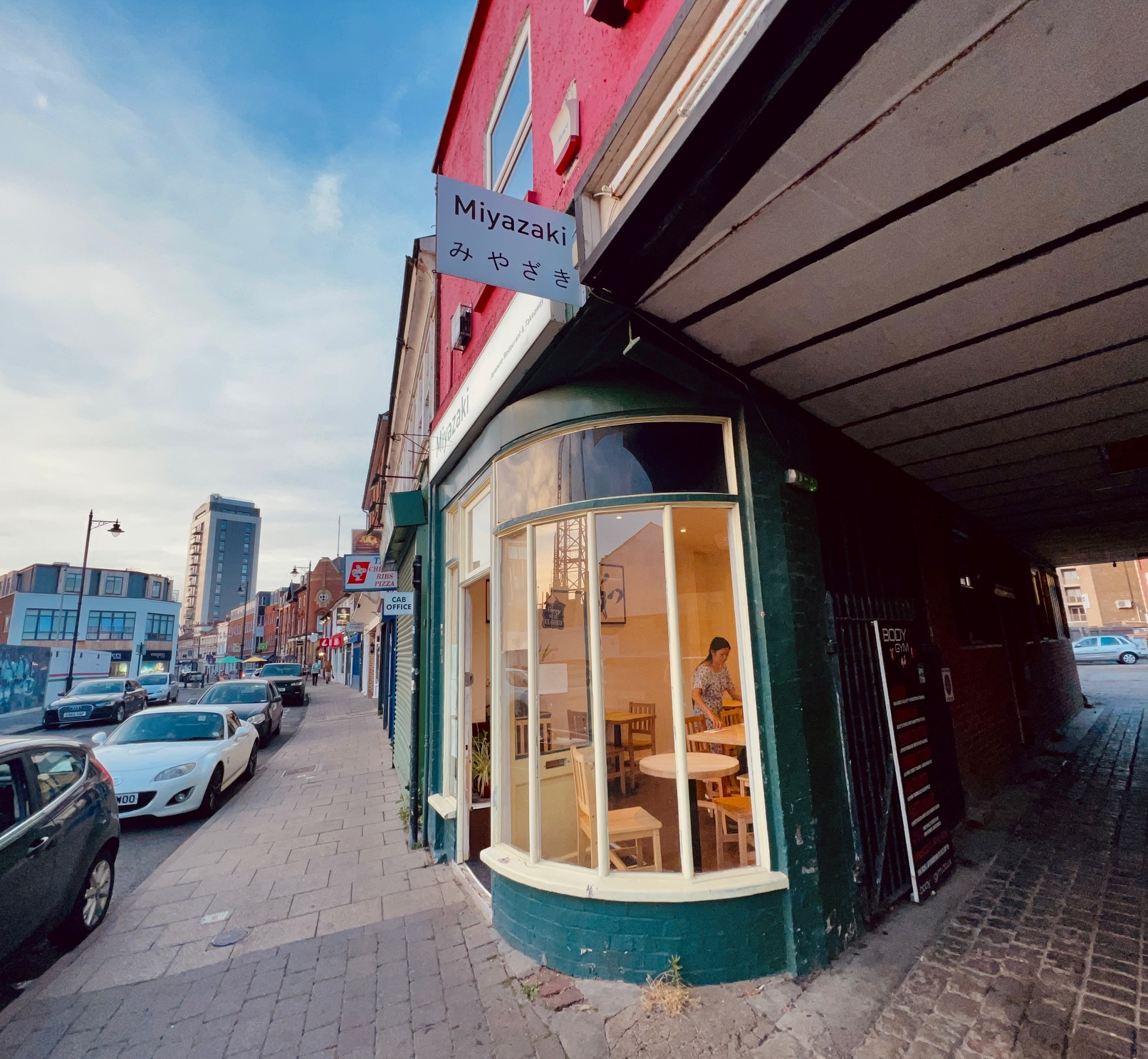
Once we reached Miyazaki, though, it stood out like the opposite of a sore thumb. Nestled between joints called Sizzlers and Tennessee Fried Chicken, a building site on the other side of the road, it looked completely out of place. No garish shop front, no big red letters and brightly-lit laminated pictures of the food on display like its neighbours, just a simple space.
Inside, the neutral, unfussy tables couldn’t have seated more than twenty people at a push, and the long thin room was beautifully lit, the light from the summer evening pouring in through the curved, graceful floor to ceiling window. Tasteful prints and drawings were dotted on the plain white walls. Just two other tables were occupied when we got there at quarter to eight – which saddened me a little. But it was a very hot evening, and the restaurant was doing a roaring trade in takeaways, neatly packaged and on the table by the bar, waiting for delivery drivers to pull up outside and take care of them.
Miyazaki’s menu was the kind that reassured you instantly. Some people, spoiled by the compendious likes of Sushimania or Yo! Sushi, would have found it restrictive but I liked the fact that it did what it did, and didn’t try to offer everything. Just three types of sashimi, a few more nigiri and just over a dozen sushi rolls in two different sizes. There was also a selection of side dishes, along with a very small selection of what you might call mains – three curries, two different noodle dishes and a range of udon soup noodles.
And even with such a restrained selection I saw dishes I’d never heard of or tried. Yasai kakiage, a sort of vegetable tempura fritter. Sunomono, a crunchy, vinegary cucumber salad. Chicken nanban, a deranged-but-inspired-sounding dish of fried chicken in a tangy coating, served with, of all things, tartar sauce. If I have one regret about this meal, it’s that I can’t tell you what those three taste like: I’ll know after next time.
Instead we stayed on safer ground, but we were richly rewarded all the same. Salmon sashimi was as perfect an example as I can remember – rich, smooth, glossy diamonds of perfect pink, just needing a dab of soy to perfect them. We liked it so much we ordered another portion. Mackerel sashimi was a little less successful: the skin looked like it had been torched, and the slight tinge of vinegar suggested it was cured rather than raw. I liked it more than Zoë did, which might have been a factor in us ordering more salmon.
Sushi rolls kept up a high standard. With a relatively compact menu a lot of these were variations on a theme, but even so I enjoyed everything I had. The small avocado maki were the kind of dish I could gladly eat every day for the rest of my life, and the avocado was splendidly buttery – ripe but not overripe, no hint of those telltale brown edges that always fill me with sadness.
Larger spicy tuna rolls with a little dab of fiery red sauce inside had a surprising kick, as did the pale ribbons of ginger on the plate – it’s always encouraging to see this more natural colour, rather than the standard-issue hyper-real pink ginger you so often get. And assembly was pretty good: there were a few ragged bits of nori here and there but generally they were put together deftly, and just the right size that you could eat them in one glorious go.
All the larger sushi rolls hovered around the eight pound mark, which struck me as very good value. Another set with both avocado and salmon were probably my favourite, and so much more than the sum of their parts, speckled on the outside with black and white sesame. I’m always reminded, when I eat food like this, how nice it can be to eat something almost-virtuous, so pure-looking. That feeling always dissipates by the time the next portion of fried chicken comes along but it’s nice to experience it all the same, however fleeting.
It helped, I’m sure, that the setting was so pared-back and ascetic, but also it’s so rare – for me at least – to find really healthy food that I actually like. By this point it was nearly quarter past eight and we were the only customers left in the restaurant, and I would have felt guilty about keeping the staff if it wasn’t for the still-steady stream of takeaway dishes coming out of the kitchen. Their work was far from over, so Zoë drank a second bottle of Sapporo, I had some sweet, fresh plum wine in a glass tinkling with ice and we ordered one last wave of dishes.
Doing so proved, if nothing else, that the period between fried chicken dishes – in my life, at least – is never that long. Karaage chicken is a staple order of mine, in Japanese restaurants and anywhere else I can find it on a menu, but Miyazaki’s was one of the best I’ve had anywhere. Normally it comes plain with some mayo on the side (and I’m absolutely fine with that) but this had been tossed in a tangy red sauce which took it somewhere even better. All soft thigh meat, crunchy coating and gnarled edges with a little spike of heat, it was up there with the nicest things I’ve eaten this year. Chicken gyoza felt a little more boilerplate, but even boilerplate chicken gyoza are still better than the majority of things you can pop into your mouth.
It’s a shame that I saved the worst til last, but our final two noodle dishes suggested that the kitchen’s strengths lay elsewhere. You can have soba or udon noodles with chicken katsu, fried prawns or vegetable korroke, but either way the underlying dish didn’t quite come together. My soba noodles – a neatly petite portion – were nice enough I suppose, but the sauce they had been lightly stir fried in had a slightly off-putting sweetness when I was hoping for more savoury depth. And my three breaded prawns, tasty though they were, didn’t feel like they really went; I resorted to eating those with my fingers and then ploughing through the noodles, but it didn’t feel like a cohesive dish, or a hugely enjoyable one.
I think Zoë picked better with the katsu chicken, which was nicely done, but other than the gauge of her noodles her dish was subject to much the same problems. These two dishes are only available at dinner time, but to be honest when I go back I’ll probably just order more sushi, because that felt like where Miyazaki truly excelled. Or I might just leap into the unknown reaches of the menu, and see whether Japanese fried chicken with tartar sauce is as chaotic and magnificent on the plate as it is in my imagination. Either way, I also plan to sample their extensive and impressive selection of sake.
I know it’s a little perverse of me to review a restaurant in Maidenhead this week, because Reading has had two Japanese restaurants open in quick succession: Intoku, where the Tasting House used to be, at the end of May and Iro Sushi, replacing Raayo on Friar Street, at the beginning of July (a third, You Me Sushi, opened a few doors down from Iro yesterday). But I thought Miyazaki was worth exploring, because restaurants that have been doing their stuff for years with no fuss are often overlooked in favour of shiny new places. Or, possibly, bandwagon-jumpers.
And it was right that I did, because Miyazaki is quietly splendid and well worth celebrating. I’m not inclined to let those final two dishes detract from what was a truly wonderful meal a twelve minute train ride from Reading in surroundings that really couldn’t be more incongruous. Service was flawless, the room has a sort of touching humility which I liked very much and if our meal wasn’t cheap – it came to just over ninety pounds for all that food and a couple of drinks each, not including tip – it was worth every penny.
And if you need somewhere to go in Maidenhead for a post-dinner drink, I can thoroughly recommend A Hoppy Place which has excellent outside seating and had two phenomenal imperial stouts on keg when I visited, both of which I enjoyed a great deal. You could go to O’Neill’s instead of course, but you don’t need to leave Reading for that, although you would need to take leave of your senses. I will get to the likes of Intoku and Iro in due course, but the standard they have to reach has already been laid down, in a little sanctuary a matter of minutes away on the Elizabeth Line. And if they turn out to be disappointing, I know exactly where I’ll go to get over it.
The sort-of roadmap back to normality was announced last month and you could almost hear, online and among friends, a cautious but relieved exhalation. Pubs and restaurants announced their plans, the days got longer, my parents were both vaccinated, my barber booked me in for a haircut on a date some months away. There were some sunny days, at long last, and when I walked through Forbury Gardens I could see people sitting on the grass, as if you could wish summer into existence by force of will alone.
And yet now we’re in March I see a lot of people looking back; the earth has completed its orbit around the sun, and everybody seems in a reflective mood. So we remember the last time we went to a pub with friends, the last time we hugged our loved ones, the last time we took a train to London or a bus to Kennet Island; someone I follow on Twitter posted recently that it was the anniversary of the date on which he is pretty confident that he contracted Covid-19.
We’ve had a year largely in stasis and it gives all the little historic moments, all those Facebook memories, enormous power. This weekend a year ago I held my last pre-Covid readers’ lunch at the Lyndhurst. Even at the time, it was an event that felt slightly more of a gamble than I might have liked – but we knew so little, back then. In any event the tables were spread out, there was hand sanitiser at every table and everybody had a pretty good idea that this was probably the last big social event they would attend for the foreseeable future.
I am hugely fortunate: if I had to pick a day to recall over and over across twelve relatively barren months, I couldn’t have chosen a better one. My birthday is in the not too distant future, and it will probably be even more of a non-event than the last one. At least I had some kind of party last year, even if I didn’t understand that at the time.
That delicious lunch at the Lyndhurst, nearly a year ago, was my first encounter with what I’ve since termed the clock of terror: that anxious seven day wait after you do something that involves an element of risk. Seven days of scanning and anxiety: is it a sore throat, or just allergies, or the arrival of the Big Bad? My own personal clock of terror has been reset dozens of times this year, and it never gets much easier. The prospect of a humdrum, quotidian life absent of risk or fear (or, at least, with a lot less risk and fear) can’t arrive soon enough.
The last meal I had on duty before the restaurants closed, a year ago today, was at Osaka, the Japanese restaurant in the Oracle that took over the spot that used to be Café Rouge. I liked a lot of my food, and I loved the way they’d made over a tired and unloved site. When I went, I thought I can fit in one more review on the blog without fully grasping, at the time, just how pointless that would be. I should have known, really: lockdowns aside, when you’re looking at a restaurant hoping it won’t get busy, when you find yourself in a hurry to pay up and leave instead of enjoying a leisurely midweek lunch, you aren’t in the right frame of mind to review it.
The week of lockdown I wrote a piece about it, but you couldn’t really call it a review. It was more of a diary piece, and it started an enjoyable few months of writing posts on the blog that weren’t just about restaurants, to keep myself occupied and give people something to read. People were very kind about them, and I kept going until just after the first big lockdown came to an end. Then I took a break, then in our third national lockdown I said I’d have a go at reviewing takeaway restaurants, and here we are.
I also said that when I went back to eating in restaurants, Osaka would be the first restaurant I reviewed. But a year has passed and we aren’t quite there yet, so to mark the occasion I thought I would review their takeaway this week instead. And flicking through the menu on a Monday night, I found myself wishing I hadn’t left it so long; I adore sushi and sashimi, and I couldn’t quite believe I haven’t eaten it for a year. I guess the problem is that the list of things we all haven’t done for a year is so long you forget half of what’s on it.
You can only order via Deliveroo, and the range is slimmed down compared to the restaurant menu – a handful of starters, just over half a dozen maki, the same for nigiri and only two types of sashimi. There’s no tempura, no temaki, no platters or bigger selections, either, so the selection is considerably more limited than at Sushimania, Osaka’s closest competitor. The pricing is comparable, but all over the place: some items are more expensive at Osaka, others at Sushimania with little rhyme or reason behind it.
Osaka also has main courses on its menu, ramen, rice and noodle dishes, all priced around the twelve pound mark. I decided to steer clear of them, partly because I figured sushi and sashimi would travel better – with no danger of going cold – and partly because once I started looking at all that sushi and sashimi I pretty much wanted to eat that and nothing else. Moreover, Deliveroo was running an offer that gave you twenty per cent off provided you spent over twenty pounds: not difficult at the best of times, but easy as pie when you’re scratching a year-old sushi itch.
Delivery was free of drama and in very good time – I placed my order just after seven o’clock, and about half an hour later the man was at my door with a couple of bags. Plonking them all on a couple of little tables in the living room, I was struck that although sushi was convenient to have delivered, it probably loses out more than most food when you compare it to eating in the restaurant. Japanese food is all about precise arrangement and beautiful presentation, and that’s something you can’t really replicate when you package food for delivery. So instead everything was crammed into black plastic trays with a clear lid – and I did find myself thinking that the black plastic might not be recyclable.
There felt like an awful lot of packaging, too: I wasn’t sure, for instance, whether a separate plastic sachet of ginger, wasabi and soy sauce with every single item was strictly necessary. It felt odd, too, that they supplied all these condiments but no chopsticks – there was probably a tick box for these when ordering but I wasn’t used to asking for asking for cutlery for a delivery order (for obvious reasons) so I didn’t spot it. Fortunately, it turned out that we had a couple of pairs of in the house: the ones pictured below, which I thought were adorable, were commandeered by my public transport-loving partner in crime.
We kicked off with the one hot dish we’d ordered – crispy chicken karaage – a portion each because we were too peckish to share. I loved this: it’s a reference dish I often order in Japanese restaurants and I think Osaka’s rendition is up there with any I’ve tried (with the possible exception of Gurt Wings’ “JFC” at Blue Collar on Fridays, which is Death Row stuff).
Good tori karaage is trickier to do than you might think, and many versions either feature breast meat which is a little too dry or thigh which is just a tad too bouncy. Perhaps it’s all in the marinade, but the texture of Osaka’s was bang on, the coating light and crispy with no grease or oiliness at all. I squeezed my lemon over the generous helping of fried chicken, dipped it in the thick mayonnaise, sprinkled with black and white sesame seeds, and ate in rapt contentment.
One way of offsetting having a whole portion of fried chicken to yourself is to eat something as clean as sashimi, so we each had a portion of salmon sashimi to ourselves, too. You got three expertly cut slabs of fish for your money – just under five pounds – and they really were terrific, marbled, almost buttery things. If only everything that was good for you tasted as marvellous (or contained as few calories as) sashimi, the planet would be a very different place. And even if it wasn’t, I might be a lot slimmer. The sashimi came, as it always does, with a big pile of spiralised mooli, and I wondered, as I always do, who actually eats that bit: slim people, probably.
I’m not generally a fan of nigiri, but I always make an exception for unagi, or grilled eel. There’s something about this especially meaty, muscular fish, strapped with seaweed to a lozenge of sushi rice, that makes for a perfect mouthful. Osaka’s were decent – and pretty good value at four pounds forty – and the eel had plenty of oily flavour, but I would have liked a little more of the savoury sauce on top.
The rest of our dishes were all variations on sushi rolls and, like the rest of the food, they were impeccably done, tasteful and a model of restraint. Avocado maki are another of those reference dishes – done well, there’s nothing quite like that gorgeous creamy avocado hugged by rice, all dabbed in a tiny pool of soy. These were very well assembled – no looseness, no nori not quite meeting in the middle – and the avocado was wonderfully ripe with no browning.
It seemed a little strange that each maki was made up of several smaller slivers of avocado rather than one big strip, but it made no difference to how enjoyable they were. Spicy tuna maki were also extremely good, with the fiery tuna perched on top of the sushi rice rather than encased by it – these were definitely the punchiest thing I ate, and a dish I’ll make a beeline for when I order again.
Finally, we had ordered an uramaki roll – these are bigger, longer affairs, all of which hover around the twelve pound mark. The selection through Deliveroo was very limited – just the five on offer, as opposed to the twelve on the restaurant menu – and the purist in me ruled out the two featuring crushed tortilla as a fusion bridge too far. Fortunately the one we ended up going for, the green dragon, turned out to be an excellent choice. This had katsu prawn, a baton of avocado and thin strips of cucumber in the middle of the rice with avocado daubed on top, the whole thing then crowned with Japanese mayonnaise (Kewpie, at a guess), a drizzle of dark unagi sauce and, last but not least, a little cluster of tobiko, or fish roe.
Typing that all out makes it sound incredibly busy, and I was worried approaching it that it would taste too muddled, but it really was a masterful dish. The many flavours and textures could have jostled for supremacy, or tried to shout each other down, but in reality the whole thing was harmonious and superb. I especially liked the fact that the cucumber was so finely cut – so often you get a big watery ingot in the middle of your sushi – and the crunch largely came from the katsu prawn instead, with everything else almost symphonically arranged.
Again, I imagine this dish is quite a looker in the restaurant but distinctly jolie laide when delivered. Not that that bothered me in the slightest: I’ve taken more than enough pictures of the university’s Lego Building to prove that I have a soft spot for the unconventionally attractive.
Our meal for two, including a 20% discount, came to just under forty-five pounds, not including tip. And although I feared at the start of my meal that I’d still be hungry at the end of it I found myself nicely sated: all those small bits of rice here and there add up, and you find yourself full almost by stealth. Some people will think that’s pricey, and I understand that you could get a lot more food for far less money, but to some extent I feel that runs the risk of missing the point.
I’ve found Osaka’s food far more difficult to sum up than usual: it’s technically very competent, and much of it is delicious, but because it’s so polite and precise, so well done and well behaved, the danger is to damn it with faint praise. It does feel like the menu is less suited to sharing than the likes of Sushimania, and more limited too, so I can see that if you wanted a sushi feast you might spend your money elsewhere. But if you compare individual dishes I’d say that Osaka is better, in terms of its attention to detail and quality of execution (a more interesting comparison might be with Oishi down the Oxford Road which, confusingly, offers delivery both under that name and the nom de plume Taberu Express).
Also, more than with most restaurants, I sense that Osaka offering its menu for delivery involves a number of compromises. Those kind of compromises wouldn’t trouble, say, a burger joint, but for sushi and sashimi it must be frustrating to present your food in a format so far from the ideal. Personally, I’m delighted that they made those compromises so I could spend some of my Monday evening enjoying their immaculate food. Resetting the clock of terror is one thing, but resetting the clock of sushi is a far happier experience.
For all of the time I’ve spent looking back, I do wonder what the world will be like in March 2022. Perhaps we’ll look back on all our Timehops and Facebook memories and we’ll struggle to remember what it was like to feel and behave the way we once did. Maybe it will be like seeing Bobby coming out of the shower in Dallas, feeling like we’ve had the strangest dream, the kind that fades quicker than we can tell it to somebody or write it down. In any event I’m looking forward to that future, when the restaurants we love are thriving again and the people we love are sitting at our table. When it comes – and it will come – Osaka will be one of the places I go to celebrate.
Osaka The Oracle, Unit R16, Reading, RG1 2AG 0118 957 3200
Sen Sushi closed in October 2023 and the owners have moved to Wokingham and opened a new restaurant called Sen Ichie. A new restaurant, Blissful Umami, is in its place. I’ve left the review up for posterity.
I’ve always, I think, been a contrarian at heart. I really don’t like being told what to do. Few things irk me more than people using that Twitter trope “Retweet if you agree” (often I do agree, but I never Retweet). Or when someone tells you to “drop everything and read this”. I used to have a very opinionated friend who was always telling me what I should listen to or read: weekends away at his house in Kent were a bit like being in the musical equivalent of North Korea, being educated in whatever records 6 Music had told him to like that month.
The contrarian in me is why you get a review of Sen Sushi, the little Japanese restaurant at the Three Tuns end of the Wokingham Road, today. I know everybody wants to read a review of Osaka, the gleaming new Japanese restaurant in the Oracle. I completely understand why – the fit out looks superb, the menu has an impressive range and the buzz so far has been good. But something in me thought: what about Sen Sushi? It’s been there a few years, I had it recommended to me recently, and if not now, when would I go? So I hopped on a number 17 bus with my partner in crime Zoë to see if Reading had an undiscovered gem I hadn’t got round to visiting yet.
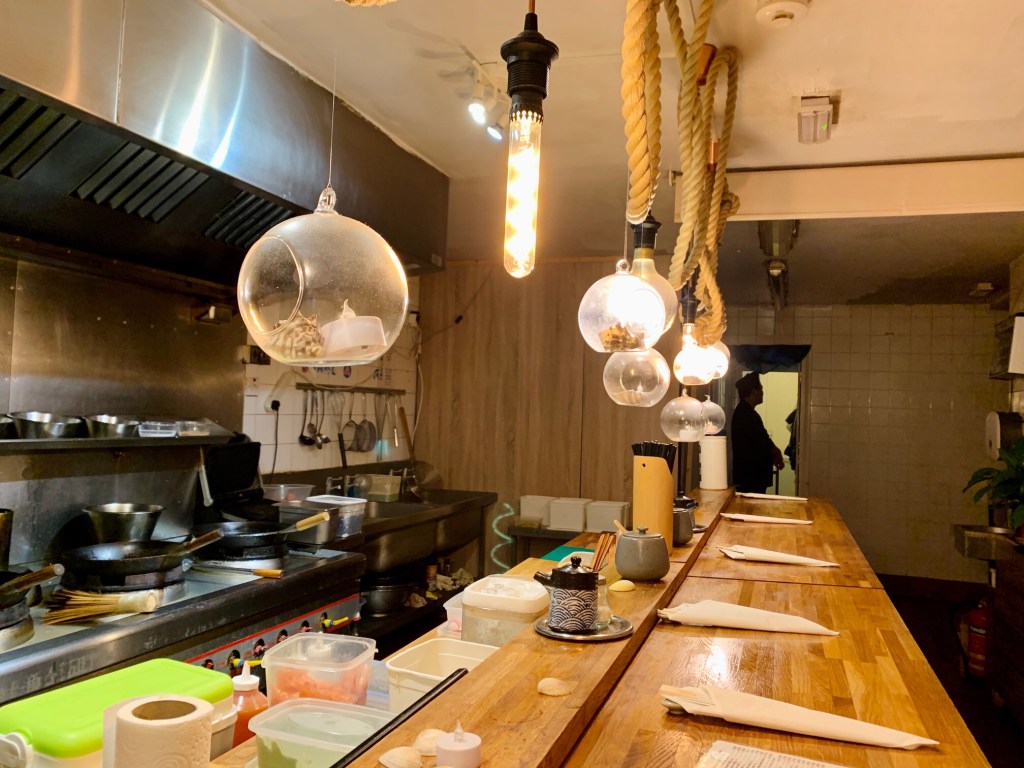
It’s a little restaurant that can probably seat less than twenty people. The front room has stools up at the window looking out, and a low table complete with tatami where you can sit cross-legged, provided you take your shoes off first. The back room has about half a dozen seats up at the counter where you can watch your sushi and sashimi being prepared. Behind the counter are a fryer and a gas range with four big weathered-looking woks, shiny with oil. That’s where we decided to sit, close to the action, and we had our pick of seats as we were the first customers that evening.
At this point, I pontificated to Zoë about how in many restaurants, being able to see the kitchen up close was considered a positive selling point. However (as we shall see) as the evening went on I started to wonder if it was such a good thing after all.
The menu was pretty big and covered all bases – hot starters, sushi and sashimi, rice and noodle dishes. We decided to try a bit of everything, but started with sushi and sashimi. Our waitress was lovely and polite but giving her our order was an interesting convoluted affair – she then went into the other room, printed off a ticket and came back to put it on the counter for the two chefs doing the cooking and prep. Admittedly, this made more sense when I realised that Sen Sushi also gets a fair amount of takeaway orders which also join the queue.
It really was fascinating watching as one of the chefs flattened the rice on the mat and cut strips of tuna, rolling the whole thing in front of us. Or seeing a beautiful piece of salmon come out of the fridge and be precisely cut into slices with an ultra-sharp Global knife. The wonderful thing about sitting at the counter is that there’s no hiding place in the kitchen: I found myself quite transported by the whole affair, and could have gawped at it for ages. I was possibly more transfixed than Zoë, who by this point was wondering why they hadn’t switched the heater on and was considering wandering over to the coat rack to retrieve her scarf.
The salmon sashimi was easily the nicest thing I ate at Sen Sushi – a really fine piece of salmon, beautifully marbled, soft and buttery. It was better than any sashimi I’ve had in Reading and probably up there with my favourite Japanese restaurants. The spicy tuna maki and avocado maki were fine but no more than that – initially they forgot that the tuna maki were meant to be spicy so they were whisked away and topped with a blob of sauce and a sprinkling of what I think was togarashi. Zoë thought they were a little ragged and lacking in uniformity, I was inclined to be a bit more charitable. Those reserves of goodwill got used up throughout the rest of the meal.
For our second round, we went for chicken gyoza, karaage (Japanese fried chicken) and, just to break up the chicken motif, some soft shell crab maki. The problem with sitting at the counter is that there’s no hiding place in the kitchen, so we saw a chef retrieve a tupperware container full of dumplings and another full of chicken nuggets – I thought it was from the fridge, Zoë reckoned the freezer – and put them in the fryer. Only the soft shell crab was done there and then, battered and then put in the fryer.
All three dishes were moved between the two fryers at what felt like random intervals, so I’m not sure how Sen Sushi would keep, say, vegetarian gyoza separate from the fried chicken. That’s especially ironic because I’m pretty sure they gave us vegetarian gyoza by mistake. They were oddly claggy, and the filling felt bulked out with something stodgy like potato. Zoë generously said I could have her last one and I said “no, I insist”, a sad inversion of how those discussions are meant to go with good gyoza.
Ignorance is bliss, and I wonder how I would have felt about the fried chicken if I hadn’t seen it being decanted from tupperware in front of my very eyes. I probably would have liked it more – the edges were nicely gnarly and crispy, and the meat was tender enough. But normally karaage comes with mayonnaise on the side, whereas Sen Sushi slathered the whole thing with wasabi mayo and a fruity sauce. Wasabi is strong enough, and enough of an acquired taste, that they should have left that choice to the diner: I found it off-putting. “You should have the extra piece, you’re hungrier than I am” I said to Zoë: a transparent attempt to dress up my lack of enthusiasm as gallantry.
Soft shell crab is one of my favourite things, so I was sorry that Sen Sushi’s maki also fell short. They looked the part, a fairly generous portion, the rice studded with tobiko, but putting both cucumber and avocado in with the crab and then drizzling the whole thing with mayonnaise and fruity sauce crowded out the flavours and felt like overkill. They were poorly rolled, too – half of the rolls weren’t closed off properly and fell apart when we tried to pick them up with chopsticks. I saw the chef struggling with rolling them: he had a couple of attempts and then clearly thought Fuck it and had one last half-hearted stab at massaging the sushi rice into the gap. Again, there’s no hiding place in an open kitchen.
What I was also quickly discovering about sitting next to an open kitchen was that it was impossible to have an honest conversation with your dining companion about whether the food was any good. “What do you think?” said Zoë. “Mmm” I replied, non-committally and in earshot.
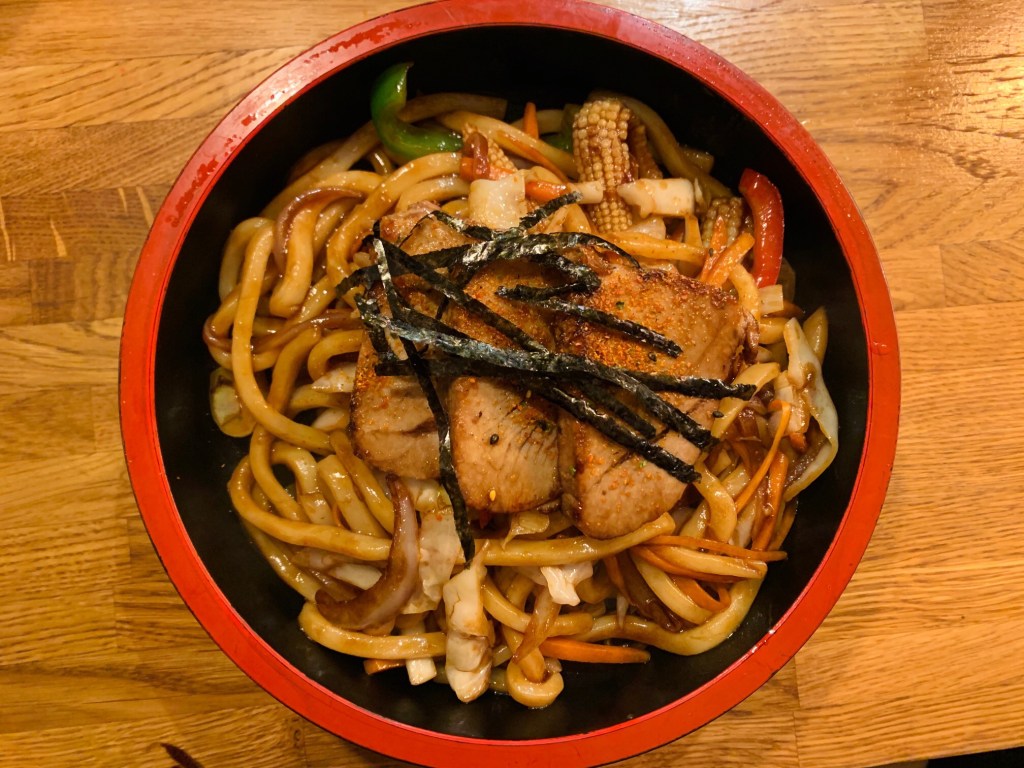
Being overheard was even more of a problem when the mains turned up, because they were the low point of the meal. Zoë’s teriyaki udon noodles with char sui came in a high-sided, thick rimmed ceramic bowl. She whispered something to me which I couldn’t make out but which I was later told was “dog bowl”. And it’s true, it did look like a dog’s bowl. “I expected to get through it and see a picture of a bone on the bottom” she told me.
But there was no danger of getting through it, because it wasn’t nice at all. The noodles were thick, slippery and strangely oleaginous, the sauce bland and thin. And the char siu was nothing of the kind. Fidget & Bob’s exemplary char siu is so beautifully cooked that it falls apart when prodded with a spoon, and comes to the table anointed with a stunning sticky-sweet sauce. Sen Sushi’s char siu, by contrast, is three thick slabs of pre-cooked pork taken out of yet another tupperware container and chucked in the wok at the end to warm through. It was hard even to tear apart with your teeth, and not worth the effort.
My dish wasn’t cooked until after Zoë’s had been served up – an odd course of action in a kitchen with multiple woks and indeed multiple chefs. I had a rice bowl with braised Taiwanese pork and again, it was an unsettling thing to eat. Disturbingly uniform little cubes of pork were served in a dark sauce which managed not to be sweet, or spicy, or even savoury, just a sort of dark brown white noise. There were a few bits of spring onion scattered on top, but they just left me wishing for more food without that mushy texture.
I didn’t want to draw the parallel, but although Zoë’s dish had come in what looked like a dog’s bowl mine – chunks of meat in a thick but strangely flavourless gravy – was the one that felt like it belonged there. I ate as much as I could face. We weren’t asked why we’d left so much of our main courses, which meant that I didn’t have to fib about how full we were. That said, something about those last two dishes did make you feel unpleasantly full: they didn’t sit easily, and it wasn’t until much later the following day that I felt like eating again.
It’s a shame the food was so iffy in so many places, because the service – from the waitress and the chefs – was pleasant, friendly and attentive for most of our meal. Nice enough that I feel like a bit of a shit for slating the food, but not so nice that they asked whether we were happy with everything, or so nice that I volunteered that information. Sen Sushi does a few desserts (mostly mochi and a matcha ice cream) but we felt like we’d given them enough money already, so we paid and made our escape.
Dinner for two – all that food, two bottles of Kirin and two cans of San Pellegrino – came to just shy of sixty pounds. Perhaps I’m a traitor to the cause for pointing out the inconvenient truth that chain doesn’t necessarily mean bad and independent doesn’t necessarily mean wonderful, but I’m afraid you would get a far better return on that sixty pounds eating at Wagamama or Yo! Sushi than you would at Sen Sushi. You’d also be better off eating at Sushimania, or Kokoro, or taking the train to Windsor and eating at Misugo. And I don’t know how good a cook you are, but you’d probably also have a better meal at home doing a stir fry.
One of my favourite Japanese restaurants is a little place called Chez Taeko in Paris. It’s part of the Marché des Enfants Rouges in the Marais, and it’s just a few little benches and tables and a small menu, on a chalkboard, of sushi, bento boxes and rice bowls. All the food there is beautiful, and when I went there last winter I sat uncomfortably close to my fellow diners, under a heater, with limited elbow room in a little temporary structure like a gazebo enjoying terrific crispy chicken and rice, maki and then concrete-grey sesame ice cream, like edible Brutalism. I honestly couldn’t have been happier.
At the end when I went round the corner to pay the bill I saw the tiniest kitchen, the staff in it working flat out, serving up terrific dish after terrific dish to the lunching Parisians. I so wanted Sen Sushi to be like Chez Taeko, to have the potential to become a happy place, but it didn’t even come close.
“It really did look like a dog bowl” said Zoë when we were safely ensconced back in our house, the meal an uncomfortably recent memory. “If my mum or dad had been there when they served that up they would have wet themselves.”
“You didn’t like it at all, did you?” I said. My initial thoughts had been that the sushi was pretty good and perhaps mitigated the disappointment of the other dishes, but the more time passed, the more I felt that I was being too kind.
“No, I really didn’t. I wouldn’t go back. And it was so cold in there – they had a heater on the wall, why the fuck didn’t they switch it on? And what about the gloves?”
“The gloves?”
“Sometimes the chef was wearing blue gloves and sometimes no gloves at all. What was that about?”
“Well, he wore gloves when he was handling raw fish though, didn’t he?”
There was a pause: Zoë was clearly deciding whether to break bad news to me.
“Not always. And I didn’t appreciate one of the chefs taking a fag break while we were eating our main meals with the back door open, so I had my dinner with a side of Benson & Hedges.”
Again, I hadn’t noticed that.
“It’s a real shame,” she went on “because I wanted to like them, but that char sui was just… it wasn’t good at all.”
“You’re right, I’m afraid.”
Zoë’s accompanied me on nearly twenty reviews by now: I’m starting to think she deserves some kind of promotion (or time off for good behaviour, at the very least). As for me, I’m sure I should learn something from this whole experience. But I fear I’m far too contrarian for that.







 Edible Reading