Restaurant review: Good Old Days Hong Kong Ltd

If I asked most Reading residents to name Reading’s most famous restaurant, the chances are the majority of them would say either Kungfu Kitchen or Clay’s Kitchen. And that makes sense because those two, the Lennon and McCartney of Reading’s food scene, are the ones that have broken out into the national consciousness, as much as Reading ever does. If we had a round of Reading restaurants on Family Fortunes, asked 100 people to name a restaurant in Reading, those two would top the leaderboard. God knows what else would be on there – Sweeney Todd, probably, and a rogue vote for Munchees.

But that would only happen if you asked Reading residents, and is indicative of the bubble we live in. Because, last year at any rate, the most nationally known restaurant in Reading was Good Old Days Hong Kong Ltd, a nondescript Cantonese restaurant just the other side of Reading Bridge. And the reason for that is that last February it was reviewed in the Observer by journalist, jazz musician, TV show judge, relentless self-publicist and life president of the Jay Rayner Appreciation Society, Mr Jason Rayner.

He raved about the place, and explained that the chef used to cook at the Hong Kong Jockey Club, and Hong Kong’s Four Seasons Hotel. “It feels like finding a senior chef from the Ritz… doing their own thing in your local caff” he declaimed. The unspoken implication was that this was almost as extraordinary as finding the U.K.’s greatest restaurant reviewer doing his own thing in a Chinese restaurant most Reading folk had never heard of, slumming it for the greater good. Lucky us!

Now, don’t be fooled into thinking Rayner had come to Reading specifically to review Good Old Days. He was in Reading recording an episode of his Radio 4 series, and I suspect he decided to kill two birds with one stone before heading back to London: after all, if there’s one thing people like to moan about below the line on his reviews, it’s how many of them are of London restaurants.

That roving Radio 4 series must be a positive boon, as it gives Rayner an excuse to visit parts of the country he otherwise wouldn’t touch with a barge pole. And I think we can include Reading as one of those, given that he described Caversham as “Reading’s Latin Quarter, as nobody has ever called it”. Such a charmer. But anyway, it was close enough to the station and he had a friend who recommended it, so Good Old Days it was, rather than one of Reading’s more high profile restaurants.

And he did seem to enjoy it, sort of. He said that “if… you happen to live nearby, get the food to go. Because in truth Good Old Days is a takeaway that just happens to have a few tables.” And that’s the funny thing about Rayner’s review – it didn’t make me fall over myself to visit. And I don’t think it galvanised Reading either, because I still know relatively few people who have had a takeaway from Good Old Days and fewer still who have eaten in there. The ones who have, that I’ve spoken to, have told me that it was “nice”, or words to that effect. I’ve never had an oh my god, you really must go – can I come?

Especially that last bit. Despite it being on my to do list for almost a year, every time I mention it to someone in terms of joining me there on duty they ask if we can go somewhere else instead; people just didn’t seem to fancy the place. In that respect, Rayner’s review is a remarkable one – if you can praise food and still leave people lukewarm about going to a restaurant you definitely have some kind of skill, albeit not one most restaurant reviewers would want to develop.

Very few of the comments on the Observer review were from people in Reading, and what ones there were were evenly split between Don’t give the secret away and We went there on your recommendation and it was awful. So it looked like there was a gap in the market for a reliable review of Good Old Days, and I was happy to fill it.

Gladly, at the start of this year I finally found an accomplice for my review. It was Liz, Reading’s elite level bellringer – her words, not mine – last seen exploring The Cellar with me the night Trump won re-election and the world turned to (even more) shit. I’m beginning to think Liz might be a lucky charm as I’m yet to have a bad meal with her on duty, so I made my way to Good Old Days at the appointed time with high hopes.

I should add, because unlike broadsheet critics I like to offer some practical help, that you can book online through their website, although it’s a little convoluted and you’re never sure it’s actually worked. You then get an email and texts which tell you that if you want to change your booking you have to call their mobile number, because you can’t amend it online. On the Wednesday night when we went, there was one other table with diners, who left shortly after I arrived at seven, and one other table seated that evening. So you may be able to turn up on spec: for some reason the Observer review doesn’t seem to have precipitated a tidal wave of demand.

It is indeed a very basic space, if not necessarily an inhospitable one. With just over a dozen covers, and most of the tables seating four people, it’s compact and resolutely unfancy. The walls were a mixture of municipal white tiling and faux wood panelling with just a few flashes of identity – a handful of framed pictures of dishes on one wall, and a framed copy of Rayner’s review on the other. It meant that he glared balefully down at us during our meal. Like the new President, it’s hard to find a photograph of Rayner where he’s smiling. Maybe he never does, or perhaps he thinks it gives him gravitas. At least the eyes didn’t follow you round the room.

I’d checked in advance and there was no alcohol licence, so I’d brought a bottle of white from home. When I asked we got two very basic tumblers, which did just fine. I was however glad that I’d also brought a corkscrew, because I wasn’t sure we’d otherwise have laid our hands on one. The menu was big – just under a hundred dishes – but somehow managed to feel compact, perhaps because they’d crammed it onto two sides of A4.

By Reading 2025 standards the prices were so reasonable that I wondered if I’d fallen through a timewarp – the vast majority of the dishes cost less than ten pounds, which meant that without an alcohol licence you could eat a lot of food for not much money. Maybe it was predominantly priced for takeaway but, not for the last time that evening, it made me think that Rayner was wrong and that this was a positive argument for bums on seats and eating close to the kitchen.

The menu leaned more Cantonese than Szechuan, so no offal and more of the dishes that, for me, bring back memories of my childhood in Woodley, of weekend treats at Hong Kong Garden in the shopping precinct coupled with the latest release from Blockbuster Video. It evoked those feelings of familiarity and wonder, because when you’re twelve these things are exotic and different, and a pancake with crispy duck is a magical world away from a Findus Crispy Pancake.

“Can you believe I’d never had Chinese food until I lived in China for a year?” said Liz. I knew she’d grown up in Cheltenham but even so, this surprised me; imagine doing it in reverse, having all the authentic stuff and then coming home to the Anglicised version.

We had plenty to natter about, and the wine was very nice, so before we got to haggling over our order we ordered some crispy dumplings with pork and vegetables. These were a neat, compact treat and they made me happy with anticipation for what was to follow – deep-fried, brittle, remarkable easy to pick up with the stainless steel chopsticks and dip in a little pot of sweet chilli sauce. Well, that’s what Liz did anyway, with her far more evolved chopstick skills: I on the other hand tended to drop mine in the sauce and then mount a cack-handed rescue mission.

We spent so long chatting while we ate our dumplings – about our respective Christmases and New Years, about the vicissitudes of Reading Buses which had made getting to the restaurant harder than it needed to be – that it took quite a while before we got down to the serious business of choosing our order. And that’s when it became apparent that Liz and I had certain philosophical differences when it came to food.

Getting to know someone is always a gradual thing; you try to be your best self and promote the version of you that you’d like to be all the time. And then, over successive meetings, you slowly reveal your true nature, if only because it’s too hard not to. What I’ve discovered, going on duty with different dining companions, is that this also happens in restaurants.

On my first meal with Liz we went to The Coriander Club, where we shared a couple of starters but then had our own personal mains. For the follow up we went to The Cellar, very much a starters/mains/desserts model. So it was only on this third meal, at a place where we would order and share several dishes, that I realised I had unwittingly gone to dinner with someone who regarded a plate of broccoli as a feature attraction.

“I have to have the broccoli with garlic sauce” said Liz. And actually, that made sense – this was a woman who had snuck aubergine, somehow, into both of our previous visits to restaurants. I mentally ticked off at least one of the carnivorous delights I’d spotted on the menu.

“And… how do you feel about tofu?”

“Well, it’s not my favourite. I like Jo’s salt and pepper tofu at Kungfu Kitchen, but that’s probably as far as it goes.”

I looked on the menu, which had a very similar dish. Would Liz go for it?

“I’d really like the mapo tofu, if you don’t mind. I have such fond memories of it from China.”

The irony is that I know, rationally, that this is good for me. Because going for dinner with people who eat the same stuff as you is like recruiting in your image – it makes the world very homogeneous, and I’m occasionally conscious that I should introduce more variety into the things I order when I’m reviewing restaurants. I also know that probably, a proportion of you might be reading this and thinking at last, he’s actually going to talk about the kind of things I like. So I accepted my part vegetarian, part-tofu driven meal with good grace. Besides, it had been Liz’s birthday the day before, so I figured she was entitled to call the shots.

I did insist on sweet and sour chicken, though, which I suspect was to Liz what broccoli in garlic sauce would be to me. We placed our order, with a beef and black bean ho fun thrown in, and our server wandered off with the order, came back, and asked me to confirm it. Which I did, absolutely certain that they had captured everything we’d ordered.

The first dishes to arrive were the ones Liz had been craving. I don’t know whether it was the lighting, or the cooking, or the slightly recherché lino on the tables, but everything seemed to have an almost hypersaturated, Martin Parr feel about it. That definitely showed in the broccoli – enormous emerald-green florets, really only just cooked, glazed in a thickened, pungent sauce which coated every irregularity and lurked in a pool at the bottom of the bowl. Dragging a floret through the sauce and eating it I realised that, although I had to unhook my jaw, I was enjoying myself against my better judgement. Liz was beaming.

“This is exactly how I wanted it to be.”

The tofu, on the other hand – I’m not sure you’ll ever get a glowing writeup of a tofu dish from me, and this was not the occasion to change that habit of a lifetime. I’m yet to find anything with tofu in it that isn’t all wobble and no flavour, and although I know people talk about mapo tofu in glowing terms I still don’t understand why. You couldn’t fault the generosity, though. This dish was huge, in the way that things you have to wade through, like bad novels or to do lists at work, so often are.

“This isn’t quite as I expected” said Liz. “It should be much redder, and much hotter.”

And I got that – instead it was a sort of glossy ruddy-brown. And although there was minced pork in it, and little bits of mushroom, nothing really made its presence felt. And yet, as we worked through it I found it exerted a strange kind of hypnotic power. I liked it more and more, appreciated its subtleties more and more.

I remember when I reviewed The Imperial Kitchen there was a suggestion from some people that I just hadn’t “got” Cantonese food, that I had expected the crash-bang-wallop flavours of, say, Kungfu Kitchen and judged it harshly when they never turned up. Well, this may count as personal growth but maybe, just maybe, there’s something to that. I would never have ordered this dish in a million years, but I was perhaps quietly pleased that somebody had.

Now, having said all that I can wax lyrical about the dish I insisted on, because Good Old Days’ sweet and sour chicken made me very happy indeed. It’s hard to explain why it was so good, but I shall try nonetheless.

My memories of this dish, my good ones anyway, are all fuelled entirely by nostalgia. And nostalgia is wonderful, but these things only really taste amazing in the past, in your mind, inextricably linked to who you were back then. If you eat a Wagon Wheel now of course you’ll say they’ve shrunk, which they have, but you’ll also think they’re rubbish. Nice N’ Spicy NikNaks, these days, are neither nice nor spicy. Maybe they never were, but when I was sixteen I thought they were. I thought they were the shit.

Late last year I had a Chinese takeaway from a place near me and I chose sweet and sour chicken. And it was dreadful. All sweet, no sour, chicken smothered in jam and pineapple, a gloopy saccharine monstrosity. And Good Old Days’ rendition was completely unlike that. Beautifully coated chicken – thigh, not breast, in a sauce which looked the same as that but had subtlety and nuance, peppers with crunch, pineapple a welcome surprise.

But the thing is, if I had to guess, the sweet and sour chicken I had from that takeaway in December was probably exactly like the stuff I’d loved as a teenager at suburban Hong Kong Garden. Whereas that dish at Good Old Days tasted how I’d wanted to remember it tasting, even though it probably never had. I’d never eaten the real deal, and Good Old Days served the real deal. The difference wasn’t colossal, and yet it was everything.

I’m also delighted to confirm that this dish had the same effect on Liz that her sodding tofu and broccoli had on me. She liked it in the way she hadn’t expected to, and I was simultaneously delighted to have gained a convert and disappointed that I couldn’t scoff the lot myself. As we ate dishes the other had picked and talked about TV (she loved Taskmaster, I’ve never watched it, I am hooked on The Traitors, she hasn’t seen a minute) I wondered if we were a very middle-class take on the Guardian’s “Dining Across The Divide” feature.

I’d love to tell you about the beef and black bean ho fun, but despite ordering and checking, it wasn’t what we got. First we discovered that they’d brought us a dish that was all beef and no noodles, then we discovered that it wasn’t black bean but black pepper. sauce

I was so taken aback that I didn’t get a photo, and so English that I didn’t say anything about it. But that’s me in general – on a recent holiday we swapped accommodation partway through because we really didn’t like our B&B, but rather than have it out with the owner we waited until he was out, got our luggage, legged it to another hotel and then sent him a long WhatsApp message apologising. It was excruciating; I told people at work that I’d accidentally done an escape room.

Anyway, that’s a round the houses way of saying we ate our beef in black pepper sauce and bloody liked it, because I’m not the strident type. And, again, it had the same subtle potency as Good Old Days’ other dishes – the sauce had a slow and steady depth, where I started out thinking “I wish this was black bean sauce” and ended up thinking “isn’t it nice to try something different?” I wasn’t so convinced by the texture of the beef – more sponge than fibre – but it was still a worthwhile discovery.

It also meant that, because our meal would otherwise have been carb free, we ordered some egg fried rice. Our meal badly needed that to bring it together, and I adored Good Old Days’ egg fried rice – fresh as you like, packed with golden egg and spring onion, a simple restorative pleasure. As with everything else you might associate with takeaway food, this showed that an elevated version did exist.

Again, it made me think that Jay Rayner was wrong – why have something glorious like this and pack it in a foil container, walk home with it or get someone to bring it to your house on a moped? This was how it should be eaten, there and then.

From that point onwards our meal was a companionable delight, spooning the rice into our bowls, deciding which of our mains to top it with and repeating until nearly everything was gone. We gave a thoroughly decent account of ourselves and I thought that this was Good Old Days’ quiet power, that the meal was so much more than the sum of its parts. Taken alone, any dish was decent, combined they made for something special – all humility, no boastfulness.

By the time we’d stopped eating and were ready to leave, a couple of the staff were having their post service meal at the table behind me, and the place was serene. I headed to the Siberian loo out back – disused shower in the corner, banana-shaped wet floor sign blocking it off – and on my way back I saw a table behind the counter with kids at it. We’d kept this family business waiting long enough for the evening to end, so we settled up. All in all, it cost fifty pounds, including tip.

On the walk back across Reading Bridge, Liz and I compared notes. She loved the place, would have rated it in the 9s, wanted to go back with a bigger group. I was more circumspect, thinking that this was one I’d need to reflect on. And as I have, I’ve decided that I liked Good Old Days more than I expected, that something about it transcended the individual dishes, that even when they weren’t quite my thing they deserved respect. There was something intangible about it which I very much liked.

Does that mean it made sense that, just over a year ago, it surprised almost everybody in Reading by finding itself in a national Sunday newspaper? Honestly, no. And honestly, I’m sure Good Old Days was as surprised by that as anybody else. Is Good Old Days Reading’s best restaurant, or Reading’s best Chinese restaurant? Probably not, although that’s not the be-all and end-all. But is it a strangely lovely thing that because a man with a weekly national newspaper column happened to be in Reading recording a radio programme and he decided, maybe perversely, to try a complete curveball Good Old Days found itself known about by thousands of people? Yes, actually. It is.

My face will never glower from the wall of a restaurant, on the byline of a printed, framed review. That’s not my fate. But for what it’s worth, I liked Good Old Days too.

Good Old Days Hong Kong Ltd. – 8.2
66 George Street, Reading, RG4 8DH
07840 180080

https://goodolddayshongkongltd.com

As of January 2025, Edible Reading is partly supported by subscribers – click here if you want to read more about that, or click below to subscribe. Whether you’re a subscriber or not, thanks for reading.

Restaurant review: Brutto, Clerkenwell

Every year, without fail, a handful of new U.K. restaurants get hyped beyond measure. Every critic goes there, usually within the space of a fortnight, and every critic raves in their own hyperbolic way. Those places become impossible to book, if booking them were ever possible in the first place, and move into the heart of smugness: proper “if you know, you know” territory. These London restaurants – it’s always London, of course – are invariably hailed as evidence that it’s the most exciting food city in the entire world, mainly by restaurant reviewers living in London and writing for the national papers (or, perhaps more understandably, the Evening Standard).

So last year, it was all about Mountain in Soho and Tomos Parry’s cooking over fire (“can a dish be too good for itself?” wibbled Tim Hayward in the FT). Or Bouchon Racine, Henry Harris’ bistro. Jay Rayner described himself as a “huge dribbling admirer”, presumably to put people off booking a table, or for that matter ever eating again. And of course, there was Kolae, but you already know whether that’s good, don’t you?

And this year? Everyone has lost their collective marbles over Josephine Bouchon, Claude Bosi’s earthy Lyonnais restaurant on the Fulham Road, and Giles Coren, Tom Parker Bowles and Jay Rayner all went to the Hero in Maida Vale seemingly in the same fortnight. Giles Coren dined with Camilla Long, which means that for once he might have had an even worse time than his dining companion. I have a friend who everybody loves, who never has a bad word to say about anybody: you should hear his vitriol on the subject of Camilla Long.

Of course, the hype beast to end all hype beasts, this year, has been the Devonshire, the Soho pub run by the chap behind Flat Iron and Oisin Rogers, the closest thing the U.K. has to a celebrity pub landlord who isn’t Al Murray. Nearly all of the U.K.’s broadsheet restaurant reviewers descended on the Devonshire, mystifyingly all being able to land a table despite it being nigh-on impossible to do so, unless you’re famous. It’s almost as if there’s one rule for civilians and one rule for everyone else. Almost.

Coren even went all meta, writing in his review about being desperate to file his copy first despite seeing Tom Parker Bowles and Charlotte Ivers in there literally at the same time as him (Grace Dent, always at the cutting edge, finally got round to it last month). Still, nobody was going to match Coren for overstatement: “It’s just insane, what they’re doing” he gushed, about a pub taking the unprecedented steps of serving beer and cooking food.

It would be temping to review The Devonshire, if I could ever get a table. I used to know Rogers, a little, over a decade ago, and even got drunk with him a couple of times; he’s enormous fun, and a very canny operator. You have to take your hat off to someone who has always managed to keep in with whoever is making the weather in the notoriously bitchy world of London food, and Osh has managed simultaneously to be on good terms with everybody from Fay Maschler to the restaurant bloggers of the late Noughties and early Tens, all the way through to those tacky toffs from Topjaw. He’s always known exactly who to have onside, and is possibly even better at doing that than he is at running a pub.

But actually, I’d be more likely to go to his previous place, the Guinea Grill, which everybody thought did the best Guinness in London before Rogers jumped ship, and which also does the kind of steaks, puddings and pies people associate with the likes of Rules. All that without having to bump into the likes of Ed Sheeran? Count me in. And it’s interesting to me, that: you have places like Rules, or St John, that have been there for ever, and you have places like the Devonshire that are the new upstarts. Between those two types of restaurant? Sometimes it feels like there’s nothing at all.

But how can restaurants ever go from being the hot new thing to becoming institutions when everybody’s attention spans have been destroyed by social media, influencers and restaurant critics desperately craving the new? And what becomes of the flavour of the month when things settle down and the bandwagon rolls on to the next place, and the place after that? That’s why this week, after meeting Zoë from work up in the big smoke, catching the Elizabeth Line to Farringdon with what felt like a thousand West Ham fans and gulping down a handful of Belgian beers at the beautiful Dovetail pub, we mooched across to Brutto for our evening reservation there.

Brutto, you see, was one of The Restaurants Of 2021. Critics flocked to it that year, not necessarily because a trattoria modelled on the restaurants of Florence was what the capital was crying out for, but because this was the comeback restaurant of restaurateur Russell Norman. Norman’s Polpo group of restaurants, fifteen years ago – no reservations, small plates, typewritten menus on brown paper, Duralex glasses – probably did as much as any other to change the way people ate in London. It’s just insane what they did, as Giles Coren might have ineptly said.

I went to Polpo a little just after it opened, and offshoot Polpetto after that, and they were brilliant places to eat, although they never entirely overcame that feeling, when the bill arrived, that you’d spent too much on too little. But then came the unwise expansion, including branches in Bristol and Brighton, and then came the crash: Norman made his exit in 2020, and now only two branches remain.

And then, pretty much a year ago, Norman died suddenly and was mourned by seemingly everybody in the food world. Yet even if you never ate at one of his places, the likelihood is that in the last fifteen years you have eaten at least somewhere that has done something differently because of one of Norman’s restaurants from all that time ago, and that in itself is an interesting and far-reaching legacy.

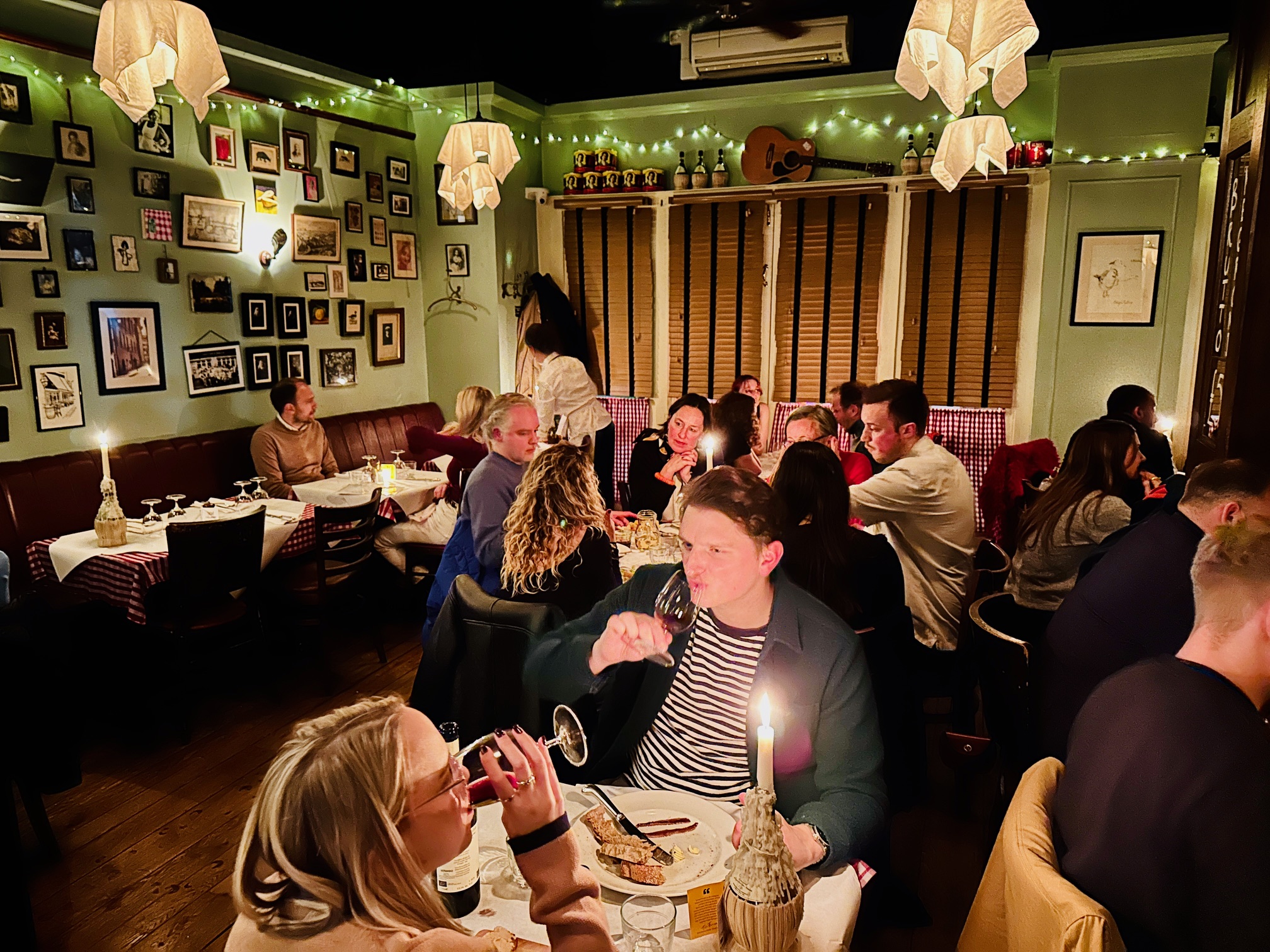
Reading all that back it sounds like a bit of a downer, but I find it hard to imagine anybody walking into Brutto would feel down for long. I can think of few dining rooms that make you feel happier to be in them – it was simultaneously snug and buzzy, with tables full of people thoroughly enjoying their Saturday nights and others sitting up at the bar, making the most of Brutto’s fabled £5 negronis.

The dining room is kind of split level, and I guess the room at the front would be the one you’d ideally want to be sitting in, with its banquette and framed pictures arranged haphazardly on the teal wall behind (“it’s like Alto Lounge, but not shit” was Zoë’s take). But we were closer to the bar at a surprisingly good table next to a pillar, and although there was a distinct hubbub, and an effortlessly cool soundtrack seemingly pitched at Gen X duffers like me, it was never uncomfortably loud.

It really was a marvellous place, from the gingham tablecloths to the napkin lightshades to the candles stuffed into wicker-chianti bottles, and I loved it. It had that feeling of otherness I adore, the restaurant as a cocoon, where for the next couple of hours you could kid yourself that you’d walk out of the door at the end of your meal and be somewhere completely different.

It was, however, and I might as well get this out of the way now, dark. It started out as atmospheric, but as the evening went on it started to reach Dans Le Noir levels of stygian gloom. A lovely spot to be in, to drink and talk, but the practicalities of doing some of the things you ideally want to do in a restaurant, like read your menu or see what you were eating, were severely curtailed.

A solitary votive candle in the middle of our table wasn’t really going to help with that, even if the staff – who were on it throughout – replaced it very efficiently when it sputtered and went out. I got told off for getting the torch out on my phone to try and read the menu. Zoë told me that I was ruining the atmosphere for everybody, and I’ve since discovered that this is allegedly a boomer thing to do, for which I can only apologise.

Once Zoë had taken some pictures with her phone, in night mode, naturally, and AirDropped them over to me, I managed to get a decent look at the menu, which was of course typewritten. It was everything you’d want it to be, mostly: compact, affordable and interesting. Starters were mostly under a tenner, pasta dishes were closer to twenty and so were the secondi, with the exception of Florentine steak which is sold by weight. I think in the past I’ve seen these listed up on a blackboard, so as to say that when they’re gone they’re gone. Maybe they’d already gone, because our server didn’t mention them to us.

The thing you don’t notice on the menu, at first, is that there’s no fish to be seen anywhere. I saw it written on a mirror in the dining room that Brutto doesn’t serve fish, and although it’s often not my first choice it was still odd to see it completely excluded. It gave the dishes on offer a certain brownish hue, or that could have been the dim lighting, but I suppose it worked on a nippy evening with London well on its way to winter. And it’s not as if I minded, much. The negroni was fierce and medicinal and, lest we forget, only a fiver and, on top of those Belgian beers from earlier on, positively knocked the edges off the day.

I don’t sense that Brutto’s menu has changed enormously since it was first reviewed three years ago, because many of the dishes on offer were talked about in those initial reviews. One definitely was – coccoli, which translates as “cuddles”, and is little fried bits of dough with prosciutto and a small pot of tangy stracchino cheese. Remember when I said that these restaurants attract bucketloads of hype? Jimi Famurewa, then of the Standard said that they were “one of the year’s best dishes”.

I don’t know about that, but they were rather enjoyable. More doughnut than doughball, and pleasant enough with little slivers of ham and a small dollop of the cheese; there wasn’t enough stracchino, but I imagine there never is. But the problem with hype, however old it is, is that it almost sets you up against something. I bet the people who raved about these would have sneered at good old Pizza Express. It reminded me of a restaurant in Shoreditch I used to love called Amici Miei which did a similar dish to this, but far better and completely unsung. But then it hadn’t been opened by Russell Norman, that was the problem.

The other starter was three things that in isolation are hard to beat. Very fine, extremely salty anchovies, with decent salted butter and sourdough from St John just down the road. It’s impossible to argue with this really, even if it involves no cooking, and all three things were good. Zoë adored it, I wasn’t convinced it was really any more than the sum of its parts. In fairness though, this dish was just over a tenner and even in Andalusia seven anchovies of this quality might well set you back more than that.

By this point we were on the red wine, The wine list is all Italian, with lots to enjoy, provided you can read the bastard thing. Bottles start at thirty-six pounds and ascend quickly into three figures from there, and we settled for a Montepulciano closer to the shallow end for sixty-two pounds. which retails for eighteen quid online. Was it worth sixty-two pounds? We’ve established over eleven years that I don’t know a lot about wine, but I’d say maybe not.

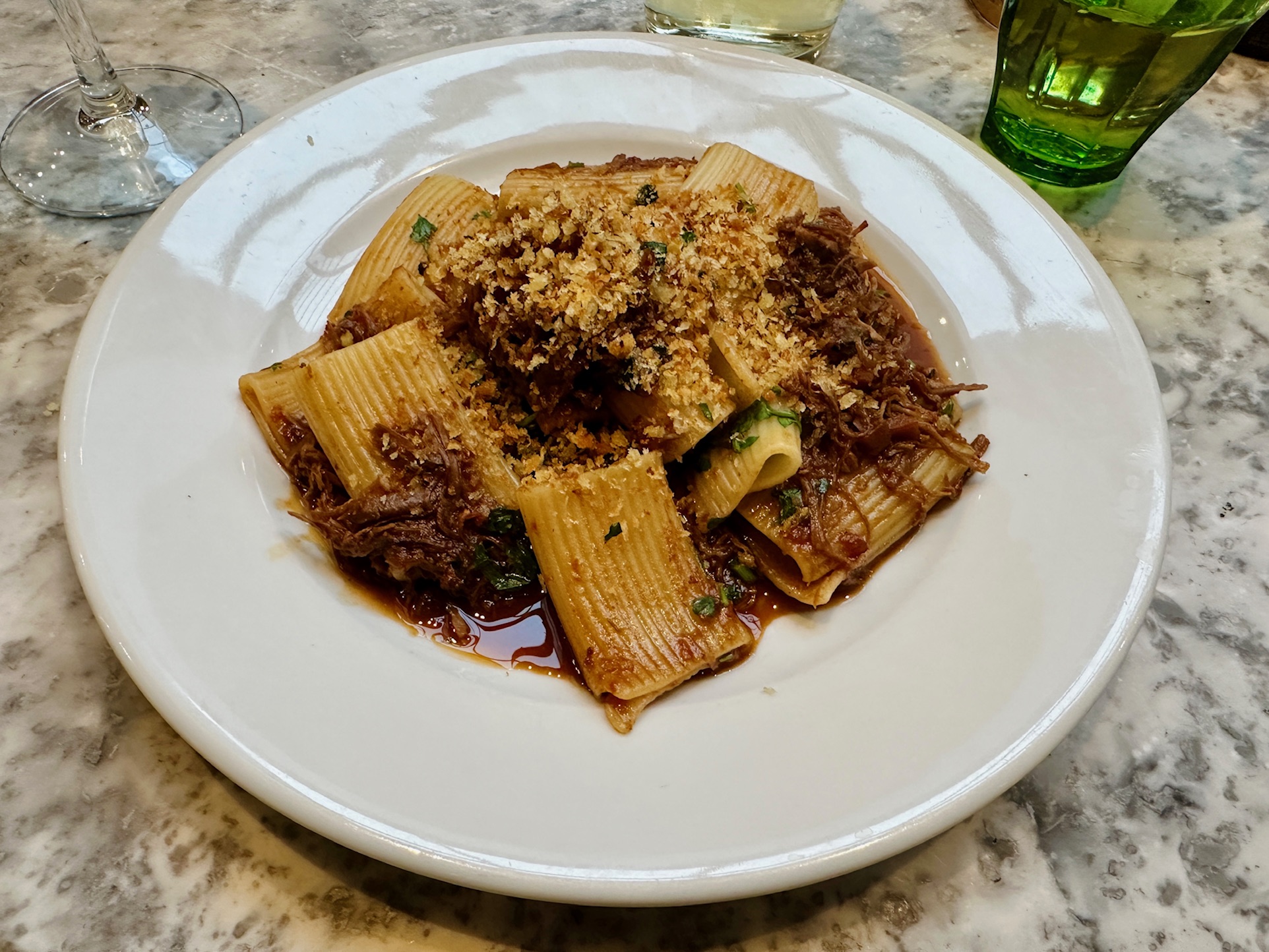
For me the pasta dishes were probably Brutto’s greatest strength, and easily the thing I most enjoyed. I’d been tempted by pappardelle with rabbit, but in the end the classic tagliatelle with ragu was too hard to resist. And it was as close to perfect as this dish gets in this country, fantastic al dente ribbons of pasta and a rich, sticky ragu that hugged its curves closely. I’ve always been somewhat sniffy about this widely-held belief that there should be more pasta than sauce, but eating this, for once, I got the point. Everything felt like it was completely in order, in absolutely the right proportions.

Because Brutto is a homage to the trattoria of Italy, they left a bowl of grated Parmesan at your table, with a spoon. But because we were still in London, there wasn’t a lot of Parmesan in it.

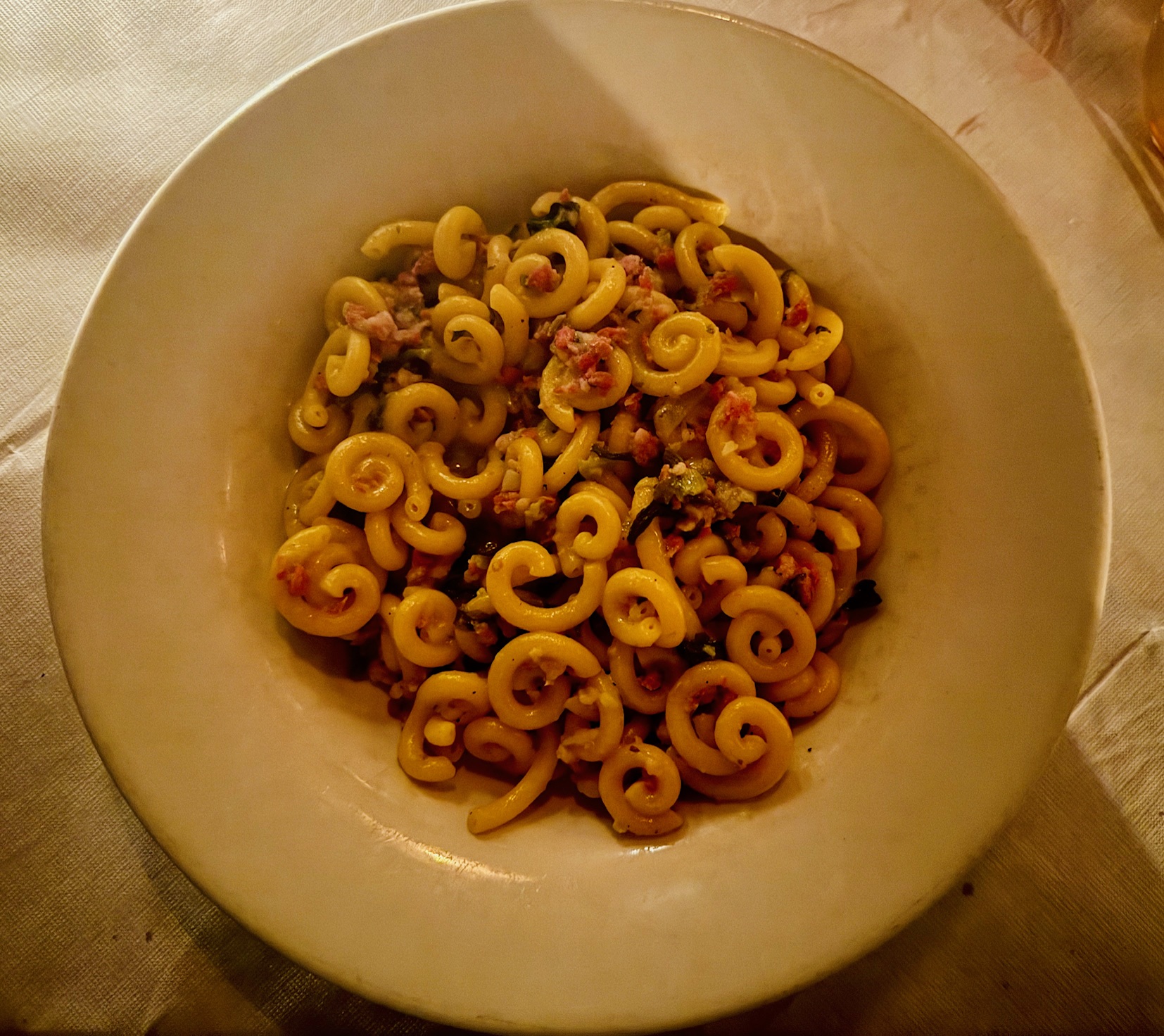
For me if anything, Zoë chose even better. Her gramigna, a little spiral shape from Emilia-Romagna, came – as it does in that region – tumbled with sausage and friarelli and was a real joy. But don’t be fooled by the brightness of these pictures from Zoë’s iPhone: by this point it was getting more and more difficult to see what was going on. Even so, these two dishes, to me, highlighted that when it came to pasta dishes restaurants like Brutto or Bancone are still light years ahead of well-intentioned pretenders like Little Hollows in Bristol or bandwagon jumpers like Maidenhead’s Sauce And Flour.

I complained recently that Reading was still lacking a really good Italian restaurant and someone popped up and said “what about Vesuvio?”. And I said that I was looking for somewhere more genuinely Italian and less like a better reimagining of Prezzo, with more interesting secondi. But actually, I got that wrong: what’s really missing is brilliant pasta like this. Pepe Sale had that, back in the day. So did San Sicario. But since then, this kind of carb-centric comfort has been missing from Reading, and it’s a poorer place for it.

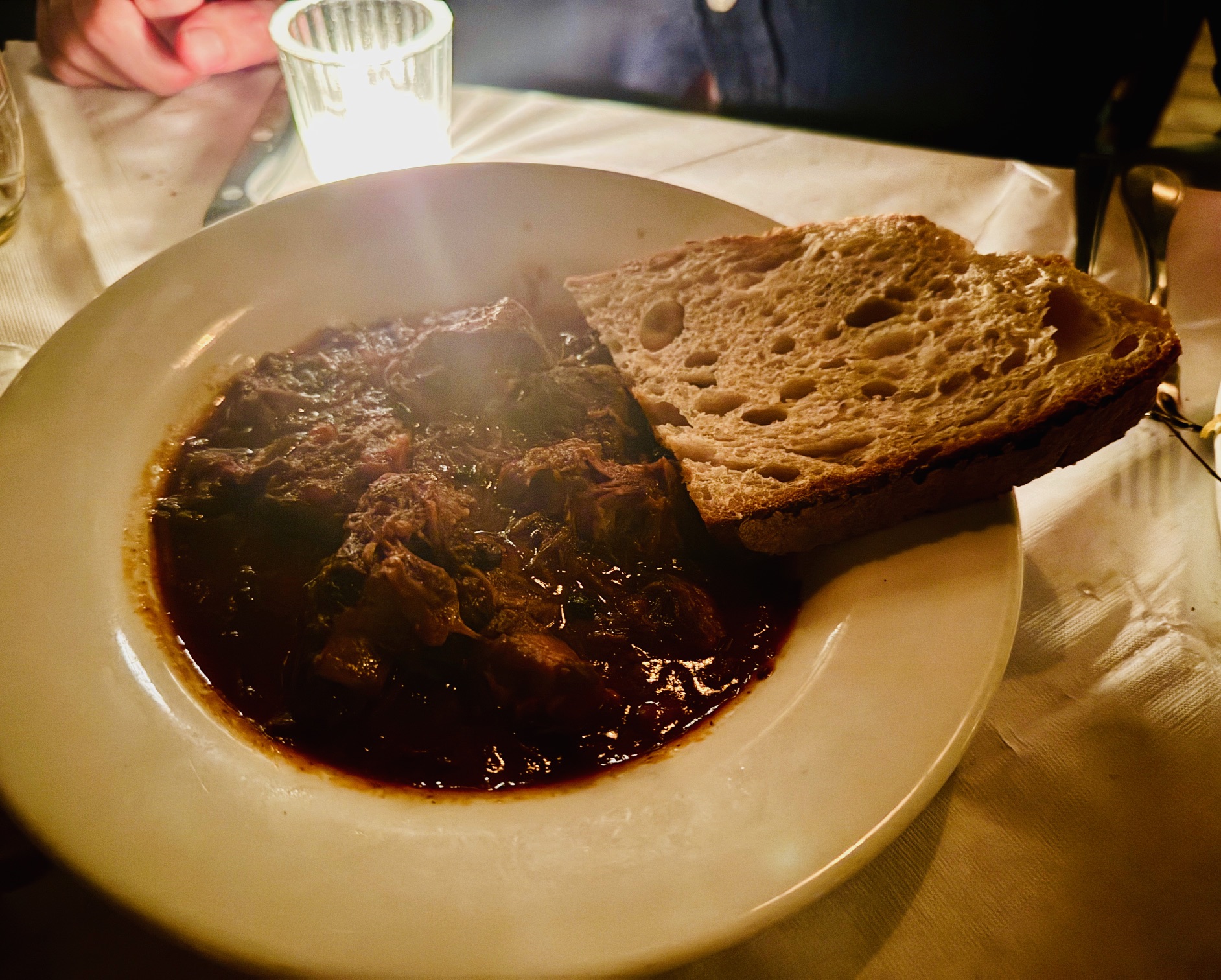
Speaking of secondi, to eat that course at Brutto it does help if you like beef. Three of the options are beef-driven (possibly four, depending on what’s in the bollito misto) and the roasted squash, virtuous though it doubtless was, just didn’t appeal. I had chosen the peposo, a slow-cooked stew of beef shin in a sticky, reduced sauce shot through with whole black peppercorns. And I liked it – it sort of reminded me of a stifado, although with no reliance on tomato or those maverick shallots that make the Greek dish such a delight.

But you know how you feel when you see a picture of a moment you don’t fully remember and you’re not sure if the photograph itself is inventing a memory you didn’t really have? Usually that experience dates back to childhood, but I have it when I look at the picture Zoë took of my main course. I know this is what I ate, the photo has my hand in it and the date stamp to prove it. But for me it was just a pool of blackness. You never quite knew what you were eating, or whether this would be your last big chunk of beef. I’ve always understood the saying that you eat with your eyes, but maybe not as well as I did after having this dish at Brutto. And however convivial the atmosphere was, this is where it took something away for me.

I didn’t need a great view of the roast potatoes I’d ordered on the side to know that they weren’t the best roast potatoes. Decent enough, but lacking that contrast of crunch and fluff that would have come if they’d been parboiled, and scuffed up, and cooked properly in really hot fat. Without that, they were just ballast.

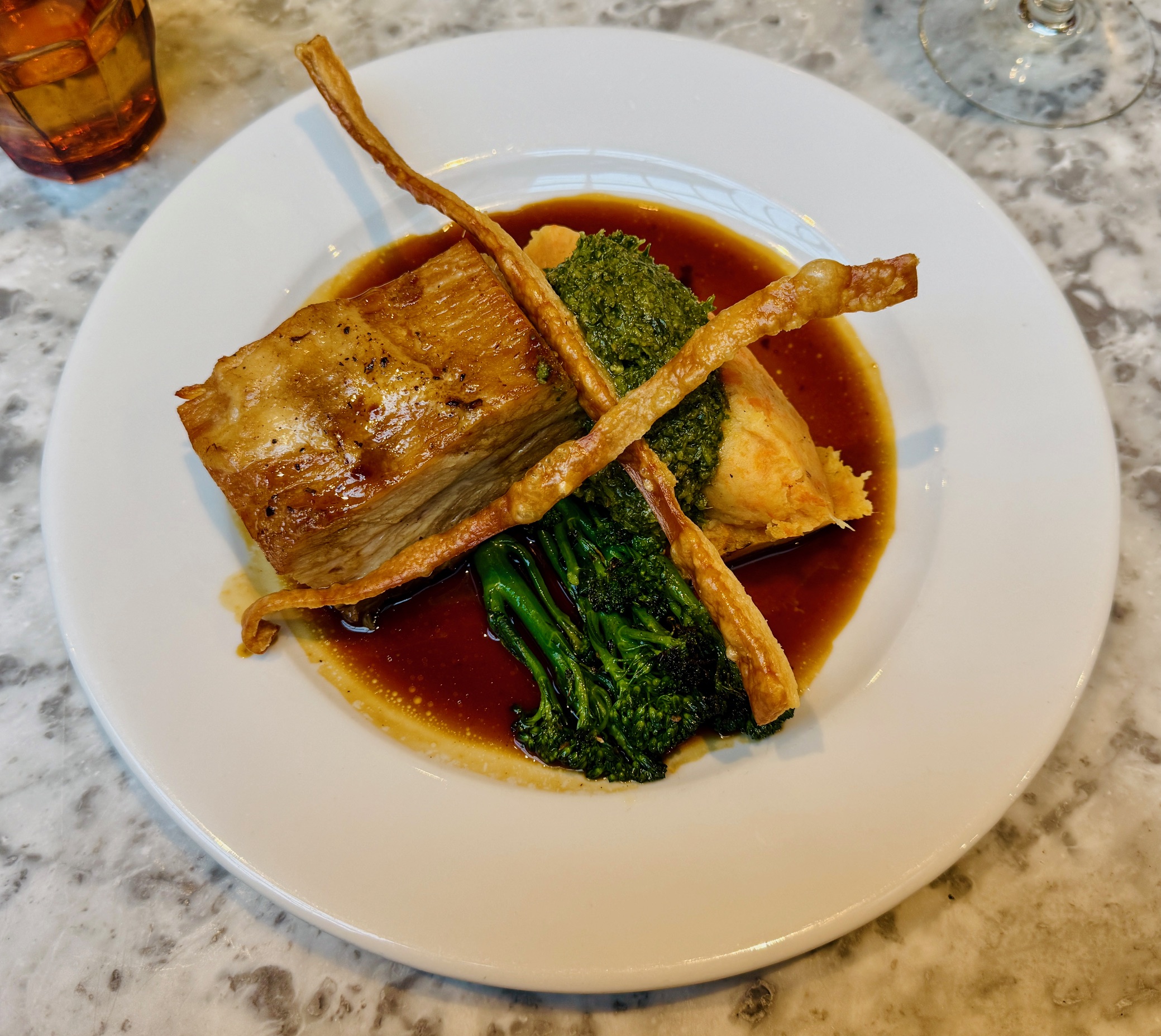
Zoë infinitely preferred her main, which was a variation on the same theme. The same roast potatoes, which she viewed more kindly than I had. A slab of pink roast beef, the fat on the outside mellow and puckered, sitting in a little pool of jus. It needed the peas with pancetta that she ordered with it – I’d have liked these à la Française, with a little cream, although I know that’s missing the point in a Florentine trattoria. Anyway Zoë loved it, although she did admit that it was a tad dry. But if there’s anything our marriage proves – six months and counting – it’s that she has far lower standards than I do.

We had a fair bit of wine left, so we drank that and chatted about all sorts before making any decisions about desserts. Now Zoë works in London she is there every Saturday, and usually knocks off at eight o’clock, so by the time our evening begins, most weeks, it’s time for bed. A rare date night in the capital was a precious thing, and so neither of us was in a rush to bring it to an end. But desserts also meant digestivi, and that meant a Frangelico for her and an Amaro del Capo for me. It’s one of my favourite amaros, with something like 29 botanicals, though the one that leaps to the surface for me is mint.

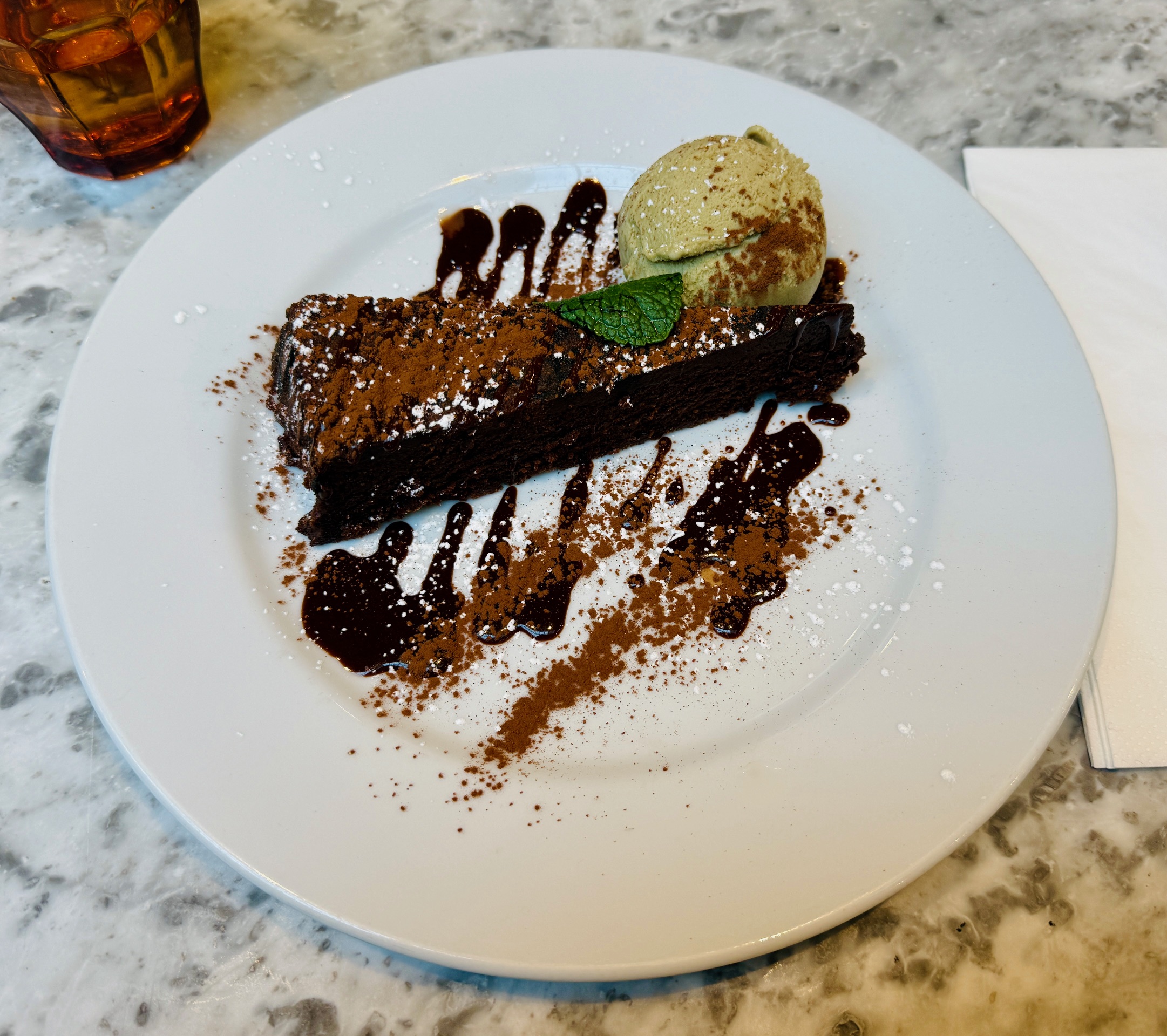
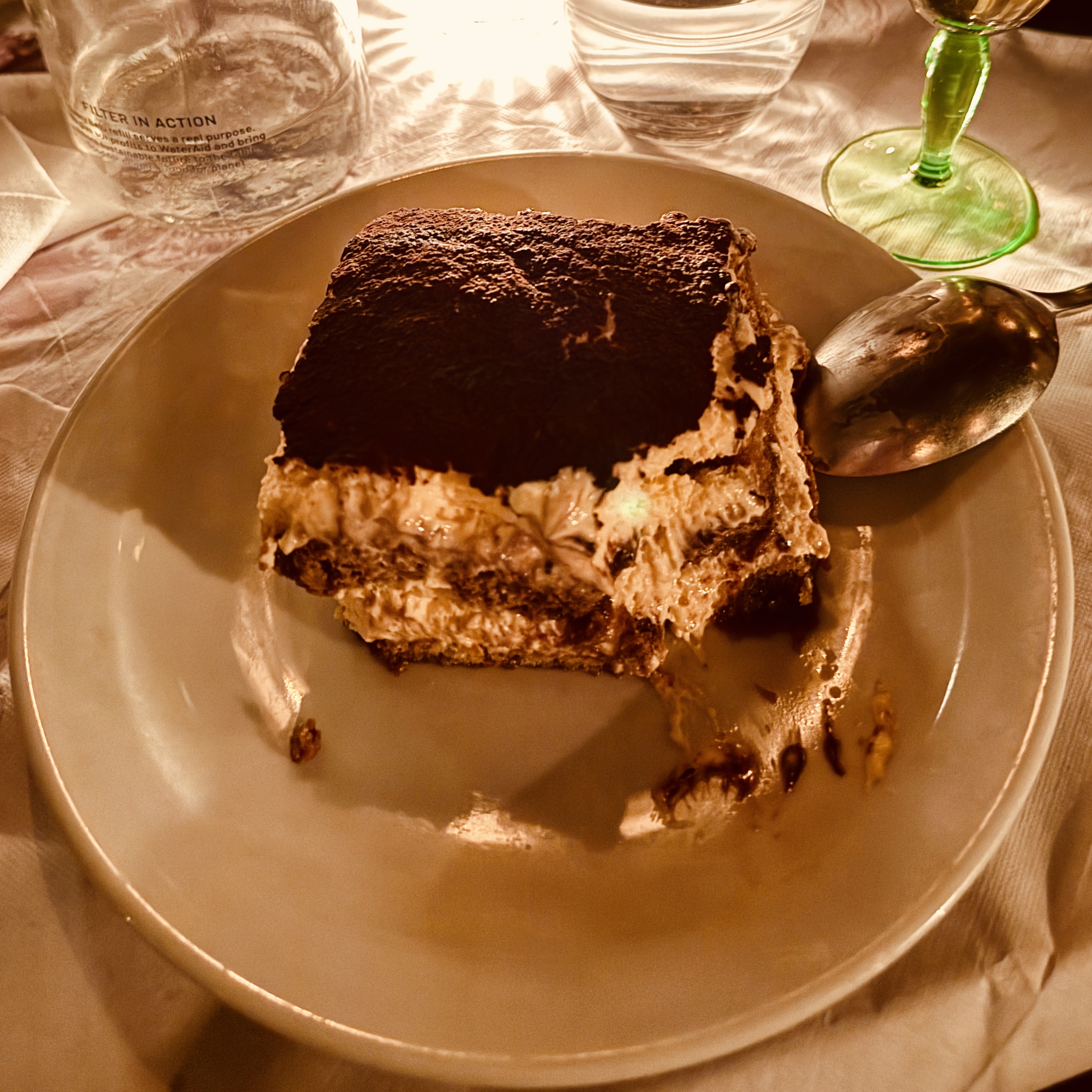
I could have nursed that for some time, and maybe even had another, but the dessert menu only had a few things on it (putting pear and almond cake on there twice, once with ice cream and once without isn’t fooling anybody). Anyway, one of the items on the dessert menu was tiramisu, which meant that we were both contractually obligated to have one. Is it the dessert I order most often when I’m on duty? It definitely feels that way, and Brutto’s is up there with the best I’ve had – miles better than Little Hollows’, better than Sonny Stores‘, better than anything I’ve had in Reading, even including the wonder of Sarv’s Slice or the sadly departed Buon Appetito.

It properly contained multitudes, managing to be substantial yet airy, innocent yet boozy, simultaneously just the right size and nowhere near big enough. I loved it, and it reminded me that on the many occasions that I skip dessert when eating on duty I’m leaving the play before the final act, taking the book back to the library with the last fifty pages untouched. Brutto understands that a good meal has a beginning, a middle and an end, and that tiramisu was a more than worthy way to bring the curtain down.

With all that done, it was time to settle up and pray that the Elizabeth Line could get us back to Paddington before we were forced to catch one of those final trains back to the ‘Ding, the ones everybody refers to as the Burger King Express.

Our meal – a couple of negronis each, that bottle of wine, four courses each and a pair of digestivi – came to just over two hundred and fifty pounds, including an optional 12.5% tip. I know that’s a fair amount of money, but we had plenty of food and didn’t stint on the wine. Personally, I think Brutto is keen value, although probably more so in its starters and pasta than in its mains or wine list. I could have spent less and enjoyed myself just as much, and if I went again I imagine I would.

But would I go again? That’s the question, isn’t it. And it prompts the time-honoured answer, which goes like this. London is so blessed with restaurants – there are easily a handful of other great places to eat less than a ten minute walk from Brutto – that places have to be truly amazing to keep you visiting time and again. That drives quality, I’m sure, and it makes restaurants work hard for custom.

And maybe that also goes to answer the other question, of why it’s hard for anything to become an institution when somewhere else is always, always coming down the tracks. Back when I was on Tinder (what a fun three months that was) I deplored the way it effectively made you channel hop human beings, with their own lives and aspirations and back stories. Whatever. Next! But the way the food media works does the same thing with a lot of restaurants: one minute you’re the hottest ticket in town, the next you’re old hat.

So I had a lovely meal at Brutto and it taught me a lot about what restaurants do at their best and their worst. I have rarely felt, in a restaurant in the U.K., more like I was part of something brilliant and bigger than me. But ultimately one of the many things that united us that night was being together in the darkness. If that’s not a metaphor for something I don’t know what is. Maybe I’m just too old for all that.

Brutto felt like a neighbourhood restaurant in search of a neighbourhood. And speaking of neighbourhoods, if somewhere like Brutto opened in Reading you can bet I would be there on its opening night, and often after that. The fact that Reading can’t attract and maintain restaurants like this really puts the lie to all the old tut spouted by the likes of Hicks Baker that the town centre isn’t dying on its arse.

But while Reading still doesn’t have places like this, it still has that one thing Reading-haters always extol the virtues of: a train station you can use to get anywhere else. You could do a lot worse than make a reservation, hop on a train and find yourself here, in a place that isn’t quite Italy, isn’t quite London, but most definitely isn’t Reading. I know that’s not exactly hype, but it’s the best I can do.

Brutto – 8.4
35-37 Greenhill Rents, London, EC1M 6BN
020 45370928

https://brutto.co.uk

Pub review: The Bell, Waltham St Lawrence

This week’s review hasn’t quite gone according to plan. Originally I was going to review The Lyndhurst, which came under new management back in May. It’s fair to say that it’s had a chequered time since then, with the new landlords complaining vociferously to the Reading Chronicle, more than once, about what they said were false claims that they planned to turn the place into a sports bar.

The way they refuted that was interesting, I thought. We’re just installing a fruit machine, just like every other pub, they said. We’re just putting in a jukebox, like every other pub. Nuts, really. They’d replaced the managers of the best food pub Reading had ever seen, and their mission was to be just like everybody else. They missed the obvious point: if you’re just like everybody else, why should we drink at yours?

Anyway, I largely stayed out of it – because I know I could easily be seen as partial – but from their Facebook page they looked a lot like a sports bar to me. During Euro 2024 it was all badly generated AI images of three lions wearing England shirts and drinking pints of lager in a generic pub, or one especially tasteless – and arguably xenophobic – picture of a lion mauling a bull to coincide with the England-Spain match. But I’m probably just a woke snowflake, because I also winced when the pub described the rumours flying around as “Chinese whispers”.

They then decided to do food, so they put a menu up on Facebook and a few people – not me, I should add – were critical of it. “Please keep your comments to yourself” the pub said. Then they closed for nearly a week, not the first time they’d shut at very short notice. As previously, they blamed having work carried out, but it looked suspiciously like a sulk. All very strange, and I’ve lost track of the number of people who have messaged me saying what the fuck is going on at the Lyndhurst? My reply is invariably the same: God only knows.

But then at the end of July they announced that they’d taken on a new chef, Chef Roots. Now, I’ve never had his food but I know of him by reputation – he cooked for a while at the Roebuck, and at the Three Tuns, and in lockdown he ran a street food business called Pattie N’ Pulled which had its fans. I thought this was a very smart move by the new management – take on a known chef and try to recapture your reputation as a food pub. It all sounded very promising.

I was even prepared to overlook just how weird the menu the pub put out was. If anything in it was correct it was by accident, and every time you looked you spotted a different clanger. Some items were in a completely different font for no particular reason. The pricing was random – £11.96 here, £24.97 there, £4.60 somewhere else. And the spelling mistakes – oh my goodness. Buttet milk chicken, paremsan fries, oniom rings, triple cooled chips. It was all a bit Officer Crabtree.

So once I found out that Chef Roots was cooking at the Lyndhurst I was interested in going back, and I had a volunteer to come with me. That was none other than Matt, who made the very wise decision of proposing to my sister in law recently, which means he’s as good as family. So we agreed a date, when I was back from holiday. I was looking forward to it.

Then it all went tits up when I discovered that Chef Roots had barely lasted a week before moving on from the Lyndhurst, a development which the Lyndhurst decided not to report. And then more weirdness emanated from the pub. A recent Google review – one star, of course – was posted by a guy who was just verbally abused by the regulars as he walked past the smoking area with a friend and his dog. He put up footage from his phone which appeared to bear this out: it was a really uncomfortable watch.

And then someone posted on Reddit about the Lyndhurst’s Sunday lunch was, and she wasn’t pulling her punches. “Unseasoned. Small portions. Cold vegetables. Misleading menu. Said ‘homemade’ Yorkshire puddings and when I inquired about allergens the waitress brought out a frozen bag of Aldi’s own Yorkshire pudding” she said. “Actually speechless at how bad the food was.”

So I sent Matt a WhatsApp: Looks like we won’t be reviewing the Lyndhurst, the chef has already sacked it off. And Matt replied. Anywhere else we can review? Well, I can ride shotgun while you do it. And that’s when I thought of the Bell at Waltham St Lawrence, a cosy pub I had loved when I first reviewed it nine years ago. I’d been back since, but not for a long time, and it felt ripe for a revisit. So this week Matt picked me up and we headed off down the A4 in search of dinner. It was the first time I’ve ever been chauffeured to a review in a Porsche, and I very quickly decided that I could get used to it.

Much what I said when I visited the Bell in 2015 is equally true today, on face value at least: Waltham St Lawrence is still a pretty village and the pub is the jewel in its crown. It’s almost the platonic ideal of a village pub, and you got a whiff of woodsmoke as you walked in. But the one thing that was different was a slight change of the guard – back then it was run by twin brothers Iain and Scott Ganson, but last year Iain left to become the new head chef at Thames Lido. So was it business as usual at the Bell, or had things changed?

Paying it a visit on a Tuesday night it was almost empty with just a few regulars at the bar. “You can sit anywhere you like” said the chap after I told him we had a reservation, and although the front room was tempting we decided to go for the dining room, a less casual space up some stairs. Even so, that was stripped back and neutral – I seem to remember on a previous visit that there was feature wallpaper of some kind, but instead it was a calm, tasteful room. We were the only people in it, which gave my dinner date with my future brother-in-law a strangely intimate feel, like they’d opened just for us.

Still, we both enjoyed getting a word in edgeways for a change. I love my in-laws dearly, but the men in the family are like the men in Sex And The City: you might enjoy it when they crop up, but everybody knows they aren’t the feature attraction. It’s all about the women, one-upping one another with their increasingly funny stories, and the best thing you can do is enjoy the ride (or, if you’re my father-in-law, tidy up after everybody and/or hide in the garage). So here Matt and I were, talking for a whole evening in some strange inversion of the Bechdel Test.

The menu the night we visited was decidedly compact: four starters, three mains (one meat, one fish, one vegetarian) and three desserts. I seemed to remember from past experience that there used to be more on offer, and although I may have been wrong the evidence suggested we’d been unlucky that night: a picture on Instagram later in the week showed an additional main course that would have expanded the options a little. But no matter, although the menu was almost narrow enough to be constricting we both found things to order. Starters hovered around a tenner, mains were scattered more widely around the twenty pound mark.

But first, drink – and the first indication of interesting things at the Bell. They won Reading CAMRA Cider Pub Of The Year this year, and it showed, with a blackboard listing plenty of interesting choices including Tilehurst’s Seven Trees Cider. And the wine list was full of temptation, all of it available by the glass. I couldn’t choose between a couple and Ganson, who was behind the bar that night, kindly let me try some of each (even if the locals heckled him, saying that this was uncharacteristic generosity for a Scot). He even didn’t complain when I decided to go for a third instead, although they were all gorgeous, and let me try some of that. It was a Priorat, from Catalunya – Priorat is always worth trying, if you find it on a list – and I thought it was terrific at ten pounds a glass.

I seem to remember years ago having a conversation with the Bell on Twitter saying that more places should bring back the 125ml glass of wine, or the 250ml carafe. Well, although they do serve 125ml glasses they’ve gone one step further by using a Coravin for seemingly all of the bottles on the list. “It means we can offer about forty wines by the glass” said Ganson, which for me would almost be reason enough to visit the Bell on its own, especially if you have a nice chap driving you home in a Porsche.

“I’d also like a pint of bitter shandy please, which bitter do you recommend?”

“Hoppit” said Ganson without hesitation, and so Matt got a shandy made with Loddon’s finest, which he seemed to like.

Matt had the best of the starters, and I didn’t realise until much later that it was essentially the starter I’d ordered and enjoyed nine years ago. A slab of pigeon terrine came bound in bacon, served with a couple of beautifully burnished slices of griddled toast and – always the clincher – a trio of cornichons. Matt enjoyed this, but because his manners were impeccable he let me try some and I thought it was knockout – slightly gamey, the texture spot on, no hint of bounce or jelly to be seen. Matt also let me have all of his cornichons, but I think that was because he didn’t like them, rather than down to his impeccable manners.

I did less well, but only by a whisper. My selection of charcuterie from Cotswold-based Salt Pig had nearly everything you could hope for, and most of it was very enjoyable. Coarse rounds of chorizo, fatty ribbons of pancetta, superb pork collar. Only the spiced pork loin underwhelmed, and although I had enough cornichons, that was partly because I’d inherited Matt’s.

But it felt like something was missing, and I wasn’t sure what it was. I think a little griddled toast would have lifted this, or even some caperberries, or even more cornichons (although more cornichons, like more cowbell, is just my answer to many of life’s problems). WIthout that, it felt a little unbalanced. Looking back at the Bell’s menu I saw that it included something I’d missed, whipped lardo – also from Salt Pig, I presume – on toast. I wish I’d noticed that, because it would have been delicious. Especially if it came with cornichons.

By this point I was on to a second glass of wine. Ganson had suggested another Spanish red, this time from Bierzo, a single varietal Mencia, and it was every bit the equal of the Priorat. I found myself thinking that even though the same time last week I’d been in Granada, in thirty degree heat, sitting outside a bar enjoying cold beer and tapas there were consolations to autumn – red wine, woodsmoke and cosy pubs not least. Besides, Strictly was back on the telly.

My main course bridged the gap between my week in Andalusia and the increasingly autumnal feel of things back home. I rarely order risotto, and I almost never make it myself – who has the time to stand at a stove for thirty minutes? – but the Bell’s version was made with Isle Of Wight tomatoes and Spenwood, and better British ingredients are hard to imagine. I had been spoiled by the exceptional tomatoes you get on the continent, but the ones that come out of the Isle Of Wight are absolutely the next best thing.

And it was mollifying comfort on a plate, a rich dish of sticky, nutty rice, topped with tomatoes that had been roasted and slightly dried, liberally dusted with one of my favourite cheeses which just so happens to be made down the road in Spencer’s Wood, the closest thing Blighty gets to Parmesan. On paper, this was the perfect thing to make you happier about the nights drawing in and being able to see your breath in the air – a gentle but insistent bear hug of a dish.

It was almost perfect, but not quite. I would have liked it to have been a little more seasoned, for a bit more salt to balance out the sweetness of the tomatoes. But I only decided that in hindsight, looking at a completely denuded plate, and hindsight is always a wonderful thing. I can’t remember the last time I ordered a risotto in a restaurant, but I won’t be able to say that next time I do.

Matt chose the Bambi Burger, a dish which has been on the Bell’s menu every single time I’ve visited. He wasn’t sure about it, which is how Matt discovered that he maybe wasn’t wild about venison. That meant I got to try a fair amount of it, and for what it’s worth I really loved it. Venison is a challenging meat to make burgers with, on account of it being so lean and lacking in fat, so to make something so delicious that didn’t fall into the trap of being dry and crumbly was no mean feat.

And again, hats off to the Bell for having a decent, sturdy bun and griddling it to give it the extra heft it needed. If I came back to the Bell, and hopefully I will before too long, I would make a beeline for this. The skinny chips, I suspect, were bought in: it might have been nice to have something chunkier, but they did the job.

Both of us felt like we had permission to order dessert: Matt because his main hadn’t hit the spot and me because mine had. We both gravitated towards the sticky toffee pudding – not something I’d normally order, but as the other two choices were cheese and oatcakes or an affogato I did feel my hand had been forced. I was sorry not to see the beer ice cream the Bell always used to make, which for me was one of the most intriguing and idiosyncratic things they did, but you can’t win them all.

It’s another nice echo of my original visit, because sticky toffee pudding was on the table then too. I think that the Bell has spent the last nine years perfecting it, because I loved this. It was a deep, dense delight, swathed in a cracking toffee sauce and crowned with a sphere of glossy ice cream – no clotted cream or the like here – and it made me wonder how many great sticky toffee puddings I might have missed out on over the years because of my vague prejudice against hot desserts. It was fantastic, and it helped, as the whole evening had, make me feel a little less sad about the changing of the seasons.

I could have stayed and drunk wine and chatted away until they chucked us out. But I’m not sure how much fun that would have been for Matt, who was on the Diet Coke by then. Besides, he had to be in London for work the next day so I settled up and we were on our way. Our dinner – three courses and two drinks apiece – came to ninety-six pounds, not including tip, which I thought was as good value as anything is these days in 2024. We shared trade secrets on how to manage our in-laws all the way home, and if any of them happen to be reading this I absolutely promise I’m kidding.

I was so happy to find the Bell still close to its best self, and if I’d have liked a little more breadth to the menu that was easily outweighed by the pluses – the service, that beautiful spot, the woodsmoke and the exceptional range of wine and cider. For many years, when people have asked me where they could have dinner a little drive away from Reading, the Bell has made my list – a list which shrunk when the Miller Of Mansfield closed, grew when I so enjoyed The Plough earlier in the year.

But we were getting to the point where I was recommending the Bell without having any recent experience to go on, and I felt like a fraud doing that. I’m very happy to have sorted that, and pleased that I can renew my endorsement. That I had a properly agreeable evening and a ride in a Porsche just added to my joy. Reading may have one fewer pub that does really great food and makes you feel welcome. But there are consolations to be found elsewhere, just as there are with the end of summer.

The Bell – 8.0
The Street, Waltham St Lawrence, RG10 0JJ
0118 9341788

https://thebellwalthamstlawrence.co.uk

Cafe review: DeNata Coffee & Co.

You can have a great network of informants, but sometimes there’s no substitute for getting out and about, keeping your eyes peeled. It’s a fact that our local journalists – what’s left of them, anyway – have forgotten, working from home. So last Saturday, after a very enjoyable lunch at Blue Collar and a coffee at Compound, my friend Dave and I took a wander down the Oxford Road to be virtuous and get some steps in ahead of a few afternoon beers at the Nag’s Head.

Much of what I saw was as expected. Traditional Romanesc are still there, in the spot where I had so many brilliant meals when it used to be Buon Appetito. Vampire’s Den, too (“is that really the only reference to Romania they thought people would get?” was Dave’s take). Oishi had definitely gone from “temporarily closed” to “never coming back in a million years” and Workhouse had been given a very attractive makeover, although the new store front didn’t seem to contain the name anywhere.

But there were, as there always seem to be, places that were news to me. Near the top of the Oxford Road, a place called AfrikInn was selling fufu, fried yam and jollof rice. SORRY WE’RE CLOSED TODAY SEE YOU TOMORROW said handwritten signs on the door and window. Further down, not far from Momo 2 Go, a place called Agnes’ Coffee Shop was open, selling coffee and Polish street food: the word Zapiekanki ran vertically down the brickwork, in a bigger font than the name of the café. I made a mental note of both.

But the place Dave and I were vaguely ambling to check out was Portuguese café DeNata, which opened in March this year, replacing – and this is where it gets confusing – Portuguese café Time 4 Coffee, which opened last August. It had been on my list for ages and although Dave and I were both full from lunch we figured an expedition to research pasteis de nata was a worthy pre-pint pursuit. Dave’s son has just come back from Lisbon on holiday, and hearing all about it made me very glad I had my own trip booked there later in the year.

We ordered a couple of pasteis, and the proprietor – instantly bright and personable – took great pride in showing me the menu; I chatted away with her for so long that poor Dave had to pay for the egg custard tarts. The owner asked me to follow DeNata on Facebook, and I dutifully promised I would. The place was bustling on a Saturday afternoon, and warm, but I didn’t pay it too much attention. Dave and I had a pub table to bag, after all, and a pastel de nata to inhale.

Anyway, the next day I left the house mid-morning, took a couple of buses and turned up at DeNata just before midday for lunch, to eat the meal you’re about to read about. So why did I do that?

Subscribe to continue reading

Become a paid subscriber to get access to the rest of this post and other exclusive content.

Restaurant review: Dough Bros

I moved house last week, and suddenly everything changed. My little slice of Reading, my walks, maps, routes and routines were no more. No more waking up in the Village and mooching into town for lunch, no more strolls round Reading Old Cemetery or Palmer Park, no more number 17s and Little Oranges buses, no more Retreat just round the corner. After seven years of East Reading life, it was time for something different.

So on moving day Zoë and I found ourselves standing, sleep-deprived, outside a large house that wasn’t quite ours yet, rented van parked up in the drive, waiting for the agent to arrive and check us in. Meanwhile, across town, movers were loading boxes into a far bigger van from a far smaller house that was no longer ours. The sun was blazing, and I strolled across Cintra Park to Greggs, of all places, to pick up coffee and pastries. This is my neighbourhood now, I thought to myself.

I’m writing this over a week later, after seven days of unpacking and tip slots and IKEA trips (I’d forgotten how depressing that place is) and everything is starting to take shape. A lot of the boxes are unpacked, the kitchen is in some kind of order and, best of all, we finally got a new bed – high off the ground, with a big firm mattress, like climbing on to a cloud at night. The walls are fresh-painted white, the blinds are new and Venetian and the rooms flood with summer sunlight.

And every morning I wake up and can’t quite believe I live here, in this new place.

There’s a clothes line in the garden, and I get to experience the meditative joys of hanging out the washing, taking it in when it’s been dried by the sun and smells of heaven. Let’s not talk about the huge rent hike, or the council tax band of this place, or the fact that I can’t afford to eat out quite so often: let’s just think about the smell of that washing from the line.

On our very first night, exhausted but with the rest of the week off to unpack and settle in, we wandered to pretty much our nearest restaurant, Kungfu Kitchen. Like me they moved recently, although a few doors down Christchurch Green maybe isn’t quite as big a shift as mine. And their new site is lovely and snazzy – especially the light feature projecting fish onto the floor – but it was also reassuring just how like their old place it was. The food was still outstanding, and the welcome was the same, because Jo and Steve do not change: I particularly enjoyed Jo frogmarching customers to the loo, proudly boasting that Kungfu Kitchen has the best toilets in the world. Her words, not mine.

But Kungfu Kitchen is only one of our nearest restaurants, and I popped into one of the others to take something home the following night, just before an England match, fresh from a purgatorial trip to the tip. Dough Bros opened in March at the top of Northumberland Avenue and has built up quite a following in three short months. It’s run by a couple of friends, one of whom also runs the neighbouring barber Short, Back & Vibes.

Subscribe to continue reading

Become a paid subscriber to get access to the rest of this post and other exclusive content.