CAU

CAU closed in July 2018 because its owners Gaucho Group went into administration. I’ve left the review up for posterity.

I recently reached the stage where I was tempted to stop reviewing restaurants in the Oracle altogether. It’s never fitted with the ER ethos – full of chains like Bella Italia and Pizza Hut that are ten a penny all across the country. And it’s always felt pointless reviewing places like Wagamama and Yo! Sushi, because even though there’s a time and a place for them you probably already know what they’re like. The final straw was the closure of Tampopo and the announcement that TGI Friday would take its place (that’s when I began to wonder if the Oracle was actually run by Monty Burns). Still I guess they need the money, with plenty of shops consciously uncoupling from Brand Oracle and a fair few vacant lots, especially on the top floor.

So, what changed (I mean, you’ve read the title, you know what this review is about)? Well, CAU’s an interesting kettle of fish for a number of reasons. It’s not a chain just like everywhere else, for one: there are only a dozen across the country. Also, I was fascinated to see how they’d done it, because the restaurant has been created out of thin air, in an empty and unloved space on the side of the Oracle, the fast but shallow Holybrook the only redeeming feature in a rather forgotten spot. But the other reason is that since it opened, CAU has been busy. Really busy. And all the feedback I’ve seen said it was pretty decent. Had the Oracle got it right for once?

It’s an odd experience having dinner in a building which, a year ago, didn’t even exist. It’s a very neat use of a compact space, with two storeys and a modest terrace on the lower floor, prettied up with some landscaping and some kind of light installation on the opposite wall (I can see it would be a nice place to eat on a warm day). I sat on the top floor, in a long thin dining room with white corrugated iron walls and modernist lighting, all chrome spheres and swivel chairs. That compactness does show, though, in the space for diners: everything is just a little smaller than you’d want it to be (I wouldn’t have wanted to be a table for four in the banquette booths in the centre of the room – not with my elbows).

As you probably know, CAU stands for Carne Argentina Unica (I wonder which came first, the name or the convenient acronym?) and is the younger/cheaper sibling of Gaucho, the awfully expensive steak house that is sprinkled over the spendy bits of London. So the menu is mainly Argentine, mainly beef, but not entirely – it does wander up to Mexico, across to Spain and even, for some of the vegetarian options, over to Italy. This presented a bit of a dilemma – I wanted to try a range of dishes, but ordering chicken or fish just to make a point about the diversity of the food felt like a silly act of tokenism. So if you don’t like steak this review might not be terribly enlightening – but anyway, there’s always the starters and the desserts.

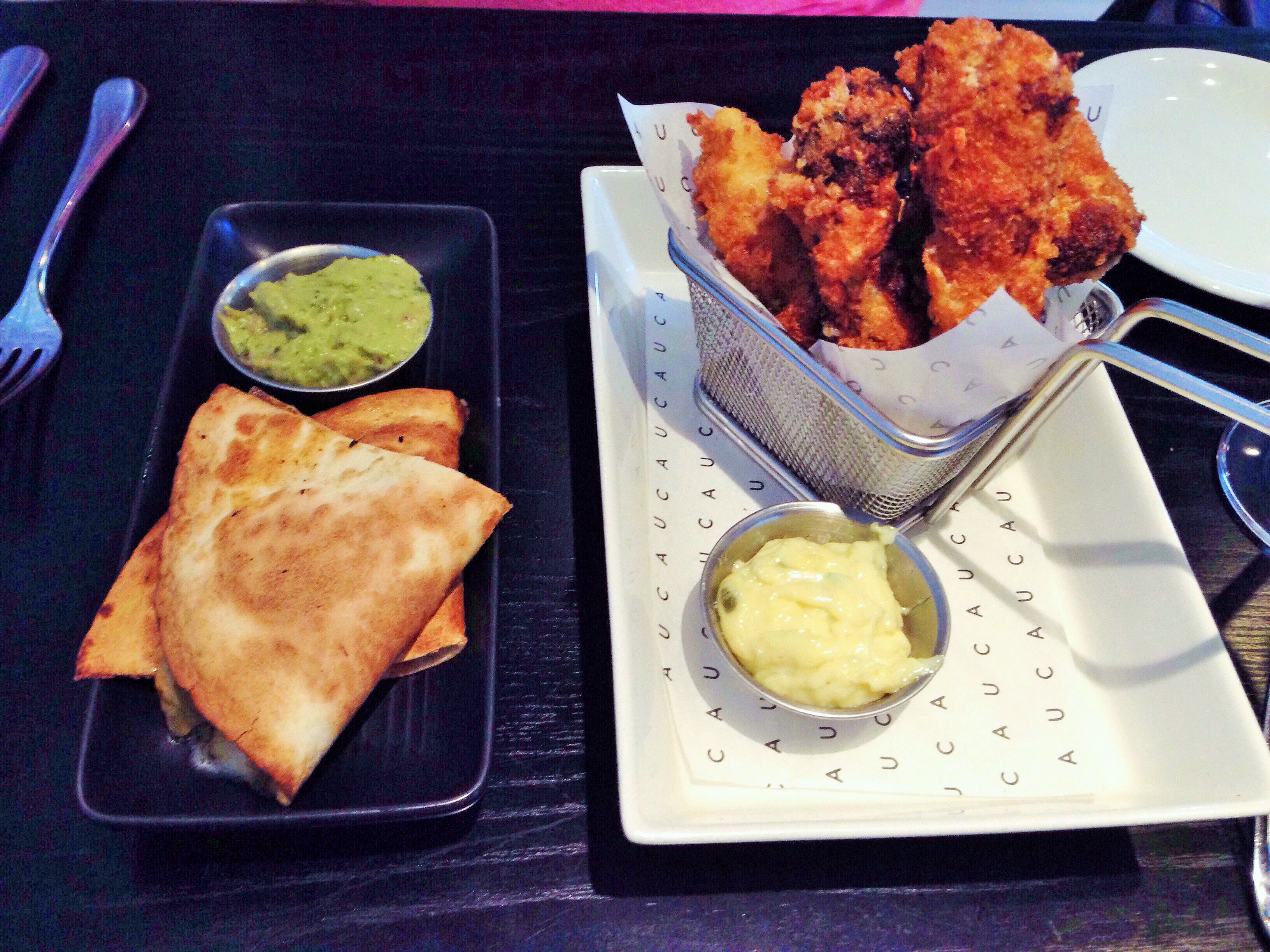
The starters were probably the most difficult decision of the evening. It really is an embarrassment of riches and you could easily have been reading about empanadas, Argentinian charcuterie or half a dozen other dishes. I was particularly torn between the swordfish carpaccio and the smoked haddock and manchego croquettes. When I asked the waitress for advice, she recommended the latter without a moment’s hesitation. That alone would have justified a tip: they were generous and delicious, half a dozen big, irregular, crunchy cylinders. Inside, the perfect contrast – a filling so smooth it was almost a béchamel, beautiful shreds of fish and tons of chives. The caper mayonnaise they came with almost felt an afterthought – creamy and bland where a bit of sharpness would have worked wonders – but it was by no means a deal breaker. I would have liked a bit more salt from the manchego but again, that was more twenty-twenty hindsight than anything else.
CAUStarter

They almost made up for the disappointment of the other starter, something that with hindsight I probably should have known better than to order. Quesadillas were a rather sad prospect compared to the crispy loveliness of the croquettes: the tortilla itself was pretty small and, despite the blurb on the menu, was by no means “packed” with vegetables or cheese. A layer of peppers, artichokes and courgette strips with manchego (for flavour, I’d guess) and mozzarella (for texture) was, in fact, even duller than it sounds. The guacamole on the side was pleasantly zesty but not enough to save the whole thing. It was bland and stingy, everything the other starter wasn’t. It’s my fault really – normally I’m good at spotting the duffer on a menu so I’m not sure what went wrong here. There are actually quite a lot of vegetarian options on the starter menu: I hope the rest aren’t as much of an afterthought as this felt. I should have had the charcuterie after all.

The range of steaks on offer at CAU ranges from the mainstream – familiar cuts like rump and rib-eye – to the more high-end. This is where you can end up spending quite a lot of money, as you can at Gaucho: most of the speciality cuts start at the thirty pound mark and you get almost a pound of flesh for your pound of flesh. I struggled with spending that much on account of not being a Russian oligarch, so we went for the more conventional cuts on the left hand side of the menu, and it has to be said that these were a lot more keenly priced: two medallions of fillet was less than fifteen pounds, a sirloin was just shy of eighteen. Unfortunately, I had to wait slightly longer to try the steak than I was expecting. The medallions turned up perfectly medium rare as requested, but the sirloin was medium well with very little pinkness, no glorious blood seeping out onto the plate.

This is, let’s face it, a pretty terrible gaffe from a restaurant which prides itself on brilliant beef cooked brilliantly. But sometimes, first impressions aren’t everything and the way CAU dealt with it was exemplary. I was in two minds about sending it back because, in my experience, that usually means that I have to watch everyone else eating their food (never fun) and then experience everyone else watching me eat mine (possibly even less fun). But the moment I suggested to my waitress that all was not well she sprang into action: both dishes were taken away, completely redone and brought to the table at exactly the same time. I’ve racked my brains and I can’t think of a single restaurant in Reading – even at the high end – that has ever gone that far, let alone without being prompted. Very nicely done indeed, and it totally won me over.

So, once they finally arrived, they truly were perfect. The medallions were beautifully seasoned, perfectly grilled and the yielding texture when sliced was enough to render me speechless. I rarely have steak at home because I can never get it right, but eating it here made me feel like most of the places I order steak at can’t get it right either (and they certainly can’t for only fifteen pounds). The sirloin was just as good – the char and salt on the outside giving way to the softness underneath. At this point any reservations – about the location, about the loudness of the music, about the slightly irksome white swivel chairs – simply melted away. I’d have eaten this beef locked in a broom cupboard listening to the Vengaboys, if that’s what it would have taken to try it.

CAUSteak

The accompaniments were very much second fiddle, although that was only to be expected. Chunky chips, served in a little fryer basket, were coarse and crispy, fluffy inside and perfect dunked in the tiny pots of sauce (which cost extra, I should add). The sauces themselves were a little underwhelming, in truth: “garlic and herb aioli” was all herb and no garlic, all mouth and no trousers. I got parsley and just enough tarragon to make me wish béarnaise was on the menu. Still, I’m going through a phase of really enjoying chips dipped in mayo, so it wasn’t all bad. The chimichurri was better, but possibly had a little too much vinegar and not enough of everything else. I deliberately didn’t order a blue cheese sauce because it felt inauthentic; by the end I wished I hadn’t been so prissy.

Just as CAU is all about beef it’s also all about Malbec – so much so that the wine list actually has four sections – sparkling, white, red and Malbec. I liked this, but what I really loved was that the vast majority of their wines are available in 500ml pots as well as full bottles. I really don’t understand why more restaurants don’t offer this, if only because I’m far more likely to order two carafes than I am to order two bottles. We had a Patagonian Malbec with our steaks and it was terrific – fruity but with a little smoke and not overwhelmed by the beef. Before that, while we made up our minds, we had an elderflower spritz – a very refreshing cocktail which tasted so little of alcohol that it was positively dangerous – and a very good Asturian cider.

On to desserts: I’d seen churros arrive at another table so I’d already decided I had to try them. They arrived in a little Jenga stack, liberally dusted with sugar and cinnamon, with a little pot of dulce de leche (which I have a bit of a soft spot for). Sadly I have to say that they didn’t quite go together – the sauce was a bit too thick to coat the churros and the churros were strong enough to drown out the toffee flavour. I resorted to eating the two dishes on their own (not exactly a hardship), running my finger round the pot to get the last of the dulce de leche out Nigella-style.

The other dessert, the cornflake ice cream sundae, is apparently a signature dish. I wasn’t a huge fan of it, I’m afraid. The cubes of chocolate brownie in it were crumbly delights, and the dulce de leche smeared round the inside of the sundae glass were gorgeous, but the cornflake-flavoured ice cream just felt like ice cream and the ginormous heap of cornflakes on top was impossible to eat without knocking them onto the table. I imagine it would be very popular with kids, but it wasn’t such a hit with me.

CAUDessert

Service made a bad first impression: the greeter at the front door failed to make eye contact, which was odd, but from that point onwards it was all terrific. Our waitress was bright, personable, knowledgeable and almost faultless – recommending dishes, correcting mistakes, talking about the restaurant and making conversation without going through the motions. But more than that, there seemed to be an energy about all the staff, from the chirpy chap who brought out our replacement steaks to the barman dancing along to the eclectic mix of music. I even found their “caugirl” and “cauboy” t-shirts amusing rather than naff – it felt like they were having fun but without any of that fake mateyness which is often so jarring in chain restaurants.

The bill, including an optional 10% service charge, came to ninety-five pounds. That’s for three courses and an aperitif each and that pot of malbec. It’s funny, when the bill turned up the amount was simultaneously more than I was expecting (that fifteen pound steak had me fooled) and not as much as I thought the meal was worth.

That rather sums up how I felt about CAU, in that I didn’t quite know what to make of it. Some of the dishes are really expensive, some are affordable. The affordable ones are terrific value. The food was bloody good, but first time round it wasn’t bloody enough. The staff make it feel like an informal restaurant but the prices at the high end are actually pretty close to what Gaucho would charge. And the clientele reflected that – some of my fellow diners were properly dolled up, to the extent where I felt a bit scruffy, and others were definitely there for a much more casual evening. You could look at all that and say that CAU is a restaurant that doesn’t know what it wants to be, or you could decide that it’s good at being all things to all people. Slightly against my preconceptions – I went expecting to like the food, hate the room and be underwhelmed by the service – I strongly suspect that it’s the latter. But I’ll probably go back soon, with my most carnivorous friends, just to be certain.

CAU – 7.8
The Oracle, Bridge Street, RG1 2AQ
0118 9505559

http://www.caurestaurants.com/book-a-table/reading/

Thai Table

To read a more recent takeaway review of Thai Table, click here.

One thing I rarely talk about in these reviews is the background music, but with Thai Table I really feel I should make an exception. There are some places where it’s perfectly normal to hear a muzak version of “Don’t Stop ‘Til You Get Enough” – in a lift for example, or in the toilets of a shopping mall (more Broad Street than Oracle). Or, for that matter, in Room 101. But I wasn’t expecting to hear it in Thai Table, a smart Thai restaurant just the other side of Caversham Bridge. I’d like to say that it was an isolated incident, but during my meal the vocals-free mangled hits kept on coming. It was as if Kenny G was in the room with us, and surely nobody wants that. Well, except Mrs G perhaps.

I wasn’t expecting to find myself in Thai Table, truth be told. It’s been on my list for eons but I still find it a little difficult to motivate myself to review Thai food – it’s rarely terrible but rarely stellar, and Reading’s Thai restaurants can feel much of a muchness. But then I happened to walk past it on my way back from Progress Theatre’s excellent production of Merry Wives Of Windsor in Caversham Court Gardens (no, I hadn’t seen that one either) and the view piqued my interest. Gone was the chunky, dark, rustic furniture I remembered and instead the interior looked warm, buzzy and contemporary, all snazzy geometric prints and clean, simple chairs and tables. I made a mental note to move it to the top of my list, although if I’d known about the music things might have been different.

Subscribe to continue reading

Become a paid subscriber to get access to the rest of this post and other exclusive content.

The Bird in Hand, Sonning Common

The Bird In Hand closed in August 2019 with the existing management going on to pastures new after five years running the pub. I’ve left the review up for posterity.

I’ve been thinking about going to the Bird In Hand for ages. It’s been sitting there on my list and I was saving it because I always had a sneaking feeling it would either be really special or crashingly disappointing and I half didn’t want to find out which. There seems to be a bit of a recent trend of country pubs round here taking a detour to Italy – like Buratta’s near Twyford (although I’ve always been a bit deterred by the fact that they’ve spelled “burrata” wrong) and the Red Lion at Mortimer Common – but something about the Bird In Hand felt like it might have star quality.

I normally talk far more about food than I do about chefs, but the Bird In Hand’s back story is an interesting one; the landlord, Santino Busciglio, cooked at various Michelin starred restaurants in London and appeared on one of Gordon Ramsay’s TV shows (don’t worry, the one about good restaurants rather than the one about cockroaches in the kitchen and eighteen page menus where all the sauces come out of a packet) before taking over the Bird In Hand, which reopened at the start of the year.

If it wasn’t the back story, maybe it was the website: in the course of my pre-visit research I decided that it was the most appealing menu I’d seen for a long time. The modish typewriter font made my eyes hurt, but looking beyond that it was an embarrassment of riches – a dizzying range of small sharing dishes to start and then a set of mains which divided their time evenly between Sicily and South Oxfordshire. Braised beef brisket pie rubbed shoulders with roasted sea bream, burger buns cohabiting with focaccia. I almost wanted to keep it on my list forever as some halcyon ideal of what a countryside pub could be, but my curiosity got the better of me so, during the hottest week of the year, my car pulled up outside and I prepared myself to deal with triumph or disaster.

The place has been done up recently and it really showed, but it also achieved the rare trick of managing to feel like a pub that serves food rather than a restaurant which pays lip service to local drinkers. The interior was lovely in that kind of studied rustic way that smart pubs are these days, with a decent-sized chic dining room, but it was completely empty because we’re British and know to make the most of whatever summer weather we actually get. So everyone was sitting outside, under the parasols, rejoicing in the beauty of a sultry English evening. We joined them, marvelling at the red kite circling above and I realised as I sipped a crisp cold pint of cider that choosing from the menu was never going to be an easy task.

It’s actually a cleverer menu than you realise at first – although the twenty or so stuzzichini dishes could seem bewilderingly huge, a lot of them contain components which also turn up in the mains, so you have to carefully pick through and decide how best to try as many different things as possible. We limited ourselves to sharing three before moving on the mains; I deeply regretted not ordering the grilled neck of treacle pork, the crab salt cod and ricotta fish cakes or the chick pea fritters, but it’s a good menu that forces you to make hard choices.

My favourite of them was a couscous salad with green garlic, yellowfin tuna and wild mushrooms – a bloody gorgeous bowl of deliciousness. The couscous was Israeli couscous (the bigger stuff that’s easier to eat and doesn’t go absolutely everywhere the moment you try to eat it), there were lots of little wild mushrooms studded through it, along with sweet cherry tomatoes and plenty of pieces of light, fresh-tasting tuna. It was the first thing I ate and it set a trickily high standard for everything that was to follow.

BirdTapas

Caponata was also good: I’ve always been a huge fan and the Bird In Hand’s version was slightly different to ones I’ve had in the past. The aubergine was firm rather than stewed into sticky submission, there was more of a starring role for the celery in the dish and the balance was much more interesting – a more closely-fought battle between the sweet and the sour – than I was used to. Again, it felt like perfect summer food, and I could gladly have eaten a bowl of it on my own.

The least successful of the starters was the trout two ways (line caught Avington rainbow trout, for any provenance buffs out there). Half had been cured in vodka, little beautifully-coloured strips arranged in a whorl. It was pretty but insubstantial. The other half, hot tea smoked, was served on a little smudge of spinach pureé and I liked it but I didn’t love it – it was powerfully smoky but that flavour wasn’t as deep or complex as I’d hoped it would be and, like the cured trout, it was almost over before it began. By serving it two ways, it felt like neither one thing nor the other: I admired the technique a great deal, but it felt a little unrewarding for six pounds (at the risk of sounding like a heathen, I would have liked some bread with it, but there wasn’t enough of it to put on bread anyway).

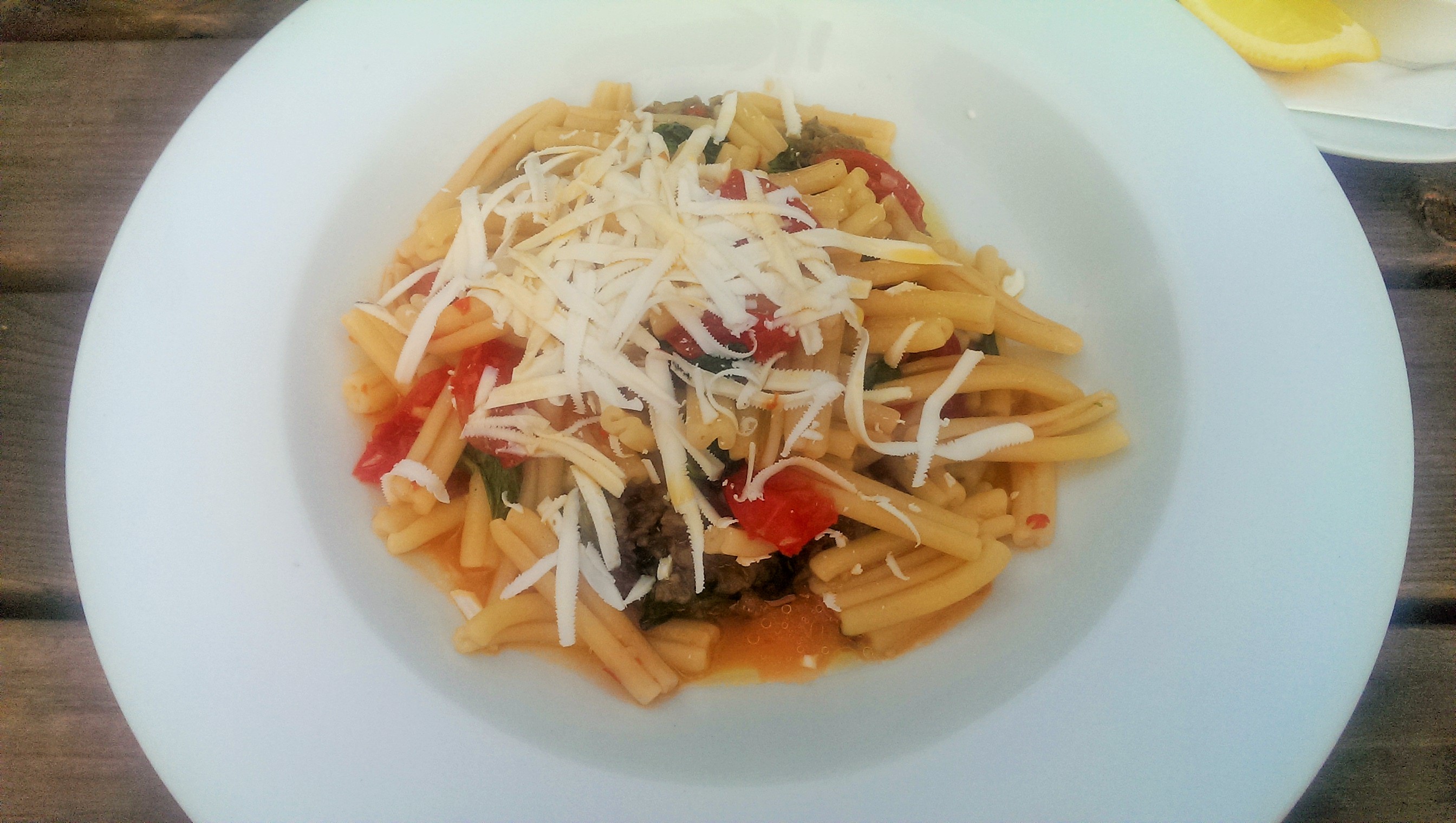
Plenty of promise in the starters, then, and the mains delivered on it. The menu has so much for vegetarians (plenty of starters and three tempting mains, including a field mushroom and green garlic pie which I would have ordered on a slightly cooler day) that I felt duty bound to try one of them, so I went for the strozzapretti pasta with aubergine caviar, basil, vine tomatoes and salted ricotta cheese. The pasta was al dente and the aubergine caviar (a bit misleading that, as it had collapsed into something approximating to baba ghanoush by the time it was served) was smoky with a touch of citrus and rich enough to make this a very substantial main. There was also some clever chilli in the sauce which built over time and the generous heap of salted ricotta – so nice to see a kitchen advertising a vegetarian dish without blotting their copybook with Parmesan – on top rounded it off nicely. It was still a bowl of pasta, and I think they always run out of steam when eaten as a main course, but it was probably the best vegetarian main course I’ve had this year. I was also impressed to see how much on the menu was gluten free – almost a third of it, and none of it felt like it involved any compromises.

BirdPasta

The other main turned out to be the perfect synthesis of Sicily and South Oxfordshire, the Bird In Hand’s cover version of fish and chips. The hake was in glorious light batter (billed as Parmesan tempura, although I didn’t really detect that). The chips were crunchy thin straws of courgette, beautifully seasoned and fried, all taste and no oil. And the peas – well, it was a fantastic pea puree, as intense and green to taste as it was to look at. I don’t even like mushy peas, but I couldn’t get enough of this. If I did have a criticism, and it’s only one, the presentation of everything on top of the pea puree made it difficult to make the most of the superlative accompaniments – a lovely piquant pimento ketchup and (a lovely touch, this) a ramekin of malt vinegar jelly. Everything I had had been tasty, but this was clever too.

BirdHake

On a lovely, sunny evening it felt like a waste to head home without making some inroads into the dessert menu, and my companion still had quite a lot of a glass of white wine to finish. Impressively, the Bird In Hand has about ten wines by the glass, nearly all Italian, all costing no more than £3.50 for a small glass or £20 for a bottle, another little detail that made me warm to the place. I didn’t try any, being the designated driver, but I’m told that the Cataratto (an organic Sicilian white) was positively medicinal on a hot day.

This is probably the right place to mention the service, which was the closest my evening came to letting the side down. Sitting outside meant that you ordered at the bar – and when I did Santino, who was working behind the bar, was charm personified and clearly a big hit with locals and diners. He could sell any of his dishes to anyone and was brilliant at bringing the details to life: the tuna cooked with orange zest, the burrata which was arriving later in the week, the salami he gets from small producers in Italy (I imagine he has built up quite a good contacts book), the ice cream which was all made there on the premises. He also lamented the end of the English asparagus season, a subject very close to my heart. The table service was a lot more erratic: the young waiter who was doing the fetching and carrying had a lot to do (serving in the garden means a lot of distance back and forth with plates) but wasn’t the canniest of workers, often bringing out food then returning to the kitchen empty handed despite our empty plates having been in front of us for quite some time. It didn’t mar the evening but I did reach the stage where I had half a mind to taken them inside myself, and that isn’t how it should be.

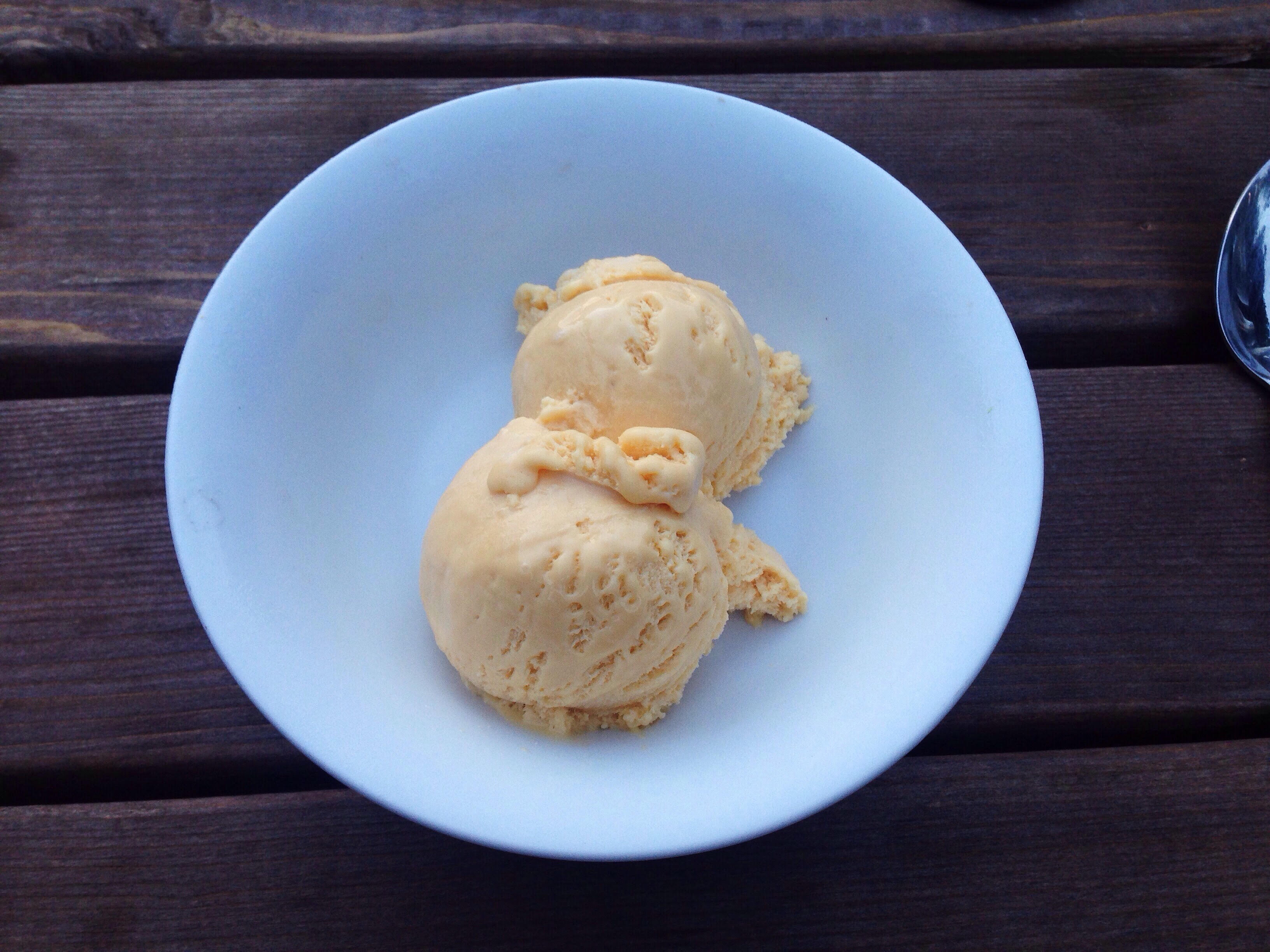
Santino recommended the ice cream, so naturally I had to try it. They’re all priced by the scoop and, interestingly, the prices all differ so, for example, pistachio is more expensive than chocolate which is more expensive than vanilla. I had two scoops of malt barley ice cream, and I think – no offence to the likes of Tutti Frutti – it’s probably the best ice cream I’ve had in this country. The texture almost defied description because somehow “smooth” isn’t enough but, raiding the thesaurus, smooth is all there is. It was so rich and glossy, with almost a burnt toffee note from the malt, that I just didn’t want it to end. Except I also wished I’d only had one scoop so I could try the chocolate as well: what did I say about good menus and hard choices?

BirdIce

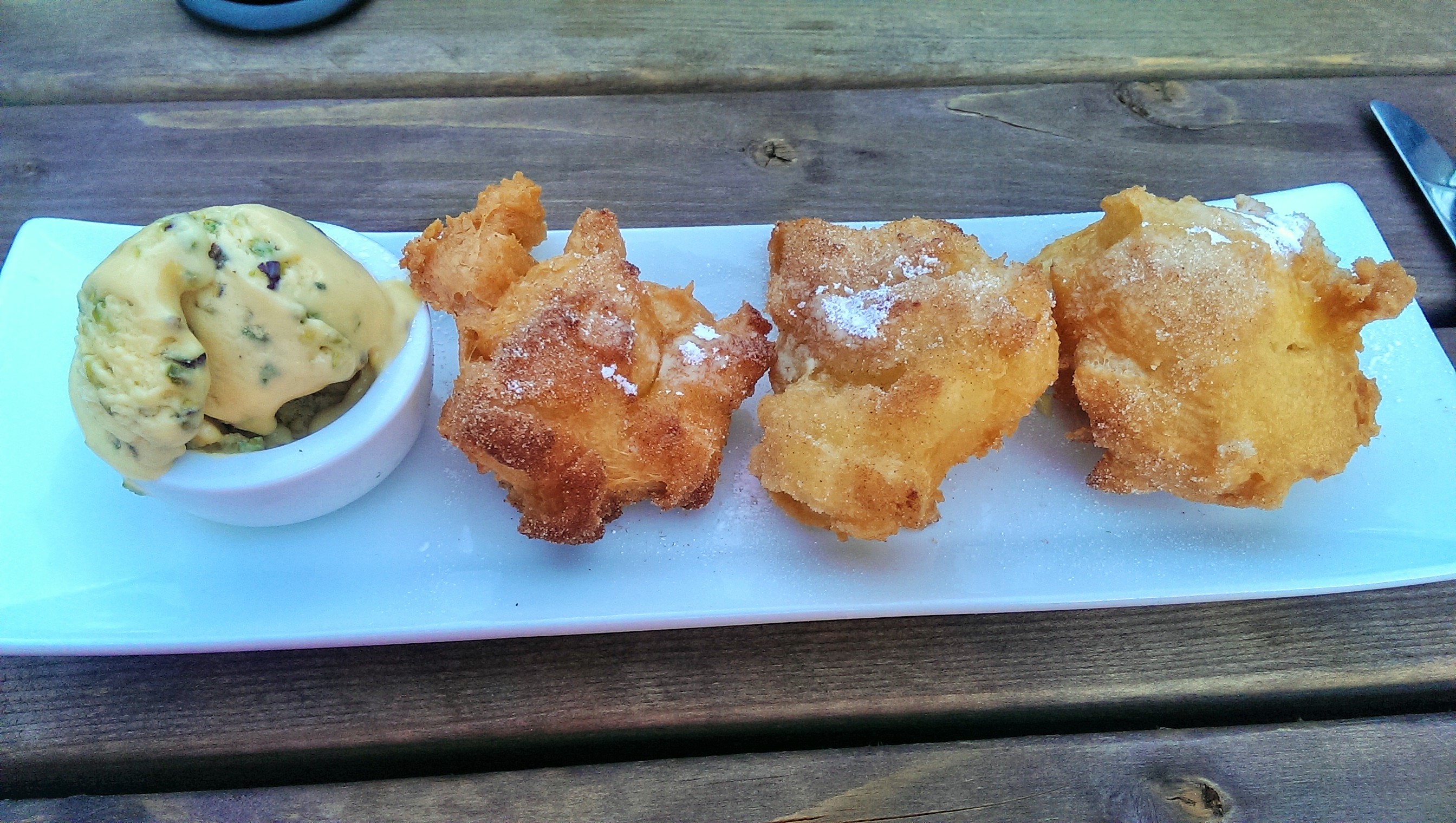
Believe it or not, I’ve saved the best for last. Sfinci, Sicilian cinnamon doughnuts, might well be my dessert of the year so far: three rough little clouds of fried batter, crisp on the outside, soft in the middle, dusted with a little icing sugar and cinnamon and served with the richest, creamiest pistachio ice cream. The irony: in Reading we’re used to being bombarded with a message saying “lovely hot doughnuts, nice and fresh” and yet so many people never get to eat anything of the kind. I was told when I ordered them that they would take fifteen minutes and I’m not sure I can think of a better way of spending fifteen minutes than waiting for that dish.

BirdDoughnut

The total bill, for three courses each, two ciders, a wine and an Averna (it looks like Coke, tastes like cough medicine and, with lots of ice and a slice of orange, is one of the best digestifs you could hope for) was seventy six pounds. Considering the number of separate moments in the meal which had a wow factor, I reckon that was money well spent.

Having written this blog for nearly two years, I’ve come to realise is that life is full of mysteries. Why do cafés persist in putting your napkin between the cake and the plate, thereby guaranteeing you can’t use it? Why is Prezzo always full? Why are the plates for Picnic’s salads so small that it’s almost impossible to eat the salad without dumping half of it on the table? Cosmo: why?

But the biggest mystery of all to me is that people just don’t read the reviews of out of town places – I know, thanks to the joys of WordPress, that every time I publish one quite a few readers decide to take a week off. That’s a real shame, because those people won’t get to find out about the Bird In Hand. They won’t get to experience little flashes of wonder of like the ones I had – that first taste of couscous, wild mushroom and tuna, the tang of the salted ricotta, the big silly smile at something with the texture of jelly and the taste of Sarson’s. That ice cream. Those doughnuts. But never mind – because if you’re reading this you’ll know, and maybe you’ll go. That’s good enough for me.

The Bird In Hand – 8.3
Peppard Road, Sonning Common, RG4 9NP
0118 9721857

http://birdinhandsonningcommon.com/

Bali Lounge

Bali Lounge was closed as of January 2018. I’ve left the review up for posterity.

When has a restaurant changed enough to be a new restaurant? Not necessarily when the chef changes, that’s for sure: chefs come and go all the time, whether it’s a steady throughput of chefs at a chain restaurant or the head chef leaving Forbury’s and being replaced by someone else. Not necessarily when they rebrand the menu, either – a good restaurant probably does this quite often. But when it closes for renovations and emerges from the chrysalis with new branding, a different menu and a different name, perhaps it’s time to look afresh.

The Warwick ceased to be at the start of the year and reopened as Bali Lounge. The exterior was slightly different: no longer described as a pub but as a “Bar. Restaurant. Gallery”, no less. The menu was altered – slimmed down, with more emphasis on Indonesian food. Ever since then, I’ve been wondering: should I go back? Is it a new restaurant? The longer it went on the more I felt my old review of the Warwick might be misleading, and that’s why this week you’re reading this.

Turning up on a weekday evening my first impressions were that the changes, such as they were, were on the subtle side. The interior looked much the same, the only concession being some newer, bigger, nicer looking tables. Curiously, the chairs were still the same and there were still at least three different types, just as there were at The Warwick. I got the impression that the management hadn’t quite wanted to start from scratch.

The menu looked the same – the same faux-chalk comedy font sported by the Warwick and, for that matter, their sister restaurants the Moderation and the Queen’s Head. But on closer inspection there were definitely some changes. There were far less of the Thai specialities and some dishes had made their way across from the menu at the Queen’s Head, like rijsttafel (a sort of Indonesian smorgasbord, if that isn’t adding an unnecessary extra level of Swedish complexity to a dish that already has both Dutch and Indonesian roots). So, was it a new restaurant? I was still none the wiser.

Perhaps the best way to find out was to compare like with like: much as I wanted to start from scratch myself, making a fresh start rather than retracing previous visits, I felt that opening with a mixed starter (the “Bar Platter”, in fact) was still the best way to try a range of Bali Lounge’s food. Besides, with Tampopo sadly closing down and Reading losing its fabulous sharing platter I was hoping to find a replacement here, especially now that the menu extends beyond Thailand.

The presentation would have aggrieved people who want everything to come on a plate, but I didn’t actually mind it turning up in a wooden trug. The chicken satay was the first to go and was a hit, with moist chicken and a rich, savoury (if quite plain) satay sauce. A little basic, perhaps, but still enjoyable – and surely nobody really expects their world to be rocked by chicken satay. The spare ribs, though, were not good. The first one was a grim right angle of gristle where there was almost no meat and what meat there was clung on in a manner best described as Blatteresque. A shame, because the second rib was how ribs are meant to be – tender meat, sliding off with no work at all, at which point I got to appreciate just how sticky and tasty the sauce was. But by then, the damage was done.

It didn’t get better. The crispy squid wasn’t. It was clearly fresh, but it was floppy and tasteless none the less. The only real flavour was the coriander dusted over it – if it had been coated in some seasoning and fried properly it could have been a knockout, but it looked more like fusilli than seafood. The saddest thing was that you got a lot of it – mouthful after mouthful of disappointment and wasted potential. The prawn fritters (or, to be more accurate, whole prawns in batter) were also forgettable – also a bit limp and again in batter with no crunch, salt or kick of any kind. It felt as if the chefs were frightened of using authentic levels of spice for our tender British palates and had erred way too far on the side of caution. Bali Lounge seemed to have managed the trick of turning from a pub to a restaurant and, at the same time, turning restaurant food into pub food.

BaliStart

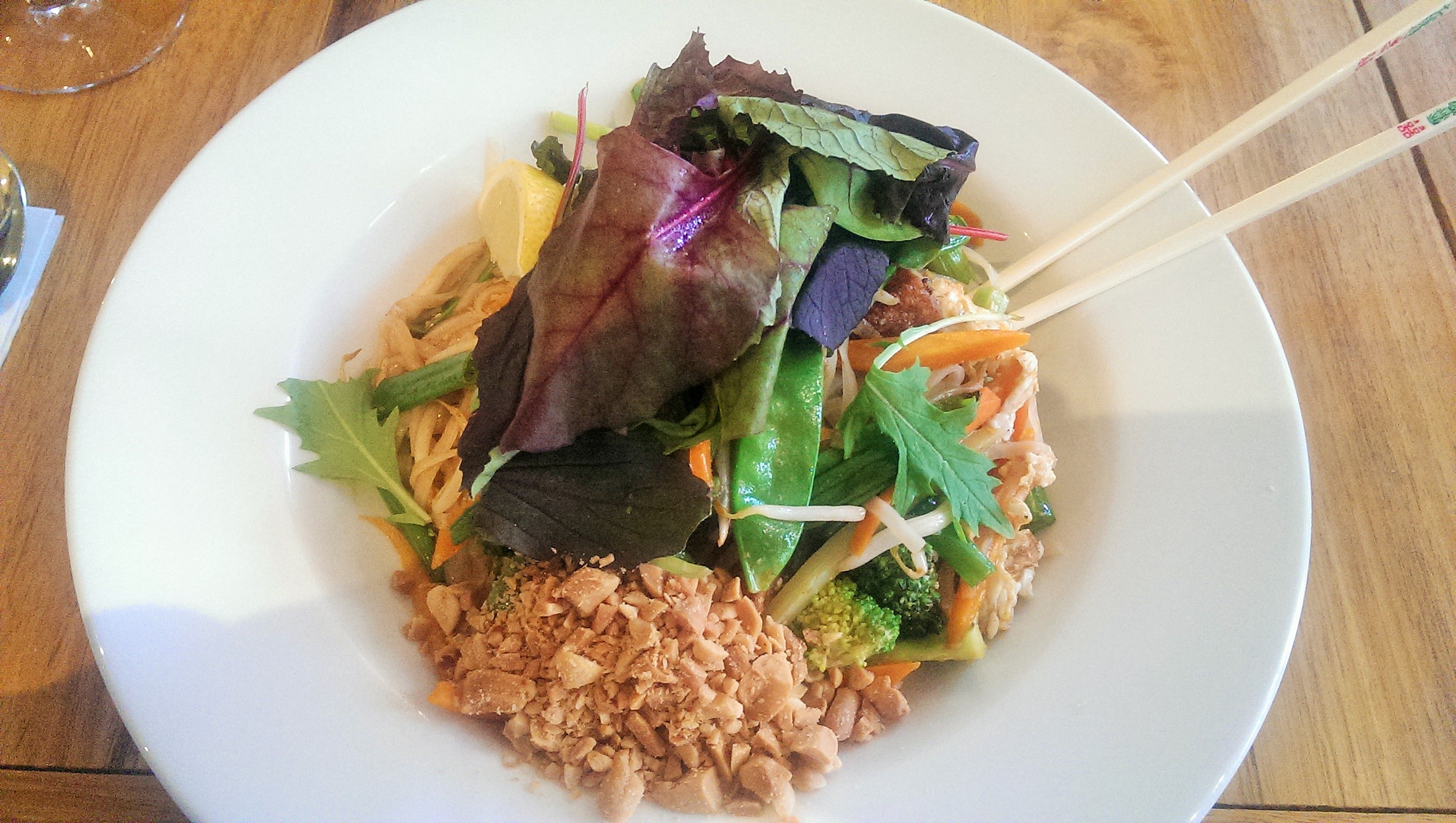
It didn’t bode well for the main courses, so we waited for them to arrive with rapidly lowering expectations. By the time the dishes turned up they almost met them. The best of the two was actually the vegetarian (hurrah!) dish, the tofu pad Thai. This was still mind-numbingly plain but at least the texture was interesting. There was a decent amount of tofu, soft like cubes of scrambled egg, throughout the noodles. The carrots were cut a little larger than I expected (I have never been to Thailand so forgive me if this is the right way to make a pad Thai) and there were little florets of broccoli and the occasional mange tout in amongst the beansprouts which gave it a nice crunch. Then there was a hugely generous sprinkling of peanuts adding yet more texture.

You’d think that would be enough, wouldn’t you? Apparently not, so we had a wedge of lemon as well, for reasons which escape me: all I can guess is that maybe they’d run out of lime. And, in case that wasn’t enough, a honkingly big pile of naked salad leaves had been dumped on top. Your guess is as good as mine. In the end they got pushed to one side and ignored, like tea drinkers in certain coffee shops. If I was trying to find something positive to say, at least it was healthy. But what it really needed wasn’t a slice of citrus or the contents of the salad crisper – it needed some soy, or some ketjap manis, or something that would have made it taste of something. It was hard to imagine being the sort of person who would eat this dish for fun, thank goodness.

BaliPad

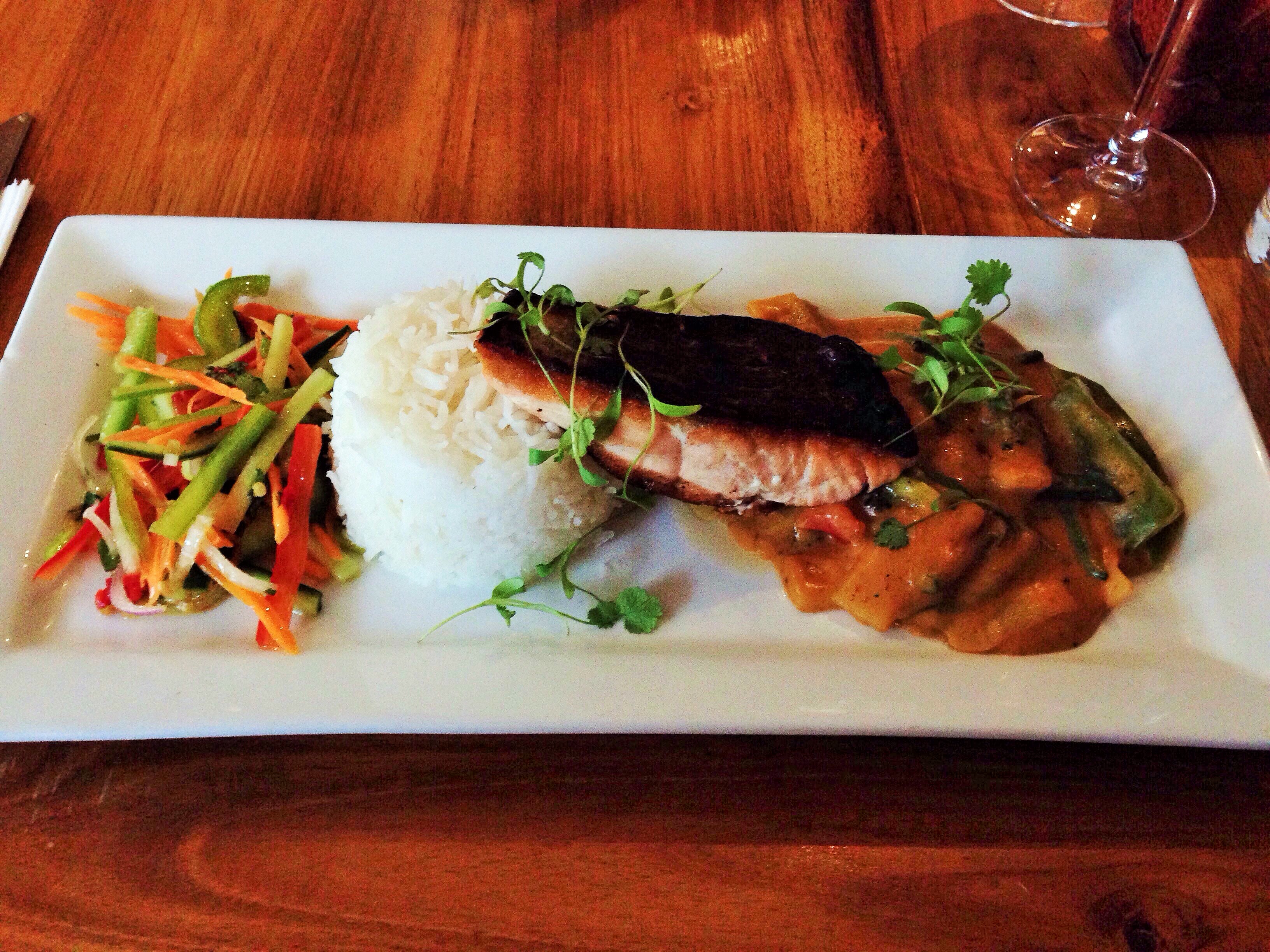
The other main was from the specials board – salmon with thick red curry sauce, courgette and green beans. I ordered this because I had happy memories of pla chuchi in other restaurants and again, wanted to see how it measured up. Well, on the plus side, the kitchen can cook salmon: lovely and firm with a crisp skin just the right side of blackened. A lot of places – Loch Fyne, for instance – get this wrong, so credit where it’s due. But again, the rest just didn’t cut it. The little pile of (unadvertised) shredded vegetables didn’t appear to be pickled or dressed so I am guessing it was the Thai equivalent of a salad garnish. The red curry sauce was one of the duller ones I’ve had, with a bit of acrid heat but no real sweetness; I expected better, based on the satay sauce I’d had earlier. The courgette and green beans were a bit thin on the ground. The rice was there to make up the numbers. If this dish had done the “which Star Wars character are you?” Buzzfeed quiz, it would have come out as Blando Calrissian.

BaliSalmon

The wine was nice but inoffensive; a decent Australian shiraz and a Chilean chardonnay were both less than five pounds a glass. I have run out of words to describe how things taste – which is ironic given that I’ve used so few in this review, but I enjoyed the wine more than the food. The service was also nice but inoffensive – the young lady doing the majority of the serving was very quiet but friendly, food was brought at about the right speed and plates were cleared efficiently. Nice. Inoffensive. They’re not words that are ever going to feature in a mission statement, are they? The bill for two people – two courses each, two glasses of wine each – came to fifty-one pounds. If I was describing the value for money, I guess I’d say it was inoffensive.

With hindsight, I wish I’d gone for the rijsttafel and the beef rendang: reading through the restaurant’s website it’s clear that the management decided to rebrand the place after recent trips to Indonesia, and it suggests that they’re really passionate about the food of those countries. But, in the predominantly Thai food I ordered, it feels like they’ve thrown the baby out with the bathwater: I didn’t get much zing or spice when I was expecting my food to be absolutely crammed full of both. My socks remained firmly unknocked-off throughout: it felt like the kind of Asian restaurant I could take my mum to, and much as I love her that’s really not a compliment. The thing is, my predominant feeling in writing this review is one of sadness. So, is it a different restaurant? Yes, I’m afraid so.

Bali Lounge – 6.4

77 Kings Road, RG1 3DD
0118 9566969
http://www.thebalilounge.co.uk/

Loch Fyne

Loch Fyne closed in February 2018. I’ve left the review up for posterity.

I’m probably as surprised to be writing a review of Loch Fyne this week as you are to be reading one. But it occurred to me recently that, despite it having been here in Reading for as long as I can remember, I’ve almost never visited. I’ve been to the branch in Henley, on the smart side of the market square, and had a light lunch in their sunlit courtyard (before going to the Rewind Festival, as it happens – nothing quite like the poignancy of hearing Johnny Hates Jazz performing “Turn Back The Clock” now Clark Datchler actually wishes he could). And I’ve been to the one in Oxford, a beautiful, big stylish space, the roof a mixture of beams and gleaming shiny pipes. But I always forget about the Reading branch, down by the canal, the wrong side of the Oracle on the edge of the Holybrook estate.

Like the others, it’s beautiful from the outside – a lovely large redbrick building overlooking the Kennet (it used to be a brewery, apparently) with a terrace out the front which many Reading restaurants must envy. But stepping inside it’s a different story: the tables and chairs are starting to look a little tired and the stairwell that runs through the centre of the building makes some of the tables on the ground floor a little dark and stranded. I know this for a fact because, despite many tables being unoccupied on a weekday evening, the waiter decided to plonk us at one of the dark, stranded ones. My fellow diners got to look out on the remains of the daylight on that terrace, or gaze out across the river, whereas I got a view of the disabled toilet. Lovely.

The options were, as you’d expect, mostly fish based (“from the sea” according to the menu, just in case you didn’t know) but with a few meat dishes (“from the land” – I know, it’s pretty educational stuff). In fairness, Loch Fyne’s meat supplier is Donald Russell, the excellent Scottish butcher, but it seemed only right to stick to the fish dishes as that’s what Loch Fyne is famous for. After all, nobody goes to Nando’s and orders the “Prego Steak Roll” – not anyone I’ve ever met, anyway. So if you really don’t like fish, this review won’t be for you I’m afraid – and now you know how vegetarian ER readers feel three weeks in every four.

The first starter was the special – potted Bradan Rost (Loch Fyne’s own trademarked hot smoked salmon) with watercress and granary toast. Now, I think of a potted dish as being spiced and topped with clarified butter, delicious spread on decent bread. This was, sadly, more like mashed, cooked salmon with dill added, popped in a glass jar and then chilled. It was potted, I suppose, in the sense that they’d put it in a pot (in the same sense, in fact, that my main course could have been described as “plated fish”).

The Bradan Rost itself was tasty – rich and smoky with a firm flesh – and I probably would have liked a fillet of it which hadn’t been mucked around with. But when it was mashed and spread on dry bread it was far less appealing. Some butter for the toasted bread would have rescued the situation somewhat, although of course if it had actually been potted salmon this wouldn’t have been a problem. Oh, and the watercress was the final nail in the coffin – a little pile of green in the middle of the plate that looked a little like it had been run over. Vegetarian roadkill – the perfect finishing touch to any dish.

LochPot

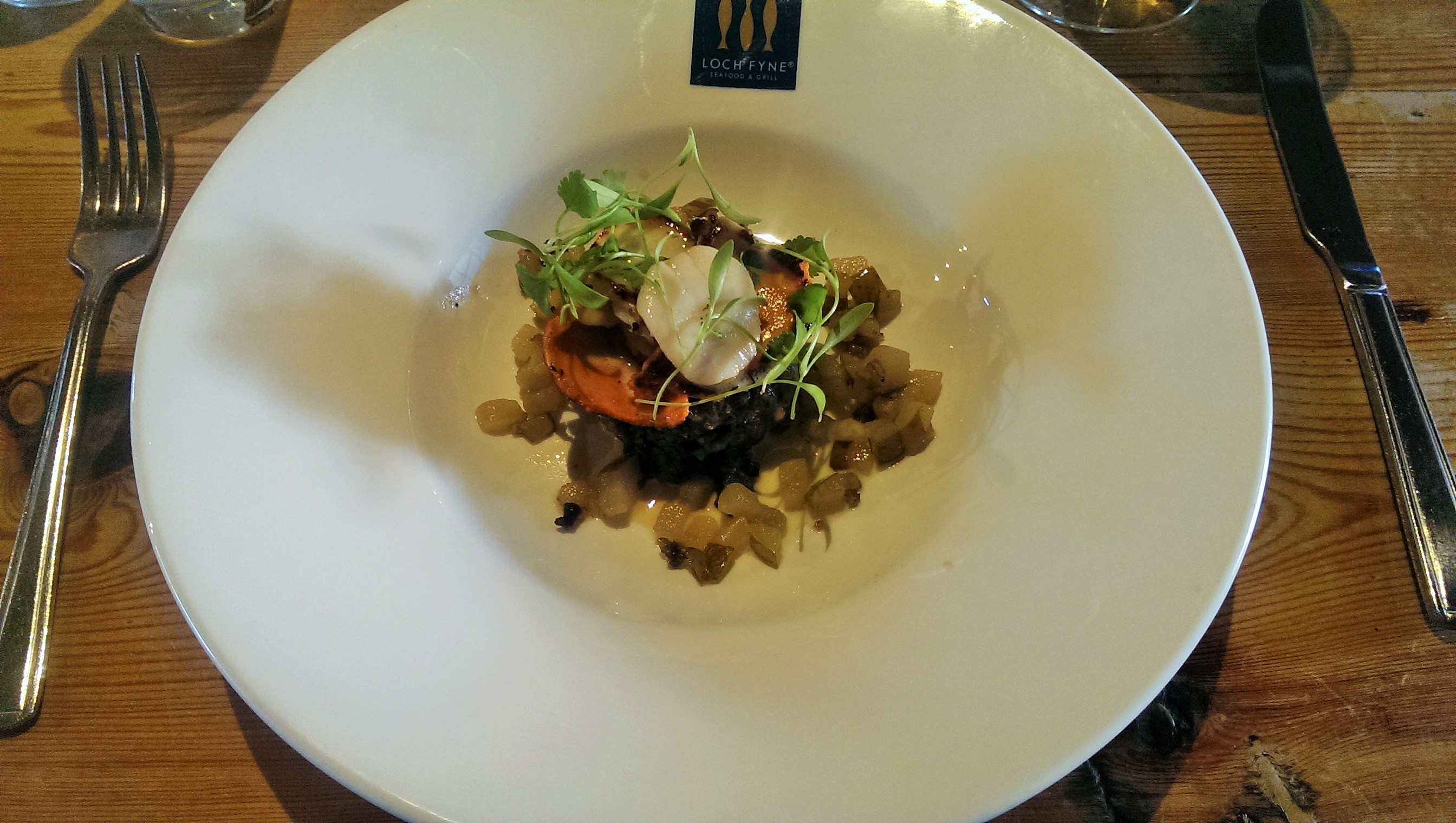
The other starter was described as “haggis with scallops”. This was also misleading to an extent verging on cheeky; I counted the grand total of one scallop, cut thinly into three slices (although that did make the coral, which I don’t usually enjoy, surprisingly tasty). Maybe they expect people to be fooled by this sleight of hand: I wasn’t. The kitchen’s knife skills were equally evidenced by the caramelised pear, although I did feel it wouldn’t have been asking too much for them to peel it first. It was pear all right, but it didn’t feel especially caramelised. You needed a similar ability to cut things into very small pieces to make the starter last very long. It was a tasty, pretty little thing (you never go far wrong with haggis), even if the lemon beurre blanc wasn’t really anywhere to be seen, but the whole thing prompted an overwhelming feeling of Is that it? followed shortly after with another of Is that it for eight pounds? It felt like the kind of starter you could only truly enjoy on an expense account.

LochHag

We had a glass of white wine each with the starters: a nice, if unremarkable picpoul de pinet and a zesty South African chardonnay, both of which were decent but not quite as cold as they should be (there was a certain symmetry to that, as my feelings towards the restaurant weren’t as warm as they should have been). By the end of the starters, which came out pretty quickly, we had got most of the way through the glass and had to decide whether to order another. We guessed that the mains wouldn’t take long to arrive so decided against a second glass. I didn’t get a huge amount of satisfaction out of being proved right, but sometimes the only certainty in a restaurant is that disappointment is lurking around the corner.

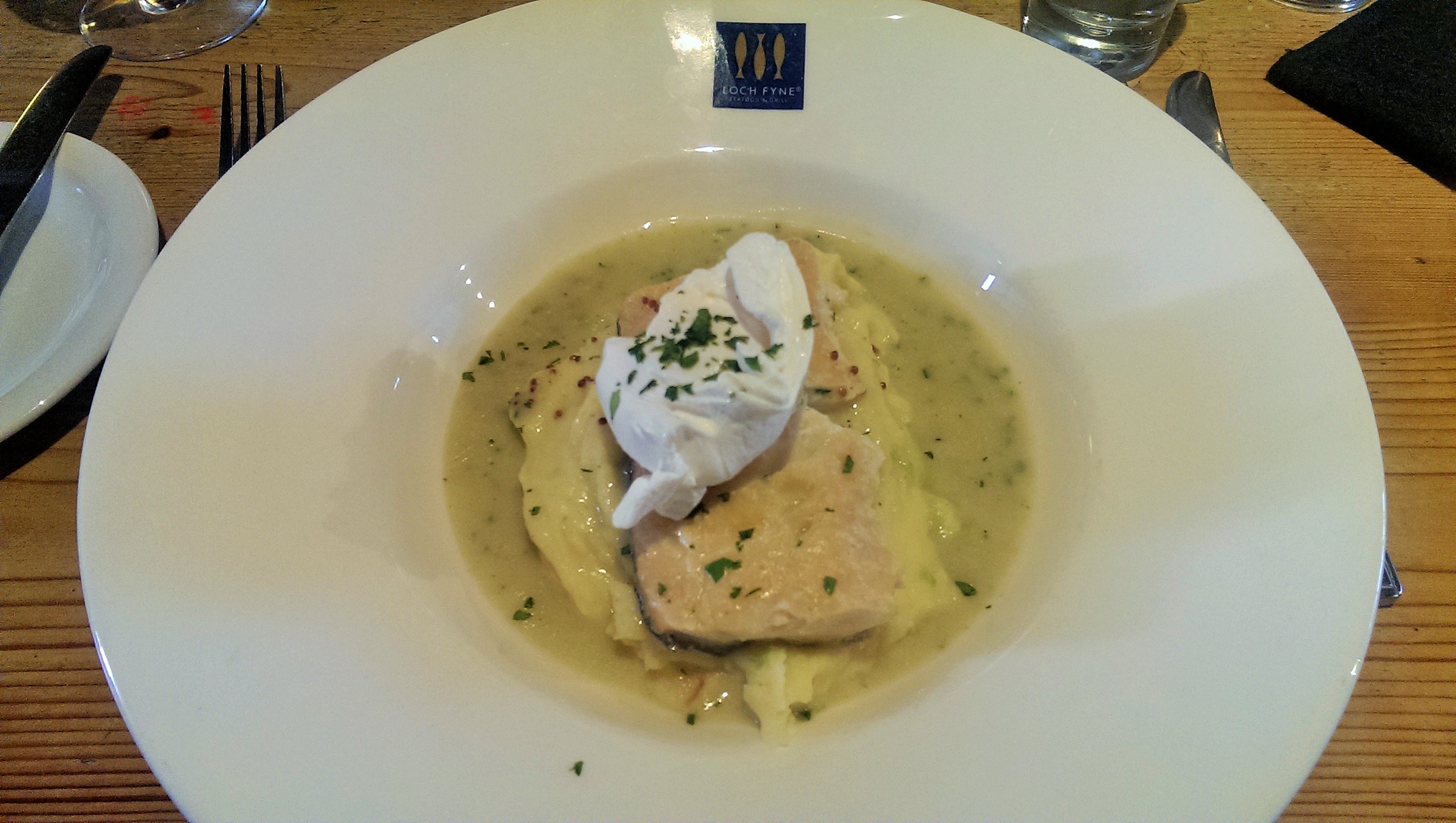
Of the mains, the first – poached smoked haddock on colcannon mash with a soft poached egg and a wholegrain mustard sauce – jumped out from the menu because it ticked so many of my boxes. I know it doesn’t sound like summer food (although, so far, it hasn’t much felt like summer) but I fancied something comforting and I couldn’t imagine anything better than poached fish and mash. It was pretty – a huge mound of steaming hot mash, a decent sized piece of smoked haddock (undyed, as you can tell from the photo) and a perfectly poached egg oozing sunshine yellow on to the rest of the dish.

It all sounds promising but, yet again, there wasn’t enough to like about the dish. The sauce round the edge had a skin on it, which suggested it had been sitting on the pass for a while, and it was oddly bland; if it hadn’t had mustard seeds speckled throughout it I’d have struggled to tell you what it was supposed to be. It should have been tasty and hearty, but the smooth texture of the mash (even with a few strands – nowhere near enough – of cabbage running through it), the gloopy nondescript sauce and the egg yolk added up to a big bowl of something like wallpaper paste. I polished off the haddock and left a fair amount of the rest. It seemed throughout the meal that Loch Fyne had really good fish, but little idea what to do with it.

LockHad

The second main was from the fish bar. A nice idea, this: you get a piece of fish of your choosing, grilled steamed or fried, with a sauce of your choice and two sides. My fried cod looked promising but again it was underwhelming – lovely thick flakes but no apparent seasoning and a soft, flaccid skin on top (which is the whole point of ordering it fried in the first place). I would describe it as just hot enough – which made it considerably hotter than the samphire which accompanied it. Hot and well cooked, samphire is one of the most beautiful things you can pair with fish. Lukewarm and clumpy, it isn’t. I left a fair amount. Salsa verde tasted better than it looked – beautifully sharp and clearly made with lots of capers but the sludgy colours and coarse texture made it feel more like Boden mushy peas than the green, fresh sauce it should be.

The best of the lot were the twice cooked chips, which were among the best chips I’ve had in Reading (only Forbury and LSB come close, from recollection). Beautifully crisp, rough outsides, lovely fluffy middles; if they’d just served me a portion of those, some bread and butter and some Heinz red sauce I’d have spent a lot less, left a lot happier and given a much higher score. They came in a metal beaker – because that’s how everyone serves chips these days, unless you get a tiny fryer basket – and at the bottom was a pale, unremarkable looking stowaway French fry. It reinforced the fact that this order was probably the only really good choice I made all evening.

LochCod

Aside from a friendly greeting at the door (by the manager, possibly) service was probably best described as apologetic. That was behaviour which made more sense as the evening went on: certainly by the end, there was a fair amount they could have apologised for. Not that I was ever invited to give any feedback which would have prompted an apology – tellingly, when clearing the plates away we were asked if we were finished but never if we’d enjoyed it. Even when the half full plate of wallpaper paste was collected there was no question or comment. Did they think that was normal behaviour from diners? Did they know the food wasn’t up to scratch? Or did they just not care? It was impossible to tell, but none of those explanations reflect well on anybody.

We didn’t have dessert. I felt like Loch Fyne had had quite enough of my money by this point: the total bill for two courses and one glass of wine each was fifty four pounds, excluding tip. The whole experience took just over an hour, and diners were still turning up as I was leaving. I hope they had more fun than I did, although they could have easily managed that playing Scrabble or eating a packet of Quavers instead.

I can never decide whether Loch Fyne is an upmarket chain or not. I saw a fair few date nights taking place during my visit – a few sparkly tops (and one I might even describe as “ritzy”, with all the connotations that word carries) and smart jackets giving the game away. But I couldn’t help wondering, based on the evening, whether they might have been happier in Henley, Oxford or even Wokingham. Perhaps I was a bit jaded – after all, they’d spent the evening gazing into each other’s eyes and I’d spent it looking at the door of the disabled loo. But I think maybe what Loch Fyne really illustrates is that not only are there good chains and bad chains but that, despite the promise of uniformity implicit in a chain restaurant, there are also good branches and bad branches. And Reading, I’m afraid, is saddled with the latter. You might get a better deal if you turn up for the thirteen pound, three course, not hugely exciting set menu. But really, why would you bother? The one thing I’ve learned from Loch Fyne isn’t where fish come from, it’s that – where restaurants are concerned – there are plenty more of them in the sea.

Loch Fyne – 5.9
The Maltings, Bear Wharf, Fobney Street, RG1 6BT
0118 9185850

http://www.lochfyneseafoodandgrill.co.uk/locations/reading