Giggling Squid, Henley

Although most ER reviews are of independent restaurants, I’m not against chains for the sake of it. Not all chains are the same: there are big and small ones, good and bad ones – just as there’s a difference between the silver chain you’d hang a pendant from and the lunking great thing you’d use to secure your bike to the railings.

I was struck by this wandering round Henley on a sunny Bank Holiday Monday, because they have chains just like Reading does, only different ones. So there are shops like Space NK and Joule’s – the next tier up, you could say, places in the same bracket as Jigsaw and LK Bennett. It’s the same with cafés and restaurants, so Henley has a Maison Blanc, a Hotel du Vin, and a CAU. I did briefly consider going to CAU to find out what we had to look forward to when the Reading branch opens this month, but nothing about the décor appealed: the nasty rigid white chairs and sterile banquettes screamed “downmarket Gaucho”.

Besides, I was on my way to a more intriguing phenomenon: Giggling Squid has grown from a single branch in Hove six years ago to a chain of thirteen restaurants (many of them opening in sites which used to belong to other chains – a handful used to be branches of Strada, Henley’s was previously an ill-fated Brasserie Gerard). And there are more on the way – the management wants to make this the first nationwide Thai chain, with plans for somewhere between fifty and eighty sites. It’s funny how, despite the popularity of Thai, Indian and Chinese food they still tend, by and large, to be chain-free zones (unless you count the delights of Ken Hom’s Yellow River Café, one of the Oracle’s first ever tenants way back when). I’ve never understood why that is – was Giggling Squid going to challenge that status quo?

It’s a lovely old building at the bottom of Hart Street and it’s been done up very nicely. On the way there I walked past Henley’s long-serving restaurant, Thai Orchid and it was the picture of an old-fashioned Thai restaurant, all dark wood, ornate panelling and intricate, inlaid, glass-topped dining tables. Giggling Squid couldn’t be more different, with its pale walls, exposed beams and almost Scandinavian bleached bentwood chairs. The front room, where I sat, was more traditional – the big room at the back was much better lit and I’d rather have sat there, but I didn’t have much choice in the matter. Which brings me to the second thing I noticed about it: it was absolutely rammed (I was lucky to get a table at all without a reservation, and quite a few couples who came in after me were turned away).

Giggling Squid bills itself as “Thai Tapas & Thai Restaurant”. The idea of anything other than Spanish food describing itself as tapas makes me feel a little exasperated, but what it essentially means is that at lunchtime, rather than having a traditional a la carte menu the main options are one of six “tapas sets”, each of them a mixture of three different dishes and jasmine rice. You can order lots of tapas separately instead, although I’m not sure why anyone would unless you really disliked the set combinations, or you can have what they describe as “one big dish with rice” or a “two dish meal combi”. This all felt overly complicated for me – did I want one big dish, two middling dishes or four small dishes? was there an option of having eight minuscule dishes? – so we went for a tapas selection each. And some prawn crackers. And some chicken satay (which by my reckoning makes a total of ten small dishes, sort of).

Despite the restaurant being extremely busy everything arrived very quickly indeed. Prawn crackers came in a metal pail and were good but unexceptional. It was a huge portion of crackers and an absurdly tiny ramekin of sweet chilli sauce – I couldn’t help feeling I would have liked less crackers and more dip, but they were pleasant enough and lasted just until the rest of the food turned up.

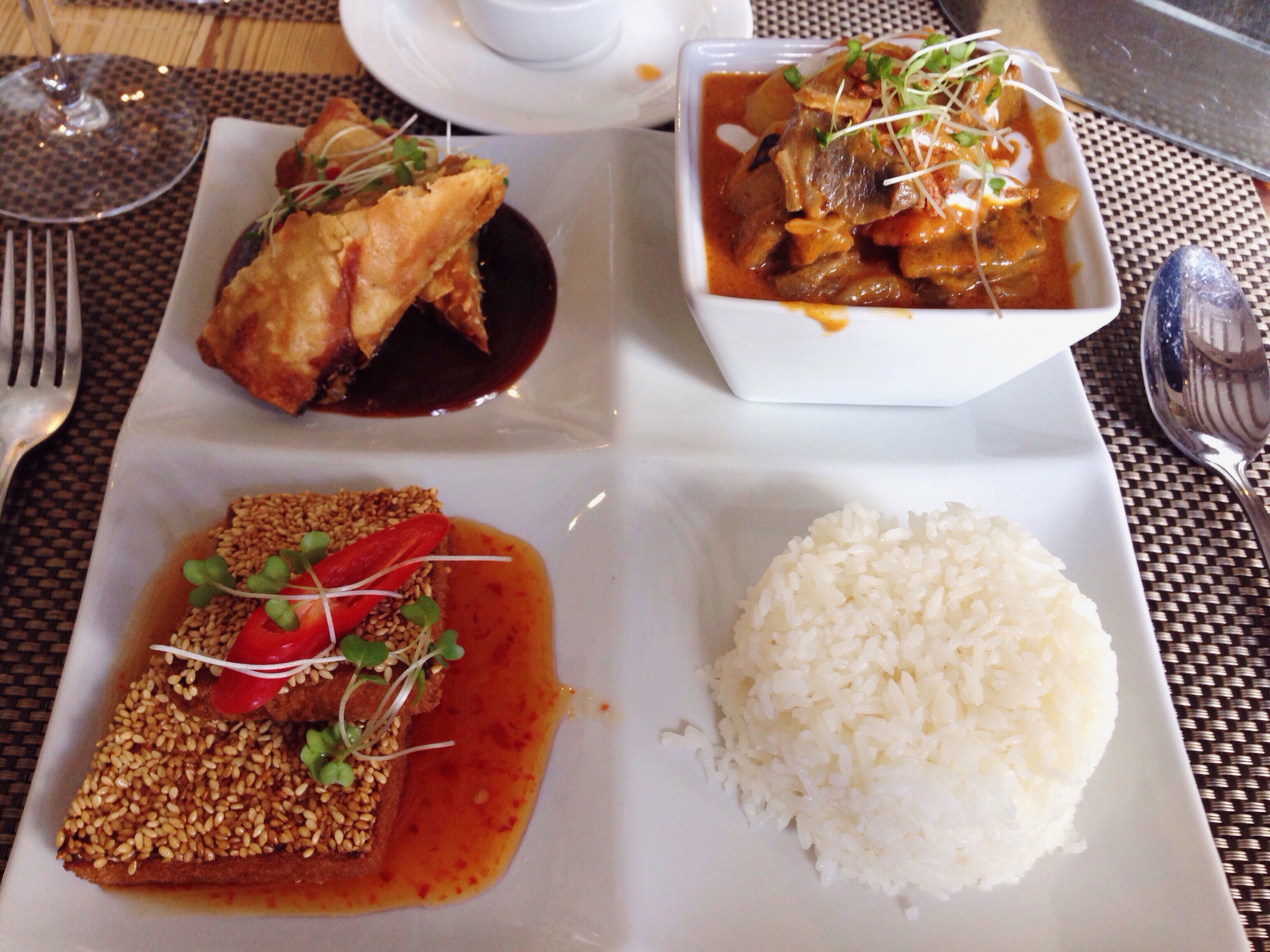
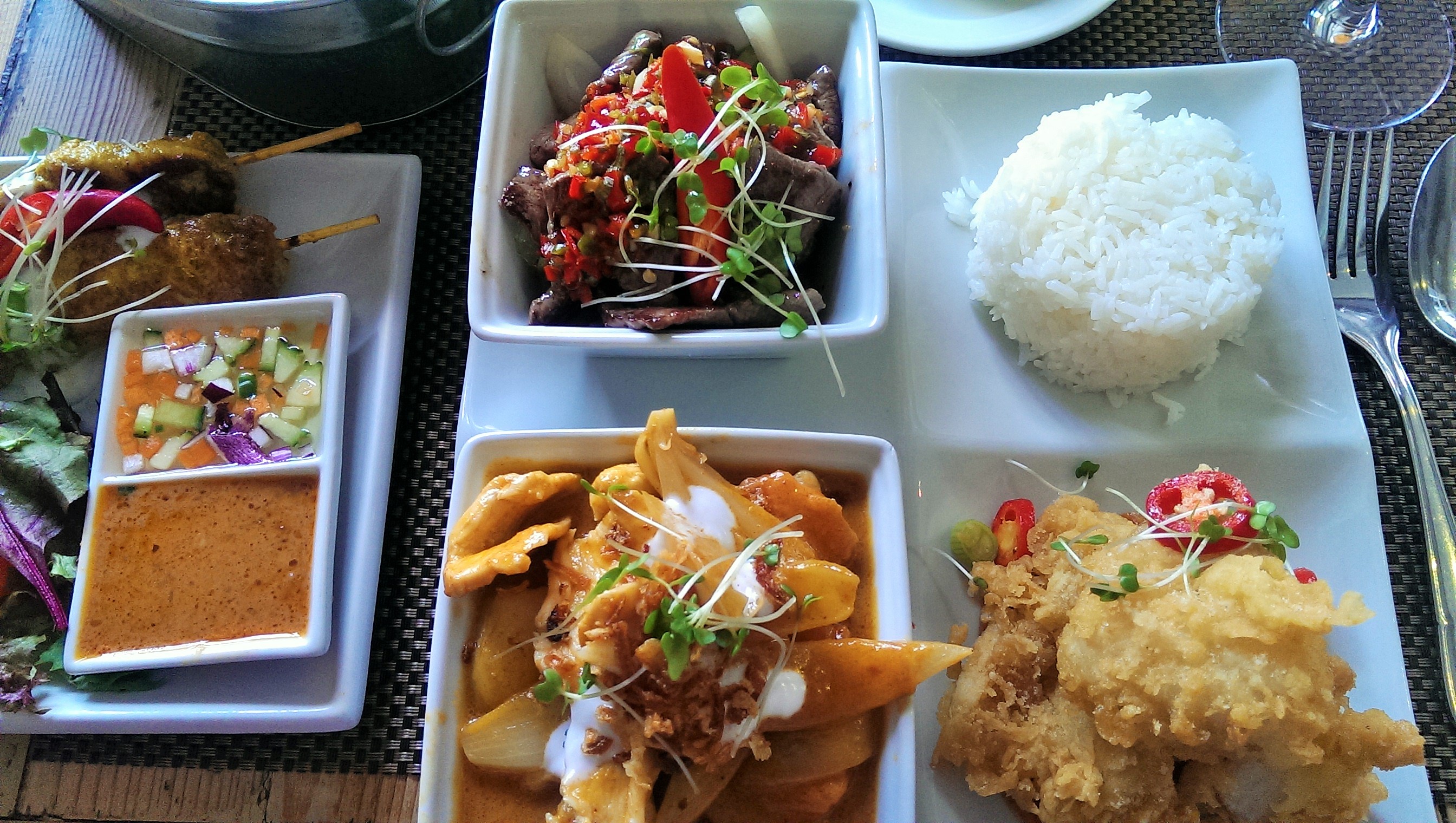
So, on to the tapas (if I really must call it that) itself: a square plate divided into four with something different on each section. Much as I might have wanted to turn my nose up at the concept I couldn’t fault the food. Shredded duck spring roll was a huge thing, full of dense strands of duck, served on a surprisingly subtle puddle of hoi sin that wasn’t just relentless sweetness. Prawn toasts were much better than I expected, crispy and light with a gorgeous layer of toasted sesame, served with more of the sweet chilli sauce. Salt and pepper squid was not at all chewy and the batter was beautifully light (maybe too light, as it did fall off the squid the moment it was challenged with a fork) served on another puddle of sauce – this time hot chilli with no sweetness. The beef salad was the cousin of the chicken salad I raved about from Art of Siam – soft, tender strips of beef on top of a bowl of salad filled to the brim with hot, sharp, sour sauce. It was agony and ecstasy to eat and would be perfect for anyone with a bit of congestion – the heat would soon clear that up.

WealthySquid

Because of the set combinations we’d gone for (“Two Giggling Squids” and “Wealthy Squid”, I have no idea why they’re called that, so don’t even ask) we had massaman curry two ways. The lamb was gorgeous, slow cooked and reassuringly free of wobble and the chicken was in tender, slender slices. There were nice firm chunks of potato, lots of onion and a healthy (or unhealthy, depending on how you look at it) sprinkling of crispy fried onion on top. The sauce was perhaps a little subtler than I’m used to but still went beautifully with the rest of the rice – and I’ve always thought, and said many times, that the rice and sauce at the end of a Thai main course is the best bit.

2Squids

The chicken satay, ordered as an extra out of curiosity, was probably more food than we needed but again, it was very good: tender, soft chicken, not dried-out fibrous breast meat, easy to slide off the skewers and dunk in a fresh clear dipping sauce or a spiced but fragrant satay sauce that was a lot more than hot Sun-Pat. We finished the lot, although it put paid to any plans I had for dessert – a pity, as I had my eye on the black sesame ice cream. Still, there’s always next time.

The menu, come to think of it, was full of little flashes of personality like that which made it feel a lot less like a chain. That really came across in the wine list in particular which managed that rare trick of getting a slightly irreverent tone without making you want to cringe. Written by the co-owner, it compared the Chardonnay – described as something like “rich and fruity” – to her husband before mentioning the extensive research he had done trying to find some reds that went with spicy food. That sort of thing might make your toes curl, but I found it oddly charming (oh, and we had a couple of glasses of the Chardonnay: if her husband is anything like that she could have done an awful lot worse).

Service was harried but friendly. It felt difficult to get attention right at the start, but given how popular the place was I was impressed by how efficient they were; at the end, when the lunchtime rush was fading out, the waiters were a lot more friendly and interested. We went from sitting down to being out of the door in just over an hour which I think is fair enough on a busy lunchtime, especially when you’re only really having one course. Lunch for two – two tapas sets, prawn crackers, chicken satay and two glasses of wine – came to £40 with a semi-optional 10% service charge on top. The tapas sets were just under £12 each, which I thought was pretty decent value.

The owners of Giggling Squid have talked about Côte as the chain they’d like to emulate and I can see why – it’s a great example of how a chain can get everything right and be consistent without being faceless. And I think Giggling Squid does that too; I liked almost everything I had, it’s a lovely spot, it’s very tastefully done and the service is good. I do wonder, though, whether the reason they haven’t chosen to target Reading is that it already has three well-established Thai restaurants with good reputations – the kind of day-in, day-out consistency that is the brand promise of most chains. I wonder too what Giggling Squid will be like if it hits its targets, has a hundred branches worldwide and takes over all the vacant Stradas, Bella Italias and Café Rouges out there. But that’s all years ahead: in the meantime, it’s worth going so you can say you were there in the early days (or back when it was good, depending on how it all turns out). I might see you there, because the whole experience made me want to go back – partly for that sesame ice cream, but mainly to try the evening menu, which is so packed with tempting-looking fish and seafood dishes that I literally wouldn’t know where to start.

Giggling Squid – 7.7
40 Hart Street, Henley-On-Thames, RG9 2AU
01491 411044

http://www.gigglingsquid.com/branches/henley.html

Feature: Al fresco dining

N.B. A more recent guide to al fresco dining has been published on the blog and can be found here.

No new review this week I’m afraid, because I’m taking my first week off of 2015. Instead, you get a feature: I’ve had a few people express interest in ER features from time to time, so this is the first of its kind.

I’m very lucky that I get to eat out often and write weekly independent restaurant reviews; I genuinely believe that the only way restaurant reviews can be totally impartial is if the person writing the review is also the person paying the bill. But I’m also painfully aware that eating out is a luxury that not everyone can afford. This week, I’m donating the cost of the meal I would have eaten to Launchpad, Reading’s homeless charity which does excellent, tireless work which is needed more now than ever. ER is free to read and it always will be – but if you felt like donating even the smallest amount of money to Launchpad too, I’d really appreciate it and I’m sure they would too. Normal service will be resumed next week – until then, on with the feature.

Summer is around the corner – the Reading Beer Festival always feels to me like the first sign that it’s on the way – and that always makes me think about the delights of eating outdoors. We all daydream about barbecues, we have our tea and coffee at pavement tables people-watching and relaxing and suddenly a whole different criterion comes into the decision-making process when you’re deciding where to eat. After all, it would be a shame to have lunch or dinner cooped up when it’s glorious outside.

It really frustrates me that good al fresco dining spots in Reading are few and far between. The town seems to be full of blind spots where the sun just doesn’t shine, and many of the plum spots are filled by disappointing chains. Bill’s, for instance, has an absolutely gorgeous space outside which is a magnet for UV rays but the food doesn’t live up to the setting. It’s quite nice for breakfast (eggs sunny side up in more ways than one) but otherwise it just doesn’t do it for me. The Riverside gets lots of sun and many of the venues have decent outdoor seating but it’s hard to be excited by them – the little tables outside Cote always look inviting, but All Bar One, Bella Italia, Pizza Hut and Nando’s aren’t quite so alluring.

So – and I might be jinxing the summer of 2015 by even saying this – the days are long, the shadows are too, it’s short-sleeves weather and you’re ravenous. Where to go?

1. Dolce Vita

It did cross my mind to pick the balcony at Jamie’s Italian, looking out over the throng of Oracle shoppers. But, for food and service, Dolce Vita easily has the egde. It’s as close as you can get to the Oracle view without actually being in the Oracle, tucked away from the hubbub. The balcony area extends out on two sides of the restaurant and the menu is equally sunny with Mediterranean food – and some more leftfield choices with traditional British and even Asian influences – and friendly, charming Greek service. The set menu, which is often on song, offers great value and a surprising range of options. When I sit outside at Dolce Vita I can almost convince myself that I’m on holiday, especially if I’m drinking a pint of Peroni or a fresh, fruity glass of rosé.

Burrata

2. The Plowden Arms

Ideally one would arrive at the Plowden in an open top sports car, passing some of the rolling green hills that the Berkshire/Oxfordshire border has in spades. The generous garden at the Plowden offers a lovely view across the countryside with added waitress service and decent umbrellas, should you be more English rose than suntanned millionaire. The food here ranges from substantial and traditional to delicate and sophisticated (and the kitchen is consistently brilliant at all of it) but everything is fresh, creative and sometimes based on old English recipes, in case you fancy a side order of education. Having your dessert outside by candlelight, the last rays of the sun not long faded, is a pretty magical way to finish an evening.

Lamb

3. Picnic

Picnic has one of the best spots in the centre of town, having taken over the old Jacobs shop eight years ago. The tables outside catch plenty of sunshine (especially early to mid-afternoon) and, provided the wind isn’t blowing a gale, it’s a great place to enjoy lunch and some of Reading’s best people watching. The salads have always been the draw here – leaves and couscous with a weekly range of toppings – and although I’ve found the interior much harder to love since they moved everything around, it can’t be denied that it has freed up the space for the kitchen to add yet more interesting variations on that theme (that said, I still have a soft spot for their roast chicken and pesto). If you scoff at salad, even in summer, there’s also a lot to be said for their cracking Cornish pasties and sausage rolls, from award winning Green’s of Pangbourne. Oh, and the cakes are magnificent: good old-fashioned Victoria sponge and terrific, moist lemon polenta cake are my favourites. All that and a view of Munchee’s opposite (what more could you want?) – no wonder, whenever I bag a table outside, I feel so reluctant to leave.

4. London Street Brasserie

London Street Brasserie has probably the nicest terrace in town, alongside the Kennet. When it catches the sun it really catches the sun, and in summer the menu – always nicely seasonal – really rises to the occasion. There’s nothing quite like making inroads into a crisp bottle of white and enjoying a half pint of prawns, easing off the head and shell before dipping that firm flesh into their peerless garlic mayonnaise (writing about doesn’t even come close: I’m hungry now). I generally find the set menu more reliable than the a la carte here (the fish and chips is another favourite of mine) which makes it perfect for a boozy weekend lunch, although if it’s not quite sunny enough or the afternoon is waning, they also do a nice line in chequered blankets and patio heaters. LSB is a good example of how the summer can change everything – on a winter evening it probably wouldn’t make any of my top fives, but when the sun is out it’s hard to beat.

LSB7

5. Forbury’s

Forbury Square is one of the prettier, quieter outdoor areas in town and Forbury’s really makes the most of it (and in some style, too). Unlike the unluckily positioned Carluccio’s – which always feels like it should be sunny but never is – it is nicely lit and, unlike Cerise, the seating is plentiful and comfortable. If you can manage to stick to their set menu (a challenge that many have failed, me included) then a three course meal can set you back as little as twenty pounds per head – and even less if you’re lucky enough to be there on a weekday lunchtime. Make sure you add some bread, though, as their sourdough is heavenly. Oh, and wear your best sunglasses and pretend you’re on the French Riviera. Air kissing optional.

Venison

6. The Allied Arms

What is ER on about? you’re probably thinking. The Allied Arms is just a pub and it doesn’t do food. I know, I know, but bear with me. I picked this tip up from friends of mine a couple of years ago and it’s a cracker; although the Allied doesn’t do food, they don’t have a problem with you consuming food from elsewhere on the premises. So, on a summer night when the Summer Lightning or the Thatcher’s Gold is flowing, instead of wandering off to a restaurant just get someone to watch your table, pop next door to Pizza Express and then return with your Pollo Ad Astra or American Hot. It’s worth it for that first bite of pizza. It’s worth it for the crispiness of the pepperoni or the salt bomb of anchovy. But, more than anything, it’s worth it for the looks of envy you get from everybody else in the pub who wishes they’d thought of it. Last time I checked, the Allied even kept a pizza cutter behind the bar, although if word gets out they might start charging people to use it.

If you like this and you’d like to read more of this sort of thing then let me know in the comments, and if there are any particular subjects you’d like to read an ER feature on then do say!

The Reformation, Gallowstree Common

The Reformation closed in August 2018, or at least the long term tenants moved on then. I’ve left the review up for posterity.

One of the things that’s always made TripAdvisor a patchy guide to restaurants is that it’s always had a rather loose definition of what a restaurant is. It used to be the case that restaurants and cafés were all lumped together, so the ten best restaurants in Reading included the likes of Tutti Frutti and Tamp Culture. Cafés tend to do better than restaurants on TripAdvisor: the algorithm is a numbers game and cafés, after all, get more customers. On one level, there’s nothing wrong with this – Tutti Frutti and Tamp are both great places – but on another it doesn’t help when deciding where to go for dinner.

TripAdvisor, possibly recognising the problem, made some changes recently to divide establishments into “Restaurants” and “Coffee & Tea”. In principle this should have improved things, but if anything it’s even more confusing because it’s been somewhat randomly applied. So places like Picnic and Workhouse – not restaurants per se, but certainly much more than just hot drinks – are now in the “Coffee & Tea” section, and yet Nibsy’s, Tutti Frutti and My Kitchen are still, apparently, restaurants. Your guess at the rationale behind this is as good as mine; I think they might have used a Magic 8-Ball.

The effect of those changes, random and incomplete though there are, is to clear out some of the noise in the TripAdvisor rankings. It’s also why I went to the Reformation this week, because now that many of the cafés have been taken out it is – with the exception of Quattro – the highest rated restaurant in Reading. Not only that, but people I know whose judgement I trust recommended it. Nothing fancy and nothing pretentious, they said, just pub classics done very well indeed. Sometimes that’s all you want, so I got in the car on a sunny day and went up the A4074 past the sites of triumphs (The Pack Saddle) and disasters (The Pack Horse), taking the next right for the village of Gallowstree Common.

Despite the photo on the website, where the building looks more suited to a horror novel than a restaurant review (the village name would be strangely appropriate, come to think of it), the Reformation is another of those handsome country pubs that I’m always banging on about. There’s a nice garden at the front (on the quiet main road) with pub tables and little shed-ette for smokers (very civilised). Stepping through the door has the opposite effect to the Tardis – I was expecting a massive restaurant but instead got a pretty small pub. Perhaps I shouldn’t be surprised, but so many pubs these days have turfed out the drinkers in favour of diners that seeing space for only twenty covers in the dining room struck me as unusual (in fairness, there’s also a conservatory although it was nowhere near as cosy and inviting). The décor was the usual mix of Farrow and Ball paint tones and mismatched furniture, with witty quotes and the signatures of the Kaiser Chiefs, amongst others, on one wall (it seems they’ve played a gig there). It felt like a pub with the right balance between restaurant and local boozer.

Having checked the menu online before coming out I knew that this week was going to be vegetarian week. Arriving at the pub, however, I was disappointed to see that the menu had changed when the website had not. Of course it’s good for menus to be regularly refreshed but on this occasion is meant that my tantalising veggie main, picked off the menu on the website (lightly spiced bubble and squeak cake, creamed spinach and peas, paneer, soft poached egg – doesn’t that sound good?) had been replaced by what was basically mushrooms on toast. I’m nothing if not committed, though, so I soldiered on. I also knew I would not get another chance this month to live up to my veggie promise.

But all that was to come. I was tempted to go full vegetarian and order the baked Camembert to share, but I couldn’t persuade my companion to go for it and eventually I ruled it out as not being a sufficient test of the kitchen’s skills. Instead, the deep fried whitebait with garlic mayo was a near miss of a consolation prize. The whitebait were crispy and the portion was generous but the mayonnaise didn’t have the courage of its convictions (nowhere near enough garlic) and the fish themselves were incredibly salty. All a little bit out of whack, and then to cap it all the Camembert turned up at another table and I realised I’d made a big mistake (huge): it looked bloody lovely and generous (huge).

RefWhitebait

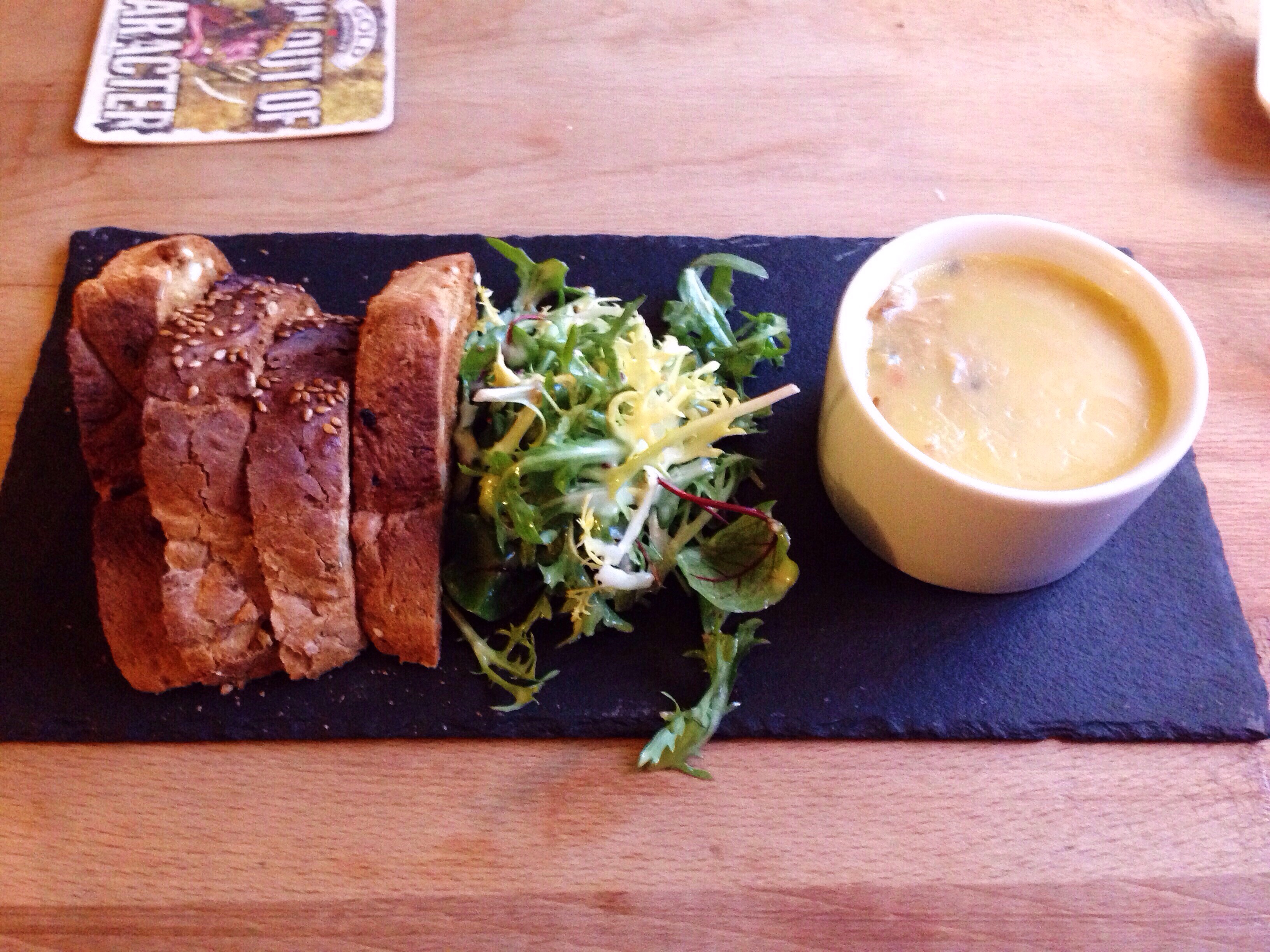
The potted local rabbit was a lot more like it. A beautiful little ramekin of shredded meat but packed with loads of other things too – ever so finely diced carrot and cornichon, rosemary, juniper berries. Just lovely – fresh and clean with just enough of a vinegary edge to stop it being cloying. There wasn’t enough toast (or, as the menu called it, “chargrilled bread”) – there never is with this kind of thing – but the salad was beautifully dressed and went nicely with the remaining rabbit. After all, you can only pile it so high on a piece of toast before it looks a bit silly.

RefRabbit

The next course meant my appointment with the aforementioned mushrooms on toast. They were cooked with wild garlic and Madeira cream, sprinkled with Stilton crumb and then topped with some salad leaves. It was fine but no more than that; if I’d cooked this at home I’d have been happy with it, but as a main course it left something to be desired. The bread was nothing special, the Stilton crumb wasn’t terribly cheesy and as a texture it just got swamped by the sauce. The salad wasn’t dressed so I ended up mopping the plate with it – serving it on the side would have made more sense, instead of putting it on top as a cheffy gesture. The mushrooms and garlic were tasty enough, but I couldn’t shift the feeling that I’d eaten a supersized starter, and twelve pounds for this felt a bit much. If only that paneer had still been on the menu.

RefShrooms

Ironically the other main, which was far more successful, was in essence a supersized breakfast. A glorious spiral of pork belly, like a Swiss roll for carnivores, came on top of a hash of firm potatoes, sweet leeks, rich crumbly black pudding and punchy, piquant chorizo. If that wasn’t enough (and it would have been) the most gorgeous soft-yolked fried duck egg was perched on top of the whole lot, ready to release liquid gold at the touch of a knife. If you’re not hungry reading all that then this really isn’t the dish for you but if you are believe me, it more than lived up to that billing. It was a symphony of pork products, although you probably didn’t want to think about just how bad for you it was. I finished nearly all of it – a little wobbly section of pork belly was never going to get eaten, but I had no complaints.

RefBelly

The wine list at the Reformation is one of those fantastic ones where many are available by the glass, where you can have 125ml, 175ml or 250ml and where you aren’t penalised for smaller measures. Close to my perfect wine list, in fact – all they had to do was offer 250ml and 500ml carafes and they’d get a gold star for wine alone. We tried three in total: the unoaked chardonnay was smooth and creamy, the Gaillac fresh and sophisticated and the Languedoc red (the cheapest red on the list) was the kind of robust unpretentious wine you could glug all evening. Really impressive stuff, and far better and more interesting than countless wine lists I’ve come across recently.

So, two good dishes and two disappointing ones. In those circumstances, having dessert felt as much like a tie-breaker as a chance to indulge further. I was tempted by the cheeses (a great British selection by the superbly named Pong of Bath including Lincolnshire Poacher, one of my favourites) but the call of the school dinner was as so often too difficult to resist. Besides, little cheers me up quite like sticky toffee pudding. Alas, again it was close but no cigar. It was on the generous side but it was far too sweet (even for me) and there wasn’t enough butterscotch sauce or enough ice cream. I chose ice cream over cream but on reflection cream would have been a better option to try and tone down the onslaught of sugar.

It reminded me strongly of those tinned Heinz steamed sponge puddings that were such a treat in my house back in the 80s. That’s not entirely a criticism – I could go one right now, in fact – but I think I expected better. And that was a problem throughout the mail, in hindsight – however good it was I think I frequently expected better. That might have been my fault for reading TripAdvisor or listening to some of my foodie friends, but whoever’s fault it was it still fell flat. I always finish sticky toffee pudding, but I left some of this; the uncleaned plate had a certain sadness to it.

Honours ended up even though, because the lemon posset was beautiful. It had the lightness and sharpness that had been missing from the STP – a perfect way to refresh the palate after the richness of the belly pork. If I was being fussy I would have liked a bit more of the shortbread crumb on top (although that might have run the risk of turning it into an upside down cheesecake), the physalis was a pointless adornment and the icing sugar was too – but I feel I may have been quite fussy enough already, so let’s just say that I liked it a lot.

RefDessert

My mixed feelings about the food were, if anything, made even sharper by just how brilliant the service was. The waitress was lovely throughout – knowledgeable about the menu, full of ideas and recommendations and genuinely enthusiastic about some of the choices we made. Even though it was just a random visit on a weekday evening she lifted it and made it feel a bit like a special occasion. She was so good, in fact, that I started to doubt myself: maybe it was me, rather than the kitchen who was having an off-day? Could all those positive reviews really be mistaken? It felt like a real puzzler. The meal for two – three courses each along with three glasses of wine and a soft drink – came to sixty-four pounds, not including tip.

You’ve probably gathered by now that I wanted to like The Reformation more than I actually did. And there was stuff to like, don’t get me wrong – that rabbit, the service, the smoker’s shed, the witticisms on the walls – but it felt very much like the cliché of a meal of two halves; had I foregone the vegetarian main, perhaps the number down there would be higher. So, this isn’t the rave recommendation you might expect from TripAdvisor, but a cautious suggestion that the Reformation is worth consideration next time you feel like a drive in the country and a meal in a pub. It’s not completely unqualified, though: if you love meat it’s probably worth the trip and the superb welcome, but if you’re a vegetarian who likes a decent portion (you lot snickering at the back can just cut it out) then you might want to give it a miss. The funny thing is that despite the fact that some of the dishes were disappointing I still left wanting to go back. Like a darts player who keeps hitting fives and ones I feel like I just need another shot and I’d get the treble twenty. So yes, I’ll be making a return visit. And I will order that bloody Camembert, just watch me. Even if I have to have it all to myself. Don’t think I won’t.

The Reformation – 7.2
Horsepond Road, Gallowstree Common, RG4 9BP
0118 9723126

http://www.therefpub.com/

L’Ortolan, Shinfield

L’Ortolan closed in August 2024. I’ve left the review up for posterity.

Despite Reading being a pretty affluent town it’s always been short on Michelin stars. There’s a gathering around Bray (Orion’s Belt, if you like) and the two star Hand and Flowers out at Marlow but the only truly local “star” is L’Ortolan, in Shinfield (so close, it’s RG2 which I guess makes it our Alpha Centauri). As with most people I expect a Michelin star to make a restaurant fussy and pricey – although if Michelin themselves are to be believed, stars are awarded for food alone and, technically at least, have nothing to do with table linen or waiters in waistcoats. Even so, driving into the countryside to try L’Ortolan gave me a sense of trepidation: not just about whether the food would be any good, but also about whether I’d be up to reviewing it.

Stepping over the threshold of Ortolan is like stepping inside a machine; the smartly dressed, suited staff are everywhere, taking coats, ushering customers to the bar, bringing drinks, wiping up invisible spills from the hardwood floor, plumping cushions. Everything looks impeccable, like a modern day clockwork Downton Abbey. Over a drink in the bar we were served canapés on a slate, just enough to get our tastebuds firing. Michelin starred dining is full of these bits and bobs – pre-pre starters, pre-starters, pre-desserts – and these were a nice enough introduction. There were little airy crackers with potato and onion, a thin wooden cone full of maple and truffle popcorn, the maple hitting you first and the truffle sneaking in at the end. The best of them were goose and foie gras croquettes, smooth and rich, Eton Turkey Twizzlers.

People often say it’s possible to eat affordably at a Michelin starred restaurant (normally, ironically, in a review where they’ve made no attempt to do so) so we were both picking from the lunchtime prix fixe. Three courses, with three or four choices per course, comes to thirty-two pounds: or it will do, at least, if you don’t pick one of the dishes with a five or ten pound supplement. Narrow, yes, but not so narrow as to be constricting, with lots of interesting choices to make. So we sat in the bar, sipping our pre-prandials, feeling pampered and making our decisions. Only when our orders had been taken and our glasses were empty did we go into to the restaurant proper: places like L’Ortolan are very good at letting you take your time.

Being taken through to the dining room revealed two rooms, one on the austere side, and the other, a conservatory room with a tented ceiling, harking back to the Raj. I was glad to be sat in the latter as it felt a little more relaxed. Tables in both rooms were the same, with smart linen, a fancy glass plate at each setting (soon whisked away, which begged the question of what it was there for) and comfy if slightly awkwardly angled velvety seats.

A big bowl of bread soon arrived and we tucked in while waiting for our starters to arrive. The best of them was a small treacle baguette, which was a golden saffron colour inside and slightly sweet with a hint of black treacle, The other breads – sourdough, focaccia and a small seeded roll – were nice, if not quite at the same heights, and there was plenty of room temperature butter (stinginess with butter is one of my bugbears, but then I do like a lot of it).

Before our starters arrived there was a pre dessert – an espresso cup of soup (isn’t it always?). This was a rich but light mushroom velouté which had a hint of truffle, a tiny sourdough crouton and a deliciously sweet and sour pickled mushroom. I enjoyed it so much that fighting the urge to clean the inside of the cup with a piece of bread was quite a titanic struggle; I didn’t want to let the side down with all the other genteel tables around me.

The starters were both beautiful to look at. The duck liver (introduced as foie gras when brought to the table) with blood orange and basil marmalade was heavenly, even for something so sinful. The liver was just cooked with a slightly caramelised outside. Next to it was a small dome of creamy duck liver parfait with pain d’epice crumb, all lovely and gingery. On a slice of flattened puff pastry were neatly laid slices of blood orange, resting on some of the marmalade. The marmalade itself was more like a curd, a thick smear of it (they do love smears in restaurants like this) on one side of the plate. Ordering this involved paying a five pound supplement, but it was a good decision: it was the best thing I ate all afternoon, and writing this makes me want to have it all over again. In particular the sweet richness of the liver with the tart blood orange was fantastic, and not a combination I’d ever have imagined before.

OrtDuck

The other starter also looked gorgeous, but looks were the main thing going for it. On paper, confit salmon, pickled cucumber and ketjap manis gel sounded terrific but what turned up had a strong air of seeming like a good idea at the time. The salmon was lovely – subtle, fresh and breaking into flakes with no effort at all (which took me aback, since it looked so much like sashimi). And I wouldn’t have minded it being so petite, if it had had more interesting things on the plate to pair it with, but I wasn’t that fortunate. The pickled cucumber, big indelicate chunks, had almost no sweetness or sharpness so was watery and bland. The ketjap manis gel was sweet and intense. But the rest? Well, it felt an awful lot like sludge to me: swirls of two different other sauces spiralling round the plate, a little heap of horseradish snow and micro herbs strewn all over the shop. Wetness, wetness everywhere. Towards the end I found some sesame seeds – strong, intense, delicious – submerged where they were almost unnoticeable and beyond rescue. It was the sort of plate you never quite clean: it looked like a Pollock once I was finished. They brought more bread after that, and I started to wonder whether I’d need it.

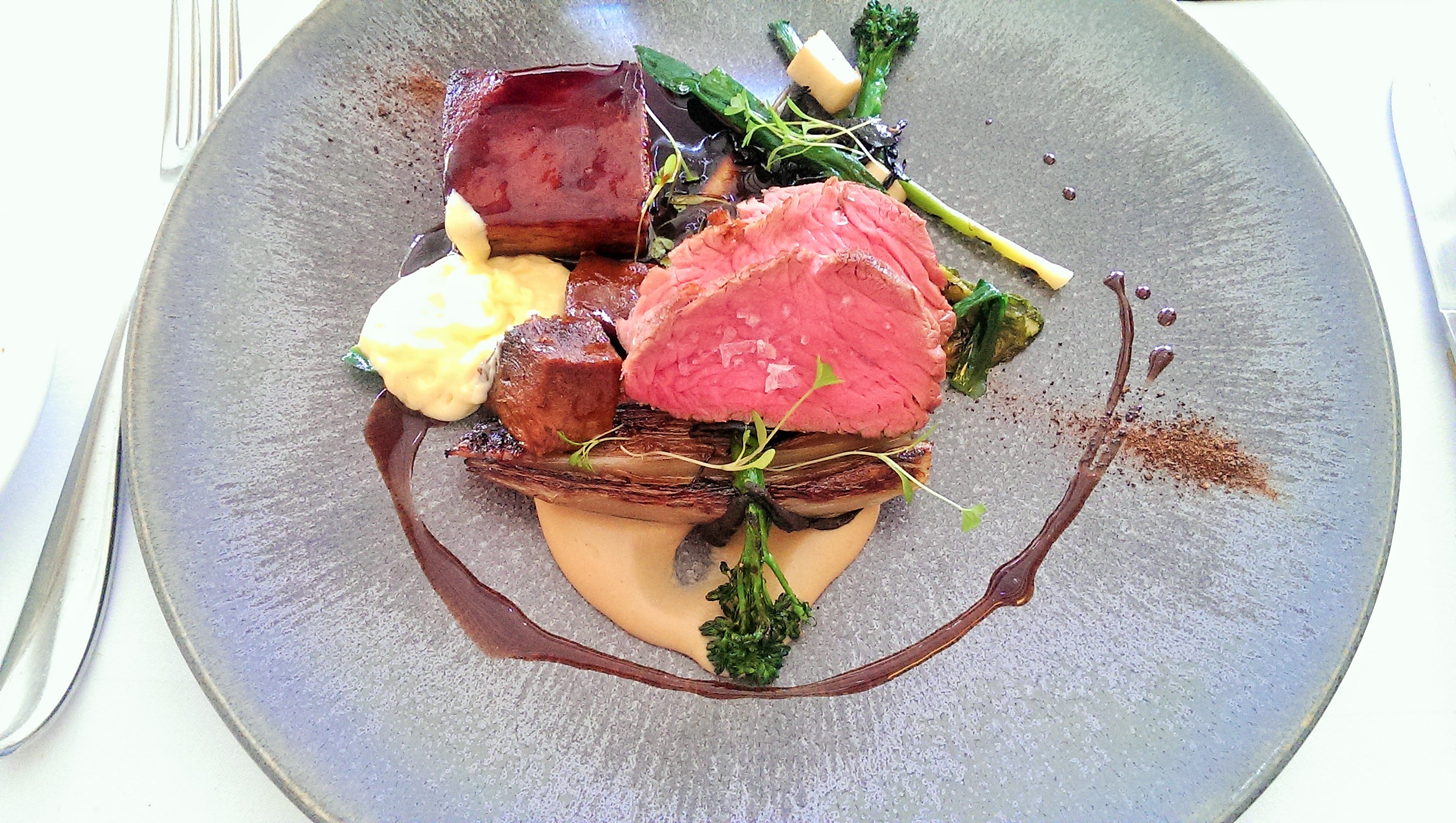
For main, the rump of beef was as lovely as the duck liver. It was three very pink (as requested) slices of beef with smoked pommes Anna on a red wine jus with bone marrow hollandaise. Underneath the beef was half a roasted banana shallot, a few pieces of tenderstem broccoli, two cubes of dense beef and a creamy mushroom sauce, dotted with mushrooms. The rump itself was a little tough under the knife but tender when chewed. The potatoes were wafer thin and richly flavoured (almost like the potatoes my mum used to cook in with the roast beef when I was a kid, although the Michelin inspectors never troubled my mum’s kitchen – or yours, I’d imagine). The shallot was sweet and the mushroom sauce was intensely flavoured. There was only one blot on the copybook – one of the cubes of beef, a big layer of fat running through it, was far too tough to cut or to eat – but apart from that, it was perfection, a high-end reinvention of a Sunday roast, where each ingredient was so concentrated and intense that size simply did not matter.

OrtBeef

The other main had sat up and begged to be ordered when I saw the menu: loin of lamb, Parmesan gnocchi, sweetbread popcorn, confit tomato. Again, it looked absolutely gorgeous, and the lamb was beautifully cooked, what there was of it anyway. But again the rest of the dish underwhelmed. The confit tomatoes were the best, little bright-coloured flashes of sweetness. The sweetbreads were an Eton reimagining of KFC popcorn chicken – nice enough but maybe not the surprise I’d been hoping for. The gnocchi was one single chewy wodge whose main role in proceedings seemed to be to show off how delicious the Pommes Anna on the other plate were. And, of course, more little spheres and splodges of sauce – along with, randomly, a smear of something that tasted like goats cheese. Oh, and more of those sesame seeds. I’ve never believed that food should ever be too beautiful to eat, but unfortunately this was more fun to look at than to eat. There was a ten pound supplement for this and I’m not really sure why, because it was smaller, lighter and far less special than the beef.

OrtLamb

More freebies followed with an impeccable pre-dessert: a little shot glass with creamy coconut rice pudding at the bottom, little cubes of rum jelly above it and a layer of passion fruit mousse at the top. I could quite easily have eaten a dessert sized portion of this. Not for the first time in a high end restaurant, I wondered why the free stuff always seems to taste the best. Maybe because it’s “free”: I know, ultimately, it isn’t but sometimes the mind is quite happy to let itself be tricked.

For dessert I simply had no choice but to have the cheese: I’d seen the cheese trolley wheeled past on several occasions while I finished the previous two courses and it was impossible to resist. There were a mind-boggling twenty cheeses on offer – going from the hard cheeses, past goats cheeses and on to some softer-rinded cheeses with varying degrees of stinkiness – all of which were explained in detail by the captain of the trolley, a really personable young man with obvious enthusiasm for his charges. I was allowed four, which were served with super thin slices of bread and crackers, and a choice of chutney and truffle honey. There were also grapes and celery just in case I wanted to offset some of the calories, although I’d given up counting by that point. The ones that stood out for me were the Burwash Rose, a rich, tangy, semi soft cheese with a rind washed in rose water and the Blue Murder, a Scottish blue so ripe it was in danger of running off the plate (or, rather, slate) and, for that matter, out of the building. The latter was particularly good with some of that honey, although the truffle couldn’t stand up to the cheese itself and was close to undetectable. This plate also attracted a five pound supplement but the variety was so good (perhaps not in the hard cheeses – I was hoping to see a really good Gruyere or Comte, but it was not to be) and the portion sufficiently generous that I didn’t begrudge them one bit.

OrtCheese

The other dessert was chocolate and cardamom ganache with orange curd and mint ice cream. Unlike many of the things I’d eaten, that was a pretty good description and – for the only time in the meal – what turned up was roughly what I’d expected to see. It was bliss: a long thin rectangle of smooth, glossy ganache, powdered with cardamom, was just gorgeous. The mint ice cream – green, fresh garden mint, a million miles from bright green mint choc chip – was so fantastic I didn’t want to pair it with anything else. The orange curd zinged with sweet sharpness. Best of all, perhaps, was the kitchen’s reinterpretation of Mint Aero – three little chunks of fluffy chocolate which imploded in the mouth, a piece of culinary pyrotechnics. Just beautiful. And, in case you’d forgotten the kitchen has a Michelin star, some pointless micro leaves.

OrtChoc

I knew the wine list would sting, and it did. As I was driving, the initial plan was to order wine by the glass but the prices by the glass were so punitive – seven or eight pounds for 125ml, easily a tenner for 175ml – that we decided it would be better value to get a bottle from the bottom end of the wine list and picked a Cote du Rhone for thirty-seven pounds (to give you an idea, that’s the fifth cheapest red they sell by the bottle). I was feeling really pleased with my bargain hunting until I got home, did some research and found that the same bottle retails for eleven pounds. Still, there was no bitter taste at the time.

Service was excellent, if a little cool. There was a constantly rotating team of waiters which served plates, cleared plates, poured wine and poured water, which gave the feeling of being continuously “served” but without a lot in the way of interaction. It was exceptionally well-run, just a tad emotionless. A few of the waiters – the captain of the cheese trolley, one of the waiters who topped up our glasses – seemed to have a little more charm, it’s just a shame that this was the exception rather than the rule. Perhaps customers at Ortolan (who do tend to be older and middle class, based on the clientèle when we were there) expect service of the “seen and not heard” variety, or perhaps my expectations have been skewed by too much casual dining. I would blame Michelin – lots of people like to – but I’ve eaten at other starred restaurants which felt a lot less, well, starchy.

The total bill, including a 12.5% “optional” service charge, for two drinks from the bar (one of them soft), a bottle of wine and three courses was one hundred and forty five pounds. So, I tried to eat cheaply at L’Ortolan and I have to say it’s just not really possible: we could have saved twenty pounds on supplements but even then it would be pretty difficult to get the bill under a hundred pounds unless neither of you were drinking.

I found L’Ortolan such a mixed bag that it’s difficult to wrap it all up in a neat and easy conclusion. I almost feel like there were two different meals here: the duck liver and beef were fantastically well-judged, well-balanced, generous and delicious dishes where it felt like there was more to them than expected. The salmon and lamb was the opposite – too delicate and light without enough oomph to stop them from being damp squibs. I guess the question is, if you went to L’Ortolan, which of those two meals you’d get. If it was the first, you’d be evangelising to friends, but if it was the second you’d be wondering what the fuss was about.

I think in the back of my mind I was partly comparing the prix fixe at L’Ortolan with the a la carte somewhere like Mya Lacarte and thinking about differences in the food, the execution, the ideas and the experience. In a straight-out comparison, I’m not sure L’Ortolan would win out very often, however stunning the building, beautiful the dishes, plentiful the freebies. Maybe that’s about me and the kind of dining I prefer, so disregard it by all means: it’s worth going to say you’ve gone, and you’re unlikely to have a bad meal if you do. But, to me at least, it still felt ever so slightly like eating in a machine – and good restaurants are a broad church of many things, but I don’t think machine is one of them.

L’Ortolan – 7.8
Church Lane, Shinfield, RG2 9BY
0118 9888500

http://www.lortolan.com/

River Spice

The single question I get asked most often, apart from where to eat, is “what do the ER ratings mean?” I’ve often wondered whether to devote a separate post to this, or to leave it an enigma. The thing is, lots of people like ratings. They want to know whether a film that’s just come out is a 4 star film or a 5 star film, and I can see why: back when I read reviews but didn’t write them I wanted to know that too. Now that I write one every week, I can see it’s more complicated than that. How can you sum a whole experience up in a mark out of ten? If I could go back and start again, I’d be tempted to miss out ratings altogether. But would I go through with it? After all, they might be difficult to decide on, they might prompt head-scratching and disagreement but, like I said: lots of people like ratings.

I’ve always hoped that the ratings on ER work a bit like those on music website Pitchfork. I can read a Pitchfork review of an album that’s rated, say, 8.0 and absolutely know that it won’t be my cup of tea (because of references to, for example, Krautrock – how exciting!), or I can read a 6.2 and rush out and buy the CD. It’s no different with restaurants: the ratings are an interesting conversation point, but there are so many other factors involved. Is it your kind of food? Is it going to be any good for vegetarians? Is it buzzy/quiet/fancy/unpretentious enough for you? Is getting to the location a faff?

Another thing I often get is people saying that my reviews are too harsh, or too kind (sometimes I get both bits of feedback about the same review) or people saying that the review doesn’t read like the rating, that the words feel like an 8 but the rating says 7. Well, I suppose if I’ve been somewhere I liked and you didn’t you’ll think I’m harsh. If I’ve raved about somewhere that left you unmoved you might think I’m too charitable.

A complicating factor is that, over the time I’ve done this, I’ve felt increasingly like being constructive. These are small independent places, mostly, and they’re trying their best – even if their best isn’t that good. I don’t have the appetite for hatchet jobs, and I know that’s disappointing because, like ratings, people really like them. So, and hopefully this will be my last word on the subject of ratings: if you read a review and it makes you feel like trying the restaurant, do. If it doesn’t, don’t. Does that sound fair enough?

Subscribe to continue reading

Become a paid subscriber to get access to the rest of this post and other exclusive content.