If I asked you to rattle off Reading’s longest-running restaurants, the chances are you’d mention London Street Brasserie. The Bina and Quattro too, over in Caversham. I’d expect you to talk about Pepe Sale, that’s a given. You might get bonus points for remembering McDonalds – the Friar Street one has been going since the Eighties – or for saying “of course, until recently there was also the branch of Pizza Hut in the Oracle”. Perhaps you’d bring up cafés like the Gorge or Rafina: the latter, in particular, is one of the last signs of pre-Oracle Reading, and hasn’t changed a huge amount in the intervening years. And, naturally, many of you might namedrop Sweeney & Todd, which has been trading for an incredible forty-four years, longer than some of you have been alive.
But would you remember Thai Corner?
The reason I ask is that often it slips my mind. It’s one of those places that feels like it has been there forever, and will be there forever, but that means it can fade into the background when you’re deciding what to eat, or talking about what Reading used to be like. By my reckoning it’s been open for nearly twenty years; I remember what was there before, an unspecial French place called Bistrot Vino, and I went there once for a Bohemian Night spinoff, but other than that it’s been Thai Corner for, well, forever.
I reviewed it back in 2014, when my blog was a mere six months old, and even then it was an old stager, having celebrated over a decade at the top of West Street. And by the time I reviewed it, it had probably already achieved that feat of fading into the background. Thai food has always been a reliable go to in this country – probably inauthentic, never amazing, rarely terrible – but it’s never had a moment where it was the hot new thing. And so Thai Corner, for those ten years and the eight that followed, has just carried on doing what it did best, whether you noticed or not.
Back before I started this blog it was a proper happy place for me, as frequently visited as the likes of Dolce Vita, and somewhere I could go on date nights or with friends visiting Reading for dinner. I had my staple dishes I always ordered – weeping tiger, sirloin steak with garlic and coriander, or pla chuchi, salmon steak with red curry sauce – and a red wine I always drank, and I never went away less than full or happy. It was a sure thing, in that way people think chains are, and I loved it there.
Anyway, the years moved on, and by the time I reviewed it for the blog I was a lapsed member of the congregation. I liked it just fine, although it didn’t knock my socks off, and my review at the time was full of faint praise in a way which, with hindsight, looks a tad condescending (so unlike me, I know). Haven’t you done well not to be closed yet? it seems to say. 2014 me had forgotten, I think, how much 2004 me liked the place. And 2022 me looked back at that and thought it was high time to go again.
Subscribe to continue reading
Become a paid subscriber to get access to the rest of this post and other exclusive content.
As a restaurant reviewer, however assiduously you do your research, however good you think you are at reading the runes of a menu to try and figure out whether a Brakes lorry regularly pulls up outside the crime scene, however much you trawl through Tripadvisor or other blogs – good luck finding those, by the way – restaurants always retain the capacity to surprise.
You can expect somewhere to be good, all the signs can say it will be, but there’s always a possibility that you’ll wind up with an underwhelming meal if you’re lucky, an out-and out-duffer if you’re not. This is especially the case when hype is involved. Or plain gratitude that a place has opened at all, either because a big name is gracing a town with its presence or because the town in question is a wasteland for decent places to eat.
The more refreshing phenomenon is when it happens the other way round, when you go to an unspecial-looking restaurant with no particular expectations only to discover that you have a proper find on your hands. That realisation that dawns gradually throughout the meal, that sense of hold on, this is really good, is one of my favourite things about restaurants, and about reviewing them. It’s happened to me a fair few times, but one that’s always stayed with me was the March evening over seven years ago when I crossed the threshold of Papa Gee.
Papa Gee, back in 2015, was an Italian restaurant on the Caversham Road, on the ground floor of the Rainbows Lodge Hotel. I’d never heard of anyone who had been to Papa Gee, and at the time I knew people who lived in Little Wales, the maze of streets on the other side of the Caversham Road named after Cardiff, Swansea, Newport. Every time I walked past Papa Gee, probably en route to a booking at Mya Lacarte, the place seemed closed.
Inauspicious was putting it lightly. So nobody was more surprised than me when I found Papa Gee wasn’t some kind of white elephant but was instead a hugely creditable little restaurant doing belting pizzas, rather nice pasta and antipasti, a family business with owner and Neapolitan Gaetano Abete, the eponymous Papa Gee, in the kitchen. I had a splendid evening, although arguably the cherry on the cake was not having to stay in the hotel upstairs afterwards.
I walked away with my faith in the world somewhat restored, and it turned out to be one of the most delightful curveballs of the very early days of this blog. And the weird thing is, people definitely went to Papa Gee before I reviewed it. It’s not as if I discovered the place: it had decent writeups on TripAdvisor and had been trading for over ten years. It’s just that I’d never met a Papa Gee customer, back then. Maybe they didn’t want the rest of us finding out.
I was worried about Papa Gee after that, because the owners of Rainbows Lodge sold the building to the Easy Hotel chain a couple of years later and the restaurant was out on its ear. But then they announced what, with the benefit of hindsight, was a perfect move – and in October 2017 they took over the old Mya Lacarte site on Prospect Street, closer to the action in Caversham.
It was a brave move to open slap bang opposite Quattro, Caversham’s long-serving Italian restaurant, and the conditions got even tougher a couple of years later when the Last Crumb, also offering pizza, opened at the top of the road where the Prince Of Wales used to be. And yet here we are in 2022 and, post-pandemic, Papa Gee is still going.
And that’s partly why they’re the subject of this week’s review. The thing is, I’d never visited them in their new home and I was starting to feel bad about that; I didn’t want them to be continually on my to do list only to find, one day, that they’d closed before I’d got round to visiting. So I made my way there with Zoë on a Friday evening, post work, the weekend stretching out ahead waiting to be filled with units and calories. Like the very first time I visited Papa Gee, a lifetime ago, I wasn’t entirely sure what to expect.
Subscribe to continue reading
Become a paid subscriber to get access to the rest of this post and other exclusive content.
One of my oldest friends lives in Swindon. Someone has to. Whenever he comes to Reading he enjoys our street food, our craft beer and our shopportunities and he complains to me – at length – that it didn’t have to turn out like this. He reckons that there was a time, back in the Nineties when all that money hadn’t decided where to coalesce, when it Could Have Been Swindon. They had a House Of Fraser, well before the Oracle opened, and that designer outlet everyone used to get so excited about. And Reading – Heelas aside, of course – was a bit of a wasteland in the mid-Nineties. Things could have been very different.
But the retail and hospitality gods smiled on Reading and, like many of us, they sneered at Swindon. We got the big names and the investment and Swindon, over the few decades, withered and died. It’s not all terrible: Darkroom Espresso is a great place to grab a coffee, Los Gatos in the old town is a tapas restaurant Reading would be lucky to have and a few doors down Rays does thoroughly likeable ice cream. But there’s a reason people who live in Swindon go to Bath, Oxford or Cirencester at the weekend, just as people from those places don’t pop over to Swindon of a Saturday.
The reason I’m starting a review of a place in Maidenhead talking about Swindon is that lately I’ve been looking at what’s going on in Maidenhead and starting to wonder if we might find ourselves in the Swindon role at some point in the coming years. Because although it’s early days, the businesses beginning to come to prominence in Maidenhead are the kind that you’d want to see in Reading instead of – hooray – a branch of Popeyes or our twentieth Costa Coffee.
Take A Hoppy Place, a credible, nicely fitted out craft beer bar a five minute walk from the train station with close to twenty beers and ciders on cask and keg. Last time I went it was doing a roaring trade and making the most of its outside space, and it was a wonderful place to while away a few hours. And although Reading has a brilliant craft beer scene – bolstered by the new addition of the Grumpy Goat’s upstairs bar – there’s nothing on that scale in the town centre.
And then there’s Seasonality, which recently got a rave review in The Guardian. It started in lockdown as a deli also selling heat at home meals, and has since morphed into a restaurant offering an interesting and inventive menu. It’s tasteful, gorgeous looking and independent: you could count the number of restaurants like that which have opened in Reading in the last couple of years on the fingers of one stump. With the winter we have looming, and the town’s famously charmless landlords, can you imagine one trying their luck here in the next twelve months?
Finally, the subject of this week’s review which might be the most interesting of the lot. Flour and Sauce opened in March as part of Maidenhead’s Waterside Quarter and seems, on paper at least, to be an example of a London trend that hasn’t so far made it this far west, the pasta restaurant. And by that I mean that, from a look at the menu, it seems to be modelled on Borough Market’s famous Padella and the hugely influential Bancone along with more recent imitators.
Those places – offering starters, a selection of pasta and not much else – have been one of my favourite trends of the last few years. They’ve given dishes like silk handkerchiefs with confit egg yolk or bucatini cacio e pepe iconic status and at their best they make for fantastic mid-priced casual restaurants. Throw in a negroni to start and a decent dessert at the end and you have the blueprint for a marvellous lunch or dinner: I’ve eaten at the original Bancone in Covent Garden a few times and never had a meal there that was less than splendid. So was Maidenhead boasting an example of this very London trend by virtue of its place on the Elizabeth Line? I wanted to find out.
It looked gorgeous from the outside, all white columns and full length windows. And it had the feeling of a fully realised concept, with clear branding, although something was niggling and bringing out my inner Mary Portas. Was it the name? Somehow it felt like it should be Flour And Sauce, both in chronological and alphabetical order. And the slogan – Wine Meats Dine – might have worked as a pun, but it didn’t seem to descibe what they actually did.
Going inside and taking my table brought out my inner Michelle Ogundehin. It was a big deep room but everything was somehow disconnected. The furniture didn’t match, but not in a charming way or even a calculated one, more as if they’d run out of stuff. I saw three different types of chair, one of which was the ubiquitous Tollix I associate with far cheaper food and greater discomfort.
Likewise the lampshades didn’t match, but not in a way that made sense – including the ones over the window seats which looked like grass skirts humping a lightbulb. There were some cheap shelving units from Ikea along one wall and a completely incongruous pine Welsh dresser at the back. It all felt thrown together, as if they’d opened in a hurry – and of course it might well have been. The faux marble wallpaper along one wall, already slightly peeling at the joins, might have gone on in a hurry too.
“It’s funny” said Zoë. “You walk in and think ‘this is nice’ but then the longer you look at it the more jarring it gets.”
I don’t think it helps that we got arguably the worst table in the place. The restaurant wasn’t really broken into zones, and we had the last free table – right at the front, near the open door. It was a bit chilly, and with people traipsing past in either direction it felt like eating in a corridor – especially when at one point a large group decided to stand right next to our table and chat to a couple eating up at the window for the best part of ten minutes. The window seats, by the way, are probably the best place to sit if you’re in a pair: the counter is lovely and deep, and you get a great view (and, therefore, superb people watching opportunities).
The menu was a little like the room – superficially attractive, but the closer you looked the more you wondered. At places like Bancone, the array of pasta dishes all involve different types of pasta which gives you a much wider range of choices. By contrast nearly all the pasta dishes at Sauce And Flour revolved around relatively similar shapes, and not too many of them, so you had multiple permutations of pappardelle, tagliatelle, linguine and bucatini which made up all but one of the pasta dishes on offer (the exception was a penne dish: what kind of a monster orders penne from choice?). I was hoping to see some ravioli, something like trofie or orechiette, a little more variety.
And while I’m whinging, the drinks list was irksome too. A reasonable selection of wine, but only one of each colour available by the glass. Come in a group or don’t bother, that seemed to say. And the pricing of the solitary red, white and rosé were absolutely nuts: the menu sold wine in 125ml and 250ml glasses with no option in between. And if you did decide you wanted a small glass of wine they stung you, with most of them costing only two pounds less than the large glass (I mean, you could say the large glasses were a relative bargain, but I suppose I’m a bit more large-glass-half-empty).
The irony wasn’t lost on me: I’ve moaned for years that not enough restaurants sell wine in 125ml glasses, and here I was in a place where it was one of the only options. But it felt badly thought out. There were two beers on offer, those ubiquitous macro lagers Peroni and Moretti. I took another look, thought fuck this and ordered a large bottle of San Pellegrino.
Would the food redeem matters? Some of it came close. We started with some thoroughly decent dishes from the starters menu and for a while I thought my tetchiness would be held in check. The pick of the bunch – of the whole meal, in fact – were the short rib beef croquettes: three beautiful specimens crisp of shell and packed with soft, yielding, slow-cooked beef. They were perched in a little moat of spiced mayonnaise which might have had a kiss of ‘nduja, and each had a slice of pickle draped on top which was more sweet than tart and tied things together nicely.
There were three of these and I let Zoë have the spare because she was so underwhelmed by the next starter, although I didn’t like it much better. Squid – “body and tentacles” according to the menu, which I think is TMI – was meant to come fried with ‘nduja but was actually in a thin, vinegary sauce with capers and no heat or seasoning. All the squid was bouncier than you’d like, and just made me think wistfully of better squid I’ve had in the not too distant past. It came with a long transverse slice of focaccia toast which was so rock hard that trying to cut it with a knife and fork left me worrying that half of it would ping off and hit the next table. A pointless blob of squid ink mayo perched on it, looking like a dirty protest.
Finally, I wasn’t sure what “warm buttermilk garlic bun & parmesan” would turn out to be, and the answer is essentially this: four giant dough balls. They were about as nice as giant dough balls can be, strewn with Parmesan and rosemary, and I squidged a piece into the sauce that came with the squid to verify that yes, it really was that dull.
Mains were better but, and this is rather a theme, not exactly as billed. My linguine puttanesca was solid, I think. The ribbons had just enough pleasing bite and the sauce, a combination of all my favourite things, worked well. It had the note of acidity from the capers, a pleasant hum of chilli in the background and beautiful, plump olives. I felt like it needed more anchovy, but then I feel that way about the world in general so this dish was hardly an isolated incident. I’d paid extra to have some yellowfin tuna in the mix and I think I spotted a couple of forkfuls, but that was it. Not bad at all, and not bad value at fourteen pounds, but in the wider context of the whole meal it was doing a lot of heavy lifting.
Zoë’s dish, slow-cooked duck ragu with tagliatelle, had sounded good on paper and she enjoyed it, but from what I tasted it didn’t quite work. Again, the menu was misleading: this didn’t feel like a ragu at all, and the pieces of duck leg I ate didn’t have that tenderness I associate with slow cooked sauces. This hadn’t been reduced for a long time in red wine and tomatoes, it was a white ragu if anything, but it felt like the duck had been added to the white wine and mascarpone right at the end.
And it tasted pleasant enough, but if I’d ordered it I’d have been disappointed: perhaps the kitchen’s other ragus – one made with beef shin, the other with pork and ‘nduja – showed off their skills better. Zoë couldn’t finish it – you can’t fault the portion size – but by the end the sauce had pretty much solidified which made it a challenge. I will say this for Sauce And Flour, though: both pasta dishes had the welcome crunch of judiciously added pangrattato, and it’s hard to completely take against a restaurant that does that.
We decided to try dessert, to give the place a fair crack of the whip. They too were pretty representative of the whole Sauce And Flour experience. Zoë’s tiramisu was decent, and she loved the mascarpone and the leftfield inclusion of Kahlua, but it was a lot more cream than sponge. It didn’t dampen her ardour for Buon Appetito’s magical pistachio tiramisu, put it that way.
I went for the cheese selection and for one person, for seven pounds, I thought it was generous. They have a big deli counter just along from the open kitchen so you can see the staff cutting and preparing the cheese plate, and maybe if I’d had better eyesight I could have worked out what they were. But with the exception of a gorgeous, crumbly Parmesan with decent age which I left until last, I have no idea what they were because the wait staff just plonked them down and sodded off (the menu doesn’t say, either).
The others were a mix of a soft cheese that might have been Brie but possibly wasn’t, a hard cheese that could have been pecorino but probably wasn’t and a couple of other cheeses which honestly could have been anything. Maybe it was the adrenalin, or maybe I was just high on life and drunk on San Pellegrino but I have absolutely no idea. I do know that they came with crackers which tasted a lot like water biscuits and a little dish of something the menu just calls “jam” which tasted of surprisingly little.
Not telling us what the cheeses were was pretty consistent with service in general: it wasn’t unpleasant or rude, just distinctly brisk and disinterested. Maybe it’s because they were busy, but it lacked warmth – and I’m not just saying that because I was sitting by the open door. For me, that was arguably the biggest drawback about Sauce And Flour because it’s the thing – over and above the quirks of the menu or that sore thumb Welsh dresser – that badly needs to be fixed. Our meal came to just over sixty-seven pounds, and included a ten per cent service charge I’m not entirely sure was warranted.
On the train home, Zoë and I mused about exactly what had been missing from our evening.
“The room wasn’t that bad, and some of the food was very good, but great service would absolutely transform that place” she said. And she’s right. Sauce And Flour is a curious beast. It looks, on paper, like an attempt to recreate those specialist pasta restaurants in the capital, but scratch the surface and I have a horrible feeling that it’s actually just a reasonable Italian restaurant with a more limited menu. Like the faux marble wallpaper, it might look the part from a distance but underneath, it’s already peeling. So we can relax: Reading isn’t missing out, not this time anyway. If you want to leave town to eat superb Italian food, take a train to Mio Fiore.
What it really made me think about was the glory days of Dolce Vita, at the height of its powers. I loved Dolce Vita, but let’s be honest: the room wasn’t the best in Reading, and a fair amount of the food didn’t quite live up to its reputation (mainly, ironically, the pasta and pizza dishes). But because of the service, you never cared about that. You’d go back time and again, and it always felt like having friends cooking for you. And if I’d gone to Dolce Vita and there had only been one wine by the glass, I wouldn’t have given a shit; I don’t think I ever went there without ordering a bottle anyway. Trends or no trends, Reading doesn’t need a Sauce And Flour. But there will always be room for another Dolce Vita.
Sauce And Flour – 7.0 4A High Street, Maidenhead, SL6 1QJ 07516 948421
Can you believe that this is the first time I’ve ever reviewed a restaurant in Oxford? Crazy, I know: it’s half an hour away by train and probably the place most readers ask me to consider when it comes to casting my net a bit wider. And yet, for a variety of reasons, I’ve never gone there on duty. For a long time, it’s because there was no gap in the market. Not because Oxford has a thriving local press – they have an iffy Newsquest paper and website, just like we do – but because it had a superb restaurant blogger, In Oxford, Will Eat, and she did such a good job that I had no desire to step on her turf.
Then she got a job in Brussels, and I considered expanding north, but shortly after that I got divorced and took some time out. And when I came back, about a year later, loads of new Reading restaurants had sprung up during my hibernation – so many, in fact, that I had my hands full catching up with them all. So I got that under control and my thoughts turned to Oxford again, and then bang: along came the pandemic. The works always seemed to have a spanner in them, to the point where I wondered if it just wasn’t meant to be.
But a couple of weeks back I decided that life was about as close to normal as it was likely to be any time soon, and Zoë and I had a Friday off together, and Oxford was calling to me. It’s a funny place, in lots of ways: I lived there for four years in the mid-Nineties and back then the gulf between town and gown was so pronounced that it felt like a bit like my ex-wife and I sharing a flat for five months while the divorce got sorted: a deeply uncomfortable, unsustainable cohabitation between two very different halves. As a student, if you walked into the wrong pub – I did it once on my first week at university, and never repeated the mistake – you could almost feel the threat of violence in the air. Mind you, at nineteen I probably provoked that response often.
Nowadays it’s a city far more at ease with itself, and walking its picturesque streets on a sunny Friday morning it seemed the far bigger problem was tourists, a group locals and students regard with equal levels of animosity. Oxford is an interesting place to compare with Reading, because it has a lot of the things Reading does not – an excellent covered market, nice little enclaves of independent shops, areas like Jericho (which is what Caversham wishes it was) or the Cowley Road (ditto, but for the Oxford Road).
It has a more upmarket mall, too, in the shape of the Westgate, and better, fancier chains than the ones we get saddled with. Pizza Pilgrims, Shoryu, Mowgli and Le Pain Quotidien all operate there. Our branch of Leon got canned and people are eagerly awaiting the opening of Gail’s where Patisserie Valerie used to be: Oxford has played host to both for years. And last time I checked, Oxford didn’t have a Taco Bell or a Jollibee. How on earth do they cope?
But it’s not as simple as that, because spending time in Oxford makes you realise that despite all its chocolate-boxiness it lacks things that we take for granted here in Reading. Street food, for one – the Covered Market is great but Oxford has nothing like Blue Collar, and the market in Gloucester Green is much more variable. Craft beer is another shortcoming – Oxford specialises in a certain kind of pub, popular with tourists, cask spods and “pubmen” (they’re always men), but it’s a struggle to find anywhere that serves more interesting stuff since The Grapes, the West Berkshire pub on George Street, closed at the end of last year, with the notable exception of Teardop, a nanopub in the Covered Market. It closes at half-five.
And what about restaurants? Well, this is another area where Oxford has never been considered quite as good as it should be. It has some cracking restaurants, and I’ve paid them many visits over the years: modern Italian Branca in Jericho, lovely family-owned Pierre Victoire on fairy light-strewn Little Clarendon Street, bright bustling Arbequina dishing up tapas down the Cowley Road and swanky Pompette out in Summertown. But those seem to be the exception rather than the rule, and beyond that top tier there are a fair few places trading on past reputation and others that just couldn’t make a go of it.
That last category tells a story all on its own, because I’ve eaten at so many lauded restaurants in Oxford that that didn’t survive. Places like The Oxford Kitchen (it won a Michelin star in 2018: now it’s a delicatessen), or Turl Street Kitchen, the Anchor or even The Rickety Press, before the pub was acquired by Dodo Pubs, the owners of our very own Last Crumb. It makes you think: we get our sackcloth and ashes out because Clay’s is moving to Caversham – well, those of us who don’t live in Caversham do, anyway – but Oxford has a bit of a track record of not being able to support good restaurants. What’s that all about?
(I should add that if by some chance you’re reading this and you live in Oxford and I’ve got the place completely wrong, please go easy on me. Let me know all the great places I’m missing in Oxford, in the comments, and I’ll make sure I add them to my to do list. And do accept my apologies: I too live somewhere where we’re used to being misjudged.)
Anyway, for my inaugural Oxford review – just as with my first ever Reading review all those years ago – I picked a proper happy place. And I couldn’t think of a better establishment to start with: the Magdalen Arms is a gastropub down the Iffley Road with impeccable credentials, part of a group which includes the legendary Anchor & Hope on Waterloo’s The Cut and, for many years, Great Queen Street just off Drury Lane, a sadly departed favourite of mine. It’s a bracing walk over Magdalen Bridge, or you can just hop on a bus outside Queens College and be there in just over five minutes.
The Magdalen Arms has been trading in its current incarnation for nearly thirteen years and has been reviewed glowingly in every broadsheet you care to name, although not for some time. It’s reached the stage, I suspect, where it’s been doing its thing consistently for so long that it’s just become part of the furniture, a position I can identify with. Even as far back as 2010 Matthew Norman in the Guardian said “Being the best restaurant in Oxford may not be a glittering accolade”, proving that smug tossers talking the city down is by no means a new phenomenon.
Anyway, I’ve been coming to the Magdalen Arms for longer than I can remember. Usually for the pie, which serves two and seems mandatory to order in most of the reviews I’ve ever read. Arriving on a clement summer afternoon the pub was every bit as handsome a place as I remembered. It’s a big old place made up of two huge rooms – a gorgeous one at the front with deep red walls and an almost continental feel, and another at the back which I’ve never taken to. Most of the customers on the day we visited were sitting outside, so we got a cracking table next to the window. I was surprised to see the place so quiet – on a Sunday lunchtime it tends to be heaving – and although I wasn’t complaining I was slightly concerned.
The Magdalen Arms’ menu has always been relatively compact, but seemed more narrow than I remembered. You had a choice of five starters and a couple of larger ones to share, and just the three main courses alongside two options for larger groups. It meant deciding was simultaneously easier and harder than usual, an interesting dilemma, and the fact that there was no pie on the menu – anyone would have thought it was the height of summer – forced us to pick a Plan B.
But while we made up our mind they brought us some squares of their exemplary focaccia and a shallow dish of deep green olive oil, all grass and pepper, and from that point onwards all decisions felt slightly de-risked. That feeling was reinforced by the arrival of a bottle of petite syrah, an agreeable chorus of red fruits and spice, and I remembered that there’s little better than a leisurely lunch on a Friday with your favourite person, the sun pouring through the window and the rest of the world at work. Returning to a restaurant you love is one of the nicest reunions there is, and I realised it must have been three years since I’d sat in that room and made those enviable choices. It was all going to be okay.
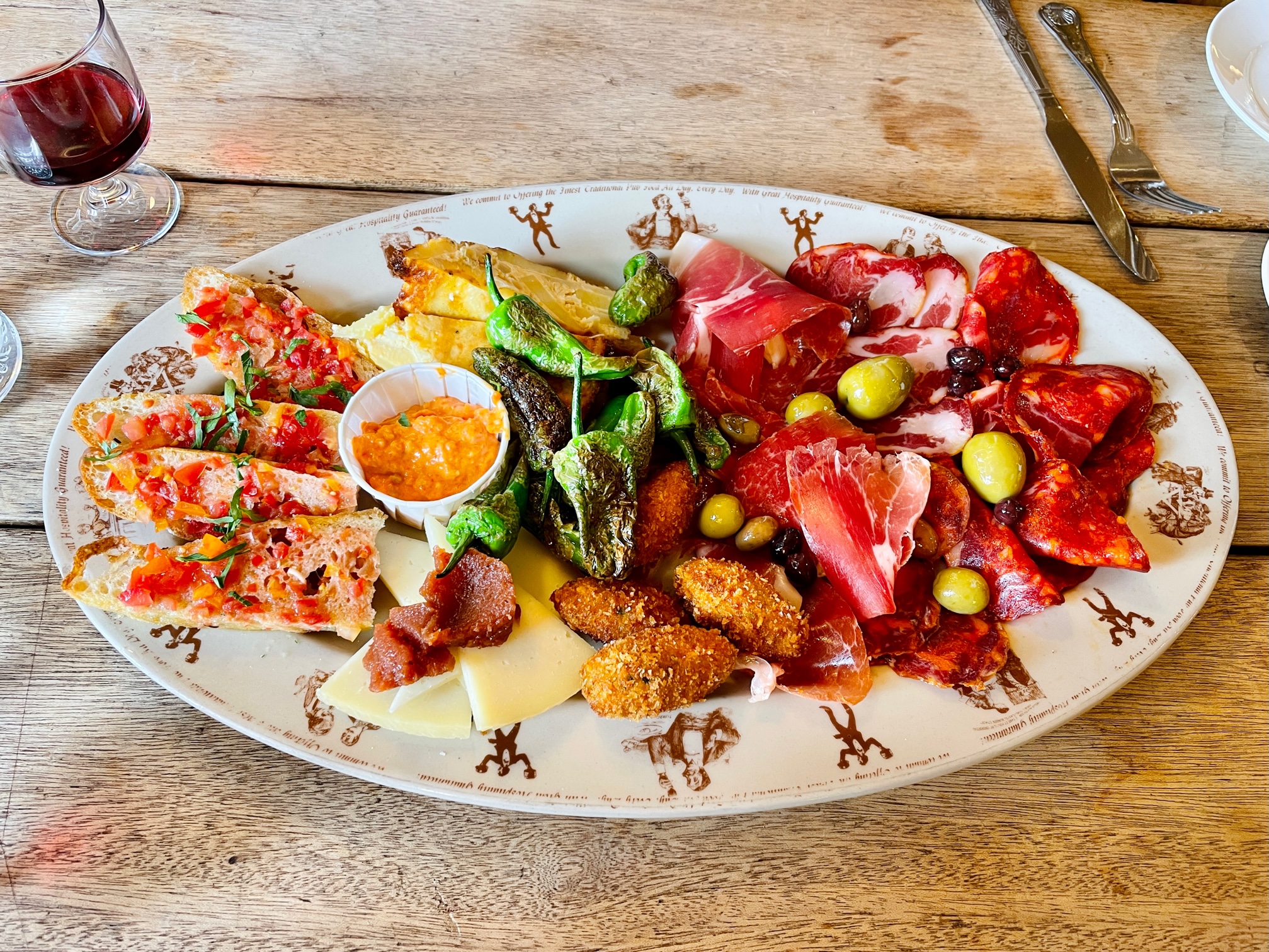
We started with something I’ve always eyed up but never ordered, a Spanish sharing plate. It came looking like a still life, and the best of it was very good indeed. Pan con tomate, toasted bread rubbed with tomato and herbs, was bright and summery and I could have eaten an awful lot more of it. And the manchego, if slightly fridge-cold, was perfect with a little lozenge of quince paste. Padron peppers were nicely blackened, too, although I personally like to see the blighters studded with salt. By contrast, these were slightly underpowered.
The least effective parts, for me, were two of the mainstays of Spanish food. Croquetas were a pleasing shape and size but the inside was coarse, not a silky bechamel, and had a strangely sweet tang to it. They were pepped up with a dab of romesco (served in those comical cardboard tubs used for hospital meds), but the romesco didn’t have the punch it needed. Similarly the tortilla was okay, but just okay – cooked through, a solid slab of eggs and carbs. I’ve been spoiled by its gooer sibling on the Cowley Road, but it did just fine.
We were on safer ground with cured meats, although again these would have been even better closer to room temperature. The Jamon was coarse and salty, with a beautiful dry texture and the lomo, which looked more like coppa, was equally delicious. And there seemed to be two different kinds of chorizo – both were gorgeous but one had that glorious alchemy of meat, fat and pimenton down pat. The plate was strewn with olives, although I did find myself wishing for something like some caperberries to add the sharpness that was missing.
But it was a thoroughly respectable thing to eat. It certainly could have served more people less greedy than Zoë and me, and felt like reasonable value at thirty-three pounds, just about. It did get me thinking, because this is one of my favourite kinds of dishes to share and many places in Reading try to offer something similar without quite getting it right: only Buon Appetito, with its ridiculously generous antipasto misto, gets close.
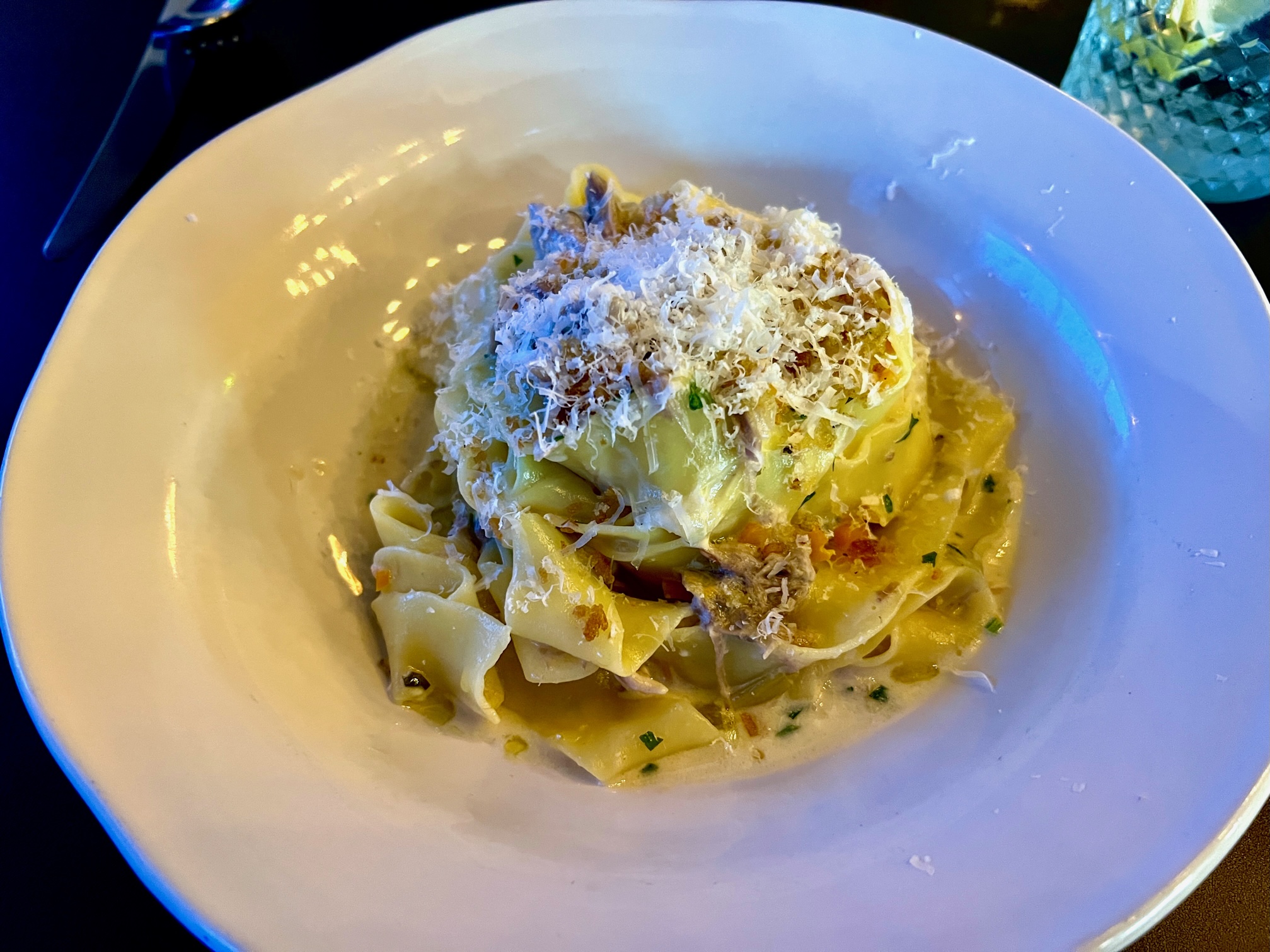
Normally I would order a different main to my dining partner, but the menu at the Magdalen Arms was so compact that when we wanted the same thing I decided neither of us should go without. I’m so glad I did, because the Magdalen Arms’ pigeon ragu with pappardelle was one of the nicest lunches I’ve had in a long time. The pasta was just right, with exactly the right amount of bite, a perfectly starchy vehicle for a wonderful ragu with celery and a little nip of what I thought might be fennel.
The pigeon had largely been slow-cooked into strands, although a handful of more stubborn clumps remained, but it was really no hardship to polish off every mouthful. If you have just one plate at lunchtime, it’s difficult to imagine something nicer than this – that includes the Magdalen Arms’ pie, by the way – and at sixteen pounds it managed the unusual feat of being cheaper than our starter; the more I think about it, the more I think that starter was meant to be shared between more than two people.
Oh, and we also had some chips with aioli: they didn’t go with anything but it’s hard to pass up chips with aioli. The chips were great – I think the food blogger chip cliché is to wank on about “rustle and snap”, whatever the fuck that is – and although the aioli was good it came in another of those mingy paper cups and I had to ask for more. Not that it was any trouble: service was terrific from start to finish, just as it always is at the Magdalen Arms.
You would think, given everything I’ve said, that we passed on dessert. But you’d be misjudging how thorough (or how gluttonous) I am. My ice cream was excellent and again – bit of a theme here – hugely generous, with an enormo-scoop of a deep, bitter chocolate gelato and a pistachio ice cream which felt to me, both in terms of colour and flavour, to have more of a marzipan note to it. I love the stuff, so I was happy if I’d been missold.
Ice cream is another of those things Oxford does well and Reading does not, so the Magdalen Arms’ ice cream isn’t as good as the stuff you can get from Swoon Gelato on the High, but it’s still miles better than anything you can get in Reading. And to reverse the trend, the Magdalen Arms’ Basque cheesecake was nice enough – and the roasted apricots were a nice touch – but I’ve had better at Geo Café from the rather literally named Reading Loves Cheesecakes.
Replete, with the post-lunch fuzziness that comes from a good bottle of wine, I could have happily whiled the afternoon away there, watching afternoon smudge into evening and seeing the pub come to life again on a Friday night, buzzing with happy diners. But I had my eye on a coffee from the brilliant Missing Bean, who have a roastery literally around the corner, and that stroll back into the centre wasn’t going to get any easier.
So we settled up and went on our way. Our bill came to a hundred and twenty-three pounds, including a twelve and a half per cent service charge. Not cheap, but not unreasonable – and the menu does have a set lunch every day including a small glass of wine for twelve pounds: if Reading had an offer like that I would probably use it often. Come to think of it Pierre Victoire also does a killer set lunch, so perhaps this is another one to chalk up as something Oxford does far better.
So, no real surprises here; the nice thing about having a long relationship with a restaurant is that, unlike romantic relationships, there’s something rich and deep about reaching that stage where you move beyond infatuation and into comfortableness. I expected to have a good meal at the Magdalen Arms, and I did. I knew it might be amazing, which in honesty it wasn’t, but I could be absolutely certain it wouldn’t be mediocre. Restaurants and pubs like that are to be celebrated, wherever they are, and I knew for a fact when I left on that Friday afternoon that I would be back, and hopefully before too long. But just to compare Oxford and Reading one final time, would I swap it for the Lyndhurst? Not in a month of Sundays.
At the start of every year, the broadsheets wheel out an article about the food trends of the coming twelve months. And every year, nobody checks the article from the previous January to verify that almost none of the trends became a thing. Peruvian food never took off, beyond a couple of places in London. Neither did corn ribs, hard seltzers, carob, eringi mushrooms.
But it fills a gap for column inches in January, among all the clean eating/“new year new you” articles they dust off and spruce up at the start of every year. And besides, it’s not like anybody’s keeping score: from this year’s predictions, keep an eye out for potato milk, whatever that is. It has another four months to become famous (they sell it at Waitrose, where reviews run the full gamut from “another unsatisfactory milk alternative” to “very neutral tasting”).
Anyway, Reading food trends aren’t like London food trends, because every year since I started this blog the trend has been pretty much the same: you’ll get more cafés, and some dickheads will complain that we have too many cafés. You’ll get more burger places, and some dickheads will moan that there are too many burger places. And, in recent years, you’ll get more American chains and some dickhead will whinge about the Americanisation of Reading. And yes, that last dickhead is me.
The real trends are the ones that blindside you. Late last year and early this year it was biryani places, with a mini explosion of options – Biryani Mama in town, Biryani Boyzz on the Oxford Road and, just opposite it, the interestingly named Biryanish (“it’s sort of like a biryani…”). And then in the last few months, the trend literally nobody saw coming: three Japanese restaurants opening in the space of two months. Did anybody predict that on New Year’s Day?
I’ve always loved Japanese food, but Reading’s never been incredibly well served for it. In the centre, you had Yo! Sushi and Sushimania, and both have their place: Yo! Sushi in particular democratised sushi and acted as an introduction for many people, me included. And I’ve always enjoyed heading to Sushimania after a day at work with Zoe, grabbing seats on the banquette and looking out on the dining room with a cold bottle of Asahi.
More recently Oishi opened down the Oxford Road: I loved it when I went, but for a while it had an alarming hygiene rating which put me off a return visit. And of course there’s Osaka which I liked but didn’t love, although I visited it during one of the weirdest months the world has ever seen. But for a more special meal I’ve always headed to Windsor, to eat at Misugo (recent discovery Miyazaki is an excellent alternative). Did any of Reading’s newcomers have what it takes to displace Misugo in my affections?
Subscribe to continue reading
Become a paid subscriber to get access to the rest of this post and other exclusive content.






 Edible Reading