Restaurant review: Gordon Ramsay Street Burger

Gordon Ramsay Street Burger closed in March 2025 for the foreseeable future. I’ve left the review up for posterity.

“What’s your angle for this one?” said Zoë when I told her this week I was going to review Gordon Ramsay Street Burger – or just Street Burger, because they use both interchangeably, but not Ramsay Street Burger which conjures up images of Lou Carpenter, a man a million miles away from being a beefcake. “You can’t go on about burgers again, because you did that a few weeks ago.”

“There’s only one thing for it, I’ll have to talk about Gordon Ramsay.”

Ah yes, Gordon Ramsay. What’s left to say about him, with his curiously line-free forehead, the gratuitous shirtless shots in Ramsay’s Kitchen Nightmares, the countless omelettes contemptuously tossed in the bin and all those expletive-laden meltdowns (he may be one of the only people alive who swears more than my other half). And that’s before we get on to his complicated life: the man’s father in law went to prison for hacking into his emails, for goodness’ sake.

And yet, I don’t really have an opinion on Ramsay. I dimly remember Kitchen Nightmares being watchable and full of good sense: don’t do too much, have a compact menu you can actually execute, advice many restaurants would do well to follow today. And I watched some of his American shows, which were usually plain nuts, but after that I never gave him much thought, except to vaguely think he was gradually becoming a parody of himself, as so many of us do. Describing Gordon Ramsay: done.

I knew that Ramsay had a vast restaurant empire, that his eponymous restaurant in Chelsea still had three Michelin stars, and I knew he had trained under Marco Pierre White before fostering the talents of Marcus Wareing, Angela Hartnett and Clare Smyth, all now Michelin starred themselves. But I didn’t see Ramsay as a chef these days, any more than I did Jamie Oliver. Crucially, I doubted he had an awful lot to do with Street Burger, which opened last month in the Oracle.

But looking at TripAdvisor before my visit, I was struck by how many reviewers held him personally responsible for their meal. “Sorry Gordon, I won’t be rushing back!” said one, followed by “Sorry Gordon, I wanted nothing more than to enjoy your place today… but today’s food didn’t reflect you or your food at all”. I was reminded of the types who reply to celebrities on Twitter, blissfully unaware that their bons mots will never be read. “My wife and I were very excited to be going to Gordon Ramsay’s, albeit a Street Burger” said a third. And then the coup de grâce: “We had high expectations as it has Gordon Ramsay’s name attached” said a disappointed diner.

Come off it. Gordon Ramsay’s probably never even set foot in the kitchen of his Reading restaurant – hadn’t these people been to Jamie’s Italian? Yet other TripAdvisor writeups painted a positive picture: many praised the service, and a lot did that thing where they name-checked a particular server (Sam and Lauren seemed especially legendary). So, a curate’s egg: I reckoned that alone made it interesting enough to visit.

“I’ve read the TripAdvisor reviews” said Nick as we took our table, and I realised I might finally have found a dining companion who did more homework than me. “They’re surprisingly good, although people seem unimpressed by the bottomless soft drinks.”

We sat outside – a combination of my caution and a temperate evening – so we definitely didn’t get the best of the restaurant, because the inside looks good. It’s more reminiscent of an upmarket steakhouse than a burger restaurant: it’s how Miller & Carter ought to look, instead of resembling an airport Wetherspoons with its whiff of bad carpet and pre-vacation despair. Street Burger had booths and banquettes, fake brick-effect wall panelling and faintly abstract wall art and struck me as an agreeable place to spend an hour eating a burger. Maybe that’s why it was doing so well.

The menu purported to be a model of simplicity: any burger with fries and the aforementioned bottomless soft drink for fifteen pounds. A bit random, because it meant that their basic cheeseburger (the “O.G.R.”) cost exactly the same as the even more dismally named “#BAE Burger” – yes, it honestly has a hashtag in the name – which is the same, but with bacon and a fried egg.

Names aren’t the restaurant’s strong point – their lamb burger is called the “Where’s The Lamb Burger?”, which strongly implies that it doesn’t contain any lamb. It does (a sharp-eyed reader has since pointed out that this is an in-joke referring to a much-memed moment: if you’re explaining, you’re losing). But what do you expect from a restaurant that calls itself “Street Burger” when it’s neither street food nor even – in the case of the Reading branch – on a street?

It’s a more limited menu than at Ramsay’s original burger restaurant in Vegas. There you choose from eleven different burgers (including the “UK Burger” made with something called “Dubliners’ Cheese”: geography’s not a strong point either). But in Reading there are just three beefburgers, that lamb burger, a chicken burger, one vegetarian and one vegan option. They don’t say anything about gluten, so I can’t say whether they offer gluten free buns.

The devil was in the detail because it’s all about the extras. If you want to swap your bottomless fizzy drink for something alcoholic – two beers and just over half a dozen wines are on offer – or a milkshake, that will be four pounds. Sweet potato fries? An extra two pounds fifty. And you can “wagyu up” – because that’s a verb now, I’m afraid – for a fiver (“the reviews on TripAdvisor say it’s worth it, so I’ll definitely do that” said Nick). There’s also an extra called a “cheese skirt”, which sounds like something half of Buck’s Fizz would wear but is in fact an extra slab of grilled cheese.

We placed our order, with various add-ons and extras, and waited to see whether our mild to moderate cynicism would be justified. I should add that we had Lauren looking after us and she was unreservedly lovely all evening: bright, friendly and enthusiastic about the food (between us we ordered her favourite shake, her favourite burger and her favourite add-ons – and if she says that to everyone, she’s at least very plausible). We were one of only two groups sitting outside, but never felt forgotten or neglected. 

Both Nick and I have a weakness for milkshakes so we went large, so to speak; I have the build of someone who likes milkshakes, while Nick has the build of someone who likes milkshakes but does lots of running so he doesn’t end up looking like me. He loved his sticky toffee pudding milkshake (“it’s got nuggets of toffee all the way through it, exactly what I was hoping for”), I thought my Oreo milkshake was okay: clearly made with ice cream, and beautifully, head-freezingly cold, but I’d have liked it to be slightly bigger. I could have done without the squirty cream, which makes it look larger without bringing anything to the table. On the menu shakes cost six pounds fifty: both that, and the four pound upgrade, felt a bit sharp.

“I miss the milkshakes at Ed’s Easy Diner.” said Nick. You’d be surprised how many Reading residents have said this to me. “There’s nothing like a malted shake.”

Our food came out relatively quickly, and this was the point where we had to start eating both our meals and our words. Because really, there was lots to like. I’d chosen the fried chicken burger and was pleasantly surprised. It had good spice and crunch, a slightly soggy hash brown underneath, a good whack of cheese and a piquant bright orange sauce, much of which had seeped out onto the tray. The hash brown felt  like padding, and the whole thing was almost well-behaved and prim – you didn’t quite have to unhook your jaw to eat it – but what was this strange feeling? Could it be that I was… enjoying it? 

As if he was reading my mind, Nick spoke.

“You know what? This really isn’t bad at all.”

Nick had gone for the hashtag burger (I can’t type its real name out again, and you can’t make me) and again, it looked pretty decent – a sensible size with a glorious-looking fried egg and nicely crispy bacon in the mix (“it’s streaky”, he confirmed). A good firm brioche bun, too, which didn’t go to pieces the way, say, Honest’s sometimes can. Nick seemed to be thoroughly enjoying it.

“It’s not as hot as it could be” he said, “because they’ve used these stupid trays.”

“Tell me about it, mine too. It’s like the hubcaps they use at the Last Crumb that mean your pizza’s cold by the time you’ve finished your first slice.”

“But that aside, it’s really good. These chips are good too – they’ve got proper crunch to them.” I agreed with him, and even as they got a little lukewarm they were still well worth dipping in ketchup and dispatching.

“Was it worth upgrading to the wagyu?”

“Not really, but then I’ve not had their normal beefburger.”

“But how does the wagyu compare to, say, a normal burger from Honest?”

“I can’t say I notice enough difference.”

We’d also ordered onion rings and, just as with the rest of our meal, they were well executed, but with just enough shortcomings to irk you. Laying them all out flat on one of those thin trays, in a weird homage to the Olympic logo, just meant they went cold quicker (and exposed how few you got). But even so, they were worth ordering – they held their shape well and the batter had seeds in it which gave an excellent texture and an extra dimension. They were great with both the dips they came with and again, even as they cooled we still wanted to polish them off.

“I prefer these to Honest’s onion rings” said Nick. “With those, some of them feel like they’re practically all batter.”

Having unexpectedly won us over with the food, reality bit when our bill arrived. All those extras mount up, and our bill – for two burgers, fries and milkshakes with a portion of onion rings – came to just shy of forty-eight pounds, not including service. But another feature of Gordon Ramsay Street Burger, which has attracted a fair bit of ire online, is that the “optional” service charge is a whopping fifteen per cent. 

That’s one thing, but the way it’s presented on the bill is disingenuous. Nowhere on the bill does it tell you what percentage they’re using, but because the service charge appears directly below the line breaking down VAT at 12.5% it felt to me like some deliberate misdirection was taking place. I paid it happily, because Lauren was excellent, but if I’d had a burger and fries and spent some time serving myself refills of bottomless soft drinks I might have felt peeved about being stung for fifteen per cent.

We left discombobulated and in need of a drink – and even now when I reflect on Street Burger I’m not entirely sure what I thought, because it confounded my expectations in almost every way. The interior was nicer than I thought it would be, the service was excellent, the food is well done. I could say that the menu isn’t the widest, but I can hardly blame them for following that advice on Kitchen Nightmares from all those years ago. 

It’s undeniably expensive, though, and that’s probably the single biggest thing counting against it. For forty-eight pounds I could eat more, and better, food at many other restaurants in Reading. If I wanted a burger, fries and a shake I’d probably spend around the same at Honest. And Honest always crops up when you discuss burger places in town: that’s how good it is, and how far above the rest of the pack it remains after all these years. Street Burger’s pricing structure is weird and expensive, and Honest offers a better range and better drinks (although I prefer Street Burger’s chicken burger, believe it or not). 

So would I go back? Actually, yes. Possibly. At some point. Because the other surprise for me is that this was pretty much the antithesis of greasy, sloppy hipster joints like 7Bone. Portions were restrained – not small per se, but not the kind of overload you might be used to at other places. And I found I rather liked that, against my better judgment. You could almost call it demure, which makes it even weirder that customers have convinced themselves that it’s somehow built in the image of Gordon Ramsay. To paraphrase the great man himself, like fuck it is.

Gordon Ramsay Street Burger – 7.1
Riverside, The Oracle, RG1 2AG
0207 3529558

https://www.gordonramsayrestaurants.com/street-burger/reading/

Restaurant review: Hamlet, Wokingham

Over the last eighteen months, the story of Reading’s restaurants has been more about trying to protect what we have than celebrating the arrival of bright, shiny new things. With a few notable exceptions, the significant restaurants to open recently in town have been chains: Wendy’s, The Coconut Tree, Gordon Ramsay’s Profanity Burger. Further afield, however, it’s a different story. 

Henley, for instance, now has a big posh-looking place called Crocker’s which contains no less than three different restaurants. The front page of their website carries a photograph of people assembling identical small plates with long stainless steel tweezers, which tells you more than enough about the kind of food you can expect. Henley also has a new steak and seafood place called Shellfish Cow (I know), the second link in a little chain which started in Wallingford. Both these venues are fancy, both look like they’ve had dough chucked at them, both are independent.

But there’s even more of a marked transformation in Wokingham, driven by the ongoing regeneration of the town and the completion of Peach Place. The earliest sign of gentrification was back at the end of 2018 when Gail’s opened there, followed by craft beer bar Sit N’ Sip the following spring. And now Wokingham is starting to attract some noteworthy restaurants, so much so that when I looked at everywhere that had opened since I last visited, I wasn’t sure where to go first.

Should I try Indian restaurant Bombay Story, which inexplicably changed its name from Dabbawalla Indian Kitchen at some point over the last year? Or RYND, which used to be a hipster-milking burger joint on Castle Street and is reborn in Wokingham Town Hall offering “Californian inspired tapas-style dining”? Or Chalk, an independent restaurant that opened at the end of last year in the old Prezzo building on Broad Street?

Well, you know I didn’t pick any of those because here you are, reading a review of Hamlet. I decided on Hamlet, which opened back in May, partly because the menu seemed to have a little more about it. But I also chose it because of the pedigree of the owners: Nick Galer, from the Miller Of Mansfield, told me that they were two old colleagues of his from his days working for the Fat Duck Group. “The early reports are good”, he said, “although I’m never sure about all day dining.”

Hamlet is also on Peach Place with a fair amount of outside space, some of it under cover, and a few heaters which I imagine will need to be switched on around a week from now for approximately the next five months. The outside was doing a roaring trade, although it felt a tad soulless. The inside, though, is quite stunning in its way, all Hans Wegner Wishbone Chair lookalikes and bleached wood tables. There are baked goods on display at the counter and a little deli area where you can buy wine, cheese and charcuterie. It’s all very Scandi, very stylish, but again, ever so slightly sterile.

Anyway, we sat outside because it was a warm Saturday afternoon and I’m a risk-averse wuss. It wasn’t initially clear whether it was table service or if you were meant to order at the counter, but that was partly because when we got there the serving staff were a bit all over the place: they settled down as the first wave of the lunchtime rush subsided.

Casting my eye over the menu, I began to see Nick Galer’s point. Hamlet is open daytimes all week and evenings Thursday to Saturday, and its menu tries to cover every single base. The overall effect is something like a cross between Gail’s and an upmarket version of Wokingham’s Sedero Lounge: so there are brunches until 1pm, sandwiches available until 4pm and small and large plates available from midday until 4pm. So if you’re there between noon and one in the afternoon you can choose between four different sections, you lucky so-and-so. Brunches run from six to ten pounds, sandwiches from seven fifty to a tenner, small plates range widely in price between five and twelve pounds and most of the large plates are between ten and fifteen pounds. 

So yes, the menu was even busier than the staff and felt a little confused. I should add that if you go in the evening the small and large plates on offer look a lot more like a conventional restaurant, so it would be easier to treat it as a starters and mains kind of place. Anyway, we ordered a couple of sandwiches to start with a view to moving on to some other dishes afterwards, aiming to cover as many of the sections as we could. I would have loved to try the sausage, egg and Comte muffin, but because we placed our order at quarter past one the brunch section was out of bounds. Rules are rules.

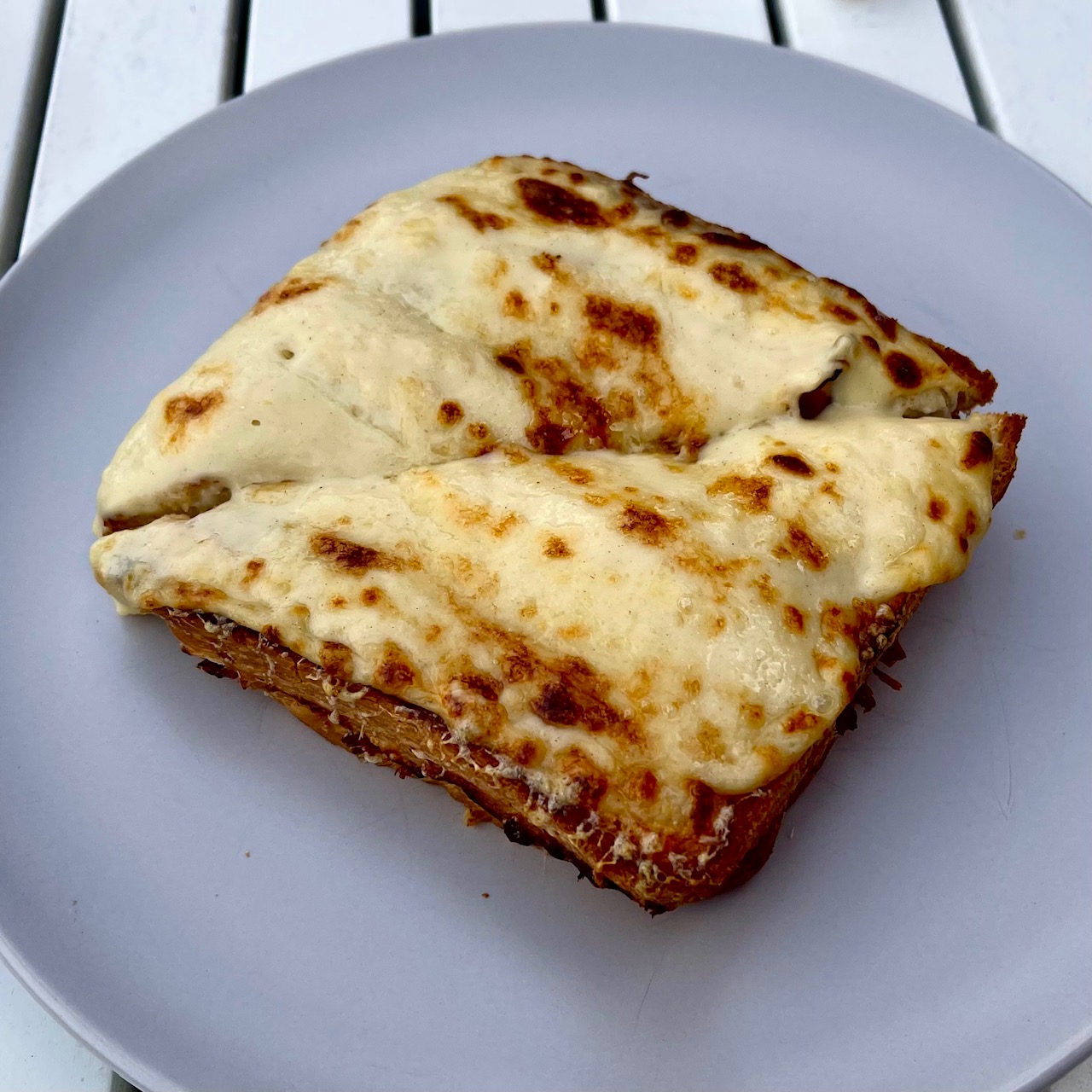
Zoë had chosen Hamlet’s croque monsieur – an excellent choice, and possibly what I would have ordered if I’d had first dibs. It was attractively burnished, covered in that molten, slightly-caramelised topping and with beautiful ham – shredded hock, rather than slices of the stuff – in the middle. The mouthful I got was pretty good, although (and this might be a bit of a trend for the rest of the review) I wasn’t sure it was nine pounds fifty’s worth of pretty good.

“I liked it, but I think it needed mustard” was Zoë’s verdict.

“Didn’t it have mustard in it?”

“If it did, it needed more.”

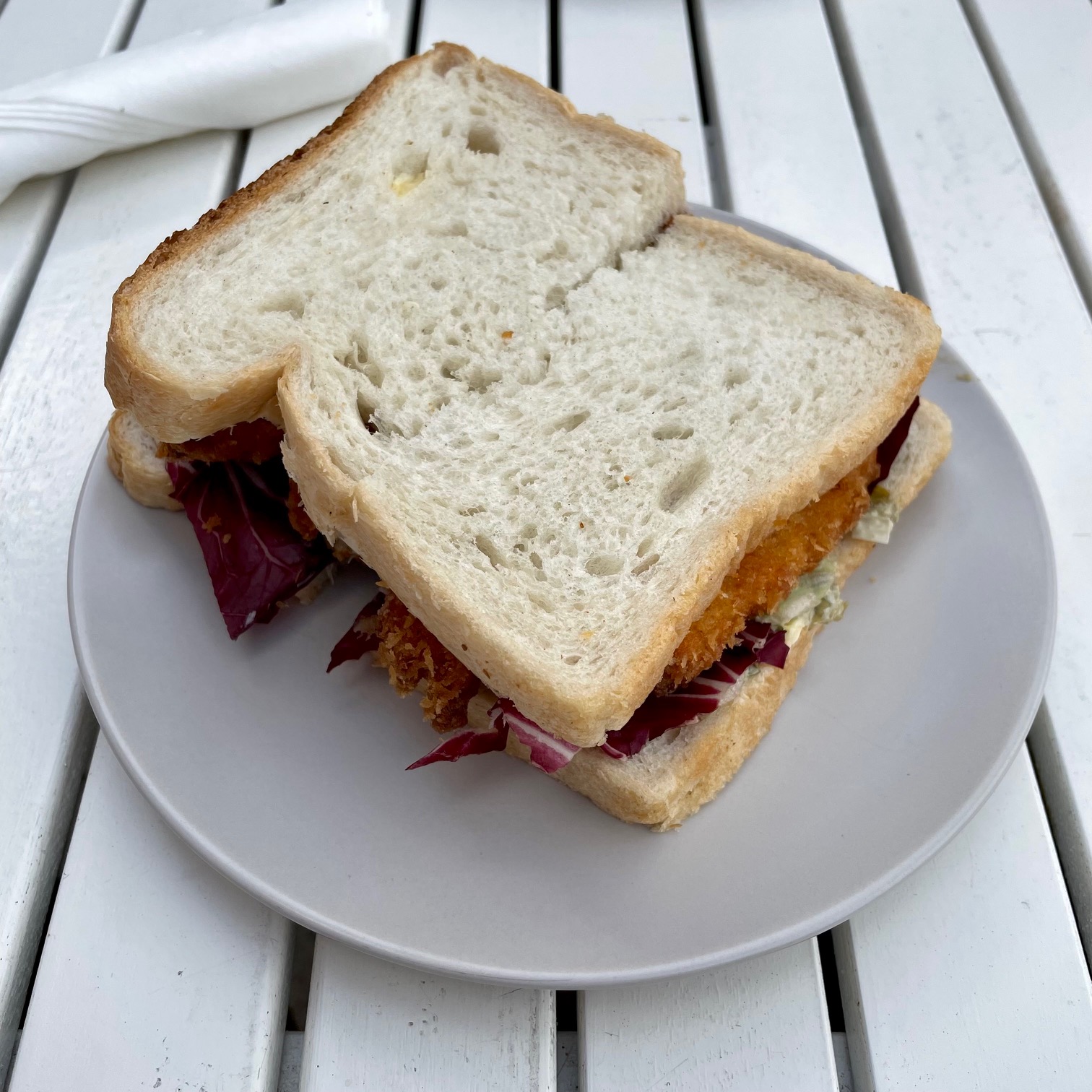
Zoë picked better than me, and my fish finger sandwich was close but not quite there. You could see all the things they’d got right: the goujons were well done, handsome things with deeply pleasing breadcrumbs. And the tartare sauce, made by Hamlet at a guess, was fantastic with plenty of crunch and acidity from the gherkins. But as a sandwich, it didn’t work – the unremarkable white bread just got soggy from all the tartare and fell apart. Putting it in a bun, or at least toasting the slices of bread, would have helped it hold together a lot better. And the decision to put bitter, chewy radicchio in there felt cheffy for cheffy’s sake – iceberg on its own would have been fine. 

Was this worth nine pounds fifty? The long answer involves telling you all about Hook & Cook, who are at Blue Collar most weeks. The short answer is no.

If we’d stopped there you’d have got a lukewarm review which might have suggested you’d be better off going elsewhere in Wokingham – and even without the choices I mentioned earlier in this review you could have stopped at the busy food market outside the Town Hall and tried something by Krua Koson, another Blue Collar regular. But fortunately we went on to order some dishes from the other sections of the menu and, to some extent, it was like eating in a different restaurant.

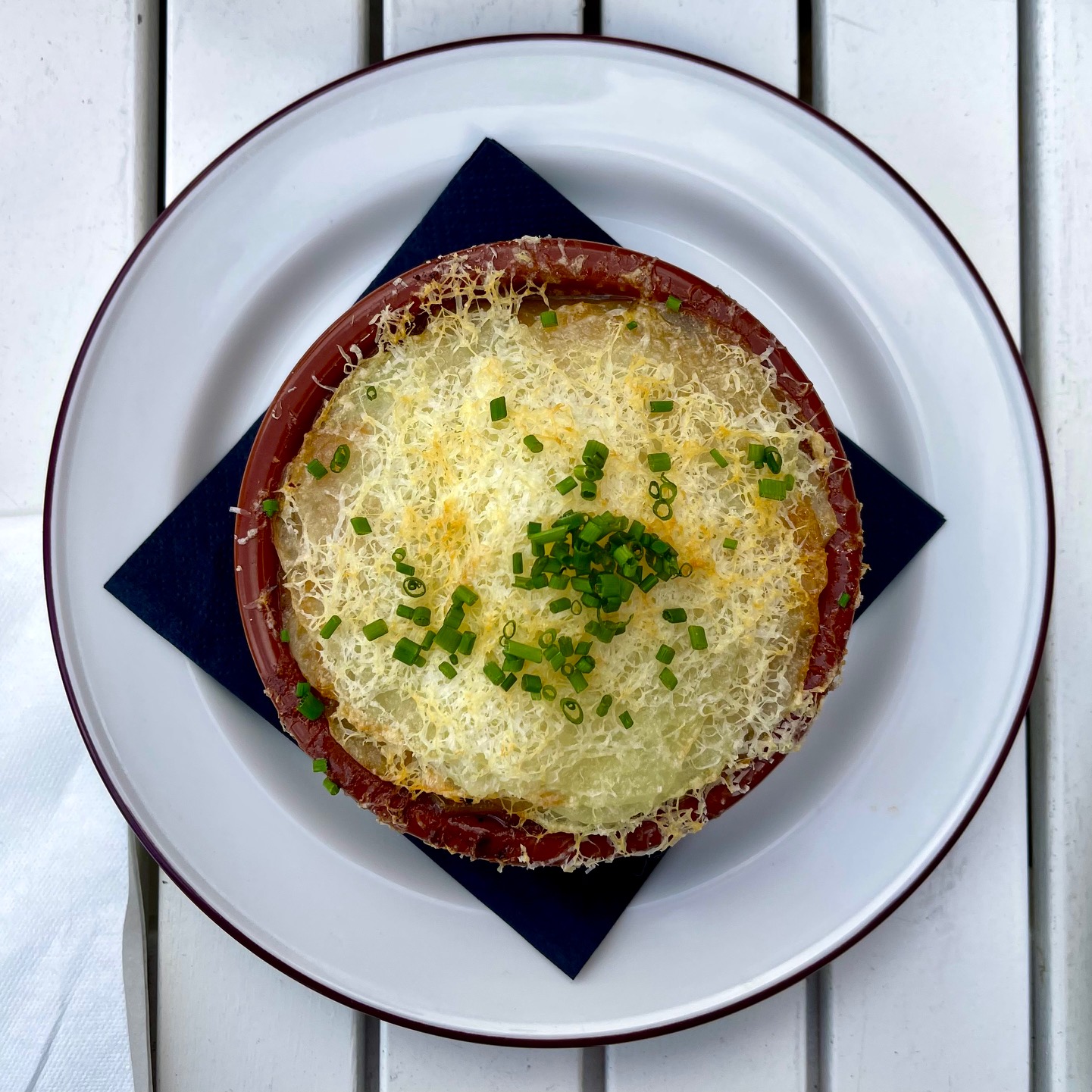
Take the beef boulangère we had, from the small plates menu. A nice-looking dish, with strands of slowly-braised beef in a nearly-sweet tomato sauce, reminiscent of a stifado, and topped with layer upon layer of thinly sliced potato, the whole thing dusted with cheese and chives. A terrific dish – and, although technically a small plate, not too difficult to divide up between two people. Yours for five pounds. Five pounds! You could get two of these for the price of either of those sandwiches, and I think it would be the better choice.

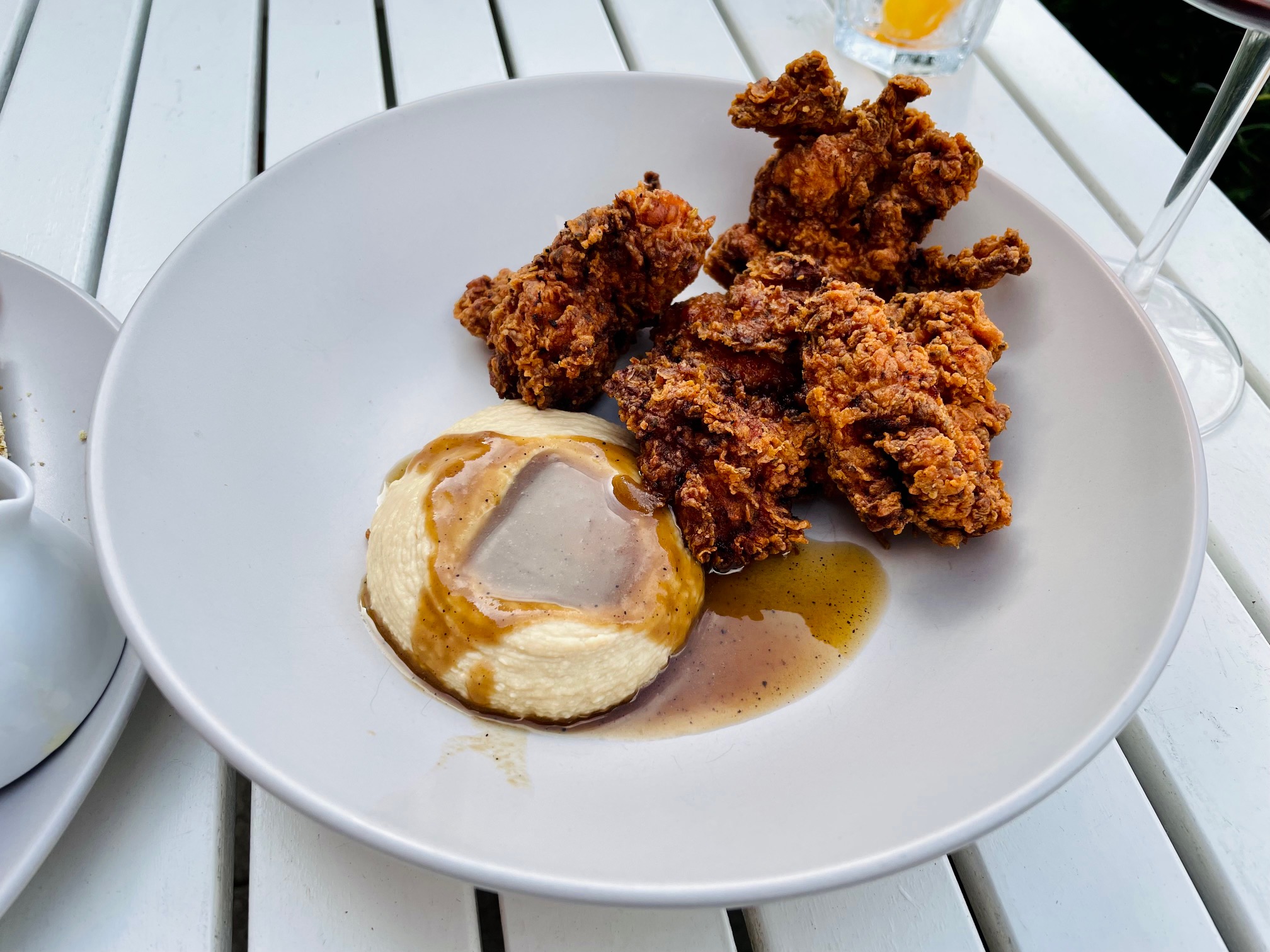
But then, also from the small plates menu, we also ordered fried chicken with beurre noisette houmous. Again, this was a fetching dish – four pieces of gorgeous chicken, all gnarly and crunchy, tender under that coating. Pairing them with houmous isn’t something that would have occurred to me, and pairing the houmous with the almost-caramel silkiness of brown butter certainly wouldn’t have: I’m so used to seeing a bright green well of extra virgin olive oil in the middle of a mound of houmous that I’d never have thought of using anything else. 

All those ideas could have come a cropper when combined, but in practice the dish was a revelation. But pricing rears its ugly head again: this lovely dish was twelve pounds. Were you paying for the produce, the idea, the skills involved or the location of the restaurant? And did it matter? I’m not averse to dropping twelve pounds on a small portion of fried chicken from time to time, but will enough people feel likewise?

Last but not least, we’d also nabbed a charcuterie board to share. This is largely about buying rather than cooking, but Hamlet buys its charcuterie from Trealy Farm so they’d bought wisely. Chorizo, a couple of different types of salami (the nicest, for my money, with fennel), some cracking air dried ham and, usually my favourite, a superb coppa. The menu suggested there would also be some lamb carpaccio, but that seemed to have gone missing somewhere. 

Personally I like something acidic with charcuterie – gherkins or caperberries – but Hamlet instead added some wonderfully sweet cherry tomatoes, little slices of soda bread and olive oil infused with rosemary. I’d have liked the bread to be a little more substantial, but it was still a great selection. Fifty pence more expensive than the fried chicken, which did make me think – not for the first time – that Hamlet’s pricing was all over the shop.

I haven’t talked about our drinks, but there was a good, compact wine list covering all sensible price points along with around half a dozen cocktails and a handful of beers and ciders, all bottled. Zoë had a negroni, because that negroni habit is coming along nicely, and I had a small glass of a red burgundy which was the costliest wine on the menu. I liked it a lot, but I liked the fancy glasses even more. 

Our meal – two sandwiches, two small plates, a large plate, a couple of drinks and a bottle of mineral water – came to just under seventy pounds, not including service. You’re probably thinking “ouch” at this point, and ordinarily this is where I would say “but you could spend a lot less”. But unless you’re just coming to Hamlet for a sandwich and a coffee – and possibly even then – I think you’re going to feel a little stung when the bill arrives.

As I said earlier, table service did feel a little haphazard at the beginning of our meal, but as it went on service got stronger and far more personable. And Hamlet was pretty busy – even later on as we wandered back through Peach Place the restaurant was still doing a pretty consistent trade. 

Afterwards we went for a drink at Sit N’ Sip, the craft beer place where, oddly, nobody sitting out front was drinking beer. It wasn’t really my glass of IPA, despite some excellent people watching opportunities. So instead we found our way to the brilliant Outhouse Brewery, which has only been open for three months, and sat outside drinking their very own excellent oatmeal stout. I couldn’t resist trying one of their sausage rolls – made by Blue Orchid Bakery, another Peach Place business – and it was phenomenal, with great pastry and a coarse, dense sausagemeat filling (the fact that I had room for it perhaps isn’t the most glowing endorsement of Hamlet).

I think Nick Galer was right about the challenges of all day dining. Hiding in Hamlet’s menu, a maze of breakfasts, brunches, sandwiches and plates of varying size, there’s a very good restaurant, making itself frustratingly hard to find. I’m sure they’re doing what works for them, and certainly looking on Instagram their lunch menu has been a work in progress since they opened, but for me it felt muddled. Maybe they feel they need to compete with Gail’s during the day and places like Chalk at night. But although the execution might have been uneven, you couldn’t deny that the ideas were there, and along the right lines. 

I’m far more tempted to go back in the evening and treat Hamlet more as a traditional restaurant, and when I do I can easily imagine that I’ll have an excellent meal. But even so, they deserve credit for lots of things – for some of the imagination involved, for the stylish space they have created and, perhaps more than anything, for giving it a go during such an awful, challenging time. So there you have it: a polished-looking, high spec, unashamedly high quality restaurant selling interesting, creative food. And a great town centre taproom just around the corner for when you’re finished, into the bargain. In Wokingham. It’s interesting that, for all our chains and burger places, restaurants like Hamlet don’t choose to open in Reading.

Hamlet – 7.6
10 Peach Place, Wokingham, RG40 1LY
0118 3048433

https://hamletwokingham.co.uk

Café review: The Collective

Some of the most prevalent of Reading’s many cynics are people I like to call the Not Another Brigade. They crop up all the time: Not another burger place, they say. Not another coffee shop. If I had a fiver for every time I’ve heard someone say that, I could open a coffee shop of my own. Shortly after doing so, I’d hear enough not anothers to be able to open another, and another, and another.

Although when it comes to burgers, they might have a point. Aside from Gordon Ramsay’s new outpost where Giraffe used to be, there’s one opening on St Mary’s Butts in the old Pizza Express site, one on the Oxford Road opposite the Broad Street Mall, one more taking up the Sprinkles Gelato building next to Smash N’ Grab, itself another – that word again – burger restaurant. Oh, and Slam Burger on Christchurch Green, which will offer burgers called the Big Slam and – ridiculous name alert – the “Beef Wooper”. There was once a Black Country establishment called Kent’s Tuck Inn Fried Chicken. Slam Burger could learn a lot from them: if you’re going to be shameless, at least be funny with it. 

Coffee shops are a different matter. People have been saying not another coffee shop ever since C.U.P. opened next to Reading Minster, but now C.U.P. has another branch on Blagrave Street and a third, a recent addition, in the Broad Street Mall. We get new coffee places all the time. Compound Coffee is now operating out of the ground floor of the Biscuit Factory, and something called “Artizan” (showing that swapping an S for a Z always makes a brand look classier) has opened in the building once occupied by Nineties throwback Smokin’ Billy’s.

It’s not a story of unchecked growth, though: the year hasn’t been without its closures in caféland. Earlier this year Anonymous Coffee pulled out of the Tasting House, shortly before the Tasting House pulled out of Chain Street. And only a few weeks ago punters heading for Tamp Culture outside the Oracle were surprised to find an empty space where the kiosk used to be. Tamp had upped sticks and left after over seven years trading at that pitch with no farewell: they’ve since put something on their website. Do these closures prove that Reading can’t sustain (not) another café, or is it just the circle of life?

One part of Reading that has traditionally felt poorly served for cafés is Caversham. There was a time when you had Costa and Alto Lounge, and that was pretty much it. Then in 2016 Tipsy Bean opened, serving something you could loosely describe as coffee, and so did Nomad Bakery. And for a while we also had Siblings Home, a little place on the Hemdean Road: I liked it a great deal, but its owners had a haphazard approach to some of the basics, such as being open when you’d expect them to be. Anyway, that flurry of activity didn’t last long – Nomad, Tipsy Bean and Siblings Home have all ceased trading.

But in more recent times, there’s been a new wave of cafés in Caversham trying to challenge the dominance of Costa. So now Geo Café, which is part cafe, part delicatessen slash general store, is where Nomad used to be, but you also have Gardens Of Caversham, a third branch of the Workhouse empire, in the old Lloyds Bank building. At the more traditional end of the spectrum, there’s the superbly named Nathan’s Nibbles. And up past the Griffin you’ll find The Collective, the subject of this week’s review.

Subscribe to continue reading

Become a paid subscriber to get access to the rest of this post and other exclusive content.

Restaurant review: The Coconut Tree

Of all of Reading’s new restaurants, The Coconut Tree might be the one most people have asked me to review as soon as possible. Which is in itself interesting, because The Coconut Tree has already had more write-ups online than most of Reading’s new places – but the thing is, they’re all on Instagram. Remember all that talk last year about how hospitality was on its knees and taking free shit was plain immoral? Nature is definitely healing, because The Coconut Tree’s plan for its launch was very much as they used to be in the before times – find some local Instagrammers with over five thousand followers, bung them some PR copy to include in the social media coverage, sit back and watch.

And I don’t know about you, but I learned a lot. Admittedly, nearly all of it I could have learned just from reading their menu, but it’s dead useful to discover that the food is “fresh, tasty and full of flavour” (it would be a brave restaurant that said “you know what? Lots of our stuff is stale and bland”). And to discover, from multiple Instagram posts, that one of the cocktails is set on fire in front of you: the drinks in general, allegedly, are “banging”. Did I mention the “proper good vibes”, or the fact that it’s “cool” and “trendy”? Perhaps the best summary was that “the cuisine is insane”. Sri Lankan food: utter madness! 

Of course, what none of those posts covered in much detail was that their food was all free. Their booze, too. “There wasn’t a cocktail I didn’t like” said another influencer. I bet. “Nothing too specific, we’re quite happy for you to construct the post!” said one writeup, showing that the influencer had copied and pasted all the text from the PR company without reading it first. That one was a “paid partnership”: not only did they get free food but, presumably, they were also paid to do the copying and pasting. I can’t compete with those levels of polish, sadly, so instead you get my impressions of the place after I turned up on a weekday with my friend Jerry, two Sancho Panzas in search of a Don Quixote. 

Subscribe to continue reading

Become a paid subscriber to get access to the rest of this post and other exclusive content.

Restaurant review: Buon Appetito

Buon Appetito closed in April 2023. I’ve left the review up for posterity.

A couple of Mondays ago I was walking through town around lunchtime, and I noticed that every table outside Bill’s was occupied. The sun was shining, and Bill’s has one of the best al fresco spots in Reading, but even so: every single table? Then I walked past Jollibee on Broad Street, with a queue outside, just like every day since it opened. As I looped back down Friar Street I noticed, through the windows, that Wendy’s was packed.  We can congratulate ourselves on promoting an independent, thriving Reading, through the money we spend and the businesses we amplify on social media, but the fact remains that chain restaurants have a huge hold on our town and its customers. 

The struggle is real, and relentless. Recently a branch of Sri Lankan themed chain The Coconut Tree opened, and influencers surfaced on Instagram raving about how good their (free) food was. It is next door to South Indian restaurant Pappadam’s, which has been there for years. Last week Gordon Ramsay opened a restaurant in the Oracle – one of five new burger restaurants coming to Reading – and gave out a thousand free burgers. Berkshire Live ran a breathless story enthusing about the opening. Of course they did, because it’s easier to Ctrl-C, Ctrl-V some guff from a PR company than it is to write a real story (although in Berkshire Live’s defence they subsequently reviewed the burger, and didn’t rate it).

The uncomfortable reality, even if we wish it wasn’t so, is that chain restaurants in general, and American ones in particular, do well in this town. Last month Deliveroo revealed Reading’s five most frequently-ordered dishes. Who made the list? Taco Bell, Wingstop, Shake Shack and Five Guys. The only thing preventing a clean sweep by American chains was the holder of the top spot, from German Doner Kebab. They wouldn’t make my top hundred dishes in Reading, let alone take the crown. Maybe Reading’s favourite illness is dyspepsia. Or dysentery, you never know.

If you’re reading this you probably have at least a passing interest in Reading’s independent restaurants, so perhaps you’re mystified (or depressed) by the continuing popularity of places like Taco Bell. It’s easy to forget, in an echo chamber that buys local, supports indie businesses and slopes off to the farmer’s market a couple of times a month, that most people in Reading would still rather queue for Wendy’s.

Even if you support independent businesses, there are other ways to be out of step. I’ve never quite “got” some of Reading’s fêted indies. I freely admit that Sweeney and Todd is one of them, Quattro is another. A third, the subject of this week’s review, is Buon Appetito. It’s always been highly rated on TripAdvisor, yet when I went there over five years ago I was bemused by the rave reviews. Years later the wonderful Tuscany opened down the Oxford Road and I had another, better pizza option; I never returned to Buon Appetito.

Yet here we are in 2021, Tuscany closed over two ago, and Buon Appetito is still going strong. It’s still highly rated on Trip Advisor. More to the point, the pictures on its Instagram account look a world away from the greasy, cheese-sodden edible cardboard I waded through back in 2016. Flicking through them made me feel decidedly peckish. So I decided to take another look, accompanied by my friend Nick, fresh from his previous appearance in this blog and not put off by the whole experience of being immortalised in print.

Buon Appetito has made the best of an unlovely spot. Like many canny businesses they’ve done great things with their outside space, with plenty of tables and some little booths with circular pub tables and heaters on the wall. Everything was covered by a corrugated plastic roof, and more corrugated plastic formed a partition closing off much of the view of Chatham Street. It will set them up perfectly for winter, and the overall effect made me feel like I was on holiday. That sensation was only accentuated by the soundtrack, which sounded like hotel lobby jazz covers of popular songs. I started out thinking the music was deeply naff, but by the end it had won me over and I’d used Shazam to work out who the band was (The Cooltrane Quartet, since you asked).

Service was bright, friendly and immediate. Rather than relegate it to the end of the review it deserves to be mentioned early and often, because the woman who looked after us all evening was brilliant. Every restaurant should have a front of house like this: warm, enthusiastic, likeable and with opinions about the dishes you ought to try. She brought us a couple of pints of Peroni (the drinks selection isn’t the widest at Buon Appetito) and we began the process of picking through the menu.

“I’m not a fussy eater, but there are four things I won’t eat” said Nick.

“What are they?” I mentally ran through my own list of no-nos, but apart from the obvious ones, like tripe, I could only come up with sweetcorn and dried fruit.

“Blue cheese, obviously. It’s mouldy. You’re literally eating mould.”

I couldn’t help but feel Nick was missing out, but I didn’t interject.

“And raw coriander. It’s awful, it just tastes soapy. It’s genetic, you know.” Having been closely associated with a coriander hater in the past, I’d been told this fact more times than I cared to recall. Can’t you just tell restaurants you’re allergic? I used to ask: apparently not.

“What are the other two?”

“Olives! They just always taste so bitter to me, it doesn’t matter what colour they are. And the last one’s marzipan.”

I could eat marzipan by the block, cutting it like cheese – I have, in my day – but I let that pass. I looked at the menu and mentally struck a virtual red pen through all the items with olives or blue cheese in them: it was more than a few (I was surprised, given our last meal out, that snails hadn’t made the list).

The menu was mainstream but better and more well put together than the one I remembered from my previous visit. It was compact in the right places – only four pasta mains, for instance – and more expansive where that made sense. It’s okay to have many different pizzas because ultimately many of the core ingredients are frequently the same. Pricing was consistent and reasonable – nearly all the pizzas and pasta dishes ranged between ten and fourteen pounds and starters were around the seven pound mark, or more expensive and big enough to share.

Pizzas were a mixture of recognisably Italian combinations – plenty of ‘nduja on there, and the classic Neopolitan pizza with anchovies, capers and olives – and options from further afield. The Honolulu and the Hawaiian, both of which featured pineapple, constituted the lunatic fringe. “I quite like pineapple on pizza” said Nick, “but I won’t order it: you’ll get hate mail from Italians.” I wondered what Italians would make of a vegetarian pizza called “Garden Of Eatin”, but perhaps they’d made their peace with that.

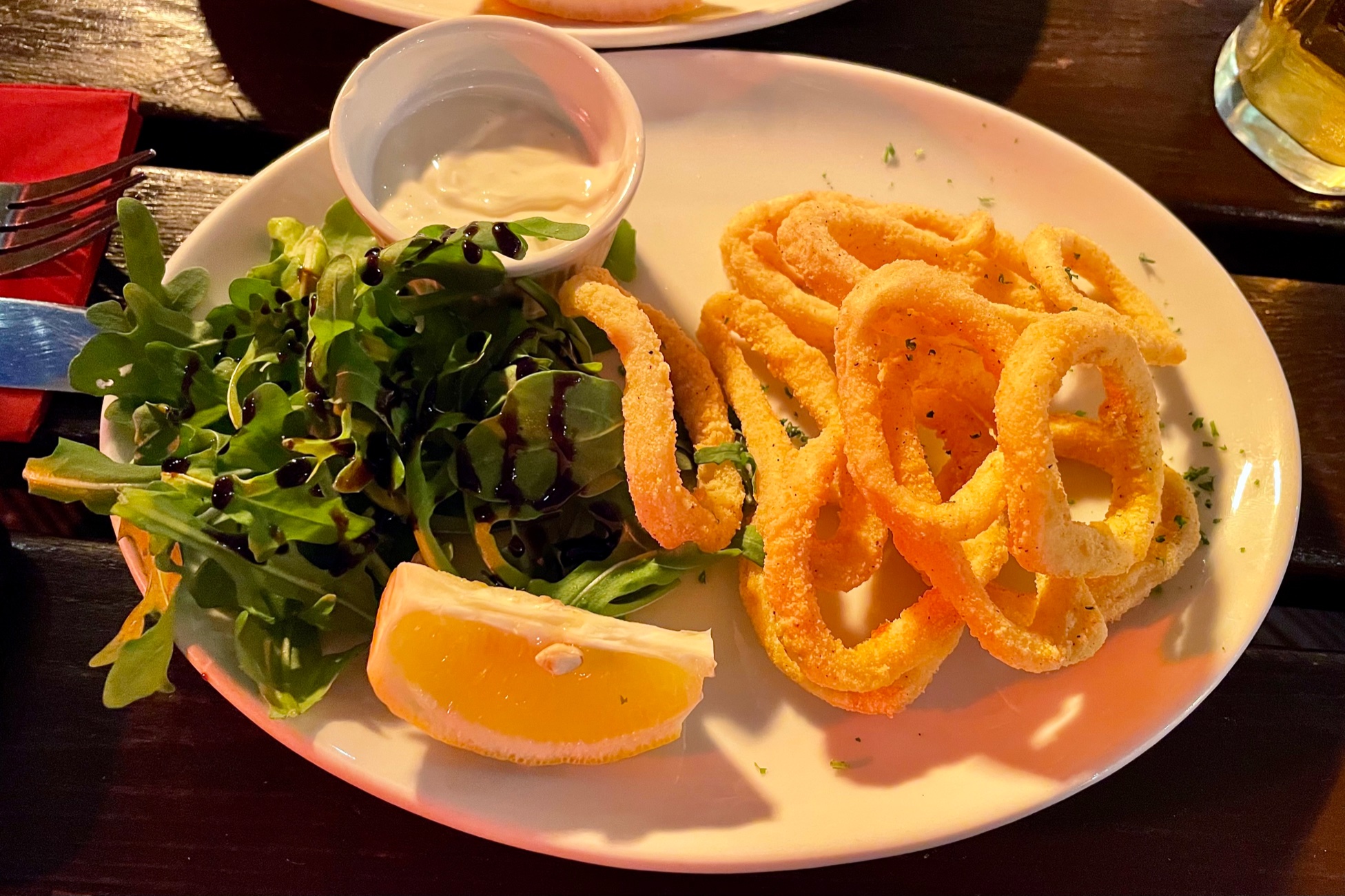
If all of our meal had been like our starters, the rating you’ve already scrolled down to check would have been lower. Calamari was decent, though: it mightn’t have had the tenderness of ultra-fresh squid, but it wasn’t rubbery either. It came with a gentle aioli: a bigger honk of garlic wouldn’t have gone amiss. Even so, it was better than the same dish at the Fisherman’s Cottage a few months back, by which token it was better than most calamari I’ve had in Reading over the years.

The other dish, king prawns with chorizo, was merely pleasant. They were nice plump prawns, three of them, with plenty of sweet flesh once you’d yanked off the head and opened up the shell. The problem was everything else. I know chorizo isn’t Italian, which made the dish potentially slightly incongruous. But worse, this chorizo was nothing special – thick, coarse and bouncy without heat or the terrific crimson oil that colours everything it touches. The menu said that this was cooked with garlic and extra virgin olive oil, but I got little or no garlic, just an anonymous orange puddle under the prawns that didn’t taste of enough.

I began to worry that history would repeat itself: I haven’t doled out a poor rating this year, and I’m somewhat dreading the first time I have an iffy meal on duty. But then our pizzas arrived and those worries, and indeed any other cares I might have had, dissipated in a cloud of carbs. Based on what I’d seen on social media I fully expected Buon Appetito’s 2021 pizzas to be an improvement on the one I had in 2016, but what I wasn’t prepared for is just how improved they would be. They weren’t just better than the previous one I’d eaten at Buon Appetito, they were better than any I’ve had in Reading and many I’ve had further afield.

Now, I can understand you being sceptical: it was only a few weeks ago that I said I might have discovered Reading’s best sandwich, and here I am saying that Buon Appetito does Reading’s best pizza. I couldn’t blame you for thinking I’m busting out hype for the sake of it. But I try hard to be sparing with the superlatives – not everywhere can be the best ever – and by any standards Buon Appetito’s pizza was extraordinary. The base was night and day compared to what I’d eaten before, with a beautifully bubbled, puffy crust with a little leopard-spotting and a deeply satisfying chewiness. 

The toppings – I’d gone for the Napoli, which has always been my ideal pizza – were superb. A great tomato base, just enough cheese, lots of salty anchovies, a judicious helping of sharp, tangy capers and those black olives Nick was so averse to. I think this particular pizza is the choice of salt and vinegar fans everywhere and when it’s perfectly in balance, as it was here, it’s a full-on, sing-at-the-top-of-your-voice truly joyous thing to eat. Better than Papa Gee’s, better than The Last Crumb’s, better even than Tuscany used to be. I loved it, and knowing I could rock up to Buon Appetito any time and order this pizza again for a mere eleven pounds was both a wonderful and a dangerous discovery. 

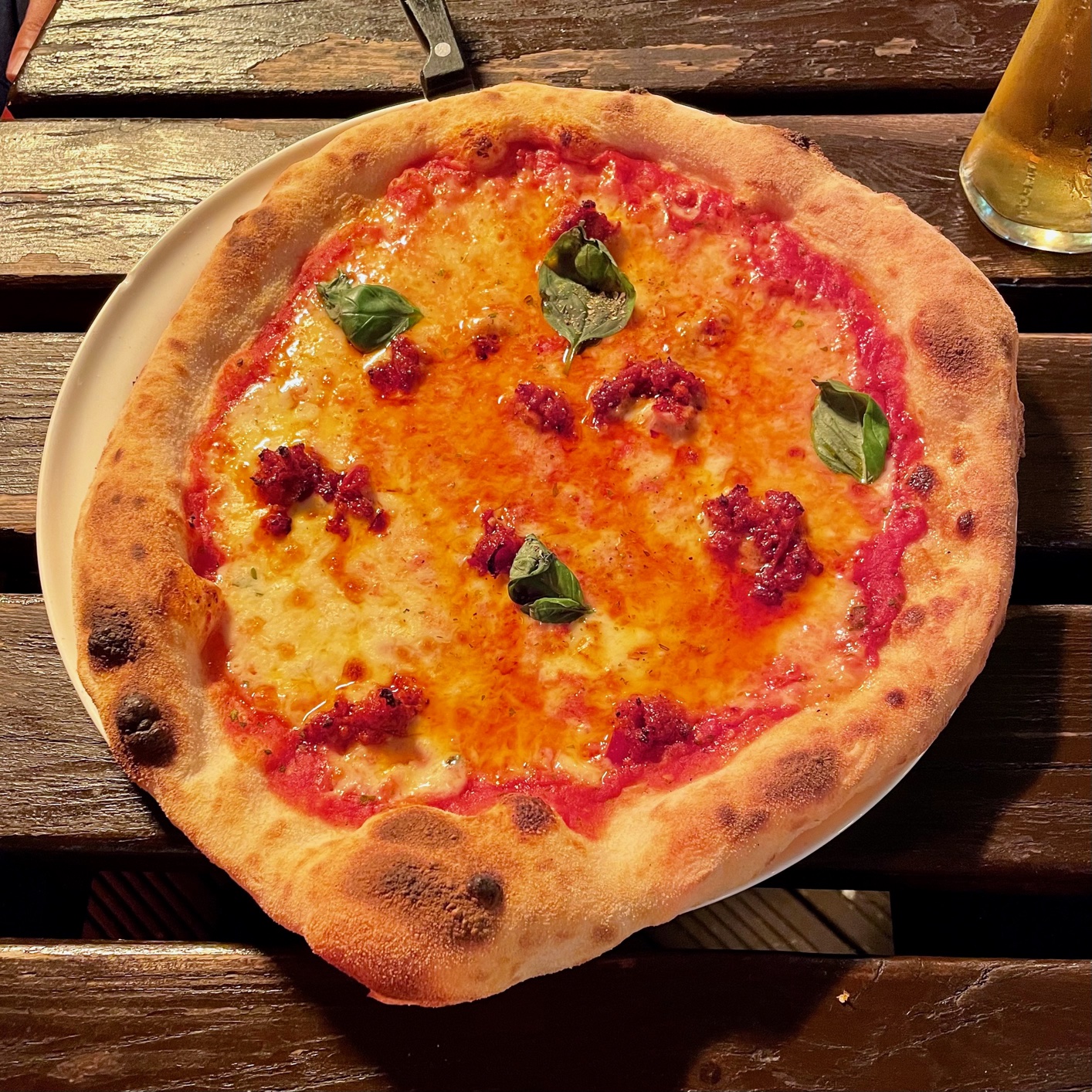
Nick’s pizza showcased that great base in a completely different direction. The “Calabrian” manages to appear on the menu twice, once halfway through and once at the end of the list of pizzas. But it was a masterpiece of pared-down simplicity – tomato sauce, mozzarella, clusters of ‘nduja, basil leaves: nothing else. Nick had never had ‘nduja before – in 2021, can you believe it? – and though he ordered it with abandon, he approached it with trepidation. “Yes, it’s hot, but it’s good” he said, just before our waitress came up and asked, part sympathetically, part playfully, whether he needed a glass of milk. “We have chilli oil, if you want to make it hotter” she added. But Nick was happy with his choice: from where I was sitting it looked a smart one.

“That was good, wasn’t it?” Nick said.

“It really was. Hold on, is that a Latin jazz cover version of Never Gonna Give You Up?”

“Certainly sounds like it.”

We asked for the dessert menu, because I’ve always felt it’s rude not to at least look. It was on the right side of too big, with four desserts and some variations on the theme of gelato and sorbetto, along with an espresso martini which had wandered over from the cocktail menu. “The panna cotta and tiramisu are the best ones” our waitress told us. “Although our banoffee pie is very good too. We import it from Italy, along with our Torta Rocher”. I suspect they come in frozen from a company called DiSotto, which also provides Buon Appetito’s ice cream and sorbet.  

We took our waitress’ advice. Nick’s tiramisu was a hefty helping, on the rustic side with huge, boozy savoiardi biscuits (or lady fingers, as you probably should no longer call them) and loads of mascarpone under a blanket of cocoa powder. He liked it, but was too full to make significant inroads into it. I gallantly stepped up purely so I could tell you what it was like, namely serviceable. Only now, looking at the DiSotto website, do I clock that they sell a defrost-it-yourself tiramisu which looks strikingly like this one. I’d love to think Buon Appetito makes its own, but I wouldn’t bet on it.

The panna cotta was a strange one: I’m used to it turned out and quivering on the plate whereas this one had been imprisoned in a little sundae dish. There was an enjoyable pistachio mousse underneath, the beautiful crunch of a candied pistachio crumb on top. All tasty enough, but it felt more like an upside-down, out-of-kilter cheesecake than a panna cotta. I’m not sure the panna cotta element – hemmed in, unable to wobble freely – worked.

“Pretty good” said Nick, “but not as good as Laura’s panna cotta.” I tried his other half’s panna cotta not long ago: he’s right.

The restaurant had a steady flow of customers throughout our meal without ever seeming busy. But it was a Wednesday evening close to payday: perhaps that was a factor. “Inside is very nice too, you should eat there next time” said our waitress as she brought the bill, along with a couple of shot glasses of a Kermit-green pistachio liqueur like next level Bailey’s. Three courses and two and a half pints each came to seventy-eight pounds, not including tip.

As I said, night and day; I still think that the place I went to five years ago left a lot to be desired, but aside from being in the same building and doing Italian cuisine I don’t see many remnants of the Buon Appetito that left me nonplussed. They’ve created a properly lovely space, the service is spot on and if part of the menu were merely not bad or even so-so, the plusses outweighed that in spades. The biggest of those plusses is the pizza, which for my money is one of the best I can remember.  

I wish there were more sunny days ahead, because few pleasures can match pizza and beer on a sunny day, but those little booths will be very inviting when the nights draw in, especially for those of us who aren’t sure how much indoor dining we plan to do in what remains of 2021. With Buon Appetito, Chef Stevie’s Caribbean Kitchen and the Nag’s Head, that little piece of West Reading is looking like the best gastronomic micro-climate the town has to offer. Chatham Street, a food hub: who’d have thought it?

Buon Appetito – 8.0
146-148 Chatham Street, Reading, RG1 7HT
0118 3276947

https://www.buonappetitoreading.co.uk