Restaurant review: Branca, Oxford

This probably isn’t something I should admit but even now, after nearly twelve years doing this, I’m not always the best judge of which reviews will and won’t prove popular.

I mean, some obviously do well: you all tend to want to know about the new openings and the big names as soon as possible, something I’ve been trying to get to quicker over the last year. And I know from my trips to the likes of TGI Friday and Taco Bell that if it looks like I’m going to have a bad time, you tune in. I don’t take that personally – everyone likes a hatchet job and we can all derive vicarious pleasure from the suffering of others at times.

Beyond that? I have a vague idea at best. Sometimes I can write up a lovely independent place in the middle of town and – well, there aren’t crickets, but it doesn’t go gangbusters in the way that a Siren RG1 or a Rising Sun might. And other times the success of a review takes me completely by surprise.

Take Gordon Ramsay Street Burger, for instance: I didn’t think that many of you would especially care what it was like. On the run up to my visit, I wasn’t even sure I especially cared what it was like. And when I went I found that it was perfectly serviceable, the kind of place you might quite enjoy if you lived in a town without Honest Burgers. Little to write home about all round, you might think, and yet it was my most popular restaurant review of the year: me having a fair to middling time at a big chain in the Oracle. Go figure.

I actually think this might be for the best, that there’s no crystal ball. Because it would get tempting just to write the crowdpleasers, and that would skew the kind of places I go to and the kind of meals I seek out. And part of my – let’s call it a job, just for the sake of argument – job here is to highlight all kinds of establishments.

The ones you know about, but also the ones you don’t. The ones you would never consider going to in a million years, or walk past thinking “I wonder what that’s like?” And the ones you may well have already been to, probably in the first month after opening, before I get round to them. If you always have a pretty good idea what, or where, is coming next then something’s probably gone wrong.

One of the impressions I do get, though, is that collectively speaking you’d like to see more Oxford reviews. I can see why: it’s only half an hour away by train and is almost the anti-Reading. It has everything Reading lacks, yet lacks all the stuff Reading has got. No widespread craft beer, but lots of handsome old boozers, the kind Reading has gradually lost. No street food, but a covered market and cheesemongers and delicatessens galore.

A big shopping mall, yes, but a completely different kind that attracts the chains that Reading still just doesn’t get. More independent retail and two independent cinemas, but crap buses. Better bookshops, but nothing like the Nag’s Head. Did I mention that it also has the Oxford Playhouse, which for all its charm South Street can’t quite match? Anyway, add the two together and you would have the perfect large town slash small city; Oxford even has a couple of universities, would you believe.

All that makes Oxford the perfect place for a weekend lunch or dinner, especially coupled with mooching, shopping, drinking coffee and people watching. So every time I put an Oxford review up it does pretty well, and I get the impression – perhaps wrongly – that you might like to see more of them. My first visit to Oxford on duty was to one of my favourite Oxford spots, The Magdalen Arms on the Iffley Road. I had a lovely time, as I expected to, and resolved to cover the city more often. Two and a half years later, I’ve written the grand total of five reviews of Oxford restaurants: time to pull my socks up.

So last weekend Zoë and I were in Oxford, on her Saturday off, and I had booked a table for two at the Oxford restaurant I’ve possibly eaten at more than any other, Branca. It’s a sort of Italian brasserie – or would be if such a thing isn’t two different kinds of cultural appropriation – and had been trading on Walton Street in Jericho for over twenty years.

And that means that, like Pierre Victoire just round the corner on Little Clarendon Street, it’s part of an elite club of restaurants that have been an ever-present in my dining life. The only thing even comparable in Reading, now that Pepe Sale is gone, is London Street Brasserie, and that tells its own story, that Oxford can hang on to these places when Reading can’t.

It helps that Jericho is such a lovely part of Oxford, less than twenty minutes’ walk from the train station but a world away from both the town and gown of the city centre. It’s all nice cafés and bars, pubs tucked away on sidestreets, the Phoenix cinema where people, me included, queued round the block to see Four Weddings thirty years ago, watering holes like Raoul’s and Jude The Obscure that feel like they’ve been there forever.

I lived in Jericho, for a strange and surreal year halfway through the Nineties, and I didn’t appreciate how gorgeous it was at the time. And now it’s so gentrified that I could never afford to do so again in this life I am struck with brutal clarity by what a terrific part of the world it is. Isn’t it always the way? Never mind. Sitting in Branca, menu in front of me, soaking it all up I could kid myself, for a couple of hours at least, that this was my place and these were my people. Good restaurants, apart from providing you with great food and wonderful drink, have a knack of giving you that, too.

In the years since it opened Branca has expanded into next door, turning it into a cafe and deli more than capable of improving your cupboards and denting your wallet. But the dining room is as it always was, a tasteful if cavernous space.

The tables nearer the front, close to the bar, are nice enough but if you can get one at the back you’re treated to a beautiful room with marble-topped tables, exposed brickwork, what looks like a Bridget Riley on the wall. There’s a view out into their courtyard through full length-windows, and the light in general is quite magical, helped by a skylight and clever use of mirrors. Even on a dreich February day it felt like spring was in touching distance.

This isn’t the criticism it might sound, but Branca’s is simultaneously the biggest and smallest menu I’ve ever seen. Big as in physically big, a one-sided sheet of something like A3 that lists everything they serve. But when you delve into the detail, it’s compact: four starters, a couple of salads, three pasta dishes, four pizzas. Four mains, a burger and a steak and a couple of specials. I felt like I had just enough choice, although if I’d fancied either of the specials I wouldn’t have felt constrained at all.

As it was, this was just on the right side of the border between streamlined and narrow. Starters clustered around the ten pound mark – don’t they always, everywhere, these days – while mains were more scattergun. A pizza was about sixteen quid, with the exception of the sirloin steak the mains stopped at twenty-five. If I hadn’t eaten at Branca before I think the menu would still have inspired confidence, that it was aiming to do fewer things better, but they’d already proved that to me time and time again.

Before any of that, a negroni apiece and some of Branca’s focaccia, which they’ve been dishing out free of charge to diners for as long as I can recall. The focaccia was great stuff, airy and speckled with salt, oily enough to make your fingers shine even before you dipped hunks of it into oil and balsamic vinegar. It made me happy to start a meal in the same way as I always had, knowing that it pretty much always presaged good things. Branca played it straight down the middle with its negroni: no fancy curveballs, just Gordon’s, Campari and Martini Rosso. It was a good reminder that stripped of any whistles and bells, the cocktail just has good bones.

Another reason I’ve always liked Branca enormously is the wine list, and more specifically that they do something so few restaurants in the U.K. do: the majority of the wines on it, around three quarters in fact, can be ordered in a 500ml carafe. So we did that and had a New Zealand sauvignon blanc for thirty quid, which was downright lovely. I got kiwi fruit and gooseberry, Zoë got a hint of melon and, for an hour or so, we managed to kid ourselves that we got wine. We became a little bit more North Oxford with every passing minute.

Most of Branca’s starters are probably a nod to the excellent deli next door: with the exception of the soup they largely involve buying well rather than cooking well. Zoë is an expert at the third part of that triumvirate, ordering well, and she had the edge with her burrata on sourdough, served with olives and cherry tomatoes. Up to a point this is something you could rustle up in your own kitchen, and we often do come summertime, but the transformative element here was a cracking red pesto. Try doing that at home seemed to be the implication and no, I wouldn’t even attempt to.

My starter left me feeling a little deceived. It was described as bresaola with a fennel, rocket and radish salad, and that description made me think it would be a cornucopia of cured beef with a little bit of greenery on top. Just how hoodwinked I had been became apparent when our server – who, I should add, was superb from start to finish – came to our table.

“Who ordered the salad?”

Neither of us, I hope I wanted to say to him, but I realised as he set the plates down that this was exactly what I had unwittingly done. And, truth be told, I felt a little conned. Three pieces of bresaola – I would say “count them”, but that didn’t take long – buried under an ambuscade of foliage is, to be honest, a salad. You can’t roll that in glitter: it is what it is. And eleven pounds for a salad and three pieces of beef felt like it could slightly mar my long and happy relationship with Branca.

And maybe it would have done but damn them, it was lovely. I always regret using the adjective “clean” to describe dishes or flavours because, like “dirty”, it’s a dimension that really shouldn’t feature in stuff you stick in your gob. So instead I would say that this was subtle, unfussy and refined, that every flavour in it was distinct, well-realised and harmonious.

Rocket seems to get a lot of stick these days but I still like it, especially compared to the twin horrors of pea shoots and watercress, two of the most pointless green things in creation. The quantity of excellent Parmesan chucked on top felt like it was by way of apology for the whole salad thing. Everything was so well-dressed and well balanced that I decided I could forgive Branca, just about. The eleven quid still felt a bit cheeky, although mainly I just wished they’d chucked some of that red pesto into the mix.

Conscious of a few recent experiences where we’d been rushed, Zoë decided to have The Conversation with our server as he came to take our empty plates. We were having a lovely time, she told him, and were really in no hurry so could they wait a while before bringing our mains? And he was brilliant with that, feeding that back to the kitchen and then coming to check with us, something like twenty-five minutes later, if we were ready for what came next.

I can’t tell you how welcome that was, that a restaurant understood how to put the brakes on. And it really helped to make me appreciate Branca all over again – the room, that light, the chatter from neighbouring tables, that feeling that there was no rush to go anywhere or do anything that comes from a proper, leisurely lunch. Saturdays with Zoë have been at a premium recently, so I felt glad this one was far from squandered.

By the time my main came, I was ready for it, and it helped that it was a treat from start to finish. Rigatoni, giant corrugated tubes of comfort sagging under the weight of their own carbiness, came interlaced with sticky strand after strand of a long-cooked duck ragu. It may not have clung to the pasta, but it was hidden away under every single layer, a glorious, indulgent beast of a sauce.

That along would have made me almost delirious with joy on a winter’s day, but carpeting the whole lot with the crunch of herb and pecorino pangrattato and then leaving a bowl of grated parmesan at the table for you to use as unsparingly as your heart desired? I’d won at lunch. There was simply no question.

Of course, as anybody who’s married knows, you only really win at lunch if your dining companion wins too. So I was glad that Zoë, picking the other dish that jumped out from the menu, was as happy as I was. A colossal slab of pork belly, all fat rendered beautifully, would have been worth the price of admission alone. Add in a deeply savoury jus, an enormous quenelle of root vegetable mash, some firm but delicious tenderstem broccoli and a couple of crispy straws of crackling and you had a dish that could redeem the month of February single-handedly.

And the final element, the icing on the proverbial, was a salsa verde that supplied the zip and verve that stopped this all being a bit too much. Like the red pesto, a little went a long way. It also highlighted, again, that the kitchen had decided to do a few things to the very best of its ability rather than produce a bloated menu that lost its way.

“This is the first Lyndhurst-style dish I’ve had since the Lyndhurst closed” said Zoë, and I knew exactly what she meant. Very few people cooked pork belly as well as Sheldon and Dishon at the Lyndhurst, and this was the first time I’d eaten somewhere that reminded me of that. The room couldn’t have been more different, and the menu couldn’t have been much more different either, but there was that thread of brilliant hospitality that connected a restaurant I’ve loved for years and a restaurant I’ve mourned for nearly twelve months. It was nice to be reminded of it like this.

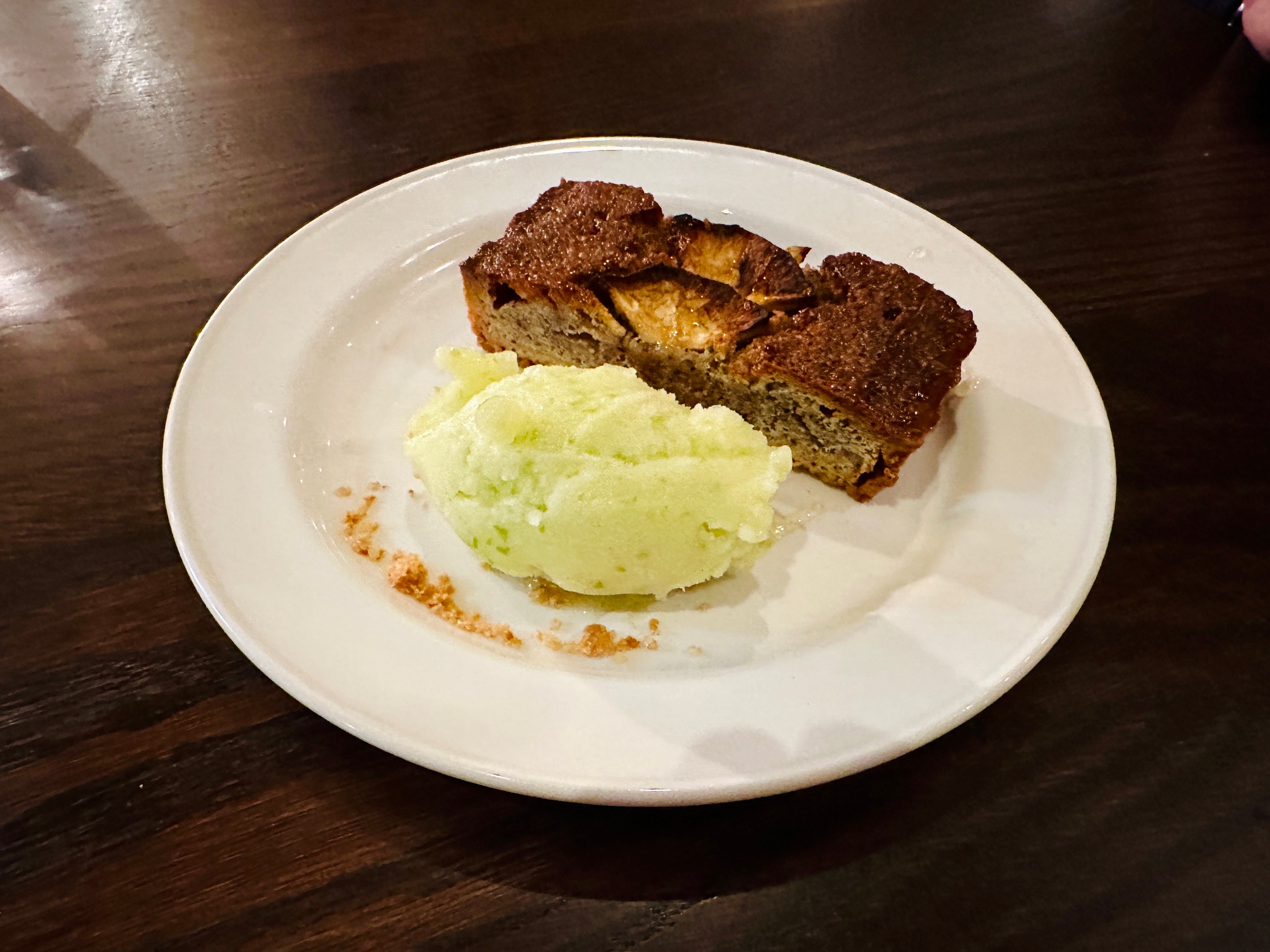
Branca’s dessert menu was also compact and really, when you stripped away the padding, it was four desserts and a range of ice cream; I’m happy to accept that a chocolate brownie classes as a dessert but things like affogato, chocolate truffles or – as was the case here – Pedro Ximenez poured over vanilla ice cream don’t really count. I found the dessert menu the least exciting bit, with most of it reminiscent of London Street Brasserie, so of course I gave Zoë carte blanche and she picked the dish I’d most likely have chosen, the chocolate nemesis.

She was very happy with it, and I daresay I would have been too. It was a tranche of deep, fudgy decadence, festooned with cocoa and squiggled with sauce, pistachio ice cream on the side. It was exactly the kind of dessert Zoë has been ordering since she first started ordering desserts many years ago, and it did not disappoint. It happens to be exactly the kind of dessert I too have been ordering, for ten years longer than her.

“It looks great” I said, which is usually my attempt to get a spoonful. “Is the texture more like a fondant, or a ganache?”

“It’s more like a brownie” said Zoë. There was to be no spoonful.

I’d asked where Branca got its ice cream from, half hoping they bought local from legendary ice cream parlour George & Davis, round the corner. They didn’t, and instead it was from Purbeck, a maker I don’t think I’ve tried.

My benchmark for these things is Jude’s – I’m still up in arms about Nirvana Spa swapping them out for the kind of stuff you get in the interval at the theatre – but I would say the ice cream at Branca came close. The chocolate was deep and smooth and studded with chocolate chips and the salted caramel was actually salted caramel with more than a hint of salt, rather than an attempt to rebadge something that’s either butterscotch or has tooth-shattering chunks of solid sugar in it. It was a fitting ending to my latest, but by no means my last, meal at Branca.

The best part of a couple of hours after we took our seats, it was time to settle up and sally forth into the streets of Jericho. Our bill for two came to just under one hundred and fifty-five pounds, including the 12.5% service charge, and paying it I thought that Branca was one of the safest bets I know of in the world of restaurants. I suppose after more than two decades it should be, but then I also remember the dwindling handful of Reading restaurants that have been here that long – places like Quattro and Sweeney and Todd – and realise that I’ve never had even a fraction of the affection for them that I do for Branca.

The rest of our afternoon, fortified by that lunch, was idyllic. We stopped at the Old Bookbinders, a ludicrously pretty backstreet boozer, for a quick half and thought that we needed to come back to try the small, perfectly formed French menu they happen to offer. We snuck into St Barnabas’ Church and gawped at the wonder of this little basilica, plonked in the middle of Jericho. We browsed paperbacks at the Last Bookshop, bought phenomenal cheeses in the Covered Market and stopped for a pre-train beer at Tap Social, wanting for nothing except a mobile signal strong enough to allow access to Untappd.

Oxford was at its finest that day, and I had that thought again: I need to come here more often. Yet the thing that really made all of that, you see, was Branca, and a reunion with an old friend of a restaurant. Lots to catch up on, but the news – getting married, moving house – was all mine. Because Branca was as it always is: classy, fetching, welcoming and utterly, utterly reliable. I’m glad I finally got round to reviewing it, and even gladder that I caught it on a day when it was very close to its best.

But if it hadn’t been, with nearly twenty years of history, I probably would have let it off. Because after all, how many restaurants can you say you’ve been going to for twenty years? I used to have more, but the ones in Reading have a habit of closing. Oxford can hold on to its institutions better, I think. But given the institutions that have been defining Oxford for nearly a thousand years, is that really a surprise?

Like I said at the beginning, I can never tell which of my reviews will do well. But I liked Branca so much that all of that feels immaterial: and that, to me, is the best reason there is to write a review.

Branca – 8.6
111 Walton Street, Oxford, OX2 6AJ
01865 807745

https://www.branca.co.uk

As of January 2025, Edible Reading is partly supported by subscribers – click here if you want to read more about that, or click below to subscribe. Whether you’re a subscriber or not, thanks for reading.

Restaurant review: Shawarma Reading

This week’s review came about because of a comment on the Edible Reading Facebook page. I’d posted a link to my do list, as I regularly do, asking if there was anywhere on it that I should prioritise. Somebody chipped in and told me I should check out Shawarma Reading on West Street. “Their mixed shawarma with rice is great on a cold day”, their comment said.

That was all well and good, but the comment wasn’t from just anybody. It was from Mansoor.

Mansoor has been a reader of my blog for as long as I can remember, an early and vocal supporter of what I do. He came to the very first readers’ lunch at Namaste Kitchen, over seven years ago, bringing a blue Toblerone because I’d enthused about them on the blog. He told me that when he was first courting his wife, he used my blog for tips; despite that, it seems to have worked out nicely for him.

He was also one of my very first subscribers, when I launched that last month. “Lifetime subscription please” he said, which moved me more than I can say. And that’s despite the fact that Mansoor, his wife and his beautiful daughter have moved to Bristol now, which makes him one of my few readers who avidly looks forward to reviews from that part of the world rather than ones from the ‘Ding (don’t worry Mansoor, you’ll get some later in the year).

But that’s not why I give Mansoor’s words such weight. Back when he lived in Reading, Mansoor tipped me off about all kinds of places which went on to be favourites. He was the one who told me to check out La’De Kitchen, out in Woodley, and Rizouq on the Wokingham Road. And perhaps most life-changing of all, Mansoor told me once about a little spot doing samosas, also on the Wokingham Road, that I ought to investigate. Years later I still stop by Cake & Cream regularly for their epic samosas and pakoras, and have recommended them to countless others.

So when Mansoor says somewhere is good, I pay attention. And he first mentioned Shawarma to me at a readers’ lunch about eighteen months ago. “Give it six months, and I think it will be worth you reviewing it”, he said. Well, that six months had more than elapsed, and Mansoor’s initial “you might want to try it out” had morphed into a “go here”.

Subscribe to continue reading

Become a paid subscriber to get access to the rest of this post and other exclusive content.

Restaurant review: Côte

Here’s what happened: I was making Friday night dinner plans with my friend Graeme and I said I’d give him some restaurants to choose from, a mixture of places I wanted to review (or re-review) and others I just fancied eating at. My text was all ready to send, and then I stopped for a minute and thought what about Côte? So I added Côte to the list of places I was due to re-review and pinged the message over to Graeme, fully expecting him to pick somewhere else.

Why don’t we do Côte? came the reply. I haven’t been for a while, and it’s such a good chain restaurant.

Appropriately Graeme’s reasons for choosing it were the same as mine for including it in my selection. The last time I went there was something like eighteen months ago, with my family, to celebrate my just having got engaged. But before that? I honestly couldn’t tell you. And yet before the pandemic I used to go an awful lot – it was one of my regular spots.

I do wonder whether the pandemic had something to do with it. Because when Covid struck national Côte did what many restaurants did, diversifying into heat at home options. But Côte did it differently to everybody else, and unlike nearly everybody else they are still doing it years later, when for most restaurants their schemes, entirely born out of necessity, were shelved ages go.

Côte decided to take advantage of the fact that many of its dishes were prepared in a central kitchen and then finished in the restaurant, turning what you could potentially see as a weakness into a Covid-era hidden strength. And it continues today: Côte At Home still offers many of the dishes you can get in their restaurants, portioned for two people, for decidedly less money.

Back when I was reviewing takeaways and meal kits, I reviewed Cote At Home. And the truth was that I didn’t know what to make of it: it was good value, and undeniably polished, and somehow occupied a completely new genre that wasn’t takeaway, wasn’t meal kits, wasn’t eating in restaurants and wasn’t ready meals. What on earth was it, then? I’m still not entirely sure.

But I can’t help feeling that Côte At Home, although it may have saved the chain from going under, slightly changed the way I thought about the restaurant. Because if many of Côte’s dishes were just glorified ready meals you could cook at home, was there still a point to going to the restaurant to eat them there, spending more money in the process? And if that was the case three years ago when the shockwaves from the pandemic started to subside, wasn’t it even more the case now, when eating out is more and more of a luxury?

I didn’t know the answers, and it felt like a return to Côte might provide them. Besides, it was a Friday night at the end of an incredibly long week at work, and I figured I’d earned a good meal, a catch up with a good friend and at least a bottle of wine, and I was hoping for an enjoyable evening irrespective of whether my visit also solved those bigger, thornier questions. After all, nobody can dissect stuff for its deeper meaning 24/7. Not even me.

Subscribe to continue reading

Become a paid subscriber to get access to the rest of this post and other exclusive content.

Restaurant review: Good Old Days Hong Kong Ltd

If I asked most Reading residents to name Reading’s most famous restaurant, the chances are the majority of them would say either Kungfu Kitchen or Clay’s Kitchen. And that makes sense because those two, the Lennon and McCartney of Reading’s food scene, are the ones that have broken out into the national consciousness, as much as Reading ever does. If we had a round of Reading restaurants on Family Fortunes, asked 100 people to name a restaurant in Reading, those two would top the leaderboard. God knows what else would be on there – Sweeney Todd, probably, and a rogue vote for Munchees.

But that would only happen if you asked Reading residents, and is indicative of the bubble we live in. Because, last year at any rate, the most nationally known restaurant in Reading was Good Old Days Hong Kong Ltd, a nondescript Cantonese restaurant just the other side of Reading Bridge. And the reason for that is that last February it was reviewed in the Observer by journalist, jazz musician, TV show judge, relentless self-publicist and life president of the Jay Rayner Appreciation Society, Mr Jason Rayner.

He raved about the place, and explained that the chef used to cook at the Hong Kong Jockey Club, and Hong Kong’s Four Seasons Hotel. “It feels like finding a senior chef from the Ritz… doing their own thing in your local caff” he declaimed. The unspoken implication was that this was almost as extraordinary as finding the U.K.’s greatest restaurant reviewer doing his own thing in a Chinese restaurant most Reading folk had never heard of, slumming it for the greater good. Lucky us!

Now, don’t be fooled into thinking Rayner had come to Reading specifically to review Good Old Days. He was in Reading recording an episode of his Radio 4 series, and I suspect he decided to kill two birds with one stone before heading back to London: after all, if there’s one thing people like to moan about below the line on his reviews, it’s how many of them are of London restaurants.

That roving Radio 4 series must be a positive boon, as it gives Rayner an excuse to visit parts of the country he otherwise wouldn’t touch with a barge pole. And I think we can include Reading as one of those, given that he described Caversham as “Reading’s Latin Quarter, as nobody has ever called it”. Such a charmer. But anyway, it was close enough to the station and he had a friend who recommended it, so Good Old Days it was, rather than one of Reading’s more high profile restaurants.

And he did seem to enjoy it, sort of. He said that “if… you happen to live nearby, get the food to go. Because in truth Good Old Days is a takeaway that just happens to have a few tables.” And that’s the funny thing about Rayner’s review – it didn’t make me fall over myself to visit. And I don’t think it galvanised Reading either, because I still know relatively few people who have had a takeaway from Good Old Days and fewer still who have eaten in there. The ones who have, that I’ve spoken to, have told me that it was “nice”, or words to that effect. I’ve never had an oh my god, you really must go – can I come?

Especially that last bit. Despite it being on my to do list for almost a year, every time I mention it to someone in terms of joining me there on duty they ask if we can go somewhere else instead; people just didn’t seem to fancy the place. In that respect, Rayner’s review is a remarkable one – if you can praise food and still leave people lukewarm about going to a restaurant you definitely have some kind of skill, albeit not one most restaurant reviewers would want to develop.

Very few of the comments on the Observer review were from people in Reading, and what ones there were were evenly split between Don’t give the secret away and We went there on your recommendation and it was awful. So it looked like there was a gap in the market for a reliable review of Good Old Days, and I was happy to fill it.

Subscribe to continue reading

Become a paid subscriber to get access to the rest of this post and other exclusive content.

Restaurant review: Bosco Pizzeria, Bristol

Zoë and I wound up in Bristol on the Saturday before Christmas because my friend James was having a barbecue to mark the end of what he refers to as the “grilling season”. Its boundaries are somewhat amorphous, because James likes to barbecue at almost any opportunity, but as far as I can gather the grilling season starts around Easter and ends at some point before New Year’s Eve. I can’t say that with any confidence though, because I wouldn’t put it past James to grill meat in the dead of winter too: it would make more sense to you, if you’d met him.

But anyway it was an evening do, and that left me with one final lunch in Bristol before the year was out. And rather than try the hot new place – assuming I knew where the hot new place was, of course – or one of the Bristol restaurants on my radar like Bank, Native Vine or The Clifton, I decided to go for a safe bet. What can I say: it was the end of the year, my last opportunity to eat on duty in 2024 and, just this once, I wanted a guarantee of what the festive season always promises, comfort and joy. So I chose Bosco Pizzeria, situated near the top of Whiteladies Road, before it meets The Downs.

I first went to Bosco the best part of a decade ago, when it was very much Bristol’s pizza pioneer, and although I hadn’t been back for some time I always had it down as a reliable banker for somewhere good to eat in the city. Since it first opened its fortunes had ebbed and flowed, opening a second branch in Clifton, closing it and reopening it, closing the Whiteladies Road branch due to Covid and then taking a long old time to reopen due to a fire. Other branches in Cheltenham and Bath had followed, and a sister restaurant called Pizzucci offering a more American, less Italian experience down the Gloucester Road.

But I’d always seen it as a sure thing, and a standout even as other pizza restaurants came and went in Bristol. I reckoned it was as good as Flour and Ash – the original one on the Cheltenham Road that Jay Rayner got worked up about that is, not the sanitised relaunched one on Whiteladies Road which I haven’t visited. And for my money it was better than the much-hyped Bertha’s on Wapping Wharf, which wasn’t quite as good as I’d expected it to be. I couldn’t definitively say it was the best pizza in Bristol: after all I don’t live there, and I’m yet to try the likes of Pizzarova or CanCanPizza, but I could say that it took some beating.

And it was a lovely, busy spot the Saturday before Christmas. They’d slightly rejigged it since I was last there, the front section buzzy and full of smaller tables, the one out back made up of booths for larger groups. You could sit up at the bar, which some people were doing, and it had that lovely air of a place where people, like me, were putting their cares to one side for a couple of hours and treating themselves. Christmas decorations were tasteful and muted, wreaths in the window, baubles running along the tops of the banquettes. My wife took a photo of me, sitting there all happy: I liked it enough to use it as a Facebook profile picture.

Bosco’s menu was split into sections – about half a dozen if you count salads, which personally I rarely do. Apart from salads there were cicchetti, a selection of meats and cheeses, plenty of permutations of pizza, a small range of pasta dishes priced as mains and a few bigger dishes (or, as they put it, “large plates”) – ribollita, parmigiana and what have you. It was, I reflected as I tried to make choices, exactly the kind of menu you always hope to see in mainstream Italian chains but never do. It struck me as the sort of place Maidenhead’s Storia was aiming to be. Zoë sipped a very good negroni, I sipped arguably an even better negroni sbagliato and gradually we honed our selection, sequencing them like a mix tape.

The first slight stutter came when we ordered. I said we’d like a couple of cicchetti, then a mixture of meats and cheeses, then our pizzas.

“We’ll bring out all the smaller dishes at the same time, is that okay?” said our server.

Now, I very much wanted to say no, actually, we’re really happy to be here and we’re in no rush so can we have the cicchetti first, then the other bits and then the pizza, like we asked for? And I would have done, but my wife gave me a look which very clearly said could you not be a restaurant reviewer, just this once? so I kept my mouth shut. It hasn’t stopped me mentioning it here, obviously, but it did irk me – what was the rush? It had that feel that Wagamama always has, that the kitchen’s convenience is the primary concern, not your experience.

And it did literally all come out at once, in the space of a couple of minutes, causing not just a sequencing problem but a logistical one too, the table barely big enough to hold five small plates at once. We prioritised the calamari, as the only hot dish we’d asked for, and it was decent but flawed. The thing I’m always watching out for here is the bounce and twang of squid that needed to be fresher, and Bosco avoided that pitfall. But in its place were brittle sticks of squid, almost like Clifton Nik-Naks, which managed to be both pale and overcooked. We squeezed the lemon, dipped in the aioli but neither could totally redeem the raw materials.

The anchovies also misfired. These were billed as coming with salted butter – as they had at Brutto – and focaccia, and almost did but didn’t quite. Instead they came with very good focaccia but swimming in extra virgin, oilier than a Bluesky reply guy, shallot finely diced on top. Is it wrong that I took against them for still having the skin on? Maybe, but it fooled me for a second into thinking these were more like vinegary boquerones than taut, salty anchovies. That wasn’t right – they were intensely salty – but somehow the texture of them didn’t feel quite as I expected.

It was either cognitive dissonance or cognitive disappointment, but I couldn’t work out which. Three anchovies for seven pounds felt a little steep, but I guess you were paying for the focaccia as well. And I liked the focaccia, as I said, and I know it wouldn’t have gone as well with butter as with olive oil. But the whole thing felt a tad disjointed.

Bosco has always excelled for cheese and charcuterie, and the menu gives you an appealing range of both which you can mix and match in the most middle class multibuy of all time. My favourite of the cheeses was the one I neglected to photograph, a gorgeous Robiolo which was soft but not stinky, complex without being overpowering. It was great with the focaccia, which begged the question of how you’d eat it if you hadn’t ordered the anchovies. Almost as good was a Gorgonzola dolce which I liked and Zoë loved – simultaneously sweet and salty and very well balanced.

But again, without the focaccia it might have been messy to eat. I know that this kind of thing – getting in nice cheeses and cured meats, keeping the former well and slicing the latter thinly – is more about buying than cooking, but that doesn’t detract from the fact that many Italian restaurants don’t do this very well. Bosco’s years of experience showed in this respect, in cultivating excellent suppliers, buying the best stuff from them and not mucking it up. It can’t be that easy: if it was, it wouldn’t be so rare.

Oh, and the coppa was divine. Clearly sliced there and then, not exhumed from leaves of plastic, with that dryness and nuttiness that marks out the best specimens. This was the one thing that didn’t need bread at all, it just needed to be picked up and polished off, with or without a soupçon of cheese. The natural order had been restored, and I remembered just how good Bosco can be. We flagged someone down for another couple of sbagliatos: even though our reservation had been for a late lunch, the dining room showed no signs of thinning out.

Maybe the staff had got the message that we weren’t in a rush, or maybe they were just too busy to rush us, but there was a decent interval between our plethora of small plates and the main attraction.

Either way I was reminded, during that time, of lots of things: what a nice room it was, and how my many visits there had all been at different stages in my life, during a decade where almost everything about my life – what I did for a living, who I did it for, where I lived and who I lived there with – had changed, the only constant being this blog. I’d never been to Bosco with Zoë, and it made me happy to share this room with her at the end of a year itself full of changes.

I was also reminded, almost as much, just how nice a well made negroni sbagliato can be, but that’s probably beside the point.

Zoë and I reverted to type in ordering our mains, that comfort and joy thing again. Her pizza was the ventricina, a very Zoë choice with spicy salami, chilli oil and honey. She loved it, as I expected she would, and it showcased what Bosco did really well – an exemplary base, a chewy, bubbled crust with plenty of blistering, a deep tomato sauce, winningly fruity. This was as good an advert for Bosco as you could hope for, and at thirteen-fifty I thought it was solid value, especially benchmarked against restaurants closer to home like Zia Lucia.

That I didn’t enjoy my pizza as much just goes to show that you can get the fundamentals bang on and then fluff it with the whistles and bells. I too had asked for my archetypal pizza preference, sometimes called the Neopolitan and sometimes, as here, the Venetian. Either way, it’s the old anchovy, olive, caper trifecta and it’s always my go to when I visit a pizza place, providing it’s on.

The base was still exemplary, so was the sauce, so what went wrong here? A few things, really. The anchovies were unevenly distributed, Franco Manca style, leaving a reasonable amount of surface area salt-free. And the anchovies (skinless this time, to be fair) were too much fish and not enough salt, although that might have been a personal preference.

And what about the capers? Apparently they were fried in this case, which can work brilliantly – Buon Appetito used to do this – but they seemed anonymous. There weren’t enough of them, and what there were didn’t contribute the acetic sharpness I wanted. This pizza is meant to be all about salt and vinegar, but instead it was more fish and mild disappointment.

Hey ho. It wasn’t a bad pizza, it just wasn’t as good as I knew it could be. The slightly haphazard timing, coupled with our gluttony, meant we ate too much too quickly and were too full for dessert, so we settled up. Our meal, including two negronis apiece and an optional 12.5% service charge, came to just over one hundred and six pounds. I didn’t begrudge that: besides, they had Aesop handwash in their very fetching loos, and that stuff doesn’t pay for itself. We called up an Uber and prepared ourselves to have a few drinks with James and Liz ahead of the official end of the grilling season. Well, maybe after a nap to sleep off some of those carbs.

It was a lovely evening, incidentally. The beers flowed thick and fast – James is the man who has turned his garage into a micropub – and the conversation was enormous fun. We got to bed well after midnight, too tired for the traditional couples debrief. But during the gathering somebody who knows that I write this blog asked me if I’d gone anywhere on duty at lunchtime and I said yes, I’d been to Bosco.

“I hear it’s not as good as it used to be, would you agree with that?” I was asked.

And the binary answer, although the world’s always more complicated than binary answers, is yes, I do agree. On my previous visits, Bosco was the place you wish would open near you, the place that could teach every Italian chain a thing or two. On this visit, although it was still good, it was closer in quality to those chains at their very best. The gap had narrowed, and not because the chains have upped their game. This is the point, often combined with expansion, at which independent restaurants need to take care.

But anyway, on that night – and, writing this now – it didn’t seem to matter quite so much. It was a very agreeable lunch, if not a perfect one, tucked away at the end of the year. If you asked me where to go for a rock solid reliable pizza in Bristol, I would still probably pick Bosco; it’s earned that latitude, because we go way back. And if one opened in Reading, all the Sarv’s Slices and Dough Bros in the RG postcode wouldn’t stop me paying it a more than occasional visit. Next time you’re in Bristol, if you want an absolute banker, I think Bosco is still that.

Bosco Pizzeria – 7.6
96 Whiteladies Road, Bristol, BS8 2QX
0117 9737978

https://www.boscopizzeria.co.uk

As of January 2025, Edible Reading is partly supported by subscribers – click here if you want to read more about that, or click below to subscribe. Whether you’re a subscriber or not, thanks for reading.