Writing about food – or, more specifically, writing about restaurants – is an enormous privilege. It costs money, and you need money to do it. It is absolutely no coincidence that most of the national broadsheet restaurant critics, nearly all men of course, are either descended from the aristocracy or other journalists. To the point where there isn’t much difference, to be honest: I heard Giles Coren described once as a “hereditary columnist” and, like my vague feelings of revulsion towards Coren, it has always stayed with me.
So how do people afford it? The most frequent route, for Instagrammers at least, is to accept free food in return for content. I’ve talked about that recently, so I won’t do it to death, but what surprises me is how little people on Instagram follow the ASA guidelines and declare things as #ADs or #gifted. Sometimes it’s down to ignorance, others down to wilful ignorance. Often it’s hard to tell. “I thought that was just a courtesy thing” said a content creator I swapped messages with recently. Err, well, how about giving your audience the courtesy of knowing that you didn’t pay for the food you just raved about?
“What if I went intending to pay and they wouldn’t let me?” he followed up, an oblique take on the eternal if a tree falls in the forest and there’s nobody around to hear it question. It doesn’t matter what you intended, it matters whether you put your hand in your pocket. I’m afraid it really is that simple.
But restaurant bloggers do this too, usually while criticising influencers and content creators, seemingly for the crime of being less subtle. They take free stuff all the time, and often don’t declare it either. They certainly wouldn’t break out the hashtags of shame, because that would let the cat out of the bag, so instead they resort to weasel words like “I didn’t see a bill”. Some restaurant bloggers are positively myopic where bills are concerned, but they still have good enough eyesight to say the food looks phenomenal. What are the chances?
But this is the problem: writing about food is an expensive business, so unless you are fantastically independently wealthy you need to find a way to keep doing it – whether that’s wealthy friends, or a patron, or in-laws you can stiff, or some other route. It’s why many restaurant bloggers drift into doing PR for restaurants they like on the side, so the line between the writer and the subject gets hopelessly blurred.
Again, I do kind of understand: I have made a few friends in the business since I started writing this blog (although, and this probably says something about my winning personality, not many) but I don’t review their restaurants. Stay in this game long enough though, and of course you risk compromising yourself. But what I don’t understand, given all the privilege entailed in being able to do this, is how little restaurant bloggers seem prepared to check or acknowledge their privilege.
Instead, you just get tin-eared humblebragging from people who aren’t even pretending to be relatable. “I eat out more often than you, so I know what I’m talking about” says one restaurant blogger who routinely promotes businesses he has worked for. “My lunch is better than yours” repeatedly boasts a second, who rarely sees a bill and appears to be about six months from a cirrhosis diagnosis. Classic car crash.
“I’m especially interested in submissions from writers who identify as working class” says a third, a double barrelled type who is currently in the twelfth week of a jaunt round Asia. Nice work, gang: keep on keeping it real!
So at this point, I should acknowledge my own privilege: I am extremely lucky that I can afford to do this, and very glad that I’ve never gone down the route of accepting free food from restaurants and reviewing it. At the start of this year, I asked if readers wanted to support the costs of what I do, and I was very fortunate that the response was positive. I said at the time that it would hopefully enable me to cover some of the costs of running this blog, and that it might allow me to write more, or different content. It has definitely done the former, and enabled me to get rid of ads on the blog, but what about the latter?
The reason I’m talking about this, today of all days, is because this week’s review is of Orwells, the widely acclaimed Shiplake restaurant that features in the Michelin guide, has received multiple accolades from the Good Food Guide and has been pursuing excellence for something like fifteen years. Its chef owners, married couple Ryan and Liam Simpson-Trotman, are regulars on James Martin’s ITV show Saturday Morning. It is probably the best, nearest restaurant I have never reviewed in nearly twelve years of doing this, and in honesty I would probably not have reviewed it if it wasn’t for the support this blog receives from subscribers.
That’s not to say that I couldn’t have afforded to, but I publish a review every week and in the old days, I could have reviewed two or three places, easily, with the money it would cost me to eat at Orwells. I try to cover a variety of places, at a variety of price points, and eating at Orwells would have scuppered that. So it has never made it to the top of my list – because I’m not one of those reviewers who “didn’t see a bill” – and it’s only now that I felt, on a Thursday night during a well-earned week off, that Zoë and I could hop in a taxi and head out to Binfield Heath to see what the fuss was about.
Incidentally, that’s also why this review is behind a paywall. It was made possible by people who subscribe to the blog, so being able to read it is the least they should get in return for their generous support. But also, be honest: if you’re thinking of going to Orwells and you want an opinion you can trust on whether it’s any good, you can afford to subscribe to this blog, for a month at least. If you can afford to eat at Orwells, you can afford that.
Subscribe to continue reading
Become a paid subscriber to get access to the rest of this post and other exclusive content.
Magdalen Road in Oxford is a 20 minute bus ride from the train station, out east, down the High and over Magdalen Bridge. It connects two of the three great thoroughfares of east Oxford, Cowley Road and Iffley Road, and you can walk from one end to the other in under 10 minutes. One side of it, at the Cowley Road end, is fairly unremarkable – a general store advertising Lycamobile, a letting agent, terraced houses of various vintages.
Only a huge shop called The Goldfish Bowl, advertising “EVERYTHING FOR THE FISHKEEPER” in big orange letters has even a hint of quirkiness. But then you reach the halfway mark, cross over to the Iffley Road side, and find yourself in Oxford’s most incongruous gastronomic microclimate.
Suddenly everything is very different, and both sides of Magdalen Road are full of independent outposts for food lovers. There’s Wild Honey, an “organic health store” advertising local produce, next to a little pink-awninged spot called The Magic Cafe. There’s a pub, The Rusty Bicycle, owned by the same group as Reading’s Last Crumb. Further down, there’s a little shop selling Scandinavian homewares – earthenware cups, sheepskin rugs, scented candles and room diffusers.
Just opposite that, plant-based café Green Routes stands next to Elle’s Deli, which used to be home to Oli’s Thai, for a long time Oxford’s most critically acclaimed restaurant (you had to book a table months in advance). The deli still serves Thai food, and people were sitting outside on a coldish Saturday morning eating it, but it also sells Superbon crisps, vermouth and jars of every kind of deliciousness from romesco to gochujang.
Travel a little further and you get to another cafe called the Larder, with attractive-looking loaves on sale in the window: again, on a day that wasn’t the warmest people were already sitting outside. And next to that, there’s the roastery for Oxford’s Missing Bean, who do some of my favourite coffee and supply to Reading’s Coffee Under Pressure. And then finally, at the southern end of Magdalen Road you reach the Magdalen Arms, which has long been one of my favourite places to eat in the city.
That little stretch of Magdalen Road seems to come out of nowhere, a strange and wonderful little oasis. Just imagine: in the space of five minutes, out in east Oxford, you can visit as many independent delis and cafes and bakeries as you can find inside Reading’s IDR. If anything, with its joggers and dog walkers, its air of bourgeois contentment, it was almost like a micro-Caversham.
At one point a mum cycled past me on some kind of cargo trike, a contraption with two wheels up front and a big box between them, her kid standing up in it and looking out on the world; the Cowley Road’s scruff and bustle was simultaneously a few minutes and a world away.
I found myself in this neck of the woods to check out Taste Tibet, a restaurant that’s been on my to do list for some time. It’s a no-reservations Tibetan restaurant, owned by married couple Yeshi Jampa and Julie Kleeman. They met in India, fell in love, and moved back to Oxford where Kleeman had a job with OUP. They started out running a street food stall over ten years ago, and during the pandemic they opened this spot on Magdalen Road. Since then success has followed, with a cookbook in 2022 and an honourable mention in that year’s Observer Food Monthly Awards as one of the best value eats in the South-East.
Not only that, but Taste Tibet also provides dozens of meals to vulnerable people in its community every week and its thoroughly charming website links with an excellent weekly blog, beautifully written by Kleeman, that is very frank about the challenges hospitality in general, and its little restaurant in particular, continue to face. I’d challenge you to read a couple of posts and not find yourself rooting for them: I certainly came away from it surprised by how invested I was in their project. As I got there at noon – because you can’t be too careful – Jampa was opening up and he cheerily told me to come on in.
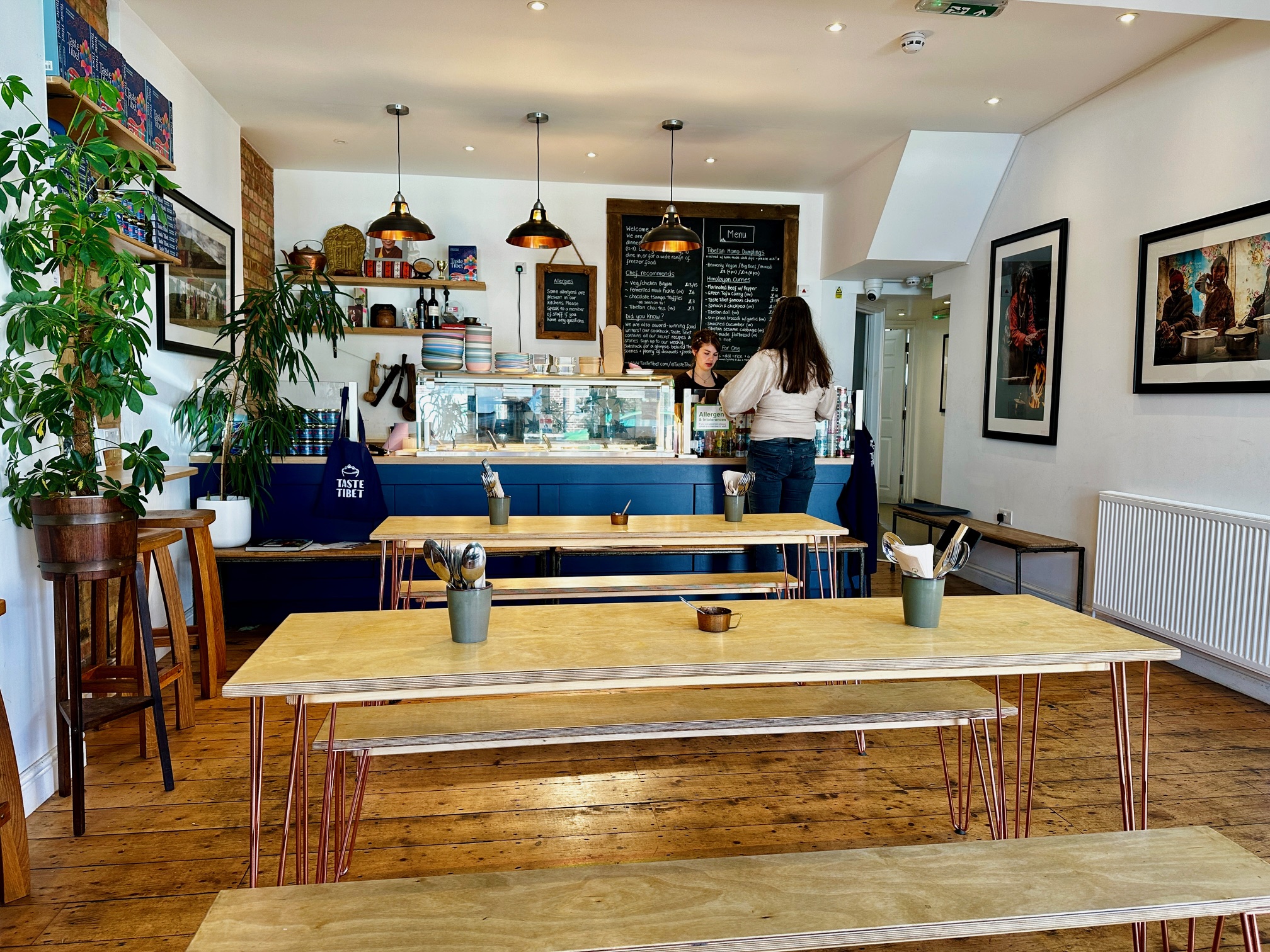
The interior is a lovely, tasteful room but very much in a canteen style, which fits with the lack of reservations. Long tables and benches, which I imagine are communal at busy times, were like a posh reimagining of the furniture you find at every tap room in the land, but the overall effect was very pleasant. There were also seats up at the window, which tempted me, or facing the wall, which didn’t. Jampa told me to hang my coat up on the hooks, which I did at first, but given that the door was left open to attract passing trade I quickly changed my mind and put it back on.
The menu, which changes weekly, is up on a blackboard behind the counter, and many of the dishes are already cooked, in chafing dishes up at the counter. Taste Tibet cannily also offers frozen meals for its customers to enjoy at home, these are in a separate freezer near the front and are a clever way to make sure nothing is wasted. They also had a decent range of drinks, soft and alcoholic, including wines in cans. I was a little disappointed, as always, to see Brewdog as one of the options but I got myself a verbena-infused pale by Earth Ale, a little brewery just outside Abingdon, which I really enjoyed for its fresh citrus and slight bitterness.
On the day I visited, Taste Tibet was offering momo – four or eight, vegan or beef – and four curries, with a mix of sides. They also served a biryani, or a feast option where you got a couple of dishes, dal, rice and a solitary momo for about fifteen pounds. If that pricing sounds keen, it wasn’t unrepresentative -curries weren’t much over a tenner and rice only two pounds fifty. Sides clustered around the five pound mark and momo were four for eight pounds. I ordered some momo, a curry and rice: that, with a tip included, cost me thirty pounds. “I’m in no rush” I said, “so it’s okay to bring the momo out first and the curry after that.”
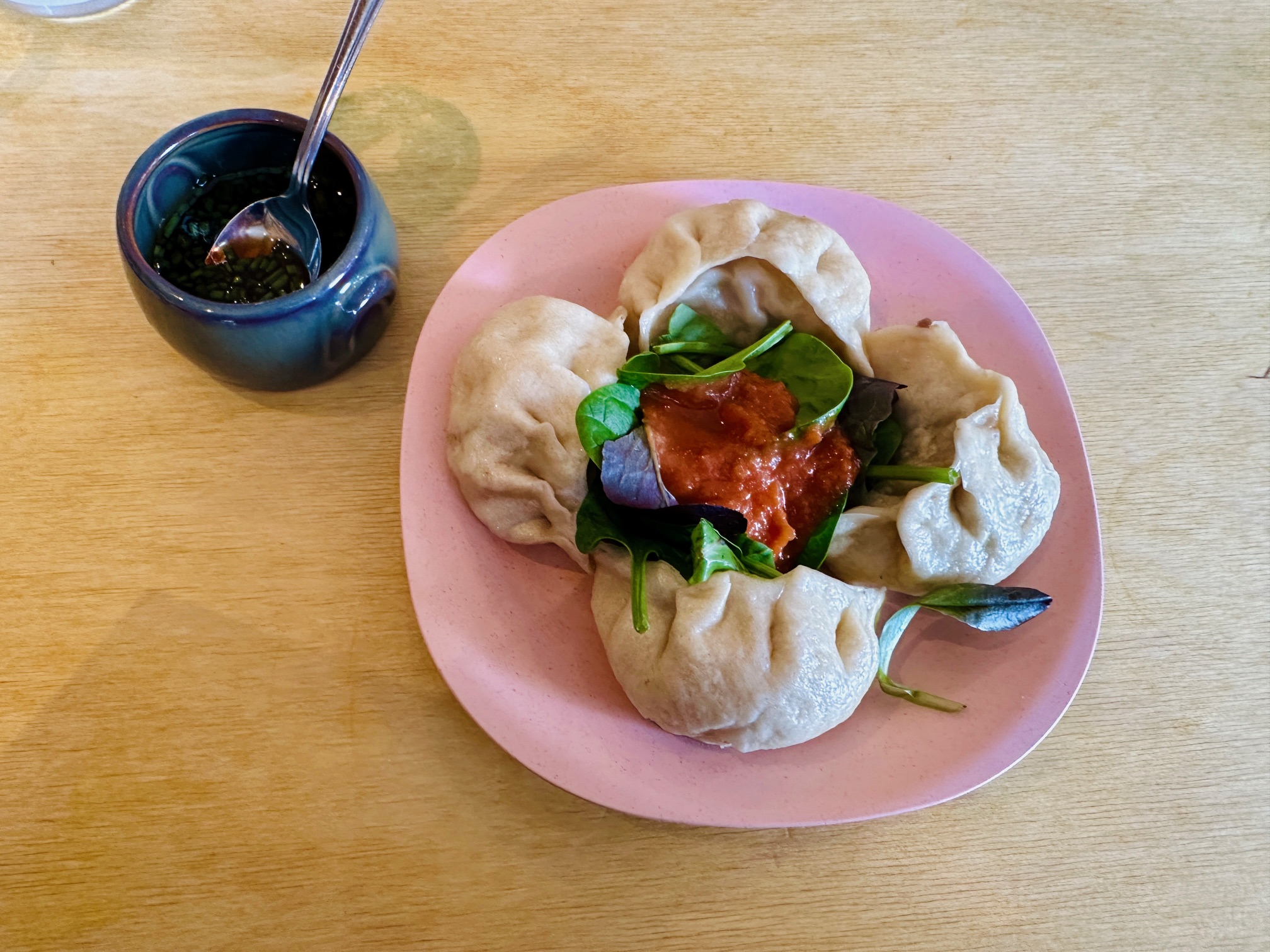
My momo came out five minutes later, and weren’t at all what I was expecting. Although momo apparently originate from Tibet rather than Nepal they’re so prevalent in Nepalese cuisine, and Nepalese cuisine is so prevalent in Reading, that I thought these would be a known quantity. And with that in mind, I thought four for eight pounds felt a bit steep. But Taste Tibet’s momo were a very different beast to the ones I’ve eaten at Sapana Home or Kamal’s Kitchen.
For a start, they were big: impossible to eat in one go, and challenging even in two. Crimped like jiaozi, they were steamed and made with dough that was thick verging on too thick, but that gave them structure and a pleasing, carby solidity. The beef inside – beef, not buffalo, although whether that’s the difference between East Oxford and Reading or Tibet and Nepal I couldn’t tell you – was properly lovely, coarse and delicious.
This came with a little handful of leaves whose main function was to serve as a bowl for a red sauce which was apparently a home-made chilli sauce: I found it a little meek. But what I did love was the bowl of a darker dipping sauce with a kick of soy. Again, I wonder if that’s the influence of Tibet, because I’ve never had Nepalese momo served with that, and it really did make me see the momo in a slightly different light. I can see the appeal of coming to Taste Tibet, as I used to with Sapana Home, and just going to town on the momo.
Later on, as I came to the end of my meal, couples and families were braving the outside tables and I saw big plates of momo going past on their way to the little terrace. Perhaps that was the way to do this place, or to come with a big group and try everything. One of the reasons I hadn’t ordered the “feast for one” was the presence of that single momo. It felt stingy, but looking at what had been put in front of me one would have been plenty, paired with an exploration of more of the menu.
My request that my curry come out after my momo had been taken a little too literally. Perhaps I should have said “after I’ve finished my momo”, although I didn’t think I’d needed to, but instead the rest of the meal arrived when I was halfway through what I thought was my starter. Really, though, that was me misjudging the place and its similarity to a canteen rather than a mistake on the restaurant’s part. Everything is there ready to dish up, and if you order something that’s exactly what they will do.
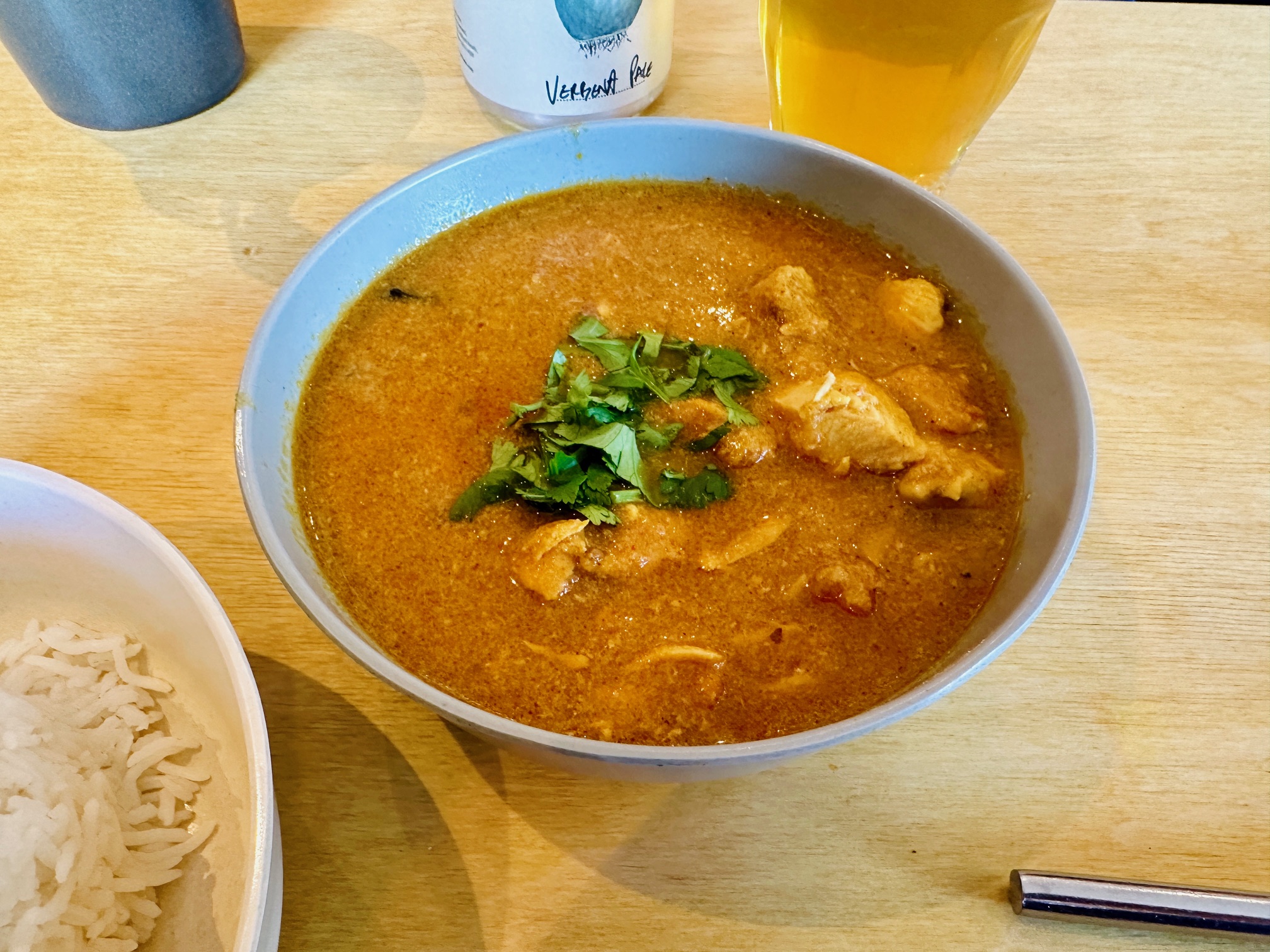
I had chosen Taste Tibet’s “famous chicken” because I took famous to mean signature, and I figured that if I was visiting a restaurant on my own I owed it to myself to check out the signature dish. And having eaten it I suspect it’s the restaurant, rather than the chicken, that is famous. It was a big portion with plenty of chicken, plenty of sauce. The chicken was all good and tender, and it was impossible to take exception to the dish.
But although not being offensive is a good thing, being inoffensive isn’t, and that’s what this was. Perhaps if my expectations had been lower I would have seen this as a comforting bowl of food, and celebrated what it was rather than noticing what it wasn’t. But this was like curry from a bygone age, before we got into regional food, started to discover the difference between Kerala and Hyderabad. It felt a bit like a Vesta curry, from forty years ago, and for something famous I expected more: I expected it to be famous for something.
How to make it more interesting, I wondered? I tried spooning in my perfectly cooked basmati rice – Taste Tibet serves both curry and rice in bowls that are just big enough for each, rather than giving you a plate to dish them up onto – but that bulked it without being transformative. I tried adding a spoonful of the dried chillis in a ramekin out on the table, but it lent an acrid pungency without elevating anything. The difference in heat levels was like the difference between sleeping on one pillow and two, going from not enough to too much.
I didn’t want to leave it like that, and I fancied dessert, so I went up to order the only thing on the blackboard that looked like afters. Chocolate tsampa truffles – as seen on TV! sounded absolutely like my sort of thing, and only cost three pounds. I was too full to have the chai that should have accompanied it, but never mind.
By this point the restaurant was far fuller, with people taking tables outside and the long table opposite me occupied by a group of impossibly young, animated east Oxford types. I looked on them indulgently, remembering a time over thirty years ago when that could have been me: not that I would have had the money to eat in a place like this.
Positively 4th Street was playing over the speakers, and I remembered that thirty years ago I loved that song, and suddenly it was back in vogue. Time can play unkind tricks, and all the things that made me so deeply unfashionable as a student – being a geek, listening to Bob Dylan and Leonard Cohen, playing chess and Dungeons & fucking Dragons – are acceptable now, too late for me. Even some of the shit I wore back then might be in now, I thought.
I felt a little tug of envy and regret, and then I let it go. It was as close to Buddhism as I got in Taste Tibet.
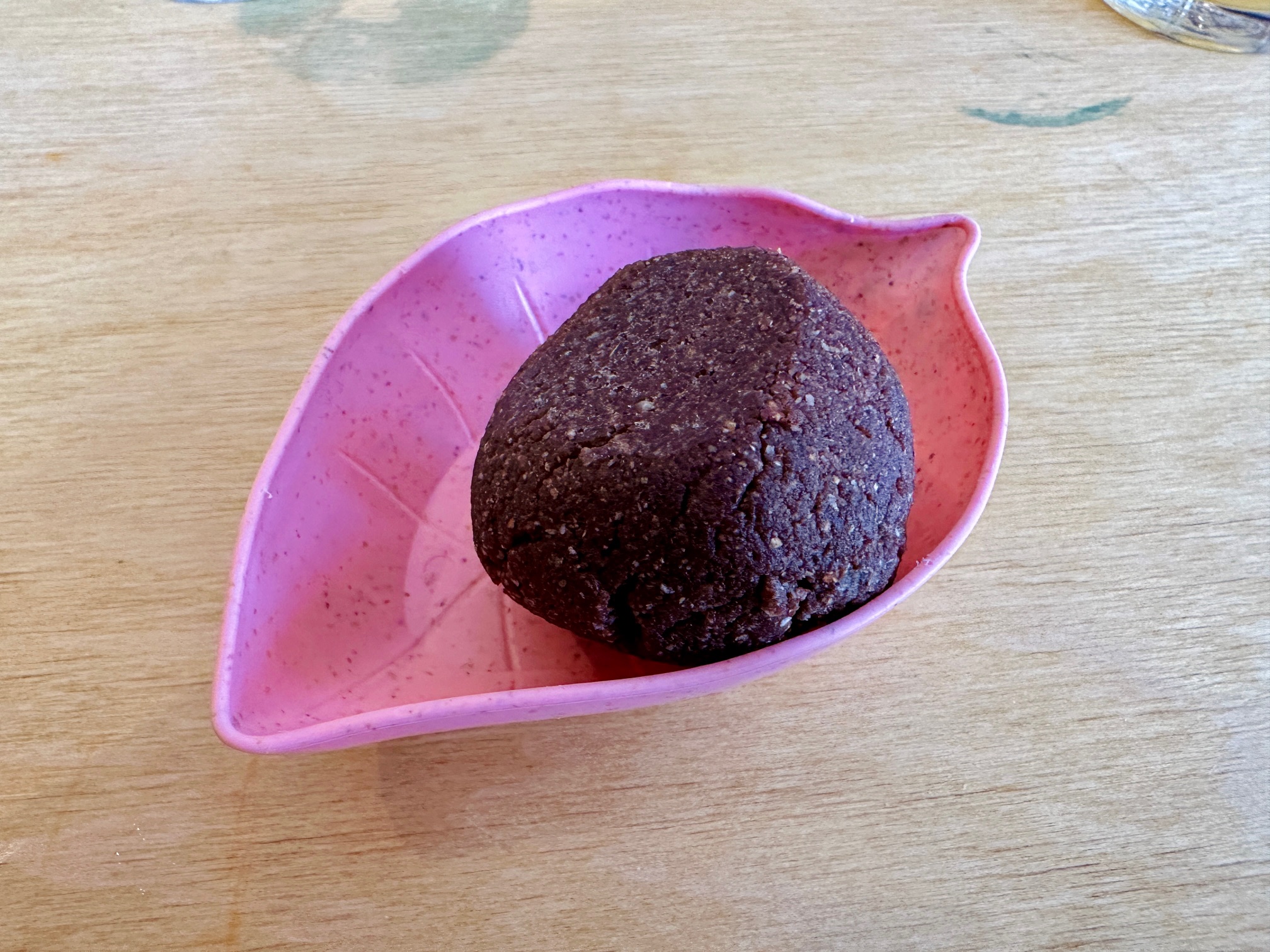
The chocolate tsampa truffles, plural, turned out to be a truffle, singular. A big thing designed, like the momo, to be taken on in multiple bites. I enjoyed it and, again, it wasn’t what I thought it would be. Its texture wasn’t dense or glossy, being more gritty with a feel of granulated sugar to it. Again, that’s down to me for misunderstanding – tsampa was not something that flavoured the truffle, but instead is a kind of flour made from ground, roasted barley, so it was the thing lending that texture.
In any event, the truffle reminded me of the brigadeiros at Minas Café, and I liked it without entirely understanding it. That’s fine, by the way: now I’m in my fifties I realise that provided you like things you don’t always need to understand them.
The rest of my day in Oxford was positively joyous. I stopped at Missing Bean, which was absolutely packed, to buy beans for the weeks ahead; I’m drinking a cup of their coffee as I write this. I strolled down the Cowley Road, past its plethora of Turkish restaurants, past the now closed Gamekeeper that used to meet all my Dungeons & fucking Dragons-related needs as a teenager.
I stopped in Truck Records to get inspiration, I stopped in Peloton Espresso to get caffeination. I bought cheese in the Covered Market, had time for a beer in Tap Social before my train home. It really is a gorgeous city, and it says something about the place that Magdalen Road is one of its little oases but far from its only one.
As you may have gathered by now, although I liked Taste Tibet I wanted to like it an awful lot more than I did. And a bit of me wonders if I’m the one in the wrong. It is a gorgeous spot in a gorgeous neighbourhood in a gorgeous city. It has a great backstory, is clearly loved by the community it’s part of and does tireless and admirable work to support that community. It is run by a committed husband and wife, where he works in the kitchen and she advocates, powerfully and eloquently, online and in the media. They want to tell the stories of where he comes from, through food.
On paper, I should love it: it sounds like other restaurants I love, closer to home.
But perhaps that’s okay. Perhaps Taste Tibet makes perfect sense in its context, in that city, on that little stretch of food and drink heaven. Maybe it doesn’t need people like me travelling to and across Oxford to try it out. It’s a neighbourhood restaurant – its neighbourhood is lucky to have it, and it’s lucky to have found its place in things.
If I lived closer I’m sure I would go back, try other dishes, fill my freezer and become part of their story, as they would become part of mine. But other places have got there first, for me at least. My train home pulled in at Gare du Ding and I thought about Kamal’s Kitchen, my favourite Nepalese restaurant, a short walk from the northern entrance to the station.
Its dining room doesn’t have the stripped-back elegance of Taste Tibet, it doesn’t have a narrative the way Taste Tibet does. I think Kamal and his family do a magnificent job, but much as I’d love them to I can’t imagine them gracing the pages of Observer Food Monthly. They don’t write beautiful blog posts, they have no plans to produce a cookbook that I know of and they won’t be at Hay Literary Festival this year. They let their food do the talking, and for what it’s worth I think their momo beat Taste Tibet’s. A restaurant can succeed in so many ways, but food and service are always king.
Magdalen Road in Oxford is a really fantastic place, and I do dearly wish Reading was a little more like it. But I wouldn’t swap their restaurant with ours.
As of January 2025, Edible Reading is partly supported by subscribers – click here if you want to read more about that, or click below to subscribe. Whether you’re a subscriber or not, thanks for reading.
One of the big gaps in my coverage of restaurants, given the name of this blog, is my failure to review the plethora of highly-rated gastropubs in the countryside around Reading. Berkshire is a funny-shaped county, long and thin, and that means you can strike out into Oxfordshire to the north or Hampshire to the south as easily as you can head east towards Maidenhead or west to Newbury staying within county lines. And one of the reasons, I suspect, why central Reading has never attracted many special occasion restaurants is the embarrassment of riches to be found a short drive away.
I’ve done some of them in my time of course, like the Bell or the Bottle & Glass, but the vast majority remain on my to do list, or at least they would if I were able to drive. And that means that when Britain’s Top 50 Gastropubs publishes its annual list, as it did early this year, I scan it for pubs nearby and realise, ruefully, that I’m unlikely to review them. This year The Loch & The Tyne in Old Windsor, Tom Kerridge’s two pubs in Marlow and The Crown in Burchett’s Green remain on my “maybe one day” list.
Another strange phenomenon in the gastropubs nearby is a tendency for musical chairs where highly rated chefs move from one pub to another. So for instance Dominic Chapman, who earned a Michelin star at the Royal Oak at Paley Street, which I reviewed, then moved on to the Beehive in White Waltham, which I have visited but not reviewed (it was, by the way, not bad at all).
And then, nine years later, he sold up: by that time he had taken on The Crown at Burchett’s Green, which he took over from Michelin starred Simon Bonwick. Again, I ate at The Crown once under Bonwick and thought it was quite good and extremely expensive. Bonwick then pitched up at The Dew Drop Inn in Hurley, managing eighteen months there before moving on again: he now cooks upstairs at a pub in Marlow three times a week.
This happens all over: The Loch & Tyne in Old Windsor is run by Michelin starred Adam Handling, but before that it was called the Oxford Blue and run by a chap called Steven Ellis. Ellis has moved on to another spot, The Bailiwick in Englefield Green which just so happens to be my stepmother’s favourite restaurant in the whole world. Again, I’ve been and it’s really rather nice, especially the venison bon bons; if you ever go, get a portion to yourself.
So maybe one good reason not to review pubs in this part of the world is the amount of toing and froing that goes on, with almost as much transfer activity as the Premiership: even The Plough, which I loved, is on to another head chef since I visited, its third in two years.
One of the benefits of this phenomenon, though, is that sometimes you see welcome, familiar faces pop up in new places. And that brings us to the Pot Kiln in Frilsham, out in West Berkshire, nestled in the Yattendon Estate. This bit of the world, too, has always been sprinkled with good food pubs: the Royal Oak in Yattendon and the Bladebone Inn in Bucklebury are just two more to add to the list of Places I Like But Have Never Reviewed.
The Yattendon Estate now owns the Pot Kiln, as it does nearby Renegade Brewery and Vicar’s Game in Ashampstead. Before that, for a long time under chef Mike Robinson – who held a Michelin star at Fulham’s Harwood Arms – the Pot Kiln was already synonymous with game, all caught on the estate. I ate there once, when Robinson was at the helm, and thought it was rather enjoyable, the surroundings idyllic. But then Robinson got divorced, and his wife got custody of the pub, running it with her musician partner, the magnificently named Rocky Rockliff.
For whatever reason the Estate subsequently snapped up the pub and installed new management. But rather than pick one of the merry-go-round of local chefs and get them to do what the pub had always done, the Pot Kiln took a more interesting course of action. It decided that instead of offering mainstream pub fare or more generic modern British food it was going to serve a Basque-infused menu. A three quarters of a million pound refurb was carried out, including a new open kitchen and a parilla grill, and it reopened last summer.
The other interesting thing they did was appoint chef Nick Galer. Now, I knew Galer’s food from his very successful spell at the Miller Of Mansfield, a lovely pub I did manage to review six years ago, out in Goring. He left the pub three years later, when our old friends Stonegate decided to nearly double the rent, and after that he had an incongruous spell cooking at a nearby golf club, but the move to the Pot Kiln made sense. It’s been on my list ever since, and as my future brother-in-law Matt drove us through the winding lines of West Berkshire in the gathering gloom I realised that I had a real sense of curiosity about the meal that lay ahead.
The thing is, I loved the Miller, and had some really successful meals there. But there were also a couple of times, especially one Christmas Day set meal, when I left somewhat peckish, and I’d heard similar reports from other people who had acted on my recommendation. A pub in the countryside offering tapas and the heartier food of Northern Spain, making good use of cooking over fire, could be an intriguing second act for Galer’s cooking.
In the summer, I imagine a review of the Pot Kiln would talk about just how beautiful its surroundings are, and what good outdoor space it has. But in grim, largely sunless March, before the clocks went forward, all I can say is how glad I was to be in the passenger seat next to an extremely competent driver and navigator. The pub itself looks classy and cosy – definitely one of those gastropubs that still operates as a pub – but the dining room of the restaurant, next to the open kitchen, was a little harder to love.
I couldn’t quite put my finger on why, because the tables were generous and the chairs comfy, but the lighting was a tad cold and the whole place had a certain feeling of sterility. It wasn’t for the lack of diners, because the room was reasonably well-occupied on a Monday night, including a large group which sang Happy Birthday later in the evening. But we grabbed a table for two with our back to all of that, both looking out on the open kitchen, and perhaps that was an error. Galer was not in the kitchen that night, although that didn’t seem to remotely affect the bustle of the staff beavering away.
The Pot Kiln’s menu read really well. There were ten tapas dishes, ranging in price from just over four to just over ten pounds, and eight mains, two of which were sharers. They started around twenty pounds and climbed from there. Half a dozen vegetable dishes, appearing out of sequence before the mains, completed the picture, although they appeared more to be sides than tapas. And actually, although I found plenty to potentially order on it, this menu wouldn’t suit vegetarians or vegans. Only one main for them, baked rice with cauliflower and capers, and four tapas options. In that sense, I suppose you could say it was quite authentically Spanish.
All that being the case, the drinks list surprised me. The local beers on offer highlight the owner’s connection to Renegade, the brewery formerly known as West Berks. But I thought there might be some Spanish sidra on offer, or at the very least some txakoli, the slightly sparkling wine which is one of the Basque country’s best exports. Not only wasn’t there any, but the wine list was dominated by other countries: less than half of the whites and about a third of the reds on offer came from Spain. It felt like some bet hedging was going on.
I decided to stick to the two Spanish whites available by the glass, starting with a Macabeo which was fresh, if slightly astringent. The Verdejo I moved on to later in the evening, not significantly more costly at eight pounds a glass, was much better: fuller, rounder, more interesting. Matt stuck to an alcohol free Asahi before then trying a mocktail with elderflower and ginger which he rated.
So, how many tapas dishes would you have ordered to share between two, not knowing how big they were or how large the mains after them would turn out to be? We opted for three, which I worried might be over-ordering: I suspect my appetite is bigger than Matt’s, or possibly it’s just that his manners are better than mine. But I needn’t have worried, because these were definitely tapa rather than media or racions.
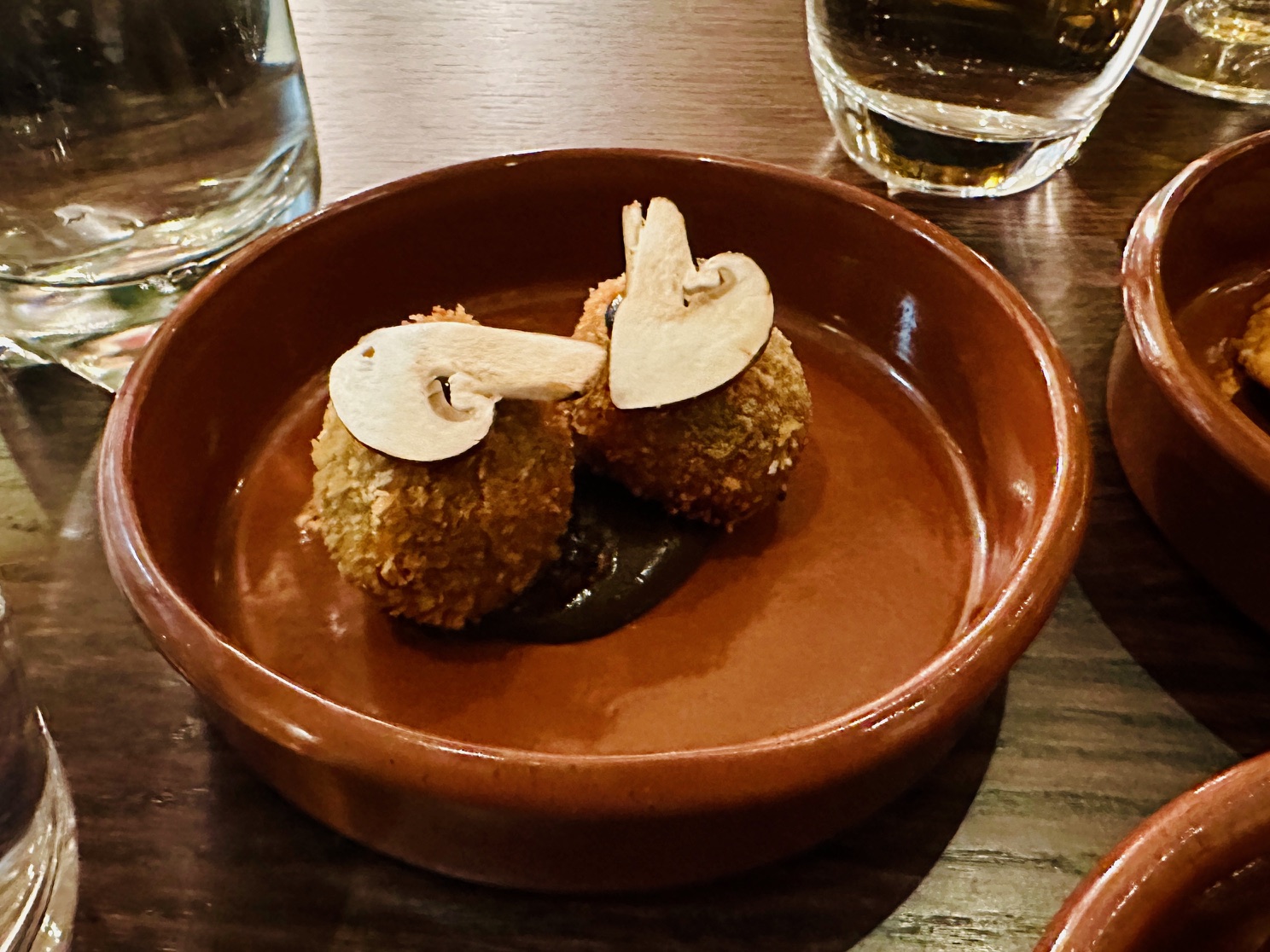
First up, two mushroom croquetas, each topped with a thin slice of raw mushroom – this seems to be in vogue at the moment, although I’m not sure it added anything – resting on a puddle of thick mushroom ketchup.
I have to say, the taste of these was extraordinary. The concentration of savoury notes at the heart of those breadcrumbed spheres was something else, but better still was the depth of the ketchup. It had an awful lot going on – yet more umami, but also a very pleasant acetic spike in the mix. These were two really lovely croquetas. Two really lovely, rather small croquetas. Two really lovely, rather small croquetas that cost seven pounds fifty.
If you wanted any proof that the Pot Kiln, whatever else it might be good at, could do ketchup, the next tapa amply demonstrated this too. A pair of empañadas, with pleasingly dense pastry, had a filling of slow-cooked short rib and came with a blob of Kermit-coloured gherkin ketchup. The star of the show here was the ketchup – even Matt, who had been suspicious from the moment he spotted the word “gherkin”, tried some and declared himself a convert.
This dish was worth ordering for the ketchup alone, such a clever piece of work, something which captured the taste of gherkins in an almost photorealistic way despite being a puddle of green. It redeemed a multitude of sins, but did it redeem the fact that the two empañadas weren’t exactly bursting at the seams with strands of beef? Maybe.
Did it also redeem the fact that a pair of empañadas set you back eleven pounds? Maybe not. The philosophical struggle I had detected in the menu was between Spanish cuisine sending you away very full indeed and Galer’s cooking sometimes rarefying things to the point where they were a perfect, but tiny, distillation of themselves. On this evidence, the latter was winning out.
I minded all that less with the third tapa, but the fact remained that it too was small and perfectly formed. Two titchy triangular toasts, topped with tomato, finely chopped onion, oil, herbs and, from somewhere, a gorgeous supporting note of citrus. These too were this kind of thing – so often in Spain a huge piece of bread amply covered in their peerless tomatoes and salt – miniaturised to a lovely, exceptionally high end version of the same.
Getting tomatoes this good in March is itself, after all, quite an achievement. If elevation was the intention, mission accomplished. But although I could well believe you wouldn’t get a better rendition in San Sebastian, I could imagine you wouldn’t get a smaller one, either. Six pounds fifty for this.
At this point I was, in truth, a little concerned that it would be one of those meals, where everything tasted amazing but you had to seriously over-order or leave without feeling replete.
But Matt and I had ordered the 12-hour lamb shoulder, intended for two or three people, and we’d been warned in advance that it took a while, so we moved on to our second drink and caught up – his job, my job, his household adjusting to the arrival of my second niece, the ins and outs of the family we were both lucky enough to have found ourselves part of. Matt has the sort of senior job that means you have to be good at talking to anyone and everyone, which makes him an excellent conversationalist, although it did leave me hoping his evening with me didn’t feel like work.
From our vantage point I could see that the lamb shoulder had spent most of its 12 hours cooked sous vide, so it was rescued from a plastic cocoon and finished in the oven. And when it was eventually brought to our table, bronzed, with a thick layer of crispy, salted fat, I thought it looked about as wonderful as could be. It was accompanied with a little pot of anchovy and garlic sauce, which had also been artfully squiggled around the plate in an unnecessary fashion. Our server – all the people who looked after us that night were excellent, by the way – started the process of testing the lamb off the bone and shredding it, doing just enough for us to dish up and leaving the rest of us to explore for ourselves.
It was absolutely glorious. Lamb is one of my favourite meats, and this must be one of my favourite ways to have it. I’ve had slow cooked shoulder before where the fattiness is to the fore, where it’s slicked with the stuff, a little too much. But this was gorgeous, almost like the best kleftiko there is, and the texture was spot on, with enough of everything: crispy shards, plenty of supremely tasty fat, both crunchy and wobbly, and piece after piece of shredded lamb, some moist, some dry, all brilliant.
The salt studded along the edge of the fat made those pieces an especially savoury delight, and although it didn’t slump off the bone the way some slow-cooked lamb can, it didn’t take an awful lot of persuasion. For some reason we’d been brought quite dinky plates, which meant that we had to keep coming back for more, but that was very far from an ordeal.
Matt wasn’t sure about the sauce, but I suspect he’s less of an anchovy fan than I am. Even being a huge lover of anchovies, I thought this was salty overkill: I’ve read other reviews that say this used to be served with a mint sauce, and I can see that, or salsa verde, offering the counterpoint this needed. It also worked out fortuitously, I think, that the bits I were drawn to, especially the fatty ones, were naturally the ones Matt might have passed on. We were a regular Jack and Mrs Sprat, and between us we polished off the lot.
At seventy pounds, I think this served two nicely but might have been stretched between three. But I liked it so much that for even for two I thought it represented agreeable value.
Meat requires potatoes, whether you’re in Thatcham or Bilbao, and torn between the enigmatically described “Spanish potatoes” and the Pot Kiln’s chips we went for the latter. Very good chips came speckled with crispy flecks of jamon and under a light dusting of Idiazabal, a Basque cheese. There was also, apparently, “Bravas seasoning”, which I imagine was another piece of refinement and deconstruction. Too much refinement, I fear, because nothing was really detectable. Still, good chips with cheese and jamon on them are always going to go down well with me, and these did.
All that was an overload of saltiness, and much as I loved that I was glad we had some contrast in the form of some carrots. These were beautiful, fresh, just-cooked things dusted in something which apparently contained chives but, to both of us, tasted strikingly of aniseed. The fact that these, really, were the only vegetable of the evening was Matt’s and my fault for ordering the way we did, but also felt quite authentically Spanish: finding anything with vegetables in it can often be a challenge there, in my experience. Not that I’ve ever tried that hard.
By this point, things had quietened down in the restaurant and we were almost the last people there. I almost felt guilty about keeping them by ordering dessert, but I also felt like we ought to try that part of the menu out.
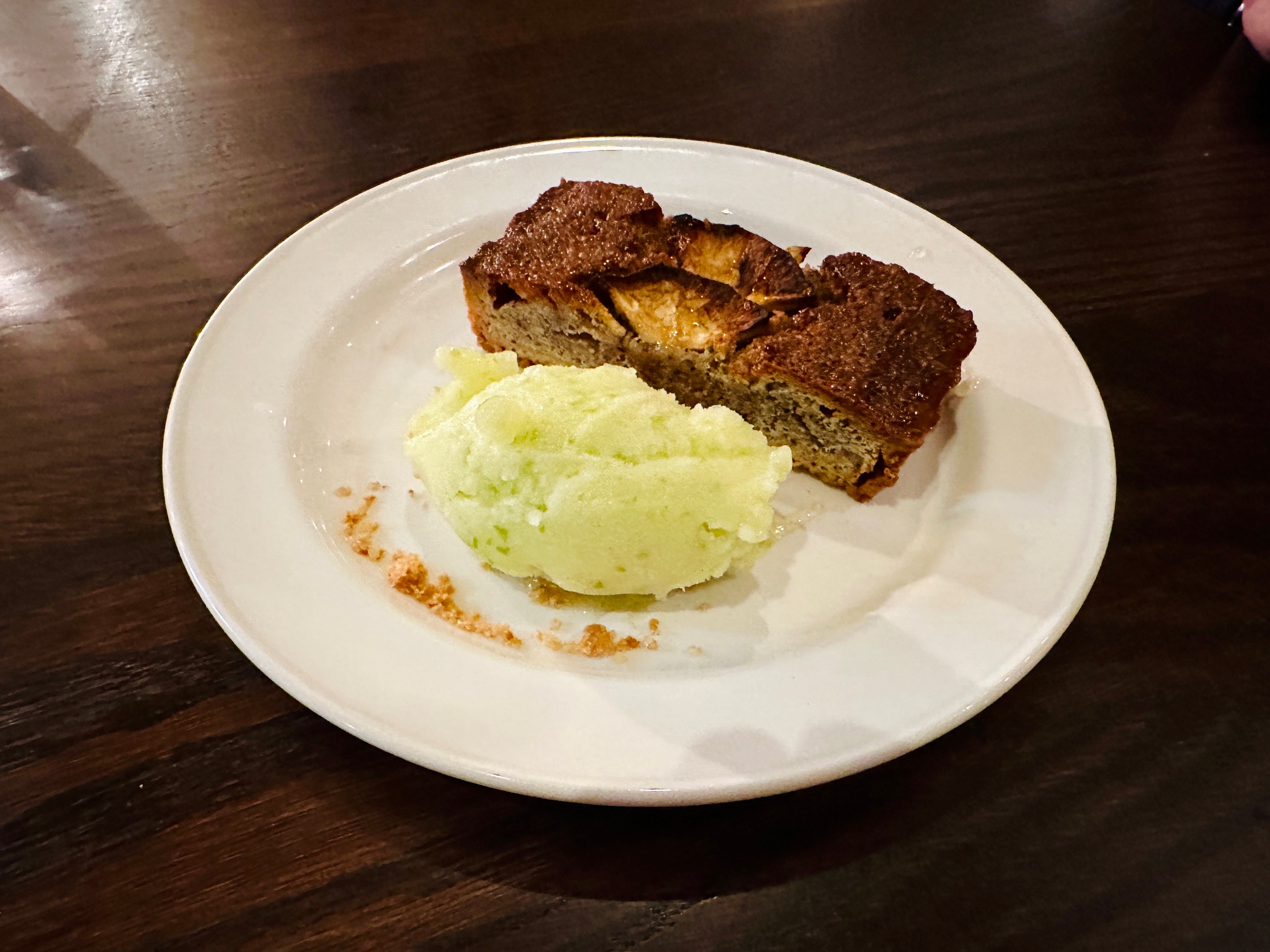
The dessert menu is compact – five dishes and a selection of cheeses, and one of them, turron at five pounds fifty a piece, felt more like something to accompany a coffee than a dessert in its own right. Matt was tempted by the apple tart with apple sorbet and calvados syrup, but unsure: he liked apple, but did he like it that much?
I told him you couldn’t have too much of a good thing, so he went for it and I think he was rewarded with the better dessert. My spoonful, again, pointed to the kitchen’s technical gifts and command of flavours: each element a slightly different iteration of apple, prioritising sweetness, sharpness or booziness. I would have been happy, had I ordered this. But had I ordered it – and even though I didn’t – I would say it was more a cake than a tart.
My choice, on the other hand, was one of those disappointing examples of how a menu can say one thing and mean another. Rhubarb sorbet, gingerbread, cava paints a picture of those three elements in harmony, maybe equivalent amounts of each, and I was expecting that to be the case. Instead, in the Pot Kiln’s standard issue terra cotta pots, I got a dollop of (admittedly very good) rhubarb sorbet with a scattering of gingerbread crumbs, like snow that would not settle.
Cava was then poured over it, but the terra cotta pot wasn’t the right vessel for a dish like this. It just meant that you got a thin lake of booze at the bottom that you couldn’t spoon up. So essentially this was a rhubarb sorbet with whistles and bells that didn’t blow or ring. At eight pounds fifty, this felt like a lot to spend on a dish that didn’t entirely cohere.
All told we’d been enjoying the Pot Kiln’s hospitality for over two hours, and I was increasingly conscious that we were probably preventing them from shutting up shop in the restaurant. At this point the open kitchen was less of a selling point: it’s one thing when you see activity, vitality, prep, flames, dishing up, but perhaps another entirely when they are mopping the floor with one eye on the service after this one, the following day.
So we settled up and Matt prepared to effortlessly work wonders with his satnav, ease us out of deepest darkest West Berkshire and take us back to the bright lights of Reading. Our meal – three tapas dishes, that lamb and side dishes, a couple of desserts and a couple of drinks apiece – cost about one hundred and sixty-five pounds, which included an optional ten per cent service charge. Overall I thought that was reasonable value – fair in parts, good in others, questionable in a few.
That was something I pondered and weighed up in the week I took to mentally digest, between eating this meal and writing it up here. Because after those tapas dishes I was all ready to write my oh-so-slighly disappointed not-quite-a-peroration, in which I gently pointed out that “perfect for sharing” should translate as “this dish is big enough for two people to enjoy” rather than “this dish is made up of two individual, rather small, morsels”.
But then the main course completely subverted all that – it wasn’t cheap, but it was outrageously good. It was the kind of food I had been expecting to find at the Pot Kiln, but I don’t think I was expecting it to be bookended by things so different – by tapas dishes that worked wonders with flavour but left you wanting more in all the wrong ways on one side, by desserts that were a tad pedestrian on the other.
In the run up to this visit I wondered which would prevail – the big portions and big flavours of the Spanish food I’ve enjoyed in the past (notwithstanding that I’m yet to go to the Basque country, sadly) or the precise, distilled, excellent cooking that Nick Galer is so good at. And the answer, based on this visit, is that the Pot Kiln, not quite open a year yet, is still resolving that identity crisis.
There is plenty to enjoy here, and I enjoyed plenty of it, but “let’s open a Basque inn in the middle of beautiful countryside just outside Newbury” is a concept I can get behind. “Let’s do the most beautiful portions of tapas that take a classic idea and produce it in its smallest, purest form” is perhaps not.
So if you want tapas, I think you might be better off heading just down the road to Goat On The Roof. If you want ludicrously good meat cooked beautifully on an amazing piece of kit, you should go here. Because that’s the part of this meal I’ll still be thinking about in the months ahead, the part I’d passionately recommend to others, the part I am remembering now, with a grateful smile on my face. For what it’s worth, I hope that side of this particular see-saw gains the upper hand.
The Pot Kiln – 7.5 Chapel Lane, Frilsham, RG18 0XX 01635 201366
As of January 2025, Edible Reading is partly supported by subscribers – click here if you want to read more about that, or click below to subscribe. Whether you’re a subscriber or not, thanks for reading.
After the news that cuddly Mark Zuckerberg was doing away with fact checkers, when the penny dropped that distinguishing between our tech overlords was a similar exercise to using the Bristol stool scale, I read a lot of stuff online about how blogs were making a comeback. Enough of pithily sharing whatever’s on your mind and giving your data away on a billionaire’s platform, they said: time to get back to the good old days when people put their thoughts, longform, on their own blogs. Taking back control – a concept we’ve learned by now can only lead to happier times ahead.
It would be lovely if that were true, but I have my doubts. I’ve been blogging, in one form or another, for over fifteen years and I was late to the party when I started, so you can imagine how behind the curve I am now, waiting for the whole thing to finally be back in fashion. What this world needs is more 3000 word reviews of restaurants is a sentence I’ve only ever heard in dreams. I’m under no illusions – I’m happy in my niche, but I know that’s exactly what it is: a niche.
The tectonic plates of food writing changed last weekend when gastro-blowhard (and life president of the Jay Rayner Appreciation Society) Jason Rayner signed off from the Observer after 26 years, with a review which was ostensibly of an Indian restaurant in Leicester but was really about how great he was and how much we’ll all miss him. Bless.
He replaces tedious Tim Hayward at the FT, who took his leave with a review showing his unerring talent to slip a repulsive sentence into every piece. “I’d compare it to some kind of ecclesiastical erection were it not so determinedly sensuous” he said. Of a restaurant. What’s the opposite of starting as you mean to go on?
But these moves, really, are just shunting deckchairs around on the Titanic of print journalism. So too is the announcement of a new website, Scribehound, amalgamating the output of 30 food writers so that for a monthly fee you get a bit of everything. “Why pay for all those Substacks?” said one of the contributors, making it clear who they’re gunning for.
No, the real opinion formers in food these days are working in short form video, on TikTok and Instagram. I’ve written about Toffjaw before with their nearly 800,000 Instagram followers, but even they pale into insignificance compared to the influencer Eating With Tod, who is followed by more than twice that number.
His real name is Toby Inskip, but “Eating With Toby” would give the game away too early that this is yet another posho telling people what to eat. For the uninitiated, Inskip is a ginger chap with a very excitable plummy voice who always sounds like he’s just about to run out of breath: his many detractors are probably disappointed that he never does. He goes to a range of places and invariably describes them all as the best of their kind in London/the United Kingdom/this galaxy, and he’s on record as saying that he won’t ever criticise anywhere. He’s not a reviewer, he says, his is a “recommendation page”, and by recommendation he means hyperbole.
Whether he pays for his meals or not is unclear, but you get a pretty good idea from a cursory scan through his Instagram what he’s about. With more raves than Ibiza and a seemingly endless supply of gurning at food, Inskip’s techniques are now ubiquitous across a whole genre of ladz reviewing food on TikTok and Instagram.
From the overload of superlatives to the ridiculously exaggerated come face that follows every single mouthful, as if each one is utterly consciousness-redefining, from finger-banging thin air, as if to say that’s what I’m talking about, to the orgasmic waggle of the fork, to the naff chef’s kiss at the end of the video, these techniques have been snapped up by dreary bloke after dreary bloke.
Inskip also misses his mouth. A lot. For someone who has made a putative career out of eating out, he doesn’t appear to be very good at it, so every bite of a burger or a pizza leaves a huge smear miles from the corner of his mouth in a way that makes me feel icky. It’s like watching a toddler. How far we have come, that back in 2014 not being able to eat a bacon sandwich properly disqualified a man from the highest office in the land and in 2025 lacking basic hand-eye coordination is a fast track to thousands of followers? It makes you think.
Anyway, this week’s review found me in Guildford eating at The Boring Burger, and it was largely because of Eating With Tod. He went there last April, as part of his ongoing quest to find Britain’s best burger, and was every bit as aerated as ever. He raved about chef-owner Jamie Kuhls’ “Michelin skill set” because he worked at Claridge’s, although no restaurant at Claridge’s has held a star for something like 7 years. “His attention to detail blows my mind” said Inskip, a man whose mind seems to be blown on a daily basis.
“I could literally just put on a pair of sunglasses and stare at these burgers all day” he said, accompanied by footage of him, sunglass free, holding a burger up and gazing with wonder before taking a bite, smearing sauce on his face and waving his hand in the air with orgiastic abandon. “The best part”, he concluded, “is when you’re ordering through UberEats you can get their brisket mac and cheese bites, and they’re rather bloody tasty”.
That’s the best part? Really? These influencers love to team up with delivery apps for even more free food, another smoking gun that they don’t really like restaurants all that much.
Now, I know I’ve been scathing about poor Eating With Tod – it’s like shooting fish in a barrel – and I could go on. But it cannot be denied that even though he’s a challenging watch, he gets a lot of information across in a short space of time. And looking at that burger, which was infinitely preferable to looking at his boat race, it did look very good. So the seed was planted… should I maybe give it a try?
Anyway, influencers are like buses: you wait ages and then two come along at once. Because last October Bos Finesse, Bristol’s answer to Eating With Tod, also ate at The Boring Burger. And that’s what swung it.
Bos Finesse – real name Oscar Bostock – is an ebullient Bristolian chap who wears a lot of streetwear and has a unique line in hyperbole. For what it’s worth I rather enjoy his contributions to the English language, although I worry terribly about his complexion and his colon, and not necessarily in that order. Bostock has amassed 85,000 Instagram followers and you can’t fault his commitment, eating at highly rated Bristol restaurants, random takeaways in the arse end of nowhere, street food joints, burger vans and even fans’ houses (he also likes Gurt Wings, so he can’t be all bad).
When Bostock went to The Boring Burger he cranked Eating With Tod’s hype-o-meter up to 11. “These might just be the sexiest burgers I’ve ever seen in my entire life” he enthused, before adding that “they aren’t messing about in here, mate”. Bostock also met the owner and said “when you hear about his portfolio of Michelin restaurants you don’t ask no further questions”, despite the obvious question being which ones are they then? Quite the evolution from just having a “Michelin skill set”.
But critical evaluation is not what influencers are about: Bostock grinned like a pig in shit as he was presented with a tray groaning with three different burgers and as many different side dishes and portions of fries. It made me wonder – is it like Masterchef and, after a couple of bites, is the rest eaten by the film crew? Anyway, Bostock loved it and awarded what, for him, might be the highest accolade possible. “Boring Burger: what a gaff” he said. That was it: I had to try it now, so off I went to Guildford on a sunny Saturday morning.
You might well know this already, but isn’t Guildford nice by the way? I don’t think I’d visited it since before the pandemic, and I’d forgotten what an agreeable place it is once you’ve crossed an IDR-style thoroughfare and cut through the decidedly retro Friary shopping centre. The other side of that is a rather fetching, gently sloping cobbled high street that reminded me of a cross between Winchester’s High Street and Windsor’s Peascod Street – or would do if the shops in the latter hadn’t all apparently closed and been replaced by phone repair and vape outlets.
No, Guildford is far more well-to-do than that and on its high street and the little lanes that slope off it you can find a who’s who of businesses Reading doesn’t have: Anthropologie; Coppa Club; Joe & The Juice; Le Creuset. At the bottom of the street a busker was doing a perfectly serviceable job of belting out Set Fire To The Rain by Adele, a song which never even tries to explain the impossibility of its title.
The lanes that head up to the castle have interesting stuff in them, too: I stopped at a very nice wine shop called Corkage and picked something up for later. Continuing my stroll I saw the Ivy and the Ivy Asia, and thought that Guildford definitely had some things Reading needn’t envy.
Boring Burger is up one of those lanes, just across from a Giggling Squid and two doors down from Meat The Greek, a souvlaki place I’ve always rather liked. The sun was shining and at about half-twelve all of its orange tables outside were already occupied, although it shares the terrace with its neighbours and so has fewer tables than you might think. Inside was a very no-frills long, thin room with about ten stools crammed together in a line, all facing the wall.
There was a self-service touchscreen at the front, which seemed a bit jarring, and quite a few orders were takeaways, either from the blokes waiting in the queue or the steady stream of delivery drivers. People must have heard about the best thing about the restaurant, those brisket mac and cheese bites.
The clientele was nearly all men, some of them dragging their partners along, and they all looked like they could easily be acolytes of Eating With Tod. If you can’t take a date, take a mate he always vacuously declaims at the end of his reviews: I, like the loser I am, had done neither.
The menu sensibly keeps it narrow. Four different permutations of beefburger, one chicken burger. Nothing vegetarian that I could see, although I’m pretty sure they used to do a portobello mushroom number. Most of the burgers are twelve pounds, though one with fifteen hour braised brisket costs more, as does having an extra smashed patty. Fries are an extra fiver, unless you jazz them up with bacon and cheese sauce or katsu sauce.
There are a couple of sides, mac and cheese bites – with gochujang, not brisket – or buttermilk chicken tenders, which I was always going to struggle to resist: once I saw them on the menu, in the immortal words of Bos Finesse, you don’t ask no further questions. I placed my order, gave them my name and then managed to find an actual low table with a banquette tucked away right at the back of the restaurant. I couldn’t quite believe my luck. A doubled up smashed burger, tenders and fries cost me twenty-eight pounds, and they told me it would be about fifteen minutes.
In reality it was half an hour, but I didn’t mind. It was fun to see the bustle behind the counter, the burgers turning up for the family of four who had camped out in a row at the end of the ledge. One thing all the influencers went on about was Boring Burger’s attention to detail: designing and making their own buns, making all their own sauces, hand-cutting fries every day the way Honest do. In fairness those influencers also talk with wonderment about restaurants “making everything from scratch”, I guess because some of the places they review don’t.
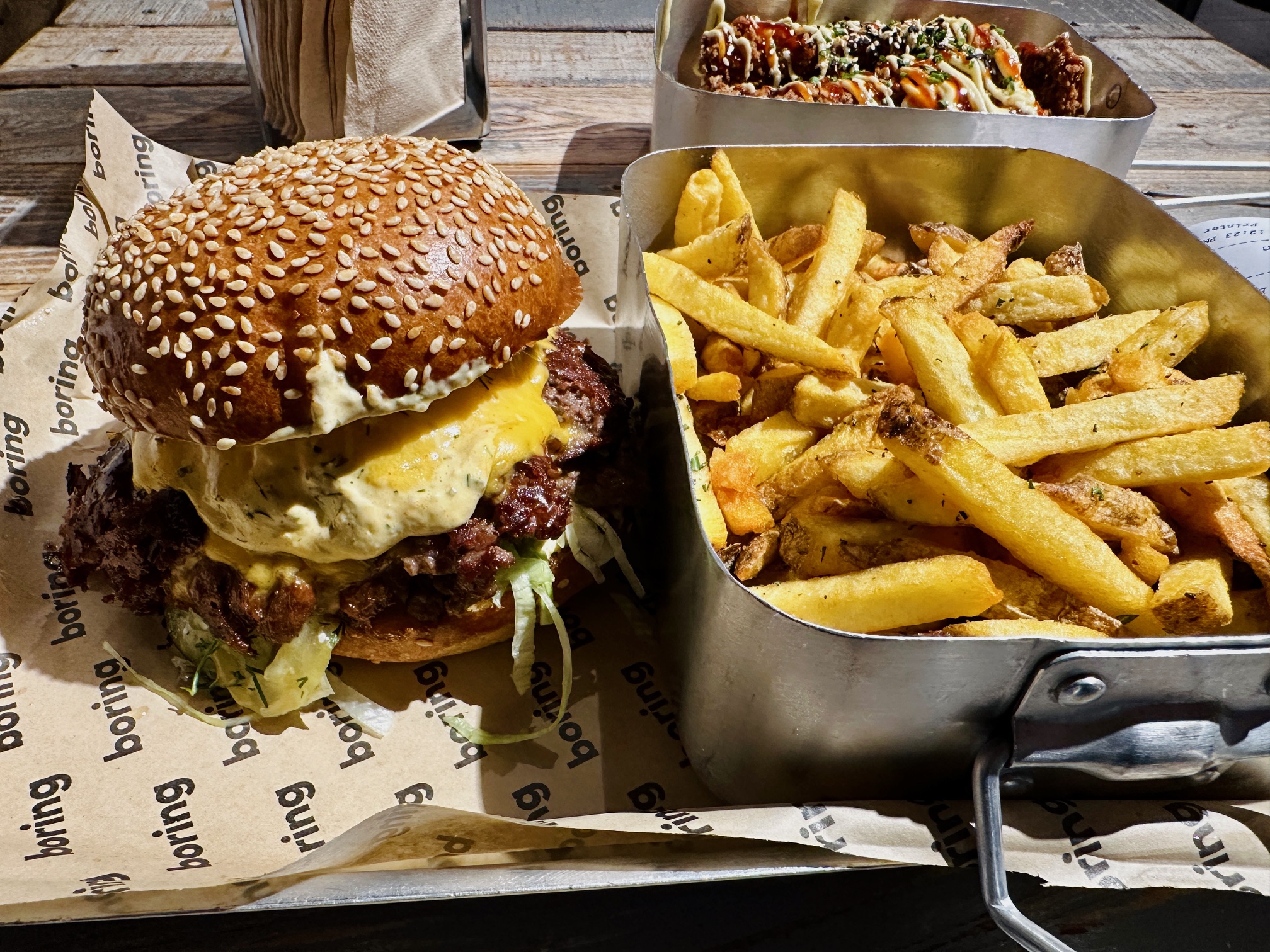
This is an exceptionally silly thing to say about a restaurant whose fame has entirely spread through a visual medium, but Boring Burger’s food really does look terrific when it lands at your table. The bun is burnished and glows, the fries are the perfect shade of golden, the tenders look gnarled and toothsome. I don’t know if I could have popped on my shades and stared at it all day, but fair play to Boring Burger: you eat with your eyes and in that respect you eat very well there. I could see why this stuff appeared in grid after grid.
But could it live up to that when you actually tasted the stuff? In the case of the burger, yes – a hundred times yes. I’d gone for the eponymous Boring Burger, their signature, and it was the best smash burger I’ve had in this country and one of the best I’ve had full stop. The patties were beautiful, especially at the edges where they were crinkled and crispy, the fabulous bits of burger overhanging the perimeter of the bun. Doubling up was probably overkill, but I felt like I ought to do it properly.
The dill pickle, sliced mandolin thin, added crunch and tartness, and the bun – toasted, another nice touch – was the perfect antidote for anybody tired of brioche. Eating With Tod said the buns “hold their shape like a bodybuilder”. Err, I guess. They definitely had the structural integrity to carry the show. No soggy mulch at the bottom as even happens sometimes with Honest’s more overloaded burgers.
Even the bacon – they dry age it themselves, apparently – was bang on. I don’t think I shared everyone else’s wide-eyed enthusiasm about the burger sauce, which was fine but no more, but honestly: this was one of the best burgers I’ve tried. I’ve had ones at this standard in France, but nothing to live up to it in the U.K. – neither Honest nor Reading’s much missed Smash N Grab came close.
That’s why it so disappoints me to say that Boring Burger’s golden touch deserted it with the rest of my order. Fries were meant to come with rosemary and tossed in confit garlic oil, and if they had done I imagine I’d have been as evangelical about them as I was the burger. But they just came, skin on, fried in oil with very little rosemary, which meant that they were about up there with Honest’s chips when Honest has a good day, which it doesn’t always.
For five pounds, on top of the price of the burger, I was hoping to see them glistening with garlic oil and honking of the stuff, so I was disappointed. This is the problem with hyping stuff, you see, it means that something that’s only thoroughly decent can still feel poor. It’s also, by the way, the problem with someone who only creates content to say that everything is absolutely bloody amazing all the time.
Even more disappointing were the tenders. Properly disappointing, and the gulf between style and substance is rarely so marked as this. On paper, and in the photo down there, they look like a profoundly good way to spend eight pounds fifty – huge, drizzled with sauce, bearing the promise of crunch and euphoria.
But they looked good in the way that some people’s lives look good on Instagram, purely cosmetically. Because the coating – wanky food bloggers call it the “dredge” – didn’t have herbs or spices in it. I’m not sure what it did have in it, because all it really tasted of was undercooked flour. Which was strange, because the texture was there, in the coating at least. Yet the chicken breast underneath was a little too firm, a little too easily parted from the shell housing it. It didn’t feel like it had been brined, or if it had something had gone amiss.
The sauces were a gochujang that felt red and anonymous with no funk or complexity and a miso mayo that just tasted of mayo. I was hoping to find something that challenged the primacy of Gurt Wings as the best chicken tenders I’ve ever tasted. Instead, I ate something that made me appreciate Honest Burgers. That wasn’t how that was meant to play out: looking good on camera is all very well, but it’s not everything.
It’s also worth noting that a combination of giant quantities and underwhelming quality meant that I did something I rarely do: I left food. I ate nearly all of the burger, maybe half of the fries and two of my tenders. That partly says that if you go to Boring Burger you should share those things, but it also says that I felt no wrench at all leaving three huge chicken tenders. That’s something that happens about as often as Michael McIntyre saying something funny.
As I left, noting ruefully that a table in the glorious sunshine outside had just come free, I was determined to find some other nice spots in Guildford just to flesh out this review and give you another reason to go there.
So I’m delighted to report that Guildford has a lovely little craft beer spot called Kerrera, down another little alley, where I sat with my people and enjoyed the fruits of them having a tap takeover by Bristol’s Left Handed Giant. They had a menu with very tempting-looking toasted sandwiches on it, and next time I might try them out: their social media is properly winning, and made me want to go back. I was delighted to see they were solidly booked that evening.
After that I walked across town to Canopy Coffee, an Australian owned café with a view overlooking the Waitrose car park. And I had a beautiful latte, in a very tasteful cup, watched people coming and going and thought that Guildford has easily enough going on to justify the forty-five minute, fifteen pound journey on the train. I’m glad I went, and really delighted that the day I visited the sun finally played ball. I didn’t take a date or a mate, but it was quality time nonetheless.
But is Boring Burger worth going to in its own right? Actually, if you like burgers, yes. Its burgers alone, for me, justified that trip and set a bar that I will mentally return to every time I have another burger for at least the next year. So if that’s your kind of thing I can unreservedly recommend the place. Just pair it with the wine bar, or the café, or the craft beer spot, rather than with fries or chicken tenders, and you’ll have a wonderful time.
I doubt any of the influencers who have covered Boring Burger will read this review, and if they did they probably wouldn’t understand a conclusion like this. That’s okay though, because I know by now that you will. It’s called nuance. They should look it up sometime.
As of January 2025, Edible Reading is partly supported by subscribers – click here if you want to read more about that, or click below to subscribe. Whether you’re a subscriber or not, thanks for reading.
Be honest: without scrolling to the bottom, do you have an idea which way this one is going to go?
On one hand Rosa’s Thai is a chain, and has come a long way from its origins as a single restaurant just off Brick Lane. It has close to fifty branches, from Leamington Spa to Liverpool, all that thanks to private equity and, more recently, a whopping £10m more funding from Barclays. And if there’s one thing private equity is good for, as chains from Bill’s to Strada have shown, it’s throttling the soul of an indie restaurant concept as it’s photocopied and plonked in any town and city where vultures like Hicks Baker can find a vacant site.
This is where I slip in the obligatory mention of Rosa’s Thai’s landlord in the old Jackson’s Corner building, noted local philanthropist and walking personification of the Pride Of Reading Awards, John Sykes. Has to be done, I’m afraid. And shall I point out that I had Rosa’s Thai’s Deliveroo Editions takeaway in lockdown and thought it was bang average? Possibly not.
Yet, on the other hand, there are chains and chains. Rosa’s Thai is probably closer to the likes of its near neighbours Honest Burgers and Pho than it is places like Jollibee or Taco Bell, more jewels in the crown than dog ends in the bin. The interior of Rosa’s Thai’s Reading site was dreamt up by local legends Quadrant Design, who did such a beautiful job of Reading’s branch of Honest. The menu, freed of the constraints of only being able to serve dishes that travel, looks interesting, with enough to pique your curiosity.
And let’s not forget, our local media went nuts about the place. I was invited to a soirée at Rosa’s Thai last month by the company handling their PR, and as I don’t do invites I thanked them kindly and said no. But who did pop up on the night of gratis grub? Why, it was our good friends the Reading Chronicle. Because as they put it “when the talented Saiphin Moore – the founder of Rosa’s Thai – offered me a seat at her exclusive opening supper club I would have been a fool to decline”. Or, as they didn’t put it, #AD or #INVITE, words which were conspicuously missing in action in all the social media posts the Chronicle did to promote Rosa’s Thai and its largesse.
Still, you can’t say Rosa’s didn’t get what they paid for, even if the Chronicle got what it didn’t pay for. “The experience begins as soon as you walk through the door when you are greeted by warm and friendly staff pleased to welcome you into the brand-new venue,” the reporter gushed, describing the experience everybody has entering almost any restaurant where you don’t order using a self-service touchscreen.
From that point, the meal at Rosa’s Thai sounded like one culinary orgasm after another. The calamari apparently created a “burst of flavour on the taste buds”. “This first-time diner was salivating over the creamy and rich Massaman Beef Curry,” the reporter went on – surely TMI – before saying that “the curry offers just enough spice to have your tastebuds tingling”. But there was more. “After a taste of all the famous dishes… my taste buds were tingling with both the breathtaking flavours and spices.”
So much tingling, so little time: maybe that’s why they were too flustered to call it out as an advert for Rosa’s Thai. Presumably somebody had to pour the reporter into a taxi at the end of the meal. So I’m not sure why I’m even bothering to write this. Rosa’s Thai clearly has “exquisite food” and “supreme service”: the Chronicle says so, and they would know.
So, a chain backed by private equity, John Sykes as a landlord, an interesting menu, a beautiful fit out and the local paper couldn’t say enough good things about it. Which way was this one going to go? If you have a good idea of that already, you’re doing infinitely better than I was when I turned up with Zoë on a weekday evening to check it out.
Subscribe to continue reading
Become a paid subscriber to get access to the rest of this post and other exclusive content.









 Edible Reading