Villa Marina, Henley

Long before George Clooney and his tuxedo wafted into Berkshire the original famous George – Cole, of course – was ensconced in Stoke Row, enjoying his twilight years in a lovely almost-in-Berkshire village with its very own Michelin recommended pub, the Crooked Billet (itself famous for catering the first of Kate Winslet’s weddings). And you can keep your Clooneys and Winslets: I bet if you’d happened to bump into George Cole in the pub you’d have had a terrific evening.

It seemed fitting to go to the Crooked Billet for the ER second anniversary review, as a mark of respect and all that, but it wasn’t to be. Even if I hadn’t got lost on the way (just once, I promise, but it could easily have been more) it still felt like too much of an expedition, too far off the beaten single-track with no passing places, not to mention the fact that it didn’t have any tables available when we arrived. Even restaurant reviewers sometimes don’t realise that they’ll need to book. On a Tuesday night. Miles away from civilisation.

Deciding where to go instead involved much head-scratching, especially as the beautiful villages out that way are usually sited in areas of outstandingly poor mobile reception. Instead we drove to Henley (getting lost another time) and drifted through town wondering where we could eat before everywhere shut up shop for the night. So Villa Marina was the second choice this week, although it nicely echoes Pepe Sale (the first restaurant I ever reviewed), also an independent Italian restaurant with a touch of old school style.

The restaurant was reasonably busy for a Tuesday night if not packed out, and it had the sort of warm prosperous glow that will draw you in after an hour of fruitless driving around the Chilterns (but I was hungry, so in truth a Wimpy might have had the same effect). The main dining room, an L shaped affair, was classically smart with crisp white tablecloths and cleverly done lighting: every table had a spot light on it, a nice touch which meant it managed the trick of being intimately lit but bright enough to see the food. The smartness extended to the clientele – all the men in the restaurant, without exception, were wearing collars. I can’t vouch for the redness of the trousers, but you wouldn’t have bet against it.

The menu was classic Italian with few surprises but quite a lot to tempt. I was impressed by its compactness: only a couple of pasta options (in their rightful place in the starters section and little or no encouragement to “go large” for a main) and no pizza. It’s didn’t look like a menu that was trying to be all things to all people, and that gave me confidence. We made our decisions – rather difficult ones, as it happened – while eating soft brown rolls spread with sundried tomato paste and salty, powerful tapenade.

The first starter was one of the specials that night; avocado with prawns and crab. It was very generous – a whole avocado filled with plenty of prawns and crab in a pretty standard dressing a la Marie Rose. There were little signs of finesse here and there (someone had spent time cutting red and yellow peppers into very, very small dice) and the big wedges of tomato were surprisingly tasty which hinted at decent ingredients. And yet, even though I should have loved it, I just liked it. Perhaps the blame is mine: it’s the kind of dish I order frequently – Dolce Vita does a similar version with smoked salmon – so maybe I should have been more adventurous. Either way, it was nicely done but not exciting.

VillaCrab

The other dish was more successful, if also slightly restrained. Orechiette with prawns in a tomato sauce was quite a lovely little thing and, if anything, that overstates how much pasta was involved and understates how many prawns there were. The prawns were beauties, too – six big fat firm fresh specimens with just enough sweetness. The sauce was earthy and savoury, also with a touch of fish (perhaps there was some stock involved). Orechiette is one of my favourite pasta shapes, just right to trap sauce without being a faff to eat as conchiglie can be, and it worked perfectly. A little wilted rocket, some sweet cherry tomatoes and intense sundried tomatoes rounded things out nicely. I would have liked the pesto advertised on the menu, but mainly out of fear of missing out: I can’t say it would have improved it.

VillaPasta

The mains followed far more quickly than I’d have liked. Monkfish with tarragon and brandy cream sauce was a delight: three decent sized pieces of monkfish in a deceptively light sauce with hints of tarragon (I always find tarragon a bit coconutty, although I suspect this is some form of culinary synaesthesia unique to me). This was under sixteen pounds, which I thought was pretty good value: most restaurants would charge more and/or serve a portion so small as to need a microscope (I still remember the weird little nuggets of cotton-wool I was served at River Spice: that was a monkfish waiting to be defrocked).

VillaMonkfish

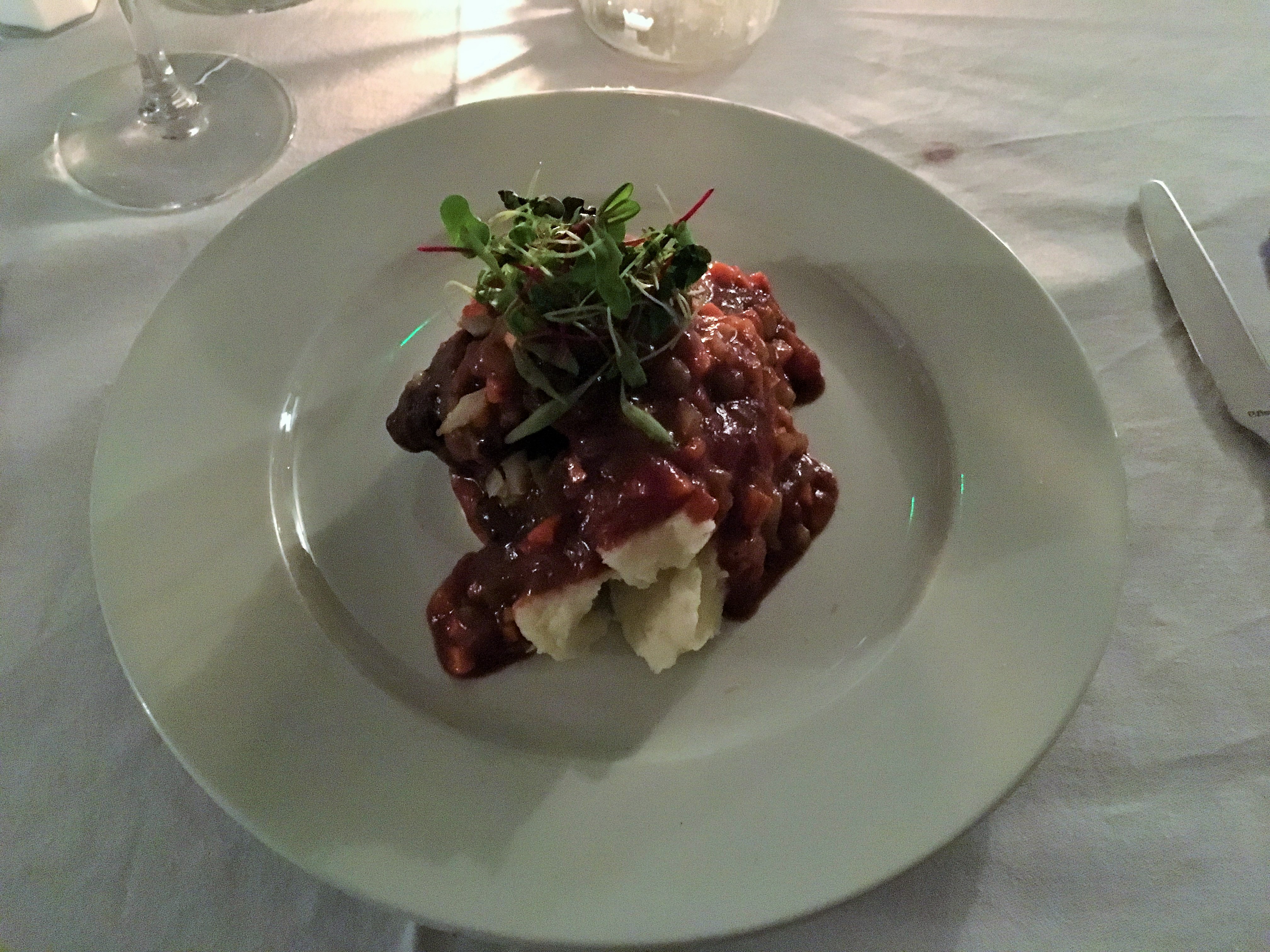
Saltimbocca was good but didn’t quite hit the heights – the veal itself was superb, delicate and tender and the parma ham was good quality stuff. But there just wasn’t enough sage which meant it didn’t have the earthy punch that it needed, and the sauce was a bit too light, thin and subtle. Like much of the food it was a little too well-behaved when what I really wanted were a few more sharp edges. I wonder which came first – the crisp décor and the well-dressed clientele or the impeccable, slightly safe food?

VillaSaltim

You pay extra for vegetables. We got a bowl of sautéed potatoes (salty with a hint of rosemary) and another of steamed, buttered mange tout, carrots and sugar snap peas, along with two of the tiniest florets of broccoli I have ever seen. The menu says that they are three pounds fifty but neglects to mention that this is per person, and that felt a bit cheeky when you don’t have any choice but to order it (the single lettuce leaf that comes with the monkfish won’t count as vegetables in anyone’s book). Perhaps the mains weren’t quite as good value as I’d thought.

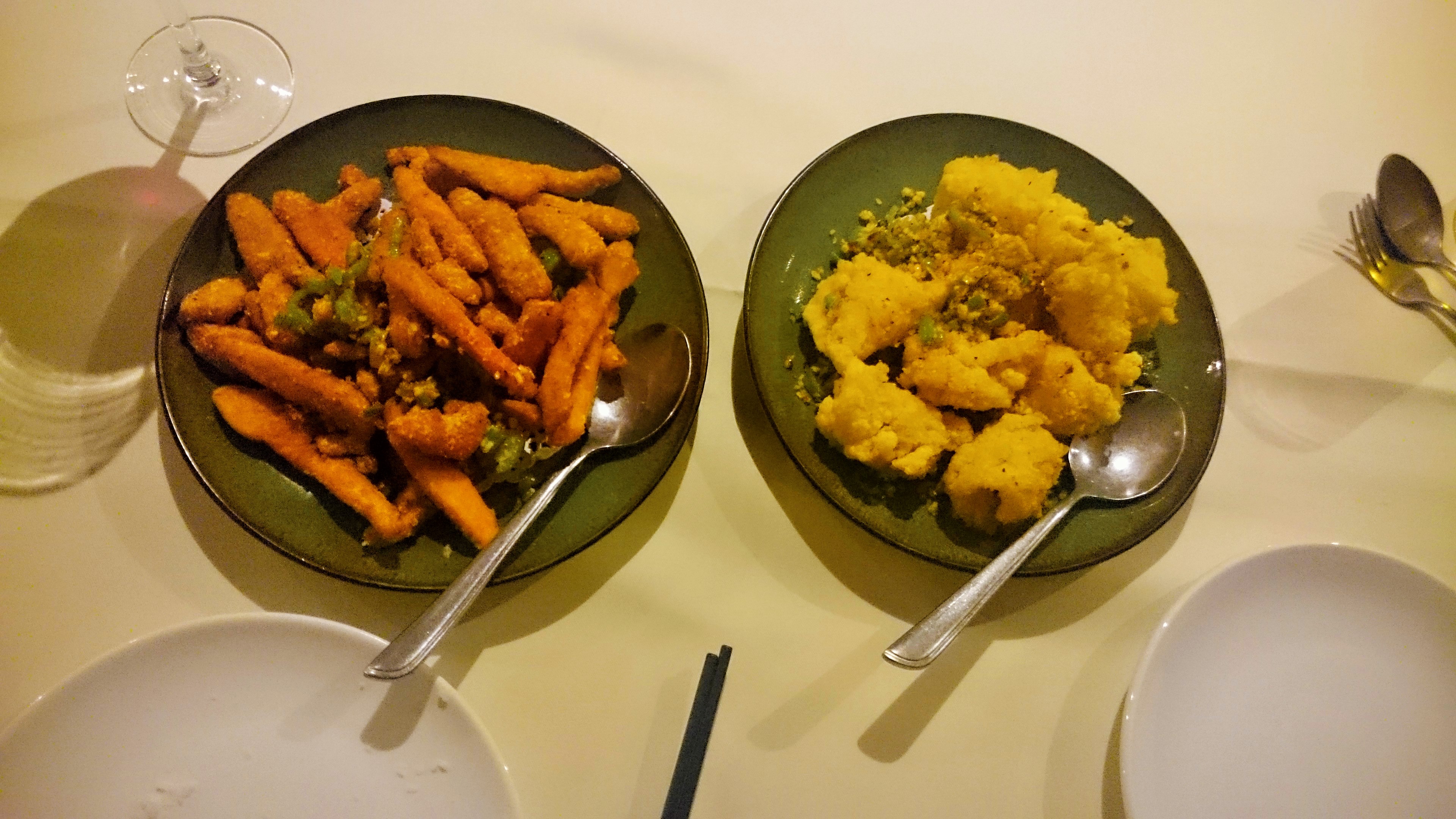
That said, the extras were good – the potatoes were beautifully crisp (deep fried rather than done in a pan, I’d guess) and the vegetables, with just enough crunch and taste, were perfect with what sauce there was. But still, three pounds fifty per person stung a bit when the bill arrived. Three pounds was much better spent on the accompanying zucchini fritti we ordered, because these were fabulous – super light, wonderfully crispy, coated (I think) in a little semolina flour. An undignified fight broke out for the last few little scraps: I won.

Another sign of how old-school Villa Marina was came when it was time to choose dessert. Nothing as modish as a menu here, instead the dessert trolley was wheeled round to our table and we got to review the selection. Dessert trollies also feel like a dying breed (I’m not sure any Reading restaurants have one, since Casa Roma closed) and I’m never sure how I feel about them. On the one hand, it’s nice to have a clear idea what your dessert will look like, on the other I quite like a hot pudding and a trolley pretty much rules that out. I was tempted by the tiramisu but went for the chocolate cake, essentially a layer of mousse on top of a sponge base. Again, it was a solid but unspectacular choice, sweet without being synthetic but certainly not overflowing with complexity or cocoa solids.

If I went back I’d have the tiramisu, but it’s an if not a when and there are a few reasons for that. One is the service, which was very much Jekyll and Hyde. The waiters were friendly and suave, smiling and looking after their customers. Even the slips and mistakes were overflowing with charm in a rather crumpled, eminently forgivable way. But the waitresses seemed to have attended the Rosa Klebb Finishing School. The young lady who introduced the dessert trolley had a way of rattling off the list of options that was so abrupt and unsmiling that it reminded me of a prison camp guard. Similarly, there was an older lady who stalked through the room with an expression so dour that I was slightly scared to engage with her. If the men were old school, the women were borstal.

Aside from the service, the other problem was the pace of everything – we’d finished three courses and been rushed out of the room in little over an hour, and that always puts me right off a place. Part of that I suppose is down to the dessert trolley and having your third course dished up right in front of you but even so, leisurely it wasn’t. The total bill, including a 12.5% “optional” service charge was eighty-five pounds. That was for two and a half courses and one glass of wine each (the recommended wines by the glass, a chianti and a chardonnay, were both nice enough to merit a mention but neither made me devastated that I couldn’t have more).

The size of the bill was a nasty surprise: adding the service charge slightly ruined it for me because it made the total look worse than it was (and, left to my own devices, I highly doubt I would have tipped that much). Quite aside from the stealth charged vegetables the price of the special starter – nearly eleven quid – also made my eyes water, ever so slightly. Perhaps if the whole affair had taken a couple of hours I wouldn’t have minded so much, but I did keep thinking about other ways that I could have spent the same amount of money. Nobody wants to have that uppermost in their mind when leaving a restaurant.

If you were opening a restaurant in Reading today, you wouldn’t open Villa Marina. That kind of high-end, slightly starched Italian restaurant, although not dying out per se, hasn’t been seen in Reading for a very long time (perhaps Topo Gigio, long closed on the top floor of King’s Walk, was the closest equivalent). I quite enjoyed my visit there, although it did feel partly like an evening out and partly the gastronomic equivalent of time travel. No shame in that, but it did make me value Reading’s restaurants just that little bit more, from the slightly naff marble tables at Pepe Sale to the no-frills room at Papa Gee, looking out onto the Caversham Road rather than the Thames. For that matter, it also made me appreciate how warm and reliable the service at Dolce Vita is, compared to the partially defrosted equivalent in Villa Marina. It all felt a bit Henley, and if there was a blog called Edible Henley I imagine they’d rave about this place. But we do things slightly differently in Reading, I’m very pleased to say.

Villa Marina – 7.0
18 Thameside, Henley-on-Thames, RG9 1BH
01491 575262
http://www.villamarina-henley.com/

Bakery House

Click here to read a more recent review of Bakery House, from July 2023.

All of the new openings in Reading lately have felt very fashionable, very on-trend. From the sleek space of CAU to the white walls and industrial chic of Manhattan Coffee Club, from the street food – if you believe a word of it – of Wolf to the forthcoming lunchtime sushi of Itsu, it feels like Reading is starting to get restaurants and cafés which reflect how people like to eat at the moment (well, people in London anyway).

All of these places have got plenty of exposure in the local websites, and there’s been a hubbub of excitement about them (and they keep coming – C.U.P. opens at the end of the month too, in a spot just along from Bill’s). But the place that’s most intrigued me lately isn’t any of the glossy town centre re-fits: it’s Bakery House, a Lebanese restaurant which has opened up the hill on London Street, where Nepalese restaurant Khukuri previously plied its (somewhat unremarkable, I’m afraid) trade for many, many years.

It’s a funny place for a restaurant: all the action seems to be at the bottom of the street, where RISC and Great Expectations make for long-standing neighbours. After that it’s all barbers, language schools and a couple of fried chicken joints, presumably to offer sustenance to people about to enter or leave the Stygian pleasure palace that is the Legendary After Dark Club (another place for which the term use it or lose it feels extremely apt). But I kept getting good reports of Bakery House, and I became increasingly curious – if only to try somewhere new where neither the light bulbs nor the brickwork were exposed.

And yes, there’s none of that palaver going on at Bakery House. The restaurant has the grill at the front and the dining room at the back, clearly with an eye on capturing some takeaway trade late at night (the menu offers a range of shawarmas and other sandwiches, easily portable and far more appealing than the dubious delights of Chicken Base at the bottom of the hill).

The dining room, containing just ten tables, has tasteful battleship grey tiles and lightboxes on the walls with pictures in them which, surreally, appear to have little to do with the Lebanon. One is of a beach with palm trees, seemingly in the Caribbean. Another shows the windmills of Mykonos in the background and, err, a bowl of Greek salad in the foreground. A third is of a veritable explosion of tropical fruit. Despite that, it’s a nice space – and the mirrored wall at the back does a good job of bringing in light and the illusion of depth.

It’s a pleasing menu, too – a good range of hot and cold mezze, Lebanese pizzas, hot dishes straight off the charcoal grill or from the kitchen out the back. I was sceptical about the name Bakery House, but there is clearly baking going on – you can see the big oven, the pittas rising in the wooden racks on the back wall. They brought us some while we made up our minds and they were lovely fluffy circles, just right dipped in the intensely garlicky sauce or its slightly piquant chilli sibling.

The falafel were probably the best I’ve had in this country and a minor miracle in themselves. You got four for three pounds fifty and the texture of them was spectacular – no stodge, just a deceptively light inside and an almost perfect thin, crunchy exterior. They made me angry at all the crimes against falafel committed by every supermarket’s sandwich aisle. Studded with sesame seeds, they were stunning dipped in the tahini sauce they came with, a silky, intense distillation of everything good about houmous with none of the accompanying clag. I also quite liked the salty, sharp pickled vegetables which came with them (purple, no less) but they were definitely a good thing you could have too much of.
BakeryFalafel

I wanted to try something from the bakery section too, and I was tempted by many of the small Lebanese pizzas. I ended up going for kallaj bil jiben and it too was a thing of wonder – a thin, translucent disc of Lebanese bread, the texture almost like a crepe, the inside smeared with spice and stuffed with halloumi, cut into quarters. Beautifully light, salty yet subtle, and stonking value at just over three pounds. When I’d arrived at about seven o’clock on a weekday night, the restaurant was already half full. By the time our mains courses arrived there wasn’t an empty table in there, with a steady stream of people turning up for takeway. I could well understand why, based on what I’d already eaten.

BakeryBread

The mains were equally keenly priced, with very few of them costing much more than ten pounds. This is where I’d like to tell you how delicious the farouj massahab, the boneless chargrilled baby chicken is – sadly, I can’t, because they brought me the farrouj meshwi (the same thing, but with bones in) instead. I asked if there had been some mistake and almost immediately they offered to redo it or leave it with me and take it off the bill. No complaints, no grumbling, no making me feel like I was being awkward – just an apology and quick action. Figurative hats off.

In the interests of eating at the same time as my companion, I went for the latter option and it was so delicious that I felt guilty about not paying for the dish. Granted, it was a faff – the plate was nowhere near big enough to strip the chicken off the part-jointed carcass tidily – but the chicken made up for that. Everything was how you’d want it: the skin moreish with crackle and char, the meat underneath tender and tasty. Every turn of a joint found an undiscovered shard of crispy skin or a beautiful seam of unmined chicken, and every turn brought another smile.

BakeryWholeChick

The accompaniments I could have taken or left – the rice was an anonymous yellow basmati with what looked like bits of frozen vegetables, the coleslaw could have been from anywhere, those strange purple pickles again – but complaining about that would be like going to see Mission Impossible: Rogue Nation and criticising some of the extras in the crowd scenes. The chicken was the star, and I knew it.

The other dish, shish taouk, was simple and effective: cubes of lightly spiced chicken cooked on a skewer with a pile of salad, coleslaw and yet more purple pickles. The outside of the meat was just charred and although the flavours weren’t as good as you’d find at La Courbe, Reading’s other Lebanese restaurant (where the chicken is all soft and fragranced with ginger) it was soon pepped up with the additional of some garlic sauce (so sweet! so dirty!). I’m pretty sure the chips were out of a bag but they were none the worse for that – and, as it happens, perfect dipped in the tahini sauce. The main let-down, really, was the tabbouleh. I had high hopes, especially after the starters, but it didn’t live up to the rest, with just too much pulpy tomato and not enough pizazz.

BakeryChickSkew

Bakery House doesn’t have a licence, so the drinks options are a range of soft drinks and fresh juices. I tried the fresh apple juice and I loved it – the sweet, green, concentrated taste of apple without any of that sour sharpness of a supermarket carton. It was terrific, although I was struck by the irony that, at three pounds, it cost almost as much as either of the starters.

Service was friendly and pleasant, although I felt they were still finding their feet and I got that impression from neighbouring tables too. I really liked my waitress’ disarming honesty – I asked her how to pronounce one of the dishes and she said “I don’t know, I’m from Romania” (I’d pick that over a bullshitter, any day). The whole bill for two starters, one main, a tabbouleh and a couple of soft drinks came to just over twenty-five pounds, not including service. When I tried to tip – because I felt bad about having such good chicken for free – the waitress tried to talk me out of it. When I left the owner told me I shouldn’t have tipped and gave me a little box of baklava (which, incidentally, were terrific the next day). How can you not at least slightly love a place like that?

Bakery House is by no means perfect. The layout is a bit odd: most of the tables seat two but have a third chair, like a spare part, at right angles, so I think a table for three or four could feel a bit crowded (there are a couple of tables properly suited to four people though, tucked away in the corners). The service is charming but erratic, although they might just be struggling with being so busy so soon. The dining room was verging on the Baltic, which I think was a combination of some aggressive air conditioning and leaving the front door open to try to be more attractive to passing trade.

Despite all that, it probably won’t surprise you that Bakery House is emphatically my kind of place. Perhaps I’m out of step with the rest of Reading, but I was much more comfortable in that unfussy, unpretentious room enjoying my food (and, I suspect, being in the company of fellow diners with exactly the same priorities) than I’ll ever be sitting at some faux reclaimed steel table eating “artisan produce” that has never been near an artisan because there’s no such thing as a bloody artisan any more. So I’m prepared to overlook the occasional misstep and I think I’ll rejoice in the fact that I, and Bakery House, are as far from cool as it’s possible to be (except for the overpowering air conditioning, of course). That said, I’m not sure whether Bakery House takes reservations and at this rate people will soon be queuing to get in: maybe being untrendy will turn out to be the new food trend after all. You heard it here first.

Bakery House – 7.5
82 London Street, RG1 4SJ
0118 3274040

http://bakeryhouse.co/

CAU

CAU closed in July 2018 because its owners Gaucho Group went into administration. I’ve left the review up for posterity.

I recently reached the stage where I was tempted to stop reviewing restaurants in the Oracle altogether. It’s never fitted with the ER ethos – full of chains like Bella Italia and Pizza Hut that are ten a penny all across the country. And it’s always felt pointless reviewing places like Wagamama and Yo! Sushi, because even though there’s a time and a place for them you probably already know what they’re like. The final straw was the closure of Tampopo and the announcement that TGI Friday would take its place (that’s when I began to wonder if the Oracle was actually run by Monty Burns). Still I guess they need the money, with plenty of shops consciously uncoupling from Brand Oracle and a fair few vacant lots, especially on the top floor.

So, what changed (I mean, you’ve read the title, you know what this review is about)? Well, CAU’s an interesting kettle of fish for a number of reasons. It’s not a chain just like everywhere else, for one: there are only a dozen across the country. Also, I was fascinated to see how they’d done it, because the restaurant has been created out of thin air, in an empty and unloved space on the side of the Oracle, the fast but shallow Holybrook the only redeeming feature in a rather forgotten spot. But the other reason is that since it opened, CAU has been busy. Really busy. And all the feedback I’ve seen said it was pretty decent. Had the Oracle got it right for once?

It’s an odd experience having dinner in a building which, a year ago, didn’t even exist. It’s a very neat use of a compact space, with two storeys and a modest terrace on the lower floor, prettied up with some landscaping and some kind of light installation on the opposite wall (I can see it would be a nice place to eat on a warm day). I sat on the top floor, in a long thin dining room with white corrugated iron walls and modernist lighting, all chrome spheres and swivel chairs. That compactness does show, though, in the space for diners: everything is just a little smaller than you’d want it to be (I wouldn’t have wanted to be a table for four in the banquette booths in the centre of the room – not with my elbows).

As you probably know, CAU stands for Carne Argentina Unica (I wonder which came first, the name or the convenient acronym?) and is the younger/cheaper sibling of Gaucho, the awfully expensive steak house that is sprinkled over the spendy bits of London. So the menu is mainly Argentine, mainly beef, but not entirely – it does wander up to Mexico, across to Spain and even, for some of the vegetarian options, over to Italy. This presented a bit of a dilemma – I wanted to try a range of dishes, but ordering chicken or fish just to make a point about the diversity of the food felt like a silly act of tokenism. So if you don’t like steak this review might not be terribly enlightening – but anyway, there’s always the starters and the desserts.

The starters were probably the most difficult decision of the evening. It really is an embarrassment of riches and you could easily have been reading about empanadas, Argentinian charcuterie or half a dozen other dishes. I was particularly torn between the swordfish carpaccio and the smoked haddock and manchego croquettes. When I asked the waitress for advice, she recommended the latter without a moment’s hesitation. That alone would have justified a tip: they were generous and delicious, half a dozen big, irregular, crunchy cylinders. Inside, the perfect contrast – a filling so smooth it was almost a béchamel, beautiful shreds of fish and tons of chives. The caper mayonnaise they came with almost felt an afterthought – creamy and bland where a bit of sharpness would have worked wonders – but it was by no means a deal breaker. I would have liked a bit more salt from the manchego but again, that was more twenty-twenty hindsight than anything else.

CAUStarter

They almost made up for the disappointment of the other starter, something that with hindsight I probably should have known better than to order. Quesadillas were a rather sad prospect compared to the crispy loveliness of the croquettes: the tortilla itself was pretty small and, despite the blurb on the menu, was by no means “packed” with vegetables or cheese. A layer of peppers, artichokes and courgette strips with manchego (for flavour, I’d guess) and mozzarella (for texture) was, in fact, even duller than it sounds. The guacamole on the side was pleasantly zesty but not enough to save the whole thing. It was bland and stingy, everything the other starter wasn’t. It’s my fault really – normally I’m good at spotting the duffer on a menu so I’m not sure what went wrong here. There are actually quite a lot of vegetarian options on the starter menu: I hope the rest aren’t as much of an afterthought as this felt. I should have had the charcuterie after all.

The range of steaks on offer at CAU ranges from the mainstream – familiar cuts like rump and rib-eye – to the more high-end. This is where you can end up spending quite a lot of money, as you can at Gaucho: most of the speciality cuts start at the thirty pound mark and you get almost a pound of flesh for your pound of flesh. I struggled with spending that much on account of not being a Russian oligarch, so we went for the more conventional cuts on the left hand side of the menu, and it has to be said that these were a lot more keenly priced: two medallions of fillet was less than fifteen pounds, a sirloin was just shy of eighteen. Unfortunately, I had to wait slightly longer to try the steak than I was expecting. The medallions turned up perfectly medium rare as requested, but the sirloin was medium well with very little pinkness, no glorious blood seeping out onto the plate.

This is, let’s face it, a pretty terrible gaffe from a restaurant which prides itself on brilliant beef cooked brilliantly. But sometimes, first impressions aren’t everything and the way CAU dealt with it was exemplary. I was in two minds about sending it back because, in my experience, that usually means that I have to watch everyone else eating their food (never fun) and then experience everyone else watching me eat mine (possibly even less fun). But the moment I suggested to my waitress that all was not well she sprang into action: both dishes were taken away, completely redone and brought to the table at exactly the same time. I’ve racked my brains and I can’t think of a single restaurant in Reading – even at the high end – that has ever gone that far, let alone without being prompted. Very nicely done indeed, and it totally won me over.

So, once they finally arrived, they truly were perfect. The medallions were beautifully seasoned, perfectly grilled and the yielding texture when sliced was enough to render me speechless. I rarely have steak at home because I can never get it right, but eating it here made me feel like most of the places I order steak at can’t get it right either (and they certainly can’t for only fifteen pounds). The sirloin was just as good – the char and salt on the outside giving way to the softness underneath. At this point any reservations – about the location, about the loudness of the music, about the slightly irksome white swivel chairs – simply melted away. I’d have eaten this beef locked in a broom cupboard listening to the Vengaboys, if that’s what it would have taken to try it.

CAUSteak

The accompaniments were very much second fiddle, although that was only to be expected. Chunky chips, served in a little fryer basket, were coarse and crispy, fluffy inside and perfect dunked in the tiny pots of sauce (which cost extra, I should add). The sauces themselves were a little underwhelming, in truth: “garlic and herb aioli” was all herb and no garlic, all mouth and no trousers. I got parsley and just enough tarragon to make me wish béarnaise was on the menu. Still, I’m going through a phase of really enjoying chips dipped in mayo, so it wasn’t all bad. The chimichurri was better, but possibly had a little too much vinegar and not enough of everything else. I deliberately didn’t order a blue cheese sauce because it felt inauthentic; by the end I wished I hadn’t been so prissy.

Just as CAU is all about beef it’s also all about Malbec – so much so that the wine list actually has four sections – sparkling, white, red and Malbec. I liked this, but what I really loved was that the vast majority of their wines are available in 500ml pots as well as full bottles. I really don’t understand why more restaurants don’t offer this, if only because I’m far more likely to order two carafes than I am to order two bottles. We had a Patagonian Malbec with our steaks and it was terrific – fruity but with a little smoke and not overwhelmed by the beef. Before that, while we made up our minds, we had an elderflower spritz – a very refreshing cocktail which tasted so little of alcohol that it was positively dangerous – and a very good Asturian cider.

On to desserts: I’d seen churros arrive at another table so I’d already decided I had to try them. They arrived in a little Jenga stack, liberally dusted with sugar and cinnamon, with a little pot of dulce de leche (which I have a bit of a soft spot for). Sadly I have to say that they didn’t quite go together – the sauce was a bit too thick to coat the churros and the churros were strong enough to drown out the toffee flavour. I resorted to eating the two dishes on their own (not exactly a hardship), running my finger round the pot to get the last of the dulce de leche out Nigella-style.

The other dessert, the cornflake ice cream sundae, is apparently a signature dish. I wasn’t a huge fan of it, I’m afraid. The cubes of chocolate brownie in it were crumbly delights, and the dulce de leche smeared round the inside of the sundae glass were gorgeous, but the cornflake-flavoured ice cream just felt like ice cream and the ginormous heap of cornflakes on top was impossible to eat without knocking them onto the table. I imagine it would be very popular with kids, but it wasn’t such a hit with me.

CAUDessert

Service made a bad first impression: the greeter at the front door failed to make eye contact, which was odd, but from that point onwards it was all terrific. Our waitress was bright, personable, knowledgeable and almost faultless – recommending dishes, correcting mistakes, talking about the restaurant and making conversation without going through the motions. But more than that, there seemed to be an energy about all the staff, from the chirpy chap who brought out our replacement steaks to the barman dancing along to the eclectic mix of music. I even found their “caugirl” and “cauboy” t-shirts amusing rather than naff – it felt like they were having fun but without any of that fake mateyness which is often so jarring in chain restaurants.

The bill, including an optional 10% service charge, came to ninety-five pounds. That’s for three courses and an aperitif each and that pot of malbec. It’s funny, when the bill turned up the amount was simultaneously more than I was expecting (that fifteen pound steak had me fooled) and not as much as I thought the meal was worth.

That rather sums up how I felt about CAU, in that I didn’t quite know what to make of it. Some of the dishes are really expensive, some are affordable. The affordable ones are terrific value. The food was bloody good, but first time round it wasn’t bloody enough. The staff make it feel like an informal restaurant but the prices at the high end are actually pretty close to what Gaucho would charge. And the clientele reflected that – some of my fellow diners were properly dolled up, to the extent where I felt a bit scruffy, and others were definitely there for a much more casual evening. You could look at all that and say that CAU is a restaurant that doesn’t know what it wants to be, or you could decide that it’s good at being all things to all people. Slightly against my preconceptions – I went expecting to like the food, hate the room and be underwhelmed by the service – I strongly suspect that it’s the latter. But I’ll probably go back soon, with my most carnivorous friends, just to be certain.

CAU – 7.8
The Oracle, Bridge Street, RG1 2AQ
0118 9505559

http://www.caurestaurants.com/book-a-table/reading/

Thai Table

To read a more recent takeaway review of Thai Table, click here.

One thing I rarely talk about in these reviews is the background music, but with Thai Table I really feel I should make an exception. There are some places where it’s perfectly normal to hear a muzak version of “Don’t Stop ‘Til You Get Enough” – in a lift for example, or in the toilets of a shopping mall (more Broad Street than Oracle). Or, for that matter, in Room 101. But I wasn’t expecting to hear it in Thai Table, a smart Thai restaurant just the other side of Caversham Bridge. I’d like to say that it was an isolated incident, but during my meal the vocals-free mangled hits kept on coming. It was as if Kenny G was in the room with us, and surely nobody wants that. Well, except Mrs G perhaps.

I wasn’t expecting to find myself in Thai Table, truth be told. It’s been on my list for eons but I still find it a little difficult to motivate myself to review Thai food – it’s rarely terrible but rarely stellar, and Reading’s Thai restaurants can feel much of a muchness. But then I happened to walk past it on my way back from Progress Theatre’s excellent production of Merry Wives Of Windsor in Caversham Court Gardens (no, I hadn’t seen that one either) and the view piqued my interest. Gone was the chunky, dark, rustic furniture I remembered and instead the interior looked warm, buzzy and contemporary, all snazzy geometric prints and clean, simple chairs and tables. I made a mental note to move it to the top of my list, although if I’d known about the music things might have been different.

Subscribe to continue reading

Become a paid subscriber to get access to the rest of this post and other exclusive content.

Nibsy’s

Nibsy’s closed in June 2021 – the café has been bought and the new owner is running a new gluten free cafe on the same site from July under the name YayLo. I’ve left this review up for posterity. Nibsy’s owner Naomi Lowe returned on 1st December 2025 with a trailer offering coffee and gluten-free food on the go outside Reading Station.

You can’t talk about Nibsy’s, I don’t think, without using the G word: I considered writing this whole review and only mentioning gluten – or the lack of it, I should say – at the end, but I decided that it just wasn’t possible. Besides, it’s a big part of how Nibsy’s markets itself (their slogan is “for the love of coffee and all things gluten-free”). Personally, I’ve never had a problem with gluten but I know many people do, and I’m sure a lot of them thought it was an absolute godsend when Nibsy’s opened last summer.

You can however, I hope, write about Nibsy’s without being patronising about gluten free food. Whatever you think about the rights and wrongs of an increasing number of people adopting a gluten free diet, I reckon the food at Nibsy’s deserves to be judged on its merits and not patted on the head as “not bad, considering”. Besides, if anything I’ve generally found that menus that specifically exclude something tend to be more imaginative to make up for it – take Bhel Puri House for example, where you could easily eat all manner of delicious food without realising that everything is vegetarian – so I turned up with an empty stomach and an open mind for a long overdue lunchtime visit.

The first thing to mention is that Nibsy’s looks very different from most of the other independents in town. There’s nothing shabby chic about it: in fact, it could teach most chains a thing or two about presentation. Everything is smart and professional looking and the branding is beautiful, from the writing on the windows, to the mugs, to the packaging for the sandwiches and salad. Although I sat outside, soaking up the sun, the interior is lovely and gets everything right: the furniture is mismatched without being scruffy, it’s cosy without being dishevelled and immaculately clean without being clinical. You only realise how difficult this balance is when you see somewhere like Nibsy’s do it so well.

I get the impression from Nibsy’s Facebook feed that the menu changes on a regular basis. It’s pretty wide – a range of sandwiches, toasted and untoasted, and a couple of salads in the fridges and a quiche behind the counter. We ordered a toasted sandwich and a slice of quiche and were told that the sandwich would come out quicker. This struck me as odd – if you know the quiche takes longer to heat up and you’re serving two hot dishes why not synchronise them and start the sandwich later? Inevitably this meant that we got to try our dishes after the other, instead of having the companionable lunch we were expecting. I thought that was a pity: I might have been “on duty” but it’s not all business, you know.

The toasted sandwich contained a generously gooey helping of mozzarella, some lovely salty black olives and good quality sundried tomatoes. Nothing complicated there, you might think, but with toasties it’s all about the balance and the execution and both were impeccable – I’ve had far too many toasted sandwiches in Reading where the inside is lukewarm or the outside is charred and Nibsy’s didn’t make either mistake. Apart from being slightly denser than usual, I didn’t really notice anything different about the bread – it helped that it was perfectly golden and crisp (I think some butter had been spread on the outside before grilling, which – in my book at least – is how you make a perfect toastie). I loved it from start to finish: if anything my only reservation was that, because it wasn’t the biggest sandwich in the world, start and finish were a bit closer together than I might personally have chosen.

NibsyToastie

The feta and spring onion quiche arrived a mere moment after the sandwich was done. C’est la vie. It was well worth waiting for, though. The pastry was crisp and crumbly (you would never have known it was gluten free, in my opinion) and the filling was fabulous – incredibly cheesy, chock full of spring onions and also with some red pepper and (I think) rocket. Honestly, it was terrific and (I’m happy to say, given the size of the toastie) extremely generous. I wasn’t so convinced by the salad that came with it, however – a big pile of iceberg lettuce. Personally I think of iceberg as the triumph of texture over taste, so I was surprised to see it used here, especially with nothing else in the salad to liven it up. It was dressed, at least, but even then it wasn’t terribly exciting, so I left most of it.

NibsyQuiche

Having heard many rave reviews of Nibsy’s cakes I felt I’d be letting the side down if I didn’t order a few to try the full range of options (although, in the interests of full disclosure, I ought also to declare that I am an enormous – in both senses – fan of cake). The range is impressive: a plethora of sponge cakes, shortbreads and brownies to equal anything you’d find over in Picnic or Workhouse. It was extremely difficult to narrow it down, and a bit of me is still wondering now when I can try the coconut praline cake, or the orange and almond cake, topped with shiny, sticky slices of bright fruit.

Instead, I tried the lemon drizzle cake, possibly the biggest misfire of my meal. Unlike most lemon drizzle cakes I’ve had this wasn’t a loaf, rather it was a layered sponge with lemon curd in the middle. I think maybe lemon drizzle was a misnomer as I didn’t detect any drizzling, no glorious layer of crackling sugar on top, and apart from the lemon curd it lacked the tart zinginess I was expecting. If anything, it was more like a slightly dry Madeira cake – not bad in itself, certainly not bad enough to complain about but not what I was expecting. Not good enough to finish eating, either, and that’s a sad thing to say about any cake.

NibsyLemon

Redemption arrived in the form of the chocolate brownie. “Quite a lot of people don’t finish this” I was told as it was brought to the table, a big slab of cocoa-rich badness. Well, all I can say is that those people have a level of restraint I will never master, and they probably find it easier to buy clothes than I do. It was truly superb – rich and dark without being too bitter or too sweet. I was lucky to get a corner piece so I could properly appreciate the contrast between the crumbly, chewy edges and the soft middle, almost like a ganache. No nuts, no chocolate chips in there – nothing that would distract you from something so perfect. I ate it with a lot of joy and a little too much haste, and by the end I had no regrets about possibly missing out on anything else.

NibsyBrownie

On the side we had Earl Grey and a latte. The Earl Grey – unbranded, so I don’t know who it was by – was served in a small teapot, bagged rather than loose, and was good enough for me to have a second pot (and that was even before I knew the lemon cake would be on the dry side). I’m told the latte was very good – not quite as good as Tamp or Workhouse, better than Picnic or My Kitchen, pretty much up there with Tutti Frutti. There’s not a huge amount of interaction in a café but the service was friendly, smiley and efficient, the glitch around timings aside. The total bill for two lunches, two pieces of cake and three hot drinks was twenty-one pounds. I think that’s pretty much fair enough: if anything was slightly on the pricey side the quality easily made up for it.

If it’s hard to review Nibsy’s without mentioning the G word, it’s even harder to sum up a review without using it. But let’s put to one side for one minute the fact that, for some people in Reading, this is the only place they can realistically go and have lunch without worrying, and judge Nibsy’s on its merits. Good coffee. Good tea. Tasty toasties and a quiche I’m already fantasising about eating again. A brownie that can match any other brownie in town. A huge range of other cakes, tantalisingly in view just down the culinary road less travelled. The only G word we should be using here is great. So yes, on its merits Nibsy’s is an excellent addition to Reading’s food scene and, whatever your dietary requirements, you should consider going there next time you either want lunch or afternoon tea. They may have taken one ingredient out, but to me there isn’t anything missing.

Nibsy’s – 7.7
26 Cross Street, RG1 1SN
0118 9597809

http://www.nibsys.com/