Café review: Cairo Café

Cairo Café closed in April 2023. I’ve left the review up for posterity.

Something I often bang on about often in restaurant reviews is that feeling of being elsewhere, of the power some places have to completely transport you, in mind if not in body. Restaurants as travel agents, taking you somewhere else without having to rack up a huge hotel bill or get to the airport two hours early, or feel that sense of gloom about no longer being able to join the “arrivals from the EU” queue.

Last Saturday evening I had dinner on the sunlit terrace at Buon Appetito, and I felt like I could have been anywhere on the continent but nowhere near Reading. My Aperol spritz shone a luminous orange, soft jazz was playing on the speakers and my pizza was speckled with savoury bombs of gorgonzola left, right and centre. At the end of the meal the manager brought over a couple of amaros for us to try – one from Sicily, rich and sweet, the other from Calabria, medicinal with rosemary and mint. Could I really be a stone’s throw from the Oxford Road? It felt hard to credit.

I had a similar feeling the following day, pretty much from the moment Zoë and I walked through the front door of Cairo Café. It’s where Beijing Noodle House used to be, in a site they’ve bizarrely divided into two not side by side, as usual, but front and back: you walk down a corridor to get to Nepalese restaurant Chillim Kitchen out back, but at the front, with a much smaller bright yellow sign advertising its presence, is Cairo Café.

Inside is a little room that could maybe seat ten people, if they knew each other extremely well. Two small tables for two are on the left, all vibrant tablecloths, and on the right is a high table seating four. A couple more stools are up at the window staring out onto West Street, which offers a characterful viewing experience. It’s tiny, but I loved it, with all the little touches like the black and white photos on the wall and a couple of clocks showing Cairo and Reading time.
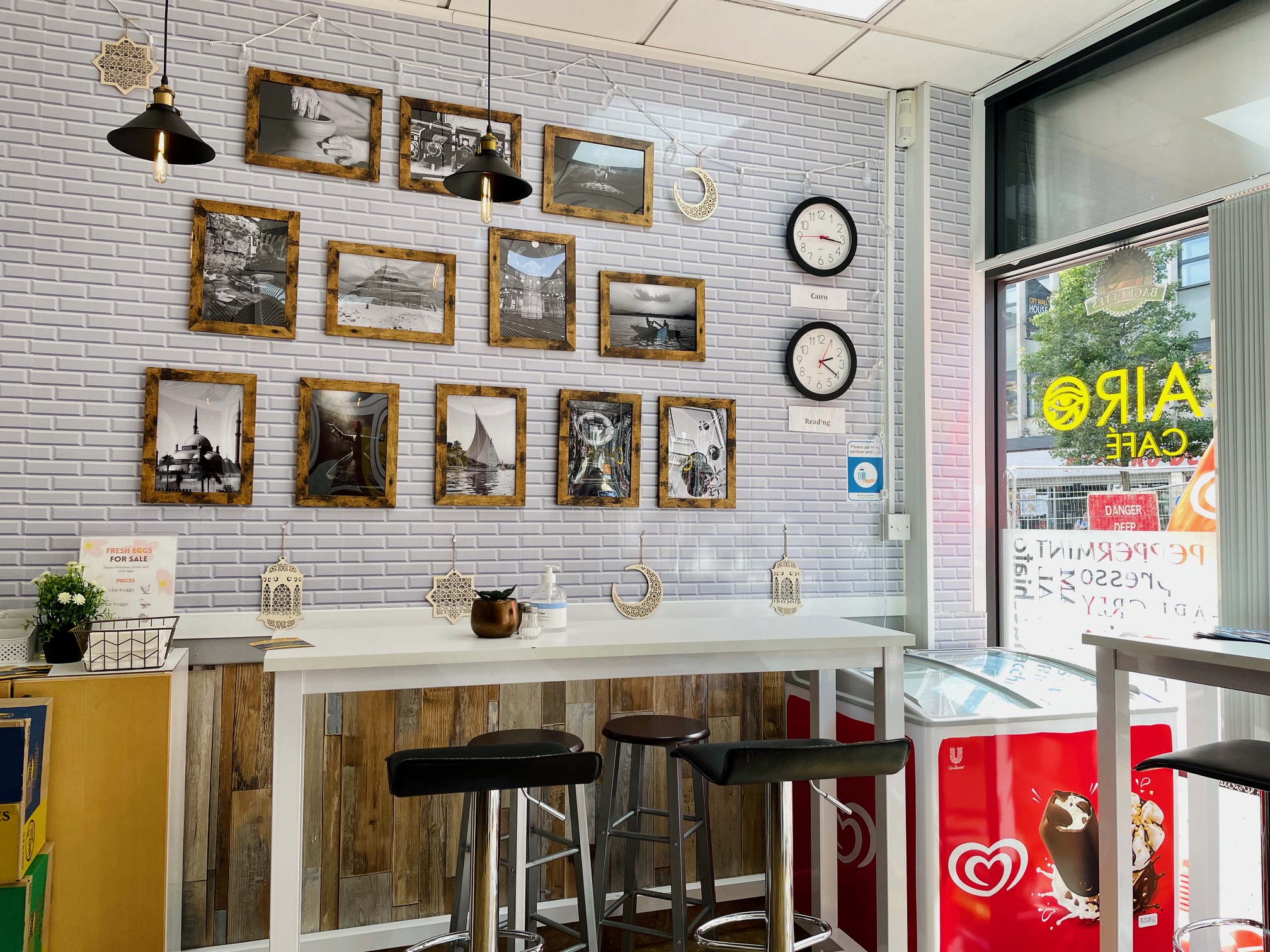
Like many places serving lunch in town, the menu – in bright yellow above the counter betrays a certain amount of bet hedging. You can have a conventional panini or baguette, if that’s what you want, and the menu gives you all the mainstream choices – tuna mayo, brie and bacon, chicken tikka and so on. And at the counter you can see all the steel dishes with those fillings, if you want to try the same sort of thing you could easily get somewhere like Pierre’s. But the middle of the menu, marked “Cairo Street Food”, is the reason I went: a range of Egyptian dishes, some of which I’d tried and some I’d never heard of. And the kitchen, just about visible out back, is where all of these are conjured up.

“I’m sorry, but we don’t have any falafel” said the owner, aproned and smiling. “It’s been a crazy morning.” Undeterred I asked him to explain a few things on the menu I hadn’t heard of before, and discovered that warak enab was what I would recognise as dolmades, stuffed vine leaves. He went on to explain that sakalans was an iconic Egyptian dessert, a sandwich made with halva, cream and honey: I made a mental note not to leave without trying it. 

I placed my order – this is a venue where you pay at the end – and took a seat. The room had a strangely serene calm, and despite knowing that all the noise of the less salubrious end of town was just the other side of the door, I had that feeling of being transported, of not being in Kansas any more. I could see the owner up at the counter plucking fresh mint leaves for our tea and I had that dangerous feeling that comes from time to time, the slowly building hope that I might have discovered a gem. The tea, by the way, was cracking: fresh and fragrant.

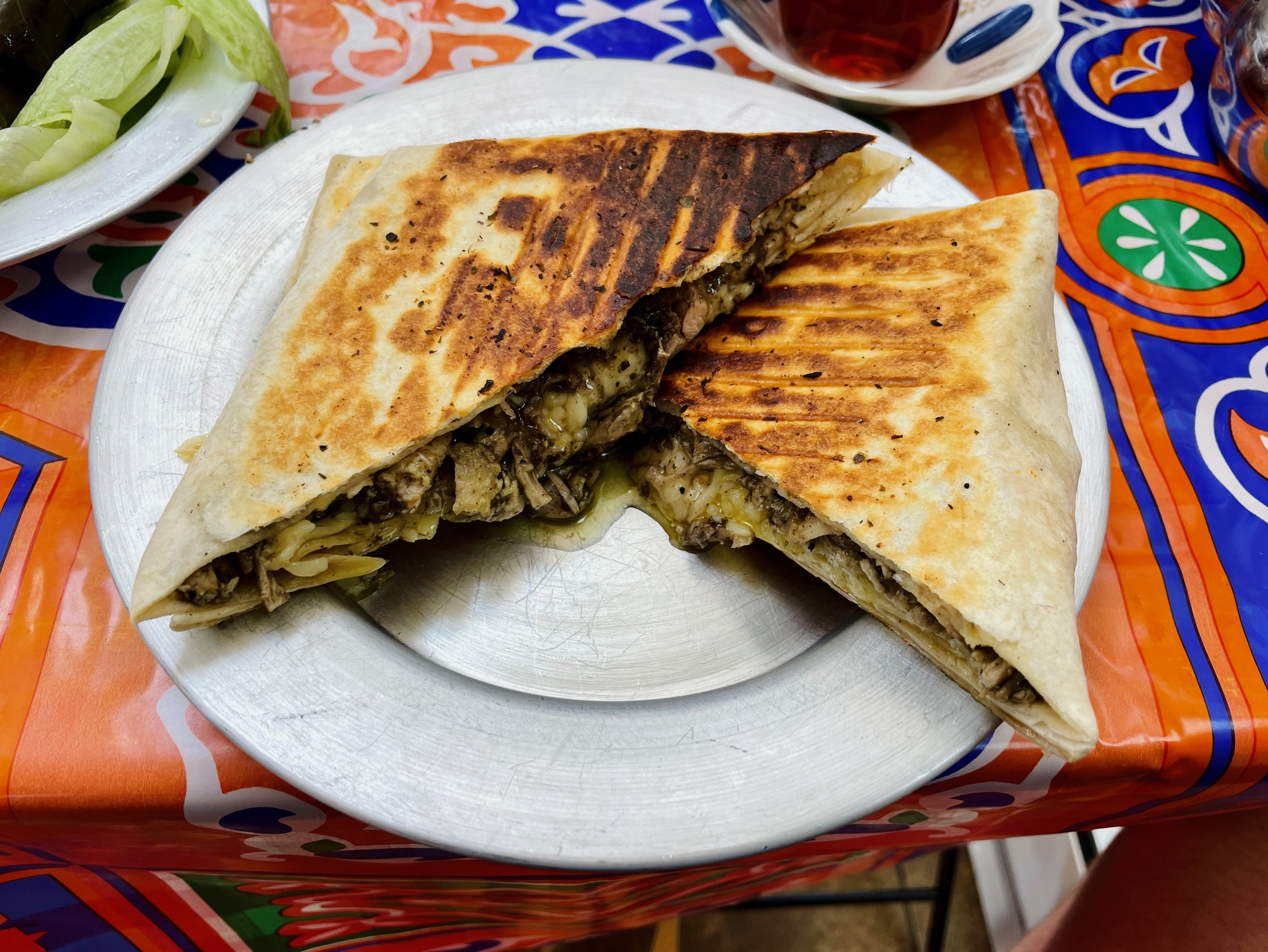
Things improved still further when the chicken shawarma wraps arrived on their little tin plates. So many places don’t know how to assemble a wrap so it can be eaten, so instead either all of it falls out of the end or you get a giant indigestible clove hitch of tortilla. You wouldn’t want these people rolling you a joint, put it that way. By contrast Cairo Cafe’s wrap was a stunner, carefully assembled as a square and flattened under a grill – neat, no wasted space, and the crisped exterior almost reminiscent of a pastilla. 

And the chicken inside was terrific: the whole filling was, in fact, with some kind of beautiful alchemy of chicken, cheese, mint and (this might have been my imagination) a hint of something like cinnamon. I ate it slowly, partly because it was hot but mostly because I didn’t want it to end. This cost a ridiculous – and in all honesty, unsustainable – four pounds fifty. You should go and try it, before he puts his prices up. He should put his prices up.
While we ate our wraps, in a sort of wordless euphoria, something lovely happened. A couple of gents came in to the café looking for a late lunch, but clearly in a rush. The owner explained that he was preparing our dishes and that it would take him a while to put some baguettes together. Were they willing to wait? It transpired that they weren’t, and so they scarpered and as the owner came over to take our plates away he was splendidly unapologetic.

“I’m not making food in a hurry. I want to give people something they’ll remember” – a quiet smile at this point, because the two chaps in question looked like they might have struggled to recall what they did the night before – “even if only for a little while.”

I was happy that we’d been prepared to wait, because our remaining choices, from the more resolutely Egyptian section of the menu, all came together and largely kept up a very high standard. Possibly the weakest thing were the waraq enab: I love stuffed vine leaves, but these weren’t quite the best I’ve had, a little too saccharine. I don’t know if they’re made on the premises – they might be, because they felt a little ragged and slightly loosely wrapped – but I’ve had better, both at Bakery House and at Blue Collar, from Fink as part of their superb mezze boxes. A good example of wayward pricing, too: these cost as much as a shawarma wrap. I know which I’d rather have.

But the other two dishes we’d chosen returned to the high standard of those wraps. Moutabal was a bright, zingy thing shot through with parsley, perfect loaded on to pitta (the pitta, again, was a slight weakness: a little hard, and not quite enough of it, although I’m inclined to be more forgiving than it was). It didn’t have the smokiness I associate with some examples – this was a light and happy dish, not a dark and brooding one – but I didn’t like it any the less for that. Dark and brooding gets boring, doesn’t it.

Even better was the sojuk, a marvellous surprise and one of the nicest things I’ve eaten this year. I was expecting something like Bakery House’s maqaneq – sausages cooked and served simply with onion and lemon juice – but what I got instead was wonderful pieces of coarse, caramelised sausages, punchy and brick-red inside, in a thick, spiced gravy (if I didn’t know better, I’d have likened it to a curry). Slow-cooked, soft pieces of green pepper and green chilli were in the mix, giving the potential for every mouthful to be a gorgeous sunburst of heat. 

Again, this was four pounds fifty and again I worry about the owner’s ability to make money charging so little. I ate forkful after forkful in beaming delight: Zoë loaded some on to a piece of pitta, dolloped some moutabal on top and said something to the effect of “this is really fucking good” between mouthfuls. It was, simply put, one of my favourite discoveries of 2022 so far, and I’m not sure I’m capable of going back and not ordering it.

As we reached the end, and sipped what was left of our mint tea, there was a moment of perfect peace. The hubbub of West Street had died away, no customers came in, the owner was out back. The clocks on the wall ticked away the advancing seconds, in Reading and Cairo, and I thought to myself: there’s something slightly magical about this place.

When the owner took these plates away, I asked him a little about Cairo Café. He’d been trading for four months, he said, and things were going well.

“Do you sell more stuff from the Egyptian side of the menu than the conventional dishes? It would be sad if most people who came here didn’t try this.”

Another grin.

“Yes, we do. But I try hard to convince people – we give out little samples, too.” I was reminded again of this man’s spiritual family here in Reading: people like Jo at Kungfu Kitchen, Nandana at Clay’s, Keti at Geo Café and Kamal at his eponymous new restaurant. People who believe in the narrative power of food, of telling stories, of welcoming you into their home with the food they grew up with.

“I’m glad customers don’t just come here for an English breakfast.”

“We don’t do one! We do that stuff in a baguette but we don’t do a full English. We sell an Egyptian breakfast instead” (it comes with falafel and shakshuka, by the way, and it sounds excellent).

“What should I order next time I come here?”

“I know we’ve sold out, but our falafel are really good. And you should try the beef livers.” I made a mental note: the menu says they come ‘all the way from Alexandria’.

The sojuk had a wonderful building heat, so I wanted something cooling and I’d left room for dessert so we ordered a couple more things. Again, the owner apologised that they would take a while but by that point I thought the prospect of another half an hour in Cairo Café was a positive boon, so I wasn’t complaining. First to arrive was a cooling drink which had rather been misplaced in the “Fresh juices” section, a drink made with yoghurt, milk and honey. I absolutely adored this – as a dairy fiend it’s right up my alley at the best of times, but what I loved about it the most was how light and delicate it was. It didn’t have that thick stubbornness a lassi can have, and the sweetness was almost floral, complementing things rather than beating you round the head. To add to the random pricing, this was four pounds but, for me, worth every penny.

Last of all, I had to try the sakalans. This took a while to prepare and I can honestly say I’ve never had anything like it – a warm, almost-crunchy baguette split lengthways and crammed with cream, honey and huge wedges of halva. I’ve loved halva for years – ironically, since my mother brought some back from a holiday in Egypt, and as a huge fan of sesame in all its forms this dish had a huge amount to appeal to me. The idea of sticking it in a sandwich had never occurred to me, but eating this I was delighted that it had occurred to someone. Zoë was a little less convinced by it, I suspect, but she was also either fuller, or more restrained, than me.

Our bill, for all that food and an hour and a half of serene, unmitigated delight, came to forty-five pounds, not including tip. I felt a compulsion to keep telling the owner how much I’d enjoyed everything, but eventually I realised I’d have to button it and stop thanking him. Besides, I have the opportunity to tell all of you instead, so it’s not as if I’m going to get an ulcer from suppressing anything. I went on my way absolutely convinced that I would be back, and positively evangelical about making sure some other people went there too.

My overwhelming feeling when I discover somewhere like Cairo Café is to think: how lucky are we in Reading? How lucky are we that despite the best efforts of the unholy trinity of Messrs Brock, Sykes and Horton-Baker, that cabal of the unimaginative, avaricious and dim-witted, people still come here to open their restaurants and their cafés, to battle away against the misguided focus of our public bodies and the bleak indifference of our local media. How lucky are we that we still get a gem like Cairo Café defying all of that inertia and doing their damnedest to get a foothold in this town?

It reminds me, many years ago, of another café only a few doors down from where Cairo Café is now: Cappuccina Café, a modest little place serving banh mi and pasteis de nata. I visited it, I rather liked it, I wrote a review and within a month it was closed. It remains, even now, one of the Reading closures I’m saddest about – more so, in a funny kind of way, than all the Mya Lacartes and Dolce Vitas out there; everybody misses them, but when I think of Cappuccina Café I sometimes think it’s mourned by me and me alone. I’m determined to do my bit to ensure that Cairo Café doesn’t go the same way. So please, go there and try the food: it has, I think, a little spark of magic. And heaven knows, we all need to keep that alive in Reading, as much as we possibly can.

Cairo Café – 8.3
13 West Street, Reading, RG1 1TT
07862 200055

https://www.instagram.com/cairocafe11/

Restaurant review: Shree Krishna Vada Pav

When it comes to food and drink, Reading is an especially interesting place. You may find this hard to believe at times, but it’s true.

I don’t mean all the stuff that’s obvious to you, especially if you’re a regular reader of this blog. I don’t mean our coffee culture, or our street food scene that’s the envy of towns for miles around. I don’t mean our two local breweries with taprooms, or excellent pubs like the Nag’s and the Castle Tap selling fantastic craft beer and cider. I don’t mean the jewels in our restaurant crown – places like Clay’s, the Lyndhurst, Kungfu Kitchen or Vegivores. I’m not even talking about our network of local producers and the independent shops, like Geo Café and the Grumpy Goat, which sell their stuff. You know all that already, although I suspect a lot of people who live here still don’t. 

No, I mean interesting in terms of the world outside our food-loving, indie-supporting echo chamber. Because a lot of businesses have clocked that Reading – with its university, its prosperous populace and its tech employers, just the right distance from London – is the perfect place for them to open another branch of their restaurant chain and make pots of cash. They have us down, mistakenly I like to think, as something of an Everytown, the perfect testbed for their particular flavour of the hospitality experience.

In fact, two very different types of businesses have Reading in their sights. The first, tapping into that affluent, well-educated demographic, are smaller, more targeted chains. They’ve often seen Reading as their first attempts to expand west (Honest, Pho) or east (The Coconut Tree), or just picked it as one of the first stops on a journey to nationwide ubiquity (Itsu). And this still continues, albeit to a lesser extent: we’re getting a Leon and a Wasabi this year, don’t forget.

But the second type is more interested in Reading as Everytown, and often we are the lucky Petri dish they squirt their pipette into before deciding whether to open branches elsewhere. And this is, I’m afraid, often an American thing. It’s no coincidence that Reading got one of the first Five Guys, got a Chick-Fil-A, albeit briefly, got a Taco Bell and a Wingstop and a Wendy’s and has a Popeyes on the way. Such is life: newly added to the Tube map, but somehow equidistant between London and the good ol’ United States. 

These big American chains with plenty of money are aided and abetted in their mission to slightly worsen Reading by our local media – which posted dozens of stories about Wendy’s, mainly because they were too dumb to think critically for even a split second about whether Reading getting the first Wendy’s in the U.K. was actually a Good Thing. But it also points to just how much is going on in Reading, and how interesting the battle will be between all these factions fighting it out for your money. No wonder Jonathan Nunn, the editor of Vittles, called our town a “fascinating anomaly”.

“Why is this the subject of your interminable preamble this week?”, I hear you say. I thought you’d never ask. The reason I talk about all of this is that the subject of this week’s review is that rare thing, a chain choosing to plonk a branch near the centre of town that people can get genuinely excited about. Because Shree Krishna Vada Pav, a small chain selling vegetarian Maharashtrian street food which started out in Hounslow and only has three branches outside the M25, comes here with an excellent reputation.

Subscribe to continue reading

Become a paid subscriber to get access to the rest of this post and other exclusive content.

Café review: Madoo

It’s a fact of life in hospitality that restaurants open and close all the time. There’s an inexhaustible supply of plucky new businesses ready to sign a lease and try their chances, and you can almost measure how long someone has lived in Reading by how far back they remember the history of certain sites. Do you recall when Thai Corner used to be Bistrot Vino, or when the Nando’s on Friar Street was a place called Bistro Je T’aime? You’ve probably been here since the early days of the Oracle, if not longer.

In some cases a restaurant makes such a go of it that you almost completely forget the establishments that went before. Some people have long memories, and remember Mum Mum or that pretzel joint on Market Place, but for many people I imagine it feels like it’s always been Tasty Greek Souvlaki. And although I know rationally, in the back of my mind, that there used to be a great branch of Ha! Ha! on the Kings Road – and that after that it was a Turkish place, and a tapas restaurant, and a weird kind of pub that closed on Sundays – it’s been House Of Flavours so long that it’s jarring to imagine anybody else there. It’s a bit like how, after you’ve been in a relationship with a person long enough, your previous life feels as if it belonged to somebody else.

But there are some sites where you need not only a long memory but a good one, because so many restaurants try and fail to make a go of it on the same premises. The quintessential example of this is the site of the old Warwick Arms, which has been Bali Lounge, the Biscuit & Barrel, Cardamom and King’s Kitchen and currently goes by the name of the Aila. I only reviewed the first two of those, and most of the others closed before I could get round to them.

Or take Cozze’s site on the Caversham Road, which has been Chi’s Oriental Brasserie, La Fontana, Al Tarboush, Casa Roma and Maracas, all of which eventually went pear-shaped. (Incidentally, I heard a fantastic story once that when Casa Roma decided to change to a Mexican restaurant called Maracas they did it mainly because they realised they could reuse all the letters in their sign except the O: I so hope this is true.) But can there really be a god in heaven when the TGI Friday opposite has outlasted them all?

What’s behind these high-churn sites, I wonder? Is it bad judgment, bad luck or bad juju? Are they run by enthusiastic amateurs who bite off more than they can chew, or are some sites simply cursed – by lack of footfall, of parking or of access, or by the presence of better (or better-known) alternatives nearby? Or is it just that they haven’t found their forever home – or rather, their forever homeowner – yet? All that crossed my mind last weekend as I stepped through the front door of Madoo, ready for lunch.

Subscribe to continue reading

Become a paid subscriber to get access to the rest of this post and other exclusive content.

Takeaway review: Biryani Boyzz

A couple of things happened last weekend that got me thinking about the cost of food, and the concept of value for money. 

The first was a visit to Nirvana Spa, where the menu had been ravaged by Storm Shrinkflation. “I’m sure last time I had the halloumi salad there was more halloumi on it” said Zoe, shortly before looking up her picture of the dish from a previous visit and finding that yes, you used to get three bits of chargrilled halloumi whereas now it’s just two. For nine pounds. I would have sympathised more, but I was too busy looking at a single, tiny tranche of pork and chicken terrine, also nine pounds, and thinking “where’s the rest?” My dish, which wasn’t billed as a salad, had more salad on it than Zoë’s, which was.

It’s one matter to reduce portion size and another to increase prices but it takes a rare kind of chutzpah to, as Nirvana has, do both at once. I’d ordered a pizza as a main course, which was nine inches at most and cost all of sixteen pounds: I couldn’t help but compare it to a lunch at Buon Appetito a couple of weeks before. Food is becoming more expensive, and it’s going to become more expensive still. That’s not necessarily a problem, but you at least want to feel that it’s great quality, even if it’s not good value. At Nirvana, it just felt like they were milking a captive audience.

The second experience, at the other end of the spectrum, was this week’s takeaway, from Biryani Boyzz (yes, not one but two Zs). It’s where Punjab Grill used to be, at the top of the Oxford Road before you reach Harput Kebab, and I think it was owned by the same people as Kobeda Palace, Palmyra and Da Village, although I’m not sure if it still is. Biryani seems to be one of Reading’s new trends, with Biryani Boyzz out west and Biryani Mama (which is owned by the same people as Crispy Dosa) just opened last week in the old Ask site on St Mary’s Butts.

Incidentally, because I’m going to be typing the word “Boyzz” numerous times during this review – with gritted teeth I might add – I want to say that I truly hope abusing the letter Z in this manner is a trend that doesn’t catch on. I know Biryani Boyzz is a stone’s throw from the equally woefully named Ladz Barbers, but I think they ought to learn lessons from history: restaurants with gimmicky Zs in their name rarely do well in Reading. When Chennai Dosa changed its name to Chennai Dosa Artisanz, it was the beginning of the end for them, and the coffee shop Artizan on St Mary’s Butts doesn’t seem to have ever opened. In my taxi back from Nirvana I spotted a place on the Wokingham Road called “Milano’z Pizza”: doesn’t the word pizza provide enough Zs already?

Rant over. I’d been tipped off to Biryani Boyzz by one of my readers, who said that it had excellent reviews on Google. So I went had a look, and although the reviews on Deliveroo were less glowing it piqued my interest enough to give it a try. Besides, their eponymous dish, the chicken biryani, was a startling four pounds ninety-nine. Could it really be any cop at that price?

Biryani Boyzz’s – I hated typing that combination of letters, just so you know – menu is a mixture of Indian, Pakistani and Afghan dishes. Chapli kebab is on there, as it would be at Kobeda Palace or Da Village, but you can also order Lahori chane, butter chicken if you want something more mainstream, or paya, a stew made with lamb trotters, if you’re the adventurous kind. 

The main thing that brings the menu together is its affordability. Nothing costs more than a tenner, most of it is far less than that and, of course, that biryani stands out at just under a fiver. I had to try that, so we ordered it along with a selection of starters, a couple of curries and some rice. The whole lot came to forty-five pounds, not including rider tip: not much money for quite a lot of food. 

Fancy a drama-free delivery paragraph? Of course you do. So here it is: I placed my order around twenty-five past seven, I was told it would be about an hour and in reality it was with me in forty-five minutes or so. And the driver took just over five minutes to reach me from the restaurant. There you go: drama-free delivery paragraph ends. It was all perfectly packed and piping hot, just to further reduce the element of drama: if only the situation in Ukraine could de-escalate as rapidly.

We’d chosen three things which broadly classed as starters, and they turned out to be a bit of a motley crew. Chapli kebab, which came in a brown paper bag shiny with grease, was a far cry from the very good ones I’ve had at Da Village or, back in the day, Afghan. It didn’t have that lean, meaty muscularity I’ve always enjoyed, and the texture was a little sodden and pappy, as if it had been padded out with something. There were bits of tomato speckled in it, but I wouldn’t be surprised if there was more. It cost three pounds: after placing the order I wish we’d added a second, but after finishing it I was glad we didn’t.

Chicken 65 was more like it, but I still came away from it liking but not loving the dish. My previous experience of the dish comes from its time on the menu at Clay’s, and I tried to put that rarefied version to the back of my mind while eating this. The flavour of it wasn’t bad, with a good whack of acrid heat but the chicken was in little pellets rather than bigger, more tender pieces and there was something slightly off-putting about that. 

I’d have liked it to feel drier and less glossy – and I know this dish isn’t big on vegetation but I couldn’t help thinking that if, say, Momo 2 Go did a version of this it would have had a flash of green from some curry leaves or some coriander, whereas this was a relentless tidal wave of day-glo terra cotta. We left some of it. “I’m not even sure it was chicken” was Zoë’s verdict: feel the burn.

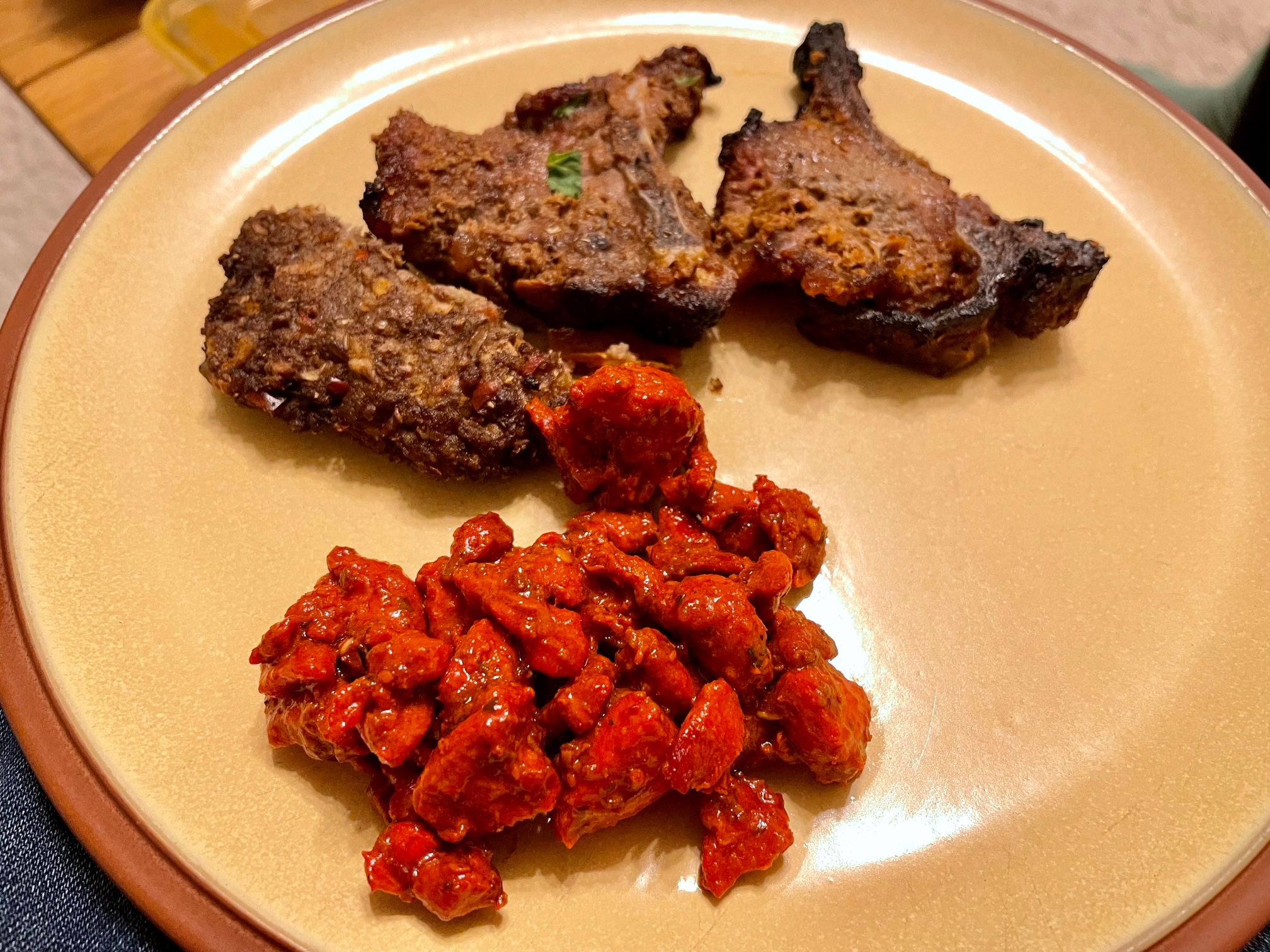
The last of our starters was Afghan lamb chops, which weren’t bad but weren’t exciting either. Cooked through with no blush, these were old-school chops where you got a postage-stamp sized piece of meat that was largely redeemed by bathing it in raita. To put this in perspective, you got four small chops for seven pounds, so if it wasn’t great it at least wasn’t expensive: presumably at Nirvana Spa they’d have charged you fifteen pounds for that lot. Deliveroo claims this dish is “Popular”. But then so is the Caversham branch of Costa Coffee.

Did things improve with the main courses? Well, yes and no. The yes came in the unlikely form of the butter chicken: it’s not a dish I ever really order but Zoë requested it and it was better than I was expecting. The sauce had a good, smooth sweetness which made the rice more interesting even if, again, there was only limited evidence it had ever seen any vegetables, or even just some herbs. And again, the chicken was in small, homogeneous pieces and lacked the generosity I would associate with the likes of Royal Tandoori or House Of Flavours.

But every rose has its thorn, and the thorn in this case was the chilli paneer. I think maybe I was expecting a dry chilli paneer, like the one you’d get at Bhel Puri House, whereas this was very much soft unfried cubes of paneer in a chilli sauce which took no prisoners and didn’t fuck around. My friend James has an expression for things that people like me think are hot but which wouldn’t make him bat an eyelid: he calls them “white people hot”. There’s no disgrace in that, per se: James classes Gurt Wings’ buffalo sauce as white people hot, although he’s never passed judgment on “The Gurt Locker”, their hottest sauce. I must take him to Kungfu Kitchen some time.

But it’s safe to say that Biryani Boyzz’s chilli paneer isn’t white people hot. It’s just hot. And not one of those clever, layered heats that builds momentum and pace as you work your way through a meal. No, it’s just really hot. Hot as in it makes your eyeballs leak with what might be tears, could be sweat or might just be a disgusting cocktail of both. Hot as in it clears out every sinus in your face while reaming your Eustachian tubes for good measure. 

Zoë said she thought there must be something like lime pickle in it and initially I disagreed, because I rather like lime pickle, but on reflection I thought she might be on to something because lurking under the brooding heat was something that could have been sour citrus. What do I know? If I’d had another couple of forkfuls I might not have been able to taste anything until the following Tuesday. The odd thing is that, in a treat ‘em mean, keep ‘em keen sort of way I admired Biryani Boyzz for doing something so uncompromising. It wasn’t for me, but there might well be customers out there who would love it. Reading the last few paragraphs, you probably know whether or not you’re one of them.

I’ve saved that five pound biryani til last, just so that this review has a little twist in the tale. You know what? I quite liked it. The chicken was on the bone, which of course it’s meant to be – and although you didn’t get huge amounts of it and it needed a little persuasion to get off the bone it was perfectly nice and the rice had some flavour – more, and better balanced, than the other dishes I’d tried. Did I mention that it was five pounds? And here we return to what I was saying at the start: something either has to be good value or good quality. Nirvana was neither, and Biryani Boyzz was one of them, in places. If Nirvana’s pizza had been something like a tenner, I’d have been quietly pleased, but if Biryani Boyzz’s biryani had been a tenner I’d have been nonplussed.

But cheap food for cheap food’s sake isn’t the holy grail some people like to think it is. Even ignoring that witless Berkshire Live article about how you can’t buy lunch in town for a quid any more (as everybody should), there can be a prevailing view in publications like Vittles that each time you get a dirt cheap meal in a restaurant you’re somehow sticking it to the man and getting one over on capitalism. But food ought to cost money, staff ought to cost money and everything ought to go through the books and be above board. I always worry that when food is cheap what you’re actually doing is just enabling a slightly different, equally unpleasant, flavour of capitalism.

Anyway, rarely have I been gladder that my takeaway reviews don’t come with a rating. Biryani Boyzz’s food is okay, and interesting in places, but I really don’t know where I’d put it if I had to find a place for it on a scale. And I’m not sure I’d order from them again, because I’d either spend more somewhere like Banarasi Kitchen or pay roughly the same amount at Momo 2 Go for very different cuisine. But I may not be Biryani Boyzz’s target market, and there’s nothing wrong with that. They didn’t lose me at that first Z, they didn’t even necessarily lose me at the second, but they probably lost me somewhere after that.

Biryani Boyzz
109 Oxford Road, Reading, RG1 7UD
0118 9573337

Order via: Deliveroo, Uber Eats

Takeaway review: Momo 2 Go

Of all the groups of people who have settled in Reading and made it their home, you could easily make an argument that few have done more to improve Reading’s food culture than our Nepalese community. I’m not talking about Standard Tandoori – I’m sure it had its day, and I know some people (the Dalai Lama included) probably mourn its passing more than I do. But perhaps more significantly, our Nepalese community is very much responsible for Reading’s love affair with the humble momo.

The godfather of the momo scene, of course, is Sapana Home which has been installed on Queen Victoria Street for many, many years. It is a terrific, completely uncompromising place in that it serves what it serves and has no interest at all in adapting its menu to more Western tastes, but it’s always warm and welcoming to people outside the Nepalese community who want to eat there. 

And who wouldn’t fall in love with momo? They’re tiny pockets of joy, you get ten of them for not very much and they’re hugely versatile, whether you want to be virtuous and have them steamed, indulgent and have them seared and caramelised in a pan or Glaswegian and eat the bastards deep fried. You can have momo in sticky chilli sauce, momo bathing in tomato gravy or momo bobbing in soup. National cuisines have been built on less, and although I know that pierogi, ravioli and gyoza have their ardent fans, momo have my heart.

For a while Sapana Home largely had the market sewn up. Sure, there was a pretender all the way out in Caversham Park Village and another at the top of the Basingstoke Road, but for most people momo meant Sapana Home. And then along came Namaste Kitchen, a game-changing restaurant in Katesgrove operating out of the Hook And Tackle pub. Its momo were fantastic, but it also showed that there was so much more to Nepalese food, whether it was exemplary chow mein, chewy, savoury dried mutton, beautiful gizzards or bara, thick lentil pancakes studded with spicy chicken. I went once and fell in love: Reading had never had it so good.

As it turned out it was too good to last, and within a year Namaste Kitchen’s dream team had split up. One of the owners, the legendary Kamal, left the business and the chef went back to Nepal. Namaste Kitchen kept trading, but it bought a tandoor and shifted its menu towards more traditional fare, slightly away from the dishes that made it famous. Kamal set up a new place, Namaste Momo, on the outskirts of Woodley in partnership with a chef from the Royal Tandoori. And the momo there were great, but there was still a friction between the Nepalese and more traditional sections of the menu. Namaste Kitchen was the Beatles of the Reading restaurant scene, and after it split up none of the solo projects quite recaptured their genius.

Fast forward to 2022 and Kamal has now left Namaste Momo as well. He’s in the middle of fitting out his new restaurant, Kamal’s Kitchen, on the Caversham Road: appropriately enough it occupies half of the space that used to be Standard Tandoori, a nice way of passing on the torch. If Kamal’s Kitchen turns out to even half as good as Namaste Kitchen was in its heyday it will be a fabulous place to have dinner. But today’s review is about a total curveball, a new pretender to the momo throne that has come out of nowhere: Momo 2 Go, a little joint down on the Oxford Road.

Momo 2 Go first came to my attention late last year, but by the looks of it it actually started trading, on the down low, last spring. It’s in a small site just before Reading West Station, with pictures of the dishes Blu-Tacked to the window, and despite the name it does have a handful of tables for dining in. But I fired up its website (they handle deliveries themselves and don’t currently use Deliveroo or JustEat: good for them) on Saturday night and decided to order a takeaway for two to stave off the winter blues.

Here’s something I really liked about Momo 2 Go’s menu – it was compact. Many of Reading’s Nepalese restaurants give you a plethora of choices, not including the huge number of ways you can customise your momo experience, and the stripped down simplicity of Momo 2 Go’s offer was a real breath of fresh air. You can have your momo steamed, in chilli sauce, in a tomato gravy or “fired” (which I assume is a typo), but that’s it. You can order chow mein or fried rice, and there’s a smallish section of sides, but that’s your lot. The water is not muddied with a crossover into more conventional Indian food or street food, there are no samosas, or chaat, or dosa. You go elsewhere for that, the menu says, and you come here for your momo. I wish more restaurants appreciated the feeling of confidence this approach instills, but I’ve been saying that for years and I’m probably not done saying it yet.

This also meant that between us Zoë and I could order a hefty cross-section of the menu – five dishes in total which came to just shy of forty pounds. That included two pounds fifty in service and delivery charges, which gives you an idea of pricing. None of the dishes costs more than a tenner and the majority are around seven pounds. We ordered at twenty to seven and the website said we’d be waiting around forty-five minutes. And pretty much bang on the dot our delivery arrived, brought to our door in a Mini which I suspect might have been driven by one of the owners. The greeting was smiley and friendly, the delivery prompt and piping hot: it’s easy to forget that most of the time, all the middle men like Just Eat and Uber Eats do is cock things up, and allow you to track how badly they’re cocking things up in something tangentially related to real time.

Our first two dishes were variations on a theme: Momo 2 Go’s chow mein, one portion with pork and the other with sukuti, dried meat usually made from buffalo or lamb. The first thing to say about this is that I’ve had chow mein from a fair few Nepalese restaurants and it’s often as beige as beige can be. But Momo 2 Go’s was pleasingly speckled with colour and life – a flash of red chilli here, a verdant glimpse of shredded cabbage or spring onion there. 

It felt fresh and vibrant, and teamed up with their impressively decongestant chutney (again, a step up from the one you get at Sapana Home) it reminded me that I think I prefer Nepalese chow mein to its Chinese cousin. But the real MVP was the sukuti – dense, chewy nuggets of savoury joy that transformed every forkful they stowed away on. I just wish there had been a few more of them – which might say that the dish was slightly out of balance, or might just say that I was greedy. The true answer’s probably at the midpoint, and besides, the dish was only eight pounds.

“You always complain that I order better than you, but I think you win this time” said Zoë. Her chow mein had pork in it (because asking Zoë to order something other than pork is to engage in a futile battle against centuries of Irish forebears) and for what it’s worth I thought it was quite nice. But it wasn’t the sukuti: Momo 2 Go sells sukuti on its own, for nine pounds (ten if you want it with beaten rice and pickles) and next time I’ll have to order a separate portion of the stuff to relive that wonderful moment when I took my first bite and knew that I’d picked a winner.

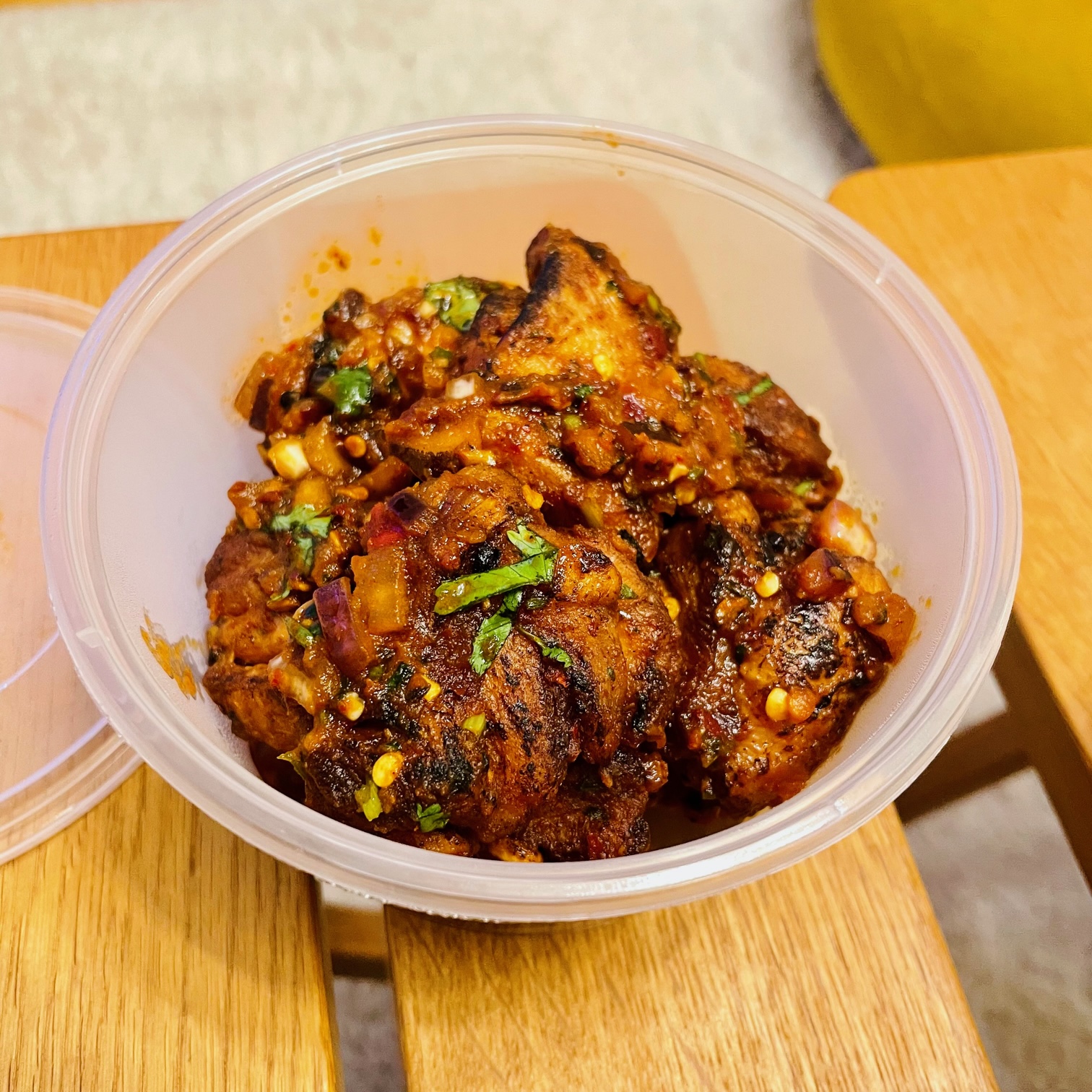
Speaking of winners, we’d chosen chicken choila as a side and again, I’m not sure I had especially high hopes. I thought it would be nice enough – it’s spiced, grilled chicken after all – but I’ve never had a choila in a Nepalese restaurant that was a feature attraction in its own right. But this was. A tub full of beautiful pieces of chicken thigh, cooked just right, not bouncy but with enough firmness left, blackened and coated with a sticky fieriness that started to make your eyes water by the end. 

I really loved this dish, so much that I don’t know how I could avoid ordering it again, except maybe to try the pork next time. We raced through, almost wordless with delight, and both offered the other the final huge, succulent piece of chicken. “No, you have it” said Zoë and, realising that if I refused one more time she would totally eat it I gratefully accepted her offer. I don’t remember whether she said at the time that it was fucking good – I know it’s the kind of thing she would say, but I don’t want to invent a memory. But either way I’m saying it myself, right now.

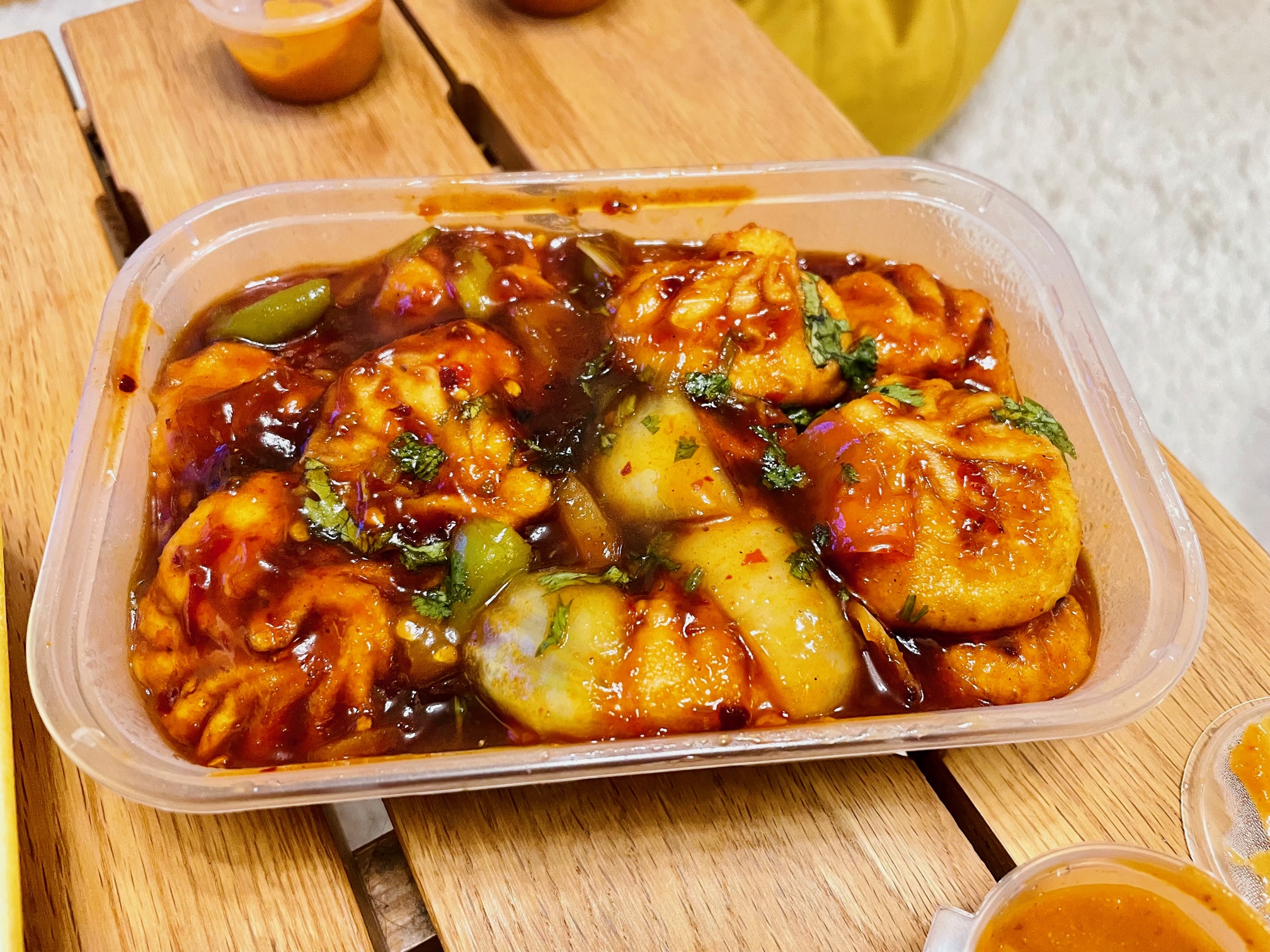
I’ve saved the momo til last, and ironically they were the dishes with the most room for improvement. But even then, they were still really very good indeed. Let’s start with the lamb chilli momo, which were the most problematic. Which is a pity, because all the elements were present and correct, almost. The chilli sauce was an absolute beauty – a glossy, hot, sour and sweet doozy that clung to every single momo. Kamal once told me that the secret ingredient in the chilli sauce at Namaste Kitchen was Heinz tomato ketchup, and this reminded me of that but with more of a barbecue sauce note. And the filling, coarse minced lamb, was extremely good. 

But the problem was that because of the way the momo had been assembled, there just wasn’t enough of the filling. Most of the momo I’ve eaten tend to be crimped along one side into a half-moon, like a gyoza, which means that the filling gets to take up plenty of space in the middle. But these momo had the dough gathered at the top, like a little pouch. Nothing wrong with that, of itself, but it meant that the filling was largely taken up with a heavy, stodgy knot of dough that didn’t leave enough room for the lamb (it’s also the reason I’ve never quite taken to khinkali, the momo’s Georgian cousin). Even so, what lamb there was and what dough there was, speared onto a crunchy piece of onion and taken for a swim in that sauce made for a very agreeable mouthful. 

The chicken fried (or fired, according to the menu) momo were also very good but not quite on the money. These were crimped the same way but the act of frying had formed little chimneys. I suspect they were deep fried rather than pan-seared, because Momo 2 Go doesn’t offer kothey momo, and the overall effect was ever so slightly tough. And again, if I wanted a little more filling it’s partly down to gluttony but also recognition that it was so good, singing as it did with fragrance and what felt like a hint of lemon grass. And again, even if they were a little knife-resistant and a little light on the chicken, they were still fairly stellar when dipped in the chutney.

Around this time last year I reviewed Banarasi Kitchen, in one of my first ever takeaway reviews. It really helped to discover somewhere brilliant, unassuming and under the radar early in the year, to remind me why I do this and reiterate that for every bland, disappointing meal and bandwagon-jumper there’s still the potential for somewhere to come out of nowhere and pleasantly surprise you. 

I don’t know if the glass is half full or half empty, and I do know – in the immortal words of Dolly Parton – that if you want the rainbow you’ve got to put up with the rain. But to fend off the occasional disillusionment I do need to feel, especially after a run including Zero Degrees, Zyka and 7Bone, that the next ThaiGrr! might be just round the corner. And that’s why I’m so delighted to have discovered Momo 2 Go this week – another modest but quietly accomplished place that gets so much right. I admire them for the concision of their menu and for sticking to their guns, and I could see plenty of little touches in what I ordered that tell me they care about their food. 

It’s ironic that the momo were possibly the weakest thing I had, but they were still pretty good and within touching distance of greatness. I can’t imagine it will be long before I order from them again, and I know I’ll face that agonising dilemma of choosing between the things I know I loved, and the unknowns I might like even better. There are far worse decisions to have on a night when you’re giving yourself a night off from doing the cooking. Try it, you’ll see.

Momo 2 Go
172 Oxford Road, Reading, RG1 7PL
0118 9586666

https://momo2go.co.uk
Order via: Restaurant website only