Restaurant review: Amò Italian Street Food

Amò closed in mid-December, apparently for maintenance, with no indication of when, or whether, it will reopen. I have left the review up for posterity.

In the good old days, where you stood on certain binary debates was simply a way of positioning you in the world. Cream first or jam first? Plain or milk chocolate Bounty? Cheese and onion or salt and vinegar? Were you a fan of the Beatles or the Stones? Blur or Oasis? All these things used just to be a form of triangulation, little points on a chart that, taken together, might give someone an idea of you (and, since you’re asking: cream first; milk chocolate; salt and vinegar; the Beatles; neither).

When did that all change? 2016, I suppose, when we all became Leave or Remain, indelibly stamped, and at every stage from that point forwards. We’re always asked what side we’re on, and now it’s not a useful piece of trivia but a necessary step to place yourself on one side or another of a yawning chasm. Are you pro- or anti-Israel? Do you think J.K. Rowling is a hero or a villain? How about Farage, or Trump? Did you believe in lockdowns, masks, vaccines? Did you leave Twitter or stay? If you left, did you go to Bluesky or Threads?

Like the Tower Of Babel, we’re now all scattered to the four winds, trying to find our tribe and arguing, endlessly, with the others. It’s not a bit of fun, any more. And this is all rich coming from me, because I’m painfully aware that I’m as polarising as most. Happily, Reading faces another tricky choice now that’s potentially just as difficult, but hopefully less divisive: Paesinos or Amò?

The two pizza places opened on Kings Road, two doors and three months apart, the latest in a weird series of rivals in very close proximity, following the example of Pho and Bánh Mì QB in Kings Walk or Iro Sushi and You Me Sushi on Friar Street. What is it with that? You must be very confident in your product to open so near to a direct competitor, like Bánh Mì QB did, but with Paesinos and Amò, Iro and You Me so little time separated both arrivals that it must be an unhappy coincidence. Imagine pouring your heart and soul into a new business only to find that another one a lot like yours is doing exactly the same, a stone’s throw away.

Anyway, regular readers will know that I reviewed Paesinos a month ago with my Italian friend Enza (who is, just to confuse matters, an Amò superfan) and it received a glowing write up from me. But I knew, even as I was eating there, that I needed to prioritise visiting its neighbour, if only because Enza told me that it was as good as, if not better than, the restaurant I had so enjoyed. I couldn’t go with Enza, because she was so far from impartial, and this time I took my friend Jo, also of Italian descent, last seen checking out House Of Flavours with me.

Amò is, as I’ve said before, something of a joint venture between Madoo, the founding father of Reading’s Italian quarter which opened four and a half years ago, and Pulcinella Focaccia, a business that sold pizza and focaccia for delivery from premises out in Earley and has been trading for a couple of years; I’d never had food from the latter, but I’d heard plenty of good things. And arriving at Amò on a weekday evening I was struck that, in terms of branding and decor at least, it felt fully formed in a way that Paesinos didn’t so much, or Madoo for that matter.

Everything was tasteful and unfussy without being Spartan, with a bare wood floor and tables, seats and benches. It seated somewhere between fifteen and twenty people, so significantly more spacious than the likes of Mama’s Way or Paesinos, and it had a nicely calm feel to it. Amò’s logo was in the middle of a deep red swatch of paint on the wall behind the counter, and resting on that counter was possibly one of the most tempting displays in Reading.

Amò very cleverly changes up its offering around the time people start finishing work, so until 5pm you can try pizza al taglio or something from a changing array of Italian street food. They also, I think, offer focaccia sandwiches during the day, although most of them had gone when Jo and I turned up around half seven. After 5pm the sandwiches drop away but instead, alongside the slices of pizza and street food, you can order a whole pizza from a more varied menu.

The street food was all very tempting, all things that I would challenge anybody not to fancy eating. Arancini, croquettes, mozzarella bites and frittatini – fried pasta – were all tributes to the time-honoured method of coating something in breadcrumbs and frying it until it was golden, crispy and alluring. The lighter side of Amò’s offering is keenly priced, too. Most of the street food dishes are around a fiver, pizza by the slice is less than that and they do multibuys if you want two stuffed focacce or two slices of pizza. Whole pizzas top out at about fifteen pounds, unless you add sausage or Parma ham to one of the options.

And Amò’s pizza menu struck me as very clever, because – either by accident or design – it kept the overlap with its neighbour’s pizzas to a minimum. Amò has a list of the classics, of course, so you can have a margherita, or prosciutto cotto and mushroom, or sausage and friarielli. But on the other side of the small, laminated menu, you find loads of less conventional options, far more interesting than the kind of things you could find at Zia Lucia or even, dare I say it, Amò’s neighbours.

That meant pizza with a purple sweet potato base, topped with cacio e pepe cream, guanciale and sweet potato crisps, or pizza with a pistachio cream base and mortadella. Others had a truffle cream base, or pumpkin cream, or even a cavolo nero base (“it’s the gourmet version of the salsiccia e friarielli”, Enza had told me, when I was looking for recommendations).

You may find all of that a bit leftfield, or it might whet your appetite for wandering off Reading’s beaten pizza track. I think for me, though, it was neither: I chalked those up as things to try once I had road tested the classics.

But first, Jo and I had a chinotto each and ordered some of those smaller dishes to kick things off. And as we waited for them, she told me about her childhood holidays by the coast, near Salerno, buying balls of mozzarella as big as your head from some beachside hut and eating them with bread, nothing else required. It was brilliant, Jo said, but it did slightly ruin the mozzarella you can easily get in this country; like me, Jo considers it a seriously underrated cheese.

As so often I felt a little pang for a childhood I didn’t have, listening to Jo. But then there was something to be said for sitting in a caravan in Devon, rain drilling on the roof, eating hog’s pudding cooked in a frying pan – always with tinned tomatoes on the side – watching Roland Rat on TV-am, knowing that the evening would be spent playing cards and watching reruns of Shogun (the original, not the superb remake). Maybe those memories would sound exotic to an Italian: on balance, though, I guessed not.

Amò’s mozzarella bites may not have been the size of my head, but they were gorgeous nonetheless. Crisp-crumbed spheres, golden but not overdone, the shell holding just-molten-enough mozzarella, they were a proper delight. I might have had them with something to dip them into, but it was a minor quibble with something so delightful. So was the fact that however carefully I ate them, with my hands at least, a little liquid sprayed out, leaving incriminating marks on my shirt. I was too happy to care, and the attentive staff quickly brought extra napkins.

At five pounds fifty for four, they could have been the bargain of the meal, if not the month, but for the fact that we also ordered two of the frittatini. These are yours for three pounds fifty, or six quid for two, and come in two flavours. If you go to Amò, my advice is to make sure you have one to yourself or, as Jo and I did, order one of each and share. They’re a bit fiddly to break up – that crisp carapace presents resistance when you’re relying on a wooden fork – but they reward the effort, with dividends.

They were beautiful things, and when I sit down in six months or so to write my annual awards it’s hard to imagine they won’t feature in some shape or form. And their form – big, irregular golden pucks – belied just how wonderful they were on the inside.

Picture an arancino, but instead of risotto rice visualise a cluster of little tubes of pasta, and rather than a molten core, imagine the whole thing bound together with sauce. In terms of taste, contrast, texture and sheer tactility I’m not sure I can think of anything finer, and writing this paragraph I am deeply aggrieved that I cannot eat one right this minute, or indeed by the end of the day.
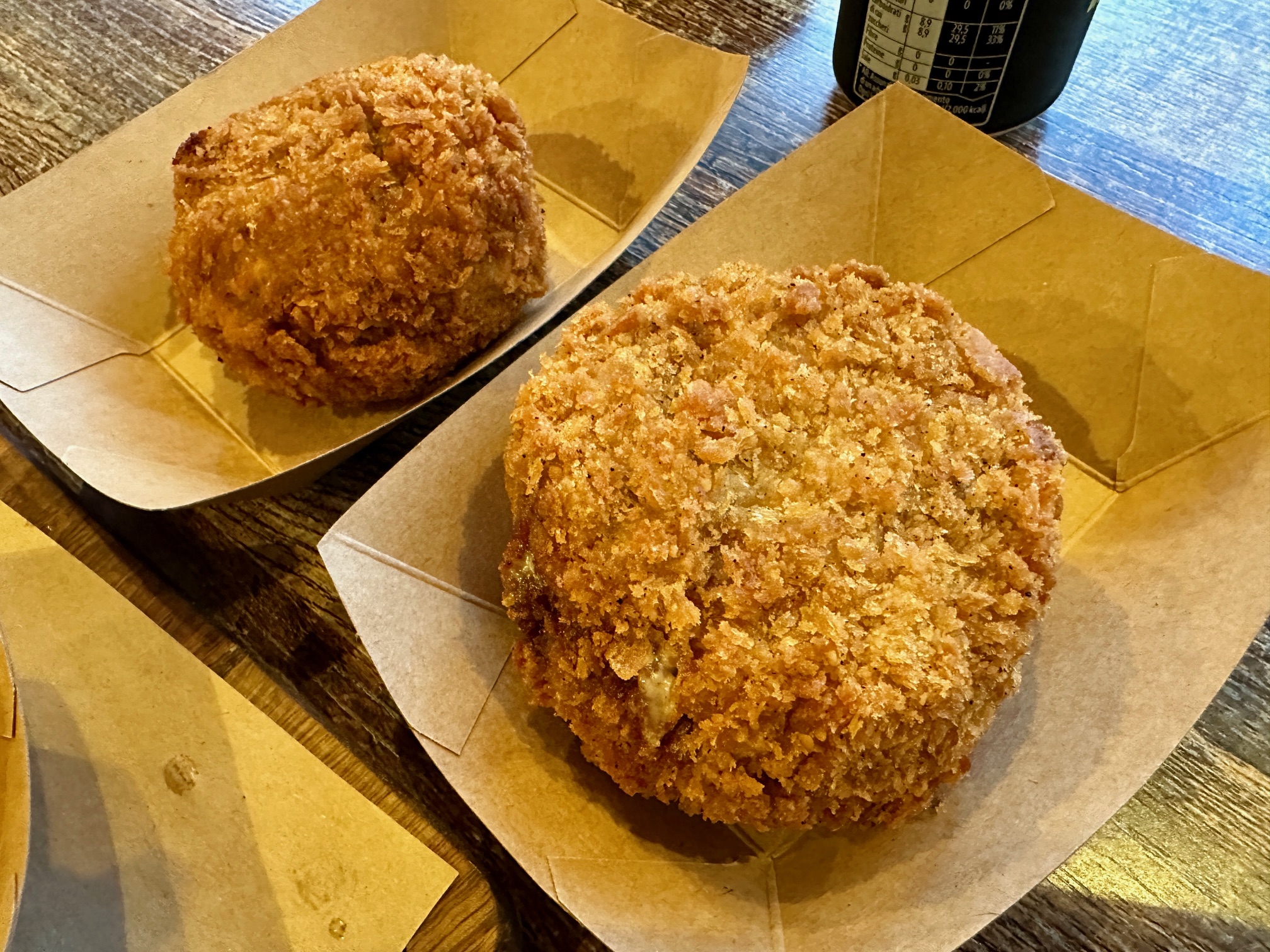
This is where Amò are an especially smart bunch, because during the day you could pitch up, have a chinotto, a slice of pizza or a sandwich crammed with porchetta and provolone, and add one of these for a mere three pounds fifty. That’s almost the price of subscribing to this blog for a month and, although it pains me to say it, it’s even better value.

Jo and I both loved the meaty version but would you believe that the vegetarian option, with fried aubergine and tomato, was even better? Jo described it as like being “slapped in the face with flavour” and believe me, apart from that fried pasta, nothing or nobody would get away with slapping Jo in the face with anything. One of the best things I’ve eaten this year, no notes at all.

Jo was very keen to try one of the pizzas by the slice, with meatballs on it, so that turned up next, thoughtfully cut up to share, a meatball perched precisely in the centre of each quadrant. This too was cracking, although I suspect the base on the pizza al taglio is slightly different to that on the whole pizza. The meatballs, in particular, were excellent – coarse and lacking in suspicious, smooth bounciness. It also, by the looks of it, was only available by the slice so, again, well worth adding to a lunch order.

By this point, as our full-sized pizzas arrived, the carbs were taking their toll, and we were already prepared to ask if some of our leftovers could be boxed up – something that rarely happens to me, because it’s rare that my capacity is defeated by a restaurant.

Jo made it a few slices into hers, the piccantina, which was topped with salami, mushrooms and Gorgonzola. I didn’t try it, and from a cursory glance I thought the porcini were common or garden mushrooms, but Jo had no complaints. She’d told me earlier in the evening that she hadn’t had pizza for a while: Jo is on a monthly treatment regime where anything she eats the next day tastes vile and puts you off whatever you ate for the foreseeable future. One of those next days had involved pizza, and Amò’s piccantina resuscitated her love for the stuff. That in itself is no mean feat.

I on the other hand had deferred to Enza’s judgement and ordered the sausage and friarielli. As so often with white pizza, it had a bit more structural integrity, so less of the Neapolitan droop you might get with other pizzas. And the base was admirable, nicely puffy with plenty going for it. You couldn’t fault the generosity either, with nuggets of crumbled sausage very, very liberally deployed.

There was very little not to like about the pizza, and if I was clutching at straws I might say that I’d have liked the sausage to have more of a whack of fennel, but that’s a minor thing. It was so well orchestrated with the friarielli that it was impossible to argue: this was a pizza without complexity or variety that kept it focused and hit the target.

I managed about half of mine, and the staff were nice as pie about bringing a couple of boxes so we could take our leftovers home. Everything we had ordered – all that food, four cans of soft drink – came to fifty-five pounds, which is a steal, and then we went to the Allied for a debrief. Two pints of forgettable macro fizzy booze at the Allied set us back nearly sixteen pounds, which is very much not a steal.

For once, I can also report back on the leftovers. Jo had hers cold the next day – no slice for her beloved dog Diesel, this time – and sent me an iMessage: tastes even better this morning, cold from the box, outstanding! I on the other hand revived mine in the oven on my lunch break, working from home, and it was the best lunch I’d had in ages. I wasn’t sure if my slight lull that afternoon was down to the carbs or a Teams call that felt especially like a trudge. Let’s put it down to the latter.

Having talked about Amò for all these paragraphs, I know I should return to my opening theme and compare it to its neighbour Paesinos. But it’s not easy to do.

If they were top trumps cards, Amò would win in a number of categories. It’s more versatile, on account of having a focused lunch offering as well as pizzas in the evening. It has arguably a wider range of sides and small plates. It’s bigger, too, with far more potential to eat there in larger groups; if you go to Paesinos as a four, you either won’t get in or you’ll take up two-thirds of the restaurant. Its pizzas are more imaginative and unconventional, so more of a challenge to the Neapolitan hegemony elsewhere in town.

On that basis, you’d have it down as a resounding victory for Amò and, for some of you, that might well be the case. On the other hand, Paesinos sticks to the classics, both for pizza and for its smaller dishes. I think its soft drink selection – and neither is licensed – is better and more interesting. The cannoli and tiramisu are worth the price of admission alone. And, speaking completely as a novice in these things, I think Paesinos’ dough and base may have the edge.

But the main reason why taking a Top Trumps approach doesn’t work is that Paesinos, for me, has a little something extra. There’s no Italian equivalent of je ne sais quoi, as far as I know, but there’s a small dash of magic in the smaller restaurant that means that rationally, although I know Amò has a huge amount going for it, it’s impossible to pick a winner.

So yes, I’ve reflected and reflected and it’s impossible to put a cigarette paper between these two places. The only thing you can put between them, it turns out, is another restaurant – called Just Momo, which helpfully doesn’t just do momo. So the rating down there reflects that: call it a cop out, if you will, but I stand by it.

Let’s not divide ourselves by being Team Amò or Team Paesinos, because as a town we can be better than that. Hopefully enough of you will pick each side that both places will continue to trade for years to come. Because the truth is that there’s one real winner in this contest, and that’s Reading.

Amò Italian Street Food – 8.6
2-4 Kings Road, Reading, RG1 3AA
07500 619775

https://amoitalianstreetfood.co.uk

Since January 2025, Edible Reading is partly supported by subscribers – click here if you want to read more about that, or click below to subscribe. By doing so you enable me to carry on doing what I do, and you also get access to subscriber only content. Whether you’re a subscriber or not, thanks for reading.

Restaurant review: The Pot Kiln, Frilsham

As of 30th March 2026 the Pot Kiln has scrapped its Basque concept and reverted to offering pub food. Nick Galer is still in the kitchen, and I may revisit in the future but this review is no longer current.

One of the big gaps in my coverage of restaurants, given the name of this blog, is my failure to review the plethora of highly-rated gastropubs in the countryside around Reading. Berkshire is a funny-shaped county, long and thin, and that means you can strike out into Oxfordshire to the north or Hampshire to the south as easily as you can head east towards Maidenhead or west to Newbury staying within county lines. And one of the reasons, I suspect, why central Reading has never attracted many special occasion restaurants is the embarrassment of riches to be found a short drive away.

I’ve done some of them in my time of course, like the Bell or the Bottle & Glass, but the vast majority remain on my to do list, or at least they would if I were able to drive. And that means that when Britain’s Top 50 Gastropubs publishes its annual list, as it did early this year, I scan it for pubs nearby and realise, ruefully, that I’m unlikely to review them. This year The Loch & The Tyne in Old Windsor, Tom Kerridge’s two pubs in Marlow and The Crown in Burchett’s Green remain on my “maybe one day” list.

Another strange phenomenon in the gastropubs nearby is a tendency for musical chairs where highly rated chefs move from one pub to another. So for instance Dominic Chapman, who earned a Michelin star at the Royal Oak at Paley Street, which I reviewed, then moved on to the Beehive in White Waltham, which I have visited but not reviewed (it was, by the way, not bad at all).

And then, nine years later, he sold up: by that time he had taken on The Crown at Burchett’s Green, which he took over from Michelin starred Simon Bonwick. Again, I ate at The Crown once under Bonwick and thought it was quite good and extremely expensive. Bonwick then pitched up at The Dew Drop Inn in Hurley, managing eighteen months there before moving on again: he now cooks upstairs at a pub in Marlow three times a week.

This happens all over: The Loch & Tyne in Old Windsor is run by Michelin starred Adam Handling, but before that it was called the Oxford Blue and run by a chap called Steven Ellis. Ellis has moved on to another spot, The Bailiwick in Englefield Green which just so happens to be my stepmother’s favourite restaurant in the whole world. Again, I’ve been and it’s really rather nice, especially the venison bon bons; if you ever go, get a portion to yourself.

So maybe one good reason not to review pubs in this part of the world is the amount of toing and froing that goes on, with almost as much transfer activity as the Premiership: even The Plough, which I loved, is on to another head chef since I visited, its third in two years.

One of the benefits of this phenomenon, though, is that sometimes you see welcome, familiar faces pop up in new places. And that brings us to the Pot Kiln in Frilsham, out in West Berkshire, nestled in the Yattendon Estate. This bit of the world, too, has always been sprinkled with good food pubs: the Royal Oak in Yattendon and the Bladebone Inn in Bucklebury are just two more to add to the list of Places I Like But Have Never Reviewed.

The Yattendon Estate now owns the Pot Kiln, as it does nearby Renegade Brewery and Vicar’s Game in Ashampstead. Before that, for a long time under chef Mike Robinson – who held a Michelin star at Fulham’s Harwood Arms – the Pot Kiln was already synonymous with game, all caught on the estate. I ate there once, when Robinson was at the helm, and thought it was rather enjoyable, the surroundings idyllic. But then Robinson got divorced, and his wife got custody of the pub, running it with her musician partner, the magnificently named Rocky Rockliff.

For whatever reason the Estate subsequently snapped up the pub and installed new management. But rather than pick one of the merry-go-round of local chefs and get them to do what the pub had always done, the Pot Kiln took a more interesting course of action. It decided that instead of offering mainstream pub fare or more generic modern British food it was going to serve a Basque-infused menu. A three quarters of a million pound refurb was carried out, including a new open kitchen and a parilla grill, and it reopened last summer.

The other interesting thing they did was appoint chef Nick Galer. Now, I knew Galer’s food from his very successful spell at the Miller Of Mansfield, a lovely pub I did manage to review six years ago, out in Goring. He left the pub three years later, when our old friends Stonegate decided to nearly double the rent, and after that he had an incongruous spell cooking at a nearby golf club, but the move to the Pot Kiln made sense. It’s been on my list ever since, and as my future brother-in-law Matt drove us through the winding lines of West Berkshire in the gathering gloom I realised that I had a real sense of curiosity about the meal that lay ahead.

The thing is, I loved the Miller, and had some really successful meals there. But there were also a couple of times, especially one Christmas Day set meal, when I left somewhat peckish, and I’d heard similar reports from other people who had acted on my recommendation. A pub in the countryside offering tapas and the heartier food of Northern Spain, making good use of cooking over fire, could be an intriguing second act for Galer’s cooking.

In the summer, I imagine a review of the Pot Kiln would talk about just how beautiful its surroundings are, and what good outdoor space it has. But in grim, largely sunless March, before the clocks went forward, all I can say is how glad I was to be in the passenger seat next to an extremely competent driver and navigator. The pub itself looks classy and cosy – definitely one of those gastropubs that still operates as a pub – but the dining room of the restaurant, next to the open kitchen, was a little harder to love.

I couldn’t quite put my finger on why, because the tables were generous and the chairs comfy, but the lighting was a tad cold and the whole place had a certain feeling of sterility. It wasn’t for the lack of diners, because the room was reasonably well-occupied on a Monday night, including a large group which sang Happy Birthday later in the evening. But we grabbed a table for two with our back to all of that, both looking out on the open kitchen, and perhaps that was an error. Galer was not in the kitchen that night, although that didn’t seem to remotely affect the bustle of the staff beavering away.

The Pot Kiln’s menu read really well. There were ten tapas dishes, ranging in price from just over four to just over ten pounds, and eight mains, two of which were sharers. They started around twenty pounds and climbed from there. Half a dozen vegetable dishes, appearing out of sequence before the mains, completed the picture, although they appeared more to be sides than tapas. And actually, although I found plenty to potentially order on it, this menu wouldn’t suit vegetarians or vegans. Only one main for them, baked rice with cauliflower and capers, and four tapas options. In that sense, I suppose you could say it was quite authentically Spanish.

All that being the case, the drinks list surprised me. The local beers on offer highlight the owner’s connection to Renegade, the brewery formerly known as West Berks. But I thought there might be some Spanish sidra on offer, or at the very least some txakoli, the slightly sparkling wine which is one of the Basque country’s best exports. Not only wasn’t there any, but the wine list was dominated by other countries: less than half of the whites and about a third of the reds on offer came from Spain. It felt like some bet hedging was going on.

I decided to stick to the two Spanish whites available by the glass, starting with a Macabeo which was fresh, if slightly astringent. The Verdejo I moved on to later in the evening, not significantly more costly at eight pounds a glass, was much better: fuller, rounder, more interesting. Matt stuck to an alcohol free Asahi before then trying a mocktail with elderflower and ginger which he rated.

So, how many tapas dishes would you have ordered to share between two, not knowing how big they were or how large the mains after them would turn out to be? We opted for three, which I worried might be over-ordering: I suspect my appetite is bigger than Matt’s, or possibly it’s just that his manners are better than mine. But I needn’t have worried, because these were definitely tapa rather than media or racions.

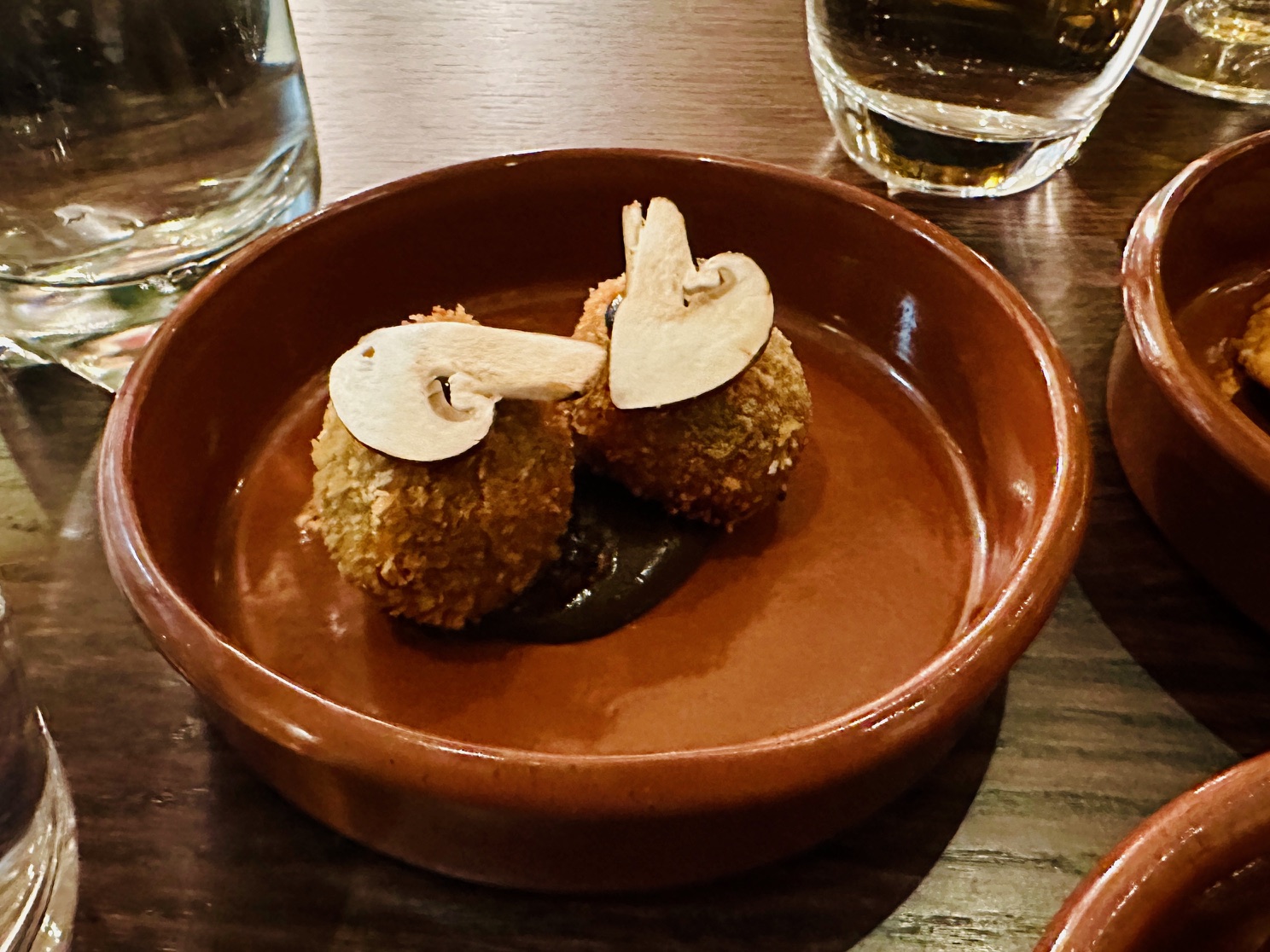
First up, two mushroom croquetas, each topped with a thin slice of raw mushroom – this seems to be in vogue at the moment, although I’m not sure it added anything – resting on a puddle of thick mushroom ketchup.

I have to say, the taste of these was extraordinary. The concentration of savoury notes at the heart of those breadcrumbed spheres was something else, but better still was the depth of the ketchup. It had an awful lot going on – yet more umami, but also a very pleasant acetic spike in the mix. These were two really lovely croquetas. Two really lovely, rather small croquetas. Two really lovely, rather small croquetas that cost seven pounds fifty.

If you wanted any proof that the Pot Kiln, whatever else it might be good at, could do ketchup, the next tapa amply demonstrated this too. A pair of empañadas, with pleasingly dense pastry, had a filling of slow-cooked short rib and came with a blob of Kermit-coloured gherkin ketchup. The star of the show here was the ketchup – even Matt, who had been suspicious from the moment he spotted the word “gherkin”, tried some and declared himself a convert.

This dish was worth ordering for the ketchup alone, such a clever piece of work, something which captured the taste of gherkins in an almost photorealistic way despite being a puddle of green. It redeemed a multitude of sins, but did it redeem the fact that the two empañadas weren’t exactly bursting at the seams with strands of beef? Maybe.

Did it also redeem the fact that a pair of empañadas set you back eleven pounds? Maybe not. The philosophical struggle I had detected in the menu was between Spanish cuisine sending you away very full indeed and Galer’s cooking sometimes rarefying things to the point where they were a perfect, but tiny, distillation of themselves. On this evidence, the latter was winning out.

I minded all that less with the third tapa, but the fact remained that it too was small and perfectly formed. Two titchy triangular toasts, topped with tomato, finely chopped onion, oil, herbs and, from somewhere, a gorgeous supporting note of citrus. These too were this kind of thing – so often in Spain a huge piece of bread amply covered in their peerless tomatoes and salt – miniaturised to a lovely, exceptionally high end version of the same.

Getting tomatoes this good in March is itself, after all, quite an achievement. If elevation was the intention, mission accomplished. But although I could well believe you wouldn’t get a better rendition in San Sebastian, I could imagine you wouldn’t get a smaller one, either. Six pounds fifty for this.

At this point I was, in truth, a little concerned that it would be one of those meals, where everything tasted amazing but you had to seriously over-order or leave without feeling replete.

But Matt and I had ordered the 12-hour lamb shoulder, intended for two or three people, and we’d been warned in advance that it took a while, so we moved on to our second drink and caught up – his job, my job, his household adjusting to the arrival of my second niece, the ins and outs of the family we were both lucky enough to have found ourselves part of. Matt has the sort of senior job that means you have to be good at talking to anyone and everyone, which makes him an excellent conversationalist, although it did leave me hoping his evening with me didn’t feel like work.

From our vantage point I could see that the lamb shoulder had spent most of its 12 hours cooked sous vide, so it was rescued from a plastic cocoon and finished in the oven. And when it was eventually brought to our table, bronzed, with a thick layer of crispy, salted fat, I thought it looked about as wonderful as could be. It was accompanied with a little pot of anchovy and garlic sauce, which had also been artfully squiggled around the plate in an unnecessary fashion. Our server – all the people who looked after us that night were excellent, by the way – started the process of testing the lamb off the bone and shredding it, doing just enough for us to dish up and leaving the rest of us to explore for ourselves.

It was absolutely glorious. Lamb is one of my favourite meats, and this must be one of my favourite ways to have it. I’ve had slow cooked shoulder before where the fattiness is to the fore, where it’s slicked with the stuff, a little too much. But this was gorgeous, almost like the best kleftiko there is, and the texture was spot on, with enough of everything: crispy shards, plenty of supremely tasty fat, both crunchy and wobbly, and piece after piece of shredded lamb, some moist, some dry, all brilliant.

The salt studded along the edge of the fat made those pieces an especially savoury delight, and although it didn’t slump off the bone the way some slow-cooked lamb can, it didn’t take an awful lot of persuasion. For some reason we’d been brought quite dinky plates, which meant that we had to keep coming back for more, but that was very far from an ordeal.

Matt wasn’t sure about the sauce, but I suspect he’s less of an anchovy fan than I am. Even being a huge lover of anchovies, I thought this was salty overkill: I’ve read other reviews that say this used to be served with a mint sauce, and I can see that, or salsa verde, offering the counterpoint this needed. It also worked out fortuitously, I think, that the bits I were drawn to, especially the fatty ones, were naturally the ones Matt might have passed on. We were a regular Jack and Mrs Sprat, and between us we polished off the lot.

At seventy pounds, I think this served two nicely but might have been stretched between three. But I liked it so much that for even for two I thought it represented agreeable value.

Meat requires potatoes, whether you’re in Thatcham or Bilbao, and torn between the enigmatically described “Spanish potatoes” and the Pot Kiln’s chips we went for the latter. Very good chips came speckled with crispy flecks of jamon and under a light dusting of Idiazabal, a Basque cheese. There was also, apparently, “Bravas seasoning”, which I imagine was another piece of refinement and deconstruction. Too much refinement, I fear, because nothing was really detectable. Still, good chips with cheese and jamon on them are always going to go down well with me, and these did.

All that was an overload of saltiness, and much as I loved that I was glad we had some contrast in the form of some carrots. These were beautiful, fresh, just-cooked things dusted in something which apparently contained chives but, to both of us, tasted strikingly of aniseed. The fact that these, really, were the only vegetable of the evening was Matt’s and my fault for ordering the way we did, but also felt quite authentically Spanish: finding anything with vegetables in it can often be a challenge there, in my experience. Not that I’ve ever tried that hard.

By this point, things had quietened down in the restaurant and we were almost the last people there. I almost felt guilty about keeping them by ordering dessert, but I also felt like we ought to try that part of the menu out.

The dessert menu is compact – five dishes and a selection of cheeses, and one of them, turron at five pounds fifty a piece, felt more like something to accompany a coffee than a dessert in its own right. Matt was tempted by the apple tart with apple sorbet and calvados syrup, but unsure: he liked apple, but did he like it that much?

I told him you couldn’t have too much of a good thing, so he went for it and I think he was rewarded with the better dessert. My spoonful, again, pointed to the kitchen’s technical gifts and command of flavours: each element a slightly different iteration of apple, prioritising sweetness, sharpness or booziness. I would have been happy, had I ordered this. But had I ordered it – and even though I didn’t – I would say it was more a cake than a tart.

My choice, on the other hand, was one of those disappointing examples of how a menu can say one thing and mean another. Rhubarb sorbet, gingerbread, cava paints a picture of those three elements in harmony, maybe equivalent amounts of each, and I was expecting that to be the case. Instead, in the Pot Kiln’s standard issue terra cotta pots, I got a dollop of (admittedly very good) rhubarb sorbet with a scattering of gingerbread crumbs, like snow that would not settle.

Cava was then poured over it, but the terra cotta pot wasn’t the right vessel for a dish like this. It just meant that you got a thin lake of booze at the bottom that you couldn’t spoon up. So essentially this was a rhubarb sorbet with whistles and bells that didn’t blow or ring. At eight pounds fifty, this felt like a lot to spend on a dish that didn’t entirely cohere.

All told we’d been enjoying the Pot Kiln’s hospitality for over two hours, and I was increasingly conscious that we were probably preventing them from shutting up shop in the restaurant. At this point the open kitchen was less of a selling point: it’s one thing when you see activity, vitality, prep, flames, dishing up, but perhaps another entirely when they are mopping the floor with one eye on the service after this one, the following day.

So we settled up and Matt prepared to effortlessly work wonders with his satnav, ease us out of deepest darkest West Berkshire and take us back to the bright lights of Reading. Our meal – three tapas dishes, that lamb and side dishes, a couple of desserts and a couple of drinks apiece – cost about one hundred and sixty-five pounds, which included an optional ten per cent service charge. Overall I thought that was reasonable value – fair in parts, good in others, questionable in a few.

That was something I pondered and weighed up in the week I took to mentally digest, between eating this meal and writing it up here. Because after those tapas dishes I was all ready to write my oh-so-slighly disappointed not-quite-a-peroration, in which I gently pointed out that “perfect for sharing” should translate as “this dish is big enough for two people to enjoy” rather than “this dish is made up of two individual, rather small, morsels”.

But then the main course completely subverted all that – it wasn’t cheap, but it was outrageously good. It was the kind of food I had been expecting to find at the Pot Kiln, but I don’t think I was expecting it to be bookended by things so different – by tapas dishes that worked wonders with flavour but left you wanting more in all the wrong ways on one side, by desserts that were a tad pedestrian on the other.

In the run up to this visit I wondered which would prevail – the big portions and big flavours of the Spanish food I’ve enjoyed in the past (notwithstanding that I’m yet to go to the Basque country, sadly) or the precise, distilled, excellent cooking that Nick Galer is so good at. And the answer, based on this visit, is that the Pot Kiln, not quite open a year yet, is still resolving that identity crisis.

There is plenty to enjoy here, and I enjoyed plenty of it, but “let’s open a Basque inn in the middle of beautiful countryside just outside Newbury” is a concept I can get behind. “Let’s do the most beautiful portions of tapas that take a classic idea and produce it in its smallest, purest form” is perhaps not.

So if you want tapas, I think you might be better off heading just down the road to Goat On The Roof. If you want ludicrously good meat cooked beautifully on an amazing piece of kit, you should go here. Because that’s the part of this meal I’ll still be thinking about in the months ahead, the part I’d passionately recommend to others, the part I am remembering now, with a grateful smile on my face. For what it’s worth, I hope that side of this particular see-saw gains the upper hand.

The Pot Kiln – 7.5
Chapel Lane, Frilsham, RG18 0XX
01635 201366

https://thepotkiln.co.uk

As of January 2025, Edible Reading is partly supported by subscribers – click here if you want to read more about that, or click below to subscribe. Whether you’re a subscriber or not, thanks for reading.

Restaurant review: The Cellar

The Cellar closed in June 2025. I’ve left the review up for posterity.

Here’s a question for you: when does a restaurant become a new restaurant?

Is it when the name changes, or when the chef changes, or when the owner does? Celebrated Reading restaurant Mya Lacarte changed chefs many times during its lifetime, but it always remained Mya. But with some restaurants, it can feel like a completely different place. Take Pepe Sale – the name and the room stayed the same, but without Toni in the kitchen and Marco or Samantha running the front of house, it might have been a decent Italian restaurant, on a good day, but it wasn’t Pepe Sale.

One of my favourite restaurants, back in the mists of time, was a place in Cheltenham called Lumiere. It was run by a married couple, a lovely, homely spot that did brilliant food, and I loved it. And then the owners decided to get out of hospitality and sold to another couple, one with a track record and aspirations. Fourteen years later, they won their first Michelin star. I’ve been since it changed hands, and I liked it well enough, but it wasn’t the same place I loved long ago.

I feel like this is especially a problem with pubs. When restaurants change hands, unless the new owners are buying a going concern the name often changes. But pubs can go through good phases and bad phases, new chefs and new concepts, all under the same name. Look at my reviews of all the pubs out on the way to Henley – the Pack Horse, the Pack Saddle, the Crown. Are any of them recognisably the same as they were when I reviewed them all that time ago? Almost certainly not.

The reason I’m starting out talking about this is that the subject of this week’s review also begs this question. Between 1996 and 2008 there used to be a restaurant on Valpy Street called Chronicles, and back then it was very much a peer of London Street Brasserie. It closed, and became an Italian restaurant and then, briefly, a truly woeful place called The Lobster Room. And then in 2015 Chronicles owner Andrew Norman decided to have another bite of the cherry and opened Valpy Street in that spot. New name, new era, new restaurant.

But in August Valpy Street closed after nearly nine years trading. Sadly this hasn’t been an isolated occurrence this year – restaurants have been dropping like flies in 2004 – and the announcement from Valpy Street listed the usual suspects: Covid, the cost of living, wage increases. But there was an additional horseman of the apocalypse in Valpy Street’s case: “accountancy errors”. War, famine, death, shonky accountants. It figures.

And so that was it for Valpy Street, but the following month another restaurant, The Cellar, opened in the same spot. The Chronicle had already reported that this was going to happen, and that some of the existing staff would transfer across to Valpy Street’s successor. And yet, if you have a look on Companies House, the director of The Cellar Ltd. is none other than… yes, it’s Andrew Norman, the proprietor of Valpy Street. 

So what’s all that about, and was the Cellar a new restaurant, or just a new name for an old one? I decided it was time to find out, so I booked a table on a week night and headed over to check it out, with my dining companion – and elite level campanologist, would you believe – Liz, last seen experiencing the exotic wonders of Calcot

I was a little early for our reservation, so I got a good look at the dining room. I can’t remember what it looked like as Valpy Street, and I didn’t have the sense to take a photo back then, so I couldn’t tell you how much it had changed. But I sense it wasn’t that much, probably because it didn’t need to. Despite being a basement restaurant the dining room was split level with another room, for drinkers, on the other side of the bar.

And everything was nicely done: gorgeous exposed brickwork – the real stuff, not faux nonsense – along with banquettes, muted panelling and comfy dining chairs. There wasn’t much in the way of soft furnishings to absorb the noise, and although it wasn’t busy on a Tuesday night the decibel level was high, mainly from a very chatty table of Americans who were here on business and celebrating, by my reckoning, for the final time for about four years.

Yet if you looked more closely, things about it weren’t quite right. My table, which was a perfectly nice table, had weird sloping edges which meant that when you looked at the wine glasses or jug of water you felt like either you were very drunk or they were about to fall off. The tables in the booths had been spaced out as if social distancing was still a thing, meaning anyone sitting at them risked scraping their elbow on some brickwork.

And speaking of elbows, the table was so sticky that, over the course of the evening, it took the skin off my elbow. If you left a napkin on it and pressed down, you left some of the napkin on the table. All a little strange, although I didn’t fully appreciate that until I got home and had to break out the Elastoplast.

Service was initially a little diffident. I think I spotted three or four servers over the course of the evening, but the young chap who showed me to my table then just leant against the wall and stared into space as I made more and more attempts to attract his attention to say that actually, I’d love a drink while I was waiting for my friend to arrive. He was absolutely lovely, but just seemed a little, well, green. (“Don’t be mean about him in the review, it’s probably his first week” was Liz’s take at the end of the evening.)

My wine arrived just as Liz did, which made me feel rude even though it wasn’t really my fault. The Cellar’s wine list is pretty interesting, partly because I couldn’t work out who they bought from. Some of it at least was available from Majestic, the popular choice with so many Reading restaurants over the years. But others, weirdly, only seemed to be available from a website that does thank you gifts for employees, so your guess is as good as mine.

I know all that, because I could Google it while I waited for Liz to arrive. Because, unusually for a basement restaurant with thick brick walls, there is actually mobile reception. Anyway, the list had a decent mix of old and new world, and if nothing was that cheap – glasses start around nine quid – that’s because nothing is any more. So I had a nero d’avola (Majestic) which I liked very much, and decided that I’d save the pleasures of the Malbec-Viognier blend (Hints of fynbos, rosemary and tobacco leaf, spiced or marinated red meats with a biltong coating, also Majestic) for another day.

I think after eleven years I’ve figured out that when it comes to wine, describing things as jammy or fruity or – if they’re dead expensive, “complex” or “fragrant” – is about as good as I get. I liked it, I ended up having a second glass. Liz ordered something neither of us had ever heard of, a Spanish white made with Airén, a grape that was a new one on me. It was from the weird corporate website, and Liz, who is better at this sort of thing than me, said it was really enjoyable, fruity but not acidic; speaking as someone who is frequently acidic but rarely fruity, I couldn’t really identify with it.

The Cellar’s menu was a bit of a dark horse, with hidden depths. At first sight, it looked pedestrian and safe, but if you kept looking you found all sorts of interesting ingredients and techniques hiding in plain sight. So there was pork rillette, which you might find somewhere like Côte, but they’d panéed it, for reasons which escape me. There was boeuf bourguignon, but repurposed into some kind of cottage pie – gîte pie? – to be different. Baba ganoush came with rum soaked raisins, pavlova with basil sorbet. A little subversion, in with the mainstream.

Small plates came in between eight and twelve pounds, although you could supersize them as large plates by paying more. And then there were main courses – which you’d hope were also large plates, unless they were even larger plates – which cost between eighteen and twenty-five pounds. These were divided into two sections, one of which was marked “classic” which, in this case, translates as “not cheffy”. Fish and chips I can see you might class as a classic, but green Thai curry? Hmm.

Anyway, all that sounds catty when it isn’t meant to. I liked the menu, like I liked the room, but like the room it still felt like a bit of a jumble. The sense of being a work in progress fitted more with it being a new place than just Valpy Street wearing glasses, a fake nose and moustache.

Having said all that, we played it safe with our starters and were maybe not rewarded for that. I chose salt and pepper squid knowing full well that calamari is something I’ve tried in many places over the years, from Vesuvio to Storia and beyond. And the Cellar’s rendition was good – or, at least, not bad. The salt and pepper didn’t come through strongly, but even if they weren’t super-fresh they were far from the nacky rubber bands you get in many places. The chilli was advertised but didn’t make its presence felt, the unadvertised leaves dumped on top were a nuisance.

Pairing this with black garlic aioli (not just any aioli) is seemingly a very now combination – Storia did this too – but I wasn’t sure how this went with a salt and pepper coating. In any case the aioli had a weird sweetness, like salad cream, with no garlic punch. I think I’d rather have had sweet chilli sauce. But the oddest thing, again contributing to that slight jarring feeling, was how this was served, in a high-sided bowl sitting on a board. This made eating it, and dipping it into an even smaller ramekin of aioli, a bit of a palaver.

Liz had gone even more classic, with baked camembert. This is a dish it’s hard to get wrong, in many ways – buy a Camembert, bake it properly and off you go – and the Cellar managed that without missteps. I got to try a bit, and for what it’s worth I thought it was decent – nice to see it scored and generously studded with rosemary, even if the white wine and honey glaze didn’t really made its presence felt. At least they hadn’t adulterated it with onion jam or suchlike. But Liz wasn’t entirely convinced.

“I guess you sort of know what you’re getting with that, though” I said. “What more could they have done?”

“It’s these things” said Liz, pointing to the insubstantial, brittle crostini on the plate. “It needs really good, crusty bread to dip.”

I think she was right. The crostini snapped if you dipped them, couldn’t bear the weight if you loaded molten cheese onto them. They looked bought in, and if they weren’t then they could have saved time by doing that. But Liz was right, this dish was a baguette away from living its best life.

At this point, even though the lighting was lovely, the conversation was absorbing and free-flowing and the Americans had scarpered, I was getting that sinking feeling that my evening was going to be better than my meal. So it gives me huge pleasure, and no small sense of relief, to say that this was where the Cellar turned a corner and the rest of the evening was a little choreographed sequence of successes.

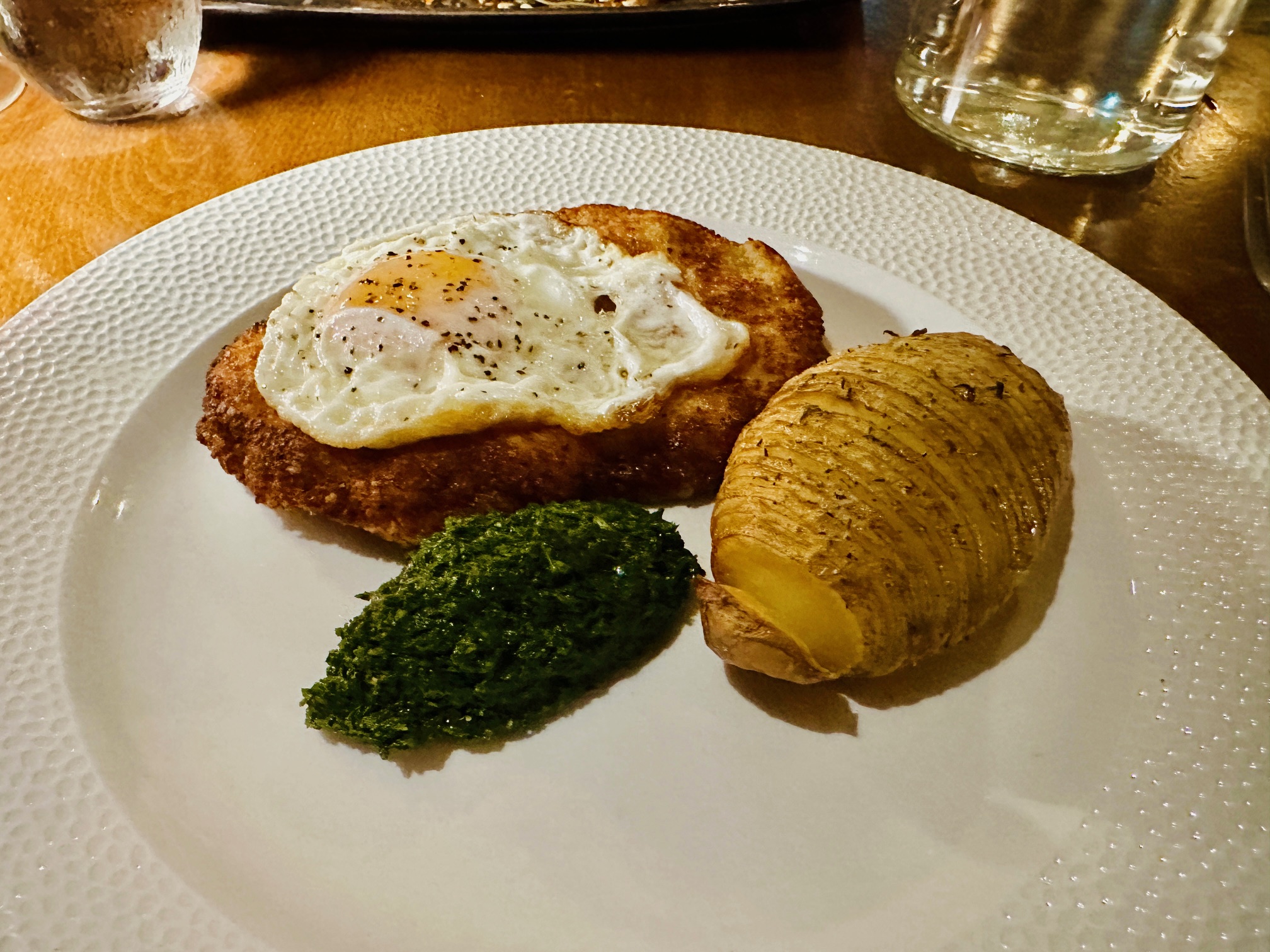
Take my main. I’m not sure what possessed me to order a chicken Milanese, a dish I’ve occasionally ordered but rarely enjoyed and really, only associated with Carluccio’s back when it was good. But it turned up and not only looked the part but was a hugely enjoyable affair all round. There’s not much to this dish but, like the Cellar’s menu, it was full of surprises.

So the chicken was a little thicker than I’d expect, not beaten flat, and was beautifully tender and superbly done. The coating could so easily have been blah old breadcrumbs, but was given a real flash of interest with Parmesan in the mix. The fried egg was absolutely terrific, spilling its yolk the way I spill gossip – freely and with joy.

I wasn’t entirely convinced by the hasselback potato – it didn’t feel like garlic or rosemary had really made their way to the centre of that particular maze – but the gremolata was also a delight. I’m not entirely convinced it was really a sauce, but more of a thick parsley pesto. But it had zing, and you could smear it on a piece of chicken or a sliver of potato, and it made everything better. I don’t mean to damn The Cellar with faint praise, but I’m not sure I’ve been more pleasantly surprised by a dish this year.

And then there was Liz’s dish. Liz doesn’t eat as much meat as I do – few people do, I suspect – and had chosen a vegetarian starter and a vegan main. I’m so glad she did, because that vegan main was a triumph, with loads going on. A slice of baked aubergine (“I really love aubergine”, Liz said, and I remembered that we’d had some at the Coriander Club, too) was served on a slick of butter bean purée.

But that was the Cellar just getting started, because on top of that you had a very good quenelle of baba ghanoush, and others of something I mistook for tapenade but the menu swears blind is mushroom duxelles. So much going on there, so many interesting flavours to mix and match.

But the Cellar understood that the dish still wasn’t complete without some textural contrast. So it was scattered with seeds and dusted with a potent dukkah, and because that still wasn’t enough, the crowning glory – crisp-edged cubes of panisse, chickpea fritters. I love panisse, and I don’t think I’ve ever seen it on a menu in Reading. I was very happy with the Cellar for doing it.

“This is really good” said Liz, offering me a forkful that confirmed that it absolutely was. So much going on, so much work and thought, but without it being overblown or overdone, or all those flavours and textures getting lost in a shouting match. And I thought that this was how you should do vegan food, to make it a destination dish where nobody in their right mind could eat it and miss meat. I was also thinking, in the back of my mind, finally, my vegan readers are going to get something out of a review for once.

Liz had her eye on the madeleines on the dessert menu, possibly because they came with lavender honey, but I managed to talk her into dessert. And perhaps more impressively, because Liz is firmly in the “one glass of wine on a school night, and possibly even a Friday night” school of thought, I managed to talk her into a dessert wine too. They only had one, a late harvest sauvignon/viognier blend, and 50ml is a bit of a stingy pour (if you’re me, or just right if you’re Liz) but it was a beautiful sip of pure sunshine and reminded me how much I love dessert wines, and how rarely I have them.

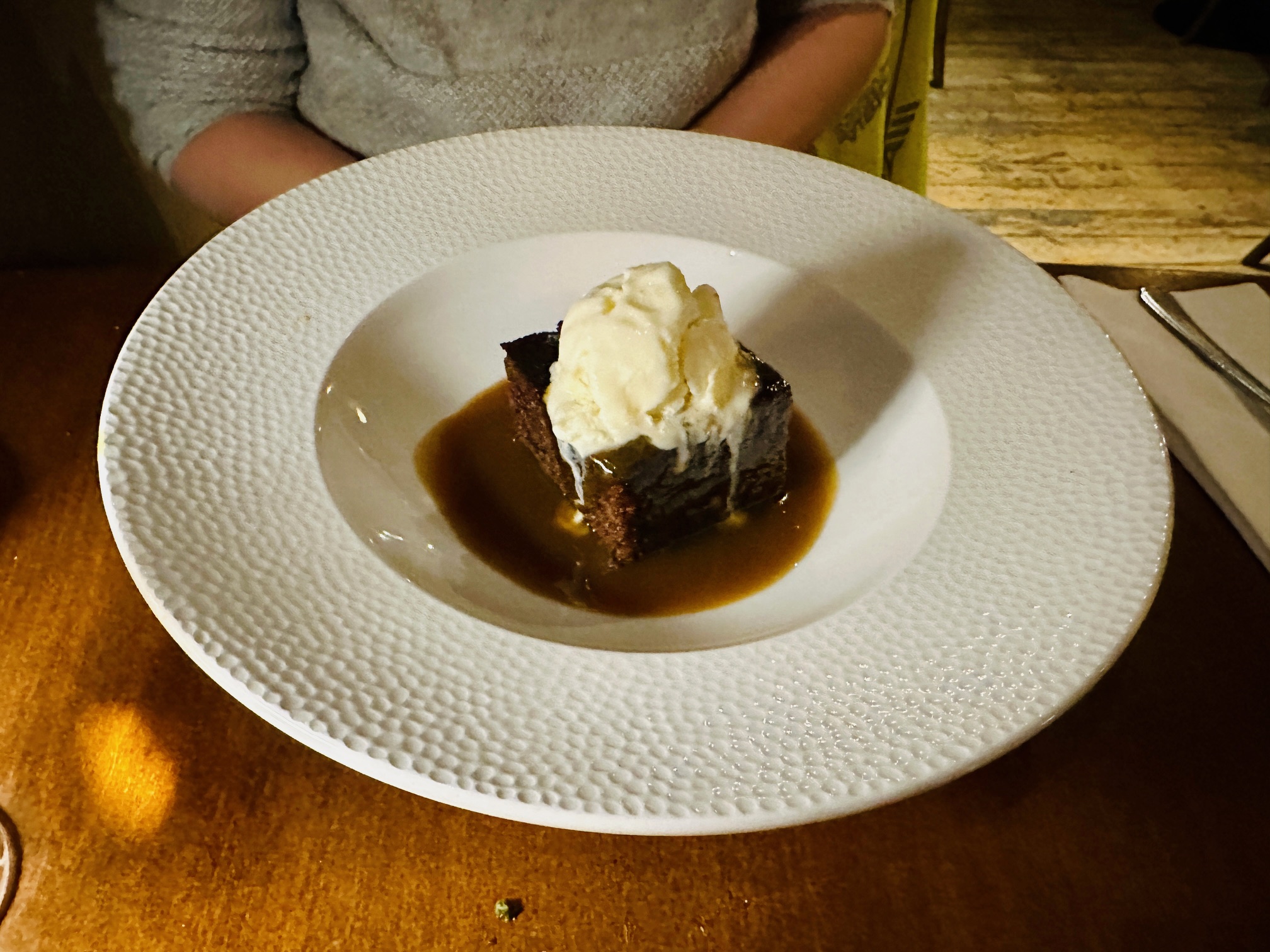
Liz’s head had been turned by the sticky toffee pudding and, again, it was really very nicely done. Reminiscent of the likes of London Street Brasserie, who have been flogging sticky toffee puddings for longer than I’ve been writing about them, it had great texture – how on earth do you describe that now everybody has cancelled the word “moist”? – and a moat of deep, rich sauce. The vanilla ice cream was already giving up the fight, which was inevitable, and I personally would have preferred clotted cream, but that’s my gluttony more than anything. Liz loved it, and my only regret was that after that she didn’t have space to raid those madeleines.

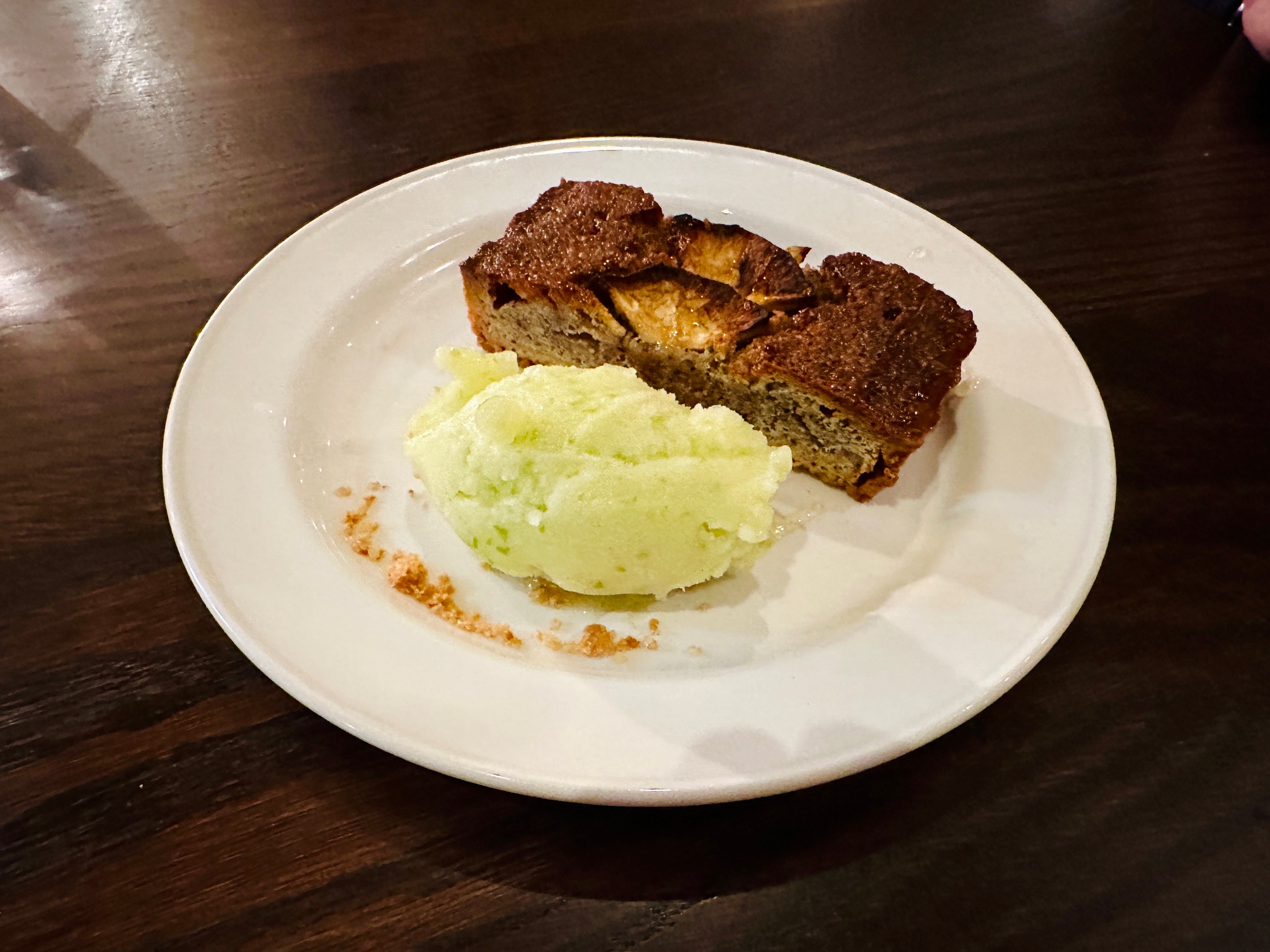
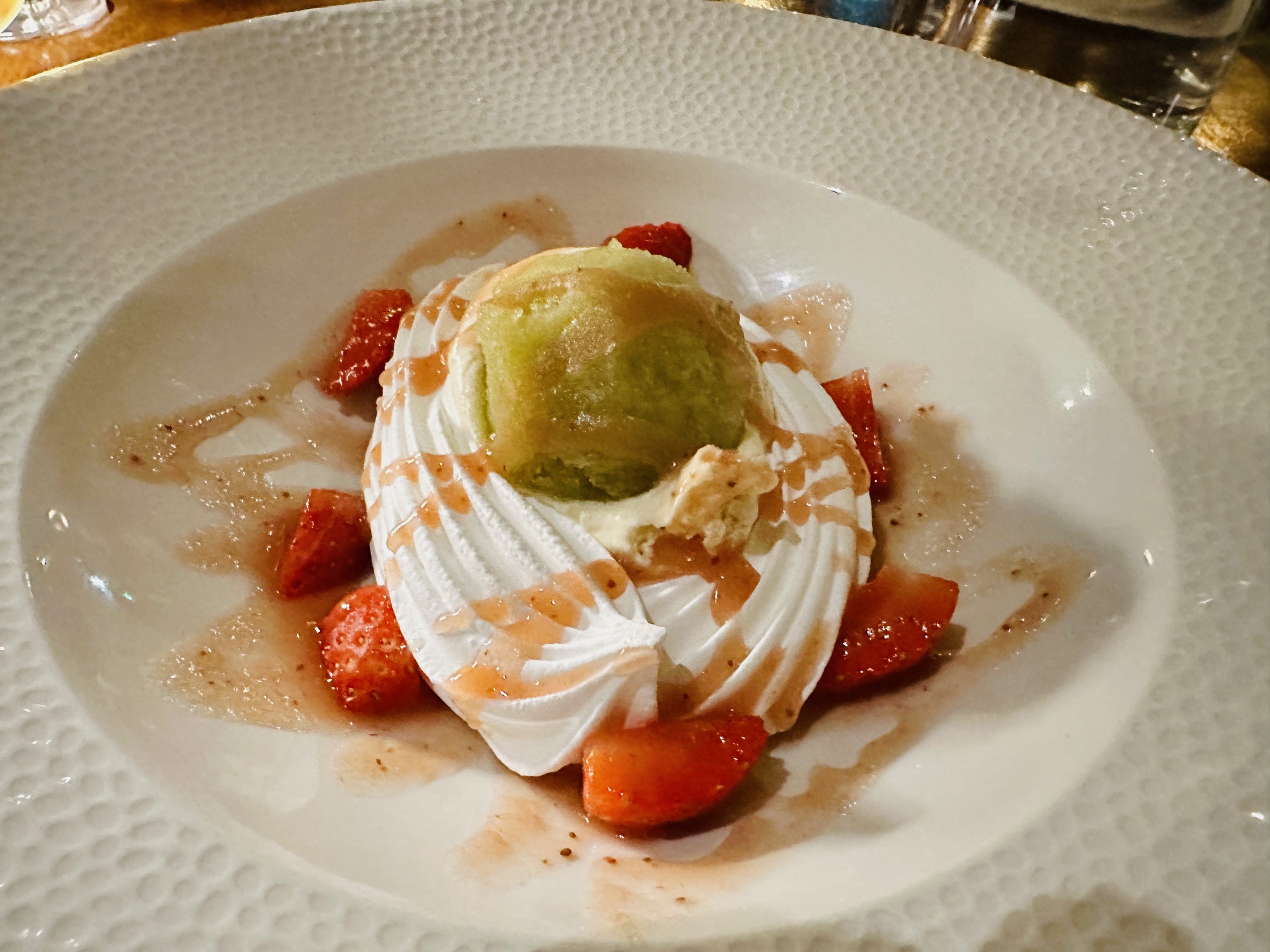
I tried the pavlova. I have a real soft spot for a pavlova – it always says that a restaurant can be arsed in a way that Eton mess never does – and the Cellar’s was a blissful piece of work. An elegant oval of chewy meringue, housing a core of cream and vanilla, ringed with macerated strawberries and syrup. A little reminder of the summer we never had, a gastronomic time capsule of a time that didn’t quite exist. And right at its centre, that verdant sphere of basil sorbet, which was truly extraordinary.

I give out awards every year for Dessert Of The Year, so thank god I went to The Cellar this week or I might have been writing a post next month saying “or you can just pick up a bar of Cadbury’s Top Deck from the corner shop”. I let Liz try a spoonful, and she had dessert envy. I’m so used to being the one that suffers from that that I didn’t even remember to gloat.

By this time everyone else had left, and we were still nattering until it got to about ten o’clock, over three hours after we started, and we both felt guilty about keeping the staff from their homes. All the people who served us were brilliant, and when one of them came over with the card reader I asked her how long they’d been going for.

“It’s just over a month” she said, “but of course we were Valpy Street before that.”

I asked how similar the Cellar was to Valpy Street, and she told me that most of the staff were the same and, crucially, the team in the kitchen was unchanged. She was very good at not saying much more than that, but I sensed again the involvement of the First Accountant Of The Apocalypse.

“How’s business going?” I said, aware that a Tuesday night in November mightn’t be the best yardstick of that.

“It’s okay, we’re getting there. But we were closed for about five weeks, and you worry that people forget about you.”

Our bill for two people – three courses apiece and five glasses of wine in total – came to just over one hundred and thirty-five pounds, including tip. And personally, for a very enjoyable evening in a lovely room with great company and some genuinely interesting dishes, I thought that was more than okay. Because when a restaurant gets a lot of things right, it wins you over. You still remember the other stuff – the glasses on the piss at the edge of the table, the waiter vacantly ignoring me at the start, the plaster I had to put on my elbow at the end of the night – but you don’t care.

The Cellar lived up to the promise of its name, an attractive, intimate, convivial space, tucked away from the bustle of Blagrave Street, of the buses, the commuters and the revellers. And I found myself really rather fond of it. We made our way out into the night, the air now sharp and wintry. Liz liberated her Brompton and headed back to West Reading, and I made my way to Market Place to play my favourite game, Bus Home Roulette: would it be the 5, the 6 or the 21? Did I feel lucky?

I realise, now I’ve got to the end, that I didn’t answer my own question. When does a restaurant become a new restaurant? I can’t help you, in this case: I have a feeling it might take someone who knew Valpy Street a lot better than I did to tell you that. But I can tell you this, instead: the staff might be the same, the owner might be the same, the chef might be the same. For all I know the menu might be the same, and those sticky tables too. But my respect for the place? Now that’s another matter. That definitely is new.

The Cellar – 7.7
17-19 Valpy Street, Reading, RG1 1AR
0118 3049011

https://www.thecellarreading.co.uk

Restaurant review: Pick Up Point, Swindon

Pick Up Point closed in July 2024. I’ve left the review up for posterity.

At the end of last summer, in a move which surprised me as much as anybody, I got on a train and went to boldly review where no blog had been before. Swindon, to be precise. I voyaged to Swindon’s Old Town and found a brilliant enclave of great coffee, craft beer, ice cream along with a Victorian park that made the Forbury look a tad lacking. And I also found, returning to Old Town institution Los Gatos, a superb tapas restaurant of exactly the kind Reading has always lacked. I loved the whole experience, and I promised myself I’d be back before too long.

It took me four months, but last weekend I found myself in Swindon again, alighting at its unloveable station and walking round the corner to grab a bus into Old Town, one bound for the splendidly named Middle Wichel. It wasn’t exactly the same personnel as last time – I was seeing my old friend Dave, but our mutual friend Al couldn’t join us. And it wasn’t the same itinerary, either: the last time I was in Swindon summer was rallying one final time and you could eat ice cream opposite Ray’s, have an al fresco coffee in the Town Gardens. On this visit, we had to forego those pleasures, but even the regret of having to do so reminded me how fetching Old Town is when the weather is fine.

Never mind. Many of the fundamentals were unchanged. I met Dave at the brilliant Pour Bois for a latte, and then we beetled off to the Hop Kettle tap room for the first of many gorgeous beers. Firmly ensconced, we proceeded to do what we’ve been doing on a regular basis for over thirty years, shooting the breeze about all sorts. I handed him his belated fiftieth birthday present and heard about his celebratory trip to Cologne, we talked about the rapidly solidifying plans for my wedding this year, and then we just got on to talking about everything and nothing: his family, my family, his work, my work, the future and the good old days.

It was all perfectly in harmony: no conversational heavy lifting to be done, and no awkward silences, just the latest instalment in a long, meandering conversation which has lasted all of my adult life. We both know where the bodies are buried, when to talk and when to listen, when to be serious and when to take the piss. It was lovely: when you have a friend that old, and that good, you can do that stuff anywhere. You could catch up in a Wetherspoons and still have a thoroughly agreeable time. But it struck me, as the hours flew by on that winter afternoon, that I would have struggled to think of a better venue for it than Old Town.

The other thing that was different about this visit to Swindon was that, much as I love Los Gatos, I had somewhere else in my sights for dinner. I’d been tipped off about Pick Up Point, a burger joint literally next door to Hop Kettle which is only open in the evenings. Chef Josh West started out cooking burgers at the tap room four years ago, but opened his own restaurant in late 2021. I couldn’t find out much about it online – Swindon might have even less local media than we do – but their well-curated Instagram made everything look terrific. The clincher though was that my Swindon man in the know, Donovan Rosema of excellent local roaster Light Bulb Coffee, rated the place. That was good enough for me.

It’s a very assured, very polished space. “This is more London than Swindon” was Dave’s verdict as we looked around, and I think that was a fair summary. With dark walls dressed with interesting art, an attractive zinc-topped bar, conspiratorial lighting, low tables and booths, it was more Brooklyn than Bassett. I think there was a second dining room out back, although I didn’t get a look at it. Having said all that, my one reservation about it was that the bit of the restaurant where they seated us had higher tables and – a bit of a bugbear of mine, this – backless stools. It felt a little like an afterthought compared to the lower tables elsewhere, and I did look enviously at the better stools up at the bar.

You might think this doesn’t really matter for casual dining, or that the dining room wasn’t designed for two men on either side of their fiftieth birthday, and you might have a point.

Pick Up Point knows how to put a menu together. I realised in the run up to this visit that the last time I reviewed a burger restaurant was Bristol’s Asado, just over a year ago, and since then I think I’ve only had burgers in Honest. And I like Honest, but their choice of burgers always feels limited, especially if you don’t fancy whatever special they have on. By contrast, Pick Up Point has half a dozen beefburgers, one chicken burger and one vegetarian or vegan option, along with a couple of specials. And they all have something a little different about them – one with pancetta and blue cheese, another with kimchi and gochujang. Even the names – “Cease & Desist”, “Heisenberger” – steered clear of the dreary ladz puns you sometimes get in this kind of establishment.

Burgers are between twelve and fourteen pounds, not including fries, so slightly more expensive than the likes of Honest. But the menu achieved what you always want a menu to manage: it intrigued me. And the sides on offer did too – not just fries, wings and slaw, although even those had interesting variations and additions. The wings were Korean, the slaw came with sweet chilli and coriander. I had looked at a menu online which suggested they did confit potatoes as well as fries, and I was very excited about trying that, but on the day something else was in its place. So we ordered that instead, along with another side and a couple of burgers.

Service was outstanding throughout, if endearingly amused that these two duffers had chanced upon their restaurant. Of course everybody was impossibly younger and cooler than me, but we’re reaching the stage where I could walk into most restaurants in Britain and that might be the case, so I’m trying not to lose too much sleep over it. I couldn’t persuade Dave to go crazy and have a rum punch (and the next morning I was very thankful that he talked me out of it) so I had a half of Kellerbier from Bristol’s Moor Beer and Dave, more sensible than me, went for a ginger beer.

Our food came out about twenty-five minutes after we sat down, which I thought was nicely paced. I had chosen the “Hand Of God”, which came with chimichurri and smoked paprika mayo, and I thought it was absolutely exceptional. The burger was tender, well seasoned and had a marvellous char to it, the chimichurri and the smoked paprika complemented it beautifully. It was so good, in fact, that it’s surprisingly difficult to write about: happiness, as they say, writes white. And I’m worried that some of the things I loved about it are going to sound like faint praise, but maybe you’ll read them and agree with me so here goes.

I loved the fact that it wasn’t messy, that nothing fell out, that I didn’t feel like I was playing food Jenga every time I took a bite, or pushing what was left out of the comforting embrace of the bun. I loved the fact that I could pick it up and eat it with my hands, the way you used to be able to do with all burgers before they became bloated parodies of themselves. Less is more, it turns out, and I was delighted to pay a little bit more for something that not only tasted fantastic but was a pleasure to eat. I think that’s what edgier restaurant reviewers mean when they say – prepare to cringe – that a dish “eats well”. It doesn’t eat well, you do. But I do appreciate the underlying sentiment.

Dave had gone for one of the specials, a Guinness rarebit burger. This was heftier – a half pounder smothered in the rarebit, resting on a huge slab of onion. This looked a bit more challenging to eat, or would have been for me anyway, but Dave ploughed through undeterred. He’d told me earlier that day that his latest blood test had suggested he needed to work on bringing his cholesterol down again, but happily he was taking a day off from that. “The way they’ve got the Guinness flavour into this is really clever” was his verdict. Dave is not the ideal person to review restaurants with because 9 times out of 10 we’ll order the same dish, which you can’t really do when you’re writing a place up. This was the 1 time out of 10 when we didn’t, and I was a smidge envious.

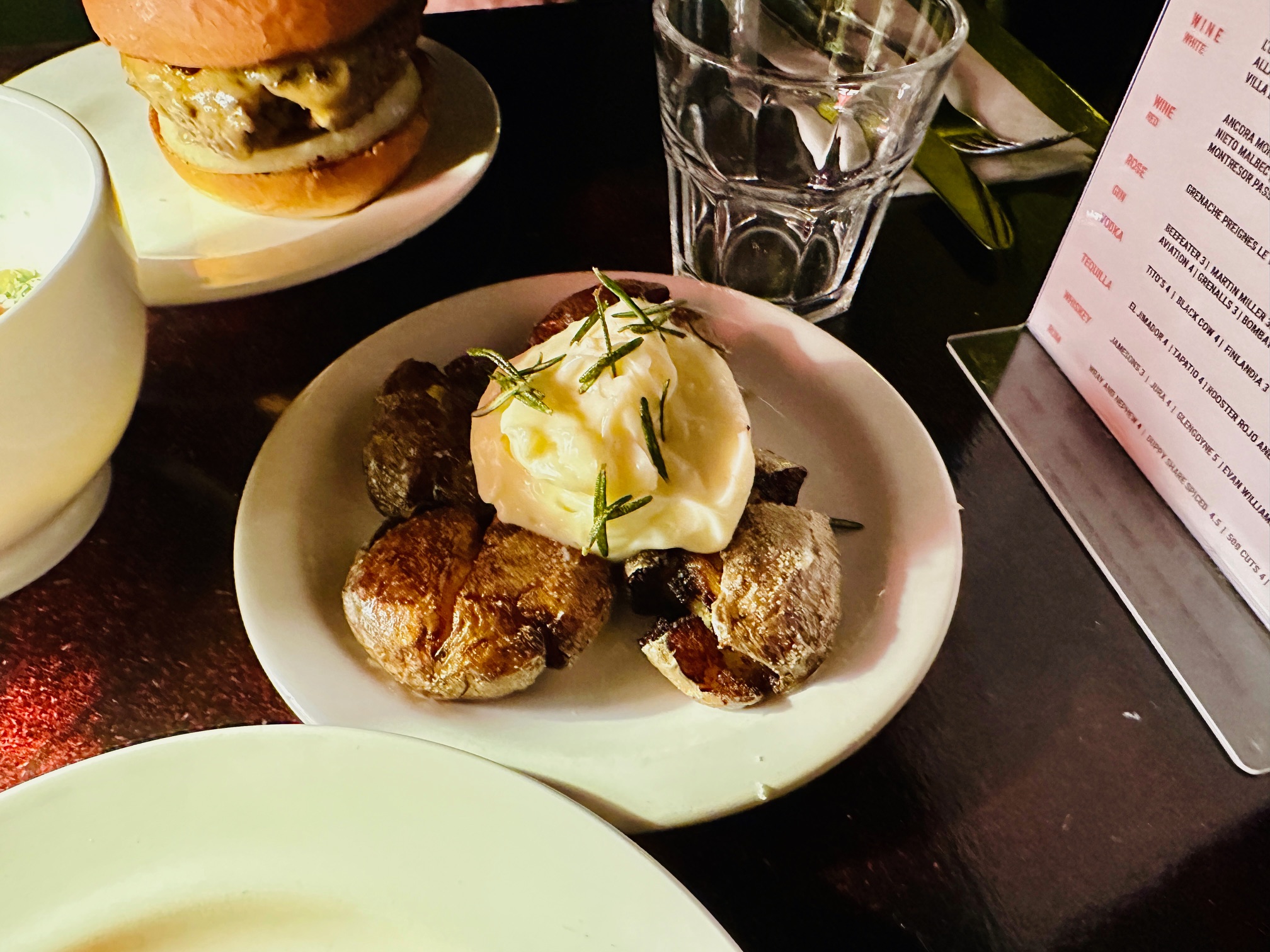
The two sides were glorious. First of all, in place of those confit potatoes they served smashed potatoes with aioli. Looking at the picture below, aioli with smashed potatoes might be a more accurate description, but it was another fabulous dish, the spuds with plenty of texture, the golden aioli with a pronounced honk of garlic and a little rosemary strewn for good measure. I think with hindsight, two side dishes might not have been enough. One of these certainly wasn’t.

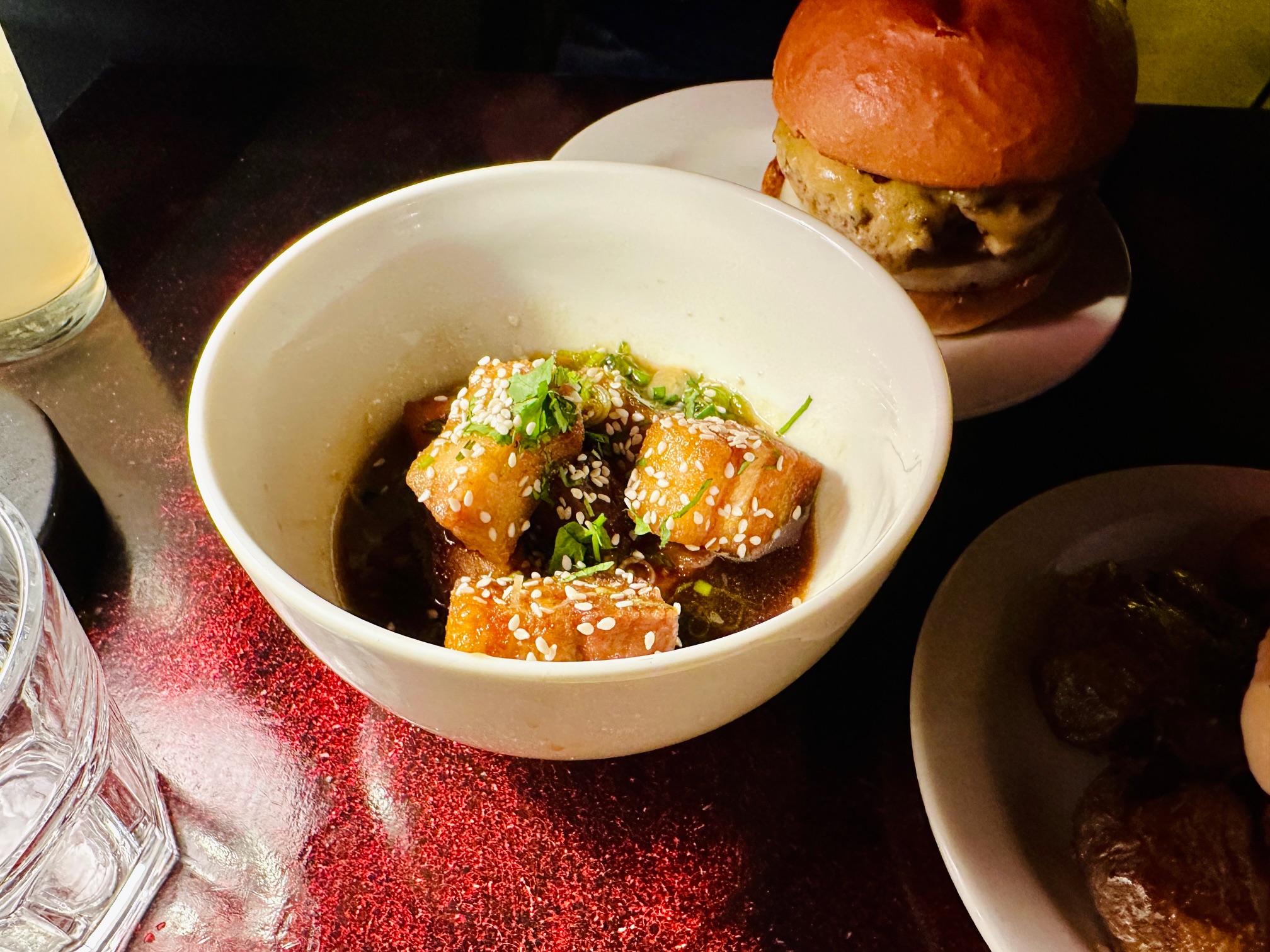
Even better were the crispy pork belly bites. They were crispy where you wanted them to be and yielding where you didn’t, they came carpeted with sesame and coriander, sitting in a pool of soy and ginger and they were pretty much a perfect example of this kind of thing. I read an interview with the guy behind the Pick Up Point just as they opened where he said he was a tinkerer. “I’m always experimenting, the menu is likely to change hourly” he said. I doubt he still does that (who has the time?) but even if he does he should keep his mitts off this dish: it should stay on the menu in perpetuity.

There was only one item on the dessert menu, a chocolate mousse with whipped cream. I was enormously tempted by it, as I always am when it comes to chocolate mousse. But I abandoned any plans of eating it when I realised that Dave, like me, was wondering what the Korean chicken burger (the “Seoul Survivor”) tasted like and was prepared to split one with me. So we flagged down our server and asked – if she didn’t mind, and if it wasn’t too weird – if we could order one to share. She smiled indulgently at us.

“Of course, that’s no problem. I’ll get them to cut it in half for you too.”

As she walked away I looked at Dave and I knew he was thinking what I was thinking.

“She thinks…”

“…that we’re a couple? Yep. Happens every time.”

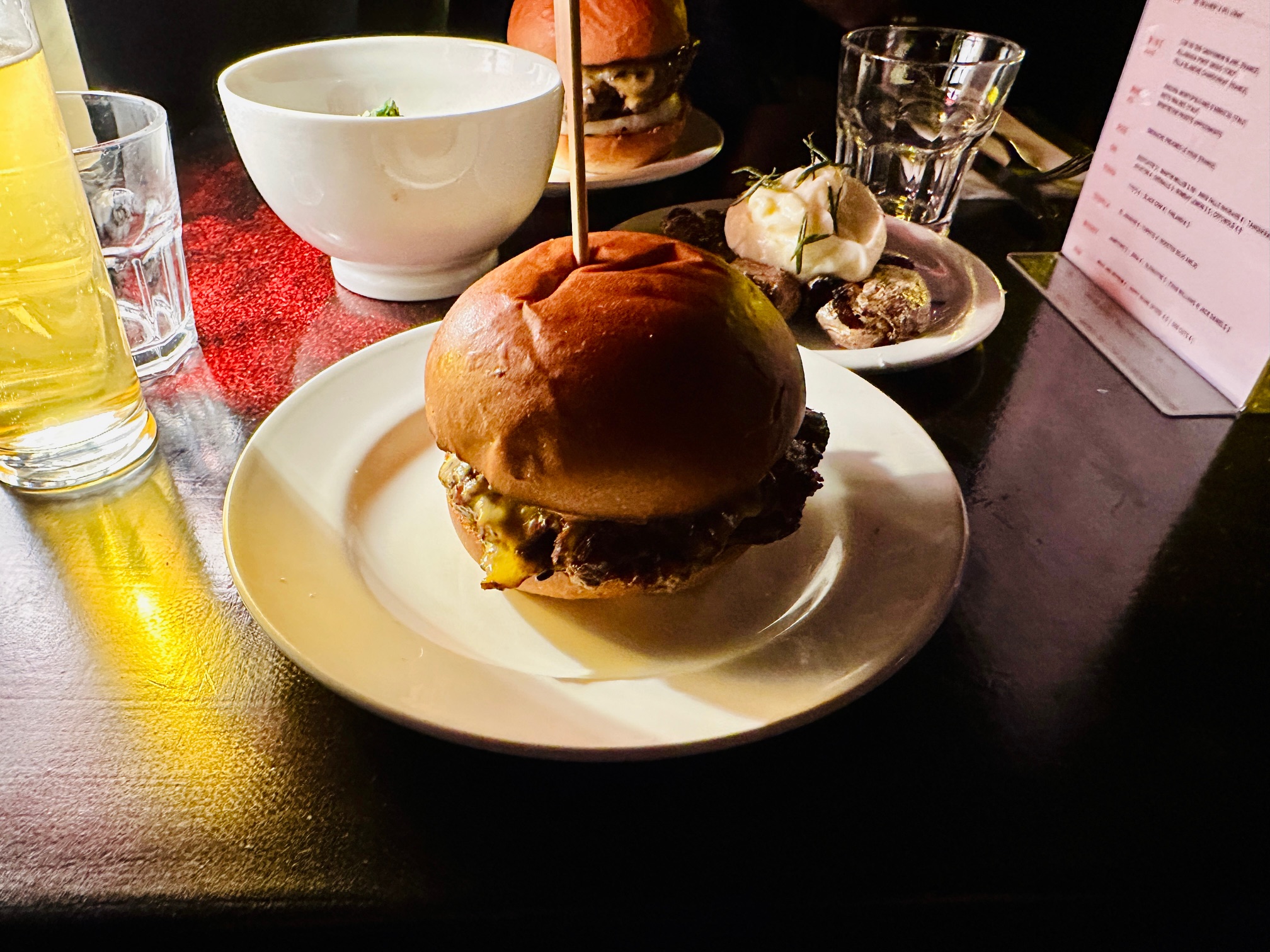
My picture of the Korean chicken burger is even worse than most of my burger photographs because it shows you nothing. You don’t get to see the magnificent crunchy, craggy coating or the chicken, breast not thigh in this case, underneath. You don’t get to see the kimchi properly, or the gochujang. Really, it’s just evidence that we ordered it and that, ever so nicely for the two weird middle aged men who seemed a little high on life, the kitchen did indeed neatly bisect it for us. But I promise you it did have all those things – crunch and give, fire and tang – and I thought it was really beautiful.

I did think about having the mousse after that, but I decided against it. I couldn’t persuade Dave, and I knew that I would have more joy talking him into a couple more beers at the Tuppenny next door. His loved ones were in London watching Depeche Mode at the O2, and as it happens my loved one was too, and I reckoned we had another couple of hours of catching up ahead of us, even if it would pass in the blink of an eye. Our dinner came to sixty pounds, not including tip, but bear in mind we ordered three burgers that came to about two thirds of that.

I often publish reviews of places outside Reading with a little trepidation. I know some people feel like they’re hoodwinked into reading them, or don’t really care about restaurants without an RG postcode or an 0118 phone number. And I end up trying to convince you of the relevance by bringing it all back home at the end. And I will do that, in a second, but really – Pick Up Point is worth going to Swindon for. Get the train on a Saturday, have a few beers beforehand and make the time to eat here. It’s a cracking thing to do – with friends, with loved ones, even on your own. I genuinely think you wouldn’t regret it.

But there’s another reason to recommend it, which is that I think Honest so dominates the burger landscape in Reading that we don’t get anywhere, really, like Pick Up Point. 7Bone is a greasier, sloppier, more American affair, but it’s moved to Phantom now, further out of town. Gordon Ramsey Street Burger is much more well behaved than the man itself, and better than I expected it to be, but it’s not exciting, nor is it independent. Some places, like the Lyndhurst, don’t specialise in burgers but happen to do some very good ones.

But Pick Up Point is genuinely a place the likes of which we don’t have in Reading, and the last time I had a burger in Reading that matched what Pick Up Point can do it was from the sadly departed Meat Juice, at Blue Collar. I would have hopped on a train to Swindon to try Meat Juice’s burgers again, I’ll gladly repeat the journey to go back to Pick Up Point. That I happen to have one of my oldest friends a few miles down the road is just the icing on the cake.

Pick Up Point – 8.0
52 Devizes Road, Swindon, SN1 4BG

https://thepickuppoint.com

Restaurant review: A.B.O.E., Bristol

A.B.O.E. closed in August 2024. I’ve left the review up for posterity.

Last Friday I found myself in Bristol enjoying a badly-needed long weekend away. Our train pulled into Temple Meads, half an hour late, and Zoë and I wheeled our suitcases into the centre, three days of eating, drinking and excellent company ahead of us. But before we checked into our hotel, before we did almost anything, I had lunch on my mind and only one candidate to provide it. We made a pilgrimage to the Apple Cider Barge and there, next door, in its distinctive black and red was Gurtrina, the van belonging to fried chicken supremos and Reading legends Gurt Wings. How could I kick off my minibreak anywhere else?

By my reckoning it’s over six months since Gurt Wings stopped coming to Blue Collar – something to do with the council being difficult, if I remember rightly – and the reunion with their magnificent food was all the sweeter for all that deprivation and delayed gratification. In my time away the buffalo sauce had become just a little more piquant, the blue cheese saltier and tangier. The sun came out, the bench we were perched on positively glowed and we polished off our food in wordless joy. Truly, it would have been worth a trip to Bristol just for that.

Afterwards James Mitchell – the man behind Gurt, also known to his many fans as Uncle Gurty – came over and the three of us caught up and shot the breeze. I told him where we were planning to eat in the city, he mentioned a few places he’d heard were good and then he did something I wasn’t expecting. He went out of his way to tell me somewhere especially good I should check out.

“You need to get yourself to Oboe” he said.

“What, like the musical instrument?”

“No, A.B.O.E. It stands for ‘A Bit Of Everything’. The chef is a guy called Seb Merry who was on Masterchef, and he’s so passionate about his food. The whole team are brilliant. They do the best Bloody Mary I’ve had – it’s not on the menu, but if you ask they’ll make it for you. And they have this fried chicken dish – well, it’s not like our fried chicken but it’s amazing, it’s more like a croquette but you’d have to try it. And they do this incredible dessert, have a look at this.”

He fired up his phone and showed me a picture of a dessert which was all chocolate and caramel, thick slabs of each. I’ve rarely seen a photograph I wanted to eat more.

After our chat we went on our way and stopped in the Small Bar for the first beer of the holiday but that glowing endorsement weighed on my mind. If the man who does the best fried chicken you’ve ever tasted tells you that a restaurant does amazing fried chicken, and more besides… could I really let a trip to Bristol pass without investigating? But anyway, there’s no way they would have a table free the following night, I thought. But then I checked, and they had. So I texted my friends James and Liz, sent them the website. 

I know the four of us are booked somewhere else tomorrow night, but Mr Gurt Wings says this place is incredible. What do you reckon, stick or twist?

James, a keen fan of Bristol’s restaurant scene, responded almost immediately. Let’s take a risk and twist, he said, and that was that. Bookings were made and cancelled, and the next night Zoë and I clambered off the bus halfway up the Whiteladies Road, ready to take our chances.

The interior was tasteful, all muted green paint, wall art and pillars. There was a mezzanine floor, although there didn’t seem to be anyone seated there on a Saturday night, and the whole place had a pleasing buzz. It sort of looked as if it could have been part of the Loungers Group in a previous life (I checked: it wasn’t) but none the less it was a pleasant dining room with tables companionably close without being crammed in.

It was also almost completely full and our server whisked us to a table right at the back, far too big for our party of four. He explained that a table for four near the front had slightly outstayed their welcome, and although they’d paid the bill they hadn’t yet left the premises. He told us, quite charmingly I thought, that he didn’t feel like acting the heavy with them given how much they had spent.

Then he asked if Zoë and I wanted a cocktail on the house while we waited. So Zoë had a negroni, made with rosemary vermouth, which she raved about and I asked for that off-menu Bloody Mary. I knew it would be good when the server didn’t ask me how spicy I wanted it: they just did their job and made it, and it was magnificent.

All in all, we were waiting ten minutes with our cocktails, hardly anything to complain about. By then James and Liz had arrived, more drinks had been ordered and we had taken our table nearer to the front of the restaurant, with a good view of other tables, dishes wafting past and the staff – just the two of them, that I could see – working non-stop.

The menu is the kind that makes jaded restaurant bloggers roll their eyes – no starters, no main courses, just snacks and small plates. The menu suggests two snacks and four small plates between two, which I suppose gives you an idea of whether they’re starters or mains. Now, I can be as critical of small plates venues as the next person and I’ve always found it counterintuitive that restaurants tell you to share small plates. I also thought that A.B.O.E.’s pricing was a little out of keeping with the small plates concept – snacks mostly cost just over five pounds, but the small plates ranged from fourteen to twenty-two pounds and that for me, at the risk of doing an accidental Partridge, is the kind of price I expect to pay for a big plate.

But anyway – perhaps it was the charm of the welcome, or the edge-softening effect of that Bloody Mary, but I found I was prepared to suspend my disbelief. So we bartered about the snacks we wanted to ourselves and the small plates we were reluctantly prepared to share, I popped it all down on a note on my phone and when our server came back we ordered with military precision.

“I just need to tell you,” he said, “that the steak tartare is a small portion, so it isn’t really suitable for sharing”.

“That’s okay, that’s for me” said James, in a manner that suggested he had never really considered sharing it with anyone.

That does James a huge disservice because when it arrived, although it was indeed too petite to share, he insisted that I try a forkful of the tartare. It was made with dry-aged bavette, and I have to say it was pretty impressive with plenty of savoury depth. Not the very best tartare I’ve ever had – that honour still goes to Paris’ superlative Double Dragon – but pretty close. Certainly it compared well with a similar dish across town at Marmo, although I wasn’t a hundred per cent sure about the stuff, allegedly taleggio, on top.

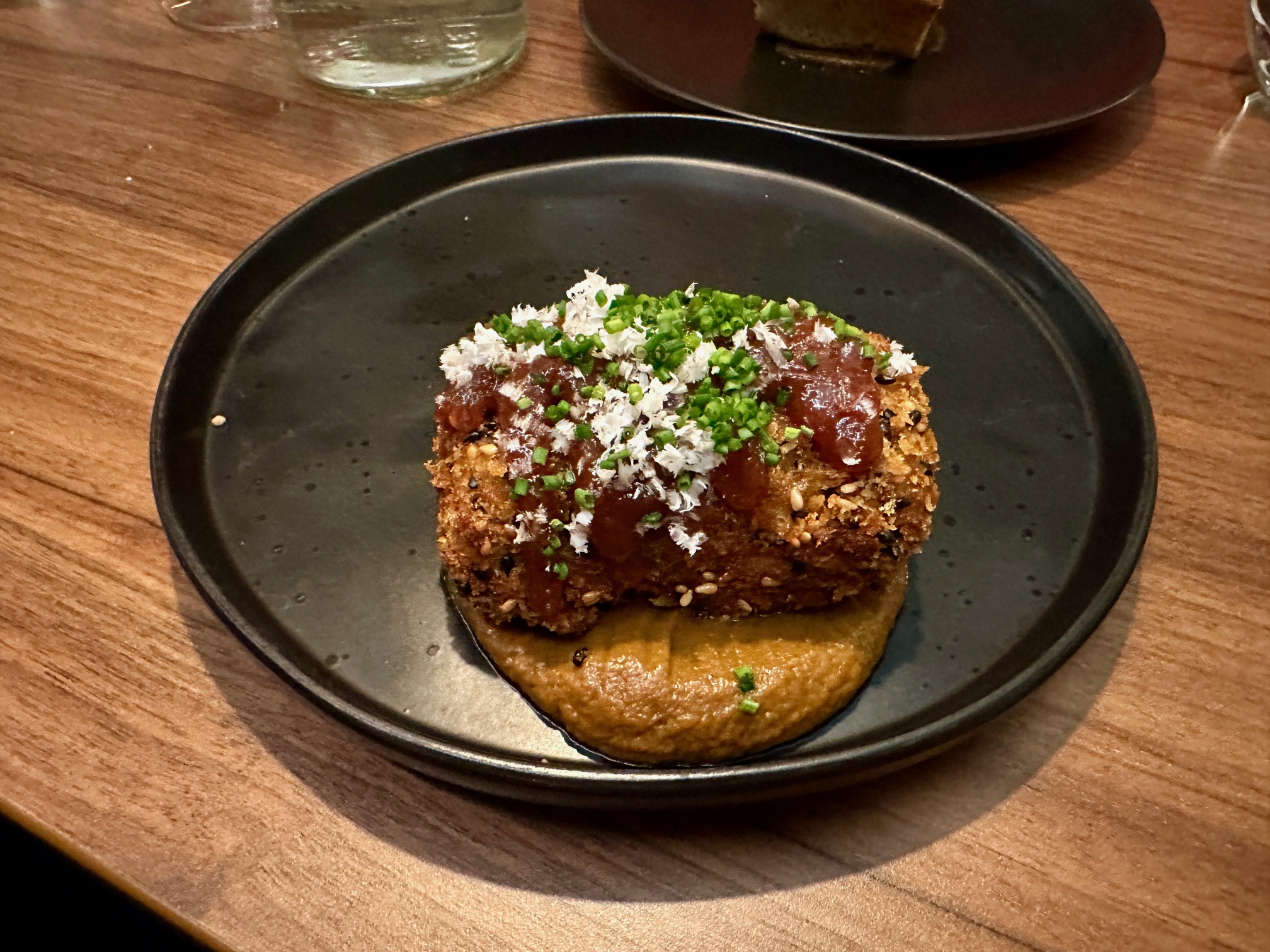
Zoë and Liz both went for the pumpkin croquette: A Bit Of Everything definitely applies geographically if in no other way, with this dish having hints of Japanese korroke. But unlike the croquettes at, say, Caper And Cure where you get four little spheres, A.B.O.E. goes for broke with a single enormo-croquette loaded with cheese and horseradish. Again, I was allowed a forkful and again it induced a reasonable amount of envy. Zoë in particular raved about this dish. I probably would have liked more, smaller croquettes to capitalise on the surface area but I couldn’t deny that the flavour of the thing was outstanding.

To continue the globetrotting, my snack was A.B.O.E.’s take on poutine. Rather than fries, it was cuboids of confit potato, à la Quality Chop House, buried in Parmesan with a jug of thick, intense, almost-sweet jus to trickle over the whole affair. Enormously enjoyable stuff: I imagine dreary types might complain that this wasn’t poutine, but it was a darned sight nicer than most poutine I’ve had. Besides, I knew exactly what it would be like because I’d checked out the restaurant’s Instagram in advance (it’s called research, you know).

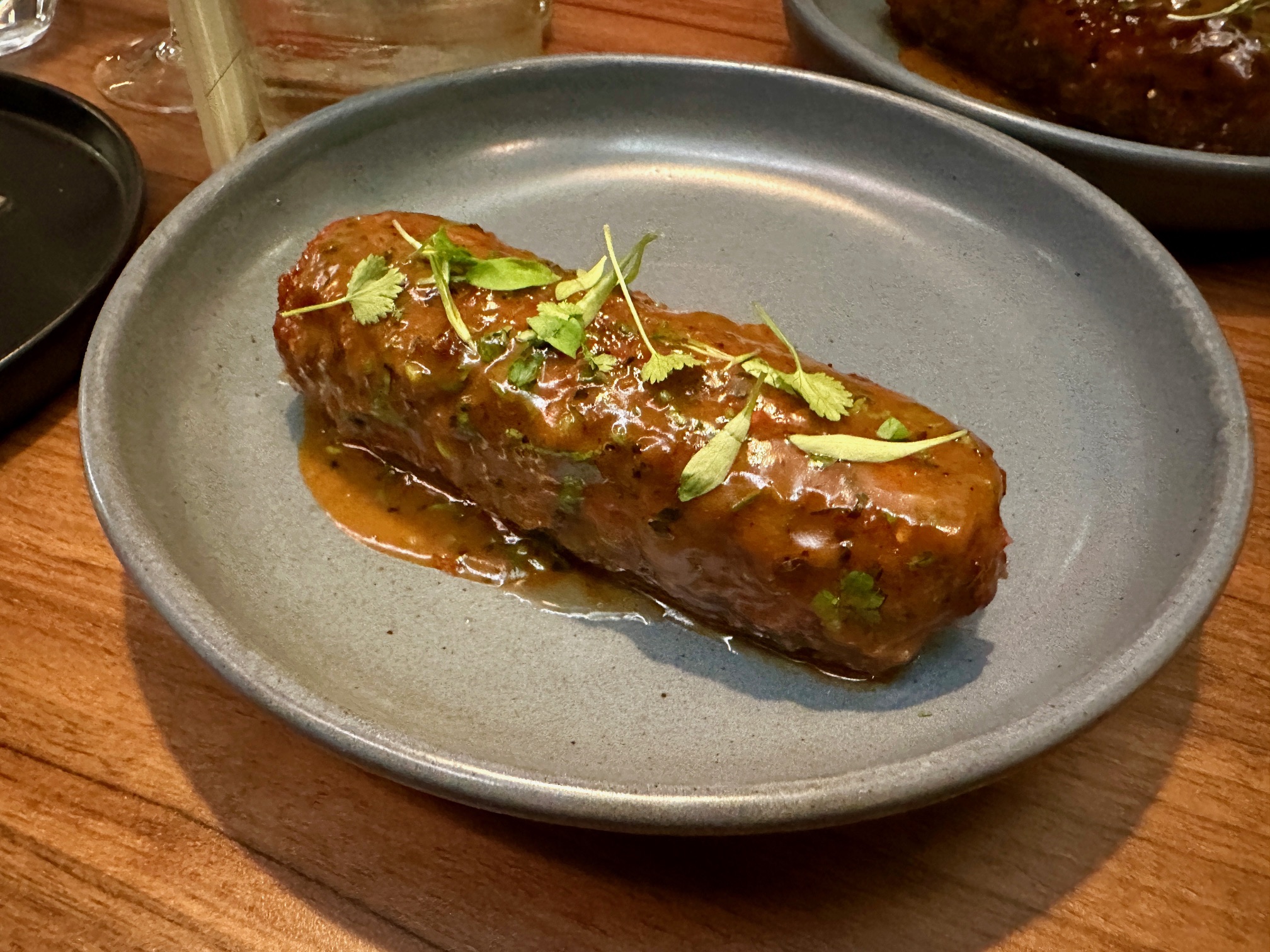
The first of the small plates to come out was that fried chicken dish so beloved by the man behind Gurt Wings – high praise indeed, from an expert in the field. Well, he was right to say that A.B.O.E.’s rendition was nothing like his. It was surprisingly hard to describe, but it’s important to try because otherwise all you have to go on is the photo below, which looks on the scatological side. It was somewhere between a boudin and a ballotine, a cylinder of tightly compressed chicken thigh bound in a crispy coating, the whole thing smothered in a sticky curried sauce.

Did it work? Well, yes, we all thought it did. As with the pumpkin croquette, I personally would rather have had more, smaller pieces to maximise the surface area. The coating didn’t have as much crunch as I’d have liked, and came away under a knife rather than adhering to the chicken beneath. But you couldn’t argue with the flavours, or the note of citrus that danced through it. Uncle Gurty had not steered me wrong – and no, it didn’t look like fried chicken, much in the way that the poutine didn’t look like poutine. That was sort of the whole point.

I’d had my eye on the barbecued squid with galangal, but it became a must-order when our server, the charming Italian chap who had sorted out our welcome cocktails, told me they’d run out of the clams it was meant to come with. Their solution, he told me, was just to give you more squid. That was good enough for me, and the dish was tender and fragrant with a nicely building heat. Another of those dishes you slightly resented sharing, which in hindsight is a decent description of literally everything we ate.

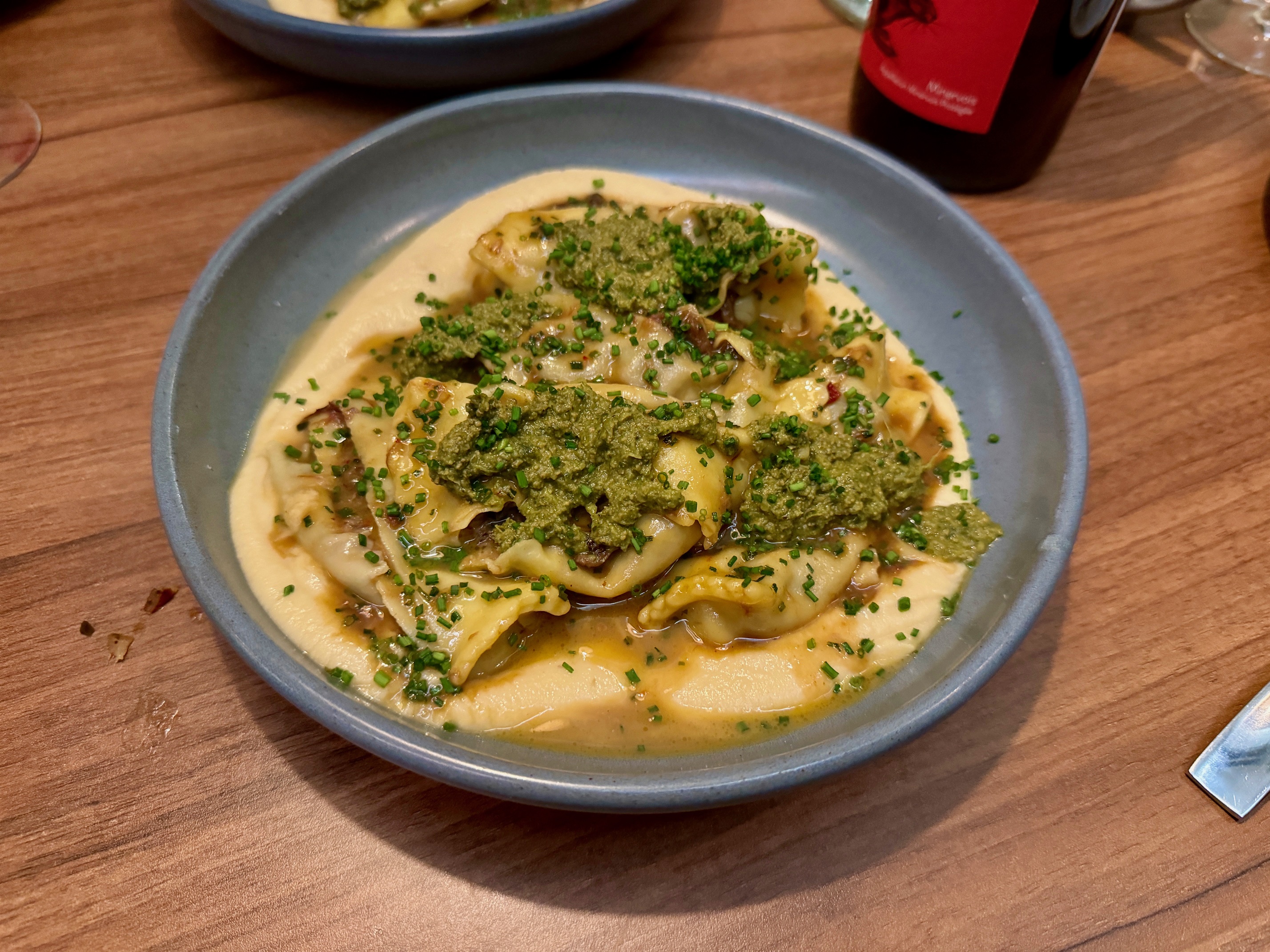
The most expensive dish on the menu – so naturally we ordered two of these – was the short rib beef agnolotti. Nearly twenty-two pounds a portion, and for me a fascinating misfire. My companions all loved it so I was the lone dissenter, but for me the agnolotti themselves were overcooked, which made the whole dish a bit limp and mulchy.

Everything on the plate was good: the celeriac, apparently with aged beef fat, the glorious beef in the filling and a powerful mole verde, although we didn’t get the advertised goats cheese. As with everything else we tried, the flavour was unimpeachable but for me, the texture let this one down. But I may well have been wrong: certainly everybody else thought so.

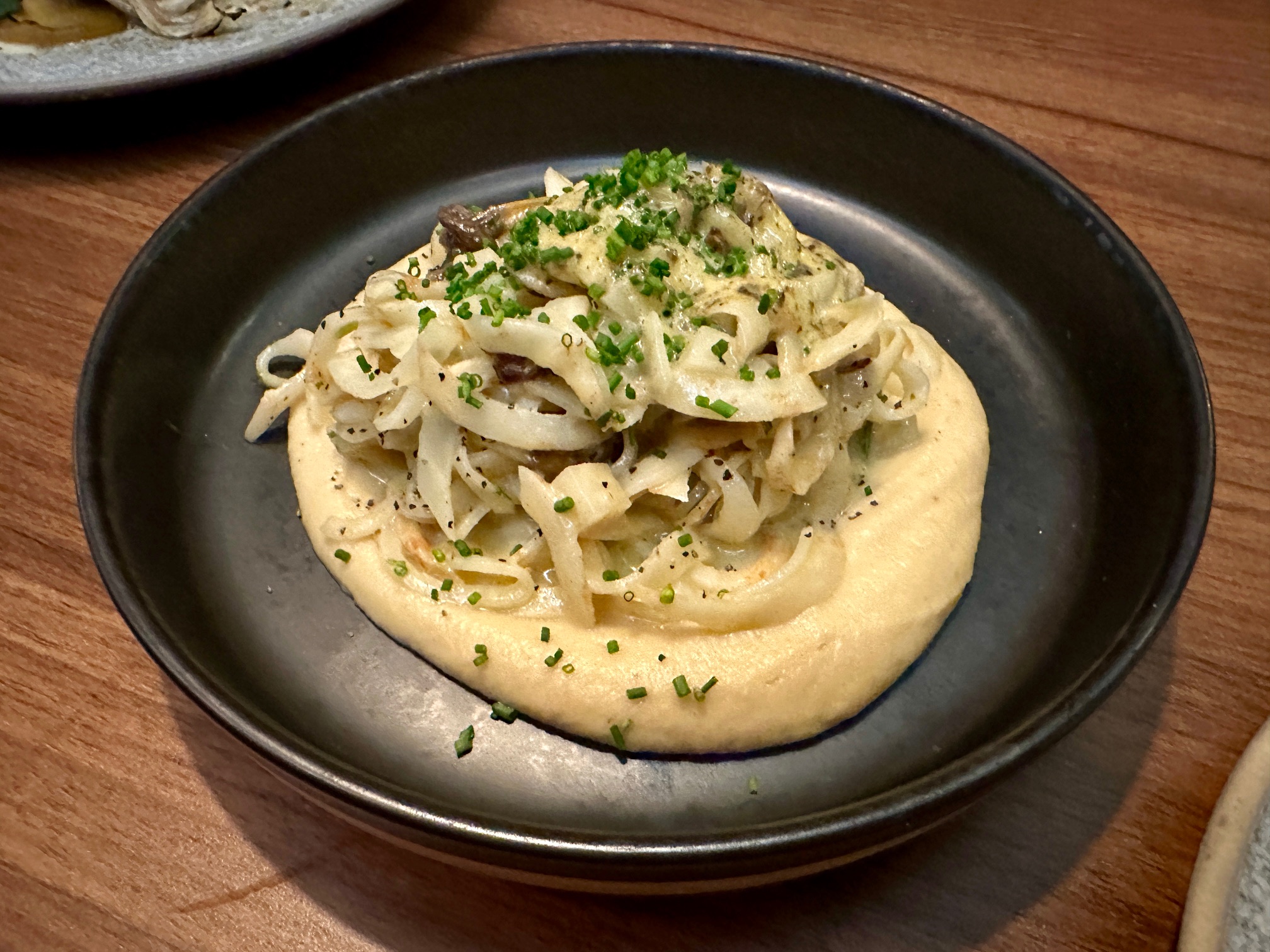
Red mullet is James’ favourite fish on earth so he had to order a portion of that, and I got enough of a taste to appreciate that it was, like everything else, very skilfully done. I’m a sucker for braised lettuce, a relatively conventional pairing, but putting mustard – a delicious mustard, at that – in the mix was the sort of clever and unexpected touch Merry seems to specialise in.

The last of our small plates was an outrageously delicious one: barbecued cod with leeks wrapped in nori and two sauces – one of which, studded with ultra-salty nuggets of chicken skin, was one of the most compelling things I’ve eaten in some time. Again, this was at the north end of the price list and I can see you could argue it wasn’t an enormous amount of food for twenty pounds. But it was exceptional, one of the best-cooked pieces of fish I can remember served alongside a sauce with a proper, clobbering heft. James and Liz left a bit of theirs, and I waited as long as I could bear it before saying “would you mind if I finish that?”

Although service was brilliant, there were only two people working front of house (and, just as gobsmacking, I understand there were only two people in the kitchen). If there had been more, or they’d been less busy, we might have got to a second bottle of wine but instead we took our time with the one we had, a beautiful Minervois which sort of went with some of the dishes. It’s a small wine list, six white and six red, about half of them available by the glass.

Our server asked what we made of the food and checked what we’d ordered. He said it was a shame we hadn’t gone for the celeriac cacio e pepe and we said that it hadn’t quite made the cut. So he decided to send a plate of it out to us anyway, which was very kind and completely unexpected. It really was a beautiful dish – ribbons of just-cooked celeriac taking the place of pasta, more sweet and comforting cubes of celeriac and little mushrooms dotted throughout. Clever and imaginative, like everything else, and in its way every bit as enjoyable as the cacio e pepe I’d raved about earlier in the year at Manteca.

“Isn’t it great?” said our server as he took the empty plate away. “I shouldn’t like it, because I’m Italian and making this without pasta is, well…” He shrugged at that point to indicate that he knew full well the dish was culinary heresy. “And I’m not just Italian, I’m from Rome. But the chef is right, and it’s just so good.”

The menu also recommends that you share one dessert between two people. I don’t know if it was our greed, or the small plates not being quite big enough, but we disregarded that and ordered one apiece. Mine and Zoë’s was the dish I’d seen in the photo on Uncle Gurty’s phone the previous day. Dubbed the Rolo Finesse, it was about the most high-end Rolo you can imagine – a thick wobbly layer of something partway between caramel and toffee, gloriously indulgent with just the slightest hint of miso. Beneath that, a thick stripe of a chocolate cremeux that was almost more like ganache, and beneath that a crunchy base.

That would have been enough, but malted milk ice cream on the side and more little nubbins of that crunchy chocolate holding it in place elevated this to god tier. If I’ve had a better dessert this year I can’t remember it, and if I have a better one next year I’ll be very surprised indeed. I can’t tell you how delighted I was that this one of the only plates I didn’t have to share.

James and Liz both opted for the tiramisu and again, were generous enough to let me try it. It was – no surprises by now – excellent: light yet moreish, a far more elegant way to finish a meal than the whopping slab I’d just eaten. I’ve tried a few Bristol tiramisu over the last couple of years – Sonny Stores and Little Hollows spring to mind – and for my money this was better than either.

As we sat there in the afterglow of a brilliant meal, ready to pay and slope off to the Good Measure for a post-prandial beer, we discussed A.B.O.E. in the wider context of a city full of phenomenal restaurants. We knew it was good, but just how good was it? James thought it was better than Wilsons, but he’s been burned by going there after my rave review, eating a meal which was almost completely devoid of carbs and leaving hungry: it’s made him an avid detractor. Zoë liked it even more than COR, which is pretty much the most exalted praise you can award in Bristol.

I loved it, but I wasn’t sure how to place it. The flavours had been exceptional, the service some of the best I’ve had this year. But those small plates were priced on the keen side. It required further reflection, I decided. Our bill, not including the two comped cocktails and that extra celeriac dish, came to just over three hundred pounds, including a 12.5% service charge which the staff more than earned. As we paid up, James told our server how much he’d enjoyed it.

“Way better than Wilsons” he said. He always takes pleasure in saying that.

“Thank you!” she replied. And then, before we put on our coats and made our exit, she came back.

“I know this is cheeky, but I passed your compliments on to the chef, and he asked if there was any way you could write a review saying you thought the food was better than Wilson’s? It’s really high praise.”

“Don’t worry” I said, “I’m sure one of us will.”

The funny thing is that since my meal, which I’ve thought about many times, I’ve discovered, while writing this review, that A.B.O.E. has a bit of a controversial reputation. I’ve read a review online, best characterised as a tad sneering, that criticised A.B.O.E., partly for some of the dishes but mainly, it seems, because they linked up heavily with influencers just after they opened around the start of the year. One influencer in particular, a chap the Rolo Finesse is named after as it happens, came in for particular criticism.

Well, I can sort of see both sides of that. I’ve always felt a bit icky about influencers myself, especially ones who don’t declare ads or invites, although that criticism in my experience comes better from people who don’t take free or heavily discounted food themselves.

And looking at the influencer in question’s output, I did feel about three thousand years old. Saying that it’s, and I quote, “non stop grub-a-dubdub” at A.B.O.E. is the kind of expression that makes me want to sigh all the remaining air out of my lungs, as is the observation that “every component on your plate will SLAP so hard you won’t even know what month you were born in”. Let’s not even get into the bit where he described A.B.O.E.’s roast beef as “more tender than your nan’s left arm” or their cauliflower cheese as “so peng I could have cried”.

But the point is, much as it might pain me to admit it, the guy is not wrong (well, except maybe about my nan’s left arm). I, rather, would say that the staff work their socks off and are brilliant at what they do, I would say that every element of every dish has been given serious thought and cooked with enormous skill and that, irrespective of how or whether it slaps, let alone how hard, A.B.O.E. has a very talented kitchen doing fascinating things. I guess if you put what I said into an English-to-influencer Google Translate it might end up as roughly what he said.

I can always tell when I’ve really, really enjoyed my meal because I actively look forward to writing it up, to trying to put into words what I’ve experienced. In that sense A.B.O.E. is a restaurant blogger’s dream, and I feel lucky to be a Bristol outsider because it means that, free of all that infighting and beef I can just judge the food and the experience, and say that both were terrific. The list of places I need to go back to in Bristol gets longer and longer, which makes reviewing restaurants there difficult. But as long as they keep that dessert on the menu – which I suspect they will, if only because it pisses off all the right people – I can very much see myself returning.

A.B.O.E. – 9.4
109 Whiteladies Road, Bristol, BS8 2PB
0117 9466144

https://www.aboebristol.com