Restaurant review: Taste Tibet, Oxford

Magdalen Road in Oxford is a 20 minute bus ride from the train station, out east, down the High and over Magdalen Bridge. It connects two of the three great thoroughfares of east Oxford, Cowley Road and Iffley Road, and you can walk from one end to the other in under 10 minutes. One side of it, at the Cowley Road end, is fairly unremarkable – a general store advertising Lycamobile, a letting agent, terraced houses of various vintages.

Only a huge shop called The Goldfish Bowl, advertising “EVERYTHING FOR THE FISHKEEPER” in big orange letters has even a hint of quirkiness. But then you reach the halfway mark, cross over to the Iffley Road side, and find yourself in Oxford’s most incongruous gastronomic microclimate.

Suddenly everything is very different, and both sides of Magdalen Road are full of independent outposts for food lovers. There’s Wild Honey, an “organic health store” advertising local produce, next to a little pink-awninged spot called The Magic Cafe. There’s a pub, The Rusty Bicycle, owned by the same group as Reading’s Last Crumb. Further down, there’s a little shop selling Scandinavian homewares – earthenware cups, sheepskin rugs, scented candles and room diffusers.

Just opposite that, plant-based café Green Routes stands next to Elle’s Deli, which used to be home to Oli’s Thai, for a long time Oxford’s most critically acclaimed restaurant (you had to book a table months in advance). The deli still serves Thai food, and people were sitting outside on a coldish Saturday morning eating it, but it also sells Superbon crisps, vermouth and jars of every kind of deliciousness from romesco to gochujang.

Travel a little further and you get to another cafe called the Larder, with attractive-looking loaves on sale in the window: again, on a day that wasn’t the warmest people were already sitting outside. And next to that, there’s the roastery for Oxford’s Missing Bean, who do some of my favourite coffee and supply to Reading’s Coffee Under Pressure. And then finally, at the southern end of Magdalen Road you reach the Magdalen Arms, which has long been one of my favourite places to eat in the city.

That little stretch of Magdalen Road seems to come out of nowhere, a strange and wonderful little oasis. Just imagine: in the space of five minutes, out in east Oxford, you can visit as many independent delis and cafes and bakeries as you can find inside Reading’s IDR. If anything, with its joggers and dog walkers, its air of bourgeois contentment, it was almost like a micro-Caversham.

At one point a mum cycled past me on some kind of cargo trike, a contraption with two wheels up front and a big box between them, her kid standing up in it and looking out on the world; the Cowley Road’s scruff and bustle was simultaneously a few minutes and a world away.

I found myself in this neck of the woods to check out Taste Tibet, a restaurant that’s been on my to do list for some time. It’s a no-reservations Tibetan restaurant, owned by married couple Yeshi Jampa and Julie Kleeman. They met in India, fell in love, and moved back to Oxford where Kleeman had a job with OUP. They started out running a street food stall over ten years ago, and during the pandemic they opened this spot on Magdalen Road. Since then success has followed, with a cookbook in 2022 and an honourable mention in that year’s Observer Food Monthly Awards as one of the best value eats in the South-East.

Not only that, but Taste Tibet also provides dozens of meals to vulnerable people in its community every week and its thoroughly charming website links with an excellent weekly blog, beautifully written by Kleeman, that is very frank about the challenges hospitality in general, and its little restaurant in particular, continue to face. I’d challenge you to read a couple of posts and not find yourself rooting for them: I certainly came away from it surprised by how invested I was in their project. As I got there at noon – because you can’t be too careful – Jampa was opening up and he cheerily told me to come on in.

The interior is a lovely, tasteful room but very much in a canteen style, which fits with the lack of reservations. Long tables and benches, which I imagine are communal at busy times, were like a posh reimagining of the furniture you find at every tap room in the land, but the overall effect was very pleasant. There were also seats up at the window, which tempted me, or facing the wall, which didn’t. Jampa told me to hang my coat up on the hooks, which I did at first, but given that the door was left open to attract passing trade I quickly changed my mind and put it back on.
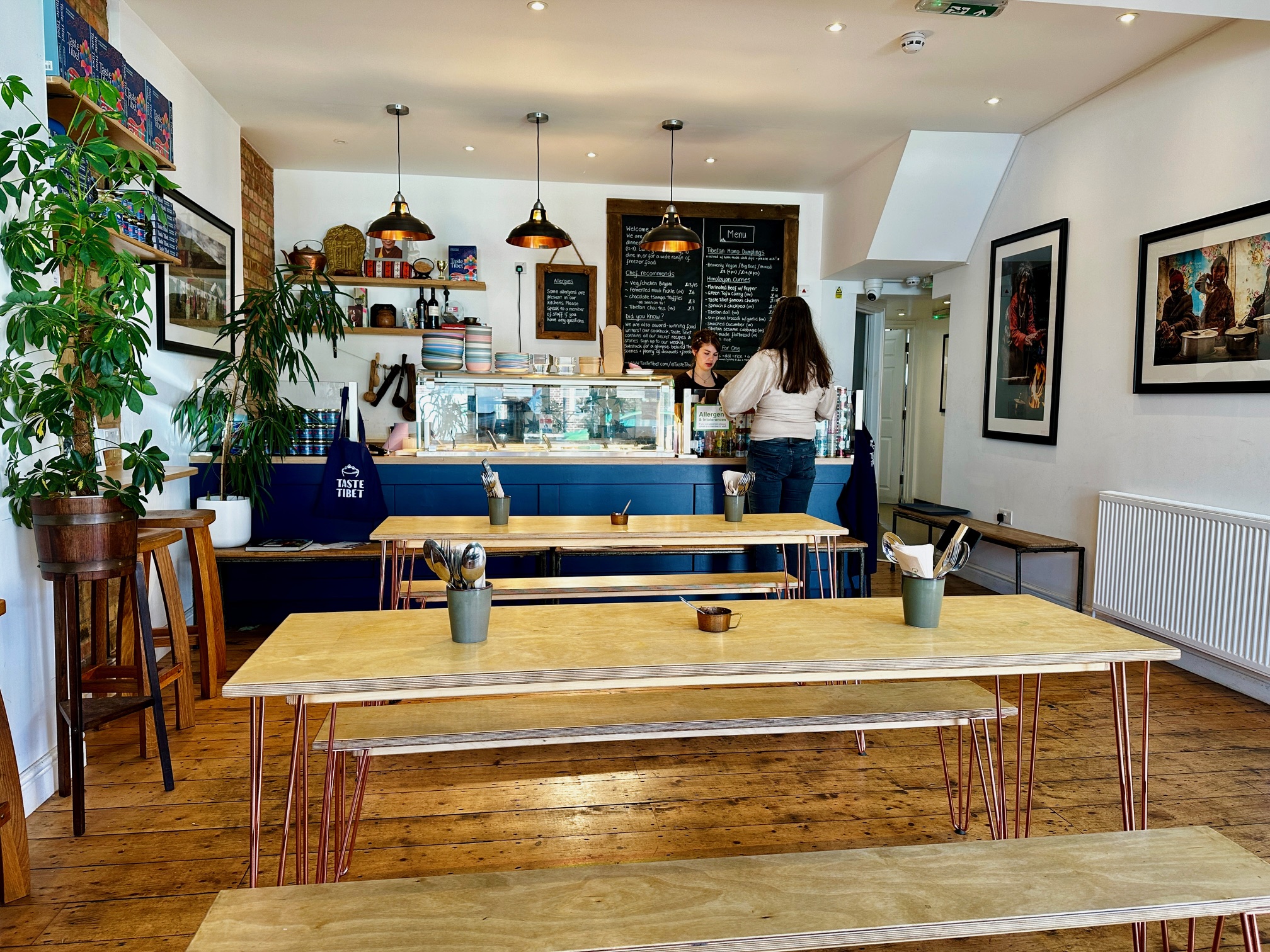
The menu, which changes weekly, is up on a blackboard behind the counter, and many of the dishes are already cooked, in chafing dishes up at the counter. Taste Tibet cannily also offers frozen meals for its customers to enjoy at home, these are in a separate freezer near the front and are a clever way to make sure nothing is wasted. They also had a decent range of drinks, soft and alcoholic, including wines in cans. I was a little disappointed, as always, to see Brewdog as one of the options but I got myself a verbena-infused pale by Earth Ale, a little brewery just outside Abingdon, which I really enjoyed for its fresh citrus and slight bitterness.

On the day I visited, Taste Tibet was offering momo – four or eight, vegan or beef – and four curries, with a mix of sides. They also served a biryani, or a feast option where you got a couple of dishes, dal, rice and a solitary momo for about fifteen pounds. If that pricing sounds keen, it wasn’t unrepresentative -curries weren’t much over a tenner and rice only two pounds fifty. Sides clustered around the five pound mark and momo were four for eight pounds. I ordered some momo, a curry and rice: that, with a tip included, cost me thirty pounds. “I’m in no rush” I said, “so it’s okay to bring the momo out first and the curry after that.”

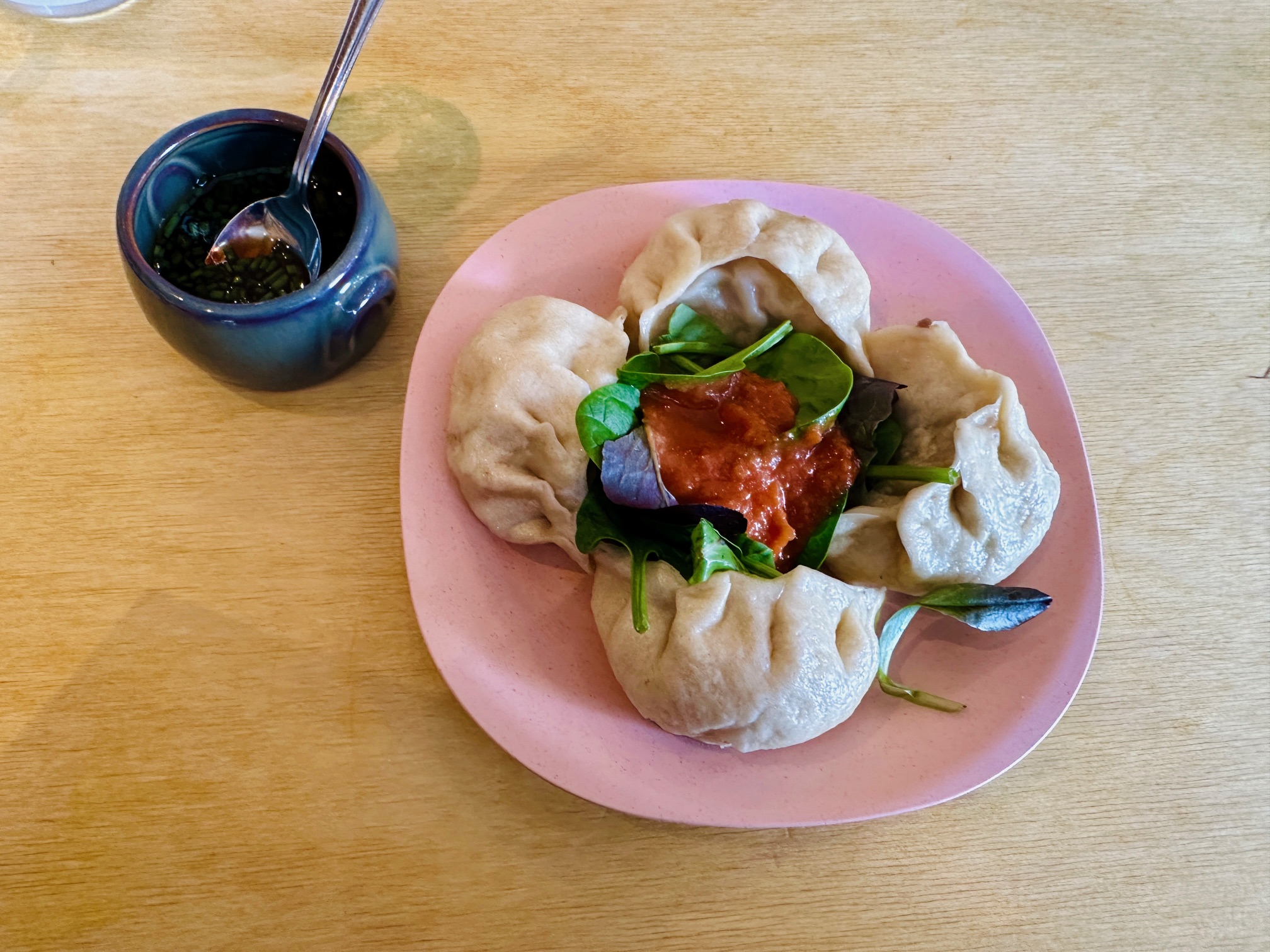
My momo came out five minutes later, and weren’t at all what I was expecting. Although momo apparently originate from Tibet rather than Nepal they’re so prevalent in Nepalese cuisine, and Nepalese cuisine is so prevalent in Reading, that I thought these would be a known quantity. And with that in mind, I thought four for eight pounds felt a bit steep. But Taste Tibet’s momo were a very different beast to the ones I’ve eaten at Sapana Home or Kamal’s Kitchen.

For a start, they were big: impossible to eat in one go, and challenging even in two. Crimped like jiaozi, they were steamed and made with dough that was thick verging on too thick, but that gave them structure and a pleasing, carby solidity. The beef inside – beef, not buffalo, although whether that’s the difference between East Oxford and Reading or Tibet and Nepal I couldn’t tell you – was properly lovely, coarse and delicious.

This came with a little handful of leaves whose main function was to serve as a bowl for a red sauce which was apparently a home-made chilli sauce: I found it a little meek. But what I did love was the bowl of a darker dipping sauce with a kick of soy. Again, I wonder if that’s the influence of Tibet, because I’ve never had Nepalese momo served with that, and it really did make me see the momo in a slightly different light. I can see the appeal of coming to Taste Tibet, as I used to with Sapana Home, and just going to town on the momo.
Later on, as I came to the end of my meal, couples and families were braving the outside tables and I saw big plates of momo going past on their way to the little terrace. Perhaps that was the way to do this place, or to come with a big group and try everything. One of the reasons I hadn’t ordered the “feast for one” was the presence of that single momo. It felt stingy, but looking at what had been put in front of me one would have been plenty, paired with an exploration of more of the menu.

My request that my curry come out after my momo had been taken a little too literally. Perhaps I should have said “after I’ve finished my momo”, although I didn’t think I’d needed to, but instead the rest of the meal arrived when I was halfway through what I thought was my starter. Really, though, that was me misjudging the place and its similarity to a canteen rather than a mistake on the restaurant’s part. Everything is there ready to dish up, and if you order something that’s exactly what they will do.

I had chosen Taste Tibet’s “famous chicken” because I took famous to mean signature, and I figured that if I was visiting a restaurant on my own I owed it to myself to check out the signature dish. And having eaten it I suspect it’s the restaurant, rather than the chicken, that is famous. It was a big portion with plenty of chicken, plenty of sauce. The chicken was all good and tender, and it was impossible to take exception to the dish.
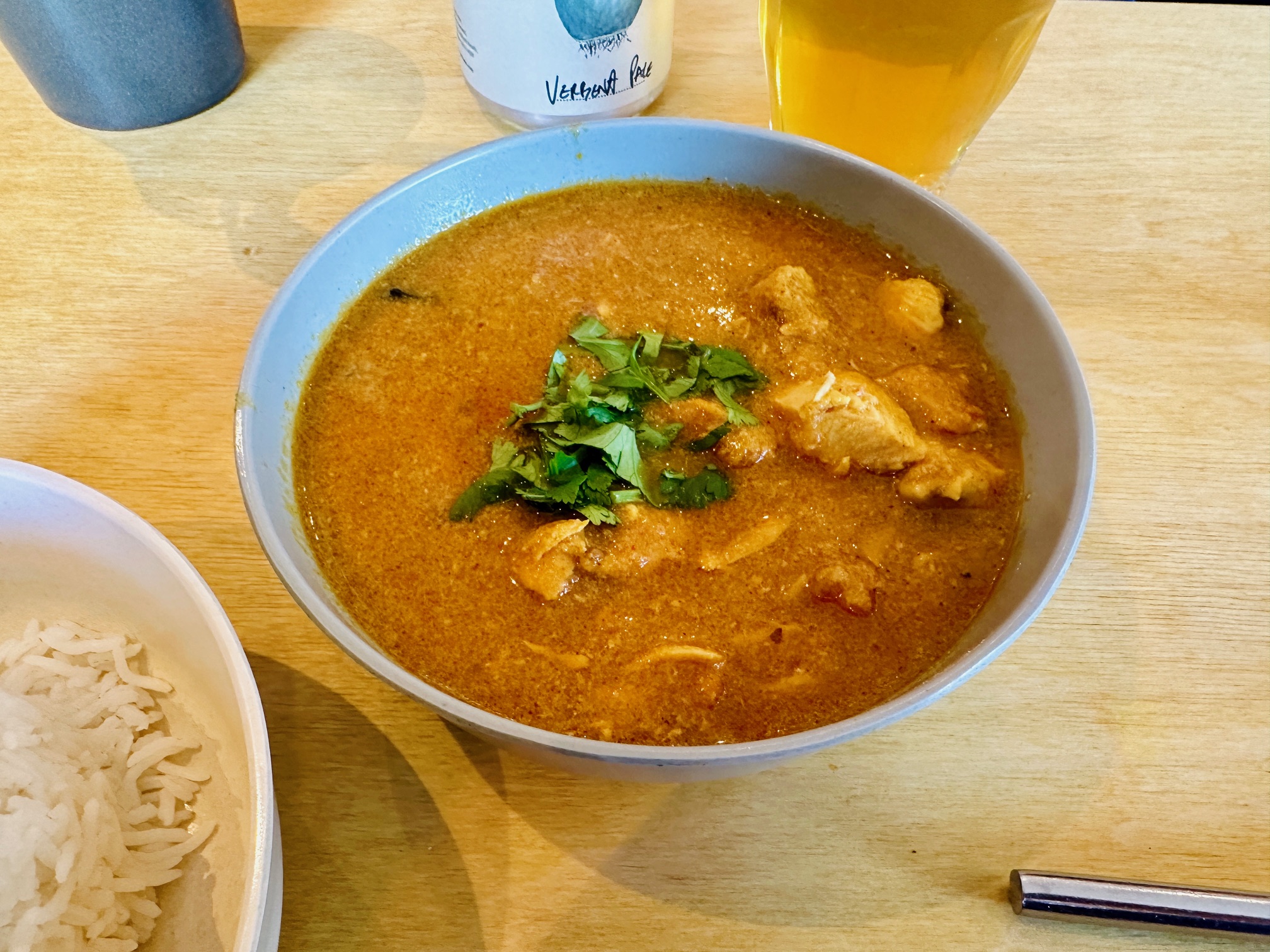
But although not being offensive is a good thing, being inoffensive isn’t, and that’s what this was. Perhaps if my expectations had been lower I would have seen this as a comforting bowl of food, and celebrated what it was rather than noticing what it wasn’t. But this was like curry from a bygone age, before we got into regional food, started to discover the difference between Kerala and Hyderabad. It felt a bit like a Vesta curry, from forty years ago, and for something famous I expected more: I expected it to be famous for something.

How to make it more interesting, I wondered? I tried spooning in my perfectly cooked basmati rice – Taste Tibet serves both curry and rice in bowls that are just big enough for each, rather than giving you a plate to dish them up onto – but that bulked it without being transformative. I tried adding a spoonful of the dried chillis in a ramekin out on the table, but it lent an acrid pungency without elevating anything. The difference in heat levels was like the difference between sleeping on one pillow and two, going from not enough to too much.

I didn’t want to leave it like that, and I fancied dessert, so I went up to order the only thing on the blackboard that looked like afters. Chocolate tsampa truffles – as seen on TV! sounded absolutely like my sort of thing, and only cost three pounds. I was too full to have the chai that should have accompanied it, but never mind. 

By this point the restaurant was far fuller, with people taking tables outside and the long table opposite me occupied by a group of impossibly young, animated east Oxford types. I looked on them indulgently, remembering a time over thirty years ago when that could have been me: not that I would have had the money to eat in a place like this.

Positively 4th Street was playing over the speakers, and I remembered that thirty years ago I loved that song, and suddenly it was back in vogue. Time can play unkind tricks, and all the things that made me so deeply unfashionable as a student – being a geek, listening to Bob Dylan and Leonard Cohen, playing chess and Dungeons & fucking Dragons – are acceptable now, too late for me. Even some of the shit I wore back then might be in now, I thought.

I felt a little tug of envy and regret, and then I let it go. It was as close to Buddhism as I got in Taste Tibet.

The chocolate tsampa truffles, plural, turned out to be a truffle, singular. A big thing designed, like the momo, to be taken on in multiple bites. I enjoyed it and, again, it wasn’t what I thought it would be. Its texture wasn’t dense or glossy, being more gritty with a feel of granulated sugar to it. Again, that’s down to me for misunderstanding – tsampa was not something that flavoured the truffle, but instead is a kind of flour made from ground, roasted barley, so it was the thing lending that texture.
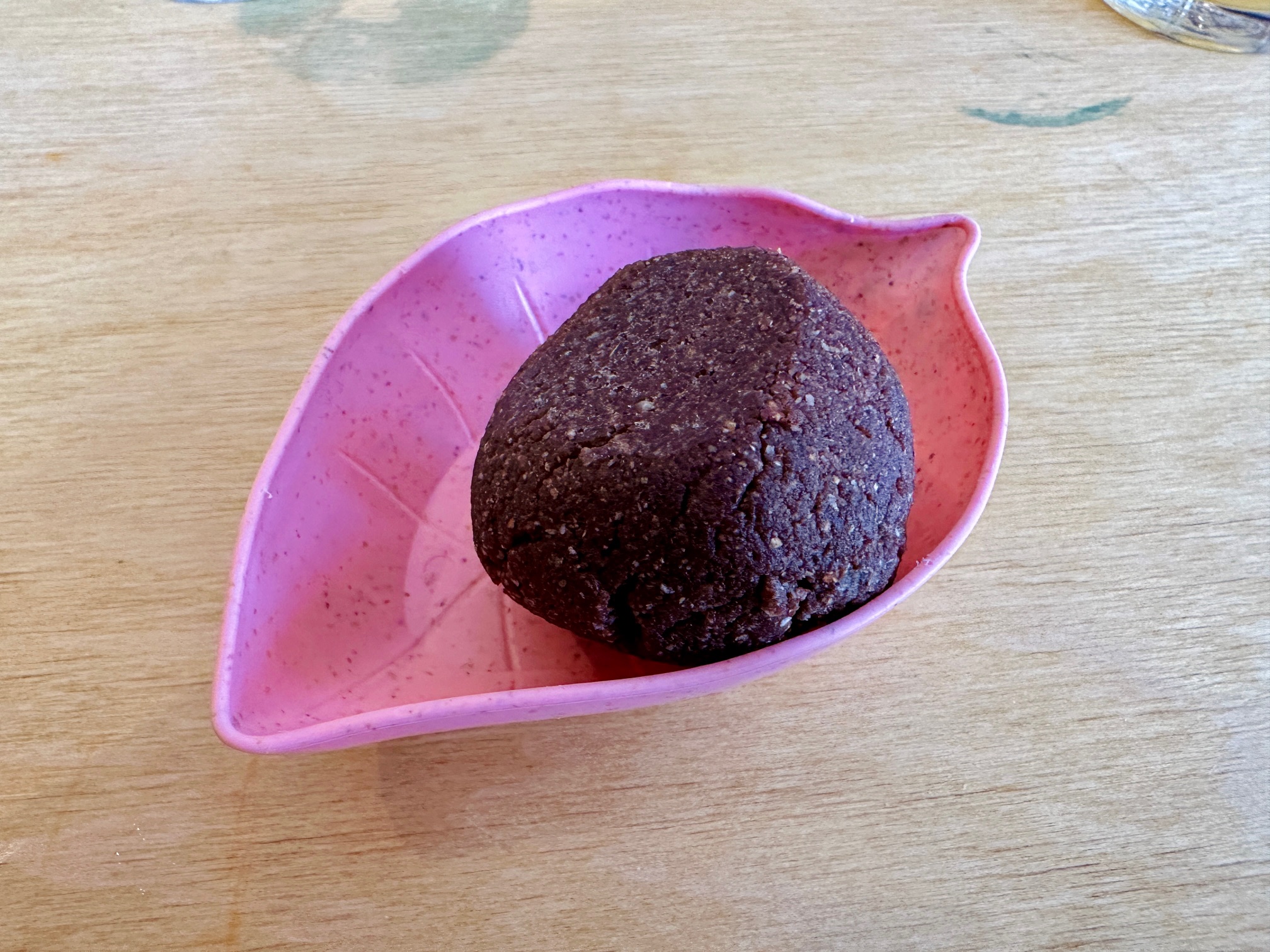
In any event, the truffle reminded me of the brigadeiros at Minas Café, and I liked it without entirely understanding it. That’s fine, by the way: now I’m in my fifties I realise that provided you like things you don’t always need to understand them.

The rest of my day in Oxford was positively joyous. I stopped at Missing Bean, which was absolutely packed, to buy beans for the weeks ahead; I’m drinking a cup of their coffee as I write this. I strolled down the Cowley Road, past its plethora of Turkish restaurants, past the now closed Gamekeeper that used to meet all my Dungeons & fucking Dragons-related needs as a teenager.

I stopped in Truck Records to get inspiration, I stopped in Peloton Espresso to get caffeination. I bought cheese in the Covered Market, had time for a beer in Tap Social before my train home. It really is a gorgeous city, and it says something about the place that Magdalen Road is one of its little oases but far from its only one.

As you may have gathered by now, although I liked Taste Tibet I wanted to like it an awful lot more than I did. And a bit of me wonders if I’m the one in the wrong. It is a gorgeous spot in a gorgeous neighbourhood in a gorgeous city. It has a great backstory, is clearly loved by the community it’s part of and does tireless and admirable work to support that community. It is run by a committed husband and wife, where he works in the kitchen and she advocates, powerfully and eloquently, online and in the media. They want to tell the stories of where he comes from, through food.

On paper, I should love it: it sounds like other restaurants I love, closer to home.

But perhaps that’s okay. Perhaps Taste Tibet makes perfect sense in its context, in that city, on that little stretch of food and drink heaven. Maybe it doesn’t need people like me travelling to and across Oxford to try it out. It’s a neighbourhood restaurant – its neighbourhood is lucky to have it, and it’s lucky to have found its place in things.

If I lived closer I’m sure I would go back, try other dishes, fill my freezer and become part of their story, as they would become part of mine. But other places have got there first, for me at least. My train home pulled in at Gare du Ding and I thought about Kamal’s Kitchen, my favourite Nepalese restaurant, a short walk from the northern entrance to the station.

Its dining room doesn’t have the stripped-back elegance of Taste Tibet, it doesn’t have a narrative the way Taste Tibet does. I think Kamal and his family do a magnificent job, but much as I’d love them to I can’t imagine them gracing the pages of Observer Food Monthly. They don’t write beautiful blog posts, they have no plans to produce a cookbook that I know of and they won’t be at Hay Literary Festival this year. They let their food do the talking, and for what it’s worth I think their momo beat Taste Tibet’s. A restaurant can succeed in so many ways, but food and service are always king.

Magdalen Road in Oxford is a really fantastic place, and I do dearly wish Reading was a little more like it. But I wouldn’t swap their restaurant with ours.

Taste Tibet – 7.0
109 Magdalen Road, Oxford, OX4 1RQ
01865 499318

https://tastetibet.com

As of January 2025, Edible Reading is partly supported by subscribers – click here if you want to read more about that, or click below to subscribe. Whether you’re a subscriber or not, thanks for reading.

Restaurant review: Branca, Oxford

This probably isn’t something I should admit but even now, after nearly twelve years doing this, I’m not always the best judge of which reviews will and won’t prove popular.

I mean, some obviously do well: you all tend to want to know about the new openings and the big names as soon as possible, something I’ve been trying to get to quicker over the last year. And I know from my trips to the likes of TGI Friday and Taco Bell that if it looks like I’m going to have a bad time, you tune in. I don’t take that personally – everyone likes a hatchet job and we can all derive vicarious pleasure from the suffering of others at times.

Beyond that? I have a vague idea at best. Sometimes I can write up a lovely independent place in the middle of town and – well, there aren’t crickets, but it doesn’t go gangbusters in the way that a Siren RG1 or a Rising Sun might. And other times the success of a review takes me completely by surprise.

Take Gordon Ramsay Street Burger, for instance: I didn’t think that many of you would especially care what it was like. On the run up to my visit, I wasn’t even sure I especially cared what it was like. And when I went I found that it was perfectly serviceable, the kind of place you might quite enjoy if you lived in a town without Honest Burgers. Little to write home about all round, you might think, and yet it was my most popular restaurant review of the year: me having a fair to middling time at a big chain in the Oracle. Go figure.

I actually think this might be for the best, that there’s no crystal ball. Because it would get tempting just to write the crowdpleasers, and that would skew the kind of places I go to and the kind of meals I seek out. And part of my – let’s call it a job, just for the sake of argument – job here is to highlight all kinds of establishments.

The ones you know about, but also the ones you don’t. The ones you would never consider going to in a million years, or walk past thinking “I wonder what that’s like?” And the ones you may well have already been to, probably in the first month after opening, before I get round to them. If you always have a pretty good idea what, or where, is coming next then something’s probably gone wrong.

One of the impressions I do get, though, is that collectively speaking you’d like to see more Oxford reviews. I can see why: it’s only half an hour away by train and is almost the anti-Reading. It has everything Reading lacks, yet lacks all the stuff Reading has got. No widespread craft beer, but lots of handsome old boozers, the kind Reading has gradually lost. No street food, but a covered market and cheesemongers and delicatessens galore.

A big shopping mall, yes, but a completely different kind that attracts the chains that Reading still just doesn’t get. More independent retail and two independent cinemas, but crap buses. Better bookshops, but nothing like the Nag’s Head. Did I mention that it also has the Oxford Playhouse, which for all its charm South Street can’t quite match? Anyway, add the two together and you would have the perfect large town slash small city; Oxford even has a couple of universities, would you believe.

All that makes Oxford the perfect place for a weekend lunch or dinner, especially coupled with mooching, shopping, drinking coffee and people watching. So every time I put an Oxford review up it does pretty well, and I get the impression – perhaps wrongly – that you might like to see more of them. My first visit to Oxford on duty was to one of my favourite Oxford spots, The Magdalen Arms on the Iffley Road. I had a lovely time, as I expected to, and resolved to cover the city more often. Two and a half years later, I’ve written the grand total of five reviews of Oxford restaurants: time to pull my socks up.

So last weekend Zoë and I were in Oxford, on her Saturday off, and I had booked a table for two at the Oxford restaurant I’ve possibly eaten at more than any other, Branca. It’s a sort of Italian brasserie – or would be if such a thing isn’t two different kinds of cultural appropriation – and had been trading on Walton Street in Jericho for over twenty years.

And that means that, like Pierre Victoire just round the corner on Little Clarendon Street, it’s part of an elite club of restaurants that have been an ever-present in my dining life. The only thing even comparable in Reading, now that Pepe Sale is gone, is London Street Brasserie, and that tells its own story, that Oxford can hang on to these places when Reading can’t.

It helps that Jericho is such a lovely part of Oxford, less than twenty minutes’ walk from the train station but a world away from both the town and gown of the city centre. It’s all nice cafés and bars, pubs tucked away on sidestreets, the Phoenix cinema where people, me included, queued round the block to see Four Weddings thirty years ago, watering holes like Raoul’s and Jude The Obscure that feel like they’ve been there forever.

I lived in Jericho, for a strange and surreal year halfway through the Nineties, and I didn’t appreciate how gorgeous it was at the time. And now it’s so gentrified that I could never afford to do so again in this life I am struck with brutal clarity by what a terrific part of the world it is. Isn’t it always the way? Never mind. Sitting in Branca, menu in front of me, soaking it all up I could kid myself, for a couple of hours at least, that this was my place and these were my people. Good restaurants, apart from providing you with great food and wonderful drink, have a knack of giving you that, too.

In the years since it opened Branca has expanded into next door, turning it into a cafe and deli more than capable of improving your cupboards and denting your wallet. But the dining room is as it always was, a tasteful if cavernous space.

The tables nearer the front, close to the bar, are nice enough but if you can get one at the back you’re treated to a beautiful room with marble-topped tables, exposed brickwork, what looks like a Bridget Riley on the wall. There’s a view out into their courtyard through full length-windows, and the light in general is quite magical, helped by a skylight and clever use of mirrors. Even on a dreich February day it felt like spring was in touching distance.

This isn’t the criticism it might sound, but Branca’s is simultaneously the biggest and smallest menu I’ve ever seen. Big as in physically big, a one-sided sheet of something like A3 that lists everything they serve. But when you delve into the detail, it’s compact: four starters, a couple of salads, three pasta dishes, four pizzas. Four mains, a burger and a steak and a couple of specials. I felt like I had just enough choice, although if I’d fancied either of the specials I wouldn’t have felt constrained at all.

As it was, this was just on the right side of the border between streamlined and narrow. Starters clustered around the ten pound mark – don’t they always, everywhere, these days – while mains were more scattergun. A pizza was about sixteen quid, with the exception of the sirloin steak the mains stopped at twenty-five. If I hadn’t eaten at Branca before I think the menu would still have inspired confidence, that it was aiming to do fewer things better, but they’d already proved that to me time and time again.

Before any of that, a negroni apiece and some of Branca’s focaccia, which they’ve been dishing out free of charge to diners for as long as I can recall. The focaccia was great stuff, airy and speckled with salt, oily enough to make your fingers shine even before you dipped hunks of it into oil and balsamic vinegar. It made me happy to start a meal in the same way as I always had, knowing that it pretty much always presaged good things. Branca played it straight down the middle with its negroni: no fancy curveballs, just Gordon’s, Campari and Martini Rosso. It was a good reminder that stripped of any whistles and bells, the cocktail just has good bones.

Another reason I’ve always liked Branca enormously is the wine list, and more specifically that they do something so few restaurants in the U.K. do: the majority of the wines on it, around three quarters in fact, can be ordered in a 500ml carafe. So we did that and had a New Zealand sauvignon blanc for thirty quid, which was downright lovely. I got kiwi fruit and gooseberry, Zoë got a hint of melon and, for an hour or so, we managed to kid ourselves that we got wine. We became a little bit more North Oxford with every passing minute.

Most of Branca’s starters are probably a nod to the excellent deli next door: with the exception of the soup they largely involve buying well rather than cooking well. Zoë is an expert at the third part of that triumvirate, ordering well, and she had the edge with her burrata on sourdough, served with olives and cherry tomatoes. Up to a point this is something you could rustle up in your own kitchen, and we often do come summertime, but the transformative element here was a cracking red pesto. Try doing that at home seemed to be the implication and no, I wouldn’t even attempt to.

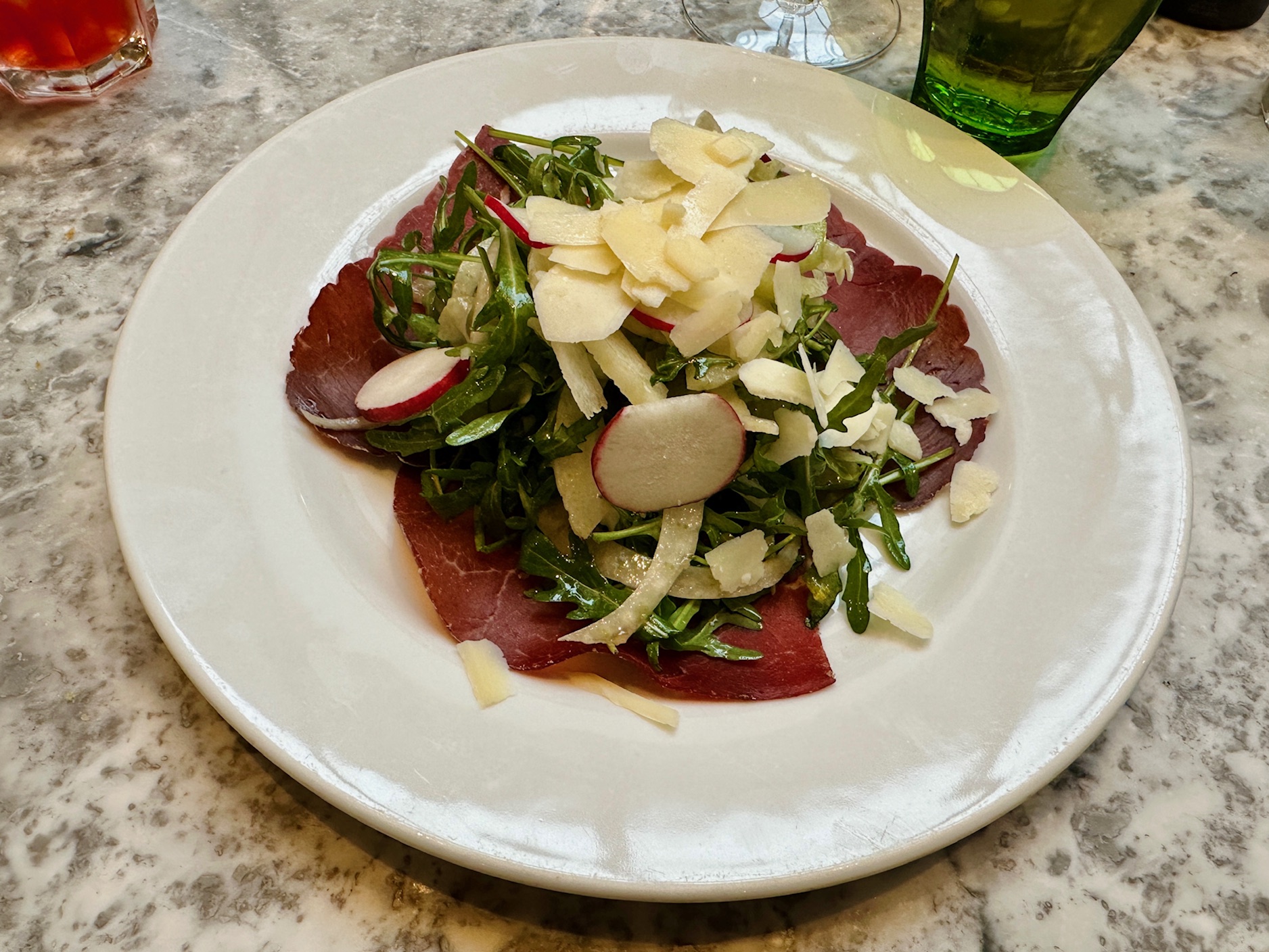
My starter left me feeling a little deceived. It was described as bresaola with a fennel, rocket and radish salad, and that description made me think it would be a cornucopia of cured beef with a little bit of greenery on top. Just how hoodwinked I had been became apparent when our server – who, I should add, was superb from start to finish – came to our table.

“Who ordered the salad?”

Neither of us, I hope I wanted to say to him, but I realised as he set the plates down that this was exactly what I had unwittingly done. And, truth be told, I felt a little conned. Three pieces of bresaola – I would say “count them”, but that didn’t take long – buried under an ambuscade of foliage is, to be honest, a salad. You can’t roll that in glitter: it is what it is. And eleven pounds for a salad and three pieces of beef felt like it could slightly mar my long and happy relationship with Branca.

And maybe it would have done but damn them, it was lovely. I always regret using the adjective “clean” to describe dishes or flavours because, like “dirty”, it’s a dimension that really shouldn’t feature in stuff you stick in your gob. So instead I would say that this was subtle, unfussy and refined, that every flavour in it was distinct, well-realised and harmonious.

Rocket seems to get a lot of stick these days but I still like it, especially compared to the twin horrors of pea shoots and watercress, two of the most pointless green things in creation. The quantity of excellent Parmesan chucked on top felt like it was by way of apology for the whole salad thing. Everything was so well-dressed and well balanced that I decided I could forgive Branca, just about. The eleven quid still felt a bit cheeky, although mainly I just wished they’d chucked some of that red pesto into the mix.

Conscious of a few recent experiences where we’d been rushed, Zoë decided to have The Conversation with our server as he came to take our empty plates. We were having a lovely time, she told him, and were really in no hurry so could they wait a while before bringing our mains? And he was brilliant with that, feeding that back to the kitchen and then coming to check with us, something like twenty-five minutes later, if we were ready for what came next.

I can’t tell you how welcome that was, that a restaurant understood how to put the brakes on. And it really helped to make me appreciate Branca all over again – the room, that light, the chatter from neighbouring tables, that feeling that there was no rush to go anywhere or do anything that comes from a proper, leisurely lunch. Saturdays with Zoë have been at a premium recently, so I felt glad this one was far from squandered.

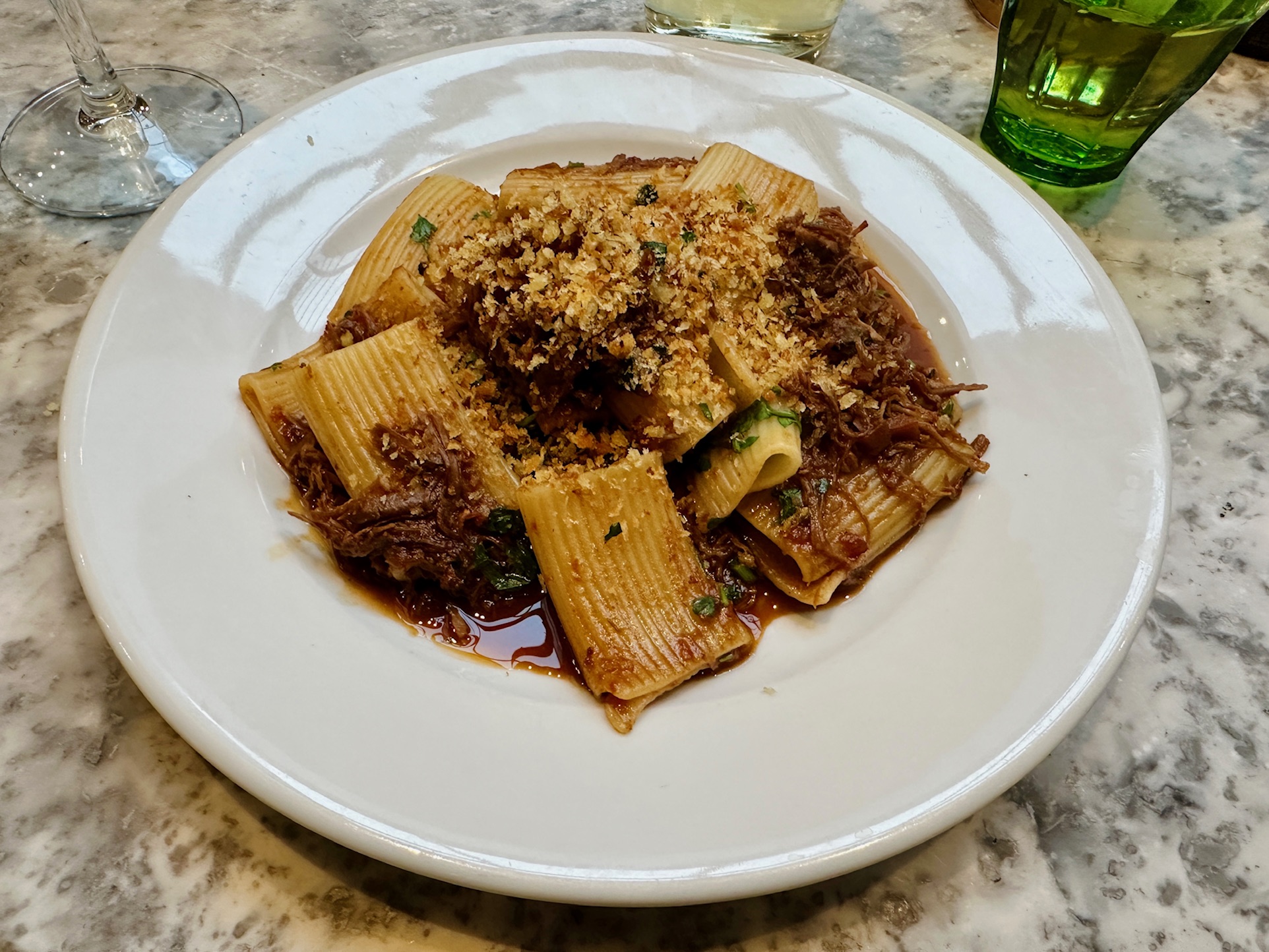
By the time my main came, I was ready for it, and it helped that it was a treat from start to finish. Rigatoni, giant corrugated tubes of comfort sagging under the weight of their own carbiness, came interlaced with sticky strand after strand of a long-cooked duck ragu. It may not have clung to the pasta, but it was hidden away under every single layer, a glorious, indulgent beast of a sauce.

That along would have made me almost delirious with joy on a winter’s day, but carpeting the whole lot with the crunch of herb and pecorino pangrattato and then leaving a bowl of grated parmesan at the table for you to use as unsparingly as your heart desired? I’d won at lunch. There was simply no question.

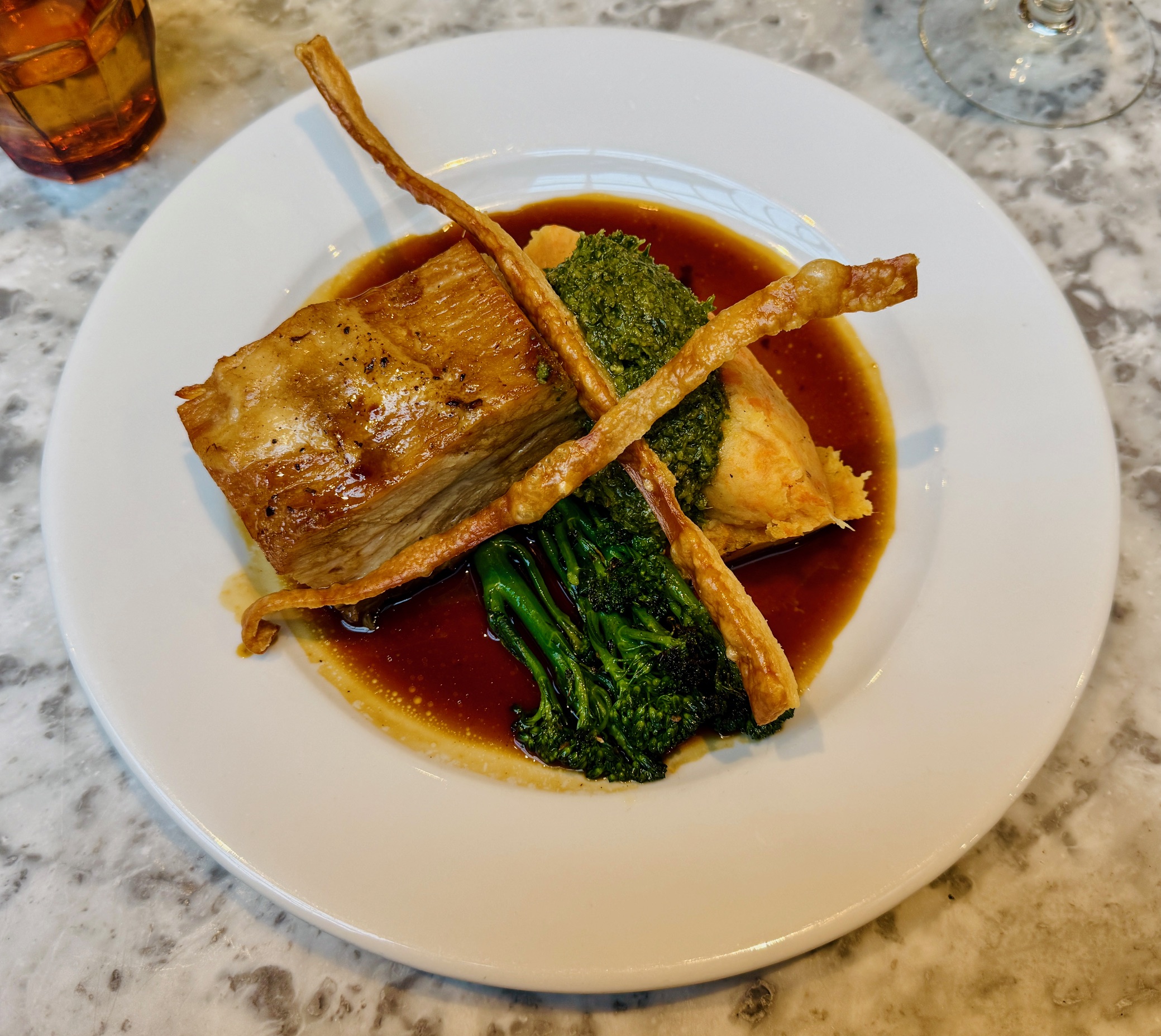
Of course, as anybody who’s married knows, you only really win at lunch if your dining companion wins too. So I was glad that Zoë, picking the other dish that jumped out from the menu, was as happy as I was. A colossal slab of pork belly, all fat rendered beautifully, would have been worth the price of admission alone. Add in a deeply savoury jus, an enormous quenelle of root vegetable mash, some firm but delicious tenderstem broccoli and a couple of crispy straws of crackling and you had a dish that could redeem the month of February single-handedly.

And the final element, the icing on the proverbial, was a salsa verde that supplied the zip and verve that stopped this all being a bit too much. Like the red pesto, a little went a long way. It also highlighted, again, that the kitchen had decided to do a few things to the very best of its ability rather than produce a bloated menu that lost its way.

“This is the first Lyndhurst-style dish I’ve had since the Lyndhurst closed” said Zoë, and I knew exactly what she meant. Very few people cooked pork belly as well as Sheldon and Dishon at the Lyndhurst, and this was the first time I’d eaten somewhere that reminded me of that. The room couldn’t have been more different, and the menu couldn’t have been much more different either, but there was that thread of brilliant hospitality that connected a restaurant I’ve loved for years and a restaurant I’ve mourned for nearly twelve months. It was nice to be reminded of it like this.

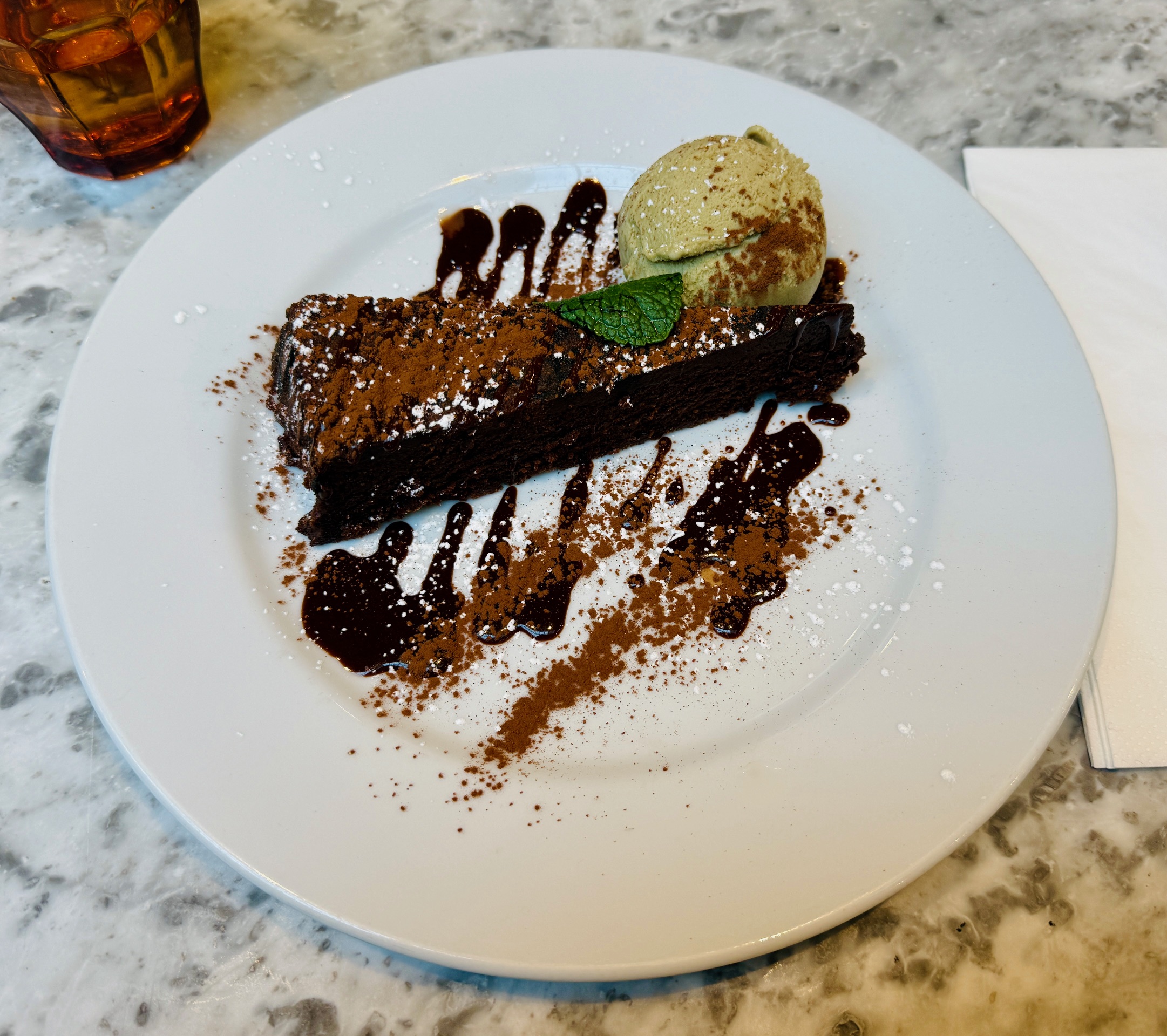
Branca’s dessert menu was also compact and really, when you stripped away the padding, it was four desserts and a range of ice cream; I’m happy to accept that a chocolate brownie classes as a dessert but things like affogato, chocolate truffles or – as was the case here – Pedro Ximenez poured over vanilla ice cream don’t really count. I found the dessert menu the least exciting bit, with most of it reminiscent of London Street Brasserie, so of course I gave Zoë carte blanche and she picked the dish I’d most likely have chosen, the chocolate nemesis.

She was very happy with it, and I daresay I would have been too. It was a tranche of deep, fudgy decadence, festooned with cocoa and squiggled with sauce, pistachio ice cream on the side. It was exactly the kind of dessert Zoë has been ordering since she first started ordering desserts many years ago, and it did not disappoint. It happens to be exactly the kind of dessert I too have been ordering, for ten years longer than her.

“It looks great” I said, which is usually my attempt to get a spoonful. “Is the texture more like a fondant, or a ganache?”

“It’s more like a brownie” said Zoë. There was to be no spoonful.

I’d asked where Branca got its ice cream from, half hoping they bought local from legendary ice cream parlour George & Davis, round the corner. They didn’t, and instead it was from Purbeck, a maker I don’t think I’ve tried.

My benchmark for these things is Jude’s – I’m still up in arms about Nirvana Spa swapping them out for the kind of stuff you get in the interval at the theatre – but I would say the ice cream at Branca came close. The chocolate was deep and smooth and studded with chocolate chips and the salted caramel was actually salted caramel with more than a hint of salt, rather than an attempt to rebadge something that’s either butterscotch or has tooth-shattering chunks of solid sugar in it. It was a fitting ending to my latest, but by no means my last, meal at Branca.

The best part of a couple of hours after we took our seats, it was time to settle up and sally forth into the streets of Jericho. Our bill for two came to just under one hundred and fifty-five pounds, including the 12.5% service charge, and paying it I thought that Branca was one of the safest bets I know of in the world of restaurants. I suppose after more than two decades it should be, but then I also remember the dwindling handful of Reading restaurants that have been here that long – places like Quattro and Sweeney and Todd – and realise that I’ve never had even a fraction of the affection for them that I do for Branca.

The rest of our afternoon, fortified by that lunch, was idyllic. We stopped at the Old Bookbinders, a ludicrously pretty backstreet boozer, for a quick half and thought that we needed to come back to try the small, perfectly formed French menu they happen to offer. We snuck into St Barnabas’ Church and gawped at the wonder of this little basilica, plonked in the middle of Jericho. We browsed paperbacks at the Last Bookshop, bought phenomenal cheeses in the Covered Market and stopped for a pre-train beer at Tap Social, wanting for nothing except a mobile signal strong enough to allow access to Untappd.

Oxford was at its finest that day, and I had that thought again: I need to come here more often. Yet the thing that really made all of that, you see, was Branca, and a reunion with an old friend of a restaurant. Lots to catch up on, but the news – getting married, moving house – was all mine. Because Branca was as it always is: classy, fetching, welcoming and utterly, utterly reliable. I’m glad I finally got round to reviewing it, and even gladder that I caught it on a day when it was very close to its best.

But if it hadn’t been, with nearly twenty years of history, I probably would have let it off. Because after all, how many restaurants can you say you’ve been going to for twenty years? I used to have more, but the ones in Reading have a habit of closing. Oxford can hold on to its institutions better, I think. But given the institutions that have been defining Oxford for nearly a thousand years, is that really a surprise?

Like I said at the beginning, I can never tell which of my reviews will do well. But I liked Branca so much that all of that feels immaterial: and that, to me, is the best reason there is to write a review.

Branca – 8.6
111 Walton Street, Oxford, OX2 6AJ
01865 807745

https://www.branca.co.uk

As of January 2025, Edible Reading is partly supported by subscribers – click here if you want to read more about that, or click below to subscribe. Whether you’re a subscriber or not, thanks for reading.

Restaurant review: Kopitiam, Oxford

Here’s a question for you – if you had decided to have lunch at a restaurant, and you knew for a fact that it didn’t take reservations, when would you get there, all things being equal? Would you turn up when it opened, bang on noon, or would you arrive early and be at the front of the queue? Or would you aim for about half one, to capitalise on the end of the lunch rush? Would it bother you, or make you anxious, or would you be blasé about the whole thing? Would you have a backup plan?

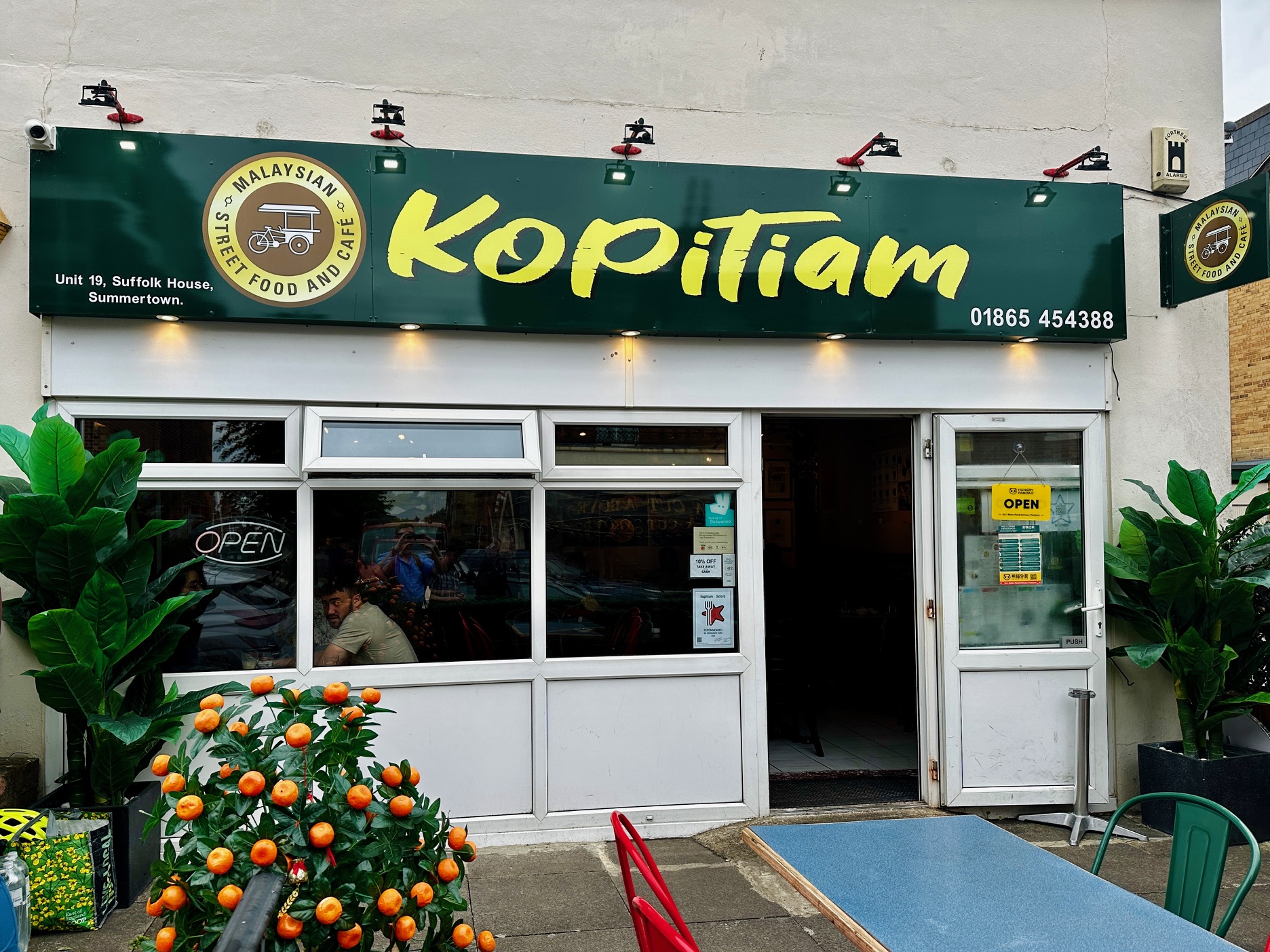
This wasn’t a hypothetical situation, because last weekend I was in Oxford with my old friend Dave and his son Leo, and I was set on having lunch at Kopitiam, a Malaysian restaurant in Summertown that received a glowing review from Tom Parker Bowles in the Mail On Sunday last December. But it didn’t take bookings, and Summertown is about a forty minute walk from the centre, so what to do?

This highlighted something of a philosophical schism between Dave and me. He would gladly have been there before the clock struck noon, ready to take the first table in the whole restaurant. “I prepare for things precisely so I don’t get anxious” he explained, although I suspected we both did equal amounts of worrying about stuff, just at different times. For my part, I thought turning up around half twelve would be more than sufficient. I knew it was Saturday lunchtime, but how busy could the place be?

It grieves me to admit that Dave was right and I was wrong: turning up bang on half past, we found every table occupied and the restaurant heaving. There were two tables out front, both with the standard-issue Tolix chairs in place, but it wasn’t quite warm enough for that kind of thing. So we went over the road to the excellent Colombia Coffee Roasters, sipped a latte and I kept a restless eye on the footfall heading to and from Kopitiam.

“It’s okay mate, if it’s still full we can always just go to Pompette a few doors down, or the pizza place on this road” said Dave equably. I didn’t understand what was going on: why was he so chilled about this after he’d been proven right? Why wasn’t he saying I told you so, the way I would have done had our roles been reversed? Honestly, you’re friends with someone for over thirty years but some days it’s like you just don’t know them at all. Leo, just turned 18 and off to Durham at the end of the month to start his history degree, sensibly stayed out of this one, and got to work on his mocha instead.

Anyway, it all worked out in the end. Half an hour later we went back and a number of tables were unoccupied, so we ensconced ourselves. The fact that so many tables had cleared so quickly suggested this was a functional lunch spot, not somewhere to linger, but we were too happy to have found space to be bothered by that.

The room was functional too – but in a way that worked, with plain, standard issue chairs and tables, faux exposed brickwork wallpaper and brightly lit pictures of all the dishes up on the wall. Now normally this would set alarm bells ringing, but somehow Kopitiam pulled it off – the saturated photos had an almost Martin Parr feel to them. And equally importantly, they all looked like food you’d actually want to eat.

Kopitiam’s menu was a tad confusing. Or really I should say menus, because you got two with no real indication of the relationship between them. The smaller one looked more Malaysian, the larger more Chinese, but the titles of the two printed menus didn’t exactly explain why this was. The smaller menu had some pictures of the food, the bigger, more generic menu, did not.

Malaysian Street Food And Cafe said the bigger menu, incongruously above the prices for crispy duck, Thai green papaya salad, sesame prawn toasts and edamame. And the same dishes, appeared on both menus in some cases – but where they did, the pricing was not the same. Anyway, on examination the smaller menu looked to be the lunch menu, the larger one the dinner menu – Kopitiam’s website spelled this out, but at the time it was a head-scratcher.

That’s partly because nothing at Kopitiam was expensive, whichever menu you ordered from and whatever it was calling itself. Few starters cost more than eight pounds, most mains on the lunch menu didn’t get north of twelve. Even on the main menu dishes tended to jostle around the ten pound mark, although rice cost extra. It did prompt a lot of discussions and plea bargaining, though, around how to try the best of the menu and what might or might not be representative. I felt, in the back of my mind, like having the Chinese dishes would be copping out.

“Are we having starters as well?” asked Dave.

“You do remember who you’re having lunch with, don’t you?” I said. Honestly, you’re friends with someone for over thirty years and some days it’s like they don’t know you at all: I don’t think the words if it’s okay with you can we skip starters have ever left my lips in all the time I’ve known Dave. And Leo is an enthusiastic eater himself: I remember going to Dolce Vita with him and his dad, back when he was something like ten years old, and watching him charm the socks off the waiters by ordering the monkfish with squid ink pasta and finishing the lot (“we have many adults who don’t try that dish” said our server, rightly impressed).

Our starters came out as we sipped a fiery and enjoyable ginger beer apiece: Kopitiam has no alcohol licence, which didn’t bother me, but also didn’t have any Sarsi (a Malaysian take on root beer), which bothered me far more. They also do a plethora of other Malaysian drinks – kopi, teh tarik and Ying Yang, a blend of coffee and tea which I was tempted to order out of morbid curiosity alone.

First to arrive were lok bak, minced pork wrapped in bean curd skin and then fried until crispy. These were a tactile delight, little brittle-coated nuggets of joy crying out to be dipped in sweet chilli sauce and scoffed. Perfect for sharing, perfect for social eating, perfectly enjoyable. And if I’d never had anything like this before, as I suspect Dave and Leo hadn’t, I would have been waxing lyrical.

But the best can be the enemy of the good, and I kept casting my mind back to a very similar dish at Lucky Lychee the previous month. There the pork was coarse and crumbly, the sweet chilli sauce was home made rather than out of a bottle and I got more of the spicing: Lucky Lychee boasts a ten spice mix, compared to the five spices deployed by Kopitiam. It showed: the Winchester restaurant’s rendition was easily twice as good.

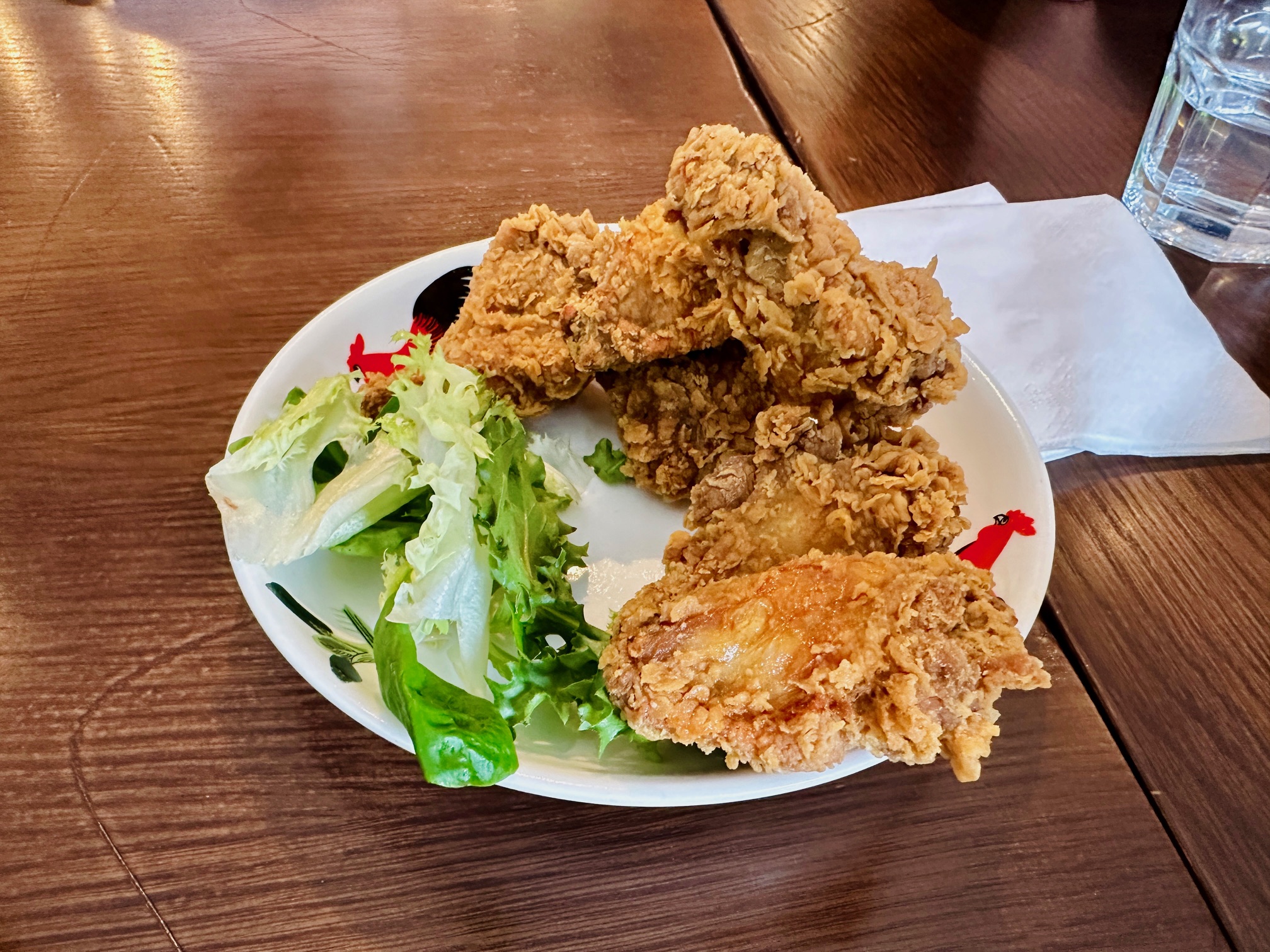
By far the single best thing we ordered was chosen because we saw it at the next table and had to have a piece of the action. It was impossibly rugged-looking fried chicken, and our neighbours somehow had the superhuman (or inhuman, depending on how you view such things) restraint to leave it there, in full view, for something like five minutes without making inroads into it.

I swear that our portion arrived and was dispatched before they finished theirs, and I wasn’t sure whether to be proud or ashamed of that. But it was so, so good. It was half a dozen wings, in a crunchy, gnarled coating which had just the slightest hint of funk from the shrimp sauce used in the marinade. Now, I’m not the biggest fan of wings, especially when they’re sauced or tossed, because for me the reward to faff ratio is out of kilter. But these were an absolute joy to rend and gnaw, to the extent where I wondered if I was giving wings an unduly hard time.

“I think these are the crispiest wings I’ve ever had” said Dave. “I wish we’d ordered a portion each.”

“There’s nothing to stop us ordering more” I said. “We could have them for dessert. Did you know there’s a fish restaurant in Lisbon where you have a steak roll for dessert?”

Dave gave me an indulgent look that said, ever so nicely, why are you like this? But I knew I’d planted the seed about dessert chicken, so I left it at that.

Last of all, we tried a Malaysian staple, the roti canai. Now, I had high hopes for this after reading Tom Parker Bowles’ review. He said they were charred, chewy and as delicate as silk handkerchiefs. Leaving aside the fact that I’m not sure something can be all three of those things at once, Kopitiam’s roti were delicious but more like rolled-up balls of tissue – sorry for the image – than silk handkerchiefs. I liked them, and they were definitely greaseless, but in little clumps they weren’t the easiest to dip into a little bowl of an admittedly delicious curry sauce, with plenty of brooding depth.

Our mains came out while we were still eating our starters. Now, this has happened to me before in a Malaysian restaurant, one called Wau in Newbury that I visited five years ago. And I complained about it in the review, and a few people told me I was being culturally ignorant and that in Malaysian cuisine everything tends to arrive at once. So I won’t moan about that again, even though it wouldn’t be my preferred way to eat. And I suppose it explains why a restaurant that’s full at noon can find room for you thirty minutes later, so swings and roundabouts.

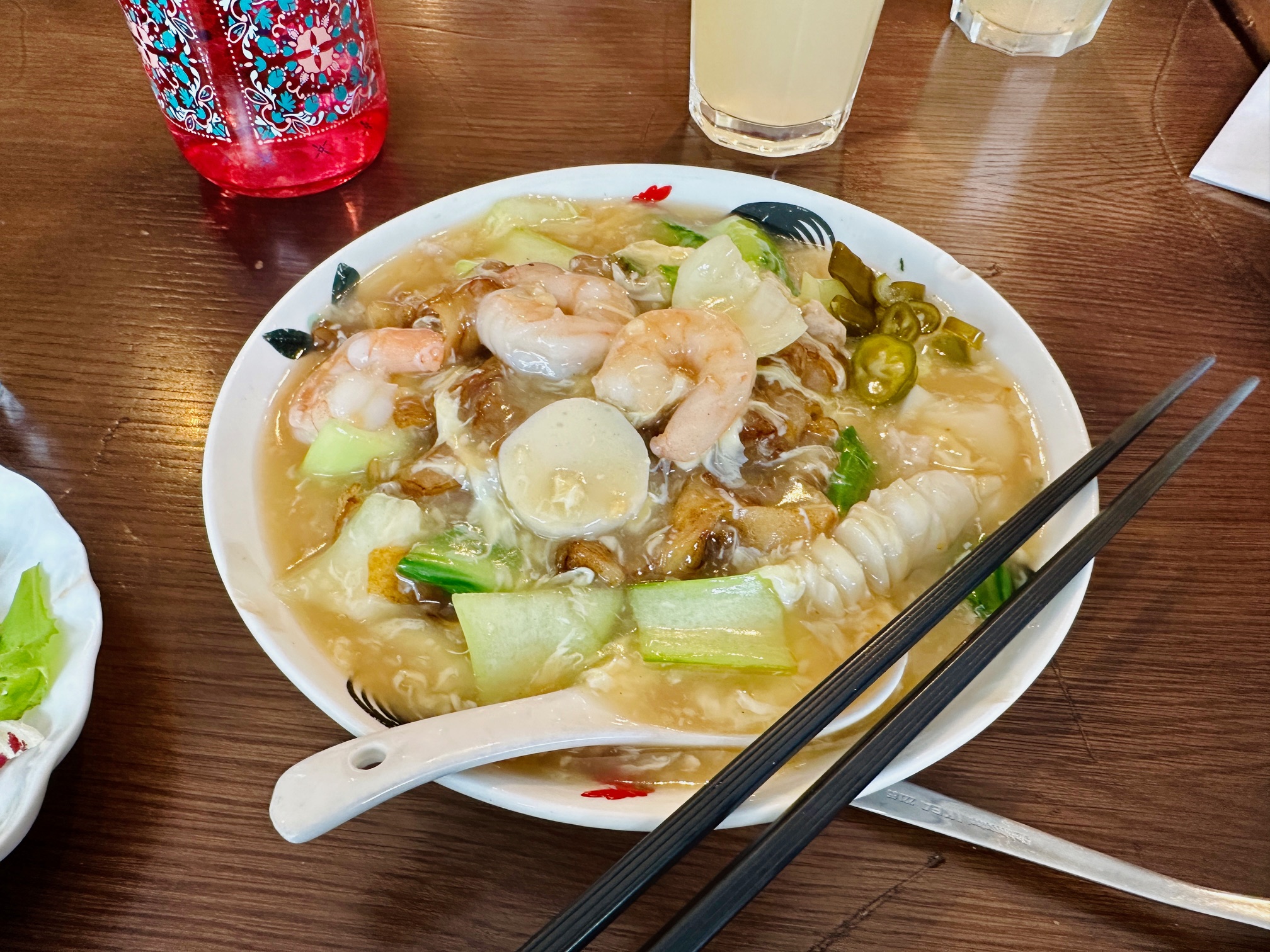
Dave and Leo had both chosen noodle dishes, but more different noodle dishes would be hard to imagine, despite having some of the same ingredients. Dave ordered Kopitiam’s special ho fun with not one, not two, but all of the following: prawns, squid, fish cake and pork. All that and what the menu described as an “egg gravy” on top. Something was surely lost in translation, because the words “egg” and “gravy”, next to one another, don’t scream take my money to me. But Dave seemed to enjoy it.

“The texture is a little… well… it’s kind of like mucus.”

“You can’t say that! I can’t put that in the review.” I said, fully intending to put it in the review.

“Well, it’s tasty mucus.”

“This is the thing, though, with some cuisines I think” I pontificated. “It’s just about us not having frames of reference. So we are generally a bit put off by gelatinous food, but I guess that’s because we associate that texture with sweet stuff. And nobody eats things in savoury jelly any more, apart from pork pies. It’s a tricky one with this kind of food – and it will make this review difficult to write. If you rave on it’s cultural appropriation, if you sound like you don’t understand it you just come across like Nigel Farage.”

“Anyway, I’m not sure if that is a fishcake. It has the same texture as a scallop. Anybody who promises a fishcake and gives you a scallop is okay in my book.”

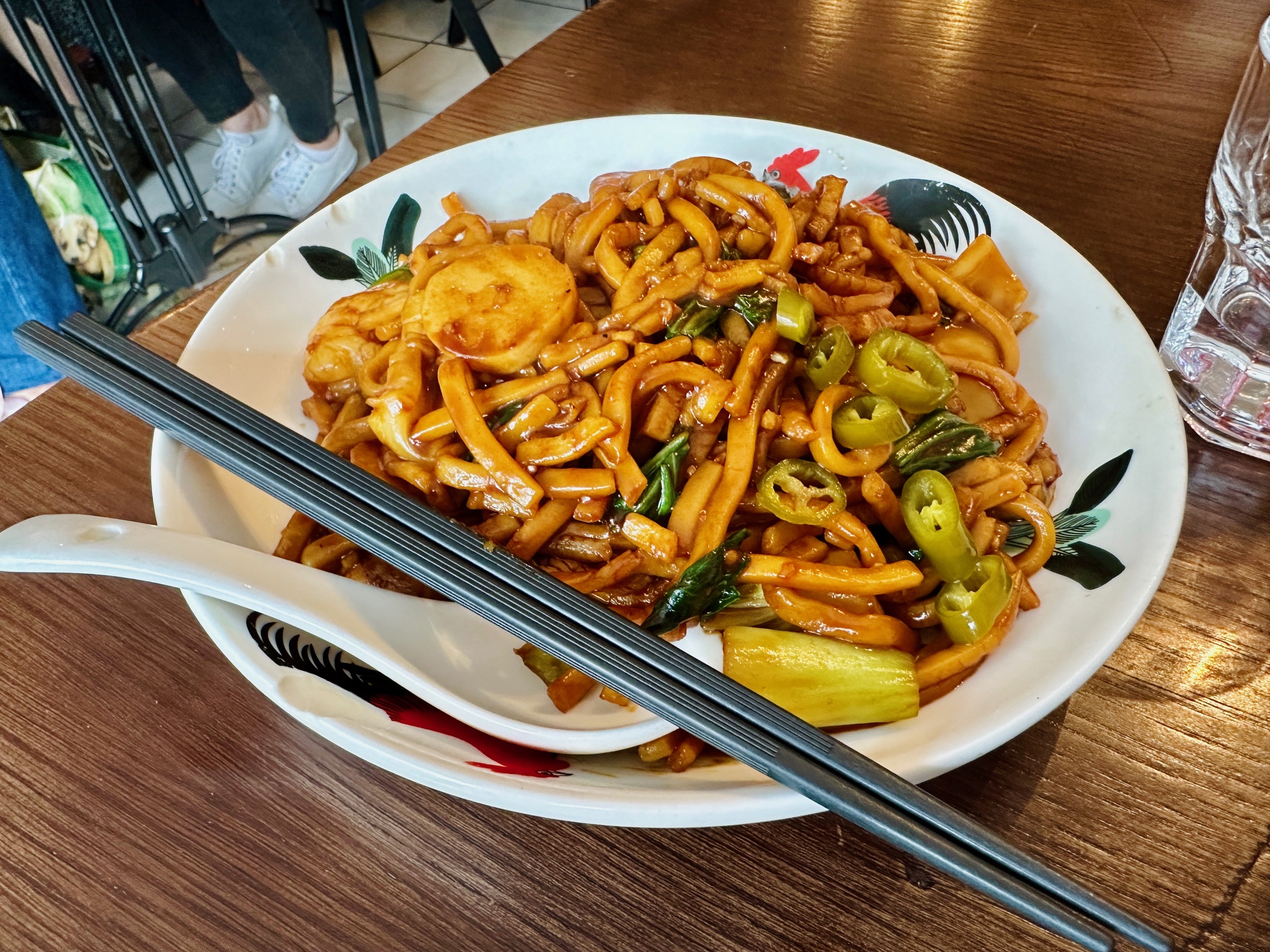
If Dave’s dish was our one Cantonese foray into the menu, Leo had chosen a Malaysian classic. Hokkien mee was wheat noodles rather than rice noodles, cooked in a darker, stickier sauce with the same mix of surf and turf and with, allegedly, the addition of fried pork lard, although that wasn’t visible to the naked eye. This looked more like it, and Leo polished it off without complaint. I didn’t try it, but I was struck that the noodles were broken and short, and I was grateful that I hadn’t ordered it because with my rudimentary chopstick skills I might well have ended up wearing half of it.

This is where, if I was a proper restaurant reviewer, I’d probably wank on about wok hei, whatever that is. But none of us are kidding ourselves that I am, so I won’t.

Originally I was going to have the beef rendang, because Dave had planned to order the Marmite chicken. But when he changed his mind it was up for grabs, and having enjoyed this dish so much at Lucky Lychee I wanted another bite of the cherry. And really, it was a similar experience to the lok bak – if I’d never had this dish before I probably would have loved it, but I knew how good it could be and so I knew that this fell short.

The texture was magnificent – we’d already established that Kopitiam could fry chicken like nobody’s business – so it wasn’t that. But the sauce was more honey than Marmite, more one note sweetness than harmonised salt and sugar. And there wasn’t a lot of it – what there was coated the chicken, and the chicken had all the crannies and crevices to make that happen, but that was your lot. What that meant was a few bites of reasonably enjoyable but dryish chicken, rendered drier by plain white rice, and not much else.

Partly my fault, perhaps, for ordering it from the lunch menu, and perhaps if I’d ordered a separate helping and a separate bowl of rice I wouldn’t have felt so diddled. But I don’t know, I still think at the end I would have had a whole expanse of naked rice, desperate to be covered with anything. I poured the rest of the sauce from the roti canai onto a little patch of rice and ate that. I left the rest.

“Are you okay mate? You haven’t eaten much of your rice” said Dave.

“There’s nothing to eat it with” I said, gesturing at my plate. Tell a lie: there was a little mound of undressed salad on the plate fighting it out with the rice to be the least appealing, like Robert Jenrick versus Kemi Badenoch. To my mind it was a dead heat.

Once we’d finished our mains I watched the seed I’d planted earlier playing out in Dave’s mind. He still wanted more chicken wings, but he also didn’t want to look like it was his idea.

“So I suppose we aren’t going to have more chicken wings now, are we.”

“We can have more chicken wings if you want them. Do you want more wings, Dave?”

“Well, I’ll have some if somebody else wants some.”

This is the dance you have to do with some people, and my dear old friend is one of them. Fortunately Leo is eighteen and slim and likes food and has no compunctions about it, so he said that yes, he would very much like more of the delicious chicken wings. So Dave flagged down our server, asked for some more and they arrived and we fell on them with no less gusto than the first portion. It was the perfect end to a thoroughly agreeable lunch.

I do have to say too that the service at Kopitiam is absolutely brilliant – I would say the majority of the customers in there were Chinese or Malaysian, but I didn’t feel like a sore thumb, or ever less than extremely well looked after. I guess once you’ve had the King’s stepson in there, you can easily manage plebs like me, one of my oldest friends and the apple of his eye. We settled up – our meal came to just over seventy-five pounds, not including service – and we headed off in the direction of the Rose And Crown on North Parade for a pint and a debrief.

Kopitiam, by the way, is on South Parade, which is further north than North Parade, one of those wonderful paradoxes you sometimes find, like Gary Oldman being younger than Gary Numan.

Whenever I travel a bit further for the blog, I’m aware that the stakes are higher and I try to pick places where I’m pretty certain I’ll have a great meal. “Hey, come and read about this place miles from Reading that isn’t really worth going to!” is not much of a sales pitch, and believe me, I know it. Generally I’ve had decent luck when I’ve travelled to Oxford on duty, and I’ve never reviewed a dud in the city. And I wish I could offer a more ringing endorsement of Kopitiam, but I don’t think I can.

Not that I’m saying Kopitiam is a dud. It’s not a bad restaurant, the service is brilliant and some of what I ate was excellent, but I don’t know that it’s worth travelling to Oxford to try unless you are really passionate about Malaysian food. And perhaps Malaysian food isn’t where they’re at their strongest: I saw items from the more Cantonese side of the menu turning up at other tables and the roast duck, skin all lacquered, invoked particular regret.

But also, if you do like Malaysian food and you’re taking a trip away from Reading I would say to take the train south-west, stop at Winchester and make your weekend by eating at Lucky Lychee. And if you’re in Oxford, better options exist. One of them, in the shape of Pompette, is literally the other side of the road. And you can book a table for whenever you like, which some people – and it turns out I’m one of them – seem rather to like. So there you have it. Kopitiam may not take reservations, but I’m afraid I had enough for the both of us.

Kopitiam – 7.0
Suffolk House, 19 South Parade, Summertown, Oxford, OX2 7HN
01865 454388

https://kopitiamoxford.co.uk

Restaurant review: Sartorelli’s, Oxford

I’m of the firm opinion that everyone has at least one useful life lesson you could learn from them. Someone I used to know, for instance, was convinced that you could never go wrong taking champagne to somebody’s house: we didn’t agree on much, it turned out, but on this she had a point. My stepmother has a rule, a very wise one, that you should never buy her any Christmas or birthday present she has to dust. I sometimes give her champagne, which combines those two rules nicely. 

A married couple I used to know had two excellent customs. One was that using the W word, talking about work, was strictly verboten on Sundays. The other was that, once in a while, one of them could play a joker and opt out of adult life for a whole day. The other one had to make all the decisions – where to go, what to do, what to watch, everything. 

I’ve tried to introduce that latter rule into my own life, but without much success. Most of the time my spouse, tired from working to the core of the bone, doesn’t want to make decisions for anybody else. And when she does, she has a bad habit of making plans for me that I just don’t like. 

“I think you should stay at home and pack for the move” was Zoë’s suggestion last Friday when I was facing another Saturday on my tod and asked her what I should get up to: I didn’t fancy that at all. 

So on a whim, a solo Saturday stretching out in front of me, I thought “fuck it, I’ll go to Oxford”. I headed for the station, and was sitting in C.U.P. having a mocha and making my plans when Zoë texted me. I thought I’d have one last crack at abdicating responsibility. 

“I’m going to Oxford but I’m torn between grabbing a late lunch at the Magdalen Arms or trying Sartorelli’s, that pizza place in the Covered Market. What do you think?”

“Have the pizza. You can review it.”

What happened next was a series of some of the happiest events. First, that moment when your train pulls up and it’s mostly empty, no standing in the aisle holding on to the back of someone’s chair, sitting on the luggage rack or slumped in the vestibule. Instead, a leisurely trundle through Oxfordshire, just me, my phone and the music in my headphones. As Larkin puts it, all sense of being in a hurry gone. 

Getting off at Oxford I was struck that although it wasn’t quiet – it never is – it wasn’t crazily busy, and as I strolled in, up George Street and Ship Street, I thought how curious it was that I’ve never quite escaped this city, just up the train tracks from home, where I spent three years learning a lot about a little but precious little about life. That used to put me off the place, but now I’ve reached some kind of accommodation with it. 

Another glad event followed as I entered the Covered Market. It was that wonderful coincidence that happens when you arrive somewhere very busy literally as somebody else is just leaving, and can jump into their place. So I got a plum spot outside Sartorelli’s at one of the long tables, just by being in the right place at exactly the right time: after that, the queue just grew and grew. If I’d got there five minutes earlier, or later, the day would have had a completely different shape. 

The Covered Market has always been one of my favourite spots in Oxford, even back in the early Nineties when I used to stop there to pick up a lunchtime pie from a trader called Ma Baker (Boney M fans, I presume). But its character has been changing in recent years, with many of the traditional traders driven out by high rents: the butchers and fishmongers have left, and on this visit one of the old-school mens’ outfitters had a closing down sign in the window. The likes of Fasta Pasta, who used to do the best ciabatta in the world, are gone too.

But in their place a very different sort of trader is settling in to the market. Although they recently got a little tap room from Botley’s Tap Social, I first noticed the phenomenon a few years back with Teardrop, a micropub offering beer from Church Hanbrewery, a little brewery based out past Witney. They had half a dozen or so beers on cask and keg, and sold charcuterie and the like, and they had a few barrels and tables outside. And then there was a wine bar, Cellar Door, next to it – again, selling wine by the glass. And finally, there was Sartorelli’s along from that, setting up a little ecosystem – wine, beer and pizza all in one little corner of the market.

Sartorelli’s also sprung up out of Church Hanbrewery, first offering pizza at the brewery taproom before opening in the Covered Market in March 2022. And since it opened, every time I’ve been to the Covered Market – usually to buy cheese, or grab a latte from the excellent Colombia Coffee Roasters – I’ve gone past, thought the setup looked great, eyed the pizzas being devoured outside with no small degree of envy. And then sighed. because I had a lunch reservation somewhere else. But on this occasion I was in Oxford with no plans, and this space at a table outside had miraculously come free. When opportunity knocks like that, you don’t send it away.

The very kind couple next to me kept an eye on my stuff and I went up to order. The place was a bustle of activity, with a big wood-fired oven and a menu displayed on the wall that was simple almost to a fault. Fundamentally you can have a margherita for £8.50 and load it with whatever you fancy, at a cost of 50p per topping, or you can have one of their suggested combos. The menu explained that sartorelli means small tailor, and that as far as they were concerned you could tailor your pizza however you like.

I spotted one of the suggestions that mentioned anchovies, ordered it, paid £10.50 and scuttled back to my seat and my bag, gratified that they were still there. My tablemates then kindly agreed to keep looking after my bag while I went to Teardrop and ordered two thirds of their Teardrop Citra on keg. It cost just under four pounds and was absolutely gorgeous – cold, crisp and, I hoped, perfect pizza accompaniment. I went back to my table with my winnings, saw the queue beginning to build and felt like coming here for lunch was turning out to be a very smart decision on my part.

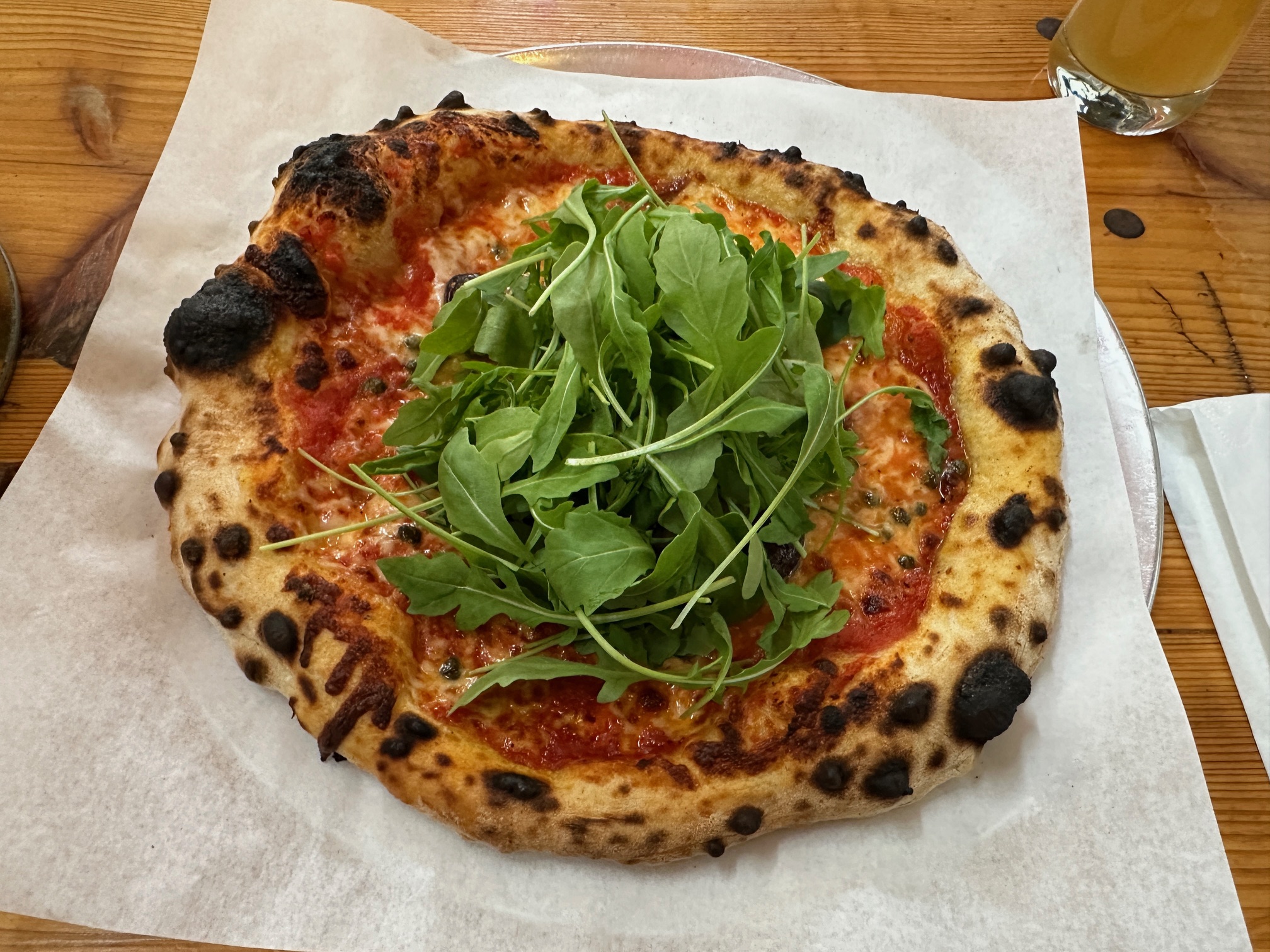
My pizza arrived just over ten minutes later, although I was having such a lovely time that I’d quite happily have waited longer. It came on a metal tray, à la The Last Crumb, but they’d sensibly put paper underneath it which also helped it stay warm longer. Sartorelli’s just gives you a pizza cutter, a napkin and some chilli and garlic oil, so if you’re a cutlery user, their pizza might challenge you. And this was the point where I realised I had completely missed the fact that, on the menu, my pizza was billed as coming with a “sprinkle of rocket”. It was a nice idea, but it was more than a sprinkle, and without cutlery it added a layer of complexity to eating the thing with your hands.

Initially I also wondered whether the rocket might have been used to camouflage the toppings, to conceal any caper or (especially) anchovy-related stinginess that was going on. But once I settled down to eating the pizza, I realised nothing could be further from the truth. It was liberally carpeted with tiny, punchy capers, had a respectable number of plump black olives and, most importantly, plenty of glorious, salty anchovies.

Not only that, but the base was excellent – especially the crust, all blistered, puffy and chewy. I was having an absolutely marvellous time: a bite of the pizza, a sip of the gorgeous beer, an unworthy look up at the queue, still growing, and I felt like I was properly winning at lunch.

I should have stayed for a dessert, really – it’s just ice cream, which they say is “hand crafted to a secret Sartorelli recipe” – but I had my eye on something from Swoon on the High later on, and I also felt guilty depriving punters of a seat. So I ambled off to the Oxford Cheese Company to pick something up for the evening, and then wandered out towards North Oxford in search of one of my favourite pubs in the whole wide world, the Rose And Crown.

I have broken one of the unspoken rules of restaurant reviewing by reviewing the same kind of establishment two weeks running. Last week was Zia Lucia, this week it’s Sartorelli’s: it’s the equivalent of putting two consecutive tracks on a mixtape by the same artist. But I think it’s very instructive in some ways because restaurants aren’t only about quality, or value, or service, or even convenience. They’re also about expectations, and whether they can surprise or delight.

So I expected Zia Lucia to be something special, and although you couldn’t fault their tomato sauce, or their Parma ham, the overall experience was a little underwhelming. And yet on a wooden stool, at a trestle table in the middle of the Covered Market I had a pizza from a place that didn’t shout or brag, but just did an absolutely marvellous job. Excellent craft beer from a place two doors down, a little people watching and hubbub, and an excellent lunch that, all told, set me back just under fifteen pounds.

Experiences like that are reason enough, if you find yourself at a loose end on a Saturday, to hop on a train and take your chances. I’m very glad I did. Besides, I’m asked quite often whether there’s anywhere decent to go for an informal, quickish lunch in Oxford, and now I have an answer for you. I may not have any great life lessons to impart to you – although my stepmother’s rule of thumb is a very good one – but you can usually rely on me for a restaurant recommendation.

Sartorelli’s – 7.7
21, Covered Market, Oxford, OX1 3DZ

https://www.sartorellis.com/sartorellisoxford

Restaurant review: Pierre Victoire, Oxford

I had to check because I thought my mind might be playing tricks, but there used to be a French restaurant chain called Pierre Victoire, the Côte of its day, thirty years ago. I remember eating in the Nottingham branch when I lived there at the turn of the last century, and I’m pretty sure Reading had one too. Perhaps readers with even longer memories than mine can correct me if I’m wrong, but I seem to recall it was on St Mary’s Butts, where Favourite Chicken is now. Anyway, also around the turn of the century the chain went bust leaving just one outpost, on Little Clarendon Street in Oxford, as the only survivor.

And it’s still going strong.

It’s approaching its thirtieth birthday in a couple of years, and I can’t remember a time in my restaurant-going life, really, when it wasn’t there. It’s been an ever-present across the past two decades, constant as my life has shifted and changed, and I’ve had countless lunches and dinners there, with family and with friends. Back when I didn’t review places outside Reading, it was my venue of choice for eating in Oxford, especially pre-theatre before watching something at the wonderful Oxford Playhouse. But there were more than a few boozy evenings there too: I still remember the horror and confusion of an American friend I lost in the divorce, trying snails for the first time.

Just as my life has changed in that time, the topography of Oxford has too. Little Clarendon Street used to be the epicentre of Oxford, for me, where everything was going on. It had Pierre Victoire, a great little tapas place next door and ice cream café George & Davis opposite, a brilliant interiors shop called Central and another little shop across the way called Ottoman selling cool bits and bobs. At night it was criss-crossed with fairy lights, just a magnificent place to be.

And then the years intervened and other parts of Oxford got more interesting – Jericho just around the corner, Summertown further north, the explosion of interesting restaurants and coffee down the Cowley and Iffley roads. I found myself more likely to have lunch at Arbequina and coffee at Peloton, or to amble down North Parade before a reservation at Pompette. The Westgate, a shopping development that makes the Oracle look sad and tired, altered Oxford’s landscape too. Little Clarendon Street by contrast didn’t really change, both its biggest strength and weakness.

But in recent times the pendulum has swung back, and heading to Pierre Victoire last Saturday for a late solo lunch I was struck by the fact that Little Clarendon Street is having another moment. Central may have closed, but next door social enterprise and excellent café Common Ground was doing a roaring trade. Across the way, The Jericho Cheese Company was full of lactic treats to take home and newish bottle shop and restaurant Wilding, where the Café Rouge of my student days used to be, looked very tempting. And there, familiar and unchanged, was Pierre Victoire: I was surprised by how gladdened I was to see it.

Pierre Victoire only opens for lunch Friday to Sunday nowadays, and it’s a tribute to how popular the place is that when I rang in the week to make a lunch booking pretty much all they had left was a table at quarter to two. And the place was humming with life and conversation when I stepped through the front door. The ground floor dining room goes back a long way and I seem to remember they have another dining room upstairs, or they certainly used to. I’m pretty sure these bare brick walls predate any trend for exposed bricks: it’s that sort of place.

But the tables at the front, with daylight, are the plum ones. Mine, literally tucked behind the front door, had “table for one” written all over it but gave a great view of the room and the happy diners of North Oxford. A table for six was making a meal of settling their bill, and the staff were perfectly attentive and friendly, showing no frustration. A steady stream of diners came in even after me – some with bookings, others chancing their arm on spec. All of the latter were turned away: an establishment this busy at 2pm on a Saturday afternoon has cracked something which eludes many restaurants, including a lot of the ones I review.

Pierre Victoire offers a prix fixe menu for lunch and dinner, and they differ slightly in terms of how much choice you get and the type of dishes: for instance, duck confit is on the lunch menu, while it’s magret de canard for dinner. The price varies too – lunch is about twenty pounds for two courses and twenty-five for three, whereas dinner is closer to thirty and thirty-five. Back when Pierre Victoire was open for weekday lunches I think it was even more affordable, but back when Pierre Victoire was open for weekday lunches literally everything was more affordable: I’m not sure how helpful that comparison is, really.

In any event the menu was full of French classics, many of which I’ve tried over the years – onion soup, chicken liver parfait, moules, escargots, steak frites and so on. I was a little jaded after an evening on the wine with a friend the night before, so I swerved the wine list on this occasion and instead opted for a fortifying Orangina. It came in the classic, original bottle and I wondered, short of Perrier and Fanta Limon, whether any non-alcoholic drink had as great a capacity to transport you as Orangina does. My body needed the sugars, that was for certain. The staff also brought a jug of iced tap water without me having to ask. Either they do this as standard or I looked as off the pace as I felt: either way, it was appreciated.

The other thing they always bring without you having to ask at Pierre Victoire is bread. Not ubiquitous sourdough: sourdough has completely passed Pierre Victoire by, or rather it’s above such things. No, you get a little basket of cheap, plain baguette with some decent butter which came out of the fridge a little too recently. But it’s always ambrosial; like the Orangina, like the hubbub, there’s something of elsewhere about the whole thing. You’re simultaneously mentally very much in Oxford and across the Channel, both of which are pleasant experiences.

My normal order at Pierre Victoire would be the chicken liver parfait, which comes in a little sphere with brioche toast and sweet, sticky, jammy red onion. But I was trying to be less predictable for once, so I chose the one vegan dish on the menu, a fricasée of mushrooms. It came out mere minutes after I’d ordered – I’d forgotten how brisk, how well oiled a machine Pierre Victoire is at lunchtime – and was a lovely and delicate piece of work. The decision to put it in a little chalice of filo pastry was a clever one which added texture, as did resting the whole lot on what I assume was a splodge of butternut squash purée.

I wasn’t sure about the tangle of pea shoots – one or two restaurants I love tend to overuse these as punctuation and I wish they wouldn’t – but overall it worked nicely. The mushrooms themselves, a mixture of wild and button if the menu was to be believed, were in a sauce with cognac and a little sweetness, but I found it slightly thin. It needed the cosseting touch of cream, I reckoned. But then it wouldn’t have been vegan, and that was the box it was ticking on the menu. Even so it was polished off in minutes, and there was just enough bread to mop up the last of the sauce.

If I’d chosen a curveball as a starter, I played safe for the main. I don’t think I’ve ever been to Pierre Victoire for lunch and not seen duck confit on the menu, and it’s rare for me not to order it there. I don’t understand why more places, especially pubs, don’t serve duck confit: it’s so easy to get right and such a joy to eat. There’s always plenty of meat, it always falls off the bone to the point where picking it clean is a meticulous delight and, done well, you get that crispy skin and that subcutaneous, glossy fat. Confit duck, as it happens, is one of the options on the menu for my wedding later in the year, and it will take all my strength not to pick it.

I really love how Pierre Victoire serves duck confit, too, with just the two accompaniments. A brick of rosti, which in this case was maybe a tiny bit too soggy and not crispy enough, and a bitter orange sauce which brought everything together beautifully. Good luck finding duck à l’orange anywhere on a menu these days – it’s one of those relics of the past, at least in this country – but Pierre Victoire’s smart, affordable take on it is all you really need.

It was a perfect, simple pleasure and it made me very glad to be at that table, in that room, in that restaurant, in that city, exactly where I should be. My paperback (an Anne Tyler I’d never read) stayed untouched throughout my meal because when I wasn’t eating, or taking pictures, I was too busy enjoying where I was. Watching the staff, so on it and so harmonious, always in control without being mechanical. And looking at my fellow diners, imagining their stories and their lives outside this little parcel of Saturday afternoon where we all happened to be in the same place.

As I said, Pierre Victoire is nothing if not efficient – I’d be surprised if I was the first customer at that table that lunch service, and I saw other tables turned while I was there. But they never made me feel processed, and I gave the dessert menu serious consideration before deciding to settle up. It’s more compact than the choice for the other two courses, and a crêpe au citron called to me, but not loud enough. My bill for the two courses and that iconic Orangina set me back twenty-two pounds fifty, not including tip. Pierre Victoire maybe isn’t the bargain it once was, but I’m not sure I want restaurants I like to be bargains any more. I want them to survive.

Don’t be fooled by the rating below (I know you’ve probably already scrolled down and checked). Yes, I gave Pierre Victoire a 7.3, but what I would say is that there are 7.3s and then there are 7.3s. There are the expensive restaurants where dinner or lunch costs you the best part of three figures and you think “well, it was okay”, and there are cheap and cheerful places where you come away thinking that your hosts have surpassed, or possibly even transcended, your expectations. And yet Pierre Victoire, would you believe, is neither of those things.

No, what Pierre Victoire is is that rarest of beasts, a truly consistent restaurant. I can honestly say that the last time I went there was every bit as good as this time – and not just that, but every bit as good in exactly the same way. The time before was too, and I dare say the next time will be as well. And there will be a next time, the next instalment in a series of meals that started something like twenty years ago and, if I’m lucky, will go on for many more.

Your mileage may vary, but for my money that’s worth a dozen culinary comets or flashes in the pan. I’d say that every town should have a place like Pierre Victoire, although travelling to Oxford is really no hardship. And I’d almost go one step further and say that every town should have a Pierre Victoire, but that’s dangerous nonsense: it is, as we know, how chains get started. Pierre Victoire doesn’t need that. It’s already been there, done that, got the t-shirt – and then moved on, a long time ago, to far better things.

Pierre Victoire – 7.3
9 Little Clarendon St, Oxford, OX1 2HP
01865 316616

https://pierrevictoire.co.uk