“I bet the word most overused in restaurant reviews is nice,” said my old friend Mike. We were sitting in the Rising Sun’s courtyard, the sun blazing down, drinkers and diners packed into the al fresco space, our empty starter plates in front of us. The starters had been, well, nice.
“I used to have a friend who said that about everything. Yeah, it’s nice. He said that about beers, about restaurants, you name it. And it wasn’t that he liked everything, it’s just that he didn’t have opinions about anything. With hindsight, not a massive surprise that he was a LibDem.”
“You say it when something’s pleasant, but if something’s bad and you don’t want to say so, you’d also call it ‘nice’, wouldn’t you?”
“Maybe, but the word I always overuse is lovely. When I write a review I go back, hit Ctrl-F and find every reference to lovely, try and reduce it to one per review.”
I do, in truth, not always succeed. Our philosophical discourse was interrupted by our very pleasant, distinctly overworked server coming to take our dishes away. “Did you enjoy your starter?” she said.
“Yes, thank you. It was lovely” I said. Mike raised an eyebrow as she walked away.
“See, you’ve used your one lovely up already.”
Subscribe to continue reading
Become a paid subscriber to get access to the rest of this post and other exclusive content.
In 2013, the first year of this blog, I reviewed the grand total of fourteen Reading restaurants (don’t hold it against me, I only started in August). And there must have been something about those very first venues, because the majority of them are still going strong: Picasso, The Warwick, The Lobster Room, Kyklos and Forbury’s are no longer with us but the other nine are still going over ten years later. I won’t list them all because I don’t want to jinx anything in the here and now – 2024 is hard enough as it is – but you get the idea: for those restaurants still to be trading, a decade on, is truly no mean feat.
But time has passed and those reviews have become increasingly out of date; they might have reflected what a restaurant was like back in those days, when I wasn’t yet forty and mistakenly thought I had the rest of my life figured out, but you couldn’t necessarily use them now with confidence. So over the last couple of years I’ve been gradually revisiting the survivors from the class of 2013 to write new reviews and see how it all went so gloriously right. And generally, with the exception of Zero Degrees, I’ve had some good meals in the process.
Not only that, but I’ve left some of those Reading institutions delighted that they’re still with us. In a world where everything seems to change beyond recognition, more and faster, with every passing day, I was relieved to find that London Street Brasserie, for instance, was still a reliable benchmark in the centre of town. I was pleased that Pepe Sale, at the time freshly under new management, was recognisable as the place I had so loved on my first ever review. And returning to Café Yolk I found that the slightly iffy brunch place I wrote off eleven years ago had blossomed into a polished and Instagrammable performer.
All those places were older and wiser, as you would expect: I, on the other hand, was probably just older, but you can’t win them all. And that brings us to the subject of this week’s review, The Moderation, a place I really should have revisited long before now. When I went there in December 2013 I remember thinking they’d had an off night, because I’d eaten there a few times before that visit and always enjoyed it. I tried to say something to that effect in my review, but ultimately I was a little underwhelmed.
Back then the Moderation was part of a little chain, under the name Spirit House, along with the Warwick Arms on Kings Road, now closed. I’m pretty sure that at one time or another that group also included The Queens Head up on Christchurch Green and even the Lyndhurst, in a far earlier incarnation. The theme with those places was that they did pub food with a sideline in Thai food, as was the fashion ten years ago, and when I went to the Moderation on duty I found it a little unspecial, not bad by any means perhaps not quite as good as the Warwick in the centre of town.
In the intervening ten years I’ve been back a few times, but only really for drinks. I’ve always had a soft spot for the Moderation’s garden, a natural suntrap that never seems to get the plaudits it deserves, but the location has always been a little tricky for me: if I’m in that area I’m probably at Phantom instead, and if I was crossing into Caversham I’d wind up at the Last Crumb. So despite being fond of the Moderation I’ve made it there rarely.
I’m also not sure I’d have been entirely welcome there anyway, because I blotted my copy book with them a few years ago. It was in the run up to the 2019 General Election, when the Tories had selected car crash candidate Craig Morley to fight Reading East and he turned up in the constituency, not a place he knew well by the sounds of it, with Sajid Javid for a spot of campaigning. They were photographed pulling pints behind the bar at the Mod before scooting over to the Caversham Butcher, presumably to massage some gammon, and I’m afraid I might have been less than my usual diplomatic self about that on social media.
Anyway, there’s been a lot of water under Caversham Bridge since then. Craig Morley is now just a surreal footnote in Reading’s history, I’ve been known to purchase the occasional sausage at the Caversham Butcher and I reckoned it was about time I reassessed the Moderation. After all, Alok Sharma visited But Is It Art in the summer of 2020, maskless, less than a week after displaying Covid symptoms in the House Of Commons, and I still buy all my birthday cards there. So last Saturday I headed there with my old friend Dave, visiting from sunny Swindon, to honour a reservation we’d made – in his name, just to be on the safe side.
Subscribe to continue reading
Become a paid subscriber to get access to the rest of this post and other exclusive content.
I still remember the first time I gave out a really good rating on this blog. It was towards the end of 2013, when we were all a lot younger and more carefree, and my blog had been running for just over three months. I wasn’t drunk on the power (next to nobody read the blog in those days) but even so giving out a rating in the high 8s felt like a proper stake in the ground. This is my kind of thing, that rating was saying. Go here on my recommendation and I promise you won’t regret it.
Ten years on, unlike a lot of restaurant reviewers who think their pronouncements should be on tablets of stone – why do so many of them write like they’re on coke? – it still feels like a big thing to say. And a presumptuous one, too: for me, that trepidation about writing a rave review has never quite gone away. Nor has the euphoric relief when anybody visits a restaurant on the back of one of my reviews and tells me they didn’t hate it, let alone loved it. I know the blog’s free, so nobody can ask for a refund, but I can’t give anybody back the money they’ve wasted on a bad meal.
The recipient of that first rave rating, a rating that wasn’t beaten for two whole years, was a gorgeous pub called the Plowden Arms in Shiplake. Run by married couple Matt and Ruth Woodley, it was the most beautiful spot – snug in the winter, with a fantastic garden in a little corner of South Oxfordshire for the summer. The crockery was vintage before everyone jumped on the chintz and retro bandwagon, the menu revived classics from the pages of Mrs Beeton and there was 20s jazz playing all the time. I adored it, and I went there often – with friends, with my partner, with my family, with anybody I could persuade to head to Shiplake.
Just over three years later, the Woodleys left the pub. It reopened under new management, but it wasn’t the same. You looked at the menu and thought that food was just something the management thought it should offer, all function and no passion. It was the first in a long string of disappointments, of places that had the temerity to close despite my loving them. Since then there’s been Dolce Vita and Buon Appetito, and soon there will be the Lyndhurst, but that first one stung. I wish I’d gone more often. As Andy Bernard says in The Office – the funnier version – I wish there was a way to know you’re in the good old days before you’ve actually left them.
When it closed two years later, I wasn’t surprised. It sat vacant by the side of the road, and for a while it looked like it would just be the latest pub to turn into accommodation, the latest community to lose a hub and gain a handful of extra residents with nowhere to drink. It was empty throughout Covid, but then in summer 2021 there was an interesting development: the owners of nearby Orwells announced that they had saved it from near-certain demolition and were going to open it as The Plough in early 2022.
That news was welcomed beyond the narrow confines of Shiplake: Orwells has a lot of fans, and I’m sure they liked the idea of a more affordable, more casual venture from the same people. But then something strange happened in 2022. The Plough didn’t open early that year and at some point – I suspect we’ll never know exactly why – Orwells dropped out of the picture. But the Plough did open, just before Christmas 2022, owned instead by Canadian-born Jill Sikkert, her first hospitality business after a career in interior design. Last month she appointed a new chef, Charlotte Vincent, who has been on Great British Menu and got one of her previous venues into the prestigious Top 50 Gastropubs list four years ago.
All very impressive: who needs Orwells anyway? But I would be the first to admit that the revitalised Plough isn’t the kind of venue I would normally review. A lot of that’s down to accessibility: I know that the countryside around Reading has plenty of food pubs which ordinarily would interest people, like the Dew Drop Inn at Hurley, the Crown at Burchett’s Green or even the Wellington Arms at Baughurst. But as a non-driver who relies on public transport they don’t generally fit my catchment area, so you’re more likely to hear about restaurants near a train station, like Seasonality.
Besides, you don’t need me for those kind of places because they’re the province of the website Muddy Stilettos, which you may know. They love rural gastropubs, and they gush about them in their weirdly infantilised language where things are “yummy” or “scrumptious” and go in their “tummies”, where food and drink are summed up as “scoff and quaff”. Apparently if you like this kind of restaurant you also like twee: I even read one review which referred to something called a “Michelin twinkler”, presumably this is awarded when your scoff and quaff are particularly yummy and scrumptious. Goody gumdrops!
If I say more about Muddy Stilettos – especially that their annual awards are an exercise in epic grift where they get small businesses slogging away to promote their website while giving back nothing in return – I’ll probably get in trouble, so let’s move on. I found myself reviewing the Plough because a very good friend got me one of their vouchers for my birthday last year, so Zoë and I finally found an opportunity to get there on Good Friday, at the end of our holiday, literally days before it expired. So I suppose, technically, I only paid for part of my bill: I wonder if that gives me something in common with Muddy Stilettos?
The makeover the Plough has received is quite something. In its previous incarnation it looked like a pub, like a beloved local that also happened to serve food. Now it is a really gorgeous series of rooms – you can tell Sikkert has a background in interiors – that take advantage of the pub’s good bones, its bricks and beams and parquet floors, but create something much more luxe. That said, the chairs looked better suited to lounging than dining, but that’s probably just me being a bit old-fashioned.
We were seated in a room I remembered well, having eaten in it many times when it was the Plowden Arms, and yet it felt completely familiar and totally different all at once. Even though it was the end of March there was still a nip in the air and the fire was burning, and it felt properly comforting: I can’t wait for summer to come, but I’ll miss the smell of woodsmoke.
The menu is written in that way that was modish a few years back, listing ingredients but nothing else: sea trout pastrami, mussel, apple gremolata, that kind of thing. I know this annoys some people but it didn’t bother me – it was more detailed than other examples I’ve seen and, besides, a little element of surprise when you order dishes can add to the experience. Perhaps I’m just getting soft.
As is the fashion there were snacks, starters, mains and desserts – most of the snacks just over a fiver, the starters just over a tenner, the mains between twenty and twenty six pounds, desserts a tenner. You’ll have your own views about whether that’s steep, but I compared it to what things cost at London Street Brasserie these days and decided to judge it at the end, not the outset.
There’s also a no-choice set lunch menu, twenty-seven fifty for three courses, which didn’t overlap with the main menu. But in honesty I think if you’re going to only offer one option on a menu it has to be more interesting than the likes of swede and carrot soup, so I gave it a miss. The Plough could learn from the likes of Quality Chop House, whose set lunch costs about the same and seriously makes you consider swerving the à la carte. Besides, that voucher was burning a hole in my satchel – in for a penny, in for a pounding, as my fiancée likes to delicately put it.
We got some snacks while we made up our mind about everything else, and they were the first indicator that it wouldn’t all be plain sailing. Homemade focaccia/blue cheese butter was the first thing we tried. Now, I don’t object to minimalist wording provided there isn’t anything significant in the dish it neglects to mention, and so long as what you’re told will be there is actually present and correct.
So the menu really should have said homemade bread/garlic butter, because that, weirdly, is what I got. The picture below is one of the dullest ever to grace my blog, but I put it there for a reason, to demonstrate that this bread wasn’t springy or spongy or aerated. It wasn’t open-crumbed at all. It wasn’t permeated with olive oil, it didn’t have salt or rosemary or anything else to zhuzh it up. The reason it was none of those things is that it wasn’t focaccia.
It was, instead, perfectly serviceable bread. And as for the butter – well, we went from the blue cheese in this must be very subtle to there’s no blue cheese at all in this, is there? before ending up at isn’t this garlic butter? The menu wasn’t just economical with words, it was a little economical with the truth too.
The second snack was a lot more enjoyable. I’ll do away with the stripped down wording from here on in, but this was a clump of battered, fried enoki mushrooms, strewn with shoots, more mushrooms (pickled, I think, but my mind might be playing tricks) and a little Walnut Whip of mushroom ketchup. This was far more like it – wild mushrooms cropped up in a few places on the Plough’s menu, and the mushroom ketchup, lending gorgeous depth, was the star of the show.
But at the risk of nit picking again, the ratio of the enoki to batter was so out of kilter that I felt like I was eating a savoury churro that just happened to have a tiny bit of mushroom in the middle. That said, if it had been described as that on the menu I might still have ordered it. Anyway, it was only a fiver.
The starters proper were more successful, and started to give me an idea of what the kitchen could do. My pork terrine wasn’t bad – a slab of pork, bound up with jamon iberico and strewn with gubbins – cups of onion with thyme crumb nestling in them, and more of those little shoots. I would have preferred some acidity in the mix – a piccalilli, or some caperberries – and without them it was nice but a little well behaved for my liking. A tad too fridge-cold, clean and pristine where it needed to be gutsy.
This came with what was billed as sourdough bread – I wasn’t sure it was sourdough but if anything, it was more open-textured than the focaccia had been. This dish felt sanitised, but it would probably have been a hit with the Muddy Stilettos crowd – every time I read a review by them, the reviewer practically apologises for having three courses and makes a tired joke about undoing the top button of her trousers. I never feel like I have to apologise to you lot for ordering too much food: it’s one of the reasons I’m so fond of you all.
Zoë had chosen scallops, a couple of plump specimens in a puddle of dashi beurre blanc, topped with some kind of sea vegetable whose name I’m sure I used to know but have since forgotten. I wouldn’t have ordered this – I’m not sure beurre blanc is improved by cross-pollinating it with dashi – but Zoë really enjoyed it. Unfortunately I wasn’t allowed to try any, and when I asked her for a more detailed critique she said “I fucking loved it, I’d order it again, what more do you want from me?”.
This will please fans of her expletives, and I know there are a few of you out there, but probably isn’t of practical help. She did eventually tell me under cross-examination that the scallops were beautifully cooked, the contrasting textures managed just right, but that’s all I have for you.
At this point I was feeling slightly underwhelmed, but the Plough rescued things with two exemplary and very different main courses. Fish and chips – just described as “day boat fish”, so I have no idea what it was – was outstanding. A thick cylinder of pearlescent, just-cooked fish was hugged by brilliant, almost ethereal batter. I was allowed to try a bit and it was miles better than I’d been expecting, and weirdly it made me think of my dad. He has a bit of a habit of ordering fish and chips in fancy restaurants, so I’ve seen him try it at Rick Stein’s place in Padstow, at the Beehive in White Waltham and in my opinion, the Plough’s rendition was better than either of those.
The accompaniments were bang on too – excellent peas which were crushed rather than mushy, and a tartare sauce Zoë could tolerate, which meant that it wasn’t quite vinegary enough for me. Having it with fries, although that was clearly communicated on the menu, felt a little strange to me. They were very good fries but, in an inversion of how I feel every time I look in the mirror these days, I’d sooner they had been chunky rather than skinny.
If that covers the pub classics end of the menu, my choice was cheffier and one of the best plates of food I’ve eaten this year. Lamb rump was just stellar – thick and tender, accurately seasoned, the perfect shade of pink with just the most beautiful stripe of fat, the kind of thing I could eat all day. It came with a little of everything wonderful – more onion, this time smoked, chewy and delectable nubbins of Jerusalem artichoke, a sweet and glossy puree, a little jus and, by the looks of this picture, some extra virgin olive oil thrown in for good measure.
Oh, and I neglected to mention my other favourite part of this dish – described as hash browns, they were a couple of golden pyramids of pressed and fried potato that were worth the price of admission by themselves. I truly loved this dish, and it single-handedly justified the trip to Shiplake. A few forkfuls in and that dense non-focaccia and the slightly timid terrine were completely forgotten. All was forgiven: this dish was twenty-six pounds and, I reckon, worth every penny. Even looking down at the picture I can remember how happy it made me.
As it was a little light on the veg I’d ordered some green beans on the side with pickled chilli and soy sauce. They were well enough executed, the beans with a little bite, but I didn’t think they quite worked: the sauce didn’t adhere, so you ended up with a pool of the stuff at the bottom. I’ll go for the ubiquitous hispi cabbage next time.
We both wanted dessert, which is a good sign, and we both wanted the same dessert. So we had it, unrepentantly and without loosening any garments. Again, it was good but not perfect and again, it wasn’t quite as billed. It was allegedly a dark chocolate cheesecake but, for my money, it wasn’t in any way dark. And texturally I didn’t think it entirely worked – that huge layer of chocolate was a tad gelatinous, the base so heavy and thick that you couldn’t get a spoon through it without risking injury to passers-by.
And again, it was a pity because the minor details were all excellent, from the chocolate soil on top to the blobs of yuzu gel and – especially – the warming, boozy cherries. I finished it, because it’s rude not to, but I would have liked something slimmer and more refined. That is something I often say when I look in the mirror, come to think of it.
Replete and satisfied, we asked for our bill and prepared for the trip home. And it would be remiss of me not to mention at this point that – more than once on my visit to the Plough – Zoë had raved about the bathrooms. “Seriously, you have to go to the loo before we leave” she said. “I think they’re some of the best restaurant toilets I’ve ever seen.” So I did, and they were indeed very chic and the handwash smelled magnificent. But, just as with Zoë and those effing scallops, that’s all I can remember. I wish I’d taken a picture.
Our bill for all that food, a non-alcoholic cocktail called a tropical something or other which Zoë found too sweet (and at nine pounds, a little too rich) and a couple of bottles of sparkling mineral water – because I was on antibiotics – came to a hundred and thirty-eight pounds, including a 12.5% service charge. And it feels like an insult to shoehorn the service in here, between the loos and the conclusion, because it was faultless from start to finish. We had just the right level of attention, enthusiasm and smiles from the moment we were greeted to the point where we said goodbye and went out the front door. It made me think what a boon this place must be to genuine locals, although if you live in Shiplake I imagine you had enough to be smug about even before the Plough came along.
I’ve ummed and aahed since about what I made of the Plough, on balance. In the debit column, some of the dishes were underpowered or didn’t work, and the feng shui menu didn’t always reflect what turned up on the plate. I suppose I compare it in some ways to the robust, magical cooking of somewhere like the Bell at Waltham St Lawrence, and it doesn’t quite match that standard. But on the other hand, some of the dishes were exceptional, especially the mains, and the little touches with much of the food show an imagination which quite won me over. And then there’s the room, the welcome, that open fire and – yes, let’s mention them again – those bathrooms.
But the main thing I took from my trip to the Plough was a feeling of being in really capable hands, of a menu that could please almost anybody and managed to walk that very fine line where it was accessible and clever. That’s not an easy balance to strike, and many chefs or restaurants, despite their best intentions, end up falling clumsily on one side or the other. That the Plough has avoided that pitfall, and that the team have created somewhere so universal but sophisticated is a more skilful trick than you might think.
“This is the kind of place we could take your dad and stepmum” said Zoë in the car on the way back to Reading, and that’s as good a summary of its appeal as I can think of: it might mean more if you’d met them, but hopefully you get the drift. I think you could take anybody here for a meal – either for a special occasion or for no reason – and have a properly charming time.
This might not read like an out and out rave, I may not have talked about tummies or the fact that they might be awarded a Michelin twinkler at some point, but regular readers will know that this is me saying I was quietly impressed. This is my kind of thing. Hopefully, if you go here on my recommendation, you won’t regret it.
I hadn’t been to Bath since before the pandemic, so when arranging a leisurely weekend lunch with my old friend Dave it sprung to mind as a break from the norm. Especially as that norm largely involves him visiting me in Reading and complaining at length that Swindon has nothing anywhere near as good (a hypothesis I tested a few months back: it isn’t the whole story).
My relative ignorance of Bath is largely a consequence of the ridiculous train fares: it costs pretty much the same exorbitant amount to sit on the train for fifteen more minutes and get off at Temple Meads, so that’s what I’ve done every time. And otherwise I usually go to Oxford, which as we’ve established is cheap, convenient and full of good places to eat. But I’ve been hearing an increasing buzz about a number of interesting restaurants springing up in Bath, so I thought this would be an auspicious opportunity to try somewhere properly new for a change.
But where to go? Even a little research uncovered an embarrassment of riches. There’s the likes of Upstairs At Landrace and Beckford Bottle Shop and Canteen, which have attracted the attention of various broadsheet hacks, and Wilks, the formerly Michelin-starred former Bristol restaurant which has recently relocated. There’s excellent fish at the Scallop Shell, or wine and small plates at Corkage. And finally there’s Chequers (not The Chequers, if their website and social media are to be believed), a gastropub near the Royal Crescent that won a Bib Gourmand from Michelin this year.
Well, I say finally but actually the list goes on and on: I could also have gone high end at The Elder or institution Menu Gordon Jones, or eaten more casually at any of Pintxo, Bath’s branch of Bosco Pizzeria, Yak Yeti Yak (which celebrates its twentieth birthday next year) or much-loved Italian Sotto Sotto. Why had I never reviewed anywhere in Bath before? And why didn’t it have a restaurant blog of its own? It was baffling.
So why Chequers this week? Well, I’d like to say that it’s because I reviewed all the options and wanted somewhere classic and timeless, untouched by the ebbing tides of small plates, natural wine and craft beer. I’d like to say, as I have before, that the Bib Gourmand remains, in this country, far more useful than stars or the Top 100 Restaurants or Gastropubs or the proclamations of some blogging tosspot or other.
But in truth I went to Chequers (the lack of a The is going to get annoying, I can tell: we’ll get through it together) for a far simpler reason. I gave a list to my friend Dave, asked him to pick and he chose Chequers because it was the only only he had been to before. In hindsight, I probably should have predicted this outcome: Dave has raised risk aversion to an art form, never encountered an airport he didn’t want to arrive at four hours before his flight was scheduled to take off. He is a man who uses the L word constantly with his wife and all his close friends: unfortunately, it stands for logistics.
Anyway, from the outside it was hard to imagine it could be a bad choice. It’s in a particularly attractive part of the city, just off from the beautiful Georgian sweep of The Circus, and Rivers Street is so fetching that even before I’d set foot through the front door of Chequers I found myself wishing it was my local. And inside it was all tasteful and classy, wood-panelled walls in muted Farrow and Ball shades and a stunning parquet floor. I say I wished it was my local, but I couldn’t say whether it was one of those gastropubs that was still a pub, or whether you’d have to be eating to pay it a visit.
Not that it mattered in our case – my friends Dave, Al and I had made our way there with one thing on our mind: luncheon. We were given an especially nice table in a little three-sided nook off from one of the two dining rooms, with comfy banquettes and a nice view out across the pub.
The menu, too, was more cheffy than pubby. The only real concession to pub food was the presence of burger and chips or steak and chips, but other than that it was a real beauty pageant of great sounding dishes, all of which you could comfortably order. On any other day I could have been telling you about the octopus with romesco, or the thyme roasted bone marrow, the saag aloo fritters or the pork tenderloin with Stornaway black pudding. Starters jostled around the ten pound mark, mains ran a much wider gamut from seventeen to thirty.
So agonising choices all round, posed by a kitchen that seemed, on paper at least, to know exactly what it was doing. And although I’d say most of it was squarely Modern European, little hints – a ponzo cured yolk here, tamarind glazed oyster mushrooms there – spoke of a little culinary wanderlust.
Matters were further complicated by a specials board including roasted monkfish tail with sobrasada, or brill with seaweed butter. Fish courses were well represented in general and I should also add, because I never talk about this enough, that there were two credible meat-free options for both starters and mains, more than half of which appeared to be vegan.
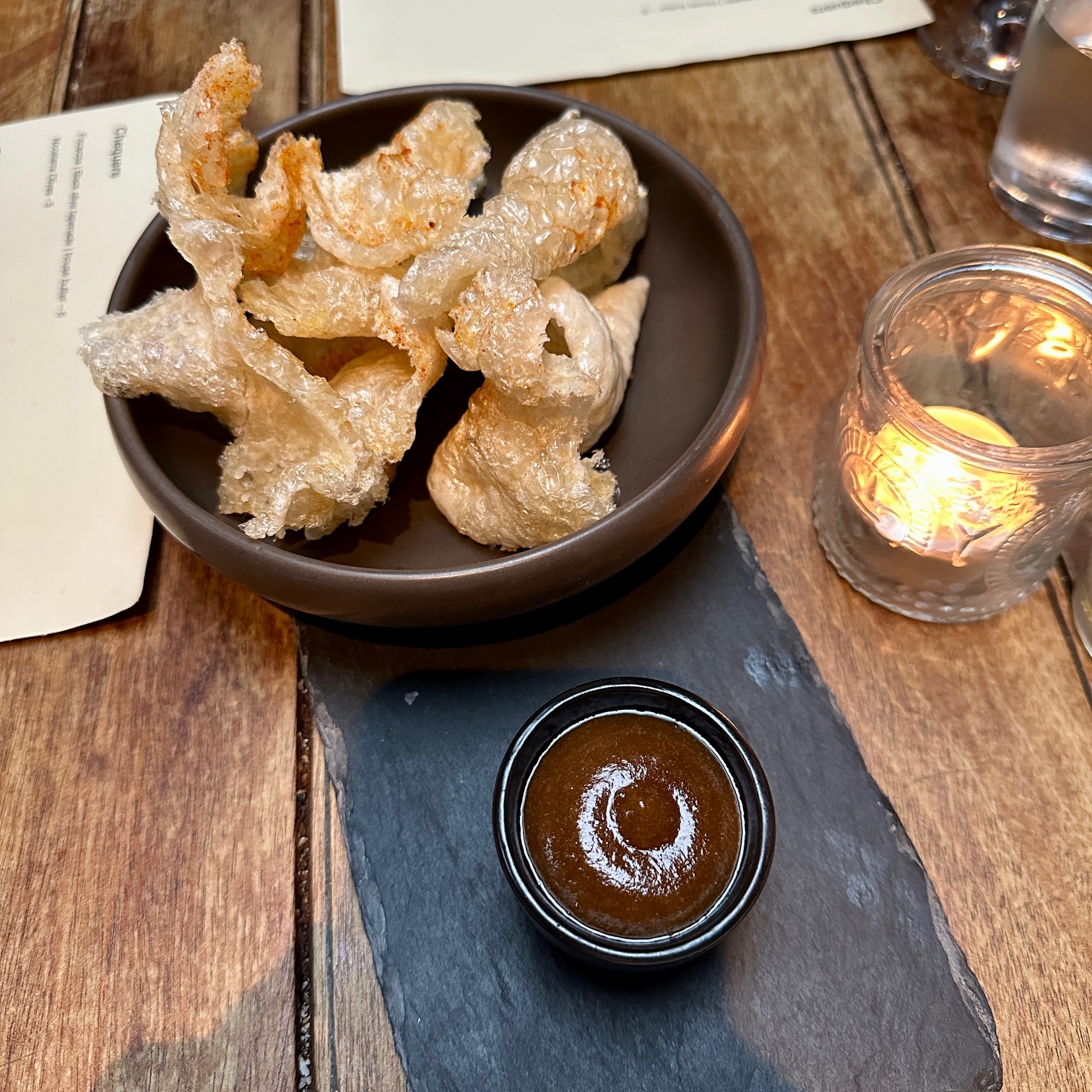
We had plenty to catch up on, so it was some time before we got our shit together and placed our order. But in the meantime we occupied ourselves with a snack from the specials board, pork scratchings with apple compote. These were wonderful, light, Quaverish things which were somehow completely lacking in grease but still left your fingers shiny by the time you’d finished.
If I was being pedantic I’d say these were more pork rinds than pork scratchings, but it’s not like I was demanding a refund. The apple dip, almost a deep, fruity ketchup, went brilliantly. Our server had brought over a bottle of Fleurie, the fancy face of Beaujolais, and it was absolutely divine with enough complexity, we thought, to stand up to what we planned to order. We clinked glasses, with a good feeling about what lay ahead.
One thing Dave loves even more than logistics is venison, so when the menu offered multiple opportunities to eat it he was dead set on taking those opportunities. I might have inwardly rolled my eyes at him – predictable, risk averse Dave – and then he showed me up as the judgmental twat I am by ordering a phenomenal dish. A solitary venison faggot, deep and delicious, was plonked on a puddle of parsnip puree, itself ringed with jus, and crowned with parsnip crisps.
But the thing that made this so enviable was the salsa verde which anointed it. Venison with dark fruits or chocolate is a tried and tested way to tease out the characteristics of that singular meat. But salse verde? A new one on me, and downright brilliant. Dave claims he let me try some for completeness’ sake, for the review. But I think he just wanted to provoke starter envy.
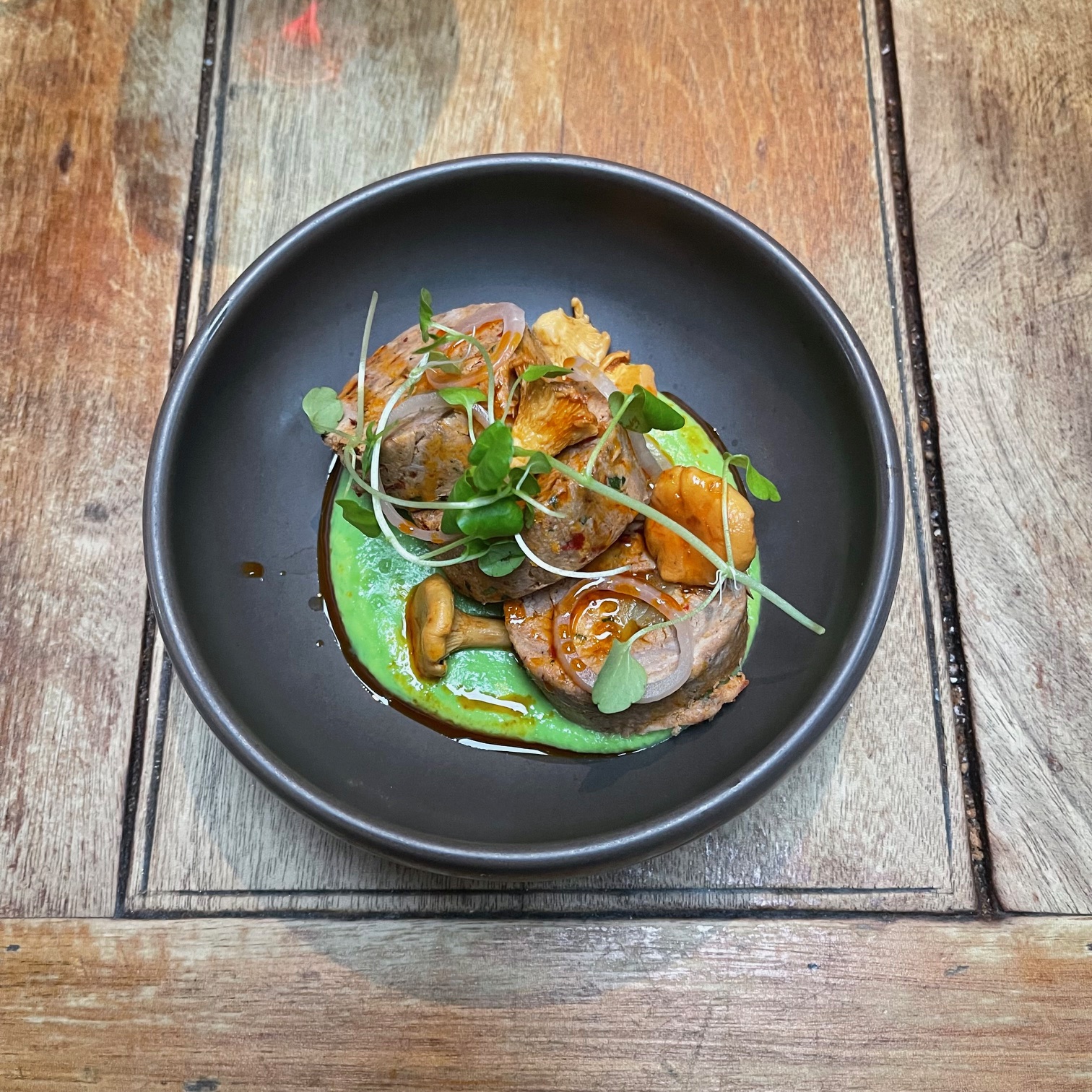
I couldn’t complain too much, though, because Al and I had both plumped for an equally admirable dish. Lamb neck terrine (which we couldn’t help but pronounce as nectarine to our server, with predictably unamusing consequences) was a really wonderful, earthy choice. But that denseness was offset with a superb lightness of touch elsewhere.
Pea purée, all hyper-saturated colour and high-contrast flavour, was a perfect accompaniment. The terrine was studded with cubes of confit aubergine and the whole thing was set off with a tumble of girolles. The menu said they were pickled, but if they were it had been done very subtly. This cost nine pounds, and was every bit as tasty as it was decorous.
Now, normally my rule when I go on duty is to order something different from my companions. But I was feeling mutinous that day, no doubt a hangover from week after week of sitting across the table from Zoë watching her demolish my first choice on the menu, so for once I decided to go easy on myself and order the venison, as I knew Dave would do.
And as it turns out Al went for the same thing too, which I think amused our server. She was brilliant throughout the lunch by the way – fantastic at looking after us, hugely engaging and clearly enthusiastic about Chequers and what it does. She twinkled indulgently at the three of us from start to finish, although whether it was from genuine entertainment or pity I suspect we will never know.
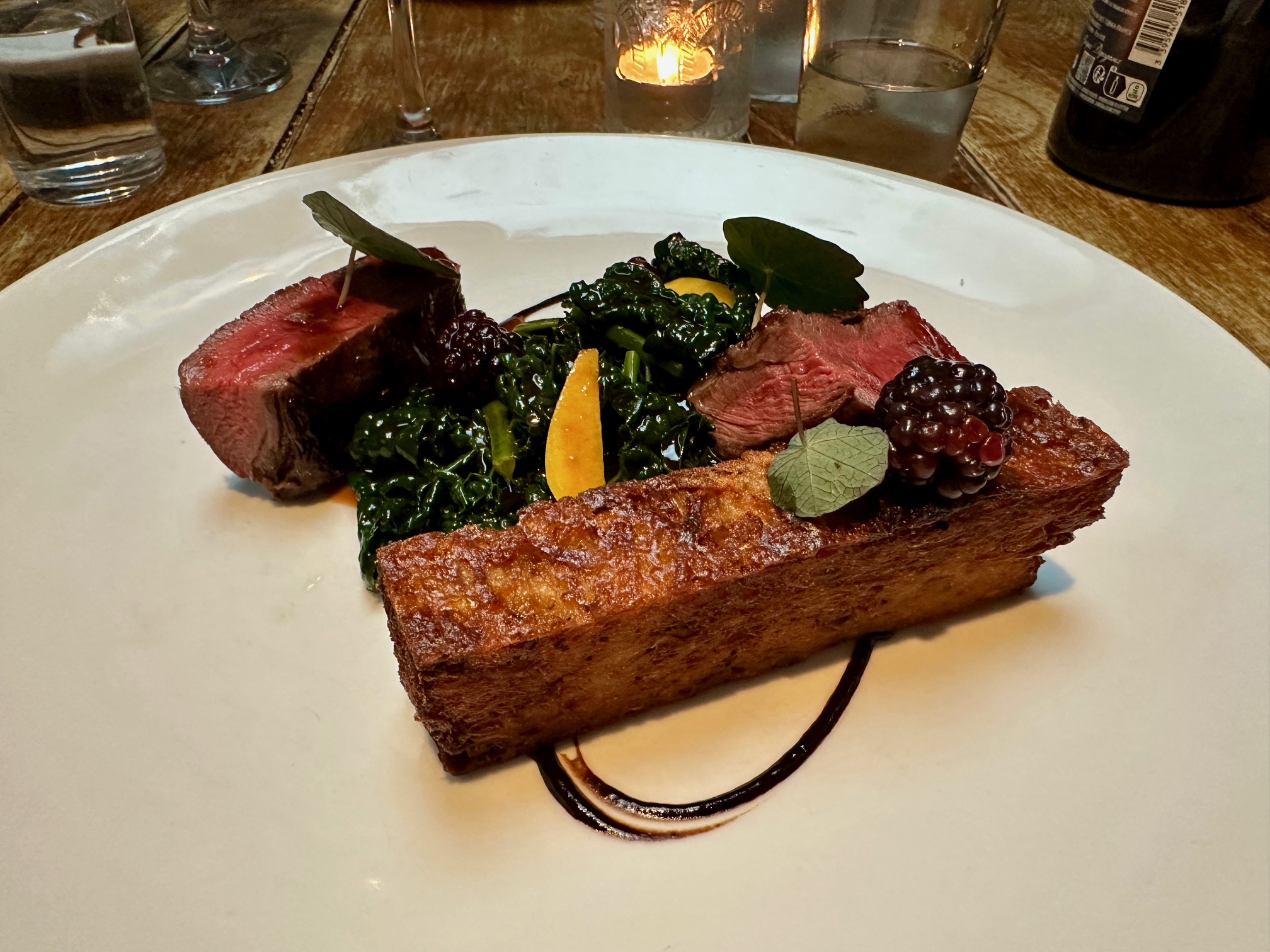
So was the venison good enough to justify three separate orders? Well, it depends rather who you ask. Dave loved it and demolished it without complaint, Al did too. I was slightly more circumspect. Although I’m not sure why because every component worked. On paper it was a smash hit, the loin beautifully cooked, still a ruddy pink where it should have been.
And the cavolo nero was a ferrous joy – it’s one of my favourite veg and a surefire sign that autumn is well under way, even if it was still warm outside in November. Little wedges of golden beetroot and scattered blackberries added earthiness and sweetness. But the real star of the show, billed as a hash brown of all things, was a hefty brick of shredded potato, pressed and fried until burnished and crispy, a proper golden wonder. I found myself enjoying this more than the venison, although I don’t know if that was a good sign or a bad one – like it or not, it was the spud I found myself ekeing out.
So why did I like it rather than love it? Well, believe it or not it was a little too restrained for me. The jus, such as it was, was gorgeous (black garlic was involved, apparently) but the dish needed more of it. Venison is a dry meat at the best of times and this needed more sauce to bring everything together. Without that it was a bunch of well-behaved elements badly in search of an overarching theme (maybe, one day, I’ll make it into Pseud’s Corner).
It was also, at thirty pounds, the most expensive dish on the menu: I couldn’t help thinking of the previous day, when dinner at the Lyndhurst had involved pheasant breast, a croquette of shredded pheasant leg, a slab of confit potato, parsnip puree and a lake of gravy for considerably less money. The Lyndhurst might never get a Bib Gourmand, but for quality and value they can comfortably beat at least one pub that’s got one.
The choice of desserts was more compact than that of mains and starters, and because we all fancied two desserts we picked one each and one to share. The one in the middle of the table was Chequers’ pavlova, made with Pernod roasted fig and granola. I have to say that I’m glad this was the one we shared, because if I’d had one to myself I would have wanted to order another dessert to make up for the disappointment.
I love Pernod, I love figs, I love the sweetness of roasted fennel. This should have been right up my alley, but the Pernod was overpowering, brutally harsh and bitter. I had a spoonful and told the others they were welcome to it. Such a pity, though, because the meringue and the Chantilly cream were both outstanding.
My own personal dessert, although better than that, still didn’t scale the heights. I’m a sucker for a chocolate cremeux, and Chequers’ rendition was a glossy marvel. But serving it with a giant nugget of honeycomb that I struggled to break up with a spoon, half fearing that it would wang across the room, wasn’t a helpful combination. Blackberries made another appearance, pickled this time, although they’d been pickled with the same diffident touch as the girolles earlier on.
Maybe I was getting curmudgeonly by this point but I also didn’t understand why they’d festooned the whole thing with foliage. It made it look like something you’d find on the forest floor, if somebody’s owner hadn’t bothered to clean it up.
This might be sour grapes, because Al and Dave ordered something I never order, sticky toffee pudding, and it was the best sticky toffee pudding I’ve only ever had a spoonful of. I sniffily thought it was overkill serving it with salted caramel and a brandy snap biscuit on top and stem ginger nestled in the brandy snap. Well, this just goes to show that I know the square root of fuck all, because it was a miraculous dessert – every element working on its own, but completely transfigured by juxtaposition. The salted caramel sauce alone was worth the price of admission alone, the best I can remember (and I’ve tried a fair few).
“Why do people only say cheers with drinks?” said Dave as, thin-lipped and resentful, I took a sip of my dessert wine. “People ought to say cheers after the first mouthful of a dessert like this.” Smug wanker, I thought.
All good things must come to an end, and once we had digested, discussed and cogitated it was time to settle up and make our way across the city in search of somewhere to drink more and talk nonsense. Even then, in the back of my mind, I was thinking that Chequers, with that table, that view and the prospect that if I stayed another hour I might be able to excuse ordering a sticky toffee pudding to myself, was a decidedly difficult place to leave.
But the beers and banquettes at Kingsmead Street Bottle were calling to us, so it was time to go. Our meal came to just over two hundred and twenty pounds, not including tip. You could spend less, I’m sure, if you didn’t order multiple desserts and a trio of glasses of late harvest Semillon, but I didn’t leave feeling mugged.
A really beautiful pub doing really wonderful food is one of life’s great pleasures, as is a Saturday lunchtime spent in one with old friends,a good bottle of red, gossip and food envy. In that sense, Chequers was only ever going to be a success. And yet I do find myself weighing it against other places with similar credentials. I liked it far better than the Black Rat in Winchester which lost a Michelin star and lost its way. I’m not sure I preferred it to Oxford’s Magdalen Arms, where the prices are a little less steep and the food a lot less pristine.
And, of course, the nearest thing we have closer to home is the Lyndhurst: I’m sure if you picked it up and dropped it in Bath it would finally get the plaudits it always seems to miss out on. But nevertheless it’s impossible to dispute that Chequers has got so many things right, from the beauty of its dining room to the sheer quality of its welcome. And if I didn’t love everything I ate, I could appreciate that all of it, with the exception of that pavlova, was accomplished, clever and skilfully done.
So here goes one of those positive reviews that somehow, even so, isn’t quite positive enough: I thought Chequers was very good. I wouldn’t go to Bath just to eat there, but if I was in Bath, and I wasn’t in the business of constantly finding new places so I can write about them, I would definitely book another table. If ever you find yourself in Bath, I think you could do an awful lot worse.
One of the best things to happen to Reading’s food scene during Covid wasn’t the influx of American chains blighting the town centre, complete with inexplicable queues for weeks. Rather it was the return of a welcome trend, with independent businesses setting up shop in the kitchens of established pubs, offering interesting menus in a way which minimised the commercial risk for all concerned. Everybody won, particularly Reading’s diners.
The notable proponents of this were in West Reading. At the Butler on Chatham Street you had Chef Stevie’s Caribbean Kitchen cooking up a storm, with beautiful dumplings, bronzed jerk chicken, moreish slabs of macaroni pie, plantain and so much more; I visited in the summer of 2021 and adored practically everything I ate. Further down the Oxford Road at the Spread Eagle, just next to Kensington Park, there was Banarasi Kitchen, offering an Indian menu with some regional specialities. I reviewed a takeaway from them early in 2021, and loved it.
All good things must come to an end, and by the end of last year both pubs had parted company with the businesses that had made them brilliant places to eat. At the Butler, it was Chef Stevie’s choice – he left to cook at Liquid Leisure in Windsor, only for the water park to close later that month in tragic circumstances. Now the Butler plays host to a business called The Toastily that serves toasties, breakfasts and that retro staple, the jacket spud. As for Chef Stevie, so far as I know he’s yet to turn up elsewhere, but if he ever does I will be there, ready and waiting to order.
The story with Banarasi Kitchen is a little more opaque, and began very curiously indeed. Last October the Spread Eagle made an announcement on Instagram. “We’re restructuring our management team” they proclaimed, language that sounded more IT and telecoms than hospitality. What did that mean for Banarasi Kitchen, somebody asked? It’s now called Bagheera, they said. But was it? Their next post had the old Banarasi Kitchen logo on it.
A couple of days later, the panther out of the bag, the pub said again that the restaurant would soon be known as Bagheera. Along with the new name came a new menu, new signage, a new chef and a new kitchen team. As further announcements came out, you could be forgiven for wondering whether we’d gone past the point of rebranding alone. The logo looked snazzy, the mock-ups of the dining room (or, as they put it, the “design concept” – more corporate speak) looked classy. Was this a conscious attempt to go upmarket?
Things continued to be baffling. In early November the pub confirmed that they had officially rebranded as Bagheera. But for some reason they didn’t announce their official opening until early December, even though they did continue posting about their menu and dishes during the intervening time. All clear as mud, but it seems that the business is one hundred per cent Bagheera now (although at the time of writing they still have the link to Banarasi Kitchen in their Instagram bio: go figure).
Subscribe to continue reading
Become a paid subscriber to get access to the rest of this post and other exclusive content.





 Edible Reading