You can have a great network of informants, but sometimes there’s no substitute for getting out and about, keeping your eyes peeled. It’s a fact that our local journalists – what’s left of them, anyway – have forgotten, working from home. So last Saturday, after a very enjoyable lunch at Blue Collar and a coffee at Compound, my friend Dave and I took a wander down the Oxford Road to be virtuous and get some steps in ahead of a few afternoon beers at the Nag’s Head.
Much of what I saw was as expected. Traditional Romanesc are still there, in the spot where I had so many brilliant meals when it used to be Buon Appetito. Vampire’s Den, too (“is that really the only reference to Romania they thought people would get?” was Dave’s take). Oishi had definitely gone from “temporarily closed” to “never coming back in a million years” and Workhouse had been given a very attractive makeover, although the new store front didn’t seem to contain the name anywhere.
But there were, as there always seem to be, places that were news to me. Near the top of the Oxford Road, a place called AfrikInn was selling fufu, fried yam and jollof rice. SORRY WE’RE CLOSED TODAY SEE YOU TOMORROW said handwritten signs on the door and window. Further down, not far from Momo 2 Go, a place called Agnes’ Coffee Shop was open, selling coffee and Polish street food: the word Zapiekanki ran vertically down the brickwork, in a bigger font than the name of the café. I made a mental note of both.
But the place Dave and I were vaguely ambling to check out was Portuguese café DeNata, which opened in March this year, replacing – and this is where it gets confusing – Portuguese café Time 4 Coffee, which opened last August. It had been on my list for ages and although Dave and I were both full from lunch we figured an expedition to research pasteis de nata was a worthy pre-pint pursuit. Dave’s son has just come back from Lisbon on holiday, and hearing all about it made me very glad I had my own trip booked there later in the year.
We ordered a couple of pasteis, and the proprietor – instantly bright and personable – took great pride in showing me the menu; I chatted away with her for so long that poor Dave had to pay for the egg custard tarts. The owner asked me to follow DeNata on Facebook, and I dutifully promised I would. The place was bustling on a Saturday afternoon, and warm, but I didn’t pay it too much attention. Dave and I had a pub table to bag, after all, and a pastel de nata to inhale.
Anyway, the next day I left the house mid-morning, took a couple of buses and turned up at DeNata just before midday for lunch, to eat the meal you’re about to read about. So why did I do that?
Subscribe to continue reading
Become a paid subscriber to get access to the rest of this post and other exclusive content.
One of the best things to happen to Reading’s food scene during Covid wasn’t the influx of American chains blighting the town centre, complete with inexplicable queues for weeks. Rather it was the return of a welcome trend, with independent businesses setting up shop in the kitchens of established pubs, offering interesting menus in a way which minimised the commercial risk for all concerned. Everybody won, particularly Reading’s diners.
The notable proponents of this were in West Reading. At the Butler on Chatham Street you had Chef Stevie’s Caribbean Kitchen cooking up a storm, with beautiful dumplings, bronzed jerk chicken, moreish slabs of macaroni pie, plantain and so much more; I visited in the summer of 2021 and adored practically everything I ate. Further down the Oxford Road at the Spread Eagle, just next to Kensington Park, there was Banarasi Kitchen, offering an Indian menu with some regional specialities. I reviewed a takeaway from them early in 2021, and loved it.
All good things must come to an end, and by the end of last year both pubs had parted company with the businesses that had made them brilliant places to eat. At the Butler, it was Chef Stevie’s choice – he left to cook at Liquid Leisure in Windsor, only for the water park to close later that month in tragic circumstances. Now the Butler plays host to a business called The Toastily that serves toasties, breakfasts and that retro staple, the jacket spud. As for Chef Stevie, so far as I know he’s yet to turn up elsewhere, but if he ever does I will be there, ready and waiting to order.
The story with Banarasi Kitchen is a little more opaque, and began very curiously indeed. Last October the Spread Eagle made an announcement on Instagram. “We’re restructuring our management team” they proclaimed, language that sounded more IT and telecoms than hospitality. What did that mean for Banarasi Kitchen, somebody asked? It’s now called Bagheera, they said. But was it? Their next post had the old Banarasi Kitchen logo on it.
A couple of days later, the panther out of the bag, the pub said again that the restaurant would soon be known as Bagheera. Along with the new name came a new menu, new signage, a new chef and a new kitchen team. As further announcements came out, you could be forgiven for wondering whether we’d gone past the point of rebranding alone. The logo looked snazzy, the mock-ups of the dining room (or, as they put it, the “design concept” – more corporate speak) looked classy. Was this a conscious attempt to go upmarket?
Things continued to be baffling. In early November the pub confirmed that they had officially rebranded as Bagheera. But for some reason they didn’t announce their official opening until early December, even though they did continue posting about their menu and dishes during the intervening time. All clear as mud, but it seems that the business is one hundred per cent Bagheera now (although at the time of writing they still have the link to Banarasi Kitchen in their Instagram bio: go figure).
Subscribe to continue reading
Become a paid subscriber to get access to the rest of this post and other exclusive content.
Of all the groups of people who have settled in Reading and made it their home, you could easily make an argument that few have done more to improve Reading’s food culture than our Nepalese community. I’m not talking about Standard Tandoori – I’m sure it had its day, and I know some people (the Dalai Lama included) probably mourn its passing more than I do. But perhaps more significantly, our Nepalese community is very much responsible for Reading’s love affair with the humble momo.
The godfather of the momo scene, of course, is Sapana Home which has been installed on Queen Victoria Street for many, many years. It is a terrific, completely uncompromising place in that it serves what it serves and has no interest at all in adapting its menu to more Western tastes, but it’s always warm and welcoming to people outside the Nepalese community who want to eat there.
And who wouldn’t fall in love with momo? They’re tiny pockets of joy, you get ten of them for not very much and they’re hugely versatile, whether you want to be virtuous and have them steamed, indulgent and have them seared and caramelised in a pan or Glaswegian and eat the bastards deep fried. You can have momo in sticky chilli sauce, momo bathing in tomato gravy or momo bobbing in soup. National cuisines have been built on less, and although I know that pierogi, ravioli and gyoza have their ardent fans, momo have my heart.
For a while Sapana Home largely had the market sewn up. Sure, there was a pretender all the way out in Caversham Park Village and another at the top of the Basingstoke Road, but for most people momo meant Sapana Home. And then along came Namaste Kitchen, a game-changing restaurant in Katesgrove operating out of the Hook And Tackle pub. Its momo were fantastic, but it also showed that there was so much more to Nepalese food, whether it was exemplary chow mein, chewy, savoury dried mutton, beautiful gizzards or bara, thick lentil pancakes studded with spicy chicken. I went once and fell in love: Reading had never had it so good.
As it turned out it was too good to last, and within a year Namaste Kitchen’s dream team had split up. One of the owners, the legendary Kamal, left the business and the chef went back to Nepal. Namaste Kitchen kept trading, but it bought a tandoor and shifted its menu towards more traditional fare, slightly away from the dishes that made it famous. Kamal set up a new place, Namaste Momo, on the outskirts of Woodley in partnership with a chef from the Royal Tandoori. And the momo there were great, but there was still a friction between the Nepalese and more traditional sections of the menu. Namaste Kitchen was the Beatles of the Reading restaurant scene, and after it split up none of the solo projects quite recaptured their genius.
Fast forward to 2022 and Kamal has now left Namaste Momo as well. He’s in the middle of fitting out his new restaurant, Kamal’s Kitchen, on the Caversham Road: appropriately enough it occupies half of the space that used to be Standard Tandoori, a nice way of passing on the torch. If Kamal’s Kitchen turns out to even half as good as Namaste Kitchen was in its heyday it will be a fabulous place to have dinner. But today’s review is about a total curveball, a new pretender to the momo throne that has come out of nowhere: Momo 2 Go, a little joint down on the Oxford Road.
Momo 2 Go first came to my attention late last year, but by the looks of it it actually started trading, on the down low, last spring. It’s in a small site just before Reading West Station, with pictures of the dishes Blu-Tacked to the window, and despite the name it does have a handful of tables for dining in. But I fired up its website (they handle deliveries themselves and don’t currently use Deliveroo or JustEat: good for them) on Saturday night and decided to order a takeaway for two to stave off the winter blues.
Here’s something I really liked about Momo 2 Go’s menu – it was compact. Many of Reading’s Nepalese restaurants give you a plethora of choices, not including the huge number of ways you can customise your momo experience, and the stripped down simplicity of Momo 2 Go’s offer was a real breath of fresh air. You can have your momo steamed, in chilli sauce, in a tomato gravy or “fired” (which I assume is a typo), but that’s it. You can order chow mein or fried rice, and there’s a smallish section of sides, but that’s your lot. The water is not muddied with a crossover into more conventional Indian food or street food, there are no samosas, or chaat, or dosa. You go elsewhere for that, the menu says, and you come here for your momo. I wish more restaurants appreciated the feeling of confidence this approach instills, but I’ve been saying that for years and I’m probably not done saying it yet.
This also meant that between us Zoë and I could order a hefty cross-section of the menu – five dishes in total which came to just shy of forty pounds. That included two pounds fifty in service and delivery charges, which gives you an idea of pricing. None of the dishes costs more than a tenner and the majority are around seven pounds. We ordered at twenty to seven and the website said we’d be waiting around forty-five minutes. And pretty much bang on the dot our delivery arrived, brought to our door in a Mini which I suspect might have been driven by one of the owners. The greeting was smiley and friendly, the delivery prompt and piping hot: it’s easy to forget that most of the time, all the middle men like Just Eat and Uber Eats do is cock things up, and allow you to track how badly they’re cocking things up in something tangentially related to real time.
Our first two dishes were variations on a theme: Momo 2 Go’s chow mein, one portion with pork and the other with sukuti, dried meat usually made from buffalo or lamb. The first thing to say about this is that I’ve had chow mein from a fair few Nepalese restaurants and it’s often as beige as beige can be. But Momo 2 Go’s was pleasingly speckled with colour and life – a flash of red chilli here, a verdant glimpse of shredded cabbage or spring onion there.
It felt fresh and vibrant, and teamed up with their impressively decongestant chutney (again, a step up from the one you get at Sapana Home) it reminded me that I think I prefer Nepalese chow mein to its Chinese cousin. But the real MVP was the sukuti – dense, chewy nuggets of savoury joy that transformed every forkful they stowed away on. I just wish there had been a few more of them – which might say that the dish was slightly out of balance, or might just say that I was greedy. The true answer’s probably at the midpoint, and besides, the dish was only eight pounds.
“You always complain that I order better than you, but I think you win this time” said Zoë. Her chow mein had pork in it (because asking Zoë to order something other than pork is to engage in a futile battle against centuries of Irish forebears) and for what it’s worth I thought it was quite nice. But it wasn’t the sukuti: Momo 2 Go sells sukuti on its own, for nine pounds (ten if you want it with beaten rice and pickles) and next time I’ll have to order a separate portion of the stuff to relive that wonderful moment when I took my first bite and knew that I’d picked a winner.
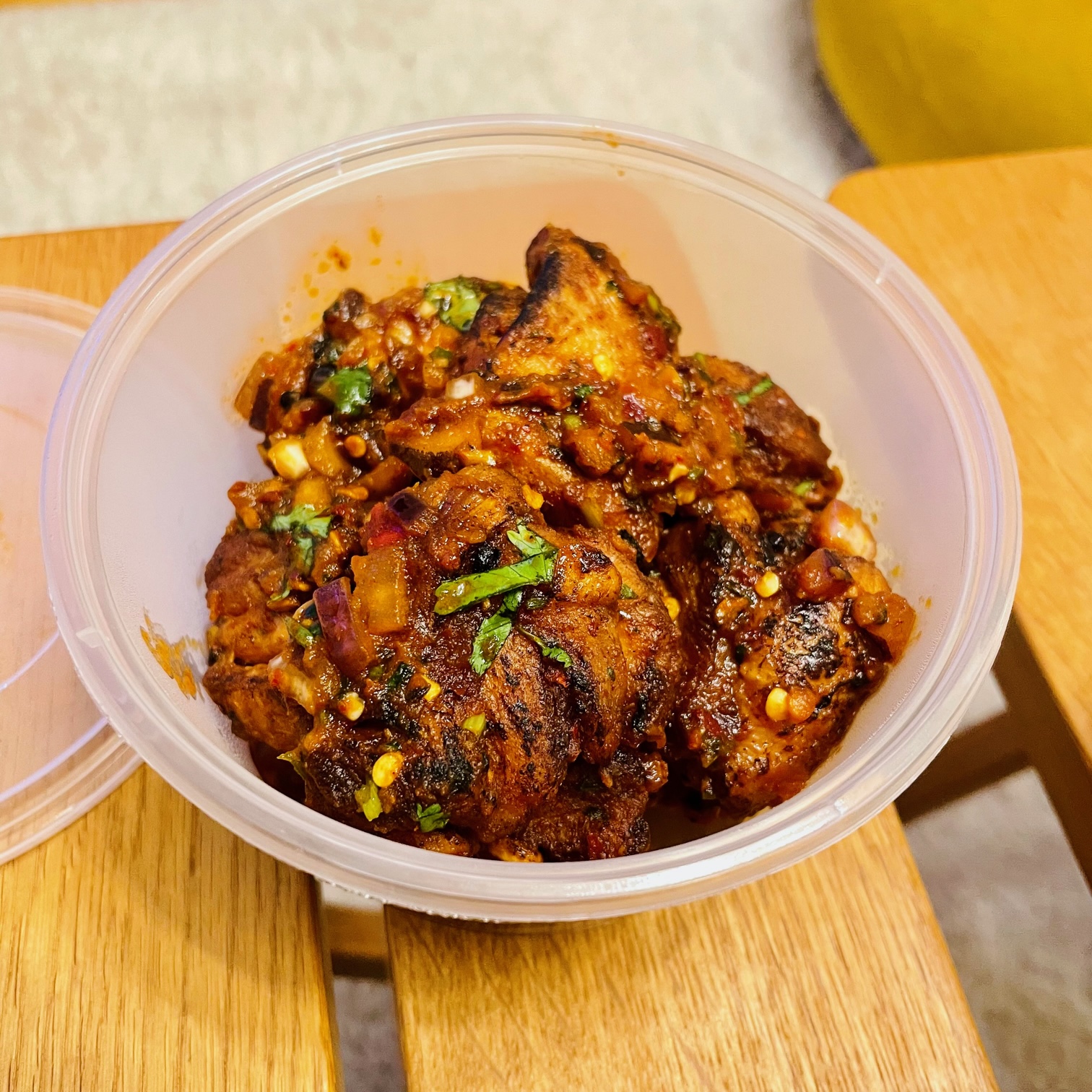
Speaking of winners, we’d chosen chicken choila as a side and again, I’m not sure I had especially high hopes. I thought it would be nice enough – it’s spiced, grilled chicken after all – but I’ve never had a choila in a Nepalese restaurant that was a feature attraction in its own right. But this was. A tub full of beautiful pieces of chicken thigh, cooked just right, not bouncy but with enough firmness left, blackened and coated with a sticky fieriness that started to make your eyes water by the end.
I really loved this dish, so much that I don’t know how I could avoid ordering it again, except maybe to try the pork next time. We raced through, almost wordless with delight, and both offered the other the final huge, succulent piece of chicken. “No, you have it” said Zoë and, realising that if I refused one more time she would totally eat it I gratefully accepted her offer. I don’t remember whether she said at the time that it was fucking good – I know it’s the kind of thing she would say, but I don’t want to invent a memory. But either way I’m saying it myself, right now.
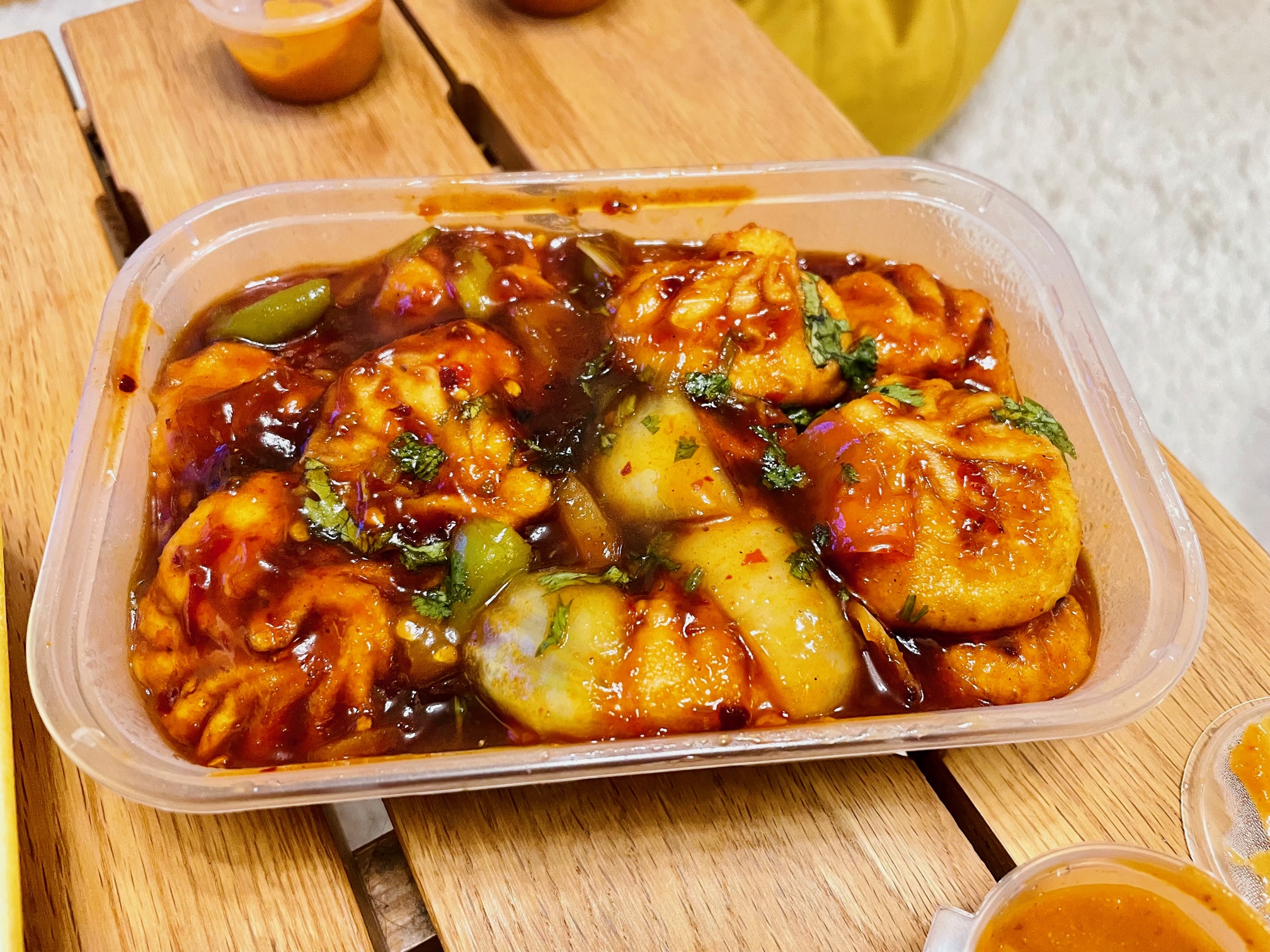
I’ve saved the momo til last, and ironically they were the dishes with the most room for improvement. But even then, they were still really very good indeed. Let’s start with the lamb chilli momo, which were the most problematic. Which is a pity, because all the elements were present and correct, almost. The chilli sauce was an absolute beauty – a glossy, hot, sour and sweet doozy that clung to every single momo. Kamal once told me that the secret ingredient in the chilli sauce at Namaste Kitchen was Heinz tomato ketchup, and this reminded me of that but with more of a barbecue sauce note. And the filling, coarse minced lamb, was extremely good.
But the problem was that because of the way the momo had been assembled, there just wasn’t enough of the filling. Most of the momo I’ve eaten tend to be crimped along one side into a half-moon, like a gyoza, which means that the filling gets to take up plenty of space in the middle. But these momo had the dough gathered at the top, like a little pouch. Nothing wrong with that, of itself, but it meant that the filling was largely taken up with a heavy, stodgy knot of dough that didn’t leave enough room for the lamb (it’s also the reason I’ve never quite taken to khinkali, the momo’s Georgian cousin). Even so, what lamb there was and what dough there was, speared onto a crunchy piece of onion and taken for a swim in that sauce made for a very agreeable mouthful.
The chicken fried (or fired, according to the menu) momo were also very good but not quite on the money. These were crimped the same way but the act of frying had formed little chimneys. I suspect they were deep fried rather than pan-seared, because Momo 2 Go doesn’t offer kothey momo, and the overall effect was ever so slightly tough. And again, if I wanted a little more filling it’s partly down to gluttony but also recognition that it was so good, singing as it did with fragrance and what felt like a hint of lemon grass. And again, even if they were a little knife-resistant and a little light on the chicken, they were still fairly stellar when dipped in the chutney.
Around this time last year I reviewed Banarasi Kitchen, in one of my first ever takeaway reviews. It really helped to discover somewhere brilliant, unassuming and under the radar early in the year, to remind me why I do this and reiterate that for every bland, disappointing meal and bandwagon-jumper there’s still the potential for somewhere to come out of nowhere and pleasantly surprise you.
I don’t know if the glass is half full or half empty, and I do know – in the immortal words of Dolly Parton – that if you want the rainbow you’ve got to put up with the rain. But to fend off the occasional disillusionment I do need to feel, especially after a run including Zero Degrees, Zyka and 7Bone, that the next ThaiGrr! might be just round the corner. And that’s why I’m so delighted to have discovered Momo 2 Go this week – another modest but quietly accomplished place that gets so much right. I admire them for the concision of their menu and for sticking to their guns, and I could see plenty of little touches in what I ordered that tell me they care about their food.
It’s ironic that the momo were possibly the weakest thing I had, but they were still pretty good and within touching distance of greatness. I can’t imagine it will be long before I order from them again, and I know I’ll face that agonising dilemma of choosing between the things I know I loved, and the unknowns I might like even better. There are far worse decisions to have on a night when you’re giving yourself a night off from doing the cooking. Try it, you’ll see.
Buon Appetito closed in April 2023. I’ve left the review up for posterity.
A couple of Mondays ago I was walking through town around lunchtime, and I noticed that every table outside Bill’s was occupied. The sun was shining, and Bill’s has one of the best al fresco spots in Reading, but even so: every single table? Then I walked past Jollibee on Broad Street, with a queue outside, just like every day since it opened. As I looped back down Friar Street I noticed, through the windows, that Wendy’s was packed. We can congratulate ourselves on promoting an independent, thriving Reading, through the money we spend and the businesses we amplify on social media, but the fact remains that chain restaurants have a huge hold on our town and its customers.
The struggle is real, and relentless. Recently a branch of Sri Lankan themed chain The Coconut Tree opened, and influencers surfaced on Instagram raving about how good their (free) food was. It is next door to South Indian restaurant Pappadam’s, which has been there for years. Last week Gordon Ramsay opened a restaurant in the Oracle – one of five new burger restaurants coming to Reading – and gave out a thousand free burgers. Berkshire Live ran a breathless story enthusing about the opening. Of course they did, because it’s easier to Ctrl-C, Ctrl-V some guff from a PR company than it is to write a real story (although in Berkshire Live’s defence they subsequently reviewed the burger, and didn’t rate it).
The uncomfortable reality, even if we wish it wasn’t so, is that chain restaurants in general, and American ones in particular, do well in this town. Last month Deliveroo revealed Reading’s five most frequently-ordered dishes. Who made the list? Taco Bell, Wingstop, Shake Shack and Five Guys. The only thing preventing a clean sweep by American chains was the holder of the top spot, from German Doner Kebab. They wouldn’t make my top hundred dishes in Reading, let alone take the crown. Maybe Reading’s favourite illness is dyspepsia. Or dysentery, you never know.
If you’re reading this you probably have at least a passing interest in Reading’s independent restaurants, so perhaps you’re mystified (or depressed) by the continuing popularity of places like Taco Bell. It’s easy to forget, in an echo chamber that buys local, supports indie businesses and slopes off to the farmer’s market a couple of times a month, that most people in Reading would still rather queue for Wendy’s.
Even if you support independent businesses, there are other ways to be out of step. I’ve never quite “got” some of Reading’s fêted indies. I freely admit that Sweeney and Todd is one of them, Quattro is another. A third, the subject of this week’s review, is Buon Appetito. It’s always been highly rated on TripAdvisor, yet when I went there over five years ago I was bemused by the rave reviews. Years later the wonderful Tuscany opened down the Oxford Road and I had another, better pizza option; I never returned to Buon Appetito.
Yet here we are in 2021, Tuscany closed over two ago, and Buon Appetito is still going strong. It’s still highly rated on Trip Advisor. More to the point, the pictures on its Instagram account look a world away from the greasy, cheese-sodden edible cardboard I waded through back in 2016. Flicking through them made me feel decidedly peckish. So I decided to take another look, accompanied by my friend Nick, fresh from his previous appearance in this blog and not put off by the whole experience of being immortalised in print.
Buon Appetito has made the best of an unlovely spot. Like many canny businesses they’ve done great things with their outside space, with plenty of tables and some little booths with circular pub tables and heaters on the wall. Everything was covered by a corrugated plastic roof, and more corrugated plastic formed a partition closing off much of the view of Chatham Street. It will set them up perfectly for winter, and the overall effect made me feel like I was on holiday. That sensation was only accentuated by the soundtrack, which sounded like hotel lobby jazz covers of popular songs. I started out thinking the music was deeply naff, but by the end it had won me over and I’d used Shazam to work out who the band was (The Cooltrane Quartet, since you asked).
Service was bright, friendly and immediate. Rather than relegate it to the end of the review it deserves to be mentioned early and often, because the woman who looked after us all evening was brilliant. Every restaurant should have a front of house like this: warm, enthusiastic, likeable and with opinions about the dishes you ought to try. She brought us a couple of pints of Peroni (the drinks selection isn’t the widest at Buon Appetito) and we began the process of picking through the menu.
“I’m not a fussy eater, but there are four things I won’t eat” said Nick.
“What are they?” I mentally ran through my own list of no-nos, but apart from the obvious ones, like tripe, I could only come up with sweetcorn and dried fruit.
I couldn’t help but feel Nick was missing out, but I didn’t interject.
“And raw coriander. It’s awful, it just tastes soapy. It’s genetic, you know.” Having been closely associated with a coriander hater in the past, I’d been told this fact more times than I cared to recall. Can’t you just tell restaurants you’re allergic? I used to ask: apparently not.
“What are the other two?”
“Olives! They just always taste so bitter to me, it doesn’t matter what colour they are. And the last one’s marzipan.”
I could eat marzipan by the block, cutting it like cheese – I have, in my day – but I let that pass. I looked at the menu and mentally struck a virtual red pen through all the items with olives or blue cheese in them: it was more than a few (I was surprised, given our last meal out, that snails hadn’t made the list).
The menu was mainstream but better and more well put together than the one I remembered from my previous visit. It was compact in the right places – only four pasta mains, for instance – and more expansive where that made sense. It’s okay to have many different pizzas because ultimately many of the core ingredients are frequently the same. Pricing was consistent and reasonable – nearly all the pizzas and pasta dishes ranged between ten and fourteen pounds and starters were around the seven pound mark, or more expensive and big enough to share.
Pizzas were a mixture of recognisably Italian combinations – plenty of ‘nduja on there, and the classic Neopolitan pizza with anchovies, capers and olives – and options from further afield. The Honolulu and the Hawaiian, both of which featured pineapple, constituted the lunatic fringe. “I quite like pineapple on pizza” said Nick, “but I won’t order it: you’ll get hate mail from Italians.” I wondered what Italians would make of a vegetarian pizza called “Garden Of Eatin”, but perhaps they’d made their peace with that.
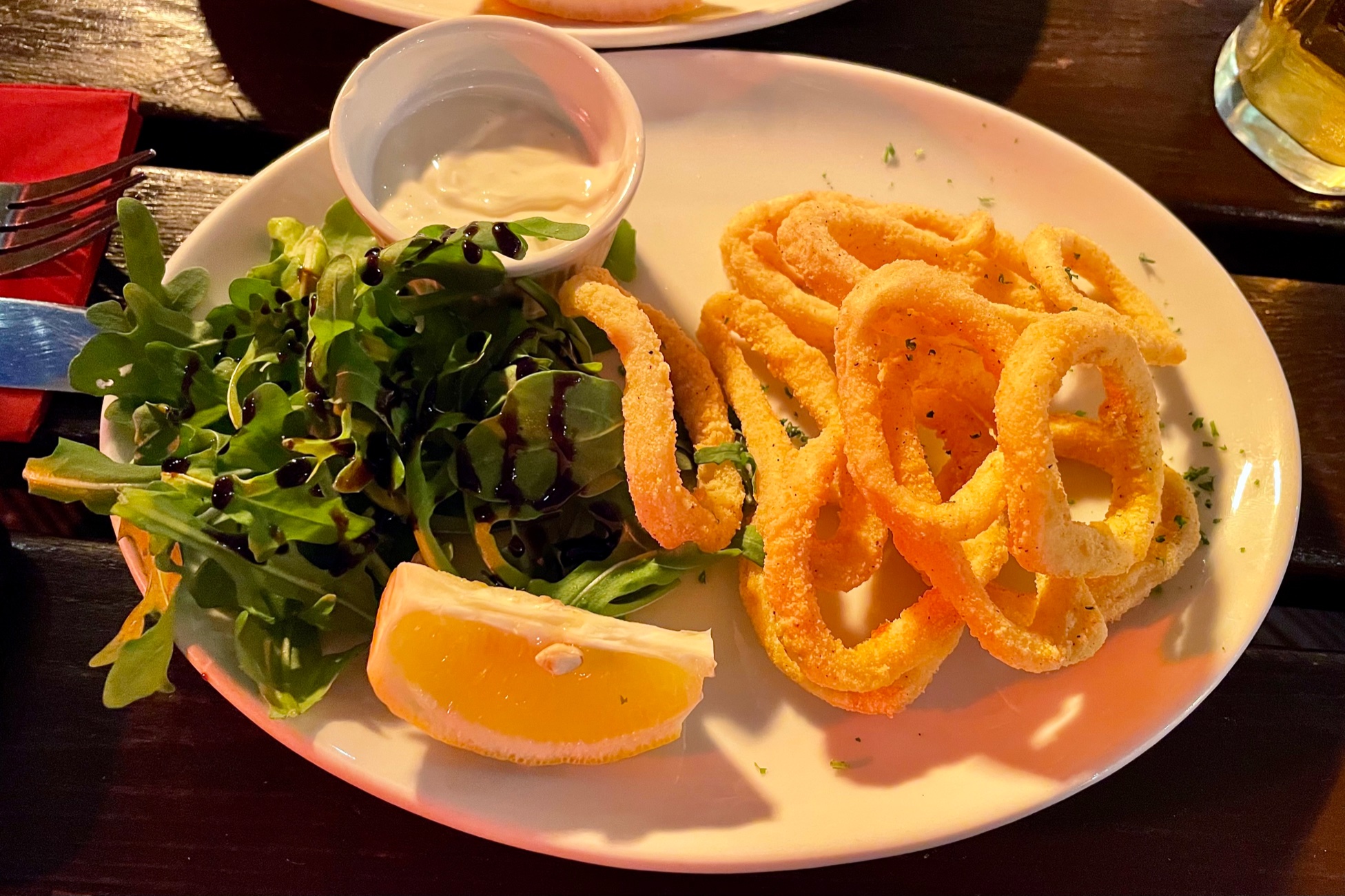
If all of our meal had been like our starters, the rating you’ve already scrolled down to check would have been lower. Calamari was decent, though: it mightn’t have had the tenderness of ultra-fresh squid, but it wasn’t rubbery either. It came with a gentle aioli: a bigger honk of garlic wouldn’t have gone amiss. Even so, it was better than the same dish at the Fisherman’s Cottage a few months back, by which token it was better than most calamari I’ve had in Reading over the years.
The other dish, king prawns with chorizo, was merely pleasant. They were nice plump prawns, three of them, with plenty of sweet flesh once you’d yanked off the head and opened up the shell. The problem was everything else. I know chorizo isn’t Italian, which made the dish potentially slightly incongruous. But worse, this chorizo was nothing special – thick, coarse and bouncy without heat or the terrific crimson oil that colours everything it touches. The menu said that this was cooked with garlic and extra virgin olive oil, but I got little or no garlic, just an anonymous orange puddle under the prawns that didn’t taste of enough.
I began to worry that history would repeat itself: I haven’t doled out a poor rating this year, and I’m somewhat dreading the first time I have an iffy meal on duty. But then our pizzas arrived and those worries, and indeed any other cares I might have had, dissipated in a cloud of carbs. Based on what I’d seen on social media I fully expected Buon Appetito’s 2021 pizzas to be an improvement on the one I had in 2016, but what I wasn’t prepared for is just how improved they would be. They weren’t just better than the previous one I’d eaten at Buon Appetito, they were better than any I’ve had in Reading and many I’ve had further afield.
Now, I can understand you being sceptical: it was only a few weeks ago that I said I might have discovered Reading’s best sandwich, and here I am saying that Buon Appetito does Reading’s best pizza. I couldn’t blame you for thinking I’m busting out hype for the sake of it. But I try hard to be sparing with the superlatives – not everywhere can be the best ever – and by any standards Buon Appetito’s pizza was extraordinary. The base was night and day compared to what I’d eaten before, with a beautifully bubbled, puffy crust with a little leopard-spotting and a deeply satisfying chewiness.
The toppings – I’d gone for the Napoli, which has always been my ideal pizza – were superb. A great tomato base, just enough cheese, lots of salty anchovies, a judicious helping of sharp, tangy capers and those black olives Nick was so averse to. I think this particular pizza is the choice of salt and vinegar fans everywhere and when it’s perfectly in balance, as it was here, it’s a full-on, sing-at-the-top-of-your-voice truly joyous thing to eat. Better than Papa Gee’s, better than The Last Crumb’s, better even than Tuscany used to be. I loved it, and knowing I could rock up to Buon Appetito any time and order this pizza again for a mere eleven pounds was both a wonderful and a dangerous discovery.
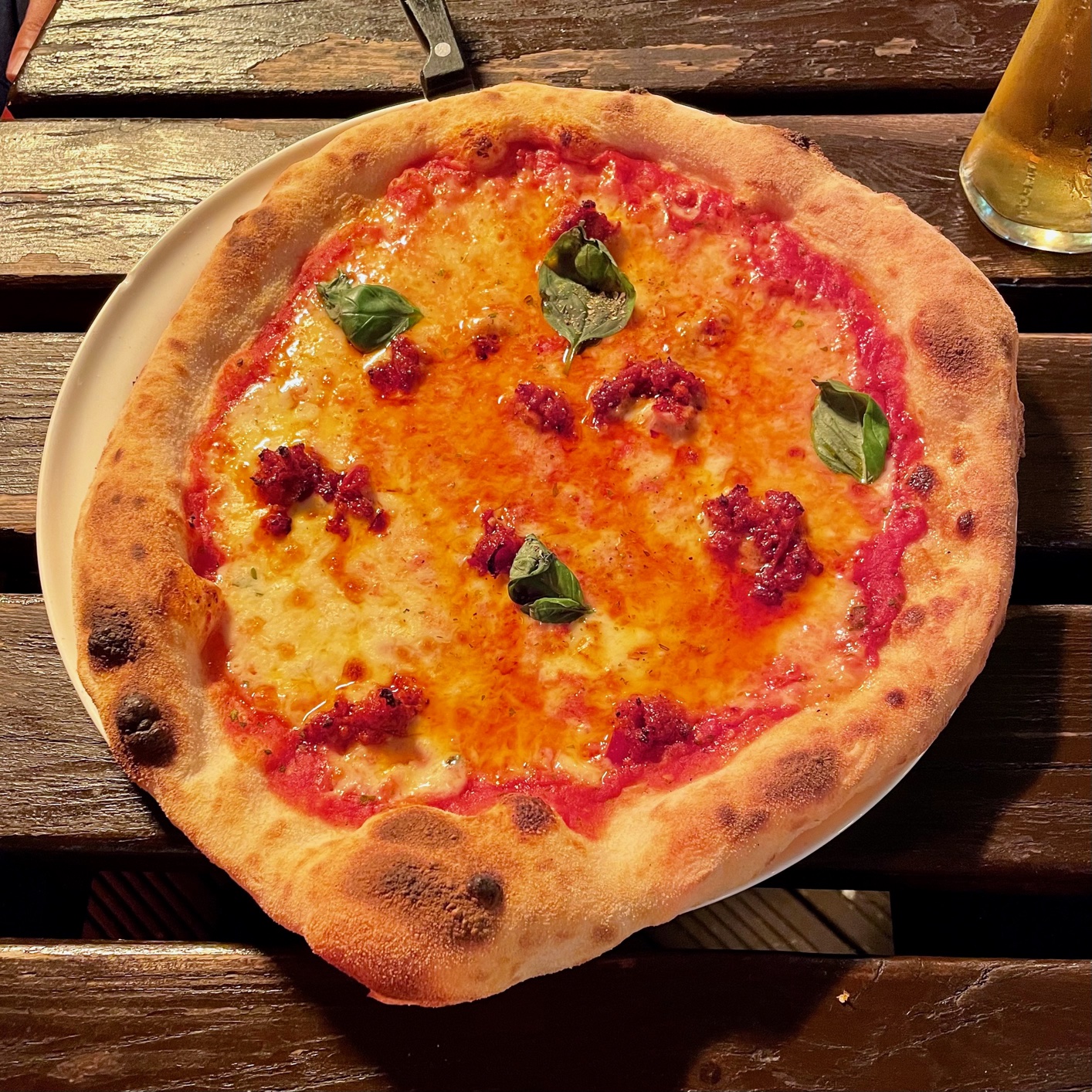
Nick’s pizza showcased that great base in a completely different direction. The “Calabrian” manages to appear on the menu twice, once halfway through and once at the end of the list of pizzas. But it was a masterpiece of pared-down simplicity – tomato sauce, mozzarella, clusters of ‘nduja, basil leaves: nothing else. Nick had never had ‘nduja before – in 2021, can you believe it? – and though he ordered it with abandon, he approached it with trepidation. “Yes, it’s hot, but it’s good” he said, just before our waitress came up and asked, part sympathetically, part playfully, whether he needed a glass of milk. “We have chilli oil, if you want to make it hotter” she added. But Nick was happy with his choice: from where I was sitting it looked a smart one.
“That was good, wasn’t it?” Nick said.
“It really was. Hold on, is that a Latin jazz cover version of Never Gonna Give You Up?”
“Certainly sounds like it.”
We asked for the dessert menu, because I’ve always felt it’s rude not to at least look. It was on the right side of too big, with four desserts and some variations on the theme of gelato and sorbetto, along with an espresso martini which had wandered over from the cocktail menu. “The panna cotta and tiramisu are the best ones” our waitress told us. “Although our banoffee pie is very good too. We import it from Italy, along with our Torta Rocher”. I suspect they come in frozen from a company called DiSotto, which also provides Buon Appetito’s ice cream and sorbet.
We took our waitress’ advice. Nick’s tiramisu was a hefty helping, on the rustic side with huge, boozy savoiardi biscuits (or lady fingers, as you probably should no longer call them) and loads of mascarpone under a blanket of cocoa powder. He liked it, but was too full to make significant inroads into it. I gallantly stepped up purely so I could tell you what it was like, namely serviceable. Only now, looking at the DiSotto website, do I clock that they sell a defrost-it-yourself tiramisu which looks strikingly like this one. I’d love to think Buon Appetito makes its own, but I wouldn’t bet on it.
The panna cotta was a strange one: I’m used to it turned out and quivering on the plate whereas this one had been imprisoned in a little sundae dish. There was an enjoyable pistachio mousse underneath, the beautiful crunch of a candied pistachio crumb on top. All tasty enough, but it felt more like an upside-down, out-of-kilter cheesecake than a panna cotta. I’m not sure the panna cotta element – hemmed in, unable to wobble freely – worked.
“Pretty good” said Nick, “but not as good as Laura’s panna cotta.” I tried his other half’s panna cotta not long ago: he’s right.
The restaurant had a steady flow of customers throughout our meal without ever seeming busy. But it was a Wednesday evening close to payday: perhaps that was a factor. “Inside is very nice too, you should eat there next time” said our waitress as she brought the bill, along with a couple of shot glasses of a Kermit-green pistachio liqueur like next level Bailey’s. Three courses and two and a half pints each came to seventy-eight pounds, not including tip.
As I said, night and day; I still think that the place I went to five years ago left a lot to be desired, but aside from being in the same building and doing Italian cuisine I don’t see many remnants of the Buon Appetito that left me nonplussed. They’ve created a properly lovely space, the service is spot on and if part of the menu were merely not bad or even so-so, the plusses outweighed that in spades. The biggest of those plusses is the pizza, which for my money is one of the best I can remember.
I wish there were more sunny days ahead, because few pleasures can match pizza and beer on a sunny day, but those little booths will be very inviting when the nights draw in, especially for those of us who aren’t sure how much indoor dining we plan to do in what remains of 2021. With Buon Appetito, Chef Stevie’s Caribbean Kitchen and the Nag’s Head, that little piece of West Reading is looking like the best gastronomic micro-climate the town has to offer. Chatham Street, a food hub: who’d have thought it?
As of October 2022 Banarasi Kitchen is no more and a new Indian kitchen, called Bagheera, will be operating out of the Spread Eagle under new management.
In its capacity as The U.K.’s Largest Town™️ Reading has many neighbourhoods and tribes who live in them. Some people are proud Caversham residents, some are firm supporters of Katesgrove, others fly the flag for New Town, or the university area. Just like having a favourite chippy, everyone has their own opinion and could happily argue the merits of living round the corner from Geo Café or Pau Brasil, just down the road from the river or from the Harris Garden.
Personally I’ve always lived either in the centre or on the east side, and I grew up in Woodley so I’ve always been more familiar with that end of town; the west side, out towards Tilehurst, remains a bit of a mystery to me. Despite that I have a huge fondness for west Reading, for its vitality and its charm. There’s always something going on out that way, and if you walk from the Nag’s Head to Double-Barrelled down the Oxford Road you see Reading in all its diverse glory. I get cross about the criticism that part of town gets: a lot of it always feels, to me at least, like poorly disguised bigotry. Something about that mosque really seems to bring out the worst in some people.
And there’s more to west Reading than just the Oxford Road: the Bath Road is grand and sweeping, with beautiful tall houses at its eastern end and the likes of Florida Court, green-roofed, pretty but incongruous, further down. The Tilehurst Road also has a lot going for it, and there are some lovely houses between it and the Oxford Road: Brunswick Hill, for instance, is always a good source of house envy. And off those main roads you can see lots of pretty little whitewashed houses with porches – places like Hollins Walk, or Benyon Court. You could almost describe them as Instagrammable.
And however well you think you know it, west Reading always throws up surprises. The fact that there’s a football ground not far from Double-Barrelled, for example, or the absurdly photogenic Wilder’s Folly a short distance from IKEA. I recently asked on Instagram, after a meditative coffee sitting up on Balmore Rise, what people’s favourite spots in Reading were. Several people mentioned McIlroy Park and its splendid view of the town: I’d never even heard of it before, and now it’s on my to visit list.
I also maintain that West Reading has always been Reading’s most interesting area in terms of food and drink. Something about it encourages people to try new things and take risks: it has Reading’s best beer pub in the shape of the Nag’s Head, and the Castle Tap and the Forester’s Arms are, in happier times, also worth a visit. It can claim to be the birthplace of Reading’s burgeoning coffee scene – the first Workhouse was there, back when C.U.P. and Tamp were just useful Scrabble words.
More to the point, it has consistently played host to a selection of some of Reading’s best restaurants. The wonderful and much-missed Bhoj plied its trade on that run of shops opposite Workhouse, and there was a halcyon age where Workhouse also allowed I Love Paella to operate out of its kitchen on evenings and weekends.
Bhoj and I Love Paella are sadly no more, but Kobeda Palace remains one of the best (and best-value) restaurants in town, and Bhoj has been replaced by Oishi, bringing sushi and sashimi to west Reading. I miss Tuscany, the brilliant Polish pizzeria a tiny bit further down the road, and the Jolly Fryer closer to town. Both were perfect for lining the stomach before a session at the Nag’s, but the other thing about having such a vibrant scene is that there’s always somewhere to take its place: I still haven’t reviewed Palmyra, the Lebanese restaurant which opened on the Oxford Road a while back, for example.
All this brings us neatly to Banarasi Kitchen, an Indian restaurant operating out of the Spread Eagle pub, between the Oxford and Tilehurst Road. They began cooking there last year and the pub joined Instagram to promote its new offering. Gradually I started to hear some noise about the food being worthy of investigation, and when I announced that I was going to start reviewing takeaways several people on Twitter told me I needed to check it out.
Banarasi Kitchen has a famous fan, too: none other than Naomi Lowe, the gluten-free genius behind Nibsy’s, who lives nearby and told me it was well worth a try (she particularly recommended the daal yellow butter fry, “although I bet you won’t have it with chips like I do”). That was all the encouragement I needed, so I fired up my laptop on a dreary Tuesday night, ready to order. But before I did that, I decided to consult a friend of mine who has forgotten more about Indian cuisine than I’ll ever know: I asked Nandana, co-owner of Clay’s Hyderabadi Kitchen and semi-regular fixture in the Guardian, what she thought of the menu.
“It looks decent.” she said. “I’m interested in the rye ke aloo, mustard-infused potatoes. That’s a very popular dish from west Bengal, close to the border with Bangladesh. I can see a few dishes from southern India too – murg kori gassi from the south-west coast and sea bass moili from Kerala.”
The menu struck me, from my inexpert point of view, as nicely balanced between some specific regional specials and an approachable mixture of more well-known dishes. So if you want to eat a rogan josh, a jalfrezi or a korma you can, and you can add onion bhajis or samosas if you like, but there are also momo and chaat, Punjabi cholay and railway lamb if you want something more off the beaten track. They even do fish and chips, burgers and salads, and a kids’ menu – which if nothing else is helpful if you really fancy a curry but the rest of your household is more conservative. Mains go from ten to thirteen pounds, and most starters are less than seven pounds.
Banarasi Kitchen is on JustEat, Uber Eats and Deliveroo (all under slightly different names) but I wanted the restaurant to take as much of my money as possible, so I phoned the restaurant to place my order directly. My older readers might remember that this used to be the only way it worked when getting takeaway – you rang them up, the line was invariably terrible, the place always sounded packed to the rafters and half the conversation consisted of you repeating yourself, or asking the person on the other end of the phone to. You read out your card details, you hoped they’d taken your address down correctly, you put the phone down and you waited, you waited and then you waited some more.
There was no such problem on this occasion, so I read out my order, gave my address and postcode and listened as the man on the other end of the phone read it back perfectly.
“Do you need my card details?”
“No, we’ll take payment at the door.” This was another development since I last ordered a conventional takeaway, which must have been, I don’t know, around four years ago.
“How long do you think it will be?”
“Around forty minutes.”
This struck me as reassuring – I live a ten minute drive from the Spread Eagle, and if the ETA had been quicker I might have been concerned. In the event, it was just over an hour before my doorbell rang, during which time I hadn’t been constantly checking my phone to watch an icon of a scooter meandering round Orts Road or, worse still, standing on the bridge over the Oracle for five minutes. My driver may well have got lost, but I didn’t know about it and that suited me fine: it turns out that ignorance is bliss after all.
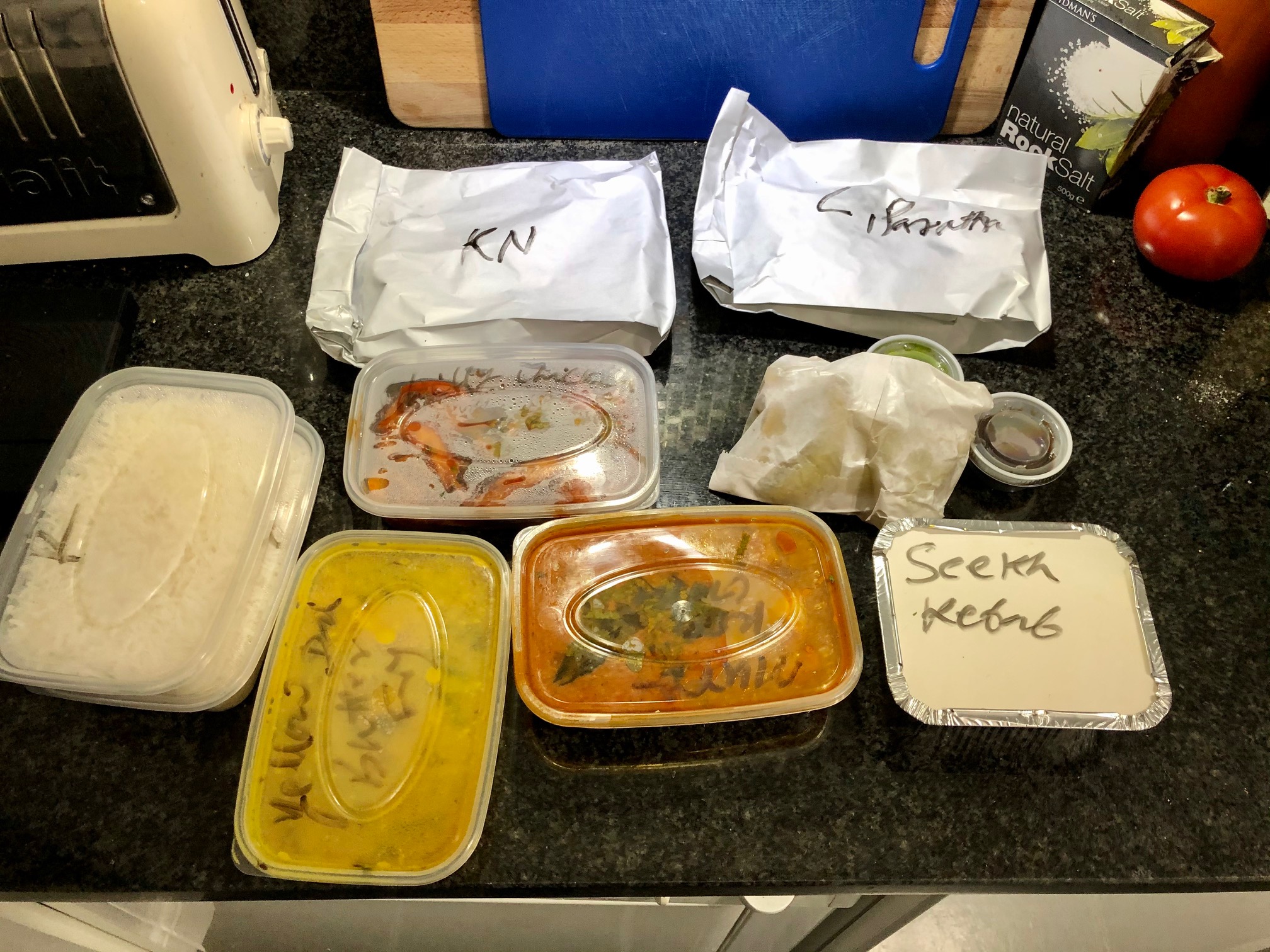
Sometimes, even when someone is wearing a mask, you can tell they’re smiling, and that’s how it was with the gentleman standing on my doorstep. He was wearing a shirt and tie, which immediately made me take to him, and he asked me how I’d heard about Banarasi Kitchen. I decided to go for the short version – “I’ve seen you on Instagram” – and quickly tapped my PIN in on the card reader before grabbing my food from his insulated bag. The packaging was a mixture of foil-lined bags for the bread, conventional plastic tubs for the curries, rice and chutneys and, randomly, a foil container for one of my starters. I’m pretty sure, though, that everything was recyclable – and, equally importantly, everything was piping hot.
We ordered a couple of starters to eat as sides, because with a takeaway everything comes at once. The lamb samosas were rather good, with a little fire to them, although the decision to use filo pastry instead of something thicker made them feel slightly insubstantial. There were three of them, which might have caused more disagreement if there hadn’t also been three very respectable lamb seekh kebabs. I made do, not that it felt like any sacrifice, with two of these – and they were almost impossibly soft, well spiced and well seasoned.
The two chutneys that came with the starters were very good indeed – one bright and zingy with bucketloads of mint and coriander, the other sweet with tamarind. I thought I would have liked some raita for the kebabs, but halfway through I found I was more than happy without it.
I’d picked the murg kori gassi, a Mangalorean chicken curry, after hearing Nandana’s thoughts on the menu and I’m so happy I did. Even on opening it, it didn’t feel like a boring curry made with a generic base sauce – it didn’t look like it had been near a tin of condensed tomato soup, and was a deeper hue with a good helping of curry leaves on top. It was an absolute delight: there was plenty of coconut in there which transformed every forkful of basmati rice and the chicken was both generous and tender. The heat in this dish built perfectly and it reminded me of dishes from Clay’s, in that the sauce was a feature attraction in its own right. The meat was almost secondary: next time I order from Banarasi Kitchen I may well go for the chickpea curry, or something with paneer.
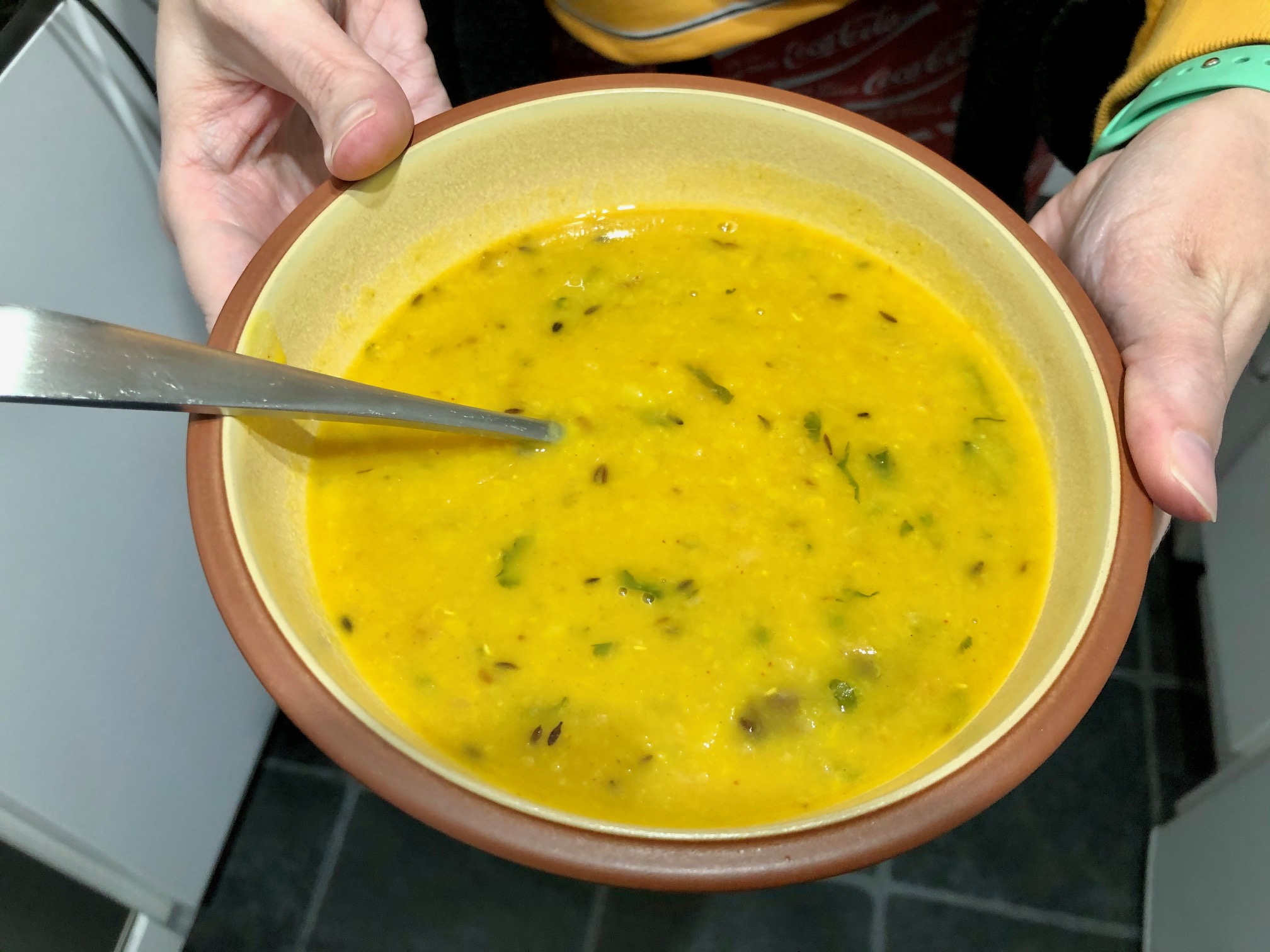
I also couldn’t not order the daal yellow butter fry after hearing such glowing reports from Naomi. Again, it was an excellent decision to defer to someone better informed: this was everything daal should be, earthy and comforting with a good dose of beautifully pungent garlic.
And although I ate some of the daal with rice, it was even better with bread. We’d ordered a keema naan, which I’m told was rather nice, and a laccha paratha which was probably the only disappointment of the meal – I was hoping for something buttery with plenty of layers, like the excellent example by House Of Flavours, whereas this was a little stodgier and closer to a naan. It did however do a brilliant job when it came to transporting daal from bowl to mouth, and it’s my fault anyway for not ordering chips as I was told to: a rookie mistake on my part.
My final choice, chilli chicken, was a dish I’ve ordered in many Nepalese restaurants, from Sapana Home to Namaste Momo. It’s a beautiful dish when done well, with a hot, sharp and sour sauce which contains, among other things, a little tomato ketchup. Banarasi Kitchen’s version was easily one of the best I’ve had, with a lovely acrid kick that made every mouthful perfectly balanced between pleasure and pain. The chicken was tender, although the pieces were strangely uniform in shape compared to those in the murg kori gassi, and the peppers and onions had the right amount of crunch for contrast. As with the murg kori gassi, every molecule of sauce was swept up and finished off: this just wasn’t food you left if you could possibly help it.
The whole thing made me incredibly happy on an otherwise nondescript evening, and reminded me of the joy that a truly good takeaway can bring – not having to worry about food, or masses of washing up, and just putting yourself in somebody else’s hands for one night. I miss restaurants, but I do also very much like being able to eat delicious food while watching crappy TV, without having to go out in the rain or change out of my comfies. When food is as good as Banarasi Kitchen’s, you don’t feel as if you’ve made any tradeoffs at all.
Our dinner – two starters, three curries, two portions of rice and two breads – came to just under forty-eight pounds, and when I looked at my bill I saw that the restaurant had knocked ten per cent off – impressive value when you think that they don’t charge for delivery. There are all sorts of offers and discount codes and vouchers on the delivery apps, but I would go direct to the restaurant any day of the week. I’m just sorry I didn’t get to leave them a tip, but I’ll make sure I do next time. Hopefully telling everybody how good they are (unless you’re one of those people who already knows) will do my bit to pay it forward.
So there you have it. I’m committed to reviewing a different takeaway every week for the duration of this third lockdown and I’m beginning to realise that it’s a lose-lose situation in some respects. If the meal is bad, you never want to use that restaurant again, and if it’s good you are disappointed that you have to move on to the next one. For those of you anywhere near west Reading I think the emergence of Banarasi Kitchen is extremely good news, and if you haven’t tried them yet I’m looking forward to seeing what you think. When life goes back to normal, I’ll be heading there in the flesh to review it properly. Not only that, but I hear the Spread Eagle has a decent quiz: I suspect I’ll be so glad to be in a pub again that I won’t even mind embarrassing myself by taking part.










 Edible Reading