Restaurant review: Gordon Ramsay Street Burger

Gordon Ramsay Street Burger closed in March 2025 for the foreseeable future. I’ve left the review up for posterity.

“What’s your angle for this one?” said Zoë when I told her this week I was going to review Gordon Ramsay Street Burger – or just Street Burger, because they use both interchangeably, but not Ramsay Street Burger which conjures up images of Lou Carpenter, a man a million miles away from being a beefcake. “You can’t go on about burgers again, because you did that a few weeks ago.”

“There’s only one thing for it, I’ll have to talk about Gordon Ramsay.”

Ah yes, Gordon Ramsay. What’s left to say about him, with his curiously line-free forehead, the gratuitous shirtless shots in Ramsay’s Kitchen Nightmares, the countless omelettes contemptuously tossed in the bin and all those expletive-laden meltdowns (he may be one of the only people alive who swears more than my other half). And that’s before we get on to his complicated life: the man’s father in law went to prison for hacking into his emails, for goodness’ sake.

And yet, I don’t really have an opinion on Ramsay. I dimly remember Kitchen Nightmares being watchable and full of good sense: don’t do too much, have a compact menu you can actually execute, advice many restaurants would do well to follow today. And I watched some of his American shows, which were usually plain nuts, but after that I never gave him much thought, except to vaguely think he was gradually becoming a parody of himself, as so many of us do. Describing Gordon Ramsay: done.

I knew that Ramsay had a vast restaurant empire, that his eponymous restaurant in Chelsea still had three Michelin stars, and I knew he had trained under Marco Pierre White before fostering the talents of Marcus Wareing, Angela Hartnett and Clare Smyth, all now Michelin starred themselves. But I didn’t see Ramsay as a chef these days, any more than I did Jamie Oliver. Crucially, I doubted he had an awful lot to do with Street Burger, which opened last month in the Oracle.

But looking at TripAdvisor before my visit, I was struck by how many reviewers held him personally responsible for their meal. “Sorry Gordon, I won’t be rushing back!” said one, followed by “Sorry Gordon, I wanted nothing more than to enjoy your place today… but today’s food didn’t reflect you or your food at all”. I was reminded of the types who reply to celebrities on Twitter, blissfully unaware that their bons mots will never be read. “My wife and I were very excited to be going to Gordon Ramsay’s, albeit a Street Burger” said a third. And then the coup de grâce: “We had high expectations as it has Gordon Ramsay’s name attached” said a disappointed diner.

Come off it. Gordon Ramsay’s probably never even set foot in the kitchen of his Reading restaurant – hadn’t these people been to Jamie’s Italian? Yet other TripAdvisor writeups painted a positive picture: many praised the service, and a lot did that thing where they name-checked a particular server (Sam and Lauren seemed especially legendary). So, a curate’s egg: I reckoned that alone made it interesting enough to visit.

“I’ve read the TripAdvisor reviews” said Nick as we took our table, and I realised I might finally have found a dining companion who did more homework than me. “They’re surprisingly good, although people seem unimpressed by the bottomless soft drinks.”

We sat outside – a combination of my caution and a temperate evening – so we definitely didn’t get the best of the restaurant, because the inside looks good. It’s more reminiscent of an upmarket steakhouse than a burger restaurant: it’s how Miller & Carter ought to look, instead of resembling an airport Wetherspoons with its whiff of bad carpet and pre-vacation despair. Street Burger had booths and banquettes, fake brick-effect wall panelling and faintly abstract wall art and struck me as an agreeable place to spend an hour eating a burger. Maybe that’s why it was doing so well.

The menu purported to be a model of simplicity: any burger with fries and the aforementioned bottomless soft drink for fifteen pounds. A bit random, because it meant that their basic cheeseburger (the “O.G.R.”) cost exactly the same as the even more dismally named “#BAE Burger” – yes, it honestly has a hashtag in the name – which is the same, but with bacon and a fried egg.

Names aren’t the restaurant’s strong point – their lamb burger is called the “Where’s The Lamb Burger?”, which strongly implies that it doesn’t contain any lamb. It does (a sharp-eyed reader has since pointed out that this is an in-joke referring to a much-memed moment: if you’re explaining, you’re losing). But what do you expect from a restaurant that calls itself “Street Burger” when it’s neither street food nor even – in the case of the Reading branch – on a street?

It’s a more limited menu than at Ramsay’s original burger restaurant in Vegas. There you choose from eleven different burgers (including the “UK Burger” made with something called “Dubliners’ Cheese”: geography’s not a strong point either). But in Reading there are just three beefburgers, that lamb burger, a chicken burger, one vegetarian and one vegan option. They don’t say anything about gluten, so I can’t say whether they offer gluten free buns.

The devil was in the detail because it’s all about the extras. If you want to swap your bottomless fizzy drink for something alcoholic – two beers and just over half a dozen wines are on offer – or a milkshake, that will be four pounds. Sweet potato fries? An extra two pounds fifty. And you can “wagyu up” – because that’s a verb now, I’m afraid – for a fiver (“the reviews on TripAdvisor say it’s worth it, so I’ll definitely do that” said Nick). There’s also an extra called a “cheese skirt”, which sounds like something half of Buck’s Fizz would wear but is in fact an extra slab of grilled cheese.

We placed our order, with various add-ons and extras, and waited to see whether our mild to moderate cynicism would be justified. I should add that we had Lauren looking after us and she was unreservedly lovely all evening: bright, friendly and enthusiastic about the food (between us we ordered her favourite shake, her favourite burger and her favourite add-ons – and if she says that to everyone, she’s at least very plausible). We were one of only two groups sitting outside, but never felt forgotten or neglected. 

Both Nick and I have a weakness for milkshakes so we went large, so to speak; I have the build of someone who likes milkshakes, while Nick has the build of someone who likes milkshakes but does lots of running so he doesn’t end up looking like me. He loved his sticky toffee pudding milkshake (“it’s got nuggets of toffee all the way through it, exactly what I was hoping for”), I thought my Oreo milkshake was okay: clearly made with ice cream, and beautifully, head-freezingly cold, but I’d have liked it to be slightly bigger. I could have done without the squirty cream, which makes it look larger without bringing anything to the table. On the menu shakes cost six pounds fifty: both that, and the four pound upgrade, felt a bit sharp.

“I miss the milkshakes at Ed’s Easy Diner.” said Nick. You’d be surprised how many Reading residents have said this to me. “There’s nothing like a malted shake.”

Our food came out relatively quickly, and this was the point where we had to start eating both our meals and our words. Because really, there was lots to like. I’d chosen the fried chicken burger and was pleasantly surprised. It had good spice and crunch, a slightly soggy hash brown underneath, a good whack of cheese and a piquant bright orange sauce, much of which had seeped out onto the tray. The hash brown felt  like padding, and the whole thing was almost well-behaved and prim – you didn’t quite have to unhook your jaw to eat it – but what was this strange feeling? Could it be that I was… enjoying it? 

As if he was reading my mind, Nick spoke.

“You know what? This really isn’t bad at all.”

Nick had gone for the hashtag burger (I can’t type its real name out again, and you can’t make me) and again, it looked pretty decent – a sensible size with a glorious-looking fried egg and nicely crispy bacon in the mix (“it’s streaky”, he confirmed). A good firm brioche bun, too, which didn’t go to pieces the way, say, Honest’s sometimes can. Nick seemed to be thoroughly enjoying it.

“It’s not as hot as it could be” he said, “because they’ve used these stupid trays.”

“Tell me about it, mine too. It’s like the hubcaps they use at the Last Crumb that mean your pizza’s cold by the time you’ve finished your first slice.”

“But that aside, it’s really good. These chips are good too – they’ve got proper crunch to them.” I agreed with him, and even as they got a little lukewarm they were still well worth dipping in ketchup and dispatching.

“Was it worth upgrading to the wagyu?”

“Not really, but then I’ve not had their normal beefburger.”

“But how does the wagyu compare to, say, a normal burger from Honest?”

“I can’t say I notice enough difference.”

We’d also ordered onion rings and, just as with the rest of our meal, they were well executed, but with just enough shortcomings to irk you. Laying them all out flat on one of those thin trays, in a weird homage to the Olympic logo, just meant they went cold quicker (and exposed how few you got). But even so, they were worth ordering – they held their shape well and the batter had seeds in it which gave an excellent texture and an extra dimension. They were great with both the dips they came with and again, even as they cooled we still wanted to polish them off.

“I prefer these to Honest’s onion rings” said Nick. “With those, some of them feel like they’re practically all batter.”

Having unexpectedly won us over with the food, reality bit when our bill arrived. All those extras mount up, and our bill – for two burgers, fries and milkshakes with a portion of onion rings – came to just shy of forty-eight pounds, not including service. But another feature of Gordon Ramsay Street Burger, which has attracted a fair bit of ire online, is that the “optional” service charge is a whopping fifteen per cent. 

That’s one thing, but the way it’s presented on the bill is disingenuous. Nowhere on the bill does it tell you what percentage they’re using, but because the service charge appears directly below the line breaking down VAT at 12.5% it felt to me like some deliberate misdirection was taking place. I paid it happily, because Lauren was excellent, but if I’d had a burger and fries and spent some time serving myself refills of bottomless soft drinks I might have felt peeved about being stung for fifteen per cent.

We left discombobulated and in need of a drink – and even now when I reflect on Street Burger I’m not entirely sure what I thought, because it confounded my expectations in almost every way. The interior was nicer than I thought it would be, the service was excellent, the food is well done. I could say that the menu isn’t the widest, but I can hardly blame them for following that advice on Kitchen Nightmares from all those years ago. 

It’s undeniably expensive, though, and that’s probably the single biggest thing counting against it. For forty-eight pounds I could eat more, and better, food at many other restaurants in Reading. If I wanted a burger, fries and a shake I’d probably spend around the same at Honest. And Honest always crops up when you discuss burger places in town: that’s how good it is, and how far above the rest of the pack it remains after all these years. Street Burger’s pricing structure is weird and expensive, and Honest offers a better range and better drinks (although I prefer Street Burger’s chicken burger, believe it or not). 

So would I go back? Actually, yes. Possibly. At some point. Because the other surprise for me is that this was pretty much the antithesis of greasy, sloppy hipster joints like 7Bone. Portions were restrained – not small per se, but not the kind of overload you might be used to at other places. And I found I rather liked that, against my better judgment. You could almost call it demure, which makes it even weirder that customers have convinced themselves that it’s somehow built in the image of Gordon Ramsay. To paraphrase the great man himself, like fuck it is.

Gordon Ramsay Street Burger – 7.1
Riverside, The Oracle, RG1 2AG
0207 3529558

https://www.gordonramsayrestaurants.com/street-burger/reading/

Restaurant review: Buon Appetito

Buon Appetito closed in April 2023. I’ve left the review up for posterity.

A couple of Mondays ago I was walking through town around lunchtime, and I noticed that every table outside Bill’s was occupied. The sun was shining, and Bill’s has one of the best al fresco spots in Reading, but even so: every single table? Then I walked past Jollibee on Broad Street, with a queue outside, just like every day since it opened. As I looped back down Friar Street I noticed, through the windows, that Wendy’s was packed.  We can congratulate ourselves on promoting an independent, thriving Reading, through the money we spend and the businesses we amplify on social media, but the fact remains that chain restaurants have a huge hold on our town and its customers. 

The struggle is real, and relentless. Recently a branch of Sri Lankan themed chain The Coconut Tree opened, and influencers surfaced on Instagram raving about how good their (free) food was. It is next door to South Indian restaurant Pappadam’s, which has been there for years. Last week Gordon Ramsay opened a restaurant in the Oracle – one of five new burger restaurants coming to Reading – and gave out a thousand free burgers. Berkshire Live ran a breathless story enthusing about the opening. Of course they did, because it’s easier to Ctrl-C, Ctrl-V some guff from a PR company than it is to write a real story (although in Berkshire Live’s defence they subsequently reviewed the burger, and didn’t rate it).

The uncomfortable reality, even if we wish it wasn’t so, is that chain restaurants in general, and American ones in particular, do well in this town. Last month Deliveroo revealed Reading’s five most frequently-ordered dishes. Who made the list? Taco Bell, Wingstop, Shake Shack and Five Guys. The only thing preventing a clean sweep by American chains was the holder of the top spot, from German Doner Kebab. They wouldn’t make my top hundred dishes in Reading, let alone take the crown. Maybe Reading’s favourite illness is dyspepsia. Or dysentery, you never know.

If you’re reading this you probably have at least a passing interest in Reading’s independent restaurants, so perhaps you’re mystified (or depressed) by the continuing popularity of places like Taco Bell. It’s easy to forget, in an echo chamber that buys local, supports indie businesses and slopes off to the farmer’s market a couple of times a month, that most people in Reading would still rather queue for Wendy’s.

Even if you support independent businesses, there are other ways to be out of step. I’ve never quite “got” some of Reading’s fêted indies. I freely admit that Sweeney and Todd is one of them, Quattro is another. A third, the subject of this week’s review, is Buon Appetito. It’s always been highly rated on TripAdvisor, yet when I went there over five years ago I was bemused by the rave reviews. Years later the wonderful Tuscany opened down the Oxford Road and I had another, better pizza option; I never returned to Buon Appetito.

Yet here we are in 2021, Tuscany closed over two ago, and Buon Appetito is still going strong. It’s still highly rated on Trip Advisor. More to the point, the pictures on its Instagram account look a world away from the greasy, cheese-sodden edible cardboard I waded through back in 2016. Flicking through them made me feel decidedly peckish. So I decided to take another look, accompanied by my friend Nick, fresh from his previous appearance in this blog and not put off by the whole experience of being immortalised in print.

Buon Appetito has made the best of an unlovely spot. Like many canny businesses they’ve done great things with their outside space, with plenty of tables and some little booths with circular pub tables and heaters on the wall. Everything was covered by a corrugated plastic roof, and more corrugated plastic formed a partition closing off much of the view of Chatham Street. It will set them up perfectly for winter, and the overall effect made me feel like I was on holiday. That sensation was only accentuated by the soundtrack, which sounded like hotel lobby jazz covers of popular songs. I started out thinking the music was deeply naff, but by the end it had won me over and I’d used Shazam to work out who the band was (The Cooltrane Quartet, since you asked).

Service was bright, friendly and immediate. Rather than relegate it to the end of the review it deserves to be mentioned early and often, because the woman who looked after us all evening was brilliant. Every restaurant should have a front of house like this: warm, enthusiastic, likeable and with opinions about the dishes you ought to try. She brought us a couple of pints of Peroni (the drinks selection isn’t the widest at Buon Appetito) and we began the process of picking through the menu.

“I’m not a fussy eater, but there are four things I won’t eat” said Nick.

“What are they?” I mentally ran through my own list of no-nos, but apart from the obvious ones, like tripe, I could only come up with sweetcorn and dried fruit.

“Blue cheese, obviously. It’s mouldy. You’re literally eating mould.”

I couldn’t help but feel Nick was missing out, but I didn’t interject.

“And raw coriander. It’s awful, it just tastes soapy. It’s genetic, you know.” Having been closely associated with a coriander hater in the past, I’d been told this fact more times than I cared to recall. Can’t you just tell restaurants you’re allergic? I used to ask: apparently not.

“What are the other two?”

“Olives! They just always taste so bitter to me, it doesn’t matter what colour they are. And the last one’s marzipan.”

I could eat marzipan by the block, cutting it like cheese – I have, in my day – but I let that pass. I looked at the menu and mentally struck a virtual red pen through all the items with olives or blue cheese in them: it was more than a few (I was surprised, given our last meal out, that snails hadn’t made the list).

The menu was mainstream but better and more well put together than the one I remembered from my previous visit. It was compact in the right places – only four pasta mains, for instance – and more expansive where that made sense. It’s okay to have many different pizzas because ultimately many of the core ingredients are frequently the same. Pricing was consistent and reasonable – nearly all the pizzas and pasta dishes ranged between ten and fourteen pounds and starters were around the seven pound mark, or more expensive and big enough to share.

Pizzas were a mixture of recognisably Italian combinations – plenty of ‘nduja on there, and the classic Neopolitan pizza with anchovies, capers and olives – and options from further afield. The Honolulu and the Hawaiian, both of which featured pineapple, constituted the lunatic fringe. “I quite like pineapple on pizza” said Nick, “but I won’t order it: you’ll get hate mail from Italians.” I wondered what Italians would make of a vegetarian pizza called “Garden Of Eatin”, but perhaps they’d made their peace with that.

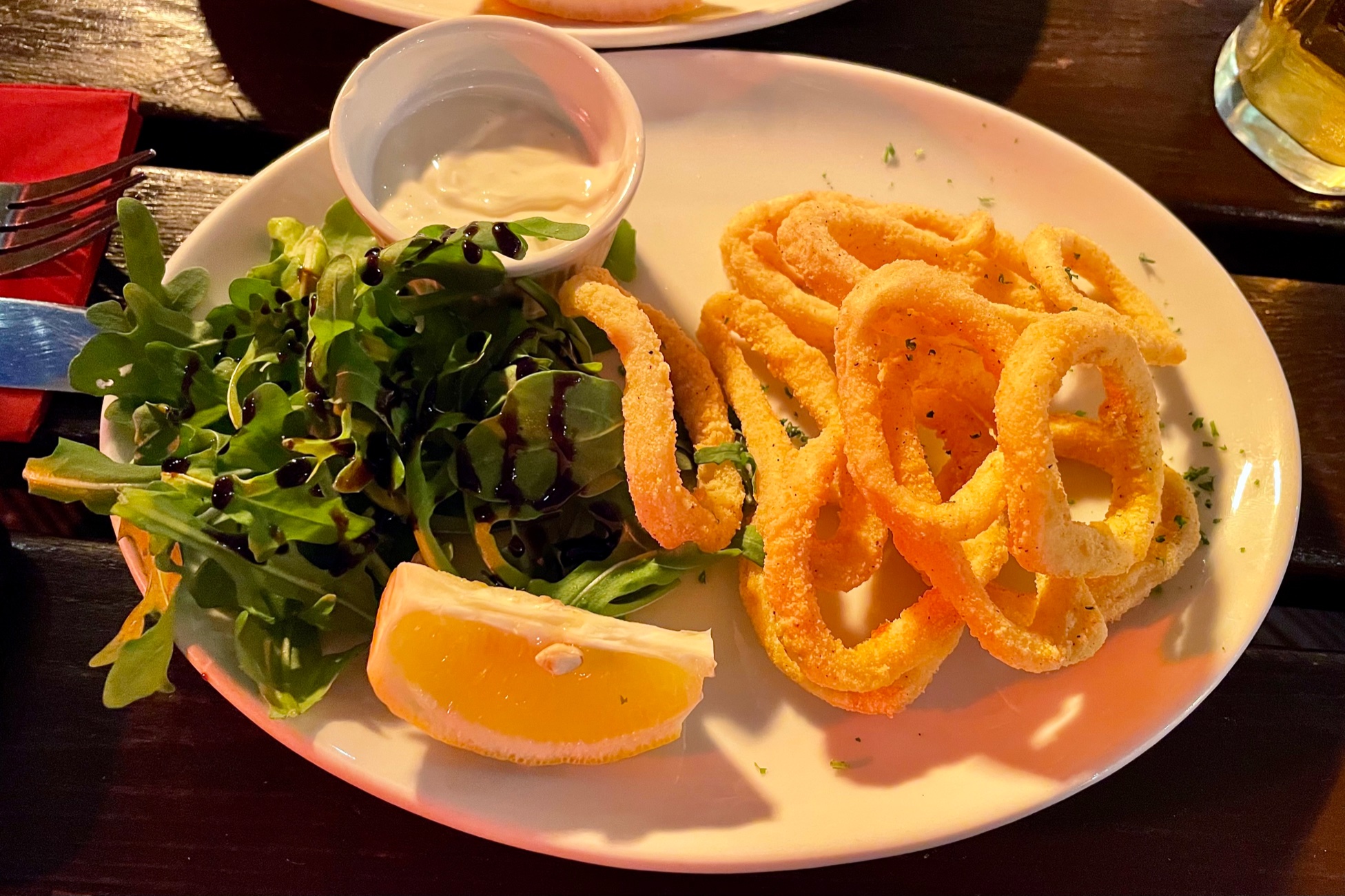
If all of our meal had been like our starters, the rating you’ve already scrolled down to check would have been lower. Calamari was decent, though: it mightn’t have had the tenderness of ultra-fresh squid, but it wasn’t rubbery either. It came with a gentle aioli: a bigger honk of garlic wouldn’t have gone amiss. Even so, it was better than the same dish at the Fisherman’s Cottage a few months back, by which token it was better than most calamari I’ve had in Reading over the years.

The other dish, king prawns with chorizo, was merely pleasant. They were nice plump prawns, three of them, with plenty of sweet flesh once you’d yanked off the head and opened up the shell. The problem was everything else. I know chorizo isn’t Italian, which made the dish potentially slightly incongruous. But worse, this chorizo was nothing special – thick, coarse and bouncy without heat or the terrific crimson oil that colours everything it touches. The menu said that this was cooked with garlic and extra virgin olive oil, but I got little or no garlic, just an anonymous orange puddle under the prawns that didn’t taste of enough.

I began to worry that history would repeat itself: I haven’t doled out a poor rating this year, and I’m somewhat dreading the first time I have an iffy meal on duty. But then our pizzas arrived and those worries, and indeed any other cares I might have had, dissipated in a cloud of carbs. Based on what I’d seen on social media I fully expected Buon Appetito’s 2021 pizzas to be an improvement on the one I had in 2016, but what I wasn’t prepared for is just how improved they would be. They weren’t just better than the previous one I’d eaten at Buon Appetito, they were better than any I’ve had in Reading and many I’ve had further afield.

Now, I can understand you being sceptical: it was only a few weeks ago that I said I might have discovered Reading’s best sandwich, and here I am saying that Buon Appetito does Reading’s best pizza. I couldn’t blame you for thinking I’m busting out hype for the sake of it. But I try hard to be sparing with the superlatives – not everywhere can be the best ever – and by any standards Buon Appetito’s pizza was extraordinary. The base was night and day compared to what I’d eaten before, with a beautifully bubbled, puffy crust with a little leopard-spotting and a deeply satisfying chewiness. 

The toppings – I’d gone for the Napoli, which has always been my ideal pizza – were superb. A great tomato base, just enough cheese, lots of salty anchovies, a judicious helping of sharp, tangy capers and those black olives Nick was so averse to. I think this particular pizza is the choice of salt and vinegar fans everywhere and when it’s perfectly in balance, as it was here, it’s a full-on, sing-at-the-top-of-your-voice truly joyous thing to eat. Better than Papa Gee’s, better than The Last Crumb’s, better even than Tuscany used to be. I loved it, and knowing I could rock up to Buon Appetito any time and order this pizza again for a mere eleven pounds was both a wonderful and a dangerous discovery. 

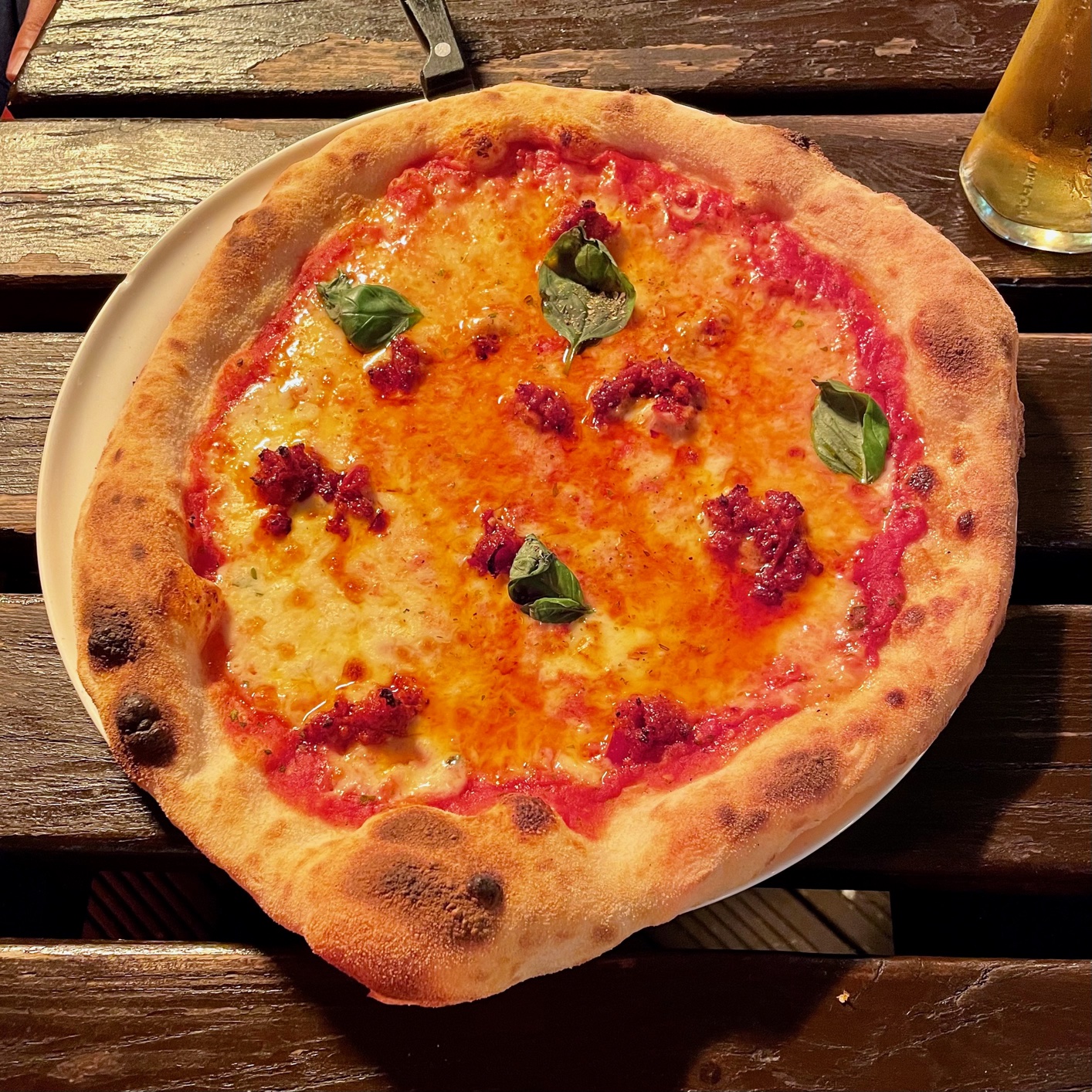
Nick’s pizza showcased that great base in a completely different direction. The “Calabrian” manages to appear on the menu twice, once halfway through and once at the end of the list of pizzas. But it was a masterpiece of pared-down simplicity – tomato sauce, mozzarella, clusters of ‘nduja, basil leaves: nothing else. Nick had never had ‘nduja before – in 2021, can you believe it? – and though he ordered it with abandon, he approached it with trepidation. “Yes, it’s hot, but it’s good” he said, just before our waitress came up and asked, part sympathetically, part playfully, whether he needed a glass of milk. “We have chilli oil, if you want to make it hotter” she added. But Nick was happy with his choice: from where I was sitting it looked a smart one.

“That was good, wasn’t it?” Nick said.

“It really was. Hold on, is that a Latin jazz cover version of Never Gonna Give You Up?”

“Certainly sounds like it.”

We asked for the dessert menu, because I’ve always felt it’s rude not to at least look. It was on the right side of too big, with four desserts and some variations on the theme of gelato and sorbetto, along with an espresso martini which had wandered over from the cocktail menu. “The panna cotta and tiramisu are the best ones” our waitress told us. “Although our banoffee pie is very good too. We import it from Italy, along with our Torta Rocher”. I suspect they come in frozen from a company called DiSotto, which also provides Buon Appetito’s ice cream and sorbet.  

We took our waitress’ advice. Nick’s tiramisu was a hefty helping, on the rustic side with huge, boozy savoiardi biscuits (or lady fingers, as you probably should no longer call them) and loads of mascarpone under a blanket of cocoa powder. He liked it, but was too full to make significant inroads into it. I gallantly stepped up purely so I could tell you what it was like, namely serviceable. Only now, looking at the DiSotto website, do I clock that they sell a defrost-it-yourself tiramisu which looks strikingly like this one. I’d love to think Buon Appetito makes its own, but I wouldn’t bet on it.

The panna cotta was a strange one: I’m used to it turned out and quivering on the plate whereas this one had been imprisoned in a little sundae dish. There was an enjoyable pistachio mousse underneath, the beautiful crunch of a candied pistachio crumb on top. All tasty enough, but it felt more like an upside-down, out-of-kilter cheesecake than a panna cotta. I’m not sure the panna cotta element – hemmed in, unable to wobble freely – worked.

“Pretty good” said Nick, “but not as good as Laura’s panna cotta.” I tried his other half’s panna cotta not long ago: he’s right.

The restaurant had a steady flow of customers throughout our meal without ever seeming busy. But it was a Wednesday evening close to payday: perhaps that was a factor. “Inside is very nice too, you should eat there next time” said our waitress as she brought the bill, along with a couple of shot glasses of a Kermit-green pistachio liqueur like next level Bailey’s. Three courses and two and a half pints each came to seventy-eight pounds, not including tip.

As I said, night and day; I still think that the place I went to five years ago left a lot to be desired, but aside from being in the same building and doing Italian cuisine I don’t see many remnants of the Buon Appetito that left me nonplussed. They’ve created a properly lovely space, the service is spot on and if part of the menu were merely not bad or even so-so, the plusses outweighed that in spades. The biggest of those plusses is the pizza, which for my money is one of the best I can remember.  

I wish there were more sunny days ahead, because few pleasures can match pizza and beer on a sunny day, but those little booths will be very inviting when the nights draw in, especially for those of us who aren’t sure how much indoor dining we plan to do in what remains of 2021. With Buon Appetito, Chef Stevie’s Caribbean Kitchen and the Nag’s Head, that little piece of West Reading is looking like the best gastronomic micro-climate the town has to offer. Chatham Street, a food hub: who’d have thought it?

Buon Appetito – 8.0
146-148 Chatham Street, Reading, RG1 7HT
0118 3276947

https://www.buonappetitoreading.co.uk

Restaurant review: O Português

O Português closed in March 2023. I’ve left the review up for posterity.

As far as hospitality is concerned, one of the hardest things you can do right now is give somewhere a bad review. For much of last year many reviewers, professional and amateur, thought that you shouldn’t do it at all. If you didn’t like somewhere, they said, you should maintain a dignified silence and write instead about the places you like. I’ve never subscribed to that point of view: it’s somewhat Pollyanna to only talk about the brilliant, and warning people about the iffy is every bit as much of a public service. 

Nonetheless, bad reviews remain the trickiest to carry off. I don’t mean a hatchet job. I know those are fun to read – they can be fun to write – but somewhere has to be really awful to justify one of those. For instance, I went to TGI Friday or Taco Bell with an open mind, but both times it soon became apparent that it was going to be one of those nights, and one of those meals. But opportunities to write that kind of review are vanishingly few and far between: I don’t choose anywhere confident that I’ll have a bad time, rubbing my hands at the prospect. 

The rest of the time, if you don’t like a meal, you’re putting the boot into an independent business. Somebody’s baby, some people’s livelihoods. It can feel like kicking a puppy. So you try and be constructive, get the tone right, find good stuff to offset the bad. Some of my attempts at this have worked better than others, although I’ve definitely softened over the years. And this year, the review I found the most difficult was when I had takeaway from O Português, the new Portuguese restaurant on the Wokingham Road. 

O Português had looked great on paper – I really wanted to like it, but I wanted to like it more than I did. Some dishes showed promise, others were less successful. The one that came in for the most criticism was my other half’s grilled chicken, which she dubbed “a carcass covered in tasty skin” with “more bones than Cemetery Junction” (this is a trick, incidentally, we all use with negative reviews: if you’re quoting someone else, you can at least play the good cop).

I really didn’t enjoy publishing that one, but to their credit the restaurant got in touch with me about it and took my feedback constructively (to my face, anyway: privately they might have called me every name under the sun). They agreed that some of their dishes maybe hadn’t travelled as well as they should, and they hoped I would give them another try once restaurants were allowed to reopen. I told them I would.

I couldn’t help but think of Thames Lido, where I’d eaten in May. I put a few pictures up on Instagram, saying some dishes were good and some could have been better, only to get an unsolicited direct message from the chef there. “May I suggest you don’t go out so much and cook a bit more at home? I’m sure we’d all love to see the photos” The difference in attitude couldn’t have been more stark.

Additionally, one of O Português’ devoted customers got in touch advising me that I should give them another try. She was Portuguese, and was a big fan of their food. She told me that there was nothing better than grabbing a prego steak roll from them and eating it straight away in Palmer Park. Put that way it sounded like a lovely thing to do, so I decided to pay them a midweek visit and try O Português properly, in the flesh. My accomplice this week was my friend Nick, who I met a couple of years ago on Twitter through our mutual admiration for car crash Tory election candidate Craig Morley.

The building that houses O Português used to be Colley’s Supper Rooms, and then Bart’s and a purgatorial-sounding place called Smokey’s House, but it looks somehow right as O Português, on the corner of the Wokingham Road and St Bartholemew’s Road, one of the handsome streets on the perimeter of Palmer Park. They’ve done a good job with their outside space on both sides, and I’ve often walked past over the last few months envying people sitting outside with a cold Super Bock, enjoying dinner with friends. 

We asked for a table out front of the restaurant, to make the most of the remaining rays of sun. The interior looks relatively unchanged from when it was Bart’s, with two dining rooms, a bar and a separate counter with cakes and pastries. I got the impression that O Português was a little bit of everything, somewhere you could go for a galao and a cake, lunch, a full on meal or a few drinks and that aforementioned steak roll. The main difference is that indoors it’s table service, whereas if you’re eating outside you go up to the counter, order and pay. Maybe they’ve some people do a runner, but it felt like a strange distinction.

O Português’ menu isn’t available online (except the bits of it that are on delivery apps) but the hard copy we looked at had plenty to tempt at a wide range of price points. The petiscos start at three pounds and go up to around seven, where they overlap with a separate, smaller, section of starters. Main courses start at nine pounds but go all the way up to twenty. Our waitress told us which dishes they didn’t have that day – it’s always strangely reassuring to know that they sell out of some things, and when they’re gone they’re gone.

I’ve been on duty with plenty of different people by now, and they all have different styles. Some seem oblivious to the experience, like my friend Jerry. Some, like my friend Reggie, get self-conscious and worry about being quoted saying something that casts them in a bad light. But few throw themselves into it with quite as much gay abandon as Nick: I always let my companion pick their food first, but I think he took it as a personal challenge.

“Let’s have the snails and the gizzards” he said, a sentence I’ve never heard before and will probably never hear again.

“Have you ever had snails or gizzards before?”

“No. But that’s kind of the point, isn’t it?”

I explained that maybe we should try one or the other but not both, and I scuttled up to the counter to order our starters.

“What are your gizzards like?” I said (a sentence, at a guess, that the woman behind the counter had also never heard before). “I’ve had ones in the past which are really firm and meaty, and others that can be a little rubbery.”

“I don’t really like them much, we have other dishes that are better.” Well, you had to credit her honesty. Our drinks came first, so Nick and I nursed a Super Bock each – not on draft the day we went, sadly, but lovely and refreshing all the same.

“This reminds me of the first beer on holiday” I said, thinking fondly of trips to Porto and Lisbon.

“There’s something about that first beer” Nick concurred, and talked about the relative benefits of Efe, Mythos and Estrella (or more precisely, how much we missed holidays where you can drink those beers) before concluding that, however many IPAs and DIPAs we might clock up on Untappd we probably couldn’t tell any of those Eurolagers apart in a blind taste test.

“It’s funny how every country has its own lager – more than one, usually – but Britain doesn’t have one” said Nick.

“I suppose we have Carlsberg – brewed in the U.K. by Danes. That’s as close as it gets.”

Our first starter to come out was that legendary prego steak roll, cut in half to allow sharing. I’m can confirm that my Portuguese correspondent was right on the money about this, and it was a superb place to begin. The roll seemed to be a cut above the slightly wan one I’d had when I ordered takeaway, and the steak in it was gorgeous – thick, tender and liberally studded with garlic. I could easily have eaten one of these to myself, and at four pounds fifty it was hard to imagine a better value lunch in Reading.

We’d also chosen the salt cod salad, a dish which was just as delicious in a completely different way – firm flakes of bacalhau, with almost no bones, a few bits of it slightly blackened, in a fantastic tangle of sweet peppers, the whole thing strewn with parsley and mixed with oil and vinegar in a way that balanced sharpness and fruitiness perfectly. All it needed was some more of that bread to mop up the last of the dressing, although that was our mistake for not ordering some (“I’d have that cod and peppers starter again right now”, Nick texted me this evening as I was in the middle of writing this).

Still, every rose has its thorn, and in this case our metaphorical thorn was a large bowl of very small snails which looked like it had come from a beachcomber rather than a kitchen. The only times I’ve enjoyed snails they’ve been much bigger, drenched in garlic butter and cooked in such a way that the shell is the only real evidence of what you’re eating. These, by contrast, were still poking out of their tiny houses, feelers glaring at you, which was disconcerting. Getting them out of the shell with a bog standard dinner fork was a challenge, although Nick developed quite an aptitude for it. 

“You can’t fault the portion size for three quid” said Nick. “How many do you think are in here?”

“About a hundred? That means each one costs about three pence.” 

He soldiered on for a bit – to my shame, I couldn’t go near them – before giving up after he’d eaten about a dozen. “Still, it’s not like we’ve wasted a lot of money. I’m glad I’ve tried them.”

Sitting there on the edge of the park, at a table bathed in sunshine I got that feeling that restaurants are so good at supplying – and which I need more than ever – of being elsewhere. The other table outside was occupied by some young Portuguese chaps, and when I went in to order our mains I waited while a group of people at the counter had a vocal disagreement with the restaurant staff in Portuguese. Goodness knows what it was about, because I couldn’t understand a word. But it was huge fun to watch  – Portuguese sounds like Spanish spoken by Sean Connery – and it reminded me of that quote about not caring what language an opera is sung in so long as it’s one you don’t understand.

Eventually one of the wait staff took me over to the bar to place my order. “They didn’t like one of their dishes, so they were claiming it wasn’t fresh” she said, rolling her eyes. I ordered our main courses and a couple of glasses of vinho verde and refreshingly, she downsold me (“the most expensive one is too dry, have this one instead”). She was right, too: it was beautifully fresh with a tiny hint of effervescence on the tongue.

Our mains took half an hour after that – a little on the slow side, though we brought it on ourselves by ordering them after we’d finished our starters. Both were knockout. Nick had chosen the espetade de carne, a whopping skewer of beef and pork which came with rice and chips. The chips were lovely, crispy things – probably from a pack but none the worse for it, and much better than the takeaway chips I’d tried earlier in the year. But of course the meat was the feature attraction, and really nicely done. The pork was good, if slightly on the dry side, but the beef was magnificent – very well seasoned and a little pink in the middle. Nick was happy – and, because he couldn’t finish it, it so was I.

I was delighted with my main course. Octopus doesn’t feature often on menus and when the wait staff told me it was fresh, not frozen, I had to order it. I’m used to eating octopus which has been cooked on the grill (after plenty of marination), but O Portugues’ was exceptionally tender – braised, at a guess – swimming in oil and garlic and covered with a layer of soft, sweet onion. At nineteen pounds this is one of the most expensive main courses they do, but it was such a joy to eat. Only the accompaniments let it down – I liked the garlic roasted baby potatoes, but the array of veg felt a little overcooked and unremarkable. Something roasted, more Mediterranean, would have worked better.  

We had one more beer and as I went up to pay I told the staff how much we’d enjoyed our meal. He asked me to put something on Facebook to that effect and I promised I would. Service was excellent all evening, and when I told them that the snails were the only thing we hadn’t loved the waitress who had warned me off the gizzards said “I don’t like snails either”. It was that kind of place: no-nonsense, candid but with plenty to be proud of. Our meal – three starters, two mains and three drinks apiece – came to seventy-six pounds, not including tip, which strikes me as decent value. We dashed to the Weather Station in time for last orders, and found a very strong imperial stout with which to finish a marvellous evening.

I’m so glad I went back to O Português. When I first reviewed their takeaway they’d barely operated as a restaurant, and they were – like many hospitality businesses – just muddling through, getting through one day at a time. I suspected that their food, eaten in, could be markedly different, but even so it really cheered me to see them doing what they do so well. 

They remind me of the best of Portuguese food that I’ve had on my travels – completely unpretentious, slightly unsung but, at its best, up there with anything you can eat in Europe. I love what they’ve done creating a little corner of Iberia on that little corner of the Wokingham Road, and I can well imagine sitting outside one lunchtime before the last of the good weather leaves us, steak roll in one hand and Super Bock in the other. What could be finer than that, except braised octopus or that fresh, sharp salt cod salad? 

Best of all, because every day is a school day, I learned a valuable lesson by going back to O Português. I paid them a visit because they were so grown up about my feedback last time around – no meltdown on social media, no passive aggressive direct messages, just a quiet determination that they would and could do even better. It’s a salutary reminder: good restaurants are always doing their best, growing, learning and evolving. Fingers crossed that restaurant reviewers never stop doing that, too.

O Português – 7.7
21 Wokingham Road, Reading, RG6 1LE
0118 9268949

https://www.facebook.com/OPortuguesInTown

Pub review: Chef Stevie’s Caribbean Kitchen at The Butler

In August 2022 Chef Stevie announced that he was leaving the Butler and moving to Windsor. I’ve left the review up for posterity.

Opening and running a restaurant is hard work. You have to find premises, sort out a lease, decide your concept, pick your staff, choose your suppliers, design your menu, set up your social media, get people through the door, get them to come back, replace your staff when some of them leave. The list goes on. 

That’s at the best of times, but the last year has hardly been that. Now you can add in navigating the complexities of furlough and bounceback loans, applying for grants, retaining your staff, getting your head round the rule of six, track and trace, “hygiene theatre” and having to close or reopen at the drop of the hat based on government fiat and what tier system is in use this week. And you can also bung in asking people nicely to wear masks so they don’t risk infecting your unvaccinated staff and closing because you have been pinged, or because your staff have and you don’t have enough left to be able to trade. It’s hard work. I sometimes wonder why anybody does it.

Most people dip their toe in the water rather than diving in at the deep end, and there are many ways to do that. One of the most common is to start out doing street food. Get a gazebo, go to some markets, build a reputation and one day you might open your own place. Take Vegivores, which has made a roaring success of its site in Caversham. But sometimes street food is the place that exposes the gap between your daydream of feeding adoring crowds and the harsh reality of getting up early in the morning only for everything to go wrong, as this touching post from a recent Blue Collar alumnus shows.

Another route is to use someone else’s premises, the “cuckoo” approach. One of the most successful exponents of this is Anonymous Coffee, who have had coffee machines in the Tasting House, Thames Tower, Curious Lounge and the Grumpy Goat without setting up permanent premises of their own. Many people in hospitality have taken this path, from Bench Rest serving food in the Tasting House to I Love Paella, operating out of a tiny kitchen in the Oxford Road branch of Workhouse Coffee. But the most obvious synergy, if you can ever forgive me for using that word in any context, is between chefs in search of a kitchen and pubs in search of a chef.

When this works, it’s a dream. The pub wants to serve food, but doesn’t want to cook it. The chef wants to cook, but doesn’t want his or her name on a lease quite yet. And so over the years we’ve been treated to I Love Paella cooking out of The Horn before graduating to the Fisherman’s Cottage and Caucasian Spice Box (now, of course, Geo Café) operating from the Turk’s Head and later from The Island, still one of the most surreal Reading establishments I’ve ever visited. I fondly remember I Love Paella’s salt cod churros, or Caucasian Spice Box’s ajika chicken, and I may not have loved The Horn or the Turk’s Head, but the food was so good that it didn’t matter.

I got wind recently that a similar arrangement was in place over on the edge of West Reading at the Butler in Chatham Street, where an outfit called Chef Stevie’s Caribbean Kitchen had popped up and was offering a full menu of Caribbean classics. I have fond memories of the Butler: it’s a handsome building which has stood proud for many years surrounded by the architectural chaos of the old Chatham Street car park with its curving Brutalist concrete walkway and the gleaming apartment buildings that have sprung up more recently, much like the house from Up. In this week’s scorching weather I couldn’t think of a better place to try, so I headed over with my friend Graeme, last seen enduring imaginable horrors at Taco Bell.

“Don’t you want to know where we’re going?” I said as we made our way down Broad Street. In the run-up to our visit Graeme had steadfastly told me that he only wanted to find out on the day.

“No, I like a surprise. Anyway, we’re heading in the direction of KFC, so I can still dream.” Graeme has a love of the secret blend of herbs and spices that exceeds even mine: when he was recovering from Covid at the start of the year, the first thing he asked for when he was past the worst was a bucket of the Colonel’s finest.

“I have a good feeling about this place, don’t worry. I hope it will make amends for that quesadilla.”

“Nothing on earth can make up for that.” 

I felt like pointing out that he did volunteer to come to Taco Bell, but I thought better of it. But Graeme’s mood lightened immediately when we rounded the bend of Chatham Street and he saw the board outside the Butler advertising Chef Stevie’s Caribbean Kitchen. “This is great! I love Caribbean food.”

I hadn’t realised how much outside space the Butler has, but it turns out there’s quite a lot. There were plenty of tables out front in the unforgiving sun, a happy few of them sporting parasols, and initially I though it might have been fun to eat dinner with the background hum of the Chatham Street traffic. But I found out when I went in to grab a menu that there was a courtyard out back, a lovely little sloping space with a little more shade, and so our decision was made. 

The pub and the kitchen run separately, so you order your drinks at the bar and your food out back, where the kitchen operates out of a different building. The menu immediately presents a couple of problems: one is that you sort of want to eat everything, the other is that because the three most iconic mains can be served in small or large sizes ordering everything is almost a realistic possibility. None of the large mains come in over fourteen pounds, most of them are closer to eleven, and there are both vegetarian and vegan options in the form of macaroni pie and a sweet potato curry respectively.

The “sides and nibbles” section is brilliantly flexible, giving you the option to order starters, have extras with your main course or even, potentially, just go for a sort of Caribbean tapas where you try it all. The majority of them hover around the six pound mark. We sort of went for a mixture of all three of those approaches – although it soon became apparent that Graeme’s appetite was even bigger than mine, which pretty much makes him my ideal dining companion (on the walk over he was complaining about having gone up to a thirty-six inch waist in recent months: if I ever slimmed down to a thirty-six I’d probably go on a week-long bender to celebrate).

“We have to have plantain as one of our starters” he said.

“I’ve always struggled with plantain. I think it’s because I went off bananas in 1999, the year I did the cabbage soup diet so I could fit into my suit for my brother’s wedding.”

Graeme gave me an indulgent look, as if he couldn’t work out which of those two sentences was the most moronic.

“Okay, we can skip the plantain, but we have to have some of the handmade patties.”

“Salt fish?”

“Exactly.”

We narrowed it down to just the four starters and two mains and I wandered over to Stevie and his partner, who were sitting at one of the pub tables waiting for orders. It transpired that they didn’t have any patties, and after a little more to-ing and fro-ing our order was placed. 

“My friend thinks we’re going to still be hungry after this lot” I said, and she laughed.

“He hasn’t seen our portions.”

Our food came to forty-eight pounds, not including tip, and once I’d got that sorted Graeme wandered into the bar and got us a couple of very satisfying pints of Neck Oil. Really, it was perfect. The sun was shining, I had good company, a cold beer was in front of me and food was on the way. I had that feeling that this could be my next favourite place: it doesn’t often happen, maybe once every couple of years, but I could feel that familiar, dangerous sensation of my expectations gradually rising. Only what appeared to be a gathering of Reading’s Socialist Worker Party in the corner was slightly incongruous. What were socialists doing picking a pub whose name was the embodiment of servitude to the ruling classes? I guess the hard left has never been known for its sense of humour.

Our starters were uniformly excellent, even if the salt fish patties had to wait for another time. I’ve always struggled with chicken wings, but these were magnificent stuff – ten of the blighters for seven pounds, all wonderfully crispy, all yielding plenty of meat and all bloody delicious. The menu describes them as “dark rum glazed”, and that wasn’t quite true: instead they came unglazed with the dark rum sauce lurking at the bottom of the foil tray. It might have been a happy accident, but I preferred it that way – less messy, more crunchy and you could still dredge bits of chicken through the sauce and fully appreciate how sweet and boozy it was; I wouldn’t be surprised if that sauce had turned out to be 90% rum.

“Those are magnificent” said Graeme as we made inroads into the big pile of napkins that had also been brought to our table. We’d also gone for the most expensive of the starters, coconut island shrimp. These were coated in panko breadcrumbs and coconut and served with a little tub of scotch bonnet aioli. I really enjoyed these too – the texture was more fluffy than firm, but you got a good helping of plump prawns. They could have done with more of the aioli, which I liked, but our cutlery basket also had a trio of hot sauces with it so we tried them with the Baron sauce which was almost luminous yellow and very hot indeed.

“I could come here and eat these starters tapas-style every day” said Graeme, and I couldn’t have agreed more: I was already beginning to wonder when (it was no longer an if) I’d be back. That decision was vindicated by our third starter, some truly beautiful beef and jerk pork dumplings which skipped the velvet rope and headed straight for my mind palace of happy food memories. The texture of these was spot on – the filling firm and fiery, the dumpling caramelised on one side – and plonking them in the dark soya dip was hugely satisfying. Everything went perfectly with a cold IPA, too: on a hot day like that, I couldn’t think of anywhere I’d rather be.

I felt that our mains continued the momentum nicely, although Graeme wasn’t quite so sure. I’d let him pick first and he’d chosen the curry goat, which arrived in a massive portion, on the bone. Initially I’d wondered whether the plastic cutlery – more hygiene theatre – would be up to the job, but Graeme deftly demonstrated that keeping the meat on the bone would have been more of a challenge.

“I don’t know what I think of it. It’s not quite a chip shop curry sauce, but it’s quite sweet.”

I was allowed to try a bit and for what it was worth, I loved it. There was definitely a fruitiness to it, but also a heat that slowly built, and the meat was stunningly tender. It was great to see some sprigs of thyme in there too, adding a little complexity. That said, I’ve always had a sweet tooth, so maybe this was more my kind of thing than Graeme’s, although he did tell me that in a previous job he came into contact with lots of Caribbean families and was always being given Caribbean home cooking to try, so perhaps he’d been spoilt by that. In any case, any issues with a slight lack of heat were easily rectified with a slug of that highlighter-yellow hot sauce, and all was well.

Personally if I’d ordered the curry goat I would have been delighted. Instead I had to slum it with the jerk chicken, and by slum it I mean lord it. The menu claims that the chicken is marinated for twenty-four hours and drum-cooked with pimento wood, and it really looked the part: that beautiful bronzed colour and all that phenomenal crispy skin. It felt like I had the best part of a whole chicken in front of me, and the taste was superb – smokey, almost leathery, with depth of flavour that can only come from time very well spent. Eating it, there in that courtyard, off a paper plate with a plastic knife and fork I felt transported, in the best possible sense. It reminded me, in some way I couldn’t place, of eating grilled meat at a roadside ocakbasi in Turkey, of being somewhere else.

“It wasn’t bad”, Graeme said later, but I do think it was a tiny bit on the dry side.”

“I didn’t have that problem, most of it was perfectly soft.”

“That’s because you deliberately gave me a dry bit” he said. “And it was a bit without skin.”

He might have been joking, he probably was, but many a true word’s spoken in jest and I didn’t quite know him well enough yet to judge. Was I just a bad sharer?

The accompaniments were also terrific – rice and peas, all present and correct, along with a tangy tangle of pickled escovitch peppers and onions, and sticky slices of plantain which completely converted me to the stuff (“didn’t I tell you?” Graeme said, enjoying it every bit as much as I would have). But the other real beauty was the side of macaroni pie we’d ordered on the side, a glorious claggy, cheesy, comforting dish with a splendid crunchy crust. Before I ate it I questioned just how interesting it would be to have a main course of the stuff: afterwards I could well understand the appeal.

Our meal finished, both of us surprisingly full, we finished our beers and headed off to the Nag’s for the post match analysis. I would have been tempted to stay for the people watching alone – by this point a chap had turned up and greeted virtually everybody in the courtyard with the term “comrade” – but Graeme, a centrist like myself, had seen enough. 

On the way out I stopped to tell Stevie’s partner just how much we’d enjoyed our food. She had done a top notch job of looking after us all evening and she seemed really pleased with the feedback, although she accepted it with the serene confidence of somebody who knows their food is good. They’d been trading for a couple of months, she told me, and things were going well, especially as the Butler was hardly known as a food pub. She said they were going to go on Deliveroo from the following day, and we promised to recommend the food to as many people as we could.

I’m sorry, as usual, to have gone on so long. But for once I feel slightly less guilty, because I wanted to try and capture the excitement of the meal I had. Seeing someone starting out, at the beginning of a journey, not knowing where it will take them or their food is exciting. And it’s exciting to get to try it early on in that process. It takes me back to all my favourite discoveries in all the time I’ve spent writing this blog, and it reminds me that Reading’s food scene never loses its ability to surprise – that there’s always potential for the next thing to be the next big thing. And when that happens, you just know it. That scorching evening on Chatham Street, I knew it.

When I got home and explained how good my meal was to Zoë, she expressed her chagrin that she’d missed out on this one. And then we got our diaries out and tried to work out when we could visit it next. The chances are pretty strong that I’ll have been there again by the time any of you make it to the Butler. Next time I want to try those patties, the roti and the chicken curry (and everything I had on this visit, even though I know that’s impossible). If you get there before me and order any of the things I didn’t try, please tell me how good they were. Make me jealous: you know you want to.

Chef Stevie’s Caribbean Kitchen – 8.1
The Butler, 85-91 Chatham Street, Reading, RG1 7DS
07780 829127

https://www.facebook.com/ChefStevieAnderson

Restaurant review: Pepe Sale

Pepe Sale closed in June 2024. I’ve left the review up for posterity.

“I’m looking forward to the full Edible Reading experience” James said when I met him at the station. He made it sound as if joining me to review a meal was some kind of theme park. The Edible Reading Experience: you have to be this smug to ride.

“It’s nothing special. There are just two rules – don’t mention the blog when we’re in the restaurant and take photos of everything you eat. Zoë’s meeting us there. Do you want to know where we’re going?”

“Don’t tell me, I don’t want to spoil it.”

“I’ve saved a good one for you. And it’s the perfect one to review this week – it’s a revisit of the first place I ever reviewed, and it came under new management last year. And it’s an Italian restaurant, which is topical after last night. Let’s hope they don’t gloat too much.”

“Sounds perfect” said James, and we ambled through town, past the side of the Broad Street Mall. James is unflappable, but he almost did a double take. “Ah, you have a Taco Bell.”

“I’m afraid so. Its popularity is a continuing mystery to me.”

Later James told me that Taco Bell’s beef is only technically 88% beef because it contains so much other gubbins. He’s full of useful information like this – with hindsight I don’t know why I didn’t invite him to come with me on duty before. He likes the finer things in life: this is a man who flew to Korea for a weekend just to learn how to cook Korean barbecue, a man who has converted his garage into a micropub. Just the person to bring along to bolster my “man of the people” credentials. 

He was also the perfect person to take to Pepe Sale, the subject of this week’s review: he’d joined Zoë and me on holiday in Bologna two years ago and we’d rhapsodised together over ragu and porchetta, each meal as superb as the last. Our last holiday before lockdown was with James and his other half Liz in Copenhagen, eating magnificent food, attending a wild beer festival out in the docklands, stumbling out of brewpub after brewpub, enjoying the driverless subway trains and being too smudged to appreciate the Design Museum. We talked about coronavirus on that holiday, but with no real appreciation of what was coming, unaware of the gathering storm.

Although Pepe Sale changed hands last year the buyers kept that news quiet, presumably because they wanted a smooth transition and to retain as many regulars as possible (perhaps wisely: I remember the panic a couple of years ago when Pepe Sale showed up as for sale on a listings website). It became more apparent this year, as previous owner Toni Sale set up his “Pasta Academy”, running classes out of his gorgeous-looking kitchen, and the new owners made a small but significant change by opening on Sundays. Prior to that, Pepe Sale only opened on one Sunday every year, namely Mother’s Day. 

A few people told me last year, after visiting Pepe Sale, that it didn’t feel the same: not necessarily better or worse, but that something had changed. And that made sense, really. Toni was a big presence in the kitchen, his wife Samantha ran front of house superbly: with both of them gone, it was bound to be a different experience. When I looked at all the restaurants I’ve reviewed, trying to gauge which ones needed a repeat visit, Pepe Sale was high on the list. And so, nearly eight years after my previous review, Zoë, James and I went on a Monday lunchtime to see how different it was.

Visually, you’d barely notice the restaurant has changed hands. The decor is unaltered, all high-backed chairs and marble-topped tables. The restaurant is split-level, with the smaller space up top looking out on Queens Walk and the lower level a bigger room that I’ve always found harder to like. The only real difference was that the space by the front door where Toni used to roll fresh pasta every day has been replaced by another table. No specials menu either, that I could see, which was a shame – although it might have been because we were there on a Monday lunchtime.

I might find myself saying “it might just have been that we were there on a Monday lunchtime” many times during this review, so let’s take it as read from now on. The three of us were the only customers that afternoon, and there was a nicely sleepy pace to things with our waiter (the only staff member that I saw) giving us plenty of time to sip our water, read our menus, catch up and eventually get round to making our choices.

“Were you celebrating last night?” James asked him, ever the diplomat.

“I had four Peronis and a bottle of pinot grigio” he said, his eyes smiling, even if you couldn’t see a grin behind his mask. “But I wanted England to win. I’ve lived here for so long, and my kids were born here. My little boy was devastated this morning.”

The menu hasn’t been changed one iota under the new management, so it’s virtually identical to the one I ordered from back in 2013 and probably much the same as it was when they opened. The wine list, though, printed on the other side of the menu, was far smaller than the one I’m used to. Pepe Sale’s wine list was always a selling point – a huge range, across all price points, the majority of it coming from Sardinia. It’s now a one pager, although it’s all still Italian. Perhaps Pepe Sale has a separate, bigger wine list but if so, I wasn’t shown it and I didn’t think to ask; I can well believe, though, that the events of Brexit might have reduced the amount of wines the restaurant can economically import. 

In any event, we had a very nice red from Piedmont called Otto Bucce, which was peppery and smokey and felt like good value at around twenty-seven pounds. We took those first happy sips, we broke off pieces of rosemary-studded pane carasau and we began the serious business of chatting and gossiping. Italian music was playing in the background – another change, I think – and even though James, technically, was the only person who was on holiday, somehow we all felt like we were. I love it when restaurants do that to you.

Before our starters arrived, there was a spanner in the works: our waiter materialised to let us know that they were out of avocados. Would we like to order something different, or wait ten minutes while they nipped out to get some new ones? We opted for the latter, and all I can say is that I’d like to know where they bought them from. It certainly wasn’t a supermarket – I’ve lost count of the number of times a “perfectly ripe” avocado meant “perfectly ripe in a couple of weeks” – so I’m guessing they nipped round the corner and got some from the kerbside cornucopia of the Oxford Road’s magnificent Best Foods. 

Anyway, Zoë’s starter of avocado and mushrooms in a dolcelatte sauce was a marvellous, indulgent thing and easily worth the additional wait. The avocado was ripe and buttery and the sauce, which added just enough salt and funk, was so good that Zoë looked ruefully over at the empty bread basket and wished she’d saved a couple of pieces to mop it up.

James ordered a starter I ate on my visit all those years ago, mozzarella baked in radicchio with anchovies, olives and cherry tomatoes (if you want a pointer that Pepe Sale resolutely resists trends, here it is: burrata is nowhere to be seen on the menu). James enthused about it and although I didn’t try any, it looked as good as I remembered. As a rule I think the worst thing you can do to mozzarella is heat it up, but there’s something about those precious parcels of molten cheese and bitter leaf that’s properly charming, especially teamed with the hit of anchovy and the sweetness of little tomatoes. 

If that description makes you think I was suffering from starter envy, you’re probably right. I had gone for malloreddus, a Sardinian pasta speciality, which are best described as halfway between gnocchi and conchiglie, tightly curled shells, in a spicy tomato sauce with chunks of sausage. Everything worked, on paper – the sauce had a good heat, it clung nicely to the pasta and the sausage tasted decent. But somehow, it started to feel like a chore by the end, a tiny bit one-note compared to the other starters at the table. Perhaps I’d have felt differently if the sausage meat had been crumbled, finer in texture, rather than big slices of the stuff.

There was a nicely civilised pause between courses, and our mains arrived just as we were ready for them – a relief, as kitchens without much to do often rattle off the next set of dishes quicker than you’d like. Zoë picked an absolute banker from the menu, chicken breast, stuffed with mozzarella and sage and wrapped in pancetta. Again I found myself gazing in envy at a pool of molten mozzarella and wishing I’d played it safer: I was allowed a forkful which reminded me what a solid, classic dish it was (it also made me miss the saltimbocca at sadly-departed Dolce Vita, halfway across town and many years ago).

James chose a dish I’ve never ordered, wild boar cutlet in a tomato sauce. It looked the part – a handsome slab of meat cut into three in a deep sauce with plenty of cherry tomatoes (“I’ve picked the two tomato-lovers’ dishes” said James). But he wasn’t wild about the texture – “it’s not a soft meat, put it that way” – and found it tougher and chewier than he’d have liked; a sharp steak knife would have helped matters along.

My dish, sea bream, was also close but not quite there. The fish was beautifully cooked, two lovely fillets with tender flesh and crisp skin, and it’s hard to go wrong with anchovies and olives (and beautifully chopped shallots). But the thing I always loved about Pepe Sale’s fish dishes was the sauce, a rich fish fumet fragrant with wine, and this felt a little thinner than I remembered. It wasn’t a bad dish by any means, but lacking a little oomph. Had it changed, or had I?

All of us went for a selection of vegetables and these were well-judged – nicely crunchy potatoes sauteed with rosemary and perfectly al dente carrots and broccoli; Pepe Sale, more than any place I can think of, taught me the virtues of not overcooking your veg.

The dessert menu is also unchanged, and is a mixture of Italian, generic and Sardinian dishes, all reasonably priced. I was tempted by the basil panna cotta, another old favourite, but James and I both went for the sweet ravioli. They were every bit as delicious as my happy memories of them, fried squares packed with gooey ricotta and orange zest, the whole thing drizzled with sweet syrup and topped with more strips of fried pastry and a little snowdrift of icing sugar. Looking back at my picture of this dish from 2013, and the mozzarella starter for that matter, I’d say this kitchen puts more effort into plating now: the camera loved it as much as I did.

Zoë’s choice was the tiramisu, and again I was allowed just enough of it to wonder if she ever ordered a bad dish. I suppose there are no surprises with tiramisu –  you know it will be boozy and rich, all cream and coffee and chocolate, and this one was no exception. “I liked it a lot, but it did make me cough” she said later. “It’s the dust of the cocoa powder and my dodgy lungs. That’s why I was never allowed Dib Dabs as a kid”. 

Our meal – three courses each, some bread, a bottle of wine and a trio of amaros to help our desserts go down – came to just over a hundred and thirty pounds, not including tip. Pepe Sale is currently running a promotion where you get 20% off your food bill Mondays to Thursdays, and without that it would have been over a hundred and fifty pounds. Looking back at my 2013 visit a similar meal for two came to eighty pounds, so prices have definitely crept up – although that’s only to be expected and our meal still felt like good value.

As we settled up, I asked our waiter how business had been since they reopened in May. He told us that they were busy at weekends, solidly booked in fact, but things were still sluggish during the week – an experience I suspect is shared by many of Reading’s restaurants. He added that having Reading’s ill-advised quarantine hotel at the end of Queens Walk had hardly helped matters, although things were recovering now. 

It did make me think about whether people would feel comfortable eating inside on a busy evening – the tables are reasonably spaced but there are no screens, and although the front of the restaurant has big double doors which could be opened for ventilation they stayed resolutely closed during our visit. It’s a shame they’ve never put any tables outside, as their neighbours ThaiGrr! and Bierhaus have chosen to, but I guess that part of town can be a bit of a wind tunnel at times. 

We carried out a debrief over beers in the garden of the Nag’s Head, and there was less consensus than I expected. Zoë was the most positive about her food, but I think she ordered better than the rest of us (“that starter was great, but you know I love the ‘shrooms”). James was more equivocal, put off slightly by the toughness of that wild boar. I was somewhere in the middle, but in the back of my mind I was thinking that the food was almost exactly as it always was, and I couldn’t decide whether that was a good thing or not. We discussed it a little further, but then we were interrupted by a positively operatic fart from a shaven-headed gentleman at the table behind us which sounded like Brian Blessed molesting a tuba. We dissolved into fits of laughter, and that was that.

I feel a bit for Pepe Sale’s new owners. Talk about a no-win situation: if they make sweeping changes they’ve have messed with an institution, if they don’t they risk preserving it in aspic. And yet the restaurant barely changed in many years, so you can understand them not wanting to muck up a winning formula. I think it misses the specials and that wider wine list, and I sincerely hope they’re still making their pasta on the premises, but all in all it feels like the new owners are worthy custodians of the food: everything I had felt up to the standards of previous visits, and if anything the focus on presentation is stronger now.

And yet there’s so much more to a restaurant than the food. Aside from how Covid-cautious customers would feel eating in Pepe Sale, it’s safe to say that the real test of a restaurant is how it copes on busier evenings, whether the service and the kitchen can step up a gear to deal with the demands of a packed dining room. But not just that: it also depends whether that magical transmutation happens, where instead of just being a room full of people it becomes a wonderful buzzy place, a club where you’re lucky enough – if only for one evening – to be a member. At its best, Pepe Sale always did that. The new owners will face far sterner challenges in the months ahead than our chatty table of three on a Monday lunchtime. My fingers are crossed that they are up to them.

Pepe Sale – 7.8
3 Queens Walk, Reading, RG1 7QF
0118 9597700

http://pepesale.co.uk