Glen Dinning has been the mastermind behind Blue Collar Street Food for nearly four years, going from running a street food stall cooking burgers to a weekly food market, adding Cheese Feast and Feastival in Forbury Gardens as major events in Reading’s food calendar. In 2018 he won the Pride Of Reading Award for Entrepreneur Of The Year, and last year he was awarded the contract to provide the match day food at the Madejski Stadium, making Reading’s fans some of the best-fed in the UK. He lives with his girlfriend in West Reading.
What are you missing most while we’re all in lockdown? Street food, pubs, restaurants, football, everything. I’m desperate to get back to work – I’ve volunteered but can see myself being more of a hindrance than help.
What’s your earliest memory of food? Trying apple crumble for the first time. I still can’t get enough of it – brown sugar instead of white is the key.
What’s the worst street food pitch you’ve ever heard? Someone once rang to pitch their entomophagy stall (the practice of eating insects). At the time I had no idea what it meant so just nodded along until I looked it up, horrified, later. I’m all for giving things a go but the conversation with Environmental Health would’ve been a difficult one.
You’ve been running Blue Collar for coming up to four years. What’s the most ridiculous situation you’ve found yourself in? Early on, a rival organiser tried to sabotage our events by getting their food traders to sign up, but pull out at the last minute leaving empty pitches. On a more positive note, the celebrations for Blue Collar’s first game at Reading FC ended at the bar with Sir John Madejski, Ady Williams and a drunken phone call to one of my heroes, former manager Brian McDermott.
What words or phrases do you most overuse? “Do you know what I mean?”
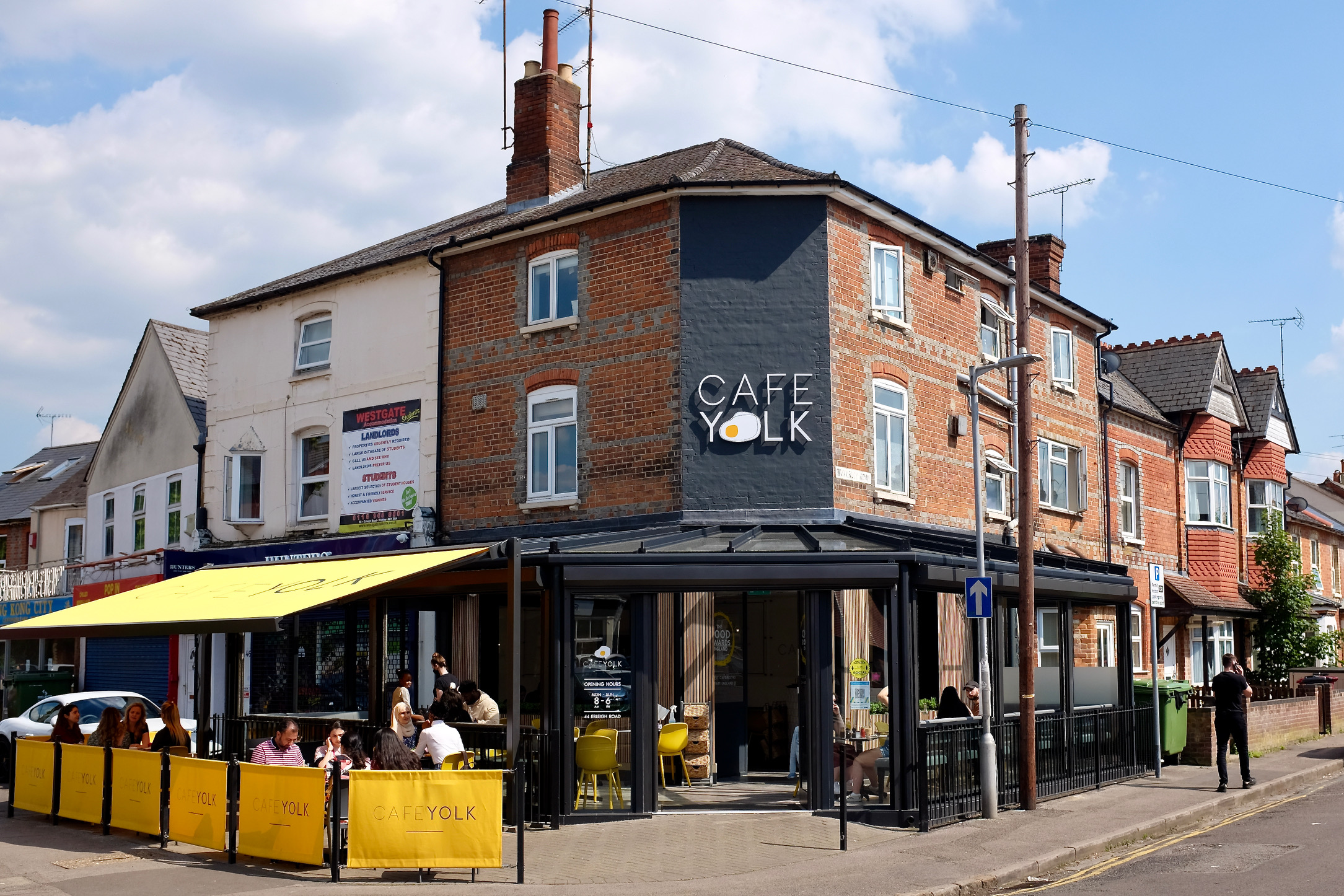
What’s your favourite thing about Reading? The independent scene in our town continues to build. You can have breakfast at Yolk, lunch at Vegivores or Shed and dinner at Bakery House, Clays or Geo Café and have an experience unique to Reading. The independent coffee places and pubs were thriving – before Coronavirus hit I genuinely thought in ten years’ time we would have an identity of our own as strong as Bristol or Oxford, but now I’m not so sure: everything is up in the air.
Who would you invite to your dream dinner party? Obama, Gervais, Robin Friday and Don King – he’s a controversial figure but the best salesman there’s ever been.
What one film can you watch over and over again? The Godfather.
What’s the best meal you’ve ever eaten? A meal at José, a tapas restaurant in London by the Spanish chef José Pizarro, had a big impact on me. It’s a tiny space, about four hundred square feet, walk ins only and the menus are chalked up daily depending on what’s available. The food is always brilliant and eaten stood up, with wooden barrels to rest small plates on. It’s a different kind of dining experience but there’s such a buzz to it, it’s so authentic and I’d love to try and open something like that one day. On the finer dining side of things, I really like Dinner by Heston and Manchester House by Aidan Byrne.
What’s your most unappealing habit? Snoring.
Where will you go for your first meal after lockdown? Bakery House for the chicken shawarma.
What’s the most important lesson life has taught you? If you find a job you love, you’ll never work again.
What’s the finest crisp (make and flavour)? The original Hula Hoop.
Where is your happy place? A long boozy lunch in the sunshine.
What would you be doing in life if you weren’t running Blue Collar? I had visions of being a comedy agent and promoter for a while and started a little business hiring out pub function rooms, booking comedians and selling tickets. It led to a job selling shows at the Edinburgh Festival and was fun, but I think I’d find it difficult to enjoy something that isn’t food and drink related now.
How do you relax? When I started Blue Collar I was still young enough to be able to drink heavily to get through stressful times and not wake up with a monster hangover the next day. More recently, I’ve jumped on every fad going – my girlfriend has tried to get me into yoga during isolation but I’m not sure my body is designed to bend that way.
Who would play you in the film of your life? If we’re being honest, it would be a low budget project that would go straight to DVD. A former Hollyoaks star would probably be the best I could hope for.
What’s your guiltiest pleasure when it comes to food? Cheese. The smellier the better.
Tell us something people might not know about you. My first little food business was selling chocolate bars in the school playground when I was eleven. I used to dabble in a few other things too, like watches and pens, but then Jamie Oliver came along and banned schools from selling sweets in vending machines. It meant my only competition was gone and my sales went through the roof. I owe that man a Wispa.
Describe yourself in three words. Ambitious, friendly, foodie.
The Hero Of Maida closed in early 2024 and has since opened as a new pub, helpfully called The Hero but run by completely different people. I’ve left the review up for posterity.
Despite the name, over six and a half years I’ve reviewed lots of restaurants which aren’t in Reading. To paraphrase David Brent, my world doesn’t end with these four walls. When I’m finished with Reading, there’s Henley, Windsor, Wokingham. You know. Newbury. Goring. Because I am my own boss.
Bracknell.
But I’ve always steered clear of reviewing London restaurants. I suppose part of that is analysis paralysis: how would you even go about picking which restaurants to visit? There are hundreds of London restaurant bloggers (not to mention influencers) swarming around all the hottest new restaurants, all the must-visit openings, so it’s hard to imagine anybody would be interested in my (provincial) opinion. And how useful would it be to my regular readers? You might be in London from time to time, but how likely would you be to go out of your way to try somewhere on my say-so? That’s why I’ve always stayed in my lane, remaining local with the occasional foray further afield on the train.
So what changed? Well, recently one of the restaurant bloggers I read wrote a review of a little Malaysian restaurant just round the corner from Paddington Station. It did what, in an ideal world, all restaurant reviews would do: it made me feel like checking the place out. After all, I’m in London reasonably often, I nearly always come home via Paddington and having decent food options to explore while I wait for an off peak train would be a very welcome development. I Retweeted the review, plenty of people showed an interest and at that point I decided: there would be no harm in adding the occasional review of venues in and around Paddington, to help out if you are in London and want to try out a good restaurant before coming home.
I picked Maida Vale for my first London review because that area has always been one of my favourite parts of the city. You leave Paddington by the exit that takes you right out onto the Grand Union Canal, turn left and meander past all the boats and the offices of Paddington Basin, the fancy gleaming bars and restaurants that have sprung up to cater for all those workers. Cross one of the pretty bridges you come to and you’re in Little Venice, ten minutes’ walk or a single Tube stop from Paddington but a world away in all important respects.
It’s loveliest in summer, but at any time it’s a house envy-inducing stroll. The Warwick Castle, tucked away on a sidestreet, is a lovely mews pub and not far from there is the equally gorgeous Formosa Street with the Prince Alfred, a cracking public house with little booths where you have to duck under a low door to pass from one to the next. If I didn’t have such a magnificent local already, I might well spend my days wishing it was mine.
The Hero Of Maida is just a little further out, on the border between Little Venice and Maida Vale, and in a previous incarnation it used to be called the Truscott Arms. I had a friend who worked in London and I used to go down after work on a Friday afternoon to meet her for a boozy dinner in that neck of the woods. We’d always stop for one last snifter at the Truscott Arms – it closed later than other establishments – before weaving back to the station and drunkenly going our separate ways, me on the Burger King Express back to Reading and her on a terrifying-sounding night bus to Tooting.
I was sad when the Truscott Arms closed but when I heard it had reopened as the Hero Of Maida under the supervision of Henry Harris (of legendary Knightsbridge restaurant Racine) offering a take on classic French cooking, I made a mental note to visit one day. So on a sunny weekday lunchtime my friend John and I paid it a visit, to finally break my London reviewing duck.
It’s a very handsome, light, airy room that instantly draws you in – tasteful muted tones, an attractive wooden floor, gorgeous tiles and a long, curving zinc bar. There’s a separate restaurant area upstairs (open in the evenings but not at lunchtime) but I didn’t feel I was missing out. Lovely tables, too, with button-backed banquettes looking out. It was quiet when we turned up, with a solitary customer plugged in and tapping away on his computer. We sat at the front by the windows, making the most of the afternoon light, although I did wish after a while that we’d grabbed a banquette. On the plus side it means my photographs are better than usual, but the drawback was that poor John was caught in a direct shaft of sun for some of the meal and had to keep shuffling his chair to one side.
The menu changes regularly and on the day we visited it was compact and appealing – just five starters, four mains and a sharing dish (pie for two, an offer I always find hard to refuse). A blackboard behind the bar offered a few other dishes, and although they were listed as bar food they seemed equally restauranty to me. Crucially, one was the same pie in an individual portion: a great relief, because it meant I didn’t have to implore John to change his mind. On another day I would have gone for another special: crispy lamb breast with salsa verde, six almost unimprovable words. “It’s National Pie Week”, our waiter told me, and in the end that made my decision for me.
There was a good selection of beers and we were slightly early for our booking so we started with a pint. My Notting Helles was pleasant enough, if not the most imaginative choice, but John enthused about his pint of Peckham Rye, a very nice-looking amber ale. Later I wished I’d gone for the coffee stout by Magic Rock, but we’d moved on to wine by then. It was a pretty decent wine list too, with plenty available by the carafe, but we settled on a chardonnay from the Languedoc which came in at just over thirty pounds for a bottle. It sounds odd to praise a wine based on all the things it wasn’t, but at the risk of sounding like Goldilocks it somehow seemed appropriate: not too dry, not too sweet, not too oaky, not too expensive. The list said it was a good alternative to a white Burgundy, and I thought that was spot on.
I’d been sorely tempted by the steak tartare, but with a pie on the way I decided to balance light and shade a bit by choosing a more delicate starter. Ibériko tomatoes with burrata felt more a test of sourcing than cooking, but even so I really enjoyed it.
The tomatoes weren’t as good as ones I’d rhapsodised over in Spain but they were close enough, with plenty of freshness and a judicious spot of salt. The burrata felt more like mozzarella to me – completely firm in the middle without any of the glorious creamy messiness of a good burrata – but that struck me rather than irked me. The salsa verde brought it all together, as did some greenery which wasn’t listed and which I didn’t recognise. It had a slightly vinegary bite but I couldn’t place what it was – not samphire, not salty fingers, not (I think) monk’s beard, but a perfect match in any event. Winning enough to overcome a couple of slight missteps: a dish, in many ways, emblematic of the whole meal.
John had chosen grilled mackerel with ‘nduja which, again, is a combination that sat up and begged to be chosen. I thought it looked fantastic, with a generous whack of the fiery, brick-red good stuff. John liked it, but not without reservations.
“I like the skin to be crispy, and this is a bit, well, flaccid. Flaccid is never a good word, is it?”
“No, it’s like damp. ‘Moist’ can be a good thing, but ‘damp’ never is.”
“There’s always ‘wipe down with a damp cloth’, I suppose” said John, equably. “Something else about this dish isn’t quite right. This stuff.”
That’s how we discovered that John, like me, is not a fan of radicchio – although, as a man who gets a vegetable box weekly, he’s very fortunate to only just be figuring that out. I understood though – again, the radicchio wasn’t mentioned on the menu and it did slightly skew the dish. I didn’t get to taste it, but from the look of the plate, also strewn with wild garlic and capers, I think I would have enjoyed it. John did find a few sizeable bones which had escaped the filleting process, though, another glitch that rankled.
John was properly delighted with his main course, though. Guinea fowl came two ways, with a hefty piece of the breast and a gorgeous-looking thigh complete with crispy skin. It was all on top of some silky celeriac puree, along with a big, coarse wedge of smoked Morteau sausage – we Googled it to make sure it was nothing like andouillette – and, apparently, “tropea onion”.
“This is lovely. I’m usually more of a starters man and main courses can feel like a bit of a let-down, so it’s a real pleasure to get such a good main course. And it’s a really big portion of guinea fowl, I wasn’t expecting that.”
I thought that was a good point – this didn’t feel like a little, cheffy plate assembled with tweezers but a proper, hearty dish put together with the diner firmly in mind. Good value at nineteen pounds, too.
My pie was, as so often, more a casserole wearing a hat and the pastry lacked the indulgence of a good suet crust. But underneath, you hit paydirt: a sticky tangle of slow-cooked lamb shoulder and a rich, savoury sauce, punctuated by coarsely chopped garlic and carrot. The greens that came with it were nice enough taken for a swim in the pie filling, but hardly the feature attraction. The whole thing was delicious but it just didn’t feel as much like a proper pie as I’d hoped; it was best described as high-ceilinged, with plenty of breathing space between the filling and the crust.
Many of these niggles were redeemed by the Hero Of Maida’s chips, which were as good as any I’ve had – huge, ragged-edged things, all crunch and fluff. I was initially dubious because they came skin-on, but even that didn’t detract. They were four pounds a portion, and I was relieved that John and I had the foresight (or greed) to order one each. I used mine to absorb every last molecule of the sauce left in my pie dish.
The dessert menu was also compact – just the four options – but we were on a roll and had no intention of letting that stop us. The list of dessert wines was equally streamlined, but we found a Coteaux de L’Aubance on it which was stunning, the colour of late summer afternoons with a clean, poised sweetness. The first sip was one of those little heavenly moments you want to remember for ages: our food so far had been lovely, the only plans for the rest of the day were a bimble from pub to pub talking about all sorts and, in my mind, I was an honorary resident of Maida Vale already.
Desserts were inconsistent in the same way as the starters, but the kitchen had garnered enough brownie points by then to earn some latitude. So for instance, my lemon posset was all out of kilter: far too big, and too cloying without the sharpness it badly needed to cut through. Instead, it felt like a big bowl of something very close to clotted cream and the crumbled amaretti biscuits all over it didn’t do enough to counteract that. It wasn’t what I ordered, or what I really wanted, but on the other hand there are worse things to do in life than eat a large bowl of clotted cream and, when push came to shove, I found I didn’t mind at all.
John’s rhubarb and custard pavlova sounded terrific on paper but again, wasn’t quite there. The rhubarb, John said, was delicious and he really enjoyed the hazelnut praline which played an equally starring role. “But this meringue”, he said, “I hate to say this but it feels shop-bought.” I saw him struggle to break it up and it seemed to be lacking any of the chewiness which would have made the dish perfect. Even so, I looked at his dessert and thought that I would gladly have ordered it myself.
Service, from one chap who seemed to be doing everything that lunchtime, was friendly without being faux-matey, knowledgeable and happy to talk about the dishes and offer recommendations. Again, it might be that if you came to the Hero Of Maida of an evening or on a busy Sunday lunchtime you might have a different experience, but I thought we were really well looked after. Three courses, a couple of pints, a bottle of white wine and two glasses of dessert wine came to just over a hundred and fifty pounds, including that old chestnut the “optional” twelve and a half per cent service charge. You could eat here for less, but I thought it was decent value.
You’ll have read all of this and you’ll already have an idea about whether the Hero Of Maida is the kind of place for you. You might think it’s ever so slightly too far from Paddington or a little too expensive, but I really enjoyed the place. And to save you the effort of questioning my verdict, I’ve already asked myself: was I being charitable because I was having such a nice afternoon? Was I letting the restaurant off the hook when, closer to home, I might have been harsher?
I don’t know. It’s possible. Maybe I was looking at the world through dessert wine-tinted glasses but if so, all I can say is that I thoroughly recommend doing so. Next time you’re in London and you’re on an off-peak ticket you could do a lot worse than booking the Hero Of Maida, especially when summer comes, and crossing the canal to treat yourself to something different before riding the rails back to Gare du ‘Ding. Make sure you get some chips: you’ll thank me for it.
The Hero Of Maida – 7.5 55 Shirland Road, London, W9 2JD 020 39609109
Sen Sushi closed in October 2023 and the owners have moved to Wokingham and opened a new restaurant called Sen Ichie. A new restaurant, Blissful Umami, is in its place. I’ve left the review up for posterity.
I’ve always, I think, been a contrarian at heart. I really don’t like being told what to do. Few things irk me more than people using that Twitter trope “Retweet if you agree” (often I do agree, but I never Retweet). Or when someone tells you to “drop everything and read this”. I used to have a very opinionated friend who was always telling me what I should listen to or read: weekends away at his house in Kent were a bit like being in the musical equivalent of North Korea, being educated in whatever records 6 Music had told him to like that month.
The contrarian in me is why you get a review of Sen Sushi, the little Japanese restaurant at the Three Tuns end of the Wokingham Road, today. I know everybody wants to read a review of Osaka, the gleaming new Japanese restaurant in the Oracle. I completely understand why – the fit out looks superb, the menu has an impressive range and the buzz so far has been good. But something in me thought: what about Sen Sushi? It’s been there a few years, I had it recommended to me recently, and if not now, when would I go? So I hopped on a number 17 bus with my partner in crime Zoë to see if Reading had an undiscovered gem I hadn’t got round to visiting yet.
It’s a little restaurant that can probably seat less than twenty people. The front room has stools up at the window looking out, and a low table complete with tatami where you can sit cross-legged, provided you take your shoes off first. The back room has about half a dozen seats up at the counter where you can watch your sushi and sashimi being prepared. Behind the counter are a fryer and a gas range with four big weathered-looking woks, shiny with oil. That’s where we decided to sit, close to the action, and we had our pick of seats as we were the first customers that evening.
At this point, I pontificated to Zoë about how in many restaurants, being able to see the kitchen up close was considered a positive selling point. However (as we shall see) as the evening went on I started to wonder if it was such a good thing after all.
The menu was pretty big and covered all bases – hot starters, sushi and sashimi, rice and noodle dishes. We decided to try a bit of everything, but started with sushi and sashimi. Our waitress was lovely and polite but giving her our order was an interesting convoluted affair – she then went into the other room, printed off a ticket and came back to put it on the counter for the two chefs doing the cooking and prep. Admittedly, this made more sense when I realised that Sen Sushi also gets a fair amount of takeaway orders which also join the queue.
It really was fascinating watching as one of the chefs flattened the rice on the mat and cut strips of tuna, rolling the whole thing in front of us. Or seeing a beautiful piece of salmon come out of the fridge and be precisely cut into slices with an ultra-sharp Global knife. The wonderful thing about sitting at the counter is that there’s no hiding place in the kitchen: I found myself quite transported by the whole affair, and could have gawped at it for ages. I was possibly more transfixed than Zoë, who by this point was wondering why they hadn’t switched the heater on and was considering wandering over to the coat rack to retrieve her scarf.
The salmon sashimi was easily the nicest thing I ate at Sen Sushi – a really fine piece of salmon, beautifully marbled, soft and buttery. It was better than any sashimi I’ve had in Reading and probably up there with my favourite Japanese restaurants. The spicy tuna maki and avocado maki were fine but no more than that – initially they forgot that the tuna maki were meant to be spicy so they were whisked away and topped with a blob of sauce and a sprinkling of what I think was togarashi. Zoë thought they were a little ragged and lacking in uniformity, I was inclined to be a bit more charitable. Those reserves of goodwill got used up throughout the rest of the meal.
For our second round, we went for chicken gyoza, karaage (Japanese fried chicken) and, just to break up the chicken motif, some soft shell crab maki. The problem with sitting at the counter is that there’s no hiding place in the kitchen, so we saw a chef retrieve a tupperware container full of dumplings and another full of chicken nuggets – I thought it was from the fridge, Zoë reckoned the freezer – and put them in the fryer. Only the soft shell crab was done there and then, battered and then put in the fryer.
All three dishes were moved between the two fryers at what felt like random intervals, so I’m not sure how Sen Sushi would keep, say, vegetarian gyoza separate from the fried chicken. That’s especially ironic because I’m pretty sure they gave us vegetarian gyoza by mistake. They were oddly claggy, and the filling felt bulked out with something stodgy like potato. Zoë generously said I could have her last one and I said “no, I insist”, a sad inversion of how those discussions are meant to go with good gyoza.
Ignorance is bliss, and I wonder how I would have felt about the fried chicken if I hadn’t seen it being decanted from tupperware in front of my very eyes. I probably would have liked it more – the edges were nicely gnarly and crispy, and the meat was tender enough. But normally karaage comes with mayonnaise on the side, whereas Sen Sushi slathered the whole thing with wasabi mayo and a fruity sauce. Wasabi is strong enough, and enough of an acquired taste, that they should have left that choice to the diner: I found it off-putting. “You should have the extra piece, you’re hungrier than I am” I said to Zoë: a transparent attempt to dress up my lack of enthusiasm as gallantry.
Soft shell crab is one of my favourite things, so I was sorry that Sen Sushi’s maki also fell short. They looked the part, a fairly generous portion, the rice studded with tobiko, but putting both cucumber and avocado in with the crab and then drizzling the whole thing with mayonnaise and fruity sauce crowded out the flavours and felt like overkill. They were poorly rolled, too – half of the rolls weren’t closed off properly and fell apart when we tried to pick them up with chopsticks. I saw the chef struggling with rolling them: he had a couple of attempts and then clearly thought Fuck it and had one last half-hearted stab at massaging the sushi rice into the gap. Again, there’s no hiding place in an open kitchen.
What I was also quickly discovering about sitting next to an open kitchen was that it was impossible to have an honest conversation with your dining companion about whether the food was any good. “What do you think?” said Zoë. “Mmm” I replied, non-committally and in earshot.
Being overheard was even more of a problem when the mains turned up, because they were the low point of the meal. Zoë’s teriyaki udon noodles with char sui came in a high-sided, thick rimmed ceramic bowl. She whispered something to me which I couldn’t make out but which I was later told was “dog bowl”. And it’s true, it did look like a dog’s bowl. “I expected to get through it and see a picture of a bone on the bottom” she told me.
But there was no danger of getting through it, because it wasn’t nice at all. The noodles were thick, slippery and strangely oleaginous, the sauce bland and thin. And the char siu was nothing of the kind. Fidget & Bob’s exemplary char siu is so beautifully cooked that it falls apart when prodded with a spoon, and comes to the table anointed with a stunning sticky-sweet sauce. Sen Sushi’s char siu, by contrast, is three thick slabs of pre-cooked pork taken out of yet another tupperware container and chucked in the wok at the end to warm through. It was hard even to tear apart with your teeth, and not worth the effort.
My dish wasn’t cooked until after Zoë’s had been served up – an odd course of action in a kitchen with multiple woks and indeed multiple chefs. I had a rice bowl with braised Taiwanese pork and again, it was an unsettling thing to eat. Disturbingly uniform little cubes of pork were served in a dark sauce which managed not to be sweet, or spicy, or even savoury, just a sort of dark brown white noise. There were a few bits of spring onion scattered on top, but they just left me wishing for more food without that mushy texture.
I didn’t want to draw the parallel, but although Zoë’s dish had come in what looked like a dog’s bowl mine – chunks of meat in a thick but strangely flavourless gravy – was the one that felt like it belonged there. I ate as much as I could face. We weren’t asked why we’d left so much of our main courses, which meant that I didn’t have to fib about how full we were. That said, something about those last two dishes did make you feel unpleasantly full: they didn’t sit easily, and it wasn’t until much later the following day that I felt like eating again.
It’s a shame the food was so iffy in so many places, because the service – from the waitress and the chefs – was pleasant, friendly and attentive for most of our meal. Nice enough that I feel like a bit of a shit for slating the food, but not so nice that they asked whether we were happy with everything, or so nice that I volunteered that information. Sen Sushi does a few desserts (mostly mochi and a matcha ice cream) but we felt like we’d given them enough money already, so we paid and made our escape.
Dinner for two – all that food, two bottles of Kirin and two cans of San Pellegrino – came to just shy of sixty pounds. Perhaps I’m a traitor to the cause for pointing out the inconvenient truth that chain doesn’t necessarily mean bad and independent doesn’t necessarily mean wonderful, but I’m afraid you would get a far better return on that sixty pounds eating at Wagamama or Yo! Sushi than you would at Sen Sushi. You’d also be better off eating at Sushimania, or Kokoro, or taking the train to Windsor and eating at Misugo. And I don’t know how good a cook you are, but you’d probably also have a better meal at home doing a stir fry.
One of my favourite Japanese restaurants is a little place called Chez Taeko in Paris. It’s part of the Marché des Enfants Rouges in the Marais, and it’s just a few little benches and tables and a small menu, on a chalkboard, of sushi, bento boxes and rice bowls. All the food there is beautiful, and when I went there last winter I sat uncomfortably close to my fellow diners, under a heater, with limited elbow room in a little temporary structure like a gazebo enjoying terrific crispy chicken and rice, maki and then concrete-grey sesame ice cream, like edible Brutalism. I honestly couldn’t have been happier.
At the end when I went round the corner to pay the bill I saw the tiniest kitchen, the staff in it working flat out, serving up terrific dish after terrific dish to the lunching Parisians. I so wanted Sen Sushi to be like Chez Taeko, to have the potential to become a happy place, but it didn’t even come close.
“It really did look like a dog bowl” said Zoë when we were safely ensconced back in our house, the meal an uncomfortably recent memory. “If my mum or dad had been there when they served that up they would have wet themselves.”
“You didn’t like it at all, did you?” I said. My initial thoughts had been that the sushi was pretty good and perhaps mitigated the disappointment of the other dishes, but the more time passed, the more I felt that I was being too kind.
“No, I really didn’t. I wouldn’t go back. And it was so cold in there – they had a heater on the wall, why the fuck didn’t they switch it on? And what about the gloves?”
“The gloves?”
“Sometimes the chef was wearing blue gloves and sometimes no gloves at all. What was that about?”
“Well, he wore gloves when he was handling raw fish though, didn’t he?”
There was a pause: Zoë was clearly deciding whether to break bad news to me.
“Not always. And I didn’t appreciate one of the chefs taking a fag break while we were eating our main meals with the back door open, so I had my dinner with a side of Benson & Hedges.”
Again, I hadn’t noticed that.
“It’s a real shame,” she went on “because I wanted to like them, but that char sui was just… it wasn’t good at all.”
“You’re right, I’m afraid.”
Zoë’s accompanied me on nearly twenty reviews by now: I’m starting to think she deserves some kind of promotion (or time off for good behaviour, at the very least). As for me, I’m sure I should learn something from this whole experience. But I fear I’m far too contrarian for that.
I know many people scroll to the bottom of my reviews to check the rating and the summary, the tl;dr equivalent of slogging all the way through my deathless prose. I know, too, that some people think my reviews are too long; God knows how many people make it to the end of the middle section where I (finally) get round to telling you what the food tastes like.
Well, this will confuse plenty of those people – let’s start at the end for once. Taco Bell is bloody awful. Truly. Don’t eat there. I can’t think of a single good reason for visiting Taco Bell unless you’ve never been to one before and are genuinely curious about what it’s like. That was me before I did this review, so I tell you what: I’ll satisfy your curiosity and then you can save your money, your calories and your dignity and have a better meal somewhere else. Sound all right to you?
Subscribe to continue reading
Become a paid subscriber to get access to the rest of this post and other exclusive content.
Is it me, or did New Year used to be a bit less, well, preachy? Nowadays we’re bombarded with things you ought to do – eat vegan food for a month, or quit drinking, or drink lots of local beer to compensate for everybody who’s quitting drinking. It’s a hard enough month at the best of times – back at work, no longer allowed to eat chocolate whenever you like. Depressed by the scales, depressed by the sales not selling anything you fancy, and it’s so bloody dark all the time. The last thing anybody needs in January, if you ask me, is a sermon.
So I’m not going to do a feature about vegan food in Reading, or where you should go to try beers from our many excellent local breweries, or which tap room is the best. Instead, this piece covers the one truly universal thing about January whoever you are: it’s a long time since the last pay day, a long time until the next and everybody is on a budget. So this feature is about the best food you can get in Reading for not much money, something I hope we can all get behind.
I’ve tried to limit this to genuine stand-alone items. Obviously I could have included plenty of starters, but nobody turns up to a restaurant, orders a starter and leaves. So, ideally, every item on this list could be eaten on its own as the feature attraction, and every one costs less than ten pounds. That does tend to push it more in the direction of lunch than dinner, but there are still at least half a dozen items on this list that you could happily eat for an early evening meal.
Having already decided which dishes I’d include I posed the question on Facebook and got a raft of answers which reminded me just how much good food in Reading didn’t quite make the cut for me. I was sad not to be able to make room for anything from Blue Collar’s Peru Sabor, for anything from Perry’s, Franco Manca, Kings Grill, Bakery House or Sapana Home. That so many good places are excluded, I hope, shows how tricky making this selection was.
Anyway, I hope this comes in handy – all of them have been extensively road-tested by me, and all come highly recommended. Happy budgeting, and good luck if you are forgoing meat, booze or indeed anything else this month. Rather you than me!
1. Chilli beef nachos, the Lyndhurst
Let’s get the obvious one out of the way first: no surprises here, especially after I awarded it Starter Of The Year in my end of year awards. But, as I said then, it’s substantial enough to eat in its own right, or to snack on with drinks. Anyway, I’ve said quite enough about these nachos lately, so instead I’ll quote my occasional dining companion Martin: after he had them for the first time last month he said “All I can say is now I realise everyone else is doing chilli wrong. And doing nachos wrong too. Fantastic dish!” And he knows what he’s talking about, because he’s the poor sod who had to endure the unique gastronomic experience of the doner meat nachos at German Doner Kebab. I’ll save you the effort of scrolling down: they don’t feature later on in this list. (88 Queens Road, RG1 4DG)
2. Jerk chicken, rice and peas, Sharian’s Cuisine
I’ve never been a fan of CHOW, the Friday street food market run in conjunction with Reading’s shadowy Business Improvement District. I’ve always thought it was a shame the market isn’t run by the better, more imaginative, more Reading Blue Collar Food who operate on Wednesdays in the same location. But what CHOW does have – which always generates huge queues – is Sharian’s Cuisine, and their jerk chicken, rice and peas is a thing of wonder. The chicken is spiced, charred and smoky, you get tons of it and they tell you, ever so nicely, that you’re being a wuss if you opt for the milder of the two hot sauces on offer. The weather isn’t quite conducive to eating it al fresco right now, but just you wait. (Market Place, RG1 2DE, Friday lunchtimes only)
3. Chilli paneer, Bhel Puri House
One of Reading’s iconic dishes, and one I’ve been raving about for the best part of six years. Caramelised cubes of paneer, crunchy peppers and spring onion and powerful green chillies lurking in there if you feel especially brave. I went through a phase of cheating on the chilli paneer with the saucier, stickier paneer Manchurian, I even went through a particularly depraved phase of ordering both of them at once. I dallied with the vada pav, too, but I always go back to the chilli paneer. It never lets you down. (Yield Hall Lane, RG1 2HF)
4. Ajika chicken wrap, Geo Cafe
There are many contenders for Reading’s finest sandwich: more than a few of them feature in this list. But, for my money, Geo Café’s chicken wrap is arguably the best. Georgian food tastes like nothing else you’ve ever eaten, and Georgian flavours transform this dish completely. The combination of fiery spice from the ajika and the pungency of baje (a Georgian sauce made from walnuts) is both otherworldly and habit-forming.
Chicken features quite heavily in this list, but this – made with free-range corn-fed chicken thighs from Vicar’s – is stupendous stuff. A wrap will set you back six pounds. Many would argue that Geo Café’s khachapuri, flat soda bread stuffed with an ingenious blend of three cheeses, should be in this list too, to which I can only say that making these decisions is harder than you might think. (10 Prospect Street, RG4 8JG, daytime only)
5. Curry night, The Lyndhurst
The Lyndhurst make this list twice because this is simply too good, in terms of quality and value, not to include in its own right. Every Thursday they offer a choice of three different curries, rice and a naan bread and a pint for nine pounds and ninety-nine pence (as you can see, when I went they threw in an onion bhaji in for good measure). The curries are all interesting and miles from kormas and bhunas, with dishes from Mangalore, Goa, Kerala and Sri Lanka, among others. I loved my visit last year, and it won’t be long before I’m back there – so much better than spending a similar Thursday in Wetherspoons making the tills ring and the microwave ping. (88 Queens Road, RG1 4DG, Thursday evenings only)
6. Tuna Turner, Shed
Another entry which will surprise nobody, and another dish which will probably make the cut if Reading Museum ever does an exhibition on iconic Reading food, the Tuna Turner is a truly legendary toasted sandwich and one of the very best things you can eat of a lunchtime. Superior tuna mayo, sweet slivers of red onion, plenty of cheese and jalapeños – very much the secret weapon – all conspire to be so much more than the sum of their parts. I think it’s something about the way the cheese melts, somehow seeps through the gaps in the sourdough and then forms a beautiful, glistening, caramelised crust.
If you’re there on a Friday lunchtime, and Shed is doing the Saucy Friday with scotch bonnet chilli chicken, rice and peas, macaroni cheese and coleslaw that dish, also far less than a tenner, runs the Tuna Turner pretty close. (8 Merchants Place, RG1 1DT, daytime only)
7. Lamb kothey momo, Namaste Momo
Namaste Momo is in a funny little spot on the border between Woodley and Earley, an area not blessed with its restaurants. Only one bus really runs that way from the town centre, and after a certain time it only ventures out once an hour. But, for all that faff, I highly recommend a pilgrimage there because their momo are worth it.
They are made by hand and in all their forms – in a hot, thickened chilli sauce, steamed or deep fried – they justify the journey. For me, it’s when you pan fry momo that you get that bang-on midpoint of taste and texture, the contrast of char and chew and the gorgeous filling inside. Speaking of fillings, the minced, spiced, seasoned lamb is my favourite – if it was served as a slider you could sell out any hipster gaff in the town centre. But we all know better than hipsters, don’t we, and these momo are perfect just the way they are. (392 London Road, RG6 1BA)
8. Scrambled eggs, Fidget & Bob
I’ve had some truly terrible scrambled eggs in my time. I once stayed over with a then-friend in Chichester and she microwaved eggs into grey pellets – I gamely ate the lot, because I didn’t want to seem rude, but really it could have been polystyrene and I might have had a better meal. I’ve tried to learn to make them myself, with guidance from the sainted Delia, and they come out okay but not great. The truth is that Fidget & Bob have ruined me for all other scrambled eggs. For five pounds you get three golden-yolked Beechwood Farm eggs, scrambled with probably more butter than I’m comfortable knowing about (that’s the great thing about eating in restaurants: ignorance is bliss) and certainly with more skill than I can manage.
They come with plenty of buttered seeded toast although extras – hash browns, nicely crispy back bacon, that legendary slab of sausagemeat loaf – are all available. They shouldn’t push the price over a tenner unless you’re really going loco, either due to gluttony or a hangover. Another great way to spend less than ten pounds in Fidget & Bob, every Tuesday night, is to go for their quite wonderful char siu pork. (The Piazza, Whale Avenue, RG2 0GX, Tuesday to Sunday)
9. Sweet chilli chicken, Kokoro
One of my very favourite things to eat for an early solo dinner or a particularly indulgent lunch, Kokoro’s chilli chicken is a crunchy, sticky, fiery, garlic-studded tub of one hundred per cent fun. A regular sized portion is pretty big and a large portion (which costs a princely additional pound) is absolutely gigantic: both come in comfortably below the ten pound mark.
The quality varies – some batches make your eyes water and your nose run, some are milder. Sometimes you get smaller, crunchier bits of chicken, sometimes they are huge, plump things (but always with that wonderful coating). But even on a relatively bad day, Kokoro’s chilli chicken is a miraculous thing. It comes with rice or noodles – I’ve always found the noodles a bit too much like hard work, but your mileage may vary. Writing this has made me seriously consider having it for lunch today, which I suppose is almost as bad as laughing at your own jokes. (29 Queen Victoria Street, RG1 1SY)
10. Challoumi wrap, Purée/Leymoun
To do the confusing bit first: for reasons I don’t completely understand, sometimes Sam Adaci runs a street food van called Purée, sometimes it’s called Leymoun. Purée operates out of a distinctive green van, Leymoun is more nondescript. I don’t know the rhyme or reason of why there are two different names and two different vans. He is at Blue Collar in the market square every Wednesday and CHOW in the same place on Fridays, and sometimes you can find the Purée van parked on Broad Street at other times. But if you’re ever near either van at lunchtime, join the queue and order a challoumi wrap. They cost six pounds, they are absolutely crammed with wonderful stuff and I can’t recommend them highly enough.
The chicken is spiced and cooked on the griddle before being finely chopped, and the halloumi is salty but not too squeaky (for a while Sam was having his own Brexit-proof halloumi specially made in London: not sure if he still does). Add the pickles, and the chilli sauce, and the garlic sauce and you have an overstuffed messy marvel of a sandwich where every mouthful gives you something ever so slightly different and you always want there to be another mouthful. “Purée/Leymoun” is also a bit of a mouthful, come to think of it, but it remains a must-eat at lunchtime, even if the van can be a tad elusive. They also do freshly-made falafel which are a beautiful meat free alternative. (Market Place, RG1 2EQ, Wednesday and Friday lunchtimes only. Also on Broad Street: times vary)
11. Com chien, Pho
I quite like Pho, even if I’ve never managed to learn to love the eponymous dish: soup plus noodles just isn’t for me. This means I’ve never developed the fervour for it that other restaurant bloggers seem to manage. But they do have an absolute ace up their sleeve in the form of their com chien, a generous fried rice dish with shreds of chicken, chewy little savoury dried shrimp and many, many flecks of chilli. This dish, sort of a Vietnamese nasi goreng, is wonderful for blowing away cobwebs. You can tell it’s hot because when you order it, the staff invariably ask if you’ve had it before – with the same trepidation barbers used to show when they asked if I really wanted a grade two all over. You can top it with an optional fried egg, but I like it just fine as it is. (1 King’s Road, King Street, RG12HG)
12. Samosas, Cake & Cream
I was tipped off by Mansoor, a regular reader, about this place that sold the best samosas in Reading. It is called Cake & Cream, and it’s off the Wokingham Road, just after the row of shops and before the Three Tuns. Their main thing is big, impressive-looking cakes, but they also have a little whiteboard near the front detailing the savoury stuff they sell. Samosas are about 75 pence each, and they also sell pakora, paneer pakora and bhajis by weight, almost like a savoury sweetshop.
The samosas really are everything Mansoor promised they would be: full of a rich and surprisingly spicy potato masala, the pastry spot on and the whole thing piping hot and utterly addictive. They come with a sauce which is tangy, sweet and hot in equal measures, although they’re just as magnificent without it. The service is very friendly and the chap always seems thoroughly surprised to see me – oh, and the pakora are also tremendous. There are tables at Cakes & Cream, and I’m sure some people eat there, but I always take my bag and scarper onto the first 17 bus I can find, counting the minutes until I can tuck in back at home. You get jealous looks from your fellow passengers, although that might just be my imagination. (11-13 St Peters Road, RG6 1NT)