Amò reopened on 23rd July 2026 after closing in mid-December 2025, apparently for maintenance.
In the good old days, where you stood on certain binary debates was simply a way of positioning you in the world. Cream first or jam first? Plain or milk chocolate Bounty? Cheese and onion or salt and vinegar? Were you a fan of the Beatles or the Stones? Blur or Oasis? All these things used just to be a form of triangulation, little points on a chart that, taken together, might give someone an idea of you (and, since you’re asking: cream first; milk chocolate; salt and vinegar; the Beatles; neither).
When did that all change? 2016, I suppose, when we all became Leave or Remain, indelibly stamped, and at every stage from that point forwards. We’re always asked what side we’re on, and now it’s not a useful piece of trivia but a necessary step to place yourself on one side or another of a yawning chasm. Are you pro- or anti-Israel? Do you think J.K. Rowling is a hero or a villain? How about Farage, or Trump? Did you believe in lockdowns, masks, vaccines? Did you leave Twitter or stay? If you left, did you go to Bluesky or Threads?
Like the Tower Of Babel, we’re now all scattered to the four winds, trying to find our tribe and arguing, endlessly, with the others. It’s not a bit of fun, any more. And this is all rich coming from me, because I’m painfully aware that I’m as polarising as most. Happily, Reading faces another tricky choice now that’s potentially just as difficult, but hopefully less divisive: Paesinos or Amò?
The two pizza places opened on Kings Road, two doors and three months apart, the latest in a weird series of rivals in very close proximity, following the example of Pho and Bánh Mì QB in Kings Walk or Iro Sushi and You Me Sushi on Friar Street. What is it with that? You must be very confident in your product to open so near to a direct competitor, like Bánh Mì QB did, but with Paesinos and Amò, Iro and You Me so little time separated both arrivals that it must be an unhappy coincidence. Imagine pouring your heart and soul into a new business only to find that another one a lot like yours is doing exactly the same, a stone’s throw away.
Anyway, regular readers will know that I reviewed Paesinos a month ago with my Italian friend Enza (who is, just to confuse matters, an Amò superfan) and it received a glowing write up from me. But I knew, even as I was eating there, that I needed to prioritise visiting its neighbour, if only because Enza told me that it was as good as, if not better than, the restaurant I had so enjoyed. I couldn’t go with Enza, because she was so far from impartial, and this time I took my friend Jo, also of Italian descent, last seen checking out House Of Flavours with me.
Subscribe to continue reading
Become a paid subscriber to get access to the rest of this post and other exclusive content.
It was a muggy Saturday, the longest day of the year in fact, the mercury was nudging close to 30 degrees and, sipping my mocha outside C.U.P., I felt like the Only Living Boy In The Ding.
Scrolling Instagram all I could see was holiday snaps – people just back from Malaga and Cordoba, newlyweds honeymooning on a Greek island, someone I know on his annual holiday to Kalkan, spending three weeks in a little Turkish piece of paradise. The world had its out of office on, or at least it felt that way, and there I was, fresh from my haircut, halfway through a C.U.P. mocha, a little on the outside of things, looking in.
I wandered round town, but nothing lifted that feeling of dislocation. Station Hill was holding a mini festival to celebrate it opening – notwithstanding that it opened over four months ago – and the whole cut through from the station to Friar Street was lined with food stalls, drink stalls, music and crafts and hubbub. London coffee spot Notes, not yet open, had a stand selling coffee and another selling Aperol spritzes, and everywhere you looked there was someone else offering street food, largely vendors I’d not heard of.
The place was buzzing, although I put a picture up on Facebook and person after person said “if only they’d advertised it”. Still, it felt like everyone I know had somehow been spirited away out of town, and there I was, surrounded by people but alone. I thought of my wife, at the far end of the M4 busy at work, and all my friends dotted across this country and others, my brother on the other side of the world (this, by the way, is why I shouldn’t spend too much time on my own).
I could have grabbed lunch from one of the stalls, fetched a drink from Siren or the Purple Turtle’s pop-up bar, I could have participated. But something stopped me. It felt a little like a glossy celebration of house prices in Reading inching slightly further out of reach, it had a slight feeling of forced fun about it. But that’s just me: I’m not much of a joiner-in. Anyway, I had a lunch appointment to go to, one for which I was several years late. Time to get going.
Normally I ride the number 5 or 6 bus all the way up the hill, along Whitley Street and past the Whitley Pump roundabout, getting off at the nearest stop to my house and strolling home from there. But this time, in the sweltering, almost oppressive heat I alighted halfway up, where Silver Street becomes Mount Pleasant, and walked the rest of the way. And there it was, Pau Brasil, with its pretty cobalt blue door and its awning out. It had been a long, long time.
Subscribe to continue reading
Become a paid subscriber to get access to the rest of this post and other exclusive content.
Devizes Road is about a thirty minute walk from Swindon’s unlovely train station, a building with a whiff of the gulag about it. Or you can take a bus, which winds its way uphill and will get you there in roughly ten. Once you reach your destination, you’re not in Kansas any more. You’re still in Swindon, but in Old Town. And Old Town’s different.
Devizes Road isn’t a looker. It’s not the pretty street in Old Town: that’s Wood Street, around the corner, lined with delis and wine shops, tapas bars and spots for lunch. Devizes Road is another kettle of fish. It is, not to put too fine a point on it, a fantastic place to drink beer, a road literally lined with wonderful spots in which to do precisely that.
You have the Hop Inn, possibly the founding father of Swindon’s craft beer scene, and on the other side of the road you have the Tuppenny, a pub of which I’m inordinately fond that has Parka and Steady Rolling Man in its permanent collection and a beer fridge its own Untappd listing refers to as the “fridge of dreams”.
There’s Tap & Brew, the superb brewpub of quietly excellent local brewery Hop Kettle, with a beer garden that’s marvellous in the sunshine. Hop Kettle also has an upstairs bar called The Eternal Optimist with a speakeasy feel, at the end of the road above the marvellous Los Gatos, a restaurant which in itself would provide ample excuse for a trip half an hour down the railway line,
I’m not finished. You can now drink at The Pulpit, the Swindon outpost for local Broadtown Brewery, a relatively new addition. And as of late last year another option is The Drink Valley, another brewpub and in fact that brewery’s second Swindon branch, having made a success of their first one in the town centre.
Were you keeping count? I make that six great beer spots in the space of a five minute walk, three of them brewpubs or brewery taps of some kind. Forget schlepping all the way to London and dragging yourself south of the river to experience a London brewery crawl, hot and crowded and absolutely rammed with Steve Zissou-style microbeanies. A quick train journey west and you can have an equally terrific time without troubling the capital – why endure the Bermondsey Beer Mile when you can enjoy the Swindon Booze Street?
Besides, a friend of mine was in a pub near Borough Market the other week where the most expensive beer on the list was a mind-boggling £20 a pint: Old Town is far, far kinder on the wallet. I was in Old Town, as I invariably am, to have lunch and beers with my old friend Dave. Dave initially wasn’t mad keen on being a dining companion on this blog but as time has passed it’s turned out that he enjoys it far more than he thought he would. This is a very Dave phenomenon.
But the winds of change are blowing through Devizes Road, and much is different from when I was here last on duty. Burger spot Pick Up Point, which I so enjoyed last year, has closed down. Ice cream parlour Ray’s is under new management, and finding its feet. And The Drink Valley, the venue for this week’s review, has opened two doors down from Tap & Brew, its second branch slap bang in the heart of Swindon’s budding craft beer scene.
First, we took advantage of another welcome development: during the day, Tap & Brew now plays host to excellent local roasters Light Bulb Coffee, and when I joined Dave there just after 11 the place was jumping. Somehow it seemed bigger than when I was there last but in truth it was just packed, every table occupied with the kind of hipsters, families and pursuers of the good life that Dave wasn’t entirely convinced lived in Swindon. And yet there they were, that Field Of Dreams principle in action.
So before lunch I enjoyed a couple of superb lattes and Dave and I began the process of catching up. It’s funny, there are friendships where you don’t see somebody for ages and when you do, it’s as if no time has passed. Dave and I have, at times over the last thirty plus years, had a friendship more like that but these days I see him most months, a combination of great company, his empty nest, our mutual love of beer and good times and our spouses being busy at weekends. And even though I see him frequently there’s never any shortage of things to discuss, in his life or mine.
So we talked about our respective families, his son at Durham, his work and mine (we always conclude, on balance, that working for a living isn’t all it’s cracked up to be) the triumphs of Liverpool Football Club – Dave’s other lifelong passion – and our plans to go on holiday together to Bruges this winter, for the first time in nearly ten years. I fully expect it to be something like a cross between The Trip and Last Of The Summer Wine.
The Drink Valley, a name which would appear to make no sense whatsoever, opened in the centre of Swindon first, and its thing was craft beer and Indian small plates. Dave tried to get me to review it back then and I was tempted, because Reading has never had anything approaching a desi pub and I think it’s a concept that could do well almost anywhere. But he never tried too hard to persuade me, because it was in the centre of Swindon and Dave doesn’t go there from choice. An upmarket sister branch in Old Town was a much easier sell.
It’s hard to get much intel on The Drink Valley – I’ll drop that The from now on, if that’s okay with you – ahead of a visit. Their website used to be under construction, with wording saying “coming soon”, and a picture of their original branch. Now it just advertises a summer festival that takes place next week. The two Facebook pages give you a rough idea of the menu but the two Instagram feeds, much as they list promotions, live music or new beers, fail miserably at what must surely be two of the main functions of Instagram: to show you what the room looks like and what the food looks like.
That’s such a wasted opportunity, especially with Drink Valley’s Old Town branch because it was really quite gorgeous and, I would say, a cut above the decor of any of its neighbours on Devizes Road. Sturdy but tasteful tables were ringed with comfy armchairs in pastel colours, a deep red banquette running along one wall. The walls and wood panels were a beautiful midnight blue (“why does this colour always look classy?”, Dave wondered) and the overall effect was really pleasing.
Craft beer often feels like a bit of a sacrifice – never mind the interior, taste the IPA – and I’m not sure I expected Swindon to be the place that rebutted the idea that you have to choose between substance and style. It felt like the middle of a restaurant/pub Venn diagram, somewhere that wasn’t quite a restaurant or a pub but could quite easily pass for either.
The selection of beers, though, would definitely suggest pub rather than restaurant. Five hand pumps, all serving cask beer brewed by Drink Valley, along with just shy of a dozen options on keg. Four of those were also brewed by Drink Valley and the others featured breweries I knew well, like Polly’s and Vault City, and a couple that were new to me.
The most expensive beer maxed out at £8.50 for a pint, but it was a 7.3% sour so I doubt you’d be guzzling the full 568ml anyway, unless you were well and truly on a mission. We started with a half each of Ceres, a very approachable pale from North Wales’ Polly’s, and started the serious business of reviewing the menu. It was an interesting mishmash of small and big plates, of pub food and more leftfield choices.
So, for instance, there were just the four mains, a couple of which – fish and chips, sirloin steak – were the kind of thing you’d get at good and bad pubs across the land. Five burgers, too, mostly conventional fare, although the “bulgogi burger” with bulgogi sauce and kimchi mayo nodded to food trends. A couple of sharing platters and some loaded fries and nachos also felt reasonably mainstream.
But then we looked at the nibbles and starters and many looked like they’d wandered in from a different menu, one that ranged from Spain to Italy to Morocco, before upping sticks and taking a long flight east. Not only that, but some of the things on it were so eccentric that it didn’t feel like a Brakes van could have been involved in their genesis.
Take the first of our small plates – clusters of shimeji mushrooms belted with bacon, cooked in what was apparently an ‘nduja butter until the bacon was crispy and the mushrooms nicely done. This was a real delight, and both Dave and I loved it. The ‘nduja didn’t come through strongly for me, but it did lend a sort of salty funk that reminded me of blue cheese. I thought it was a superior take on devils on horseback, Dave thought it was everything good about a full English in a little package.
Either way it was clever, fun and quite unlike anything I’ve had. By this point I was on small beer number three, having tried a slightly too bitter pale by Rotherham’s Chantry Brewery and then moved on to a passion fruit mojito sour by Vault City which was sweet, boozy and surprisingly good with this dish.
“Try this” I said to Dave, offering him a sip. “It’s the kind of thing where you’ll try it and tell me it might be perfectly nice, but it isn’t beer.”
Dave took a sip and said exactly that. Which pleased me enormously, even though I wasn’t entirely sure I disagreed with him.
Those bundles of joy cost five pounds fifty for three, although as so often I think Drink Valley should work on giving you even numbers of these things to increase sharing and reduce arguments. Equally good, and equally good value, was a little bowl of nuggets of chorizo, cooked in wine, with a great mixture of chewiness, caramelisation and punch. This is such a simple thing to do, and such a perfect thing to have on hand when you’re drinking beer. And yet I don’t think I’ve ever been to a craft beer place, in this country at least, which thinks to serve it.
Drink Valley made good progress towards a clean sweep on the first impression with a very serviceable dish of Moroccan fried cauliflower. The spicing on the coating was impeccable, nicely arid with plenty of interest, and the cragged and crinkled exterior was cooked beautifully. The mayo, speckled with sesame, was a perfect dip, although I didn’t necessarily get the promised mushroom in it. The only fault with this dish was that cooking it perfectly involved getting all bits of it right: for me, the cauliflower had steamed slightly inside its glorious housing, lacking just a little of the bite I’d want to see.
But again, at less than six pounds I didn’t feel remotely robbed. What we were eating here were perfect beer snacks, and I couldn’t think of anywhere in Reading that offered something comparable. Well, except Siren RG1 I suppose, but when I ate there you got a little less for an awful lot more money, and it wasn’t much cop. Had Drink Valley stumbled on something here? Further research was undoubtedly called for, but what about the main courses we’d promised ourselves we would order?
The final dish, though, was decisively brilliant. Dave had insisted on us ordering salt and pepper squid, because he thought it was a really good dish to benchmark with. I was a little resistant to the idea, because I agreed with him and suspected Drink Valley’s rendition would fall short. Well – and Dave reads the blog these days, so I know he’ll especially enjoy this bit – he was right, and I was wrong.
What we got, in fairness, was not salt and pepper squid as I understand it. It didn’t have that distinctive coating, the way the same order at, say, Kungfu Kitchen would have done. But we got something even better. Six pieces of squid, beautifully scored, in a crispy salt and pepper-free coating, fried and brought to our table fresh as you like with some charred lemon and a nicely tangy srirachi mayo.
And my goodness: if you’d told me before the visit that I’d have some of the best squid I can remember anywhere in a craft beer bar in Swindon I’d have replied that you must be on mushrooms. But, would you believe, that’s exactly what this was. So fresh and tender, no twang of rubber, coated so well, cooked spot on, intensely moreish and dippable. And you got six pieces for a crazy six pounds fifty – so affordable and easy to divide up, even if you resented giving away half.
It’s safe to say that at this point Drink Valley wasn’t in any way what I was expecting. And then Dave said something somewhat wonderful.
“You know what, mate, I could pass on the main courses. They all come with carbs, and I’m getting enough of that today with the beer. I could just go another round of small plates, instead.”
What a cracking idea, I said. Let’s do that.
“Won’t that interfere with your review?”
I thought about it briefly and made an executive decision that actually, it could be the making of it. Because you may or may not want to know about burgers, steaks or fish and chips, but you can get those anywhere. And if you go to Drink Valley, which I slightly hope at least one of you will, you can have those then, if that’s your thing. But I couldn’t think of anything better than eating more small plates like the ones we’d had, on a rainy Saturday afternoon with an old friend. So up I went to the bar to order our second wave.
When I did, I talked to the chap who’d served us both our food and our drinks. They’d been open almost bang on six months, he told me, and things were going well. He said the idea was that the original branch was craft beer and Indian food, whereas this follow-up was craft beer and Korean food: I didn’t challenge that, although I wasn’t sure the menu quite bore out that ambition.
He said that they brewed offsite and didn’t currently have a tap room, although in the fullness of time they wanted to can their beers and sell them more widely. I told him how great the squid was, and he told me it was his favourite dish on the menu. I got that little glow of pride from him that always comes with people giving a shit what they do, and in return I felt happiness that Dave and I were in with a fighting chance of being his most gluttonous customers that day.
Our second wave of dishes was maybe not quite as successful as the first, but that’s always the way: you start out picking your must-haves, and trying to repeat your success always risks ordering an also-ran. For me the least successful dish we had were the pork ribs, roasted in miso and barbecue marinade. They were very close to greatness, but not quite close enough: they looked the part, and the marinade came through really well – and was rather interesting, at that.
But they weren’t big enough specimens and the meat took some pulling away from the bone, lacking substance and tenderness. Again, there was an odd number and I left the spare rib – pardon the pun – to Dave. He loves ribs, and is threatening to take me to a place in Bruges called Mozart where they do bottomless ribs: he told me, with great pride, how his son got through quite a few of them on his visit earlier in the year.
More successful was the wild mushroom bruschetta: two halves of toasted ciabatta roll topped with mushrooms that packed an impressive intensity of flavour, although – and I know this is a bugbear of mine – I really don’t think they were wild at all. I do wish people would stop making wild claims about their non-wild mushrooms, but I’ve been moaning about that for years and it shows no signs of abating. And while I’m moaning – everything we had at Drink Valley was excellent value, which made the nine pounds fifty conspicuously irrational pricing. Nothing this small is worth that, however good it tastes.
The remainder of our dishes restored the natural order. I had been sniffy about ordering the honey and mustard chipolatas, because in the immortal words of someone (I think it might have been John Inman), I don’t generally go near a sausage unless I’m confident of its provenance. To quote another famous person, my ex-wife used to say that cheap sausages are made up of, and this was her exact phrase, “eyelids and arseholes”.
I’ve always thought she was right about that but, again, Dave talked me into this one. And again – he’s going to be insufferable after this – he was right. The texture of these, in any other context, I might have found a little homogeneous but they were just coarse enough, just herby enough, just sticky enough to be a treat, especially dredged through the honey and mustard gathering at the bottom of the bowl. Also, just to say – these were allegedly cocktail sausages. I’d like to see the cocktail that went with them. It would be a tiki bowl and a half.
We also had something that, by this stage, was a bit of a variation on a theme. Strips of crispy chicken, served sizzling in a hot skillet, cooked in garlic butter, topped with slices of jalapeno and sitting on a bed of beansprouts and carrots. It’s a well-known fact that, unless you happen to find yourself in TGI Fridays, nothing that comes to your table sizzling can be entirely bad, and so it proved here.
The chicken was quite pleasant, but it came into its own towards the end of the dish when the bits we were slow getting to got crispy-crunchy, almost blackened. And by that point the julienned carrots and beansprouts, conversely, had softened and taken on the garlic butter, become a treat in their own right. This was a dish that required patience to get the best out of it. In that respect, I think I rather identified with it.
Oh, and we had some more squid. I couldn’t resist ordering that.
I’d like to tell you what Drink Valley’s dessert menu is like, but I mostly failed in that endeavour. They do a Basque cheesecake, like everybody else, and ice cream and a brownie and a chocolate orange torte, but none of that interested me and I had half an eye on ice cream at Ray’s later on. But they did have something that served as an excellent dessert: a chocolate caramel brownie stout, brewed by Drink Valley themselves. Two halves of it cost us £7.60, so less than two desserts would have cost, and it was twice as fun.
“Time for dessert, is it?” said the man behind the bar when I ordered these, and then he told me that when Drink Valley brewed it they invited staff to the brewery to test drive it. “I don’t remember much of that evening!” he told me, and after a half I could understand why. It was almost nitro-smooth, with a depth of flavour and thickness that belied its 7% strength. If they’d had it in cans, I’d have come away with a couple.
We were preparing to grab our brollies and go out and brave the heavy rain, and I was inwardly congratulating myself for how we’d tackled the menu when I saw our man heading past to an adjacent table with the fish and chips, made with batter using Drink Valley-brewed beer. I couldn’t help rubbernecking as it went past our table, an unbreakable bad habit of mine I’m afraid, and the chap gave me a little smile. Next time, it said. Next time indeed. Our meal – a total of nine small plates and seven halves of beer – had come to just under eighty-five pounds.
The rest of the day was every bit as winning as the start it got off to. I trudged mutinously round the Town Gardens with Dave while he literally stopped to smell the roses and told me how he and his wife had got into wandering along canals. “What have you become?” I said to him, adding “Do you know, I think you’re the only person I’d walk round a park in the pissing rain with when there are amazing pubs five minutes away?” It’s not Fleabag’s sister running through an airport, but it’s close.
After that, there was beer. Beer at the Tap & Brew, beer at the Hop Inn (Dave mentioned their Korean chicken burger was excellent: “now you tell me”, came my refrain). Then there was beer at the Tuppenny, and more beer at the Tuppenny, and then Dave’s wife kindly picked us up and gave me a lift to the station. And then the perfect end to a perfect day: catching the same train as my very own wife, coming back from Bristol with a tin of leftover goodies from the work bakesale. I maintain that the injection of sugar saved me from a brutal hangover – forget Dioralyte, I’m stocking up on cornflake cakes from now on.
Anyway, that’s enough about my minutiae: back to Drink Valley. I remember when I returned from Montpellier thinking that the French understood how to eat with beer in a way that had eluded us Brits. I had beer with karaage chicken, or padron peppers, or charcuterie and cheese and amazing bread, and all of it was magnificent. And what do we get in the U.K.? Inevitably it’s a street food trader – burgers, pizza or fried chicken, it’s nearly always one of those three – and you eat it on a bench or on your makeshift chair and think this is the life.
Don’t get me wrong, sometimes it is. Those things can be great, and when I’m next at Double-Barrelled eating something from Anima E Cuore I won’t feel like I’m slumming it. But Drink Valley reminds me, in the words of Frank Costanza, that there had to be another way. How I would love somewhere comfy and stylish that does an excellent range of craft beer and has a menu optimised for exactly that. Snacking, sharing, small plates and huge amounts of variety. I don’t want to keep going on about them, but Drink Valley is at the standard I really hoped Siren RG1 would attain.
Siren RG1 might well get there, as I’ve said before. But in the meantime, if Drink Valley is thinking about opening that third site I would implore them to think big and move further east. Until they do, Reading has nothing to match Old Town for such a concentration of great places to drink. It turns out you can also caffeinate superbly there and, crucially, eat well too. I’ll be back, because it turns out that Swindon is a destination in a way Reading isn’t quite. Their tourist board can have that one for free.
The Drink Valley, Old Town – 7.8 53 Devizes Road, Swindon, SN1 4BG 07827 484649
Since January 2025, Edible Reading is partly supported by subscribers – click here if you want to read more about that, or click below to subscribe. By doing so you enable me to carry on doing what I do, and you also get access to subscriber only content. Whether you’re a subscriber or not, thanks for reading.
As of April 2026 I’ve heard reports that Paesinos has parted company with its pizzaiolo, and that the quality has dipped as a result, so approach with caution.
Here’s a tip for you: if you want to discover how many Italians live in Reading just drop innocuously into conversation online, on a local Facebook page or the Reading subreddit, the question of Reading’s best pizza. Because if you do, Reading’s Italian contingent will come out of the woodwork. This calls for opinions, and they have plenty. They don’t fuck about, either.
“Being Italian and of partly Neapolitan descent, I am picky when it comes to pizza. Or better, I eat anything, but I know a good pizza from a bad one, and from a non-pizza” began Luca, on the Edible Reading Facebook page. He went on.
“The only real pizzas in Reading have been Papa Gee’s, for years. Then Sarv came, and Zia Lucia (both ok). I have recently tried Zi Tore and above all Paesinos, the latter is possibly the best in Reading. The chef and manager is Sicilian and has previously worked at the Thirsty Bear. However, Thirsty Bear make American style pizza, while Paesinos make real pizza.”
Another of my Italian readers, Franz, was more generous about the Thirsty Bear. “It’s just a different style” he said. “Italian pizza purists perhaps will take a bit to adapt (I’m Italian, but open minded). A slice of their TriBeCa, curly fries and a pint is hard to beat. It just makes me happy and satisfied.” Franz also had opinions about Zia Lucia, and its “horrible, plasticky” mozzarella.
After that Luca and Franz ended up having a fascinating conversation about whether you could find good pizza outside Italy. Franz thought it was easy to do, these days. Luca disagreed, but said you could even end up getting what he called “non-pizza” in Italy, unless you were in Campania or Sicily. Just to chuck in a curveball, the best pizza Franz ever had was in the Swedish city of Norrköping. “It was Neapolitan style and was excellent, but then they had a corner in the pizzeria that was all dedicated to Totti so that confused me from an allegiance perspective.”
I could have listened to Luca and Franz discuss these niceties all day: it seemed that if you asked two Italians you were likely to come out of the conversation with at least three opinions. Over on Reddit, other Italians were weighing in. “Zi Tore in Smelly Alley has taken the crown as the best pizza in town (in my humble, Italian, opinion)” said one. “And the pizza al taglio from Amò is even better.”
This is particularly topical because last week Sarv’s Slice announced that they were leaving the Biscuit Factory, after falling out with the owners both there and in Ealing. The reaction across the internet was one of huge sadness, coupled with genuine fear for the future of the venue. But this happens against a backdrop of Reading’s pizza scene exploding, so Sarv’s Slice might have quit while they were ahead: the market has become saturated since they opened in 2023, and even more so in the last six months or so.
Let’s run through the timeline. Last year Dough Bros opened out on Northumberland Avenue, and in the summer Zia Lucia opened in town. From then, things have only accelerated: at the start of the year Paesinos opened opposite Jackson’s Corner. Then Zi’Tore opened in February, in the old Grumpy Goat site. At the end of April, two doors down from Paesinos, Reading got Amò, a joint venture between the owners of Madoo and Pulcinella Focaccia, a pizza trader who operated from their home address out in Earley.
And believe it or not, last Wednesday another pizza restaurant, Peppito, opened on the first floor of Kings Walk, John Sykes’ restaurant sweatshop. The time between pizza restaurants opening in Reading appears to have some sort of half-life, so by the time this goes to press I wouldn’t be surprised if two more places had started trading, making all this out of date.
Subscribe to continue reading
Become a paid subscriber to get access to the rest of this post and other exclusive content.
This might come as a surprise to you – probably not – but for the best part of the last fifteen years my friends and I have regularly taken part in something called Poncefest. Nope, not a misprint. The idea was to take a day off, invariably a Friday, and go into London together for a bit of shopping, always for fragrance, followed by a fancy lunch somewhere, then falling into a pub before getting the train home. Something like the Finer Things Club from the American version of The Office, only even finer.
Having sacrificed whatever credibility I might have had with that opening paragraph, I may as well explain. So yes, these trips usually involved shopping at one of London’s great fragrance shops – Bloom or Les Senteurs – and then a gorgeous, drawn out lunch. We’ve done Medlar in Chelsea, Soho’s famous Andrew Edmunds, Portland in Fitzrovia, Calum Franklin’s renowned pies at Holborn Dining Room and doubtless other places I’ve forgotten. We’ve even been to Oxford, enjoying a very pleasant lunch at Pompette one Friday towards the end of the year, exchanging Christmas presents and cards and eating brilliantly.
The members of the Guild Of Ponces – because I’m afraid that’s what we call ourselves – have fluctuated over time. It started as Al, Dave, Jimmy and I, but then Jimmy fell by the wayside and my stepfather Ian decided to join our number. He chose to drop out after a while, but by then we had also recruited my friend James, a man who didn’t need to seek out the ponce life, because the ponce life found him.
Like the Spice Girls, we each have our own unique identity. Al is Sartorial Ponce, because he’s always immaculately dressed: the man’s had his colours done, for goodness’ sake. Dave is Reluctant Ponce, to denote the fact that he always complains about the whole affair but secretly loves it.
Jimmy, back in the day, was Pub Ponce, and in charge for picking the post-lunch boozer. Ian, who knows more about Apple products than many people who actually work there, was Tech Ponce, and James is Preppy Ponce – or Neophyte Ponce, a title our newest member always gets, like the Baby Of The House, or New Guy in Loudermilk.
I, of course, am Grand Master Ponce. Would you expect anything else by now? Mock all you like – I’m immune these days, thanks to my childhood years in chess club and Dungeons & Dragons club (both hobbies, too late for me, are cool now). I unapologetically love Poncefests. They’ve always been a lovely miniature escape in the year, when my friends and I can catch up, more than slightly aware of how ridiculous the premise is.
Anyway, that was all well and good, but then Covid happened, and it all went quiet for Poncefest. A risk averse eighteen months meant that I saw my fellow ponces sporadically, and never all at the same time. Even after things unlocked, for some reason we were never all in the same place at once. We were like the Beatles, or the Pythons, without the acrimony. I lunched with Dave and Al a few times – once even for this blog – but a Poncefest proved elusive.
Of course, all the ponces were there for my and Zoë’s joint stag and hen do last year in Bruges, and at the wedding too, but both were part of a bigger gathering rather than a reunion per se. And then James went and put a spanner in the works by being seconded to India for nine months, and those gatherings, now five years dormant, felt more of a distant prospect than ever. So I was absolutely delighted when he returned to Blighty in the spring and talk on our WhatsApp group (the logo is a picture of Niles and Frasier Crane holding up a sign saying WILL WORK FOR LATTES) turned to getting the band back together. Would it happen?
It may not surprise you to hear that it did, and one sunny Saturday morning at the start of May I found myself bimbling round sunny Clifton, really looking forward to a long overdue luncheon. I’d bumped into people I knew outside Hart’s Bakery, straight off the train, before taking a bus to Bristol’s prettiest, if most unreal district. I stopped for a latte in the sunshine outside a little kiosk called Can’t Dance Coffee, before walking in wonder through Birdcage Walk, too taken with the glimmer of the sun through the foliage to realise I was, in fact, going in the wrong direction.
After an amble through Clifton, past the spot where I was born – it’s now been turned into flats – I found myself ruminating on all the different paths my life might have taken, and how many of them involved me never having left Bristol, or leaving but coming back to live here. Too much time alone always has this effect on me, so I grabbed a bench in the Mall Gardens, put something relaxing on my headphones and got lost in my library book. Not long after Al joined me and, because old habits died hard, we stopped in Shy Mimosa, Bristol’s excellent perfume shop, before grabbing a coffee and a taxi to our lunch venue.
Lapin was back in the centre of the city, in Wapping Wharf, a part of Bristol I knew and knew of but had almost never eaten in, unless you count a slightly underwhelming pizza at Bristol institution Bertha’s. Most of it is shipping containers, stacked two storeys high, and it boasts some of Bristol’s biggest names. Bravas‘ sibling Gambas is there, as are the likes of Root and Box-E. This year it’s been bolstered with three big names: Gurt Wings, who opened at the start of the year, to an apparently shaky start; COR‘s younger sibling RAGÙ and Lapin, which is the second site behind the owners of Totterdown’s BANK.
I should stress, by the way, that all those irksome block capitals are their choice, not mine: I guess in a city with as many good restaurants fighting for punters’ cash maybe they feel the need to shout. In any event, I’d chosen Lapin for a couple of reasons – partly because as a French restaurant it seemed especially appropriate for such a gathering and partly because it was shiny and new. On the day we visited it had been open exactly a month, by which time it had already received not one but two reviews from Mark Taylor, Bristol’s resident Reach plc hack. I on the other hand gave it a month to settle in, because that’s what I do.
It was a very warm day and Wapping Wharf was full of people younger, thinner and less fearful of hangovers than me, many of them sitting outside either at Lapin or its neighbours Gambas and Cargo Cantina. The place had the glow of youth, of sunlight diffused through an Aperol Spritz, but because I partly wanted to get a sense for the room we sat inside. Dave was already there – slightly early, because he is Dave – and James joined us shortly after, slightly later than us, because he is James. The natural order was very much in place.
The dining room, by the way, is rather nice. I think the nicest thing I can say about it is that you could easily forget that you were eating in a few shipping containers joined together. I tend to associate them with street food or Boxpark, with places you don’t linger, so I was glad that they’d turned these into a very convivial space, and one where there was quite enough daylight coming in from the big floor to ceiling windows. It was pretty no-frills, but just tasteful enough: sage walls, framed retro prints, tasteful overhead lights, sturdy, timeless furniture. No Tolix chairs to jam my arse into, I’m delighted to say.
Lapin’s menu was that especially challenging kind that felt like it contained no poor choices. Half a dozen starters, or a whole baked cheese to share, and another seven mains, again with three sharing options. On another day you would be reading about asparagus with sauce gribiche, confit duck with a spring cassoulet – whatever that is – Provençal fish stew or deep fried rabbit leg: the latter turned up at a neighbouring table towards the end of our meal and made me wish I could go back and start again.
Starters stopped just short of fifteen pounds, mains ranged more widely from just under twenty to just over thirty. The sharers were more expensive – côte de boeuf, for instance, clocking in at ninety-five pounds – sides were about a fiver, desserts just shy of a tenner. Little of that, in 2025, is especially shocking. The menu, under a section marked Accoutrements, gave you an option to add a spoon of caviar or a shaving of truffle to any of your dishes, and I was surprised by that: in a place defined by taste and tastefulness it felt – dare I say it? I guess I do – ever so slightly tacky.
But before the main event, drinks and nibbles. Lapin’s selection of apéritifs was tempting and extensive, and I think the four of us chose roughly in line with our ponciness. Al, easily the most refined, kept it classic with a Lillet Blanc. James and I, the next level down, had a cidre – Galipette – which was awfully nice, although now I’ve discovered you can buy it from Waitrose and Ocado I almost want to salute Lapin for their exorbitant markup. Dave, though, chose best with something called a demi peche, a keller pils with peach syrup. Don’t knock it til you’ve tried it: Dave recreated it the following weekend at home, which was an exceptionally good idea.
We had a quartet of Comte gougères with that, and I thought they were decent but perhaps not too inspiring. The filling was good, the carpeting of finely grated cheese always welcome but the pastry itself lacked the lightness of touch it needed. At twelve pounds for these, I couldn’t help but compare them with the gorgeous cheddar curd fritters I’d had at Upstairs At Landrace a few weeks before, which had cost significantly less.
Now, when I review in a pair I always feel like I have to have something different to my dining companion, to present a range of dishes. That’s less of an issue in a bigger group, so as it turned out Dave and James ordered the same starters and mains, as did Al and I. Even at the time, I have to admit that I was thinking This is the life, I’m in a lovely restaurant with three of my favourite people, the wine is flowing… and I have less to write up than I might have done. Unworthy I know, but there it is.
Dave and James were pleased with their starter, I think. A puck of deep fried pig’s head was the good part, and the forkful I had was great. Plonking a forest floor of chicory and dandelion on top of it, though, was less successful. I don’t think either is really anybody’s favourite salad ingredient – not as pointless as frisée, but not far off – and the nicest croutons in the world aren’t going to redeem that.
Al’s and my starter was similarly along the right lines but not at its destination. I adore rillette, I adore rabbit, the prospect of rabbit rillette was a nailed-down choice for me. And it was pretty pleasant – clean and ascetic rather than punchy and rustic. I loved the carrot jam, and thought the dish could have stood a bit more of it. The bread, I’m sorry to say, was unremarkable. And somehow the whole thing combined to less than the sum of its parts, even with a few rogue cornichons secreted away.
This dish troubled me, if that isn’t a silly way to put it, because I should have loved it and I’m not sure why I didn’t. It felt too nice, too well-behaved, like an attempt to create a platonic ideal of a dish rather than the dish itself. As it happened, I was of course in France the week after I ate at Lapin, but it wasn’t the meals I had in Montpellier that came to mind when I weighed up this rabbit rillette. It was the unforced, unshowy kind of dishes I had earlier in the year, at Paulette.
We also, out of pure greed, ordered another starter to attack between the four of us. Duck liver parfait was, again, a pleasant, glossy little number, hiding in its ramekin under a layer of cherry. The menu called it “pickled stone fruit” but really, it wasn’t clear that any pickling had taken place. Again, this was nice rather than knockout – and, again, it highlighted that Lapin’s bread wasn’t the best. And that you could have done with more of it.
By this point, whatever misgivings I might have had about the starters, our meal was in full swing. There’s something lovely about that interplay with good friends – that mixture of catching up and reminiscing, of mild ribbing and in-jokes. All that was helped by an extremely good bottle of wine – a Languedoc white by Domaine Montplezy, not bone dry with notes of peach and citrus.
As it happens, I found that wine the following weekend in Montpellier at the wine shop round the corner from our B&B. We bought a bottle and again that means I got a good idea of Lapin’s markups, which are considerable. But perhaps that misses the point, and perhaps ordering a whole bottle of something does too: one of the things that is genuinely impressive about Lapin is that its whole wine list is available by the glass. Someone has spent a fair amount of money with Coravin, and it gives you an enviable range of choices compared to most restaurants I can think of.
If the starters were a little wobbly, the mains are where Lapin became far more sure-footed. My and Al’s skate wing was a really joyous plate of food, served in a vadouvin butter rather than the conventional beurre noisette that so often accompanies this fish. And that in itself was interesting – vadouvin is a mild curried sauce that originates from the French colonial period and you could almost taste in it the intersection between traditional and colonial French.
It wasn’t a conventional brown butter sauce dotted with capers, and instead came topped with monk’s beard, but in it you could sense some of the DNA it shared with the classic dish. It was little like those pavement cafés in Marrakesh’s Ville Nouvelle that, despite being stuck on the edge of northern Africa, feel like they carry some echo of Paris. I wouldn’t pick this over a more traditional rendition, but that doesn’t mean I didn’t like it.
James and Dave went for perhaps a more mainstream option from the menu, a whole truffle roasted poussin with a Madeira jus. This, to me, was probably a stronger choice – the truffle present but not dominating, the meat beautifully cooked and that jus setting off the whole shooting match. James very generously let me try some, and although I enjoyed it it didn’t make me wish I had ordered it.
That tells its own story, I guess, that I still wondered whether the real gem was elsewhere on the menu, undiscovered. But again, that might tell you more about me than Lapin: I can already picture Dave, at some point over the weekend, reading this review and thinking What is he going on about? That poussin was amazing.
The sides were a weird inversion of the natural order and a good example of how expectations can be completely confounded. The menu offers duck fat frites, and all four of us could think of nothing finer. But when we went to order four portions our server – who was excellent, as all the staff at Lapin were – suggested ever so nicely that this might be a bit monotonous and that we might want to mix it up a bit with some pomme purée.
So we did that, and were rewarded with an experience that is pretty much solely worth visiting Lapin to enjoy. The duck fat frites were decent rather than exceptional, but compared to the pomme purée they became more like “fuck that” frites. Because the pomme purée – no hint of hyperbole here I promise – was one of the best things I’ve eaten in years. Loaded with butter until it could take no more, than bathed in more brown butter, it took on a taste and texture that transcended savoury or sweet, almost with a note of toffee, or fudge.
Al told our server, when the empty dishes were taken away, that you could have served it as a dessert. He wasn’t far off: it was truly magnificent stuff.
Before dessert, three of us had an intermediate course, the Trou Normand. This is a Normandy tradition, a palate cleanser consisting of apple sorbet anointed with apple brandy. It was very good indeed, the sorbet smooth and hyper-real with the taste of apple.
The apple brandy, from Somerset, was excellent too. The menu said that you could add a glass of Calvados for an extra four pounds, although it wasn’t clear whether you would get Calvados on the side or whether the apple brandy would be swapped out for Calvados.
Whichever it was, the pricing of this felt a little awry: eight pounds felt like a lot, twelve in total for Calvados would have been like, well, like paying an extra thirteen pounds to dump a spoonful of caviar, randomly, on your main course.
Before dessert proper we’d also decided to push the boat out and order a bottle of dessert wine. Dave doesn’t do wine these days – he stayed on his demi peche during dinner – but he makes an exception for dessert wine. Again many of the dessert wines are available by the glass, and the menu pairs one with each of the desserts, but we couldn’t resist. Lapin also offered two really tempting bottles – a Rivesaltes Ambré 1978 for a slightly ridiculous amount or a 1992 vintage of the same wine for eighty pounds. Don’t judge, but we had the latter, and it was ambrosial.
Our server explained, in a “look what you could have won” kind of a way, that by most standards 1992 was still quite young for this wine but we were very happy with our choice nevertheless.
“1992, the year we met” said Dave to me, as we took our first heavenly sips. Suddenly I felt like however old the wine was, I was older still. But in any case there was much to celebrate, so I thoroughly enjoyed a wine as old as one of my oldest friendships. The wine has aged well, the friendship even better.
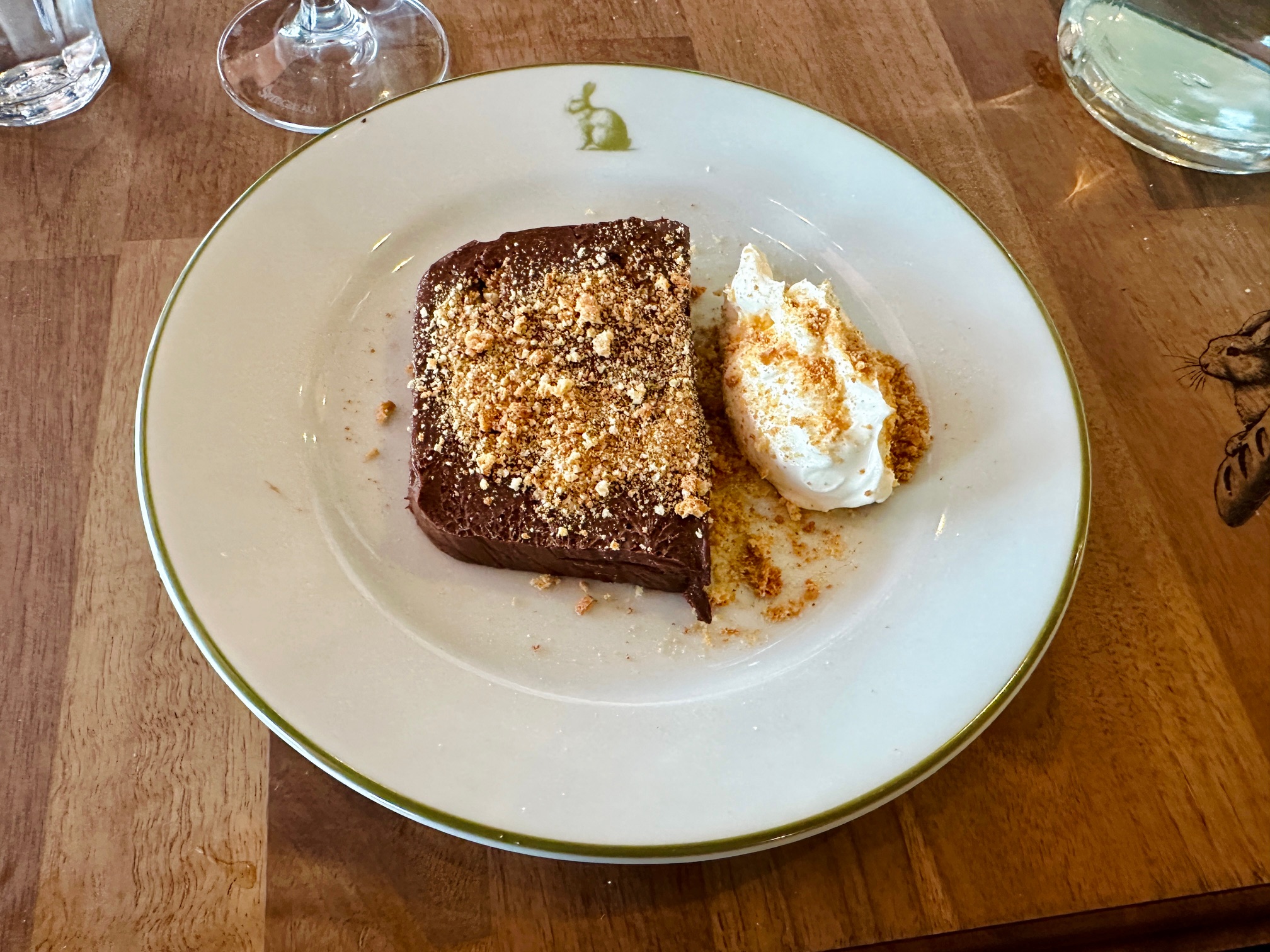
We tried a decent range of the desserts. I think on this occasion Al and I chose best with the St. Emilion au chocolat. I’ve never heard it called that before but it was an extremely nicely done ganache, a not ungenerous portion of it, topped, I think, with crumbled amaretti biscuit and served simply with terrific crème fraiche. I was always going to gravitate towards this dessert and, however good the others were, I would struggle not to order it again.
I think the other candidates were more workmanlike. Dave enjoyed the pain perdu with apple and vanilla ice cream, again crumbled with the good stuff to lend texture, with a shiny, sticky sauce. I expect if I ordered it I would have liked it too, and I imagine it went better with the dessert wine, in terms of colour coordination if for no other reason, than my overdose of chocolate did.
James ordered the Basque cheesecake, but neglected to take a picture. In fairness, you probably know what a Basque cheesecake looks like. Imagine one of those, with some rhubarb on the side. That’s what James had. He liked it, and Dave reminded me that it’s ridiculously easy to make which is why he never orders it in restaurants. I still have the WhatsApp message he sent me, with the recipe, favourited on my phone. One of these days.
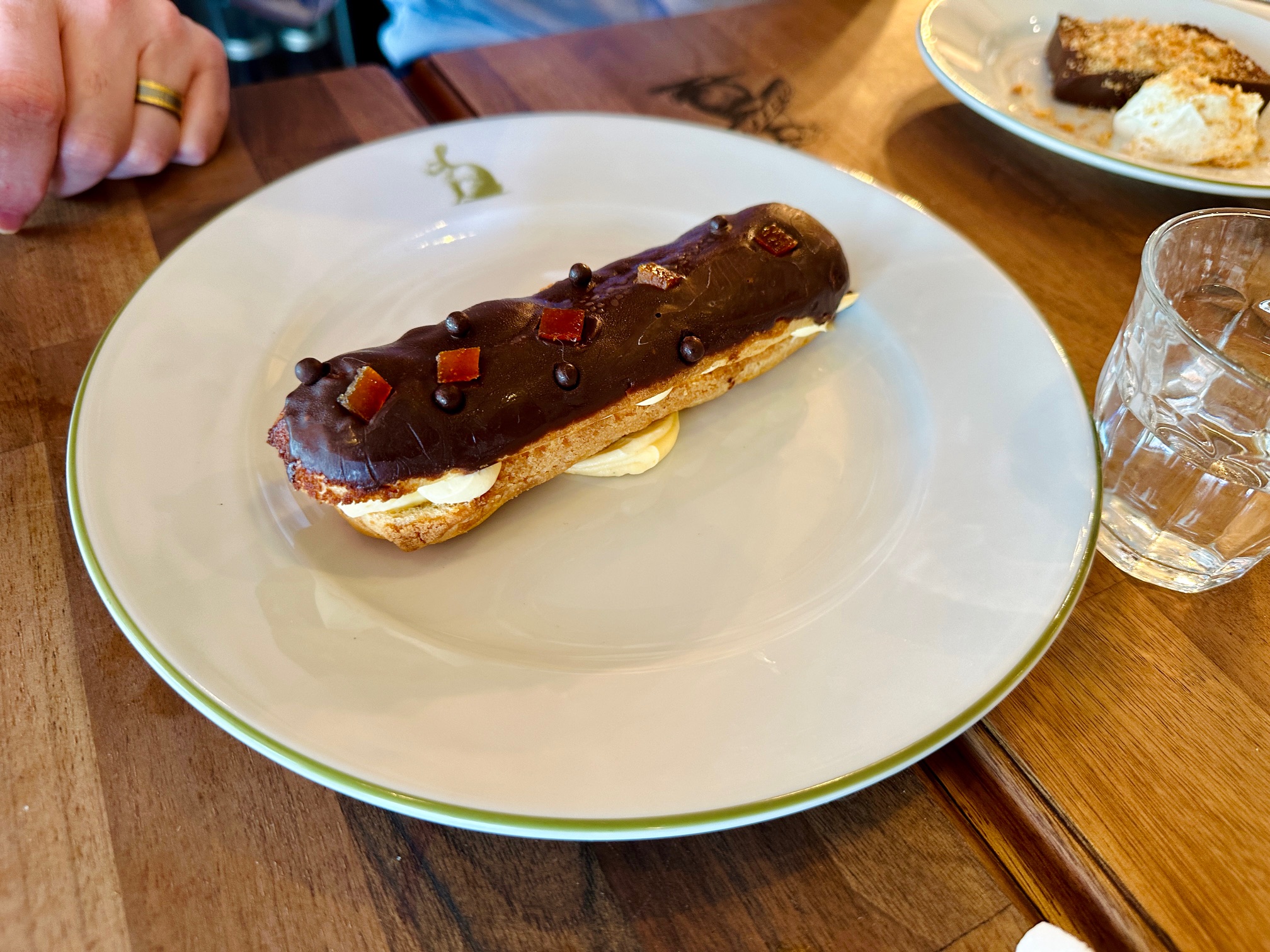
Al is legendary for ordering two desserts, very much following in the footsteps of the great Nora Ephron who always held that this was one of the most important life lessons she ever learned. Technically if you count the Trou Normand and about a quarter of the Éclair Suzette we ordered to share between us, this meal constituted a personal best.
We’d ordered the éclair on the advice of our server and again, it had some nice touches – the candied orange on top, the Grand Marnier infused crème diplomat inside. But again, Lapin’s touch with the choux let it down. It was leaden rather than ethereal, and took some sawing through. As a finishing touch to the meal it summed up some of the inconsistencies, and gave me something to think about.
Our meal for four, including a 12.5% service charge, came to just shy of five hundred and twenty pounds. Now, after you’ve had your sharp intake of breath, I have to say that doesn’t feel like poor value, at all, for what we had. We had something like five courses each, and even then we threw in a couple of extra things to try. We had apéritifs and two bottles of wine, one of which was from the deeper end of the list.
All things considered, I think about one hundred and thirty pounds each isn’t at all bad, for the afternoon we had. If you’re going to spend that kind of money, you should feel like you get this much living for it. It made me feel sad for my poor friend Jerry, parting with a hundred pounds for an infinitely less enjoyable meal at Gee’s not too long ago. Besides, expense be damned: this was Poncefest, it’s not like we were going to settle for a Happy Meal.
You might ask, given all that, why the rating down there is what it is. You might feel that this reads higher than that, or lower, and I would have some sympathy. When I think of meals I’ve had in Bristol, Lapin is really pretty good. But something stops it, for me, being in that upper echelon, with the likes of Caper and Cure, or Marmo. Or, if you’re comparing French meals with French meals, something prevents it reaching the standard of Paulette.
I keep coming back to that rabbit rillette, pretty close to being an eponymous dish for this restaurant. I keep remembering that it was nice and clean and pure and rarefied. And it’s not because Lapin is in a shipping container, because as I said the place managed to make me completely forget that. But Lapin, for all its excellent qualities, ever so slightly felt, to me, like a brilliant piece of cosplay, more than a French restaurant.
You could say that there’s nothing wrong with that, and I might agree. But that’s what stopped it, as far as I was concerned, attaining true greatness. I wouldn’t rule it out that at some point they will get there, and I imagine enough people in Bristol will rave about it to sustain it on that journey. In the meantime, it has a single dish that almost merits a pilgrimage, even if it’s a mere side, and it played host to a marvellous, long overdue reunion. When the ponces assemble next – in a suitably effete way, I can assure you – Lapin has set a standard we’ll be very lucky to exceed.
Lapin – 8.6 Unit 14, Cargo 2, Museum St, Bristol, BS1 6ZA 0117 4084997
Since January 2025, Edible Reading is partly supported by subscribers – click here if you want to read more about that, or click below to subscribe. By doing so you enable me to carry on doing what I do, and you also get access to subscriber only content. Whether you’re a subscriber or not, thanks for reading.