Restaurant review: Bosco Pizzeria, Bristol

Zoë and I wound up in Bristol on the Saturday before Christmas because my friend James was having a barbecue to mark the end of what he refers to as the “grilling season”. Its boundaries are somewhat amorphous, because James likes to barbecue at almost any opportunity, but as far as I can gather the grilling season starts around Easter and ends at some point before New Year’s Eve. I can’t say that with any confidence though, because I wouldn’t put it past James to grill meat in the dead of winter too: it would make more sense to you, if you’d met him.

But anyway it was an evening do, and that left me with one final lunch in Bristol before the year was out. And rather than try the hot new place – assuming I knew where the hot new place was, of course – or one of the Bristol restaurants on my radar like Bank, Native Vine or The Clifton, I decided to go for a safe bet. What can I say: it was the end of the year, my last opportunity to eat on duty in 2024 and, just this once, I wanted a guarantee of what the festive season always promises, comfort and joy. So I chose Bosco Pizzeria, situated near the top of Whiteladies Road, before it meets The Downs.

I first went to Bosco the best part of a decade ago, when it was very much Bristol’s pizza pioneer, and although I hadn’t been back for some time I always had it down as a reliable banker for somewhere good to eat in the city. Since it first opened its fortunes had ebbed and flowed, opening a second branch in Clifton, closing it and reopening it, closing the Whiteladies Road branch due to Covid and then taking a long old time to reopen due to a fire. Other branches in Cheltenham and Bath had followed, and a sister restaurant called Pizzucci offering a more American, less Italian experience down the Gloucester Road.

But I’d always seen it as a sure thing, and a standout even as other pizza restaurants came and went in Bristol. I reckoned it was as good as Flour and Ash – the original one on the Cheltenham Road that Jay Rayner got worked up about that is, not the sanitised relaunched one on Whiteladies Road which I haven’t visited. And for my money it was better than the much-hyped Bertha’s on Wapping Wharf, which wasn’t quite as good as I’d expected it to be. I couldn’t definitively say it was the best pizza in Bristol: after all I don’t live there, and I’m yet to try the likes of Pizzarova or CanCanPizza, but I could say that it took some beating.

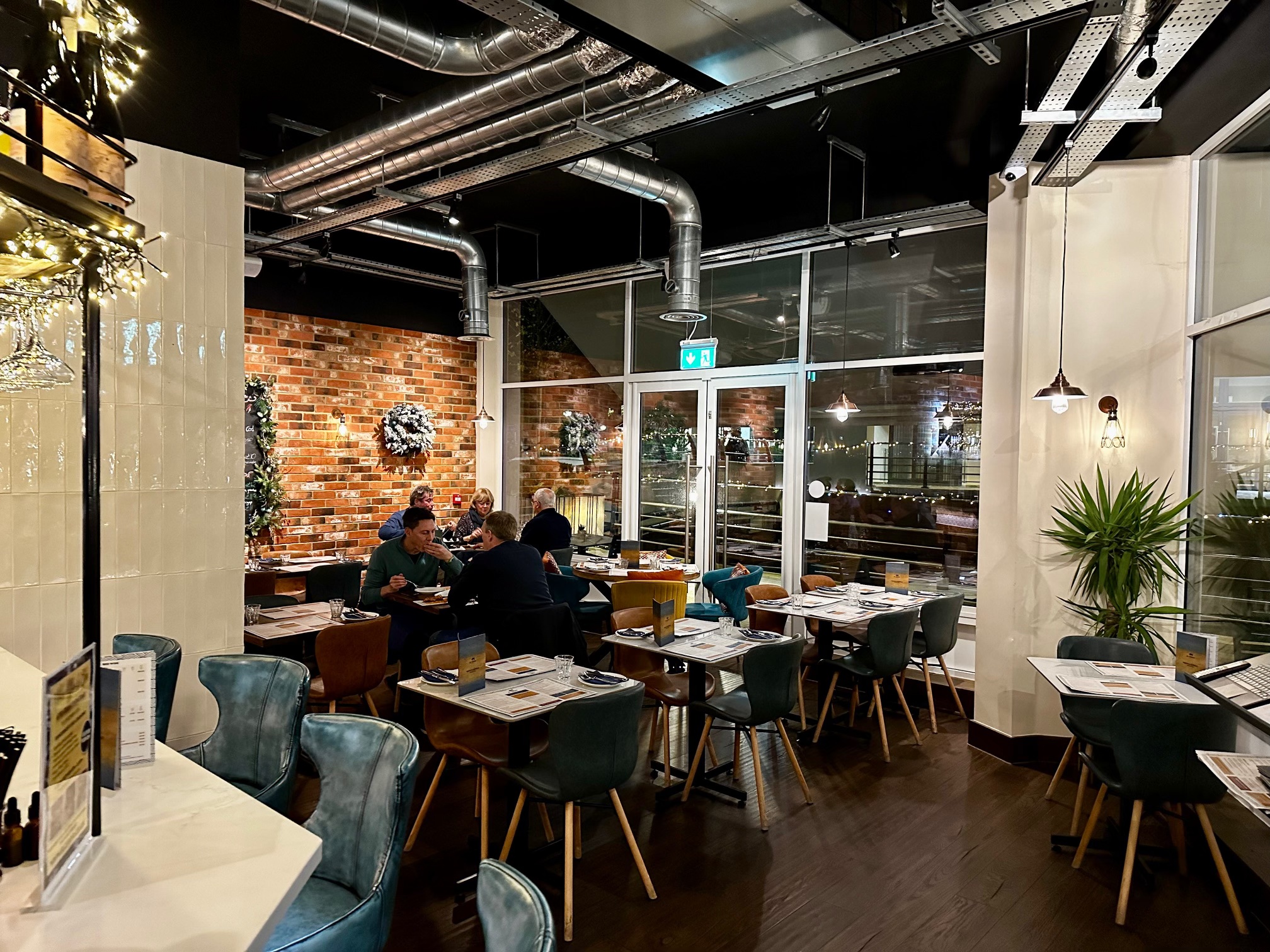
And it was a lovely, busy spot the Saturday before Christmas. They’d slightly rejigged it since I was last there, the front section buzzy and full of smaller tables, the one out back made up of booths for larger groups. You could sit up at the bar, which some people were doing, and it had that lovely air of a place where people, like me, were putting their cares to one side for a couple of hours and treating themselves. Christmas decorations were tasteful and muted, wreaths in the window, baubles running along the tops of the banquettes. My wife took a photo of me, sitting there all happy: I liked it enough to use it as a Facebook profile picture.

Bosco’s menu was split into sections – about half a dozen if you count salads, which personally I rarely do. Apart from salads there were cicchetti, a selection of meats and cheeses, plenty of permutations of pizza, a small range of pasta dishes priced as mains and a few bigger dishes (or, as they put it, “large plates”) – ribollita, parmigiana and what have you. It was, I reflected as I tried to make choices, exactly the kind of menu you always hope to see in mainstream Italian chains but never do. It struck me as the sort of place Maidenhead’s Storia was aiming to be. Zoë sipped a very good negroni, I sipped arguably an even better negroni sbagliato and gradually we honed our selection, sequencing them like a mix tape.

The first slight stutter came when we ordered. I said we’d like a couple of cicchetti, then a mixture of meats and cheeses, then our pizzas.

“We’ll bring out all the smaller dishes at the same time, is that okay?” said our server.

Now, I very much wanted to say no, actually, we’re really happy to be here and we’re in no rush so can we have the cicchetti first, then the other bits and then the pizza, like we asked for? And I would have done, but my wife gave me a look which very clearly said could you not be a restaurant reviewer, just this once? so I kept my mouth shut. It hasn’t stopped me mentioning it here, obviously, but it did irk me – what was the rush? It had that feel that Wagamama always has, that the kitchen’s convenience is the primary concern, not your experience.

And it did literally all come out at once, in the space of a couple of minutes, causing not just a sequencing problem but a logistical one too, the table barely big enough to hold five small plates at once. We prioritised the calamari, as the only hot dish we’d asked for, and it was decent but flawed. The thing I’m always watching out for here is the bounce and twang of squid that needed to be fresher, and Bosco avoided that pitfall. But in its place were brittle sticks of squid, almost like Clifton Nik-Naks, which managed to be both pale and overcooked. We squeezed the lemon, dipped in the aioli but neither could totally redeem the raw materials.

The anchovies also misfired. These were billed as coming with salted butter – as they had at Brutto – and focaccia, and almost did but didn’t quite. Instead they came with very good focaccia but swimming in extra virgin, oilier than a Bluesky reply guy, shallot finely diced on top. Is it wrong that I took against them for still having the skin on? Maybe, but it fooled me for a second into thinking these were more like vinegary boquerones than taut, salty anchovies. That wasn’t right – they were intensely salty – but somehow the texture of them didn’t feel quite as I expected.

It was either cognitive dissonance or cognitive disappointment, but I couldn’t work out which. Three anchovies for seven pounds felt a little steep, but I guess you were paying for the focaccia as well. And I liked the focaccia, as I said, and I know it wouldn’t have gone as well with butter as with olive oil. But the whole thing felt a tad disjointed.

Bosco has always excelled for cheese and charcuterie, and the menu gives you an appealing range of both which you can mix and match in the most middle class multibuy of all time. My favourite of the cheeses was the one I neglected to photograph, a gorgeous Robiolo which was soft but not stinky, complex without being overpowering. It was great with the focaccia, which begged the question of how you’d eat it if you hadn’t ordered the anchovies. Almost as good was a Gorgonzola dolce which I liked and Zoë loved – simultaneously sweet and salty and very well balanced.

But again, without the focaccia it might have been messy to eat. I know that this kind of thing – getting in nice cheeses and cured meats, keeping the former well and slicing the latter thinly – is more about buying than cooking, but that doesn’t detract from the fact that many Italian restaurants don’t do this very well. Bosco’s years of experience showed in this respect, in cultivating excellent suppliers, buying the best stuff from them and not mucking it up. It can’t be that easy: if it was, it wouldn’t be so rare.

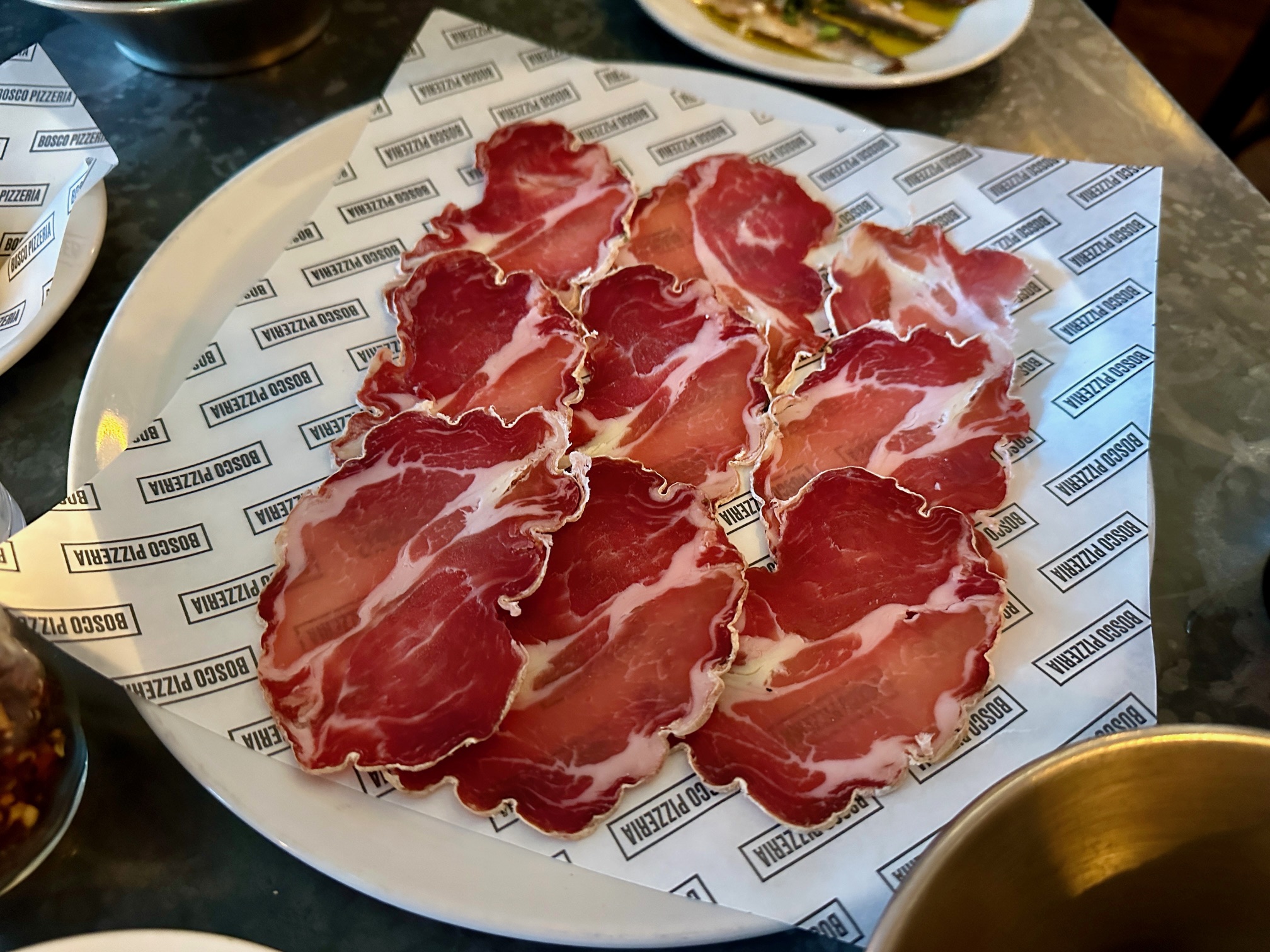
Oh, and the coppa was divine. Clearly sliced there and then, not exhumed from leaves of plastic, with that dryness and nuttiness that marks out the best specimens. This was the one thing that didn’t need bread at all, it just needed to be picked up and polished off, with or without a soupçon of cheese. The natural order had been restored, and I remembered just how good Bosco can be. We flagged someone down for another couple of sbagliatos: even though our reservation had been for a late lunch, the dining room showed no signs of thinning out.

Maybe the staff had got the message that we weren’t in a rush, or maybe they were just too busy to rush us, but there was a decent interval between our plethora of small plates and the main attraction.

Either way I was reminded, during that time, of lots of things: what a nice room it was, and how my many visits there had all been at different stages in my life, during a decade where almost everything about my life – what I did for a living, who I did it for, where I lived and who I lived there with – had changed, the only constant being this blog. I’d never been to Bosco with Zoë, and it made me happy to share this room with her at the end of a year itself full of changes.

I was also reminded, almost as much, just how nice a well made negroni sbagliato can be, but that’s probably beside the point.

Zoë and I reverted to type in ordering our mains, that comfort and joy thing again. Her pizza was the ventricina, a very Zoë choice with spicy salami, chilli oil and honey. She loved it, as I expected she would, and it showcased what Bosco did really well – an exemplary base, a chewy, bubbled crust with plenty of blistering, a deep tomato sauce, winningly fruity. This was as good an advert for Bosco as you could hope for, and at thirteen-fifty I thought it was solid value, especially benchmarked against restaurants closer to home like Zia Lucia.

That I didn’t enjoy my pizza as much just goes to show that you can get the fundamentals bang on and then fluff it with the whistles and bells. I too had asked for my archetypal pizza preference, sometimes called the Neopolitan and sometimes, as here, the Venetian. Either way, it’s the old anchovy, olive, caper trifecta and it’s always my go to when I visit a pizza place, providing it’s on.

The base was still exemplary, so was the sauce, so what went wrong here? A few things, really. The anchovies were unevenly distributed, Franco Manca style, leaving a reasonable amount of surface area salt-free. And the anchovies (skinless this time, to be fair) were too much fish and not enough salt, although that might have been a personal preference.

And what about the capers? Apparently they were fried in this case, which can work brilliantly – Buon Appetito used to do this – but they seemed anonymous. There weren’t enough of them, and what there were didn’t contribute the acetic sharpness I wanted. This pizza is meant to be all about salt and vinegar, but instead it was more fish and mild disappointment.

Hey ho. It wasn’t a bad pizza, it just wasn’t as good as I knew it could be. The slightly haphazard timing, coupled with our gluttony, meant we ate too much too quickly and were too full for dessert, so we settled up. Our meal, including two negronis apiece and an optional 12.5% service charge, came to just over one hundred and six pounds. I didn’t begrudge that: besides, they had Aesop handwash in their very fetching loos, and that stuff doesn’t pay for itself. We called up an Uber and prepared ourselves to have a few drinks with James and Liz ahead of the official end of the grilling season. Well, maybe after a nap to sleep off some of those carbs.

It was a lovely evening, incidentally. The beers flowed thick and fast – James is the man who has turned his garage into a micropub – and the conversation was enormous fun. We got to bed well after midnight, too tired for the traditional couples debrief. But during the gathering somebody who knows that I write this blog asked me if I’d gone anywhere on duty at lunchtime and I said yes, I’d been to Bosco.

“I hear it’s not as good as it used to be, would you agree with that?” I was asked.

And the binary answer, although the world’s always more complicated than binary answers, is yes, I do agree. On my previous visits, Bosco was the place you wish would open near you, the place that could teach every Italian chain a thing or two. On this visit, although it was still good, it was closer in quality to those chains at their very best. The gap had narrowed, and not because the chains have upped their game. This is the point, often combined with expansion, at which independent restaurants need to take care.

But anyway, on that night – and, writing this now – it didn’t seem to matter quite so much. It was a very agreeable lunch, if not a perfect one, tucked away at the end of the year. If you asked me where to go for a rock solid reliable pizza in Bristol, I would still probably pick Bosco; it’s earned that latitude, because we go way back. And if one opened in Reading, all the Sarv’s Slices and Dough Bros in the RG postcode wouldn’t stop me paying it a more than occasional visit. Next time you’re in Bristol, if you want an absolute banker, I think Bosco is still that.

Bosco Pizzeria – 7.6
96 Whiteladies Road, Bristol, BS8 2QX
0117 9737978

https://www.boscopizzeria.co.uk

As of January 2025, Edible Reading is partly supported by subscribers – click here if you want to read more about that, or click below to subscribe. Whether you’re a subscriber or not, thanks for reading.

Restaurant review: Thames Lido

Can you believe that Thames Lido celebrated its seventh birthday this year? It was such an event – three articles in quick succession from the Guardian was a big deal in 2017 – and for many people it’s been a real statement piece, a special occasion restaurant that has seen off the likes of Forbury’s, Cerise and, at the start of this year, the Corn Stores. It put Reading on the map when nowhere else had, just before the two kitchens, Clay’s and Kungfu, arrived in town and changed everything.

And yet, as regular readers might know, I’ve always had a very chequered experience of Thames Lido. When I visited it on duty, over six years ago, I found things to like but wasn’t won over by the place as a whole. And on the occasions when I’ve been back, for a meal with friends or tapas by the pool, it has never completely convinced me. Consistency has consistently – irony of ironies – been the problem. There have been moments in every meal that impressed but always, somehow, an equal and opposite Newtonian disappointment.

The meal that stayed with me was one I had in the spring of 2021 with my family, just as I was emerging from a self-imposed Covid lockdown and tentatively eating outside again. We had tapas by the pool, and I had that experience – again – that some of the dishes were quite good and some were very much something and nothing. I made the mistake of posting about it on Instagram, and shortly after that I had a direct message from the head chef. It’s safe to say that dealing with criticism was not a strong suit of his.

“Looking through your account, your reviews are generally critical so may I suggest you don’t go out so much and cook a bit more at home?” he said. “I’m sure we’d all love to see the photos.”

Well, I didn’t take his advice – and I doubt he took mine in return that he might want to consider developing a thicker skin – except in one important respect, which is that I didn’t bother going back to Thames Lido after that. He left not long after those messages and for a while Thames Lido churned through head chefs like the U.K. got through Prime Ministers. I think it also had some kind of executive chef/”restaurant director” at the time – rarely a good thing – and the menu felt like it was focused more on buying and dishing up rather than cooking. So, much as others still loved the Lido, it well and truly fell off my radar.

And then, late last year, something happened which put them back on it. Out of the blue, I heard from the person handling Thames Lido’s PR, who told me that the restaurant had recently acquired a new head chef.

Nothing out of the ordinary there – it seemed to happen every few months at the time – but this time they had picked someone interesting. Thames Lido had gone for Iain Ganson, previously at the Bell at Waltham St Lawrence where he’d cooked with his brother Scott for the best part of twenty years. That made it somewhere I needed to revisit. Ganson’s food, like his brother’s, had always been exceptional and it had the potential to revitalise Thames Lido, which felt like it had been cosplaying founder Freddy Bird – not brilliantly, I might add – ever since he’d left.

So I politely turned down the PR’s very kind offers to attend pop-up guest nights at Thames Lido (and endure the horrors of what they described as “a little media table”) but I made a mental note that I had to go back before 2024 was out to find out whether the menu was remade in Ganson’s image or, like a covers band in a hotel lobby, he was playing somebody else’s hits. And finally, at the start of December at the beginning of a week off with Zoë, I made it there on a Tuesday lunchtime to try and find out the answer.

Subscribe to continue reading

Become a paid subscriber to get access to the rest of this post and other exclusive content.

Restaurant review: El Cerdo, Maidenhead

Every year, without exception, you can reliably expect two things to happen in Reading’s hospitality scene. One is that there will be a raft of closures and new openings. Some years that ratio is pretty much one to one, others – like this year – it’s badly out of kilter, with far more places giving up the ghost than newcomers showing up to take their place. It’s tough out there, with no relief in sight. But the other thing that happens, every year without fail, is that none of those new openings will be a tapas bar.

I have complained about this so many times that it’s boring for all of us, so I won’t go on at length. But everywhere you look there’s a tapas bar, it seems, apart from Reading. Swindon has Los Gatos, Oxford has Arbequina. Newbury has Goat On The Roof, and Wokingham has Salty Olive. And Reading? Reading has next to sod all – unless you count Thames Lido, which I don’t, or Alto Lounge, which surely nobody should (Oh wow! Excited for this said the Chronicle‘s Facebook page this week, about the news that Alto Lounge had received permission from the council to double in size: that’s the Chronicle for you, excited about pretty much anything).

No, it’s never a tapas bar. Biryani joints are ten a penny, we went through a phase where we got three sushi restaurants in quick succession and momo are having a moment, but nobody wants to open a tapas bar. It’s a long, long time since La Tasca (which also wasn’t great) and six years since I Love Paella – not a tapas bar, but the closest thing we had – was unceremoniously booted out of the Fisherman’s Cottage. Is it a Brexit thing? Surely somebody feels like getting on the blower to renowned Bristol importer Mevalco and sorting this out, you might think, but every year nobody does.

And that’s what sends me scuttling off to the likes of Swindon, or Oxford, or Wokingham, trying to find the next best thing. Sometimes it works – Los Gatos is a little miracle – and sometimes I find myself somewhere like Sanpa, but I keep on trying because it’s a wonderful way to eat and I am always on the hunt for somewhere that brings a little hint of Granada or Málaga to unsung Berkshire. And that’s why this week I ended up at El Cerdo in Maidenhead, a ten minute walk from the train station, in the company of Katie, last seen last month sampling the glitzy splendour of Calico with me: inexplicably, after a dinner with me, she felt like repeating the experience.

Katie, it turned out, was on a proper journey of discovery, having never been to Maidenhead before. On the stroll through town to the restaurant I gave her a whistle stop tour of everything I knew about Maidenhead, which didn’t take long: former constituency of Theresa May, the infidelity capital of the U.K. (allegedly) and the town that, possibly because it was originally meant to be the terminus of the Elizabeth Line, was getting all the interesting things Reading didn’t.

That last one really is true – Maidenhead has a great independent craft beer bar in A Hoppy Place, wonderful pizza at Knead, an absolutely top notch town centre restaurant in Seasonality. And if some of the misfires, like Sauce and Flour, weren’t amazing, they at least showed that someone was trying. We walked past Sauce and Flour on the way to El Cerdo, and it was rammed, which shows how little I know about anything.

El Cerdo is by the canal, in the new development (the Waterside Quarter, apparently). “This looks so much like the Oracle it’s disconcerting” was Katie’s take, not without justification. The restaurant looked welcoming from the outside, and it wasn’t unpleasant on the inside but it had a feeling of “new build” that it couldn’t quite shake, a functional box rather than a cosy, appealing cocoon.

That’s not entirely their fault – it’s the hand they’ve been dealt with the space, and I liked the giant pig logo on one wall, past the handsome bar. But overall I felt it lacked a little character, in a way I couldn’t put my finger on. After all, Knead has a very similar dining room, but somehow it still has a feeling of bustle and hubbub. I guess the open space with the pizza oven perhaps brought things together in a way that El Cerdo’s bar, attractive though it was, didn’t quite manage. A handful of tables were occupied when we got there, including one large group in the corner, but it was a quiet Tuesday night.

El Cerdo’s menu read well. It wasn’t so big as to be unwieldy, and was divided into logical sections – nibbles, cold tapas, meat, seafood and fish. They hadn’t given in to the temptation to do paella on the side, so there was just the one rice dish and a few types of tortilla. In the run up to my visit I’d looked at the menu at Los Gatos, just to benchmark prices, and El Cerdo was definitely more expensive: nearly everything was north of a tenner, with some dishes nudging twenty.

But the wine list was good, and exclusively Spanish, and although we were tempted by a txakoli – the slightly sparkling Basque white you rarely see on menus – we went for an albariňo. It was an excellent choice – crisp and clean but not bone dry, with a little fruit. Thirty-eight quid for a bottle that’s fifteen online, so not an oppressive mark-up, either.

Now, before we get started on the food – and because tapas is by definition small plates, we have a fair bit to run through – I want to get a couple of things out of the way. One is that I had an absolutely lovely evening, and that makes it far more tempting to see the food through the Albariño-tinted glasses of good company. The other is that your mileage at El Cerdo might very well vary from mine: Katie, I suspect, enjoyed most of the dishes more than I did.

And of course, your take on this kind of food will depend on how and where you’ve had it before. Despite loving tapas and small plates, it turned out that Katie had never been to Spain, although she’s rectifying that with a trip to Barcelona just before Christmas.

I on the other hand go to Andalusia most years – and yes, I know that makes me sound like the pretentious tosspot I am – and unfortunately that means that although I went hoping for the best, I was painfully aware of all the instances where the best simply didn’t materialise. El Cerdo’s website says, pretty plainly, “If a dish doesn’t taste like it does in Spain, then we won’t serve it”. Although it also says that El Cerdo has an “executive chef”, and in my experience very little good comes of having one of those in place of an actual chef.

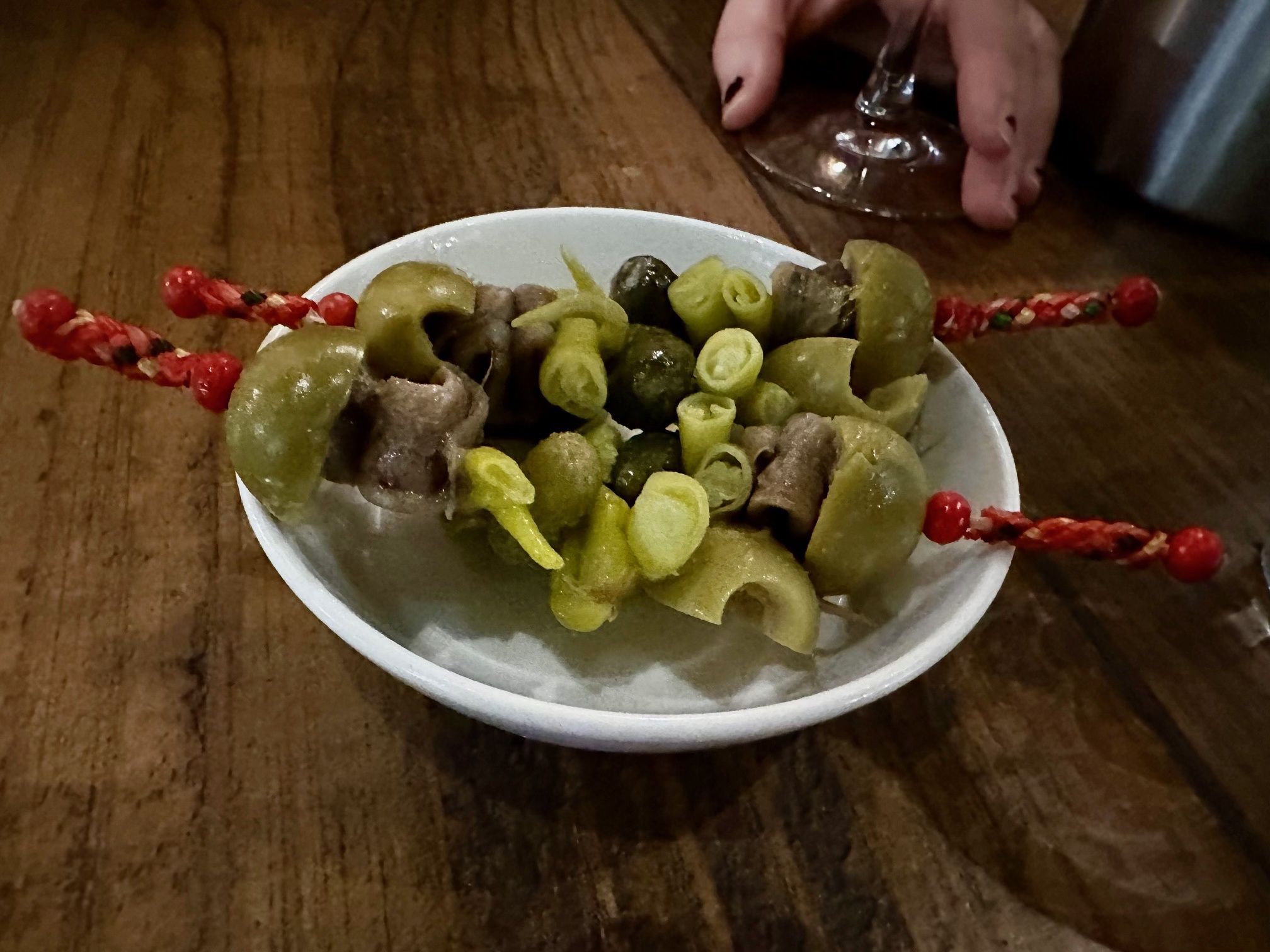
The first sign that I was going to have to write this kind of review came with the accompaniment to those first sips of wine, a couple of gildas. A gilda is a very simple thing – a skewer of olives and pickled chillis, all brought together with a slim ribbon of salty anchovy. Named in homage to Rita Hayworth, it’s almost a perfect mouthful, and quite hard to get wrong. You could have really amazing olives, and truly best in class Cantabrian anchovies, but even an entry level one is going to be a delight.

Or it should be, providing you use salty anchovies. But it felt to me like these were made with boquerones, the softer, more vinegary Spanish anchovies without the saline tautness of the good stuff. Which in turn meant they were all out of kilter – all vinegar and no salt, and somehow fishier than they should have been as a result. I felt like a right killjoy thinking this, because Katie seemed to enjoy hers. But I knew it could, and should, have been better.

The jamon croquetas were a similar story. They weren’t terrible – easily better than the deep fried abominations I’d eaten at Sanpa – but nowhere near the quality of anything you would get in Spain. They were a little flabby, a little pale, a little lacking in the crisp shell you needed. And the bechamel inside was lacking silkiness and a proper hit of jamon. Perching a little slice of it on top of each croqueta just showed you, Jim Bowen-style, what you could have won.

Last time I went out with Katie at Calico, she took me out of my comfort zone by ordering more vegetarian dishes than I would personally have chosen, which probably meant that my review was useful to slightly more people than it would ordinarily have been. The same thing happened here, where Katie was stuck between two dishes, broccoli with almonds or hispi cabbage, that I would never have ordered in a million years.

I took against the former for containing coconut ajo blanco in order to be vegan – good luck convincing anybody that they’d serve that in Spain – and so hispi cabbage it was. And actually this turned out to be one of the better things we ordered, although possibly one of the less Spanish ones. The cabbage came topped with a caper and raisin purée, which was heavy on the raisin and light on the caper, and squiggled vigorously with what was apparently a cured egg yolk sauce.

Your guess is as good as mine: I certainly didn’t get cured egg yolk from it, partly because I don’t really know what a cured egg yolk would even taste like. The little pieces of fried kale on top were pleasant too, although it gave me flashbacks to the Lyndhurst, which always makes me sad. There was a real whack of lurking heat in this too, and all in all it was probably the cleverest thing we had. Not massive, and not cheap at just shy of a tenner, but with lots to recommend it.

One of the biggest crimes against Spanish food was what came next, something the menu described as our “lazy” or open tortillas. We picked the eponymous El Cerdo tortilla, with chorizo and black pudding, and it’s difficult to describe how underwhelmed I was by this. Lazy is about right, to the point where maybe the menu should have said “we can’t be arsed to make a tortilla”.

Now in fairness the server, who was excellent, asked us if we wanted it runny or medium, and maybe we should have gone for the former. But whether it was runny or medium, this wasn’t a tortilla. It was an omelette. An underseasoned one that had been cooked through, with four bits of chorizo plonked on top and some black pudding – the British kind, not gorgeous soft Spanish morcilla, lobbed in the middle. No softness, a little onion, no potato that I could discern. This dish frustrated me. I imagine it would have made a Spaniard angry.

We’d ordered dishes in waves, partly because El Cerdo, Wagamama-style, says that everything you order will come out when they feel like it and we didn’t want to be swamped with dishes in one hit only to find the evening over. El Cerdo said that you should aim for two to three dishes each, which we took to mean three each, and actually doing it this way helped because we got to spy on the table next to us – four lads who kept their coats on throughout for some reason – and swap one of our dishes for something they’d ordered.

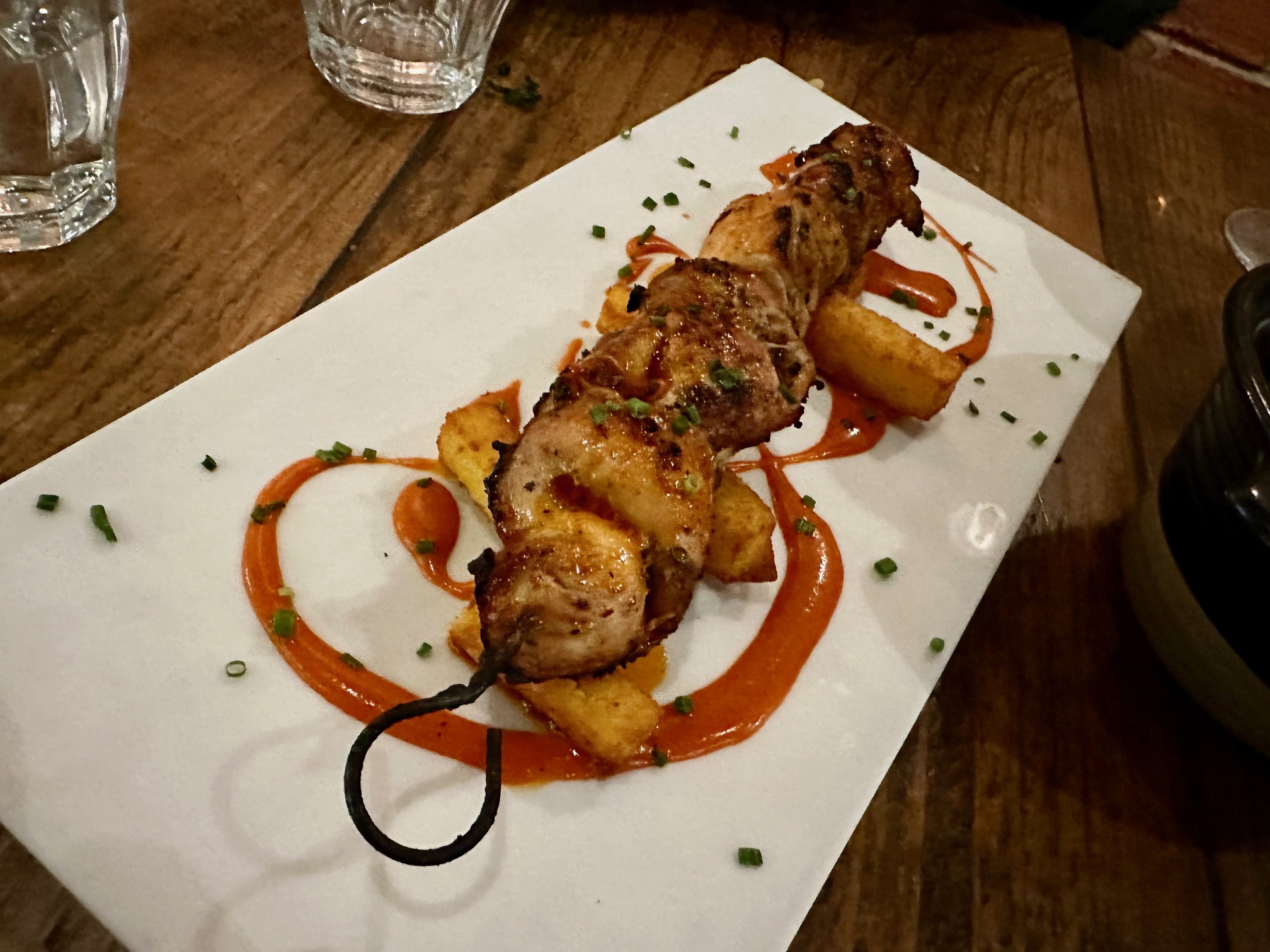
That dish was another of the relative hits of the evening, pincho de pollo with crispy polenta and mojo rojo. It was a reasonably generous skewer – four substantial enough pieces of chicken with a weird treble clef of red sauce, resting on a rope bridge of crispy sticks of polenta. And again, it wasn’t terrible but I didn’t found myself wowed. The chicken was nicely enough done, but El Cerdo makes much of its charcoal oven and I didn’t feel this had the char I’d expect from such an impressive piece of kit. The polenta added contrast, but if it did indeed have Idiazabal cheese in it it was a whisper, not a shout.

And again, thirteen pounds for this – even by 2024 standards – felt steep. I thought back to the skewer of chicken I had at Kolae, earlier in the year. Different cuisine, of course, but in terms of technique, flavour and value it was worlds away from this. This felt like the kind of dish that might pleasantly surprise you at Alto Lounge, but only because your expectations were on the floor.

If you wanted more evidence that El Cerdo wasn’t capable of delivering a flawless plate of food, their monkfish in tempura with chickpeas was exactly that. Just as at Calico, Katie had talked me into ordering something with chickpeas and they were lovely – nutty, earthy, positively moreish. But what in god’s name was going on with the monkfish? Two slightly forlorn nuggets of the stuff in a batter that was not, by any stretch of the imagination, tempura. It had no crunch, no texture, and when you tried to cut through it it all fell away, leaving a dense little knot of woolly monkfish, a sad savoury parody of a profiterole.

It turned out that Katie had never had monkfish before. “It’s not usually like this” I told her, feeling like I had to do something to rescue monkfish’s reputation. I hope for Katie’s sake that her first visit to Spain is better than her first taste of monkfish. If it’s on a par, that means she’s had her pocket picked on Las Ramblas.

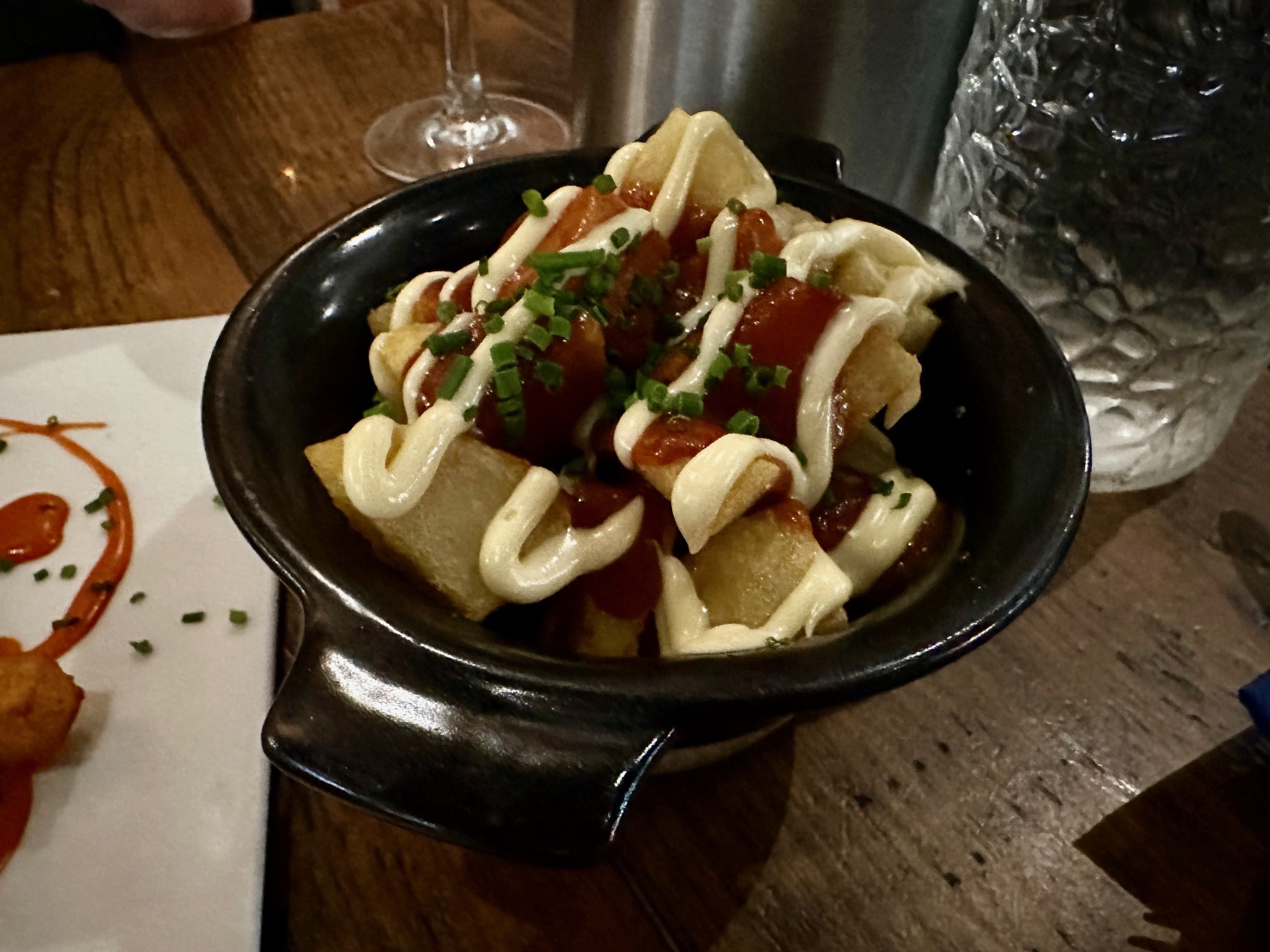
By this point I’m guessing neither of us really wants me to go on, but go on I must because there were a couple more dishes. Again, Katie quite liked the patatas bravas, which I think we’d picked to make sure we felt full at the end. And again, it wasn’t atrocious but I have never, ever had patatas bravas like this in Spain or indeed anywhere decent in the U.K.

The bravas sauce didn’t taste like bravas sauce, it was fruitier and lacked any kind of heat. The alioli, giving the benefit of the doubt and assuming that’s what it was, was not unpleasant. But it needed more of both, and moreover the potatoes were wan specimens, technically cooked but lacking the golden hue and brittle texture that makes this dish a treat.

Writing this, I should let you know, is the weirdest experience. Because I had a really lovely evening but the more I think about the food the more surprised I am by that.

We decided to have a dessert and there was one on the specials menu – a tangerine cake with white chocolate ganache and yuzu sorbet – which our server told us was perfect for sharing. So we also decided to have a dessert wine each, and identified a very nice-looking Pedro Ximenez on the wine list. So we ordered it, and our server came over apologetically. There was only enough left in the bottle for one glass – well, one and a half glasses, really. So what would we like to do?

Of course, as something approximating to a gentleman, I let Katie have that and went instead for a white dessert wine from Rueda. But when they came over, both were in very small glasses, both were the same size, and both looked bigger than they were because each of them had an ice cube lobbed in it.

“They weren’t the coldest, so I put an ice cube in them” explained our server.

This begged so many questions, like why aren’t you keeping your dessert wine in the fridge? or maybe you should have asked first?, let alone is that really what a glass of Pedro Ximenez looks like? or why didn’t you give her the rest of the bottle, were you saving that final half glass for Santa?

It was just baffling, and especially so because otherwise service was lovely all night. She told us they’d been open about a year and that although this week was quiet, things ramped up for the Christmas season after that and business was booming.

Last but not least, the dessert. It looked fancy, it looked cheffy and I can see that it was kind of designed for sharing. And leaving out the question of whether yuzu is remotely Spanish, the yuzu sorbet in the middle was easily the best and most enjoyable thing in the whole dish, resting on a sort of granola crumb. But there was nothing you could really describe as a white chocolate ganache, because neither the quenelles of something or other or the isosceles triangles of white chocolate fitted that bill.

But that wasn’t the most heinous failing: that was the cake. Dense didn’t even begin to describe it. You could work out your upper body trying to drive a spoon through that cube of stodge, and I felt like I did. There’s a chap called David who comes to my readers’ lunches whose job is to build machines that are used to test whether materials can withstand immense pressure. David would take a professional interest in that cake.

Because I seem to have spent most of this review pointing out places that do things better than El Cerdo, this feels like the right time to mention the pistachio cake I had last year at Manteca.

By this point, with the exception of a couple of chaps at the bar, we were the last table there so we settled up and made our way back to the station in the cold. Our meal, including a 12.5% service charge, came to just over a hundred and fifty pounds. Now, I think life in Britain has reached the point where it’s difficult to say “that’s expensive” any more because you’d end up saying that about most meals out.

But instead, we can at least talk about value: that’s more than my recent meals cost at Calico, at The Cellar, or Storia. My meal at Goat On The Roof cost a smidge more, admittedly two years ago, but El Cerdo can’t hold a candle to Goat On The Roof.

Granted, none of those restaurants are an exact match in terms of how many courses, how much booze and all that jazz, but the central point remains: El Cerdo does not feel like value. Not compared to any of those places, not compared to the tapas places you could eat at along the train tracks in Oxford or Swindon. So the search continues, and maybe next year I’ll rock up at Salty Olive having one last stab at finding great Spanish food a very short distance from Reading. Because if there’s one thing we can be fairly sure of, it’s that a tapas bar will not open in Reading next year.

But let’s close by looking on the bright side. For two years now I’ve been taking the train to Maidenhead, trying all these places and bemoaning the fact that Reading doesn’t have them. But actually, now, I’m beginning to think that my head was turned by Seasonality and Knead. Because outside those two, the new places I’ve eaten at in Maidenhead – the likes of Sauce and Flour, Storia and El Cerdo – don’t leave me thinking that we’re missing out. If there’s a market for box-ticking, slightly inauthentic, sterile restaurants and those restaurants want to go to Maidenhead instead, I’m all for it. I’m happy to hold out for something better. Even if experience tells me I might be waiting a very long time.

El Cerdo – 6.3
The Colonnade, Waterside Quarter, Maidenhead, SL6 1QG
01628 617412

https://elcerdo.co.uk/maidenhead/

Restaurant review: Brutto, Clerkenwell

Every year, without fail, a handful of new U.K. restaurants get hyped beyond measure. Every critic goes there, usually within the space of a fortnight, and every critic raves in their own hyperbolic way. Those places become impossible to book, if booking them were ever possible in the first place, and move into the heart of smugness: proper “if you know, you know” territory. These London restaurants – it’s always London, of course – are invariably hailed as evidence that it’s the most exciting food city in the entire world, mainly by restaurant reviewers living in London and writing for the national papers (or, perhaps more understandably, the Evening Standard).

So last year, it was all about Mountain in Soho and Tomos Parry’s cooking over fire (“can a dish be too good for itself?” wibbled Tim Hayward in the FT). Or Bouchon Racine, Henry Harris’ bistro. Jay Rayner described himself as a “huge dribbling admirer”, presumably to put people off booking a table, or for that matter ever eating again. And of course, there was Kolae, but you already know whether that’s good, don’t you?

And this year? Everyone has lost their collective marbles over Josephine Bouchon, Claude Bosi’s earthy Lyonnais restaurant on the Fulham Road, and Giles Coren, Tom Parker Bowles and Jay Rayner all went to the Hero in Maida Vale seemingly in the same fortnight. Giles Coren dined with Camilla Long, which means that for once he might have had an even worse time than his dining companion. I have a friend who everybody loves, who never has a bad word to say about anybody: you should hear his vitriol on the subject of Camilla Long.

Of course, the hype beast to end all hype beasts, this year, has been the Devonshire, the Soho pub run by the chap behind Flat Iron and Oisin Rogers, the closest thing the U.K. has to a celebrity pub landlord who isn’t Al Murray. Nearly all of the U.K.’s broadsheet restaurant reviewers descended on the Devonshire, mystifyingly all being able to land a table despite it being nigh-on impossible to do so, unless you’re famous. It’s almost as if there’s one rule for civilians and one rule for everyone else. Almost.

Coren even went all meta, writing in his review about being desperate to file his copy first despite seeing Tom Parker Bowles and Charlotte Ivers in there literally at the same time as him (Grace Dent, always at the cutting edge, finally got round to it last month). Still, nobody was going to match Coren for overstatement: “It’s just insane, what they’re doing” he gushed, about a pub taking the unprecedented steps of serving beer and cooking food.

It would be temping to review The Devonshire, if I could ever get a table. I used to know Rogers, a little, over a decade ago, and even got drunk with him a couple of times; he’s enormous fun, and a very canny operator. You have to take your hat off to someone who has always managed to keep in with whoever is making the weather in the notoriously bitchy world of London food, and Osh has managed simultaneously to be on good terms with everybody from Fay Maschler to the restaurant bloggers of the late Noughties and early Tens, all the way through to those tacky toffs from Topjaw. He’s always known exactly who to have onside, and is possibly even better at doing that than he is at running a pub.

But actually, I’d be more likely to go to his previous place, the Guinea Grill, which everybody thought did the best Guinness in London before Rogers jumped ship, and which also does the kind of steaks, puddings and pies people associate with the likes of Rules. All that without having to bump into the likes of Ed Sheeran? Count me in. And it’s interesting to me, that: you have places like Rules, or St John, that have been there for ever, and you have places like the Devonshire that are the new upstarts. Between those two types of restaurant? Sometimes it feels like there’s nothing at all.

But how can restaurants ever go from being the hot new thing to becoming institutions when everybody’s attention spans have been destroyed by social media, influencers and restaurant critics desperately craving the new? And what becomes of the flavour of the month when things settle down and the bandwagon rolls on to the next place, and the place after that? That’s why this week, after meeting Zoë from work up in the big smoke, catching the Elizabeth Line to Farringdon with what felt like a thousand West Ham fans and gulping down a handful of Belgian beers at the beautiful Dovetail pub, we mooched across to Brutto for our evening reservation there.

Brutto, you see, was one of The Restaurants Of 2021. Critics flocked to it that year, not necessarily because a trattoria modelled on the restaurants of Florence was what the capital was crying out for, but because this was the comeback restaurant of restaurateur Russell Norman. Norman’s Polpo group of restaurants, fifteen years ago – no reservations, small plates, typewritten menus on brown paper, Duralex glasses – probably did as much as any other to change the way people ate in London. It’s just insane what they did, as Giles Coren might have ineptly said.

I went to Polpo a little just after it opened, and offshoot Polpetto after that, and they were brilliant places to eat, although they never entirely overcame that feeling, when the bill arrived, that you’d spent too much on too little. But then came the unwise expansion, including branches in Bristol and Brighton, and then came the crash: Norman made his exit in 2020, and now only two branches remain.

And then, pretty much a year ago, Norman died suddenly and was mourned by seemingly everybody in the food world. Yet even if you never ate at one of his places, the likelihood is that in the last fifteen years you have eaten at least somewhere that has done something differently because of one of Norman’s restaurants from all that time ago, and that in itself is an interesting and far-reaching legacy.

Reading all that back it sounds like a bit of a downer, but I find it hard to imagine anybody walking into Brutto would feel down for long. I can think of few dining rooms that make you feel happier to be in them – it was simultaneously snug and buzzy, with tables full of people thoroughly enjoying their Saturday nights and others sitting up at the bar, making the most of Brutto’s fabled £5 negronis.

The dining room is kind of split level, and I guess the room at the front would be the one you’d ideally want to be sitting in, with its banquette and framed pictures arranged haphazardly on the teal wall behind (“it’s like Alto Lounge, but not shit” was Zoë’s take). But we were closer to the bar at a surprisingly good table next to a pillar, and although there was a distinct hubbub, and an effortlessly cool soundtrack seemingly pitched at Gen X duffers like me, it was never uncomfortably loud.

It really was a marvellous place, from the gingham tablecloths to the napkin lightshades to the candles stuffed into wicker-chianti bottles, and I loved it. It had that feeling of otherness I adore, the restaurant as a cocoon, where for the next couple of hours you could kid yourself that you’d walk out of the door at the end of your meal and be somewhere completely different.

It was, however, and I might as well get this out of the way now, dark. It started out as atmospheric, but as the evening went on it started to reach Dans Le Noir levels of stygian gloom. A lovely spot to be in, to drink and talk, but the practicalities of doing some of the things you ideally want to do in a restaurant, like read your menu or see what you were eating, were severely curtailed.

A solitary votive candle in the middle of our table wasn’t really going to help with that, even if the staff – who were on it throughout – replaced it very efficiently when it sputtered and went out. I got told off for getting the torch out on my phone to try and read the menu. Zoë told me that I was ruining the atmosphere for everybody, and I’ve since discovered that this is allegedly a boomer thing to do, for which I can only apologise.

Once Zoë had taken some pictures with her phone, in night mode, naturally, and AirDropped them over to me, I managed to get a decent look at the menu, which was of course typewritten. It was everything you’d want it to be, mostly: compact, affordable and interesting. Starters were mostly under a tenner, pasta dishes were closer to twenty and so were the secondi, with the exception of Florentine steak which is sold by weight. I think in the past I’ve seen these listed up on a blackboard, so as to say that when they’re gone they’re gone. Maybe they’d already gone, because our server didn’t mention them to us.

The thing you don’t notice on the menu, at first, is that there’s no fish to be seen anywhere. I saw it written on a mirror in the dining room that Brutto doesn’t serve fish, and although it’s often not my first choice it was still odd to see it completely excluded. It gave the dishes on offer a certain brownish hue, or that could have been the dim lighting, but I suppose it worked on a nippy evening with London well on its way to winter. And it’s not as if I minded, much. The negroni was fierce and medicinal and, lest we forget, only a fiver and, on top of those Belgian beers from earlier on, positively knocked the edges off the day.

I don’t sense that Brutto’s menu has changed enormously since it was first reviewed three years ago, because many of the dishes on offer were talked about in those initial reviews. One definitely was – coccoli, which translates as “cuddles”, and is little fried bits of dough with prosciutto and a small pot of tangy stracchino cheese. Remember when I said that these restaurants attract bucketloads of hype? Jimi Famurewa, then of the Standard said that they were “one of the year’s best dishes”.

I don’t know about that, but they were rather enjoyable. More doughnut than doughball, and pleasant enough with little slivers of ham and a small dollop of the cheese; there wasn’t enough stracchino, but I imagine there never is. But the problem with hype, however old it is, is that it almost sets you up against something. I bet the people who raved about these would have sneered at good old Pizza Express. It reminded me of a restaurant in Shoreditch I used to love called Amici Miei which did a similar dish to this, but far better and completely unsung. But then it hadn’t been opened by Russell Norman, that was the problem.

The other starter was three things that in isolation are hard to beat. Very fine, extremely salty anchovies, with decent salted butter and sourdough from St John just down the road. It’s impossible to argue with this really, even if it involves no cooking, and all three things were good. Zoë adored it, I wasn’t convinced it was really any more than the sum of its parts. In fairness though, this dish was just over a tenner and even in Andalusia seven anchovies of this quality might well set you back more than that.

By this point we were on the red wine, The wine list is all Italian, with lots to enjoy, provided you can read the bastard thing. Bottles start at thirty-six pounds and ascend quickly into three figures from there, and we settled for a Montepulciano closer to the shallow end for sixty-two pounds. which retails for eighteen quid online. Was it worth sixty-two pounds? We’ve established over eleven years that I don’t know a lot about wine, but I’d say maybe not.

For me the pasta dishes were probably Brutto’s greatest strength, and easily the thing I most enjoyed. I’d been tempted by pappardelle with rabbit, but in the end the classic tagliatelle with ragu was too hard to resist. And it was as close to perfect as this dish gets in this country, fantastic al dente ribbons of pasta and a rich, sticky ragu that hugged its curves closely. I’ve always been somewhat sniffy about this widely-held belief that there should be more pasta than sauce, but eating this, for once, I got the point. Everything felt like it was completely in order, in absolutely the right proportions.

Because Brutto is a homage to the trattoria of Italy, they left a bowl of grated Parmesan at your table, with a spoon. But because we were still in London, there wasn’t a lot of Parmesan in it.

For me if anything, Zoë chose even better. Her gramigna, a little spiral shape from Emilia-Romagna, came – as it does in that region – tumbled with sausage and friarelli and was a real joy. But don’t be fooled by the brightness of these pictures from Zoë’s iPhone: by this point it was getting more and more difficult to see what was going on. Even so, these two dishes, to me, highlighted that when it came to pasta dishes restaurants like Brutto or Bancone are still light years ahead of well-intentioned pretenders like Little Hollows in Bristol or bandwagon jumpers like Maidenhead’s Sauce And Flour.

I complained recently that Reading was still lacking a really good Italian restaurant and someone popped up and said “what about Vesuvio?”. And I said that I was looking for somewhere more genuinely Italian and less like a better reimagining of Prezzo, with more interesting secondi. But actually, I got that wrong: what’s really missing is brilliant pasta like this. Pepe Sale had that, back in the day. So did San Sicario. But since then, this kind of carb-centric comfort has been missing from Reading, and it’s a poorer place for it.

Speaking of secondi, to eat that course at Brutto it does help if you like beef. Three of the options are beef-driven (possibly four, depending on what’s in the bollito misto) and the roasted squash, virtuous though it doubtless was, just didn’t appeal. I had chosen the peposo, a slow-cooked stew of beef shin in a sticky, reduced sauce shot through with whole black peppercorns. And I liked it – it sort of reminded me of a stifado, although with no reliance on tomato or those maverick shallots that make the Greek dish such a delight.

But you know how you feel when you see a picture of a moment you don’t fully remember and you’re not sure if the photograph itself is inventing a memory you didn’t really have? Usually that experience dates back to childhood, but I have it when I look at the picture Zoë took of my main course. I know this is what I ate, the photo has my hand in it and the date stamp to prove it. But for me it was just a pool of blackness. You never quite knew what you were eating, or whether this would be your last big chunk of beef. I’ve always understood the saying that you eat with your eyes, but maybe not as well as I did after having this dish at Brutto. And however convivial the atmosphere was, this is where it took something away for me.

I didn’t need a great view of the roast potatoes I’d ordered on the side to know that they weren’t the best roast potatoes. Decent enough, but lacking that contrast of crunch and fluff that would have come if they’d been parboiled, and scuffed up, and cooked properly in really hot fat. Without that, they were just ballast.

Zoë infinitely preferred her main, which was a variation on the same theme. The same roast potatoes, which she viewed more kindly than I had. A slab of pink roast beef, the fat on the outside mellow and puckered, sitting in a little pool of jus. It needed the peas with pancetta that she ordered with it – I’d have liked these à la Française, with a little cream, although I know that’s missing the point in a Florentine trattoria. Anyway Zoë loved it, although she did admit that it was a tad dry. But if there’s anything our marriage proves – six months and counting – it’s that she has far lower standards than I do.

We had a fair bit of wine left, so we drank that and chatted about all sorts before making any decisions about desserts. Now Zoë works in London she is there every Saturday, and usually knocks off at eight o’clock, so by the time our evening begins, most weeks, it’s time for bed. A rare date night in the capital was a precious thing, and so neither of us was in a rush to bring it to an end. But desserts also meant digestivi, and that meant a Frangelico for her and an Amaro del Capo for me. It’s one of my favourite amaros, with something like 29 botanicals, though the one that leaps to the surface for me is mint.

I could have nursed that for some time, and maybe even had another, but the dessert menu only had a few things on it (putting pear and almond cake on there twice, once with ice cream and once without isn’t fooling anybody). Anyway, one of the items on the dessert menu was tiramisu, which meant that we were both contractually obligated to have one. Is it the dessert I order most often when I’m on duty? It definitely feels that way, and Brutto’s is up there with the best I’ve had – miles better than Little Hollows’, better than Sonny Stores‘, better than anything I’ve had in Reading, even including the wonder of Sarv’s Slice or the sadly departed Buon Appetito.

It properly contained multitudes, managing to be substantial yet airy, innocent yet boozy, simultaneously just the right size and nowhere near big enough. I loved it, and it reminded me that on the many occasions that I skip dessert when eating on duty I’m leaving the play before the final act, taking the book back to the library with the last fifty pages untouched. Brutto understands that a good meal has a beginning, a middle and an end, and that tiramisu was a more than worthy way to bring the curtain down.

With all that done, it was time to settle up and pray that the Elizabeth Line could get us back to Paddington before we were forced to catch one of those final trains back to the ‘Ding, the ones everybody refers to as the Burger King Express.

Our meal – a couple of negronis each, that bottle of wine, four courses each and a pair of digestivi – came to just over two hundred and fifty pounds, including an optional 12.5% tip. I know that’s a fair amount of money, but we had plenty of food and didn’t stint on the wine. Personally, I think Brutto is keen value, although probably more so in its starters and pasta than in its mains or wine list. I could have spent less and enjoyed myself just as much, and if I went again I imagine I would.

But would I go again? That’s the question, isn’t it. And it prompts the time-honoured answer, which goes like this. London is so blessed with restaurants – there are easily a handful of other great places to eat less than a ten minute walk from Brutto – that places have to be truly amazing to keep you visiting time and again. That drives quality, I’m sure, and it makes restaurants work hard for custom.

And maybe that also goes to answer the other question, of why it’s hard for anything to become an institution when somewhere else is always, always coming down the tracks. Back when I was on Tinder (what a fun three months that was) I deplored the way it effectively made you channel hop human beings, with their own lives and aspirations and back stories. Whatever. Next! But the way the food media works does the same thing with a lot of restaurants: one minute you’re the hottest ticket in town, the next you’re old hat.

So I had a lovely meal at Brutto and it taught me a lot about what restaurants do at their best and their worst. I have rarely felt, in a restaurant in the U.K., more like I was part of something brilliant and bigger than me. But ultimately one of the many things that united us that night was being together in the darkness. If that’s not a metaphor for something I don’t know what is. Maybe I’m just too old for all that.

Brutto felt like a neighbourhood restaurant in search of a neighbourhood. And speaking of neighbourhoods, if somewhere like Brutto opened in Reading you can bet I would be there on its opening night, and often after that. The fact that Reading can’t attract and maintain restaurants like this really puts the lie to all the old tut spouted by the likes of Hicks Baker that the town centre isn’t dying on its arse.

But while Reading still doesn’t have places like this, it still has that one thing Reading-haters always extol the virtues of: a train station you can use to get anywhere else. You could do a lot worse than make a reservation, hop on a train and find yourself here, in a place that isn’t quite Italy, isn’t quite London, but most definitely isn’t Reading. I know that’s not exactly hype, but it’s the best I can do.

Brutto – 8.4
35-37 Greenhill Rents, London, EC1M 6BN
020 45370928

https://brutto.co.uk

Restaurant review: The Cellar

The Cellar closed in June 2025. I’ve left the review up for posterity.

Here’s a question for you: when does a restaurant become a new restaurant?

Is it when the name changes, or when the chef changes, or when the owner does? Celebrated Reading restaurant Mya Lacarte changed chefs many times during its lifetime, but it always remained Mya. But with some restaurants, it can feel like a completely different place. Take Pepe Sale – the name and the room stayed the same, but without Toni in the kitchen and Marco or Samantha running the front of house, it might have been a decent Italian restaurant, on a good day, but it wasn’t Pepe Sale.

One of my favourite restaurants, back in the mists of time, was a place in Cheltenham called Lumiere. It was run by a married couple, a lovely, homely spot that did brilliant food, and I loved it. And then the owners decided to get out of hospitality and sold to another couple, one with a track record and aspirations. Fourteen years later, they won their first Michelin star. I’ve been since it changed hands, and I liked it well enough, but it wasn’t the same place I loved long ago.

I feel like this is especially a problem with pubs. When restaurants change hands, unless the new owners are buying a going concern the name often changes. But pubs can go through good phases and bad phases, new chefs and new concepts, all under the same name. Look at my reviews of all the pubs out on the way to Henley – the Pack Horse, the Pack Saddle, the Crown. Are any of them recognisably the same as they were when I reviewed them all that time ago? Almost certainly not.

The reason I’m starting out talking about this is that the subject of this week’s review also begs this question. Between 1996 and 2008 there used to be a restaurant on Valpy Street called Chronicles, and back then it was very much a peer of London Street Brasserie. It closed, and became an Italian restaurant and then, briefly, a truly woeful place called The Lobster Room. And then in 2015 Chronicles owner Andrew Norman decided to have another bite of the cherry and opened Valpy Street in that spot. New name, new era, new restaurant.

But in August Valpy Street closed after nearly nine years trading. Sadly this hasn’t been an isolated occurrence this year – restaurants have been dropping like flies in 2004 – and the announcement from Valpy Street listed the usual suspects: Covid, the cost of living, wage increases. But there was an additional horseman of the apocalypse in Valpy Street’s case: “accountancy errors”. War, famine, death, shonky accountants. It figures.

And so that was it for Valpy Street, but the following month another restaurant, The Cellar, opened in the same spot. The Chronicle had already reported that this was going to happen, and that some of the existing staff would transfer across to Valpy Street’s successor. And yet, if you have a look on Companies House, the director of The Cellar Ltd. is none other than… yes, it’s Andrew Norman, the proprietor of Valpy Street. 

So what’s all that about, and was the Cellar a new restaurant, or just a new name for an old one? I decided it was time to find out, so I booked a table on a week night and headed over to check it out, with my dining companion – and elite level campanologist, would you believe – Liz, last seen experiencing the exotic wonders of Calcot

I was a little early for our reservation, so I got a good look at the dining room. I can’t remember what it looked like as Valpy Street, and I didn’t have the sense to take a photo back then, so I couldn’t tell you how much it had changed. But I sense it wasn’t that much, probably because it didn’t need to. Despite being a basement restaurant the dining room was split level with another room, for drinkers, on the other side of the bar.

And everything was nicely done: gorgeous exposed brickwork – the real stuff, not faux nonsense – along with banquettes, muted panelling and comfy dining chairs. There wasn’t much in the way of soft furnishings to absorb the noise, and although it wasn’t busy on a Tuesday night the decibel level was high, mainly from a very chatty table of Americans who were here on business and celebrating, by my reckoning, for the final time for about four years.

Yet if you looked more closely, things about it weren’t quite right. My table, which was a perfectly nice table, had weird sloping edges which meant that when you looked at the wine glasses or jug of water you felt like either you were very drunk or they were about to fall off. The tables in the booths had been spaced out as if social distancing was still a thing, meaning anyone sitting at them risked scraping their elbow on some brickwork.

And speaking of elbows, the table was so sticky that, over the course of the evening, it took the skin off my elbow. If you left a napkin on it and pressed down, you left some of the napkin on the table. All a little strange, although I didn’t fully appreciate that until I got home and had to break out the Elastoplast.

Service was initially a little diffident. I think I spotted three or four servers over the course of the evening, but the young chap who showed me to my table then just leant against the wall and stared into space as I made more and more attempts to attract his attention to say that actually, I’d love a drink while I was waiting for my friend to arrive. He was absolutely lovely, but just seemed a little, well, green. (“Don’t be mean about him in the review, it’s probably his first week” was Liz’s take at the end of the evening.)

My wine arrived just as Liz did, which made me feel rude even though it wasn’t really my fault. The Cellar’s wine list is pretty interesting, partly because I couldn’t work out who they bought from. Some of it at least was available from Majestic, the popular choice with so many Reading restaurants over the years. But others, weirdly, only seemed to be available from a website that does thank you gifts for employees, so your guess is as good as mine.

I know all that, because I could Google it while I waited for Liz to arrive. Because, unusually for a basement restaurant with thick brick walls, there is actually mobile reception. Anyway, the list had a decent mix of old and new world, and if nothing was that cheap – glasses start around nine quid – that’s because nothing is any more. So I had a nero d’avola (Majestic) which I liked very much, and decided that I’d save the pleasures of the Malbec-Viognier blend (Hints of fynbos, rosemary and tobacco leaf, spiced or marinated red meats with a biltong coating, also Majestic) for another day.

I think after eleven years I’ve figured out that when it comes to wine, describing things as jammy or fruity or – if they’re dead expensive, “complex” or “fragrant” – is about as good as I get. I liked it, I ended up having a second glass. Liz ordered something neither of us had ever heard of, a Spanish white made with Airén, a grape that was a new one on me. It was from the weird corporate website, and Liz, who is better at this sort of thing than me, said it was really enjoyable, fruity but not acidic; speaking as someone who is frequently acidic but rarely fruity, I couldn’t really identify with it.

The Cellar’s menu was a bit of a dark horse, with hidden depths. At first sight, it looked pedestrian and safe, but if you kept looking you found all sorts of interesting ingredients and techniques hiding in plain sight. So there was pork rillette, which you might find somewhere like Côte, but they’d panéed it, for reasons which escape me. There was boeuf bourguignon, but repurposed into some kind of cottage pie – gîte pie? – to be different. Baba ganoush came with rum soaked raisins, pavlova with basil sorbet. A little subversion, in with the mainstream.

Small plates came in between eight and twelve pounds, although you could supersize them as large plates by paying more. And then there were main courses – which you’d hope were also large plates, unless they were even larger plates – which cost between eighteen and twenty-five pounds. These were divided into two sections, one of which was marked “classic” which, in this case, translates as “not cheffy”. Fish and chips I can see you might class as a classic, but green Thai curry? Hmm.

Anyway, all that sounds catty when it isn’t meant to. I liked the menu, like I liked the room, but like the room it still felt like a bit of a jumble. The sense of being a work in progress fitted more with it being a new place than just Valpy Street wearing glasses, a fake nose and moustache.

Having said all that, we played it safe with our starters and were maybe not rewarded for that. I chose salt and pepper squid knowing full well that calamari is something I’ve tried in many places over the years, from Vesuvio to Storia and beyond. And the Cellar’s rendition was good – or, at least, not bad. The salt and pepper didn’t come through strongly, but even if they weren’t super-fresh they were far from the nacky rubber bands you get in many places. The chilli was advertised but didn’t make its presence felt, the unadvertised leaves dumped on top were a nuisance.

Pairing this with black garlic aioli (not just any aioli) is seemingly a very now combination – Storia did this too – but I wasn’t sure how this went with a salt and pepper coating. In any case the aioli had a weird sweetness, like salad cream, with no garlic punch. I think I’d rather have had sweet chilli sauce. But the oddest thing, again contributing to that slight jarring feeling, was how this was served, in a high-sided bowl sitting on a board. This made eating it, and dipping it into an even smaller ramekin of aioli, a bit of a palaver.

Liz had gone even more classic, with baked camembert. This is a dish it’s hard to get wrong, in many ways – buy a Camembert, bake it properly and off you go – and the Cellar managed that without missteps. I got to try a bit, and for what it’s worth I thought it was decent – nice to see it scored and generously studded with rosemary, even if the white wine and honey glaze didn’t really made its presence felt. At least they hadn’t adulterated it with onion jam or suchlike. But Liz wasn’t entirely convinced.

“I guess you sort of know what you’re getting with that, though” I said. “What more could they have done?”

“It’s these things” said Liz, pointing to the insubstantial, brittle crostini on the plate. “It needs really good, crusty bread to dip.”

I think she was right. The crostini snapped if you dipped them, couldn’t bear the weight if you loaded molten cheese onto them. They looked bought in, and if they weren’t then they could have saved time by doing that. But Liz was right, this dish was a baguette away from living its best life.

At this point, even though the lighting was lovely, the conversation was absorbing and free-flowing and the Americans had scarpered, I was getting that sinking feeling that my evening was going to be better than my meal. So it gives me huge pleasure, and no small sense of relief, to say that this was where the Cellar turned a corner and the rest of the evening was a little choreographed sequence of successes.

Take my main. I’m not sure what possessed me to order a chicken Milanese, a dish I’ve occasionally ordered but rarely enjoyed and really, only associated with Carluccio’s back when it was good. But it turned up and not only looked the part but was a hugely enjoyable affair all round. There’s not much to this dish but, like the Cellar’s menu, it was full of surprises.

So the chicken was a little thicker than I’d expect, not beaten flat, and was beautifully tender and superbly done. The coating could so easily have been blah old breadcrumbs, but was given a real flash of interest with Parmesan in the mix. The fried egg was absolutely terrific, spilling its yolk the way I spill gossip – freely and with joy.

I wasn’t entirely convinced by the hasselback potato – it didn’t feel like garlic or rosemary had really made their way to the centre of that particular maze – but the gremolata was also a delight. I’m not entirely convinced it was really a sauce, but more of a thick parsley pesto. But it had zing, and you could smear it on a piece of chicken or a sliver of potato, and it made everything better. I don’t mean to damn The Cellar with faint praise, but I’m not sure I’ve been more pleasantly surprised by a dish this year.

And then there was Liz’s dish. Liz doesn’t eat as much meat as I do – few people do, I suspect – and had chosen a vegetarian starter and a vegan main. I’m so glad she did, because that vegan main was a triumph, with loads going on. A slice of baked aubergine (“I really love aubergine”, Liz said, and I remembered that we’d had some at the Coriander Club, too) was served on a slick of butter bean purée.

But that was the Cellar just getting started, because on top of that you had a very good quenelle of baba ghanoush, and others of something I mistook for tapenade but the menu swears blind is mushroom duxelles. So much going on there, so many interesting flavours to mix and match.

But the Cellar understood that the dish still wasn’t complete without some textural contrast. So it was scattered with seeds and dusted with a potent dukkah, and because that still wasn’t enough, the crowning glory – crisp-edged cubes of panisse, chickpea fritters. I love panisse, and I don’t think I’ve ever seen it on a menu in Reading. I was very happy with the Cellar for doing it.

“This is really good” said Liz, offering me a forkful that confirmed that it absolutely was. So much going on, so much work and thought, but without it being overblown or overdone, or all those flavours and textures getting lost in a shouting match. And I thought that this was how you should do vegan food, to make it a destination dish where nobody in their right mind could eat it and miss meat. I was also thinking, in the back of my mind, finally, my vegan readers are going to get something out of a review for once.

Liz had her eye on the madeleines on the dessert menu, possibly because they came with lavender honey, but I managed to talk her into dessert. And perhaps more impressively, because Liz is firmly in the “one glass of wine on a school night, and possibly even a Friday night” school of thought, I managed to talk her into a dessert wine too. They only had one, a late harvest sauvignon/viognier blend, and 50ml is a bit of a stingy pour (if you’re me, or just right if you’re Liz) but it was a beautiful sip of pure sunshine and reminded me how much I love dessert wines, and how rarely I have them.

Liz’s head had been turned by the sticky toffee pudding and, again, it was really very nicely done. Reminiscent of the likes of London Street Brasserie, who have been flogging sticky toffee puddings for longer than I’ve been writing about them, it had great texture – how on earth do you describe that now everybody has cancelled the word “moist”? – and a moat of deep, rich sauce. The vanilla ice cream was already giving up the fight, which was inevitable, and I personally would have preferred clotted cream, but that’s my gluttony more than anything. Liz loved it, and my only regret was that after that she didn’t have space to raid those madeleines.

I tried the pavlova. I have a real soft spot for a pavlova – it always says that a restaurant can be arsed in a way that Eton mess never does – and the Cellar’s was a blissful piece of work. An elegant oval of chewy meringue, housing a core of cream and vanilla, ringed with macerated strawberries and syrup. A little reminder of the summer we never had, a gastronomic time capsule of a time that didn’t quite exist. And right at its centre, that verdant sphere of basil sorbet, which was truly extraordinary.

I give out awards every year for Dessert Of The Year, so thank god I went to The Cellar this week or I might have been writing a post next month saying “or you can just pick up a bar of Cadbury’s Top Deck from the corner shop”. I let Liz try a spoonful, and she had dessert envy. I’m so used to being the one that suffers from that that I didn’t even remember to gloat.

By this time everyone else had left, and we were still nattering until it got to about ten o’clock, over three hours after we started, and we both felt guilty about keeping the staff from their homes. All the people who served us were brilliant, and when one of them came over with the card reader I asked her how long they’d been going for.

“It’s just over a month” she said, “but of course we were Valpy Street before that.”

I asked how similar the Cellar was to Valpy Street, and she told me that most of the staff were the same and, crucially, the team in the kitchen was unchanged. She was very good at not saying much more than that, but I sensed again the involvement of the First Accountant Of The Apocalypse.

“How’s business going?” I said, aware that a Tuesday night in November mightn’t be the best yardstick of that.

“It’s okay, we’re getting there. But we were closed for about five weeks, and you worry that people forget about you.”

Our bill for two people – three courses apiece and five glasses of wine in total – came to just over one hundred and thirty-five pounds, including tip. And personally, for a very enjoyable evening in a lovely room with great company and some genuinely interesting dishes, I thought that was more than okay. Because when a restaurant gets a lot of things right, it wins you over. You still remember the other stuff – the glasses on the piss at the edge of the table, the waiter vacantly ignoring me at the start, the plaster I had to put on my elbow at the end of the night – but you don’t care.

The Cellar lived up to the promise of its name, an attractive, intimate, convivial space, tucked away from the bustle of Blagrave Street, of the buses, the commuters and the revellers. And I found myself really rather fond of it. We made our way out into the night, the air now sharp and wintry. Liz liberated her Brompton and headed back to West Reading, and I made my way to Market Place to play my favourite game, Bus Home Roulette: would it be the 5, the 6 or the 21? Did I feel lucky?

I realise, now I’ve got to the end, that I didn’t answer my own question. When does a restaurant become a new restaurant? I can’t help you, in this case: I have a feeling it might take someone who knew Valpy Street a lot better than I did to tell you that. But I can tell you this, instead: the staff might be the same, the owner might be the same, the chef might be the same. For all I know the menu might be the same, and those sticky tables too. But my respect for the place? Now that’s another matter. That definitely is new.

The Cellar – 7.7
17-19 Valpy Street, Reading, RG1 1AR
0118 3049011

https://www.thecellarreading.co.uk