
I meet Graeme off his train back from London. He is smartly dressed and layered up, because he has come from work and because he knows that it’s autumn. I am slightly parky in shorts and a short-sleeved shirt, because I have the week off and am pretending it’s still summer. He is appropriately dressed, I am trying and failing to make denial a fashion choice: naturally he is too kind to point that out.
Graeme had been keen to grab a bite to eat before we made a beeline for the pub, somewhere nice and quick, and I’d suggested Sapana Home because it was close to the station, en route to the Nag’s Head, cheap and cheerful. Besides, according to the geotagged photos on my phone I’d not eaten there in three and a half years. Never been. Would be up for that came Graeme’s reply, so Sapana Home it was.
Reading has had a Nepalese community for fifty years or so, and I expect it’s always had restaurants serving them. But Sapana Home, which opened in 2012, was the one that broke out and reached a wider audience – offering specifically Nepalese food rather than just being a Nepali take on a curry house like Standard Tandoori. By the time I reviewed Sapana, a couple of years later, it already had a reputation in Reading as somewhere central to go for good, affordable no-frills food.
It was, I expect, where many Reading folk had their first momo: it was certainly where I had mine. And from that seed grew a whole network of Nepalese restaurants. Namaste Kitchen for instance, followed by Namaste Momo and then Kamal’s Kitchen, all propelled by the charm of shy and retiring local legend Kamal Tamrakar. Dhaulagiri Kitchen up on Basingstoke Road, and its street food spin-off Momo Bros.
And that’s just for starters. There are plenty more, like Momo 2 Go, where you can eat in, Just Momo, which doesn’t just do momo, and Yo Momoz on the Wokingham Road, which doesn’t just misspell ‘momos’. What’s the collective noun for Nepalese restaurants? Regional bloggers in other cities lose their shit when they happen upon momo: here in Reading we could become blasé about them.
But it would be revisionist of me to say that it was love at first sight when I reviewed Sapana Home, 12 years ago. Because actually, when I went, I liked the momo but I was unmoved by the rest – the chow mein, the siu mai from over the border, the sukuti with soy beans, the thali and the strangely crispy jeli, deep fried batter in sugar syrup. I gave Sapana Home a pretty low rating: this was back when more people thought I was too harsh, as opposed to now when people tend to reckon I’m too kind. I said to go for the momo, settle up and quit while you’re ahead.
In the intervening years, I went back – always for the momo but often for other dishes – and I realised my view of Sapana Home was more and more unduly negative. In fairness this was before Nepalese food blossomed in Reading, and certainly before I first ate at Namaste Kitchen, but Sapana Home occupied a real place in my affections. I’ve written about it more than once – giving it all kinds of plaudits, nominating it as producing one of Reading’s 50 best dishes, saying it was the perfect place to eat solo. So how had it been over three years since I last walked through those doors?
The room itself hadn’t altered much: same tables, same chairs, same awkward shape on the ground floor with a table in the window, a couple at the back near the counter and one against the wall which felt like it would be nobody’s first choice of somewhere to eat. There is a room downstairs, too, but I’ve only eaten there when there’s been no other choice and I didn’t plan to depart from that habit of a lifetime in the name of research.
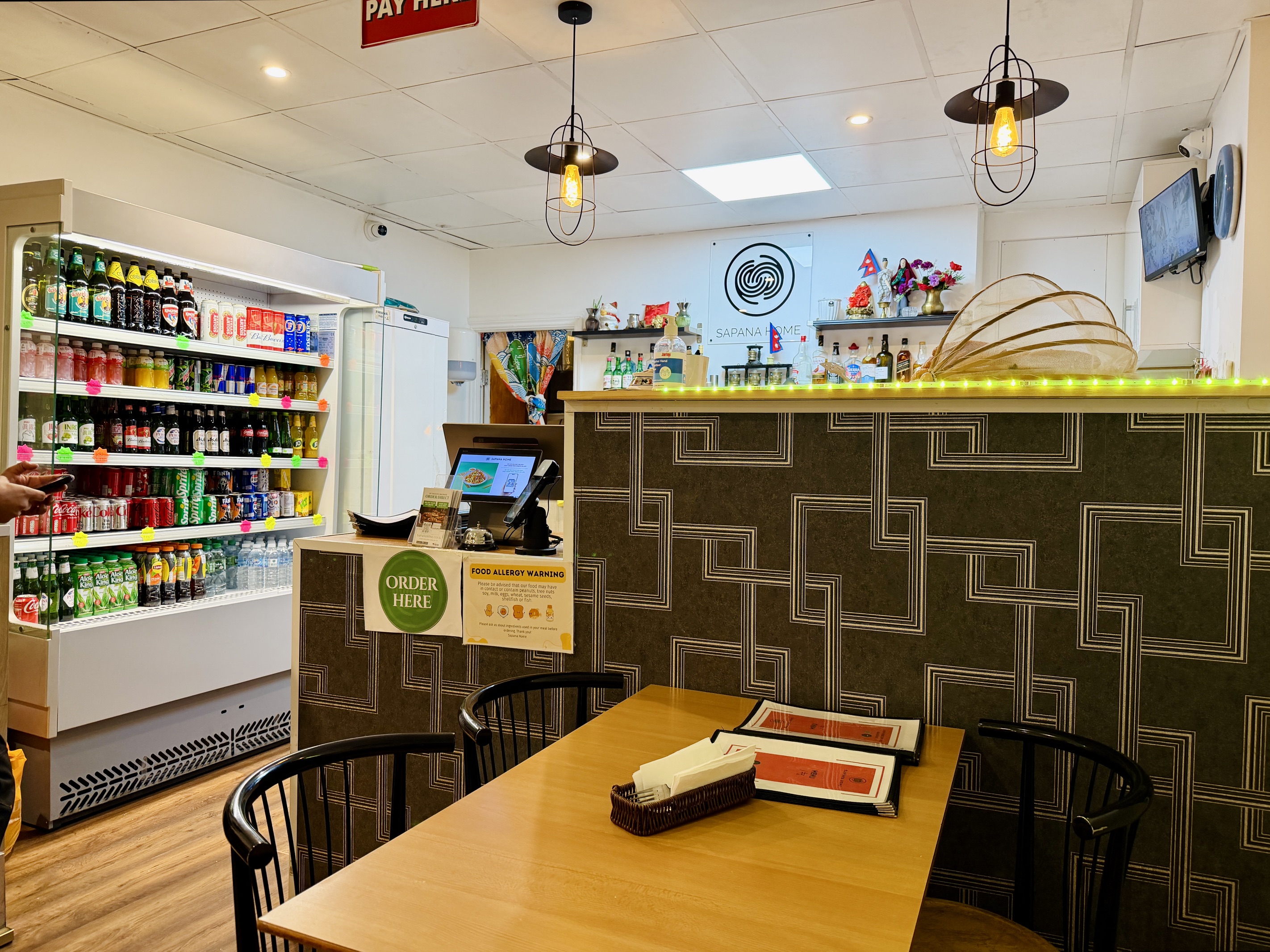
Any changes the restaurant had made, beyond replacing the bright, friendly blue and white frontage with a glossier black and yellow one, were subtle and incremental. You ordered and paid at the counter now, which definitely wasn’t the case when I last ate there, and the loud and incongruous commercial radio – I can honestly say that eating at Sapana was the only time I’d ever willingly listen to Heart FM – seemed to have been axed. The place wasn’t full when we turned up on a Thursday night, but there was a regular trickle of delivery drivers. Perhaps that was where Sapana did much of its trade.
Sapana’s menu was also much the same, which I found oddly comforting. This kind of food is not buffeted around by trends, so it still contained all the classics – momo cooked every which way, chow mein, chaats and puri, curries and thalis. The prices somehow felt frozen in time, too. Not at 2014 rates – ten momo cost a measly £6 then – but nowadays most of the momo max out at a tenner, and have done for years. Very few dishes cost more than that, and even the thalis were only £15.
How an independent restaurant bang in the middle of the town centre had kept prices so low felt like one of Reading’s great mysteries: did they have the luxury of RG1’s only kindly landlord?
The first thing we tried was a curiosity, a misfire and I think a mistake on my part. Graeme was drawn to the sel roti, a sweet rice doughnut. You can have two of them with a portion of alu dum, a slow-cooked potato curry, for just under a tenner but, mindful of how much other food we had ordered, I persuaded him to try one on its own. So essentially it’s thanks to me that we were presented with a doughy hoop that reminded me of a Turkish simit, only sweeter and more incongruous.
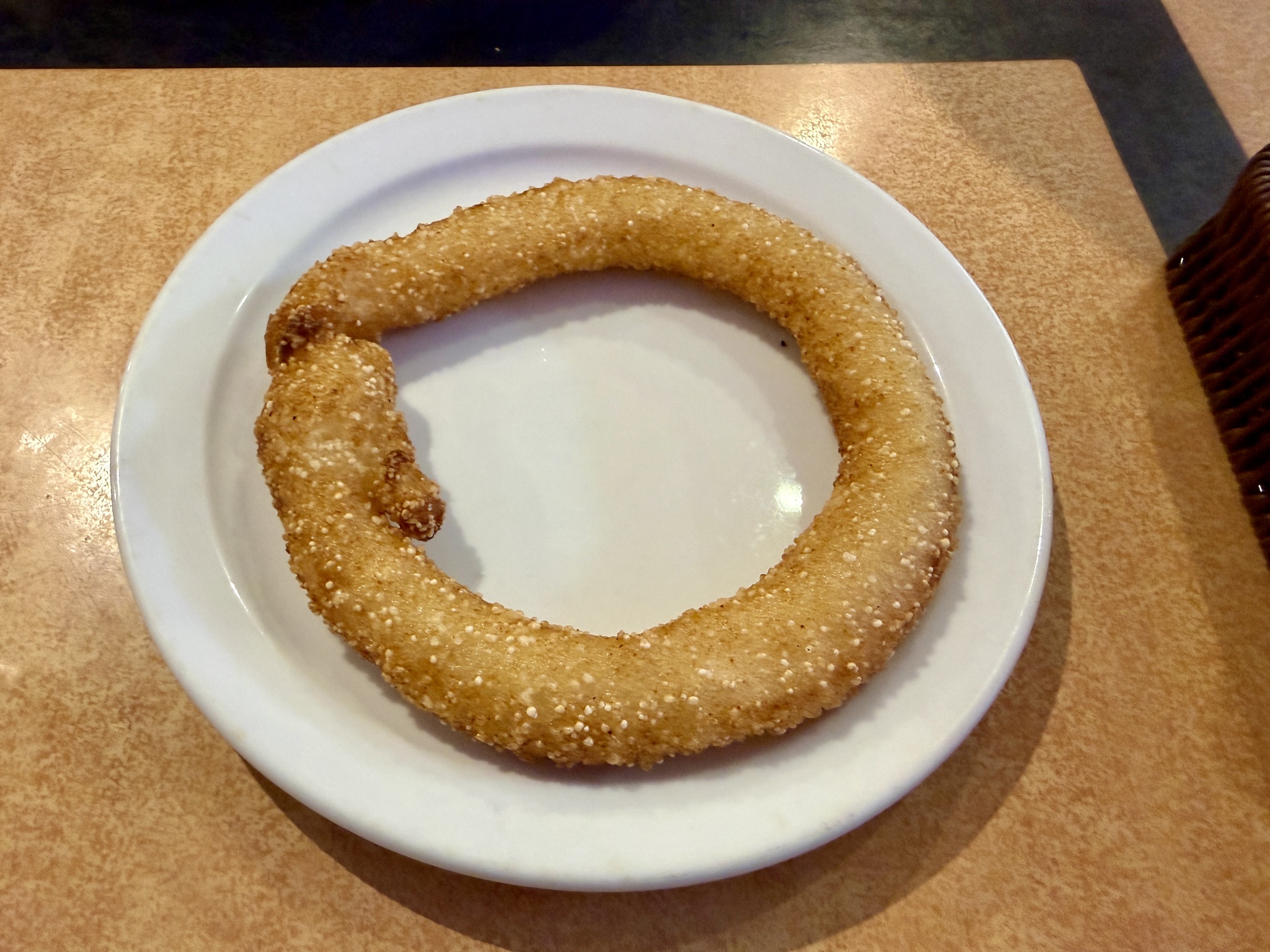
“I’m sorry, this is my fault” I said to Graeme. “This is like having dessert before the main course.”
“It is a bit strange, but I think it needs stuff to go with it, that you can sort of dip it in.”
Like a portion of potato curry, I thought to myself ruefully. Graeme tested the hypothesis by dipping it in a couple of the other dishes we had ordered. It did not seem to go with either, we were to discover. But this is another subversion of the savoury-sweet partition that Western palates are so prone to: this was not in a dessert section, it was in the vegetarian section, and if it’s intended to be eaten alongside other dishes perhaps my finding that strange was more a failure of my imagination.
That misstep aside, the other dishes were unfortunately easier to dislike on their merits. Chilli chicken has been a favourite of mine at Nepalese restaurants for many years, and the benchmark is the one you can get at Kamal’s Kitchen: it’s rich, punchy and will hurt you, in a good way. This was really a very long way from that, the chicken dry and tough, the peppers and onions without char or caramelisation, the sauce watery and one-note. I have absolutely no idea what a lemon wedge is doing on top of this dish, apart from having as little fun as we did eating the bloody thing.
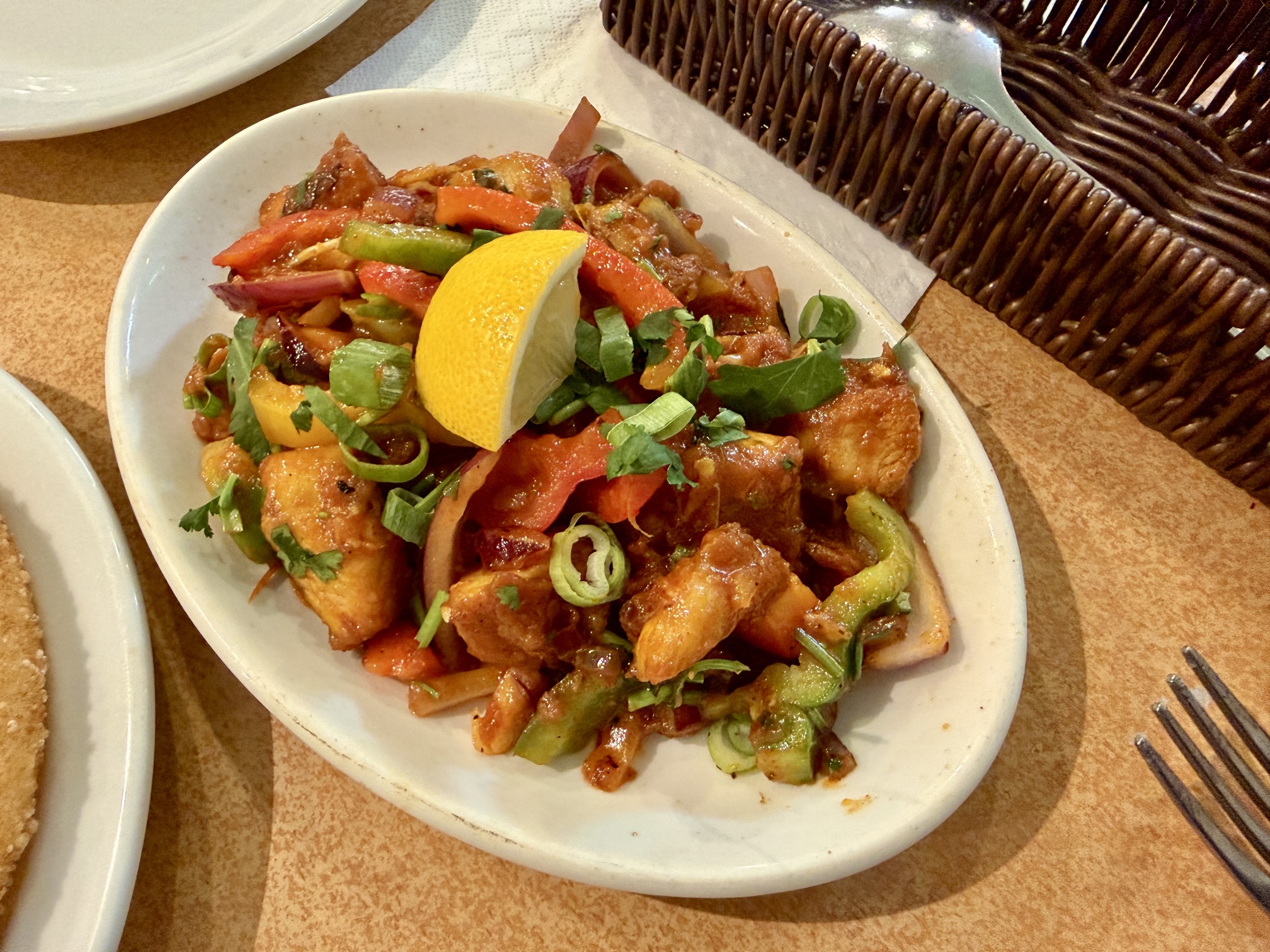
And it’s not just the inevitable comparison with Kamal’s Kitchen’s rendition of chilli chicken. More instructive, though, was comparing it with Sapana Home’s in days gone by: a picture of the same dish, on my phone, ordered back in 2022 was like night and day. In that, the sauce was glossy, thickened, potent, coated everything. That was the kind of dish that would make you fight your dining companion for the last piece of chicken, the last glorious piece of red onion, the last sweet but fiery strip of yellow pepper.
By contrast in 2026, Graeme and I did not finish this dish. Nobody was clamouring to tear off another piece of the sel roti and trawl the depth of the dish for every last molecule of sauce.
Even stranger was a dish I’d never tried before, the sadheko pork. This was meant to be marinated pork belly in a tomato gravy, packed with chilli and spice. What it was instead was big wobbly sections of pork belly: to Sapana’s credit these did feel more like they’d been exposed to a primary heat source than the chicken, with more evidence of textural contrast.
A bit too much textural contrast, actually. It was jarring to find pieces of bone studded throughout the pork belly, and I’m glad that Graeme made that mistake before me, because without him acting as the advance party this was the kind of dish that could cost me £12.50 at the till and considerably more at the dentist.
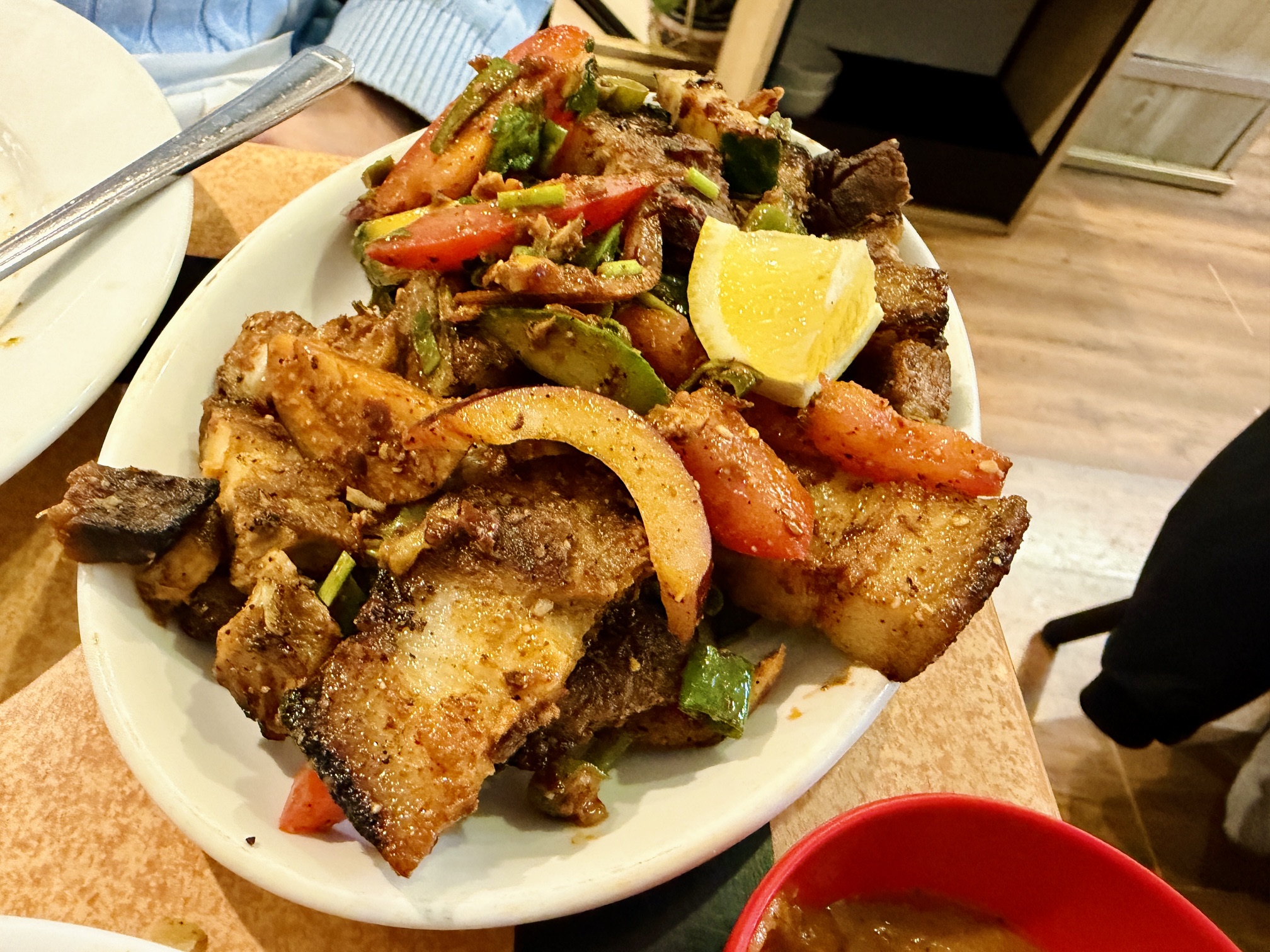
But even without that, the dish was a curious beast. There was no gravy of any kind, making the whole thing more like a dry fry. There was another ornamental lemon wedge, which I found very odd indeed. And I would say that the idea of citrus in this dish didn’t make sense, but if anything it was worse than that because someone had taken a heavy hand to the citrus already. I don’t know what exactly went into the marinade, but that pork tasted so much of lime that it was dangerously close to Toilet Duck territory. Again, we left a fair amount.
The rest of our meal hewed closer to Sapana Home’s traditional strengths, the reassuring carbs that Nepalese food does so well. I really enjoyed the chow mein, tumbled through with really enjoyable nuggets of sukuti (dried buffalo at a guess, although it could have been lamb). Graeme was not sure about the spicy sauce that came with it but to be fair, the first time I tried a Nepalese chow mein neither was I. It was only further down the line that I came to appreciate this spin on a dish that, previously, I had only ever eaten from a Chinese takeaway.
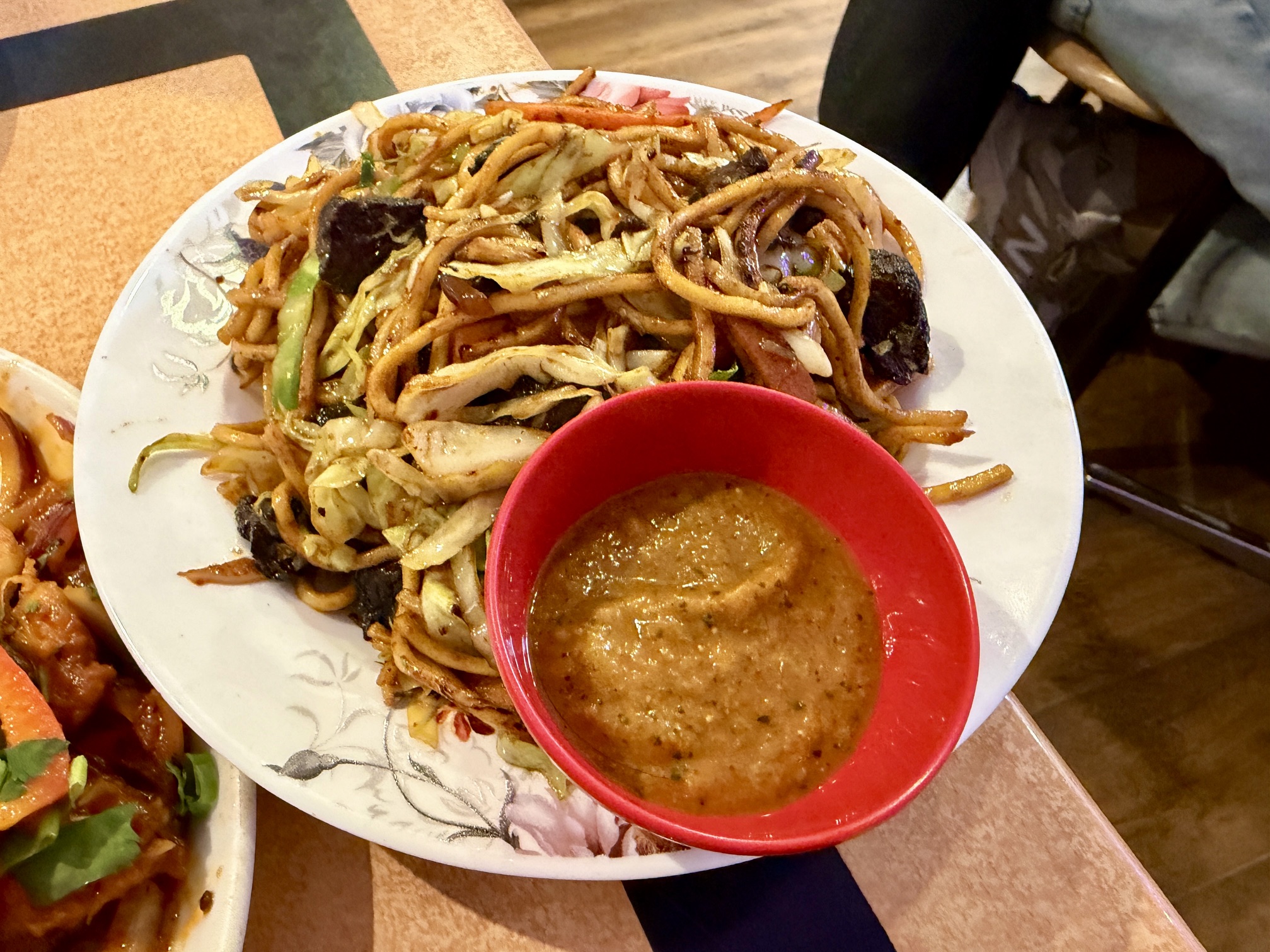
This was the kind of dish you could drop into Sapana Home for after work, to hunker over in the miserable months that are just around the corner. Thinking about it, there have been many times when I did exactly that.
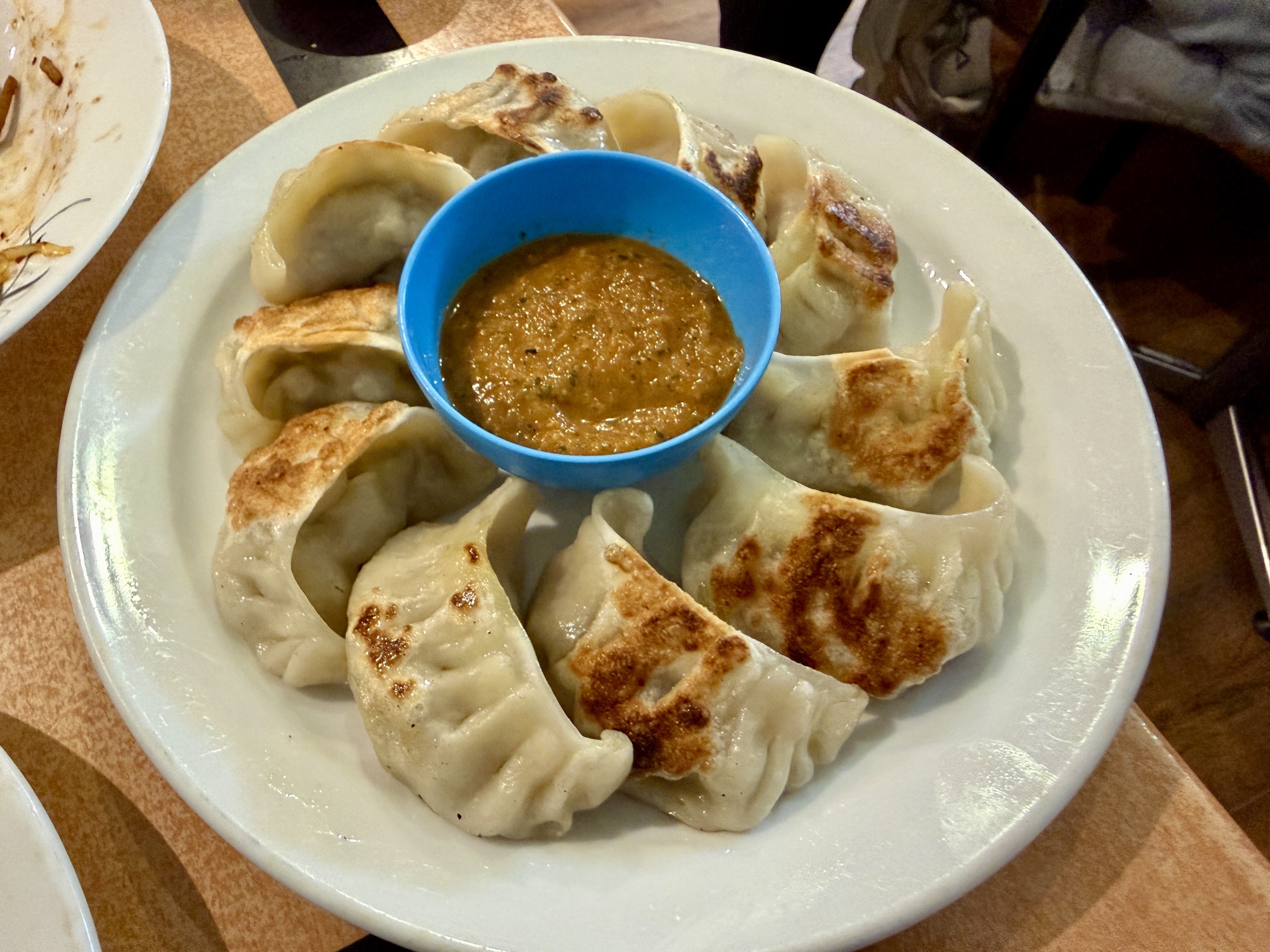
I’ve saved the best ’til last: Sapana Home’s momo are still marvellous. We went for pan fried, as I usually do, stuffed with buffalo and they were easily the highlight of the meal. I really needed them to be good, because at that point my confidence in Sapana Home was wobbling and I didn’t want this to be one of those reviews, where I revisit a place to find that anything I liked about it was gone.
That wasn’t the situation here. The casing was still just the right thickness, with that glowing tan only pan-frying can induce. The filling was still generous, plumping each parcel out, and I think buffalo is worth the extra quid, even if it takes the cost of ten parcels of pleasure over the £9.99 rubicon. Sapana Home’s momo are still up there with the best of Reading’s momo peddlers, and if the chasing pack has caught up with Sapana in the fourteen years since it opened in the centre of town, it is still a tricky proposition to overtake.
All that, plus a couple of extremely tall and very good mango lassis, came to just shy of £60 including service. Sapana Home is still a relatively inexpensive place to eat fairly well, but I was struck that the two carb-based dishes remained the value propositions: I’m not sure anybody should go there to eat the other dishes we tried.
Over post-dinner pints at the Nag’s Head, I wondered whether I would ever go back to Sapana Home if my first impression of it in 2014 had been the same as Graeme’s that night. But then I realised, thinking more clearly, that that had been my impression the first time I ate at Sapana Home: the carbs were good, the momo were terrific and the rest felt like it wasn’t for me. It was only through returning and persevering that I found the other dishes to like on Sapana’s menu, although it felt sad and unfortunate that they let me down on this occasion.
But that’s the point about restaurants – they neither exist nor change in a vacuum. In 2014 Sapana was the only momo joint in town, and Reading’s gastronomic scene was in its infancy: no pizza explosion, no glut of sushi places, no high end chains like Honest and Pho changing the landscape. So in 2014, a spot like Sapana would get more chances to get it right than it might today, when money is tight and nobody goes to a restaurant – unless they’re an idiot like me – with an appetite for risk.
So in 2014 I visited Sapana Home, I wasn’t sure, and then I grew to love it. I went often for a long time and then I put it to the back of my mind for three years. Going back now I can see the nucleus of what I liked – it’s still there – but time moves on and I wonder whether Sapana might get left behind.
What will be interesting is to see if this sparks Graeme to go again, when he’s straight off the train after a long hard day and keen for carbs, and whether it’s the start of him having the kind of relationship with Sapana that I once had. My guess is that none of that will happen, because Reading is such a different place now. But I’ll ask him, next time we’re down the pub.
Sapana Home – 6.6
8 Queen Victoria St, Reading, RG1 1TG
0118 9509898
Since January 2025, Edible Reading is partly supported by subscribers – click here if you want to read more about that, or click below to subscribe. By doing so you enable me to carry on doing what I do, and you also get access to subscriber only content. Whether you’re a subscriber or not, thanks for reading.

